GLOBAL VALUECHAINS AND PRODUCTIONNETWORKS:
STATE-BUSINESSRELATIONS AND COMPLEXITY INECONOMICCRISES
Zhengqi Pan
A dissertation submitted to the faculty of the University of North Carolina at Chapel Hill in partial fulfillment of the requirements for the degree of Doctor of Philosophy in the Department of Political Science.
Chapel Hill 2015
Approved by: Thomas Oatley Timothy McKeown Justin Gross
ABSTRACT
ZHENGQI PAN: Global Value Chains and Production Networks: State-Business Relations and Complexity in Economic Crises
(Under the direction of Thomas Oatley)
ACKNOWLEDGEMENTS
I would first like to thank my dissertation committee for their valuable feedback, support and encouragement. My advisor, Thomas Oatley, provided prompt feedback during the course of this project and has, in many ways, helped to fine-tune my thinking and writing. Timothy McKeown was very supportive and encouraging, and had given me very constructive feedback on my research as well as excellent advice for my academic career. Justin Gross taught me the fundamentals of quantitative research in social science and has encouraged me to think more clearly about the substantive interpretation and implications of my results. Todd BenDor was instrumental in inspiring and fine-tuning my computational models, and was very approachable throughout the project. Gary Gereffi provided me with the most current and best resources on GVCs, and was critical in helping me develop this project in the first place. I am extremely grateful to having a wonderful committee and have learned so much from all of them.
I am also very honored to have received the George Hartman Summer Research Fellowship in 2014 and I wish to express my gratitude to the donor, Professor Harold Glass. Professor Glass has inspired me to excel and contribute back to the community when I have the chance.
TABLE OF CONTENTS
LIST OF TABLES . . . ix
LIST OF FIGURES . . . x
1 INTRODUCTION . . . 1
1.1 Overview of Global Value Chains and Global Production Networks . . . 3
2 STATE-BUSINESS RELATIONS IN ASIAN DEVELOPMENTAL STATES . . . 7
2.1 Introduction. . . 7
2.2 The Primacy of Politics in Asian Developmental States. . . 8
2.3 The Developmental State Model: Redundancy or Reconfiguration? . . . 10
2.3.1 Evolution of Developmental States Following Participation in GVCs . . . 13
2.4 Data and Methods . . . 15
2.4.1 Multiple Imputation . . . 17
2.4.2 Fixed Time Effects (Least Squares Dummy Variable Approach) . . . 18
2.5 Results and Analysis . . . 20
2.6 Conclusion . . . 29
3 DEVELOPMENTAL STATES AND PARTNERSHIPS FOR INNOVATION . . . 31
3.1 Introduction. . . 31
3.2 Developmental States and Innovation Partnerships . . . 32
3.3 Innovation Partnerships and the Triple Helix Model . . . 35
3.3.1 Configurations of the Triple Helix Model . . . 36
3.3.2 The Developmental State and the Triple Helix Model . . . 37
3.4.1 Emerging Asia: Indonesia. . . 41
3.4.2 Philippines . . . 42
3.4.3 Thailand . . . 44
3.4.4 Malaysia . . . 46
3.4.5 Advanced Asian Economies: Taiwan . . . 48
3.4.6 South Korea . . . 50
3.4.7 Singapore . . . 52
3.4.8 Japan . . . 55
3.5 Analysis and Discussion . . . 57
3.6 Conclusion . . . 59
4 THE GREAT TRADE COLLAPSE: SHOCK AMPLIFIERS AND ABSORBERS . . . 61
4.1 Introduction. . . 61
4.2 Economic Shock Amplifiers: Complex Interdependencies and the Bullwhip . . . 62
4.2.1 The Bullwhip Effect: A Complexity Analysis of Economic Shock Propagation 64 4.2.2 Variations in the Length of GVCs . . . 65
4.3 Shock Absorbers: State Capacity and the Developmental State . . . 67
4.3.1 The Developmental State and Crisis Mitigation . . . 68
4.4 Data . . . 70
4.5 Methods . . . 71
4.5.1 Agent-based Model . . . 71
4.5.2 Temporal Exponential Random Graph Model . . . 71
4.5.3 Thresholding and Creating the Dependent Variable . . . 72
4.6 TERGM Results and Analysis . . . 73
4.6.1 TERGM Results Robustness Check . . . 76
4.6.2 TERGM Goodness-of-Fit Tests . . . 77
4.7 Complementing the TERGM: Using ABM in Modeling Shock Propagation . . . 79
LIST OF TABLES
2.1 Fixed Time Effects Regression Results . . . 22
2.2 Fixed Time Effects Regression Results (Continued) . . . 23
2.3 Fixed Time Effects and Ordinary Least Squares (OLS) Regression Results . . . 28
3.1 Summary of Findings from Case Studies . . . 57
4.1 Partial TERGM Results for Intermediate and Final Networks (1996-2013) . . . 74
4.2 Partial TERGM Results for Intermediate and Final Networks (2007-08) . . . 76
A.1 Full TERGM Results for Intermediate and Final Networks (1996-2013) . . . 87
LIST OF FIGURES
1.1 GPN Framework (adopted from Dicken (2004)) . . . 5
2.1 Predicted and Marginal Effects Plots (Transfer and Subsidies) . . . 24
2.2 Predicted and Marginal Effects Plots (Tariff & Non-Tariff Barriers) . . . 25
2.3 Predicted and Marginal Effects Plots (Foreign Ownership Investment & Restrictions) 26 2.4 Predicted and Marginal Effects Plots (Capital Controls) . . . 27
3.1 Triple Helix Topologies . . . 39
4.1 GVC Length Variation in 2008 (adopted from OECD (2012)) . . . 66
4.2 Crisis Simulation for Intermediate and Final Export Networks (2%) . . . 81
A.1 Thresholding for intermediate trade and out-degree distributions (2013) . . . 83
A.2 Thresholding for final trade and out-degree distributions (2013) . . . 84
A.3 Intermediate Trade Network 2013 . . . 85
A.4 Final Trade Network 2013 . . . 86
A.5 Goodness-of-Fit Plots for Intermediate Exports (1996-2013) at 2% threshold . . . 89
A.6 Goodness-of-Fit Plots for Final Exports (1996-2013) at 2% threshold . . . 90
A.7 Goodness-of-Fit Plots for Intermediate Exports (2007-08) at 2% threshold . . . 91
A.8 Goodness-of-Fit Plots for Final Exports (2007-08) at 2% threshold . . . 92
A.9 Intermediate and Final Exports (2%) ROC Plots (for each year from 1996-2013) . . . . 93
A.10 Intermediate and Final Exports (2%) ROC Plots (for the two years of 2007-08) . . . 94
A.11 Netlogo Intermediate Export Network (2%) . . . 95
1 INTRODUCTION
International trade today is primarily characterized by the fragmentation of production processes and the dispersion of these processes around the world. With improvements in information and communications technology (ICT), logistics and services, as well as increased liberalization of cross border transactions since the 1990s and especially in the 2000s, firms are incentivized to relocate production processes to different countries (UNCTAD (2013)). Given that labor and capital costs are unevenly distributed across the world, firms also find it profitable and advantageous to participate in fragmented and dispersed production or supply chains. Previous economic development models that entail deep and vertical industrialization within the country to spur economic growth are increasingly abandoned in both developed and developing countries. In other words, countries today seek to join supply chains1and no longer aspire to develop their own industries from scratch.
With the emergence and proliferation of global supply chains or GVCs/GPNs, economies are not merely connected via trade in final products – they are also increasingly connected through trade in intermediate goods and services required to produce the final product. In fact, statistics from the OECD in 2013 show that over 50% of the world’s manufacturing imports are intermediate goods and more than 70% of the world’s services imports are intermediate services.2 Countries are thus
increasingly exporting goods that contain value-added3imported from abroad. Global supply chains
has thus radically altered the dynamics of international trade, increasing the economic complexity and interdependence among different economies.
The dynamics of GVCs/GPNs are most evident in the Northeast and Southeast Asian economies, which have adopted a strategic state-led developmental model and are highly successful in global supply chain participation and integration (Ferrarini and Hummels (2014)). As Choi and Rhee (2014) note, the world has witnessed the meteoric rise ofFactory Asia, or Asia’s critical role as a 1In general, scholars use the terms global supply chains, global value chains (GVCs), and global production networks
(GPNs) quite interchangeably. But as a guide, this dissertation uses the GVC/GPN framework. An overview of the GVC/GPN approach is discussed in the next section.
2See OECD (2013b).
global manufacturing hub.Factory Asiadepicts a set of production networks that connect “factories in different Asian economies; producing parts and components that are then assembled, with the final product shipped mainly to advanced economies” (ibid, p.5). Indeed,Factory Asiasignify the phenomenon of “supply in the East, consume in the West” (Ferrarini and Hummels (2014)). A study of the Asian economies would no doubt increase our understanding of global supply chains.
This three-essays dissertation focuses on two important aspects of GVC/GPN dynamics: (1) state-business relations in the context of Asian developmental states, and (2) shock propagation via production networks following an economic crisis. The first and second papers discuss how state-business relations evolve as Asian developmental states move up the GVC. Notably, paper 1 focuses on changes in state-business industrial policies, while paper 2 examines the evolution of state-business partnerships. I provide a counterintuitive finding: instead of converging towards the neoliberal market model, Asian developmental states moving up the GVC will embark on more strategic and aggressive industrial policies in order to counter the vagaries of market forces and facilitate the entry of fledging domestic firms into the global economy. Moreover, the developmental state will engage in more intensive partnerships with businesses as it moves up the GVC in order to spur innovation. While both papers 1 and 2 focus on domestic dynamics as a consequence of global economic forces, paper 3 takes on a more macro-level approach and examines complex global network dynamics as a whole during an economic crisis. I investigate how complex interdependencies and the bullwhip effect exacerbate the spread of economic crisis in GVCs. Importantly, I look at how the developmental state can serve as a shock absorber in times of crisis, pointing to the significance of politics in mitigating economic crises.
innovations in current research by taking into account complex interactions and interdependencies within GVCs, as well as complements the large existing qualitative literature on GVCs/GPNs. 1.1 Overview of Global Value Chains and Global Production Networks
Two dominant analytical frameworks exist to conceptualize global supply chains: (1) Global Value Chains (GVCs), and (2) Global Production Networks (GPNs). The value chain concept was first used in Porter (1985) and is highly popular in the management science community. But the most rigorous theorization of GVCs is found in the works of Gary Gereffi, whose GVC framework has a specific intellectual lineage tied to the world-systems theory developed by Immanuel Wallerstein.4
Broadly, Gereffi defined the value chain as “the full range of activities that firms and workers perform to bring a product from its conception to end use and beyond” (Gereffi (2014), p.4). Gereffi (1995) uses four fundamental dimensions to understanding GVCs: (1) an input-output structure, which describes the process of transforming raw materials into final products, (2) a geographical consideration, which maps the spatial shifts in global production and industries, (3) a governance structure, which explains how the value chain is controlled and managed by firms5, and (4) an
institutional context in which the industry value chain is embedded, which describes how local, national and international conditions and policies shape each stage of the value chain. In addition, subsequent work by Gereffi and his colleagues explored the concept of upgrading, which is the “dynamic movement within the value chain by examining how producers shift between different
stages of the chain” (Gereffi and Fernandez-Stark (2011), p.4).
Gereffi’s work focuses on the linear nature of cross border supply chains, noting the value creation and capture across each progressive stage of the supply chain. Importantly, Gereffi notes the differential power of firms and their value extraction at various points in the chain (see Gereffi, Humphrey and Sturgeon (2005)): governance is largely exercised by lead firms in global industries, constituting power asymmetries between powerful (western) firms and firms in developing countries. Nonetheless, firms in developing countries still have opportunities for industrial upgrading through different methods of organization and by moving up the value chain. As such, Gereffi’s GVC concept
4See for instance Gereffi (1994b,a, 1995, 1999b,a, 2003, 2005, 2014) among others.
5Gereffi, Humphrey and Sturgeon (2005) further conceptualized GVC governance into five typologies: (1) market, (2)
extends beyond Wallerstein’s static core and periphery world-systems theory to a more dynamic framework.
Building on the GVC concept, Dickens and his colleagues extended the theorization of global supply chains to include more actors and placed more emphasis on geospatial network relations (see Dicken and Malmberg (2001); Dicken, Kelly, Olds and Yeung (2001) and Henderson, Dicken, Hess, Coe and Yeung (2002)). Their notion of the Global Production Networks or GPNs thus includes actors beyond the firm such as states, regional and intergovernmental organizations (IGOs), as well as nongovernmental organizations (NGOs) and individuals, and allows scholars to explore more closely the various institutional contexts in which the value chain is embedded in.6 Moreover, as its
name suggests, the GPN framework hinges on the concept of the network, which reflects the complex and dynamic interconnectedness andpower relationsbetween the diverse set of actors in the global economy. Importantly, actors in GPNs are embedded in a complex nexus of relations, within global and local contexts.
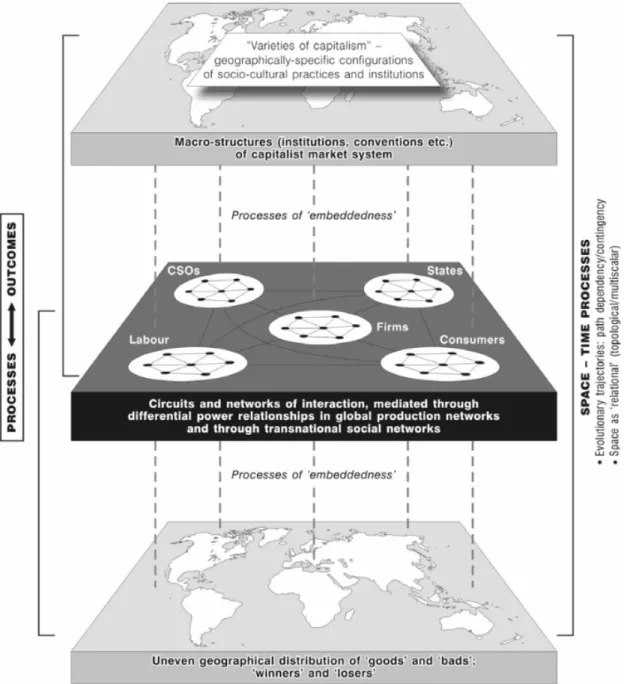
Figure 1.1 below shows a heuristic framework to analyze the global economy. Apart from the diverse network of actors, Figure 1.1 also shows a “complex intermingling ofdifferent geographical scales(global, regional, national and local) in network formation and network processes” (Dicken et al. (2001), p.95). Indeed, “it becomes meaningless to talk of local versus global processes as in much of the global-local literature. Instead, we should think in terms of network agents (such as individuals, firms or states) acting across various distances and through diverse intermediaries” (ibid). It might thus be useful to think of actors in the global economy as interacting in complex patterns in a multiscalar and multidimensional latent space.7 While the processes and interactions transcend
boundaries, actors themselves are nonetheless shaped by the geographical territory or institutions that they are in. Moreover, “actors involved in most commodity chains are typically dissimilar because they are the products of different institutional environments...even firms operating in highly internationalized sectors still tend to retain distinct organizational forms and practices that largely 6Depending on the discipline, both GVC and GPN approaches are used quite interchangeably by scholars. I provide an
overview of the GVC and GPN approaches for greater intellectual clarity and to introduce the main works of prominent scholars.
7This idea is reinforced by Dicken et al. (2001): “we believe that the global economy is constituted by ‘spaces of
Figure 1.1: GPN Framework (adopted from Dicken (2004))
reflect the regulatory environment of their home country”.8 As such, even though actors may be
transnational, they still carry an ‘institutional baggage’ with them, reflecting a certain path-dependent developmental trajectory.
2 STATE-BUSINESS RELATIONS IN ASIAN DEVELOPMENTAL STATES
2.1 Introduction
While scholars have recognized the importance of domestic political and economic institutions in global value chains (GVCs), research on supply chains remains largely firm-centric. The role of the state and its institutional environment are often overlooked. As such, while the economics of supply chains receive widespread discussion from management science to urban planning to business communities, thepoliticsof supply chains are very rarely discussed by scholars.1
Bridging the gap between the discussion on GVCs and the state, this paper uses the develop-mental state theory to examine Asian state-business relations within global supply chains. The developmental state model is a form of hybrid capitalism model that combines both neoliberal eco-nomic characteristics with state-led intervention and industrial policy.2Following Schmidt (2009),
this paper attempts to put “the ‘political’ back into political economy by bringing the state back in yet again” (p.516).
Importantly, the increasing complexity of globalization has led some scholars question the relevance of the developmental state.3In particular, with the emergence of global supply chains and
lead firms that guide global production, has the developmental state model become redundant? Is the world witnessing a convergence towards the neoliberal or free market model? Are local firms in developmental states detaching themselves from the state and gaining more autonomy?
I argue that claims about the demise of the developmental state are unfounded. As Weiss (1999) notes, the neoliberal claims about the redundancy of the developmental state due to globalization ignore the adaptability of these states. Rather than a convergence to the neoliberal model, the developmental state has adapted and evolved according to changing global circumstances, while still maintaining its grip on the economy. This paper discusses the role of Asian developmental states in 1See Smith (2014), MacDonald (2014), Bair (2005, 2009), Smith, Rainnie, Dunford, Hardy, Hudson and Sadler (2002),
and Leslie and Reimer (1999).
2See Johnson (1982) and Woo-Cumings (1999). I will provide a more thorough review of the developmental state
model in the subsequent section.
global production networks and explores the specific state-business relations in these countries. I posit that in the face of greater uncertainty and foreign competition following participation in GVCs, Asian developmental states continue to maintain tight control of trade and investment policies. As such, far from being autonomous, local firms are still very much tied to the state.
2.2 The Primacy of Politics in Asian Developmental States
First theorized by Chalmers Johnson in his seminal work on Japan’s industrial policy, the devel-opmental state model or develdevel-opmental capitalism is a Weberian ideal type of state-led interventionist economic model that has both neoliberal and socialist elements.4 Compared to the neoliberal and
social-market models, developmental capitalism is much more state-centric and involves the active role of the state in industrial policy and economic strategy. As such, rather than viewing the state as a problem, as portrayed in the neoliberal paradigm, the developmental state model emphasizes the significant role of the state in spearheading economic growth and poverty reduction in society. As Evans (2013) notes, the model provides a counter framework to the dominant neoliberal narrative that emphasizes the market as the most important institution that drives economic growth and wel-fare. Notable examples of developmental states include Japan, South Korea, Singapore and Taiwan, which are often considered as archetypes of the developmental state, as well as Malaysia, Indonesia, Thailand, Philippines, Vietnam and (most recently) China.5 Recent literature has also explored the
developmental state beyond the Asian context, looking at African economies such as Botswana.6
The dominant force driving development in these states is politics. Indeed, developmental states are interested in shoring up economic growth and reducing povertybecausepolitical stability rests on these achievements. Moreover, the political stability of developmental states rests on significant improvements (or perceived improvements) in the standards of living across a broad segment of society so as to avoid social unrest and for the ruling elites to stay in power. As Doner, Ritchie and Slater (2005) note, many developmental states came to being because they faced the threat of 4See Johnson (1982). Also see Wade (1990), Amsden (1989), and Woo-Cumings (1999) for an extensive discussion on
the developmental state.
5See Johnson (1982), Amsden (1989), Wade (1990), Woo-Cumings (1999), Chang (2006), Doner, Ritchie and Slater
(2005), Hayashi (2010), Howell (2006), and Jian-xing and De-jin (2010).
6Botswana is often held up as an example of a developmental state in Africa. Some scholars and policymakers have
internal unrest, and thus, one of the key aims of the developmental state was to develop a workable strategy that involves economic growth in order to quell domestic unrest. In addition, the authors posit a set of factors for the developmental state to emerge, namely, (1) a credible internal threat, (2) geopolitical insecurities, and (3) scarcity of natural resources. Indeed, the developmental state focuses on broad-based economic development and growth due to political and economic exigencies. A pragmatic view of political stability is the prime motivation of economic development in the developmental state.
Given the primacy of politics in the developmental state literature, Vu (2007) notes two key aspects of developmental states that go hand in hand: (1) state capacity, and (2) political will7. Indeed,
a state that possesses strong institutional capacity may still not be classified as ‘developmental’ if it lacks the leadership or political will to carry out developmental goals, which refer to the attainment of high economic growth rates, widespread increases in standard of living and broad-based legitimacy (Routley (2012), p.7). Conversely, a state that possesses the political will to carry out developmental reforms but lacks the capacity to do so will also not become a developmental state. To further operationalize the concept of the developmental state, I draw from Routley (2012) and a variety of the readings in the developmental state literature. The attributes of the developmental state can be summarized as having: (1) a political leadership that is oriented towards the economic development of the country8, (2) a meritocratic and autonomous9bureaucracy that is connected to
or embedded in business communities10, and (3) active policy interventions to help promote and
sustain economic growth11. Consequently, developmental states are commonly characterized by the
7Political will in this case is narrowly defined as the determination of political leaders to carry out developmental
goals. Some countries lack the political will to carry out developmental policies and prey on society through rent-seeking operations. Notable examples include Zaire under Mobutu and Cameroon under Biya. For a more thorough discussion, see Evans (1995).
8See for instance Fritz and Menocal (2007), Vu (2007), and Musamba (2010).
9Generally free from political influence in the country. Even in authoritarian regimes, the bureaucracy is able to exercise
considerable autonomy in economic policies. In Johnson’s words, “politicians reign and the state bureaucrats rule” in developmental states (Johnson (1981)).
10Evans (1995).
11See Johnson (1982), Wade (1990), Amsden (1989), and Woo-Cumings (1999). Notably even with active industrial
deliberate, close, and often mutually beneficial symbiotic relationship between state agencies and business communities.
2.3 The Developmental State Model: Redundancy or Reconfiguration?
For much of the past three decades, economic globalization has progressed hand-in-hand with the dominant theory of neoliberalism, which advocates unfettered markets and the minimal role of the state (Hayek (1973), and Rothbard (2004)).12 To proponents of neoliberal economics, free
markets and free trade will unleash the creative and entrepreneurial spirit of individuals, leading to individual liberty and well-being, as well as the efficient allocation of scarce resources. The state, on the other hand, does not possess sufficient information to “second-guess market signals (prices)” and is prone to be captured by particularistic interests that will “inevitably distort and bias state interventions” (Harvey (2005), p.2). Neoliberal economists thus view states with skepticism and they view state intervention in the economy via active industrial policy with disdain. Consequently, the developmental state model is often seen as incompatible with the competitive pressures of economic globalization (Baker, Epstein and Pollin (1998), Kozul-Wright and Rowthorn (1998)). As Weiss (2003) notes, states seem to be increasingly threatened by capital mobility from below and intergovernmental organizations such as the World Trade Organization (WTO) from above, and their “traditional hold over economic actors has diminished, their control of the domestic economy has eroded, and their room for maneuver in the policy arena has been reduced to the margins” (p.245). In addition, some critics argue that the Asian financial crisis in 1997 was “the result of the malfunctioning of the Asian developmental states in the age of globalization” (Frankel (2000) and Yellen (1998)).13
With increasing fragmentation of world trade and global production, the dominance of the developmental state over the economy seems to be even more bleak. Yeung (2014) asserts that as local firms in developmental states become more embedded in global production networks, these firms will be increasingly tied to global lead firms and gradually detach themselves from the state.
12For more discussion see Harvey (2005), and Friedman (1980). In particular, Harvey (2005) attempts to provide a
comprehensive definition of neoliberalism by defining it as, “a theory of political economic practices that proposes that human well-being can best be advanced by liberating individual entrepreneurial freedoms with skills within an institutional framework characterized by strong private property rights, free markets and free trade. The role of the state is to create and preserve an institutional framework appropriate to such practices...Furthermore, if markets do not exist (in areas such as land, water, education, health care, social security- or environmental pollution) then they must be created, by state action if necessary. But beyond these tasks the state should not venture” (p.2).
Yeung develops the concept of ‘strategic coupling’ to advance a firm-centric model of economic transformation and industrialization in East Asian economies. For Yeung, the notion of ‘strategic coupling’ involves the “dynamic processes through which national firms decouple partially or completely from their domestic political-economic structures – developmental states or otherwise – over timeandre-couple with lead firms in global production networks” (p.3). Importantly, he posits that the developmental state’s ability to manage industrial transformation through direct industrial policy will become increasingly “difficult and problematic” due to deepening linkages between local firms and global lead firms that drive global production networks (Yeung (2014), p.4). For Yeung, inter-firm dynamics play an increasingly critical role in driving GPNs.
Quite similarly, Wong (2011a) notes that state-led development in advanced Asian economies such as South Korea, Taiwan and Singapore is no longer tenable in the phase of science-based high-tech industrialization. He posits that these hi-tech industries pose great uncertainty in terms of (1) technological research, which does not always yield the expected results, (2) economic returns, which may not be profitable after all due to uncertainty in the economic valuation of new science applications, and (3) the length of time taken to achieve performance and results (Wong (2011a)). Indeed, as advanced developmental states move into the hi-tech value chain, they will face multiple challenges in managing their industries and achieving phenomenal growth rates. Wong’s central argument is that developmental states that are engaged in innovation processes can no longer micro-manage and intervene directly in the economy due to the lack of information and high degree of uncertainty, and must thus (inevitably) cede control to firms and let market mechanisms play out efficiently. Indeed, systemic factors such as the nature of the hi-tech global value chain and transnational inter-firm dynamics may force the state to take a secondary role in the industrialization process.
not less, important” (p.267). For instance, the South Korean government created new initiatives to finance high-tech start-ups and created a new state-backed software retail market to support the Korean software industry in the late 1990s and early 2000s. According to Weiss, local producers in the software industry also welcomed close collaboration with the Korean government as piracy was rife and firms needed the state to regulate the consumer market. Local firms also benefitted from close private-public partnerships when the state organized a consortium of thirty-seven companies, the Software Infra Network of Korea (SOFRANO), to enable firms establish close contacts with other firms and engage in synergistic development (Weiss (2003), p.258). Moreover, when local firms face fierce competition from abroad, they may “end up inviting, rather than rejecting, state involvement in a shared transformative project” (ibid). Indeed, the developmental intent behind Taiwan’s Financial Merger and Acquisition law was to “promote national firms capable of withstanding competition from foreign firms in banking, insurance, and securities” (Weiss (2003), p.266). For Weiss, the state is in a process ofadaptiverather than transformative institutional change. Local firms are not given free reign in their business networks, but rather, are being encouraged and facilitated by the developmental state.
Dent (2007) argues that developmental states have not become extinct, but rather have evolved within the complexity of the global economy. He notes that “while the policy tools and means may have changed, developmental states still preside over various adaptive-cum-transformative economic projects that increasingly involve a partnering with transnationalized capital” (p. 227). Importantly, he asserts that developmental states are highly adaptive because of their inherent characteristics, such as having strong technocratic capabilities for strategic planning and market intelligence, as well as having close and established networks with domestic and foreign businesses (ibid). His case analysis of Singapore, South Korea and Taiwan shows that the workings of developmental states are still very much evident in these countries. The author notes that even in the case of South Korea, where attempts have been made to decouple the state-chaebol14 nexus, the path dependent interlocking
nature of both the state and thechaebolsmade decoupling very difficult. Dent (2007) remarked that the developmental state’s “embeddedness within the domestic political economy is not so easily eradicated” (p.239).
In another more recent paper, Lee, Heo and Kim (2014) note that the South Korean government was instrumental in the creation of newly-emerging high-tech clusters, giving birth to Korea’s successful liquid crystal display (LCD) industry. Moreover, the state was a critical player in the coupling process between local firms and global lead firms, acting as the role of coordinator and mediator of conflicts. Consequently, strategic coupling cannot occur without the auspices of the state, and the developmental state with its institutional capacity and political will is aptly positioned to facilitate such a process.
Perhaps the more interesting question is not whether Asian developmental states still exist (or if they are still important), but rather,howandwhythey have changed with time. Importantly, Asian economies have neither converged to the neoliberal model nor have they remained the same as before (Yeung (2007), and Kyung-Sup, Fine and Weiss (2012)). Even scholars who emphasize a firm-centric argument still recognize some core characteristics of the developmental state in Asia (Yeung (2014), and Wong (2011a)). For instance, Yeung (2014) wrote that his argument for the evolution of East Asian state-firm relationships “does not imply a zero-sum relationship in which state power declines
becauseof the rise of national-firms”, but rather, the state is no longer the dominant player in complex production networks (p.5).
2.3.1 Evolution of Developmental States Following Participation in GVCs
While studies have tried to explain the adaptability of developmental states and how these states influence businesses, the evolution process itself has not been adequately accounted for.15 Most
of these processes seem to be influenced by the abstract and complex forces of ‘globalization’. I argue that in order to better understand the evolution of state-business relations, we need to examine changes in the country’spositionalong the global value chain.16 I assess state-business relations by
looking at: (1) the degree of intrusiveness of the state on businesses through economic policy, such as price controls and investment restrictions17, and (2) the number of state-business partnerships.
A country’s position in the global value chain determines its state-business relations. Wong (2011a) argues that as developmental states climb higher up the value chain and venture into 15See for instance Weiss (1999, 2003, 2012), Weiss and Hobson (2000) and Dent (2005, 2007). Also see the collection
of articles in Fine, Saraswati and Travasci (2013), and Kyung-Sup, Fine and Weiss (2012).
16Notably, some countries may switch value chains (e.g. from medium to high tech chains) but the analysis is similar to
that of moving up the value chain.
innovation processes, they are less likely to micro-manage the economy and restrict businesses due to great difficulties in doing so arising from technical and information uncertainty. However, this argument underestimates the political will of developmental states to conduct active industrial policies and overlooks the possibility that developmental states may still be eager to manage the economy even in the face of great uncertainty and difficulties. Indeed, increasing challenges do not necessarily deter developmental states from active industrial policies. After all, the primary objective of the developmental state is to maintain political and social order through economic growth and prosperity. Taking a hands-off approach after decades of developmentalism may create unnecessary shocks in the economy, thereby hurting domestic producers. This may in turn upset the political stability within the country and undermine the state’s power. Moreover, even though the prospect of gradual reforms may be tempting, developmental states may not be willing to liberalize much given that economic growth is so critical to regime stability. Since participation in GVCs entail exposing the country to greater market forces and uncertainty, the state may choose to further tighten the management of its economy, rather than subject the economy to the vagaries of the market. As such, rather than neoliberal reforms, the developmental state may adopt more aggressive industrial policies as it moves up the value chain in order to overcome new challenges and maintain economic and political stability.
In addition, as states move into research and innovative processes, high barriers to entry make it difficult for fledging domestic firms to enter the global market. Consequently, the developmental state needs to step in to support and protect local firms. Local firms can then better survive through incentives and help from the state. Thus, state support is critical to ensure that local firms have a chance to enter the market in the first place. Notably, state support for local firms occur at every stage of the value chain, but this support may be more critical and substantial as the state moves higher up the chain due to increasingly high barriers to entry.
chain may impose more restrictive investment policies that reflect the states’ priority of cultivating champion industries. I thus develop the following hypothesis:
Hypothesis 1:The higher the developmental state is on the GVC, the more intrusive its economic policies will be.
Besides economic restrictions, developmental states also rely on positive inducements such collaborative partnerships with MNCs to drive and sustain growth. Following participation in GVCs, developmental states need to leverage the technical expertise and reputation of global lead firms to advance their domestic industries. As such, developmental states often form partnerships with global MNCs for technical diffusion to occur.18 Industrial parks catered to particular sectors may be set
up to induce MNCs to invest in the country. The industrial parks provide opportunities for local firms and global MNCs to interact and exchange information, linking local firms with prestigious multinational brands. Indeed, local-global business partnerships allow for synergistic development and enable local firms to leapfrog into the global market. Notably, as developmental states move higher up the GVC, they will require more partnerships with MNCs due to the need for greater technical and knowledge diffusion.
Hypothesis 2:The higher the developmental state is on the GVC, the more partnerships it will forge with global MNCs.
From the discussion above, local firms are still very much tied to the state. While local firms may have increased their linkages with global MNCs, they are still highly bounded by local state policies. Moreover, as Lee, Heo and Kim (2014) note, strategic coupling between local and global firms cannot occur without the auspices of the state. Importantly, the state is also a critical player in conflict resolution and mediation between local and global firms. Thus, one can view Asia’s state-business relation as ‘tripartite’ in nature, as an ‘iron triangle’ constituting local firms, MNCs, and developmental states in production networks.
2.4 Data and Methods
My dependent variables are (1) intrusiveness of state-business policy, and (2) number of collabo-rative state-business partnerships. The data cover the years 2000 to 2011 and include 94 countries worldwide for each year. Countries beyond Asia are included in the full dataset to ensure greater
generalizability and validity of results. Data used to measure the intrusiveness of state-business policy are drawn from the 2012 Economic Freedom of the World (EFW) Data by the Fraser Institute. This dataset represents a credible source of economic freedom data, and is used widely in peer-reviewed academic journals such asAcademy of Management Journal,World Development,Kyklos, andPublic Choice, to name a few.19 By having several disaggregated indicators, the EFW dataset provides a
nuanced way of measuring economic freedom. In particular, I will pay attention to the following indicators, which are directly relevant to this paper: (1) transfers and subsidies, (2) tariffs and non-tariff barriers, (3) foreign ownership investment and restrictions, (4) capital controls, (5) licensing restrictions, and (6) government enterprise and investment. The data is based on a 10-point scale (interval variables) and I have transformed the data by multiplying it by -1, such that the higher the score of a particular component, say transfers and subsidies, the worse a country has fared in terms of economic freedom.20Six separate regressions are thus run to assess the importance of developmental
states in affecting each of these indicators. Lastly, data for state-business partnerships are obtained from the United Nations Educational, Scientific, and Cultural Organization’s (UNESCO) Institute for Statistics, which shows the percentage of manufacturing firms that cooperated with the government and public research institutes.
My main independent variable is the interaction termDevelopmental State x Position on the GVC, which comprise the variablesDevelopmental StateandPosition on the GVC.Developmental State is a binary variable with ‘0’ representing countries that are not developmental states, ‘1’ representing the developmental states of Northeast and Southeast Asia, such as Japan, South Korea, Singapore, Taiwan, Malaysia, Indonesia, Thailand, Vietnam and the Philippines. Position on the GVCis calculated using a country’s domestic value-added exports divided by its gross exports. Thus, a country with high domestic value-add as a percentage of gross exports is said to be positioned high up on the chain or is primarily engaged in a high-tech value chain for exports. Data to measure 19For a full list of peer-reviewed journals published using the EFW dataset since 1994, see http://www.
freetheworld.com/papers.html(Last assessed: 22 April 2015).
20Originally, the reverse is true: a score of 10 represents the maximum freedom rating for a component, while a 1
domestic value-add as a percentage of gross exports are obtained from United Nations Conference
on Trade and Development (UNCTAD) GVC-EORA database.21
My control variables include (1)Bribes, Payments, and Favoritism, which represents corruption, (2) Polity, which is the democracy score of a country, (3)FDI as a percentage of GDP, which measures the stakes and extent of foreign MNC involvement in the country, (4)Centralized Collective Bargaining, which measures the power of labor unions in the country, (5)Percentage of R&D Financed by the Government, which represents the gross domestic expenditure on research and development financed by the government, and (6)Tertiary Education Expenditure by the Government, which is the tertiary education expenditure as a percentage of total government education expenditure.22 Data
forPolityare obtained from the Polity IV project, and data forFDI as a percentage of GDPare obtained from UNCTAD. Data forPercentage of R&D Financed by the Government, andTertiary Education Expenditure by the Governmentare both obtained from UNESCO’s Institute of Statistics. The rest of the data are obtained from the EFW dataset. In addition, the variablesFDI as a percentage of GDP, Percentage of R&D Financed by the Government, andTertiary Education Expenditure by the Government, have continuous values greater than 0 but less than 100, while Polityis an ordinal variable ranging from -10 to 10.Bribes, Payments, and FavoritismandCentralized Collective Bargainingare interval variables on a 10-point scale.
2.4.1 Multiple Imputation
Like the vast majority of statistical analyses, the dataset for this paper contains missing values. Most statistical software only considers complete cases in their statistical analysis, and casually deletes the missing rows from the data in a process known as casewise deletion. Casewise deletion omits cases that might yield important results and are likely to bias our statistical analysis. Another method that is increasingly popular and more accurate is known as multiple imputation, which is a procedure to fill in a set of plausible values that reflect the uncertainty about the correct value for each of the missing case. The set of imputed datasets are subsequently analyzed using standard statistical techniques and the results are combined using strategies described in Rubin (1987). Multiple imputation is desirable because it helps to reduce bias and obtain fairly accurate estimates of the 21I would like to specially thank Mr Masataka Fujita, Head of Investment Trend and Issues Branch, UNCTAD for kindly
sharing the UNCTAD dataset with me.
standard errors and t-scores. Moreover, multiple imputation is robust to departures from normality assumptions and provides adequate results in the presence of low sample size or high rates of missing data. For my dataset on the intrusiveness of business policy, I have approximately 21.54% missingness, which is considered a moderate level of missingness. On the other hand, my dataset on state-business partnerships has very high degree of missingness, with the year 2010 containing the least missingness (at 65.96% missingness) and some years containing complete missingness for the variable on state-business partnerships. Rather than deleting all the missing cases, I impute the datasets and conduct my regression analysis for the pooled datasets and also specifically for the year 2010 as a further robustness check.23
The main assumption is that the missing data are Missing at Random (MAR), which is the case when missingness of one variable can be related to other variables. This is in contrast with data that are Missing Completely at Random (MCAR) or Non-Ignorable (NI). As noted by Gelman and Hill (2007), MCAR is very rare in social phenomena because it assumes that no underlying association process exists to cause the absence of the data. NI occurs when missingness is related to unknown and unobserved parameters, and is not likely in my data as all the missing values contain at least one neighborhood observation. In addition, given that the missing data are mainly related to sensitive issues such as government economic policies and state-business partnership information, companies and the government may be reluctant to provide such information in surveys. In the case of state-business partnerships, businesses may be more comfortable with providing just their research and development expenditure data rather precise data on state-business cooperation. The inclusion of more predictors in the model can thus mitigate the censoring mechanisms and bring the data closer to what is described as MAR (Gelman and Hill (2007)). As such, the assumption of MAR fits my dataset the best.
2.4.2 Fixed Time Effects (Least Squares Dummy Variable Approach)
Many studies in political science ignore heterogeneity across time by running a straightforward ordinary least squares (OLS) or logistic regression on time-series cross-sectional (TSCS) data, which are data that consist of “repeated observations on a series of fixed units” (Beck (2001)). This crude 23Time-series multiple imputation is conducted using the Amelia II package in R (see Honaker and King (2010)). I have
aggregation will lead to bias estimates and inaccurate analysis. Recognizing time heterogeneity, I will use the Fixed Time Effects model with Least Squares Dummy Variable (LSDV) approach in my paper, which controls for time effects but considers unit heterogeneity in the model. This model is well-suited for my research, given that my main aim is to explore the effects of various developmental states on government economic policies and collaboration. Mathematically, the fixed time effects with LSDV has the same mechanism as the general OLS, except that it controls variation across time by incorporating time dummy variables24. The equation below presents the general form
of the fixed time effects with LSDV:
Yi =✓+
2011X
t=2001
↵t⌧t+ 1Xi+µi, (2.1)
where:
• Yi is the dependent variable
• ✓is the base year intercept of the model, which is year 2000 in this case
• ↵tis a coefficient estimate for each time dummy variable apart from the base year
• ⌧tis a time dummy variable
• Xi is an independent variable
• 1is the coefficient estimate ofXi
• µiis the error term
To ensure greater robustness of the results, I implement panel-corrected standard errors (PCSE) in my models. As noted in the seminar paper by Beck and Katz (1995), TSCS data are often plagued with non-spherical errors due to unit level heteroskedasity and contemporaneous correlation across units. Cross-sectional heteroskedasity will yield inconsistent OLS standard errors, and contemporaneous correlation of errors across units will result in inefficient coefficient estimates and 24An alternative (but almost identical) way is to model it using fixed effects with the within-time approach. However,
biased standard errors. As such, in order to correct these issues and to allow better inference of my models, I use panel-corrected standard errors.
2.5 Results and Analysis
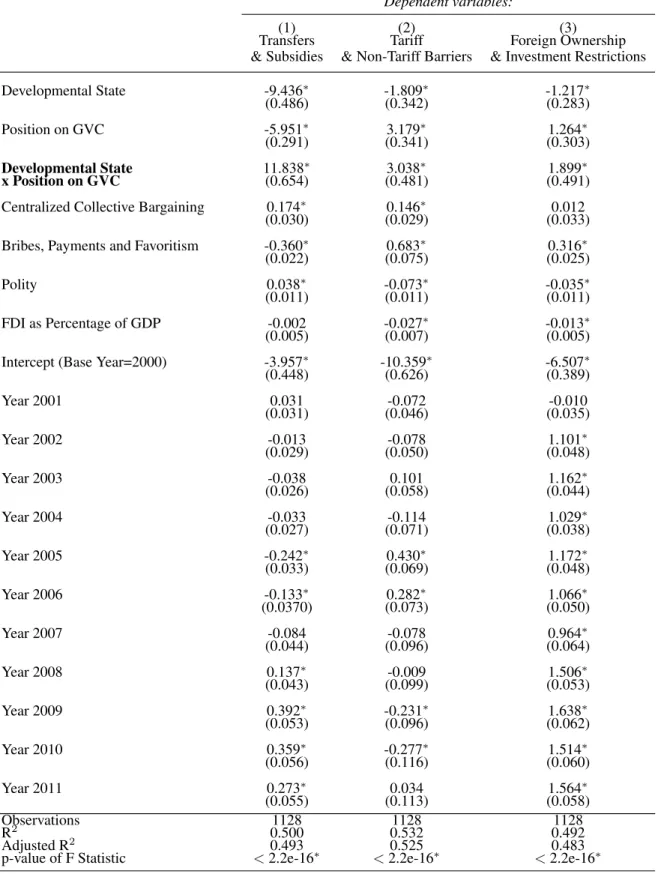
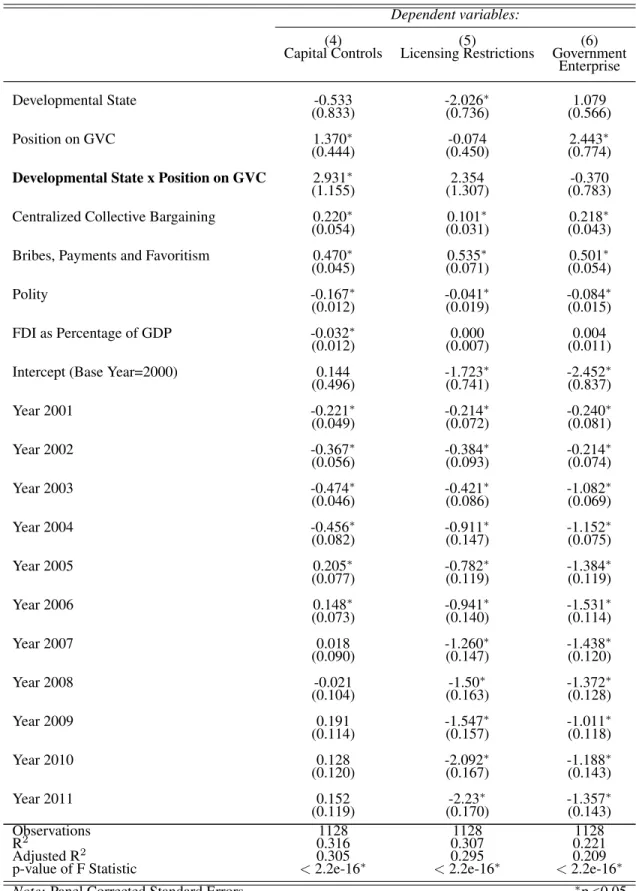
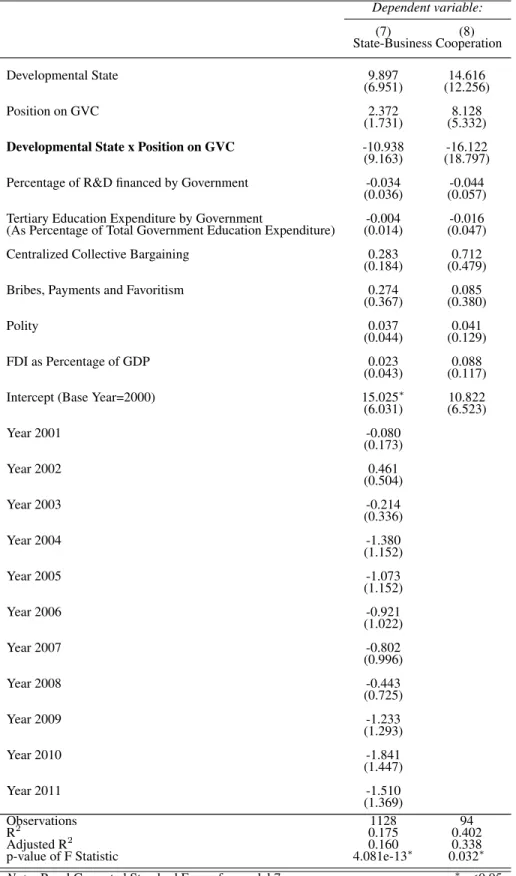
The results in tables 3.1 and 2.2 (see below) point to the statistical significance of the main predictor: Developmental State x GVC Position. Overall, the results support hypothesis 1 of this paper by showing that the higher a developmental state is on the global value chain, the more intrusive its industrial policies. The coefficient estimate of the main predictor is positive and statistically robust at the 0.05 level in four of the six models with the following dependent variables: (1) Transfers and subsidies, (2) Tariff and non-tariff barriers, (3) Foreign ownership and investment restrictions, and (4) Capital controls.25 The other two models with dependent variablesLicensing Restrictionsand Government Enterprise and Investmentdo not show statistical significance of the main predictor. None of the models has a negative and statistically significant interaction term, meaning that no results were found to be in conflict with hypothesis 1. Notably, the interpretation of just the individual terms in the interaction may be incomplete or misleading as one term is conditioned upon the other.
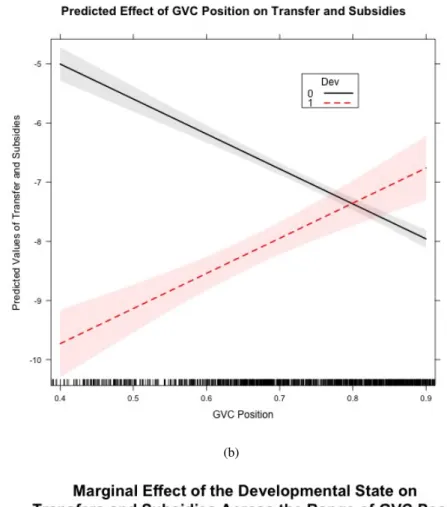
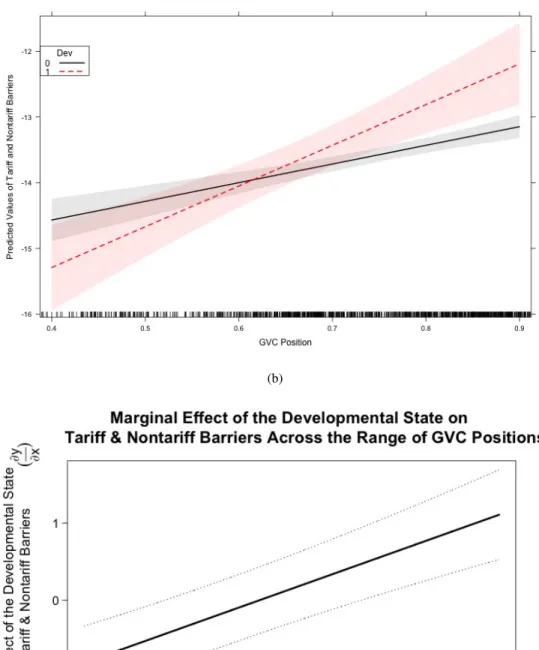
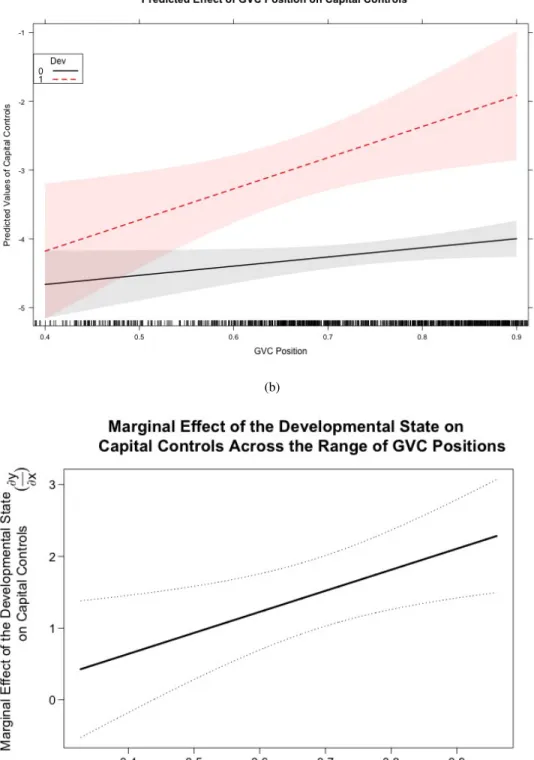
In addition, the predicted and marginal effects plots (with 95% confidence bands) provide a greater robustness check and shows how the interaction term is empirically salient (see figures 3.1-2.4). From the plots, we see that the predicted effects of GVC position on various industrial policies26 for developmental states are all positive and much more impactful compared to
non-developmental states, as characterized by larger slopes of the non-developmental state. In fact, for figure 3.1, non-developmental states have an inverse relationship between GVC position and predicted values of transfers and subsidies, while developmental states exhibit a positive relationship in lieu with hypothesis 1. The positive relationship also holds true for all the marginal effects plots that show the marginal effect of the developmental state on various industrial policies across the range of possible GVC positions. Consequently, developmental states encourage greater use of industrial policies as these states move higher up the value chain.27
25These variables are also the most commonly cited within the developmental state literature.
26These are the dependent variables as mentioned above. The plots show in greater detail the relationship between the
significant interaction terms and their respective dependent variables. To be clear, the dotted line represents developmental states, while the solid line represents non-developmental states.
27A straightforward substantive interpretation of the coefficient estimates is not possible given the various mathematical
For the control variables, corruption (Bribes, Payments and Favoritism) is statistically significant and positive for all but one of the models in tables 1 and 2.28, which means that the higher the
level of corruption, the more intrusive the business policies (except transfers and subsidies) of a country. A possible explanation for the anomaly in the transfers and subsidies model is that official government transfers and subsidies have manifested in the form of illegal and underhand monetary transfers, bribes and payments, thereby decreasing the need for outright monetary transfers. For the case ofCentralized Collective Bargaining, it is positively correlated with intrusiveness business policies and is statistically significant for five of the six models, indicating that the more powerful the labor unions, the more restrictive the economy will be as governments seek to protect the local workforce from foreign competitors. Centralized Collective Bargainingis not statistically significant for model 3 (“Foreign Ownership Investment and Restrictions”). ForFDI as a Percentage of GDP, the results are only statistically significant and negative for three of the six models29, showing that
as MNC investment in the domestic economy increases, the government will be less willing to implement intrusive business policies as these policies may hinder investors and hurt the economy.
Polityis a proxy for democracy and has a negative and statistically significant coefficient for five of the six models. Interestingly,Polityis positive and statistically significant for the transfer and subsidies model, implying that as a country becomes more democratic, it is likely to increase transfers and subsidies in the economy. Examples can be seen in the US and the European Union, where agricultural subsidies are rife. In addition, given that mature democracies are usually affluent societies, transfers and subsidies may also be used in high-tech industries such as Boeing and Dow Chemical in the US to moderate costs and encourage innovation under high degrees of technological uncertainty. For other intrusive business policiesPolityhas a dampening effect, meaning that democracies are more likely to demolish trade barriers and engage in free trade in general. ForPosition on GVC, it is a statistical control used to create the interaction term in question.30
conditioned by bothPosition on GVCandDevelopmental State, interaction term plots present more nuanced relationships on predicted values and marginal effects, and are thus more effective than the direct interpretation of the coefficient estimates.
28Results for hypothesis 2 will be discussed later in this section.
29These are models 2 (“Tariff and Non-Tariff Barriers”), 3 (“Foreign Ownership Investment and Restrictions”) and 4
(“Capital Controls”). The rest of the models are not statistically significant.
30Note that the intercept, which represents the base year dummy variable (year 2000), as well as the other year dummy
Table 2.1: Fixed Time Effects Regression Results
Dependent variables:
(1) (2) (3)
Transfers Tariff Foreign Ownership
& Subsidies & Non-Tariff Barriers & Investment Restrictions
Developmental State -9.436⇤ -1.809⇤ -1.217⇤
(0.486) (0.342) (0.283)
Position on GVC -5.951⇤ 3.179⇤ 1.264⇤
(0.291) (0.341) (0.303)
Developmental State 11.838⇤ 3.038⇤ 1.899⇤
x Position on GVC (0.654) (0.481) (0.491)
Centralized Collective Bargaining 0.174⇤ 0.146⇤ 0.012
(0.030) (0.029) (0.033)
Bribes, Payments and Favoritism -0.360⇤ 0.683⇤ 0.316⇤
(0.022) (0.075) (0.025)
Polity 0.038⇤ -0.073⇤ -0.035⇤
(0.011) (0.011) (0.011)
FDI as Percentage of GDP -0.002 -0.027⇤ -0.013⇤
(0.005) (0.007) (0.005)
Intercept (Base Year=2000) -3.957⇤ -10.359⇤ -6.507⇤
(0.448) (0.626) (0.389)
Year 2001 0.031 -0.072 -0.010
(0.031) (0.046) (0.035)
Year 2002 -0.013 -0.078 1.101⇤
(0.029) (0.050) (0.048)
Year 2003 -0.038 0.101 1.162⇤
(0.026) (0.058) (0.044)
Year 2004 -0.033 -0.114 1.029⇤
(0.027) (0.071) (0.038)
Year 2005 -0.242⇤ 0.430⇤ 1.172⇤
(0.033) (0.069) (0.048)
Year 2006 -0.133⇤ 0.282⇤ 1.066⇤
(0.0370) (0.073) (0.050)
Year 2007 -0.084 -0.078 0.964⇤
(0.044) (0.096) (0.064)
Year 2008 0.137⇤ -0.009 1.506⇤
(0.043) (0.099) (0.053)
Year 2009 0.392⇤ -0.231⇤ 1.638⇤
(0.053) (0.096) (0.062)
Year 2010 0.359⇤ -0.277⇤ 1.514⇤
(0.056) (0.116) (0.060)
Year 2011 0.273⇤ 0.034 1.564⇤
(0.055) (0.113) (0.058)
Observations 1128 1128 1128
R2 0.500 0.532 0.492
Adjusted R2 0.493 0.525 0.483
p-value of F Statistic <2.2e-16⇤ <2.2e-16⇤ <2.2e-16⇤
Table 2.2: Fixed Time Effects Regression Results (Continued)
Dependent variables:
(4) (5) (6)
Capital Controls Licensing Restrictions Government Enterprise
Developmental State -0.533 -2.026⇤ 1.079
(0.833) (0.736) (0.566)
Position on GVC 1.370⇤ -0.074 2.443⇤
(0.444) (0.450) (0.774)
Developmental State x Position on GVC 2.931⇤ 2.354 -0.370
(1.155) (1.307) (0.783)
Centralized Collective Bargaining 0.220⇤ 0.101⇤ 0.218⇤
(0.054) (0.031) (0.043)
Bribes, Payments and Favoritism 0.470⇤ 0.535⇤ 0.501⇤
(0.045) (0.071) (0.054)
Polity -0.167⇤ -0.041⇤ -0.084⇤
(0.012) (0.019) (0.015)
FDI as Percentage of GDP -0.032⇤ 0.000 0.004
(0.012) (0.007) (0.011)
Intercept (Base Year=2000) 0.144 -1.723⇤ -2.452⇤
(0.496) (0.741) (0.837)
Year 2001 -0.221⇤ -0.214⇤ -0.240⇤
(0.049) (0.072) (0.081)
Year 2002 -0.367⇤ -0.384⇤ -0.214⇤
(0.056) (0.093) (0.074)
Year 2003 -0.474⇤ -0.421⇤ -1.082⇤
(0.046) (0.086) (0.069)
Year 2004 -0.456⇤ -0.911⇤ -1.152⇤
(0.082) (0.147) (0.075)
Year 2005 0.205⇤ -0.782⇤ -1.384⇤
(0.077) (0.119) (0.119)
Year 2006 0.148⇤ -0.941⇤ -1.531⇤
(0.073) (0.140) (0.114)
Year 2007 0.018 -1.260⇤ -1.438⇤
(0.090) (0.147) (0.120)
Year 2008 -0.021 -1.50⇤ -1.372⇤
(0.104) (0.163) (0.128)
Year 2009 0.191 -1.547⇤ -1.011⇤
(0.114) (0.157) (0.118)
Year 2010 0.128 -2.092⇤ -1.188⇤
(0.120) (0.167) (0.143)
Year 2011 0.152 -2.23⇤ -1.357⇤
(0.119) (0.170) (0.143)
Observations 1128 1128 1128
R2 0.316 0.307 0.221
Adjusted R2 0.305 0.295 0.209
p-value of F Statistic <2.2e-16⇤ <2.2e-16⇤ <2.2e-16⇤
Figure 2.1: Predicted and Marginal Effects Plots (Transfer and Subsidies)
(a)
Figure 2.2: Predicted and Marginal Effects Plots (Tariff & Non-Tariff Barriers)
(a)
Figure 2.3: Predicted and Marginal Effects Plots (Foreign Ownership Investment & Restrictions)
(a)
Figure 2.4: Predicted and Marginal Effects Plots (Capital Controls)
(a)
Table 2.3: Fixed Time Effects and Ordinary Least Squares (OLS) Regression Results
Dependent variable:
(7) (8)
State-Business Cooperation
Developmental State 9.897 14.616
(6.951) (12.256)
Position on GVC 2.372 8.128
(1.731) (5.332)
Developmental State x Position on GVC -10.938 -16.122
(9.163) (18.797)
Percentage of R&D financed by Government -0.034 -0.044
(0.036) (0.057)
Tertiary Education Expenditure by Government -0.004 -0.016
(As Percentage of Total Government Education Expenditure) (0.014) (0.047)
Centralized Collective Bargaining 0.283 0.712
(0.184) (0.479)
Bribes, Payments and Favoritism 0.274 0.085
(0.367) (0.380)
Polity 0.037 0.041
(0.044) (0.129)
FDI as Percentage of GDP 0.023 0.088
(0.043) (0.117)
Intercept (Base Year=2000) 15.025⇤ 10.822
(6.031) (6.523)
Year 2001 -0.080
(0.173)
Year 2002 0.461
(0.504)
Year 2003 -0.214
(0.336)
Year 2004 -1.380
(1.152)
Year 2005 -1.073
(1.152)
Year 2006 -0.921
(1.022)
Year 2007 -0.802
(0.996)
Year 2008 -0.443
(0.725)
Year 2009 -1.233
(1.293)
Year 2010 -1.841
(1.447)
Year 2011 -1.510
(1.369)
Observations 1128 94
R2 0.175 0.402
Adjusted R2 0.160 0.338
p-value of F Statistic 4.081e-13⇤ 0.032⇤
In addition, models 7 and 8 above are run to examine the effect of developmental states on state-business partnerships: (1) a pooled model containing all years from 2000 to 2011, and (2) a single-year model based on observations in year 2010. As discussed earlier in the section on multiple imputation, data on state-business partnerships are mired with high degree of missingness, which inevitably make the imputation process less accurate. Data for year 2010 contain the least number of missing values and are thus run as a single-year model as an added robustness check to the statistical analysis. From table 2.3, however, both models do not provide conclusive statistical evidence to the hypothesis that as a developmental state moves up the value chain, it will increase the number of state-business partnerships. Importantly, the results may be inconclusive due to the heterogenous nature of state-business partnerships across space and time: state-business partnerships may be manifested in different forms for different countries and at different time periods, making statistical comparisons difficult. For instance, state-business partnerships in South Korea may be represented by the creation of hi-tech consortiums while partnerships in Indonesia may be more concentrated around specific private-public infrastructure development. Moreover, due to the limitations of hi-tech industries, the number of partnerships in South Korea may be less than that of Indonesia’s. Thus, merely judging thenumberof state-business partnerships is insufficient – we should also pay attention to the type and intensity of state-business partnerships. Case study analysis may be better suited to investigate this hypothesis at a deeper level.31
2.6 Conclusion
This paper brings our attention to the importance of politics in GVCs/GPNs. Notably, the developmental state is primarily driven by politics, not economics. Critics to the developmental state argue that it will converge towards the neoliberal model in the era of dense economic globalization. However, the neoliberal convergence argument proved to be too simplistic and underestimates the resilience of politics in developmental states. Indeed, the empirical results of this paper show the prevalence of the state in Asian economic affairs. Consequently, instead of being decoupled from the state, local firms are still highly dependent on their governments.
31A more extensive research on state-business partnerships involving Japan and three of the tiger economies (Singapore,
One could understand the actions of the developmental state through its goals. As discussed earlier in the paper, the developmental state’s goal is to shore up economic growthin order topreserve social order. In other words, politics not economics is what primarily motivates developmental states. Consequently, while developmental states may find it more difficult to implement strict industrial policies as they move higher up the value chain due to high degrees of technological uncertainty and the lack of information, they will nonetheless find ways to do so (and indeed find ingenious methods to tap the hi-tech markets) in the hopes of providing more incentives for local businesses to participate and thrive in the value chain, as well as to reduce the probability of failed investments that can result in domestic unhappiness and backlash. In addition, given that developmental states are prone to nurture national champions and cultivate niche industries, the state’s reputation as a credible leader in guiding the economic progress for the country is also at stake. The developmental state thus finds it necessary to maintain a degree of oversight and control on the nation’s economy.
3 DEVELOPMENTAL STATES AND PARTNERSHIPS FOR INNOVATION
3.1 Introduction
Asia’s emerging economies have long enjoyed prosperity due to their comparative advantage in low-cost labor. However, with the acceleration of technology and the resulting mechanization of global manufacturing, Asian economies aspiring to sustain high growth rates and achieve strong economic performance cannot merely depend on exporting labor-intensive goods. Economic re-structuring and moving up the value chain will be imperative for these economies to maintain their competitiveness. In other words, innovation is key for Asian economies to continue to grow and thrive.
In an era of rapid technological advances, the most competitive economies are knowledge-based economies (KBE). A central feature of KBEs is that these economies harness the resources of multiple actors, from the government to the industry to universities, forging a trilateral synergistic relationship between the actors and sustaining a virtuous cycle of economic innovation1. According to the
World Bank and OECD, a knowledge-based economy is one that has (1) an institutional regime that “stimulates the acquisition, creation, dissemination, and use of knowledge and information to improve its growth and welfare”, (2) an educated and skilled workforce to create, use and share knowledge, (3) a technological adaption system made up of multiple actors ranging from firms to research institutes to the government that will tap and assimilate the immense stock of global knowledge and adapt it to local needs, and (4) an information and communications technology-enabled (ICT-enabled) environment to facilitate the creation, processing and flow of information (WB (2012b) and ADB (2014)).
Consequently, Asian economies aspiring to move up the global value chain (GVC) will need both an enabling institutional regime to spur research and development, education and innovation, as well as strong partnerships between the various stakeholders of innovation. Moreover, given the pressing concern that some of the emerging Asian economies such as Malaysia and Thailand are
stuck in a middle-income trap, which refers to the predicament that middle-income countries face due to their lack of competitiveness in high-tech products on one hand and cheap low-end products on the other making them a sandwiched class of economies, these economies have no choice but to move up the value chain and plug themselves into the knowledge-based economy (ADB (2014)). Indeed, moving towards a knowledge-based economy will no doubt help Asian economies to achieve much more in economic productivity and output. The transformation towards a knowledge-based economy will also ensure that countries stay adaptive and viable in the face of fierce global economic competition and technological change.
Given the huge degree of information uncertainty and resource constraints in innovation, the state needs to step in to not only provide an institutional framework conducive for innovation to occur through policies and incentives, but also identify potential sources of high-technology to invest in. The Asian developmental state, a state-led interventionist economic model consisting of neoliberal and socialist elements, thus plays a critical role. Even for the case of high-income Asian economies such as Japan, South Korea, Singapore and Taiwan, the developmental state is still important in sustaining innovation and finding new areas of growth. Moreover, as Lee, Heo and Kim (2014) note, strong partnerships between multiple stakeholders of innovation are most likely to be formed with the support of the government.
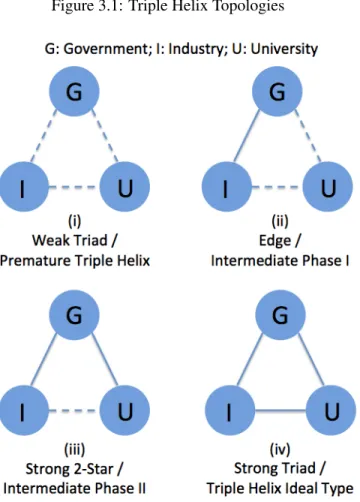
This paper discusses the importance of the developmental state in helping Asian economies engage in innovation, focusing on the role of the state in establishing partnerships with the industry and universities. Importantly, how and under what conditions do state-business partnerships evolve when a developmental state moves up the value chain? I argue that Asian developmental states that are high up on the value chain will move away from a simple bilateral state-industry relation to a more complex trilateral state-business-university relation under the auspices of the government, leveraging the talent in universities to further drive innovation processes. This paper uses both the developmental state model and the triple helix model to examine innovation partnerships in Asian economies.
3.2 Developmental States and Innovation Partnerships
the minimal role of the state. Moreover, industrial policies include not only protectionist trade policies to shield infant industries from global competition, as characterized by Alice Amsden’s notion of “getting the prices wrong” (Amsden (1989)), but also policies to forge strong economic partnerships with targeted industries to ensure smooth state-business dynamics that runs in congruence with the state’s economic goals. In other words, developmental states are highly active in establishing linkages with the respective industries so that the state and industry are embedded in a strategic collaboration. As Evans (1995) notes, one of the core elements of the developmental state is strategic embeddedness within productive sectors of the economy, an alliance that facilitates the implementation of industrial policies. Notable examples include the cooperation between the Korean state and the largechaebols, the partnership between the Japanese government and the dominant keiretsu, as well as direct government-linked corporations (GLCs) in Singapore.2
As Asian developmental states move up the value chain, they will face high degrees of uncer-tainty inherent within innovation processes and in a global knowledge-based economy. Strategic partnerships between the state and the industry, as well as between the state, the industry, and univer-sities help to ameliorate the uncertainties involved. Notably, the principal challenge in innovation is to first identify which science-based techniques and applications actually work to avoid resource and time wastage. For instance, Wong (2011a) notes that even after several decades of basic research in the biotech industry, scientists are still unclear “if, how, and which biotechnological techniques and applications can work to improve human health” (p.7). Developmental states fill this gap of uncertainty by actively identifying niche areas of research to focus on, and forging links between public and private sectors, thereby creating a collaborative environment for actors to pool and share information. Consequently, developmental states provide national innovation frameworks and strate-gies for firms and universities to focus on, with partnerships that further inform and advance the direction of innovation. Through cooperative networks made up of innovation actors, the uncertainty of identifying which areas to research and innovate can be greatly reduced.
In addition, under the coordinative leadership of developmental states, local entrepreneurs are encouraged to invest in particular high-tech sectors with the costs and risks of industrial upgrading 2The Korean chaebols are large conglomerates of family-owned firms that have close links with the Korean government.