If you’re hooked on achieving process excellence, then Business Process Management (BPM) may be exactly what you’re looking for. This book gives you an introduction to the basics of BPM and shows you how to implement it in your organization to improve business performance. Discover why so many organizations are using BPM and how it enables new levels of business flexibility and operational excellence. Understand BPM technology and why it’s so powerful!
ISBN: 978-0-470-28571-8
Client part number: 4AA1-3661ENW Book not for resale
Save money, time,
and resources
Software AG Special Edition
Get smart about
Business Process
Management
⻬ Find listings of all our books
⻬ Choose from many different subject categories
⻬ Sign up for eTips at
etips.dummies.com
BPM Basics
Kiran Garimella
Michael Lees
Bruce Williams
A Reference
for the
Rest of Us!
®FREE eTips at dummies.com® .14
Explanations in plain English
“Get in, get out” information Icons and other navigational aids
Top ten lists
A dash of humor and fun
Find out more at softwareag.com/bpm
notch paper bind Phoenix cover printer
If you want to understand
Business Process Management,
this book is for you!
Deliver more business value — faster
Gain visibility into your processes
Implement process solutions quickly
Model, simulate, and optimize process designs
Build adaptive and flexible processes
Software AG is the world’s largest independent provider of
Business Infrastructure Software. Our 4,000 global customers
achieve measurable business results by modernizing and
automating their IT systems and rapidly building new systems
and processes to meet growing business demands.
Our industry-leading product portfolio includes best-in-class
solutions for managing data, enabling service oriented architecture,
and improving business processes. By combining proven technology
with industry expertise and best practices, our customers improve
and differentiate their businesses – faster.
Software AG – Get There Faster
Front
Measurement: Real-time process visibility
Portals: Integrated views of the work environment
Modeling: Integrated representation of business and system processes and human workflow
Metadata: Reference library of IT and process assets
Simulation: What-if studies of a process model
Analysis: Graphical and statistical studies of process performance
Integration: Connectivity of people, information, services, systems, and processes
Execution: Orchestration of processes in real time
Suppliers: Each of the individuals, functions, systems, and entities that provide all inputs to a given business process.
Input: The complete set of materials, information, space, equipment, energy, supplies and other items needed for the process to perform.
Process: The transformation of inputs to outputs.
Output: Everything that emerges from the process; primary output is what’s desired by the customer; secondary output is waste and non-value added by-products.
Customers: The individuals, functions, systems, and other entities that demand and consume process output.
Adaptive and flexible processes
End-to-end process visibility and control
Automation of standard, repeatable processes
Process performance simulation and optimization
Role-focused composite applications
BPM Fundamentals BPM Approach
Measure First – Then Improve
Functional Modules of BPM
Defining “Process”
Suppliers – Input – Process – Output – Customers
S
I
P
O
C
1. Identify business objectives and select Key Performance Indicators. 2. Measure where you are now. 3. Determine what’s working and what isn’t.
4. Fix and improve problem areas. 5. Calculate value creation —
and celebrate!
BPM Basics
For Dummies
®BPM Basics
For Dummies
®For Dummies: Bestselling Book Series for Beginners
Wiley
, the Wiley Publishing logo, Fo
r
Dummies, the Dummies Man logo, the Fo
r
Dummies Bestselling Book
S
e
r
ies logo and all
r elated t r ade d r ess a r e t r adema r ks o r r egiste r ed t r adema r
ks of John Wiley &
S
ons, In
c
. and/o
r
its affiliates. All othe
r t r adema r ks a r e p r ope r
ty of thei
r r espe c tive owne r s. C opy r
ight © 2008 Wiley Publishing, In
c . All r ights r ese r
ved. Item 8571-8. Fo
r
mo
r
e info
r
mation about Wiley Publishing,
c
all 1-800-762-2974.
For Dummies: Bestselling Book Series for Beginners
Back
Business Analytics System Analytics Process Analytics Service MonitoringBusiness Activity Monitoring
Business architecture: The overall structure of the goals and objectives of the organization’s customers and stakeholders, and the strategies, roles, and responsibilities needed to achieve them.
Business Activity Monitoring
Monitor and respond to process activities
in real time
Process Modeling
A representation of how activities
operate or should operate
Process architecture: The methods, practices, and procedures by which the people in the enterprise transform available resources and capital to add value for the customers and stakeholders and achieve the business goals and objectives.
Management architecture: How the actions and behaviors of people and systems, as well as the flow of information over time, are directed in exercising the processes to achieve the business goals.
Educate Measure Prototype Justify Initiate Implement Mature Scope Process Design
& Execution CompositionApplication
Processes & Applications
Partners Packaged
Applications Databases ApplicationServers Mainframes
Enterprise Integration
B2B Service BusEnterprise ModernizationLegacy
Registry & Repository Roles & Responsibilities Policy Design & Enforcemnet Lifecycle Management SOA Governance Identify
Need EvaluateSolution
Define Design Develop Deploy
Define
Project Roll-outProject OptimizeResults
Business Architecture Process Architecture Management Architecture
Technology Architecture BPM Capability Delivery
Process Methodologies Project Management
Integration Competency/Center of Excellence
Support
Monitor Train
BPMS Technology Ecosystem
The BPM Architecture
BPM Implementation Plan
BPM Basics
For Dummies
®BPM Basics
FORDUMmIES
‰by Kiran Garimella,
Michael Lees,
and Bruce Williams
Software AG Special Edition
BPM Basics For Dummies®, Software AG Special Edition
Published by
Wiley Publishing, Inc.
111 River Street Hoboken, NJ 07030-5774
Copyright © 2008 by Wiley Publishing, Inc., Indianapolis, Indiana
Published by Wiley Publishing, Inc., Indianapolis, Indiana
No part of this publication may be reproduced, stored in a retrieval system or transmitted in any for m or by any means, electronic, mechanical, photocopying, recording, scanning or otherwise, except as permitted under Sections 107 or 108 of the 1976 United States Copyright Act, without the prior written permission of the Publisher. Requests to the Publisher for permission should be addressed to the Legal Department, Wiley Publishing, Inc., 10475 Crosspoint Blvd., Indianapolis, IN 46256, (317) 572-3447, fax (317) 572-4355, or online at www.wiley.com/go/permissions.
Trademarks:Wiley, the Wiley Publishing logo, For Dummies, the Dummies Man logo, A Reference for the Rest of Us!, The Dummies Way, Dummies Daily, The Fun and Easy Way, Dummies.com, and related trade dress are trademarks or registered trademarks of John Wiley & Sons, Inc. and/or its affiliates in the United States and other countries, and may not be used without written permission. Software AG and the Software AG logo are trademarks or registered trademarks of Software AG, Inc. in the United States and other countries. All other trademarks are the property of their respective owners. Wiley Publishing, Inc., is not associated with any product or vendor mentioned in this book.
LIMIT OF LIABILITY/DISCLAIMER OF WARRANTY: THE PUBLISHER AND THE AUTHOR MAKE NO REPRESENTATIONS OR WARRANTIES WITH RESPECT TO THE ACCURACY OR COMPLETE-NESS OF THE CONTENTS OF THIS WORK AND SPECIFICALLY DISCLAIM ALL WARRANTIES, INCLUDING WITHOUT LIMITATION WARRANTIES OF FITNESS FOR A PARTICULAR PURPOSE. NO WARRANTY MAY BE CREATED OR EXTENDED BY SALES OR PROMOTIONAL MATERIALS. THE ADVICE AND STRATEGIES CONTAINED HEREIN MAY NOT BE SUITABLE FOR EVERY SITU-ATION. THIS WORK IS SOLD WITH THE UNDERSTANDING THAT THE PUBLISHER IS NOT ENGAGED IN RENDERING LEGAL, ACCOUNTING, OR OTHER PROFESSIONAL SERVICES. IF PRO-FESSIONAL ASSISTANCE IS REQUIRED, THE SERVICES OF A COMPETENT PROPRO-FESSIONAL PERSON SHOULD BE SOUGHT. NEITHER THE PUBLISHER NOR THE AUTHOR SHALL BE LIABLE FOR DAMAGES ARISING HEREFROM. THE FACT THAT AN ORGANIZATION OR WEBSITE IS REFERRED TO IN THIS WORK AS A CITATION AND/OR A POTENTIAL SOURCE OF FURTHER INFORMATION DOES NOT MEAN THAT THE AUTHOR OR THE PUBLISHER ENDORSES THE INFORMATION THE ORGANIZATION OR WEBSITE MAY PROVIDE OR RECOMMENDATIONS IT MAY MAKE. FURTHER, READERS SHOULD BE AWARE THAT INTERNET WEBSITES LISTED IN THIS WORK MAY HAVE CHANGED OR DISAPPEARED BETWEEN WHEN THIS WORK WAS WRIT-TEN AND WHEN IT IS READ.
For general information on our other products and services, please contact our Customer Care Department within the U.S. at 800-762-2974, outside the U.S. at 317-572-3993, or fax 317-572-4002.
ISBN: 978-0-470-28571-8
Manufactured in the United States of America
10 9 8 7 6 5 4 3 2 1
About the Authors
Dr. Kiran K. Garimella is Vice President of BPM Solutions at Software AG. Previously, he was a Chief Architect and a Chief Information Officer at General Electric, and he has over 18 years of global experience in management consulting, business architecture, and teaching. He is the author of a business novel on Business Process Management, The Power of Process: Unleashing the Source of Competitive Advantage, and an active writer of articles and whitepapers, as well as three blogs on BPM and related methodologies. He is a frequent speaker at BPM conferences and related events around the world. He is Six Sigma certified from GE, with project experience in Six Sigma and Lean. Dr. Garimella holds a BS in Chemistry, an MS in Computer Science, and a Ph.D. in Decision and Information Sciences from the Warrington College of Business, University of Florida.
Michael J. Lees is Director of BPM Product Marketing at Soft-ware AG, and previously held a similar position at webMethods, Inc. Prior to joining webMethods he was Founder and CEO of the market-leading metadata and knowledge management vendor Cerebra, Inc., which was acquired by webMethods in 2006. He has held senior positions in technology analysis and fund management organizations. Michael is a qualified UK Chartered Accountant (ACA) and has a degree in Business Economics from Durham University, England.
Bruce D. Williamsis Senior Vice President and General Manager of the BPM Solutions Group for Software AG. He was previously VP of BPM Solutions for webMethods. In prior business lives, he was the founding principal of Savvi International, a CPI training and consulting firm, and the founding executive of Entrada Software, a PLM company. He previously held management positions with Sybase, Inc. and Ball Aerospace Systems. He has graduate degrees in Engineering Computing and Technical Management from Johns Hopkins University and the University of Colorado, and a BS in Physics also from Colorado. Bruce is coauthor of Six Sigma For Dummies, The Six Sigma Workbook For Dummies, and Lean For Dummies.
Dedications
Kiran Garimella: To my wife Raji, daughters Lillian and Angela, for their patience and encouragement; and to my mother, Dr. Seeta Garimella, for being an inspiration.
Mike Lees: For Ben and Katie, who have yet to understand the phrase, “Daddy has to work” . . . This is what I do!
Bruce Williams:To My Beloved Audrey; it’s good to know you’re always on my side.
Authors’ Acknowledgements
The authors acknowledge Nancy Beckman, Julie Sheridan, Sherry Bussel, and Kevin Iaquinto at Software AG for their technical and administrative assistance in the preparation of this work.
Our special thanks to our colleagues at Cox Communications, especially Bruce Beeco, and also Norman Gottschalk of Lenders First Choice, for pushing us — and the envelope. We especially thank Roger Burlton at the Process Renewal Group, Peter Fingar of The Greystone Group, Roxanne O’Brasky at the International Society of Six Sigma Professionals, Celia Wolf and Paul Harmon of BPTrends, and Dr. Richard Welke of Georgia State University, for their insight and participation in the development of the global BPM movement.
And we’d like to acknowledge our many BPM friends and col-leagues at Software AG, especially Matt Green, Peter Carlson, Reed Wellman, James Crump, Sami Morcos, Susan Ganeshan, Phani Pandrangi, Anthony Coker, Bob Brooks, Russ West, Stewart Loewen, Michael Cupps, William Brown, and Doug Sheeran, whose collective dedication to BPM and process excellence has driven us all to new heights of capability and accomplishment.
Table of Contents
Introduction . . . 1
About This Book...1
Foolish Assumptions ...2
Icons Used in This Book...3
Where to Go from Here...4
Chapter 1: Defining Business Process
Management (BPM). . . 5
The Three Dimensions of BPM ...6
Business: The value dimension ...6
Process: The transformation dimension ...6
Management: The enabling dimension...8
The Catalyst: BPM Technology ...8
BPM: A Model for Success ...9
BPM & CPI: Birds of a feather ...10
BPM is business infrastructure ...10
BPMS: A Suite Deal ...10
Chapter 2: The Business Drivers of BPM . . . 11
The Business Imperatives ...11
BPM Business Drivers ...13
BPM: Something for Everyone...14
Chapter 3: The Functional Goals of BPM . . . 15
What Does BPM Do? ...15
Process Effectiveness ...17
Optimization ...17
Automation ...18
Control and decision making ...18
Process Transparency ...18
What you model is what you run ...19
Process monitoring and analysis ...19
How about them processes?...20
Process Agility ...20
Communication and collaboration ...20
Rapid development ...21
Productive Workspaces...22
Chapter 4: The Business, Process, and Management
Architectures of BPM . . . 23
Many Architectures in One ...23
The BPM Business Architecture...24
Process-centric organizations ...24
BPM business infrastructure ...27
The IT organization for BPM...29
Integration competency ...30
The BPM Center of Excellence ...30
BPM Basics For Dummies
vi
The BPM Process Architecture ...30
The process framework...31
Process methodologies ...31
The process life-cycle ...32
The Management Architecture for BPM...32
BPM project management ...32
Process management...33
Process improvement...34
Chapter 5: The Technology Architecture of BPM . . . 35
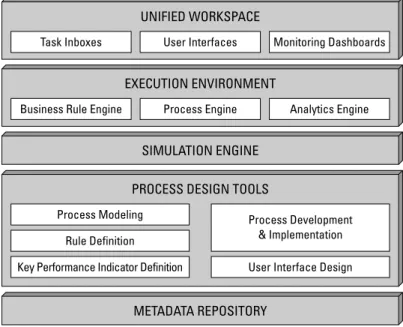
BPM Technology Architecture ...35
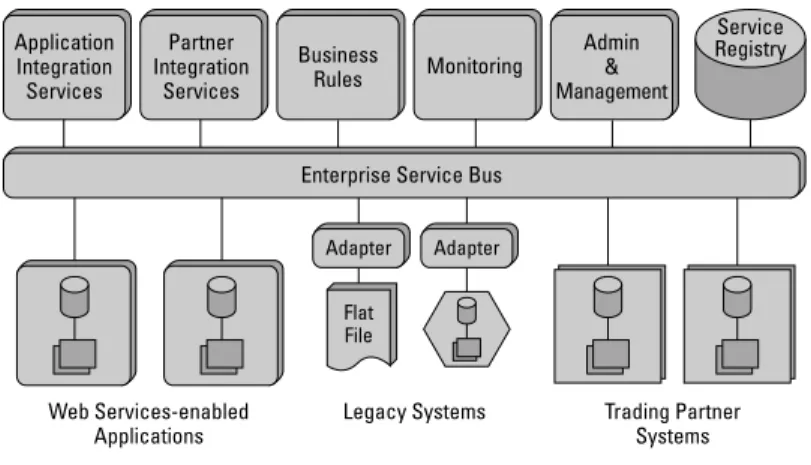
Middleware: The Physical Glue ...37
Metadata: The Logical Glue ...38
Unified Modeling ...39
Defining processes and designing workflows ...39
Developing processes ...41
Defining business rules ...41
The design of user interfaces ...42
Simulation ...43
The Execution Environment ...43
Process execution engine...44
Analytics engine ...44
The Unified Workspace ...44
Task inboxes ...45
Process and people management ...45
Monitoring dashboards ...45
Third-Party Components...46
Chapter 6: Getting There from Here. . . 47
Laying the Foundation...48
The strategic imperative ...48
Know your goals...48
Follow a process methodology...48
Set up the architectures ...49
Define measurement systems...49
Preparing for the Bigger Issues ...49
Taking Your First Steps...51
Showing Them the Money...52
Achieving ROI ...52
Benefits for constituencies ...52
Obliterate the gaps!...52
Chapter 7: Ten Best Practices of BPM . . . 53
Chapter 8: Ten BPM Pitfalls to Avoid . . . 55
Appendix A: Glossary. . . 57
Appendix B: Resources . . . 61
Introduction
B
usiness Process Management (BPM) was unheard of just a few years ago, but it has burst onto the global scene to become the hottest business and technology management trend of the decade. If you’re in any business or industry — public or private — you’ve probably heard of the movement toward process,or about things like process managementorprocess improvement.You may know about process improve-ment methods like Lean and Six Sigma or about new technolo-gies like Business Activity Monitoring (BAM) or Service-Oriented Architectures (SOA).
BPM represents a culmination of all the collective experience, thinking, and professional development in business manage-ment over the past several decades. It’s customer first. It’s business focused. It empowers people in all corners of a busi-ness to be more successful. It brings people and systems together. BPM is where all the lofty goals and best strategies are coming home to roost.
You stir all these things together and it can start sounding pretty confusing. But really, BPM is very simple. It’s a set of methods, tools, and technologies used to design, enact, ana-lyze, and control operational business processes; a process-centric approach for improving performance that combines information technologies with process methodologies.
About This Book
This book helps you understand what BPM is really all about. We wrote it because BPM is so useful and so powerful — and because it is also very accessible. We wrote this book for you — the individual. You may be a business manager, or an Information Technology practitioner, or maybe an ambitious career individual who wants to know what BPM is all about and how to apply it.
BPM Basics For Dummies
2
BPM Basics For Dummies, Software AG Special Edition is more than just an overview or survey of BPM. It covers both the business management and information technology sides, and delves into the process-centric foundation upon which BPM is built. As a basics book, it is necessarily brief, so you’ll want to follow up in some of the areas that are most interesting or important to you.
We wrote this book not only for you to read, but also for you to use as a business reference, to help you while you practice everyday BPM. BPM Basics For Dummiesshould help you establish a sound conceptual basis for understanding BPM, and help you appreciate how BPM is applied to achieve break-through business performance improvement.
This book is:
A reference book that’s organized into chapters, so you can flip right to what you need
A text that addresses the core concepts and practical ideas in BPM
A primer for getting started with BPM
A step-by-step guide for implementing BPM successfully
A compilation of resources that you can go to for addi-tional help or continued education
We use some business management, process improvement, and information technology concepts and language in this book. To get extra smart on some of these aspects, check out
Lean For Dummiesby Natalie Sayer and Bruce Williams; Six Sigma For Dummiesby Craig Gygi and Bruce Williams, and the Six Sigma Workbook For Dummiesby Craig Gygi, Bruce Williams, and Terry Gustafson. Also check out Balanced Scorecard Strategy For Dummiesby Chuck Hannabarger, Rick Buchman, and Peter Economy (all published by Wiley).
Foolish Assumptions
We assume that you have heard something about BPM or process management, and are intrigued about what it can do for you and your business. You want to find out more, for at least one of these reasons:
Your company is considering BPM, and intends to imple-ment it, and you need to understand what it is and how it works.
Your company is implementing BPM now, and you need to know how to use it to improve the performance of your business area.
You’re a practitioner of a process improvement method-ology like Lean or Six Sigma, and you want to know how these and BPM fit together.
You’re a manager, analyst, or practitioner in the IT organ-ization; you know BPM will have a big impact on your future, and you want to know what BPM will mean to you.
You’ve heard a lot about BPM, and now you want to really understand it!
Whatever the reason you’ve picked up this book, we’re assuming that you’re a business or information technology professional, that you recognize the potential in your organi-zation for performance improvement, and that you’re ready to be part of the solution.
Icons Used in This Book
In the margins of this book, you will see some helpful little icons that can help you pinpoint particular types of information:
Key points for implementing BPM successfully.
Caution — a risk or pitfall could get you into trouble.
When you see this, it’s an indication of a technical detail.
A Remember icon pinpoints the most important ideas in the book. Pay attention when you see this!
Introduction
3
Where to Go from Here
This book is organized into chapters on specific topics. You can read it straight through or you can use it as a reference. If you’re brand new to BPM, start at the beginning, with Chapter 1. If you’re most interested in the technical aspects, start with Chapter 5. Interested in the business and management side? See Chapter 4. Want to know how to implement BPM? Look at Chapter 6. Need to know all the language and lexicon of BPM? See our Glossary in Appendix A.
But no matter where you begin, be sure to read the whole book, because BPM is more than the process, management, and technology pieces; it’s a complete and systematic way to look at your business. And besides, it’s only 72 pages — you’ll get through it in no time!
BPM is a big deal, because it makes a big difference in busi-ness performance. BPM can be a very big opportunity for you and your business. We wish you well on your BPM journey. We’re here with you, and with this book by your side, you’ll have a good start on knowing the way.
BPM Basics For Dummies
4
Chapter 1
Defining Business Process
Management (BPM)
In This Chapter
Explaining the three dimensions of BPM
Recognizing BPM technology — the catalyst
Getting the total package
B
usiness Process Management (BPM) is a set of methods, tools, and technologies used to design, enact, analyze, and control operational business processes. BPM is a process-centric approach for improving performance that combines information technologies with process and governance methodologies. BPM is a collaboration between business people and information technologists to foster effective, agile, and transparent business processes. BPM spans people, systems, functions, businesses, customers, suppliers, and partners.Like many people, you may find this confusing. What are “operational business processes”? Or what’s a “process-centric approach”? And since when do business and IT people “collaborate”? Don’t worry — we explain all of this.
BPM combines established and proven process management methods with a new class of enterprise software tools. It’s enabled breakthroughs in the speed and agility of how organizations improve business performance. With BPM:
Business managers can more directly measure, respond to, and control all the aspects and elements of their oper-ational processes.
BPM Basics For Dummies
6
Information technology managers can apply their skills and resources more directly on business operations.
Staff and workers across the organization can better align their efforts and improve personal productivity and performance.
The enterprise as a whole can more quickly respond to changes and challenges to continuously meet its goals and objectives.
Sound too good to be true? Well, this time, it’s true. BPM is quickly changing the landscape of global business.
The Three Dimensions of BPM
BPM is aptly named, because it addresses the comprehensive world of an enterprise across its three core dimensions.
Business: The value dimension
The business dimension is the dimension of value, and of the creation of value for both customers and stakeholders. BPM directly facilitates the goals and objectives of the business enterprise: sustained top-line growth and improved bottom-line performance; increased innovation; improved productiv-ity; enhanced customer loyalty and satisfaction; and elevated levels of staff effectiveness.
BPM brings more capability than ever before to align opera-tional activities with goals and strategies. It focuses enterprise resources and effort on the creation of customer value. BPM also enables a much faster response to change, fostering the agility needed for continuous adaptation.
Process: The transformation
dimension
The process dimension creates value through structured activities called processes. Operational processes trans- form resources and materials into products or services for
customers and end consumers. This “transformation” is how a business works; it’s the magic elixir of the enterprise. The more effective this transformation, the more successfully you create value.
The applied science of processes and transformation spans the history of modern industrial management — from the quality gurus like Deming, Juran, Shingo, Crosby, and Peters and recently the practices of Lean and Six Sigma. BPM fully incorporates these methodologies, and accelerates them with dramatically enhanced systems of definition, measurement, analysis, and control.
Through BPM, business processes are more effective, more transparent, and more agile. Problems are solved before they become issues. Processes produce fewer errors, and those errors surface faster and are fixed sooner.
Process effectiveness
Effective processes are more consistent, generate less waste, and create greater net value for customers and stakeholders. BPM directly promotes increased process effectiveness through the adaptive automation and coordination of people, information, and systems.
Unlike methods and tools of the past, BPM doesn’t impose effectiveness through rigid and unyielding systems of control focused on functional domains. Instead, BPM enables the con-tinuous response and adaptation to real-world and real-time events and conditions.
Process transparency
Transparencyis the property of openness and visualization — and it’s critical to effective operations. Transparency has long eluded businesses, whose processes are often codified into arcane systems, unintelligible to mere mortals. BPM opens these black boxes and reveals the inner workings of business processes. With BPM, you can directly see all the elements of a process design, including the model, workflows, rules, systems, and participants, as well as its real-time perform-ance, including events and trends. BPM enables business people to directly manipulate the structure and flow of processes and track the outcomes as well as the causes.
Chapter 1: Defining Business Process Management (BPM)
7
Process agility
Of all demands on business operations, perhaps the most pressing is the need for change — the ability to adapt to chang-ing events and circumstances while still maintainchang-ing overall productivity and performance. BPM delivers process agility, minimizing the time and effort needed to translate business needs and ideas into action. BPM enables business people to define processes quickly and accurately through process models. It enables them to perform what-if analysis on business scenarios. It empowers them to configure, customize, and change transaction flows by modifying business rules. It directly translates process designs into execution — integrat-ing systems and buildintegrat-ing applications codelessly and seam-lessly. Moreover, the BPM platform comes equipped with technology components that make codeless development and integration fast and easy.
Management: The enabling
dimension
Management is the enabling dimension. Management sets people and systems into motion and prods processes into action, in pursuit of the business goals and objectives.
For management, processes are the tools with which they forge business success. Before BPM, constructing and applying these tools spawned an unwieldy mix of enterprise-class automation, many isolated desktop tools, manual methods and techniques, and brute force. With BPM, you can bring together all the systems, methods, tools, and techniques of process development and process management into an archi-tected system, complete with the visibility and controls nec-essary for steering and tuning. How could you not want that?
The Catalyst: BPM Technology
Business leaders and managers know the fundamental roles of business, process, and management in the enterprise. These have been defined, studied, and improved over a period of decades. Technology, however, has been evolving more rapidly, and recently, significant advancements have changed the game. BPM technology is the new enabler that has taken business, process, and management to new levels. BPM technology is
BPM Basics For Dummies
8
the key ingredient of BPM — it’s the catalyst in a new, faster, and more effective business alchemy.
BPM technology is the result of many years of development and application experience; the product of the most current advances in information systems and processing; the pinnacle of all computing architectures, languages, and protocols. BPM technology is a breakthrough, and a new paradigm in flexibil-ity, management, and control of data and information. BPM, as a comprehensive management practice, is the result of com-bining the technical advancements with established methods and practices of a process-centric business model.
BPM technology includes everything you need to design, enact, analyze, and control operational business processes:
Process Modeling and Designmake it possible for you to quickly and rigorously define processes that span value chains, and to orchestrate the roles and behaviors of all necessary people, systems, and other resources.
Integrationallows you to include any information system, control system, data source, or other technology into business processes. Service-Oriented Architecture (SOA) makes it faster and easier than ever before. Nothing of value need be discarded; everything is reusable.
Composite Application Frameworks allow you to build and deploy fully-functional Web-based applications code-lesslyand almost instantly.
Execution directly turns models into real-world action, orchestrating processes in real-time.
Business Activity Monitoring tracks process perform-ance as it’s happening, monitoring many indicators, dis-playing key process metrics and trends, and predicting future behaviors.
Controlallows you to respond to process events based on circumstances, such as rule changes, notifications, exceptions, and escalations.
BPM: A Model for Success
Because processes represent value chains that often cut across functional departments and even separate businesses, BPM
Chapter 1: Defining Business Process Management (BPM)
9
initiates important shifts in business architecture and man-agement practice. BPM orchestrates processes, and that has implications on the ways people communicate. The behaviors are different — and that has implications on roles, job
descriptions, and incentives.
BPM & CPI: Birds of a feather
Continuous Process Improvement (CPI) methodologies like Six Sigma and Lean are naturally part of BPM. These time-tested approaches to process optimization are extended in force and range when combined with BPM technology. BPM is the platform that takes CPI to the enterprise level. BPM accel-erates the adoption and execution of CPI methodologies, and propagates best practices throughout the enterprise.
BPM sustains the effectiveness of CPI.
BPM is business infrastructure
BPM brings all dimensions of a business together, and enables new levels of participation and collaboration among teams — especially between business staff and IT professionals. BPM promotes quick, incremental improvements while reaching levels of process stability and performance quickly.
BPM is the central discipline — including the tools and the techniques — that connects enterprises and organizations by fostering operational process performance with effectiveness, transparency, and agility.
BPMS: A Suite Deal
There’s an “S” that you’ll sometimes see on the end of BPM. The “S” in BPMS stands for “Suite.”
A BPMS is the suite of BPM technologies — including all the functional modules, technical capabilities, and supporting infrastructure — integrated into a single environment that performs all the BPM technology functions seamlessly. A BPMS is the total package.
BPM Basics For Dummies
10
Chapter 2
The Business Drivers
of BPM
In This Chapter
Recognizing what’s motivating the adoption of BPM
Realizing that BPM addresses many critical business needs
Appreciating the breadth and scope of BPM
W
hy are businesses across the globe adopting BPM prac-tices and technologies? Because BPM addresses each of today’s most significant business drivers.The Business Imperatives
The pressures on organizations and enterprises around the world are increasing. Markets are crowded; margins are squeezed. New challenges pop up seemingly overnight on all fronts. Believe it or not, BPM can help you improve your offerings in all of the following categories:
Globalization: Companies are going further to find advantages in cost, quality, and innovation. Successful business now requires seamless integration of processes and the instant exchange of information on a planetary scale. Fonterra, the largest global exporter of dairy prod-ucts, uses BPM to streamline its supply chain operations.
BPM Basics For Dummies
12
Commoditization: In mature, commoditized markets, competing products and services are nearly indistin-guishable to the consumer, forcing providers to differen-tiate along a single factor, such as price. Companies in commodity markets must achieve new levels of efficiency and cost control in order to survive, and they must invest in innovation in order to grow. In the highly commoditized consumer lending industry, U.S. banks are using BPM to close lending processes faster.
Productivity: You have to produce more, and generate more value, with fewer resources and in less time. Continuously. Toyota became the world’s largest automo-tive company with this mantra. Lean is now the global framework for implementing the Toyota Production System and achieving continuous improvement in pro-ductivity. Companies everywhere are steadily driving for improved productivity.
Innovation:Perhaps the business word of the decade, “innovation” is exhaustively attached to invention, break-through, excitement, and everything new. But that’s just the product marketing definition of innovation. Business innovation is much more. While mostly associated with products, innovation also applies to services, business and manufacturing processes, development, store design, business models, and even packaging.
Speed: You hear it every day: somebody suddenly intro-duced a new product or service, and took a big share of the market from an established firm. Its brand, reach, and resources couldn’t protect it from the more nimble newbie — it couldn’t move fast enough.
Compliance: Regulatory and governance requirements are drowning companies in bureaucratic exercises that drain value. The cost of regulatory compliance has been growing, but is growing even more quickly in IT as com-panies attempt to reduce the overall cost of compliance by automating processes and reporting.
Information overload: The world is now data rich, but information starved. People struggle with gleaning true intelligence from the vast stores of data and information. Market and customer intelligence are necessary weapons in the Age of Information.
The changing nature of people and work: In the era of the knowledge worker and the transition to intellectual capital, the nature of work has changed. Many work envi-ronments are now characterized by flexible time,
telecommuting, collaboration, social networks, and increasing dependence on information and communica-tions technology. Reaching higher levels of productivity and performance requires new approaches.
Customer first: You’d better put the customer first, because if you don’t, you can be certain that they won’t put you first. Or second. Or even on the list. Customers have more choices, more freedoms, and a much more developed sense of needs, wants, and desires than ever before. Customers are savvy, and can quickly spot poor quality and service. Over half of all major global busi-nesses now use Balanced Scorecards or Net Promoter Scores to track the influencers on customer satisfaction. The cost of low customer loyalty is high; the cost of customer defection is astronomical.
And there’s more: This list is by no means exhaustive. It’s representative of the broad nature of challenges besetting enterprises and institutions of all types and sizes around the world.
BPM Business Drivers
Four core business drivers are motivating the adoption of BPM.
Improving a process or sub-process: Companies imple-ment BPM as a means for improving selected processes. Typically, these are not complete process frameworks or value chains, but sub-processes within a value chain. In these cases, BPM offers a faster time to a solution. This also serves as a pilot to a first experience with BPM.
BPM(S) for CPI: Because of the synergistic relationship between BPM and Continuous Process Improvement methodologies like Lean, Six Sigma, SCOR, TQM, and so on, many companies who have embarked on a CPI initia-tive implement a BPMS as the technology companion and enabler to their CPI program.
Chapter 2: The Business Drivers of BPM
13
BPM for SOA: Many IT organizations have adopted Service-Oriented Architectures (SOA) and are exposing services for next-generation integration. BPM directly leverages SOA, and together the combined BPMS (suite) is a higher-value system.
Business Transformation: BPM, as the combination of BPM technology and CPI methods, represents the most complete, comprehensive, and holistic framework for enacting strategic business transformation.
BPM: Something for Everyone
The value propositions of BPM are extensive. All corners of the enterprise can reap benefits from BPM. Here are just a few:
Automation:Increased productivity, consistency, reduc-tion in errors, maximized customer satisfacreduc-tion, and compliance.
Agility:Faster response times to issues, faster time to develop solutions, faster turnaround time.
Flexibility:Combining the scale, scope, and capacity of legacy information systems with the agility, flexibility, and innovation of modern technologies such as Web 2.0; and enhancing an information platform with the tools and techniques of CPI, Balanced Scorecards, methodology, governance, frameworks, and metadata.
Visibility:Tracing individual business transactions (even in real-time) throughout the entire process, drilling down into sub-processes, zooming up to the parent processes, and seeing the process through the perspective of any particular role.
Collaboration:Alignment and participation, especially between IT and business.
Governance:A strong model of management control and change that builds confidence in customers, partners, suppliers, regulators, and shareholders. BPM ensures policies of use and re-use are followed, and provides oversight to tasks and the flow of work.
BPM Basics For Dummies
14
Chapter 3
The Functional
Goals of BPM
In This Chapter
Understanding the foundational components of BPM
Appreciating the business dimension of the functional components of BPM
Realizing how BPM’s functional aspects help address business drivers
W
hen you say BPM, what does that mean in terms of what people actually do? This chapter is a description of the functional capabilities of BPM, how the inner workings relate to one other, and how people use BPM to improve busi-ness performance. (The technology architecture of BPM is described in Chapter 5.)What Does BPM Do?
BPM is a broad discipline, but it has a specific functional pur-pose. And, of course, the BPM technology components have precise specifications. How do these all come together? Here’s a list that explains:
Process-Centricity: BPM unifies business and IT activi-ties and coordinates the actions and behaviors of people and systems around the common context of business processes. Using standard process modeling conventions and notations, an operations manager, for example, sees the process from a business perspective, while the IT manager sees the systems and information elements.
BPM Basics For Dummies
16
Business/IT Alignment: BPM facilitates the direct collab-oration and joint responsibility of business and IT profes-sionals in developing, implementing, and optimizing operational business processes. The same process model, for example, provides a business perspective for the business analyst and a systems perspective for the systems analyst.
Continuous Process Improvement: BPM implements the management and behavioral methods and tools of Continuous Process Improvement (CPI). For example, each functional module of a BPMS supports one or more of the DMAIC phases of Six Sigma, and Business Activity Monitoring allows you to monitor Six Sigma metrics for your processes.
Composition of Solutions:BPM facilitates the rapid design, assembly, and deployment of complete business processes. A developer attaches IT systems and services to the same process model designed by the business analyst. A complete set of connectors and codeless tools makes the development of solutions even faster.
Transparency: BPM provides real-time, cross-functional visibility into operational processes and a common understanding of activities for all participants. An opera-tions manager, for example, can view running business processes and their business metrics in real time, and an IT manager can see the supporting systems’ availability and performance.
Leave and Layer: BPM directly incorporates existing information systems and assets and coordinates their use within a process “layer” accessible to business managers. A comprehensive set of system adapters and “business-to-business” (B2B) tools allows you to re-use any of your existing IT applications. Users see one inter-face in front of many systems. And the BPM dashboards present a unified business façade to business users.
Each of these functional components of BPM adds value to multiple aspects of business performance, such as effective-ness, transparency, and agility.
Process Effectiveness
BPM assumes the paradigm of managing business activities through a framework of operational processes. The term business process may sound loose, but don’t be misled; it is a precise term.
A business processis the set of all formally coordinated tasks and activities, conducted by both people and equipment, which leads to accomplishing a specific organizational objec-tive. An example of a business process is order fulfillment. The act of a customer placing an order initiates a process to record the order, approve their credit, and trigger the produc-tion and delivery.
BPM endeavors to maximize the effectiveness of business processes, by:
Determining the optimal process for the current conditions
Making the process operate as effectively as possible
Enabling decisions and controls for ongoing effectiveness
Optimization
You need to find out what’s happening in your business as it’s happening, and how potential changes can impact your business.
Real-time monitoring
BPM provides visibility into the state of current processes, and extracts the key metrics that are important to how that process affects the business. This way, you can judge how effective your processes are now, and then design processes that will improve performance against these metrics. For example, you might view the logistics process across your entire global supply chain. You would see status, run-charts, and red flags showing where shipments are delayed. Your BPM platform would send automatic escalations to trouble-shooters. You would receive follow-up information that noti-fies you when shipments are moving again. Your customers would be automatically notified about delays.
Chapter 3: The Functional Goals of BPM
17
‘What-if’ analysis
With BPM, you can simulate the performance of processes before you implement them. Experiment with different paths, resource levels, rules, and more, asking “what if. . . ?” about how the process could work best. For example, you could simulate the addition of staff in order processing to see what impact such additions would make to the overall performance.
Automation
With BPM, you can automate the execution of many process tasks that may have previously been handled manually. You can combine new and existing services to do this. For tasks that still require manual handling, BPM will coordinate the workflow and direct action by notifying people and presenting them the information they need to perform their work. If the customer service manager needs to review a high-value order, BPM sends a notification via e-mail or to a task inbox in the process workspace.
Control and decision making
BPM gives business managers direct control over certain change and control points in how the information systems facilitate process management. Managers have unimpeded access to data about process performance. Business users participate both in the specification of the initial process defi-nition and also in changes to keep it continuously optimized. Business managers also have direct control of the rules and policies that govern process behaviors. For more on how this works, see Chapter 5.
Sharing control isn’t loss of control. IT systems managers can rest assured that BPM provides the governance necessary to ensure business managers implement changes properly.
Process Transparency
Business processes shouldn’t be black boxes. BPM provides visibility through modeling and monitoring capabilities.
BPM Basics For Dummies
18
What you model is what you run
Models are usually just that. You don’t actually drive a model car, or move into a model home. Models are representations, and what you experience later is something different. Some-times, what you experience is verydifferent, and when you work with complex systems like operational business processes, it’s oftentoodifferent.
But what if the model actually becamereality? What if the model and the real thing were directly connected and what you modeled was what actually ran? In BPM, what you model is what you run (WYMIWYR).
With BPM, the model isn’t just the design — it actually becomes the engine that runs the process. No translations, no muddled interpretations of requirements or design docu-ments. Doing things this way is far faster and much more accurate than the way it’s been done before.
In traditional development environments, you must use multi-ple tools and create different models at each stage of your development life cycle. This gives rise to multiple interpreta-tions and inconsistencies. But BPM gives you a unified design environment that avoids this problem. What you model is what you run.
Process monitoring and analysis
We promise not to make another acronym about it, but it’s an old adage: what you measure is what you manage. And the con-verse is true, too: you can’t manage what you don’t measure. If you can’t sense it, you can’t respond.
BPM allows you to see processes as they execute, and to determine how the business transactions that flow through the processes affect your key business metrics. BPM provides the tools not just to react and respond, but also to manage impending threats and opportunities proactively. BPM delivers information that helps uncover the root causes of problems and provides actionable, objective feedback as to how the process can be improved.
Chapter 3: The Functional Goals of BPM
19
Sensing deterioration in the performance of your business requires you to understand what your “normal” operating state is. But “normal” varies depending on time and events. You can use BPM technologies to sense deterioration from what is statistically normal for the current circumstances, rather than relying on abstract thresholds or long-term aver-ages. For example, the number of orders an online toy store receives tend to be greater in December. Operations managers don’t want to compare December sales volume to October or November. They want it compared to the prior December, and they want to be alerted if orders deviate significantly from the expected level for December.
How about them processes?
Business processes are complex assemblies of models, rules, data, logic, services, and lots more. The structured collection of information that describes all these pieces and how they work together is called metadata.BPM uses metadata to keep everything straight. (For more on metadata, see Chapter 5.)
An architecture of reusable components means you have many more moving parts in your business. With different people controlling and changing different components, it can be a challenge to maintain a clear picture of how all of the moving parts interact. Metadata allows you to store the descriptions of all of these pieces and the relationships between them in a central repository. You need this view of what’s going on to manage all the assemblies and dependencies.
Process Agility
Process effectiveness and transparency are powerful enough, but with BPM, you also have process agility. BPM directly enables change, both by streamlining existing processes and developing new ones.
Communication and collaboration
The greatest barrier to change is communication. BPM lowers this barrier by increasing the direct and immediate lines of
BPM Basics For Dummies
20
communications and collaboration among all process partici-pants. BPM enables the process team to:
Agree on the metrics of business process performance
Share process models and common business semantics
Clearly communicate about the tasks to be performed And this goes beyond your four walls (that’s just a metaphor, anyway — it’s been a long time since a business was contained in one place!). BPM allows you to extend your reach into processes beyond the boundaries of your business, allowing you to effectively collaborate with your customers, partners, and suppliers.
Rapid development
BPM is much faster than anything you’ve experienced before. It allows you to sense change when it happens, interpret the impact of that change, and develop a shared understanding of how the business should respond. It also allows you to develop and deploy solutions faster than is currently possible.
With BPM, you:
Have a central point of change in the infrastructure for process and rule logic (the process model)
Minimize the amount of code that must be developed and maximize the reuse of existing capabilities
Expose existing functionality as discrete reusable serv-ices that can be graphically assembled into new applica-tions and processes
Share the burden of design and change outside of the IT group
Quickly simulate the operation of new processes prior to deployment
Chapter 3: The Functional Goals of BPM
21
Productive Workspaces
People working in and around formal business processes are often forced to interact with multiple existing systems, includ-ing packaged applications. Coordinatinclud-ing this hodge-podge has become a productivity-draining part of our everyday world. Packaged applications and fixed systems can’t readily be cus-tomized to the individual needs of any particular person. The result? People switch back and forth between many systems and applications, and they have to figure out how to make it all work for them.
With BPM, you abstract the process worker from the complex-ity of different systems and align the work they have to do and the tools they need through a single, personalized process environment.
The practices of CPI and the technologies of BPM make this possible. Process workers are more productive. People like the look and feel. Instead of users changing their work style to suit the applications, the new process environment adapts itself to how people work productively.
For example, in a typical order-entry process, a clerk would have to move between their e-mail, where they were first noti-fied, and the different sales systems to record different parts of the order, as well as the finance system to record the credit transaction and finally the ERP system to check stock levels. With BPM, the clerk would simply see a single view that pres-ents all of the entry fields and notifications needed to complete the order. Each of the existing systems would be updated in the background, but this would not be the concern of the order-entry clerk.
BPM Basics For Dummies
22
Chapter 4
The Business, Process,
and Management
Architectures of BPM
In This Chapter
Adjusting your architectures for business, process, and management
Appreciating that these architectures are critical to the success of your BPM initiative
Understanding how each architecture is part of BPM
W
ith BPM, you have the ability to develop, deploy, and change business processes faster than ever. However, technology alone doesn’t translate business needs into sus-tainable business advantage. You must plan the architecture of your business, processes, and management. Because of the capabilities of BPM technology, you are more obligated than ever to have a comprehensive enterprise architecture in place. Without it, you risk going in the wrong direction, quickly solving the wrong problems, or just chasing your tail.Many Architectures in One
An enterprise of any size or any type, in any industry, any-where in the world, has an overall framework or design to it in order to describe and manage how it works. Business Process Management is a process-centric way of doing business, and it requires you to adjust your enterprise frameworks and your enterprise architecture accordingly. When adopting BPM,
BPM Basics For Dummies
24
think of your enterprise architecture as consisting of four sub-architectures. The technology architecture is addressed in detail in Chapter 5. In this chapter, we address the other three:
Business architecture:The overall structure of the organization, designed to apply strategies that meet the goals and objectives of its customers and stakeholders
Process architecture:The methods, practices, and pro-cedures by which the people in the enterprise transform available resources and capital to add value for the customers and stakeholders
Management architecture:How the actions and behaviors of people and systems, as well as the flow of information over time, are directed in exercising the processes to achieve the business goals
BPM is a business system, and it includes the technology architecture described in Chapter 5 in concert with the pre-ceding architectures. Use them to address the business driv-ers described in Chapter 2 and you will have a more nimble, adaptive, and successful enterprise.
The BPM Business Architecture
A business architecture is the design representation of how an enterprise defines itself in terms of its role and purpose, and how it defines the way it creates value. Every enterprise defines its high-level business goals, and creates an organizational structure, including a functional decomposition into operating units, as a basic structure for meeting its goals. The enterprise develops relationships across those units, and determines how it will relate with its customers, shareholders, and stake-holders. It knows its principles and practices, and develops a distinctive culture and language as well as habits in response to opportunities and challenges. Think about your enterprise and how your business architecture is structured.
Process-centric organizations
For most of the industrial age, enterprises have been organized as a collection of common tasks or functions, such as design, finance, manufacturing, operations, and so on. The prevailing
wisdom was that overwhelming economies of scale are afforded by such aggregations. In the latter part of the 20th century, new organizational structures emerged, including
product-line (where all the functions for a single product are collected), and matrix(where expertise from functional organ-izations is brought in and assigned to projects). More recently, Lean practices have further evolved these models into busi-ness architectures that align people, work, and capital to the processes that create customer value.
Business Process Management calls on the organization to adjust its business architecture to directly foster value-creating business processes. The process-driven organization treats these business processes as a portfolio of valuable corporate assets. BPM techniques are used to explicitly define and exe-cute processes in a manner that creates significant benefits.
Redefining roles
It’s not easy to modify functional alignments and structures, but BPM asks you to create new roles that cut across func-tional stovepipes to support the process-centric business. Some of these roles are:
Chief process officer:The executive responsible for defin-ing and enabldefin-ing the enterprise process architecture, who fosters the process-centric business culture, including skills, systems, and behaviors.
Process architect:The individual who designs and con-structs models and frameworks for the core and enabling business processes, including workflows, Key Process Indicators (KPIs), and control plans.
Business process owners:Individuals responsible and accountable for the performance of end-to-end processes.
Process engineers: Individuals who build run-time busi-ness processes, including the composition of orches-trated services, composite applications, and systems of measurement, notification, and control.
Process analyst (process psychiatrist): The expert who defines what events should be monitored, diagnoses process problems, and prescribes performance solutions.
Process performer(or process member, process worker): Someone who not only works inside a process, but under-stands how he fits within an extended value stream.
Chapter 4: The Business, Process, and Management Architectures
25
These roles don’t typically describe new headcount. These are new roles for people who already know your business.
Being a process owner
The most important of all roles in a process-centric business is the process owner— the individual who designs and coordi-nates the assembly and participation of all the functions and work activities at all levels within a process. The process owner typically is a business person with the authority or ability to make changes in the process who oversees the entire process life cycle to ensure its performance and effectiveness. The process owner is responsible for the process measurement and feedback systems, process documentation, and the train-ing of the process performers within its structure and conduct. The process owner is also the person ultimately responsible for process improvement.
Working in a process-centric world
A process participantis a member of a global stream of people, systems, and technology — all coming together to create value for some customer purpose. Everyone in these participative roles is responsible not only for doing his direct functional jobs — for which he’s been highly trained and educated — but also for understanding how his role fits in the bigger picture.
The process participant is aware of his position in the value stream and how his own job affects the people before and after him. Ultimately, through BPM process modeling, the process participant knows precisely how he creates value. BPM workflows help guide him; real-time monitoring provides feedback to him; and BPM control systems help him take action when things are going wrong.
Many business processes were designed long ago for situations and applications that have since changed. Unfortunately, most people working in those processes rarely see the change and ask, “Why are we doing it this way? Can’t we do it better?” But the BPM-enabled worker sees processes more clearly, is able to analyze and understand them, and participates directly in making improvements.
BPM Basics For Dummies
26
Connecting strategy and operations
Process-centric organizations leverage their process frameworks to connect business strategy and departmental operations. You can map strategic intent to performance metrics through a process-based value map. BPM connects methods like Economic Value Added and measures such as the Balanced Scorecard with operational process metrics.
BPM business infrastructure
Within your business architecture is a set of infrastructural elements that you adjust and tune to foster and facilitate successful process-centric behaviors and performance.
Leading and the Leadership Team
As with anything worth doing, BPM requires leadership — to set the vision, effect the change, and stay the course. BPM leadership comes from the enterprise leadership team as well as from within each member of the organization:
The Leadership Team articulates the strategic imperative for change, communicates the vision for a process-centric organization and the approach for a continuously-improving enterprise, authorizes structural adjustments, and trumpets the results.
Everyone is authorized, empowered, and compelled to measure and analyze performance, participate in the design and implementation of new ways of working, and continuously improve performance outcomes.
Counting the beans: Financial performance
The BPM business architecture ensures that both process per-formance and process improvements are quantified in terms of financial results. You train both the accounting people and the process teams on how to instrument processes and improvement projects for net value creation. Figure 4-1 shows the top-level financial equation against which all projects are measured.
BPM shines because it not only maximizes the gross value through the development of new capabilities, but it does it with minimized cost, time, and waste.
Chapter 4: The Business, Process, and Management Architectures
27
Figure 4-1: Quantifying financial results.
Life’s more than numbers — the balanced view
Everyone knows that numbers are only one of several sets of indicators that reflect the true health and status of the organi-zation. In fact, financial performance alone is a wholly inade-quate guide for evaluating the broad spectrum of customers, employees, suppliers, and distributors as well as the processes and technologies that enable the modern enterprise.
The Balanced Scorecard is a widely-used framework for evalu-ating an organization along the lines of four major perspec-tives. One is financial, of course. The others are: customer, process, and learning. Simple and easy to understand, the Balanced Scorecard has been applied in some form as a stan-dard in over half the world’s corporations.
Facilitating behavior: HR and training
BPM means new skills. It also means different titles and job descriptions. And new incentives and compensation tied to both quantitative and qualitative measures of process ori-entation, process improvement, and process performance. Because the introduction of BPM is a new direction, it also means change management.
Training regimens for process design and improvement in BPM are borrowed directly from the Six Sigma and Lean communi-ties. If you already know Lean and Six Sigma, you’re well on your way to understanding BPM.
Set up a formal education and training regimen that ensures your process-focused role players are fully capable, and that your technical staff is versed in both the programmatic and technical elements of BPM.
where
the net value produced by the project or process
net
V
net
V
the total new value produced
new
V
the total cost of the new process and system
Cost
the operational cycle time or development time
Time
unused or discarded systems orcapabilities
Waste
new
V
[Cost
+
Time
+
Waste]
=
−
BPM Basics For Dummies
28
Don’t expect business people to become skilled process work-ers overnight. Process maps and process flow diagrams are foreign to most business folks and take time to understand.
The IT organization for BPM
The changes needed to develop a BPM enterprise are most pronounced in the IT organization, where the functional world of application development and sustaining support is turned over to a collaborative business world of process engineering, application assembly, and business optimization.
Facilitating business participation
BPM represents a sea-change in the organizational alignment of the enterprise IT function. IT is no longer hidden from view and sequestered in a world of arcane computer code. Business people and IT practitioners work collaboratively, with tools like process modelers, codeless application assemblers, and service orchestrators. IT reorganizes itself to support an embedded business process facilitation capability.
The CIO is becoming the CPO
The Information Technology function is splitting in two. At one level, it is pure infrastructure management: tactical, standard-ized, cost-driven. But at the other level, by using BPM, IT is becoming a strategic enabler of process effectiveness. With this change, IT leadership evolves into a process leadership: The Chief Information Officer becomes the Chief Process Officer.
IT practitioners are becoming process engineers
Because BPM enables shifting the bulk of IT effort from sus-taining support to solutions development, and because solutions are composed of orchestrated services, IT staff (and particularly business analysts) elevate their roles from IT practitioners to process engineers.
Most IT shops have many “code-heads” who just want to write computer code. Unless you’re a software development com-pany, this isn’t your core competence. Over time, train your IT developers to become more process-centric, and enable some of your developers to become process engineers.