THE IMPACT OF USING TECHNOLOGY ON STUDENT ACHIEVEMENT: TEACHING FUNCTIONS WITH THE TI-NSPIRE TO 9TH GRADE ALGEBRA
STUDENTS
By
Barbara Renee Buckner B.S., Lee University, 1994 M.S., Tusculum College, 1996
A Dissertation
Submitted to the Faculty of the
Graduate School of the University of Louisville in Partial Fulfillment of the Requirements
for the Degree of
Doctor of Philosophy
Department of Teaching and Learning University of Louisville
Copyright 2011 by Barbara Renee Buckner
THE IMPACT OF USING TECHNOLOGY ON STUDENT ACHIEVEMENT: TEACHING FUNCTIONS WITH THE TI-NSPIRE TO 9TH GRADE ALGEBRA
STUDENTS
By
Barbara Renee Buckner B.S., Lee University, 1994 M.S., Tusculum College, 1996
A Dissertation Approved on
April 4, 2011
by the following Dissertation Committee:
Dr. Robert Ronau Dissertation Director
Dr. Bill Bush
Dr. Carl Lee
Dr. Namok Choi
DEDICATION
This dissertation is dedicated:
To my Great-grandmother, Barbara Bradshaw, who always said I would be a teacher.
To my Papaw, Frank Bradshaw, who provided my earliest memories of mathematics trying to add up on paper what he calculated faster in his head.
To my Mamaw, Elizabeth Bradshaw, you were my best friend and I still miss you so.
To my Parents, James and Rita Buckner, for moving back to Virginia to give me my rural roots and the experience of a tight-knit family.
To my Great Aunt Carol, for continual support and encouragement. I know your prayers made a difference.
To my high school mathematics teacher, Mr. James Sink, you allowed me to advance through high school mathematics in a unique way that set me up for excellent educational opportunities.
ACKNOWLEDGEMENTS
While it may take a village to raise a child, there is no way I could have
completed this dissertation without the help, support, and guidance of my family, friends, colleagues, cohort members, and committee. I am extremely grateful for the ACCLAIM Program, specifically Dr. Bill Bush and Dr. Vena Long, for the creation and support of this unique doctoral program. Special thanks to my cohort members who are more like family. I treasure the memories from the summers spent at the University of Tennessee, the University of Kentucky, and the University of Louisville. I would especially like to thank my committee chair, Dr. Robert Ronau for his assistance, guidance, and support throughout this entire process. I would also like to thank Dr. Bill Bush, Dr. Carl Lee, Dr. Sue Peters, and Dr. Namok Choi for serving on my committee and providing valuable feedback and support.
Special thanks for my colleagues at Bradley Central and Lee University. Thank you for grading papers, covering classes, and encouraging me. This process has taught me to be more understanding with assignments and to be more grateful for the
My deepest gratitude is to my family. To my mom and dad, thank you for raising me in a loving Christian home, always challenging me to do my best, and encouraging me to be and do all that God wants of me. Thank you for the many times you drove to Cleveland, cooked meals, folded clothes, took out the trash, and countless other ways you assisted me. To my sisters, Hope and Jenny, gone is my need to take the easy way out on family events and to arrange the calendar around my graduate school schedule. I am so ready for more family time. To my niece and nephew, Faith and Sam, you have both grown up into such wonderful young adults as I have completed this degree. Your encouragement, text messages, and emails have always brought a smile to my face. You are both so bright and intelligent; I look forward to being there to celebrate the many accomplishments that lie ahead for you both. Special thanks to Mrs. Mary Schimmels for being my personal editor. Your unending support and encouragement have been
invaluable. You are such a gift from God.
I am often amazed at how God has ordered my steps and brought such leaders into my life. At a student council retreat, Ken Brummett gave me a plaque with the
IROORZLQJTXRWHWKDWKDVEHHQDFRQVWDQWHQFRXUDJHPHQW³,KDYHDGUHDPWKDWVRDUVRQ
HDJOH¶VZLQJVDGUHDPRI\RXUDFFRPSOLVKPHQWVDQGRWKHUZRQGURXVWKLQJV,NQRZQRW
when, or where you will challenge fate, I only know you ZLOOEHJUHDW´7KHQRQD
mission trip traveling across Europe, Dr. Randall Parris challenged me with the statement
WKDW³3UHSDUDWLRQDOZD\VKDVDZD\RI&URVVLQJWKHSDWKRI2SSRUWXQLW\´7KHVHWZR
ABSTRACT
THE IMPACT OF USING TECHNOLOGY ON STUDENT ACHIEVEMENT: TEACHING FUNCTIONS WITH THE TI-NSPIRE TO 9TH GRADE ALGEBRA
STUDENTS
Barbara Renee Buckner April 4, 2011
The purpose of this study was to determine the effect of TI-Nspire graphing calculator use on student achievement and on teacher behavior variables of planning, teaching, and assessing. This study investigated the teaching of functions by teachers using the TI-Nspire graphing calculator versus teachers using a non-graphing scientific calculator.
A review of the literature found that the emergence of calculators and computers has changed the way mathematics is both done and used (Ellington, 2006; Thorpe, 1989; & Kieran, 1992). Research also showed that students can effectively use a graphing calculator as an instructional tool to make and understand different types of
representations (Choi-Koh, 2003; Colgan, 1993; and Drijvers & Doorman, 1996). Other studies have shown how graphing calculator use has engaged students in higher level thinking skills (Dessart, DeRidder, Charleen, & Ellington, 1999; Ellington, 2006; Graham & Thomas, 1998; Keller & Hirsch, 1998; Huntley, Rasmussen, Villarubi,
designed to link together multiple-representations within a single problem, so the concept of functions is an ideal context within which to study the impact of the TI-Nspire.
This was a quasi-experimental study. The researcher gathered and analyzed pre-test, post-pre-test, and post post-test data on student performance on function concepts. The study included a 90 minute classroom observation of each class as well as document analysis of weekly questionnaires, daily lesson plans, and daily assessments. Vignettes employed classroom observations, document analysis, and thick description to triangulate the results of the qualitative analysis.
vital strategies necessary to support teachers with this new technology tool and to assure their fidelity in treatment implementation and control maintenance. All professional development sessions were taught by Texas Instruments trained Instructors.
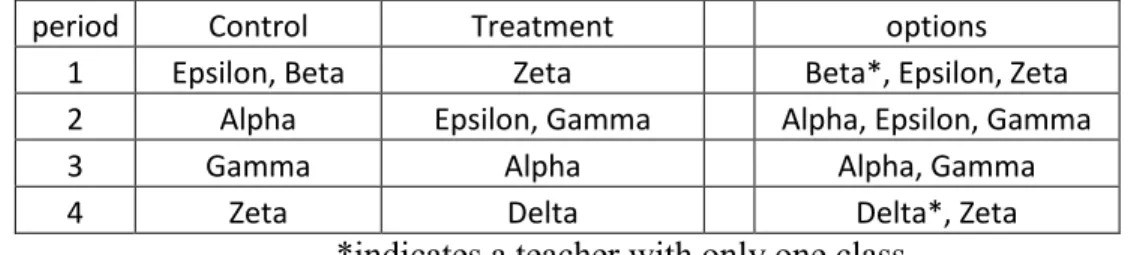
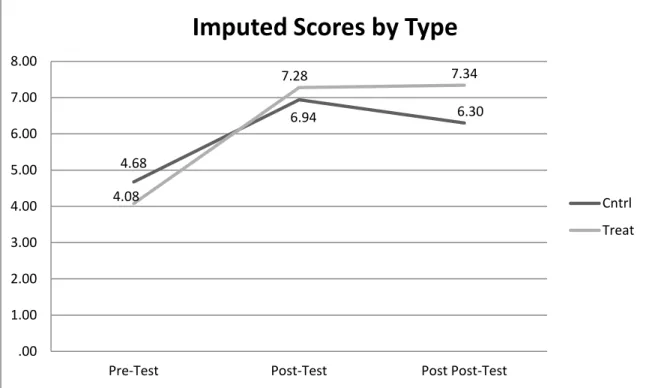
The results from four teachers, each with one treatment class using the TI-Nspire and one control class using a non-graphing scientific calculator, were significant on the pre-test with the control group having a higher mean score than the treatment group and statistical significance on the post post-test with the treatment group having a higher mean score than the control group. While there was a statistically significant effect of Teacher Zeta on the post-post test in comparisons with the other teachers, most of the teacher effect was controlled for within the design of the study. To control for teacher effect, all teachers taught both a treatment and a control class. For each teacher, one of their two algebra classes was randomly assigned to treatment and the other was then assigned to control. There was not enough power in the data to properly analyze the effect of socioeconomic status and special education.
This study supports the use of TI-Nspire graphing calculators in Algebra
TABLE OF CONTENTS
PAGE
Dedication ... iii
Acknowledgements ... iv
Abstract ... vii
List of Tables ... xiv
List of Figures ...xv
Chapter 1: Introduction ...1
Introduction ...1
Technology within the classroom ... .3
Mathematics Learning ...4
Need for the Study ...5
Overview of Study ...7
Statement of Problem ...8
Purpose of Study ...9
Research Questions and Hypotheses ...9
Research Questions ...10
Null Hypotheses ...11
Definitions of Terms ...11
Significance of the Study ...12
Organization of the Dissertation ...13
Introduction ...14
Importance of Mathematics ...15
Historical Framework: School Mathematics ...21
Historical Framework: Learning ...29
Historical Framework: Technology ...32
Historical Framework: Technology in Learning ...33
Calculators as Learning Tools ...38
Chapter 3: Methodology ...45
Introduction ...45
Research Design...46
Participants ...48
Population and Sampling ...48
Demographics ...52
Instruments ...56
Content Validity ...57
Internal Reliability ...61
Professional Development ...63
Treatment ...65
Data Collection Procedures ...73
Data Analysis Procedures ...75
Summary ...75
Chapter 4: Results ...78
Student Outcomes ...88
Vignettes ...102
Teacher Alpha ± Control Class ...103
Teacher Alpha ± Treatment Class ...110
$FURVV7HDFKHU$OSKD¶V7reatment and Control Classes ...117
Teacher Epsilon ± Control Class...121
Teacher Epsilon ± Treatment Class ...128
$FURVV7HDFKHU(SVLORQ¶V7UHDWPHQWDQG&RQWURO&ODVVHV ...135
Teacher Gamma ± Control Class ...139
Teacher Gamma ± Treatment Class ...147
$FURVV7HDFKHU*DPPD¶VTreatment and Control Classes ...154
Teacher Zeta ± Control Class ...158
Teacher Zeta ± Treatment Class ...165
$FURVV7HDFKHU=HWD¶V Treatment and Control Classes ...171
Summary of Control Classes ...174
Summary of Treatment Classes ...176
Summary of Results ...179
Quantitative Summary ...180
Qualitative Summary ...182
Conclusion ...189
Chapter 5: Discussion ...194
Introduction ...194
Overall Findings...201
Limitations of the Study...204
Implications...205
Recommendations ...212
Summary ...214
References ...216
Appendices ...238
LIST OF TABLES
TABLE PAGE
1. ACT Composite Averages ...54
2. Eagle High School SAT Averages ...54
3. Eagle High School Algebra I Gateway ...55
4. Eagle High School Dropout and Graduation Rates ...55
5. Results of Content Validity Analysis ...60
6. Internal Reliabilities for Algebra I Clusters and Complete Assessment ...62
7. Internal Reliabilities for Geometry Clusters and Complete Assessment ...62
8. Internal Reliabilities for Algebra II Clusters and Complete Assessment ...63
9. Teachers Educational Background ...72
10. Original Missing Data ...89
11. Missing Data when Comparing Tests ...89
12. Teacher and Type ...102
13. Depth of Knowledge Noted During Classroom Observations ...186
LIST OF FIGURES
FIGURE PAGE
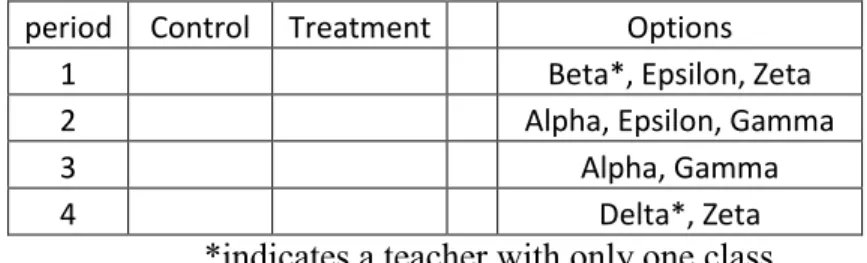
1. Assignment of Treatment Chart ...51
2. Final Treatment Assignment ...52
3. Treatment Class Questionnaire ...70
4. Control Class Questionnaire ...70
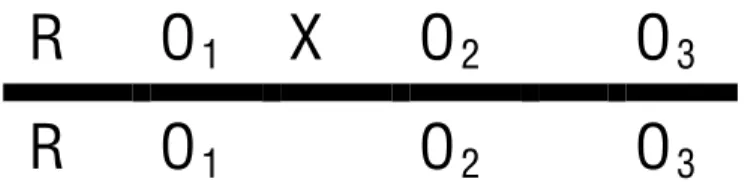
5. Quasi-experimental design...79
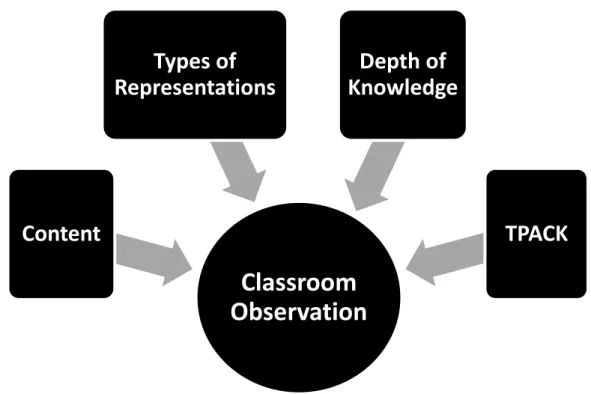
6. Observation Categories ...85
7. Questionnaire Categories ...87
8. Original Scores by Type for Each Test ...91
9. Pooled Imputed Scores by Type for Each Test ...93
10. Original Scores for Each Teacher by Test ...94
11. Pooled Imputed Scores for Each Teacher by Test ...95
12. Original Scores for Each Test by Teacher and Type ...97
13. Pooled Imputed Scores for Each Test by Teacher and Type ...98
14. Average Way of Representing an Activity During Observation ...183
15. Average Way of Representing an Activity Within Lesson Plans ...184
16. Average Depth of Knowledge During Observations ...185
17. Average Depth of Knowledge from Lesson Plan Analysis ...187
C H APT E R 1 IN T R O DU C T I O N
IN T R O DU C T I O N
7KHWHFKQRORJLFDOZRUOGLQZKLFKWRGD\¶VVWXGHQWVDUHJURZLQJXSLVYHU\
different from the one in which their parents grew up. In the late 1960s, the launch of Sputnik spurred the United States into a race for space that incorporated, improved, and advanced mathematics that was used in science, engineering, and new technologies. After having been to the moon and helping create the International Space Station, the United States Space Program must again take a renewed look at where we stand in this key area. While mathematics is important to space and engineering, as a society we must also be aware of the current status of mathematics within our classrooms. The 1997 Third International Mathematics and Science Study (TIMMS) study (Tarr, Uekawa, Mittag, & Lennex, 2000) showed that in the United States there was a gap between fourth
JUDGHVWXGHQWV¶SHUIRUPDQFHDQGIRXUWKJUDGHUVIURPvarious other countries around the world. The study went on to show that this gap widens when comparing our eighth grade students¶ performance (Tarr et al., 2000).
WHFKQRORJ\LVDQHYHUSUHVHQWSDUWRIRXUGDLO\OLYHV7RGD\¶VVWXGHQWVKDYHQHYHUNQRZn a time without cell phones, microwaves, or the internet. The National Council of
Teachers of Mathematics (2000) recommends that the availability of technology supports the need for new ways to teach, while integrating this technology into the classroom.
History shows there have been many types of ³WRROV,´ such as the abacus, that
KDYHEHHQXVHGWR³GR´ mathematics computations (Maxfield & Brown, 1997; Rostky, 1997). The slide rule of the 17th century dominated and was the tool of choice for the next 300 years (Museum of HP Calculators, 2004). The need for accuracy brought about the Pascaline in 1643, which was the first mechanical adding device used for practical purposes (Redin, 2004a). In the late 17th century, Gottfried Leibniz designed a machine that would add, subtract, multiply, and divide. William Burroughs is credited with the first practical calculator that was really an adding machine that included a full keyboard and had printing capabilities (Rostky, 1997). In 1963, Sumlock Comptometer of England introduced the first fully electronic calculator called the ANITA, meaning A New
Inspiration to Arithmetic (Redin, 2004b).
With the invention of the transistor, the electronic calculator exploded on the scene. In 1964, gas-discharged tubes were used to help create the first almost-all-transistor calculator (Rostky, 1997). Canon and Texas Instruments came on the scene
DQGLQWURGXFHGWKH³3RFNHWURQLF´LQWR-DSDQDQGLQWRWKH8QLWHG6WDWHV
the slide rule obsolete, but the scientific calculator completed the process. Casio introduced the first graphing calculator in 1986 (Waits & Demana, 1998).
In 1998, handheld technology took an amazing leap when Texas Instruments started using flash technology for the purpose of updating a calculators¶ operating
system. In time, this same flash technology has allowed programs to be written within an individual calculator and to share these applications between calculators, or to be
downloaded from computers (Waits & Demana, 1998). This flash technology created a
WLPHZKHQ³SRUWDEOHDQGDIIRUGDEOHFRPSXWHUVZLWKSHGDJRJLFDOVRIWZDUHGHVLJQHGWR
HQKDQFHWKHWHDFKLQJDQGOHDUQLQJRIPDWKHPDWLFV´:DLWV& Demana, 1998, p. 2) were made readily available and practical for the classroom teacher.
T E C H N O L O G Y W I T H IN T H E C L ASSR O O M
What started with a chalkboard and slate has now progressed to computers and projectors. Along the way, there have been many other devices such as the slide rule, overhead projector, chalk dust graph grid, protractor, printer, and copier to name a few. Teachers used such items for instruction and allowed students to use them for
computations. The handheld calculator came into the classroom and progressed from the basic four function device to scientific, to graphing, and, finally, to computer algebra systems. The use of such items varies from classroom to classroom, subject area, and school district.
With technology such as the ditto master, teachers were able to provide
well as immediate feedback to work. Today a student can take a mathematics class virtually and never step into the classroom or meet the teacher face to face.
The development of the overhead projector enabled teachers to have pre-made notes that allowed for easier lectures while teachers faced the students. This allowed teachers to have problems worked out step by step that they could show simply. A teacher could present a problem and, as students worked on the problem, circulate the classroom to check on progress and understanding. Then the instructor could then show the completed answer, which was prepared in advance, on the overhead for the students to see the entire process, thus saving time within the classroom. This also allowed for more teacher interaction among the students as they worked the problems.
As calculators have become increasingly more common, they have made their way into the classroom, soon followed by computers as well. Advances with calculators have produced devices that allow students to see the teachHU¶VYLHZVFUHHQWRXQGHUVWDQG
the process the teacher uses with the calculator. Graphing calculators allow the teacher to use graphs with extreme accuracy, precision, and repeatability in a short period of time. There are also projection devices available that show a dual screen. One screen shows the actual keystrokes that were input on the calculator, while the other shows what the calculator screen would actually be doing. The dual screen allows for students to easily follow along and to literally see where they are in the process.
M A T H E M A T I CS L E A RNIN G
³GULOODQGNLOO´RUWUDGLWLRQDO where student complete multiple problems over and over to help students master the concept (Waits & Demana, 1998, pg 5).
Another theory about learning reform mathematics involves the Theory of Constructivism. In this approach students are engaged in activities where they actually construct or discover the mathematical knowledge by building relationships out of the material presented. This theory allows students to be the processor of knowledge by creating their own methods of learning and understanding mathematics.
The recent use of computers, projectors, and interactive white boards continue to make teaching more interactive and user friendly, allowing the teacher more time to circulate around the classroom and assist students, all the while continuing the lecture while standing away from the board. This new technology also allows for more student led discussion and activity within the class. The ability to do many problems in a short period of time allows topics to be looked at in-depth and students are allowed to
³GLVFRYHU´KRZPDQLSXODWLQJDQHTXDWLRQDIIHFWVDJUDSK
N E E D F O R T H E ST UD Y
As technology advances at lightning speed, mathematics performance and achievement in scKRROV³VKRUWFKDQJHVRXUVWXGHQWV¶IXWXUHDQGHQGDQJHUVRXUSURVSHULW\
DQGRXUQDWLRQ¶VVHFXULW\´8QLWHG6WDWHV'HSDUWPHQWRI(GXFDWLRQD, p. 1). In
Principles and Standards, the National Council of Mathematics Teachers includes technology as one of ³WKHVL[SULQFLSOHVIRUVFKRROPDWKHPDWLFV´1&70p. 10). These principles are not specific content or process, but are critical issues within schools. NCTM espouses, ³7HFKQRORJ\LVHVVHQWLDOLQWHDFKLQJDQGOHDUQLQJPDWKHPDWLFVLW
p. 11). The interaction between the six principles and the standards will help to develop high quality school mathematics programs (NCTM, 2000).
7KH3ULQFLSOHVDQG6WDQGDUGVVWDWHWKDWWHFKQRORJ\³HQKDQFHVPDWKHPDWLFDO
OHDUQLQJ´1&70p. ³VXSSRUWVHIIHFWLYHPDWKHPDWLFVWHDFKLQJ´1&70
2000, p. DQG³LQIOXHQFHVZKDWPDWKHPDWLFVLVWDXJKW´1&70p. 25). The Principles and Standards (NCTM, 2000) goes on to say that students can make and test conjectures and work at higher levels of generalization or abstraction within a
technologically-enhanced instructional environment.
A review of the literature on the impact of technology on mathematics teaching and learning found significant evidence that calculators, both scientific and graphing, are being used within the mathematics classroom. In particular, several studies focused on graphing calculators at the elementary level (Fleener, 1995a), middle school level (Fleener, 1995b; Merriweather & Tharp, 1999), and high school level (Doerr & Zangor, 2000; Farrell, 1996; Fleener, 1995a; Fleener, 1995b; Goos, Galbraith, Renshaw & Geiger, 2000; Huntly, Rasmussen, Villaruni, Sangtong & Fey, 2000; Kendal & Stacey, 1999; Lauten, Graham, & Ferrini-Mundy, 1994; Lloyd & Wilson, 1998; Slavit; 1996, Thompson & Senk, 2001). Research exists at the college level regarding the use of graphing calculators in college classes (Adams, 1997; Hollar & Norwood, 1999; Keller & Hirsch, 1998; Keller & Russell, 1997; Keller, Russell, & Thompson, 1999; Lauten, Graham, & Ferrini-Mundy, 1994; Quesada & Maxwell, 1994; Shoaf-Grubbs, 1994; Slavit, 1998; Zbiek, 1998). This review of the research revealed little, if any, research on the use of graphing calculators within the first year of algebra in high school. If
Mathematical Society, 1994), then research needs to be done to investigate what level of technology needs to be used as well as what technology is effective. This evidence-based research can then be disseminated to have teaching that works within the classroom.
O V E R V I E W O F ST UD Y
In this southern state, all high school students are required to take four years of high school mathematics. Algebra I is the lowest level of mathematics a student can take to obtain a credit towards high school graduation. For most students, this is typically their first course in mathematics in high school.
This study took place at ³Eagle High School,´ a comprehensive four-year high school, located in this southern state. Eagle High School has a current enrollment 1673 students and is on the block scheduling format. Block scheduling provides an extended period for a class and fewer classes each day. Different types of block scheduling allow for variations in student schedule such the classes attended each day were alternated, the classes could be completed within one semester, or were a combination or both block scheduling and traditional scheduling. At Eagle High School, the block scheduling format provided four classes each day that met for ninety minutes within each class period. Specifically, the teachers selected taught Algebra I, which is the first year of algebra for a high school student. Utilizing data and statistics from the VRXWKHUQVWDWH¶V
Department of Education, the school was categorized by socio-economic status, racial demographics, and location within Chapter 3.
This study was a quasi-experimental study. For the quantitative portion the researcher gathered and analyzed WHDFKHUV¶FODVVSUH-test averages and compared them
Teachers were selected to teach their classes either with or without the utilization of a TI-Inspire calculator. The study used the Kentucky High School Diagnostic Mathematics Assessment Tool for Algebra, which had been created and developed by the University of Louisville and was being used by the Kentucky Department of Education. There were three versions of this test. These three different versions were used for the pre-test, post-test, and post post-test. The test addressed the use of functions within algebra. For the qualitative portion of this study, the research completed a 90 minute classroom
observation of each class as well as document analysis of a weekly questionnaire, daily lesson plans, and daily assessments. Document analysis, triangulation, and thick description were used to analyze the qualitative portion of the study.
ST A T E M E N T O F PR O B L E M
There has been a rapid change in technology that has occurred in the past thirty years. The launch of the calculator has changed the emphasis of mathematics in school classrooms. Rather than spending the majority of time on rote and procedural learning, teachers and students can now apply such answers to situations and problems in real life. A once difficult task of mathematical computation has been simplified to a combination of punching buttons. With the realization of the dreams of Babbage and Leibniz, the computing machine is available to the common man in many shapes and formats from desktop, pocket, watch, and hand held formats (Davis, 2000). With the advances in technology, there are increased opportunities for their employment within the mathematics classroom (Privateer, 1999).
within the mathematics classroom environment lead to increased student understanding. Instructional technology used in the classroom needs to be thoughtfully selected,
appropriately used, and pedagogically sound. Sang Sook Choi-Koh says that the
³XQLYHUVDODYDLODELOLW\RIWHFKQRORJ\LVKDYLQJDSURIRXQGLPSDFWRQZKDWVKRXOGEH
WDXJKWLQPDWKHPDWLFVFXUULFXODDQGKRZPDWKHPDWLFVSURFHVVHVVKRXOGEHWDXJKW´&KRL
-Koh 2003, p. 1).
The questions for educators today, regarding the TI-Nspire calculator, are the same questions that faced educators when the four function calculator and the scientific calculator were made available (Waits & Demana, 1998). Does one allow students to use the TI-Nspire calculators? If so, when and how much does one allow them to use them? What effect does the calculator have on how the students learn and what the students learn? Under what circumstances should students be allowed to use them? What is the impact on assessment, testing, and on content that is taught?
PU RPOSE O F ST UD Y
The purpose of this study was to determine the effect of the implementation of the TI-Nspire graphing calculators on student achievement and teacher behavior variables of teacher planning, teacher teaching, and assessments used. With the many variables that exist within the classroom, the design of this study sought to control for as many factors as possible while investigating the treatment of the use of a TI-Nspire graphing calculator by a trained teacher while teaching the concept of functions with respect to
representations, Depth of Knowledge, and TPACK.
R ESE A R C H Q U EST I O NS A ND H YPO T H ESES
Research Questions
1) Was there a difference in student test scores on function concepts in Algebra I classrooms that used TI-Nspire graphing calculators versus those who did not use this device? The independent variable was treatment and the dependent variables were the pre-test, post-test, and post post-test.
a. Treatment Effect b. Teacher Effect
c. Interaction of Teacher and Treatment
d. Factors: special education status and socioeconomic status
2) Did the use of TI-Nspire graphing calculators affect the way teachers taught function concepts in Algebra I classrooms with respect to representations, Depth of Knowledge, and TPACK? The independent variable was treatment and the dependent variables how teacher taught.
3) Did the use of TI-Nspire graphing calculators affect the way teachers planned lessons for function concepts in Algebra I classroom with respect to
representations, Depth of Knowledge, and TPACK? The independent variable was treatment and the dependent variables how teacher planned. 4) Did the use of TI-Nspire graphing calculators affect the way teachers assessed
Null Hypothesis
The above research questions were the basis for this study and lead to the
following null hypothesis: There was no statistically significant difference in student test scores on function concepts in Algebra I classrooms that used TI-Nspire graphing
calculators versus Algebra I classrooms that did not use this device. There was no difference in the way teachers taught function concepts in Algebra I classrooms that used TI-Nspire graphing calculators versus Algebra I classrooms that did not use this device with respect to representations, Depth of Knowledge, and TPACK. There was no difference in the way teachers planned lessons for function concepts in Algebra I
classrooms that used TI-Nspire graphing calculators versus Algebra I classrooms that did not use this device with respect to representations, Depth of Knowledge, and TPACK. There was no difference in the way teachers assessed students on functions concepts in Algebra I classrooms that used TI-Nspire graphing calculators versus Algebra I
classrooms that did not use this device with respect to representations, Depth of Knowledge, and TPACK.
D E F INI T I O NS O F T E R MS
Algebra I ± the first year of algebra taken by a high school student. The following is a description taken from various southern states¶ Department of Education:
Algebra I is a formal, in-depth study of algebraic concepts and the real number system. In this course students develop a greater understanding of and appreciation for algebraic properties and operations. Algebra I
reinforces concepts presented in earlier courses and permits students to explore new, more challenging content which prepares them for further study in mathematics. The course focuses on the useful application of course content and on the development of student understanding of central concepts. Appropriate use of technology allows students opportunities to work to improve concept development. As a result, students are
empowered to perform mathematically, both with and without the use of technological tools (Alabama State Department of Education, 2006). In Algebra I, students build upon the mathematical understandings that are addressed in prekindergarten through the eighth grade. Students will use symbolic reasoning to represent mathematical situations, to express generalizations, and to study relationships among quantities; use functions to represent and model problem situations as well as to analyze and interpret relationships; set up equations in a wide range of situations and use a variety of methods to solve them; and use problem solving,
representation, reasoning and proof, language and communication, and connections both within and outside mathematics. In Algebra I, hand-held graphing calculators are required as part of instruction and assessment. Students should use a variety of representations (concrete, numerical, algorithmic, graphical), tools (matrices, data), and technologies to model mathematical situations to solve meaningful problems. The technologies include, but are not limited to, powerful and accessible hand-held calculators as well as computers with graphing capabilities (South Carolina State Department of Education, 2009).
Ditto master ± machine that used carbon paper for the purpose of making mass production of worksheets.
Mathematical knowledge ± the relating and utilization of mathematics that is used to construct, develop, and relate analogies, illustrations, multiple ways of doing mathematic problems
SI G NI F I C A N C E O F T H E ST UD Y
within the mathematics classrooms. Significance would also promote more Algebra I teacher training and professional development with the use of TI-Nspire calculators.
O R G A NI Z A T I O N O F T H E DISSE R T A T I O N
This study is organized into five chapters. Chapter 1 is the introduction of the study and provides the background, history and development of technology. Chapter 2 contains the literature review regarding key research as related to the study. Chapter 3 consists of an explanation of the methodology that was used to test the hypotheses. Chapter 4 includes and describes the quantitative results of the study. Chapter 5, the final chapter, consists of conclusions, implications, and suggestions for needed further
research.
SU M M A R Y
C H APT E R 2 L I T E R A T UR E R E V I E W
IN T R O DU C T I O N
Long gone are the days of getting the news by only watching the evening news or reading the QHZVSDSHU$VWKHZRUOGFRQVWDQWO\FKDQJHVWRGD\¶VQHZVFDQEHDFFHVVHG ZLWKGDLO\XSGDWHVVHQWWRRQH¶VEODFNEHUU\ZDWFKHGRQ&11DURXQGWKHFORFNRUIRXQG
instantly via the internet. Checking out from the local store is less about counting change and more about processing with a computer. If students are not prepared to be productive members in this ever changing global and technical society, is education really
succeeding? In a society with ever increasing technology, it seems fitting to incorporate that technology into the classroom. Since technology has its base within mathematics, mathematics should be the starting place to the integration of technology into the classroom (Heid, 1997).
separate the creation and induction of technology into practical education and use within the classroom (Privateer, 1999). Vogel and Klassen (2001) state that content changes so much that it can become outdated before a student even graduates.
I MPO R T A N C E O F M A T H E M A T I CS
Mathematics has always held importance in society for the purpose of trade, industry, and business. In the early days of the United States, the main textbooks were imported from England, and mathematics was taught for the understanding of weights, measurements, navigation, and bookkeeping. However, over time, the importance of mathematics has greatly increased.
According to Jones and Coxford (1970), in 1726, arithmetic and surveying were the only mathematics taught at Yale. By 1776, algebra and trigonometry were added to the course selection available at Yale. By the end of the 18th century, the rise of science created a new demand for increased need for mathematics which was reflected in new curricula in the early 19th century at such colleges as Princeton, West Point, and Virginia. In 1820, Harvard began requiring algebra for admission. This was soon followed by Yale in 1847 and Princeton in 1848 (Jones & Coxford, 1970).
With the emergence of mathematics into the curriculum came organizations that helped to shape the role of mathematics. In 1888, the American Mathematical Society was created to unite mathematics teachers within already established teacher
organizations. In 1892, the National Education Association formed the Committee of Ten (Osborne & Crosswhite, 1970). In 1920, the National Council of Teachers of
mathematics was taught. With academic mathematics, students would complete algebra, geometry, trigonometry and another year of algebra. This led to the requirements of algebra, geometry and trigonometry being the basis within high school for college admission. (Osborne & Crosswhite, 1970).
With the many changes occurring on the collegiate level, things had to change at the grammar school level as well. Part of this was accommodated with the creation of a new type of secondary school, which is now called high school, in 1821. The mid-19th century saw a booming increase in these high schools. As colleges continued to push down requirements such as arithmetic, algebra, and then geometry, the secondary schools started doing the same. By the end of the 19th century, the teaching of arithmetic was pushed down from the secondary school to the elementary school (Jones & Coxford,
³$UHPDUNDEOHQRWLRQKDGHPHUJed around 1900: that schooling could make the
ordinary office clerk, shop-IORRUZRUNHUDQGHYHQWKHIDUPHUPRUHSURGXFWLYH´*ROGLQ
2003).
With the occurrence of the two world wars, there was a realization of the need for a greater knowledge of mathematics. The wars served to revitalize the need for
mathematics to the public not only in war time, but also demonstrated the everyday benefits of communications and electronics for peace time. The post-war society was readily becoming a scientific society. Not only were people concerned with atomic energy, missiles, and radar, but other educational disciplines, such as psychology and sociology, were utilizing mathematics for the creation of models and in calculating statistics (Jones & Coxford, 1970).
With the Cold War and the launch of Sputnik in 1957, public attention was
quickly turned to the educational needs of the United States (United States Department of Education, 2009). The government realized the need to increase support, in particular, financially. In 1958, the passing of the National Defense Education Act by President Eisenhower provided much needed funding for mathematics and science. Parts of this act provided student loans, funding to strengthen science, mathematics and modern foreign language instruction, and the identification and encouragement of able students (Flattau, Bracken, Atta, Bandeh-Ahmadi, de la Cruz, & Sullivan, 2006).
of Education, Engineering, and Liberal Arts and Sciences of the University of Illinois was the University of Illinois Committee on School Mathematics, UICSM (Golden, 2006).
With the two large-scale projects of SMSG and UICSM came curricula and materials that expressed a more modern view and role of mathematics. In the mid-1960s, the Secondary School Mathematics Curriculum Improvement Study (SSMCIS) and the Comprehensive School Mathematics Program (CSMP) created additional curricula (Fey & Graeber, 2003). The focus of these curricula was less about computation and more about conceptual understanding (Garrett & Davis, 2003). Out of UICSM, a four-year high school curriculum was created that addressed the mathematical content and the aspect of teaching philosophy. This, in turn, led to an increased focus of the importance of teaching strategies (Osborne & Crosswhite, 1970).
The 1970s brought many changes including the emphasis on arithmetic and algebra and increased standardized testing. The new curriculum developed during this time included Individually Prescribed Instruction, IPI, and Developing Mathematical Processes, DMP, (Fey & Graeber, 2003). The National Assessment of Educational Progress, NAEP, was created in 1969, for the purpose of assessing various subject areas within the educational curriculum across the nation. NAEP tests students in fourth grade, eighth grade, and twelfth grade. From these assessments came data for thH1DWLRQ¶V 5HSRUW&DUGDVZHOODVLQGLYLGXDO6WDWH¶V5HSRUW&DUGV8QLWHG6WDWHV'HSDUWPHQWRI
Education, 2008).
PRISM, to collect the beliefs and reactions to potential curriculum (National Council of Teachers of Mathematics, 1981). The results of the PRISM project, as well as the first two NAEP results, were the driving forces that created the Agenda for Action:
Recommendations for school mathematics of the 1980s (National Council of Teachers of
Mathematics, 1980). There were eight recommendations from the Agenda for Action: problem solving as the focus of school mathematics, basic skills to include more than computation, use of calculators and computers and their full advantage at all grade levels, standards for teaching mathematics, evaluation of mathematics programs and student learning to include more than testing, flexible curriculum and more research, high level of professionalism for mathematics teachers, and public support for mathematics instruction (National Council of Teachers of Mathematics, 1980).
As newly elected President Ronald Reagan reduced funding for education, organizations sought out ways to increase educational awareness. In 1983, the National
6FLHQFH%RDUG16%FRPPLVVLRQHGDVWXG\RQWKHQDWLRQ¶VHGXFDWLRQDOQHHG7KH
National Council for Teachers of Mathematics also released a statement in 1981 stating that the federal government needed to take a role in teacher preparation and research, among other things. While these basically went unnoticed by the presidential
While A Nation at Risk did not bring increased federal support, it did stimulate concern about the quality of education in the United States. McLeod (2003) states that meetings held because of A Nation at Risk were important to the development of the NCTM Standards Project. In 1989, NCTM produced the Curriculum and Evaluation Standards for School Mathematics. The Curriculum and Evaluation Standards was
divided into three grade levels: K-4, 5-8, and 9-12 (NCTM, 1989). It was followed by the release of Professional Standards for Teaching Mathematics in 1991 and Assessment Standards for School Mathematics in 1995. The Professional Standards contained
standards for teaching mathematics, evaluating the teaching of mathematics, the
professional development of teachers and mathematics, and the support and development of mathematics teachers and teaching (NCTM, 1991).
While the 1989 Standards provided a foundation for both teachers and
policymakers regarding mathematics education, NCTM felt the need to keep them viable through periodic examination and revisions as necessary. After a decade of discussions, NCTM (2000) released Principles and Standards for School Mathematics, PSSM. PSSM was built on the foundation of the 1989 Standards, but it also incorporated the classroom portion of both Professional Standards for Teaching Mathematics and Assessment Standards for School Mathematics (NCTM, 2000).
While the importance of mathematics has mushroomed over the years, the need
IRUEDVLFDULWKPHWLFLVQRWWKHHQGWRRQH¶VHGXFDWLRQEXWPHUHO\WKHEHJLQQLQJRILW7KH
school. The day of technology is here, and the need for higher mathematics learning came with it.
H IST O RI C A L F R A M E W O R K : SC H O O L M A T H E M A T I CS
TKUHH³5V´RIHGXFDWLRQKDYHORQJEHHQUHDGLQJZULWLQJDQGDULWKPHWLFKRZHYHU
there have been many changes in arithmetic. While in the early grades, dealing with arithmetic can be associated with working with numbers. Numbers are all around us. One of the first tasks children use relating numbers is displaying the number of fingers that corresponds with their age. Whether looking at a clock to tell time, reciting their phone number, learning an address or counting the number of chicken nuggets in a happy meal, children are constantly bombarded with numbers that can easily be formulated into the arithmetic content (Usiskin, 2002).
Arithmetic is now more commonly called mathematics as it has been expanded within the curriculum to include more topics. When dealing with fractions, decimals, percents, addition, and subtraction, people recognize this as the use of mathematics within their daily lives. Usiskin (2002) states that while arithmetic is more about
numbers, people can see the direct need just by picking up a daily newspaper. Adults use fractions, decimals, and percents in many areas of life from recipes, bills, taxes or
discounts while shopping. Russell, Geddes, and Grosset (1990) define mathematics as
³WKHVFLHQFHGHDling with quantities, forms, etc. and their relationships by the use of
QXPEHUVDQGV\PEROV´5XVVHOO*HGGHV *URVVHWp. 336).
divide the algebra curriculum into different sections. Kieran (1989) suggests that algebra starts with variables, simplifying algebraic expressions, solving equations with one unknown and eventually solving multiple variable equations. Thorpe (1989) describes the main topics of algebra as the real number system, relations, functions, graphs, algebraic manipulations, word problems, quadratic formulas, complex numbers, tables, and interpolation, and systems of linear equations.
Within mathematics, there are many specific content areas across the curriculum from K-16. In particular, in elementary schools the curriculum focuses on arithmetic, while in middle school and high school, the curriculum transitions into the concepts of algebra, geometry, and some calculus. In the post-secondary setting, algebra, calculus, and beyond are explored. Recently, efforts have led to a model of algebra that spans grades K-12 (Carpenter, Franke, & Levi, 2003; Kaput, Carraher, & Blanton, 2007; & RAND Mathematics Study Panel, 2003).
7KH1&70¶VAgenda for Action (1980) called for problem solving to become an
important activity within the mathematics classroom. Middleton, Dougherty, Heid,
'¶$PEURVLR5H\VGH/RDFK-Johnson, Gutstein and Hala (2004) credit the Agenda for
$FWLRQDVEHLQJWKH³ILUVWVWHSLQSHUKDSVWKHJUHDWHVWDQGORQJHVW-lasting ferment of educational research and development ever (certainly since the early post-Sputnik dD\V´
(p.76). Within the Assessment Standards for School Mathematics, NCTM created five general goals for all students: (1) that they learn to value mathematics, (2) that they become confident in their ability to do mathematics, (3) that they become mathematical problem solvers, (4) that they learn to communicate mathematically, and (5) that they learn to reason mathematically (NCTM, 1995).
In looking at state mathematics requirements, several states have required that every high school graduate must pass at least an entry level algebra course in order to graduate. Recently, Tennessee conducted a high school redesign to implement more stringent requirements in the field of science, technology, engineering and mathematics, STEM. This new redesign requires students to successfully take a mathematics class each of their four years in high school. Tennessee further strengthened their
mathematical requirements by recognizing the first year of algebra as the lowest level of high school mathematics that will be honored as credit towards a high school diploma (Tennessee Department of Education, 2009). This is a huge shift from algebra being the gatekeeper (Hill, Griffiths, Bucy, et al., 1989; Stone, 1996; Atanda, 1999; Rech & Harrington, 2000; Usiskin, 2004; Seeley, 2005; & Norfolk Public Schools, 2006).
the need for reaching students with mathematics and the need for raising mathematics achievement, it is important to take a deeper look at algebra. According to Jones and Coxford (1970) during colonial times, mathematics, even at the college level, focused very little on algebra. Osborne and Crosswhite (1970) go on to say that students mainly studied algebra for the purpose of getting into college. At the college level, in a typical mathematics textbook of 429 pages, only 8 % or 33 pages were devoted to the study of algebra (Jones & Coxford, 1970).
In 1981, NCTM released the results of the PRISM project which provided several insights into the way aOJHEUDZDVWDXJKW³6WURQJVXSSRUWZDVJLYHQWRIRXUJRDOVIRU
teaching algebra: these concerned applying mathematics, building background for taking
PRUHPDWKHPDWLFVJDLQLQJYRFDWLRQDOVNLOOVDQGSUHSDULQJIRUFROOHJH´1&70p.
9). Strong support was also shown for the algebraic topics of signed numbers, evaluating formulas, linear equations, writing equations to solve word problems, and exponents in the curriculum for all students (NCTM, 1981). Furthermore, the PRISM project reported
WKDWWHDFKHUV³WRWDOO\UHMHFWHG´WKHLGHDRIGURSSLQJIRUPDOZRUNZLWKalgebra from the curriculum (NCTM, 1981, p. 10). PRISM also reported that while the use of calculators was strongly supported for checking answers within an algebra class, the use of
calculators during an algebra test were quite mixed as to agreement and rejection (NCTM, 1981).
WZHOIWKJUDGHFXUULFXOXPLQVXFKDZD\WKDWDOOVWXGHQWVDUHDEOHWR³XQGHUVWDQGSDWWHUQV
relations, and functions; represent and analyze mathematical situations and structures using algebraic symbols; use mathematical models to represent and understand
TXDQWLWDWLYHUHODWLRQVKLSVDQGDQDO\]HFKDQJHLQYDULRXVFRQWH[WV´1&70p. 36).
PSSM goes on to say that within the Algebra Standard, the emphasis should be on the
relationships between quantities, representing relationships, and the analysis of change. PSSM VSHFLILFDOO\VWDWHVWKDWWKH³IXQFWLRQDOUHODWLRQVKLSVFDQEHH[SUHVVHGE\XVLQJ
symbolic notation, which allows complex mathematical ideas to be expressed succinctly
DQGFKDQJHWREHDQDO\]HGHIILFLHQWO\´1&70 p. 36).
Russell (1990, p. 28) defines aOJHEUDDV³WKHEUDQFKRIPDWKHPDWLFVGHDOLQJZLWK WKHSURSHUWLHVDQGUHODWLRQVRIQXPEHUVWKHJHQHUDOL]DWLRQDQGH[WHQVLRQRIDULWKPHWLF´
Fey (1989) stated that algebra should be the core of the high school mathematics curriculum because of its contribution to problem solving, which is used in every scientific discipline. Kieran (1992) stated that the content of algebra has not changed
VLJQLILFDQWO\KRZHYHU³PDWKHPDWLFVDQGLWVDSSOLFDWLRQVKDYHFKDQJHGGUDPDWLFDOO\´
(Thorpe, 1989, p. 11). The need for algebra goes beyond the need to gain entrance into college, although colleges continue to use algebra as a gatekeeper and placement tool (Atanda, 1999; Usiskin, 2004; & Norfolk Public Schools, 2006).
be seen as a means of representation with an emphasis on conceptual understanding and problem solving (NCTM, 1989).
Recently, there has been a push to have algebra included across all levels of the mathematics curriculum. In a position statement from the National Council of Teachers of Mathematics, algebra was described as
³«a way of thinking and a set of concepts and skills that enable students to generalize, model, and analyze mathematical situations. Algebra provides a systematic way to investigate relationships, helping to describe, organize, and understand the world. Although learning to use algebra makes students powerful problem solvers, these important concepts and skills take time to develop. Its development begins early and should be a focus of mathematics instruction from pre-K through grade 12. Knowing algebra opens doors and expands opportunities, instilling a broad range of mathematical ideas that are useful in many professions and careers. All students should have access to algebra and support for learning it. (NCTM 2008, p.1).
The Algebra Project, Equity 2000, and Algebra for All advocated for the inclusion of algebra beyond the high school level and into elementary and middle school levels (Silva, Moses, Rivers, & Johnson, 1990; Choike, 2000; Pugalee, 2001; & NCTM, 2008). The
XQGHUO\LQJFRQYLFWLRQRI7KH$OJHEUD3URMHFWLVVXPPHGXSLQWKHLUVWDWHPHQWWKDW³DOO
The inclusion of functions into the mathematics curriculum occurred at the end of the 19th century. With the addition of graphs to geometry, other aspects of analytical geometry and calculus into the curriculum, functions were beginning to find their natural place (Hamley, 1934; Osborne & Crosswhite, 1970). Felix Klein is credited for pushing the concept of functional thinking as a part of mathematics in Germany. According to Hamley (1934), D. E. Smith and E. R. Hedrick were the first advocates of the function concept in the United States. The National Committee on Mathematical Requirements committed an entire chapter to the concept of functions at the high school level
(American Association for the Advancement of Science, 1922; & Osborne & Crosswhite, 1970). According to Hamley (1934), this chapter was a comprehensive overview
implying that functions were an integral part of formulas, equations, graphs, proportions,
FRQJUXHQFHDQGVLPLODULW\,QWKHVWKHFRQFHSWRIIXQFWLRQ³SHUPHDWHG´WKHalgebra
curriculum (Osborne & Crosswhite, 1970).
The concept of function is both essential and fundamental to the algebra curriculum and is considered by many to be the most important concept in all of
PDWKHPDWLFV+DPOH\)URHOLFK%DUWNRYLFK )RHUHVWHU 2¶&DOODJKDQ
1998). Within algebra, functions are typically represented as equations, tables or graphs (Fey, 1984). Hamley (1934) compares the concept of function to the concept of the
UHODWLRQDQGFODLPVWKDWWKH\DUHHOHPHQWDU\WRKXPDQWKRXJKW+HIXUWKHUVWDWHVWKDW³WKH
The familiarity of relations and functions is common among mathematics teachers (May & Van Engen, 1959; & Herscovics, 1989). Herscovics (1989) brought light to the
IDFWWKDWPRVWSULPDU\OHYHOWHDFKHUVXVHWKH³IXQFWLRQPDFKLQHV´ZLWK inputs and outputs (Herscovics, 1989, 7p. 5). When students solve problems such as + 3 = 10 or even x + 7 when x is 2, they may not realize that they are working with a function, but the
underlying concept is still there. Furthermore, function tables, two variable equations, and graphs also expose students to the intuitive concept of functions (Herscovics, 1989; & Blanton & Kaput, 2005). Mathematics now uses the concept of sets to define the terms of function and relation. Various examples of sets used in daily life include the height-weight and time-temperature. Within the realm of science, there are uses of linear, quadratic, polynomial, exponential, and other classes of functions. With these connections, the concept of functions can provide a more efficient and deeper understanding of the concept (May & Van Engen, 1959).
2¶&DOODJKDQFUHDWHGa framework for functions that had four conceptual areas: modeling, interpreting, translating, and reifying. Each conceptual area was associated with a set of procedural skills as well. The research of function was broken down into six themes in the Research in Colligate Mathematics Education (Dubinsky, Schoenfeld, & Kaput, 1994, 23):
1. Concept image and concept definition 2. Function as action, as process, and as object
3. Function as co-variation of quantities and function as correspondence 4. Understanding phenomena and representing phenomena
5. Operations on numbers and operations on functions 6. Emergent Issues
With the call for more mathematics in the curriculum, the level of mathematics continues to be pushed down. While algebra, still a gatekeeper course, is now the beginning course for many high school students, algebra is also being included in the elementary mathematics curriculum as well. With an increased focus on algebra, the fundamental concept of functions can be seen throughout all grade levels, therefore, serving as an ideal topic to research.
H IST O RI C A L F R A M E W O R K : L E A RNIN G
Three theories addressing how students learn are the Behavior Theory, the Cognitive Theory, and the Constructivist Theory. For the first half of the 20th century, the psychological learning theory was bHKDYLRULVP³%HKDYLRULVWVKHOGWKDWWKHVFLHQWLILF
study of psychology must restrict itself to the study of observable behaviors and the
VWLPXOXVFRQGLWLRQVWKDWFRQWUROWKHP´%UDQVIRUG%URZQ &RFNLQJp. 6).
Pavlov, Thorndike, and Bloom are three of the noted psychologist that dealt with
bHKDYLRULVP3DYORY¶VFRQGLWLRQLQJRUUHIOH[RORJ\WUDLQHGDGRJWRVDOLYDWHDWWKH
ULQJLQJRIDEHOO6DFNQHU\ 0HUJHO7KRUQGLNH¶VWKHRU\ZDVNQRZQDV
connectionism, but it is best remembered as the stimulus-response explanation of learning (Lankford, 1959).
While Pavlov and Thorndike are best known for stimulus-response, Bloom was
PRUHIRFXVHGRQWKHWKRXJKWSURFHVV(GXFDWRUVRIWHQXVH%ORRP¶V7D[RQRP\IRr the
SXUSRVHRIFODVVLI\LQJVWXGHQWV¶FRJQLWLYHDELOLW\7KHUHDUHVL[OHYHOVWR%ORRP¶V
widely accepted guides used to classifying cognitive ability (Granello, 2000). With an understanding of the different levels, teachers can design and ask specific questions that determine the level as well as compel students to achieve new levels. The Taxonomy of
(GXFDWLRQDO2EMHFWLYHVH[SDQGVRQ%ORRP¶V7D[RQRP\LQVXFKDZD\WKDWLWFDQEHXVHG
DVD³VFKHPHIRUFODVVLI\LQJHGXFDWLRQDOJRDOVREMHFWLYHVDQGPRVWUHFHQWO\VWDQGDUGV´
(Krathwohl, 2002, p. 218).
Behaviorism was unable to explain why a child did not respond as stimulated or why the child responded when they had not been stimulated. These and other
unanswered questions led to the development of the Cognitive Theory that viewed
OHDUQLQJDVLQYROYLQJWKH³DFTXLVLWLRQRUUHRUJDQL]DWLRQRIWKHFRJQLWLYHVWUXFWXUHV
through which humans process and store information" (Good & Brophy, 1990, p. 187). Tolman, Piaget, Bruner, and Gardner are some of the noted cognitive psychologists. Cognitive psychology focuses more on the intellectual development of a person, in particular how they acquire, process, and store information. For example, Tolman worked with rats and mazes. He discovered that the rats created a mental map of the maze. When a part of the maze was blocked off, the rats would take a different route that led to success (Sackney & Mergel, 2007).
Piaget studied the mental development of children. From his study, Piaget
LGHQWLILHG³IRXUVWDJHVRIFRJQLWLYHGHYHORSment: the sensorimotor, the preoperational,
WKHFRQFUHWHRSHUDWLRQDODQGWKHIRUPDORSHUDWLRQDO´6WLII-RKQVRQ -RKQVRQ, p.
6WLII-RKQVRQ -RKQVRQJRRQWRVD\WKDW3LDJHW¶VWKHRU\FHQWHUHGRQWKH
and other cognitive development theorists have provided the framework from which we have gained research on conceptual understanding (Wagner & Parker, 1993).
According to Stiff, Johnson, & Johnson (1993), Bruner created four theorems about learning mathematics: construction theorem, notation theorem, contrast and variation theorem, and the connectivity theorem. The first, construction, talks about how students are to create their own mathematical models. The second, notation, is that good use of notation can simplify the cognitive process when learning new materials. The third, contrast and variation, describes the process of going from concrete to abstract as one that varies based upon one¶s experiences. The fourth and last one, connectivity, describes how every mathematical concept, principle and skill are related to each other. These four theorems helped to support the constructivist view of cognition (Stiff, Johnson, & Johnson, 1993).
+RZDUG*DUGQHU¶VWKHRU\RIPXOWLSOH-intelligences provides a different view of human learning than that of Piaget. Gardner posited that there were seven intelligences: logical-mathematical, linguistic, musical, spatial, bodily-kinesthetic, interpersonal and intrapersonal (Gardner & Hatch, 1989). He stated that there are multiple ways to introduce concepts to students to take advantage of the variety of ways of knowing that students bring to the classroom (Gardner, 1995).
The writings of Dewey, Piaget, and Bruner helped to lay the ground work for constructivism (Mergel, 1998). The Constructivist Theory is based on the idea that students learn new information by scaffolding, which is building new knowledge upon previous knowledge (Long & Barrett, 2007). Brooks and Brooks (1999) go on to
DUHQHFHVVDU\ZLWKLQDVWXGHQW¶VFRJQLWLYHJURZWK%URRNV %rooks, 1999, p. 18). Within the classroom stetting, constructivist approaches to learning would have students using group work, discussions, and word problems to help create their new knowledge (Lee, 1999). Long and Barrett (2007) compare a behaviorist approach of teaching mathematics to a constructivist approach. While there is no one specific approach to either theory, those who espouse both theories attempt to guide instruction in such ways as to take advantage of their beliefs of how students learn. Because behaviorists believe that a student can be conditioned to learn the right answer, classroom instruction includes positive reinforcement. Since constructivists learning builds on previous knowledge, classroom instruction occurs through a participatory role where the student learns by discoveries that challenge previous held beliefs. It is important to note that this is not discovery learning, but learning where the teacher is constantly monitoring, guiding, and modifying thHVWXGHQWV¶UHVSRQVHs to the material (Long & Barrett, 2007).
There are many theories on how students learn and how instruction within the classroom should occur. Many contributions by behavioral psychologists and cognitive psychologists have greatly impacted how mathematics is taught in the classroom today. Teachers strive to teach more than rote memorization and more application. Students are participatory learners and teachers create environments where they can build on previous knowledge and higher order thinking skills.
teaching for instrumental understanding, the teacher drills the algorithm until the student is able to repeat the steps. Relational understanding is more about the application of the algorithm, which leads to true understanding (Skemp, 1976). Once a student has gained relational understanding, technology within the classroom can assist in quickly moving through cumbersome calculations to the deeper applications. The teacher must be aware of which algorithms to continue teaching and which procedures to explain with an algorithm, but carry out using technology (Burrill, 1998). National Council of Teachers
RI0DWKHPDWLFV1&70KDVVWDWHGWKDWLQVWUXPHQWVGHVLJQHGWRDVVHVVVWXGHQWV
mathematical understanding anGDSSOLFDWLRQPXVWDFNQRZOHGJHVWXGHQWV¶DFFHVVWRDQG
use of calculators (National Council of Teachers of Mathematics, 1998).
H IST O RI C A L F R A M E W O R K : T E C H N O L O G Y IN L E A RNIN G
From the abacus to the calculator, instructional technology in the mathematics classroom has been around for a long time. One of the first technology tools for
to draw geometric images with Cabri Jr. or solve algebraic equations with CAS (Computer Algebra Systems) technology.
Sang Sook Choi-.RKVD\VWKDWWKH³XQLYHUVDODYDLODELOLW\RI technology is having a profound impact on what should be taught in mathematics curricula and how
PDWKHPDWLFVSURFHVVHVVKRXOGEHWDXJKW´&KRL-Koh 2003, p. 1). The mathematics classroom envisioned by the Principles and Standards includes access to technology that
IDFLOLWDWHVDVWXGHQW¶VOHDUQLQJ1DWLRQDO&RXQFLORI7HDFKHUVRI0DWKHPDWLFV
NCTM goes on to say that the effective use of technology within the mathematics classroom depends on the teacher (National Council of Teachers of Mathematics, 2000, p. 25). Klassen and Vogel suggest that the infusion of technology within the classroom does not remove the teacher from the educational equation; however, it changes the role of the teacher. The changes include a more interactive approach to teaching with the use of a multimedia environment (Klassen & Vogel, 2001). Choi-Koh (2003) went on to say
WKDWWKHXVHRIWHFKQRORJ\KDVDVVLVWHGLQPRYLQJVWXGHQWV¶³WKLQNLQJSURFHVVIURP
LQWXLWLYHWRRSHUDWLYHDQGWKHQRQWRDSSOLFDWLRQ´&KRL-Koh, 2003, p. 368). The use of music, movies, and television allow a teacher to address several different types of learners. Studies have shown that the use of various resources is effective in instruction and learning, while at the same time enhances the learning environment (Imig, 1981; & Stein, 1983). The use of such media allows for deeper and
PRUHPHDQLQJIXOXQGHUVWDQGLQJDFFRUGLQJWR*DUGQHU¶VPXOWLSOHLQWHOOLJHQFHV*DUGQHU
1995).
According to Privateer (1999), mathematics learning with technology is a new
spearhead serious institutional reform because they create real change, especially in the area of course content and delivery (Privateer, 1999, p. ´*DOEUDLWKp. 15)
VWDWHVWKDWWHFKQRORJ\PD\EH³UHJDUGHGDVDPDWKHPDWLFDOWRRORUDVDWUDQVIRUPLQJWRRO
,WPD\DOVREHUHJDUGHGDVDFXOWXUDOWRRO´,QWKLV*DOEUDLWKGHVFULEHVWKHPDWKHPDWLFDO
tool as one that amplifies capacity, the transforming tool as one that reorganizes thinking, and the cultural tool as one that changes the relationship between people and tasks. The process of using a calculator for deeper understanding ensures that students achieve
KLJKHUOHYHOVZLWKLQ%ORRP¶V7D[RQRP\DQGZLWKLQWKHPDWKHPatics classroom.
Overall there is a prevailing policy of allowing calculators during classroom learning activities and testing (Dion, Harvey, Jackson, Klag, Liu, & Wright, 2001). Although it is evident from Dion, Harvey, Jackson, Klag, Liu, and Wright (2001) that calculators are used on tests, their study did not determine whether the tests actually had questions that were designed for calculator usage when answering them. The TIMMS study indicated that one of the greatest characteristics of the calculator was its use with problem solving and discovery of mathematical relationships (Tarr, Uekawa, Mittag, & Lennex, 2000).
Privateer (1999) suggests that learning outcomes be developed by teachers using technology to teach that would integrate the technology throughout the curriculum. With all of the available technologies today, one of the biggest challenges to teachers is
(Choi-Koh, 2003). Burrill (1998) points out that a student needs to see the mathematical objective that needs to be learned and not focus on the particular tool that assists them in arriving at an answer. Burrill goes on to say that test questions should also focus on the mathematics and not the particular tool that is going to be used (Burrill, 1998).
Sang Sook Choi-Koh (2003, p. VWDWHVWKDW³WKHUHLVOLWWOHUHVHDUFKDERXWKRZ
technology affects mathematical thinking processes and even less on the impact of the graphing calculator in the learning enviroQPHQW´ Hembree and Dessart (1986)
conducted a meta-analysis on the effects of hand-held calculators. Hembree and Dessart (1992) also produced a meta-analysis on the research on calculators in mathematics education. Both of these publications show an increase in the amount of research that has occurred during the decade, but also reinforce the need for additional research to be completed.
While there is still a need for more research, there are several studies that have demonstrated the value of calculators within the mathematics classroom. Ellington (2003) concluded that when calculators were an integral part of instruction, operational skills and problem solving skills improved. Research shows that students with the strongest mathematics skills perform best with handheld calculators at solving problems (Hembree & Dessart, 1986). Research has also shown that students who used graphing calculators have a more positive attitude towards mathematics (Hennessy, Fung & Scanlon, 2001; Ellington, 2003; Ellington, 2004, & Ellington, 2006). Hollar and
1RUZRRGFRPSOHWHGDPDWKHPDWLFDOVWXG\WKDWIRFXVHGRQWKHVWXGHQW¶VXQGHUVWDQGLQJRI
technology improved their performance on visual and graphing tasks (Hollar & Norwood, 1999). Hollar and Norwood went on to say that students with the graphing technology
ZHUHDOORZHGDJUHDWHUDELOLW\WR³FUHDWHHTXations, tables, and graphs quickly and the
IDFLOLW\WRPRYHDPRQJWKHUHSUHVHQWDWLRQVUDSLGO\´+ROODU 1RUZRRGp. 224).
Another recent piece of technology being used within the mathematics classroom is the interactive white board, often called a Smart Board. The interactive white board is a system that allows the teacher to network with a computer, projector and a white board. The teacher can use the white board as a standalone, or incorporate it with visual
demonstrations, PowerPoint, etc. Ball (2003, p. 7) stated that the use of interactive whiteboards can influence teaching and learning of mathematics because:
one shared image encourages discussion the pace of the lesson is increased
the teacher is encouraged to plan utilizing whole-class activities the teacher can face the students within the classroom
the teacher can concentrate on student responses numbers, diagrams, and graphs can be quickly changed dynamic images are readily available and easily manipulated ease of switching between different modes of use and programs.
The introduction of Flash-ROM changed the look of hand-held technologies. In 1999, Texas Instruments released the TI-83, which came preloaded with various
applications and upgradeable software. The TI-84 was released in 2004. The TI-84 had twice the speed and three times the memory of the TI-83. In addition to the speed and memory, the TI-84 came with a versatile USB plug allowing for easy computer
simultaneously link multiple represents of a single problem, while also providing enhanced interactivity. In particular, the TI-Nspire allows one to take an algebraic equation written symbolically, to graph it geometrically, to create a table of values numerically, to show flow charts of it analytically and to take notes verbally. Because the TI-Nspire has been out since the fall of 2007, there has been very limited research done using it to see how it compares to the other technologies that are available.
The mathematics classroom has come a long way from drawing in the sand, using an abacus or even a slide rule. Teachers have many options when wanting to diversify the tools with which they teach. While the computer and the internet hold many
opportunities, the cost of computers and even the space to place them within a school can be a challenge. Fortunately for mathematics, advances have been made so that programs originally designed for computers, such as Cabri and Maple, can now be held in your hand with similar programs like Cabri, Jr. and Computer Algebra Systems or CAS. Time will only tell how the impact of new technologies, such as the interactive whiteboard and the TI-Nspire, will influence the way students learn.
C A L C U L A T O RS AS L E A RNIN G T O O LS
The Third International Mathematics and Science Study (TIMMS) indicated that the United States and Portugal tend to have relatively high levels of calculator use, while Japan has practically no calculator usage (Tarr, Uekawa, Mittag, & Lennex, 2000). Podlesni (1999) states that he believes that students should use graphing calculators. According to Dion, Harvey, Jackson, Klag, Liu, and Wright (2001), the use of scientific calculators in United States schools is greater than the use of graphing calculators within Algebra I classrooms and geometry classrooms. However, graphing calculators are more frequently used within Algebra II classrooms and pre-calculus or trigonometry
classrooms.
A study among United States schools by Dion, Harvey, Jackson, Klag, Liu, and Wright (2001) indicates that as the mathematics class level increases, so does the fact of the graphing calculator becoming an integral part of the classroom. Their study showed that graphing calculators were required as a part of eighteen percent of the Algebra I classrooms, twelve percent of the geometry classrooms, forty-two percent of the Algebra II classrooms, and seventy percent of pre-calculus/trigonometry classrooms. Graphing calculators were not allowed in thirteen percent of the Algebra I classrooms, eight percent of the geometry classrooms, five percent of the Algebra II classrooms, and only one percent of pre-calculus/trigonometry classrooms (Dion, Harvey, Jackson, Klag, Liu, & Wright, 2001). Within the TIMMS study, only 10% of United States students said that
WKH\KDG³QHYHU´XVHGDFDOFXODWRUGXULQJDPDWKHPDWLFVOessons (Tarr, Uekawa, Mittag, & Lennex, 2000).