Introducing Concentrations into the Cal Poly CM Program
Kevin L. Barry
California Polytechnic State University
San Luis Obispo, California
This paper explores the introduction and integration of industry related concentrations into the Construction Management program at Cal Poly San Luis Obispo. Specialization has been an integral part of not only the construction industry, but also throughout the industrialization of America. With these concentrations, students will be able to select either an industry sector or job function they are interested in pursuing and take additional classes that dive deeper into that specific facet of industry rather than only brushing the surface with general construction education classes. This program will better prepare students for industry and give those who have a desire to learn more the chance to truly apply Cal Poly’s “Learn By Doing” philosophy. This paper will analyze and discuss the possibility of allowing students to select a concentration within the CM program, as well as explore why having this option will benefit the program in general, and project how the concentrations will benefit students before they step out into industry.
Key Words: Construction Education, Educational Concentrations, Construction Curriculum, Construction Management, Collegiate Specialization
Introduction
During the past 15 years, Construction Education has taken a large upswing in popularity and has become necessary for project and site managers in the rapidly growing industry. Through the evolution of construction and the
exponential growth of technology, construction contractors, designers, and engineers have been required to evolve with the industry as time goes on. With the days of the Master Builder behind us, young industry leaders are finding it necessary to seek out higher education to better prepare them to design, coordinate, and execute these increasingly complex projects.
With more and more high school students graduating and choosing to pursue a career in the construction industry through higher education, we see a decrease in those choosing to attain their knowledge through the trades and skilled labor. We can attribute this to several factors including an increase in industry need for managers and also the development of collegiate curricula in construction education that offers more than just trade knowledge being passed down through the generations. The bottom line is that less students are graduating high school and going straight into the trades and unions, and more and more are getting their higher education in construction related studies.
Construction Education Today
to work in the construction industry, choosing to pursue their desired sector and job function during their time in college.
Economic recessions hit the industry hard especially in the 2008 downturn and students lucky enough to find a job have had to work their way through the industry to enter the field and position they desired. However, the
construction industry is booming once again and student placement after graduation is on the rise. Coming from the same universities that a lot of us are currently attending, many top industry leaders started at an accredited university as Construction Management students. Some of the major schools of construction here on the west coast include Cal Poly SLO, Colorado State, Chico State, and Sacramento State and for nearly 15 years, many ASC schools of construction have boasted a nearly 100% placement rate for their graduating seniors. This placement can be attributed to many factors, one of which being the program and education attained as a student of Construction Management, but what makes these programs the preferred path for aspiring construction professionals?
Cal Poly SLO Curriculum
Cal Poly SLO has arguably one of the top programs in Construction Management and turn out many high executives to the construction industry. The curriculum differs from the above-mentioned schools because of the “Learn By Doing” attitude that Cal Poly focuses on from the beginning of year one. Rather than requiring students to complete most of their General Education classes before diving into the Construction Management curriculum, Cal Poly has students taking a mix of GE, Support, and Major courses during their entire collegiate career.
Another significant difference Cal Poly has compared to other schools is that the Construction Management program has industry sector specific labs (Residential, Commercial, etc.) where project tasks are learned and reinforced within that sector (estimating, scheduling, contracts, etc.). The result is a continual reinforcement and practice of construction tasks with different sets of plans, specs, and lab groups. Rather than taking single and separate classes in estimating, scheduling, and project management for example, students are required to utilize and exercise these concepts throughout every lab and throughout their college career.
Being on the quarter system, Cal Poly is also able to fit more units into their four-year program, further adding to the hands-on construction experience in the classes and labs offered to students. The Construction Management program has one of the top highest number of required units to graduate with 189 units (Cal Poly 2015). This breaks down into 65 units of class-time for major classes, and 69 units of support classes. Of the 65 major classes, there are 35 lab units over 7 labs that include Fundamentals of Construction Management, Residential Construction, Commercial Construction, Heavy Civil Construction, Jobsite Management, Specialty Contracting, and Integrated Project Delivery. Typically, the number of units assigned to a class is reflected by how many hours per week that class meets. This however, doesn’t apply to lab courses. Where the Commercial Construction lab may be 5 units which should indicate 5 hours of class per week, it in fact has 13 hours of instruction and lab time per week. These labs are very hands on and very intensive for the 10 – 12 week quarters, but are one of the most integral parts of what makes the Cal Poly Construction Management program so successful.
Trade Education
Out of the 6.87 million people that the construction industry currently employs, 5.16 million or 75% of the industry is made up of production and nonsupervisory employees (Bureau of Labor Statistics, 2017). This huge percentage of the industry typically goes through the same route of construction education as seen below in Figure 1:
Right out of high school, most tradesmen enter a union or subcontractor role as a laborer or trade apprentice. From there they work up the ladder for many years until they earn a supervisory position as a general foreman or superintendent. However, for someone with little or no higher education, this could be the end of the road as the industry has been trending towards requiring a four-year degree at a minimum for all supervisory and construction management related job occupations for the past 5-10 years.
Literature Review
Introduction
Construction education is such an integral part of training and evolving the industry’s next leaders, no matter which route is taken to achieve. This essay however will focus on the need for specialization during the college career of Construction Management students. The following is an exploration into the benefits of specialization.
Specialization
“Discovering One’s Talent: Learning from Academic Specialization” by Ofer Malamud is an academic research paper that discusses and analyzes the difference between British and Scottish college students. The significance of these two comparative nations being chosen is because the British are required to apply and select their specific field of study while still in high school, like Cal Poly, and Scottish college students must wait until later in their college careers to figure out what it is that they want to do, and then choose their specialization or major field of study.
His theory and model for research is strongly parallel to the basis of my paper. “If higher education
serves mainly to provide specific skills, the model predicts that students in a system with late specialization will be more likely to switch to an occupation that is unrelated to their field of study. This is because the cost of switching in a late system is lower in terms of foregone skills. Conversely, if higher education serves mainly to provide
information about match quality, the incidence of switching to an unrelated occupation will be higher in a system requiring early specialization. This is because the benefit associated with the increase in expected match quality when switching in an early system will out-weigh the greater loss of field-specific skills” (Malamud 2011).
These findings rely on the type of education that the students are receiving at these colleges. Based on Malamud’s study, higher education that serves to mainly provide specific skills (aka technical or vocational schools, or polytechnic universities like Cal Poly) are predicted to have more switching when specialization is chosen later. What this means is that “England—a system with early specialization—exhibits a higher incidence of switching implies that the benefits to increased match quality are substantial, and, indeed, large enough to outweigh the greater loss of skills (Malamud 2011).”
Taking these findings, it appears that undergrad education plays a large role in guiding students towards choosing their major and their desired field. So why is Cal Poly known for minimal amounts of major changes? Is it their stringent change of major policy or do Cal Poly students actually know what it is that they want to pursue in life when they start their college career? Furthermore, specifically regarding Construction Management students, why are there significantly more students that switch into CM, and virtually none that switch out of it and how does this benefit the students who started the program early? More of these ponderings will be discussed later in the paper.
Previous Senior Project
Research. A previous senior project was completed by Bradford Reller who graduated in 2015 from the Cal Poly
Construction Management department that also explored introducing concentrations into the CM curriculum. The project consisted of a survey of the construction management department students and interviews with industry professionals about their opinion of having concentrations in college programs.concentrations, would choose to concentrate in some aspect of construction if given the option, and think it would help prepare them for industry. The three concentrations current students desire most are Project management, Field Management, and Estimating/Preconstruction” (Reller, 2015). The results also indicated that BIM and MEP Management were not seen to be as valuable, but attribute it to the fact that they could fit within the main three concentrations. The survey percentages of Reller’s survey can be found below in Figure 2:
Figure 2: CM Department Survey Results (Reller, 2015)
As you can see, 77% of students responded with a “yes” answer to being able to declare a concentration, with 55% of them chose a concentration in Project Management with 22% choosing Field Management. The analysis of data explores integrating concentrations into the CM program and suggests a class schedule for each of the highest requested concentrations from Reller’s study, which you may find below in Figure 3:
Figure 3: Proposed Concentration Course Flowchart. (Reller, 2015)
Response to Reller’s Research. I believe that this senior project was a great start to the research and discussion on integrating a concentration program into the CM curriculum. Since there is virtually no research out there regarding the matter, Reller has a great basis of research to derive my research questions from. In addition, he was able to address potential issues and concerns with a concentration program through some of his interview responses. My hopes with my own senior project is to recreate Reller’s study, build upon it, and suggest new evidence, data, and considerations.
Survey Discussion and Data Analysis
Introduction
My hope with these avenues of research is that I will be able to further support the implementation of a
concentration program, but also lay the groundwork for future research of an interesting hypothesis. My research questions in my survey have led me to a peculiar finding in that it suggests that CM students have a pretty good idea of what it is that they want to do when they graduate, at a rather early stage in their college career.
This proves to be contradictory to the research and findings by Malamud discussed in my Literature Review. What is it that makes Cal Poly CM students different than not only other Cal Poly students, but also college students in general? My belief is that our department is made up of outliers from both the Malamud survey and research supporting later specialization for college students. In the rest of this paper, I will be discussing my reasons for believing so, supporting with my own personal research, and establishing a basis for future research.
Survey Results
My survey was sent out to the CM department and invited students to participate, which yielded a response group of 42 individuals. My questions and responses can be found in the Paper References section of my senior project binder. The survey results indicate similar answers to Reller’s research, stating that 88% of students would be interested in the option of picking a concentration and that 76% of students would choose a concentration in project management. My survey takes these questions a step further by not only exploring a job function related
concentration program, but also an industry sector based program.
While a few of these question responses were to be expected such as the majority of students wanting to work in commercial construction (76%), some of the answers yielded unexpected results. I personally believed that students would prefer a concentration program based off job function, but the results proved differently. Responses indicate that 50% of students would like to have a concentration program based on industry sector and 33% said they want a concentration program that is related to job function.
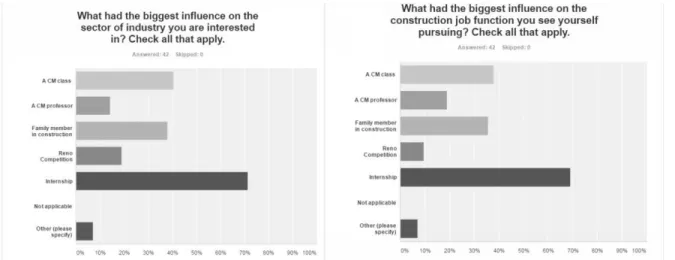
Another data point that interested me was the influence on what drove students’ interest in a particular sector and/or job function.
Figure 4: Influences on student choices
As you can see above in Figure 4, the biggest influence of nearly 70% of students was the internship experience that they’ve had out in a construction related field. Now a startlingly high response was the fact that 35% of students attributed their choice of industry and job function to a family member in construction. This could be an interesting statistic for senior projects in the future if a student chooses to research the different factors that influence a student’s choice in career path and how that can be utilized by the Construction Management department.
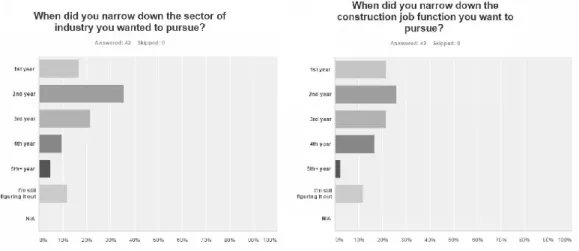
My focus for the rest of this paper is centered around the questions of when students decided on what industry and job function they wanted to pursue. As seen below in Figure 5, the distribution of grade levels where students claimed they figured out what sector and job function they desired to pursue is centered right around their second year, with many students even knowing in their first year of college.
Figure 5: Student interest timing distribution
What’s interesting about this statistic is how early on the majority of students have a pretty good idea of what it is that they want to do in life once they graduate. Furthermore, the number of students that indicated it was their first year of college that they had an idea of what they wanted to do suggests that they came in to Cal Poly with that notion already in their head. Now there are two classifications of students that I will be comparing this to: Cal Poly students, and college students in general. One might wonder why the distinction between the two, and the reason lies within Cal Poly’s unique requirement of not having an “Undecided” major classification; students entering the school are required to declare a major due to the immediate submersion into major course curricula. What this means is Cal Poly students are forced to choose their specialization early-on like the British college students in Malamud’s research, rather than in their junior year like most other college students.
What makes Cal Poly Construction Management even more unique is that it is such a specific and destination driven major; it’s not one that students would idly pick if they don’t know what the major is, or what it is that they want to do in life. By nature of the major and of the industry, choosing to pursue an education in Construction Management has a very clear and concise destination in mind. This contrasts with other majors such as Business or Psychology that house an inert nature of ambiguity and can allow for students to further decide what it is that they want to do upon graduation, while remaining open ended within such a broad industry.
Figure 6. (right) College graduates with a job matching their degree
college students that end up switching their majors despite any perceived lost time while in school, or they figure out what they want to do later and enter a different field than their college major.
Summary
No matter how well-supported this contradictory research is, I have found definitive statistical evidence to support the fact that Cal Poly Construction Management students seem to know what it is that they want to do after college while staying in their field of study. So is this just a fluke? Outliers that can be simply thrown away? Arguably no, because the major retention rates and post grad placements are boasted in other top ASC schools such as Colorado State, Chico State, and Sacramento State universities. Each of these schools receive incoming freshman into the CM program that a large majority know for a fact that they want to do in the construction industry in some way or another.
That being established, the Malamud study, Reller’s study, and my research all support the fact that specialization works and is sought after by the student body at Cal Poly. Being a very technical and hands-on school, Cal Poly would benefit by introducing concentrations to the CM program because of the findings indicating that switching majors happens less often at schools that require specialization early on. Having students statistically less likely to switch out of their major or field suggests that these groups of CM students do in fact know what they want to do after graduation. These students are given an opportunity to form and develop a desire to work in a specific project role or sub field within the industry rather than finding which industry they’re interested in, though only through the current curriculum available to them.
Cal Poly higher education is able to facilitate and cultivate the development of student desire for specialization within the industry as students join appropriate clubs, competition teams, and have access to 8 technical elective units that change on a quarterly basis. The next step towards improving the student experience and developing young professionals that are high above their peers in terms of knowledge and experience is the introduction of concentrations. Providing concentrations for students to dive deeper into their desired field through additional regimented class flowcharts (as suggested by Reller in Figure 3), will benefit not only the industry, but the student as well. This added education track will supplement student internships and competition teams by providing more than just general construction education classes that are offered to all students within the major. The result is students going out to the internships and to their full-time positions with more knowledge and experience than that of a student with no concentration.
Possible Future Research
Due to time and page length constraints, there are limits to the number of avenues I can take this research. This leaves a few unanswered research questions and room for expansion on a few of the points. I would encourage future students to explore these avenues with their own research and develop a few of the points that arose from my survey.
An expansion of survey group. Being able to survey the whole student body, or have access to more
representative data will be able to further support or reject that Cal Poly students have a better idea of what they want to do after college compared to other college freshman.Supplemental data of just Construction Management students should also be pursued: What percentage of CM students change out of the major. What percentage of graduating students transferred in? How does that compare to the number of major changes outside of the department?
Project Management Desire. What is it about Project Management that stirs such an interest in students? Is it
the CM program’s version of the default position to pursue or are there external factors influencing the desire? With a decrease in Superintendents and a comparative lack of interest in some of the other project roles, how can the CM program generate interest in the other project roles?integrate into the program and supplement it with their own curriculum to provide the most valuable education for students?
References
Bureau of Labor Statistics (2017). “Industries at a Glance – Construction: NAICS 23.”
https://www.bls.gov/iag/tgs/iag23.htm
Cal Poly San Luis Obispo (2017). Construction Management. https://construction.calpoly.edu/content/public-information/student-employment
Colorado State University (2017). “Undergraduate Student Placement Statistics.”
http://www.cm.chhs.colostate.edu/about-us/files/WebsiteAccreditationPlacementInformation.pdf
FRED.stlouisfed.org (June 2017). “All Employees: Construction.” Employment Rates from the US Bureau of Labor Statistics.https://fred.stlouisfed.org/series/USCONS
Freedman, Liz (2013). “The Developmental Disconnect in Choosing a Major: Why Institutions Should Prohibit Choice until Second Year.” Retrieved from https://dus.psu.edu/mentor/2013/06/disconnect-choosing-major/.
Gamayunova, Olga (2015). “The First Steps to Getting the Higher Construction Education.” Retrieved from
http://www.sciencedirect.com.ezproxy.lib.calpoly.edu/science/article/pii/S1877705815018871
Offer, Malamud (2011). “Discovering One’s Talent: Learning from Academic Specialization.” ILR Review. Jan. 2011, Vol 64 Issue 2, p375-405. 31p.