We present a new two-color algorithm, the “Stellar Bump Sequence” (SBS), that is optimized for robustly identifying candidate high-redshift galaxy clusters in combined wide-field optical and mid-infrared (MIR) data. The SBS algorithm is a fusion of the well-tested cluster red-sequence method of Gladders & Yee with the MIR 3.6μm–4.5μm cluster detection method developed by Papovich. As with the cluster red-sequence method, the SBS identifies candidate overdensities within 3.6μm–4.5μm color slices, which are the equivalent of a rest-frame 1.6μm stellar bump “red-sequence.” In addition to employing the MIR colors of galaxies, the SBS algorithm incorporates an optical/MIR (z–3.6μm) color cut. This cut effectively eliminates foreground 0.2< z <0.4 galaxies which have 3.6μm–4.5μm colors that are similarly red asz >1.0 galaxies and add noise when searching for high-redshift galaxy overdensities. We demonstrate using thez ∼1 GCLASS cluster sample that similar to the red sequence, the stellar bump sequence appears to be a ubiquitous feature of high-redshift clusters, and that within that sample the color of the stellar bump sequence increases monotonically with redshift and provides photometric redshifts accurate toΔz=0.05. We apply the SBS method in the XMM-LSS SWIRE field and show that it robustly recovers the majority of confirmed optical, MIR, and X-ray-selected clusters atz > 1.0 in that field. Lastly, we present confirmation of SpARCS J022427-032354 atz=1.63, a new cluster detected with the method and confirmed with 12 high-confidence spectroscopic redshifts obtained using FORS2 on the Very Large Telescope. We conclude with a discussion of future prospects for using the algorithm.
Key words: galaxies: clusters: general – galaxies: high-redshift – infrared: galaxies – large-scale structure of universe
Online-only material:color figures
1. INTRODUCTION
Massive galaxy clusters are important astrophysical objects. As the largest virialized structures in the universe, their space density, mass function, and clustering provide robust constraints on cosmological models (e.g., Edge et al.1990; Eke et al.1998; Bahcall et al.2003; Gladders et al.2007; Vikhlinin et al.2009; Rozo et al. 2010; Sehgal et al. 2011; Benson et al. 2013). As the highest-density regions in the universe, they are also important cosmic laboratories for studying how environment affects the evolution of galaxies (e.g., Dressler1980; Balogh et al. 1999; Poggianti et al. 1999, 2006; Patel et al. 2009a,
2009b; Vulcani et al.2010; Wetzel et al.2013; Muzzin et al.
2012, and numerous others). For these reasons, there has always been strong motivation to discover larger samples of clusters, increasingly more massive clusters, and naturally, clusters at the highest possible redshifts.
Substantial progress on all these fronts has been made in the last decade, particularly in finding clusters to the highest redshifts. Ten years ago only a few clusters atz >1 had been discovered and confirmed (Stanford et al. 1997; Rosati et al.
1999). Five years ago only a few clusters atz >1.4 had been confirmed (Stanford et al.2005,2006). Now, using a multitude of techniques, the number of confirmed clusters abovez >1
is approaching∼100, and the number of confirmed clusters at
z >1.4 is now>10.
The progress in finding high-redshift clusters has occurred at an extremely rapid pace, but perhaps what has been most astonishing is that new high-redshift clusters are now being discovered routinely using different techniques and observations at a wide range of wavelengths. In previous decades, searches for the highest-redshift clusters were almost completely dominated by X-ray surveys (e.g., Gioia et al.1990; Rosati et al.1998), whose superior sensitivity over wide areas allowed them to robustly discover massive clusters with relative ease. In recent years, the advent of wide-field near- and mid-infrared imaging (hereafter NIR and MIR, respectively) as well as millimeter-wavelength surveys for clusters using the Sunyaev–Zel’dovich effect (hereafter SZE) have made these methods competitive with the latest generation of X-ray surveys.
et al.2011; Spitler et al.2012), millimeter SZE surveys (e.g., Brodwin et al.2010; Foley et al. 2011; Stalder et al. 2013), as well as narrowband and MIR searches around high-redshift radio galaxies (e.g., Venemans et al.2007; Galametz et al.2010,
2012).
Naturally, this array of detection methods has produced a heterogeneous sample of high-redshift clusters. While this may create some difficulty when comparing the properties of clusters and cluster galaxies between various samples, there are also distinct advantages to having samples of clusters selected in diverse ways. For example, SZE and X-ray surveys detect clusters based on their baryonic mass in the form of hot gas, and therefore preferentially select halos with higher gas densities and higher gas fractions. Optical/IR surveys detect clusters based on their stellar mass, and therefore preferentially select halos with higher stellar-mass fractions. If the relative fraction of baryons in the form of gas and stars varies substantially from halo to halo (e.g., Lin et al.2003; Dai et al.2010), then these techniques are complementary—indeed almost necessary—for finding mass-complete samples of clusters.
For technical reasons, X-ray and SZE cluster surveys have historically covered large volumes searching for the most mas-sive systems, whereas optical/IR surveys have covered smaller volumes and have primarily discovered low-mass systems. Optical/IR surveys over large volumes are advantageous be-cause they can discover complementary samples of the rare massive clusters typically selected in SZE and X-ray surveys. It is challenging to obtain optical/IR data in multiple filters over wide areas; however, Gladders & Yee (2000, 2005) demon-strated that clusters can be selected in wide-area surveys with a low contamination rate with just two photometric bands up to
z=1 using the red sequence of cluster early-type galaxies as a high-contrast signpost for clusters. This red-sequence method was adapted into the MIR for the SpARCS survey (Muzzin et al.
2009; Wilson et al.2009), where the 50 deg2 SpitzerSWIRE fields (Lonsdale et al.2003) were observed in thezband and clusters toz ∼1.4 were detected using az−3.6μm color to identify galaxy overdensities.
SpARCS was a logical extension of the red-sequence method into the MIR in order to search for clusters at higher redshift than optical surveys; however, the technique does require deep optical data to compliment the MIR data, a considerable investment in observing time. Papovich (2008) proposed a novel method for selecting high-redshift clusters using MIR data alone, thus avoiding the need for additional deep optical data. Papovich (2008) demonstrated that high-redshift galaxies tend to have red 3.6–4.5μm colors, and that because of the negativek-correction in these bands, even distant galaxies are bright enough to be detected in relatively shallow MIR imaging. He devised a color cut (3.6μm–4.5μm>−0.1 AB) that allowed the identification of numerous cluster candidates in the SWIRE field atz >1.3, and this approach led to the identification of the highest-redshift known cluster at that time (Papovich et al.2010).
In this paper, we present the “Stellar Bump Sequence” (SBS) which is an improved algorithm for efficiently detecting high-redshift clusters in combined medium-deep optical/MIR imaging data. The method is a two-color (three filter) algorithm based on combining the red-sequence cluster detection method used in SpARCS with the MIR method as developed by Papovich (2008) and Papovich et al. (2010). In this paper, we show that the hybrid of the two methods improves the reliability of candidate overdensities and also provides good-quality photometric redshifts for all cluster candidates. We apply
this new technique to the XMM-LSS SWIRE field, and show that it recovers the majority of known clusters atz > 1 in that field, with good estimates of their photometric redshift. Lastly, we present a new, rich cluster spectroscopically confirmed at
z=1.63 that was discovered using the method.
The layout of this paper is as follows. In Section 2, we present the SBS algorithm and demonstrate that the stellar bump sequence is clearly seen in spectroscopically confirmed clusters at z ∼ 1. In Section 3, we apply the algorithm to the XMM-LSS field and show that it recovers the majority of known clusters at z > 1 in that field. In Section 4, we present the confirmed cluster SpARCS J022427-032354 atz=
1.63, a demonstration of the effectiveness of the algorithm for selecting high-redshift clusters. We conclude with a discussion in Section5. Throughout this paper, we assume a ΩΛ =0.7,
Ωm = 0.3, and H0 = 70 km s−1 Mpc−1 cosmology. All
magnitudes are in the AB system.
2. THE STELLAR BUMP SEQUENCE ALGORITHM
2.1. Motivation
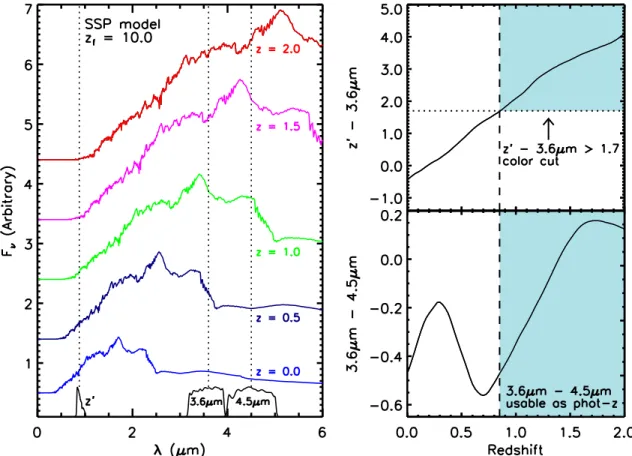
Photometric redshifts for galaxies are typically determined by fitting the observed colors of galaxies with a range of templates for galaxy spectra. The features in galaxy spectral energy distributions (SEDs) that provide the tightest constraints on their photometric redshift are those that are the sharpest, particularly the Lyman break at 912 Å, the Balmer break at ∼3800 Å, and the 4000 Å break in old stellar populations. An additional strong feature is the so-called stellar bump feature at rest frame∼1.6μm which is caused by the minimum opacity of the H−ion at this wavelength (e.g., John1988). This results in a maximum of the flux density at 1.6μm for galaxies whose ages are >10 Myr (Sawicki2002). As an illustration of the stellar bump feature, in Figure 1we plot the SEDs of a single-burst simple stellar population (SSP) with solar metallicity formed at
z=10 as it would be seen atz =0.5, 1.0, 1.5, and 2.0. The SEDs have been generated using the Bruzual & Charlot (2003) models. We note that we have used an SSP as a fiducial model for the purpose of illustration, but that any stellar population with an age>10 Myr also shows the 1.6μm feature (see, e.g., Sawicki2002; Papovich2008). The 1.6μm stellar bump feature can be seen clearly in the SEDs in Figure1, and its prominence resulted in it being discussed prior to the launch ofSpitzeras a potentially powerful photometric redshift indicator (Simpson & Eisenhardt1999; Sawicki2002).
In practice, the stellar bump does provide constraints on the photometric redshifts of galaxies; however, these tend to be much weaker than those obtained from the bluer features such as the 4000 Å break. In the lower right panel of Figure1, we plot the 3.6μm–4.5μm color of this model as a function of redshift. The observed color maps uniquely onto redshift within the redshift interval 0.7< z <1.7; however, the complete range in color is small (∼0.7 mag), making the color only a modest-precision estimator of photometric redshift. In the upper right panel of Figure1, we plot the observedz−3.6μm color of the model as a function of redshift. This color spans the 4000 Å break at z > 1, and in contrast to the 3.6μm–4.5μm color, increases monotonically with redshift at all redshifts, and has a substantial range (∼4 mag). These properties make it a more powerful tool for identifying high-redshift cluster candidates and estimating their redshifts.
In the SpARCS survey (Muzzin et al. 2009; Wilson et al.
Figure 1.Left panel: the evolving SED of an SSP with azf=10 generated with the BC03 models as it would be observed at various redshifts. Filter response curves for thez, 3.6μm, and 4.5μm bands are shown below and the central wavelengths are marked with the dotted vertical lines. Top right panel: thez−3.6μm color as a function of redshift for the SEDs in the left panel. Thez−3.6μm color increases monotonically with redshift and hence provides an estimate of the photo-zfor an SSP. Bottom right panel: the 3.6μm–4.5μm color as a function of redshift for the SEDs in the left panel. Due to the more complex SED shape in the rest-frame NIR, the 3.6μm–4.5μm color does not uniquely map onto redshift; however, if az−3.6μm>1.7 color cut is applied to cull low-redshift galaxies (see top right panel), the 3.6μm–4.5μm color becomes a viable estimate of the photometric redshift as those filters move through the rest-frame 1.6μm stellar bump feature.
(A color version of this figure is available in the online journal.)
clusters up toz ∼1.4. However, as Figure 1 shows, at z >
1.4 the z−3.6μm colors of the model become extremely red (z−3.6μm > 3.0). This implies that z-band imaging that is substantially deeper than the MIR data are required to identify candidate high-redshift clusters with this method. This is approximately the limiting depth of the SpARCSzdata (z<
24.2), which makes it challenging to select clusters atz >1.4 robustly with the red-sequence method.
Papovich (2008) showed that provided only clusters atz >
1.3 were considered, the 3.6μm–4.5μm color of galaxies is sufficient to select high-redshift overdensities of galaxies. This novel idea allowed him to take full advantage of the deep SWIRE MIR data (a 5σ depth of∼0.5L∗ atz ∼2), to select distant cluster candidates. Papovich (2008) searched for overdensities of galaxies in position space that passed a single color cut of 3.6μm–4.5μm>−0.1 in the SWIRE fields and discovered hundreds ofz >1.3 cluster candidates including the confirmed cluster ClG J0218.3-5010 (Papovich et al.2010).
This new method has been an important step forward for pushing MIR cluster detection to the highest redshifts, and ClG J0218.3-5010 has been an important object for studying galaxy evolution in high-redshift, high-density environments (e.g.,. Tran et al.2010; Papovich et al.2012; Quadri et al.2012; Rudnick et al.2012; Tadaki et al.2012). Still, a single cluster almost certainly cannot be representative of the full population of clusters at z > 1.4 and much larger samples of clusters selected in the MIR that are mass complete and have a high purity level would be extremely valuable. As of yet, it is unclear
whether searching for clusters with only the Papovich (2008) 3.6μm–4.5μm color cut is sufficiently robust to produce such samples.
There are several disadvantages to the color-cut method as compared to red-sequence selection (e.g., Muzzin et al.
2009; Wilson et al.2009) or multi-band photometric redshift selection (e.g., Eisenhardt et al.2008). Specifically, the fact that 3.6μm–4.5μm does not uniquely map onto redshift means that galaxies at redshifts 0.2< z <0.4 have colors similar to those atz >1.0 and add noise when selecting high-redshift clusters. Papovich (2008) argued that this contamination is minimized provided the MIR color cut was red enough (3.6μm–4.5μm> −0.1); however, as we show in Section2.2.1, even with such a red color cut the contamination is considerable, particularly at bright magnitudes.
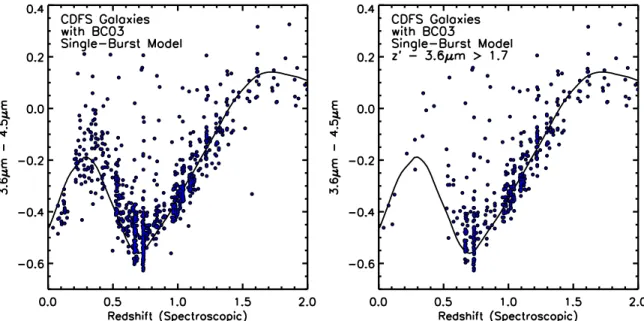
Figure 2.Left panel: the observed 3.6μm–4.5μm color as a function of spectroscopic redshift for all galaxies in the FIREWORKS catalog of Wuyts et al (2008) with 3.6μm<22.0. An SSP with azf =10 generated using the BC03 models is overplotted for reference and is a reasonable description of the colors of most galaxies. This occurs because the 3.6μm–4.5μm colors of galaxies are fairly insensitive to their star formation history. Galaxies that lie considerably above the curve are likely to have a warm dust component heated by an active galactic nucleus. Right panel: same as left panel, but with galaxies withz−3.6μm>1.7 plotted. The color cut excludes most galaxies atz <0.7 with red 3.6μm–4.5μm colors and shows that for the remaining galaxies the 3.6μm–4.5μm color can be used as a photo-zaccurate to±0.15 for an individual galaxy.
(A color version of this figure is available in the online journal.)
method, which suggests that a cluster sample selected using that method may suffer similar projection effect issues as in the early optical cluster surveys.
The last issue with the MIR color-cut approach is that it does not provide information on the photometric redshift of cluster candidates (other than the cluster should be atz >1.3). Whether they are used for cosmological purposes or for studying the galaxy population, the photometric redshift distribution for a cluster sample is a key quantity. Furthermore, given the current lack of known clusters at 1.5 < z <2.0, being able to differentiate cluster candidates at higher redshift compared to lower redshift is a distinct advantage for prioritizing follow-up observations.
Here, we outline some modifications that we have made to the MIR cluster detection method proposed by Papovich (2008) that address some of these issues. The two main changes are the use of an additional optical/MIR color cut, and the selection of clusters within multiple MIR color slices. This effectively combines the MIR color approach of Papovich (2008) with the well-tested cluster red-sequence method of Gladders & Yee (2000,2005). We show that the optical/MIR color cut substantially reduces the contamination of high-redshift galaxies by low-high-redshift galaxies and is so efficient at removing interlopers that the MIR selection method can be used down to much lower redshift (z ∼ 0.85). Similar to the red-sequence approach, the 3.6μm–4.5μm color slice method reduces the number of line-of-sight projections, and also provides an estimate of the photometric redshift for each cluster candidate.
2.2. Modifications to the Papovich Method
2.2.1.z−3.6μm Color Cut
In the left panel of Figure 2, we plot the observed 3.6μm–4.5μm color versus spectroscopic redshift for galaxies with 3.6μm<22.0 mag (the 5σ depth of the SWIRE survey)
in the GOODS-South FIREWORKS catalog of Wuyts et al. (2008). Overplotted as the solid line is the color of the single-burst model shown in Figure 1. The single-burst model is a reasonable description of the galaxy population at all redshifts, primarily because the 3.6μm–4.5μm colors of galaxies are in-sensitive to star formation history.
Figure 2 shows that while there is a good correspondence between 3.6μm–4.5μm color and redshift for galaxies atz >
0.7, there is a significant population of 0.2< z <0.4 galaxies with colors similar to those atz >1. Papovich (2008) argued that using a color cut of 3.6μm–4.5μm>−0.1 excludes most of the 0.2< z <0.4 population. The number ofz >1.3 galaxies in the FIREWORKS spectroscopic sample with 3.6μm–4.5μm> −0.1 and 3.6μm < 22.0 mag is 82. The number of z <
0.4 galaxies matching the same color/magnitude criteria is 23. Although the Papovich MIR color criterion does eliminate some low-redshift interlopers, clearly the interloper fraction is still non-negligible,∼20%. We note that 20% is formally an upper limit for the contamination because the spectroscopy in GOODS-South is more complete at z <0.4 than atz >1.3. Still, the overall spectroscopic completeness is quite good (see Wuyts et al.2008), particularly at these bright magnitudes, so the estimate of 20% should be indicative of the actual interloper fraction.
In the right panel of Figure2, the FIREWORKS galaxies are plotted again, this time excluding galaxies withz−3.6μm<
1.7. This removes the majority of the 0.2< z <0.4 population without excluding thez >1.3 population. The color cut removes 20/23 of the low-redshift interlopers (∼85%), but only removes five galaxies atz >1.3 (∼6%). Therefore, with the additional
z−3.6μm>1.7 criteria, the interloper fraction from galaxies atz <0.4 is improved by a factor of five to an impressively low∼4%.
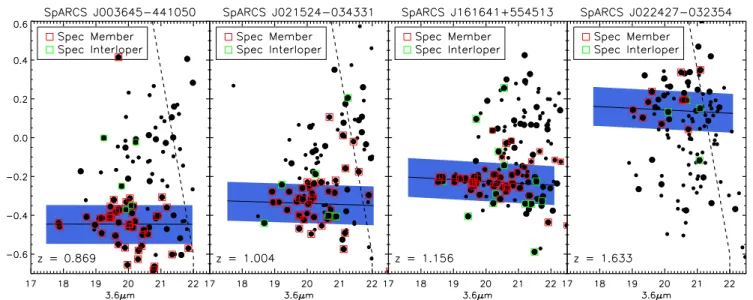
Figure 3.3.6μm–4.5μm vs. 3.6μm color–magnitude diagrams for four SpARCS clusters. The three leftmost clusters were discovered with thez−3.6μm red-sequence method and have extensive spectroscopy from the GCLASS survey. Galaxies withinR<0.5 Mpc and 0.5 Mpc<R<1.0 Mpc are plotted as large and small symbols, respectively. Galaxies that have spectroscopic redshifts concurrent with being clusters members are shown as red squares, those with spectroscopic redshifts inconsistent with being clusters members are shown as green squares. The cluster members belong to a fairly tight (scatter∼0.1 mag) sequence in color–magnitude space that becomes monotonically redder with increasing redshift. Similar to the red-sequence method, this “stellar bump sequence” can be used as a signature to identify clusters in wide-field imaging. The solid lines and blue shaded regions are models for the stellar bump sequence determined using BC03 models. The 3.6μm–4.5μm CMD for SpARCS J022427-032354, which was identified from its stellar bump sequence is shown in the rightmost panel and is substantially redder than the lower-redshift SpARCS clusters.
(A color version of this figure is available in the online journal.)
3.6μm–4.5μm color selection. Papovich (2008) also showed similar reductions in the interloper fraction if a simpleR-band magnitude cut was employed (R <22.5 mag). Indeed, mak-ing a color cut does not even require particularly deep optical data. The SpARCSzdata in the SWIRE fields is approximately 2.2 mag deeper than the 3.6μm data, deeper than is needed to make thez−3.6μm>1.7 cut. This implies that future surveys employing the SBS selection could use ∼3× less integra-tion time than SpARCS in thez band, which would be only 35 minutes per pixel on a 4 m class telescope.
2.2.2. Color Slices versus a Color Cut
Within Figure 2, several overdensities in spectroscopic redshift are clearly visible. These overdensities have mean 3.6μm–4.5μm colors consistent with the single-burst model and fairly small dispersions around this color (∼0.1 mag). This suggests that using slices in 3.6μm–4.5μm color would be an effective way to minimize projection effects when selecting high-redshift clusters. This approach is identical to that taken for red-sequence selection, other than it uses very different rest-frame wavelengths which bracket the 1.6μm stellar bump fea-ture rather than the 4000 Å break.
To further demonstrate the well-behaved nature of the MIR colors of cluster galaxies, in Figure3we plot the 3.6μm–4.5μm colors versus 3.6μm flux for galaxies in the fields of three clus-ters atz=0.869, 1.004, and 1.156 with extensive spectroscopy from the GCLASS survey (see Muzzin et al.2012). Confirmed spectroscopic members are shown as red squares and confirmed non-members are shown as green squares. Similar to the over-densities in FIREWORKS, the colors of the cluster members are nearly identical. It appears that similar to the red sequence of early types, there is a “stellar bump sequence” for galaxies in high-redshift clusters that increases monotonically with redshift (within this redshift window).
The stellar bump sequence also appears to be quite tight. Overplotted in each panel is a model for the sequence (see Section2.3) with a shaded region that represents a scatter of 0.1 mag. This is consistent with the rms scatter around the model for galaxies with 3.6μm<21.0 seen in the two lowest-redshift clusters which are 0.093 and 0.078 mag, respectively (rejecting >3σ outliers). The data for those clusters are from the SWIRE survey that has 150 s integration time per pixel and the median photometric error is 0.05 mag. Thez=1.156 cluster (see also Demarco et al.2010) has data from a GTO follow-up program (PI: Fazio/Wilson) and has an exposure time of 2040 s per pixel. The scatter in the stellar bump sequence for that cluster is substantially smaller, 0.047 mag (again rejecting>3σoutliers). The median photometric error in the deeper data is 0.02 mag. Subtracting the photometric scatters from the measured scatters in quadrature for all three clusters suggests that the stellar bump sequence has an impressively small intrinsic scatter of 0.04–0.07 mag.
Figure 3 shows that selecting clusters in narrow slices of 3.6μm–4.5μm color should be an effective way to minimize projection effects. The sequences in Figure3 are spaced such that there should be little overlap within the photometric scatter for clustersδz >0.15 apart in redshift space. This is not as good as the precision from red-sequence selection where sequences typically only overlap within the photometric scatter for clusters withδz < 0.05 (Gladders & Yee2005; Muzzin et al. 2008); however it is a significant improvement over no color selection whatsoever.
Lastly, we note that the solid lines shown in Figure3are not fits to the data, but are Bruzual & Charlot (2003) models for the 3.6μm–4.5μm sequence at the redshift of the cluster assuming a single burst with a zf = 10. These are remarkably good
Figure 4.Top panel: smoothed density map of galaxies in the XMM-LSS SWIRE field withz−3.6μm>1.7 and−0.5<3.6μm–4.5μm<−0.3. The field of view on the sky is∼3◦×2◦, north is up, east is to the right. The locations of spectroscopically confirmed clusters discovered with X-ray observations (XLSSC clusters) and the red-sequence method (SpARCS J021524-034331) are shown with red circles. Those clusters are clearly associated with overdensities in the map and this shows that the two-color SBS method recovers clusters discovered with other search techniques. Shown in blue are two new cluster candidates discovered with the technique (see the text). Bottom panel: same as top panel but for galaxies in a redder color slice, 0.0<3.6μm–4.5μm<0.2. The cluster SpARCS J022427-032355 is clearly visible in the upper right and is the most significant overdensity in the map. The cluster discovered by Papovich et al. (2010) using the SWIRE observations is also visible in the bottom left and is also one of the more significant overdensities in this color slice.
(A color version of this figure is available in the online journal.)
2.3. The SBS Algorithm
The SBS algorithm is nearly identical to the red-sequence detection algorithm proposed by Gladders & Yee (2000) and applied in Gladders & Yee (2005) and Muzzin et al. (2008) and we refer to those papers for a detailed step-by-step description of the method. In brief, the method is the following. First, several SSP models for the apparent 3.6μm–4.5μm colors of galaxies as a function of redshift are determined using the Bruzual & Charlot (2003) models. These models are normalized using the
U−V,V −I, andJ−Kcolors of the red sequence in the Coma cluster (Bower et al. 1992). These models are then used to construct color slices analogous to those plotted in Figure3. For each color slice, the probability that a given galaxy in the survey area belongs to that slice is calculated, the result being a probability weight for each galaxy, in each slice. In this process, we only calculated weights for galaxies that pass the
z−3.6μm>1.7 color cut.
Probability maps are then created for each slice by placing galaxies on a pixelated grid of the survey field in their observed positions, weighted by their probabilities. The maps are then smoothed with a kernel with a physical size of 0.5 Mpc FWHM, and object detection is performed to identify sources above the background. Sources in the probability map are then flagged as candidate galaxy clusters. Sources are typically found in several color slices and a final catalog of candidates is made by connecting detections between slices and assigning candidates a photometric redshift based on the slice where they have the most significant detection. An example of SBS probability maps in the XMM-LSS SWIRE field in two different color slices is shown in Figure4.
3. APPLICATION TO THE XMM-LSS SWIRE FIELD
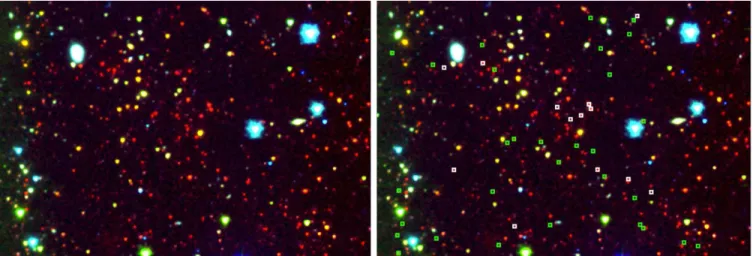
Figure 5.Left panel:gz3.6μm color composite of the cluster SpARCS J022427-032354. The field of view is 7×5. Right panel: same as left panel but with spectroscopically confirmed cluster members shown in white and spectroscopically confirmed foreground/background galaxies shown in green.
(A color version of this figure is available in the online journal.)
(Pierre et al. 2006). The field has been searched extensively for high-redshift clusters using a variety of techniques, making it an ideal testbed for the SBS algorithm. There are four spectroscopically confirmed z > 1 X-ray-selected clusters from the XMM-LSS: XLSSC005, XLSSC029, XLSSC048, and XLSSC046 (Bremer et al.2006; Pacaud et al.2007; Adami et al.
2011). There is one confirmed cluster from the SpARCS survey (SpARCS J021524-034331) discovered with the z−3.6μm red-sequence method (Muzzin et al.2012), and also recently detected in the X-ray (XLSSC067, Willis et al. 2013). The field also contains the spectroscopically confirmed cluster CIG J0218.3-510 atz=1.62 discovered by Papovich et al. (2010) using the MIR color-cut method.
The field contains four channel IRAC imaging from the SWIRE survey (see Lonsdale et al.2003) covering a total area of 9.4 deg2. There is also deepzdata taken as part of the CFHTLS-Wide survey, as well as an extended region ofzdata coverage taken as part of a Canada–France–Hawaii Telescope follow-up program (PI: Pierre, ID: 2006BF11). We use these data sets to apply the SBS method and search for clusters at 0.85< z <2.0. In Figure4, we show the probability maps generated using the SBS method. The top panel shows the color slice corresponding to azphoto = 1.0, the bottom panel shows the same field but
generated with galaxies in the color slicezphoto=1.6. In both
panels, the width of the slice in color corresponds to a width in redshift ofδz∼ ±0.1. In thezphoto=1.0 slice, there are several
overdensities that are clearly visible. Those that are associated with the confirmedz >1 clusters are circled in red. When object detection is run, the SBS algorithm recovers 3/4 X-ray-selected clusters, as well as the red-sequence-selected SpARCS cluster. There appears to be no overdensity associated with the fourth X-ray cluster (XLSSC005), although we note that for this cluster the spectroscopic redshift is based on only two members and therefore its spectroscopic redshift may not be secure (Pacaud et al.2007).
Figure4shows that the SBS selection appears to work well, recovering most of the high-confidence clusters atz∼1 selected with other methods. As shown by the blue circles in Figure4, the method has also identified two otherz∼1 overdensities with even higher significance than any of the confirmed clusters. These two candidates, SpARCS J022158-034000 and SpARCS J022056-033348 have estimated photometric redshifts of 1.08 and 1.10, respectively, and are not in the latest XMM-LSS
catalogs (Pacaud et al. 2007; Adami et al. 2011). We note that SpARCS J022158-034000 is detected as a weak X-ray source in (Andreon et al. 2005), and follow-up observations with XMM show a clear X-ray detection (F. Pacaud 2013, private communication). SpARCS J022056-033348 was not flagged in the XMM-LSS cluster pipeline because the X-ray emission is highly contaminated by a bright point source, but a weak extended component cannot be excluded (M. Pierre 2013, private communication).
We note that none of the spectroscopically confirmed XMM-LSS clusters at 0.2< z <0.4 (Adami et al.2011) are as-sociated with overdensities in the probability map, even though they have similar 3.6μm–4.5μm colors (see Section5). This further highlights the effectiveness of thez−3.6μm color cut in eliminating low-redshift interlopers. The removal of these interlopers also means that the SBS method can be robustly applied to redshifts as low as z ∼0.8, creating a larger red-shift range than can be probed by the Papovich (2008) color-cut method.
4. THE CLUSTER SPARCS J022427-032354 ATz=1.6
The bottom panel of Figure4 shows the color slice that is centered at a zphoto = 1.6. There appear to be fewer cluster candidates in thez =1.6 slice compared to thez =1 slice. This is partially because the z =1.6 map is noisier than the
z=1 map due to the fixed depth of the observations. Even so, the data are deep enough (M < M∗ + 1.3) to robustly detect massive clusters so the reduced number of candidates suggests a significant decline in the number of massive clusters between
z=1.0 andz=1.6, consistent with expectations fromΛCDM models (e.g., Haiman et al.2001).
The most prominent structure in the z = 1.6 slice is the candidate cluster in the northeast corner of the image which we designate SpARCS J022427-032354. Also visible in the southwest corner of the field is CIG J0218.3-510 discovered by Papovich et al. (2010). That cluster is also one of the more prominent overdensities in the color slice.
Figure 6.Histogram of spectroscopic redshifts in the field of SpARCS J022427-032354. The inset shows the distribution around the cluster redshift.
(A color version of this figure is available in the online journal.)
the structure appears to be filamentary without a dominant central galaxy.
In the right panel of Figure 3, we have also plotted the 3.6μm–4.5μm colors of galaxies near SpARCS J022427-032354 as a function of 3.6μm. Similar to the GCLASS clusters, SpARCS J022427-0323354 has a well-defined stellar bump sequence; however, that sequence is substantially redder, consistent with azphoto=1.6. Given its high significance and estimated redshift, SpARCS J022427-032354 was designated as a high-priority target for spectroscopic follow-up in our v1.0 SBS-selected cluster catalog of the XMM-LSS field. The cluster was observed using two multi-slit masks with the FORS2 instrument on the Very Large Telescope as part of Program 085.A-0613(B) (PI: Demarco). The on-sky integration time for each mask was 3.75 hr. The two-dimensional spectra were reduced using standard techniques for flat-fielding, wavelength calibration, and relative flux normalization using the pipeline described in Demarco et al. (2005,2007). Once one-dimensional wavelength-calibrated spectra were extracted, spectroscopic redshifts were determined both by cross correlation and eye-examination of faint spectra for emission lines. Full details of the procedure will be discussed in a future paper (G. Wilson, in preparation).
From the two spectroscopic masks, a total of 56 high-confidence redshifts were determined. In Figure6, we plot the spectroscopic redshift distribution of galaxies within 3 arcmin of SpARCS J022427-032354. There is a clear overdensity of galaxies atz =1.63, with a total of 12 galaxies in the range 1.62< z <1.64 (see inset of Figure6). In Figure7, several examples of spectra in this redshift range are shown. The majority of galaxies in this redshift range with spectra show clear [Oii] emission (9/12); however, there are three spectra that have weak or possibly no [Oii] emission, two of which are shown in Figure7. For these galaxies, there is a nearby night sky line that makes it difficult to put strong constraints on the level of [Oii] emission; however, the continuum shape is similar to that expected in galaxies with quenched star formation. Overplotted in blue in Figure7is the mean stacked spectra of galaxies in the cluster SpARCS J003550-431224 (see Wilson et al.2009; Muzzin et al.2012) which primarily contains quenched galaxies. The UV continuum of the template matches the UV continuum
of the weak [Oii] galaxies in Figure7 quite well, suggesting that these two galaxies may be quenched cluster members at
z=1.63.
In the right panel of Figure5, the positions of these 12 cluster galaxies are plotted as white squares and the positions of the remaining spectroscopic redshifts as green squares. Most of the galaxies with redshifts 1.62 < z < 1.64 are concentrated in the central few arcmin of the field suggesting this is a cluster of galaxies as compared to a large, unvirialized “sheet” of galaxies. There are, however, several galaxies at the same redshift that extend to∼1 Mpc, suggesting that this may be a massive cluster in the process of forming and hence the system may be only partially virialized. A more detailed analysis of the dynamics of the system will be presented in a future paper (G. Wilson, in preparation).
We note that there are many red galaxies near the center of the galaxy distribution that do not have redshifts. Several of these were targeted in the spectroscopic masks but we were unable to determine a spectroscopic redshift due to the target being too faint in the observed optical. These galaxies have very red
z−3.6μm colors and could potentially be additional quiescent galaxies in the cluster core. If they are also at z = 1.633, then future NIR spectroscopy would be valuable to determine redshifts using the absorption features that are typically present in galaxies with old stellar populations.
Overall, with 12 confirmed members, it appears that SpARCS J022427-032354 is the first confirmed cluster discovered using the SBS selection technique.
5. DISCUSSION AND CONCLUSIONS
The confirmation of SpARCS J022427-032354 shows that the SBS method is capable of selecting high-redshift clusters in combined optical/MIR data sets. Here, we investigate how the SBS photometric redshifts compare to those determined from the typical red-sequence photometric redshifts. In the left panel of Figure8, we plot the medianz−3.6μm colors of red-sequence galaxies from several different samples of clusters in the SpARCS fields as a function of spectroscopic redshift. The lowest-redshift clusters come from the XMM-LSS cluster sam-ple (Adami et al.2011) and are X-ray selected. The GCLASS clusters arez−3.6μm red-sequence selected. The “other” clus-ters come from Demarco et al. (2010; red-sequence selection) and Hashimoto et al. (2005; X-ray selection). Also shown are CIG J0218.3-510 and SpARCS J022427-032354. Overplotted are two single-burst models with formation redshifts ofzf =
4.0 and zf = 10.0. The models are good descriptions of the
redshift evolution of the color of the observed red sequence and the rms scatter of the data compared to the model is 0.18 mag, implying that thez−3.6μm red-sequence color provides pho-tometric redshifts for clusters to an accuracy ofδz=0.08 from 0.1< z <1.6.
In the right panel of Figure 8, we plot the median 3.6μm–4.5μm colors of the stellar bump sequence for the same clusters, as well as the same single-burst models. The model is also a good description of those data. The rms scat-ter in color is 0.05, which implies a redshift accuracy of δz =0.05 for clusters at 0.8< z < 1.6. This is better than the
z−3.6μm colors as a photometric redshift and is surprising given that 3.6μm–4.5μm spans a much smaller range over this redshift. The slightly betterzphotomay be because it is less
Figure 7.Example spectra of cluster members of SpARCS J022427-032354. Portions of the spectra with strong atmospheric absorption have been masked out. The locations of the Mgiiand Mgiabsorption lines as well as the [Oii] emission line are marked. The majority of the spectroscopic members show strong [Oii] emission and Mgiiabsorption suggesting active star formation. Shown is blue is the mean stacked spectrum of cluster members in a lower-redshift cluster that is dominated by galaxies whose star formation is quenched. The top two spectra show much weaker [Oii] emission and have a continuum shape that matches the lower-redshift cluster suggesting they may be quenched galaxies.
(A color version of this figure is available in the online journal.)
Regardless, Figure 6 demonstrates just how well the models describe the color evolution of the population and that good-qualityzphotocan be determined using the 3.6μm–4.5μm colors
of galaxies in candidate clusters.
Figure 8.Left panel: the observedz−3.6μm color of the red sequence as a function of spectroscopic redshift for clusters within the 42 deg2SpARCS survey. Points are color-coded based on the source of the spectroscopic redshift. Two SSP models from the BC03 code with formation redshifts of 4.0 and 10.0 are shown and are good descriptions of the data. Right panel: the observed 3.6μm–4.5μm color of the stellar bump sequence as a function of redshift for the same clusters, with the same BC03 models. Both thez−3.6μm and 3.6μm–4.5μm color sequences of clusters can be used as an accurate photometric redshift estimate up toz∼1.7. (A color version of this figure is available in the online journal.)
observed 3.6μm–4.5μm colors of galaxies do not evolve as rapidly with redshift as observed colors that span the 4000 Å break such asz−3.6μm. Therefore, line-of-sight projection will occur more frequently. The false-positive rate for red-sequence selection is∼5% (see Gladders & Yee2005; Gilbank et al.2007). Given the limited color range, the SBS false-positive rate may be as much as several times higher than this. At present, with only one confirmed cluster it is not possible to quantify the purity level of cluster samples selected with SBS. In the future, quantifying the false-positive rate will be important for using large samples of these clusters.
Overall, the SBS algorithm appears to be an effective means of identifying candidate high-redshift clusters in combined optical/MIR data. It is based on combining the cluster red-sequence method of Gladders & Yee (2000) with the MIR method of Papovich (2008); however, the combination of the two provides distinct advantages over each individually. Using the MIR colors of galaxies allows the cluster searches to continue to higher redshift over wider areas than is feasible using ground-based optical imaging. Likewise, the use of MIR color slices and the optical/MIR color cut reduces the low-redshift interloper fraction and the probability of line-of-sight projections which increases the purity level of the cluster sample. As shown in Figure8, it also allows for an estimate of the photometric redshift for all clusters in the survey with good accuracy.
The SBS algorithm has potential to provide a large, homoge-nously selected sample of clusters in the coming years. We have already applied it to the 50 deg2SWIRE fields and discovered
several hundred cluster candidates atz >1. In this paper, we presented confirmation of the cluster SpARCS J022427-032354 atz = 1.63; however, several other clusters discovered with the method in the SWIRE area have also been confirmed and will be discussed in future papers (G. Wilson, in preparation; R. Demarco, in preparation). In the future, the method could also be applied to the available wide-field imaging data sets from
Spitzer. At present, these cover of order several hundred square degrees and could provide an intermediate-mass cluster sample up toz∼1.7, something which has potential for providing both interesting constraints on the growth of massive structures as well as the evolution of the cluster galaxy population.
G.W. gratefully acknowledges support from NSF grant AST-0909198. R.D. gratefully acknowledges the support provided by the BASAL Center for Astrophysics and Associated Tech-nologies (CATA), and by FONDECYT grant No. 1100540.
REFERENCES
Adami, C., Mazure, A., Pierre, M., et al. 2011,A&A,526, A18
Andreon, S., Valtchanov, I., Jones, L. R., et al. 2005,MNRAS,359, 1250
Bahcall, N. A., Dong, F., Bode, P., et al. 2003,ApJ,585, 182
Balogh, M. L., Morris, S. L., Yee, H. K. C., Carlberg, R. G., & Ellingson, E. 1999,ApJ,527, 54
Benson, B. A., de Haan, T., Dudley, J. P., et al. 2013,ApJ,763, 147
Bower, R. G., Lucey, J. R., & Ellis, R. S. 1992, MNRAS,254, 601
Bremer, M. N., Valtchanov, I., Willis, J., et al. 2006,MNRAS,371, 1427
Brodwin, M., Ruel, J., Ade, P., et al. 2010,ApJ,721, 90
Brodwin, M., Stern, D., Vikhlinin, A., et al. 2011,ApJ,732, 33
Bruzual, G., & Charlot, S. 2003,MNRAS,344, 1000
Dai, X., Bregman, J. N., Kochanek, C. S., & Rasia, E. 2010,ApJ,719, 119
Demarco, R., Rosati, P., Lidman, C., et al. 2005,A&A,432, 381
Demarco, R., Rosati, P., Lidman, C., et al. 2007,ApJ,663, 164
Demarco, R., Wilson, G., Muzzin, A., et al. 2010,ApJ,711, 1185
Dressler, A. 1980,ApJ,236, 351
Edge, A. C., Stewart, G. C., Fabian, A. C., & Arnaud, K. A. 1990, MNRAS,
245, 559
Eisenhardt, P. R. M., Brodwin, M., Gonzalez, A. H., et al. 2008,ApJ,684, 905
Eke, V. R., Cole, S., Frenk, C. S., & Patrick Henry, J. 1998,MNRAS,298, 1145
Fassbender, R., B¨ohringer, H., Nastasi, A., et al. 2011a, NJPh,13, 125014
Fassbender, R., Nastasi, A., B¨ohringer, H., et al. 2011b,A&A,527, L10
Foley, R. J., Andersson, K., Bazin, G., et al. 2011,ApJ,731, 86
Galametz, A., Stern, D., De Breuck, C., et al. 2012,ApJ,749, 169
Galametz, A., Stern, D., Stanford, S. A., et al. 2010,A&A,516, A101
Gilbank, D. G., Yee, H. K. C., Ellingson, E., et al. 2007,AJ,134, 282
Gioia, I. M., Henry, J. P., Maccacaro, T., et al. 1990,ApJL,356, L35
Gladders, M. D., & Yee, H. K. C. 2000,AJ,120, 2148
Gladders, M. D., & Yee, H. K. C. 2005,ApJS,157, 1
Gladders, M. D., Yee, H. K. C., Majumdar, S., et al. 2007,ApJ,655, 128
Gobat, R., Daddi, E., Onodera, M., et al. 2011,A&A,526, A133
Haiman, Z., Mohr, J. J., & Holder, G. P. 2001,ApJ,553, 545
Hashimoto, Y., Henry, J. P., Hasinger, G., Szokoly, G., & Schmidt, M. 2005,A&A,439, 29
Henry, J. P., Salvato, M., Finoguenov, A., et al. 2010,ApJ,725, 615
John, T. L. 1988, A&A,193, 189
Lin, Y.-T., Mohr, J. J., & Stanford, S. A. 2003,ApJ,591, 749
Lonsdale, C. J., Smith, H. E., Rowan-Robinson, M., et al. 2003,PASP,115, 897
Rozo, E., Wechsler, R. H., Rykoff, E. S., et al. 2010,ApJ,708, 645
Rudnick, G. H., Tran, K.-V., Papovich, C., Momcheva, I., & Willmer, C. 2012,ApJ,755, 14
Wilson, G., Muzzin, A., Yee, H. K. C., et al. 2009,ApJ,698, 1943
Wuyts, S., Labb´e, I., Schreiber, N. M. F., et al. 2008,ApJ,682, 985