Multi-modal Surrogates for Retrieving and
Making Sense of Videos: Is Synchronization
between the Multiple Modalities Optimal?
By Yaxiao Song
A dissertation submitted to the faculty of the University of North Carolina at Chapel Hill in partial fulfillment of the requirements for the degree of Doctor of Philosophy in the School of Information and Library Science.
Chapel Hill 2010
Approved by
Dr. Gary Marchionini, Advisor Dr. Barbara M. Wildemuth, Reader
Dr. Jane Greenberg, Reader Dr. Bradley M. Hemminger, Reader
c 2010 Yaxiao Song
Abstract
YAXIAO SONG: Multi-modal Surrogates for Retrieving and Making Sense of Videos: Is Synchronization between the Multiple
Modalities Optimal?
(Under the direction of Dr. Gary Marchionini)
Video surrogates can help people quickly make sense of the content of a video
before downloading or seeking more detailed information. Visual and audio features
of a video are primary information carriers and might become important
compo-nents of video retrieval and video sense-making. In the past decades, most research
and development efforts on video surrogates have focused on visual features of the
video, and comparatively little work has been done on audio surrogates and
examin-ing their pros and cons in aidexamin-ing users’ retrieval and sense-makexamin-ing of digital videos.
Even less work has been done on multi-modal surrogates, where more than one
modality are employed for consuming the surrogates, for example, the audio and
vi-sual modalities. This research examined the effectiveness of a number of multi-modal
surrogates, and investigated whether synchronization between the audio and visual
channels is optimal. A user study was conducted to evaluate six different surrogates
on a set of six recognition and inference tasks to answer two main research questions:
(1) How do automatically-generated multi-modal surrogates compare to
manually-generated ones in video retrieval and video sense-making? and (2) Does
video sense-making? Forty-eight participants participated in the study, in which
the surrogates were measured on the the time participants spent on experiencing
the surrogates, the time participants spent on doing the tasks, participants’
perfor-mance accuracy on the tasks, participants’ confidence in their task responses, and
participants’ subjective ratings on the surrogates. On average, the uncoordinated
surrogates were more helpful than the coordinated ones, but the manually-generated
surrogates were only more helpful than the automatically-generated ones in terms
of task completion time. Participants’ subjective ratings were more favorable for
the coordinated surrogate C2 (Magic A + V) and the uncoordinated surrogate U1
(Magic A + Storyboard V) with respect to usefulness, usability, enjoyment, and
engagement. The post-session questionnaire comments demonstrated participants’
preference for the coordinated surrogates, but the comments also revealed the value
Acknowledgments
It is my pleasure to thank all the wonderful people who have supported me and made this dissertation possible.
First and foremost, I want to express my sincerest gratitude to my advisor, Dr. Gary Marchionini, for providing guidance, resource, time, support, care, and effort, throughout the entire duration of my research. He enlightened me in the field of information science, and ignited my enthusiasm for research. He is a wonderful mentor.
I also offer my deep appreciation to Dr. Barbara Wildemuth. It was my great pleasure to have Dr. Wildemuth on my committee. I would like to thank her for her constant help and support. I have benefited a lot from the numerous discussions with her during the past few years.
I’m also grateful to the other members of my committee, Dr. Jane Greenberg, Dr. Brad Hemminger, and Dr. Abby Goodrum, for their careful attention to my research, their time and knowledge, and their valuable feedbacks shared with me.
In my daily work, I have been blessed with a friendly and cheerful group of fellow students, faculty, and staff. Thanks to all of them for the help they offered to me and the joyful time we spent together. Special thanks to Dr. Evelyn Daniel, Dr. Chuanshu Ji, Dr. Rob Capra, Dr. Lili Luo, Terrell Russell, Scott Adam, Lara Bailey, and Chiyoung Oh.
Table of Contents
List of Tables . . . xiv
List of Figures . . . xviii
1 INTRODUCTION . . . 1
1.1 Problem Statement . . . 1
1.2 Research questions . . . 5
1.2.1 Multi-modal Surrogates . . . 5
1.2.2 Coordination between Channels . . . 6
1.2.3 Sampling Together or Separately? . . . 7
1.2.4 Hypotheses . . . 8
1.3 Significance of the Study . . . 9
2 RELATED LITERATURE . . . 10
2.1 Psychological Theories of Making Sense of Videos . . . 10
2.1.1 Multimedia Sense-making . . . 11
2.1.1.1 Physiological Perception of Visuals . . . 12
2.1.1.2 Psychological Perception of Visuals . . . 12
2.1.1.3 Perceiving Films and Videos . . . 18
2.1.2 Video Sense-making through surrogates . . . 22
2.1.3 Dual Coding Theory . . . 25
2.1.3.1 Dual Coding of Verbal and Nonverbal Systems 26 2.1.3.2 Dual Coding of Multiple Sensory Modalities . 29 2.1.3.3 Criticisms of Dual Coding Theory. . . 30
2.1.3.4 Applications of Dual Coding Theory . . . 31
2.1.4 Summary . . . 31
2.2 Automated Video Summarization . . . 33
2.2.1 Video Summarization via Temporal/Spatial Compression 34 2.2.1.1 Time Compressed Video . . . 34
2.2.1.2 Systematic Subsampling Video . . . 37
2.2.1.3 Split-screen Display . . . 38
2.2.2 Audio-based Video Summarization . . . 39
2.2.2.1 Emphasis/Pitch Detection . . . 39
2.2.2.2 Excitement Levels Detection. . . 41
2.2.3 Text-based Video Summarization using Closed-captions or Transcripts . . . 41
2.2.4 Visual-based Video Summarization via Frame Clustering 45 2.2.5 Video Summarization through Redundancy Detection . 47 2.2.6 Video Summarization using Specific Domain Knowledge 48 2.2.6.1 Sports Videos . . . 48
2.2.6.2 Audio-visual Presentation Videos . . . 50
2.2.6.3 News Videos . . . 52
2.2.7 Video Summarization via Multi-modal Integration . . . 53
2.2.8 Summary . . . 58
2.3 Video Retrieval through Metadata and Surrogates . . . 59
2.3.1 Video Retrieval through Metadata . . . 59
2.3.1.1 Metadata: Definition and Purposes . . . 60
2.3.1.2 Concept-based Indexing . . . 63
2.3.1.3 Content-based Indexing . . . 65
2.3.2 Video Retrieval based on Surrogates . . . 70
2.3.2.1 Visual Surrogates . . . 72
2.3.2.2 Audio Surrogates . . . 74
2.3.2.3 Multi-modal Surrogates . . . 78
2.3.3 Summary . . . 81
2.4 Methodologies Used in Video Retrieval and Surrogation Studies 82 2.4.1 Intrinsic Evaluation . . . 82
2.4.1.1 Coverage of key content / Precision and Recall 83 2.4.1.2 Similarity to Ground-truth . . . 83
2.4.1.3 Questionnaire Method & Subjective Measures 84 2.4.2 Extrinsic Evaluation . . . 84
2.4.2.1 Performance for specific information retrieval tasks . . . 85
2.4.2.2 Quiz Method . . . 87
2.4.2.3 Evaluation using simulated user principal . . 88
2.4.3 Limitations of intrinsic and extrinsic evaluation . . . . 88
2.4.4 Evaluation using both Intrinsic and Extrinsic Methods 90 2.4.5 Automatic Evaluation methods . . . 91
2.4.6 TRECVID Fact-Finding Shot-Based Retrieval . . . 93
2.4.7 Interactive IR Laboratory Studies . . . 107
2.4.7.1 Open Video Project studies . . . 108
2.4.7.2 Think-aloud Protocol . . . 113
2.4.7.3 Interviews . . . 113
2.4.8 Transaction Log Studies . . . 114
2.4.9 Summary . . . 116
3 METHODOLOGY . . . 118
3.1 Introduction . . . 118
3.2.1 The 1st Study . . . 120
3.2.2 The 2nd Study . . . 125
3.3 Method . . . 129
3.3.1 Test Videos . . . 130
3.3.2 Surrogates . . . 131
3.3.2.1 Automatically-generated Surrogates . . . 132
3.3.2.2 Manual Creation of the Gold Standard Surro-gates . . . 134
3.3.3 The Extrinsic Evaluation . . . 140
3.3.3.1 Participants . . . 140
3.3.3.2 Tasks . . . 140
3.3.3.3 Rationale for the Tasks . . . 150
3.3.3.4 Experimental Design . . . 152
3.3.3.5 Study Procedure . . . 153
3.3.3.6 Measures . . . 155
3.3.4 Data Analysis . . . 157
4 EXPERIMENTAL RESULTS . . . 160
4.1 Study Participants . . . 161
4.2 Surrogate Consumption Time . . . 164
4.3 Task 1: Free-text Gist Written Task . . . 166
4.3.1 Coordinated vs. Uncoordinated Surrogates . . . 172
4.3.2 Manually-generated vs. Automatically-generated Surro-gates . . . 174
4.3.3 Task 1 Summary . . . 175
4.4 Task 2: Keyword Determination Task . . . 176
4.4.2 Manually-generated vs. Automatically-generated
Surro-gates . . . 181
4.4.3 Task 2 Summary . . . 183
4.5 Task 3: Keyframe Determination Task . . . 183
4.5.1 Coordinated vs. Uncoordinated Surrogates . . . 186
4.5.2 Manually-generated vs. Automatically-generated Surro-gates . . . 188
4.5.3 Task 3 Summary . . . 190
4.6 Task 4: Visual Excerpt Determination Task . . . 191
4.6.1 Coordinated vs. Uncoordinated Surrogates . . . 194
4.6.2 Manually-generated vs. Automatically-generated Surro-gates . . . 195
4.6.3 Task 4 Summary . . . 196
4.7 Task 5: Audio Excerpt Determination Task . . . 196
4.7.1 Coordinated vs. Uncoordinated Surrogates . . . 199
4.7.2 Manually-generated vs. Automatically-generated Surro-gates . . . 200
4.7.3 Task 5 Summary . . . 201
4.8 Task 6: Verbal Gist Determination Task . . . 202
4.8.1 Coordinated vs. Uncoordinated Surrogates . . . 205
4.8.2 Manually-generated vs. Automatically-generated Surro-gates . . . 206
4.8.3 Task 6 Summary . . . 208
4.9.1 Coordinated vs. Uncoordinated Surrogates . . . 210
4.9.2 Manually-generated vs. Automatically-generated Surro-gates . . . 213
4.9.3 Subjective Measures Summary. . . 214
4.10 Post-session Questionnaire . . . 214
4.11 Summary . . . 219
5 DISCUSSION . . . 227
5.1 Surrogate Interfaces . . . 227
5.2 Task Performance Correlations. . . 228
5.3 Coordinated vs. Uncoordinated Surrogates . . . 231
5.4 Manually-generated vs. Automatically-generated Surrogates . 234 5.5 Learning Effect . . . 235
5.6 Limitations of the study . . . 237
6 CONCLUSION . . . 240
Appendix: Metadata for the Test Videos . . . 245
List of Tables
3.1 Three Surrogate Conditions for the 1st Study . . . 120
3.2 Gist & Recognition Tasks Used in the 1st Study . . . 121
3.3 Result Summary for the 1st Study. . . 123
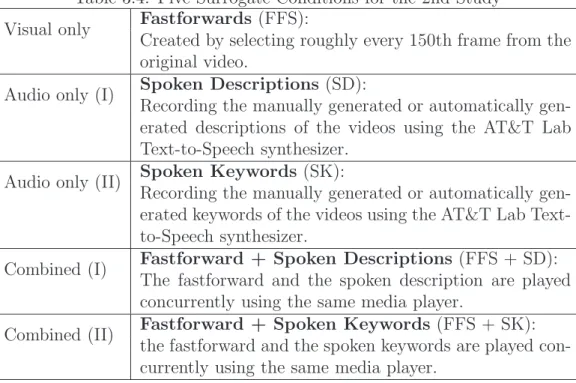
3.4 Five Surrogate Conditions for the 2nd Study . . . 125
3.5 Gist & Recognition Tasks Used in the 2nd Study . . . 126
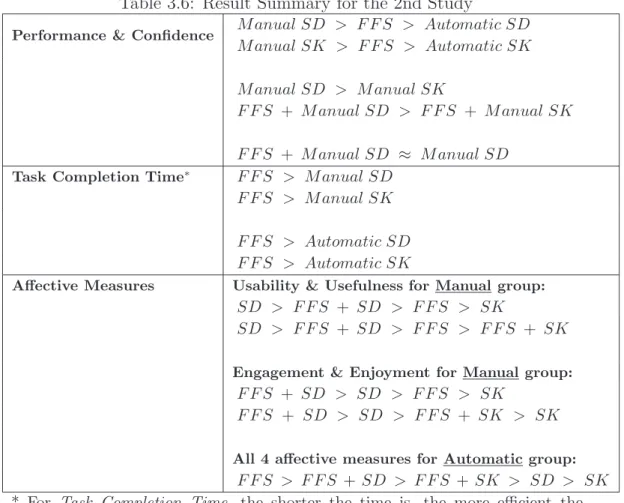
3.6 Result Summary for the 2nd Study . . . 128
3.7 Methods of Extracting Audio and Visual Excerpts for the Multi-modal Surrogates . . . 132
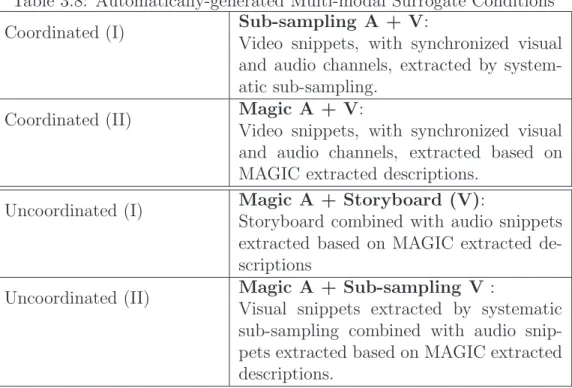
3.8 Automatically-generated Multi-modal Surrogate Conditions . 133 3.9 Automatically-generated Multi-modal Surrogate Conditions Ex-cluded from the Evaluation. . . 134
3.10 Manually-generated Gold Standard Surrogate Conditions . . . 134
3.11 Experimental Design: Counterbalance the Surrogate Conditions 152 3.12 Subjective Questions related to Usefulness and Usability . . . 156
3.13 Subjective Questions related to Enjoyment and Engagement . 157 4.1 Demographic Characteristics of Study Participants . . . 161
4.2 Department Affiliation of Study Participants (Note: Numbers in brackets indicate affiliation with more than one department.) 162 4.3 Participants’ Experience with Computers and Video Use. (Val-ues: 1 Never, 2 Occasionally, 3 Monthly, 4 Weekly, 5 -Daily.) . . . 162
4.5 Participants’ Video Searching Purposes . . . 163 4.6 Measures Used in the Study . . . 164 4.7 Surrogate Consumption Time (N = 48, df = 5, 43) . . . 165 4.8 Task 1. Free-text Gist Written Task (N = 48, df = 5, 43) . . . 166 4.9 Pairwise Comparisons for Task 1 Accuracy . . . 170 4.10 Summary of Pairwise Comparisons (Coordinated vs.
Uncoordi-nated) Significant at 0.05 Level for Task 1 Accuracy, Confidence, and Task Completion Time. . . 172 4.11 Summary of Pairwise Comparisons (Manually vs.
Automati-cally) Significant at 0.05 Level for Task 1 Accuracy, Confidence, and Task Completion Time. . . 175 4.12 Task 2. Keyword Determination Task (N = 48, df = 5, 43) . . 177 4.13 Summary of Pairwise Comparisons (Coordinated vs.
Uncoordi-nated) Significant at 0.05 Level for Task 2 Accuracy . . . 180 4.14 Summary of Pairwise Comparisons (Automatically vs.
Manu-ally) Significant at 0.05 Level for Task 2 Accuracy.. . . 182 4.15 Task 3. Keyframe Determination Task (N = 48, df = 5, 43) . 184 4.16 Summary of Pairwise Comparisons (Coordinated vs.
Uncoordi-nated) Significant at 0.05 Level for Task 3 Accuracy, Confidence, and Task Completion Time. . . 187 4.17 Summary of Pairwise Comparisons (Automatically vs.
Manu-ally) Significant at 0.05 Level for Task 3 Accuracy, Confidence, and Task Completion Time. . . 189 4.18 Task 4. Visual Excerpt Determination Task (N = 48, df = 5, 43)191
4.19 Summary of Pairwise Comparisons (Coordinated vs. Uncoor-dinated) Significant at 0.05 Level for Task 4 Completion Time
4.20 Summary of Pairwise Comparisons (Automatically vs. Manu-ally) Significant at 0.05 Level for Task 4 Completion Time . . 195 4.21 Task 5. Audio Excerpt Determination Task (N = 48, df = 5, 43)196 4.22 Summary of Pairwise Comparisons (Coordinated vs.
Uncoordi-nated) Significant at 0.05 Level for Task 5 Confidence and Task Completion Time . . . 199 4.23 Summary of Pairwise Comparisons (Automatically vs.
Manu-ally) Significant at 0.05 Level for Task 5 Confidence and Task Completion Time . . . 200 4.24 Task 6. Verbal Gist Determination Task (N = 48, df = 5, 43) 202 4.25 Summary of Pairwise Comparisons (Coordinated vs.
Uncoordi-nated) Significant at 0.05 Level for Task 6 Confidence and Task Completion Time . . . 206 4.26 Summary of Pairwise Comparisons (Automatically vs.
Manu-ally) Significant at 0.05 Level for Task 6 Accuracy, Confidence, and Task Completion Time. . . 207 4.27 Participants’ Subjective Ratings on the Surrogates . . . 209 4.28 Pairwise Comparisons (Coordinated vs. Uncoordinated) of the
Subjective Measures Significant at 0.05 Level . . . 212 4.29 Pairwise Comparisons (Automatically vs. Manually) of the
Subjective Measures Significant at 0.05 Level. . . 213 4.30 Pairwise Comparisons of Task Completion Accuracy among
Sur-rogates . . . 222 4.31 Pairwise Comparisons of Participants’ Confidence Ratings in
their Task Responses among Surrogates . . . 223 4.32 Pairwise Comparisons of Task Completion Time among
Surro-gates . . . 224 4.33 Pairwise Comparisons of Subjective Measures among
List of Figures
2.1 Panofsky-Shatford Mode Facet Model. (Source: Armitage and Enser (1997), p. 290.) . . . 15 2.2 The 10-level Jaimes Chang Indexing Pyramid. . . 16 2.3 A CIRES Query of a Parrot based on an Example Image . . . 68
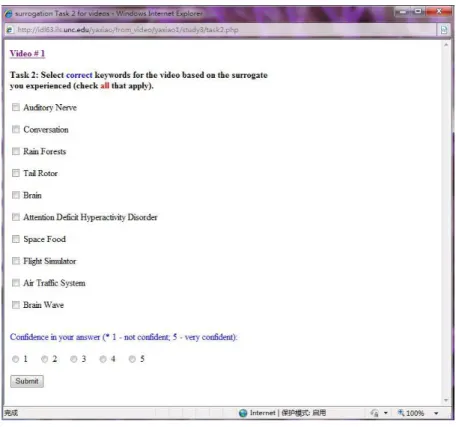
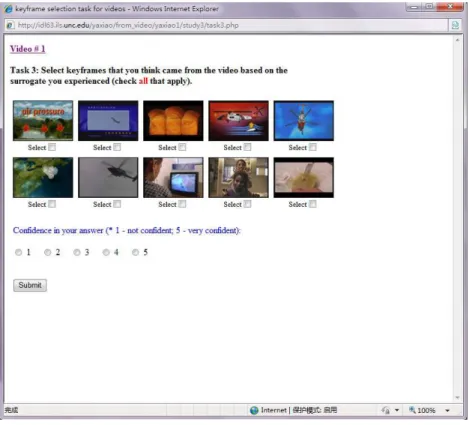
3.1 Overlaps among Summary Segments for Video “NASAConnect: Virtual Earth” : (a) Overlaps in the audio only version, (b) Overlaps in the visual only version, (c) Overlaps in the full video. . . 138 3.2 Online Stimulus for Task 1 (Free-text Gist written Task) . . . 143 3.3 Online Stimulus for Task 2 (Keyword Determination Task) . . 145 3.4 Online Stimulus for Task 3 (Keyframe Determination Task) . 146 3.5 Online Stimulus for Task 4 (Visual Excerpt Determination Task)148
4.1 Mean Accuracy for Task 1 (Free-text Gist Written Task) by Surrogate Condition. Possible data value range: 0 - 4.0. . . 167 4.2 Participants’ Mean Confidence for Task 1 (Free-text Gist
Writ-ten Task) by Surrogate Condition. Possible data value range: 1 - 5. . . 168 4.3 Mean Task Completion Time (in seconds) for Task 1 (Free-text
Gist Written Task) by Surrogate Condition. . . 168 4.4 Mean Accuracy for Task 2 (Keyword Determination Task) by
Surrogate Condition. Possible data value range: 0.0 - 1.0 . . . 178 4.5 Participants’ Mean Confidence for Task 2 (Keyword
4.6 Mean Task Completion Time (in seconds) for Task 2 (Keyword Determination Task) by Surrogate Condition . . . 179 4.7 Mean Accuracy for Task 3 (Keyframe Determination Task) by
Surrogate Condition. Possible data value range: 0.0 - 1.0 . . . 185 4.8 Participants’ Mean Confidence for Task 3 (Keyframe
Determi-nation Task) by Surrogate Condition. Possible data value range: 1 - 5. . . 185 4.9 Mean Task Completion Time (in seconds) for Task 3 (Keyframe
Determination Task) by Surrogate Condition. . . 186 4.10 Mean Accuracy for Task 4 (Visual Excerpt Determination Task)
by Surrogate Condition. Possible data value range: 0.0 - 1.0 . 192 4.11 Participants’ Mean Confidence for Task 4 (Visual Excerpt
De-termination Task) by Surrogate Condition. Possible data value range: 1 - 5. . . 193 4.12 Mean Task Completion Time (in seconds) for Task 4 (Visual
Excerpt Determination Task) by Surrogate Condition. . . 193 4.13 Mean Accuracy for Task 5 (Audio Excerpt Determination Task)
by Surrogate Condition. Possible data value range: 0.0 - 1.0 . 197 4.14 Participants’ Mean Confidence for Task 5 (Audio Excerpt
De-termination Task) by Surrogate Condition. Possible data value range: 1 - 5. . . 198 4.15 Mean Task Completion Time (in seconds) for Task 5 (Audio
Excerpt Determination Task) by Surrogate Condition. . . 198 4.16 Mean Accuracy for Task 6 (Verbal Gist Determination Task)
by Surrogate Condition. Possible data value range: 0.0 - 1.0 . 203 4.17 Participants’ Mean Confidence for Task 6 (Verbal Gist
Deter-mination Task) by Surrogate Condition. Possible data value range: 1 - 5. . . 204 4.18 Mean Task Completion Time (in seconds) for Task 6 (Verbal
Chapter 1
INTRODUCTION
1.1
Problem Statement
full videos, as well as to locate the most relevant minutes from thousands of hours of video content. We refer to these human-consumable summaries as surrogates.
Video surrogates are the key to successful video search systems or large video repositories because they facilitate finding and selecting videos from the large collections, and help people quickly make sense of the content of a video before downloading (which requires not only large storage but bandwidth) or seeking further detailed information. It has been demonstrated by a number of usability studies (Christel et al., 1998; Ding et al., 1999; He et al., 1999;
Goodrum, 2001;Yang et al., 2003;Wildemuth et al., 2002, 2003;Lie and Lai,
2004) and some real-life video retrieval and search applications (e.g., Internet Archive, Open Video) that people can quickly make sense of videos by viewing the abbreviated video surrogates.
was automated (Over et al., 2005). Nevertheless, some studies report that people like to have visual surrogates regardless of their performance effects. For example, He et al. (2000) compared four possible ways of summarizing presentations, presentation slides, text transcript, transcript with highlighted points, and a manually created audio-video summary. They reported that users prefer audio-visual summaries to both text transcripts and presentation slides, though the four summarization methods offer comparable results. An eye-tracking study by Hughes et al. (2003) also confirmed that participants liked the pictures and felt that they were necessary and added some value to the search process.
be-cause they engage humans’ natural ability to hear and require no training for sense-making. If reasonably designed, audio surrogates can very well assist people in understanding the content of the videos. Not only can audio surro-gates be downloaded much faster than videos, but they also require less system resources and minimal screen real estate to be useful. They thus have the po-tential to be successful surrogate alternatives for limited displays on small devices (e.g., PDAs, cell phones). Moreover, audio surrogates can be used by people in situations where they can not use vision to work on videos, for exam-ple, when they are driving or walking on the street. Most importantly, audio surrogates can be even more powerful if successfully combined with visual sur-rogates to leverage multiple sensory channels without significantly increasing people’s cognitive loads.
1.2
Research questions
The study described here explores multi-modal surrogates for retrieving and making sense of videos. The main questions to be answered are:
• How do automatically generated multi-modal surrogates compare to manually generated ones in video retrieval and video sense-making?
• Does coordination between multiple surrogate channels enhance or in-hibit video retrieval and video sense-making?
– Ifunsynchronized multi-modal surrogates are created by extracting the most salient samples from the audio and visual channels sepa-rately and then combining the extracted salient samples, will they convey more useful information about the video per unit time and lead to better retrieval and sense-making performance than extract-ing the most salient samples from the two channels synchronically?
1.2.1
Multi-modal Surrogates
Multi-modal surrogates are surrogates that employ multiple sensory channels, for example, the visual modality and the audio modality. The obvious gain of using multiple sensory channels is increased usefulness: Weaknesses of one modality are offset by the strengths of another. Possible drawbacks are in-creased cognitive load.
On the contrary, slide shows can be augmented by audio narrations to leverage both the hearing and seeing modalities. Additionally, it is less expensive to sample from the two channels separately and then create the surrogate. To make surrogates available to be used in large video collections, inexpensive surrogates which can be created automatically are preferred.
This study examined the effectiveness of several multi-modal surrogates, for which human audio and visual sensory channels are both leveraged. The potential value of spoken audio (either extracted from the video or spoken by a speech synthesizer) when combined with some visual surrogates for retrieving and making sense of videos, is of special interest.
This research question leads to the second research question of this study: the need for synchronization between the audio and visual channels of the surrogates. With surrogates consisting of audio and visual abstracts from the video, is it necessary to carefully synchronize the audio and visual channels?
1.2.2
Coordination between Channels
According to Dual Coding Theory (Paivio, 1986), verbal and visual infor-mation are simultaneously processed in two separate sub-systems of human cognition. Auditory information, when designed to complement the visual en-vironment, can have additive effects on human recall (Thompson and Paivio,
1994).
this coordination requirement for primary information objects also applies to highly abbreviated, condensed information objects, such as video surrogates. In fact, our two preliminary studies (Song and Marchionini,2007;Marchionini et al.,2009) are among the first studies examining uncoordinated multi-modal surrogates employing multiple sensory channels, yet different conclusions were drawn from these two studies about the synchronization necessity due to the fact that different multi-modal surrogates were examined in the two studies. This study will take lessons from the previous studies, and carry out the eval-uation of synchronized modal surrogates against unsynchronized multi-modal surrogates.
1.2.3
Sampling Together or Separately?
though pre-coordination at indexing time may be desired from the consumer’s affective point of view because we are more used to synchronized presentations, my hypothesis is that, because the most salient abstracts from the audio chan-nel do not necessarily align temporally with the most salient abstracts from the visual channel, more information may be carried in the abstracts than if the audio and visual of the abstracts are temporally coordinated. As a result, independently sampling the most salient samples across different channels and letting users integrate the uncoordinated channels at consumption time may lead tomore sense-making potential.
1.2.4
Hypotheses
Based on the research questions, a set of hypotheses are proposed as follows:
1. Human interpretation cost
• Time: it will take people longer time to make sense of the gates with unsynchronized audio and visual channels than surro-gates with the synchronized channels.
• Affective measures: people will prefer the synchronized surro-gates to the unsynchronized ones.
2. Performance:
• Confidence: people will have higher confidence in their task re-sponses using the unsynchronized multi-modal surrogates than us-ing the synchronized ones.
1.3
Significance of the Study
Chapter 2
RELATED LITERATURE
This chapter reviews existing literature in four different but related research areas. To study users’ use of multi-modal surrogates in video retrieval and sense-making, it is necessary to consider the literature on how people under-stand videos and images from a cognitive point of view. In addition, previous and current techniques for automatically making video summaries or video surrogates, and video retrieval techniques through metadata and surrogates will be considered. Finally, the methodologies used in evaluating the video summaries or surrogates are examined.
2.1
Psychological Theories of Making Sense of
Videos
multimedia contents and, more importantly, how people make sense of videos through surrogates. Since videos, as well as multi-modal surrogates, contain multiple channels of information, i.e., audio, visual, and textual channels, it’s also important to look at the literature on Dual Coding Theory. This sec-tion reviews the previous work on how people make sense of videos and video surrogates.
2.1.1
Multimedia Sense-making
Viewing images and videos is both a sensory and a mental experience. Hanson
(1987, p.36) has written:
“Sensory and mental experiences are also influenced by a complex process that includes environmental, technical, physiological, psy-chological, cultural, and social factors.”
2.1.1.1 Physiological Perception of Visuals
Our brain gets 75% of its information from the eyes (Youngblood, 1970, p. 46), and the eyes filter the information to be processed in the brain. When we watch a film or video, we are actually watching a series of still images displayed to us at 24fps (frame per second) or more. Because of the way our brain and eye process the visual information, an image appears to be present (known as the “afterimage”) for approximately one twenty-fifth of a second on the retina after the exposure to the image ceases (Wertheimer,1961). This phenomenon is calledpersistence of vision. Due to this physiological phenomenon, our eye and brain get the illusion that the images are moving.
2.1.1.2 Psychological Perception of Visuals
Once the eye and brain register a visual representation, the process of making sense of icons and symbols in the visual field falls into the realm of psychological perception (Hanson, 1987).
The same image can convey different meanings to different people given their different backgrounds, knowledge, experiences, cultures, specific infor-mation needs, or interests. Watching video (or film) requires comprehension performance such that people are required to know what a video is about and make meaningful representations out of the video (Lee and Roskos-Ewoldsen,
people are involved with mental representation construction along five situa-tional dimensions–time, space, causation, intensitua-tionality, and protagonist– all five dimensions account for how information is integrated when people watch videos. To explore what kinds of video surrogates can help people efficiently and effectively makes sense of videos or make relevance judgments, it is im-portant to learn how people make sense of video, either through perceiving the full video itself, or through perceiving surrogates.
The smallest meaningful unit in a video is the frame (image). To under-stand how people make sense of multimedia content, we can look at how people perceive visual images as a starting point for corresponding video understand-ing and sense-makunderstand-ing.
People’s understanding of visual images involves several different levels. The Renaissance art historian Panofsky identified three levels of imagery com-prehension: pre-iconographical description,iconographical analysis, and icono-graphical interpretation or synthesis (Panofsky, 1955).
• The secondary level,iconographical analysis, describes what the im-age represents (i.e., the specific things in the imim-age).
This level of comprehension requires the viewer’s pre-iconographical un-derstanding of and familiarity (e.g., social and cultural knowledge) with the theme and concepts represented, and involves a deeper understand-ing of the subject matter. For example, a representation of a haloed woman could be specifically interpreted as the Virgin Mary, and a saint holding keys usually represents St. Peter.
• The third level, iconological (iconographical interpretation or synthesis), examines an image beyond its face value, and focuses on
the symbolic meaning (especially in personal, social, and political terms) of the image, such as “nature”, “peace” and “fidelity”.
This level of comprehension requires knowledge of the first two levels as well as adding an emotional aspect to the viewers’ understanding of the image.
Similar to Panofsky’s image comprehension model, Hanson (1987) defined three levels of meaning that we can find from a frame: icon,index, andsymbol. As stated in (Hanson, 1987, p. 43)
“An icon is an image that stands for something else ... [A]n in-dex ... associates the image with a conceptual idea ... [A] sym-bol...(relates) the image to the actual context...”
understand-thority, and camera pan up often signifies smallness and weakness; zoom in signifies observation and focus, while fade in and fade out signify beginning and ending, respectively. People’s understanding of these codes or symbols are learned through their experiences and influenced by the culture. The same visual representation can convey different meanings to different people.
Figure 2.1: Panofsky-Shatford Mode Facet Model. (Source: Armitage and Enser (1997), p. 290.)
“about” level contains moods, emotions, abstractions and symbols, for exam-ple, happiness, fear, justice, etc. The 3x4 matrix has often been referred to as the Panofsky-Shatford model by information scientists (e.g., Enser, 1995) and used in a number of studies in indexing both still images (Armitage and Enser, 1997) and moving images (Turner, 1995).
From the Content Based Information Retrieval (CBIR) perspective, Jaimes et al. (1999) incorporated Panofsky and Shatford’s models and defined a 10-level pyramid framework for describing the visual content attributes of images or video. The same pyramid can also be used to classify attributes obtained from audio. The pyramid includes 4 syntactic layers and 6 semantic layers (see Figure 2.2).
Figure 2.2: The 10-level Jaimes Chang Indexing Pyramid.
Global Distribution describes the global attributes of the image, such as color histogram, texture. The third level,Local Structuredescribes components that are local to individual parts within the image, such as dots, lines, and circles, as well as temporal/spatial positions (e.g., start time and centroid) (Jaimes and Chang, 2000). As for the fourth level, Global Composition, as noted in
Jaimes et al. (2000, p.1), it
“relates to the way in which those local components are arranged in the image (e.g., symmetry).”
The four syntactic/perceptual levels do not require world knowledge to perform indexing of the images. The six semantic levels describe the meaning of the elements within the images, and closely mirror the Panofsky-Shatford model (i.e., Generic,Specific, and Abstract).
Each of the levels of image comprehension discussed above (Panofsky,1955;
Shatford, 1986; Jaimes et al., 1999) may also apply to video materials, both full videos or video surrogates.
knowl-edge to identify the objects perceived. For example, to comprehend a picture of a “double-decker bus” or “the Eiffel tower” (Eakins and Graham, 1999, p. 7), one needs some prior knowledge to identify an object as a bus rather than a lorry or have the knowledge that a specific building structure has been named “the Eiffel tower”. Level 3involves a great amount of high-level complex rea-soning and subjective judgement about the image’s abstract attributes, such as the meaning and purpose of the objects or scenes depicted, and emotional or religious significance of the image. Greisdorf and O’Connor (2002, p. 8) described hierarchical levels of image perception which were consistent with
Eakins and Graham (1999).
2.1.1.3 Perceiving Films and Videos
Beyond perceiving individual frames, video comprehension is more compli-cated than image comprehension due to its temporal and spatial complexity. In particular, new information is associated with previous information and also modifies the viewer’s current mental representation.
Noel Carroll and David Bordwell are often considered the two main cog-nitivists in film theory. They proposed a cognitive approach to film theory as an alternative to the mainstream in film studies. Cognitivists are inter-ested in both simple visual information processing and more complex kinds of interpretative and emotional responses. As summarized in Yang (2005),
spec-tatorship involves two kinds of perceptual activities: sensory contact with the cinematic image and epistemic access to the image along with further objects, situations, and events”. Thus, the viewers’ sense-making process always in-volves two levels: “sensory seeing and cognitive seeing”.
In a work contemporary to Ponech (1997),Grodal (1999, p. 59) described a flow diagram with four main steps in processing of audiovisual input. Step 1 consists of basic perception. The brain makes its first visual analysis of colors, textures, lines and figures. The process creates perceptual intensities without any meaning in the ordinary sense of the word. Step 2 consists of memory-matching. The brain searches its memory files for possible matches, aided by feelings of familiarity or unfamiliarity. Step 3is the construction of narrative scene or universe, and a cognitive-emotional appraisal and motivation phase, which consists of relating and contextualizing the items seen and determined in steps 1 and 2 to a living being (a human or an animal in cartoons) and a scene. For example, snakes represents possible danger, and the viewer may experience strong arousal with increased heartbeats and sweat. Step 3 then leads to step 4: reactions at a high level of arousal, such as crying, laughter, or shivering.
analysis and iconographical interpretation are about cognitive seeing.
Moreover, according to the research on information objects (e.g., the Dual Coding Theory) involving more than one modality (take, for example, full motion videos with both audio and visual channels), if the information from different modalities is well integrated, the modalities reinforce rather than interfere with each other and may lead to increased usability and comprehen-sion. A more detailed discussion of the Dual Coding Theory will be provided in Section 2.1.3.
Furthermore, when people watch a video, they may screen out some infor-mation and choose to pay attention to only some stimuli. Selective attention and retention are results of the individual’s information needs and interests, and may also relate to the genre of the video itself. For example, a person watching a video for the first time may pay different attention to the video than a person who is watching it for the second time. Also, the same person pays different attention when he watches a news video than when he watches a comedy. Next, let’s look at the different levels of attention we use when watching videos.
levels of attention we use when watching films: (1) attending to the video other than to the circumstances, (2) attending to the film as a fictional story versus a constructed world consisting of actors, sets, and artificial devices, and (3) attending to the diegetic or internal circumstances of the story itself.
For the first level, attending to the video, it has been found that movie viewing always involves some goal-driven attention (i.e., a viewer sits down with the intention of watching the movie). However, stimulus-driven attention can be activated by peripheral events (e.g. a person stands up and leaves his seat) or auditory stimuli (e.g. chatting and coughing from other audiences).
For the second level, attending to the film as a fictional story, most movie viewers (if not professional critics) will watch a film with attention to the fictional story. Film makers employ “invisible” film editing so as to hide the camera transitions from one angle to another. Artificial devices like cameras, microphones, cables, etc, are intentionally kept outside the camera frame to hide the distracting stimuli from the viewers as much as possible.
The last level of film viewing attention, attending to diegetic circumstance, involves maintaining the viewer’s attention and interest. Like a bird flying in the sky, a movie or film needs to have a great deal of continual changes to be engaging, especially over long periods of time.
2.1.2
Video Sense-making through surrogates
With the boom of digital technologies, large collections of digital videos are increasingly available for people to download and use. The tremendous volume of digital videos, in turn, requires effective and efficient access to those videos. It has been demonstrated by a number of usability studies (Ding et al., 1999;
Yang et al., 2003;Wildemuth et al.,2002,2003) and some real video retrieval and search engines (e.g., Open Video, Internet Archive) that people can quickly make sense of videos by viewing the abbreviated video surrogates. Surrogates facilitate faster lookups of and access to video collections.
Yang et al. (2003) classified video surrogates into two modalities: textual andaudiovisual. In fact,audio andvisual can be further divided into two sep-arate modalities. Better understanding the role of the individual modalities and how to integrate multiple modalities so as to facilitate better video search-ing and browssearch-ing is crucial to the success of a digital video library. Hence, it is important to learn how people react to, perceive, conceive, and integrate these different modalities.
For the visual-based surrogates, people make sense of the videos through understanding the images. The previous sections have already discussed how people perceive images, and these models and theories also apply to how people make sense of the videos through visual surrogates.
2.1.2.1 Rephrasing the literal
visual and verbal combined.
After viewing the surrogates (i.e., keywords, key frames, or both), partic-ipants were asked to write 2-3 sentences that summarize what the video clip was about. It was found that participants tended to make up a sentence to include all keywords they saw in the surrogates or tried torephrase them. The participants also tended to usespecificterms with iconographic concepts such as names, location, and means to summarize the video. The same rephrasing pattern was also reported bySong and Marchionini (2007).
In addition, the summaries they wrote by viewing the video surrogates were often people oriented (Ding et al., 1999), consistent with Massey and Bender (1996). It seems to be easier to make a story about people, hence participants tended to make a story and put a particular person at the core of the story, which may or may not match the video content.
2.1.2.2 The Effects of Individual and Multiple Modalities
Surrogates of different modalities contribute unique values. Christel et al.
According to the research on information objects involving more than one modality (e.g., full motion videos), if the information from different modali-ties is well integrated, the modalimodali-ties reinforce rather than interfere each other and may lead to increased usability and comprehension. The redundant infor-mation from different modalities provides cross-references to the target to be understood (Pryluck, 1976), and offsets weaknesses of one modality with the strengths of another. Ding et al.(1999) confirmed these benefits of combining multiple modalities (i.e., text and image), and found that redundant infor-mation simultaneously perceived through the two modalities actually sped up processing time.
The advantages of integrating multiple modalities in full video objects also apply to consuming condensed video surrogates. Ding et al.(1999) found that users viewed key frames and keywords sequentially and selectively: They may first look at key frames or keywords as a whole, then switch to the other modality. The textual surrogates such as keywords or short abstracts are often used by people to set up the baseline of the story. The visual surrogates such as key frames are often used to reinforce, confirm, and adjust the story. The study concluded that users strongly favor the combined surrogates, in which each modality (i.e., verbal, image) makes a unique contribution to the comprehension of a video, and in combination they reinforce each other.
The unique values and additive effects of the textual and visual surrogates were also confirmed by other studies (Wildemuth et al., 2002; Hughes et al.,
visual portion of the surrogate, and as a source of ideas for terms to use in future searches. They commented that textual video surrogates can facilitate the process of determining relevance, and non-textual video surrogates can effectively complement textual surrogates. Hughes et al. (2003) conducted an eye-tracking study and demonstrated that text dominates how people make sense of retrieval sets, while images add confirmatory value. Note that these studies concentrated on text and visual modalities, which both fall into the visual sensory modality. In a more recent multi-modal surrogate study, Song and Marchionini(2007) compared the effectiveness of three different surrogates – visual alone (a storyboard), audio alone (spoken description), and visual and audio combined (a storyboard augmented with spoken description) – for mak-ing sense of digital video, and showed that combined surrogates that employ both visual and audio modalities are more effective, strongly preferred, and do not penalize efficiency. According to the study participants, the audio and vi-sual reinforced each other. “With the two (modalities) together, the surrogate is more efficient, and understanding the surrogates becomes simpler than when they are apart.” In particular, the audio (spoken description) carries semantic information in video, “gives you a concrete outline of what is going on in the video”, while the visual (storyboard) anchors the content, aids memory, and motivates people to watch the video.
2.1.3
Dual Coding Theory
videos also requires simultaneous information processing in verbal and non-verbal systems of human cognition. Therefore, it is necessary to review works and experiments done in Dual Coding Theory (DCT).
2.1.3.1 Dual Coding of Verbal and Nonverbal Systems
According to Paivio’s Dual Coding Theory (Paivio,1986,2006), humans have the ability to process information in verbal and nonverbal (i.e., visual) channels simultaneously and separately in two subsystems (i.e., verbal and nonverbal) of human cognition.
As Paivio wrote (Paivio,2006, p.58):
“The verbal and nonverbal systems, although functionally indepen-dent, must coordinate their activities to achieve common goals... Independence means that the systems can be active separately or together. Cooperation is possible because each system can activate the other via their interconnections.”
(i.e., as images) and verbal (i.e., as words) systems of human cognition; when we see an image, given enough response time, we name it silently in our mind. When the images are shown too fast, dual coding is prevented because there is not enough time to name the images. Similarly, concrete words might be dually coded as well because they may arouse mental images in our mind. It is generally easier to dually code pictures than words. Abstract words, on the contrary, are unlikely to evoke images in our mind; therefore, they can not be dually coded. The higher the probability of dual coding occurring, the higher are the additive effects. This reasonsing explained the higher recall of the concrete words over the abstract words.
Note that the additive benefits of dual coding are distinct from repetition of a single coding system. The additive effects of dual coding were tested further by Paivio (1975), when free recall proportions were compared for pic-tures presented once, words presented once, picpic-tures presented twice, words presented twice, and pictures presented once followed by their printed names (or vice versa). It was found that successive repetition of the same code (ei-ther words or images) increased the recall more than unrepeated code, but by an amount that was lower than additive benefits from dual coding, where the same items were presented in both images and words. Likewise, it can be predicted that dually coded multi-modal surrogates lead to higher recall than simple repetition of unimodal surrogates.
summarized in Paivio (2006, p.75).
In addition to free recall and cued memory, dual coding also has powerful ef-fects onrecognition memoryand search times. Parallel to the above-mentioned finding that “pictures were superior to words asretrieval cues” (Paivio, 1971, p.66, italics added), recognition memory was also found to be higher for pic-tures than for their concrete word counterparts, which is in turn, found to be higher than for recognition memory for abstract words. For example, Shepard
(1967) investigated recognition memory of long lists of words, sentences, and images, and showed that, from a list of 600 stimuli per session, images came out on top with 98.5% correct recognition, while 90% of words and 88% of sen-tences were recognized correctly. The results can be explained by the fact that images are more easily dual coded than the concrete words, and the abstract words can only rarely be dual coded into images. However, the superiority of images discussed above may not directly apply to video surrogates consist-ing of movconsist-ing images that are played fast, due to the dual codconsist-ing difficulty given inadequate consumption time. Likewise, text surrogates should be given enough time for consumption.
Although it is, in general, correct that pictures are superior to words in terms of free recall, cued recall, recognition and search times, Paivio and Begg
de-scriptions of the robber’s face, while the other half did some task unrelated to the video. It was found that only 1/3 of the participants who wrote the descriptions were able to correctly recognize the robber’s face, as opposed to 2/3 of those who did not write the descriptions. The verbal overshadowing effects can be explained in Dual Coding Theory: verbal coding was aroused when participants were asked to write descriptions, and the verbal descrip-tions composed by the participants became a new memory trace, which may not have been precise. The imprecise memory of the robber’s face may not help and might even hinder the identification of the robber. Therefore, contra-dicting the usual additive effects of dual coding (i.e., naming images), verbal descriptions (though inducing dual coding) were proven to be unhelpful in remembering faces.
2.1.3.2 Dual Coding of Multiple Sensory Modalities
The above paragraphs discussed dual coding of verbal and nonverbal systems.
Paivio (1972) suggested that sensory modalities (for example, visual modal-ity and auditory modalmodal-ity) may have additive effects on recall as well. The additive effects of multiple sensory modalities were confirmed in Thompson and Paivio (1994): hearing the sound and seeing the pictures of audiovisual objects (e.g., phone) yields an additive effect on object recall as compared to only having single modality stimulus. Moreover, the additive effects of multiple modalities were higher than simple repetitions of the same modality.
vi-sual) and smelling odors (i.e., olfaction) at the same time led to higher recog-nition memory and free verbal recall of odors, while having auditory, visual, and olfaction altogether could further increase the recall.
2.1.3.3 Criticisms of Dual Coding Theory
Despite the success of Dual Coding Theory, there have also been a lot of criti-cisms of DCT. Some criticriti-cisms focus on the inconsistent experimental findings, for example, pictures are not always recalled better than words, especially with children (Dilley and Paivio, 1968). Paivio (2006) suggested this might be ex-plained by the labeling difficulties by children. Experiments done by Cole et al. (1971) supported Paivio’s explanation about the inconsistency. Cole et al. (1971) explicitly asked the children in Grades 1 through 8 to name pic-tures, and found that the children indeed recall images better than words, due to the additive effects of verbal and nonverbal dual coding. Also, as summa-rized in Paivio (2006), when people age, the superiority of images over words will vanish, such that for old people, the advantages of dual coding for images over words may not be found.
Criticisms of DCT also seek alternative attributes or explanations of con-crete words superiority to abstract words, or theoretical alternatives to DCT. For a detailed summary of the critiques and rejoinders of DCT, please refer to
2.1.3.4 Applications of Dual Coding Theory
Dual Coding Theory has applications in many cognitive domains, and has been used by instructional designers as a theoretical basis for multimedia ma-terials. One DCT hypothesis is that the verbal and nonverbal codes, being functionally independent, can have additive effects on human recall. Audio accompaniment has been found effective in complementing visual cues and “auditory information, when designed to complement the visual environment, is natural and people are innately comfortable with it - its use requires no training” (Gunther et al., 2004, p.435). For example, Kulhavy et al. (1993) conducted two experiments where undergraduates studied a city map and then heard a text which was associated with the map features, and found that hav-ing visual and verbal stimuli together added memory for structural properties of a map. Mayer and Moreno (1998) also offered strong evidence for using narrated text with graphics rather than on-screen text with graphics, which they termed the “modality effect”. Watching videos with one or more syn-chronized audio track(s) also leads to increased recall over consuming just the visual or the audio, and observations of the benefits of multi-modal surrogates have also started to be reported (Ding et al.,1999;Goodrum and Spink,2001;
Wildemuth et al.,2002;Boekelheide et al.,2006;Song and Marchionini, 2007;
Marchionini et al.,2009).
2.1.4
Summary
experience, and various models that pose multiple levels of image comprehen-sion and movie spectatorship were reviewed (Panofsky, 1955; Shatford, 1986;
Jaimes and Chang,2000;Eakins and Graham,1999;Greisdorf and O’Connor,
2002; Ponech, 1997). When people watch videos, they may screen out some information and pay selective attention to only some stimuli. The way people perceive videos is also influenced by cultural and sociological aspects.
2.2
Automated Video Summarization
As more digital videos become available online, it is imperative to give users effective summarization and skimming tools to facilitate finding and browsing of the videos. Surrogates are condensed information for representing the full information objects. Video surrogation, a mechanism for generating this con-densed information for full videos, is needed for effective and efficient video acquisition from and indexing for large collections of videos. Video summa-rization, or video abstraction, as their names imply, are mechanisms for gen-erating short summaries of videos. Therefore, those names are closely related and dependent, if not completely interchangeable.
There is a great deal of work on summarization techniques for text, audio, and videos (e.g.,Abracos and Lopes,1997;Chen and Withgott,1992;Kennedy and Ellis, 2003; Li et al., 2004). A number of summarization techniques for text documents utilize the tf-idf (term frequency-inverse document frequency) schema or its variations to find the most informative and representative sen-tences to form text summaries (Abracos and Lopes, 1997;Li et al., 2004).
be exploited to create video summaries.
In this Section, previous and current techniques for automatically making video summaries and video abstracts are reviewed. Since audio and video are closely related, and the audio stream is an important and non-neglectable part of video, some work in automated audio or speech summarization is also reviewed.
Various approaches have been investigated for summarizing videos. Yahiaoui et al. (2003) classified existing video summarization approaches in two main categories: rule-based approaches and mathematically oriented approaches. The former combine evidence from several types of processing (i.e., audio, video, text) to detect certain configurations of events to include in the sum-mary (Christel et al., 1998; Lienhart et al., 1997). The latter use similarities within the video to compute a relevance value of video segments or frames, for example, using singular value decomposition (Gong and Liu, 2003) and segment importance measures (Uchihashi et al., 1999).
This section categorizes and reviews some existing summarization approaches according to the type of data stream they mainly process.
2.2.1
Video Summarization via Temporal/Spatial
Com-pression
2.2.1.1 Time Compressed Video
up the video clip. However, the increased playback speed often comes with decrease in comprehension due to the audio distortion (i.e., a degradation of the speech signal) and a processing overload of short-term memory. Therefore, compression of this kind is limited to a maximum compression factor of 1.5-2.5 depending on the particular program genre and speech speed (Heiman et al.,
1986), beyond which the speech audio becomes perturbing and incomprehen-sible.
2.2.1.1.2 Dropping short sequences One practical way to time-compress the audio is to remove redundant information from the speech signal. The sam-pling methods drops short segments from the speech signal at regular intervals. For example, for the original sequences {1,2,3,4,5,6,7,8,9} of 50 milliseconds each, short sequences{2,4,6,8}can be dropped. By dropping alternate chunks of speech from the original signal, 2x compression can be achieved. Unfortu-nately, this results in an increase in pitch, making the audio less comprehen-sible and enjoyable.
2.2.1.1.3 Pause shortening or removal In addition to speeding-up the video and dropping short sequences, removing or shortening pauses can be used to further reduce 15%-20% playback time without compromising content (Gan and Donaldson, 1988). Simply removing all pauses in speech results in speech that is “natural, but many people find it exhausting to listen to because the speaker never pauses for breath”, as stated in Neuburg (1978). There are two categories of pauses in speech: Juncture pauses, average 500-1000 ms, which are under talkers’ conscious control, usually occurring at major syntactic boundaries; and Hesitation pauses, averaging 200-250 ms, which are not under talker control (Minifie, 1974). Lass and Leeper (1977) suggested that when time compressing the speech, juncture pauses can not be removed or shortened without interfering with comprehension. For example, Arons
(1997) time compressed speech audio, such that the pauses are selectively shortened or removed. In particular, pauses less than 500 ms are removed, and pauses more than 500 ms are shortened to 500 ms. With these thresholds, speech audio is sped up while providing the listener with cognitive processing time as well as the pace of the utterance.
However, time compression via speeding-up and/or pauses shortening or removing, even when used together, can hardly lead to compaction rates of more than 2:1 (Arons, 1997). In many real-life video retrieval or audio/video summarization applications, a compaction rate of 10 and above is desirable.
5 or 10 seconds with higher levels of skimming techniques. The following paragraphs review existing skimming techniques for summarizing videos.
2.2.1.2 Systematic Subsampling Video
Another simple and straightforward method for creating video summaries would simply increase the frame rate across the whole video. A computation-ally expensive way to get a two-fold video speed-up, is to render the frames at twice the original frame rate. This puts burden on a client’s CPU, which has to decode twice as many frames in the same amount of time.
On the other hand, the fast forward, a common summarization approach used in many video retrieval systems, is performed by taking every Nth frame from the original video, and concatenating them as a summary to be played at normal speed.
Fast forwards with audio is equivalent to the time compressed video by sampling discussed above: EveryN thimage frame is extracted from the visual stream, and the audio stream is time-compressed at the same compaction rate. This approach can not decrease the viewing time by more than five-fold without seriously degrading the audio coherence.
Instead of taking the every N th frame of the video, video summariza-tion can be simply performed by systematic subsampling: Extracting fixed-duration excerpts of the original video at fixed intervals. For example, select the first 10 seconds of the video, skip the next 50 seconds, select another 10 seconds, and skip another 50 seconds, so on and so forth. Then the se-lected 10-second segments can be joined together to form a video summary and played back to the viewer at the original frame rate. This subsampling summarization method by keeping and skipping frames at fixed intervals, will likely produce discontinuities at the interval boundaries and exclude essential information from the summary (Wactlar et al.,1996). To improve the quality of the summaries based on subsampling techniques, a windowing function or smoothing filter, such as a cross-fade, can be applied at the junctions of the selected segments (Omoigui et al., 1999).
Although the summaries created by systematic subsampling are likely sub-ject to exclusion of important segments, they are easy and inexpensive to implement. Therefore, subsampling is often adopted as the default or base-line method in evaluating other automated video summarization techniques (Christel et al., 1998).
2.2.1.3 Split-screen Display
Instead of doing time compression and systematic subsampling, some summa-rization techniques reduce video playback time by displaying multiple video streams at the same time.
pre-sented a summarization approach where the most important and non redun-dant shots selected to appear in the summary were dynamically accelerated and optimally grouped into sets of four and presented simultaneously using a split-screen display, so as to maximize the content included in the summary per time unit. However, the resulting summaries increased the viewers’ cognitive load greatly and did not rate highly with the evaluation campaign assessors in terms of ease of use.
2.2.2
Audio-based Video Summarization
The audio stream is an important and non-neglectable part of video. For some videos, especially these featuring presentations or conversations, a great deal of important information is contained in the audio stream. Therefore, not only have the audio summarization techniques focused on processing audio (Chen and Withgott, 1992; Cooper and Foote, 2002a), but also a number of video summarization techniques have also taken the approach of processing the audio stream of video (Chen and Withgott, 1992; Arons, 1997; Taskiran et al., 2002).
2.2.2.1 Emphasis/Pitch Detection
games are often accompanied by excitements and peaks in the audio stream.
Chen and Withgott(1992) focused on creating summaries for natural, con-versational speech such as recorded telephone or interview conversations. A discrete density Hidden Markov Model (HMM) was used to recognize emphasis in the speech, and groups of emphasized words in phrases are selected to form audio excerpt summaries. In other words, acoustic phrases in which emphasis occurred in close proximity are used to form a summary. Experimental results were quite promising and showed that the automatically generated summariz-ing excerpts have no noticeable difference when compared to human selected excerpts, which suggests that speech emphasis may be useful for summarizing animated conversations or videos dominated by these conversations.
skimming level, the higher frequency of the tone. With the SpeechSkimmer interface, users have continuous real-time control of the speed and detail level of the audio: the speech content can be played at normal speeds, with pauses removed, or restricted to phases emphasized by the speaker.
2.2.2.2 Excitement Levels Detection
For sports videos, the important events are often accompanied by great audi-ence excitement and sharp increase in the audio volume, and video summariza-tion can be performed by detecting the sudden changes in excitement levels (Cabasson and Divakaran, 2003; Li et al., 2003). This approach actually falls within the scope of video summarization based on specific domain knowledge (i.e., sports video), which is discussed in Section 2.2.6.
For videos of informational presentations and seminars, video segmenta-tion can be performed based on audio pause boundaries. For example, Taski-ran et al. (2002) segmented speech by detecting large inter-word pauses of the speaker in the audio based on the timecode of the extracted transcript. This segmentation method avoids having very long segments selected for the summary. Then the emphasized segments can be selected to form video sum-maries.
2.2.3
Text-based Video Summarization using
Closed-captions or Transcripts
important information is contained in the audio stream. Therefore, an intuitive and practical approach of summarizing videos is based on analyzing the speech text transcripts (Christel et al., 1996). Closed captions are readily available for most broadcast videos, like news programs. For other video genres, such as presentations and teleconferences, where closed captioning is not available, automatic speech recognition (ASR) techniques can be used to generate the speech transcript.
Agnihotri et al. (2001) presented a summarization system for generating summaries for talk shows using the closed-caption text. The system extracts and analyzes closed-caption text of the talk show videos, uses cue words and domain knowledge of program structure to determine the boundaries of in-dividual guests of the talk show and commercial breaks, and then creates a program summary. The authors experimented with their summarization sys-tem with seventeen hours of closed-caption data, and evaluated the syssys-tem in terms of precision and recall. The summarization system produces high level summary information and a table of contents indexed by topics. The recall of finding the guests in a talk show is 93% (i.e., 25 out of 27 guests in the talk shows were correctly identified), while no guest was incorrectly identified (i.e., precision is 100%).
Taskiran et al. (2002) proposed an algorithm, referred to as FREQ in
on long inter-word pauses. Then the words in a segment are scored based on a method related totf-idf, and each segment is scored by summing the scores for all words contained in the segment. The log-likelihood ratio was used for detecting significant co-occurring words in the program to identify important phrases. To manage the tradeoff between detail and coverage of the summaries while maximizing the coverage of the summaries, a measure of similarity dis-persion over the whole video program was derived, where small disdis-persion is wanted when summaries are clustered in the full video, and large dispersion is wanted when summaries are distributed uniformly across the video. In each iteration of the greedy algorithm for selecting segments, the segment yielding the greatest increase in the dispersion value of the current summary is selected to be included in the summary, until the summarization ratio of 0.1 is reached.
Also note that Taskiran et al. (2006) used error prone speech transcripts from ASR in the FREQ algorithm to automatically generate summaries. If highly accurate transcripts such as closed-captioning are available, we can expect the automated video summaries using transcript will perform even better. The state-of-art ASR techniques, however, is not sufficient to be used solely to generate closed-captioning with high accuracy. Martone et al.(2004) proposed an algorithm for generating automated closed-captioning using text alignment. The algorithm aligns video transcripts with no time codes with ASR output containing time code for each word. With this technique, if the program transcript is available, highly accurate closed-captions can be automatically generated efficiently, and more effective video summaries can be created from the speech transcript.
2.2.4
Visual-based Video Summarization via Frame
Clus-tering
Another common strategy in summarizing videos is to segment the videos and extract one or more keyframes from each segment. Then the extracted keyframes can be concatenated to form static or dynamic summaries.
Video segmentation can be done by detecting shot boundaries (Hampapur et al., 1994) or by detecting changes in the dominant image motion (Peyrard and Bouthemy,2003). A shot is an image sequence which presents continuous action from a single operation of the camera without an editor’s cut, fade or dissolve. The shot boundary detection can be performed using visual features, such as color histograms (Nagasaka and Tanaka,1992), and special effects like fades and dissolves (Zhang et al.,1993).
Video segmentation can also be done by detecting important events, e.g., cheering crowds and goals in sports videos or guests in the talk shows. Because some video programs contain easily identifiable important events, it is possible to summarize the videos by exploiting domain knowledge for identifying these events. In fact, summarization using domain knowledge will be discussed in Section 2.2.6.
Once the video is segmented, one or more keyframes can be extracted from each segment. The keyframe extraction is generally determined based on visual features, such as clustering using color histograms (Uchihashi et al.,
works contained similar two-stage clustering structures. For example, Ferman and Tekalp (2003) first selected a non-redundant set of keyframes from each shot using the fuzzy c-means algorithm (a variation of the K-means clustering method) and data pruning methods. The number of keyframes selected from each shot is determined through cluster validity analysis. In the second stage, the number of keyframes from each segment can be reduced and clusters can be merged according to user browsing preferences, so as to update the size of the video summary.
With the extracted keyframes, static summaries like the storyboard can be created. Dynamic summaries can be created too. A simple and straightforward method for generating skims is to include the contiguous neighborhood frames of the selected keyframes and concatenate them together to form continuous segments. Note that care must be taken at spoken sentence boundaries, as users find it annoying when audio begins in the middle of a sentence or phrase (Taskiran et al., 2002).
while avoiding redundancy.
Gong and Liu (2003) used the singular value decomposition (SVD) of a 3-D RGB histogram frame feature matrix to construct video summaries. They segmented the whole video sequence into several “clusters”, each of which contains “visually similar” shots. The longest shot from each cluster was then chosen and concatenated, in the time order, to form the video summary. The SVD was used to reduce the dimensionality of the frame feature vectors (i.e., from 1125 dimensions down to 150 dimensions) for clustering.
2.2.5
Video Summarization through Redundancy
De-tection
In some videos (e.g., News, sports, video rushes), important visual and speech materials are often repeated multiple times in adjacent shots, which creates a certain level of redundancy in the video. The redundancy phenomenon has been incorporated in many video retrieval works.
significant improvements in retrieval performance. Hauptmann et al.(2007a) proposed a method for automatically summarizing unedited video rushes which have a lot of repeated shots, by removing unusable shots and clustering the remaining frames using k-means clustering to identify repeated shots.
2.2.6
Video Summarization using Specific Domain
Knowl-edge
Some special genres of videos, like sports video, talk shows, news videos and audio-video presentations, have special characteristics, such that specific do-main knowledge can be exploited in the summarization algorithms.
2.2.6.1 Sports Videos
For a lot of viewers, interesting events in the soccer games are limited to goals and goal attempts, which only occupy a small portion of the entire game. Incorporating the specific domain knowledge about these important events in the sports videos, the long program can be condensed into a compact summary.