KNOWLEDGE, OPINIONS, AND BEHAVIORS OF NORTH CAROLINA NURSES AND DENTAL HYGIENISTS REGARDING ELECTRONIC CIGARETTES
Kayla Marie Cunningham
A thesis submitted to the faculty at the University of North Carolina at Chapel Hill in partial fulfillment of the requirements for the degree of Master of Science in the Department of
Dental Ecology in the School of Dentistry (Dental Hygiene).
Chapel Hill 2018
© 2018
ABSTRACT
Kayla Marie Cunningham: Knowledge, Opinions, and Behaviors of North Carolina Nurses and Dental Hygienists Regarding Electronic Cigarettes
(Under the direction of Rebecca Wilder)
I would like to dedicate this thesis to my family who have always been a constant source of support and encouragement in achieving my dreams. Thank you for your continued love and
belief in me.
“Never give up on education. It’s the most important part of your success that you’ll ever have... Education is not just books, it’s learning from others, it’s learning new techniques, it’s
ACKNOWLEDGEMENTS
I would like to give special thanks to Professor Rebecca Wilder for all of her guidance and encouragement throughout this entire endeavor. I would also like to thank Professor Lynne Hunt, Dr. Lauren Patton, and Dr. Devon Noonan for their insight and feedback. Special thanks are given to Dr. Ceib Phillips with her expertise in statistical analysis, without which I wouldn’t have been able to complete this project.
TABLE OF CONTENTS
LIST OF TABLES ... viii
LIST OF ABBREVIATIONS ... ix
Chapter I. INTRODUCTION ... 1
II. REVIEW OF THE LITERATURE ... 3
Recent Reports on Tobacco Use Status ... 3
Current Tobacco Products ... 4
Current Approved Nicotine Replacement Therapies ... 6
Electronic Nicotine Delivery Systems—What are They? Are they safe? ... 6
Knowledge and Behaviors of Nursing Students Regarding Tobacco Use and Tobacco Cessation Counseling ... 8
Knowledge and Behaviors of Dental Hygiene Students Regarding Tobacco Use and Tobacco Cessation Counseling ... 9
What is the current knowledge and behaviors of North Carolina dental hygiene and nursing students regarding electronic cigarettes? ... 11
References ... 13
III. INTRODUCTION AND REVIEW OF THE LITERATURE ... 16
Electronic Cigarettes ... 16
Knowledge, Confidence, and Practice Behaviors of Health Care Providers Regarding E- Cigarettes ... 19
V. RESULTS ... 25
VI. DISCUSSION ... 29
VII. CONCLUSION ... 32
APPENDIX ... 33
LIST OF TABLES
Table I. Student and Practitioner Practice Behaviors ... 33
Table II. Knowledge Levels Regarding E-Cigarettes ... 34
Table III. Student Comfort Levels Discussing Tobacco Products ... 35
Table IV. Practitioner Comfort Levels Discussing Tobacco Products ... 36
LIST OF ABBREVIATIONS
DH Dental Hygiene
E-cigarettes Electronic Cigarettes
INTRODUCTION
Tobacco is the number one preventable cause of death in the United States.1 Since
1964, an estimated 20 million have died because of smoking.2 As the detrimental effects of
smoking have become more well-known, smoking rates have decreased from 20.5% in 2005 to 15.5% in 2016.3 There are multiple smoked and smokeless tobacco products still in the
United States market and commonly used today. Tobacco products have been linked to damage and disease in almost all the bodies organ systems; including directly causal relationships with lung, liver, prostate, breast, and colorectal cancer.1
Current approved nicotine replacement therapies (NRTs) include both over-the-counter and prescription therapies. Common over-the-over-the-counter therapies come in transdermal nicotine patches, nicotine gum, and nicotine lozenges.4 These types of therapies should only
be used for a short time to manage nicotine cravings and withdrawal symptoms. Electronic nicotine delivery systems (ENDS), otherwise known as electronic cigarettes (e-cigarettes, e-cigs), consist of: a liquid cartridge, an atomizer, and a battery.5
E-cigarettes were invented in 2003 in China and arrived on the US market in 2007.6,7
E-cigarettes are the latest trend in nicotine, but little is known about the safety and suitability of their use in place of traditional tobacco products. Currently, there is little research regarding the negative impacts e-cigarettes have on overall health.
must be educated about e-cigarettes regarding Food and Drug Administration (FDA) regulations, effects on the oral cavity and overall body, and counseling of patients using e-cigarettes. Primary healthcare providers should be aware that e-cigarettes are not as harmless as they are advertised and should be advising patients to use alternative approved nicotine replacement therapies. Long term effects (i.e. 20-30 years) of e-cigarettes are unknown and dental hygienists and nurses must be aware of these health facts and advise patients
appropriately that are using or are considering using e-cigarettes as nicotine cessation products.
REVIEW OF THE LITERATURE
Recent Reports on Tobacco Use Status
As the detrimental effects of tobacco have become more well known, the percentage of U.S. adults that smoke has decreased from 20.9% in 2005 to 15.5% in 2016.3 Since the
1964 Surgeon General’s report, cigarette smoking has been linked to disease and damage in almost all of the body organ systems, including the establishment of direct causal
relationships with lung cancer, liver cancer, colorectal cancer, prostate cancer, and breast cancer.1 Cigarette smoking has been linked to adverse health outcomes in cancer patients and
quitting smoking or opting for nicotine replacement therapy can improve prognosis.1
Research has continued to identify a relationship between cigarette smoking and diabetes mellitus and rheumatoid arthritis.1 The risk of developing diabetes for smokers is 30-40%
higher than nonsmokers.1 Cigarette smoking is known to affect inflammatory processes and
immune function, both of which contribute to diabetes and rheumatoid arthritis, as well as overall inflammation and immune function.8
Second-hand smoke exposure in children and infants has been linked to cancer, respiratory issues, cardiovascular disease, and adverse health effects.1 Since the Surgeon
General’s report in 1964, nearly 20 million premature infant deaths can be linked to cigarette smoking.1 Nicotine during prenatal maturity could have lasting effects on brain development
and women are cautioned to stay away from nicotine products during pregnancy.8 Evidence
a developing fetus and infant, nicotine exposure during adolescence may have lasting
consequences on brain development and effects on brain function as adults.1 Smoking during
pregnancy has been linked to orofacial clefts and other congenital malformations such as club foot, gastrochisis, and atrial septal heart defects.1 In addition, maternal smoking has
been linked to ectopic pregnancies and spontaneous abortions.1
In 2014, smoking was reported more often in individuals insured via Medicaid and those who were uninsured than those with private insurance.8 Smoking is more prevalent
among those with lower educational levels (general education development certificate) than those with more education (graduate degree).8 In addition, people living below the poverty
level have a higher prevalence of smoking than those above that level.8 Prevalence was also
highest in the Midwest, among adults with a disability, and among lesbian, gay, and bisexual adults.8 The effects of cigarette smoking and tobacco on the body are well known and
extremely detrimental. Current Tobacco Products
There are multiple smoked and smokeless tobacco products on the market in the United States today that are commonly used. Smoked tobacco products include: cigarettes, light cigarettes, menthol cigarettes, cigars, pipes, Bidis, Kreteks, and Hookahs.9,10 A cigarette
is any roll of tobacco wrapped in paper and is the most widely used tobacco product in the United States.9 Tobacco smoke contains over 7000 chemicals, of which more than 100
chemicals are toxic, and 70 are known to cause cancer.9 Some of the cancer-causing
chemicals in tobacco smoke include: formaldehyde, benzene, polonium 210, and vinyl chloride.9 Light cigarettes have less tar or tobacco; however, they have been found to have
not been found to have any reduced health benefits in comparison to traditional cigarettes.10
Tobacco manufacturers were banned from using the term light cigarettes in June of 2010 because all cigarettes are harmful and the term was misleading for consumers.11 Menthol
cigarettes are traditional tobacco products with menthol added for a minty flavor. Tobacco companies market menthol cigarettes as healthier; however, menthol only reduces the harshness of cigarette smoke making it more appealing for children and teens to smoke.9
Cigars are large rolls of unbundled tobacco and include cigars, cigarillos, and little cigars. Traditional tobacco can also be purchased and smoked from a pipe.9 Bidis are small,
hand-rolled cigarettes imported from India and Southeast Asia and Kreteks are clove cigarettes imported from Indonesia and typically contain 60% tobacco and 40% cloves.9 In order to
stay lit bidis must be puffed more rapidly and the concentration of nicotine, tar, and carbon monoxide is higher than in traditional cigarettes.10 Kretek cigarettes contain cloves and
eugenol. Eugenol has a local anesthetic effect and can induce more intense smoking and is suspected to be a carcinogen.10 Hookah smoking has become extremely popular among
younger populations and involves inhaling flavored tobacco over a water bowl. An average hookah smoking session is typically one-hour long and involves inhaling 100-200 times the volume of smoke inhaled from a normal cigarette.9
Smokeless tobacco products include: chewing tobacco, snuff, dip, snus, and
dissolvable products (lozenges, orbs, sticks, strips).9 These products are easily concealable
and therefore are more likely to be used by young people, although these products are not smoked these products are not a safe alternative to smoking cigarettes.9 Betel quid, imported
Current Approved Nicotine Replacement Therapies
Individuals wanting to quit traditional tobacco products often turn to nicotine replacement therapies to make quitting easier on their body. Tobacco users should always consult a health care provider before turning to any nicotine replacement therapies. Approved nicotine replacements therapies can include both over-the-counter and prescription therapy. These types of therapies should be used for a short time to help manage nicotine cravings and withdrawal symptoms. Some approved over-the-counter nicotine replacement products include: transdermal nicotine patches, nicotine gum, and nicotine lozenges.4 Nicotrol®
(Pfizer, Inc., Mission, KS) is a prescription nicotine replacement product and comes in both a nasal spray and oral inhaler4. Chantix® (Pfizer, Inc., Mission, KS) and Zyban®
(GlaxoSmithKline, Research Triangle Park, NC) are prescription medications in a tablet form without nicotine that have FDA approval as smoking cessation products. Chantix® acts at sites in the brain that are affected by nicotine; conversely, the pharmacokinetics of Zyban® in nicotine replacement are unknown.4 Prescription medications may have some side effects
including: behavior changes, depressed mood, hostility, aggression, and suicidal thoughts or actions.4
Electronic Nicotine Delivery Systems—What are they? Are they safe?
Electronic nicotine delivery systems (ENDS), otherwise known as electronic cigarettes (e-cigarettes, e-cigs), consist of: a liquid cartridge, an atomizer, and a battery.5
E-cigarettes were invented in 2003 in China and arrived on the US market in 2007.6,7 In 2014,
12.6% of adults reported trying an electronic cigarette, with the highest percentage of use being in adults aged 18-24 years with declining use as age increased.12 Current smokers and
1 year).12 The liquid for e-cigarettes has various concentrations of nicotine and flavoring
dissolved in propylene glycol and water.5,12 Propylene glycol is known to be an irritant and
the long term effects of its inhalation are unknown.13 E-cigarettes create vapor by heating the
liquid into an inhalable suspension. This behavior has been deemed “vaping”.5 E-cigarette
vapor contains multiple toxic compounds, including tobacco-specific nitrosamines, polycyclic aromatic hydrocarbons, cadmium, lead, nickel in trace levels, volatile organic compounds, phenolic compounds, and tobacco alkaloids.14,15 Yet, the toxin levels in
e-cigarettes is 9 to 450 times less than in traditional e-cigarettes.12,16
Marketing has promoted e-cigarettes as a reduction or quit method for traditional cigarettes; however, there is extremely limited data to support this claim.17 E-cigarettes are a
more attractive quit method for many smokers due to the similarity to smoking (inhalation and vapor exhalation).14 The hand-to-mouth motion and visual cue of “smoke” provide the
user with the feeling of smoking. Many cigarette smokers are switching to e-cigarettes for the cost reduction in comparison to traditional cigarettes.17 Some physiological effects of
e-cigarettes include: mouth and throat irritation at initial use, no changes in heart rate, carbon monoxide levels, or plasma nicotine levels, increase in respiratory impendence, no changes in complete blood count, no changes in lung function, no change in cardiac function with an echocardiogram, and no increase in inflammatory markers.17 Early evidence suggests that
second-hand vapor from ENDS may adversely affect the health of non-users as the aerosol emitted contains nicotine and additional toxins.15
Currently, data limited to assess the safety of e-cigarettes and further studies must be done in order to assure their efficacy and safety.14 It is proposed that the health risks of
was in 2014; therefore, it is not possible to determine long-term patterns of use at this time.8,17 However, potential benefits of e-cigarettes could include: use as a tobacco cessation
tool or a harm reduction tool as a substitute for traditional tobacco cigarettes.5 In 2013 3.3%
of U.S. adults used e-cigarettes and e-cigarette use more common in current smokers versus former or never cigarette smokers.15
E-cigarettes were not regulated by the FDA until June, 2016.18 Before this new rule,
e-cigarettes could be sold without any reviews of ingredients, how they were made, and potential dangers.19 The FDA has been regulating cigarette, cigarette tobacco, and smokeless
tobacco products since 2009 under the Family Smoking Prevention and Tobacco Control Act.11 This act was extended in June 2016 to allow FDA regulation of e-cigarettes, all cigars,
hookah, pipe tobacco, nicotine gels, and dissolvables.18 The FDA does not support
e-cigarettes as an approved tobacco cessation aid at this time.15
Knowledge and Behaviors of Nursing Students Regarding Tobacco Use and Tobacco Cessation Counseling
As primary health care providers, nurses must be knowledgeable in tobacco products, tobacco alternatives, and tobacco cessation counseling. Due to the burden of tobacco on overall health, nurses must provide evidence-based tobacco cessation in all settings.20
VanDevanter et al., found that undergraduate and graduate nursing students have a lack of knowledge regarding alternative tobacco products (hookahs, cigars, cigarillos, bidis, kreteks, smokeless tobacco, and e-cigarettes) despite high rates of self-reported tobacco product use.21
Zhou noted that students report feeling less comfortable discussing alternative tobacco products and cessation counseling and were less likely to talk to patients about these types of products.22 Schwindt et al. reported that nursing programs have an absence of standardized
provide tobacco cessation counseling.20 Nurses report being more comfortable with tobacco
cessation interventions with additional tobacco education training outside of the normal tobacco education programs currently offered in nursing schools.20
Nurses must receive more education in tobacco cessation counseling and alternative tobacco products in order to discuss these topics with patients. In their study, Schwindt et al. concluded that a theory-based tobacco education program should be integrated into curricula so that nurses will be proficient in the delivery of tobacco cessation counseling.20 Nurses lack
of understanding about the evolving use and health threats associated with alternative
tobacco products compromises their ability to provide accurate tobacco cessation counseling to their patients.19 Nurses must have knowledge of approved nicotine replacement therapies
in order to best provide information and recommendations to their patients. Currently the American Heart Association, suggests that practicing clinicians should not recommend e-cigarettes as a primary cessation method and should work with patients using e-e-cigarettes to set a quit date and not plan to use e-cigarettes indefinitely.23
Knowledge and Behaviors of Dental Hygiene Students Regarding Tobacco Use and Tobacco Cessation Counseling
As primary health care providers, dental hygienists have the responsibility to provide tobacco cessation counseling and education to their patients that use tobacco products. Dental hygienists have abundant opportunities to provide vital tobacco cessation counseling that can reduce or prevent tobacco-related morbidity and mortality.24 Current research shows that
there is limited and inconsistent evidence of tobacco cessation counseling occurring in dental practice.24 Dental hygiene educators report a significantly greater time spent on tobacco
creating tobacco cessation programs for the patient.24 Enhanced training in tobacco cessation
counseling for dental hygiene students could reduce rates of oral cancer, periodontitis, impaired healing, and dental caries in children exposed to second-hand smoke.24 Clinician’s
should be aware of current approved nicotine replacement therapies and should not be promoting e-cigarettes as a primary method for tobacco cessation as there is insufficient evidence on their efficacy and e-cigarettes can cause acute lung disease, atrial fibrillation, and nicotine poisoning.7
Dental hygienists believe that tobacco cessation counseling is within their scope of professional responsibilities; however, dental professionals are failing to provide adequate counseling on tobacco cessation.25 Shearston et al. found that dental, dental hygiene, and
advanced dental students reported feeling more confident counseling on cigarettes and received more education regarding cigarettes than ATPs.26 Dental health professional
students reported low confidence in helping patients quit tobacco and felt they did not receive enough training on intervening with patients regarding cigarettes and ATPs.26 Monson et al.
reported that even after receiving tobacco cessation training, dental hygiene graduates do not provide tobacco cessation counseling to the majority of their patients, but they are more likely to discuss tobacco habits with patients that have periodontal disease.27 Monson et al.
suggests that access to tobacco education materials and emphasis on tobacco cessation education for all patients may increase counseling provided.27
sciences, ophthalmic medical technology, physical therapy, physician assistant, respiratory care, and surgical technology) students.28 Zhou et al. found that a majority of medical
students reported ever using tobacco products and more than 50% reported using ATPs. Despite the high percentage of self-use, medical students stated they lacked the knowledge, education, and cessation counseling skills necessary to provide correct information to patients.22
Research suggests that even after receiving tobacco cessation training, dental hygienists do not provide tobacco cessation counseling to the majority of their patients, but that they are more likely to discuss tobacco habits with patients that have periodontal
disease.27 Dental hygienists must receive more education to improve tobacco education with
their patients and provide better nicotine replacement options education.
What is the current knowledge and behaviors of North Carolina dental hygiene and nursing students regarding electronic cigarettes?
The present evidence for the efficacy and safety of e-cigarettes as a nicotine
replacement therapy is limited. What should dental professionals be telling patients about the use of cigarettes? Dental hygienists and nurses need to be aware of the rise in the use of e-cigarettes. Dental hygienists and nurses should be prepared to discuss e-cigarette usage with patients. However, current research shows that many health care providers may not be comfortable with counseling patients on tobacco use in general and are not currently being taught about e-cigarettes.20,22,24,25 Nurses and dental hygienists play a fundamental role in
tobacco dependence and cessation education of their patients. Current curricula in North Carolina teach tobacco cessation counseling, and the students believe that tobacco cessation education is within a dental hygienist’s scope of professional responsibilities.25 It was found
use and cessation, but are less likely to recommend over-the-counter nicotine replacement products, and have not been taught about cigarettes or how to counsel a patient regarding e-cigarettes.25 Dental hygienists and nurses should be asking patients in their histories about
electronic cigarette use, as nicotine is considered a risk factor in the onset and progression of periodontal disease and other health conditions.29 Currently the American Heart Association
suggests that clinicians should not recommend e-cigarettes as a primary cessation and if a patient is using an e-cigarette, he/she should be advised to consider a quit date and not plan to use them indefinitely.23 However, smokers have reported fewer withdrawal symptoms when
using e-cigarettes17, so for those patients who are unsuccessful with approved smoking
REFERENCES
1. National Center for Chronic Disease Prevention and Health Promotion (US) Office on Smoking and Health. The Health Consequences of Smoking—50 Years of Progress: A Report of the Surgeon General. Atlanta (GA): Centers for Disease Control and
Prevention (US); 2014.
2. Agaku IT, King BA, Husten CG, et al. Tobacco product use among adults--United States, 2012-2013. MMWR Morb Mortal Wkly Rep 2014;63(25):542–7.
3. CDC - Fact Sheet - Current Cigarette Smoking Among Adults in the United States - Smoking & Tobacco Use [Internet]. [cited 2018 Mar 2];Available from:
https://www.cdc.gov/tobacco/data_statistics/fact_sheets/adult_data/cig_smoking/index. htm
4. Consumer Updates > FDA 101: Smoking Cessation Products [Internet]. [cited 2016 Nov 22];Available from:
http://www.fda.gov/ForConsumers/ConsumerUpdates/ucm198176.htm
5. Nickels AS, Joshi AY, Dinakar C. Electronic cigarettes: navigating the vapor. Ann Allergy Asthma Immunol 2014;112(6):481–3.
6. Pauly J, Li Q, Barry MB. Tobacco-free electronic cigarettes and cigars deliver nicotine and generate concern. Tob Control 2007;16(5):357.
7. Orellana-Barrios MA, Payne D, Mulkey Z, Nugent K. Electronic cigarettes—a narrative review for clinicians. Am J Med 2015;128(7):674–81.
8. Jamal A, Homa DM, O’Connor E, et al. Current cigarette smoking among adults - United States, 2005-2014. MMWR Morb Mortal Wkly Rep 2015;64(44):1233–40. 9. Cigarettes and Smoking Tobacco Products | Be Tobacco Free.gov [Internet]. [cited
2016 Nov 22];Available from: https://betobaccofree.hhs.gov/about-tobacco/Smoked-Tobacco-Products/index.html
10. Prignot JJ, Sasco AJ, Poulet E, Gupta PC, Aditama TY. Alternative forms of tobacco use. Int J Tuberc Lung Dis 2008;12(7):718–27.
11. Senate and House of Representatives of the United States of American in Congress Assesmbled. Family Smoking Prevention and Tobacco Control and Federal Retirement Reform. Public Law 111-31 2009;123 Stat. 1776.
12. Committee on the Review of the Health Effects of Electronic Nicotine Delivery
Consequences of E-Cigarettes. Washington, D.C.: National Academies Press; 2018. 13. Bam TS, Bellew W, Berezhnova I, et al. Position statement on electronic cigarettes or
electronic nicotine delivery systems. Int J Tuberc Lung Dis 2014;18(1):5–7.
14. Polosa R, Rodu B, Caponnetto P, Maglia M, Raciti C. A fresh look at tobacco harm reduction: the case for the electronic cigarette. Harm Reduct J 2013;10:19.
15. King BA, Patel R, Nguyen KH, Dube SR. Trends in awareness and use of electronic cigarettes among US adults, 2010-2013. Nicotine Tob Res 2015;17(2):219–27. 16. Drummond MB, Upson D. Electronic cigarettes. Potential harms and benefits. Annals
of the American Thoracic Society 2014;11(2):236–42.
17. Callahan-Lyon P. Electronic cigarettes: human health effects. Tob Control 2014;23 Suppl 2:ii36-40.
18. Consumer Updates > The Facts on the FDA’s New Tobacco Rule [Internet]. [cited 2016 Nov 15];Available from:
http://www.fda.gov/ForConsumers/ConsumerUpdates/ucm506676.htm
19. Rules, Regulations & Guidance > FDA’s New Regulations for E-Cigarettes, Cigars, and All Other Tobacco Products [Internet]. [cited 2016 Oct 11];Available from:
http://www.fda.gov/TobaccoProducts/Labeling/RulesRegulationsGuidance/ucm394909 .htm
20. Schwindt RG, McNelis AM, Agley J. Curricular Innovations in Tobacco Cessation Education for Prelicensure Baccalaureate Nursing Students. J Nurs Educ
2016;55(8):425–31.
21. VanDevanter N, Zhou S, Katigbak C, Naegle M, Sherman S, Weitzman M.
Knowledge, beliefs, behaviors, and social norms related to use of alternative tobacco products among undergraduate and graduate nursing students in an urban U.S. university setting. J Nurs Scholarsh 2016;48(2):147–53.
22. Zhou S, Van Devanter N, Fenstermaker M, Cawkwell P, Sherman S, Weitzman M. A Study of the Use, Knowledge, and Beliefs About Cigarettes and Alternative Tobacco Products Among Students at One U.S. Medical School. Acad Med 2015;90(12):1713– 9.
23. Bhatnagar A, Whitsel LP, Ribisl KM, et al. Electronic cigarettes: a policy statement from the American Heart Association. Circulation 2014;130(16):1418–36.
25. Harris JL, Patton LL, Wilder RS, Peterson CA, Curran AE. North Carolina dental hygiene students’ opinions about tobacco cessation education and practices in their programs. J Dent Educ 2009;73(5):539–49.
26. Shearston JA, Shah K, Cheng E, et al. Dental, dental hygiene, and advanced dental students’ use, knowledge, and beliefs regarding tobacco products. J Dent Educ 2017;81(11):1317–26.
27. Monson AL, Engeswick LM. Promotion of tobacco cessation through dental hygiene education: a pilot study. J Dent Educ 2005;69(8):901–11.
28. Franks AM, Hawes WA, McCain KR, Payakachat N. Electronic cigarette use, knowledge, and perceptions among health professional students. Curr Pharm Teach Learn 2017;9(6):1003–9.
INTRODUCTION AND REVIEW OF THE LITERATURE
Tobacco is the number one preventable cause of death in the United States.1 Since
1964, an estimated 20 million Americans have died because of smoking.1 As the detrimental
effects of tobacco have become more well-known, the prevalence of U.S. adults who smoke has decreased. For example, smoking rates have decreased from 20.9% in 2005 to 15.5% in
2016.2
There are multiple smoked and smokeless tobacco products on the market in the United States today that are commonly used. Tobacco smoke contains over 7000 chemicals,
of which more than 100 chemicals are toxic, and 70 are known to cause cancer.3 Some of the
cancer-causing chemicals in tobacco smoke include: formaldehyde, benzene, polonium 210,
and vinyl chloride.3
Electronic Cigarettes
Electronic nicotine delivery systems (ENDS), otherwise known as electronic
cigarettes (e-cigarettes, e-cigs), consist of: a liquid cartridge, an atomizer, and a battery.4
Electronic cigarettes were invented in 2003 in China and arrived on the US market in
2007.5,6 In 2014, 12.6% of adults reported ever trying an electronic cigarette, with the
highest percentage of use being in adults aged 18-24 years with declining use as age
use e-cigarettes than former smokers (more than 1 year).7 The liquid for e-cigarettes has
various concentrations of nicotine and flavoring dissolved in propylene glycol and water.4
Propylene glycol is known to be an irritant with unknown long term inhalation effects.8
E-cigarettes create vapor by heating the liquid into an inhalable vapor. This behavior has been
termed “vaping”.4 E-cigarette vapor contains multiple toxic compounds, including
tobacco-specific nitrosamines, polycyclic aromatic hydrocarbons, cadmium, lead, nickel in trace
levels, volatile organic compounds, phenolic compounds, and tobacco alkaloids.9,10 Yet, the
toxin levels in e-cigarettes are 9 to 450 times less than in traditional cigarettes.11
Some physiological effects of e-cigarettes include: mouth and throat irritation at initial use, no changes in heart rate, carbon monoxide levels, or plasma nicotine levels, increase in respiratory impendence, no changes in complete blood count, no changes in lung function, no change in cardiac function with an echocardiogram, and no increase in
inflammatory markers.12 However, early evidence suggests that second-hand vapor from
ENDS may adversely affect the health of non-users as the aerosol emitted contains nicotine
and additional toxins.10
Marketing campaigns have promoted e-cigarettes as a reduction or quit-method for
traditional cigarettes; however, there is extremely limited data to support this claim.12
E-cigarettes are a more attractive quit method for many smokers due to the similarity to
“smoke” provide the user with the feeling of smoking. Many cigarette smokers are switching
to e-cigarettes for the cost reduction in comparison to traditional cigarettes.12
Currently, there is limited data assessing the safety of e-cigarettes, and further studies
must be conducted in order to assure their efficacy and safety.9 The first assessment of
electronic cigarette use was in 2014; therefore, it is not possible to determine long-term
patterns of use at this time.13,12 However, potential benefits of e-cigarettes could include use
as a tobacco cessation tool or a harm reduction tool as a substitute for traditional tobacco
cigarettes.4 In 2013, approximately 3% of U.S. adults used e-cigarettes and electronic
cigarette use was more common among current smokers than among former or never
cigarette smokers.10
E-cigarettes were not regulated by the U.S. Food and Drug Administration (FDA)
until June, 2016.14 Before this new rule, e-cigarettes could be sold without any reviews of
ingredients, how they were made, or potential dangers.15 The FDA has been regulating
cigarette, cigarette tobacco, and smokeless tobacco products since 2009 under the Family
Smoking Prevention and Tobacco Control Act.16 This act was extended in June 2016 to
allow FDA regulation of e-cigarettes, all cigars, hookah, pipe tobacco, nicotine gels, and
dissolvables.14 The FDA does not support e-cigarettes as an approved tobacco cessation aid
at this time.10
Individuals wanting to quit traditional tobacco products often turn to nicotine
should be used only for a short time to help manage nicotine cravings and withdrawal symptoms. Several products are approved as over-the-counter nicotine replacement choices. Prescription medications are also available and may have some side effects including:
behavior changes, depressed mood, hostility, aggression, and suicidal thoughts or actions.17
Knowledge, Confidence, and Practice Behaviors of Health Care Providers Regarding E-Cigarettes
It is critical as primary healthcare providers that both nurses and dental hygienists have the knowledge and confidence to converse with patients about tobacco products, alternative tobacco products (ATPs), and tobacco cessation counseling. E-cigarettes are new to the alternative tobacco product market and healthcare professionals need current
information in order to discuss these with patients.
VanDevanter et al assessed undergraduate and graduate nursing students’ knowledge, behaviors, and beliefs related to ATPs (i.e. hookahs, cigarillos, bidis, kreteks, smokeless tobacco, and e-cigarettes) and found that although higher accounts of use were reported,
students demonstrated a low level of knowledge of health consequences.18 Schwindt et al
reported that nursing programs have an absence of standardized tobacco cessation training which can lead to diminished confidence in nurses ability to provide tobacco cessation
counseling.19 Nurses report being more comfortable with tobacco cessation interventions
with additional tobacco education training outside of the normal tobacco education programs
currently offered in nursing schools.19 In their study, Schwindt et al concluded that a
theory-based tobacco education program should be integrated into curricula so that nurses will be
education in tobacco cessation counseling and ATPs in order to discuss these topics with patients. Nurses must have knowledge of approved NRTs in order to best provide
information and recommendations to their patients.
Dental hygienists have abundant opportunities to provide vital tobacco cessation
counseling that can reduce or prevent tobacco-related morbidity and mortality.20 Current
research shows that there is limited and inconsistent evidence of tobacco cessation
counseling occurring in dental practice.20 Dental hygiene educators report a significantly
greater time spent on tobacco dependence education than either physician’s assistant or nursing programs; however, there is still a lack of training in motivational interviewing,
medications for tobacco cessation, and creating tobacco cessation programs for the patient.20
Enhanced training in tobacco cessation counseling for dental hygiene students could reduce rates of oral cancer, periodontitis, impaired healing, and dental caries in children exposed to
second-hand smoke.20 Clinician’s should be aware of current approved NRTs and should not
be promoting e-cigarettes as a primary method for tobacco cessation as there is insufficient evidence on their efficacy and e-cigarettes can cause acute lung disease, atrial fibrillation,
and nicotine poisoning.6
Dental hygienists believe that tobacco cessation counseling is within their scope of professional responsibilities; however, dental professionals are failing to provide adequate
counseling on tobacco cessation.21 Shearston et al found that dental, dental hygiene, and
advanced dental students reported feeling more confident counseling on cigarettes and
students reported low confidence in helping patients quit tobacco and felt they did not receive
enough training on intervening with patients regarding cigarettes and ATPs.22 Monson et al
reported that even after receiving tobacco cessation training, dental hygiene graduates do not provide tobacco cessation counseling to the majority of their patients, but they are more
likely to discuss tobacco habits with patients that have periodontal disease.23 Monson et al
suggests that access to tobacco education materials and emphasis on tobacco cessation
education for all patients may increase counseling provided.23
Franks et al found that substantial gaps in e-cigarette knowledge exist among medical, nursing, pharmacy, public health, and allied health (audiology and speech pathology, dental hygiene, dietetics and nutrition, emergency medical services, genetic counseling, health information management, imaging and radiation sciences, laboratory sciences, ophthalmic medical technology, physical therapy, physician assistant, respiratory
care, and surgical technology) students.24 Zhou et al found that a majority of medical
students reported ever using tobacco products and more than 50% reported using ATPs. Despite the high percentage of self-use, medical students stated they lacked the knowledge, education, and cessation counseling skills necessary to provide correct information to
patients.25 Currently the American Heart Association, suggests that practicing clinicians
should not recommend e-cigarettes as a primary cessation method and should work with
patients using e-cigarettes to set a quit date and not plan to use e-cigarettes indefinitely.26
comfortable with counseling patients on tobacco use in general and are not currently being
taught about e-cigarettes.19,25,20,21 Nurses and dental hygienists play a fundamental role in
tobacco dependence and cessation education of their patients. Current curricula in North Carolina teach tobacco cessation counseling, and the students believe that tobacco cessation
education is within a dental hygienist’s scope of professional responsibilities.21
METHODS AND MATERIALS
The study population consisted of two groups: 1) North Carolina dental hygiene and nursing students; and, 2) North Carolina registered dental hygienists and registered nurses. Initially, the survey was emailed to DH and nursing program directors across North Carolina for distribution to their senior students. A second recruitment surveyed students and
practitioners via convenience samples of those in attendance at the 2017 North Carolina Nursing Association Annual Convention and the 2017 North Carolina Dental Hygienists’ Association Annual Fall Scientific Conference. All subjects were over the age of 18 and able to read and write in English. Subject participation was voluntary. The study was reviewed and deemed exempt by the University of North Carolina Institutional Review Board.
RESULTS
A total of 144 practitioners (54 RDH/ 90 RN) and 146 students (81 DH/ 65 Nursing) completed the Qualtrics survey. The mean age for each group was: DH students 27.2 years, nursing students 30.4 years, RDH 40.3 years, and RN 49.2 years. The highest degree earned for RDHs was associates (41.5%), bachelors (45.3%), masters (11.3%), and doctorate (1.9%). The highest degree earned to date for RNs was associates (14.4%), bachelors (35.6%), masters (36.7%), and doctorate (13.3%). There was a statistically significant difference among the practitioner group regarding highest degree earned to date (p < 0.001). Some of the students had earned other degrees prior to matriculating into dental hygiene school. The highest degree earned to date for DH students was associates (41.9%), bachelors (16.1%), masters (2.5%), and N/A (39.5%). The highest degree earned to date for nursing students was associates (27.7%), bachelors (29.2%), masters (9.2%), doctorate (3.1%), and N/A (30.8%). There was a statistically significant difference among the practitioner groups regarding highest degree earned to date (p=0.02).
Greater than 78% of practitioners reported never using tobacco and greater than 71% of DH students and 53% of nursing students reported never using tobacco products. Students had an overall higher reported previous or current use of tobacco products than practitioners. The majority of students and practitioners (74.4%-87.3%) reported a friend or family
DH students were more likely than nursing students to always ask about cigarette use (p=0.002) and e-cigarette use (p=0.02) during health histories. There was a statistically significant difference between DH and nursing students regarding the behavior of advising a patient to quit e-cigarettes (p=0.03) with DH students always advising more often than nursing students. RDHs and RNs were equally likely to always ask about cigarette use (~50%); however, RNs were more likely than RDHs to always ask about e-cigarettes use and to refer patients to specialists to assist in quitting (21% vs. 6%). Approximately one-fifth of nurses (22.5%) reported never asking patients about cigarette use in health histories. (Table I)
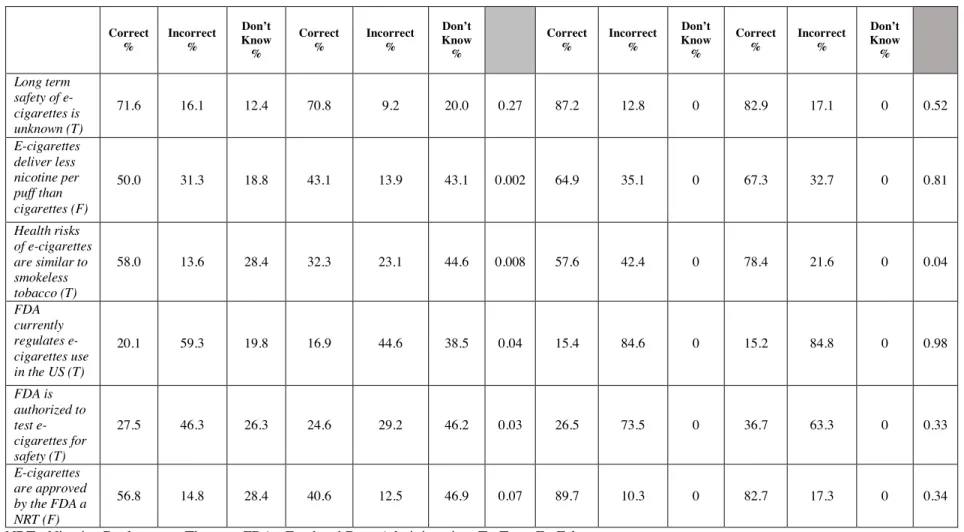
The majority of students and practitioners were knowledgeable regarding long-term safety of e-cigarettes. Table II shows that there were four questions with statistically
significant differences among the student groups. DH students were more likely than nursing students to know that e-cigarettes deliver less nicotine per puff and that they hold similar health risks to smokeless tobacco. Interestingly, RNs were more likely than RDH
practitioners to know that the health risks of e-cigarettes are similar to smokeless tobacco, with knowledge of this health risk rising in the nursing profession after graduation. In regards to knowledge of FDA regulations, both students and practitioners answered either incorrectly or that they don’t know the answer to these questions, with statistically significant
differences only among the student groups.
practitioner groups felt similarly less comfortable discussing NRTs, ATPs, and risks/benefits of e-cigarettes with patients. Refer to Table III and Table IV.
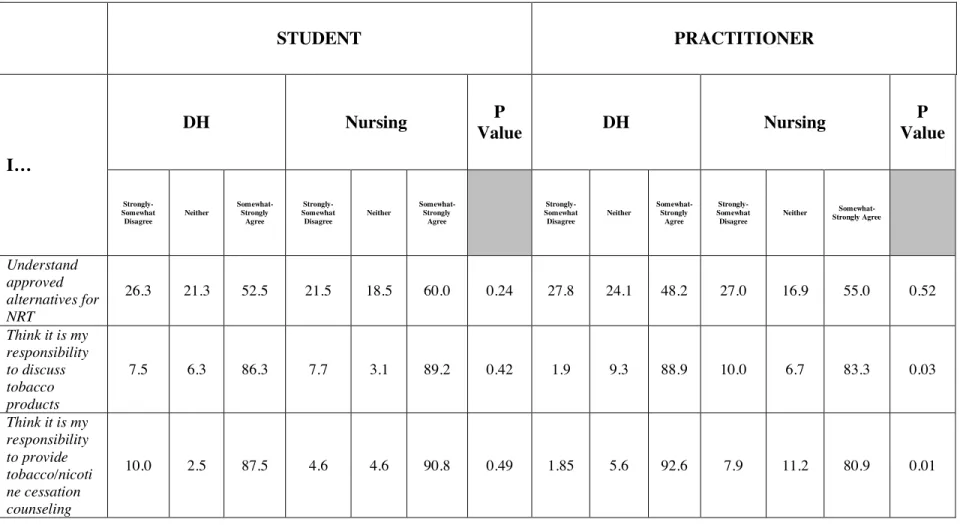
There was a statistically significant difference in agreement among the practitioner groups regarding responsibility to discuss tobacco products (p=0.03) and provide cessation counseling (p=0.01) to patients, with the RDHs agreeing more often than the RNs. The majority of students understood approved NRTs and agreed it was their responsibility to discuss tobacco products and tobacco cessation counseling with their patients (52.5%-90.8%). Table V
Neither students or practitioners were likely to recommended e-cigarettes as a quit method to patients (57.5%-72.3%). In addition, practitioners and students were likely (70.0%-84.6%) to advise a patient to quit using e-cigarettes and to switch to an approved cessation aid. There were no statistically significant differences between students or practitioners regarding likelihood of recommendations or advisement.
DISCUSSION
The results of this study support three main findings: a lack of knowledge among students and practitioners regarding e-cigarettes, diminished confidence in tobacco cessation counseling, and a deficiency in curricula for both dental hygiene and nursing students. To our knowledge, this study is the first to document, the knowledge, opinions, and behaviors of NC DH and nursing students and practitioners about e-cigarettes.
This study provided the opportunity to bring to the forefront the practice behaviors of DH and nursing students and practitioners regarding tobacco products and e- cigarettes. Students were asking about cigarette use in health histories more often than practitioners. While students are in training they are more likely practice what they are taught; however, the fact that only approximately one-half of practitioners were always asking about cigarette use during health histories was alarming and almost one-fifth of nurses reported not asking about cigarette use at all suggests that behavior changes after graduation. As students transition into practice, they need to continue to ask patients about tobacco use and need tobacco use cessation continuing education (CE) and incorporation of a standardization about always asking about cigarette, e-cigarette, and ATPs use with patients. Students and
practitioners alike need more information provided in their curricula or CE to assist them in making referrals to specialists or community resources that could assist in quitting.
Students and practitioners alike lacked knowledge regarding FDA regulations and safety testing of e-cigarettes. Shearston et al found similar findings in that dental professional
nursing students had low levels of knowledge regarding ATPs (including e-cigarettes) and their health consequences despite high rates of self-use and that nurses lack of knowledge
undermines their ability to provide appropriate tobacco cessation counseling.18 Franks et al
found that for multiple health professional students, substantial gaps in e-cigarette knowledge exists including gaps in knowledge regarding: smoking cessation, perceived harm reduction,
and enhanced regulations.24
Dental hygiene and nursing students and practitioners reported feeling more
comfortable discussing approved NRTs, tobacco products, and tobacco cessation counseling; however, they were less comfortable discussing ATPs and risks/benefits of e-cigarettes. These findings are consistent with Shearston’s study that found that students reported low
confidence levels on ATPs and tobacco cessation counseling.22 In a similar study assessing
the use, knowledge, and beliefs about cigarettes and ATPs conducted at New York
University School of Medicine, Zhou et al also found that a large percentage of the medical students lacked knowledge about the use of tobacco products and cessation counseling and
were uncomfortable in providing accurate information to patients.25 The findings of
VanDevanter et al were consistent with our findings regarding comfort levels with ATPs and e-cigarettes. To account for our findings and the findings of previous research, curricular modifications should be made in NC to address general information about ATPs (including e-cigarettes) and FDA regulations in order to provide practitioners with accurate and up-to-date information for their patients.
cessation counseling was. This is consistent with multiple other studies where traditional tobacco products are more stressed than ATPs, which are quickly rising in
prevalence.18,22,24,25,27 In addition, both DH and nursing students and practitioners want
more training on e-cigarettes and tobacco cessation counseling involving e-cigarettes. Efforts should be made in North Carolina to modify curricula and CE to meet the needs of the healthcare workforce and should focus on interprofessional education as a method to teach these two primary healthcare disciplines.
There were limitations to this study that should be noted. Data was collected from a one-time convenience sample (144 practitioners, 146 students) of students and practitioners in attendance at one of the two statewide-conferences. Therefore, this information may not be generalizable to the entire population of DH and nursing students and practitioners across North Carolina. Those in attendance at the conferences were already those practitioners and students that were motivated to participate in extra education outside of school and could not be representative of the entire student population or workforce of these two disciplines.
CONCLUSION
The findings from this study support the need for standardization among healthcare professions (DH and nursing) in asking patients about their cigarette, e-cigarette, and alternative tobacco product use. Modifications must be made to dental hygiene and nursing curricula in North Carolina to include e-cigarettes and how to counsel patients who are using them. Once in practice, RDHs and RNs need continuing education regarding e-cigarettes and the effects on patient health. Practitioners need more resources to assist them in referring their patients to specialists to assist in quitting tobacco use or e-cigarettes. Current and future primary healthcare providers need to be knowledgeable and comfortable discussing
APPENDIX
Table I. Student and Practitioner Practice Behaviors
How often do you… STUDENT PRACTITIONER
DH Nurse P
Value
DH Nurse P
Value
Ask about cigarette use N % N % N % N % Always 65 80.3 37 56.9
0.002
28 51.9 44 49.4
0.14
Usually 9 11.1 14 21.5 9 16.7 6 6.7
Sometimes 4 4.9 7 10.8 11 20.4 12 13.5
Rarely 0 0 5 7.7 4 7.4 7 7.9
Never 3 3.7 2 3.1 2 3.7 20 22.5
Ask about e-cigarette use
Always 24 29.6 10 15.4
0.02
6 11.1 23 25.8
0.40
Usually 8 9.9 6 9.2 3 5.6 9 10.1
Sometimes 21 25.9 14 21.5 12 22.2 8 9.0
Rarely 12 14.8 15 23.1 18 33.3 20 22.5
Never 16 19.8 20 30.8 15 27.8 29 32.6
Advise a patient to quit e-cigarettes
Always 27 33.3 13 20.0
0.03
13 24.1 26 29.2
0.70
Usually 10 12.4 9 13.9 7 13.0 10 11.2
Sometimes 17 21.0 12 18.5 12 22.2 8 9.0
Rarely 14 17.3 12 18.5 9 16.7 17 19.1
Never 13 16.1 19 29.2 13 24.1 28 31.5
Refer patients to assist in quitting
Always 12 14.8 4 6.2
0.61
3 5.6 19 21.4
0.09
Usually 11 13.6 13 20.0 6 11.1 10 11.2
Sometimes 21 25.9 15 23.1 12 22.2 15 16.9
Rarely 19 23.5 20 30.1 12 22.2 16 18.0
Table II. Knowledge Levels Regarding E-Cigarettes
NRT= Nicotine Replacement Therapy; FDA= Food and Drug Administration; T= True; F= False Correct % Incorrect % Don’t Know % Correct % Incorrect % Don’t Know % Correct % Incorrect % Don’t Know % Correct % Incorrect % Don’t Know % Long term safety of e-cigarettes is unknown (T)
71.6 16.1 12.4 70.8 9.2 20.0 0.27 87.2 12.8 0 82.9 17.1 0 0.52
E-cigarettes deliver less nicotine per puff than cigarettes (F)
50.0 31.3 18.8 43.1 13.9 43.1 0.002 64.9 35.1 0 67.3 32.7 0 0.81
Health risks of e-cigarettes are similar to smokeless tobacco (T)
58.0 13.6 28.4 32.3 23.1 44.6 0.008 57.6 42.4 0 78.4 21.6 0 0.04
FDA currently regulates e-cigarettes use in the US (T)
20.1 59.3 19.8 16.9 44.6 38.5 0.04 15.4 84.6 0 15.2 84.8 0 0.98
FDA is authorized to test e-cigarettes for safety (T)
27.5 46.3 26.3 24.6 29.2 46.2 0.03 26.5 73.5 0 36.7 63.3 0 0.33
E-cigarettes are approved by the FDA a NRT (F)
56.8 14.8 28.4 40.6 12.5 46.9 0.07 89.7 10.3 0 82.7 17.3 0 0.34
Table III. Student Comfort Levels Discussing Tobacco Products
NRT= Nicotine Replacement Therapy
How comfortable you feel …
DH Nursing P Value
Extremely-Somewhat Uncomfortable Neither Somewhat-Extremely Comfortable Extremely-Somewhat Uncomfortable Neither Somewhat-Extremely Comfortable Discussing approved NRT
with patients 29.6 18.5 51.8 24.6 21.5 53.9 0.53
Discussing tobacco products
with patients 23.5 14.8 61.7 15.4 13.9 70.8 0.25
Discussing tobacco cessation with patients
25.9 4.9 69.1 15.4 4.6 80.0 0.10
Discussing alternative
tobacco products 32.1 18.5 49.4 23.1 18.5 58.5 0.12
Discussing risks and benefits of e-cigarettes with patients
23.5 22.2 54.3 33.8 18.5 47.7 0.52
Table IV. Practitioner Comfort Levels Discussing Tobacco Products
NRT= Nicotine Replacement Therapy
How
comfortable you feel …
DH Nursing P Value
Extremely-Somewhat Uncomfortable Neither Somewhat-Extremely Comfortable Extremely-Somewhat Uncomfortable Neither Somewhat-Extremely Comfortable Discussing approved NRT
with patients 35.2 14.8 50.0 20.0 31.1 48.9 0.14
Discussing tobacco products with patients
27.8 11.1 61.1 14.4 10.0 75.6 0.01
Discussing tobacco cessation with patients
24.1 9.3 66.7 12.2 13.3 74.5 0.02
Discussing alternative
tobacco products 39.6 15.1 45.3 34.5 16.7 48.9 0.42
Discussing risks and benefits of e-cigarettes with patients
44.2 19.2 36.5 31.1 31.1 37.8 0.40
Table V. Professional Responsibility and Preparedness
NRT= Nicotine Replacement Therapy
STUDENT PRACTITIONER
I…
DH Nursing P
Value DH Nursing
P Value
Strongly- Somewhat Disagree
Neither Somewhat-Strongly Agree
Strongly- Somewhat Disagree
Neither Somewhat-Strongly Agree
Strongly- Somewhat Disagree
Neither Somewhat-Strongly Agree
Strongly- Somewhat Disagree
Neither Somewhat-Strongly Agree
Understand approved alternatives for NRT
26.3 21.3 52.5 21.5 18.5 60.0 0.24 27.8 24.1 48.2 27.0 16.9 55.0 0.52
Think it is my responsibility to discuss tobacco products
7.5 6.3 86.3 7.7 3.1 89.2 0.42 1.9 9.3 88.9 10.0 6.7 83.3 0.03
Think it is my responsibility to provide tobacco/nicoti ne cessation counseling
10.0 2.5 87.5 4.6 4.6 90.8 0.49 1.85 5.6 92.6 7.9 11.2 80.9 0.01
REFERENCES
1. Agaku IT, King BA, Husten CG, et al. Tobacco product use among adults--United
States, 2012-2013. MMWR Morb Mortal Wkly Rep 2014;63(25):542–7.
2. CDC - Fact Sheet - Current Cigarette Smoking Among Adults in the United States -
Smoking & Tobacco Use [Internet]. [cited 2018 Mar 2];Available from:
https://www.cdc.gov/tobacco/data_statistics/fact_sheets/adult_data/cig_smoking/index. htm
3. Cigarettes and Smoking Tobacco Products | Be Tobacco Free.gov [Internet]. [cited
2016 Nov 22];Available from: https://betobaccofree.hhs.gov/about-tobacco/Smoked-Tobacco-Products/index.html
4. Nickels AS, Joshi AY, Dinakar C. Electronic cigarettes: navigating the vapor. Ann
Allergy Asthma Immunol 2014;112(6):481–3.
5. Pauly J, Li Q, Barry MB. Tobacco-free electronic cigarettes and cigars deliver nicotine
and generate concern. Tob Control 2007;16(5):357.
6. Orellana-Barrios MA, Payne D, Mulkey Z, Nugent K. Electronic cigarettes—a
narrative review for clinicians. Am J Med 2015;128(7):674–81.
7. Schoenborn CA, Gindi RM. Electronic cigarette use among adults: united states, 2014.
NCHS Data Brief 2015;(217):1–8.
8. Bam TS, Bellew W, Berezhnova I, et al. Position statement on electronic cigarettes or
electronic nicotine delivery systems. Int J Tuberc Lung Dis 2014;18(1):5–7.
9. Polosa R, Rodu B, Caponnetto P, Maglia M, Raciti C. A fresh look at tobacco harm
reduction: the case for the electronic cigarette. Harm Reduct J 2013;10:19.
10. King BA, Patel R, Nguyen KH, Dube SR. Trends in awareness and use of electronic cigarettes among US adults, 2010-2013. Nicotine Tob Res 2015;17(2):219–27.
11. Drummond MB, Upson D. Electronic cigarettes. Potential harms and benefits. Annals of the American Thoracic Society 2014;11(2):236–42.
12. Callahan-Lyon P. Electronic cigarettes: human health effects. Tob Control 2014;23 Suppl 2:ii36-40.
13. Jamal A, Homa DM, O’Connor E, et al. Current cigarette smoking among adults - United States, 2005-2014. MMWR Morb Mortal Wkly Rep 2015;64(44):1233–40.
2016 Nov 15];Available from:
http://www.fda.gov/ForConsumers/ConsumerUpdates/ucm506676.htm
15. Rules, Regulations & Guidance > FDA’s New Regulations for E-Cigarettes, Cigars, and All Other Tobacco Products [Internet]. [cited 2016 Oct 11];Available from:
http://www.fda.gov/TobaccoProducts/Labeling/RulesRegulationsGuidance/ucm394909 .htm
16. Family Smoking Prevention and Tobacco Control and Federal Retirement Reform. 17. Consumer Updates > FDA 101: Smoking Cessation Products [Internet]. [cited 2016
Nov 22];Available from:
http://www.fda.gov/ForConsumers/ConsumerUpdates/ucm198176.htm
18. VanDevanter N, Zhou S, Katigbak C, Naegle M, Sherman S, Weitzman M.
Knowledge, beliefs, behaviors, and social norms related to use of alternative tobacco products among undergraduate and graduate nursing students in an urban U.S. university setting. J Nurs Scholarsh 2016;48(2):147–53.
19. Schwindt RG, McNelis AM, Agley J. Curricular Innovations in Tobacco Cessation Education for Prelicensure Baccalaureate Nursing Students. J Nurs Educ
2016;55(8):425–31.
20. Davis JM, Koerber A. Assessment of tobacco dependence curricula in U.S. dental hygiene programs. J Dent Educ 2010;74(10):1066–73.
21. Harris JL, Patton LL, Wilder RS, Peterson CA, Curran AE. North Carolina dental hygiene students’ opinions about tobacco cessation education and practices in their programs. J Dent Educ 2009;73(5):539–49.
22. Shearston JA, Shah K, Cheng E, et al. Dental, dental hygiene, and advanced dental students’ use, knowledge, and beliefs regarding tobacco products. J Dent Educ 2017;81(11):1317–26.
23. Monson AL, Engeswick LM. Promotion of tobacco cessation through dental hygiene education: a pilot study. J Dent Educ 2005;69(8):901–11.
24. Franks AM, Hawes WA, McCain KR, Payakachat N. Electronic cigarette use, knowledge, and perceptions among health professional students. Curr Pharm Teach Learn 2017;9(6):1003–9.
25. Zhou S, Van Devanter N, Fenstermaker M, Cawkwell P, Sherman S, Weitzman M. A Study of the Use, Knowledge, and Beliefs About Cigarettes and Alternative Tobacco Products Among Students at One U.S. Medical School. Acad Med 2015;90(12):1713– 9.
from the American Heart Association. Circulation 2014;130(16):1418–36.