When Citizens Become Terrorists
A within-case analysis
of the link between democracy and domestic terrorist activity
in Greece after Metapolitefsi
By
Thomas Westerhout, BSc Student no: 0922110 A thesis submitted to the
Department of Political Science of Leiden University, the Netherlands, in partial fulfilment of the requirement for the degree of
Master of Science
Final version January 12th, 2015
Supervisor and first reader C. Jentzsch, MPhil
Second reader Dr. R.K. Tromble
Cover photo: The arrest of the Greek fugitive Christodoulos Xiros, formed member of terrorist organization RO17N, January 3rd, 2015.
Table of Contents
1.
Introduction
4
a. Research topic and question 4
b. The democracy-terrorism link 6
2.
Literature Review
8
a. A workable definition and conceptual difficulties 8
b. Proposed working definition 10
c. The difference between domestic and transitional terrorism 11
d. Towards a structural analysis of terrorism 12
e. Overview of research on terrorism and democracy 13
f. Perspective 1 13
g. Perspective 2 15
h. Perspective 3 16
i. Interest group dynamics 17
j. Chenoweth’s theory of the competitive logic 18
k. Why uniquely democracies enhance the competitive logic 19
l. Core strengths and weaknesses 20
3.
Theoretical Framework
23
a. Step 1: Formation of interest groups 23
b. Step 2: Interest groups become competitive for public space 24
c. Step 3: Competition leads to outbreak of initial violence 25
d. Step 4: Cascade effect 26
e. Step 5: A decrease in number of groups and incidents? 27
f. Overview of variables 28
4.
Research Design
29
a. Operationalization of key intervening variables 29
b. Operationalization of outcome of interest 30
c. Case selection for within-case analysis 31
d. Method of analysis 33
5.
Analysis
35
a. Historical narrative of events prior to democratization 35
b. From civil war, to repression, to reform to dictatorship 35
c. The 1974 Metapolitefsi 37
d. Table 2: Domestic terrorist group emergence in Greece (1967-1983) 38
e. Testing of hypotheses: tracing the causal mechanism in the case of ELA and RO17N 40
f. Phase 1 (H1) 40
g. Phase 2 (H2) 45
h. Phase 3 (H3) 49
i. Phase 4 (H4) 50
j. Phase 5 (H5 and H6) 51
6.
Conclusion
53
a. Main finings and argument 53
b. Limitations 55
c. Future of terrorism 56
Chapter 1: Introduction
Research Topic and Research Question
“Can violent actions take place in a democracy? (…) Would someone want to
overthrow such democracy? Of course, he would, since it is a self-negating system of
democracy… a democracy that refutes itself”
[Excerpt from statement of alleged Greek terrorist, 17N member Giannopoulos, in his court testimony, 25th July, 2003]1
The past few decades have shown that domestic terrorism is a continuing social phenomenon that cannot be overlooked by the public, politicians and scholars alike. Both the acts of terror committed by radical leftist terror groups in the 1970s and 1980s against fellow citizens in Germany, Belgium and Italy2 and to the present day Greek leftist splinter terrorist groups and the ‘homegrown’ radicalized Islamic organized terrorist cells in western Europe point at this continuum. The recent cold-blooded assassination of the editorial staff of the satirical magazine ‘Charlie Hebdo’ in Paris demonstrates that escalation to extreme violence can happen unexpectedly in a short time span and without much prior warning. For researchers and policy-makers in the field of terrorism studies, the most puzzling question that arises in the aftermath of such attacks is why certain persons in western liberal states are willing to commit gross atrocities against innocent fellow citizens instead of using non-violent manners for achieving policy changes. The thesis intends to contribute to existing academic literature by focusing on this question.
The attack in September 2001 by Al-Qaeda against American targets undoubtedly is the clearest example of a massive-scale international terrorist atrocity committed against large groups of innocent citizens. This form of terror, however, should be distinguished from domestic terrorism, also known by its popularized synonym ‘homegrown terrorism’. The unique characteristic of the latter type is that such terror is largely independent from internationally operating terrorist cells and evolves out of mainly organized and self-radicalized individuals that have experienced their entire upbringing, schooling and cultural influence in the country that they are active in (Precht 2007, 9). Some locally organized
1 Cited from Kassimeris (2013, 30)
2 Respectively the German RAF (Rote Armee Fraktion), the Belgian CCC (Cellules Communistes
Combattantes) and the Italian PCI (‘Partito Communista Italiano’).
2 Respectively the German RAF (Rote Armee Fraktion), the Belgian CCC (Cellules Communistes
activist groups have the willingness and capacity to shift their modus operandi into the usage of excessive violent political force aimed at the citizenry that they are part of. In this respect, domestic terrorism presents societies with a fundamental and structural social problem: they consist of members that have a sense of alienation and disconnectedness, combined with a deeply rooted hatred against general prevailing essential values of the (Western) community that were part of their upbringing (Precht 2007, 9). This has severe implications for the way the causal factors that lie behind domestic terror are perceived, since they seem to stem from intra-societal dynamics rather than inter-state mechanisms.
Moreover, it should be noted that the current numbers of ‘homegrown’ extremist individuals in Western Europe, mostly radical Muslims, do certainly not indicate that their occurrence is merely incidental. Instead, they point at a disturbing and alarming structural social problem. In November 2007, the Director General of the British MI5 stated that they had identified “at least 2.000 individuals who are believed to pose a direct threat to national security and public safety because of their support for terrorism.” In addition, he declared, “We expect that there are as many again that we do not yet know off”(Precht 2007, 10). Political officials in all of Western Europe signal an alarming increase in numbers of radicalized Islamic youth. This statistic reaffirms the importance of disclosing what factors contribute to the radicalization of such extremist organizations and their willingness to carry out heinous acts against innocent fellow citizens.
I propose to focus exclusively on Western ‘homegrown’ terrorism for three reasons. Firstly, it is estimated by the Global Terrorism Database (GTD)3 that this form of political violence accounts for 90 to 95% of the total worldwide terrorist activity. Moreover, Engene (2004) argues that domestic terrorism has claimed nearly 3000 innocent civilian casualties4 since the 1950s. Secondly, due to the recent perceived threat posed by primarily domestic Islamic groups in Western Europe, domestic terrorism has gained significantly more attention in the political and public discourse of European states over the past 10-15 years, thereby adding to its societal relevance. Thirdly, I find it particularly incomprehensible that such a resort to political violence has continuously occurred in liberal democracies, since such state
3 Excerpt the website of the Global Terrorism Database: http://www.start.umd.edu/gtd/: “The GTD is an
open-source database including information on terrorist events around the world from 1970 through 2013 (with annual updates planned for the future). Unlike many other event databases, the GTD includes systematic data on domestic as well as international terrorist incidents that have occurred during this time period and now includes more than 125,000 cases”
4 According to the TWEED Database (Terrorism in Western Europe: Events Data): folk.uib.no/sspje/tweed.htm:
regimes supposedly have a low active and passive participation threshold and should thus offer many opportunities for aggrieved citizens to exert political influence in non-violent ways. Moreover, democracies generally do not engage in brutal injustices against their own population and thus it seems illogical that citizens are being driven to outbursts of violent desperation even though little injustice is being inflicted against them. The fact that domestic terrorism occurs in democracies is odd and it points at the enduring theoretical and empirical puzzle that this thesis is going to engage in.
The link between democracy and the proliferation of domestic terrorism has received much attention in both the political and scholarly discourse (Chenoweth 2013, 356-357). The prevailing wisdom amongst many Western political leaders is that the global spread of democracy serves as a powerful remedy against the use of terrorism by aggrieved political groups that are seeking to express their discontent. Former American President George W. Bush was arguably one of the most passionate supporters of this premise. He proclaimed in his Second Inaugural Address: “The best antidote to radicalism and terror is the tolerance kindled in free societies”5. Thus the overthrow of hostile and authoritarian regimes in support
of democracy was deemed righteous, as its key defining traits (equality, freedom and justice) would ultimately lead to more just, prosperous and a ‘terrorism-free’ world. Recently, during the uprisings that occurred in the ‘Arab Spring’, many experts and policymakers still fiercely endorsed this policy rationale. They speculated that the unfolding events in the Arab World were to be understood as a clear sign that the transition to democracy would gradually bring about more political opportunities for dissatisfied citizens. They would be able to use their newly obtained rights as a peaceful outlet to manifest their political hardships.
The democracy – terrorism link
Much scholarly research has scrutinized the perceived negative relationship between democracy and terrorism. Historical analysis has actually given reason to believe that such an optimistic depiction of reality might not be valid. Data retrieved from the GTD has given evidence to suggest that “At least during the period 1968-1997, relatively poor and transitioning democracies with internally inconsistent institutions were more likely to experience domestic terrorism than advanced democracies and authoritarian regimes” (Chenoweth 2013, 356). Although this claim has not been uncontested, it does point at a striking second puzzle. Not only is it curious that domestic terrorism systematically occurs in
5 Washington Post, March 9th 2005, Bush calls democracy terror’s antidote. Source:
democracies. The fact that it even seems to occur with a higher frequency is even more counterintuitive (Chenoweth 2014, 1). Evenly perplexing is the variation of the prevalence of terrorism amongst democracies. Indeed the GTD also demonstrates that some states, such as Greece, Spain, Italy, the United Kingdom and the United States have a disturbing track record when it comes to their experiences with domestic terrorism. Other states, such as the Scandinavian countries, Canada, Japan and South Korea have not struggled with these alarming numbers. This discrepancy is in need of a substantial explanation. Also, can such an explanation also spell out the recent emergence of domestic Islamic groups in Western Europe? This thesis also seeks to explore this secondary question.
Researchers have proposed numerous possible interactions between democracy and terrorism. While some scholars claim that the former leads to increasing levels of terror, others state exactly the opposite, claiming that democracy reduces citizens’ tendency to escalate to terrorism as a political tool. Democracy is often portrayed as an open arena or forum where competing interests are expressed. Much scholarly discussion evolves around the ascribed consequences of this essential feature of democracy for levels of terrorism. Paradoxically, the debate consists of two theoretical positions that claim two competing effects. The ‘democratic forum’ is perceived to lead to various “avenues for interest articulation among citizens”, which results in their endorsement of peaceful resolutions of conflict (Schmid 1992, 14-15). However, this forum is also perceived to lead to more competiveness in the public realm. This political competition in democracies tends to provoke acts of terrorism, as ideologically diverse groups compete with one another for limited influence (Chenoweth, 2010 16). Both strands come to different empirical conclusions, which are predominantly based on quantitative large n-studies. A preponderance of studies postulate “that something about democracy might promote terror” (Young and Dugan 2011, 19). However, due to the absence of substantial and systematic qualitative research, a full understanding of the complex causal chain by which democracy affects terrorism is lacking. This thesis primarily aims at addressing this scientific gap by conducting a case study to test which causal mechanism is at work, thereby adding to the explanatory value of either one (or both) scholarly position.
I propose to research the following general research question to address this puzzle:
Chapter 2: Literature Review
Due to the grave physical and structural dangers it poses to Western governments and society, domestic terrorism has been a widely studied phenomenon. Scholars have identified many differing causal factors over the past few decades. Policy-makers have continuously deemed such preliminary investigations in causality crucial since such inquiries can offer fitting and thus adequate counter-terrorism strategies. This chapter intends to offer a thematic overview of the existing approaches that the literature has taken to explain domestic terrorism. Subsequently, their conclusions and weaknesses are critically evaluated. For the sake of clarity, I will present a workable definition of the concept of domestic terrorism based on similar definitions that have been established in the literature. But before doing so, I shall firstly outline a few persistent conceptual problems that have continuously hampered the study of terrorism.
A workable definition and conceptual difficulties
Academic study of domestic terrorism has been troubled because of the absence of an agreed definition of what the central concept constitutes of (Lutz and Lutz 2009, 2; Young and Ducan 2011, 19). Throughout the literature, social scientists cannot agree on what exactly defines terrorism and what distinguishes it from other types of political violence. Schmid and Jongman (1988), who conducted their search in the eighties, already collected no less than 100 definitions of terrorism. The absence of an agreed definition evolves out of an important persevering conceptual challenge that has afflicted many conceptualizations of terrorism. At the core of this conceptual flaw lies the struggle to identify those specific acts of violence that are exclusively linked to domestic terrorism and that are distinct from other forms of political violence, such as insurgencies and state-led warfare behaviour (Sánchez-Cuenca and De La Calle 2009, 33). An abundance of social scientists have attempted to define terrorism in terms of which acts of violence ought to be labelled ‘terroristic’. As a consequence, terrorism becomes a type of political violence that can be carried out by a multiplicity of actors. This, as I will argue in the following paragraph, affects any systematic coherent definition of terrorism.
audience can actually be observed in many examples of general warfare behaviour. The two atomic bombs dropped on the Japanese cities Hiroshima and Nagasaki by the American Army, as well as the allied bombing on the German city of Dresden in World War II are plain examples of intimidation from the U.S. High Command directed against respectively the Japanese and German government. Clearly, in those cases, “the civilians attacked were not the audience target” (Sánchez-Cuenca and De La Calle 2009, 33). In addition, insurgent groups in civil wars frequently perpetrate acts of violence against innocent civilians when they aim to coerce the established elite as the immediate target. For example, the Peruvian Maoist guerrilla insurgent organization Shining Path (Sendero Luminoso) deliberatively killed Peruvian Lima locals in the 1980s when it mounted attacks and sabotages against the capital’s infrastructure.
The reliance on the threat of violence and spreading fear to achieve political objectives is also frequently identified as a typical terroristic action. Likewise, this phenomenon ought not to be distinctively labelled as exclusively ‘terroristic’. The importance of instilling fear is a mechanism that is actually being implemented in all types of small and large-scale forms of political violence. “Violence is a means to generate compliance” (Sánchez-Cuenca and De La Calle 2009, 33).
All these issues raised here demonstrate the core of the conceptual problem that troubles any definition of domestic terrorism that seeks to define terrorism on the basis of what kind of acts ought to be labelled ‘terroristic’. As I demonstrated in the previous paragraphs, many actors, both individuals, organizations, insurgent groups, armies and governments, can ostensibly carry out acts of terrorism. Consequently, terrorism is being degraded to a simple ‘catchall’ concept that is used to denote any act of political violence whereby innocent individuals are harmed in order to advance some political goal.
contact with the population because they cannot act in the open” (Sánchez-Cuenca and De La Calle 2009, 35). This is what also distinguishes them from organizations that are engaged in civil wars, which have a clear interest in mobilizing the support of the local population in order to topple the state regime. Likewise, whereas insurgents can have the potential to at least partially defeat the state regime militarily, terrorists can solely challenge the state by contesting its monopoly of violence. The ability to employ their power to contest the state turns them into a long-term organized threat, which exceeds the political violence that occurs during incidental outbursts of violent street riots.
Proposed working definition
Lutz and Lutz (2009) have presented a fairly common and consequently comprehensible definition that is consistent with various prior definitions that can be found in the literature. Their definition consists of six separate but interrelated characteristics. Although this has arguably led to a more complex working definition, it has the major advantage of resolving the above-described conceptual challenge that hampered so many of the previously conducted theoretical studies on terrorism. Lutz and Lutz present the following definition of terrorism (2009):
1. “Terrorism has political objectives;
2. it relies on violence or the threat of violence;
3. it has a target audience beyond the immediate victims;
4. it involves organization and is not just the actions of isolated individuals; 5. it involves a non-state actor as the perpetrator or the target or both; and 6. it is the weapon of the weak designed to change the distribution of power.”
Previously, I made the point that domestic terrorism is better defined in terms of who the actor is, in addition to which actions are characterized as ‘terrorist’. This definition has the advantage of combining both action-based elements (features 1, 2 and 3) and actor-based elements (features 4, 5 and 6).
organization (4, 5, 6) commits those actions, then it is fitting to label that type of political violence as terrorism.
Thus, according to my definition, the FARC-organization in Colombia, as well as the IRA in Northern Ireland are, to a certain extent, insurgent groups, because they have some control over several rural areas and because they intentionally enjoy some popular support. Meanwhile, the ETA in Spain, the Italian Red Brigades (BR) and both the Revolutionary Popular Struggle (ETA) and RO17N groups in Greece have always deliberately operated underground, have never controlled state territory and have not actively attempted to mobilize large groups of supporters for their respective causes.6
The difference between domestic and transnational terrorism
A key issue is to separate acts of domestic from transnational terrorism. This consideration does not only have a practical purpose. It also serves an analytical and theoretical objective; through a clear distinction, domestic terrorism can be studied as a separate social phenomenon, which contains its own causal determinants and mechanisms. On the one hand, “domestic terrorism involves terrorists, victims, and territory of one state. Support, financing and operations for the terrorist attack are homegrown and are conducted within one country” (Chenoweth 2007, 19). This characteristic thus refers to the physical
locus operandi of terrorism, and is based on a legal requirement: the full act, both its
preparation and its execution, have to occur within the territorial jurisdiction of the state it originates from.7 Secondly, the perpetrators need to have had their upbringing in the state that they conduct their campaigns in.
On the other hand, the label ‘transnational’ is used in the literature when an attack involves more than one state (Rosendorff and Sandler 2005, 172). Strictly speaking this implies that an organization’s intentional attack on foreign citizens, is to be considered as an act of international terror. ITERATE8, the commonly utilized dataset of international and transnational terrorist attacks, indeed counts some acts of the far-left 17N in Greece as international, because 7 of the 22 total fatalities were not Greek citizens, but primarily Americans. ITERATE disregards the fact that all of the killings were committed on Greek
6 It can be argued, however, that those anarcho-communist organizations actually did seek to mobilize the local
population; in the sense that they used terrorism as a tool to raise awareness amongst the populace for the sake of inciting social revolution against the ruling class. These attempts have always been more idealistic in nature. On the contrary, insurgent groups need local support; otherwise they could not exert control over a certain territory and thus could practically not exist.
7 Based on the legal definition used by the American FBI and the United States Law:
http://www.fbi.gov/about-us/investigate/terrorism/terrorism-definition.
territory. Meanwhile, the similar leftist Portuguese 25th April Popular Force movement (FB25) is excluded in this dataset, because their 20 killings in the 1980s are all on Portuguese nationals (Sánchez-Cuenca and De La Calle 2009, 37). According to my definition, those acts are both forms of domestic terrorism, since the perpetrators all had their upbringing in respectively Greece and Portugal and all had the objective to coerce their own government.
Lastly, a terrorist attack is also identified as transnational when terrorists commit their crimes outside the national boundaries. This requirement seems rather obvious. However, this part of a definition is also contentious when the attacks of the Northern Irish IRA are considered: some acts that were perpetrated in Northern Ireland while others on British targets overseas. The latter crimes would be viewed as international attacks, while the IRA is notoriously known for the frequent bombings that have occurred within its own national borders.
In conclusion, I assert, just as Sánchez-Cuenca and De La Calle (2009) do, that what matters the most in distinguishing domestic from international terrorism is whether a non-state clandestine organization acts in its ‘natural’ territory and seeks to coerce its own government. Consequently, identities of victims and the physical location are of lesser relevance.
Towards a structural analysis of terrorism
Traditionally, the critical assessment of what factors lead to individuals’ or groups’ decision to engage in costly and violent acts of terrorism was based on an ideographic approach (Qvortrup and Lijphart 2013, 473). For this reason scientific research approached different incidents of terrorism solely from a historical perspective. Explanations of terrorism that took into account more than one case were not considered useful. As a result, no common causal patterns were identified from the isolated terrorist cases. Laqueur (1977, 22) even claimed that any nomothetic study that would attempt to draft causal links between concepts would be “exceedingly vague or altogether wrong”.
about terrorism, which could both be logically compared, and of which variables could be specified and rank-ordered in terms of explanatory strength (Crenshaw 1981, 380). For the sake of clarity, Crenshaw organized the research topic into three separate workable questions that were ready to be properly analysed: how does the process of terrorism work, what are its social and political effects and why does it occur? The latter question is of particular interest to this thesis. It invited scholars to undertake nomothetic studies in order to identify common patterns of causation.
Overview of research on terrorism and democracy
Crenshaw’s argument sparked a preponderance of research that sought to determine what factors caused groups to exert extreme political violence. An important strand of academia began emphasizing institutional factors as the primary causes of terrorism. In general, this approach assumes that institutions are relevant and matter in terms of presence of (domestic) terrorism. The study of the effects of regime type gained momentum as researchers observed an ostensible relationship between the presence of terrorist incidents and modern democracies. Many scholars namely claimed that the bulk of terrorism is directed against democracies and not against illiberal regimes. In the last decade, this view was reinforced due to the high-profile attacks by Al-Qaeda on American and European soil. All in all, these events endorsed the longstanding conviction “that democracies are inherently susceptible to terrorist attacks” (Abrahms 2007, 226). Weinberg and Eubank (1994) asserted based on rudimentary investigation that “a terrorist attack was four times likely to occur in democracy than in a non-democratic country” (418). In addition, Gurr (1979), Turk (1982), Chenoweth (2010), and Young and Dugan (2010) base their work on the theoretical preposition that terrorism ostensibly occurs more frequently in liberal regimes than in non-democracies. Although the validity of this observation has been thoroughly contested and criticized (Abrahms 2007, 2010), I shall ignore these at this point for they still hold much theoretical explanatory power.
Perspective 1: Effect of respect for civil and human rights
Gurr (1979), Ross (1993) and Eyerman (1998) argue that because of people’s freedom of movement and association, terror organisations can more easily mobilize, manoeuver, arm themselves and subsequently act. Moreover, citizens’ human and civil rights tend to paralyze democracies and affect their capabilities to crush terrorist organizations. Li (2005, 283) argues that democracies do not have the power to exert unconstrained and excessively repressive countermeasures, nor do they have a straightforward possibility to convict alleged terrorists beforehand. Weinberg and Eubank (1987, 46-47) advance the argument that democracies are vulnerable to terrorists’ demands because their guarantees for civil liberties lead to citizens’ low cost tolerance for sustaining casualties of the civil population. In addition, press freedom is also said to create incentives for terrorism. As Atkinson, Sandler and Tschirhart (1987) point out: “Press freedom increases the opportunities for terrorists to be heard and watched by a large audience and hence their ability to create widespread fear” (Li 2005, 282). Schmid (1992) furthers the point by asserting that free press is capable of offering detailed information of terrorist events, thereby encouraging the process of recruitment, education and training of future perpetrators.
However, it should be noted that the literature has also identified mitigating effects of civil liberties on terrorism (Li 2005, 281). The contention is that citizens, who enjoy more civil liberties, therefore also have more opportunities to influence the political process successfully. Schmid (1992, 15) argues that democratic participation through free elections makes sure that political and social change can be reached by peaceful means. This lowers the incentive to resort to political violence. Having a right to express political discontent can thus serve as a powerful remedy against violent outbreaks of political frustration and grief. Abrahms (2007, 242-251) also questions the positive relationship between civil rights and terrorism. Alternatively, he states that, precisely because democracies have a commitment to these rights, they are not inclined to fumble with these rights in the face of terrorist provocations. Consequently, liberal states can maintain “the support of the three constituencies – moderates, the international community and their own publics – essential to prevailing” (2007, 242).
the American Service Member Protection Act (ASPA), thereby authorizing the Presidency much more powers to ‘fight the war on terror’. In other words, liberal states’ abilities to combat terrorism are not always restricted (Chenoweth 2007, 31).
The second, and more fundamental limitation of the civil liberties explanation is that it is exclusively ‘opportunity-based’ and that it fails to explain what the motivations are for terrorist groups to form (Abrahms 2007, 227; Chenoweth 2007, 30). The logic of the theory is that democracies, due to their openness and permissiveness, render rational terrorist organizations the greatest opportunity to undertake a successful terrorist campaign. However, such an explanation ignores that opportunity is merely “a necessary but not a sufficient condition” for a group to commit acts of terrorism (Ross 1993, 321-322). It fails to take into account that many political groups never use violence, although they might very well have the opportunity for it. And put differently, if opportunity alone would be a sufficient explanatory factor, then there should also be predominance of terrorism in the so-called ‘weak’ states that do not have the ability and authority to govern their own territory. However, several of these states, such as Belarus, Zimbabwe, Senegal and Honduras have not contained domestic terrorist movements (Stewart 2006, 31-32; Chenoweth 2007, 30-31), while any explanation based on the effect of civil liberties would expect so. This observation leads to the conclusion that there is something more fundamental, associated with the nature of a democracy, which attracts domestic terrorism.
Perspective 2: Effect of democratic systems and their political institutions
influence, the less they are inclined to engage in acts of terrorism (2013, 472). A high level of consociationalism in a democracy is associated with a low level of domestic terrorism. And so broad multiparty coalitions, multiparty systems, proportional representation, corporatist and coordinated interest groups systems and constitutional balance between the executive and legislative powers are all seen as predictors for low levels of domestic terrorism. On the contrary, one-party governments, two-party systems, majoritarian electoral systems, pluralist and competitive interest group systems and the dominance of the executive power are all indicators that positively influence domestic terrorism (2013, 478). Qvortrup and Lijphart’s work has built further on previous single-country case studies that had already anecdotally shown the importance of consensus institutions in mitigating the proliferation of domestic terrorism (2013, 474). For instance, McGarry and O’ Leary (2006) have given this support with their case study of the effects of consociationalism in Northern Ireland. The fact that their theory is backed by both qualitative and quantitative research strengthens their proposed theory.
The strength of this argument is that it, unlike the first perspective, can explain citizens’ motivations to adopt violence. Majoritarian democracies generally leave far less space for opposing views to be taken into consideration, and this could encourage violence as an ultimate means to advance a controversial policy goal. The second advantage of this rationale is that it can account for variation amongst liberal states. Indeed, majoritarian democracies, such as the U.S. and the UK, historically have suffered from more terrorist incidents than the consociational Scandinavian democratic states.
On the contrary, a weakness of this claim is that it cannot explain fluctuations in terrorism over time. Greece, since it transitioned to modern democracy in 1974, has experienced an awful lot of terrorism, but the flow has not been constant. GTD data demonstrate that right after the transition terrorism peaked, and then gradually declined (see chapter 4) until it peaked again a few years later. The proposition is that terrorism is associated with a certain ‘cycle’. The presence or absence of certain indicators of consociationalism or majoritarian insufficiently account for such a cycle.
Perspective 3: Effect of social mobilization
and political mobilization. This presumption leads her to assert that terrorism proliferates in democracies due to the dynamics between various mobilizing political interest groups that are active within the political realm. Such a rationale fits in the tradition of political mobilization theory. Scholars within this theoretical framework have been preoccupied with explaining terrorism as merely another mobilizing tactic that organizations may utilize “to increase their chances of achieving their goals and to enhance their uniqueness or attractiveness to potential recruits” (Chenoweth 2013, 367). An important difference between such a mobilization theory and the earlier mentioned ‘civil liberties theories’ (see perspective 1), is that the former relies less on tactical and strategic opportunities to explain groups’ resort to terrorist violence. Instead, mobilization theory associates violent attacks are more with the density and intensity of the polity’s interest group environment (Chenoweth 2013, 367). I will go into more detail on mobilization and Chenoweth’s theory in the following paragraphs.
Interest group dynamics
success is always relative to another’s failure. Groups are thus compelled to engage in a zero-sum conflict game with one another. When groups are heavily opposed to each other in the political realm, this competitive dynamic can lead to an intensification and escalation of one’s methods to resist the possible loss of agenda-setting power. Those interest groups that ‘lose’ the power to influence the political agenda will “trim their losses and the gain to winners by lobbying, threats, disobedience, migration and other kinds of political pressure to raise their influence” (Becker 1983, 377). Such escalating tactics are a clear indication that the agenda is politically ‘saturated’. Inter-group conflict then is conceived as unresolvable and bound to getting out of hand. They can be motivated to escalate their political activities to the use of violence. Competing groups perceive a need to ‘outdo’ one another for influence thereby resulting in an overall escalation of violent activity. If the interest group playing field becomes so dense, competitive and ultimately violent, then the political realm becomes overly competitive and dangerous. This process has been called a ‘crowding effect’ (Chenoweth 2007, 32-45 and 2010, 28).
Chenoweth’s theory of the competitive logic
Essentially, the main motivation to become violent is not inherently different from non-violent groups’ motivation to use additional resources such as money; they seek to preserve either the status quo or to bring about political chance (Chenoweth 2007, 37). Given that the ‘game’ of political competition leads to a zero-sum outcome, a decision to utilize violent expressions can be perfectly rational. Violence “may be less costly and more effective in achieving attention in the short-term than investing abundant conventional resources that are lacking” (Chenoweth 2007, 38). As, according to Chenoweth (2007, 2010), these groups potentially arise out of all kinds of organizations, their ideologies will also become more extremist to justify their use of violence. However, they also endorse a more extremist ideology as this can consolidate their political frustrations into a coherent identity. Subscribing to extremism can solve collective action problems within a violent group. Indeed, a strong group identity can advance a sense of togetherness and collective responsibility, which buttresses individuals’ decisions to comply with acts of extreme violent behaviour.
leads to much effect since terrorism naturally leads to instant high levels attention from the public and policy-makers.
As has been argued by many authors (Crenshaw 1981, Ross 1993), ultimately a terrorist offensive commences “with a precipitating event or circumstance that turns a group to adopting violence rather than utilizing conventional political means” (Chenoweth 2007, 38). For Chenoweth, the initial act of violence is crucial. This is because, just like any other interest groups, terrorists are highly responsive and sensitive to the pressures exercised by other organizations. Here is where the quintessential element of her theory plays out:
“The constant competitive tensions between conventional and violent interest groups in asserting themselves may lead to a “cascade effect” during which more groups adopt terrorism in response to a diminishing space on the public agenda due to initial violence” (Chenoweth 2007, 40)
Once again this demonstrates the rational logic behind the proliferation of domestic terrorism. As one group favours terrorism, which is a low-cost and short-term efficient undertaking, other groups will be driven to the same suboptimal outcome in the zero-sum game by also adopting violence. That is, essentially, the causal mechanism by which the democratic competition process lead to a domestic groups becoming terroristic. By the way, terrorists do often overestimate their political success of their tactics. Indeed an escalation to violence on a short-term can be highly successful since the impact of such acts often is significant. However, often they are not able to control the more long-term political effects of their tactical attacks (Chenoweth 2007, 38).
Why uniquely democracies enhance the competitive logic
The theory of the competitive logic is grounded on the effects of an overly crowded or saturated interest group sector. Interest group competition occurs in all political systems, even in non-democracies. However, Chenoweth makes three compelling arguments of why this logic applies solely to (certain types of) democracies.
Secondly, democracies inherently tolerate the existence of a free media, which have the power to set the political agenda without the government’s interference. This open and transparent information society bolsters widespread media coverage on terrorist activity, which very often is highly sensational. Subsequently, interest groups become easily aware of one another’s actions and reactions. The competitive logic subscribes to a ‘cascade effect’, in which groups are obliged to react as a way to ‘outbid’ the others for political influence. This reaction is particularly present in the case of groups that are ideologically heavily opposed to each other.
Thirdly, as I already have described extensively in the previous chapter, democracies’ commitment to civil liberties prevents them from reacting fiercely against terrorist organizations. On the other hand, authoritarian regimes often react to initial violence with extreme disproportionate counter-violence. The much more powerful repressive state authority can invite various violent interest groups to form a unified front against the state, thereby halting the increasing escalation of interest group violence. In other words, “The power asymmetry is so distorted under these conditions that terrorist groups will circumvent normal operations and solicit the help of other outcasts in order to confront a major threat to their very survival” (Chenoweth 2007, 55). Whereas non-democracies are more inclined to enhance cooperation between terrorists, democracies tend to provoke heavy competiveness amongst terrorist organizations. The harsh measures that the Israeli authorities impose on the Palestinian territories are a good example of this phenomenon. Palestinian organizations often have occasionally overcome their strategic and ideological difference to form an alliance of convenience against the Israelis.
Core strengths and weaknesses
This outlook on the relationship between democracy and domestic terrorism is promising. Chenoweth’s approach has three significant advantages. The claims that she makes are promising and offer a clear frame by which domestic terrorism should be considered and researched in the future.
In the first place, her theory is unique in the sense that she is able to explain the theoretical link between domestic terrorism and democracy not merely on the basis of the
opportunities, but on the basis of terrorists’ motivations. The competitive logic subscribes to a
In the second place, her theory is able to offer an explanation for the variation in domestic terrorism amongst democracies (Chenoweth 2013, 367). I already indicated that this is one of the puzzling facts that need more clarification. Indeed, this theory gives a plausible account for the discrepancies that exist between for instance the Scandinavian countries, which have always been relatively invulnerable from terrorism and Greece, which has an unfortunate track record of high levels of domestic terrorist violence ever since that country gradually democratized in the mid-seventies. Following the logic of the effect of a highly competitive interest group sector, it can be argued that states that traditionally have low levels of mobilization and thus hardly any extreme political competition (consociational democracies), also are less susceptible to domestic terrorist violence.
In the third place, the competitive logic, unlike other theories of domestic terrorism, has the “potential ability to identify the timing of different waves of terrorism” (Chenoweth 2013, 367). It assumes that terrorism proliferates the most during times of political mobilization. Democratic regime transformations and election cycles are classical examples of times when citizens mobilize. These moments are therefore the most vulnerable and attract the most political violence. The potential to predict terrorism is unprecedented. Not only does this have promising opportunities for further analysis; it also can be of great use for policy-makers that are preoccupied with counter violent extremism.
In the fourth place, Chenoweth has been able to find much support for her hypothesized claims by means of a substantial quantitative large-N study9. She found a statistically significant and positive correlation between terrorist group competition and the number of new terrorist groups emerging within a country. Likewise, she discovers a positive and statistically significant relationship between participation competition and new terrorist groups emerging. According to her conclusion, “participation competition, inter-group competition, and interest group density are fairly good predictors of whether terrorist groups will form in a state” (Chenoweth 2007, 81).
The weakness of Chenoweth’s account, however, is the lack of existing with-in case studies that have tested whether this causal mechanism is indeed at work. Her core explanatory independent variables (participation competition, inter-group competition, and interest group density) are complex variables, which are difficult to quantify in a large-N study. Therefore, these variables are in need of more in-depth observation by means of a single within-case study. Chenoweth has acknowledged this shortcoming, and claims any
9 Chenoweth conducted a longitudinal analysis of 119 states for the period 1975-1997 using number of attacks
large-N analysis is “susceptible to a great deal of residual error, much of which contains the most interesting nuances of causality. Indeed, it is virtually impossible to identify necessary and sufficient conditions using a large-n framework” (Chenoweth 2007, 82). The ‘cascade effect’ has been backed up by statistical evidence, but which intervening variables play a role in this ‘path of causality’ is unclear. Although she did conduct two separate more or less anecdotal case studies (Chenoweth 2007), in which she researched terrorist proliferation in the United Kingdom and Italy overtime, she did not subject her theory’s proposed causal mechanism to an in-depth analysis. She merely investigated a few preliminary observable implications but never analysed the full causal mechanism extensively.
Secondly, her theory cannot really predict a decline in the number of emerging terrorist groups. The logic of competing interest groups suggests that, once a single group initiates violence, other groups follow that strategy to ensure a suboptimal outcome in the zero-sum conflict game. Theoretically, the implication of this argument is that terrorist groups are proliferating infinitely, “since the emergence and activity of a new group should compel even more groups to form leading to an endless cycle of competition and reactionary violence” (Chenoweth 2007, 249). Chenoweth does mention that the number of terrorist groups can decline when the so-called ‘carrying capacity’ of a democracy increases (Chenoweth 2007, 42). This can happen when structural long-term changes in the government are made, or when there is a shift in the existing social cleavages in society. However, this type of structural change typically takes place at a very slow and gradual rate. Historically, a more sudden rapid decline in the number of terrorist groups has occurred over time, “indicating that at least some groups tend to exercise at least some restraint even while they compete with other groups for power” (Chenoweth 2013, 368).
Chapter 3: Theoretical Framework
According to my evaluation of the existing literature about the link between domestic terrorism and democracy, the first perspective fails to explain why the vast majority do not
become terrorists, although they might be evenly deprived of political influence. The second perspective overcomes this issue. However, it cannot identify the timing of different waves of terrorist violence.
Chenoweth’s theory of the competitive logic (2007, 2010) does not suffer from these deficiencies. The weakness of this theory, however, is the lack of existing with-in case studies that have tested whether this causal mechanism is indeed at work. This thesis will therefore scrutinize her work by means of a within-case analysis to further investigate the intervening variables that are an inherent part of the theory’s causal chain. That will be the primary contribution of this thesis.
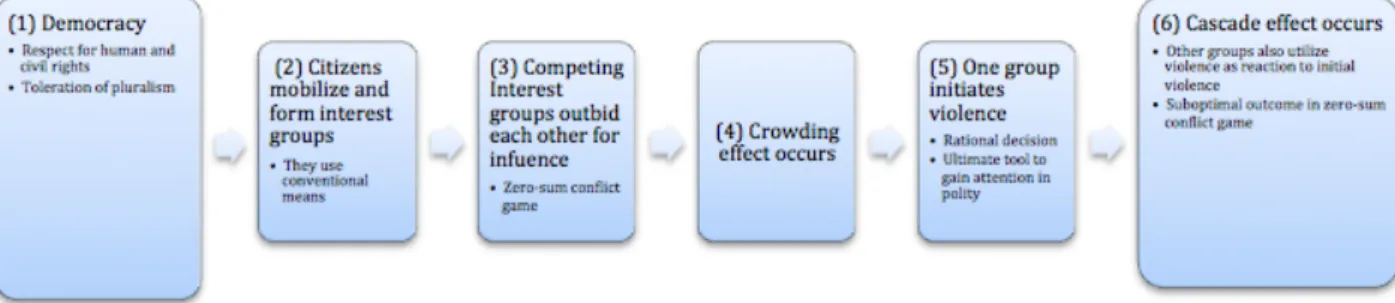
In order to be more precise on which aspects of her theory need to be subjected to more thorough investigation and testing, this thesis presents here the causal chain that I derived from Chenoweth’s theory of the competitive logic.
Figure 1: Causal path of the Theory of the Competitive Logic
The causal path as depicted in chart 1 demonstrates the theory. However, the causal inferences (the arrows) are still highly contested, for it is unknown under which exact circumstances each different step occurs. Indeed, under many circumstances interest groups
do not decide to use violence as a political tool, making it more worthwhile to illuminate the
The full causal chain subdivided in hypotheses
This thesis presents six hypotheses that give a possible explanation of how each of the separate steps in the ‘path causality’ comes about. Each of the hypotheses is derived from Chenoweth’s theory and is framed as a directly observable mechanism. Such a design is well suited to research the causal mechanism. I will elaborate more on this claim in the following chapter (‘research design’).
Step 1: formation of interest groups
Since Chenoweth’s account is derived from more general social mobilization theory, the very first step in the causal process ultimately leading towards the proliferation and prevalence of domestic terrorism concerns the formation of citizens into interest groups. Much of the research, which discusses the link between domestic terrorism and democracy, claims that democracies encourage citizens’ mobilization. This is because democratic governments respect and uphold citizens’ civil liberties and because they ensure opportunities for citizens to influence the public agenda and change public policy. The positive relationship between democracy and social mobilization is portrayed in the following first hypothesis:
H1: If groups have more opportunities for political influence, then citizens are more likely to mobilize themselves collectively by forming interest groups to influence the public agenda.
Disconfirming evidence would be that new interest groups form, without the government being responsive and susceptible to the various interests. Other disconfirming proof would be the reversed finding: that no new interest groups arise, although there are more opportunities for political influence. Both findings would make an alternative outcome in the first step of the causal process.
Step 2: interest groups become competitive for public space
possible win for the other? Why can there not be a sense of compromise between the various interest groups? A possible explanation for this mistrust and lack of understanding between groups could be the government’s preference for dealing with certain interests and disregard for others. This leads to the second hypothesis, which infers a causal relationship between the government’s actions and high levels of competitiveness of the interest group sector:
H2: If a government is only susceptible to a limited number of interests, then interest groups that strive for ignored interests are more likely to become highly competitive towards each other.
This hypothesis thus assumes that the government (consciously or unconsciously) plays an important role in stirring up the tensions between various societal interest groups. Disconfirming evidence would be that groups are being instigated by some other external factor, or that they themselves are responsible for the friction amongst them due to their own actions. Other disconfirming evidence would be the vice-versa outcome: that the IV (government being insusceptible) is present, without an increase in the occurrence of competition. These are other possible and contradicting explanations that are in need of more clarification.
Step 3: Competition leads to outbreak of initial violence
Arguably the most crucial part of Chenoweth’s causal chain, is the initial outbreak of violence. In other words, the moment, in which any group of citizens decides to become terrorists in order to advance their policy goals better and perceivably in a more effective way, sets in motion the cascade effect and leads to a further escalation of the number of (domestic) terrorist groups. Regarding the immediate cause of this outbreak of initial violence, Chenoweth only claims: “A terrorist campaign will usually begin with a precipitating event or circumstance that turns to adopting violence rather than utilizing conventional political means” (2007, 38). This leads to the formulation of the third hypothesis, which is directly derived from Chenoweth’s account:
H3: If one interest group’s interest threatens to become completely marginalized due to an external precipitating event or circumstance, then that interest group is more likely to resort to violence.
study should illuminate what such an event could potentially be. Disconfirming evidence would be that the initial moment of violence did not result from some external event. An alternative explanation would be that intra-group dynamics play an important role in the group’s decision to become violent. An interest group leader, for instance, can play a meaningful role in the groups’ decision to use violence. Also, I argue that it is worthwhile to examine how long a political organization used conventional means before they initiated violence. My argument is that interest groups that have a long history of using conventional means in the ‘political arena’ are more likely to stick to these means out of habit although it might be rational not to do so. It is therefore also interesting to examine for how long an interest group was in existence before it started using violence as a political tool.
Alternative disconfirming evidence would be the reversed outcome: namely that there is a ‘precipitating event or circumstance’, but that there is no occurrence of violence. This finding would be detrimental to Chenoweth’s theory, because the alleged connection between inter-group dynamics and an outbreak of violence is the centrepiece on which her account is built on. If an interest groups decides to stick to conventional means of action, even if the polity is at its maximal level of ‘saturation’ and its interests are maximally degraded, then the theory of competitive logic requires fundamental re-thinking.
Step 4: The cascade effect
The next step in Chenoweth’s account is a defining feature of her theory. She claims that groups are not only responsive to the government but also towards each other. Because they are involved in a zero-sum conflict game with one another, they will likewise resort to violence as a low cost rational decision. Consistent with Chenoweth’s theory, this ‘cascade effect’ will also be tested through the fourth hypothesis:
H4: If one interest group resorts to the initial use of violence, then other interest groups are more likely to also resort to violence to compensate for the sudden significant decrease in attention received on the public agenda.
Disconfirming evidence would be that a terrorist group escalates its attacks, without any groups responding by using violence to counterbalance the initial escalation. It is also useful to examine not only an increase in numbers of groups, but also an increase numbers of
incidents. Do interest groups react differently to a group, which has a long history of violence,
terrorist organization matter in terms of whether or not it triggers a violent counter-balancing reaction from other groups. It would be logically sound to suggest that groups of an opposing ideology have much greater incentive to adopt violent strategies (Chenoweth 2007, 47).
Step 5: A decrease in numbers of group and incidents?
A weakness of Chenoweth’s account is that her theory has difficulties with explaining and predicting a decrease both in the number of terrorist groups and the number of incidents. To offer an explanation for these events, I will test two hypotheses, which give two different explanations for a sudden decrease in the number of incidents. This thesis will primarily focus on a decline in incidents and less so on a decline in numbers, because I contend that fluctuations in the number of incidents happen at a relatively fast rate, while the difference in the number of groups overtime generally is not that variable. Studying a sudden significant increase or drop in terrorist incidents is thus more meaningful, since it is easier to infer causality from any sudden change. The possible explanations are laid out in the following fifth and sixth hypotheses:
H5: If a government decides to compromise on all the various interest groups’ demands, then interest groups are more likely to cease their acts of violence.
H6: If the number of terrorist interest groups and incidents peaks, then domestic terrorist interest groups are more likely to cease their acts of violence due to the ‘terrorism taboo’.
Overview of variables
As this thesis will trace an entire causal process, there multiple intervening variables in each of the steps that need to be investigated. The analysis starts with the independent variable (IV) that stands at the very beginning of the causal ‘path’.
Independent Variable
- IV: The democratic freedom of association
Dependent Variables
Ultimately, the outcome of interest of this thesis is twofold. I am not only interested in examining an increase of group proliferation, but also in what causes changes in the number of incidents. Therefore I present two dependent variables (DVs):
- DV1: Number of domestic terrorist groups
- DV2: Number of domestic terrorist incidents by groups
Intervening variables
As this thesis aims to identify the full ‘path of causality’, I therefore derive a sequential chain of intervening variables that are expected to ultimately lead to the DVs. In accordance with the hypotheses, I will examine the following intervening variables (InterVs), which express the consecutive steps in the final outcome of interest:
- InterV1: Formation of interest groups
- InterV2: Government’s susceptibility to a limited number of interests - InterV3: Competitiveness of interest groups
- InterV4: External precipitating event
- InterV5: Likeliness to resort to initial violence
- InterV6: Likeliness to become violent as reaction to initial violence - InterV7: Government’s willingness to compromise
Chapter 4: Research Design
I have discussed the need to unravel the full causal mechanism in Chenoweth’s theory by which an domestic interest group, which formed itself as a consequence of citizens’ civil liberty to do so, may use violence and thus become terroristic to influence public policy. In addition, I stipulated the need to further examine how these groups respond to each other, and by which causal mechanism groups might cease their violent perpetrations. The starting point for analysis is examining democratic competition, which is the fundamental determinant of the proliferation of domestic terrorist groups according to Chenoweth. Also, I extend the research interest to investigating changes in the number of incidents, and thus not just the number of groups.
Operationalization of key intervening variables
In her doctoral dissertation, Chenoweth (2007) established through a large N-study a significant positive relationship between inter-group competition (IV) and terrorist group proliferation (DV). Her indicators for inter-group competition were all statically quantified indexes (Chenoweth 2007, 57-62):
- Participation competition (parcomp); operationalized as the level of agenda openness based on level of citizens’ civil and human rights, derived from the POLITY IV dataset score;
- Ideological intensity of group competition (compindx); operationalized as the degree of ideological heterogeneity in a given year (communist, nationalist, religious, right-wing
reactionary, racist).
Although this operationalization gave her the possibility to execute a large N-study in order to establish correlation between the key IV and DV, such indexes lack the nuances that naturally exist in each different country that has experienced domestic terrorism.
Therefore this thesis will operationalize my interVs in a way that captures the variation of the variables more thoroughly:
- InterV2: expressions from government conveyed through communiqués, speeches by political leaders, government legislation, scholarly analysis on post-junta Greece;
- InterV3: expressions from interest groups conveyed through communiqués, public statements, and presence or absence of hostile incidents directed towards other groups; - InterV7: government communiqués, speeches by political leaders, government
Furthermore, InterV1, InterV4, interV5, interV6 and InterV8 are operationalized quantifiably: - InterV1: numbers of formed groups10
- InterV4: absence or presence of an event
- InterV5 and InterV6: absence of presence of an attack by a group - InterV8: an absolute peak in incidents in certain time frame
Operationalization of outcome of interest
The data for the DVs are taken from two databases:
- The Global Terrorism Database (‘National Consortium for the Study of Terrorism and Responses to Terrorism’). It is composed by the University of Maryland includes terrorist group profiles from the period 1970 till 2012. The date of group formation and its ideological background are also mentioned. It also contains data on the known terrorist incidents for which the respective group is responsible. GTD is renowned for its data richness (it is comprised of more than 125,000 incidents of terrorism). Therefore it is used to compose the annual Global Terrorism Index, published by the global non-profit Institute for Economics and Peace. In addition to its data richness, GTD offers the possibility to filter out specific data from specific countries and time frames.11
- The TRAC Database (‘Terrorism Research & Analysis Consortium’). This consortium is a supplement of the GTD. TRAC also offers an overview of terrorist groups since the 1960s.12 In addition, it offers analytical and evaluating articles on terrorism worldwide.
The GTD defines terrorism as “the threatened or actual use of illegal force and violence by a non-state actor to attain a political, economic, religious, or social goal through fear, coercion, or intimidation”13 Practically, this means that the GTD only includes an incident in its selection when all three of the following attributes are met:
1. The incident must be intentional;
2. The incident must entail some level of violence or threat of violence;
10 Quantitative data on interest groups for the period 1973-1983 is limited. Empirical research on Greek civil
society did not commence until the 1990s. Eurostat, a profound data source of the European Commission, does have information on the organized voluntary activity of Greeks, but only started to collect data after Greece’s accession to the European Community in 1981. Therefore, I rely primarily on general statements about the emergence of Greek interest groups.
11 GTD accessed online (December 18th, 2014): http://www.start.umd.edu/tops/process_request.asp 12 TRAC accessed online (December 18th, 2014): http://www.trackingterrorism.org/groups
13 Definition cited from the GTD Codebook, p.8; accessed online (December 18th, 2014):
3. The perpetrators of the incidents must be sub-national actors.14
This definition does not differ substantially from my working definition of terrorism.
Sometimes the GTD did not clarify when a group was formed or when it was dissolved. Most of those profiles simply state that the group is currently ‘inactive’. In that case, I relied on the dates of the first and last attack of the organization as the respective dates of formation and dissolution.
The GTD is well suited for terrorism research. Nevertheless, there are some reliability concerns that need to be addressed. Firstly, we cannot know for sure whether data on groups or incidents may be omitted from the dataset simply because they were unreported. Unfortunately, this is an issue that is nearly impossible to resolve. Secondly, GTD does not distinguish between domestic and transnational incidents, in the sense that it includes any attack that occurred on a country’s territory, even if the attack was not directed at the government of the respective state. Therefore, I have made sure that every group under examination meets the requirement which I have outlined that are needed to count as a valid domestic terrorist group.
Case selection for within-case analysis
In order to test the hypotheses, this thesis has selected studying the case of modern post-authoritarian Greece. From the outset, Chenoweth’s theory of competitive logic should also apply to this case. According to POLITY IV data (which measures the democracy level of countries from -10 – +10 range), Greece ascends from a -7 score (autocracy) in 1974 to a spectacular +8 score in 1977.15 After 1977, Greece’s democracy level score stabilizes and remains between +8 and +10.
Meanwhile, Greece has witnessed a continuous fluctuating flow of domestic terrorist activity from multiple terrorist groups since its complex democratization process, which commenced in 1974. This pattern is peculiar, since one could expect that democratization, and the subsequent guarantees for civil and human rights, would give less incentive for aggrieved citizens to express their dissatisfaction with public policy violently. Figure 2.1 illustrates this puzzling increase in terrorist activity in Greece, which experienced its first peak just a few years after the democratization period commenced:
14 Idem.
Figure 2.1: Number of terrorist incidents in Greece (1970-2013, N=1154)16
In accordance with the increase in the number of terrorist increase in Greece in the mid-1970s, figure 2.217 likewise indicates an increase in the total number of Greek domestic terrorist organizations:
Both figures suggest that there is a certain pattern in the cycle of terrorist proliferation and diminishment. The period 1973-1983 is of great interest. In terms of the total number of
16 Figure taken from GTD:
http://www.start.umd.edu/gtd/search/Results.aspx?search=greece&sa.x=-424&sa.y=-208&sa=Search (accessed December 18th, 2014)
17 Data taken from GTD and TRAC 0
1 2 3 4 5 6 7 8 9
1967 1968 1969 1970 1971 1972 1973 1974 1975 1976 1977 1978 1979 1980 1981 1982 1983
Number
Figure 2.2 Domestic Terrorist Group Emergence in Greece (1967-1983)