Prostate-specific antigen velocity in a
prospective prostate cancer screening study
of men with genetic predisposition
Christos Mikropoulos
1et al.
Background:Prostate-specific antigen (PSA) and PSA-velocity (PSAV) have been used to identify men at risk of prostate cancer (PrCa). The IMPACT study is evaluating PSA screening in men with a known genetic predisposition to PrCa due to BRCA1/2
mutations. This analysis evaluates the utility of PSA and PSAV for identifying PrCa and high-grade disease in this cohort.
Methods:PSAV was calculated using logistic regression to determine if PSA or PSAV predicted the result of prostate biopsy (PB) in men with elevated PSA values. Cox regression was used to determine whether PSA or PSAV predicted PSA elevation in men with low PSAs. Interaction terms were included in the models to determine whetherBRCAstatus influenced the predictiveness of PSA or PSAV.
Results: 1634 participants had X3 PSA readings of whom 174 underwent PB and 45 PrCas diagnosed. In men with PSA 43.0 ng mll, PSAV was not significantly associated with presence of cancer or high-grade disease. PSAV did not add to PSA for
predicting time to an elevated PSA. When comparingBRCA1/2carriers to non-carriers, we found a significant interaction between
BRCAstatus and last PSA before biopsy (P¼0.031) andBRCA2status and PSAV (P¼0.024). However, PSAV was not predictive of biopsy outcome inBRCA2carriers.
Conclusions:PSA is more strongly predictive of PrCa inBRCAcarriers than non-carriers. We did not find evidence that PSAV aids decision-making forBRCAcarriers over absolute PSA value alone.
Men with germline mutations inBRCA2have an increased risk of prostate cancer (PrCa), estimated at 2.5–8.6 fold increased risk for
BRCA2 mutation carriers (Breast Cancer Linkage Consortium, 1999; van Asperen et al, 2005; Kote-Jarai et al, 2011). There remains debate about whether there is an increased risk of PrCa associated withBRCA1mutations, with some studies reporting no increased risk to those reporting a 1.8–3.75 fold increased risk (Thompsonet al, 2002; Leongamornlert et al, 2012; Moranet al,
2012). A number of studies have reported thatBRCA2 mutation carriers have more aggressive disease, suggested by their younger age at diagnosis, higher rates of lymph node involvement and distant metastasis at diagnosis, and higher mortality rates compared with non-carriers (Tryggvado´ttir et al, 2007; Mitra
et al, 2008; Edwardset al, 2010; Gallagheret al, 2010; Thorneet al, 2011; Castroet al, 2013). There is increasing evidence thatBRCA1
mutation carriers may also harbour more aggressive disease (Giusti
et al, 2003; Gallagheret al, 2010; Castroet al, 2013). Furthermore,
BRCA2-mutant localised prostate cancer demonstrates increased genomic instability and a mutational profile that more closely resembles metastastic than localised disease, therefore supporting early detection in this at risk patient population (Taylor et al, 2017).
General population prostate specific antigen (PSA) screening remains controversial due to an unclear balance of benefits, in terms of mortality reduction when compared to harms such as overdiagnosis and overtreatment. However, many expert groups continue to recommend PrCa screening with particular attention towards men with risk factors based on family history, genetics and/or race (Roobolet al, 2013; Eeleset al, 2014; Mikropouloset al, 2014; Murphyet al,2014).
It has previously been suggested that the rate of PSA change over time, or PSA velocity (PSAV), can be used to assist in differentiating between men with cancer from those with benign disease (Carter et al, 1992; Bergeret al, 2005). Monitoring PSA
*Correspondence: Professor RA Eeles; E-mail: [email protected]
Received 17 July 2017; revised 3 November 2017; accepted 6 November 2017; published online 4 January 2018
rThe Author(s) named above Keywords:prostate cancer; genetic predisposition; predictive model; PSA velocity;BRCA1;BRCA2
over time could also improve the sensitivity of screening. It is also possible that PSAV could distinguish between men who might have advanced or aggressive disease that would require definitive treatment thus avoiding overdiagnosis and overtreatment (Carter
et al, 2006; Carteret al, 2007).
However, the utility of PSAV in PrCa decision-making has been called into question. In particular, while PSAV may be predictive of biopsy outcome in univariate analyses, it has not been shown to improve the predictiveness of biopsy outcome over the absolute value of PSA (Roobol et al, 2004; Vickers et al, 2011; Loughlin, 2014). Although some studies have suggested that PSAV can be used to identify men with aggressive disease, these did not investigate whether calculation of PSAV provided additional information than the most recent PSA value (Carter et al, 1992; D’Amico et al, 2004; D’Amicoet al, 2005). PSA and PSAV are highly correlated, and this may explain why PSAV does not add predictive value (Vickers et al, 2011). As a result of these considerations, PSAV has been removed from all major guidelines concerning the detection of prostate cancer.
It is currently unknown whether PSAV provides more information, beyond PSA absolute value, among a cohort of men considered to be at increased genetic risk of PrCa and aggressive disease. The IMPACT study (Identification of Men with a genetic predisposition to ProstAte Cancer: Targeted screening in men at higher genetic risk and controls; www.impact-study.co.uk) is an international multi-centre study evaluating the role of targeted PSA screening in men with a BRCA1 or BRCA2
mutation and was established in 2005 (Bancroft et al, 2014). To date, B3000 men have been recruited from 20 countries across the world. Men are followed up with annual (or biannual in the Dutch cohort) PSA screening for a minimum of 5 years within the study and this has produced a wealth of PSA results and follow-up data over time. The primary end-point of the IMPACT study is to determine the incidence, stage and pathology of screen-detected prostate cancer in the study population; a secondary end-point is to determine a profile of PSA level and its predictive value for the development of prostate cancer in the study population. The objective of the present study was to determine whether PSA values and/or PSAV were associated with PrCa and aggressive tumours among men at increased risk enrolled in the IMPACT trial.
MATERIALS AND METHODS
Patient selection. The design and eligibility criteria for the IMPACT study have been described elsewhere (Mitraet al, 2008; Bancroft et al, 2014). The protocol was approved by the West-Midlands Research and Ethics Committee in the UK (reference 05/ MRE07/25), and subsequently by each participating institution’s local committee. Briefly, men aged between 40 and 69 were recruited from families with a known pathogenic germlineBRCA1
orBRCA2mutation. Men were invited to enrol if they had tested positive (carriers) or negative for the familial mutation (BRCA1/2
non-carriers), or if they were at 50% risk of inheriting a mutation but had not yet undergone predictive genetic testing. All participants provide written consent. Men with PrCa or with a prior diagnosis of another cancer with a prognosis of o5 years were excluded. In the Dutch centres, men were also excluded if they had PSA screening prior to study entry.
According to the IMPACT study design, men underwent annual PSA screening and those with a PSA43.0 ng mllwere referred for a 10- or 12-core transrectal ultrasound guided (TRUS) biopsy based on institutional clinic practices. Men with a PSA43.0 ng/ml and a negative biopsy continue annual screening, with a repeat
biopsy recommended when PSA increased by 450%. Men were also referred for biopsy if they had a PSAp3.0 ng mllbut clinical suspicion (e.g., abnormal digital rectal examination or clinical symptoms). After 5 years in the study, men at a subset of centres were also offered an elective biopsy.
PSA readings in the study are validated in a central laboratory to exclude inter-site variations. The results found a Spearman’s agreement of 0.95 between study sites (Bancroftet al, 2014).
Statistical considerations. PSA velocity (PSAV) has been used as a marker to inform decisions about biopsy or about the timing of the next PSA screen. With respect to the former, we considered that a physician had the most recent PSA measurements available. Our study question was therefore whether adding PSAV to this data point improves prediction of presence of PrCa at biopsy. As elevated PSA is the primary indication in routine clinical practice, our main analysis was restricted to men who had any PSA X3.0 ng mllprior to biopsy. A sensitivity analysis was conducted including all men who underwent biopsy. We created logistic regression models, adjusted for last PSA measurement and age, for the outcomes of any grade and high-grade cancer. PSAV was calculated using three methods: arithmetic equation of change in PSA over time; linear regression; rate of PSA change using first and last values only. We also used cubic splines with knots at the tertiles to test for non-linearity in PSA and in PSAV.
To investigate whether the effect of PSAV on predicting biopsy outcome differed based onBRCAstatus, we included an interaction term between PSAV andBRCAstatus (BRCA1orBRCA2carriers
vs BRCA non-carrier patients, andBRCA2carriersvs BRCA1and
BRCA non-carrier patients). Due to a limited number of events, this analysis was performed only for the outcome of any cancer on biopsy. This analysis included 13 cancers diagnosed among 55
BRCA1 carriers and 23 cancers among 65BRCA2carriers. To determine whether PSAV could aid decisions about screen-ing frequency, e.g., whether a man with a high PSAV should receive a subsequent PSA test at a shorter interval than a man with low PSAV, we assessed whether PSAV was associated with having a future PSA 43.0 ng mll. As a minimum of three PSA measurements are required for accurate estimation of PSAV, we created Cox proportional hazards models for the time from the first PSA measurement to the patient’s third PSA measurement 43.0 ng mll. Four models were then created: one including the third PSA measurement only, and the others including both the third PSA measurement and each of the three methodologies for calculating PSAV. Men who had a PSA 43.0 ng mllwithin the first three PSA measurements were excluded from this analysis. A total of 1086 men were included.
We planned to first evaluate the independent statistical significance of PSAV in models that also included absolute PSA level. If significant, we planned to estimate the improvement in concordance index afforded by PSAV after 10-fold cross-valida-tion. All analyses were conducted using Stata 13.0 (Stata Corp., College Station, TX, USA).
RESULTS
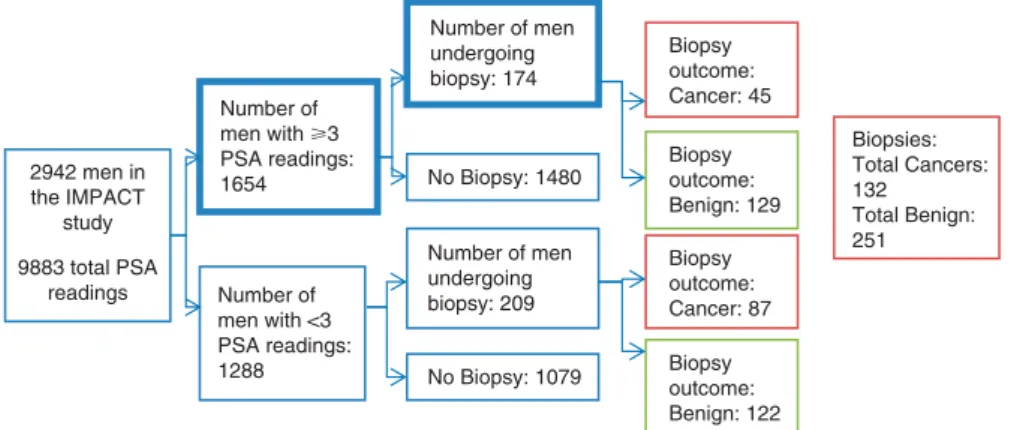
Of the 2942 men recruited to the IMPACT study, 1654 men had three or more PSA measurements and appropriate clinical follow-up to be included in the analyses (Figure 1). Table 1 shows the demographic, PSA and biopsy grade characteristics of the analysis cohorts. The cohort of 1654 men consisted of 510BRCA1mutation carriers, 584 BRCA2 mutation carriers, 260BRCA1 non-carriers and 288BRCA2non-carriers. Two men carried both aBRCA1and
BRCA2 mutation (included in theBRCA2 group for genetic sub-analysis) and 10 had not yet had a predictive test for the BRCA
this cohort, 174 men underwent prostate biopsy, with 45 men having any grade cancer of whom 21 having Gleason score 7 or higher (high-grade) cancer. Among men who had any PSA 43.0 ng mll, 40 had any grade of whom 20 had high-grade cancer.
The median age at the first PSA of BRCA2 carriers was significantly younger than both BRCA1 carriers and non-carriers (51vs53vs54 years, respectively,Po0.0001). Overall,BRCA2and
BRCA1carriers had significantly lower first PSA values than non-carriers (0.80vs0.80vs0.89 ng mll;P¼0.022; however, overall there was no statistically significant difference in the median PSAV between the BRCA2,BRCA1and non-carrier groups (P¼0.8).
The median age at first PSA reading of men diagnosed with cancer was higher than that of men without cancer (60vs53 years,
U¼22069, z¼ 5.24, Po0.001). The median most recent PSA (i.e., PSA at diagnosis for cancer cases) was significantly higher for those with cancer compared with those without cancer (3.70 vs
0.90 ng mll)U¼8564,z¼ 9.34,Po0.001). The median PSAV was significantly higher for those with cancer vs those without cancer (medians: 0.56 vs 0.02 ng/ml/yr, U¼9641, z¼ 9.012,
Po0.001). Of those diagnosed with cancer, there was no significant difference between the proportion ofBRCA2carriers with a PSAV
(calculated by linear regression)40.35 ng mllper year compared with BRCA1 carriers and non-carrier controls (78.3 vs 61.5 vs
53.8%, p0.28).
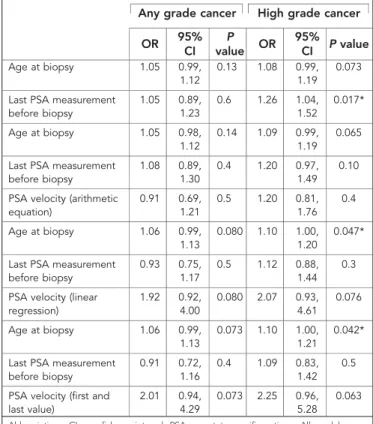
We next assessed whether adding PSAV to the most recent PSA measurement would improve the ability to determine which men should undergo biopsy. Using cubic splines, we investigated and found no evidence of non-linearity in PSA or in PSAV. Among men with any PSA measurements 43.0 ng/ml, PSAV was not significantly associated with either any grade or high-grade cancer after adjusting for most recent PSA measurement (Table 2). We repeated these analyses including all men who were biopsied, and found that PSAV was not statistically significant in any of the models (Table 3).
Additionally, we assessed whether PSAV affected the prediction of PrCa at biopsy differently based on BRCA status. When comparingBRCA1 andBRCA2carriers toBRCA1/2non-carriers, we found a significant interaction between BRCAstatus and the last PSA before biopsy (P¼0.031), however there was no evidence of an interaction between BRCA status and PSAV (Table 4). However, when comparingBRCA2carriers toBRCA1carriers and
BRCA1/2non-carriers, we found evidence of interactions between
BRCA2 status and last PSA before biopsy (P¼0.078) and 2942 men in
the IMPACT study
9883 total PSA readings
Number of men undergoing biopsy: 209 Number of
men with ⭓3 PSA readings: 1654
Number of men with <3 PSA readings: 1288
Biopsy outcome: Cancer: 87 No Biopsy: 1480
Number of men undergoing biopsy: 174
No Biopsy: 1079 Biopsy outcome: Benign: 122 Biopsy outcome: Benign: 129 Biopsy outcome: Cancer: 45
Biopsies: Total Cancers: 132 Total Benign: 251
Figure 1. Consort diagram of study population.The two bolded cohorts were included for in-depth analysis, as they had 3 or more PSA values available for analysis and underwent a prostate biopsy.
Table 1.Patient characteristics
Total cohort
N¼1654 BRCA2 N¼586
a
BRCA1 N¼510 Non-carrier controls (BRCA1andBRCA2 negative)N¼548
Age at first PSA test 53 (46, 60) 51 (45, 59) 53 (46, 60) 54 (48, 61)
Patient underwent biopsy 174 (11%) 65 (11%) 55 (11%) 54 (10%)
Prior negative biopsy 26 (1.6%) 8 (1.4%) 8 (1.6%) 10 (1.8%)
Biopsy Gleason score
p6 24 (14%) 11 (17%) 6 (11%) 7 (13%)
7 15 (8.6%) 6 (9.2%) 6 (11%) 3 (5.6%)
47 6 (3.4%) 5 (7.7%) 0 (0%) 1 (1.9%)
Negative biopsy 129 (74%) 43 (66%) 43 (78%) 43 (80%)
First PSA measurement (ng ml1) 0.8 (0.5, 1.3) 0.80 (0.50, 1.20) 0.80 (0.50, 1.30) 0.89 (0.60, 1.40) Last PSA measurement (ng ml1) 0.9 (0.6, 1.6) 0.91 (0.59, 1.50) 0.88 (0.55, 1.70) 1.00 (0.60, 1.70)
Number of PSA tests before biopsy
3 503 (30%) 163 (28%) 158 (31%) 178 (32%)
4 328 (20%) 123 (21%) 108 (21%) 96 (18%)
5 474 (29%) 160 (27%) 135 (26%) 174 (32%)
6 156 (9.4%) 62 (11%) 50 (10%) 44 (8.0%)
7 108 (6.5%) 36 (6.1%) 38 (7.5%) 34 (6.2%)
8 or more 85 (5.1%) 42 (7.2%) 21 (4.1%) 22 (4.0%)
Data are reported as median (interquartile range) or frequency (%). a
significant interactions between BRCA2 status and PSAV calcu-lated using the arithmetic equation and linear regression (P¼0.024 andP¼0.049 respectively, Table 4).
Based on these interactions, we performed subgroup analyses by
BRCA2status. All models were adjusted for age at biopsy and last PSA before biopsy. Due to a limited number of events (26 cancers in BRCA2 non-carriers and 23 inBRCA2 carriers), these models were somewhat overfit. No evidence of an association between PSA and any grade cancer or PSAV and any grade cancer was seen in
BRCA2carriers or non-carriers, likely due to the strong correlation between PSA and PSAV (Table 5).
We then investigated whether PSAV was associated with time to PSA X3.0 ng mll. Using Cox proportional hazards models, we found no evidence of an association between PSAV and time from the third PSA measurement to PSA X3.0 ng mll. Out of 1533 men who did not have a PSAX3.0 ng mllwithin the first three PSA tests, there were 28 who had a PSA X3.0 ng mllwithin 1 year, 50 within 2 years and 62 within 3 years.
DISCUSSION
This is the first study to show that there are differences in PSA values among men with different genetic backgrounds. These PSA differences could be used to identify those men considered to be at high genetic risk of more aggressive disease. However, when evaluated with absolute PSA values, PSAV did not appear to provide additional information forBRCA1orBRCA2carriers.
A major problem of PSA screening is that, in attempting to detect clinically significant disease, it is inevitable that indolent disease will also be detected leading to overdiagnosis. However, early diagnosis and identification of men with high-risk disease is important to prevent mortality from PrCa. This might be
particularly essential in light of recent publications indicating that men with a BRCA1 or BRCA2 mutation are at risk of more aggressive disease (Castro et al, 2013; Castro et al, 2015), early identification of those with clinically significant disease will be imperative. In view of the controversy about the role of PSAV in prostate screening in the general population, it was important to assess its role inBRCA1andBRCA2carriers and whether it added to the ability to detect clinically significant disease.
In this analysis of the IMPACT study cohort, we foundBRCA2
carriers on average to be screened at a relatively young age. This may account for lower overall PSA values for BRCA2carriers in this analysis compared to non-carrier controls. However, there were no differences in median PSAV between carriers and non-carriers. Given the possibility that higher PSAV may associate with aggressive PrCa (D’Amico et al, 2004; D’Amico et al, 2005), we would expectBRCA2carriers who are at risk of aggressive disease would exhibit higher PSAVs (Castroet al, 2013; Castroet al, 2015).
BRCA2carriers in this group may be too young to demonstrate this trend at this point of follow up.
A single PSA reading over 3 ng mll was applied to guide biopsy decisions according to the IMPACT protocol, as well as if there was clinical suspicion on digital rectal examination or clinical symptoms. PSAV was not a good indicator in this analysis for distinguishing between those with any grade cancer and high-grade cancer when men were biopsied for either indication. It is possible that PSAV could be a good predictor of high-grade disease in men who had PSA valuesp2 ng mll(Kitagawaet al, 2014). However, due to the protocol’s 3 ng/ml PSA threshold for prostate biopsy, we were limited in the number of cancers diagnosed when PSA was p2 ng mll. Further follow up will be required to assess when additional cancers are diagnosed. As part of the IMPACT trial, there is an optional end of study biopsy regardless of PSA. This may help delineate PSAV among men diagnosed with PrCa with low PSA values (Carteret al, 1992; Kitagawaet al, 2014). Table 2.Models for any grade and high-grade cancers among
men with any PSA measurementX3.0 ng/ml,N¼116
Any grade cancer High grade cancer
OR 95% CI
P value OR
95% CI Pvalue Age at biopsy 1.05 0.99,
1.12
0.13 1.08 0.99, 1.19
0.073
Last PSA measurement before biopsy
1.05 0.89, 1.23
0.6 1.26 1.04, 1.52
0.017*
Age at biopsy 1.05 0.98, 1.12
0.14 1.09 0.99, 1.19
0.065
Last PSA measurement before biopsy
1.08 0.89, 1.30
0.4 1.20 0.97, 1.49
0.10
PSA velocity (arithmetic equation)
0.91 0.69, 1.21
0.5 1.20 0.81, 1.76
0.4
Age at biopsy 1.06 0.99, 1.13
0.080 1.10 1.00, 1.20
0.047*
Last PSA measurement before biopsy
0.93 0.75, 1.17
0.5 1.12 0.88, 1.44
0.3
PSA velocity (linear regression)
1.92 0.92, 4.00
0.080 2.07 0.93, 4.61
0.076
Age at biopsy 1.06 0.99, 1.13
0.073 1.10 1.00, 1.21
0.042*
Last PSA measurement before biopsy
0.91 0.72, 1.16
0.4 1.09 0.83, 1.42
0.5
PSA velocity (first and last value)
2.01 0.94, 4.29
0.073 2.25 0.96, 5.28
0.063
Abbreviations: CI¼confidence interval; PSA¼prostate-specific antigen. All models were adjusted for age at biopsy and the last PSA measurement before biopsy. *Statistically significant.
Table 3.Models for any grade and high grade cancers among all men undergoing biopsy,N¼174
Any grade cancer High grade cancer
OR 95% CI
P value OR
95% CI Pvalue Age at biopsy 1.05 1.00,
1.11
0.051 1.08 1.00, 1.18
0.056
Last PSA measurement before biopsy
1.13 1.00, 1.28
0.058 1.35 1.14, 1.59
0.001*
Age at biopsy 1.05 1.00, 1.10
0.064 1.09 1.00, 1.18
0.050
Last PSA measurement before biopsy
1.17 1.01, 1.36
0.041* 1.29 1.06, 1.57
0.010*
PSA velocity (arithmetic equation)
0.88 0.67, 1.17
0.4 1.19 0.79, 1.78
0.4
Age at biopsy 1.06 1.00, 1.11
0.033* 1.10 1.01, 1.19
0.036*
Last PSA measurement before biopsy
1.01 0.84, 1.22
0.9 1.19 0.95, 1.50
0.14
PSA velocity (linear regression)
1.85 0.92, 3.71
0.085 2.09 0.95, 4.62
0.068
Age at biopsy 1.06 1.01, 1.11
0.030* 1.10 1.01, 1.20
0.033*
Last PSA measurement before biopsy
1.00 0.82, 1.22
40.9 1.16 0.90, 1.49
0.2
PSA velocity (first and last value)
1.90 0.93, 3.89
0.080 2.24 0.97, 5.20
0.059
A strength of this study is the unique patient cohort of men with a genetic predisposition to PrCa, in particularBRCA2carriers who are predisposed to aggressive PrCas (Mitraet al, 2008; Narodet al, 2008; Castroet al, 2013; Castroet al, 2015). Within the group of
BRCA2 carriers, PSAV proved predictive of any grade cancer, however, given the low number of cancers diagnosed overall it was not possible to assess whether PSAV was associated with high grade cancer andBRCA2status. A high PSAV in an individual with a BRCA2 mutation could be used as an indicator of presence of PrCa and therefore as an indication for prostate biopsy. This model
could lead to diagnosis of lower grade cancers inBRCA2carriers. It may lead to better prognosis for men at risk for more aggressive disease and better disease-free survival when treated early. Although there are no definitive treatment recommendations for men withBRCA2mutations when found to be diagnosed with low grade cancers, their risk for aggressive disease may spur them to follow a more active treatment plan such as radical prostatectomy
vsexternal-beam radiation therapy or active surveillance (Bratt and Loman, 2015; Castroet al, 2015).
One major limitation of this analysis is the relatively small number of men in the study who had undergone diagnostic prostate biopsy. End of study biopsies are not mandated and the true incidence of PrCa is unknown in this population. As more men progress through the IMPACT screening study, undergo prostate biopsy and follow-up time increases, the findings from this analysis can be explored and validated. At this point, the results from this analysis did not justify modifying the study algorithm to include a PSAV calculation.
In the general population, PSAV is not part of any major screening guideline. We also did not find PSAV to be an independent prognostic factor in BRCA1 or BRCA2 mutation carriers and therefore for screening an absolute PSA cut-off value should preferably be used.
CONCLUSION
PSA is more strongly predictive of PrCa in BRCA carriers than
BRCA non-carriers. We did not find evidence that PSAV aids to decision making for either indicating biopsy or frequency of follow-up testing in BRCA carriers, but further follow-up is required for more definitive conclusions.
Table 4.Models for any grade cancer based onBRCAstatus (BRCApositive carriersvs BRCAnegative non-carriers) and BRCA2status (BRCA2positivevs BRCA1positive andBRCA negative)
BRCA1andBRCA2 vs BRCA non-carriers
BRCA2 vs BRCA1 andBRCA non-carriers OR 95% CI P value OR 95% CI Pvalue Age at biopsy 1.07 1.01,
1.13
0.017* 1.06 1.01, 1.12
0.022*
Last PSA measurement before biopsy
0.87 0.65, 1.16
0.3 0.99 0.81, 1.20
0.9
BRCA1orBRCA2 Positive
0.40 0.10, 1.67
0.2 0.74 0.21, 2.65
0.6
Interaction between last PSA measurement andBRCAþ
1.44 1.03, 2.02
0.031* 1.28 0.97, 1.69
0.078
Age at biopsy 1.06 1.00, 1.12
0.034* 1.06 1.01, 1.12
0.025*
Last PSA measurement before biopsy
1.14 0.97, 1.35
0.10 1.06 0.89, 1.27
0.5
PSA velocity using all PSAs (arithmetic equation)
0.77 0.51, 1.16
0.2 0.72 0.49, 1.08
0.11
BRCA1orBRCA2 Positive
1.54 0.66, 3.61
0.3 1.07 0.43, 2.67
0.9
Interaction between PSAV and BRCAþ
1.31 0.74, 2.34
0.4 2.63 1.13, 6.12
0.024*
Age at biopsy 1.07 1.01, 1.13
0.014* 1.07 1.02, 1.13
0.010*
Last PSA measurement before biopsy
0.97 0.81, 1.18
0.8 0.93 0.75, 1.15
0.5
PSA velocity using all PSAs (linear regression)
1.19 0.49, 2.89
0.7 1.46 0.69, 3.11
0.3
BRCA1orBRCA2 Positive
0.99 0.37, 2.68
40.9 0.93 0.34, 2.52
0.9
Interaction between PSAV andBRCAþ
2.26 0.74, 6.90
0.2 3.26 1.01, 10.54
0.049*
Age at biopsy 1.07 1.01, 1.13
0.013* 1.07 1.02, 1.13
0.009*
Last PSA measurement before biopsy
0.97 0.79, 1.18
0.7 0.92 0.74, 1.16
0.5
PSA velocity using all PSAs (first and last value)
1.24 0.50, 3.07
0.6 1.48 0.68, 3.18
0.3
BRCA1orBRCA2 Positive
1.01 0.37, 2.74
40.9 0.92 0.34, 2.51
0.9
Interaction between PSAV andBRCAþ
2.08 0.70, 6.20
0.2 2.96 0.97, 9.02
0.056
Abbreviations: CI¼confidence interval; PSA¼prostate-specific antigen. All models were adjusted for age at biopsy, last PSA measurement before biopsy,BRCAstatus and the interaction between PSA or PSA velocity andBRCAstatus. *Statistically significant.
Table 5.Models for any grade cancer byBRCA2status (BRCA2carriersvs BRCA1carriers andBRCA1/2non-carriers)
BRCA2Carriers (N¼65)
BRCA2Non-carriers (N¼109)
OR 95% CI
P value OR
95% CI Pvalue Age at biopsy 1.02 0.95,
1.10
0.6 1.10 1.02, 1.19
0.011*
Last PSA measurement before biopsy
1.27 1.05, 1.54
0.013* 0.97 0.79, 1.19
0.8
Age at biopsy 1.03 0.95, 1.11
0.5 1.10 1.02, 1.19
0.017*
Last PSA measurement before biopsy
1.12 0.81, 1.55
0.5 1.03 0.83, 1.27
0.8
PSA velocity (arithmetic equation)
1.61 0.57, 4.55
0.4 0.74 0.49, 1.11
0.14
Age at biopsy 1.04 0.96, 1.12
0.4 1.11 1.02, 1.19
0.010*
Last PSA measurement before biopsy
1.01 0.71, 1.44
40.9 0.90 0.68, 1.19
0.4
PSA velocity (linear regression)
3.27 0.65, 16.38
0.15 1.56 0.66, 3.67
0.3
Age at biopsy 1.04 0.96, 1.12
0.4 1.11 1.02, 1.19
0.010*
Last PSA measurement before biopsy
1.00 0.67, 1.49
40.9 0.89 0.67, 1.19
0.4
PSA velocity (first and last value)
3.08 0.58, 16.42
0.2 1.55 0.66, 3.66
0.3
ACKNOWLEDGEMENTS
We are indebted to all of the men who are taking part in this study. This research is coordinated by the Institute of Cancer Research, London, UK and is supported by grants from Cancer Research UK (Grant references (C5047/A21332, C5047/A13232 and C5047/ A17528) and The Ronald and Rita McAulay Foundation. Mr and Mrs Jack Baker for the study in NorthShore University HealthSystem, Evanston, Illinois and Myriad Genetics Laboratory, Salt Lake City, Utah, for providing research BRCA testing rates for NorthShore University HealthSystem participants. We acknowl-edge funding from the NIHR to the Biomedical Research Center at The Institute of Cancer Research and The Royal Marsden NHS Foundation Trust, at Central Manchester Founda-tion Trust and the Oxford Biomedical Research Centre Program. We acknowledge that in Australia, this project was co-funded by Cancer Council Tasmania and Cancer Australia, grant number 1006349 (2011–2013), Prostate Cancer Foundation of Australia, grant number PCFA PRO4 (2008) and Cancer Councils of Victoria and South Australia, grant number 400048 (2006–2008), The Victorian Cancer Agency Clinical Trial Capacity CTCB08_14, Cancer Australia & Prostate Cancer Foundation of Australia (2014–2016) grant number 1059423, and Translational grants EOI09_50. The Association of International Cancer Research funded data collection in The Netherlands (AICR 10–0596). We acknowledge funding from the Basser Center for BRCA (to S Domchek). We acknowledge funding from the National Cancer Institute [P30-CA008748], the Sidney Kimmel Center for Prostate and Urologic Cancers, and David H. Koch through the Prostate Cancer Foundation, the National Institute for Health Research (NIHR) Oxford Biomedical Research Centre Program in UK, Swedish Cancer Society (Cancerfonden project no. 11–0624), and the Swedish Research Council (VR-MH project no. 2016– 02974). We acknowledge funding from the Slovenian Research Agency, Research programme P3–0352. Elena Castro acknol-wedges funding from a Juan de la Cierva’ fellowship from MINIECO (grant reference IJCI- 2014–19129). We acknowledge the support of the Asociacio´n Espan˜ola Contra el Ca´ncer (AECC), the Instituto de Salud Carlos III (organismo adscrito al Ministerio de Economı´a y Competitividad) and ‘Fondo Europeo de Desarrollo Regional (FEDER), una manera de hacer Europa’ (PI10/01422, PI13/00285, PIE13/00022, PI16/00563 and CIBERONC) and the Institut Catala` de la Salut and Autonomous Government of Catalonia (2009SGR290, 2014SGR338 and PERIS Project MedPerCan). We acknowledge David Fisas, Consol Lopez and Dr Nuria Calvo for their involvement in the project at Hospital de Sant Pau, Barcelona. We are grateful to the members of the Data and Safety Monitoring Committee: S. Duffy (Chair), P. White (UK NEQAS representative) and J. McGrath (BAUS representa-tive). We acknowledge the contribution of past members of the IMPACT Steering Committee: J. Melia, S. Moss, P. Wilson and G. Mitchell.
CONFLICT OF INTEREST
Hans Lilja holds patents for free PSA, hK2, and intact PSA assays, and is named, along with Andrew J. Vickers, on a patent application for a statistical method to detect prostate cancer. The marker assay patents and the patent application for the statistical model has been licensed and commercialised as the 4Kscore by OPKO Diagnostics. Drs Vickers and Lilja receive royalties from sales of this test. Additionally, Dr Lilja owns stock and Dr Vickers owns stock options in OPKO. Professor Rosalind Eeles—Janssen: provided medical education support to GU ASCO Feb 2013. Succinct Communications: received an honorarium and expenses
for attending and speaking at UK Cancer Convention Oct 2013. The authors have no other conflict of interest to declare.
REFERENCES
Bancroft EK, Page EC, Castro E, Lilja H, Vickers A, Sjoberg D, Assel M, Foster CS, Mitchell G, Drew K, Mæhle L, Axcrona K, Evans DG, Bulman B, Eccles D, McBride D, van Asperen C, Vasen H, Kiemeney LA, Ringelberg J, Cybulski C, Wokolorczyk D, Selkirk C, Hulick PJ, Bojesen A, Skytte AB, Lam J, Taylor L, Oldenburg R, Cremers R, Verhaegh G, van Zelst-Stams WA, Oosterwijk JC, Blanco I, Salinas M, Cook J, Rosario DJ, Buys S, Conner T, Ausems MG, Ong KR, Hoffman J, Domchek S, Powers J, Teixeira MR, Maia S, Foulkes WD, Taherian N, Ruijs M, Helderman-van den Enden AT, Izatt L, Davidson R, Adank MA, Walker L, Schmutzler R, Tucker K, Kirk J, Hodgson S, Harris M, Douglas F, Lindeman GJ, Zgajnar J, Tischkowitz M, Clowes VE, Susman R, Ramo´n y Cajal T, Patcher N, Gadea N, Spigelman A, van Os T, Liljegren A, Side L, Brewer C, Brady AF, Donaldson A, Stefansdottir V, Friedman E, Chen-Shtoyerman R, Amor DJ, Copakova L, Barwell J, Giri VN, Murthy V, Nicolai N, Teo SH, Greenhalgh L, Strom S, Henderson A, McGrath J, Gallagher D, Aaronson N, Ardern-Jones A, Bangma C, Dearnaley D, Costello P, Eyfjord J, Rothwell J, Falconer A, Gronberg H, Hamdy FC, Johannsson O, Khoo V, Kote-Jarai Z, Lubinski J, Axcrona U, Melia J, McKinley J, Mitra AV, Moynihan C, Rennert G, Suri M, Wilson P, Killick E. IMPACT CollaboratorsMoss S, Eeles RA (2014) Targeted prostate cancer screening in BRCA1 and BRCA2 mutation carriers: results from the initial screening round of the IMPACT Study.Eur Urol66: 489–499.
Berger AP, Deibl M, Steiner H, Bektic J, Pelzer A, Spranger R, Klocker H, Bartsch G, Horninger W (2005) Longitudinal PSA changes in men with and without prostate cancer: assessment of prostate cancer risk.Prostate
64: 240–245.
Bratt O, Loman N (2015) Clinical management of prostate cancer in men with BRCA mutations.Eur Urol68: 194–195.
Breast Cancer Linkage Consortium (1999) Cancer risks in BRCA2 mutation carriers.J Natl Cancer Inst91: 1310–1316.
Carter HB, Pearson JD, Metter EJ, Brant LJ, Chan DW, Andres R, Fozard JL, Walsh PC (1992) Longitudinal evaluation of prostate-specific antigen levels in men with and without prostate disease.JAMA267: 2215–2220. Carter HB, Kettermann A, Ferrucci L, Kettermann A, Landis P, Wright EJ,
Epstein JI, Trock BJ, Metter EJ (2006) Detection of life-threatening prostate cancer with prostate-specific antigen velocity during a window of curability.J Natl Cancer Inst98: 1521–1527.
Carter HB, Kettermann A, Ferrucci L, Landis P, Metter EJ (2007) Prostate-specific antigen velocity risk count assessment: a new concept for detection of life-threatening prostate cancer during window of curability.Urol70: 685–690. Castro E, Goh C, Olmos D, Saunders E, Leongamornlert D, Tymrakiewicz M,
Mahmud N, Dadaev T, Govindasami K, Guy M, Sawyer E, Wilkinson R, Ardern-Jones A, Ellis S, Frost D, Peock S, Evans DG, Tischkowitz M, Cole T, Davidson R, Eccles D, Brewer C, Douglas F, Porteous ME, Donaldson A, Dorkins H, Izatt L, Cook J, Hodgson S, Kennedy MJ, Side LE, Eason J, Murray A, Antoniou AC, Easton DF, Kote-Jarai Z, Eeles R (2013) Germline BRCA mutations are associated with higher risk of nodal involvement, distant metastasis, and poor survival outcomes in prostate cancer.J Clin Oncol31: 1748–1757.
Castro E, Goh C, Leongamornlert D, Saunders E, Tymrakiewicz M, Dadaev T, Govindasami K, Guy M, Ellis S, Frost D, Bancroft E, Cole T,
Tischkowitz M, Kennedy MJ, Eason J, Brewer C, Evans DG, Davidson R, Eccles D, Porteous ME, Douglas F, Adlard J, Donaldson A, Antoniou AC, Kote-Jarai Z, Easton DF, Olmos D, Eeles R (2015) Effect of BRCA mutations on metastatic relapse and cause-specific survival after radical treatment for localised prostate cancer.Eur Urol68: 186–193. D’Amico AV, Chen MH, Roehl KA, Catalona WJ (2004) Preoperative PSA
velocity and the risk of death from prostate cancer after radical prostatectomy.N Engl J Med351: 125–135.
D’Amico AV, Renshaw AA, Sussman B, Chen MH (2005) Pretreatment PSA velocity and risk of death from prostate cancer following external beam radiation therapy.JAMA294: 440–447.
Genetic Prostate Cancer Study Collaborators and BAUS Section of Oncology (2010) Prostate cancer in BRCA2 germline mutation carriers is associated with poorer prognosis.Br J Cancer103: 918–924.
Eeles R, Goh C, Castro E, Bancroft E, Guy M, Al Olama AA, Easton D, Kote-Jarai Z (2014) The genetic epidemiology of prostate cancer and its clinical implications.Nat Rev Urol11: 18–31.
Gallagher DJ, Gaudet MM, Pal P, Kirchhoff T, Balistreri L, Vora K, Bhatia J, Stadler Z, Fine SW, Reuter V, Zelefsky M, Morris MJ, Scher HI, Klein RJ, Norton L, Eastham JA, Scardino PT, Robson ME, Offit K (2010) Germline BRCA mutations denote a clinicopathologic subset of prostate cancer.Clin Cancer Res16: 2115–2121.
Giusti RM, Rutter JL, Duray PH, Freedman LS, Konichezky M,
Fisher-Fischbein J, Greene MH, Maslansky B, Fischbein A, Gruber SB, Rennert G, Ronchetti RD, Hewitt SM, Struewing JP, Iscovich J (2003) A twofold increase in BRCA mutation related prostate cancer among Ashkenazi Israelis is not associated with distinctive histopathology.J Med Genet40: 787–792.
Kitagawa Y, Sawada K, Urata S, Izumi K, Ueno S, Kadono Y, Konaka H, Mizokami A, Namiki M (2014) Impact of PSA levels on second-round screening for the development of prostate cancer in men with low baseline PSA levels (o/¼2.0 mg/ml).Anticancer Res34: 6739–6746.
Kote-Jarai Z, Leongamornlert D, Saunders E, Tymrakiewicz M, Castro E, Mahmud N, Guy M, Edwards S, O’Brien L, Sawyer E, Hall A, Wilkinson R, Dadaev T, Goh C, Easton D. UKGPCS CollaboratorsGoldgar D, Eeles R (2011)BRCA2is a moderate penetrance gene contributing to young-onset prostate cancer: implications for genetic testing in prostate cancer patients. Br J Cancer105: 1230–1234.
Leongamornlert D, Mahmud N, Tymrakiewicz M, Saunders E, Dadaev T, Castro E, Goh C, Govindasami K, Guy M, O’Brien L, Sawyer E, Hall A, Wilkinson R, Easton D. UKGPCS CollaboratorsGoldgar D, Eeles R, Kote-Jarai Z (2012) Germline BRCA1 mutations increase prostate cancer risk.Br J Cancer106: 1697–1701.
Loughlin KR (2014) PSA velocity: A systematic review of clinical applications. Urol Oncol32(8): 1116–1125.
Mikropoulos C, Goh C, Leongamornlert D, Kote-Jarai Z, Eeles R (2014) Translating genetic risk factors for prostate cancer to the clinic: 2013 and beyond.Future Oncol10: 1679–1694.
Mitra A, Fisher C, Foster CS, Jameson C, Barbachanno Y, Bartlett J, Bancroft E, Doherty R, Kote-Jarai Z, Peock S, Easton D. IMPACT and EMBRACE CollaboratorsEeles R (2008) Prostate cancer in male BRCA1 and BRCA2 mutation carriers has a more aggressive phenotype.Br J Cancer98: 502–507. Moran A, O’Hara C, Khan S, Shack L, Woodward E, Maher ER, Lalloo F,
Evans DG (2012) Risk of cancer other than breast or ovarian in individuals with BRCA1 and BRCA2 mutations.Fam Cancer11(2): 235–242. Murphy DG, Ahlering T, Catalona WJ, Crowe H, Crowe J, Clarke N,
Cooperberg M, Gillatt D, Gleave M, Loeb S, Roobol M, Sartor O, Pickles T, Wootten A, Walsh PC, Costello AJ (2014) The Melbourne Consensus Statement on the early detection of prostate cancer.BJU Int113(2): 186–188. Narod SA, Neuhausen S, Vichodez G, Armel S, Lynch HT, Ghadirian P,
Cummings S, Olopade O, Stoppa-Lyonnet D, Couch F, Wagner T, Warner E, Foulkes WD, Saal H, Weitzel J, Tulman A, Poll A, Nam R,
Sun P. Hereditary Breast Cancer Study GroupDanquah J, Domchek S, Tung N, Ainsworth P, Horsman D, Kim-Sing C, Maugard C, Eisen A, Daly M, McKinnon W, Wood M, Isaacs C, Gilchrist D, Karlan B, Nedelcu R, Meschino W, Garber J, Pasini B, Manoukian S, Bellati C (2008) Rapid progression of prostate cancer in men with a BRCA2 mutation.Br J Cancer99: 371–374.
Roobol MJ, Kranse R, de Koning HJ, Schroder FH (2004) Prostate-specific antigen velocity at low prostate-specific antigen levels as screening tool for prostate cancer: results of second screening round of ERSPC
(ROTTERDAM).Urology63: 309–313discussion 313–315. Roobol MJ, Kranse R, Bangma CH, van Leenders AG, Blijenberg BG,
van Schaik RH, Kirkels WJ, Otto SJ, van der Kwast TH, de Koning HJ, Schro¨der FH. ERSPC Rotterdam Study Group (2013) Screening for prostate cancer: results of the Rotterdam section of the european randomized study of screening for prostate cancer.Eu Urol64: 530–539. Taylor RA, Fraser M, Livingstone J, Espiritu SM, Thorne H, Huang V, Lo W, Shiah YJ, Yamaguchi TN, Sliwinski A, Horsburgh S, Meng A, Heisler LE, Yu N, Yousif F, Papargiris M, Lawrence MG, Timms L, Murphy DG, Frydenberg M, Hopkins JF, Bolton D, Clouston D, McPherson JD, van der Kwast T, Boutros PC, Risbridger GP, Bristow RG (2017) Germline BRCA2 mutations drive prostate cancers with distinct evolutionary trajectories. Nat Commun9(8): 13671.
Thompson D, Easton DF. Breast Cancer Linkage Consortium (2002) Cancer Incidence in BRCA1 mutation carriers.J Natl Cancer Inst94: 1358–1365. Thorne H, Willems AJ, Niedermayr E, Hoh IM, Li J, Clouston D, Mitchell G,
Fox S, Hopper JL. Kathleen Cunningham Consortium for Research in Familial Breast Cancer Consortium, Bolton D (2011) Decreased prostate cancer-specific survival of men with BRCA2 mutations from multiple breast cancer families.Cancer Prev Res (Phila)4: 1002–1010.
Tryggvado´ttir L, Vidarsdo´ttir L, Thorgeirsson T, Jonasson JG, Olafsdo´ttir EJ, Olafsdo´ttir GH, Rafnar T, Thorlacius S, Jonsson E, Eyfjord JE, Tulinius H (2007) Prostate cancer progression and survival in BRCA2 mutation carriers.J Natl Cancer Inst99: 929–935.
van Asperen CJ, Brohet RM, Meijers-Heijboer EJ, Hoogerbrugge N, Verhoef S, Vasen HF, Ausems MG, Menko FH, Gomez Garcia EB, Klijn JG, Hogervorst FB, van Houwelingen JC, van’t Veer LJ, Rookus MA, van Leeuwen FE. Netherlands Collaborative Group on Hereditary Breast Cancer (HEBON) (2005) Cancer risks in BRCA2 families: estimates for sites other than breast and ovary.J Med Genet42: 711–719.
Vickers AJ, Till C, Tangen CM, Lilja H, Thompson IM (2011) An empirical evaluation of guidelines on prostate-specific antigen velocity in prostate cancer detection.J Natl Cancer Inst103(6): 462–469.
This work is licensed under the Creative Commons Attribution-Non-Commercial-Share Alike 4.0 Inter-national License. To view a copy of this license, visit http:// creativecommons.org/licenses/by-nc-sa/4.0/
rThe Author(s) named above 2018
APPENDIX 1
The IMPACT Collaborators IMPACT Study Steering Committee
Rosalind Eeles—Institute of Cancer Research, London
Elizabeth Bancroft—Royal Marsden NHS Foundation Trust, London
Elizabeth Page—Institute of Cancer Research, London Zsofia Kote-Jarai—Institute of Cancer Research, London Audrey Ardern-Jones—Royal Marsden NHS Foundation Trust, London
Chris Bangma—Erasmus University Medical Center, Rotterdam Elena Castro—CNIO, Madrid
David Dearnaley—Institute of Cancer Research, London Alison Falconer—Imperial College Healthcare NHS Trust, London, UK
Christopher Foster—HCA Pathology Laboratories, London Henrik Gro¨nberg—University Hospital, Umea
Freddie C. Hamdy—University of Oxford, Oxford
O´ skar Þo´r Jo´hannsson—Landspitali—National University Hos-pital of Iceland, Reykjavik
Vincent Khoo—Royal Marsden NHS Foundation Trust, London
Diana Eccles—Wessex Clinical Genetics Service, Southampton Hans Lilja—MSKCC, New York & University of Oxford, Oxford Gareth Evans—St Mary’s Hospital, Manchester, UK
Jorunn Eyfjord—University of Iceland, Reykjavik
Jan Lubinski—International Hereditary Cancer Center, Szczecin Lovise Maehle—Norwegian Radium Hospital, Oslo
Christos Mikropoulos—The Institute of Cancer Research Alan Millner—Royal Marsden NHS Foundation Trust, London Geoffrey Lindeman—Royal Melbourne Hospital; WEHI; Uni of Melbourne, Melbourne
Anita Mitra—University College London Hospitals, London Sue Moss—Queen Mary University of London
Gad Rennert—CHS National Cancer Control Center, Carmel Medical Center, Haifa
Mohnish Suri—Nottingham City Hospital, Nottingham, UK Penny Wilson—Director, BioZenix, Cheshire
Rosalind Eeles, Elizabeth Bancroft, Elizabeth Page, Sibel Saya, Alex Dias, Natalie Taylor, Kathryn Myhill, Sarah Thomas, Ashton Stroud, Jenny Pope, Anthony Chamberlain, Diana Keating— Coordinating Centre, Institute of Cancer Research, London
Australia (*more than 1 affiliation)
Gillian Mitchell*, Sue Shanley, Kate Richardson, Joanne McKinley, Lara Petelin, Morgan Murphy, Lyon Mascarenhas, Paul James*—Parkville Familial Cancer Centre, Peter MacCallum Cancer Centre, East Melbourne, VIC
Gillian Mitchell*, Paul James*—The Sir Peter MacCallum Department of Oncology, University of Melbourne, VIC
Paul James*—Genetics Medicine, Royal Melbourne Hospital, Melbourne, VIC
Declan Murphy—Department of Urology, Peter MacCallum Cancer Centre, East Melbourne, VIC
Jimmy Lam, Louise Taylor, Cathy Miller, Alan Stapleton, Michael Chong—Department of Urology, Repatriation General Hospital, Daw Park, SA
Graeme Suthers, Nicola Poplawski—SA Clinical Genetics Service, SA Pathology (at Women’s & Children’s Hospital), North Adelaide, SA
Katherine Tucker*, Lesley Andrews, Jessica Duffy—Hereditary Cancer Clinic, Prince of Wales Hospital, Randwick, NSW
Richard Millard—Department of Urology, Prince of Wales Hospital, Randwick, NSW
Robyn Ward, Rachel Williams—Hereditary Cancer Clinic, Prince of Wales Clinical School, Faculty of Medicine, UNSW, Sydney, NSW
Phillip Stricker—St Vincent’s Clinic, Sydney, NSW
Judy Kirk*, Michelle Bowman—Familial Cancer Service, Westmead Hospital, Wentworthville, NSW
Judy Kirk*—Centre for Cancer Research, The Westmead Institute for Medical Research, NSW
Manish Patel—Westmead Hospital, Wentworthville, NSW Marion Harris, Shona O’Connell, Clare Hunt, Courtney Smyth—Familial Cancer Centre, Monash Health, Clayton, VIC
Mark Frydenberg—Monash Medical Centre, VIC
Geoffrey Lindeman*, Kylie Shackleton, Catherine Morton— Parkville Familial Cancer Centre, The Royal Melbourne Hospital, Grattan St, Parkville, VIC
Geoffrey Lindeman*—Stem Cells and Cancer Division, The Walter and Eliza Hall Institute of Medical Research, Parkville, VIC Geoffrey Lindeman*—Department of Medicine, The University of Melbourne, Parkville, VIC
Rachel Susman, Julie McGaughran, Melanie Boon—Genetic Health Queensland, Royal Brisbane & Women’s Hospital, Herston, QLD
Nicholas Pachter*, Sharron Townshend, Lyn Schofield, Cassan-dra Nicholls—Genetic Services of WA, King Edward Memorial Hospital, Subiaco, WA
Nicholas Pachter*—Department of Paediatrics, University of Western Australia, Perth, WA
Allan Spigelman*, Margaret Gleeson—Hunter Family Cancer Service, Waratah, NSW
Allan Spigelman*—University of New South Wales, St Vincent’s Clinical School, NSW
Allan Spigelman*—Hereditary Cancer Clinic, The Kinghorn Cancer Centre, St Vincent’s Hospital, Sydney, NSW
David Amor*, Jo Burke, Briony Patterson—Tasmanian Clinical Genetics Service, Hobart, TAS
David Amor*—Murdoch Childrens Research Institute, Park-ville, VIC
Peter Swindle—Mater Private Hospitals, QLD
Rodney Scott—School of Biomedical Sciences and Pharmacy, University of Newcastle, NSW
Victorian Cancer Biobank, Carlton, VIC
Department Gynaecological Oncology Laboratory, Westmead Hospital, Centre for Cancer Research, NSW
PathWest (Clinical Trials Lab), Nedlands, WA
Pathology Queensland (Central Laboratory; Health Support Queensland), QLD Department of Health, Herston, QLD
Canada
William Foulkes, Talia Boshari, Armen Aprikian—McGill University, Montreal
Denmark
Thomas Jensen, Anders Bojeson, Palle Osther, Anne-Bine Skytte, Dorthe Cruger, Majbritt Kure Tøndering—Vejle Hospital, Vejle
Anne-Marie Gerdes—Odense University Hospital, Odense
Germany
Rita Schmutzler, Kerstin Rhiem, Petra Wihler—Center of Familial Breast and Ovarian Cancer, University Hospital of Cologne, Cologne
K Kast, C Griebsch—University Hospital Dresden
Iceland
Oskar Johannsson, Vigdis Stefansdottir—University Hospital of Iceland, Reykjavik
India
Vedang Murthy, Rajiv Sarin, Kasturi Awatagiri, Sujata Ghonge, Pradnya Kowtal, Gouri Mulgund—Tata Memorial Centre, Mumbai
Ireland
David Gallagher, Richard Bambury, Michael Farrell, Fergal Gallagher, Ingrid Kiernan—Mater Private Hospital, Dublin
Israel
Eitan Friedman—Chaim Sheba Medical Center, Tel-Hashomer and the Sackler School of Medicine, Tel-Aviv University, Tel-Aviv
Rakefet Chen-Shtoyerman, Alon Basevitch, Dan Leibovici, Ehud Melzer and Sagi Josefsberg Ben-Yehoshua—The Genetic Institute, the Gastroenterology Institute and the Urology Department, Kaplan Medical Centre, Rehovot
Italy
Nicola Nicolai, Paolo Radice, Riccardo Valdagni, Tiziana Magnani, Simona Gay—Istituto Nazionale dei Tumori, Milan
Malaysia
Soo Hwang Teo, Hui Meng Tan, Sook-Yee Yoon—Cancer Research Initiatives Foundation, Subang Jaya Medical Centre, Selangor Darul Ehsan
Soo Hwang Teo, Meow Keong Thong—University of Malaya, Kuala Lumpur
The Netherlands
STOET—Stichting Opsporing Erfelijke Tumoren, Leiden Christi van Asperen—Leiden University Medical Centre, Leiden Bart Kiemeney. Wendy van Zelst-Stams—Radboud University Nijmegen Medical Centre
Margreet G.E.M. Ausems, Rob B. Van der Luijt—University Medical Center Utrecht
Theo van Os—Academic Medical Center, Amsterdam
Marie¨lle W.G. Ruijs—Netherlands Cancer Institute, Amsterdam Muriel A. Adank—VU University Medical Center, Amsterdam
Rogier A. Oldenburg—Erasmus Medical Center, Rotterdam A. (Paula) T.J.M. Helderman- van den Enden, B.A.H. Caanen— University Hospital Maastricht
Jan C. Oosterwijk—University Medical Centre Groningen
Norway
Lovise Maehle, Pal Moller, Bjorn Brennhovd, Heidi Medvik, Eldbjørg Hanslien—Norwegian Radium Hospital, Oslo
Cezary Cybulski, Jan Lubinski, Dominika Wokolorczyk— International Hereditary Cancer Centre, Szczecin
Portugal
Manuel Teixeira, Sofia Maia, Ana Peixoto, Rui Henrique, Jorge Oliveira, Nuno Gonc¸alves, Luı´s Arau´jo, Manuela Seixas, Joa˜o Paulo Souto, Pedro Nogueira—Portuguese Oncology Institute, Porto
Slovakia
Lucia Copakova—National Cancer Institute, Bratislava
Slovenia
Janez Zgajnar, Mateja Krajc, Alenka Vrecar—Institute of Oncology, Ljubljana
Spain
Gabriel Capella´, Ignacio Blanco—Hereditary Cancer Program, Catalonian Institute of Oncology, Barcelona
Teresa Ramo´n y Cajal, David Fisas, Josefina Mora, Salvador Esquena—Hospital de Sant Pau, Barcelona
Judith Balman˜a, Neus Gadea, Juan Morote—Hospital Vall d’Hebron, Barcelona
Sweden
Annelie Liljegren, Marie Hja¨lm -Eriksson, Karl-Johan Ekdahl, Stefan Carlsson—Karolinska University Hospital, Karolinska Institutet, Stockholm
United Kingdom
Angela George, Zoe Kemp, Jennifer Wiggins, Cathryn Moss, Vincent Khoo, Nicholas Van As, Alan Thompson, Chris Ogden, Christopher Woodhouse, Pardeep Kumar—Royal Marsden NHS Foundation Trust
D Gareth Evans, Barbara Bulman, Jeanette Rothwell, Karen Tricker—Manchester Regional Genetics Service, Manchester
Diana Eccles, Gillian Wise, Catherine Mercer, Donna McBride, Philandra Costello, Allison Pearce, Audrey Torokwa—Wessex Clinical Genetics Service, Southampton.
Marc Tischkowitz, Joan Paterson, Virginia Clowes, Amy Taylor, Barbara Newcombe—East Anglian Regional Genetics Service, Cambridge Lisa Walker, Dorothy Halliday, Barbara Stayner, D Fleming-Brown—Oxford Regional Genetics Service, Oxford
Katie Snape, Helen Hanson, Shirley Hodgson, Glen Brice, Tessa Homfray, Carrie Hammond, Kelly Kohut, Uruj Anjum, Audrey Dearing, Mark Mencias—South West Thames Regional Genetics Service, London.
Carole Brewer, Alison Potter, Caroline Renton, Anne Searle, Kathryn Hill, Selina Goodman, Lynda Garcia, Gemma Devlin, Sarah Everest, Maria Nadolski—Peninsula Clinical Genetics Service. Exeter.
Alex Henderson, Fiona Douglas, Irene Jobson, Edgar Paez— Northern Clinical Genetics Service, Newcastle.
Alan Donaldson, Sue Tomkins—South West Regional Genetics Service, Bristol
Caroline Langman, Chris Jacobs, Gabriella Pichert, Adam Shaw, Anju Kulkarni, Vishakha Tripathi, Sarah Rose, Cecilia Compton, Michelle Watson and Cherylin Reinholtz—South East Thames Regional Genetics Service, Guys Hospital London
Angela Brady, Virginia Clowes, Huw Dorkins, Athalie Melville, Monika Kosicka-Slawinska, Carole Cummings, Vicki Kiesel, Marion Bartlett, Kashmir Randhawa, Natalie Ellery—North West Thames Regional Genetics Service, Harrow
Lucy Side, Alison Male, Kate Simon, Katie Rees, Cecilia Compton, Lizzie Tidey, Jana Gurasashvili—North East Thames Regional Genetics Service, NE Thames.
Jackie Cook, Louise Nevitt, Stuart Ingram, Alice Howell—North Trent Clinical Genetics Service, Sheffield
Derek Rosario, James Catto, Joanne Howson—Academic Urology Unit, Sheffield
Rachel Hart, Kai-Ren Ong, Cyril Chapman, Trevor Cole, Tricia Heaton, Jonathan Hoffman, Lucy Burgess, Wayne Glover, Camilla Huber—West Midlands Regional Clinical Genetics Service, Birmingham
Rosemarie Davidson, Mark Longmuir, Cathy Watt, Alexis Duncan—West of Scotland Genetics Service, Glasgow
Julian Barwell, Roger Kockelbergh, Shumikazi Mzazi, Amy Dineen, Ayisha Sattar, Beckie Kaemba, Zahirah Sidat, Nafisa Patel, Kas Siguake—Leicester Royal Infirmary
Alex Henderson, Angela Birt, Una Poultney, Nkem Umez-Eronini, Jaswant Mom—North Cumbria University Hospitals Trust
Lynn Greenhalgh, Vivienne Sutton—Cheshire and Mersey Clinical Genetics Service, Liverpool Women’s Hospital
Philip Cornford, Nicola Bermingham, Pembe Yesildag, Katy Treherne, Julie Griffiths—Royal Liverpool and Broadgreen Hospi-tal NHS Trust, Liverpool
Carole Brewer, Lyn Cogley, Hannah Gott—Derriford Hospital, Plymouth
United States
Dr Wendy S Rubinstein, Dr Peter Hulick, Dr Michael McGuire, Dr Daniel Shevrin, Dr Karen Kaul, Scott Weissman CGC, Anna Newlin, Kristen Vogel, Shelly Weiss, Nicole Hook—NorthShore University HealthSystem, Evanston
Saundra Buys, David Goldgar, Tom Conner, Vickie Venne, Robert Stephenson, Christopher Dechet—Salt Lake City, Utah
Susan Domchek, Jacquelyn Powers, Neil Rustgi—University of Pennsylvania, Philadelphia
Sara Strom, Banu Arun, John W. Davis, Yuko Yamamura—MD Anderson, Texas
Elias Obeid, Veda Giri, Laura Gross, Linda Okoth—Fox Chase Cancer Center
Christos Mikropoulos
1, Christina G Hutten Selkirk
2,3, Sibel Saya
1, Elizabeth Bancroft
1,4, Emily Vertosick
5,
Tokhir Dadaev
1, Charles Brendler
2, Elizabeth Page
1, Alexander Dias
1,4, D Gareth Evans
6, Jeanette Rothwell
6,
Lovise Maehle
7, Karol Axcrona
8, Kate Richardson
9,10, Diana Eccles
11,12, Thomas Jensen
13, Palle J Osther
13,
Christi J van Asperen
14, Hans Vasen
15, Lambertus A Kiemeney
16, Janneke Ringelberg
15, Cezary Cybulski
17,
Dominika Wokolorczyk
17, Rachel Hart
18, Wayne Glover
18, Jimmy Lam
19, Louise Taylor
19, Monica Salinas
20,
Lidia Feliubadalo´
20, Rogier Oldenburg
21, Ruben Cremers
16, Gerald Verhaegh
16, Wendy A van Zelst-Stams
15,
Jan C Oosterwijk
22, Jackie Cook
23, Derek J Rosario
24, Saundra S Buys
25, Tom Conner
25, Susan Domchek
26,
Jacquelyn Powers
26, Margreet GEM Ausems
27, Manuel R Teixeira
28,29, Sofia Maia
28, Louise Izatt
30,
Rita Schmutzler
31, Kerstin Rhiem
31, William D Foulkes
32, Talia Boshari
32, Rosemarie Davidson
33,
Marielle Ruijs
34, Apollonia TJM Helderman-van den Enden
35, Lesley Andrews
36, Lisa Walker
37, Katie Snape
38,
Alex Henderson
39, Irene Jobson
39, Geoffrey J Lindeman
40,41,42, Annelie Liljegren
43, Marion Harris
44,
Muriel A Adank
45, Judy Kirk
46,47, Amy Taylor
48, Rachel Susman
49, Rakefet Chen-Shtoyerman
50,
Nicholas Pachter
51,52, Allan Spigelman
53,54,55, Lucy Side
56, Janez Zgajnar
57, Josefina Mora
58,
Carole Brewer
59,60, Neus Gadea
61, Angela F Brady
62, David Gallagher
63, Theo van Os
64, Alan Donaldson
65,
Vigdis Stefansdottir
66, Julian Barwell
67,68, Paul A James
9,10,69, Declan Murphy
10, Eitan Friedman
70,71,
Nicola Nicolai
72, Lynn Greenhalgh
73, Elias Obeid
74, Vedang Murthy
75, Lucia Copakova
76, John McGrath
60,
Soo-Hwang Teo
77, Sara Strom
78, Karin Kast
79,80,81, Daniel A Leongamornlert
1, Anthony Chamberlain
1,
Jenny Pope
1, Anna C Newlin
3, Neil Aaronson
34, Audrey Ardern-Jones
4, Chris Bangma
21, Elena Castro
82,
David Dearnaley
1,4, Jorunn Eyfjord
83, Alison Falconer
84, Christopher S Foster
85, Henrik Gronberg
86,
Freddie C Hamdy
37,87, Oskar Johannsson
66, Vincent Khoo
4, Jan Lubinski
17, Eli Marie Grindedal
7,
Joanne McKinley
9, Kylie Shackleton
40, Anita V Mitra
88, Clare Moynihan
1, Gad Rennert
89, Mohnish Suri
90,
Karen Tricker
6, The IMPACT study collaborators
91, Sue Moss
92, Zsofia Kote-Jarai
1, Andrew Vickers
5,
Hans Lilja
87,93, Brian T Helfand
2and Rosalind A Eeles*
,1,41The Institute of Cancer Research, 15 Cotswold Road, Sutton, Surrey SM2 5NG, UK; 2The John and Carol Walter Center for
Urological Health, Department of Surgery, North Shore University Health System, Evanston, IL 60201, USA;3Center for Medical
Genetics, Department of Medicine, NorthShore University HealthSystem, Evanston, IL 60201, USA; 4Royal Marsden NHS
Foundation Trust, Fulham Rd, London SW3 6JJ, UK;5Department of Epidemiology and Biostatistics, Memorial Sloan Kettering
Cancer Center, New York, NY 10065, USA; 6Genomic Medicine, Manchester Academic Health Sciences Centre, Division of
Evolution and Genomic Sciences, University of Manchester, Central Manchester University Hospitals NHS Foundation Trust, Manchester M13 9WL, UK;7Department of Medical Genetics, Oslo University Hospital, Oslo 0372, Norway;8Akershus University Hospital, Lørenskog 1478, Norway;9Parkville Familial Cancer Centre, Peter MacCallum Cancer Centre, East Melbourne, VIC 3000, Australia; 10The Sir Peter MacCallum Department of Oncology, University of Melbourne, VIC 3010, Australia;11Wessex Clinical Genetics Service, Princess Anne Hospital, Southampton SO16 5YA, UK; 12Cancer Sciences, Faculty of Medicine, University of
Southampton, University Hospital Southampton NHS Foundation Trust, Southampton SO16 6YD, UK; 13Department of Clinical
Genetics, Vejle Hospital, Vejle 7100, Denmark;14Leiden University Medical Center, Department of Clinical Genetics, Leiden, ZA 2333, The Netherlands; 15Netherlands Foundation for the Detection of Hereditary Tumors, Leiden, ZA 2333, The Netherlands;
16Radboud University Medical Center, Nijmegen, GA 6525, The Netherlands; 17International Hereditary Cancer Center,
Department of Genetics and Pathology, Pomeranian Medical University, Szczecin 70-204, Poland; 18Clinical Genetics Unit,
Birmingham Women’s Hospital, Birmingham B15 2TG, UK;19Department of Urology, Repatriation General Hospital, Daw Park, SA 5041, Australia;20Hereditary Cancer Program, Catalan Institute of Oncology (ICO-IDIBELL, CIBERONC), L’Hospitalet de Llobregat,
Barcelona 08908, Spain; 21Department of Clinical Genetics, Erasmus Medical Center, Rotterdam 3015 CE, The Netherlands;
22Department of Genetics, University Medical Center Groningen, University of Groningen, Groningen 9713 GZ, The Netherlands;
23Sheffield Clinical Genetics Service, Sheffield Children’s Hospital, Sheffield S10 2TH, UK;24Royal Hallamshire Hospital, Sheffield
S10 2JF, UK; 25Huntsman Cancer Institute at the University of Utah, Salt Lake City, UT 84103, USA; 26Basser Research Center, University of Pennsylvania, Philadelphia, PA 19104, USA;27Department of Genetics, University Medical Centre Utrecht, Utrecht, CX, The Netherlands; 28Genetics Department and Research Center, Portuguese Oncology Institute, Porto 4200-072, Portugal; 29Biomedical Sciences Institute (ICBAS), Porto University, Porto 4200-072, Portugal;30South East Thames Genetics Service, Guy’s
Hospital, London SE1 9RT, UK;31Center of Familial Breast and Ovarian Cancer, University Hospital of Cologne, Cologne 50937, Germany;32McGill Program in Cancer Genetics, Departments of Oncology and Human Genetics, McGill University, Montreal, QC H3A 0G4, Canada;33Duncan Guthrie Institute of Medical Genetics, Yorkhill NHS Trust, Glasgow G38SJ, UK;34The Netherlands Cancer Institute, Amsterdam 1066 CX, The Netherlands;35Department of Clinical Genetics, Maastricht University Medical Center, Maastricht, HX 6229, The Netherlands; 36Hereditary Cancer Clinic, Prince of Wales Hospital, Randwick, NSW 2031, Australia; 37Churchill Hospital, Headington, Oxford OX3 7LE, UK; 38St George’s Hospital, Tooting, London SW17 0QT, UK; 39Northern
Melbourne Hospital, Grattan St, Parkville, VIC 3050, Australia;41Stem Cells and Cancer Division, The Walter and Eliza Hall Institute of Medical Research, Parkville, VIC 3050, Australia;42Department of Medicine, The University of Melbourne, Parkville, VIC 3050, Australia; 43Karolinska University Hospital and Karolinska Institutet, Solna 171 77, Sweden; 44Familial Cancer Centre, Monash Health, Clayton, VIC 3168, Australia; 45VU University Medical Center, Amsterdam 1081 HV, The Netherlands; 46Familial Cancer Service, Westmead Hospital, Westmead, Sydney, NSW 2145, Australia;47Centre for Cancer Research, The Westmead Institute for Medical Research, Westmead, Sydney, NSW 2155, Australia;48Cambridge University Hospitals NHS Foundation Trust, Cambridge CB2 0QQ, UK;49Genetic Health Queensland, Royal Brisbane & Women’s Hospital, Herston, QLD 4029, Australia;50The Genetic Institute, Kaplan Medical Center, Rehovot 76100, Israel;51Genetic Services of WA, King Edward Memorial Hospital, Subiaco, WA 6008, Australia; 52School of Medicine and Pharmacology, University of Western Australia, Perth, WA 6009, Australia; 53Hunter Family Cancer Service, Waratah, NSW 2298, Australia;54University of New South Wales, St Vincent’s Clinical School, NSW 2052, Australia; 55The Kinghorn Cancer Centre, St Vincent’s Hospital, Sydney, NSW 2010, Australia; 56NE Thames Regional Genetics Service, Great Ormond St Hospital & UCL Institute of Women’s Health, London WC1N 3JH, UK;57Institute of Oncology, Ljubljana 1000, Slovenia;58Hospital de Sant Pau, Barcelona 08041, Spain;59Peninsular Genetics, Derriford Hospital, Plymouth PL6 8DH, UK; 60Royal Devon and Exeter Hospital, Exeter EX2 5DW, UK;61High Risk and Cancer Prevention Clinic, Vall d’Hebron University
Hospital, Barcelona 08035, Spain;62North West Thames Regional Genetics Service, London North West Healthcare NHS Trust, London HA1 3UJ, UK;63St James’ Hospital, Dublin 8, Ireland;64Academic Medical Center, Amsterdam 1105 AZ, The Netherlands; 65St Michael’s Hospital, Bristol BS2 8EG, UK;66Landspitali—the National University Hospital of Iceland, Reykjavik 101, Iceland;
67University of Leicester, Leicester LE1 7RH, UK;68University Hospitals Leicester, Leicester LE1 5WW, UK; 69Genetic Medicine,
Royal Melbourne Hospital, Melbourne, VIC 3050, Australia;70Chaim Sheba Medical Center, Tel-Hashomer 52621, Israel;71Sackler School of Medicine, Tel-Aviv University, Tel-Aviv 6997801, Israel;72Istituto Nazionale dei Tumori, Milano 20133, Italy;73Cheshire
and Mersey Clinical Genetics Service, Liverpool Women’s Hospital, Liverpool L8 7SS, UK; 74Fox Chase Cancer Center,
Philadelphia, PA 19111, USA;75Tata Memorial Centre, Mumbai, Maharashtra 400012, India;76National Cancer Institute, Bratislava 83310, Slovak Republic;77Cancer Research Initiatives Foundation, Subang Jaya Medical Centre, Subang Jaya, Selangor 47500,
Darul Ehsan, Malaysia; 78The University of Texas, MD Anderson Cancer Center, Houston, TX 77030, USA; 79Department of
Gynecology and Obstetrics, Medical Faculty and University Hospital Carl Gustav Carus, Technische Universita¨t Dresden, Dresden 01069, Germany;80National Center for Tumor Diseases (NCT), Partner Site Dresden, Dresden 01307, Germany;81German Cancer
Consortium (DKTK), Dresden and German Cancer Research Center (DKFZ), Heidelberg 69120, Germany;82Prostate Cancer Unit,
Spanish National Cancer Research Centre, Madrid 28029, Spain;83Faculty of Medicine, School of Health Sciences, University of
Iceland, Reykjavik 101, Iceland; 84Imperial College Healthcare NHS Trust, London, London W2 1NY, UK; 85HCA Healthcare
Laboratories, London WC1E 6JA, UK;86University Hospital, Umea 907 37, Sweden;87Nuffield Department of Surgical Sciences, University of Oxford, Oxford OX1 2JD, UK;88University College London Hospitals NHS Foundation Trust, London NW1 2BU, UK; 89CHS National Cancer Control Center, Carmel Medical Center, Haifa 3436212, Israel;90Nottingham City Hospital, Nottingham
NG5 1PB, UK;91The IMPACT Study Collaborators List see Appendix 1;92Centre for Cancer Prevention, Queen Mary University of
London, London EC1M 6BQ;93Departments of Laboratory Medicine, Surgery, and Medicine, Memorial Sloan Kettering Cancer