Meghan Jones Degler
A dissertation submitted to the faculty of the University of North Carolina at Chapel Hill in partial fulfillment of the requirements for the degree of Doctor of Philosophy in the School of
Education (Teacher Education and Curriculum).
Chapel Hill 2018
ii © 2018
iii ABSTRACT
Meghan Jones Degler: Practitioner Perspectives and Pedagogies in Globally-Minded World Language Educators
(Under the direction of Jocelyn Glazier)
Over the previous few decades, global education has become a buzzword among education researchers and practitioners mindful of the realities of a globalizing society. In these years, the field has grown to include multiple definitions and ideologies. Neoliberal ideals reflect the development of knowledge and skills for individual and corporate gain, centrist
iv
v
ACKNOWLEDGMENTS
Finishing a project on the scale of a dissertation is always a team effort. I first owe my thanks to each member of my committee, Dr. Wooten, Dr. Able, Dr. Rong, and Dr. Cain, for your valuable insights, encouragement, and time. I am immeasurably grateful for the continued support, feedback, internship opportunities, and advice of my advisor, Dr. Jocelyn Glazier, during what became a long-distance writing process.
Graduate students may have official committee members to support learning and writing efforts, but there is also an unofficial committee made up of the friends and fellow students who share the ups and downs of the dissertation journey. My unofficial committee gave pointers, made me take breaks, held writing groups, crash landed at the bottom of water slides, shared tears of frustration, and encouraged me to finish just one more section. To Diane, Alex, Emily, Betsy, Soojin, and Meredith, thank you for taking this path with me.
Though I can’t name them, I could not have finished this project without the teachers who indulged in being a part of this study. To the real people behind Maya, Lauren, Cynthia, Natalie, and Erin, thank you. Each of you shared so much of yourselves with me, and inspired me to dig deeper into what it really means to be a global language educator. I hope that this and any of my future work does justice to the amazing work you do in your classrooms.
vi
Finally, to my husband, Grant, thank you for the endless support through this process. You’ve believed in me on days I didn’t believe in myself and indulged my need to bribe myself to write at times. Thank you for giving me the space to finish this
vii
TABLE OF CONTENTS
LIST OF TABLES ...xv
LIST OF FIGURES ... xvi
CHAPTER 1 MERGING SCHOLARLY CONVERSATIONS ON GLOBAL EDUCATION AND WORLD LANGUAGE EDUCTION: AN INTRODUCTION ...1
Setting the Stage: Defining and Merging Global and World Language Frameworks ...3
Global Education ...3
World Language Education ...8
The World-Readiness Standards for Language Learning ...9
Merging Frameworks ...15
Operational Definitions ...17
Overview of Dissertation ...17
CHAPTER 2 LITERATURE REVIEW OF PRACTITIONER PERSPECTIVES AND PEDAGOGIES IN GLOBAL AND WORLD LANGUAGE EDUCATION ...19
Global Education ...20
Global Education Practitioner Perspectives and Pedagogies ...21
World Language Education ...33
World Language Education Teacher Perspectives and Pedagogies ...35
Conclusion ...48
CHAPTER 3 EXAMINING WORLD LANGUAGE TEACHER PERCEPTIONS AND PEDAGOGIES WITHIN GLOBAL FRAMEWORKS: METHODOLOGY ...50
viii
Multiple Case Study ...51
Recruitment ...53
Participants ...54
Erin ...56
Natalie ...56
Maya ...57
Cynthia ...57
Lauren ...57
Contexts ...58
Metropolitan County ...58
Foothills County...60
Park County ...61
Recruitment Processes ...62
Data Collection ...62
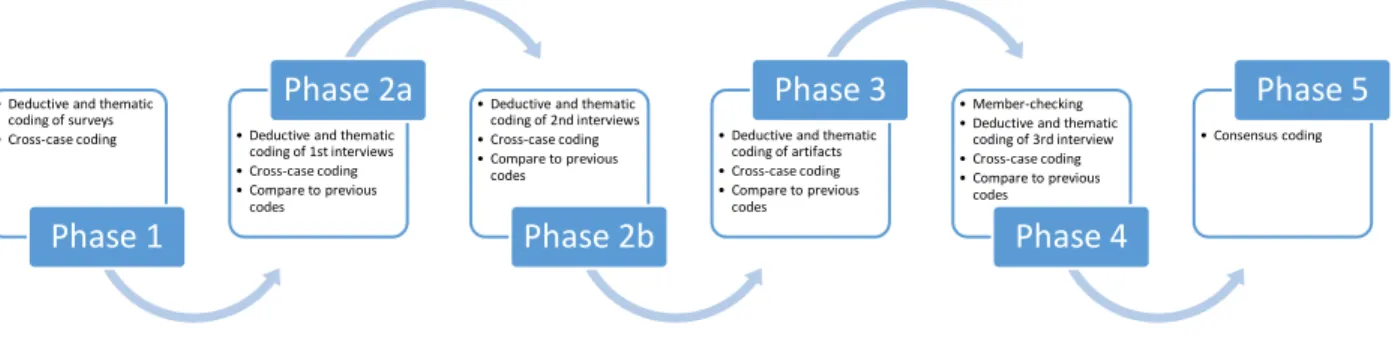
Dana Analysis ...65
Credibility ...68
Limitations ...69
Reflexivity...70
CHAPTER 4: WORLD LANGUAGE TEACHER PERCEPTIONS AND PEDAGOGIES: FINDINGS ...74
Prioritizing Proficiency: Maya’s Teaching Perspectives and Practices ...78
Maya’s Story ...79
Language background ...80
ix
School context ...81
Maya’s Perspectives...83
Unpacking Maya’s Ideologies ...86
Neoliberal conceptualizations ...86
Supporting practices ...88
Centrist conceptualizations ...91
Supporting practices ...93
Liberal conceptualizations ...95
Barriers to Maya’s Perspective and Practice Alignment ...96
Concluding Maya’s Story ...97
In Another’s Shoes: Lauren’s Teaching Perspectives and Practices ...97
Lauren’s Story ...98
Language background ...98
Teaching background ...99
School context ...101
Lauren’s Perspectives ...102
Unpacking Lauren’s Ideologies ...105
Neoliberal conceptualizations ...105
Centrist conceptualizations ...106
Supporting practices ...108
Liberal conceptualizations ...112
Barriers to Lauren’s Perspective and Practice Alignment ...112
x
Cultivating Global Citizens: Cynthia’s Teaching Perspectives and Practices ...114
Cynthia’s Story ...115
Language background ...115
Teaching background ...115
School context ...116
Cynthia’s Perspectives ...117
Unpacking Cynthia’s Ideologies ...120
Neoliberal conceptualizations ...120
Centrist conceptualizations ...121
Supporting practices ...124
Liberal conceptualizations ...127
Supporting practices ...127
Barriers to Cynthia’s Perspective and Practice Alignment ...129
Concluding Cynthia’s Story ...130
The Big Picture: Natalie’s Teaching Perspectives and Practices...131
Natalie’s Story ...132
Language background ...132
Teaching background ...133
School context ...134
Natalie’s Perspectives ...135
Unpacking Natalie’s Perspectives...138
Neoliberal conceptualizations ...138
xi
Supporting practices ...141
Liberal conceptualizations ...143
Supporting practices ...144
Barriers to Natalie’s Perspective and Practice Alignment ...147
Concluding Natalie’s Story ...148
More than just Spanish: Erin’s Teaching Perspectives and Practices...149
Erin’s Story ...150
Language background ...150
Teaching background ...151
School context ...152
Erin’s Perspectives ...153
Unpacking Erin’s Perspectives ...158
Neoliberal conceptualizations ...158
Supporting practices ...160
Centrist conceptualizations ...161
Supporting practices ...163
Liberal conceptualizations ...166
Supporting practices ...167
Barriers to Erin’s Perspective and Practice Alignment...169
Concluding Erin’s Story ...170
Concluding Findings ...171
CHAPTER 5 CROSS-CASE ANALYSIS AND DISCUSSION ...172
xii
Range of Perspectives ...173
Focus on Centrist Ideologies ...178
Merging of Global Education and World Language Education Ideals ...180
Cross-Case Analysis of Participant Practices ...182
Supplemental Material ...182
Authentic materials and artifacts ...183
Multiple perspectives ...185
Comparisons ...187
Practical Limitations ...188
Curriculum ...188
Common planning and assessment ...189
Student maturity ...191
Content knowledge ...192
Discussion on Practices...192
Conclusions ...194
CHAPTER 6 IMPLICATIONS AND CONCLUSIONS ...196
Implications for Teacher Pre-Service and In-Service Education ...196
Pre-Service Teacher Education ...197
Connect teacher experience to personal ideology ...197
Make space for global experience...198
Encourage creative pedagogies that align with teacher philosophies ...199
Redesign teacher preparation to include interdisciplinary global content ...200
xiii
Eliminate curricular barriers to creative practice ...202
Utilize technology to foster communication across cultural barriers ...203
Fund and encourage continued global experience ...204
Support interdisciplinary collaboration through restructuring planning ...205
Advocate Policies Supporting Global Frameworks ...207
Suggestions for Future Research ...208
Invite Diverse Educators to the Conversation ...209
Research World Language Teacher Practice on a Broader Scale ...209
Consider Teacher Proficiency ...211
Investigate Teacher Backgrounds ...213
Explore Student Responses ...214
Additional Considerations ...214
Conclusion ...215
APPENDIX A: RECRUITMENT LETTER ...217
APPENDIX B: RECRUITMENT FLYER ...218
APPENDIX C: SURVEY INFORMED CONSENT ...219
APPENDIX D: INTERVIEW INFORMED CONSENT ...220
APPENDIX E: SURVEY ...221
APPENDIX F DOCUMENT ANALYSIS PROTOCOL ...225
APPENDIX G: INTERVIEW 1...226
APPENDIX H: INTERVIEW 2...227
APPENDIX I: INTERVIEW 3 ...228
xiv
xv
LIST OF TABLES
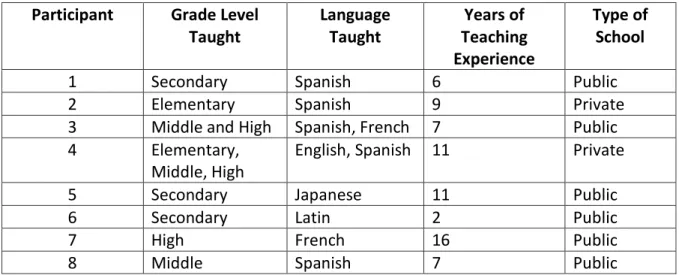
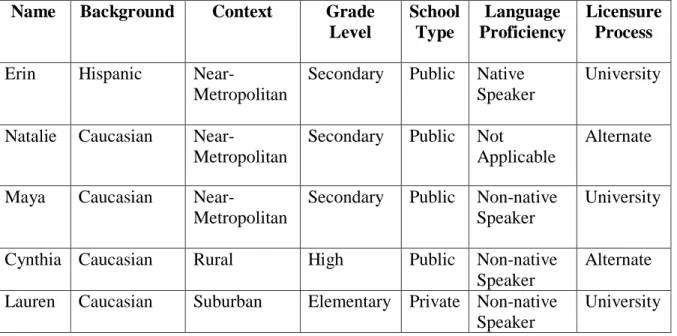
Table 1 Participant Demographics ...55
xvi
LIST OF FIGURES
Figure 1 Global Education Continuum ...4
Figure 2 World Language Education Continuum ...11
Figure 3 Global Education and World Language Education Chart ...15
Figure 4 Discursive Analysis Procedures ...66
Figure 5 Maya’s Global Education Perspectives ...83
Figure 6 Maya’s World Language Education Perspectives ...84
Figure 7 Combining Maya’s Perspectives ...85
Figure 8 Lauren’s Global Education Perspectives ...103
Figure 9 Lauren’s World Language Education Perspectives ...104
Figure 10 Combining Lauren’s Perspectives ...105
Figure 11 Cynthia’s Global Education Perspectives ...118
Figure 12 Cynthia’s World Language Education Perspectives ...119
Figure 13 Combining Cynthia’s Perspectives...120
Figure 14 Natalie’s Global Education Perspectives...136
Figure 15 Natalie’s World Language Education Perspectives ...137
Figure 16 Combining Natalie’s Perspectives ...138
Figure 17 Erin’s Global Education Perspectives ...154
Figure 18 Erin’s World Language Education Perspectives ...156
Figure 19 Combining Erin’s Perspectives ...157
Figure 20 Combined Global Education Perspectives ...174
Figure 21 Combined World Language Perspectives ...176
1 CHAPTER 1
MERGING SCHOLARLY CONVERSATIONS ON GLOBAL EDUCATION AND WORLD LANGUAGE EDUCATION: AN INTRODUCTION
In 1957, the launch of Sputnik began the “Space Race” between the United States and the U.S.S.R (Garber, 2007). More than the race to advance scientific discoveries related to the area beyond our own globe, this event also heralded changes and advancements in economic, technological, communication, and educational realms in an effort to compete internationally and prepare U.S. citizens for participation in a world that was suddenly less insular than it was before the launch of this tiny satellite. In the decades that followed, up to the present, global education became a buzzword among education researchers and
practitioners mindful of the realities of a globalizing society. It aimed at developing awareness and appreciation of those who are culturally different, recognizing
interdependence, acknowledging global social challenges, and committing to global social engagement (Gaudelli & Hewitt, 2010). For the most part, educators dedicated to the social studies took up the work of global education, adjusting the concept to meet a variety of ideologies in the economic and civic areas of study.
2
then, however, world language education remains on the periphery of core academic curricula in schools. While some state graduation requirements include several years of language study, the designation of world languages as an elective or add-on course at lower levels contributes to this sense of disconnection from the rest of the traditional curriculum. Today, developing global competence in all students is a goal of public education (P21, 2014; U.S. Department of Education, 2017). World language education responds to this goal by developing courses that begin earlier and extend language learning to include “a greater emphasis on the study of global and international affairs and the economies, societies and cultures of other nations” (ACTFL, 2014; P21, 2014, p. 4). These emphases connect world language education to other academic pursuits such as global education and they extend access to language study to more students than have historically engaged in language learning in the U.S. (Herman, 2002). In fact, in January of 2017, the U.S. Department of Education released a statement of global and cultural competency that puts language proficiency and the ability to operate in intercultural contexts on par with social studies learning as a core tenet of developing these crucial global competencies (U.S. Department of Education, 2017). The underlying goal of this statement adds a sense of academic relevance to the discipline and to the students pursuing language study. As language learning becomes a more central element of developing global competence, it is important to study how
language teachers engage with frameworks of global education competencies and adjust their curricula to focus on language study within a global education framework.
3
courses and how they then incorporate cultural and/or global themes into their daily instruction and planning. The research questions are:
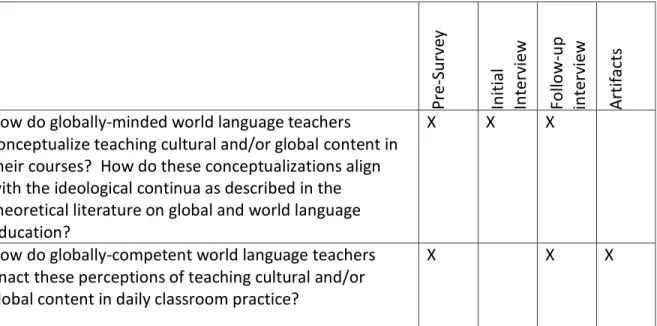
1. How do globally-competent world language teachers conceptualize teaching cultural and/or global content in their courses? How do these conceptualizations align with the ideological continua as described in the theoretical literature on global and world language education?
2. How do globally-competent world language teachers enact these perceptions of teaching cultural and/or global content in daily classroom practice?
Setting the Stage: Defining and Merging Global and Language Frameworks To frame the scholarly contexts of this study, this section addresses the frameworks and ideologies that form the background of research conversations on global education and world language education. Further, it explores the areas of intersection between the two fields to show why this study contributes to these conversations. The literature review in Chapter 2 further describes the empirical studies that illustrate what it looks like to be a globally minded educator.
Global Education
4
literature. Pike’s assessment of the continuum of global educational beliefs, as described by Reimer and McLean (2009), reveals that “one end [is] representing the conviction that global education serves to equip students to perform better in the global marketplace, and the other extreme [is] denoting a transformative vision of schooling focused on global social justice” (p. 906-907). The first end of the continuum that Pike describes relates to neoliberal
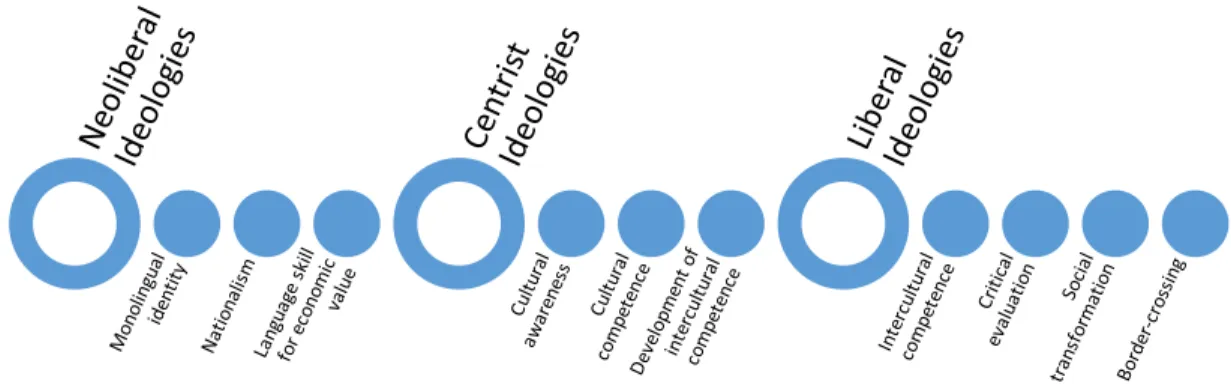
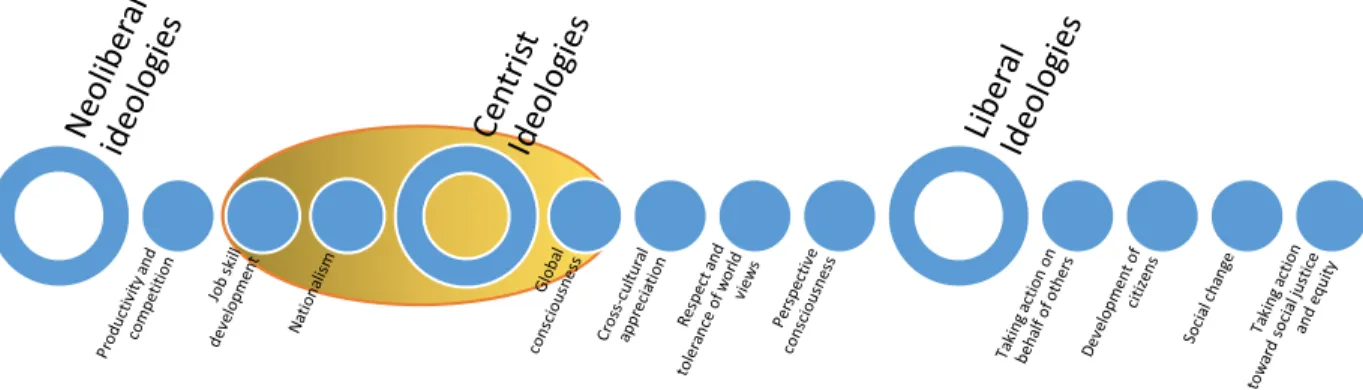
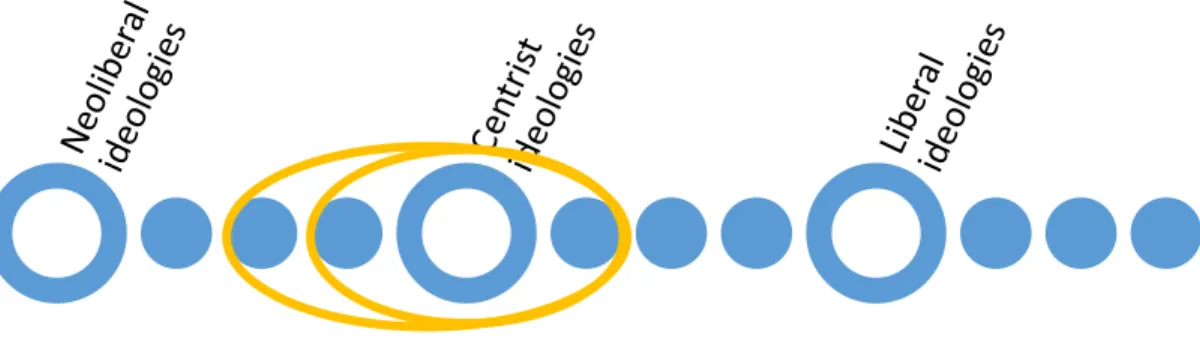
ideologies while the other end represents examples of liberal discourse on global education. Lying between these two extremes are centrist definitions of global education that fill the gaps between the ideological endpoints. Figure 1 illustrates different ideological points on this continuum, described in more detail below.
Neoliberal ideologies in education link to economic initiatives related to
globalization, characterized by a focus on individualism and preparation for competition in a global market context (Olssen & Peters, 2005). While global education originally focused on civic matters in the 1960s, conservative controversies surrounding global education and
Figure 1: Global education continuum. This figure illustrates a range of global education
5
nationalistic priorities in the 1980s led to the evolution of the continuum to include a
neoliberal end (Gaudelli, 2003). From this ideological perspective, global educators seek to provide students with the knowledge and skills that they will need to compete in a
knowledge-driven workforce. This ideology takes shape in K-12 education in a variety of ways. One focus has students develop competencies related to economic productivity, enabling efficiency, and free market competition (Bloom, 2004). Another neoliberal perspective for global education has a nationalistic bent, as educators seek to mold global skills and competencies in students for the purpose of protecting and expanding U.S. economic interests (Diaz, Massialas, & Xanthopoulous, 1999; Merriman & Nicoletti, 2007; Pike, 2000). A final neoliberal perspective on global education leads to a focus on the individualistic development of job skills. Scholars cite a myriad of skills needed within a neoliberal global framework to include higher-order thinking skills, problem finding and solving, articulating arguments and substantiating claims, teamwork, integration, flexibility, relationship-building, ethical decision-making, networking, self-management,
6
A more centrist notion of global education found in the literature moves from a focus on economic and competitive potential toward developing a wider perspective, emphasizing an in-depth awareness or consciousness of nations and peoples beyond U.S. borders. Boix-Mansilla and Gardner (2007) define global consciousness as “the capacity and inclination to place our self and the people, objects, and situations with which we come into contact within the broader matrix of our contemporary world” (p. 58). In other words, global consciousness here promotes a cross-cultural appreciation of the ‘other,’ without necessarily seeking to reconcile a concept of otherness into the global framework (Cole, 1984). Concerns arise amongst more liberally-influenced scholars in global education, however, when these centrist ideals fail to critique the often celebratory, one-sided approaches used to learning about other cultures; thereby reifying and reproducing a “false consensus on what are appropriate facts, skills, hopes, and fears and the ways we all should evaluate them” (Apple, 2004, p. 176; Pashby, 2015). The idea of global consciousness thus grew out of the notion of respect and tolerance for diversity to include a variety of world views and acknowledgement of cultural universals as well as cultural differences (Merryfield, 1994; Merryfield, 1994a; Süssmuth, 2007). Another concept falling within this centrist consciousness category is that of perspective consciousness or perspective-taking. This idea goes a step further on the
continuum than global consciousness by not only validating the existence of multiple global perspectives, but also acting to seek out these perspectives in order to more fully understand a global concept or issue or to collaborate to solve a global problem (Brown & Kysilka, 2002, Suárez-Orozco & Sattin, 2007; Tye & Tye, 1990).
7
development of citizens and their active roles in a global society. Tye (1990) states that the ultimate goal of global education from this liberal perspective “is to cause people to
transcend more limited levels of interest and to take personal and collective action on behalf of all humankind” (p. 6). Similarly, Gaudelli and Hewitt (2010) list the aims of global education to include cultural awareness, acknowledgement of interdependence,
acknowledging issues related to social justice and environmental challenges, and committing to social engagement, suggesting that “schools would become incubators of social change” if global education took hold as a primary focus (p. 93). Global education within these
definitions centers the student as a participant in a global context, and seeks to build the student’s understanding of his or her civic role with the catchphrase “think globally, act locally” (Gaudelli, 2003). Davies (2006) also takes up the notion of global education for taking action toward social justice, defining a global citizen as one who “participates in and contributes to the community from the local to the global [and is] willing to act to make the word more equitable and sustainable” (p. 7).
While some definitions of global education clearly fall onto a specific point on a continuum, others suggest overlapping ideals and still others acknowledge the validity of global purposes that lie on both ends of the ideological spectrum. These ideas address a variety of purposes for global education to include a perspective that emphasizes notions of citizenship while also stressing an idea of preparation for economic competition, and including multiple facets in between these two points on the ideological scale. As Suárez-Orozco and Sattin (2007) suggest, global education has the great challenge of educating “the whole child for the whole world” (p. 19). For example, Merryfield’s (1995) oft-cited
8
the basis for decision making and participation in a world characterized by cultural pluralism, interconnectedness, and international economic competition” (p. 2). Anderson (1991), too, notes that global education has a variety of large goals, and further notes that a plurality of understandings are acceptable under this umbrella that defines the broadness of global education.
World Language Education
Like its global education counterpart, world language education also includes a continuum of definitional ideologies. On one end of the continuum lies a rationale for language learning that focuses on language proficiency for the completion of tasks and linguistic competency within an individual job-preparation framework. This ideology reflects historical tendencies in the United States toward monolingual identity and a sense that only an elite class destined for work in international affairs and business needed language study. The other end of the continuum represents more recent trends in the field toward language competencies that incorporate a holistic, intercultural dimension (Kramsch, 2005). This trend follows a cultural and political shift in the U.S. that demanded
international knowledge for competition in the 1980s, prioritized understanding of a
9
definitions, it is important to note that the National World-Readiness Standards for Language Learning (2015) bridge the two ends of the spectrum as conceptualized here.
The World-Readiness Standards for Language Learning. The standards link the importance of both linguistic and intercultural emphases through foci on interpretive, interpersonal, and presentational communication in the target language juxtaposed with understandings of the products, practices, and perspectives that make up a cultural group related to the target language (The National Standards, 2015). These standards should, then, influence world language educators toward a holistic view of teaching language and
intercultural concepts within a global context.
These National Standards include five interwoven elements that together constitute the holistic approach to teaching language and culture: Communication, Cultures,
Connections, Comparisons, and Communities (The National Standards, 2015). The
Communication standard allows students to show their linguistic abilities to interact, interpret meaning, and present information “in order to function in a variety of situations and for multiple purposes” (The National Standards, 2015, p. 1). The Cultures standard asks students to critically investigate, explain, and reflect upon the products, practices, and perspectives of the cultures studied, ideally considered in the target language. Connections helps students connect language and culture learning to information in other academic
10
communicate beyond the classroom over a lifetime, allowing them to “interact and collaborate in their community and the globalized world” (p. 1).
11
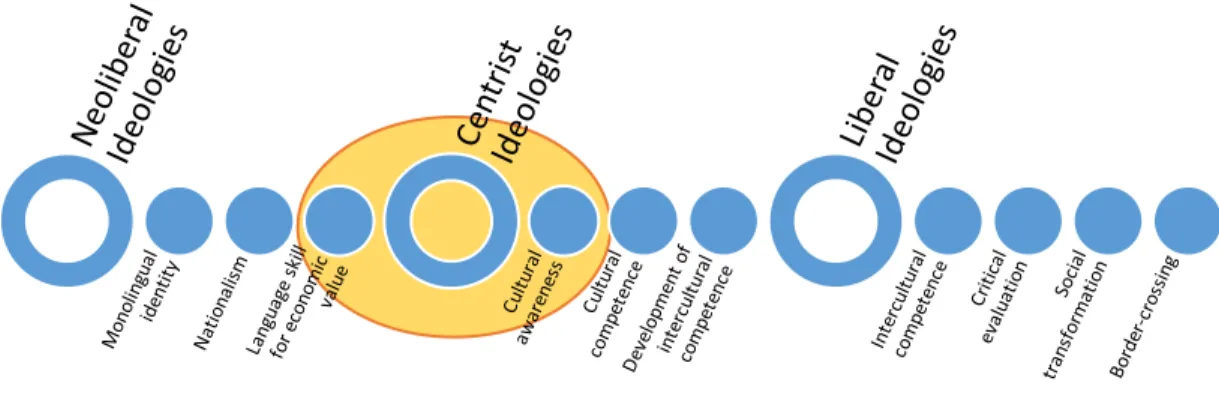
next section further describes this range of theoretical foundation found in world language education literature. Figure 2 illustrates these different points.
Like global education, world language education, too, has an element of underlying neoliberal discourse as some scholars seek to define language proficiency for the purpose of building linguistic skills needed in the prospective global job market. World language education in the U.S. came of age, so to speak, in the early 20th century during an era dedicated to preserving a sense of nationalism and a sense of elitism for language learning (Herman, 2002). One of the effects of the combination of these two ideals is a lingering comfort with monolingual identity and a sense that English is the dominant language for global participation, an attitude “reinforced from without at the international level, as [students] witness people from around the world rushing to learn their language, as the language of modernity or professional discourse” (Fonseca-Greber, 2010, p. 102; Kearney, 2016). English may well be the current dominant language of many global business
Figure 2: World language education continuum. This continuum shows a range of
12
transactions, but world language scholars advocate the need for native English-speakers to become proficient in other languages in order to maintain a competitive edge for global market participation, emphasizing neoliberal discourse on language study for the global job market. Stewart (2012) suggests that “language learning is a central part of what high-performing nations are doing to make their students and societies globally competitive” (p. 137). In fact, Cutshall (2004) notes that Americans routinely lose out on jobs if they do not have skill with a second language, highlighting the importance of language study for individual job skills in addition to national economic competition. Cho (2015) verifies this claim, noting that high pressures for learning English in South Korea undergird a
“neoliberalism [that] encourages social actors to commit themselves to endless self-development in order to enhance individual entrepreneurship (p. 688). In other words, language study within a neoliberal discourse prioritizes the individualistic, functional, economic value of linguistic proficiency.
13
the world, and set within specific social contexts” (p. 24). These perspectives move language learning from its functional value for economic initiative toward fostering an awareness of other cultures. In fact, the intended student outcomes of cultural learning, like the centrist perspectives on global education, stress an awareness and understanding of other cultures while adding an emphasis on linguistic proficiency in at least one more world language (Moran, 2001). A centrist perspective on language study, according to Meadows (2010), further includes an element of reflexivity as students begin to develop knowledge, skills, and attitudes they will need to critically engage and interact in new contexts. Cultural
competence falls into a centrist point on an ideological continuum because it centers on combining linguistic skills with building knowledge and awareness of cultural distinctions (Semaan & Yamazaki, 2015).
Byram and Zarate’s (1997) model of intercultural competence bridges the divide between awareness-focused centrist ideologies of language learning and action-focused liberal ideologies. The first three elements of their model, savoirs, savoir faire, and savoir être, in turn focus on building knowledge, skills, and attitudes of openness toward other cultures and languages (Byram & Zarate, 1997). Moving from an awareness stance to a more liberal one that considers critical action, Byram (1997) adds a final element to the model, savoir s’engager, meant to focus on critically engaged citizenship. This model leads into liberal understandings of language learning as it intertwines language skill with cultural competence and moves toward intercultural competence as described next.
Based on a notion of social liberalism characterized by tolerance toward a variety of group perspectives, a liberal slant to world language education suggests a need for
14
and cultural learning carries with it a view of using language and cultural skills for social transformation toward equity and fairness, or creating world citizens (Borghetti, 2013). Byram (2012) defines this holistic model as intercultural competence which includes “an ability to evaluate critically and on the basis of explicit criteria, perspectives, practices and products in our own and other cultures and countries” (p. 9). Andreotti (2006) suggests that this critical stance is “not an attempt to expose errors but to engage with assumptions, contradictions, and limitations: an exercise of enquiry that is both reflective and reflexive” (p. 7). Guilherme’s (2002) work further links liberal ideals of language learning to those of social-justice oriented global education by further describing the role of language education as developing “sources of active citizens prepared to responsibly engage the new emerging structures and to consciously intervene in the shaping of history” (Guilherme, 2002, p. 55). The socially transformative ideology underlying the creation of intercultural communicative competence echoes liberal definitions in global education that emphasize social
responsibility, taking action, and equality. Guilherme (2002) takes on the language of educational theorist Giroux to describe the role of language education for the role of
“preparing pupils to cross borders –linguistic, cultural, social, political, [and] racial” (p. 4). A position statement from the American Council on the Teaching of Foreign
15
hold relevant purposes for language education, citing a need to develop additional language skills for both a citizenry and a workforce knowledgeable about the globe.
Merging Frameworks
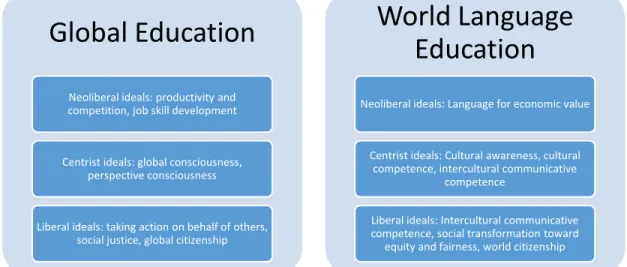
Given the broad and plural set of meanings and purposes associated with global education and world language education, it is possible to relate pieces of the ideological continuum of global education to that of world language education in order to gain a deeper understanding of the potentially complementary nature of language and culture learning in a global context. While there is no perfect alignment between the two fields, both have similar underlying ideologies at various points on their respective continua. Broadly speaking, there are three main ideological categories: those with a neoliberal slant as evidenced by their focus on the development of knowledge and skill for individual and corporate gain, those with a centrist perspective that acknowledge a need to develop an appreciation, awareness, and openness toward other cultures and perspectives, and those with a liberal slant shown by a dedication to action and interaction in an effort at global understanding and
Global Education
Neoliberal ideals: productivity and competition, job skill development
Centrist ideals: global consciousness, perspective consciousness
Liberal ideals: taking action on behalf of others, social justice, global citizenship
World Language
Education
Neoliberal ideals: Language for economic value
Centrist ideals: Cultural awareness, cultural competence, intercultural communicative
competence
Liberal ideals: Intercultural communicative competence, social transformation toward
equity and fairness, world citizenship
Figure 3: Global education and world language side by side chart. This chart compares
16
communication. Figure 3 above illustrates the similarities of these two fields’ ideological continua.
As Figure 3 shows, underlying frameworks for world language education share core ideals with global education frameworks. However, despite calls by scholars to seek interdisciplinary ideals to complement both fields, there are currently no interdisciplinary studies that look at the intersections in perceptions and pedagogies between global and world language education (ACTFL, 2014; Gaudelli, 2003; Rivière, 2013; Stewart, 2012; Zhao, 2010). In fact, one scholar cautions such an alliance, noting that a focus on linguistic skill building in a language class without a considerable emphasis on the interaction of global languages and cultures does not warrant connection between the two fields (Strasheim, 1979). Her warning stems from an observation that language learning does not automatically have a global focus without significant attention to developing global frameworks for
language learning. However, the similarities between the two fields, coupled with the impetus toward including language as a key element of global competence as defined by the Partnership for 21st Century Skills (2014) and the U.S. Department of Education (2017) leads to a need for studies that explore how the fields complement one another in practice. This study describes how world language educators connect existing curricula to global
frameworks, focusing on building language proficiency through an intercultural focus tied to global frameworks. It explores the perceptions and pedagogies of world language educators as they work to develop and incorporate global frameworks into their curricula. The hope is that this study will begin filling the gap where the two disciplines meet, not only in
17
Operational Definitions
Global Education: In this study, conceptualizations of global frameworks that encompass the neoliberal, centrist, and liberal portions of the above-described continuum are valid areas for a global focus and outlook, and are acceptable for discussion and practice, as are versions of global education that either span both ends of the continuum or lie on one of its many points. World Language Education: In this study, world language education focuses on building language proficiencies for the purpose of individual growth, developing an awareness of others, and developing intercultural competencies that lead to social action within global frameworks.
Globally-Competent World Language Educator: In this study, a globally competent world language educator engages students with language through cultural and global content that connects language learning to broader global competencies.
Overview of Dissertation
In the next chapter, I provide a detailed review of the empirical literature that has two key elements. The first section explores what it means to be a global educator in practice, showing how global frameworks play out in social studies education since global education originated in that discipline. Next, I describe the literature on how world language
practitioners approach global, multicultural, or intercultural themes in their own classroom contexts.
18
19
LITERATURE REVIEW OF PRACTITIONER PERSPECTIVES AND PEDAGOGIES IN GLOBAL AND WORLD LANGUAGE EDUCATION
In the first chapter, I outlined the ideological origins of global education and the places where the field connects to the tenets of World Language Education based on these similar ideologies. In this chapter, I turn to the empirical studies that show how these ideals and theories play out in teacher conceptualizations and classroom practices. There are two major sections to this literature review. In the first part of this chapter, I review studies showing how educators conceptualize global education or global citizenship education in their classroom contexts. Most of these studies describe global education within social studies courses since global education originated within this discipline. Some of the studies reviewed illustrate how teachers conceptualize global education, while others describe the pedagogical strategies that teachers use to incorporate global frameworks in their classrooms. The second part of this chapter moves toward language education and examines how teachers incorporate global content through teaching about the culture(s) related to the target
20
Global Education
In order to find literature describing global education, I employed a keyword search on the ERIC and Education Full Text databases. Keywords included global education, global education and classroom practice, global citizenship education, and global education and teachers. I chose these keywords because they elicited both theoretical and empirical examples of global education. Based on these keywords, the databases yielded hundreds of examples of peer-reviewed studies that address global education frameworks in teacher conceptualization and practice. Upon review of article abstracts, I limited literature for this review based on evidence of empirical studies and relevance to practicing K-12 teachers. Reading these studies and their references led to the inclusion of more studies deemed relevant as I read. Mentioned previously, many hits using these keywords also included theoretical articles and chapters. For this review, I chose to exclude the strictly theoretical studies, focusing instead on those that highlight practice. As MacDonald-Vemic, Evans, Ingram, and Weber (2015) suggest, strictly theoretical emphases can be problematic because:
21
Global Education Practitioner Perspectives and Pedagogies
As I began this literature search, I had two questions in mind: 1.) How do teachers conceptualize global education? and 2.) How do these teachers incorporate these ideals in their classroom practice? Several studies begin to answer these questions by first
highlighting the conceptual nature of what it means to be a global educator and then following up these conceptual descriptions with accounts of classroom pedagogies that incorporate global education. In this section, I will describe six of these studies in-depth and how they connect to other theoretical studies reviewed but not highlighted in this chapter. These studies underscore the complexities and nuances that surround global education. The studies then move from teacher perspectives on global education to the pedagogies and strategies that these teachers use to implement global education frameworks into their individual practices.
Like other scholars, Merryfield (1994) laments the heavily theoretical nature of the literature on global education (MacDonald-Vemic et al., 2015; Pike 2000; Reimer & McLean, 2009). Therefore, she undertook a year-long study dedicated to observing, reflecting upon, and analyzing classroom practice of Social Studies teachers in order to understand the principles guiding the teachers’ instructional decisions on global education and to detail the contextual factors that influenced these principles. In order to best
22
predominantly Black and White population, and half represented a small suburban district with a predominantly White student body.
Merryfield collected data for this study through observations and follow-up interviews for observation clarification throughout the course of an entire school year in 1990-1991. Throughout the study, she asks teachers to identify what elements made up their instructional decision making, to include personal experience, availability of instructional materials and resources, mandated curriculum, and student factors. With each piece of data collected, Merryfield and her team conducted formal member checks to aid in the reflection and analysis process. They analyzed the data line-by-line at least six times during the study, categorizing each sentence to answer questions related to content, process, context, and other instructional factors in order to answer the two research questions of guiding principles and contextual factors.
For each of the 12 cases in this study, Merryfield develops a profile of guiding
principles and their accompanying contextual factors that lead to decision making in a global classroom. A dated example of classroom practice accompanies each principle. While each participant used different terminology and listed different contextual factors in their personal profiles, Merryfield notices a trend of six themes throughout these guiding principles that hold true across multiple participants in her study. First, she notices a commitment to the study of diverse cultures and the inclusion of multiple perspectives, suggesting that the teachers “perceived that the purpose of studying other cultures is to bring people together through mutual understanding of beliefs, experiences, and the historical contexts of people’s live” (p. 19). Teachers arrived at this principle through personal experience and a
23
leads teachers to incorporate global frameworks thematically, such as through technology, the environment, literature, or health. Factors that led to this principle include teacher expertise and availability of resources. The third guiding principle in the study is helping students make global connections, linking learning across time and space through the “big picture” (p. 20) or “cause and effect” (p. 20) relationships. These themes denote a dedication to teaching for global awareness and interconnectedness of peoples across the globe,
reflecting theories prevalent in the definitional literature on global education (Boix-Mansilla & Gardner, 2007; Brown & Kysilka, 2002; Cole, 1984; Merryfield, 1994a; Pike, 2000; Süssmuth, 2007; Ukpokodu, 1999). Participants also stressed a principle of connecting content to students based on their perceived interests. Contributing factors to this principle was an effort to engage students and increase student motivation. Finally, the last two guiding principles lead teachers to encourage higher order thinking skills in their classrooms and employ a variety of teaching methods in order to engage students or “keep them
thinking” (p. 23). In conclusion, Merryfield acknowledges that “the relationships between teacher beliefs, student characteristics, and global content are complex and dynamic as teachers, students and the milieu in which they operate are always changing” (p. 28).
24
incorporate global frameworks. This study took place in three high schools located in New Jersey chosen based on their willingness to participate and location in a variety of contexts: urban, suburban, and rural. The contexts of these three schools play an important role in this study, as Gaudelli characterizes one of the schools as pursuing trivial knowledge with the domination of a textbook, one of the schools as incorporating interdisciplinary, active learning, and one of the schools as heavily relying on individualism and ability tracking. These factors influenced teacher conceptualizations and pedagogies related to global education by offering or constraining resources and classroom practice expectations.
Throughout the study, Gaudelli seeks to examine how teachers and students approach global education, acknowledging that “global education takes shape in the real world of classrooms in the lives of teachers and students” (p. 11).
As he delves into the experiences of the teachers and students in the World Cultures courses, Gaudelli continues to acknowledge that while teaching within a framework of global education is an important element for an interconnected international society, many tensions and questions also arise from that framework. He dedicates three chapters to findings that elucidate these tensions. Gaudelli does not try to offer solutions to these tensions and problems, acknowledging that global education is a complex endeavor with a myriad of factors and contexts that affect its implementation. One chapter discusses controversies surrounding the perception that global education stands in opposition to a sense of
25
from another aspect” (p. 77). Instead, teachers in his study focus on ethnic loyalties, enacting change through civic action, recognizing the interplay between national and global loyalties, and merging inward and outward-centric ideas of national and global citizenship. Another chapter tackles the theme of cultural relativism and its impact on global education as teachers strive to present aspects of different cultures with their inherent value in spite of the lenses that US students place on them. Due to the potentially controversial nature of topics related to cultural relativism, Gaudelli finds that some teachers in the study approach the topics carefully and others prefer to avoid controversial areas when possible. He describes the teachers in the study as ethical universalists, trying to “walk a fine line between appreciating diversity, such as religious differences, and not offending students of various backgrounds or faiths,” while at the same time “privately, they were more willing to discuss their own
perspectives about the issues addressed in class, including religion” (p. 93). He finds that this difference between how teachers reacted in public in their classrooms and in private conversations show that “global education teachers privately hold judgements about topics encountered in the course, despite publicly encouraging the students to be nonjudgmental” (p. 94).
Finally, Gaudelli finds that teacher backgrounds strongly influenced the areas of global education in which they chose to focus, again highlighting the fact that there is not one simple answer, solution, or method to teaching within a global framework. For example, despite evidence of collaborative preparation, some of the teachers in the study emphasized studies of gender in a global context, where others focused on religions concerns.
26
Overall, this study seeks to describe how teachers and their students engage in what it means to teach a World Cultures class within a global framework. Each teacher approaches the task differently, and chooses to emphasize different curricular elements based on his or her own cultural and academic background, his or her level of comfort with controversial elements of the course, and how he or she navigates the global and national perspectives inherent in the course. As other studies also indicate (Merryfield, 1994; Rapoport, 2013; Rapoport, 2015), Gaudelli’s study acknowledges that there is no one-size-fits-all method for teaching such a complex and nuanced topic. Instead, it is important to have descriptive empirical evidence that illustrates how teachers practically apply their own conceptions of global education.
27
the theories existing in literature on global citizenship education. They found that the main global focus for the educators varied across Canada.
In Halifax, the general focus seemed to be teaching for worldmindedness or global awareness (Cole, 1984; Hanvey, 1976; Merryfield, 1994). Teachers in Halifax described their efforts at teaching for global awareness as “awareness of differences in culture and religion,” “perceiving themselves as citizens not only of their communities but of the world,” and “teaching students to discover and embrace diversity” (MacDonald, et al., 2015, p. 95). There was an underlying sense in this group that they wanted students to recognize a
common humanity across cultures and boundaries. Teachers exemplified these ideals through prioritizing culturally responsive classrooms, the use of globally-oriented resources, and opportunities for cross-cultural interaction. One teacher highlighted in this region focused on helping students recognize similarity in diversity, while the other gave students opportunities to recognize unfairness and actively participate in taking action against injustice.
In Toronto, teachers focused more on critical literacy and civic action within global themes (Davies, 2006; Gaudelli & Hewitt, 2010; Tye, 1990). Teachers explained their efforts as “making curriculum relevant to local, national, and global contexts,” “to make students aware of inequities around the world,” and to “think globally and act locally” (p. 100). Like the teachers in Halifax, these teachers prioritized an inclusive classroom ethos and globally-themed resources, but they also incorporated inquiry-based lessons and
28
critical lens during her class lessons, while the other encouraged students to use a critical lens to “read the world” (p. 103).
In Vancouver, foci included worldmindedness and civic action (Cole, 194; Davies, 2006; Gaudelli & Hewitt, 2010; Hanvey 1976; Merryfield, 1994; Tye, 1990). These teachers expanded these topics to include teaching students to “make a difference,” “take action,” and “develop empathy” (p. 105). Similar to teacher responses in Halifax and Toronto, these teachers highlighted an inclusive, responsive classroom environment and a reliance on meaningful global sources as pedagogical strategies they used to emphasize global
frameworks with their students. One of the teachers highlighted in this section incorporates pedagogies to help students become aware of global and local connections while the other emphasized awareness of global interconnections and the responsibilities and privileges of global citizenship.
Like Merryfield (1994) and Gaudelli (2003), the researchers acknowledge the
complex and unresolved issues surrounding efforts to teach within global frameworks. They, too, recognize a tension related to controversial topics that arise within global frameworks. Like Gaudelli (2003), they note that participants show a concern about offending students through stereotypical representations and potentially offensive stances. Further, the
MacDonald et al. (2015) team also notes that limiting factors to global education include the need for teachers to acquire and maintain content knowledge and gain confidence in teaching about the complexities inherent in global education, a concern also expressed by Merryfield (1994), Gaudelli (2003), and Rapoport (2013, 2015).
29
citizenship education to the studies described above. He goes on in this study to focus beyond teacher conceptualizations to the curricular devices and pedagogies that teachers use in their classrooms. Like previous studies mentioned, Rapoport (2015) uses purposeful sampling of Social Studies teachers. His criteria for participation included a minimum of five years’ teaching experience and international travel experience. He, too, collected data from observations and interviews of six teachers.
His study found that educators interpret the term global citizenship education very broadly to include goals of understanding other cultures, learning and understanding the world around us, being aware of global interdependence, and placing the US in the greater context of the world (Boix-Mansilla & Gardner, 1007; Brown & Kysilka, 2002; Cole, 1984; Ukpokodu, 1999; Merryfield, 1995). Several of the teachers focused on global citizenship education as an interconnectedness of cultures and an awareness of and sensitivity toward other cultures. He also notes that much emphasis on topics and themes came from
participant backgrounds related to study and travel experiences. This attention to personal background connects to Gaudelli’s (2003) longer study by showing how teacher background influences pedagogical choices related to teaching within global frameworks.
While Gaudelli (2003) and Merryfield (1994) find a certain level of discomfort from their participants upon incorporating potentially controversial global themes, Rapoport (2015) notes that the teachers in his study were uncomfortable using the term global or world citizenship despite the fact that their pedagogies evidenced understanding of the ideas
30
citizenship has on teachers” (Rapoport, 2013, p. 415). He questions whether the term is correctly applied in research contexts, or if it shows a reluctance on the part of teachers to engage with potentially controversial issues.
The study suggests that although there are educators dedicated to implementing global or global citizenship pedagogies in their daily practice, not much has been
accomplished to prepare teachers to engage in these practices. This fact is supported by what Rapoport calls a lack of assistance to help teachers gain substantive and methodological information and a lack of focus on global citizenship in undergraduate preparation avenues. As one of his participants emphasizes, “you can’t teach what you don’t know” (p. 128). This problem is echoed in Gaudelli’s (2006) article that reminds educators that teacher preparation for teaching in a globally competent manner with strong background knowledge is still lacking. Rapoport goes on to suggest that this struggle exists because there is still a conceptual vagueness related to the idea, despite the prevalence of theoretical literature, as well as an insecurity about where global education fits in a traditionally discipline-oriented culture of schooling (Pike, 2000; Reimer & McLean, 2009).
31
citizenship education. They employ a US-centered or loyal perspective, they view global citizenship as an extension of US national citizenship, and they critically look at and
reevaluate the role of one’s own country in the globe. Like his later study (Rapoport, 2015), Rapoport calls for more global preparation for both pre-service and in-service educators, citing a need to solidify regular global instructional practices.
While the previous studies emphasize teacher global perceptions and pedagogies in social studies contexts, Tichnor-Wagner, Parkhouse, Glazier, and Cain (2016) focus on the global strategies that teachers across disciplines use in their respective classrooms. This qualitative multiple case study purposefully sought participants through an application process who were committed to globally competent teaching and who represented a variety of subjects and grade levels. The team conducted in-depth interviews, classroom
observations, post-observation interviews, focus group sessions, and collected teaching artifacts to triangulate data showing how each educator weaves globally competent pedagogies into the existing curricula for his or her discipline.
Whereas other studies show how teaching for global competence can be a
controversial and/or confusing arena with poorly defined specific pedagogical strategies, (Gaudelli, 2003; Rapoport 2015), this study finds that participant teachers committed to globally competent teaching used three core signature pedagogies that were evident across content areas. These pedagogies included intentional integration of global topics and
multiple perspectives into and across the standard curriculum, ongoing authentic engagement with global issues, and connecting teachers’ and students’ global experiences with the
32
throughout the curriculum in an effort to promote global competence. Participants used source material from a variety of cultural perspectives, encouraged an awareness of global current events, shared their own global experiences to elicit student contribution, used authentic assessment methods to connect learning to real-world opportunities, and made connections to interdisciplinary themes in order to encourage the value of global citizenship.
Like other research studies mentioned earlier, the findings of this study suggest that more work is needed to help teachers realize a vision of global possibility in their classrooms, including a stronger focus on developing global content in pre-service programs and a state policy framework that prioritizes global education. Mentioned by Gaudelli (2003) and Rapoport (2013, 2015), pre-service opportunities can incorporate a stronger global focus on content, materials, and pedagogies resulting in practicing teachers equipped to begin
implementing global frameworks across curricular areas. Policy frameworks can help set the stage and provide resources for teacher development processes that encourage a global focus. For example, education policies in North Carolina, the context of this study, come from the State Board of Education’s Task Force on Global Education that designs initiatives to allow educators, schools, and students to gain global skills and knowledge (Preparing Students for the World). Initiatives include opportunities for educators to gain recognition for global curricula through earning a Global Educator Digital Badge and opportunities for schools and districts to earn Globally-Ready designations for strategic plans to incorporate global
frameworks within their areas (NC Global Education).
33
describes pedagogical strategies across academic realms, these studies focus on perceptions and pedagogies only within Social Studies education. In summary, the studies included in this review guiding principles for incorporating global education into classes, how educators engage in thinking about and teaching within a global education mindset, and the tendency to focus on broad, non-controversial themes within a global framework. Further, several of the studies find that teachers report a need for opportunities to develop their perceptions and pedagogies to solidify their efforts to teach within global frameworks.
With the exception of Tichnor, et al. (2017), there is a gap in the literature that shows a lack of empirical studies relating the tenets of global education tenets to other curricular areas that have similar underlying principles, such as world languages (ACTFL, 2014; Gaudelli, 2003; Rivière, 2013; Stewart, 2012; Zhao, 2010). While there are theoretical studies that connect the ideological tenets of global education and world language education, I found no empirical studies that link the two disciplines based on teacher perceptions and pedagogical strategies. Furthermore, I did not find studies that link teacher perceptions and practices to the ideological tenets of the global education theoretical literature. There are, however, studies that explore world language teacher perceptions and pedagogies related to cultural content and intercultural communicative competence strategies. These two elements, despite using a different set of terms, do reflect global content and mirror perceptions of global educators for teaching within a globalized context. The next section explores these studies.
World Language Education
34
noting that “it is foreign language/culture education that helps facilitate intercultural
communication among citizens in multicultural societies and in a global world” (Guilherme, 2002, p. 166). However, the literature on world language education tends to focus on perceptions and pedagogies that reflect a traditional paradigm of culture. This centers cultural focus on factual, or cognitive, elements of learning rather than on the multi-dimensional intercultural communicative competence and fails to make perceptual and pedagogical connections to broader global frameworks (Byram, 1997). This section reviews six studies that address teacher perspectives and pedagogies on incorporating cultural
elements and intercultural communicative competencies into their teaching repertoires. The studies show a need for further work incorporating cultural content and pedagogical
strategies at the pre-service and in-service levels to support teachers.
35
highlight three of these studies in this section. On the ERIC database, one article arose from a search of world language education and intercultural communicative competence.
However, I excluded it from this review because the article focused more clearly on service learning opportunities than on pedagogies and perspectives related to intercultural
communicative competence. Searching with the term intercultural communicative competence on its own yielded the most results related to world language education. As I went through this list, I excluded studies that were not relevant to world language educational contexts and those that described the evolution of intercultural communicative competence based on opportunities for study abroad. Other articles for this section came from literature I previously found during research for other courses and contexts.
World Language Teacher Perspectives and Pedagogies
36
In 2011, Byrd, Hlas, Watzke, and Valencia conducted a study to determine how practicing language teachers focus on culture and the elements of culture included in the standards in their classrooms. They also discuss the motivators and barriers that teachers report regarding including culture. Researchers collected questionnaire data from 415 teachers and 64 teacher educators over the 2006-2007 school year in order to answer these questions. The most common teaching languages represented in this study included Spanish, English as a Second Language, and French, and it included educators from a variety of US regions.
Using quantitative analysis, these researchers found a statistically significant
difference in the application of the cultural aspects of the National Standards between the two groups: teachers and teacher educators. They attribute this difference to the fact that teacher educators spend more time researching and unpacking the national standards and cultural elements, while classroom teachers tend to base their culture teaching more on personal experiences. Both groups showed similar trends reporting the efforts needed to maintain their own cultural knowledge related to cultural perspectives, showing ‘some emphasis’ on the quantitative survey scale. Both groups acknowledged a lack of time and resources to more fully incorporate culture into their courses, while the teachers felt that this was a
missing element of their preparation programs. In other words, the teacher educators felt that cultural elements were well represented within the preparation sequences, while the teachers did not. While teachers acknowledged including both products and practices in their courses, they felt a need to better incorporate perspectives and the ability to integrate the three
37
Languages (ACTFL), excluding potential participants who are not members of this
professional organization. It would be interesting to see how world language educators who were not necessarily affiliated with this organization responded to the inclusion of cultural elements in their courses.
Based on their results, the researchers call for a revamping of preparation programs to provide “prospective teachers with historical, social, and political insights and to encourage teachers to critically examine significant cultural issues” (p. 9) and a need to support in-service teachers in order to “deepen their understanding of cultural perspectives and continue developing their cultural knowledge base” (p. 22). These suggestions echo those found in studies related to deepening content knowledge and resources for educators teaching a variety of subjects within a global framework (Gaudelli, 2003; Rapoport, 2013, Tichnor-Wagner, et al., 2016), suggesting an important relationship that could exist in extending language teachers’ content knowledge to include a wider global perspective in addition to the specific cultural contexts that are associated with the target languages.
Moving away from the language of the US National Standards (2015) and toward the intercultural communicative competency language developed by Byram (1997), Tran and Dang (2014) conducted a similar survey in Vietnam to find out how English as a Foreign Language teachers, both native English speakers and native Vietnamese speakers, approach teaching culture in their respective classrooms. Their study explored both teacher beliefs and definitions regarding teaching culture and the instructional strategies that they use to
38
Respondents from both the native English speaking group and the native Vietnamese speaking group showed a similar, favorable attitude toward incorporating cultural elements into their classrooms. These responses indicated teacher beliefs that teaching culture is important, that students can use English to explore the target culture(s), and that including culture at multiple levels is necessary. One respondent likened the importance of linking culture to global citizenship, saying “culture is definitely important in [English Language Teaching], and I think my job here is to help my learners become global citizens” (Borghetti, 2013; Davies, 2006; Gaudelli, 2003; Tran and Dang, 2014, p. 96). Native Vietnamese-speaking teachers, especially, acknowledged the interrelationship that exists between language and culture, citing that “cultural awareness was an indispensable skill that learners should possess” (Liddicoat & Scarino, 2013; Tran & Dang, 2014, p. 96). Not all of the participants, however, responded favorably to the introduction of culture into English classes; one of them suggests that “it doesn’t help learners learn English much except for making the lessons more interesting” (p. 97).
39
in the classroom, or to their own lack of familiarity with the content. Like Byrd, et al. (2011), Tran and Dang (2014) found that educators expressed a lack of preparation to teach cultural topics and a lack of time in a crowded curriculum to incorporate these elements into their courses. In order to include some cultural content, the teachers relied on factual tidbits rather than fostering intercultural attitudes and opportunities to practice communicative behaviors.
40
culture teaching and learning as complex. However, the majority shows a tendency to focus cultural opportunities in class on the cognitive, factual element.
Larzén-Östermark (2008) then moves from teacher perceptions of culture to the pedagogies that they enact in class. As influenced by their orientations toward cultural teaching, the majority of educators relied on informational pedagogies to convey facts, relying on the cognitive domain. The sample shows three examples of pedagogies related to the active domain, preparing students to behave and perform in culturally-appropriate
contexts and avoid “cultural blunders” (p. 534). This domain incorporates both cognitive and emotional learning and relies on examples of dialogues and culture clashes. These examples, either ready-made or created by the teacher, help students recognize cultural nuance and learn how to act/react in unfamiliar cultural scenarios. Finally, Larzén-Östermark (2008) describes few strategy as an encounter, where the educator engages the affective or
41
culture as important, but the majority of participants treated it pedagogically from a traditional paradigm that favors factual knowledge over affective or active opportunities.
Echoing Byrd, et al. (2011), Tran and Dang (2014), and Sercu (2006), this study implicates shortcomings in world language teacher preparation and in-service support for the lack of cultural insight and resources leading to the fact that teachers in this study do not typically engage their students in cultural learning beyond the factual or cognitive level. Further, she suggests that there is pressure in this context to teach the material found on regional exams, which prioritize linguistic skill over cultural understandings.
Sercu (2006) conducted an international survey in Europe to determine how world language teachers characterize professional self-concepts and culture teaching practices and whether she can develop an intercultural teaching profile typical of teachers across
nationalities and languages in Europe. She conducted a questionnaire with 424 world language teacher participants including respondents from Belgium to Bulgaria. Most teachers reported teaching English, German, French, and to a lesser extent, Spanish.
42
active domains (Larzén-Östermark, 2008; Tran & Dang, 2014). Sercu (2006) says “we can derive that teachers tended to employ techniques that aimed to enlarge learners’ knowledge of the foreign culture” without engaging them beyond this cognitive approach to address communicative skills and open attitudes (p. 63).
Across the countries represented in this study, 79.48% of the educators professed a favorable attitude toward the incorporation of culture and intercultural competence in
language courses, as did Tran and Dang (2014). This signifies that they believed that culture and language are inseparable elements of language education. The other 20% of the
educators expressed disagreement, believing that cultural and language skills are separate elements. This suggests an underlying belief that intercultural skills reinforce stereotypes and cannot be fully understood in a school context and that building linguistic skill is the priority in language classrooms.
Despite slight dissention regarding the combination of language and culture teaching in world language classes, Sercu determines that it is possible to develop a language-and-culture teaching profile for educators across geographical boundaries and educational