Abstract:
Background: Polymerase chain reaction (PCR) nasal swabs are used for methicillin resistant Staphylococcus aureus (MRSA) colonization screening. Previous institutional data demonstrated that screening protocols based on admission unit resulted in a high yield of negative results and higher costs. The objective of this study was to determine risk factors associated with MRSA colonization for an improvement in targeted screening.
Methods: This is a retrospective study of potential risk factors included for analysis based on availability within the medical record. Patients were included if admitted between 2016 and 2018 with a MRSA PCR screen obtained within 48 hours. Multivariate logistic regression was used to identify characteristics associated with MRSA colonization.
Results: Preliminary results using logistic regression (c-statistic = 0.81) included 9,269 MRSA negative and 2,427 MRSA positive encounters. Admission from a skilled facility (odds-ratio: 2.74), acute (6.92) or history of MRSA infection (2.63), homelessness (1.81), skin and subcutaneous tissue infection (1.71), chronic obstructive pulmonary disease (1.36), venous thromboembolism (1.41), and skin ulcer (1.44), were positively associated with MRSA colonization. The number of hospitalizations in the past 90 days and the number of
hospitalizations in the past 91 to 365 days were not adequately generated in the MRSA negative group for analysis.
Conclusions: Due to errors in data collection the results of this study are invalid. Further research is needed to determine the true effect of recent hospitalization on MRSA colonization and the cost effectiveness of adopting a risk-based predictive screening model.
Keywords:
Introduction:
Methicillin-resistant Staphylococcus Aureus (MRSA) was identified as the causative pathogen in over half of nosocomial infections in a multicenter prevalence study, and infections caused by MRSA can be serious.1 In 2011 it was estimated that 4% of patients develop at least one
nosocomial infection during hospitalization. The direct medical costs from hospital-acquired infections ranged from roughly $20,000 to $26,000 per patient in 2007.2 This cost is based on hospital expenditures to provide medications, nutrition, procedures, supplies, and more. Reimbursement rates for hospital-acquired infections through Medicare vary depending on the health system’s performance. Hospitals can face penalties in the form of payment reductions if
they have higher than average rates of hospital-acquired infections.3 The prevalence of MRSA, the high cost of treating nosocomial infections, and risk of financial penalties create the potential for an overall monetary loss for the hospital.
Mission Hospital is an 812-bed tertiary care hospital located in a metropolitan area of Asheville, North Carolina. It serves as the main hub of Mission Health System, a six-hospital network located in Western North Carolina. In 2006, Mission Hospital piloted an active MRSA surveillance study due to increasing rates of nosocomial MRSA. Patients admitted to the intensive care unit (ICU) were screened for nasal MRSA colonization obtained through polymerase chain reaction (PCR) testing of nasal swabs.6 When the PCR result was positive, contact precautions were implemented, requiring gowns and gloves to be worn by all health care workers who entered the patient’s room and prohibited nonessential healthcare providers from entering. After that initial year-long ICU trial, nosocomial MRSA infection rates declined, and the PCR MRSA screen was gradually expanded to other units with high rates of nosocomial MRSA. The results of this initiative demonstrated a remarkable 80% decrease in nosocomial MRSA infections from 2006 to 2008. 6 It became hospital policy to screen all patients admitted to specific units of the hospital for MRSA; patient units with automatic screening were chosen based on nosocomial MRSA prevalence and percent MRSA PCR positive screening.
Studies have shown there is a reduced cost associated with risk-based MRSA screening compared to universal screening that is not associated with an increase in nosocomial MRSA infections.8 The most commonly identified risk factors were nursing home residence, previous hospitalization, skin or bone infection, diabetes, heart disease, lung disease, kidney disease, and immunosuppression.9-12 However, results of the analyses and definitions of certain comorbidities were widely varied, and the lack of agreement in published literature make it difficult to
extrapolate data to other patient populations. One study published in 2011 validated a number of models to predict MRSA colonized patients; however, it was focused on identifying patients not previously known to be colonized. As such, patients with a history of MRSA colonization were omitted, and data that would only be available after a day of admission were included in the analysis.9
The present study utilized a standardized approach to diagnostic nomenclature through the International Classification of Diseases, Tenth Revision, Clinical Modification (ICD10-CM) coding system. ICD10 codes are recorded in a patient’s hospital encounter and can be accessed through the electronic medical record (EMR). The primary objective was to determine risk factors available on admission that were positively associated with a subsequently positive MRSA PCR nasal swab. The secondary objective was to utilize significant risk factors identified as a basis for building a risk algorithm into the EMR to automatically calculate risk for MRSA colonization and provide a screening recommendation upon hospital presentation.
Data were extracted retrospectively from Mission Hospital’s EMR program using data analytics software. Inpatient and observational patient encounters were included if: (1) admission date was between January 1st, 2016 and January 1st, 2018; (2) patient was at least 18 years of age on admission, and (3) if the MRSA PCR screen resulted as positive or negative within 48 hours from presentation. Only the most recent encounter was included for patients who presented multiple times during this time frame. Per Mission Hospital’s MRSA surveillance protocols, MRSA PCR screening data was available for all patients admitted to ten hospital units (3 ICUs and 7 general medical units) and patients having cardiothoracic or orthopedic surgery. The Mission Hospital Institutional Review Board and Research Institute approved the study protocol.
Variables
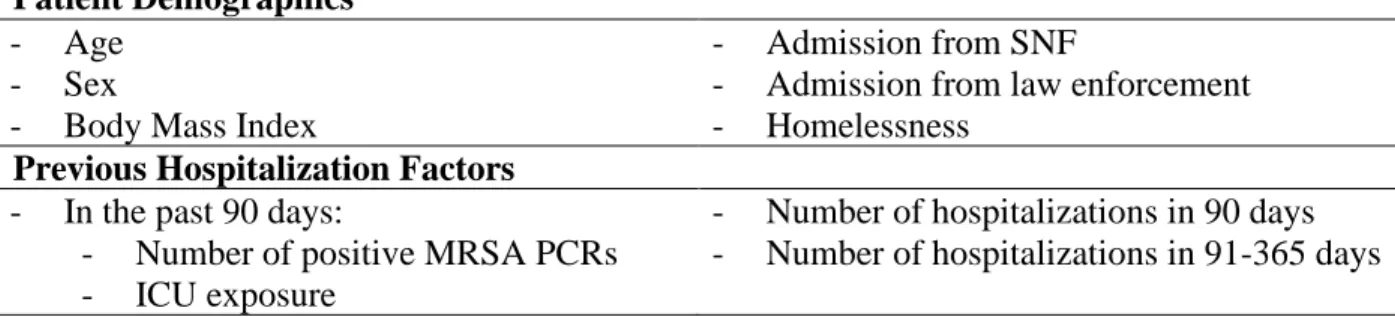
Thirty-four risk factors for MRSA were identified for analysis from existing published literature and through consensus agreement with practitioners and clinical pharmacists. Risk factors were categorically separated into patient demographics, previous hospitalization factors, and
comorbidities (Table 1). Comorbidities were included as ICD10 diagnostic codes. ICD10 codes were grouped into 23 broader disease states, then were separated into chronic and acute
conditions.
Table 1. Categorization of Risk Factors Patient Demographics
- Age - Sex
- Body Mass Index
- Admission from SNF
- Admission from law enforcement - Homelessness
Previous Hospitalization Factors - In the past 90 days:
- Number of positive MRSA PCRs - ICU exposure
- Vancomycin exposure
- Non-vancomycin antibiotic exposure Comorbidities
- Acute:
- MRSA Infection
- Skin and subcutaneous tissue infection
- Acute venous thromboembolism - Acute congestive heart failure - Transient ischemic attack or stroke - Renal failure
- Clostridium difficile infection
- Chronic:
- History of MRSA infection - Chronic obstructive pulmonary
disease
- Chronic venous thromboembolism - Chronic skin ulcer
- Chronic congestive heart failure - Hemodialysis
- Cystic fibrosis
- End stage renal disease - Chronic kidney disease - Diabetes mellitus
- Substance related disorders - Human immunodeficiency virus - Immunity disorders
- Other chronic pulmonary diseases
ICU intensive care unit; SNF skilled nursing facility.
All patient demographic and previous hospitalization risk factors were able to be electronically abstracted from the EMR from previous visits within Mission Health System. All chronic comorbid conditions were included regardless of present on admission designation. Acute comorbid conditions were those designated as present on admission for inclusion in the analysis (i.e. no new diagnoses made during the index hospitalization were considered for this study).
Statistical Methods
90 days, number of hospital visits in the past 91 to 365 days, and number of positive MRSA PCR screens in the past 90 days. To allow for nonlinear relationships between numeric variables and the outcome, the five numeric variables were modeled with restricted cubic splines. Age, BMI, number of hospital visits in the past 90 days, and number of hospital visits from 91 to 365 days ago received five knots, while number of positive PCR screens in the past 90 days was modeled with three knots due to its limited data range.
To determine the predictive capability of this model, bootstrap resampling validation with 100 samples was conducted. Area under the curve (equivalent to the c-statistic) was then calculated to determine the accuracy of the model. An AUC of 1.0 indicates the model will predict the outcome with 100% accuracy. A p-value of <0.05 was considered statistically significant. All analyses were performed using the statistical software R version 3.5.0.
Results:
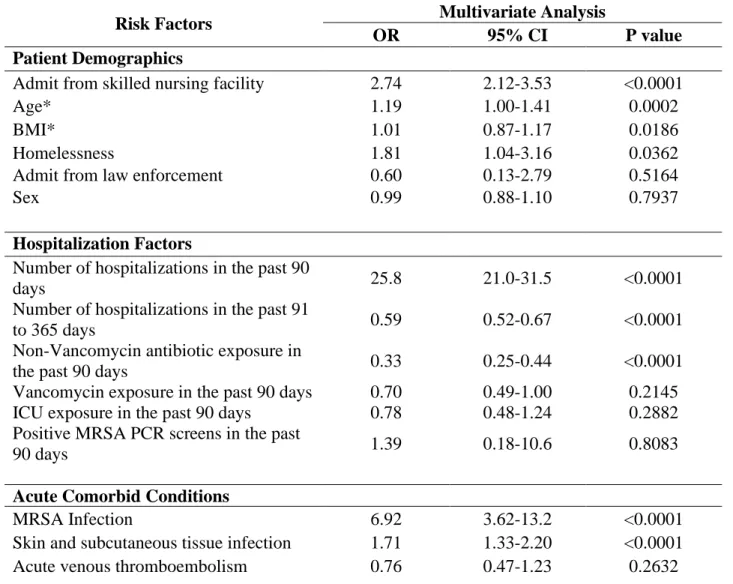
The preliminary results of the multivariate analysis of thirty-four risk factors are reported in Table 2. The c-statistic of the multivariate regression model is 0.8096. Thirteen risk factors were found to be statistically significant with at least one factor from each category; patient
skin ulcers (OR: 1.44, CI:1.08-1.91) were also found to have a significant positive correlation with MRSA colonization.
Non-vancomycin antibiotic exposure (OR: 0.33, CI: 0.25-0.44) and number of hospital visits in the past 91 to 365 days (OR: 0.59, CI: 0.52-0.67) were found to have a negative correlation with MRSA colonization. The two-way interacting variables of cancer with antibiotics (p = 0.4581) and HIV with antibiotics (p = 0.7542) were both found to be non-significant.
Table 2. Multivariate analysis results of 34 risk factors.
Risk Factors Multivariate Analysis
OR 95% CI P value
Patient Demographics
Admit from skilled nursing facility 2.74 2.12-3.53 <0.0001
Age* 1.19 1.00-1.41 0.0002
BMI* 1.01 0.87-1.17 0.0186
Homelessness 1.81 1.04-3.16 0.0362
Admit from law enforcement 0.60 0.13-2.79 0.5164
Sex 0.99 0.88-1.10 0.7937
Hospitalization Factors
Number of hospitalizations in the past 90
days 25.8 21.0-31.5 <0.0001
Number of hospitalizations in the past 91
to 365 days 0.59 0.52-0.67 <0.0001
Non-Vancomycin antibiotic exposure in
the past 90 days 0.33 0.25-0.44 <0.0001
Vancomycin exposure in the past 90 days 0.70 0.49-1.00 0.2145 ICU exposure in the past 90 days 0.78 0.48-1.24 0.2882 Positive MRSA PCR screens in the past
90 days 1.39 0.18-10.6 0.8083
Acute Comorbid Conditions
MRSA Infection 6.92 3.62-13.2 <0.0001
Acute congestive heart failure† 1.34 0.98-1.84 0.0675 Transient ischemic attack or stroke 1.19 0.85-1.66 0.3146
Renal Failure 1.08 0.91-1.29 0.3763
Clostridium difficile infection 1.20 0.69-2.09 0.5235
Chronic Comorbid Conditions
History of MRSA infection 2.63 1.78-3.89 <0.0001 Chronic obstructive pulmonary disease 1.36 1.18-1.58 <0.0001 Chronic venous thromboembolism 1.41 1.10-1.82 0.0071
Chronic skin ulcer 1.44 1.08-1.91 0.0122
Cancer 0.82 0.68-1.00 0.0529
Substance related disorders 1.19 0.91-1.56 0.1985
Human immunodeficiency virus 2.05 0.97-4.37 0.3170
Immunity disorders 0.68 0.28-1.63 0.3838
Other chronic pulmonary diseases 0.72 0.34-1.55 0.4048 Chronic congestive heart failure 1.09 0.89-1.33 0.4068
Hemodialysis 0.74 0.36-1.53 0.4188
Cystic fibrosis 0.47 0.03-7.35 0.5875
End stage renal disease 1.15 0.58-2.29 0.6929
Chronic kidney disease 0.99 0.82-1.19 0.8744
Diabetes mellitus 1.00 0.87-1.14 0.9706
CI confidence interval, OR odds ratio.
*The Age and BMI confidence intervals appear to cross 1, but the p value is still <0.05 and these risk factors are statistically significant. This occurs due to the upper and lower limit of the
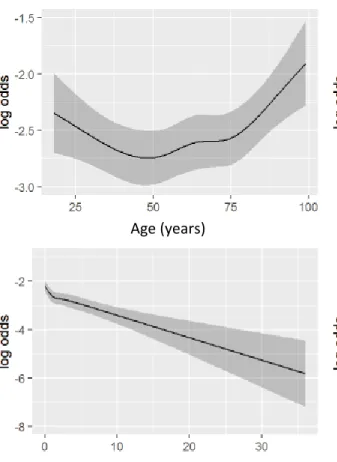
confidence interval defaulting to the 75th and 25th percentile respectively. The significant ranges fall out side of the confidence interval, as illustrated in Figure 1.
†Acute congestive heart failure includes ICD10 codes specified as “acute on chronic”.
data, the number of hospital visits in the past 90 days (OR: 25.8 CI: 21.0-31.5) was initially determined to be significant. The risk for colonization peaks around 2 hospital visits, then trends down before increasing again after 5 or more visits. Age and BMI had similar shaped curves and increased risk associated with being on the lower or higher end of either range. Number of hospital visits in the past 91 to 365 days showed more encounters associated with a decreasing risk of MRSA colonization.
Figure 1. Non-linear Relationship of Significant Continuous Variables and Odds Ratios on a Log Scale.
Discussion:
Age (years) Number of Hospital visits past 90 days
Initial results indicated that certain patient characteristics available on admission were positively associated with MRSA colonization including: admission from a SNF, age, BMI, homelessness, hospital visits in the past 90 days, acute MRSA infection, acute SSTI, a history of MRSA infection, COPD, chronic VTE, and chronic skin ulcer. However, multivariate analysis studies simultaneously determine independent significance and correlation between each variable. Because of this, the erroneous data points may have skewed the results of other variables in the analysis.
These results are invalid and are not an accurate representation of the risk factors that are positively associated with MRSA colonization. Upon post-analysis review, it was determined that data was not generated for a significant portion of the MRSA negative group. Incomplete data was converted to a zero value which was defined as having no recent hospitalizations in the analysis. This would account for our initial findings that suggested multiple admissions to the hospital within a three-month window profoundly increases an individual’s risk for being colonized with MRSA at their next admission. This error affects the validity of the other data points as well.
of the patient population. Available literature also evaluates different hospitalization and time measures including: hospitalization in the past 12 months, hospitalization in the past 18 months, and hospitalization lasting greater than 7 days in the past year.9-12 There is a still undefined relationship between MRSA colonization risk and time from most recent previous hospitalization that needs to be evaluated further. This highlights the utility of developing a site-specific
predictive model to determine the MRSA colonization risk factors unique to an institution.
Our next analysis will include other pertinent antibiotic classes and route of administration including: enterally, parenterally, and topically. Other studies have separated antibiotics into MRSA active and not MRSA active.7 The results showed MRSA active antibiotics were not significant, consistent with our findings that vancomycin was not significant. Additionally, their results showed cephalosporins were a negative predictor while other antibiotics were a positive predictor. We expected that since vancomycin is an antibiotic that is used to treat MRSA
infections, recent exposure may decrease risk of colonization, while exposure to other antibiotics may select for the resistant bacteria. Further analysis into classes of antibiotics and route of administration of antibiotics is needed to determine the true effect on colonization risk.
A subsequent analysis will be completed to address the skewed data points. The next sample will not have reductions in the MRSA negative group and will be expanded to include patients
Classification Systems, a database maintained by the federal government to group ICD10 codes into larger categories. This approach, as opposed to using custom groupers, will allow us to more easily re-assess the predictive model over time. To utilize this model at admission, ICD10 codes will only be included if they were inputted during a previous encounter. We believe these changes will address the limitations encountered during this study.
Limitations:
Our data are limited by current screening protocols and are not a true reflection of the greater hospital population. This limits generalizability of the model and may affect the accuracy if Mission Hospital admission population varies considerably from our sample. Additionally, our proportion of MRSA positive patients to MRSA negative patients is much larger than expected in the general population due to the reduction in sample size of the negative population. This approach allowed us to capture significantly more MRSA positive subjects compared to other studies and provided a more manageable total sample size so we could evaluate a larger number of risk factors. The data available for the MRSA negative group was further reduced for the number of hospitalizations risk factor. This was an unintentional error.
the patient’s EMR or will be documented on admission by a provider as a part of their past
medical history.
Conclusions:
The results of this study are not an accurate analysis of risk factors positively associated with MRSA colonization for this sample. Future studies will reassess the data points in a complete sample. Results from that study may be used to redefine the MRSA screening protocols as Mission Hospital. However, further evaluation of utility measures and the cost effectiveness of the predictive model need to be done prior to implementation.
References:
1. Magill SS, Edwards JR, Bamberg W, et al. Multistate point-prevalence survey of health care-associated infections. N Engl J Med. 2014;370(13):1198-208.
2. Scott RD. The Direct Medical Costs of Healthcare-Associated Infections in U.S. Hospitals and the Benefits of Prevention. https://www.cdc.gov/hai/pdfs/hai/scott_costpaper.pdf. 3. Cassidy A Health policy brief: Medicare's hospital-acquired condition reduction program.
Bethesda, MD, Health Affairs; 2015 Aug 6. Health policy briefs. http://www.healthaffairs.org/healthpolicybriefs/brief.php?brief_id=142. 4. Background. Centers for Disease Control and Prevention.
5. Dantes R, Mu Y, Belflower R, et al. National burden of invasive methicillin-resistant Staphylococcus aureus infections, United States, 2011. JAMA Intern Med.
2013;173(21):1970-8.
6. Cost-Effectiveness of PCR Screening for Methicillin-Resistant Staphylococcus aureus at a Large Regional Hospital. American Journal of Infection Control. 2009;37(5).
doi:10.1016/j.ajic.2009.04.041.
7. HAC-Reduction-Program. CMS.gov Centers for Medicare & Medicaid Services.
https://www.cms.gov/Medicare/Medicare-Fee-for-Service-Payment/AcuteInpatientPPS/HAC-Reduction-Program.html. Published July 20, 2017. Accessed April 11, 2018.
8. Roth VR, Longpre T, Coyle D, et al. Cost Analysis of Universal Screening vs. Risk Factor-Based Screening for Methicillin-Resistant Staphylococcus aureus (MRSA). PLoS ONE. 2016;11(7):e0159667.
9. Robicsek A. Electronic prediction rules for methicillin-resistant staphylococcus aureus colonization. Infection control and hospital epidemiology. 01/2011;32(1):9-19. doi: 10.1086/657631.
10. Mckinnell JA, Miller LG, Eells SJ, Cui E, Huang SS. A systematic literature review and meta-analysis of factors associated with methicillin-resistant Staphylococcus aureus colonization at time of hospital or intensive care unit admission. Infect Control Hosp Epidemiol. 2013;34(10):1077-86.
MRSA nasal carriage. Clinical infectious diseases. 07/2005;41(2):159-166. doi: 10.1086/430910.
12. Wakatake H. Positive clinical risk factors predict a high rate of methicillin-resistant