MEDIA FRAMING OF CONTRACEPTION
Hailey Sherman
A thesis submitted to the faculty of the University of North Carolina at Chapel Hill in partial fulfillment of the requirements for the degree of Master of Arts in the Department of Political Science.
Chapel Hill 2019
Approved by:
Frank R. Baumgartner
Christopher J. Clark
ABSTRACT
Hailey Sherman: Media Framing of Contraception (Under the direction of Frank R. Baumgartner)
TABLE OF CONTENTS
LIST OF TABLES . . . vi
LIST OF FIGURES . . . vii
INTRODUCTION . . . 1
CONTRACEPTION . . . 4
FRAMING . . . 6
METHODS . . . 9
Topic Models . . . 10
Measuring the Frame Set . . . 19
Aggregating Frames . . . 19
RESULTS AND DISCUSSION . . . 20
Drift . . . 24
Frame Set . . . 25
Aggregating Frames . . . 26
CONCLUSION . . . 30
APPENDIX A - KEY WORD SEARCHES . . . 32
APPENDIX B - REMOVING TERMS . . . 36
APPENDIX C - SELECTING NUMBER OF TOPICS . . . 37
APPENDIX D - DRIFT . . . 39
LIST OF TABLES
1 High Probability Words . . . 17
2 FREX Words . . . 18
3 Combining Frames . . . 26
4 Frames by Topic Correlation . . . 27
5 STM with 7 Topics . . . 28
6 STM by Decade - 1980s . . . 39
7 STM by Decade - 1990s . . . 40
8 STM by Decade - 2000s . . . 40
9 STM by Decade - 2010s . . . 41
10 7 Topic STM by Decade - 1980s . . . 43
11 7 Topic STM by Decade - 1990s . . . 43
12 7 Topic STM by Decade - 2000s . . . 43
LIST OF FIGURES
1 Number of Articles Published by Year . . . 13
2 Word Cloud of Article Text . . . 15
3 Prevalence of Topics over Time . . . 21
4 Change in Frame Set . . . 25
5 Expected Topic Prevalence - 7 Frames . . . 29
6 Removed by Lower Threshold . . . 36
7 Diagnostics - 10-75 Topics . . . 37
8 Diagnostics - 25-50 Topics . . . 38
9 Diagnostics - 26-34 Topics . . . 38
10 Relative Frequency of Frame . . . 41
INTRODUCTION
In 2016, theNew York Times ran an article with the headline “No Contraception, No Equality.” Within the next year, the newspaper also published articles headlined “On Contraception, It’s Church Over State,” “Set It and Forget It: How Better Contraception Could Be a Key to Reducing Poverty,” and “Trump Takes Away Fundamental Health Care for Women.” These stories all focus on the same issue: contraception. But the way that they present that issue differs—their frames vary. Those differences in framing have consequential effects on public opinion and public policy.
Contraception refers to the use of devices or techniques intended to prevent pregnancy. As the methods of contraception have advanced over time, individuals’ practice of using contraception has consequently evolved as well. As of 2012, approximately 62% of women of reproductive age were using some form of contraception (Jones et al., 2012). Almost all women (99%) who have had sexual intercourse have used a form of contraception at some point in life according to a report published by the National Center for Health Statistics (Jones et al., 2012).
Public policy, public opinion, and discourse regarding contraception have also evolved over the years. While legal access to contraception was secured for both married and unmarried women in 1965 and 1972, respectively, access to contraception is still a debated policy topic. For example, insurance coverage was federally mandated as part of the Affordable Care Act in 2010 but has repeatedly been challenged.
This paper identifies how contraception has been framed over time in order to expand our knowledge of contraceptive practices and attitudes, which affects many individuals directly or indirectly. Limited previous research exists on this issue, though scholars have begun to explore the topic. In an article, Jaworski (2009) looked to popular culture, such as television or rap music, to consider the problematic or potentially harmful ways that reproductive rights are framed. Through analyzing letters sent to legislators in Maryland regarding a state policy that would include contraception as a standard part of health care, Rasmussen (2011) identified five frames that shaped the discussion of contraception and health care. These frames include medical, gender and class equity, market-based, religious, and elective/immoral procedure frames. These papers both begin to explore the framing of contraception but are limited in scope. Further in-depth analysis is necessary to understand how contraception has broadly been framed in society over time. The framing of contraception has not been studied comprehensively, and this phenomenon should be analyzed empirically to capture what types of frames are used and how this evolves.
because it influences their access to contraception, their opinion on it, and thus their likelihood to use it.
While this paper focuses on contraception, the methodology used to identify and analyze frames can be extended to other issues. Frames are often identified using readers and inductive or deductive approaches to coding or with dictionary methods, but the use of topic models provides an alternative. It could be implemented with any form of text, such as media sources, bills, Congressional debates, or candidate platforms and speeches. This approach would assist researchers through the efficiency of a computer-based analysis and circumvent some challenges that accompany other methods.
CONTRACEPTION
Contraceptive practices are not a recent development in human history with references to con-traception ranging back to the Ming Dynasty in China, Ancient Egypt, Ancient Greece, and Rome (Greene, 1999; J¨utte, 2008; Wood and Suitters, 1970; Perera, 2004). The practice of using contraceptive devices in the United States has been controversial and was even illegal until 1965 (Reed, 1978). However, the use and types of contraceptive methods have expanded over the years. The movement to promote contraceptive devices in the United States started in the early 1900s due to Margaret Sanger’s efforts. While women did practice natural family planning or implement some contraceptive practices as part of the “voluntary motherhood” movement that began in the late nineteenth century, using contraceptive devices was prohibited under the Comstock Act (1873) (Gordon, 2002). Sanger coined the term “birth control,” opened the first clinic in the United States, founded the American Birth Control League, and advocated for the legality, accessibility, and use of contraception (Gordon, 2002; Parry, 2013). By the 1930s, the birth control movement intentionally underwent professionalization in order to strategically reframe contraception as a matter of health and family planning rather than a part of a radical women’s movement (Gordon, 2002; Parry, 2013). Many technological advances have occurred in recent decades, such as the invention of the oral contraceptive pill in 1960 (Eig, 2014; Perera, 2004). Following the social movement, legal battles, pharmaceutical inventions, and more challenges throughout the twentieth century, contraception has become more accepted and commonplace in society.
Policy regulating access to contraception has also shifted. After being outlawed by the Comstock Act as “obscene,” contraception became more socially acceptable over the 1900s (Parry, 2013). The
the introduction of new legislation has gradually expanded access to contraception over the years, though it is not entirely accessible for everyone still.
Many technological advances have occurred over the years. Beyond natural family planning methods, women used to use contraceptive devices such as diaphragms, sponges, and jellies. The pill, an oral contraceptive, was invented around 1950 and approved by the Food and Drug Administration (FDA) in 1960, revolutionizing birth control. Other methods have also grown in popularity, such as intrauterine devices (IUDs), contraceptive injections, and emergency contraception, including the “morning-after pill.” With these advances, women’s options for contraceptive methods have expanded. These changes have subsequently led to changes in how contraception is understood, discussed, and used since the field of contraception has drastically changed throughout history.
The way that contraception is viewed and discussed has also evolved. First, the safety and effectiveness of different types of contraceptive devices has been questioned over time, including concerns regarding side effects or effects of long-term use (Solinger, 2013; Roye, 2014). This is also connected to the debate over how contraception fits into health care. For example, there are arguments of contraception (not) being a basic feature of health care and questions of the doctor or pharmacist role in providing access to contraception (Rasmussen, 2011). There are also a range of moral objections that have been used to oppose contraception, including religious opposition, concerns of “promoting promiscuity” or “risky sexual behavior,” questions over which types of women should be able to use contraception (married v. unmarried), and beliefs over women’s role as mothers (Solinger, 2013; Roye, 2014; Rasmussen, 2011; Parry, 2013). These arguments are countered by some feminist and women’s rights movement that women should be able to make decisions regarding their own bodies.
FRAMING
A frame is “a central organizing idea or story line that provides meaning to an unfolding strip of events,” which “suggests what the controversy is about, the essence of the issue” (Gamson and Modigliani, 1987, 143). It makes certain aspects of an issue or argument more salient in order to shape how an issue is perceived or what action is taken. This paper will focus on a macro-level understanding of frames, as opposed to how an individual perceives the issues.
Frames alter how people perceive issues by changing the weights for competing considerations (Druckman, 2001a). However, an individual’s values or morals still influence beliefs (Brewer, 2003; Chong and Druckman, 2007a,b). Framing effects also depend on strength of attitude formed by communication and the recency or prominence of a frame (Chong and Druckman, 2010).
An issue can be framed differently over time as actors seek to frame and reframe the subject. This is often done with the goal of convincing the public to see an issue a certain way. This may be accomplished by trying to attract attention to other dimensions of issue (Baumgartner and Jones, 1993; Baumgartner and Mahoney, 2008; Jones, 1994). With contraception, an actor could discuss contraception as a basic feature of health care and a medical necessity rather than a religious or moral issue.
This is also related to “conflict expansion theory,” where an actor may attempt to reframe issues in way that will include more individuals and shift support to “losing” side (Schattschneider, 1975). With contraception, actors could argue that contraception is used for many uses beyond preventing pregnancy, such as treating acne and endometriosis or preventing ovarian cysts and anemia. This would expand the individuals affected by contraception to a larger audience by potentially changing the user demographics and introducing alternate considerations for the public.
issue frames utilize different considerations in order to sway opinion. When individuals receive competing messages simultaneously, then they are able to weigh their options. If received at different times, the previous arguments are more difficult to recall due to decay, so individuals will put more weight on the newer arguments (Chong and Druckman, 2010). It is important to note that frames in competitive environments can cancel out, and strong frames are probably more effective than comparatively weaker frames (Chong and Druckman, 2007a). It is difficult to know what makes a strong frame, however.
Collectively, the frames used at a point in time compose the frame set (Shoub, 2018). Rather than focusing on individual frames, the unit of analysis is the combined bundle of frames, providing insight on the overall discourse around the topic. Shoub (2018) argues and finds evidence that changes in the frame set increase the likelihood of changes in policy. It is consequently important to consider how the collective frame set varies given its potential political influence.
Framing is important to consider because it affects society in several different ways. First, framing can influence public opinion (Druckman, 2001b; Nelson et al., 1997; Chong and Druckman, 2007b, 2010; Druckman, 2004). There are also examples of how media framing has shaped public policy in different contexts, including poverty, the death penalty, same-sex marriage, and the war on terror (Rose and Baumgartner, 2013; Baumgartner et al., 2008; Wiggins, 2001; Boydstun and Glazier, 2013). It may be difficult, however, to confirm the direction of causality and specify the casual mechanism, though there are several potential explanations (Jones and Wolfe, 2010).
Media outlets are important forums that create and promote frames. Gamson and Modigliani (1989) argue that this is the case because “media discourse is part of the process by which individuals construct meaning, and public opinion is part of the process by which journalist ... develop and crystallize meaning in public discourse” (2). Journalists uses frames because “they give the story a ‘spin,’ ... taking into account their organizational and modality constraints, professional judgments,
and certain judgments about the audience” (Neuman et al., 1992, 120).
METHODS
Scholars have previously noted that a vast amount of of political data takes the form of texts, such as news reports, legislation, or candidate platforms (Grimmer and Stewart, 2013; Roberts et al., 2016). These sources can be extremely informative, but analysis of these texts is difficult due to the time and effort required (Grimmer and Stewart, 2013; Quinn et al., 2010; Roberts et al., 2016). There are several different approaches that researchers have used to identify frames, though each has its limitations.
First, researchers can identify frames inductively by reading articles and determining the frames (or “frame elements”). Each article must then be manually coded by the researchers through making subjective decisions about the text. While this can allow for in-depth readings of the texts and identification of many potential frames, it is a time consuming process, can be costly, and leaves room for error (Quinn et al., 2010).
Articles can be coded using dictionaries, which are lists of key words created by the researcher. Each article is then scanned to count the frequency of each category within the text. A similar approach would be to implement some type of machine learning where the researcher codes a training set and then the computer codes the remaining articles, but this faces its own challenges (Grimmer and Stewart, 2013; Quinn et al., 2010). Both of these methods run into problems because the researcher must decide what frames to include, requiring a high level of knowledge about the topic and leaving room for error based on this decision (Quinn et al., 2010).
number of clusters, k, and the statistical software completes the analysis sorting the text into topics. In comparison to other methods, like dictionaries or human coding, topic models require less substantive knowledge and relatively little time or effort (Quinn et al., 2010). For these reasons, topic models are a useful option for analyzing large corpora. Topic models have not yet been used to identify frames but will simplify the process and provide an objective analysis.
Topic Models
Topic models are a form of machine learning that use probability distributions in order to identify patterns in words, which form underlying topics (Alghamdi and Alfalqi, 2015). The researcher predetermines the number of clusters,k, and the statistical software completes the analysis sorting the text into topics. A topic is a “semantically coherent content that is shared by a corpus” (Alghamdi and Alfalqi, 2015, 152). Topics are made up of an assortment of words, and each document contains a combination of topics. The list of words used for each topic provides insight into the themes or broad ways that an issue is discussed, or framed. In comparison to other methods, like dictionaries or human coding, topic models require less substantive knowledge and relatively little time or effort (Quinn et al., 2010). For these reasons, topic models are a useful option for analyzes large corpora.
Probabilistic models provide a general overview of the topics, which can be useful for a broad understanding of how the issue is framed. These models ignore word order and rely on term frequency within each document to compare the distribution of words to other documents in the corpus (Alghamdi and Alfalqi, 2015). The most common topic model, and arguably the simplest, is the Latent Dirichlet Allocation (LDA) (Grimmer and Stewart, 2013; Roberts et al., 2016). Based on the Dirichlet distribution and a Bayesian approach, this model assumes that each document in the corpus is comprised of a combination of topics and works to determine the proportion of each topic in every document. LDA provides a broad overview of topics from the entire corpus but does not account for any other covariates, which may confound topic discovery (Alghamdi and Alfalqi, 2015).
example, the date, author, publication, and section are only a few pieces of information that could be used to study newspaper articles and provide insight in changes in topics. STMs run inR using thestmpackage, developed by Roberts et al. (2016).
One limitation of these topic models is that I must determine an appropriate number of topics for the model to identify, which can be a challenge with machine learning (Grimmer and Stewart, 2013; Wallach et al., 2009). There is not a standard method to determine the appropriate number of topics. Grimmer and Stewart (2013) argue that “rather than statistical fit, model selection should be recast as a problem of measuring substantive fit” (Grimmer and Stewart, 2013, 286). This suggests that the researcher should run models with varying number of clusters and infer the optimal amount. Other literature suggests that there are several statistics that can help choose the number of clusters, such as held-out likelihood, residuals, and semantic coherence (Roberts et al., ming; Wallach et al., 2009; Taddy, 2012). Mimno et al. (2011) found evidence that models with more topics often provide topics with less substantive coherence than models with fewer topics. For these reasons, it is extremely important to consider the number of clusters when implementing topic models.
In order to conduct my analysis, I use topic models and media data in order to determine how contraception has been framed in media over time. To accomplish this, I follow the four steps of text analysis described by Brodnax and James (2018): (1) acquire the data, (2) prepare the data for the topic model, (3) estimate the model, and (4) validate the results.
Acquire Data
data is constrained due to accessibility of the articles, and this time frame will still provide insight on the recent changes in contraception framing.
These newspaper articles are available through Nexis Uni. Through trial and error of key word searches, I develop search terms designed to collect articles about contraception within the context of the United States. These terms start with a baseline search for all articles mentioning contraception, contraceptive, birth control, and family planning. Then I filter out unrelated results through a list of “AND NOT” statements to narrow on relevant articles. For example, I worked to eliminate articles that referenced foreign countries unless it was in relation to US policy. These search terms, provided in Appendix A, varied by decade given that the discourse and related issues have evolved over time.
Once I identify the articles of interest, I download a PDF version of each article. Each of these articles is referred to as a document. This process results in a total of 8983 documents, and the distribution of documents over time is displayed in Figure 1. Articles about contraception increased in the late 1980s, peaking at 1987, which may have been due to the introduction of new methods of contraception, such as Paragard, a copper IUD, female condoms, and pills with lower levels of hormones. These advancements were accompanied by increased use of these contraceptive devices and others, such as condoms. The increased articles around this time period could also be due to changing partisan support for access to contraception or conversations about abortion, given the increased number of abortions in the 1980s and lack of partisan agreement on the topic, which lead to discussions about protected sex. The number of articles has also climbed since 2010 with a peaks in 2012 and 2017, which are likely related to the contraceptive mandate that requires insurance plans to cover contraception under the Affordable Care Act and then the Trump administration’s actions to allow religious or moral exemptions to the mandate.
Preparation
100 200 300 400 500 600
1980 1990 2000 2010
Year
Frequency
Figure 1: Number of Articles Published by Year
into R, all articles are compiled into a corpus, which collects the documents into one file. Here, I attach the metadata to the corpus, which tracks the year when each article is published.
Then, I create a document-feature matrix (DFM) from the corpus using the quantedapackage inR. This counts how often each word, or feature, appears in each individual document (Grimmer and Stewart, 2013). There are a few steps necessary to clean this data. First, each document is treated as a “bag of words,” meaning that word order within each document is ignored (Jurafsky and Martin, 2009; Grimmer and Stewart, 2013). All characters are converted to lower case, and punctuation and numbers are removed (Grimmer and Stewart, 2013). I stem each word to the root word, which limits the number of unique words in the corpus (Grimmer and Stewart, 2013; Jurafsky and Martin, 2009; Manning et al., 2008). For example, “abortion,” “abortions,” “abort,” “aborts,” “aborted,” “abortionist,” are all stemmed to “abort” (Quinn et al., 2010). Next, I remove a list of
other irrelevant or common words to this list, which I identify by looking through the most frequent words in the corpus. At this stage, each term is counted. These steps are all necessary for the model to properly analyze words and are commonplace with topic modeling (Grimmer and Stewart, 2013). The DFM is then converted to a stm file, and words that appear in fifty documents or less are also discarded in order to further clean the data and remove noise (Grimmer and Stewart, 2013).
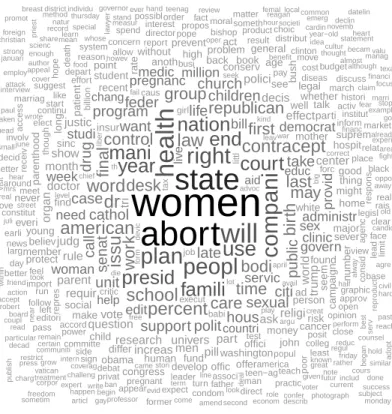
A word cloud depicting the most common terms is presented in Figure 2 with larger words in the cloud occurring more frequently in the articles. As shown in the figure, women is the most common word used in articles about contraception, which is not surprising given that contraception is usually a women’s health issue. The next largest word is abortion, and this is an interesting finding because it shows that the media often discusses contraception as associated with abortion or the articles mention both issues rather than focusing on contraception as a separate topic. State is a commonly used word, likely due to states’ varying legislation regarding access. Health, company, and plan are all prominent, showing that many articles discuss the health care and insurance aspect. Additionally, president, court, law, and right are all important and demonstrate that media discusses the politics of contraception. When moving towards the outskirts of the word cloud, other terms of interest like church, school, cancer, and clinic appear, which provides insight as to important themes that the topic model may discover.
Estimate
women
abort
state
will
health
compani
right
plan
peopl
use
court
end
nation
year
presid
mani
famili
american
law
contracept
word
dr
issu
school
percent
bodi w or k control republican caretime bir th may first group last desk final late cathol program children case pub lic senat feder want church dr ug takesupport polithous
call unit sexual life citi sex govern edit administr democrat million pregnanc servic pro vid clinic studi need week woman bill medic educ liv e help chang countri aid univers judg doctor decis rule vote w or ld part ask show parent question research effect justic month center polici tr ump religi tr i men organ requir increas pill mother well person conserv offici see back found high major problem anoth washington recent sinc fund money white seem social home young thing student find human member patient develop campaign offic rate n umber differ might whether good without believ suprem long risk ad protect book b ush make child hospit prevent general point offer parenthood cancer age sever parti legal john act talk never everi insur obama congress view agenc girl report place repres babi diseas test pope caus bishop inform director leader allow critic accord constitut continu concern depart receiv feel forc meet associ america import popul propos busi graphic legisl respons littl posit effort start power result committe around like turn reason consid job elect teen−ag institut run father opinion pregnant colleg cost pay follow expect approv activ open product editori condom debat clinton news lead though man side move left interest tax earli clear moral march spend system distribut face suggest relat fact order involv letter teach day execut poor sign someth black marriag rais direct histori discuss realli budget least billion possibl close appear access market death matter larg choic better privat hope love base decid limit pass former practic friend die kind candid alreadi action coverag perform remain whose review play june agre avail la wy er reproduct hear for m street juli liber second wrote measur war seek line benefit come intern board challeng came oppos communiti took teenag certain chief away reduc howev professor thought term great free role lot econom alw a y idea regul stori reagan fight exampl governor write amend best special given confer appeal almost food argu old mrs cover claim creat year−old hand societi thursday mean voter friday although deal interview enough particular begin head cultur cardin robert small stop look advoc vatican ser v th share experi author emerg ban got read area decad restrict happen rather note hard paul treatment april known half past correct focus accept photograph expert marri local articl financ counsel taken began near leav employ level current visit press statement becam cours coupl de vic record scienc hold method attack femal big includ reach ever heart freedom valu hour declin texa strong manag district describ pr iest januari financi foreign learn fear pub lish individu subject datelin charg done grow futur success stand promot civil within common novemb oper evid christian gay corpor sometim adopt monday natur breast real similar fail
Figure 2: Word Cloud of Article Text
documents; held-out likelihood, a measure of the prediction power of the model based on training and test subsets of the data; residuals, which indicates how well the number of topics fits model; and the lower bound, which is an approximation of the lower bound on the marginal likelihood. This process suggests that more topics is preferable based on the held-out likelihood, residuals, and lower bound. However, there would be a trade-off with semantic coherence, meaning that the topics became less substantively meaningful with increased topics. I run a series of structural topic models with varying number of topics with different starting point for each model, given some previous evidence suggesting that this helps find a global optimum (Quinn et al., 2010), and consider how substantively coherent the output of each model appears. By weighing the statistical diagnostic information with the coherence of the topic output, I conclude that 30 topics is the best fit for my corpus.
which are words unique to that topic. Then, there is a measure of topic prevalence, the proportion of documents that contain that topic, and this measure is predicted by the covariates.
Validate
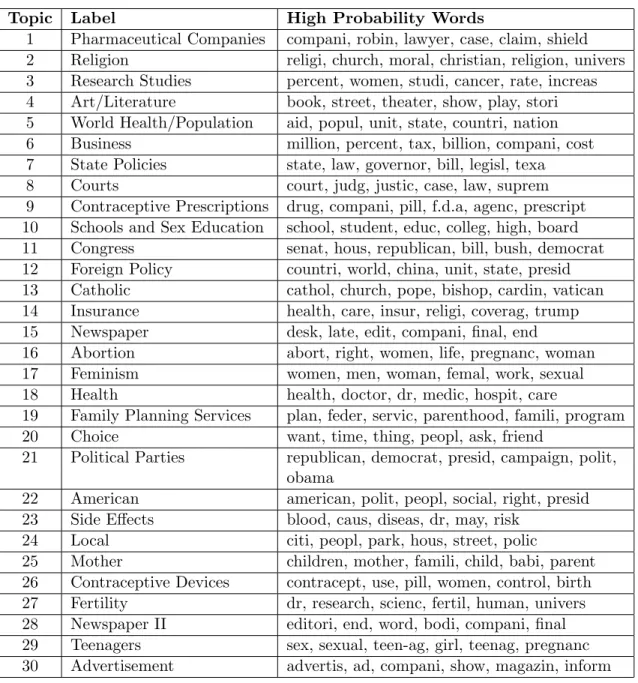
Validating the results of automated text analysis models is essential because it cannot entirely replicate or replace human analysis of text (Grimmer and Stewart, 2013). To validate the quality of the topics, I first consider the semantic validity of each topic. As part of the validation and determining the coherence of each topic, I have assigned descriptive labels to each topic (Grimmer and Stewart, 2013; Quinn et al., 2010). This helps confirm that there is a reasonable or meaningful interpretation. Table 1 shows an overview of each topic with the most frequent words and a topic label.
When looking at Table 1, most of the frames seem to have a clear meaning. For example, Topic 13 is easily identifiable as a Catholic frame, with high probability words like “pope” and “Vatican.” Similarly, Topic 8 is intelligibly about courts given the stems of the high probability words are “court,” “judg,” justic,” “case,” and “law.” The topics broadly fit with what one might expect from contraception frames, capturing politics, medical arguments, religious or moral discussions, business interests, and social context. However, some frames are more difficult to identify, such as the local frame, which has words describing cities and places. The meaning of the Choice frame is not immediately apparent, but the terms to seem to suggest a decision or options, which clearly fits when considering contraception given the language around women making choices about their bodies. Similarly, the newspaper frames, while identifiable, are not substantively of interest but rather capture common language used in the newspaper articles. Generally, however, the topics seem to be substantively coherent and reasonable to interpret as frames.
Table 1: High Probability Words Topic Label High Probability Words
1 Pharmaceutical Companies compani, robin, lawyer, case, claim, shield 2 Religion religi, church, moral, christian, religion, univers 3 Research Studies percent, women, studi, cancer, rate, increas 4 Art/Literature book, street, theater, show, play, stori 5 World Health/Population aid, popul, unit, state, countri, nation 6 Business million, percent, tax, billion, compani, cost 7 State Policies state, law, governor, bill, legisl, texa
8 Courts court, judg, justic, case, law, suprem
9 Contraceptive Prescriptions drug, compani, pill, f.d.a, agenc, prescript 10 Schools and Sex Education school, student, educ, colleg, high, board 11 Congress senat, hous, republican, bill, bush, democrat 12 Foreign Policy countri, world, china, unit, state, presid 13 Catholic cathol, church, pope, bishop, cardin, vatican 14 Insurance health, care, insur, religi, coverag, trump 15 Newspaper desk, late, edit, compani, final, end
16 Abortion abort, right, women, life, pregnanc, woman
17 Feminism women, men, woman, femal, work, sexual
18 Health health, doctor, dr, medic, hospit, care
19 Family Planning Services plan, feder, servic, parenthood, famili, program
20 Choice want, time, thing, peopl, ask, friend
21 Political Parties republican, democrat, presid, campaign, polit, obama
22 American american, polit, peopl, social, right, presid 23 Side Effects blood, caus, diseas, dr, may, risk
24 Local citi, peopl, park, hous, street, polic
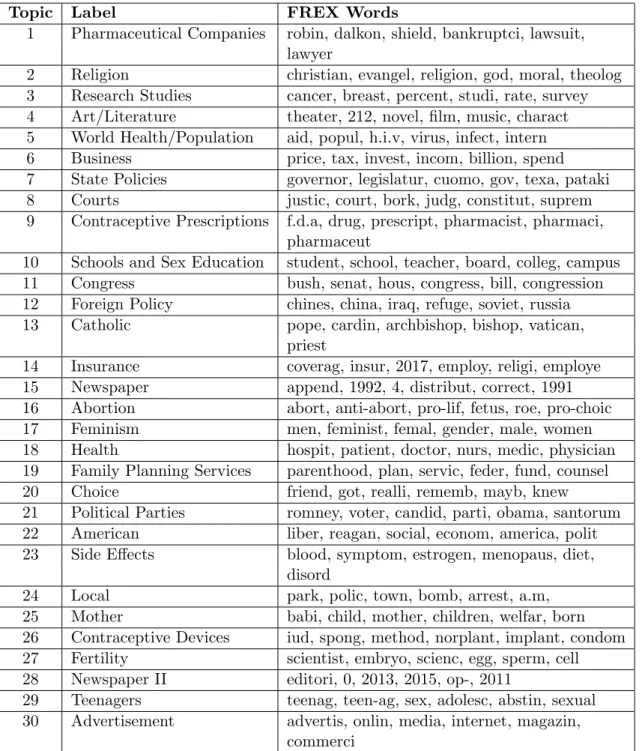
similarities in the words, such as the Schools/Sex Education and Teenagers, or Side Effects and Research Studies, but even these have some distinct words that suggest different meanings. Again, the two newspaper frames do have significant crossover, which is a symptom of the topic model but does not describe the framing of contraception. Overall, these results provide evidence of separation between topics and satisfactory topic quality.
Table 2: FREX Words
Topic Label FREX Words
1 Pharmaceutical Companies robin, dalkon, shield, bankruptci, lawsuit, lawyer
2 Religion christian, evangel, religion, god, moral, theolog 3 Research Studies cancer, breast, percent, studi, rate, survey 4 Art/Literature theater, 212, novel, film, music, charact 5 World Health/Population aid, popul, h.i.v, virus, infect, intern 6 Business price, tax, invest, incom, billion, spend 7 State Policies governor, legislatur, cuomo, gov, texa, pataki 8 Courts justic, court, bork, judg, constitut, suprem 9 Contraceptive Prescriptions f.d.a, drug, prescript, pharmacist, pharmaci,
pharmaceut
10 Schools and Sex Education student, school, teacher, board, colleg, campus 11 Congress bush, senat, hous, congress, bill, congression 12 Foreign Policy chines, china, iraq, refuge, soviet, russia 13 Catholic pope, cardin, archbishop, bishop, vatican,
priest
14 Insurance coverag, insur, 2017, employ, religi, employe 15 Newspaper append, 1992, 4, distribut, correct, 1991 16 Abortion abort, anti-abort, pro-lif, fetus, roe, pro-choic 17 Feminism men, feminist, femal, gender, male, women 18 Health hospit, patient, doctor, nurs, medic, physician 19 Family Planning Services parenthood, plan, servic, feder, fund, counsel
20 Choice friend, got, realli, rememb, mayb, knew
21 Political Parties romney, voter, candid, parti, obama, santorum 22 American liber, reagan, social, econom, america, polit 23 Side Effects blood, symptom, estrogen, menopaus, diet,
disord
24 Local park, polic, town, bomb, arrest, a.m,
25 Mother babi, child, mother, children, welfar, born 26 Contraceptive Devices iud, spong, method, norplant, implant, condom 27 Fertility scientist, embryo, scienc, egg, sperm, cell 28 Newspaper II editori, 0, 2013, 2015, op-, 2011
29 Teenagers teenag, teen-ag, sex, adolesc, abstin, sexual 30 Advertisement advertis, onlin, media, internet, magazin,
Measuring the Frame Set
In addition to measuring the prevalence of individual frames, I will also measure changes in the frame set, or the collective group of frames used at a point in time. Based on the methods outlined by Shoub (2018), I determine the proportion of articles using each frame by year. Then, I will calculate the absolute change in use of the frames between years and sum these values to create an annual total. This measure captures how much the framing changes from the previous year, allowing for analysis of when there are broad changes in framing.
Aggregating Frames
Identifying many topics may be useful to researchers to fully understanding the framing of an issue. In some cases, however, researchers may wish to analyze a smaller number of frames. A large number of frames can illuminate the nuance in how issues are discussed in media but may be overly specified to understand the implications of the framing. Therefore, broader frames can be useful in order to study the connection between framing and policy, for example. Several different approaches could be implemented to identify a condensed number of frames.
The researcher could intuitively combine frames. First, I will consider the 30 frames identified by the STM and decide which frames substantively should be combined. For example, there could be one political frame that combines several frames, including Congress, Courts, and State Policies. This method aggregates the frames by subject, but it is subjective.
Alternatively, another approach is to consider the correlation between the topics to objectively identify which frames should be combined. This should create a more objective measure based on when frames are used concurrently in articles. It could suggest that frames be combined that are not substantively related, however.
A different approach is to run another STM with fewer clusters. One of the advantages would be that the computer will identify the patterns in the articles. However, running with a small number of clusters may not generate the best results according to the diagnostic statistics.
RESULTS AND DISCUSSION
The results from the STM provide insight into the framing of contraception. The topics all seem to align with what one may expect for the framing of contraception and appear fairly coherent. It is important to note that these topics capture frames from the entire time period, but the use of each frame may vary over the years. Beyond identifying topics, the STM can also predict topic prevalence by year. Figure 3 depicts the relative use of each topic over time. Some topics have increased in prevalence, while others have decreased or remained constant.
A number of medical frames are identified by the topic model. First, some of these frames focus on the development and sales of contraceptive devices, such as Pharmaceutical Companies, Research Studies, and Business. The Pharmaceutical Companies frame peaked in the late 1980s, potentially due to the introduction of new contraceptive devices, including low-dosage hormone pills, Paragard, and the female condom. Research Studies captures the development of devices while Business describes the sales and entrepreneurial aspects. These frames are both relatively stable over time, though slightly decrease in prevalence in recent years.
Other frames focus more on health care, such the Insurance and Prescriptions frames. The Insurance frame broadly discusses health insurance and the mandate for insurance coverage of contraception. Use of the Insurance frame steadily increases until the mid-2000s when it dramatically increases as it became a more prominent political issue. The Prescription frame captures language about the Food and Drug Administration and pharmacists. This frame similarly fluctuates some with a peak in 2005, which could be due to changes in the reasons for prescribing contraception or significant changes in the types of contraceptive devices being prescribed (Watkins, 2012).
Teenagers Advertisement
Mother Devices Fertility Newspaper II
Political Parties American Side Effects Local
Feminism Health Family Planning Choice
Catholic Insurance Newspaper Abortion
Prescriptions Schools Congress Foreign Policy
World Health Business State Policies Courts
Pharm. Companies Religion Research Studies Art/Literature
1980 2000 2020 1980 2000 2020
1980 2000 2020 1980 2000 2020
0.00 0.05 0.10
0.00 0.05 0.10
0.00 0.05 0.10
0.00 0.05 0.10
0.00 0.05 0.10
0.00 0.05 0.10
0.00 0.05 0.10
0.00 0.05 0.10
Year
Expected T
opic Pre
v
alence
Devices topic covers different forms of contraception, such as IUDs or sponges. These frames are utilized relatively consistently over time, indicating that they are always present in the media discussions of contraception but their role does not majorly shift.
Next, frames such as Congress, Courts, Political Parties, and State Politics focus on the political institutions that influence access to contraception. The prevalence of these frames tend to vary over time. The Congress frame is less relevant in the mid-1980s but peaks around 2000. Meanwhile, the Courts frame fluctuates with peaks around 1989, 2005, and 2015 and valleys at 1997 and 2010. Some of the focus on Courts might be explained by seminal cases such asWebster v. Reproductive Health Services (1989),Burwell v. Hobby Lobby Stores, Inc. (2014), or court appeals against the contraceptive mandate. The Political Parties frame slightly increases in prominence until 1995 when it sharply increases, peaking in 2013. This reflects that contraception has become more of a partisan and polarized issue over time. The State Policies frame, which captures differing state policies and the decisions that state legislatures and governors are making to influence access to abortion, is relatively stable over time with a slight increase in the early 2000s. This rise could be related to the Contraceptive Parity laws that many states passed around that time.
Several frames focus on different policies related to family planning services or education. One frame focuses on domestic Family Planning Services, such as Planned Parenthood and federal funding for reproductive health services. This frame fluctuated in the 1980s following a cut in public funding for family planning services but has not experience major changes in recent decades. Relatedly, another frame focuses on Sex Education in schools, and this frame both decreased and increased in the 1980s during the public debate about sex education, though it has slightly decreased over the years. Additionally, two frames are more internationally focused. First, the Foreign Policy frame broadly captures relations with other countries and US funding of programs that cover reproductive issues. The prevalence of this frame remains fairly consistent until 2016 when it spikes, which is likely related to the Trump Administration. Next, the World Health/Population frame is related but more focused on public health concerns like HIV/AIDS, viruses, and population control. The use of this frame is consistent over time, which is interesting to note given epidemics at different points in history and growing concerns over world population size.
related to the declining abortion rates since 1990 and increased use of contraception (Kliff, 2018). Additionally, individuals’ attitudes toward reproductive issues may be interconnected.
Two different religious or moral frames are discovered by the topic model. The Religion frame is stable over time. The Catholic frame, however, fluctuates over the years. It is extremely prevalent in 1980 with another peak in the mid-1980s, which could be due to 1980 Synod of Bishops on the Christian Family and the ideological shift towards more traditional Catholic family values in the early 1980s (D’Antonio, 1985).
Two related frames that capture the feminist movement’s involvement in framing contraception is the Feminism frame and the Choice frame. The prevalence of the Feminism frame is fairly stable over time, which is likely explained by the feminist’s movement consistent stance on the topic over the years. The Choice frame, however, steadily increases over the years. This shows that there is a change in language and way of discussing the issue as this frame becomes more important.
The experience of two different groups affected by contraception—mothers and teenagers— emerge from the model. The Mother frame includes discussions of motherhood, pregnancy, and babies, while the Teenage frame is about adolescents and abstinence since this is an important life phase of exploring sexuality and teaching about sexual health and contraception. Neither of these frames experience drastic changes in use but seem consistently relevant.
Advertisement and Art/Literature frames both represent media discussions of contraception. The Art/Literature frame is about television and theater. This varies from the advertisement frame which is likely meant to influence the type of contraception women choose. Both of these are stable over time, which seems reasonable because contraception has been consistently discussed in these media forms over the years.
The American frame contains terms that broadly encompass American values with some references to social or economic issues and ideology. This frame is consistently used over time but is interesting to note that American ideals is an important part of how the media frames contraception.
As previously mentioned, there are several frames that do not capture substantively meaningful frames. The Newspaper frames and the Local frame capture language used in theNew York Times
Many of the frame that are relatively stable over the years decrease slightly over 2010 as the Insurance, Political Parties, Choice, and Foreign Policy frames are used more frequently. The rise in Political Parties and Insurance frames may be connected since access to contraception is a partisan issue.
Additionally, I replicate the results in Figure 3 using keyword searches. I take the most frequent FREX words from each topic and use dictionary searches to measure how often each frame is used. I then determine the relative frequencies of the frames over the years. The results, presented in Appendix E, do not perfectly reflect the topic prevalence measure created by the topic model, but the major trends do appear in both graphs. For example, it is evident that there is an increase in the discussion of insurance and political parties. This also shows a slight increase in the use of the Feminism, Health, Family Planning, Research studies, Courts, and Congress frames after 2010. Several frames diverge from the result, such as a different trend with Family Planning. Otherwise, the frames seem to remain relatively stable according to this measure. These dictionary replications do not perfectly capture the results of the topic model as the dictionaries do not encapsulate all of the terms generated by the STM. The results from the topic model are more comprehensive and utilize on computer-identified patterns, giving it an advantage over dictionary methods that rely on lists of terms created by the researcher. Therefore, the results of this replication support the findings of the topic prevalence from the topic model but show that the computer can identify clearer patterns in framing than relying on dictionaries.
Drift
Frame Set
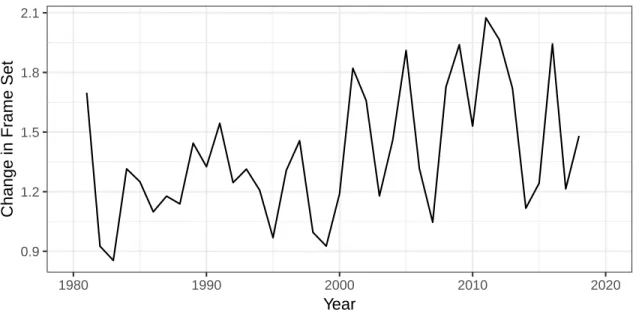
In addition to considering each frame separately, I also analyze changes in the frame set. I create an overall measure of how the frame set changes each year, and the results are presented in Figure 4. Possible values range from 0-30, representing no change in framing from the previous year to complete change. Each peak represent a difference in the frame set, meaning that contraception is framed distinctively from the previous year. Every year indicates some level of change from the previous year, although there are not any years where the frame set drastically shifts, with the least amount of change occurring in 1983. The peaks in 2005, 2009, 2011, 2012, and 2016 show that these years have the largest changes in framing. To obtain these peak values, the proportion of articles using each frame would change by 6-7% on average. The values for change in the frame set slightly increase over time, indicating more continuous changes in the framing over the years. This finding shows that there are constant changes in the media framing of contraception, though there are not any drastic changes. When the frame set changes, there is increased likelihood for change in policy (Shoub, 2018) and potentially other political outcomes. Therefore, the spikes of changes in the frame set that indicate potential for changing policies.
0.9 1.2 1.5 1.8 2.1
1980 1990 2000 2010 2020
Year
Change in Fr
ame Set
Aggregating Frames
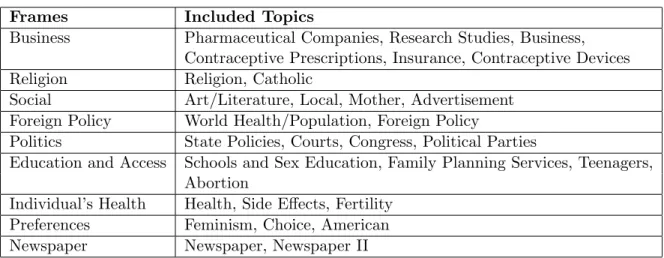
Some research questions would be better answered using a condensed number of frames rather than the full list of 30 topics. This allows for analysis of broader framing and its political implications. In order to combine the frames identified by the topic models, I completed several different methods. First, I collapsed the frames based on which frames are intuitively associated. These results, provided in Table 3, include nine frames. It separates the topics into Politics, Business, Religion, Individuals’ Health, and several other categories. While this process ensures that there are meaningful labels, it is a subjective process where I categorized topics into groups, incorporating my own expectations of the framing. Further, some topics, such as abortion, did not clearly fit into any of the frames. While this approach will provide a condensed number of frames, it also introduces potential for incorrectly aggregating the frames.
Table 3: Combining Frames Frames Included Topics
Business Pharmaceutical Companies, Research Studies, Business, Contraceptive Prescriptions, Insurance, Contraceptive Devices
Religion Religion, Catholic
Social Art/Literature, Local, Mother, Advertisement Foreign Policy World Health/Population, Foreign Policy
Politics State Policies, Courts, Congress, Political Parties
Education and Access Schools and Sex Education, Family Planning Services, Teenagers, Abortion
Individual’s Health Health, Side Effects, Fertility Preferences Feminism, Choice, American Newspaper Newspaper, Newspaper II
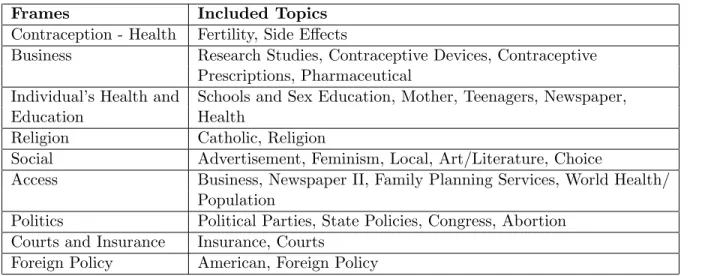
however, is that it aggregates topics that frequently appear in articles together, so these frames are more validated that the combined frames that I created based on my expectations.
Table 4: Frames by Topic Correlation Frames Included Topics
Contraception - Health Fertility, Side Effects
Business Research Studies, Contraceptive Devices, Contraceptive Prescriptions, Pharmaceutical
Individual’s Health and Schools and Sex Education, Mother, Teenagers, Newspaper,
Education Health
Religion Catholic, Religion
Social Advertisement, Feminism, Local, Art/Literature, Choice
Access Business, Newspaper II, Family Planning Services, World Health/ Population
Politics Political Parties, State Policies, Congress, Abortion Courts and Insurance Insurance, Courts
Foreign Policy American, Foreign Policy
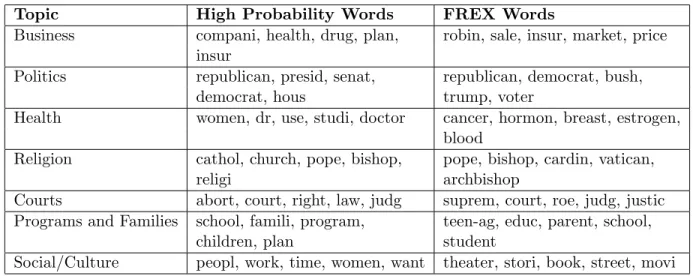
One final approach to creating a condensed list of frames is to run a structural topic model that identifies fewer topics. After running several STMs with clusters varying from 5-10, I determine that seven topics provides the best results within this smaller range. Table 5 shows these frames, all of which have clear meaning and align with what one would expect from the frames, including Business, Politics, Health, Religion, Courts, Programs and Families, and Social/Culture. While these are not drastically different than the other aggregated frames, they are clearer. Using an STM removes all researcher bias and instead relies on patterns in the text to uncover the frames, which is an advantage to this approach.
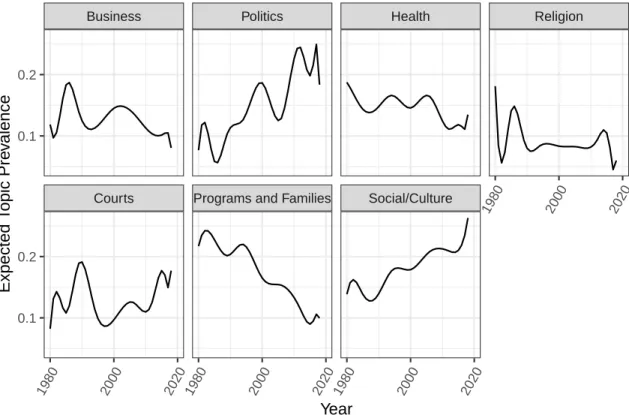
There are large shifts in the prevalence of the frames produced by this model, as shown in Figure 5. The Politics frame climbs over the year, becoming a more significant part of the media coverage of contraception along with the Social/Culture frame. At the same time, the Programs and Families frame decreases in prominence. The other frames all also fluctuate over the years.
As with the larger topic model, I replicated these results with separate models by decade in Appendix G and found that many of the frames emerge repeatedly. One or two of the frames vary each decade, but the same themes appear.
Table 5: STM with 7 Topics
Topic High Probability Words FREX Words
Business compani, health, drug, plan, robin, sale, insur, market, price insur
Politics republican, presid, senat, republican, democrat, bush,
democrat, hous trump, voter
Health women, dr, use, studi, doctor cancer, hormon, breast, estrogen, blood
Religion cathol, church, pope, bishop, pope, bishop, cardin, vatican,
religi archbishop
Courts abort, court, right, law, judg suprem, court, roe, judg, justic Programs and Families school, famili, program, teen-ag, educ, parent, school,
children, plan student
Social/Culture peopl, work, time, women, want theater, stori, book, street, movi
Courts Programs and Families Social/Culture
Business Politics Health Religion
1980 2000 2020 1980 2000 2020 1980 2000 2020
1980 2000 2020
0.1 0.2
0.1 0.2
Year
Expected T
opic Pre
v
alence
CONCLUSION
Through topic models, I have identified the frames used to discuss contraception in the media. In the model with 30 topics, there are political, medical, moral, and social frames, and almost all of the frames appear substantively meaningful. Many of these frames are themes that appear in the national discourse about contraception and the history of the contraception movement, such as Feminism, Catholic, and Mother. The more medical considerations about developing, selling, and using contraception also are expected frames that capture a practical part of this discussion. The discussions of political institutions and actors that determine access to contraception and related policies are also important aspects of the information that is conveyed in the media. The model with seven topics echos the themes found in the comprehensive model but provides more parsimonious results that can be used in future research.
The framing of contraception has evolved over time. The prevalence of each frame varies by year, with large increases in the use of Insurance, Political Parties, and Choice frames. These increases reflect a significant policy debate, the increasingly partisan nature of the issue, and increased attention to women’s control over their reproductive health choices. Other frames, like Pharmaceutical Companies and Catholic, peaked during the 1980s. Congress and Courts both fluctuate over time depending on political developments. Most frames, however, are used relativity consistently over time.
policies occur. This paper is a crucial first step to my future research agenda that will explore these topics.
APPENDIX A - KEY WORD SEARCHES
All Searches:
• New York Times articles
• Filtered by date
• Duplicates filtered out (“group”)
2010-2018:
(contraception OR “birth control” or contraceptive OR “family planning”) AND NOT ((china OR chinese) AND NOT (trump OR obama OR “supreme court” OR “Guttmacher” OR “U.N” OR UN)) AND NOT (india AND NOT (trump OR obama OR “F.D.A.”)) AND (Philippines AND NOT (trump OR Obama OR senate)) AND NOT ((“Latin America” OR Islam OR Himalayan OR Pakistan OR Turkey OR Ethiopia OR Africa OR Ireland OR “south korea ” OR Haiti OR “costa rica”) AND NOT (trump OR obama)) AND NOT (india AND NOT (Bush OR Trump OR Obama OR “F.D.A.” OR Bronx OR Steinem)) AND NOT (Philippines AND NOT (trump OR obama OR Boston)) AND NOT (Poland AND NOT (Trump OR Obama OR “American Catholics” OR Michigan OR Boston)) AND NOT ((islam or muslim) AND NOT (obama or trump)) AND NOT ((islam or muslim) AND NOT (Obama OR trump OR “Supreme Court” OR “New York City” OR Arizona OR Texas OR Chicago OR Mississippi OR Republican OR Manhattan)) AND NOT (Rwanda AND NOT (trump OR obama OR Kwame OR “Planned Parenthood”)) AND NOT (iran AND NOT (trump OR Obama OR Republican)) AND NOT (zoo AND NOT (Trump OR congress OR “Supreme Court” OR “F.D.A.” OR Vernacchio OR Kurin)) AND NOT (“What’s on friday”) AND NOT (“What’s on today”) AND NOT (“What’s on monday”) AND NOT (“What’s on TV”) AND NOT (“What’s on sunday”) AND NOT (“paid notice: deaths”) AND NOT (Airbnb) AND NOT (horse) AND NOT (lion AND NOT (king OR Hillary)) AND NOT (deer AND NOT (“Sarah deer”))
2000-2009
OR pakistan) AND NOT (clinton OR bush OR obama OR Congress OR “F.D.A.” OR FDA)) AND NOT(india AND NOT (clinton OR bush OR obama OR senate OR Washington)) AND NOT (Africa AND NOT (Clinton or bush or Obama or senate or American or gorilla)) AND NOT (“latin america” AND NOT (obama OR clinton OR bush)) AND NOT ((Philippines OR Poland OR islam OR australia OR Romania OR islam OR Rwanda OR portugal OR iran OR Ethiopia OR Russia or Asia) AND NOT (bush OR Obama OR Clinton)) AND NOT (Britain AND NOT (Obama OR Clinton OR bush OR palin OR Philadelphia OR Hopkins OR “F.D.A.” OR Georgia)) AND NOT (France AND NOT (Clinton OR bush OR Obama OR “F.D.A” OR “Food and Drug Administration”
OR California OR Washington)) AND NOT (mexico AND NOT (bush OR clinton OR obama OR “F.D.A.” OR “Food and drug administration” OR california)) AND NOT (iran AND NOT (Clinton OR bush OR Obama OR Georgia or “Food and Drug Administration” OR Pentagon OR California OR Kansas OR Albany OR Brooklyn OR Anthony)) AND NOT (Germany AND NOT (Bush OR Clinton OR Obama OR Yaz OR Philadelphia OR Georgia OR Chicago OR Sanger OR California)) AND NOT (japan AND NOT (bush OR Obama OR Clinton OR Segal)) AND NOT (Ireland AND NOT (Obama OR Clinton OR bush OR “Food and Drug Administration” OR Bloomberg)) AND NOT (“the listings”) AND NOT (“holiday movies”) AND NOT (“inside the times”) AND NOT (“news summary”) AND NOT (“what’s on today”) AND NOT (“what’s on tonight”) AND NOT (“paid notice”) AND NOT (deer) AND NOT (pigeon)
1990-1999
OR “F.D.A.” OR Washington)) AND NOT (muslim AND NOT (bush OR clinton OR reagan OR “F.D.A.” OR Purdue OR Connecticut OR Anthony OR Milwaukee OR Louisiana)) AND NOT (France AND NOT (bush OR clinton OR reagan OR “F.D.A.” OR “Food and Drug Administration”
OR Seattle OR Upjohn OR “Planned Parenthood” OR “American women” OR “Columbia”)) AND NOT (britain AND NOT (bush OR clinton OR reagan OR “Food and Drug Administration” OR Upjohn OR Seattle OR Sanger OR “White House” OR Lightfoot OR Connecticut OR “American women”)) AND NOT (Poland AND NOT (bush OR Reagan OR Clinton OR Fordham)) AND NOT (Germany AND NOT (Bush OR Clinton OR Reagan OR “Food and Drug Administration” OR Lightfoot OR Upjohn OR Wichita OR Texas OR Senate OR Jackson OR Bronx OR Sanger)) AND NOT (“third world” AND NOT (Bush OR Clinton OR Reagan OR Princeton “F.D.A.” OR Bronx OR Wisconsin)) AND NOT (Asia AND NOT (bush OR clinton OR Reagan OR Sanger)) AND NOT (japan AND NOT (Bush OR clinton OR Reagan OR “Food and Drug Administration” OR Maine OR Sanger OR “Growing Together” OR Connecticut)) AND NOT (“soviet union” AND NOT (bush OR clinton OR reagan OR Conly OR Wichita OR Iowa OR California)) AND NOT ((ireland OR irish) AND NOT (bush OR clinton OR reagan OR Sanger OR Albany OR “New York City” AND NOT “Patricia Ireland”)) AND NOT (Mexico AND NOT (Bush OR Clinton OR Reagan OR “New Mexico” OR “Title X” OR Medicaid OR “Food and Drug Administration” OR Texas)) AND NOT (Romania AND NOT (Bush OR Clinton OR Reagan OR House)) AND NOT (“paid notice” OR “news summary” OR “theater review” OR (debt AND NOT (democrat OR California OR Louisiana)) OR “business digest” OR “critic’s notebook” OR “track and field” OR pigeon OR deer OR zoo OR soccer OR parliament OR “review/television” OR “television review)
1980-1989
APPENDIX B - REMOVING TERMS
When preparing the documents for the structural topic model, there is a lower threshold where terms that do not appear a certain number of times are discarded. Figure 6 shows the distribution of how many documents, words, and tokens would be removed by different thresholds. I discard words that did not appear in at least 50 documents because it is where the word plot begins to level. No documents are discarded.
0 50 100 150 200
−1.0
−0.5
0.0
0.5
1.0
Documents Removed by Threshold
Number of Documents Remo
v
ed
0 50 100 150 200
40000
50000
60000
70000
Words Removed by Threshold
Threshold (Minimum No. Documents Appearing)
Number of W
ords Remo
v
ed
0 50 100 150 200
2e+05
4e+05
6e+05
8e+05
Tokens Removed by Threshold
Number of T
ok
ens Remo
v
ed
APPENDIX C - SELECTING NUMBER OF TOPICS
The searchk() function from the stmpackage provides diagnostic values for different numbers of clusters. These results are provided in Figures 7-9. Both figures show a trade-off because more topics produce better models in terms of residuals, lower bound, and held-out likelihood but drastically lower the semantic coherence.
●
●
●
● ●
●
●
●
●
● ●
●
● ●
● ●
● ●
● ●
● ●
● ●
Residuals Lower Bound
Semantic Coherance Held−Out Likelihood
20 40 60 20 40 60
20 40 60 20 40 60
−7.2 −7.1
−29400000 −29100000 −28800000 −65
−60 −55 −50 −45
1.8 2.0 2.2 2.4
K
● ● ● ● ● ● ● ● ● ● ● ● ● ● ● ● ● ● ● ● ● ● ● ●
Residuals Lower Bound
Semantic Coherance Held−Out Likelihood
25 30 35 40 45 50 25 30 35 40 45 50
25 30 35 40 45 50 25 30 35 40 45 50
−7.125 −7.100 −7.075 −7.050 −29000000 −28900000 −28800000 −28700000 −60.0 −57.5 −55.0 −52.5 −50.0 1.90 1.95 2.00 2.05 2.10 K
Figure 8: Diagnostics - 25-50 Topics
● ● ● ● ● ● ● ● ● ● ● ● ● ● ● ● ● ● ● ●
Residuals Lower Bound
Semantic Coherance Held−Out Likelihood
26 28 30 32 34 26 28 30 32 34
26 28 30 32 34 26 28 30 32 34
−7.125 −7.115 −7.105 −7.095 −7.085 −29100000 −29050000 −29000000 −28950000 −53 −52 −51 2.000 2.025 2.050 2.075 K
APPENDIX D - DRIFT
In order to account for policy drift, or topics gradually changing, I run separate structural topic models for each decade. I subset the DFM using year to create for separate DFMs. Then, I run the STM with no covariates and 20 topics. It produces the following results.
Table 6: STM by Decade - 1980s
Topic Label FREX Words
1 Court suit, searl, damag, award, lawyer, juri
2 Family Planning Services budget, program, cut, popul, polici, foundat
3 Local bomb, town, polic, hall, arrest, build
4 Foreign Policy china, chines, soviet, deduct, econom, world 5 Literature book, art, novel, film, music, writer
6 Mother babi, marri, infant, born, black, survey 7 Pharmaceutical Companies robin, claimant, bankruptci, dalkon, rorer,
merhig
8 Clinics parenthood, clinic, regul, servic, plan, feder, 9 Religion curran, theolog, religion, religi, moral,
theologian
10 Choice daughter, friend, thing, feel, got, someth 11 Companies advertis, sale, market, commerci, price,
industri
12 Side Effects cancer, breast, hormon, estrogen, smoke, risk 13 Abortion abort, fetus, anti-abort, perform, restrict, life 14 Sex Education student, school, board, curriculum, educ,
teacher
15 Catholic pope, bishop, cardin, synod, archbishop, pastor
16 Health toxic, shock, symptom, tampon, vitamin, diet 17 Teenagers sex, teen-ag, adolesc, sexual, girl, pregnanc 18 Contraceptive Devices condom, virus, spong, aid, cap, infect
Table 7: STM by Decade - 1990s
Topic Label FREX Words
1 Congress republican, democrat, bill, senat, vote 2 Newspaper editori, desk, edit, letter, distribut
3 Side Effects cancer, breast, infect, estrogen, menopaus 4 Companies product, sale, consum, dow, corpor 5 Health hospit, doctor, patient, care, medic 6 Research Studies rate, survey, percent, declin, per
7 Art tour, ticket, museum, art, avenu
8 Contraceptive Devices norplant, capsul, comput, implant, internet 9 Health Care tax, medicaid, coverag, insur, budget 10 Foreign Policy foreign, china, popul, clinton, intern 11 Literature novel, charact, movi, stori, televis 12 Catholic pope, priest, cathol, bishop, archbishop 13 Clinics bomb, arrest, polic, protest, rescu 14 Court justic, souter, court, constitut, suprem 15 Sex Education student, condom, school, abstin, educ 16 Mother mother, child, babi, children, daughter 17 Abortion abort, anti-abort, pro-choic, oppon, rule 18 Contraceptive Devices pill, ru, f.d.a, drug, approv
19 Research Studies sperm, scienc, scientist, surgeon, elder 20 Feminist men, feminist, q, femal, male
Table 8: STM by Decade - 2000s
Topic Label FREX Words
1 Newspaper editori, administr, popul, intern, famili 2 Sex Education sex, teenag, sexual, abstin, condom 3 Legislation assembl, bill, albani, pataki, legislatur
4 Media mccain, museum, site, televis, tv
5 Side Effects cancer, estrogen, breast, blood, risk 6 Contraception fertil, skin, acn, pill, birth
7 Abortion abort, fetus, clinic, parenthood, procedur 8 Literature book, novel, write, scienc, narrat
9 Relationship babi, cat, mother, husband, friend 10 Pharmaceutical Companies johnson, price, sale, market, pharmaceut
11 Jewish graduat, jewish, die, son, career
12 Insurance insur, coverag, employ, cover, medicaid 13 Court judg, court, justic, ashcroft, alito 14 Catholic cardin, pope, priest, bishop, vatican 15 World Health africa, bank, gate, foundat, hors
16 Contraceptive Devices f.d.a, agenc, morning-aft, crawford, drug
17 Economy tax, immigr, econom, incom, build
18 Art theater, street, west, broadway, cast
Table 9: STM by Decade - 2010s
Topic Label FREX Words
1 Newspaper op-, editori, writer, re, columnist 2 Contraception rate, iud, method, percent, unintend 3 Companies china, chines, australia, advertis, korea 4 Feminist men, gender, femal, male, feminist 5 Court kavanaugh, gorsuch, judg, justic, confirm 6 President trump, donald, global, bannon, militari 7 Health Care tax, bill, budget, spend, obamacar
8 Local water, citi, park, mayor, local
9 Religious Companies corpor, lobbi, hobbi, religion, discrimin 10 Family Planning Services parenthood, texa, fund, plan, clinic 11 Abortion abort, roe, anti-abort, wade, pro-lif 12 Sex Education student, sex, porn, teenag, school
13 Insurance coverag, administr, employ, mandat, rule 14 Presidential Campaigns romney, santorum, mitt, limbaugh, gingrich 15 Political Party democrat, parti, republican, senat, voter 16 Television episod, moor, gail, guy, tv
17 Health f.d.a, zika, virus, drug, dr
18 Art/Literature novel, book, art, museum, artist
19 Catholic pope, cardin, vatican, franci, archbishop
20 Mother babi, infant, mother, matern, nurs
APPENDIX E - DICTIONARY FREQUENCIES OF FRAMES
Teenagers Advertisement
Mother Devices Fertility Newspaper II
Political Parties American Side Effects Local
Feminism Health Family Plnaning Choice
Catholic Insurance Newspaper Abortion
Prescriptions Schools Congress Foreign Policy
World Health Business State Policies Courts
Pharm. Companies Religion Research Studies Art/Literature
1980 1990 2000 2010 1980 1990 2000 2010
1980 1990 2000 2010 1980 1990 2000 2010
APPENDIX F - CORRELATION BETWEEN FRAMES
APPENDIX G - DRIFT WITH 7 TOPICS
Table 10: 7 Topic STM by Decade - 1980s
Topic Label FREX Words
1 Religion bishop, archbishop, vatican, pope, bork 2 Families and Programs teen-ag, parent, educ, student, adolesc 3 Politics reagan, congress, republican, budget, senat 4 Medical breast, hormon, fertil, estrogen, pill
5 Business dalkon, robin, bankruptci, shield, claimant 6 Health virus, condom, diet, vitamin, spread 7 Culture freud, book, friend, art, music
Table 11: 7 Topic STM by Decade - 1990s Topic Label FREX Words
1 Access editori, parenthood, abort, nay, yea 2 Programs teen-ag, condom, welfar, hospit, school 3 Health breast, hormon, cancer, f.d.a, implant 4 Culture park, art, tour, film, stori
5 Religion cathol, pope, vatican, priest, bishop 6 Politics republican, tax, democrat, clinton, budget 7 Courts court, souter, suprem, judg, justic
Table 12: 7 Topic STM by Decade - 2000s Topic Label FREX Words
1 Religion pope, cardin, priest, vatican, bishop 2 Politics bush, tax, obama, mccain, reagan 3 Health estrogen, cancer, hormon, breast, risk 4 Families sex, teenag, condom, parent, girl 5 Courts court, judg, roe, suprem, abort
Table 13: 7 Topic STM by Decade - 2010s Topic Label FREX Words
1 Religion pope, cardin, vatican, archbishop, franci 2 Families sex, parent, student, porn, teenag
REFERENCES
Alghamdi, R. and K. Alfalqi (2015). A survey of topic modeling in text mining. International Journal of Advanced Computer Science and Applications 6, 147–153.
Baumgartner, F. R., S. L. D. Boef, and A. E. Boydstun (2008). The Decline of the Dealth Penalty and the Discovery of Innocence. Cambridge University Press.
Baumgartner, F. R. and B. D. Jones (1993). Agendas and Instability in American Politics. Chicago: University of Chicago Press.
Baumgartner, F. R. and C. Mahoney (2008). The two faces of framing: Individual-level framing and collective issue definition in the european union. European Union Politics 9(3), 435–449. Bischof, J. M. and E. M. Airoldi (2012). Summarizing topical content with word frequency and
exclusivity. Appearing in Proceedings of the 29th International Conference on Machine Learning, Edinburgh, Scotland, UK, 2012.
Boydstun, A. E. (2013). Making the News: Politics, the Media, and Agenda-Setting. Chicago: University of Chicago Press.
Boydstun, A. E. and R. A. Glazier (2013). A two-tiered method for identifying trends in media framing of policy issues: The case of the war on terror. The Policy Studies Journal 41(4), 706–735. Brewer, P. R. (2003). The shifting foundations of public opinion about gay rights. The Journal of
Politics 65(4), 1208–1220.
Brodnax, N. and S. James (2018). Topics as outcomes: Using structural topic models to measure policy diffusion. Prepared for the 35th Annual Meeting of the Society for Political Methodology, July 18-21, 2018, Provo, UT.
Caron, S. M. (2008). Who Chooses? American Reproductive History since 1830. Gainesville: University Press of Florida.
Chong, D. and J. N. Druckman (2007a). Framing public opinion in competitive democracies.
American Political Science Review 101(4), 637–55.
Chong, D. and J. N. Druckman (2007b). A theory of framing and opinion formation in competitive elite environments. Journal of Communication 57, 99–118.
Chong, D. and J. N. Druckman (2010). Dynamic public opinion: Communication effects over time.
American Political Science Review 104(4), 663–80.
Druckman, J. N. (2001a). The implications of framing effects for citizen competence. Political Behavior 23(March), 225–56.
Druckman, J. N. (2001b). On the limits of framing effects: Who can frame? The Journal of Politics 63, 1041–1066.
Druckman, J. N. (2004). Political preference formation: Competition, deliberation, and the (ir)relevance of framing effects. American Political Science Review 98(4), 671–86.
Eig, J. (2014).The Birth of the Pill: How Four Crusaders Reinvented Sex and Launched a Revolution. New York: W.W. Norton & Company.
Eshbaugh-Soha, M. (2006). The conditioning effects of policy salience and complexity on american political institutions. Policy Studies Journal 34(2), 223–243.
Gamson, W. A. and A. Modigliani (1987). Research in political sociology, Volume 3, Chapter The changing culture of affirmative action, pp. 137–177. Greenwich, CT: JAI.
Gamson, W. A. and A. Modigliani (1989). Media discourse and public opinion on nuclear power: A constructionist approach. American Journal of Sociology 95(1), 1–37.
Gordon, L. (2002). The Moral Property of Women: A History of Birth Control Politics in America
(2nd ed.). University of Illinois Press.
Gormley, W. T. J. (1986). Regulatory issue networks in a federal system. Polity 18(4), 595–620. Greene, S. (1999). Understanding party identification: A social identity approach. Political
Psychology 20(2), 1999.
Grimmer, J. and B. M. Stewart (2013). Text as data: The promise and pitfalls of automatic content analysis methods for political texts. Political Analysis, 1–31.
Iyengar, S. (1991). Is Anyone Responsible? How Television Frames Political Issues. Chicago: University of Chicago Press.
Iyengar, S. and D. R. Kinder (1987). News That Matters: Television and American Opinion. Chicago: University of Chicago Press.
Jaworski, B. K. (2009). Reproductive justice and media framing: a case-study analysis of problematic frames in the popular media. Sex Education 9(1), 105–121.
Jones, B. D. (1994). Reconceiving Decision-Making in Democratic Politics. Chicago: University of Chicago Press.