Clinical Infectious Diseases
M A J O R A R T I C L E
Home Screening for Bacterial Vaginosis to Prevent Sexually
Transmitted Diseases
Jane R. Schwebke,1Jeannette Y. Lee,2Shelly Lensing,2Susan S. Philip,3Harold C. Wiesenfeld,4Arlene C. Seña,5Nikole Trainor,3Nincoshka Acevado,6 Lisa Saylor,6Ann M. Rompalo,7and Robert L. Cook8
1
Department of Medicine, University of Alabama at Birmingham;2
Department of Biostatistics, University of Arkansas for Medical Sciences, Little Rock;3
San Francisco Department of Public Health, California;4
Department of Obstetrics and Gynecology, Magee-Women’s Hospital of University of Pittsburgh Medical Center, Pennsylvania;5
Department of Medicine, University of North Carolina at Chapel Hill, and6
Family Health International, Durham, North Carolina;7
Department of Medicine, Johns Hopkins University School of Medicine, Baltimore, Maryland; and8
Departments of Epidemiology and Medicine, University of Florida, Gainesville
Background. Longitudinal studies have consistently found a significant association between bacterial vaginosis (BV) and acqui-sition of sexually transmitted diseases. However, there are limited prospective data to confirm thesefindings.
Methods. We conducted a prospective, randomized, open-label trial of home screening and treatment of young women with asymptomatic BV who were also at high risk for sexually transmitted diseases. These women were screened every 2 months for 12 months and randomized to treatment with oral metronidazole 500 mg twice daily for 7 days or observation alone. The primary outcome was the incidence of gonorrhea and/or chlamydia.
Results. A total of 1365 subjects were enrolled in the study across 10 sites. Adherence with mailing specimens obtained at home was excellent in both groups (84%–88%). The incidence of gonorrhea and/or chlamydia was 19.1 per 100 person-years (95%
con-fidence interval, 15.1–22.1) for the treatment group and 18.5 per 100 person-years (15.1–22.8) for the observation arm, a difference that was not statistically significant.
Conclusions. Young women were very amenable to home screening for BV, gonorrhea, and chlamydia. Treatment of asymp-tomatic BV with 1 week of oral metronidazole did not decrease the incidence of gonorrhea and/or chlamydia.
Clinical Trials Registration. NCT00667368. Keywords. bacterial vaginosis; STD; home screening.
Bacterial vaginosis (BV) is characterized by a shift in the vaginal bacterialflora from lactobacillus predominant to lactobacilli de-pleted and high concentrations of bacteria such asGardnerella vaginalis, and anaerobes [1]. Although BV may cause symptoms of vaginal discharge and odor, a significant number of women are asymptomatic [2,3]. Currently, treatment is not recom-mended for the latter group [4]. BV is significantly associated with acquisition of sexually transmitted diseases (STDs), in-cluding chlamydia and gonorrhea [5–8], but there have been few published clinical trials to determine whether screening and treatment of asymptomatic BV will reduce this risk [9]. We conducted a clinical trial to determine whether regular screening and treatment for asymptomatic BV reduces the 1-year incidence of chlamydia and gonorrhea.
METHODS
Women aged 15–25 years were recruited from 10 sites (STD, family planning, obstetrics-gynecology, and clinical research
clinics) in 6 geographic locations (Baltimore, Maryland; Birming-ham, Alabama; Durham and Raleigh, North Carolina; Pittsburgh, Pennsylvania; and San Francisco, California). All sites were ap-proved to conduct the study by their local institutional review boards. To qualify for participation, women must have had vag-inal intercourse in the past 3 months and also had≥2 of the fol-lowing risk factors for STDs: age≤20 years, African American race, Hispanic ethnicity, douching at least once per month,≥2 sex partners in the past 12 months, and STD diagnosis in the past year (self-reported or from clinic notes) [10–12]. These cri-teria were designed to ensure that subjects were at increased risk for STDs. In addition, participants had to have asymptomatic BV, defined as having 2 of the 4 clinical criteria commonly used to diagnose BV (vaginal pH >4.5% and >20% clue cells on vaginal wet preparation microscopy) and no endorsement of abnormal vaginal discharge or odor. Compared with microbiological crite-ria for BV (Nugent critecrite-ria), elevated pH and clue cells have a spe-cificity of 92%; thus, most women with these 2 criteria would meet criteria for BV [13]. Women were excluded if they were pregnant, used antibiotics daily, lived with their sexual partner (due to lower risk of future STDs), were homeless, were unwilling to abstain from alcohol during treatment, were allergic to metro-nidazole, had seizure disorder or liver disease, took cimetidine or warfarin, had undergone hysterectomy, were currently menstru-ating, or had trichomoniasis in addition to BV.
Received 7 August 2015; accepted 19 November 2015; published online 26 November 2015. Correspondence: J. R. Schwebke, University of Alabama at Birmingham, 703 19th St S, ZRB 239, Birmingham, AL 35294-0007 ([email protected]).
Clinical Infectious Diseases®
2016;62(5):531–6
Recruitment
Women were informed about the study by contact with a re-cruiter working in the community, referral from a clinician, or a study brochure. Some participating clinics conducted wet mount screening of asymptomatic women as part of routine care, and women with asymptomatic BV were asked if they were interested in the study. At other sites, a screening informed consent was obtained to determine whether the woman had asymptomatic BV. Screening was conducted from vaginal swabs that were either self-obtained after receiving instruction from study staff or obtained by the clinician. For women with asymptomatic BV who were interested in the study, full in-formed consent was obtained, followed by assessment of all el-igibility criteria.
Randomization
Women were randomized into either the treatment group or the control group (observation), using a computer-generated block randomization scheme stratified by site. Assignments were con-cealed using sealed envelopes at each site. Women randomized to treatment were provided oral metronidazole at enrollment, 500 mg twice daily for 7 days. When a follow-up home-testing sample was positive for BV (Nugent score, 7–10 [14]), subjects in the treatment group were informed of their results and pro-vided the same 7-day treatment for BV either by mail or by pick-up at the clinic. Women in the control group did not re-ceive notification of BV status or treatment for BV, which is consistent with usual care for asymptomatic BV. Subjects in both groups were encouraged to see their healthcare provider if they developed genitourinary symptoms, and women were al-lowed to receive any recommended treatments received outside the study protocol. Women in both groups with positive chla-mydia and/or gonorrhea results were notified and referred to a healthcare provider or a public STD clinic to receive treatment. This was an open-label study; however, the primary end point, positive chlamydia and/or gonorrhea results, was determined at central laboratories that were masked to randomization assignment.
Enrollment and Follow-up
At enrollment, subjects completed a baseline questionnaire to assess demographic factors, sexual risk behavior, contraceptive methods, and health history. Subjects provided 2 vaginal swabs (self-obtained or obtained by a clinician). One swab was rolled across a microscope slide, and another was placed in a transport tube for gonorrhea and chlamydia testing. Subjects re-ceived a home testing kit in the mail every 2 months for 12 months, including 2 vaginal swabs, an instruction sheet for swab collection, a microscope slide and holder, and a prela-beled, stamped return envelope. For BV evaluation, women ob-tained a vaginal swab sample and rolled the swab across a prelabeled glass slide in a prepackaged slide holder. Self-testing for BV with vaginal swabs has excellent reliability and validity
compared with clinician-obtained swabs [15,16]. Swabs for chlamydia and gonorrhea testing were provided at 4, 8, and 12 months after study entry. With each home testing kit, sub-jects completed a brief survey that assessed sexual risk behavior, contraceptive use, as well as any treatment for BV outside the study. We did not collect information about symptoms with the follow-up testing. Subjects mailed their specimens and questionnaires through the US mail to the study laboratory. In the laboratory, slides were interpreted for Nugent score by technicians blinded to treatment assignment, swabs were tested for chlamydia and gonorrhea using the BDProbeTec assay, and study questionnaires were sent to the central data management site. Study research staff regularly contacted subjects to remind them to send in the testing kits. Subjects received afinancial incentive for each follow-up kit submitted. The laboratory notified research staff of results from BV, chlamydia, and gon-orrhea testing.
Sample Size Calculations
The planned enrollment was 1500 eligible subjects, from which 1200 were expected to complete the study, reflecting an expect-ed loss to follow-up rate of 20%. Sample size and power calcu-lations were based on the primary study outcome: the 1-year STD infection rate which counted each occurrence of a positive chlamydia or gonorrhea infection during the follow-up period in estimating the infection rate. This approach allowed the dis-tinction between women who had a single STD and those who had multiple positive STD tests. We considered a 2-sided signif-icance level (αvalue) of .05; an estimated proportion of 15% and 20% of subjects in the treatment and observation groups, re-spectively, having any chlamydial and gonococcal infections during the 12-month follow-up; and an estimated 30% of sub-jects with 1 STD who would acquire an additional infection during the follow-up period. Assuming the STD incidence rate above and a Poisson distribution, the study had >80% power to detect an absolute difference of 7 infections per 100 person-years in STD incidence rates (13 vs 20 infections per 100 person-years). The cumulative proportion of subjects who had≥1 STD detected was estimated for both groups using the Kaplan–Meier method, and its 95% confidence interval (CI) was estimated using Greenwood’s formula and compared using log-rank tests. The sample size had >90% power to detect a 5% difference in the cumulative proportion of persons with an STD (10% vs 15%) at 12 months.
Interim Analyses
futility analysis based on 1265 subjects. The Board recommend-ed that recruitment be terminatrecommend-ed because further accrual would not significantly contribute to the outcome of the study. Statistical Analysis Plan
To assess the primary study outcome, the incidence of chlamyd-ia and/or gonorrhea in the 2 groups was estimated as Poisson rates, and the difference between them tested for statistical sig-nificance at the .05 significance level. In addition, the Cox pro-portional hazards model was used to compare the time tofirst STD. The event time was considered the midpoint between the date of the positive test collection and the date of prior test col-lection, with the exception of baseline. Baseline STDs were not included in the incidence rate calculation. Subject characteris-tics and the proportion of subjects experiencing adverse events were compared according to arm using the Cochran–Mantel– Haenszel test stratified by site (categorical variables) or analysis of variance with adjustment for site (continuous variables). The primary analysis population for efficacy and safety was the intent-to-treat (ITT) population, which included all subjects randomized. Confirmatory analyses was performed with the per-protocol (PP) population, which was defined as all random-ized subjects who completed 12 months of follow-up and re-turned ≥4 of the 6 home testing kits. This definition was based on the assumption that 100% adherence with kits was un-likely; thus, it was decided to include those who adhered the majority of the time.
RESULTS
Enrollment Data
There were 1370 enrollments to the study; however, 5 subjects were enrolled twice and data from their second enrollment was removed from both ITT and PP populations, leaving 1365 sub-jects in the ITT population. Of these, 986 subsub-jects met criteria for the PP population. Of 1365 subjects enrolled in the trial (Figure1), 683 were randomized to treatment and 682 to obser-vation. Owing to early discontinuation or loss to follow-up of 172 treatment subjects and 200 observation subjects, 511 (74.8%) and 482 (70.7%) completed the study, respectively. The early discontinuation or loss to follow-up rate was 25%
for the treatment arm and 29% for the observation arm (P= .09). The median number of visits was 7 for both arms (P= .76). Comparison of women who completed the study with those who discontinued early showed the latter to be slightly younger (20.8 vs 21.4 years;P= .04) and to have signifi -cantly higher rates of STD at the baseline visit (1% vs 3%;
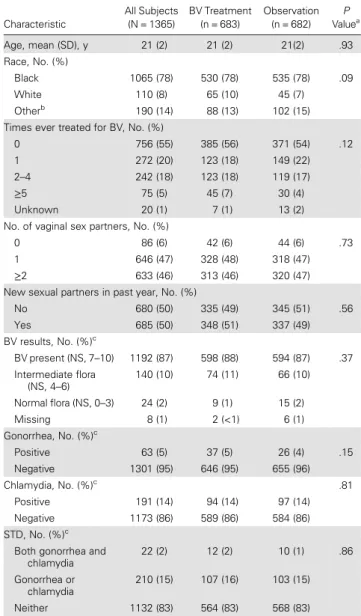
P= .004). Regardless of completion status, data from all evalu-able visits for all randomized subjects were analyzed in the ITT analysis. Table1shows the baseline characteristics of the ITT population stratified by study arm. The 2 arms did not sig-nificantly differ in terms of baseline subject characteristics. At
Figure 1. Participant flow. BV, bacterial vaginosis.
Table 1. Baseline Characteristics
Characteristic
All Subjects (N = 1365)
BV Treatment (n = 683)
Observation (n = 682)
P
Valuea
Age, mean (SD), y 21 (2) 21 (2) 21(2) .93 Race, No. (%)
Black 1065 (78) 530 (78) 535 (78) .09
White 110 (8) 65 (10) 45 (7)
Otherb
190 (14) 88 (13) 102 (15) Times ever treated for BV, No. (%)
0 756 (55) 385 (56) 371 (54) .12
1 272 (20) 123 (18) 149 (22)
2–4 242 (18) 123 (18) 119 (17)
≥5 75 (5) 45 (7) 30 (4)
Unknown 20 (1) 7 (1) 13 (2)
No. of vaginal sex partners, No. (%)
0 86 (6) 42 (6) 44 (6) .73
1 646 (47) 328 (48) 318 (47)
≥2 633 (46) 313 (46) 320 (47)
New sexual partners in past year, No. (%)
No 680 (50) 335 (49) 345 (51) .56
Yes 685 (50) 348 (51) 337 (49)
BV results, No. (%)c
BV present (NS, 7–10) 1192 (87) 598 (88) 594 (87) .37 Intermediate flora
(NS, 4–6)
140 (10) 74 (11) 66 (10)
Normal flora (NS, 0–3) 24 (2) 9 (1) 15 (2)
Missing 8 (1) 2 (<1) 6 (1)
Gonorrhea, No. (%)c
Positive 63 (5) 37 (5) 26 (4) .15
Negative 1301 (95) 646 (95) 655 (96) Chlamydia, No. (%)c
.81 Positive 191 (14) 94 (14) 97 (14) Negative 1173 (86) 589 (86) 584 (86) STD, No. (%)c
Both gonorrhea and chlamydia
22 (2) 12 (2) 10 (1) .86
Gonorrhea or chlamydia
210 (15) 107 (16) 103 (15)
Neither 1132 (83) 564 (83) 568 (83)
Abbreviations: BV, bacterial vaginosis; NS, Nugent score; SD, standard deviation; STD, sexually transmitted disease.
a
Analysis of variance adjusting for site (age) or stratified (by site) Cochran–Mantel–Haenszel test.
b
The“Other”category comprised multiracial (n = 102), missing race (n = 55), Hawaiian/ Pacific Islander (n = 13), Asian (n = 16), and Native American (n = 4).
c
follow-up visits, kit completion rate ranged from 84% to 88% across arms, with no difference in adherence between treatment arms (Figure2).
1-Year Incidence of Chlamydia and Gonorrhea
The 1-year incidence rate of gonorrhea or chlamydia was 18.3 (95% CI, 15.1–22.1) per 100 person-years for the BV treatment arm and 19.2 (15.9–23.2) per 100 person-years for the observa-tion arm in the ITT populaobserva-tion (Table2). This risk difference of
−0.9 (95% CI, −12.0 to 10.1) was not statistically significant (P= .75). The cumulative proportion of subjects with a diagno-sis of gonorrhea and/or chlamydia infection by 12 months was 11.7 (95% CI, 9.3–14.7) for the BV treatment arm and 12.2 (9.7–15.3) for the observation arm (P= .80). Twenty-three sub-jects (2%) had multiple visits with a positive STD test. There was no difference in reported regular use of condoms during the course of the study, with 22% reporting regular use in the treatment arm versus 24% in the control arm.
Prevalence of BV
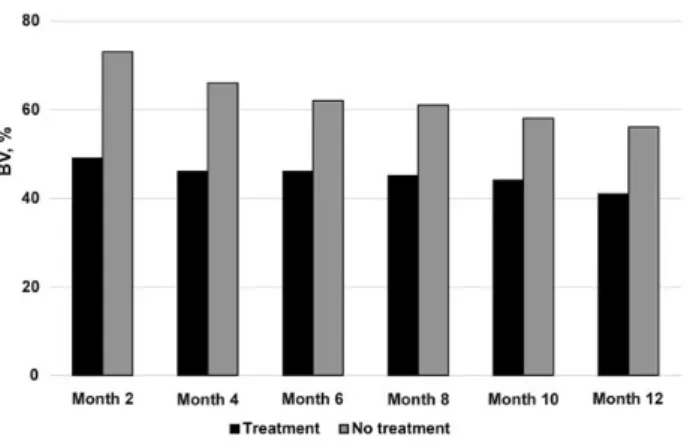
The proportion of subjects with BV at any follow-up visit dif-fered significantly according to study arm, with≥1 diagnosis of BV occurring in 83% of subjects in the BV treatment arm and 93% in the observation arm (P< .001). Considering the pres-ence of BV across all visits, after adjustment for the prior visit’s
BV test result, age, race/ethnicity, and sexual history, the odds of BV being diagnosed at a follow-up visit in the treatment arm was nearly half that in the observation arm (odds ratio, 0.53; 95% CI, .46–.61;P< .001) (Figure3). There was no significant difference in the percentage of women who reported treatment for BV outside the study protocol (11% vs 13% in the treatment and observation arms, respectively;P= .15).
Analysis of Safety Data
There were 9 and 3 serious adverse events in the BV treatment and observation arms, respectively. None of these was deemed to be associated with use of metronidazole. The most common adverse event was vulvovaginal candidiasis, reported by 3% of subjects in both arms, and urinary tract infections, reported by 2% in the treatment arm and 3% in the observation arm. Thirty subjects (4.4%) experienced gastrointestinal events in the treat-ment arm and 12 (1.8%) in the observation arm (P= .005).
DISCUSSION
BV is the most common form of vaginitis and is linked to seri-ous sequelae, such as preterm birth and acquisition/transmis-sion of STD [8,17,18]. Although treatment recommendations differentiate between women who report symptoms and those who do not [4], this differentiation is probably somewhat arbi-trary. In a large study of vaginalflora patterns, 63% of women with BV denied having vaginal discharge and/or odor and the difference in reported vaginal symptoms between women with and without BV was small [3]. To our knowledge, there are no published studies on differences in sequelae between asymp-tomatic and sympasymp-tomatic BV. However, adverse outcomes linked to BV are probably caused by alterations in the vaginal
flora that are seen in both [18,19]. Current recommendations for withholding therapy for asymptomatic BV allowed us to eth-ically randomize women to observation alone [4].
We hypothesized that screening and treatment for asymp-tomatic BV would prevent STDs by restoring optimal vaginal
flora, thus reducing susceptibility to STDs. This hypothesis is supported by studies consistently demonstrating an associa-tion between BV and an increased prevalence and incidence Figure 2. Adherence to kit collection.
Table 2. Sexually Transmitted Disease Follow-up Event Rates and Intent-to-Treat Population Total Follow-up for the Cohort (1137.4 Person-years in 1365 Subjects)
Randomization Arm
Gonorrhea Chlamydia Gonorrhea or Chlamydia
BV Treatment (n = 683)
No BV Treatment (n = 682)
BV Treatment (n = 683)
No BV Treatment (n = 682)
BV Treatment (n = 683)
No BV Treatment (n = 682)
Total follow-up, person-years 580.0 557.4 580.0 557.4 580.0 557.4
Total visits with any STD, No. 26 19 80 88 106 107
Rate per 100 person-years (95% CI) 4.5 (3.1–6.6) 3.4 (2.2–5.3) 13.8 (11.1–17.2) 15.8 (12.8–19.5) 18.3 (15.1–22.1) 19.2 (15.9–23.2) Rate difference (95% CI) 1.1 (−4.0 to 6.1) (P= .46) −2.0 (−11.8 to 7.8) (P= .47) −0.9 (−12.0 to 10.1) (P= .75)
of STDs and human immunodeficiency virus (HIV) infection [6–8,20,21].
We are aware of only 2 prospective studies addressing wheth-er treatment of asymptomatic BV prevents STD acquisition [9]. In one trial, treatment of BV with metronidazole gel followed by twice-weekly gel as BV prophylaxis reduced the incidence of chlamydia [9]. A recent, secondary analysis from a trial of intra-vaginal metronidazole and miconazole [22], showed a trend to-ward lower incidence of chlamydia and gonorrhea in the treatment arm compared with the placebo arm [23].
Although STDs were common in our study, (nearly 20 infec-tions/100 woman-years), we found no difference in the inci-dence of chlamydia or gonorrhea during 1 year of follow-up. Women randomized to treatment for asymptomatic BV had lower rates of future BV, an expectedfinding. The lack of re-duction in the incidence of chlamydia and gonorrhea suggests either that asymptomatic BV is not causally linked to a woman’s increased risk of STDs or that cure rates with metronidazole or duration of cure were insufficient to protect against STDs. In terms of risk associated with treatment of asymptomatic BV, we found that the overall rate of adverse events was low and did not differ substantially between treatment and observation arms, except for gastrointestinal side effects.
Several limitations of our study warrant mention. It was not possible to blind participants or local research staff to random-ization arm. However, we do not believe that this knowledge would affect a participant’s risk of acquiring an STD. Laborato-ry staff evaluating the main outcome were blind to study assign-ment. We do not have information on adherence to treatment with metronidazole among women in the treatment arm. Lack of adherence to a treatment regimen is an issue on clinical trials as demonstrated in a study of preexposure prophylaxis for HIV infection [24]. Adherence in our study may have been affected by the fact that these women had no symptoms to alleviate as well as by the unpleasant taste of metronidazole. Although
the study conducted testing for chlamydia and gonorrhea every 4 months, we did not obtain information regarding chla-mydial or gonococcal infections diagnosed outside the trial. In another trial of home screening for chlamydia and gonorrhea, subjects received an average of 1 to 2 STD tests per year outside the testing protocol [25]. However, the nearly identical rates of STD diagnoses within our trial make it unlikely that a signifi -cant difference in overall STD rates would be found, even if these additional test results were known and included. Further-more, this analysis only considered the effect of BV treatment on chlamydial and gonococcal infections and did not include other STDs, such as trichomonas or HIV infection.
In summary, this is the largest study to ever evaluate the im-pact of treatment of BV on STD outcomes and demonstrated that women were very compliant with the submission of self-collected vaginal specimens mailed every 2 months. However, based on this study, treatment of asymptomatic BV with oral metronidazole does not affect the incidence of gonorrhea or chlamydia. If more effective therapies for BV become available, consideration should be given to revisiting this approach.
Notes
Acknowledgments. We gratefully acknowledge the support of Jonathan
Glock, National Institute of Allergy and Infectious Diseases (NIAID) Clinical Project Manager.
Financial support. This work was supported by the Division of
Microbiology and Infectious Diseases of the NIAID (contract HHSN26620040073C).
Potential conflicts of interest. All authors: No reported conflicts. All
authors have submitted the ICMJE Form for Disclosure of Potential Con-flicts of Interest. ConCon-flicts that the editors consider relevant to the content of the manuscript have been disclosed.
References
1. Hillier SL. Diagnostic microbiology of bacterial vaginosis. Am J Obstet Gynecol
1993; 169:455–9.
2. Eschenbach DA, Hillier S, Critchlow C, Stevens C, DeRouen T, Holmes KK. Diag-nosis and clinical manifestations of bacterial vagiDiag-nosis. Am J Obstet Gynecol1988; 158:819–28.
3. Klebanoff MA, Schwebke JR, Zhang J, Nansel TR, Yu KF, Andrews WW. Vulvo-vaginal symptoms in women with bacterial vaginosis. Obstet Gynecol2004; 104:267–72.
4. Workowski KA, Bolan GA. Sexually transmitted diseases treatment guidelines, 2015. MMWR Recomm Rep2015; 64:1–137.
5. Ness RB, Kip KE, Soper DE, et al. Bacterial vaginosis (BV) and the risk of incident gonococcal or chlamydial genital infection in a predominantly black population. Sex Transm Dis2005; 32:413–7.
6. Wiesenfeld HC, Hillier SL, Krohn MA, Landers DV, Sweet RL. Bacterial vaginosis is a strong predictor ofNeisseria gonorrhoeaeandChlamydia trachomatis infec-tion. Clin Infect Dis2003; 36:663–8.
7. Martin HL, Richardson BA, Nyange PM, et al. Vaginal lactobacilli, microbialflora, and risk of human immunodeficiency virus type 1 and sexually transmitted disease acquisition. J Infect Dis1999; 180:1863–8.
8. Brotman RM, Klebanoff MA, Nansel TR, et al. Bacterial vaginosis assessed by Gram stain and diminished colonization resistance to incident gonococcal, chla-mydial, and trichomonal genital infection. J Infect Dis2010; 202:1907–15. 9. Schwebke JR, Desmond R. A randomized trial of metronidazole in asymptomatic
bacterial vaginosis to prevent the acquisition of sexually transmitted diseases. Am J Obstet Gynecol2007; 196:517.e1–6.
10. Gaydos CA, Howell MR, Pare B, et al.Chlamydia trachomatisinfections in female military recruits. N Engl J Med1998; 339:739–44.
11. Stergachis A, Scholes D, Heidrich FE, Sherer DM, Holmes KK, Stamm WE. Selec-tive screening forChlamydia trachomatisinfection in a primary care population of women. Am J Epidemiol1993; 138:143–53.
12. Tsai CS, Shepherd BE, Vermund SH. Does douching increase risk for sexually transmitted infections? a prospective study in high-risk adolescents. Am J Obstet Gynecol2009; 200:38.e1–8.
13. Gutman RE, Peipert JF, Weitzen S, Blume J. Evaluation of clinical methods for di-agnosing bacterial vaginosis. Obstet Gynecol2005; 105:551–6.
14. Nugent RP, Krohn MA, Hillier SL. Reliability of diagnosing bacterial vaginosis is improved by a standardized method of Gram stain interpretation. J Clin Microbiol
1991; 29:297–301.
15. Nelson DB, Bellamy S, Gray TS, Nachamkin I. Self-collected versus provider-collected vaginal swabs for the diagnosis of bacterial vaginosis: an assessment of validity and reliability. J Clin Epidemiol2003; 56:862–6.
16. Strauss RA, Eucker B, Savitz DA, Thorp JM Jr. Diagnosis of bacterial vaginosis from self-obtained vaginal swabs. Infect Dis Obstet Gynecol2005; 13:31–5. 17. Eschenbach DA. The role of bacterial vaginosis as a cause of amnioticfluid infection,
chorioamnionitis and prematurity—a review. Arch Gynecol Obstet1993; 16:S282–7. 18. Hillier S. The vaginal microbiol ecosystem and resistance to HIV. AIDS1998;
14:17–21.
19. Eschenbach DA. Bacterial vaginosis and anaerobes in obstetric-gynecologic infec-tion. Clin Infect Dis1993; 16(suppl 4):S282–7.
20. Balkus JE, Richardson BA, Rabe LK, et al. Bacterial vaginosis and the risk of trich-omonas vaginalis acquisition among HIV-1-negative women. Sex Transm Dis
2014; 41:123–8.
21. Gallo MF, Macaluso M, Warner L, et al. Bacterial vaginosis, gonorrhea, and chla-mydial infection among women attending a sexually transmitted disease clinic: a longitudinal analysis of possible causal links. Ann Epidemiol2012; 22:213–20. 22. McClelland RS, Balkus JE, Lee J, et al. Randomized trial of periodic presumptive
treatment with high-dose intravaginal metronidazole and miconazole to prevent vaginal infections in HIV-negative women. J Infect Dis2015; 211:1875–82. 23. Balkus J, Anzala O, Kimani J, et al. Periodic presumptive treatment for vaginal
in-fections may reduce chlamydia and gonorrhea incidence: a secondary analysis from the Preventing Vaginal Infections trial. In: World STI and HIV Congress, Brisbane, Australia, 13–16 September 2015.
24. Marrazzo JM, Ramjee G, Richardson BA, et al. Tenofovir-based preexposure prophylaxis for HIV infection among African women. N Engl J Med2015; 372:509–18.