GERMANY, AND THE UNITED KINGDOM
Claire A. Archer
A thesis submitted to the faculty of the University of North Carolina at Chapel Hill in partial fulfillment of the requirements for the degree of Master of Arts in the Department of Political
Science, Concentration European Governance.
Chapel Hill 2015
Approved by:
John Stephens
Donald Searing
ABSTRACT
Claire A. Archer: The Welfare State and the Social Rights of Asylum Seekers and Refugees in Comparative Perspective:
The Cases of Sweden, Germany, and the United Kingdom (Under the direction of John Stephens)
This thesis examines reception conditions for asylum applicants and social rights for
refugees and non-EU legal immigrants across the United Kingdom, Germany, and Sweden.
These countries are among the top asylum recipients in the EU, but each exemplifies a different
welfare state typology: liberal, Christian democratic, and social democratic, respectively. The
thesis rests on the analytical assumption that welfare regime affects immigrants’ social rights,
but also explores the impact of incorporation regime (inclusive vs. exclusive policies) and “entry
categories” to determine how these influence immigrants’ access to benefits.
There are considerable differences across the regimes, but in all three cases asylum
seekers receive minimal material support and face barriers to labor market participation. There
are huge discrepancies between social rights granted to various entry categories, with asylum
seekers always at the bottom, admitted refugees near the top, and third-country nationals
TABLE OF CONTENTS
LIST OF TABLES ... vi
LIST OF ABBREVIATIONS ... vii
CHAPTER I: INTRODUCTION ... 2
CHAPTER II: BACKGROUND AND LITERATURE REVIEW ... 7
Welfare State Regimes ... 8
Immigrant Incorporation Regimes ... 11
Common EU Legislation in Asylum and Migration ... 13
Historical Development of EU Competence in Asylum ... 14
EU Competence in Non-EU Migration ... 18
CHAPTER III: METHODOLOGY ... 23
National Case Study Justification ... 23
Major Sources of Country-Specific Information ... 28
CHAPTER IV: ANALYSIS OF NATIONAL CASE STUDIES ... 30
THE UNITED KINGDOM ... 33
Overview ... 33
Reception Conditions and Benefits for Asylum Seekers ... 38
Social Rights for Admitted Refugees ... 45
Social Rights for Third-Country Nationals ... 49
GERMANY ... 52
Reception Conditions and Benefits for Asylum Seekers ... 56
Social Rights for Admitted Refugees ... 63
Social Rights for Third-Country Nationals ... 65
SWEDEN ... 70
Overview ... 70
Reception Conditions and Benefits for Asylum Seekers ... 72
Social Rights for Admitted Refugees ... 80
Social Rights for Third-Country Nationals ... 82
CHAPTER V: CONCLUSION ... 87
LIST OF TABLES
Table 1 – Welfare and Incorporation Regimes of Case Studies………13
LIST OF ABBREVIATIONS
AIDA Asylum Information Database
BAMF German Federal Office for Migration and Refugees (from the original German Bundesamt für Migration und Flüchtlinge)
CEAS Common European Asylum System
COMPASS Commercial and operational managers procuring asylum support services (contracts for providing accommodation to asylum seekers in the United Kingdom)
CDU Christian Democratic Union of Germany (in German
Christlich-Demokratische Union)
CSU Christian Social Union of Bavaria
EASO European Asylum Support Office
ECRE European Council on Refugees and Exiles
EMN European Migration Network
EP European Parliament
EU European Union
EU-28 the 28 Member States of the European Union
EURODAC EURODAC Regulation, or EURODAC fingerprint database
FDP Free Democratic Party of Germany (in German Freie Demokratische
Partei)
ILR Indefinite leave to remain
JHA Justice and Home Affairs
LO Swedish Trade Union Confederation (in Swedish Landsorganisationen i
Sverige, literally “National Organisation in Sweden”)
NHS National Health Service (in the United Kingdom)
RIES Refugee Integration and Employment Service
SAP Swedish Social Democratic Party (from the Swedish Sveriges socialdemokratiska arbetareparti)
SMB Swedish Migration Board (in Swedish Migrationsverket)
SPD Social Democratic Party of Germany (in German Sozialdemokratische Partei Deutschlands)
TFEU Treaty on the Functioning of the European Union
ToA Treaty of Amsterdam
UKBA United Kingdom Border Agency
UKVI United Kingdom Visas and Immigration
CHAPTER I: INTRODUCTION
` In the past few decades the European Union (EU) has received massive inflows of
refugees, first from the Baltic States and collapsing communist regimes in the early 1990s and
now from conflict areas in the Middle East and North Africa. In 2014, the 28 Member States of
the EU (EU-28) received 626,065 asylum applicants, an increase of 191,000 applications, or 44
percent more than the previous year (Bitoulas 2015). In 2013, over 100,000 new applications
were lodged in the EU-28, a 32 percent increase compared with 2012 (Bitoulas 2014). In 2014,
like in the previous year, Germany was the largest single recipient of new asylum claims among
the EU-28; in 2014, it recorded an over 60 percent increase in asylum applications compared
with 2013, equivalent to over 80,000 new applications (Bitoulas 2015).
Given the high numbers of new arrivals, the provision of adequate welfare for asylum
applicants, in order to facilitate their integration into their new societies, has never been more
important. The Common European Asylum System (CEAS) was designed in the early 2000s as a
means to harmonize national asylum systems and reduce differences between EU Member
States on the basis of binding EU legislation. Specifically, the CEAS was supposed to prevent
“asylum shopping” and to fix numerous problems stemming from large differences in national
asylum systems. However, after the final round of implementation of the CEAS in 2014, national
asylum systems still differ significantly in many areas of asylum and immigration policy,
This thesis will examine differences in reception conditions for asylum applicants and
formal social rights for admitted refugees and non-EU legal immigrants1 in the United Kingdom
(UK), Germany, and Sweden. It will also explore whether implementation of CEAS Directives
has had any substantive effects on the social rights of asylum seekers and refugees. The UK,
Germany, and Sweden are excellent cases for comparison because they are among the top
asylum recipients in the EU in terms of absolute and relative numbers, but each exemplifies a
different welfare state typology: liberal, Christian democratic, and social democratic,
respectively. This thesis rests on the analytical assumption that welfare regime type affects
immigrants’ social rights. However, examining their social rights through the lens of social
policy alone does not provide a full picture. It is also necessary to analyze the impact of each
country’s incorporation regime – rules and norms that determine immigrants’ inclusion and
exclusion – on immigrants’ social rights, as well as to analyze the impact of forms of
immigration, or “entry categories.” This thesis focuses on three entry categories in particular, to
examine how various forms of immigration – here asylum seekers, refugees, and non-EU legal
immigrants – entail specific rights and influence immigrants’ access to social benefits.
First, this thesis will explore what reception conditions exist for asylum seekers – that is,
while they wait for a decision on their asylum applications, what each welfare state provides in
terms of access to housing, healthcare, education, and the labor market, as well as social benefits
and transfers. In almost all EU Member States, including the three countries studied here,
asylum seekers’ benefits are fully separated from mainstream welfare benefits and/or subject to
1 This thesis uses the terms non-EU immigrant and third-country national interchangeably to refer to
distinct rules and limitations. Comparing reception conditions and asylum support across three
different welfare states and incorporation regimes can illuminate how these regimes affect
asylum seekers’ social rights. Furthermore, the UK, Germany, and Sweden are each subject to
some version of the EU’s common asylum legislation. Both the original and the recast versions
of the Reception Conditions Directive of the CEAS aim to improve and harmonize living
standards for asylum applicants across the EU, essentially establishing minimum social rights
that should be provided for asylum seekers across all Member States. As such, comparing
reception conditions in the UK, Germany, and Sweden will be a valuable way to determine
whether adherence to the CEAS has actually led to substantive changes in national policies and
what differences persist across these welfare regimes. In other words, even though these
countries have distinct welfare and incorporation regimes, have the Directives of the CEAS
harmonized the social rights of asylum seekers across Member States of the EU?
Second, the thesis will look at the social rights granted to admitted refugees across the
three countries, including access to education, healthcare, housing benefits, and the labor
market, in addition to the provision of social benefits. Third, it will examine the social rights of
non-EU legal immigrants in order to situate refugee and asylum seeker experiences in the
context of benefits afforded to other immigrant entry categories. It is valuable to compare rights
among the three entry categories to determine how forms of immigration affect access to
benefits. Across the three countries, asylum seekers are generally at the bottom of the spectrum,
while admitted refugees are at the top, on par with or very close to citizens, and non-EU legal
immigrants are somewhere in between, depending on how the country’s welfare and
incorporation regimes affect their social rights.
Much of the previous research into immigration and welfare has focused on immigration
and the challenges it presents to the welfare state, but few studies have explored the social rights
of asylum seekers, refugees, and immigrants. Fewer still have done this through the lens of
it incorporates the EU dimension, in order to discern whether national welfare states have
adapted their protections for asylum seekers and refugees in response to EU Directives.
Asylum policies within EU Member States are important for two reasons. First, asylum
policies across EU Member States reflect the success – or not – of the CEAS and EU
harmonization in this policy area. Overall, EU competences in the field of immigration and
welfare policies are limited in those Member States that have not adopted the EU’s legal
migration Directives (Denmark, Ireland, and UK). Although the EU has increased its
competences in non-EU legal migration recently, all Member States retain control over the
numbers of third-country nationals they will accept for employment purposes, and all Member
States design and implement social welfare systems and policies as they choose (EMN 2014).
Given the complicated mix of competences between Member States and the EU, an
important question that this thesis will explore is whether implementation of EU Directives in
asylum and non-EU migration policy have affected refugees’ and third-country nationals’ social
rights. The EU has competences in asylum seekers’ reception and admission, but much less
involvement in national immigrant incorporation policies. However, given the growing
importance of immigration in EU and national discourse, it will be interesting to investigate
whether the social rights afforded to admitted refugees and third-country nationals have
changed in each national case, perhaps in response to EU pressures or in response to
anti-asylum and anti-refugee rhetoric in national political discourse.
The second, and even more important, reason to study asylum policies is that social
rights granted to asylum applicants and refugees and the success of these welfare states in
ensuring that these individuals are well integrated figures heavily into the future of European
societies. Social security systems comprise one of the most powerful tools to reduce poverty and
inequality and to foster social inclusion and dignity. By protecting individuals against specific
social risks, such as unemployment, sickness, and disability, social security systems improve
common interest to promote the well-being of their populations through effective welfare
provision, their rules on who has access to social security and healthcare, which benefits are
granted, and under what conditions vary considerably (Jonjić and Mavrodi 2012, 5).
At the same time, anti-immigrant, and, in particular, anti-asylum, rhetoric has increased
across EU Member States. Especially after the 2008 economic crisis, the general climate of
social discontent and economic hardship has worsened, and immigrants have become an easy
target for restrictive policies. Even Sweden, typically lauded for its successful refugee and
immigrant integration policies, has experienced new tensions lately with a rise in inequality and
the increasing popularity of the far-right, anti-immigrant Sweden Democrats in 2014 elections
(Eddy 2015). Anti-immigrant sentiment and asylum controversy seem to be rising in all three of
the countries studied in this thesis, while for the most part, the social benefits of immigrants are
diminishing due to heavy cuts in public expenditures overall, but especially in those dedicated to
immigrant integration (Jonjić and Mavrodi 2012, 8).
For these reasons, this thesis is relevant and timely. By investigating welfare benefits for
asylum seekers and refugees in three ideal-type welfare states in the EU, it will explore
commonalities and differences between national systems in three of the largest
asylum-recipients in the EU. In doing so, it will consider solutions for improving the system as a whole –
that is, replicating positive policies and harmonizing conditions to improve outcomes for asylum
CHAPTER II: BACKGROUND AND LITERATURE REVIEW
The theoretical background of this thesis integrates three areas of existing literature:
comparative research on welfare states, literature on immigration regimes and immigrant entry
categories (and the ways these intersect with welfare regime types), and literature on EU
competences in migration and asylum policy and their influence on social rights for asylum
seekers and third-country nationals. First, the background section will explain the key
dimensions of Esping-Andersen’s welfare state typology, which include: decommodification;
stratifying effects of social policies; relationships between the state, market, and family in social
provision; and finally, dynamics between the welfare state and the structure of employment.
Next, it will explain Diane Sainsbury’s research that compares immigrants’ social rights across
welfare states. Her analytical framework utilizes comparative welfare state research in
combination with research into immigrants’ social rights. In particular, she analyzes
immigration/incorporation regimes along a spectrum of inclusion vs. exclusion and examines
different entry categories and what rights are afforded to each category. The theoretical
background of this thesis as a whole is deeply informed by her work. Finally, the background
section will briefly discuss EU legislation in the realm of asylum and migration policy, including
the historical development of EU competences and what current legislation means for Member
States in practice. Here it is particularly important to understand the components of the CEAS
in order to understand how common EU legislation could affect national asylum systems and
Welfare State Regimes
Esping-Andersen’s Three Worlds of Welfare Capitalism (1990), the seminal work in
welfare regime typologies, identifies three distinct welfare state regimes: liberal (or
market-oriented) welfare states typical of the Anglo-American democracies, the Christian Democratic
regime emblematic of continental Europe, and the Nordic social democratic model. They differ
with respect to how they respond to social inequalities generated by the market (and by
extension by their relative generosity and spending), the ways they condition and regulate wage
distribution and job insecurities that the market is allowed to generate, and by their institutional
logic for distributing welfare functions between the state, the market, and the family (Myles and
Quadagno 2002; Stephens and Huber 2010). Put another way, Sainsbury (2012) pulls out four
principal dimensions of variation in Esping-Andersen’s typology. The first and most important
dimension – decommodification – refers to an individual’s ability to enjoy an acceptable
standard of living independently of his or her participation in the market. The second dimension
comprises the stratifying effects of social policies. Esping-Andersen explains that the “welfare
state is not just a mechanism that intervenes in, and possibly corrects, the structure of
inequality; it is, in its own right, a system of stratification. It is an active force in the ordering of
social relations” (Esping-Andersen 1990, 23). The third dimension includes the relationships
between the state, market, and family in social provision, and the fourth encompasses the
dynamics between the welfare state and the structure of employment (Sainsbury 2012, 10).
In liberal welfare states, usually exemplified by the United States and the UK, citizens are
considered individual market actors who are encouraged to obtain their welfare in the market,
for example, through subsidies for private welfare benefits. Liberal regimes are extremely
reluctant to replace market relations with social rights. Basic security schemes tend to be
means-tested and targeted to a limited clientele of the needy, and social insurance schemes offer
only modest benefits. Liberal states actively and passively encourage market solutions; passively
working poor, and actively by subsidizing private welfare arrangements (Sainsbury 2012, 23).
Liberal social policies tend to stratify the poor and the non-poor and have few de-commodifying
effects (Esping-Andersen 1990; Miles and Quadagno 2002; Sainsbury 2012).
Christian Democratic welfare states – also often called conservative, corporatist, or
Bismarckian2 – offer universal coverage (at least historically) but provide different benefits
under different programs, with rights to benefits based on employment categories, class, and
status, and by public financing or subsidizing of privately provided services. Although social
spending in Christian democratic states is considerably higher than in liberal states and social
rights are extensive, the primary focus is on income transfers that preserve the income and
status of the traditional male breadwinner, and there is only a minimal role for private welfare
arrangements (the market). Given the focus on the traditional family model with the man at the
head, social services that assist with women’s employment (i.e., child care) and provide jobs for
women are modest.
Like Christian democratic states, social democratic welfare states leave a marginal role
for private welfare provision, but provide extensive, universal coverage for citizens, emphasizing
equality of citizenship instead of preserving status differences between occupational groups.
2 The continental European countries are variously referred to as conservative, corporatist, Bismarckian,
or Christian Democratic, depending on the characteristics being emphasized. The term corporatist is used more often by comparative Europeanists to describe the regime’s type of wage bargaining system in which employers’ organizations and union confederations, as well as wage bargaining, are highly centralized. The term conservative is generally employed in the classic European sense of the term, highlighting the regime’s pre-capitalist origins in the dynastic elites of continental Europe. The continental European regimes were decidedly anti-liberal in origin, not at all concerned with market efficiency, but rather with maintaining an organic-hierarchical social order inherited from the past. Historically rights and privileges were differentiated on the basis of class and status, and redistribution was marginal (Myles and Quadagno 2002). Today, the term conservative is also used to describe continental European regimes with reference to their gender policies, although it does not apply in this regard to Belgium and France. The term
Even though both social democratic and Christian democratic welfare states tend to spend a lot
on social protection they do so in fundamentally different ways (Miles and Quadagno 2002).
Social democratic welfare states (found mainly in Scandinavia) emphasize redistribution and
provide high levels of income security to all citizens. These regimes tie welfare to work; they
commit to full employment and remain entirely dependent on its attainment as a source of
continued funding (Esping-Andersen 1990). Because women’s – and everyone’s – place is in the
labor market, the welfare state is service intensive as well as transfer intensive. Social services
provide employment for women as well as childcare and other services that facilitate women’s or
parents’ labor market participation (Huber and Stephens 2000; Myles and Quadagno 2002).
Social democratic and Christian democratic welfare states have created well-entrenched
collective bargaining structures that limit wage dispersion and regulatory institutions that limit
employers’ abilities to hire and fire at will (Myles and Quadagno 2002).
The ways in which each regime assigns welfare provision among state, market,
community, and family reflect certain value commitments and views about the desirable
relationship between these elements. For example, the liberal regime reflects the values of
individual responsibility and efficiency, and the view that the state should primarily rely on
market forces and work with these forces to prevent destitution and provide essential social
services. The Christian democratic regime rejects the primacy of the market, and instead reflects
the Catholic doctrine of harmony and subsidiarity, where the state is responsible for keeping
people out of poverty but not for altering the social order. The family is viewed as the locus of
social order and social welfare; therefore the state only performs the functions that are not
performed well by the family or civil society. Finally, the social democratic regime reflects the
values of solidarity and equality, and the view that the state is charged with counteracting
market forces to realize these values (Stephens and Huber 2010). Many scholars have criticized
Esping-Andersen’s typology for disregarding or oversimplifying more complex aspects of
and Lewis 1995; Sainsbury 1996; O’Connor, Orloff, and Shaver 1999); however, his central
insight about the institutional logic for distributing welfare functions among the state, market,
and family remains remarkably robust (Orloff 1996; Myles and Quadagno 2002).
Immigrant Incorporation Regimes
Welfare regimes alone do not fully explain immigrants’ social rights within the welfare
state. Diane Sainsbury, a comparativist and a scholar of welfare and social policy, has published
extensively about immigrants in the welfare state. Rather than focusing on the impact of
immigration on national welfare systems as most scholars do, Sainsbury studies the impact of
national welfare systems on immigrants’ social rights and well-being. Her major body of
research concerning immigrants and the welfare state, Welfare States and Immigrant Rights
(2012),begins from the fundamental premise that the type of welfare state has a large impact on
immigrants’ social rights. Utilizing Esping-Andersen’s welfare regime typology as a point of
departure, she adds two analytical constructs from international migration literature: the
immigration policy regime, or incorporation regime, and entry categories associated with the
form of immigration.
An immigration policy regime, or incorporation regime, regulates immigrants’ inclusion
in or exclusion from society. It “consists of rules and norms that govern immigrants’ possibilities
to become a citizen, to acquire residence and work permits, and to participate in economic,
cultural and political life” (Sainsbury 2006, 230). Previous scholars have identified four types of
regime, including the imperial regime, the ethnic regime, the republican regime, and the
multicultural regime (Castles and Miller 1993; Baldwin-Edwards and Schain 1994; Williams
1995; Kofman et al. 2000). Building upon these, authors have also described policy models for
managing ethnic diversity, such as the differential exclusionary model, the assimilationist
model, and the multicultural model (Castles and Miller 1998, 244-50). Critics of these ideal type
policies are characterized by convergence, which tends to undermine the usefulness of such
models entirely (Joppke and Morawska 2003).
Rather than categorize immigration regimes in terms of ideal types, Sainsbury (2006;
2012) describes them along a spectrum of inclusiveness. To this she adds an analysis of the form
of immigration, or entry category, which typically has a large bearing on immigrants’ access to
social benefits. The most important entry categories she identifies are labor or economic
migrants, refugees and asylum seekers or political immigrants, ethnic “citizens,” and
undocumented immigrants. For example, refugees with Convention status3 receive the same
treatment as nationals with regard to public assistance and social security benefits, whereas
undocumented immigrants and asylum seekers have either no or minimal claims to social
entitlements. In other words, “entry categories create a hierarchical differentiation of
immigrants’ social rights, and the pattern of stratification is quite different from the stratifying
effects conceptualized in the welfare regime typology” (Sainsbury 2006, 230).
The rights of Convention refugees are usually on par with those of citizens, and because
of their protected legal status, refugees’ rights are less vulnerable to welfare state retrenchment.
The type of welfare regime has essentially the same impact on their rights as it does on the rights
of citizens. In contrast, the rights of asylum seekers are very tenuous and have diminished in
recent years (Sainsbury 2006, 240); in all three cases in this study, asylum seekers cannot
access mainstream welfare benefits. This thesis examines the impact of welfare regime,
incorporation regime, and entry category on the social rights granted to asylum seekers and
3 A refugee with Convention status refers to an individual who has been designated a refugee based on the
refugees (although one necessarily follows the other) and compares these to the rights of citizens
and third-country nationals in each national case.
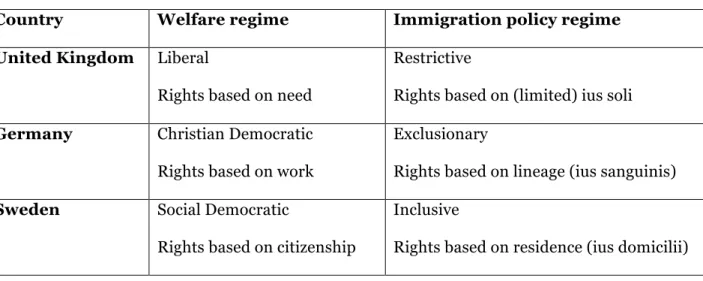
Based on Sainsbury’s comparison of welfare regime and incorporation regime variations,
the three cases of interest in this study are set out in the table below.
Table 1 – Welfare and Incorporation Regimes of Case Studies
Country Welfare regime Immigration policy regime
United Kingdom Liberal
Rights based on need
Restrictive
Rights based on (limited) ius soli
Germany Christian Democratic Rights based on work
Exclusionary
Rights based on lineage (ius sanguinis)
Sweden Social Democratic
Rights based on citizenship
Inclusive
Rights based on residence (ius domicilii)
Sainsbury’s research into each national case will also factor heavily into the country analyses
found in Chapter Four.
Common EU Legislation in Asylum and Migration
This section explores the historical development of EU competences in asylum and
migration, particularly EU legislation as it deals with social rights and benefits for asylum
seekers, refugees, and third-country nationals. Of course, Sweden, Germany, and the UK have
each implemented – or often not, in the case of the UK – EU Directives differently, but
understanding what EU measures exist is an important foundation for the deeper country
Historical Development of EU Competence in Asylum
The EU’s first efforts to cooperate on refugee and asylum policy began in the early 1990s
in response to the rising number of refugees fleeing the Yugoslav Wars and the collapse of
communist regimes in Eastern Europe (ECRE 2013). In 1985 the Schengen Agreement planned
for the gradual removal of Europe’s internal borders to enable the free movement of goods and
people within the European Community. In 1992 the Maastricht Treaty created the EU’s pillar
structure and extended its powers in migration and asylum for the first time. A new third pillar,
Justice and Home Affairs (JHA), established a legal structure for intergovernmental cooperation
in many areas, including asylum and migration of non-EU nationals. In order to achieve one of
its key objectives – the free movement of people – Member States recognized that asylum and
immigration policy had become a matter of common interest for members of the EU (UK
Foreign and Commonwealth Office 2014).
In 1997 the Treaty of Amsterdam (ToA) moved most JHA policy areas relating to the free
movement of people (including asylum, migration, and external border controls) into the first
pillar (European Communities pillar), where the “community method,” or supranational (EU)
decision-making was strongest (Espinoza and Moraes 2012). The ToA introduced Community
legislative competence in the field of migration and asylum largely because there was “a general,
albeit reluctant, acknowledgment that many common problems had a global as well as a
regional dimension to them with … asylum being a case in point” (Velluti 2014: 13). After a
transitional period of five years, in which Member States and the Commission shared the right
to initiate legislation on asylum and immigration, the Commission gained sole right of initiative
on asylum and immigration matters. The ToA also incorporated the Schengen acquis into EU
law, which removed internal border controls and harmonized visa policies (UK Foreign and
Commonwealth Office 2014). Soon after this, the “landmark” moment of EU cooperation on
Council acknowledged that the “’separate but closely related issues of asylum and migration call
for a common EU policy’” (Espinoza and Moraes 2012, 158).
During the first phase of the CEAS, between 1999 and 2005, the EU adopted six
legislative measures that established minimum standards across Member States on the
qualification for refugee status, the reception of asylum seekers, and the procedures for granting
or withdrawing refugee status. They also updated the instruments that established which
Member State would be responsible for determining an asylum application. Overall, they
imposed “significantly more detailed obligations on Member States than the old third pillar
provisions,” (UK Foreign and Commonwealth Office 2014, 17-18). In 2009, the Lisbon Treaty, or
the Treaty on the Functioning of the European Union (TFEU) further widened the scope for EU
action in asylum and migration, allowing the EU to develop policies on asylum and on the
immigration of third country nationals generally rather than merely establishing minimum
standards. The TFEU constituted a significant widening of the EU’s competences in this area
(UK Foreign and Commonwealth Office 2014).
Within a few years of the adoption of the CEAS Directives, the Commission evaluated
their implementation and found persistent inconsistencies in reception conditions and asylum
decision trends, even among Member States with comparable systems and similar caseloads
(Gardella 2013). In 2008, the Commission released “Policy Plan on Asylum: An integrated
approach to protection across the EU” which was intended as a roadmap for the second phase of
the CEAS, with a projected completion date at the end of 2012. In its Policy Plan, the
Commission concluded, “the agreed common minimum standards have not created the desired
level playing field” (European Commission 2008). The Policy Plan proposed a three-pronged
strategy to improve the CEAS and promised to continue monitoring the implementation of
existing provisions. In practice, however, the plan just reiterated the unrealized goals of the first
Per the Commission’s plan, the instruments of the CEAS have undergone review and
revision in the past few years. Most recently, the European Parliament (EP) adopted final
measures in June 2013, ending the legislative harmonization process that began in December
2008 when the Commission presented its first revised proposals in the area of asylum (Pollett et
al. 2013; ECRE 2013). In its current (and purportedly final) harmonized version, the CEAS
includes three Directives (the Qualifications Directive, Asylum Procedures Directive, and
Reception Conditions Directive), the Dublin Regulation, and EURODAC. According to Cecilia
Malmström, EU Commissioner for Home Affairs from 2010 to 2014, the functions of each of the
components of the CEAS are as follows: the Qualifications Directive specifies the grounds for
granting a person international protection and refugee status. Although the 1951 Convention is
“of course valid … the Directive gives a common interpretation of the original definition of a
refugee” (Malmström 2013) so that Member States apply that uniform definition to all refugees
who apply for asylum within their borders. The Asylum Procedures Directive requires that
Member States adhere to minimum safeguards and standards throughout the process of
claiming asylum. It includes standards regarding how to apply, how applications will be
examined, and what help asylum seekers will be given. If asylum seekers are rejected, the
Asylum Procedures Directive specifies common minimum standards for how they should appeal
negative decisions, whether they will be allowed to stay in the country where they applied during
the appeals process, what can be done if they flee, and how to deal with repeated applications.
The Reception Conditions Directive deals with the conditions asylum seekers experience
while they wait for their asylum claims to be examined. The Directive is intended to ensure that
applicants have access to housing, food, healthcare, employment, and medical and psychological
care (European Commission 2014; Malmström 2013). The recast Reception Conditions
Directive introduced several important changes with regard to social benefits for asylum
seekers. It includes strictly delineated rules concerning detention of asylum seekers, stipulates
previous 12 months), and introduces more restrictions for Member States to reduce or withdraw
material reception conditions. It also specifies more rules on conditions under which applicants
can receive free legal assistance and representation in appeal procedures and specific rules on
reception needs of minors and victims of torture (Langer 2014).
The recast CEAS also includes the Dublin Regulation, which sets out explicit rules for
determining which Member State will be responsible for processing and deciding an asylum
case. The system is designed this way to avoid asylum seekers from being sent from one country
to another, and also to prevent asylum seekers abusing the system by submitting applications
for asylum in multiple countries. The Member State designated as responsible for the asylum
application must take charge of the applicant and process the application. According to the
Dublin Regulation, the criteria for establishing responsibility run, in hierarchical order, from
family considerations, to recent possession of visa or residence permit in a Member State, to
whether the applicant has entered the EU irregularly or regularly (European Commission 2014).
Usually, however, the Member State designated as responsible for the asylum application is the
Member State through which the asylum seeker first entered the EU.
Determining where an asylum seeker first entered the EU is possible via the EURODAC
database, the final component of the CEAS. The EURODAC database, in operation since 2003,
is an EU-wide fingerprinting system for asylum seekers and migrants who enter the EU illegally.
When people (over the age of 14) apply for asylum, no matter where they are in the EU, their
fingerprints are transmitted to the EURODAC central system. If, for example, an asylum seeker
submits an application in Sweden but his fingerprints were first registered in Italy, the asylum
seeker will be transferred to Italy, which will take charge of his application for asylum. Asylum
seekers who are transferred to another Member State to have their asylum application processed
(due to the stipulations of the Dublin Regulation) are known as “Dublin Cases” (European Court
of Human Rights 2015; Migration and Home Affairs 2015). The 2013 recast version of the
ensure that an asylum seeker may not be transferred to a Member State where there is a risk of
inhumane or degrading treatment. The update also created an early warning system to detect
and address possible issues in national asylum systems (Malmström 2013). These attempts to
improve the Dublin Regulation were direct responses to the crises that rapidly developed in Italy
and Greece in 2012. EURODAC was also updated in 2013 to address data protection concerns
and to help combat terrorism and serious crime (European Commission 2014; Malmström
2013).
EU Competence in Non-EU Migration
In addition to recognizing the need for common EU action on asylum, the 1997
Amsterdam Treaty and the 1999 Tampere Program extended the EU’s competences in non-EU,
or third-country national, immigration as well. The EU “immigration policy” as it currently
stands concerns the entry, residence, and return of non-EU citizens for employment purposes
(including high-skilled immigrant workers), for purposes of family reunification, and for study
and research. EU legislation also deals with circular migration, illegal immigration, and return
and re-admission of non-EU citizens who reside in the EU without authorization (Jonjić and
Mavrodi 2012). Of course, the EU also wields considerable competences regarding the
movement and settlement of EU citizens within the EU; EU citizens receive special and more
favorable treatment than third-country nationals within the legal framework of EU citizenship
rights. The most important EU Directives relating to third-country nationals, especially their
provisions for welfare and social benefits, are described in the following paragraphs.
While agreement on the non-controversial issues of admitting researchers (Directive
Directive), and students (Directive 2004/114/EC)4, was relatively easy to achieve, the adoption
of common binding EU norms on the entry and residence of third-country nationals for the
purpose of employment has proven far more difficult, and Member States retain high levels of
discretion with regard to granting social benefits to third-country nationals under these
Directives. Directive 2011/98/EU created a single procedure for issuing a single residence and
work permit and established a common set of rights for permit holders. The Single Permit
Directive mandates that third-country nationals with the permit should receive the same
treatment as the nationals of the member state where they reside with regard to conditions of
employment, freedom of association and membership in a labor union or professional
association, education and vocational training, recognition of professional qualifications, social
security, healthcare, access to goods and services (including procedures for obtaining housing
and assistance from employment offices), and tax benefits. The Single Permit Directive does not
apply in the case of third-country nationals who are already posted in a member state,
intra-company transfers, seasonal workers, asylum seekers, long-term residents, illegal immigrants,
or third-country nationals awaiting expulsion or removal from a Member State (EMN 2013;
EMN 2014).
Directive 2003/86/EC on the right to family reunification, which applies to all Member
States except the UK, Ireland, and Denmark, specifies that third-country nationals who legally
reside in a Member State for at least one year and have reasonable prospects for permanent
residence have the right to bring their non-EU national spouse and minor and unmarried
children into the country. Spouses have the right to full access to the labor market (at the latest
one year after their reunification) and both spouses and children have the right to education.
Five years after their reunification, spouses and children reaching majority are granted
4 Council Directive 2004/114/EC on the conditions of admission of third-country nationals for the
autonomous residence permits. However, because Member States have significant leeway in
adapting their national legislation to the Directives’ optional provisions, implementation across
the EU ranges from liberal to restrictive. For example, Member States may authorize family
reunification contingent upon certain conditions, such as requiring that the family member’s
sponsor in country possess stable and regular financial resources and provide adequate
accommodations and sickness insurance to the family member joining him or her5 (EMN 2014).
Directive 2003/109/EC concerning the status of third-country nationals who are
long-term residents – one of the founding instruments of the common EU immigration policy within
the Amsterdam Treaty framework – covers third-country nationals who reside in a Member
State for purposes other than international and temporary protection, studies and vocational
training, seasonal employment, and employment for providing cross-border services.
Third-country nationals who reside continuously and lawfully in a member state for at least five years
acquire the status of long-term resident and are granted equal treatment with the nationals of
Member States in employment access and employment conditions, education, vocational
training, recognition of qualifications, and welfare and social benefits. However, Member States
may decide to restrict long-term residents’ access to employment, education, and welfare and
social benefits (EMN 2014).
It is important to note that EU competences in the field of immigration and welfare
policies are limited in those Member States that have not adopted the EU’s legal migration and
asylum Directives. Additionally, for all Member States, the decisions on the number of
third-country nationals accepted for the purpose of seeking an employment, and the design and
implementation of the social welfare systems rests with the respective Member State (EMN
5 Germany and the UK have requirements about sponsors possessing sufficient resources and stress the
2014). Complicating the implementation and harmonization of EU Directives in asylum and
migration, the UK and Ireland negotiated a special status with regard to the Treaty of
Amsterdam’s Title IV issues – “Visas, Asylum, Immigration, and Other Policies Related to the
Free Movement of Persons” – via three additional Protocols (UK Foreign and Commonwealth
Office 2014). These Protocols include the Opt-In Protocol (which exempts the Ireland and the
UK from provisions made under Title IV unless they decide to “opt-in” to a particular measure),
the Schengen Protocol, and the Frontiers Protocol (which protects their rights to border checks
on anyone entering the country). Per the conditions of the Schengen Protocol, the UK may
request to take part in some or all of the provisions of the Schengen acquis, which was fully
incorporated into EU law with the ToA, too. The UK decided to opt-in to areas of the acquis
involving police and judicial cooperation but did not opt-in to areas involving visas and border
control, as successive UK governments believe that the UK’s national interest was “best served”
by having an independent border and visa policy (UK Foreign and Commonwealth Office 2014).
Thus, despite significant gains in common EU action and legislation on asylum and
migration since the Maastricht Treaty, the balance of competences between the EU and the UK
remains predominantly with the UK. The UK has not opted into the border and visa elements of
the Schengen acquis, and it participates in very few EU legal migration measures, thanks to its
Opt-In Protocol there, too. The UK has chosen not to adopt instruments aimed at establishing
common rules for a range of non-EU migrants, including: workers; students and researchers;
families (including spouses, underage children, unmarried partners, adult dependent children
or dependent older relatives); and those who have resided in a Member State long term,
meaning for at least five years of legal residence (UK Foreign and Commonwealth Office 2014).
On asylum, the current balance of competence is more complex, because the UK is
bound by the first round of CEAS but has not opted into all of the second round legislation. The
UK felt that the recast Directives on Reception Conditions, Asylum Procedures, and
making and encouraging unfounded asylum claims” (UK Foreign and Commonwealth Office
2014, 19). For those recast Directives that it did not opt-in to, the UK remains bound by the
original minimum standards from the first round. However, it elected to opt-in to the recast
versions of the Dublin Regulation and the EURODAC Regulation, as well as the Regulation
establishing the European Asylum Support Office (EASO), an EU Agency that furthers practical
cooperation on asylum, assists with the implementation of the CEAS, and supports Member
States that deal with excessive pressures on their asylum systems (UK Foreign and
CHAPTER III: METHODOLOGY
First, this section justifies the choice of national cases studies. Sweden, Germany, and
the UK each receive some of the highest numbers of asylum applicants within the EU, and each
exemplifies a different welfare state typology and incorporation regime. Second, the
methodological section describes the primary resources used for analysis. This thesis relies on
publicly available sources published by EU bodies and the Member States themselves, which
offer detailed accounts of reception conditions and integration policies for admitted refugees. In
addition, many scholars have already published relevant research concerning welfare states and
immigrant rights. Their analyses assist with this thesis.
National Case Study Justification
To examine the effects of welfare state regime on refugee and asylum seekers’ social
rights, this thesis looks at three EU Member States, each with very high numbers of asylum
seekers and refugees. In the EU in 2013, Germany, Sweden, and the UK, along with France and
Italy, were among the top recipients of asylum applicants, registering 70 percent of all
applicants in the EU-28. In 2014, in terms of total numbers of asylum applicants, including first
time applicants, the UK dropped to sixth position behind Hungary,6 but remains a major
6 Hungary recorded almost 25,000 more asylum seekers in 2014 compared with 2013, an almost 130
recipient of asylum seekers and among the top five Member States in terms of number of first
instance decisions issued in 20147 (Bitoulas 2014; Bitoulas 2015).
The EU-28 recorded a total of 626,065 asylum applications in 2014, which constitutes a
44 percent increase, or 191,000 more applications, compared with 2013. Germany recorded the
highest number of applicants in 2014 (202,645 applicants, or 32 percent of total applicants)
followed by Sweden (81,180, or 13 percent), Italy (64,625, or 10 percent), France (62,375, or 10
percent), Hungary (42,775, or 7 percent), and the UK (31,745, or 5 percent). Among almost
163,000 positive first instance decisions issued in the EU-28 in 2014, Sweden and Germany
granted the highest number. Based on United Nations High Commissioner for Refugees
(UNHCR) data from the first half of 2014, Germany was the largest single recipient of new
asylum claims among the group of industrialized nations studied by the UNHCR, with 65,700
new asylum applications registered in the first half of 2014 (UNHCR 2014a). Sweden was by far
the country with the highest rate of applicants per million inhabitants in 2014, with 8,415
applicants per million inhabitants, followed by Hungary (4,330), Austria (3,295), Malta (3,180),
Denmark (2,610), Germany (2,510), and Luxembourg (2,025), The UK registered 461 asylum
applicants per million inhabitants in 2014 (Bitoulas 2015; Bitoulas 2014).
In 2014, the EU took a total of almost 360,000 first instance decisions, of which 55
percent were negative decisions (197,025) and 45 percent were positive decisions (162,770). Of
the positive decisions taken, 55 percent received refugee status, 34 percent received subsidiary
protection, and the remaining 11 percent received authorization to stay for humanitarian
reasons (Bitoulas 2015). However, recognition rates differ widely between Member States.
7 Asylum decisions can be distinguished according to the stage of the procedure when they are taken.
According to Eurostat, the EU defines first instance decision as a decision granted by the respective authority acting as a first instance of the administrative/judicial asylum procedure in the receiving country. If an asylum seeker is rejected at first instance, he or she can lodge an appeal. The next step in the asylum procedure, the final decision on appeal, means that all normal routes of appeal in a country have been exhausted. This varies between Member States according to national legislation and
Germany took 97,275 first instance decisions in 2014, of which 58 percent were rejections, 34
percent were refugee status, and 8 percent were other protection statuses. Of its 25,870 first
instance decisions in 2014, the UK rejected 61 percent, while 35 percent of first-time applicants
were granted refugee status and 4 percent were granted protection for humanitarian reasons. In
sharp contrast, Sweden only issued rejections in 23 percent of its total 39,905 first instance
decisions. It granted refugee status to only 26 percent of first-time applicants, but granted
subsidiary protection to 48 percent of first-time applicants and protection for humanitarian
reasons to the remaining 3 percent. Germany granted subsidiary protection to 6 percent of
first-time applicants and the UK granted no onesubsidiary protection (Bitoulas 2015).
The vast majority of asylum seekers in the EU in 2014 came from Syria (122,790
applicants), followed far behind by Afghanistan (41,305), Kosovo (37,875), Eritrea (36,990), and
Serbia (30,810). However, the distribution of asylum applicants from certain countries varies
considerably depending upon the Member State. For example, 33 percent of Syrian asylum
applicants applied in Germany in 2014, followed by 25 percent in Sweden. The next highest
concentration of Syrian applicants was in the Netherlands, with 8 percent. In addition,
recognition rates vary significantly between applicants of different national origins. In the
EU-28 as a whole, 5 percent of Syrian applicants were rejected, yet 51 percent were granted refugee
status and 43 percent were granted subsidiary protection. Thirty seven percent of Afghan
applicants were rejected, and a full 98 percent of Serbians were rejected (Bitoulas 2015). The
significant differences between Member States’ recognition rates is one of the primary reasons
that the CEAS is often criticized, because asylum systems are clearly not harmonized across EU
Member States (Gardella 2013).
Germany, Sweden, and the UK also differ substantially in terms of welfare state regime.
Germany, with its work-related social insurance scheme, corporatist structures, and policies that
affirm traditional societal values, embodies the properties of the Christian democratic regime.
safeguards the standard of living of insured workers and their families; it places high value on
work performance, incorporates stiff work tests, and distributes benefits according to
contributions. In addition, several features of the German welfare system tend to preserve class
and status differentials, such as separate insurance funds for workers, white-collar employees,
and civil servants. Status differentials between classes are perpetuated by the principle of
suitable employment, which guarantees insured persons the right to refuse a job with lower pay
or below their qualifications. Furthermore, earnings- related benefits (combined with no or
marginal taxation of benefits) lead to higher benefit income for salaried employees compared
with wage workers. The principle of subsidiarity, a centerpiece of Catholic social thought which
holds that the state should only intervene when the family or civil society are unable to provide
welfare, is particularly prevalent in Germany, where it is enshrined in the constitution and
major social legislation. Families, local communities, and voluntary organizations wield the
primary responsibility for providing social services, while the German state serves as the
guarantor that these providers fulfill their tasks. Historically, six welfare associations (mainly
denominational and working-class based) have provided services, and non-profit organizations
provide between 65 and 70 percent of services directed to children and the elderly (Sainsbury
2012, 54-55).
Sweden, with its universal social insurance scheme heavily reliant on taxation and with
entitlements based on citizenship and residence, is the prime example of the social democratic
welfare state type. The universalistic social model in Sweden has entailed the expansion of
public services to the entire population (in particular, healthcare, education, employment
services, and childcare), and until the 1990s, the private sector played a negligible role in
providing those services. In the 1950s Sweden introduced work-related benefits to protect
against the loss of earnings. Instead of replacing flat-rate benefits, the combination of citizen
benefits and earning-related benefits means that benefits are available to individuals in the
earnings-related benefits provide income security to employees, whose numbers have increased
since Sweden began implementing active labor market policies in the 1950s. Active labor market
measures remain a crucial characteristic of the Swedish welfare system, with the ultimate goal of
full employment and the right to work for everyone. Finally, Sweden’s social democratic welfare
state emphasizes egalitarian outcomes and redistributive policies; although income inequality in
Sweden has increased since the 1980s, it remains significantly less prominent than in liberal and
Christian democratic welfare regime countries (Sainsbury 2012, 83-84).
The UK, with its heavy reliance on means-tested benefits and market solutions,
embodies the key characteristics of a liberal welfare state regime. Compared with the United
States, which is often considered the prototype of the liberal welfare state, the British welfare
state provides a much broader range of public benefits, including medical care, family and
maternity benefits, and housing and personal services. However, the UK still clearly classifies as
a liberal regime because of its modest social insurance benefits, the prominence of means-tested
benefits based on a bare minimum, and the importance of private welfare benefits and market
solutions. The UK’s postwar welfare state was designed to provide minimum benefits; however,
the combination of flat-rate benefits and low benefit levels increased reliance on means-tested
benefits and supplementary protection through the market. In the UK (and the US) a poverty
test for means-tested benefits restricts access to the needy and benefit levels are quite low. The
UK and the US have relatively high poverty rates, especially children’s poverty (Sainsbury 2012).
While the UK’s private welfare component has been much less prominent compared with
the US, it ranked second to the US in the proportion of GDP comprising private welfare
spending. Indeed, since the 1970s private occupational pensions have increased from 55
percent, reaching 70 percent of total pension income in the mid-1990s. At the same time the
value of public pensions has declined, increasing income inequalities among pensioners.
However, the middle class, which generally has access to private pensions, has received more
been the growing importance of tax benefits (a pro-market solution). Since 1997, the British
government has moved to replace means-tested allowances with income-tested tax benefits to
top up earnings for groups with low pay or “in work benefits” to supplement wages. Essentially,
the tax credit system focuses on wage supplements rather than on insurance benefits that aim at
wage replacement. Tax credits have become an essential part of the UK income transfer system,
and the design of these tax credits has extended means-tested benefits to a larger proportion of
the population (Sainsbury 2012, 36-37).
Major Sources of Country-Specific Information
Fortunately for the scope of this thesis, publicly available EU and national sources
provide detailed accounts of reception conditions for asylum seekers and access to social
benefits for asylum seekers, refugees, and third-country nationals. The European Migration
Network (EMN) offers a wealth of current and consistent reporting about asylum and migration
topics in the EU and its Member States. The EMN was formally established by the European
Council in 2008 with the goal to meet the information needs of European Community
institutions and of Member States’ authorities and institutions on migration and asylum by
providing “up-to-date, objective, reliable and comparable information on migration and asylum
topics” to policy makers at the EU and Member State levels and to the general public (Council of
the European Union 2008). In collaboration with “National Contact Points” in each Member
State, the EMN publishes a variety of reports and studies, ad-hoc queries, policy briefs,
bulletins, and policy factsheets, all of which are publicly available on its website. The EMN’s
output each year is determined by EMN Work Programs developed by the European
Commission. The EMN’s annual Status Report details its progress in implementing the
Commission’s Work Program, but it also publishes country fact sheets describing political and
on Annual Policy Reports produced each year by each EMN National Contact Point. The EMN
also collects and analyzes migration and asylum statistics annually.
Another valuable source of EU and Member State asylum and migration information is
the Asylum Information Database (AIDA), a project of the European Council on Refugees and
Exiles (ECRE), in partnership with Forum Refugiés-Cosi, the Hungarian Helsinki Committee
and the Irish Refugee Council. Similar to the EMN, the AIDA project provides independent and
up-to-date information to the media, researchers, advocates, legal practitioners, and the public
about asylum practices in Europe, focusing especially on asylum procedures, reception
conditions, and detention. Overall, the project aims to improve asylum policies and practices in
Europe and the situation of asylum seekers by providing all involved actors with the appropriate
tools and information to support their advocacy and litigation efforts, both at the national and
European levels. Fourteen country reports (from Austria, Belgium, Bulgaria, Germany, France,
Greece, Hungary, Ireland, Italy, Malta, the Netherlands, Poland, Sweden, and the UK) were
written in the first stage of the AIDA project, from September 2012 to December 2013, and in
the second phase of the project, from January 2014 to December 2015, the database will expand
to include two additional EU Member States (Cyprus and Croatia) as well as two non-EU
neighboring countries (Switzerland and Turkey). AIDA regularly updates its comparative
indicators (the first update was published in spring 2014) and relevant news and advocacy
CHAPTER IV: ANALYSIS OF NATIONAL CASE STUDIES
This chapter examines the social rights of asylum seekers, admitted refugees, and
non-EU legal immigrants in each national case. First, it looks at the reception conditions and social
rights of asylum seekers (including access to housing, healthcare, education, and the labor
market, as well as social benefits and transfers) and how these have changed, or not, since the
final rounds of implementation of the CEAS. Second, it compares the social rights of admitted
refugees and non-EU legal immigrants in the same areas.
The UK, Germany, and Sweden were selected as case studies because each has a high
number of asylum seekers and each exemplifies a different welfare regime type. The
fundamental analytical assumption here is that welfare state type affects immigrants’ social
rights. However, social policy alone cannot explain away all outcomes for immigrants’ social
rights; to complete the picture, it is also necessary to analyze the impact of each country’s
incorporation regime and the impact of entry categories. For example, as a general rule,
admitted refugees are granted access to the same social rights as citizens in all three countries;
however, because of core differences in the countries’ welfare regimes, the social rights of
admitted refugees (and citizens) still differ considerably between the UK, Germany, and
Sweden.
The countries’ incorporation regimes – how inclusive or restrictive they are for
newcomers – also have clear consequences for immigrants’ social rights. For instance, Germany
and Sweden both grant asylum-seeking children and children of asylum seekers access to
education on the same level as citizen children. Sweden, with its inclusive incorporation regime,
school curricula, so asylum-seeking children have the right to receive an education in their
mother tongue. Under Germany’s restrictive incorporation regime, however, many Länder do
not have special language courses to accommodate asylum-seeking children, who tend to
struggle in the German education system as a result. Moreover, in Sweden, a simplified permit
system grants a residence permit almost immediately to anyone expected to stay in the country
for over a year, and residence is the main entry point to accessing non-work-related benefits. In
Germany and the UK, however, foreigners can only obtain permits if they prove they can
support themselves with no “recourse to public funds.” These are just some examples of the
ways in which different immigrant incorporation regimes lead to different outcomes for
immigrants’ rights across the three countries studied here.
It is also essential to analyze the impact of the forms or immigration or “entry categories”
on immigrants’ social rights. In all three countries, asylum seekers’ benefits are organized under
entirely separate welfare schemes from those of the general population. In the UK, their benefit
levels are far below the standard social minimum, in Germany they were far below until very
recently, and in Sweden asylum seekers’ benefits have not been adjusted since 1994. At the
opposite end of the spectrum, admitted refugees are granted access to the same social rights as
citizens. Similarly, highly skilled migrants are fast-tracked for residence permits and have
instant access to all benefits in the UK and Germany. Sweden does not grant permits differently
for highly skilled migrants and has not limited labor migration to only professionals.
However, it is important to note that national immigration policies are not created in a
vacuum; the party in government can have a significant impact on a country’s immigration
regime if that party favors inclusive over restrictive policies, or vice versa. Various scholars have
explored how the existence or growth of far-right parties can affect mainstream parties’ electoral
competition and stances on immigration policy (Mudde 2012; Green-Pedersen and Odmalm
2008; Howard 2010; Schain 2006). Others have investigated the role of external shocks and
van der Torre 2014), as well as general shifts in party alignment and contestation (Hooghe,
Marks, and Wilson 2002; Kitschelt and Rehm 2012; Pardos-Prado et al. 2014). An in-depth
discussion of these topics with regard to the three countries studied here is beyond the scope of
this thesis, but a cursory analysis shows that the party in government has made a difference in
immigration and asylum policies in these case studies. The governing party has made the most
difference in the UK, where almost all of the most restrictive immigration and asylum legislation
has been passed by Conservative governments. In Germany and Sweden, the relationship
between immigration and asylum policy party is less clear-cut but some trends are discernible.
Finally, as could be expected, the EU’s influence in asylum support and in social rights
for refugees and third-country nationals differs greatly between the three countries. It is clearly
stronger in Germany and Sweden than in the UK, which has not opted into most of the EU
legislation dealing with welfare provision for asylum seekers and third-country nationals. In
Germany, implementation of EU Directives appears to have improved reception conditions for
asylum seekers, yet in Sweden, adherence to EU standards has actually led to slightly more