CHOOSE YOUR OWN ADVENTURE: INTERACTIVE NARRATIVES AND ATTITUDE CHANGE
Keenan M. Jenkins
A thesis submitted to the faculty at the University of North Carolina at Chapel Hill in partial fulfillment of the requirements for the degree of Master of Arts in the Department of Psychology
(Social) in the College of Arts and Sciences.
Chapel Hill 2014
ABSTRACT
Keenan M. Jenkins: Choose Your Own Adventure: Interactive Narratives and Attitude Change (Under the direction of Melanie Green)
Most existing research on narratives and attitude change focuses on how traditional narratives can be used as persuasion tools (Green & Brock, 2000). However, interactive
narratives – narratives in which the reader decides the direction of the plot – have garnered little empirical attention. In Study 1, participants read a traditional narrative, an interactive narrative, or no narrative (control). The effect of interactive narratives on attitude change was mediated by readers’ feelings of responsibility for the character’s decisions. Additionally, when readers made decisions based on what they would actually do, identification was increased. In Study 2,
ACKNOWLEDGEMENTS
Any shortcomings in this thesis can be attributed to me; but, if you read goodness on these pages, I share the credit among the following:
My advisor, Melanie Green, for her endless patience, her useful advice, and her unyielding support; my committee members, Keith Payne and Paschal Sheeran, for taking the time to give me their counsel and guidance; my parents, Cleo and Clementine, for supporting me and pushing me (not too much – just enough) when I needed it; the research assistants who helped collect these data and shape these studies; my fellow graduate students, for providing encouragement or commiseration – whichever I most needed at the time; Bread & Butter Bakery, Suzzallo Library at the University of Washington, Wilson Library, and Davis Library, for giving me the right environment in which to write; the National Science Foundation, for financial support.
Thank you to my people. And thank you to Stella.
TABLE OF CONTENTS
LIST OF TABLES………..vi
LIST OF FIGURES………...vii
INTRODUCTION………...8
What is an Interactive Narrative? ……….……….…...9
Narrative Engagement and Persuasion in Interactive Narratives...……….…..11
Individual Differences and Interactive Narratives………..…..16
Overview……….…..18
STUDY 1………...19
Results……….……...24
Discussion………..………29
STUDY 2………...31
Results……….…...33
Discussion………...…...38
GENERAL DISCUSSION………...……….40
CONCLUSION………..43
APPENDIX A: INTERACTIVE NARRATIVE………...…44
APPENDIX B: MEASURES……….……56
REFERENCES………...………...71
LIST OF TABLES
Table 1 - Study 1: Means (standard deviations) [95% confidence intervals] and
analyses of variance for dependent variables between conditions……….77 Table 2 - Study 1: Means (standard deviations) [95% confidence intervals] for
decision-making methods in the interactive condition. Within-subjects
variables……….78 Table 3 - Study 1: Means (standard deviations) [95% confidence intervals] and
analyses of variance for individual differences between conditions.………...…….79 Table 4.1 - Study 1: Bivariate correlations between all measures.……….……...80 Table 4.2 - Study 1: Bivariate correlations between all measures.………...….81 Table 5 - Study 2: Means (standard deviations) [95% confidence intervals] and
analyses of variance for dependent variables between conditions.………....82 Table 6 - Study 2: Means (standard deviations) [95% confidence intervals] and
LIST OF FIGURES
Figure 1 - Roadmap of an interactive narrative, using decisions from The Brewsters…………..86 Figure 2 - Study 1: Effect of narrative condition on attitudes toward unprofessional
photos, moderated by gender..………...87 Figure 3 - Study 1: Effect of narrative condition on pharmacy attitudes, moderated
by identification..……….…..88
Figure 4 - Study 1: Indirect effect path diagram..……….…………..……….…..89 Figure 5 - Study 1: Indirect effect path diagram……….……….…..90 Figure 6 - Study 1: Effect of narrative condition on identification, moderated by
need for cognition………..91 Figure 7 - Study 1: Effect of narrative condition on perceived realism, moderated
by transportability………....…..92 Figure 8 - Study 1: Effect of narrative condition on story satisfaction, moderated
by transportability……….………...93 Figure 9 - Study 2: Indirect effect path diagram……….……….…..94 Figure 10 - Study 2:Interaction between narrative condition and need for cognition
on transportation……….….…..95 Figure 11 - Study 2:Interaction between narrative condition and need for cognition
on identification……….……….….…..96 Figure 12 - Study 2:Interaction between narrative condition and need for cognition
INTRODUCTION
You surface, trying to do the awesome head toss you’d seen on so many TV shows, and failing. A lap or two around the pool would be nice, but there are too many bodies in the way. You float about a bit, getting splashed and splashing in return, until you feel the need for the sun again – and, to be honest, more drink – and leave the pool. As you towel off, you walk toward one of the many coolers. The contents are plentiful and varied. Beer, of course. Soft drinks. Sparkling water. You make your decision and reach into the crushed ice, pulling out…
Turn to page 38 to pull out a beer; turn to page 39 to pull out a soda…
- The Brewsters, by Jeffrey P. Spike, Thomas R. Cole, and Richard Buday
In most stories, the reader has no control over the actions of the characters. Usually, stories have a clearly demarcated beginning, middle, ending; the author has already determined the direction of the plot before the reader ever lays eyes on the narrative. However, interactive narratives are different. Interactive narratives, also known as “choose your own adventure” stories, allow the readers to take the driver’s seat and decide the direction of the story’s plot. For example, The Brewsters (Spike, Cole, & Buday, 2011; excerpt above) is an interactive novel in which the reader takes the role of a medical student who navigates ethical dilemmas (e.g., whether to pose for an unprofessional photo or whether to accept a gift from a pharmaceutical representative).
What is an Interactive Narrative?
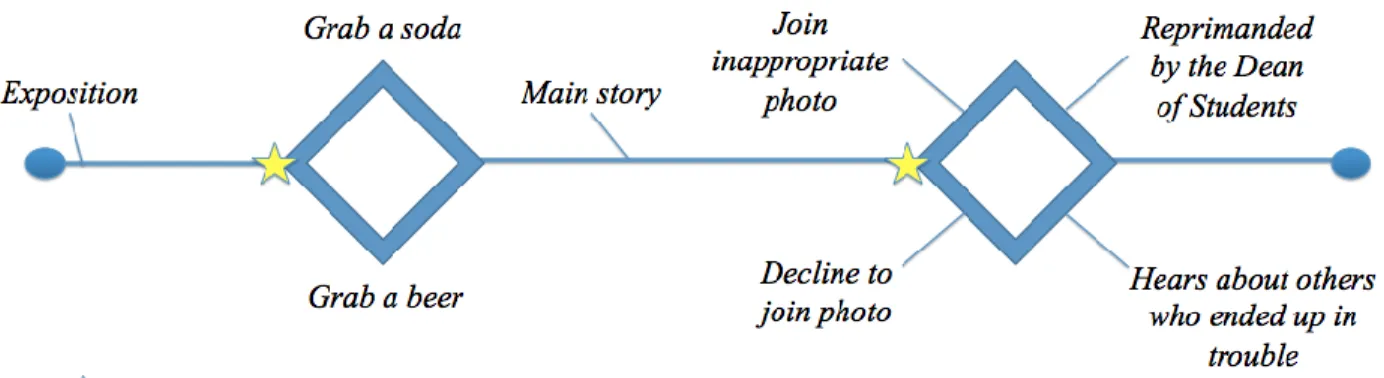
In an interactive narrative, the reader first encounters some introductory material, and then reaches a decision point. At this decision point, the story then branches off in one of two (or more) directions based on the consequences of the reader’s decision. In many narratives, a branching scene then brings the narrative back to the main story (Hand & Varan, 2007, 2008; see Figure 1 for an example). Some interactive narratives ask readers to make decisions every few paragraphs or pages; even in narratives with a relatively high frequency of decision points, there is generally substantial narrative content between each choice. In some interactive narratives, such as The Brewsters, readers may make a few “practice” decisions about minor issues (e.g., which beverage to choose) before making more critical decisions (e.g., accepting or rejecting a gift from a pharmaceutical representative).
Interactive narratives stand in contrast to “traditional” narratives, in which the writer controls the direction and events of the story. Traditional narratives typically move from
beginning to middle to end, without exploring alternative paths or endings.Although interactive narratives can be conveyed in different media (text, audio, video, live performance), the current research focuses on text-based narratives.
Interactive narratives are not new; a web search for “interactive fiction” or “gamebook” reveals a variety of interactive narratives, most created for purely entertainment purposes. These narratives have been written for a wide range of audiences and age groups, from children (e.g., the original Choose Your Own Adventure books; the Give Yourself Goosebumps series by R. L. Stine in the late 1990’s) to adults training to become medical professionals (e.g., The Brewsters). For example, in The Brewsters, the outcomes of the reader’s decisions illustrate the
narratives are not as widely used as other forms of persuasion. However, given the rapid advances in technology (e.g., iPads, Kindles) that allow for a variety of forms of storytelling, research on these narratives is timely.
Narrative Engagement and Persuasion in Interactive Narratives
There is substantial empirical precedent for using narratives as tools for persuasion (see Green & Brock, 2002; van Laer, Ruyter, Visconti, & Wetzels, 2014). Interactive narratives provide fertile ground for gaining a greater understanding of narrative processing; how do individuals respond psychologically to narratives that provide an opportunity for active participation? Here, the existing research on narrative engagement and persuasion is outlined with a focus on why interactive narratives should spur stronger attitude change than traditional narratives. Specifically, I focus on transportation, identification, and responsibility.
Transportation into Narratives
Most people have had the experience of being so engaged in a story that the real world seems to disappear while they peruse the pages. Often, a reader will feel as if the characters are real and the situations in the story are actually occurring. This experience is called transportation into a narrative world. Transportation into narratives is broadly defined as cognitive and
emotional, immersion in a story, accompanied by vivid mental imagery (Gerrig, 1993; Green & Brock, 2000, 2002). Researchers have used a variety of terms to describe these kinds of
immersive states, including narrative engagement (e.g., Busselle & Bilandzic, 2008) and involvement (see Klimmt & Vorderer, 2003).
research by Escalas (2004) showed that this positive affect partially mediates the effect of transportation on subsequent attitudes toward an advertisement and evaluation of a brand. Green and colleagues (2004) have suggested that interactivity should facilitate transportation, leading to an immersive and enjoyable narrative experience. While traditional narratives involve passive engagement, interactive narratives require active engagement. In an interactive narrative, a reader “enacts rather than witnesses the story, and in this way the audience more deeply
[internalizes] and personalizes the story events…the consequences of those events are felt more deeply” (Hand & Varan, 2008, p. 13; see also Murray, 1997). Although there have been few empirical tests of this hypothesis, Hand and Varan (2008) found that interactive television programs were more immersive and entertaining than traditional programs, and that the interactive versions were not more difficult to comprehend than their traditional counterparts. Vorderer, Knobloch, and Schramm (2001) altered the level of interactivity in a movie; those in the high interactivity condition were able to intervene in the story three times, compared to one time for the low interactivity condition and zero times for the no interactivity condition. The results suggested that people with higher cognitive capacity found an interactive movie more entertaining, more suspenseful, and rated it as more positive than a traditional movie. Those with higher cognitive capacity also reported higher levels of empathy for the protagonist in interactive narratives.
pathways in an interactive narrative may even provide additional imagery to the reader. While interactive narrative readers do have to evaluate the plot options at decision points, they will likely be in an immersive mindset and will be unlikely to evaluate or criticize story claims and implications. While it is possible that adding interactivity to a narrative could decrease
immersion, this is doubtful; though readers are momentarily lifted from narrative to make a decision, this process still involves thinking deeply about the events of the story and evaluating the possible plot options. Engagement is unlikely to falter at these points.
Identification
Identification with characters is the process of “merging with the character and sharing the character’s knowledge about the narrated events, adopting the character’s goals…and sharing the character’s emotions” (Tal-Or & Cohen, 2010, p. 404). To identify with a character is to figuratively step into that character’s shoes and feel empathy for the character. During identification, readers “make this leap into another mind” (Oatley, 2002, p. 62) and adopt the character’s point of view.
Identification is similar to transportation, but while the two processes can occur simultaneously, they are conceptually different. Transportation refers to immersion in the
theoretical perspective, and it can be especially important for health persuasion, where stories often involve characters with goals for healthy behavior. Identification with a character temporarily broadens the reader’s perspective; the reader can understand events in a different light and this, too, is a possible path toward attitude change (Cohen, 2001).
Identification and decision-making methods. The ability to control and interactive
narrative opens up multiple paths to identification. These paths are manifested in the way that readers make decisions during the story. Though there may be other possibilities, there are three primary ways that the reader may make decisions for the protagonist. First, the reader might project him or herself into the story, and make a decision based on what he or she would do in that situation. Alternatively, the reader may attempt to understand the character as presented in the story and make the decision based on what that character would do (i.e., take on the
presumed traits and motivations of the character). For example, if a character has been
established as risk-seeking, a reader might choose risky options to be consistent with his or her idea of the character’s preferences. Finally, readers might also treat the story as a game, and simply choose the option that seems most exciting or seems like it would make the best story.
Responsibility for the Story Outcomes
Though readers often feel empathy for a character in traditional narratives, they do not often feel responsibility for the character’s actions and subsequent consequences. However, in interactive narratives, readers choose the character’s actions; thus, readers are likely to feel a sense of responsibility for the consequences and outcomes in the story due to the enhanced user control. These increased feelings of agency in an interactive narrative could lead to more
enjoyment (Roth, Vermeulen, Klimmt, & Vorderer, 2012). Indeed, Klimmt, Hartmann, and Frey (2007) found that higher perceived influence predicted increased enjoyment of an interactive game. However, increased responsibility for negative outcomes could also threaten the reader’s self-concept (Markman & Tetlock, 2000).
Additional research in the health domain suggests that internal attributions of responsibility can lead to attitudinal and behavioral change (Harackiewicz, Sansone, Blair, Epstein, & Manderlink, 1987; Rothman, Salovey, Turvey, & Fishkin, 1993; but also see Sogin & Pallak, 1976; Kelley, 1967). Rothman and colleagues (1993) altered a persuasive message about breast cancer and mammography to incite either internal or external responsibility. Women in the internal responsibility condition were more likely to feel personally responsible for their self-care, as well as more likely to obtain a mammogram than those in the external responsibility condition. Similarly, in a study about smoking cessation, Harackiewicz and colleagues (1987) found that those who took personal responsibility (internal attributions) for quitting were more successful at abstaining from cigarette use in the long-term.
Counterfactuals
imagined alternatives to reality, or a mental simulation of “what could have happened”
(Kahneman & Miller, 1986; Kahneman & Tversky, 1982). Being able to make decisions in an interactive narrative may make it easier for participants to imagine counterfactuals (Markman, Gavanski, Sherman, & McMullen, 1995). Counterfactual thinking can amplify the emotional response to an event (Kahneman & Miller, 1986). Furthermore, Tal-Or, Boninger, Poran, and Gleicher (2004) found that counterfactuals increase narrative persuasion, particularly if the blame lies with the self. Although traditional narratives can evoke counterfactuals, interactive narratives do so almost by definition: at each decision point, readers can imagine a “road not taken.” If interactive narratives do indeed lead to increased feelings of responsibility for story outcomes, then the presence of these counterfactuals may lead to attitudinal and behavioral change. This could be especially effective when a reader chooses an option that leads to
negative consequences for the character; counterfactual thinking is more common with negative outcomes (Roese & Hur, 1997). While there is a potential for readers to have their self-concept threatened, interactive narratives should provide a safe space for readers to either imagine or feel responsibility for negative outcomes and explore counterfactuals. Though investigating
counterfactuals is beyond the scope of the current studies, further research should consider their importance in interactive narratives.
Individual Differences and Interactive Narratives
An individual’s traits may be important when examining the impact of interactive
Need for Cognition
Need for cognition is the extent to which individuals enjoy engaging in effortful cognitive activity (Cacioppo, Petty, & Kao, 1986). Need for cognition has not been shown to directly predict narrative persuasion. However, high need for cognition people are more likely to become transported into text; in contrast, low need for cognition people are more likely to become transported into movies (Green et al., 2008). This effect of medium appears to be driven by the level of mental effort required; texts are perceived as more effortful than films.
Ostensibly, interactive narratives require more mental effort than traditional narratives; thus, it follows that interactive narratives should be more enjoyable for people high in need for
cognition.
There has been some evidence that need for cognition can impact how people perceive interactive media. Vorderer and colleagues (2001) showed that people with higher cognitive capacity, compared to people with lower cognitive capacity, rated an interactive movie as more entertaining and more positive than a traditional movie, as well as reported higher levels of empathy for the protagonist. Viewers with lower cognitive capacity likely found the interactive framework distracting and displeasing.
Transportability
Transportability refers to individuals’ general tendencies to become transported into stories (Dal Cin, Zanna, & Fong, 2004; Mazzocco, Green, Sasota, & Jones, 2010). Individuals who are more transportable are more likely to become transported into any particular story, and are therefore more likely to be persuaded by narratives. The effect of transportability on
individuals who are more transportable will be more engaged and influenced by interactive narratives than their less-transportable peers. Furthermore, higher transportability may mean that individuals are less affected by the potential interruptions to the narrative structure caused by the decision points in an interactive narrative, because they are more easily engaged in narratives.
Overview
Interactive narratives should evoke all of the aforementioned processes. Being able to participate in the narrative should make readers more immersed into the story. Making decisions for a character should encourage identification. Having a hand in the actions and outcomes of the story should make participants feel a sense of responsibility for the events of the narrative. I suggest that these processes differ between interactive narratives and traditional narratives, such that they are stronger in the former, and that interactive narratives will be more effective tools for attitude change. The current research will provide empirical evidence to examine these claims.
STUDY 1
Study 1 examined the effect of interactive narratives, compared to traditional narratives, on subsequent attitudes. I predicted that interactive narratives would facilitate higher engagement (e.g., transportation, identification, feelings of responsibility for the story outcome). Further, I predicted that transportation, identification, and responsibility would independently mediate the effect of interactive narratives on attitudes, such that participants in the interactive narrative condition will report higher levels of the engagement variables, leading to more story-consistent attitudes.
Participants
Participants were 193 undergraduates (98 female, 95 male; 128 White; Mage = 18.75, SD = 1.26) enrolled in an introductory psychology course. All participants were given course credit in exchange for their participation.
Procedure and Design
Participants entered the lab in groups of up to 7 to complete the experiment. After giving informed consent, the rest of the study was conducted entirely using Qualtrics survey software. Study 1 employed a between-subjects design, in which people were randomly assigned to read a traditional narrative, an interactive narrative, or assigned to a no-narrative control group.
(i.e., medical ethics). Those who read the interactive narrative were able to make these decisions for the character (e.g., they decided whether or not John accepted a gift from a pharmaceutical representative). For those reading the traditional narrative, each decision was randomly selected; these readers were not aware that there were other plot options. While the different decisions briefly lead to different actions and consequences within the narrative, all decisions (except for the final decision) lead back to the same plot line (i.e., whether John took a beer or a soda, he still ends up getting asked to join a group photo later). Participants were only able to go through the narrative once; they could not go back to explore other plot options.
After reading the narrative and completing the measures in the order listed below, participants were debriefed and released1. Appendix A contains the interactive narrative; Appendix B contains all measures.
Measures
Behavioral intention items – pharmaceutical. Four items assessed participants’ attitudes
toward behaviors relating the issue of accepting gifts from pharmaceutical representatives. One of the items assessed temptation (“If you were a medical student or a doctor, how tempted would you be to accept free items from pharmaceutical companies?”). One of the items assessed
attitudinal reactions (“It’s not a big deal for medical students/professionals to accept free gifts from pharmaceutical representatives.”). Two items assessed likelihood (“If you were a medical student or a doctor, how likely would you be to accept reduced/free items from pharmaceutical companies?” and “Imagine that you have a friend who is a medical student, and your friend was about to accept a gift from a pharmaceutical representative. Would you encourage or discourage your friend from doing so?”). The two likelihood items were significantly correlated (r = .67, p < .001) and were averaged to make a single likelihood measure.
Behavioral intention items – photo. Eleven items assessed participants’ attitudes toward
behaviors relating to photo issues. Two highly correlated items (r = .69, p < .001) assessed likelihood (e.g., “How likely would you be to post pictures of your friends online in which your friends have an alcoholic drink in their hands?”). Seven items (Cronbach’s α = .92) assessed attitudinal reactions to photo issues (“big deal” subscale; e.g., “What would your reaction be if
1
your friend posted pictures of you online in which you had an alcoholic drink in your hand?”). Two highly correlated items (r = .78, p < .001) assessed attitudes toward how photos can affect careers (e.g., “My professional career would not be affected if my friends posted pictures of me online which I have drinks in my hand.”).
Attitudes. To assess attitudes toward both accepting pharmaceutical gifts and
unprofessional photos, 7 identical semantic differential items were used for each issue. Using a scale from 1 to 7, participants were asked to “Please rate your judgments toward doctors accepting gifts from pharmaceutical companies [allowing pictures of yourself appearing intoxicated to be published online]” on dimensions such as foolish – wise, immoral – moral, or unintelligent – intelligent. Items were recoded when necessary so that higher scores indicate more disapproving attitudes (Cronbach’s αpharmaceutical = .91; Cronbach’s αphotos = .84).
Character evaluations.Participants reported their evaluations of the protagonist using 8 semantic differential items (e.g., unintelligent – intelligent, indecisive – decisive) on a scale from 1-7; higher ratings indicated a more positive evaluation (Cronbach’s α = .84).
Transportation. Narrative transportation was measured using Green & Brock’s (2000)
12-item Narrative Transportation Scale (with 3 additional items to further assess imagery). Participants reported their immersion into the story on a scale from 1 (not at all) to 7 (very much) with items such as “While I was reading the narrative, I could easily picture the events in it taking place” (Cronbach’s α = .82).
Identification. Identification with characters was measured with Cohen’s (2001) 9-item
Perceived realism. Participants also completed a 7-item subset of the Perceived Realism
Scale (Elliott, Rudd, & Good, 1983). These items assessed how real and believable the story seemed to the participants (e.g. “Events that actually have happened or could happen are discussed in this narrative.”). Each item was scored on a scale from 1 (not at all) to 7 (very much) (Cronbach’s α = .63).
Responsibility.Participants in the narrative conditions were asked to report how
responsible they felt for the protagonist’s decisions on a scale from 1 (not at all responsible) to 7 (completely responsible).
Story satisfaction. Participants answered two questions to assess story satisfaction: “How much did you like or dislike the story?” and “How good or bad was the story?” Across the full sample, responses to these questions were strongly correlated (r = .74, p < .001), so these two items were averaged to form a single story satisfaction measure, with higher values indicating a more positive story evaluation (response options ranged from 1 to 7).
Decision-making methods. Three items assessed the way in which people who read the
interactive narrative made their decisions. Using scales ranging from 1 (not at all) to 7 (very much), participants were asked to what extent they made decisions in the story based on: 1) what they thought the character would do; 2) what they would do themselves; and 3) what would make the most interesting story.
Need for cognition. Participants completed the 18-item Need for Cognition Scale
Transportability. Participants completed a 4-item Transportability Scale, an individual
measure that assesses one’s likelihood of being transported into a narrative. Response options ranged from 1 (not at all) to 7 (very much) with items such as, “I can become so absorbed in a story that I forget the world around me.” (Cronbach’s α = .84).
Results
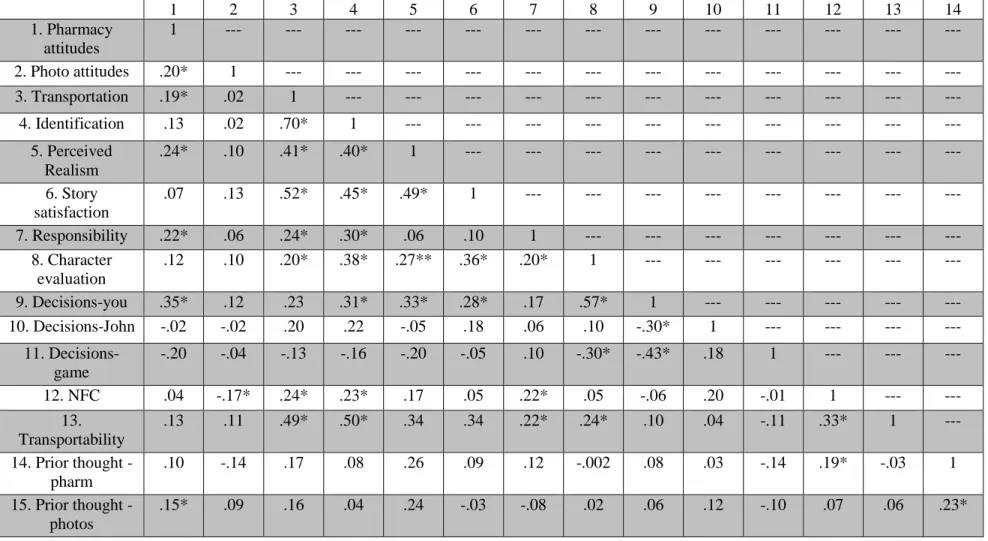
Tables 1-3 contain means, standard deviations, and 95% confidence intervals for dependent variables (Table 1), decision-making methods (Table 2), and individual differences (Table 3). Bivariate correlations between all measures can be found in Tables 4.1 and 4.2. Main Effects for Pharmacy and Photo Attitudes
Contrary to expectations, there was no evidence for a main effect of condition on
pharmacy attitudes, F (2, 188) = 1.34, p = .26. Similarly, there was no evidence for a main effect of condition on attitudes toward unprofessional photos, F (2, 187) = 0.16, p = .85. The effect of narrative condition on photo attitudes was significantly moderated by gender, such that females in the interactive condition showed more disapproval toward unprofessional photos than males, b = -0.30, SE = 0.14, p = .04 (see Figure 2); however, the simple slopes for each condition were not significant.
Main Effects for Behavioral Intention Items – Pharmaceutical
likely participants would be to engage in unethical pharmaceutical behaviors, F (2, 183) = 3.45, p = .03. Again, post-hoc comparisons using the Tukey’s HSD test indicated that those who read the interactive narrative reported that they would be less likely to accept pharmaceutical gifts than those who read the traditional narrative, while the control group did not differ significantly from either narrative condition.
In the interactive narrative condition, participants’ likelihood ratings were significantly correlated with ratings of responsibility (r = .31, p = .02), such that those who reported higher levels of responsibility for the character’s decisions in the story also reported more being less likely to accept pharmaceutical gifts. Similarly, in the interactive condition, participants’ likelihood ratings were significantly positively correlated with perceived realism (i.e., higher perceived realism was associated with being less likely to accept pharmaceutical gifts; r = .36, p = .004). These correlations were not significant in the traditional narrative condition.
Main Effects for Behavioral Intention Items – Photos
For each of three photo subscales, there was no evidence for a main effect of condition on participants’ ratings of taking unprofessional photos, Fs < 1.21, ps > .05. In the interactive
condition, ratings of responsibility were significantly correlated with the “big deal” subscale, such that those who felt more responsible for the character’s decisions in the story reported negative evaluations of taking unprofessional photos, r = 26, p = .04. Similarly, in the traditional narrative condition, ratings of responsibility were significantly correlated with the “likelihood” subscale, such that those who felt more responsible for the character’s decisions in the story reported being less likely to take unprofessional photos, r = .27, p = .046.
Participants did not differ significantly in reported levels of transportation, perceived realism, or story satisfaction across narrative conditions, Fs < 1, ps > .05. However, participants did report higher identification in the interactive condition than in the traditional condition, F (1, 128) = 4.16, p = .04.2
Contrary to the hypotheses, identification did not significantly mediate the effect of interactive narratives on pharmaceutical nor photo attitudes. However, identification was a significant moderator of the effect of condition on pharmaceutical attitudes, b = 0.31, SE = 0.16, p = .05. Participants who reported higher levels of identification reported more story-consistent pharmaceutical attitudes in the interactive narrative condition; however, the simple slopes at each level of identification were not significant. See Figure 3.
Responsibility
In line with the predictions, participants who read the interactive narrative felt more responsibility for the story outcome than those who read the traditional narratives, F (1, 117) = 72.34, p < .001. An SPSS script by Preacher and Hayes (2008) was used to test for evidence of an indirect effect. There was evidence of an indirect effect of narrative condition on pharmacy attitudes through responsibility. This effect was statistically significant, z = 2.53, p = .01. Furthermore, using bootstrapping with 5000 samples, the 95% confidence interval obtained for the indirect effect did not contain zero (0.10, 0.66). These analyses support the model proposed in Figure 4 such that those who read the interactive narrative felt more responsibility, and increased responsibility predicted higher levels of disapproval of pharmaceutical gifts.
Similarly, there was evidence of full mediation for the likelihood ratings, such that the indirect effect of narrative condition on pharmacy-likelihood ratings through responsibility was
2
statistically significant, z = 2.32, p = .02. Furthermore, using bootstrapping with 5000 samples, the 95% confidence interval obtained for the indirect effect did not contain zero (0.10, 0.84). See Figure 5.
Character Evaluations
There was no main effect of narrative condition on character evaluations, F (1, 128) = 0.07, p = .79.3
Decision-making Methods
There was a significant positive correlation between readers making a decision based on what they would do and levels of identification, r = .31, p = .01, as well as with perceived
realism, r = .33, p = .01, and story satisfaction, r = .28, p = .03. Similarly, there was a marginally significant correlation between readers making a decision based on what they would do and levels of transportation, r = .23, p = .08. Making decisions based on what the reader would do was positively correlated with disapproving attitudes toward accepting pharmaceutical gifts, (r = .35, p = .005), as well as negatively associated with participants’ likelihood to accept
pharmaceutical gifts (r = .36, p = .005). See Tables 2 and 4.
3
In contrast, there were no significant correlations between readers making decisions based on what the character would do and any engagement variables, attitude measures, or behavioral intention measures. Similarly, there were no significant correlations between readers making decisions based on what would make the most interesting story and any engagement variables, attitude measures, nor behavioral items.
Prior Thought
The amount of prior thought participants gave to pharmaceutical issues did not predict their pharmacy attitudes, b = 0.07, SE = 0.05, p = .18. Similarly, the amount of prior thought participants gave to photo issues did not predict their photo attitudes, b = 0.04, SE = 0.03, p = .23. Using prior thought as a control variable did not change any of the above results, nor did the interaction between narrative condition and prior thought reveal any significant effects.
Gender
Across all conditions, females (Mfemale = 5.36, SD = 1.00) showed more story-consistent pharmacy attitudes than males (Mmale = 4.75, SD = 1.00), F (1, 189) = 17.74, p < .001. Similarly, females (Mfemale = 6.19, SD = 0.79) showed more story-consistent photo attitudes than males (Mmale = 5.90, SD = 0.82), F (1, 188) = 6.20, p = .01.
Males (Mmale = 2.48, SD = 1.85) reported more prior thought about pharmaceutical issues than females (Mfemale = 1.79, SD = 1.22), F (1, 166) = 8.20, p = .005. Conversely, females
(Mfemale = 5.04, SD = 1.68) reported more prior thought about photo issues than males (Mmale = 4.53, SD = 2.00); this difference was marginally significant, F (1, 184) = 3.63, p = .06.
Males (Mmale = 4.97, SD = 0.99) reported higher levels of story satisfaction than females (Mfemale = 4.48, SD = 1.04), F (1, 128) = 7.38, p = .01.
There was an overall difference in participants’ reports of need for cognition between conditions, such that those in the interactive condition reported higher levels of need for cognition than those in the other conditions, F (2, 188) = 3.16, p = .04. The effect of narrative condition on identification was significantly moderated by need for cognition, b = 0.60, SE = 0.30, p = .05. Participants higher in need for cognition reported significantly higher levels of identification in the interactive condition than in the traditional condition; this simple slope was significant, p = .01. See Figure 6.
Transportability
Participants did not report significantly different levels of transportability across
conditions, F (2, 187) = 0.72, p = .49. The effect of narrative condition on perceived realism was significantly moderated by transportability, b = 0.20, SE = 0.09, p = .03. Those who reported high levels of transportability reported higher perceived realism when reading the interactive narrative. The effect of narrative condition on story satisfaction was also marginally significantly moderated by transportability, b = 0.25, SE = 0.14, p = .08. Those who reported high levels of transportability reported higher satisfaction with the story when reading the interactive narrative. However, none of the simple slopes for transportability were significant. See Figures 7 and 8.
Discussion
Results from Study 1 suggest that the effect of interactive narratives on attitudes may be influenced by key variables such as responsibility and decision making methods. As predicted, responsibility mediated the effect of interactive narratives on attitudes toward pharmaceutical gifts. An unpredicted, but important, finding was that participants who made decisions based on what they would do, rather than what the character would do or what would make an interesting story, were more likely to show disapproval toward issues regarding pharmaceutical gifts. This finding makes sense, as making decision based on what you would do implies a high level of immersion into the narrative. This is evidenced by the significant correlations between making decisions based on what you would do and narrative engagement variables (identification, perceived realism, story satisfaction, and transportation).
Individual differences also played a key role in Study 1. In particular, need for cognition and transportability predicted increased engagement into interactive narratives, but not
traditional narratives. This was not surprising; as stated above, interactive narratives are effortful, and people high in cognition are more likely to become immersed into these types of stories. In Study 2, I will continue to probe these results.
Results from Study 1 spurred further research questions. Might decision-making methods be an important factor when assessing the effect of interactive narratives on attitudes? Study 1 only measured decision-making methods after participants read the story; in Study 2, this
STUDY 2 Participants
Participants were 209 undergraduates enrolled in an introductory psychology course. Twelve data points were deleted due to computer errors (no data was recorded for those
participants); thus, results are reported for 197 participants (99 females; 143 White; Mage = 19.33, SDage = 1.52). All participants were given course credit in exchange for their participation. Procedure and Design
The procedure was identical to Study 1. The same excerpt from The Brewsters was used. Participants were randomly assigned into one of five conditions:
1) A no-narrative control condition, identical to Study 1 (n = 42). 2) A traditional narrative condition, identical to Study 1 (n = 43).
3) An interactive narrative condition in which the readers are told to make decisions based on what they would do (interactive-self condition) (n = 36).
4) An interactive narrative condition in which the readers are told to make decisions based on what they think the character would do (interactive-character condition) (n = 42).
5) An interactive narrative condition in which the readers are told to make decisions based on what they think would make the most interesting story (interactive-game condition) (n = 34).
You are about to read a story in which the main character is John Guerra, a third year medical school student. At certain points, you will be able to make decisions about the direction of the story. At these points, we would like you to make decisions based on what you would do in the situation. Try to put yourself into the story when making decisions. When you are ready, please click the arrow to begin reading.
For those in the interactive-character condition, the italicized phrases read: At these points, we would like you to make decisions based on what you think the character, John would do. Try to think about John’s qualities and traits when making decisions for him. For those in the
interactive-game condition, the instructions read: At these points, we would like you to make decisions based on what you think will make the most interesting story. Think of the narrative as a game, and try to make the plot as entertaining as possible. Participants in each of the
interactive conditions then completed a brief attention check to ensure that they carefully read the instructions and understood their task. Also, in the survey after the narrative, participants were again asked to recall their instructions and the extent to which they felt they were able to follow the instructions. Identical to Study 1, those in the traditional narrative condition saw the introduction without any decision-making instructions.
Measures
responsibility items were highly correlated (r = .86), and so they were averaged together to form a composite responsibility measure.4
Results
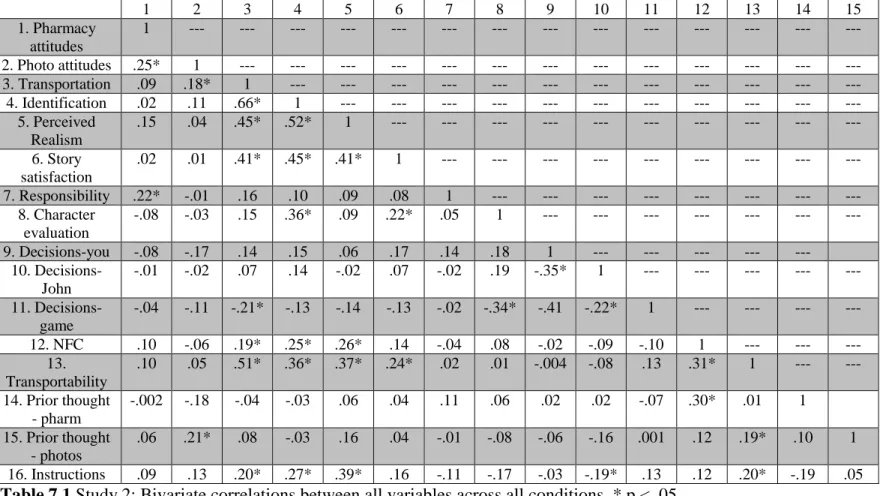
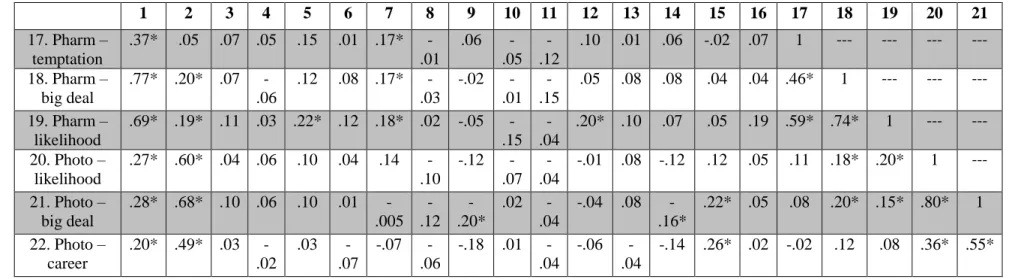
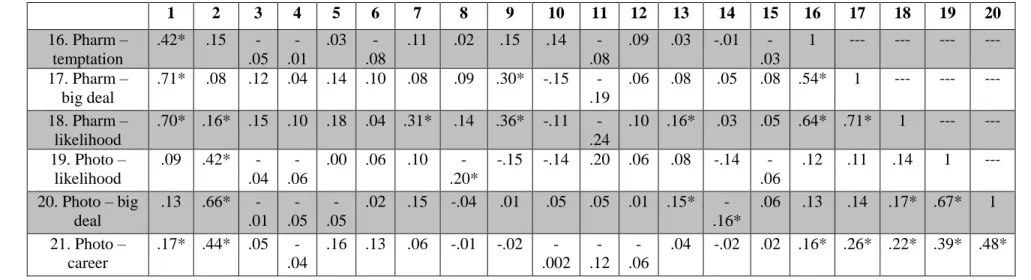
Tables 5-6 contain means, standard deviations, and 95% confidence intervals for the dependent variables (Table 5) and individual differences (Table 6). Bivariate correlations between all measures can be found in Tables 7.1 and 7.2.
Overview of Analyses
The current study consisted of five conditions; thus, the analyses were done differently than in Study 1. Here, analyses of variance were conducted across all conditions to examine main effects of narrative condition. Then, when appropriate, post-hoc comparisons were done using Tukey’s honest significant difference test (HSD). This test compared each of the five conditions against each of the remaining four conditions to examine pairwise differences (e.g., the interactive-self condition was compared to the other four conditions, then the interactive game-condition was compared to the other four conditions, and so forth). Additionally, in line with the hypotheses, two planned contrasts were used. The interactive-self condition (i.e., “make decisions based on what you would do”) was directly compared to the traditional narrative condition, and the traditional narrative condition was compared to the average of all interactive conditions (interactive-all).
4
Manipulation Check
Table 5 shows results for the manipulation checks. Only one participant incorrectly recalled his decision-making instructions. Overall, participants in the interactive conditions reported feeling able to follow the instructions, Ms > 5.67, SDs < 1.24. However, there was a significant difference across conditions, such that those in the interactive-character condition were less able to follow the instructions than those in the other interactive conditions, F (2, 108) = 7.47, p = .001. (However, the mean for the interactive-character condition was 5.67, indicating that though it may have been slightly more difficult for these participants to follow instructions, it was still relatively easy. This difference appears unlikely to affect subsequent results).
Participants in each condition reported actually following the correct decision-making methods. ANOVAs examining the effect of narrative condition on each decision-making method revealed significant differences in the expected direction (e.g., those in the interactive-self condition reported making decisions based on what they would to more than making decisions based on what the character would do or making decisions based on what would be most entertaining), Fs > 69.18, ps < .001.
Main Effect for Pharmacy and Photo Attitudes
There was no evidence for a main effect of condition on pharmacy attitudes, F (4, 190) = 1.16, p = .33. Post-hoc comparisons using the Tukey’s HSD test indicated no significant pairwise differences between conditions. Surprisingly, those who read the traditional narrative reported the less story-consistent attitudes than participants in all other conditions, including control.
Main Effects for Behavioral Intention Items – Pharmaceutical
There was evidence for a main effect of condition on how tempted participants would be to engage in unethical pharmaceutical behaviors, F (4, 190) = 4.74, p = .001. Post-hoc
comparisons using the Tukey’s HSD test indicated that those in the control condition reported more story-consistent temptation ratings than those who read the traditional narrative or the interactive-game narrative. Similarly, there was evidence for a main effect of condition on how likely participants would be to engage in unethical pharmaceutical behaviors, F (4, 188) = 2.61, p = .04. Post-hoc comparisons using the Tukey’s HSD test indicated that those who read the traditional narrative reported less story-consistent likelihood ratings than those who read the interactive-self narrative or those in the control condition.
Participants’ ratings for all three behavioral subscales were significantly correlated with ratings of responsibility (rs > .17, ps < .05), such that those who reported higher levels of responsibility for the character’s decisions in the story also reported more story-consistent behavioral judgments. Participants’ likelihood ratings were significantly positively correlated with perceived realism (r = .22, p = .01) and need for cognition (r = .20, p = .01).
Main Effects for Behavioral Intention Items – Photos
For each of three subscales, there was no evidence for a main effect of condition on participants’ ratings of unprofessional photo behaviors, Fs < 1.04, ps > .05.
Narrative Engagement
Contrary to the hypotheses, there was no evidence for main effects of condition on transportation, identification, perceived realism, or story satisfaction, Fs < 1.28, ps > .05.
was significantly correlated with photo attitudes, r = .18, p = .03. However, because there were no main effects of condition on the engagement variables, these variables could not be examined as possible mediators to test the hypotheses.
Responsibility
There was evidence for a main effect of narrative condition on responsibility, F (3, 139) = 19.47, p < .001. Post-hoc comparisons using the Tukey’s HSD test indicated that participants in each of the interactive narrative conditions reported significantly higher levels of
responsibility than those in the traditional narrative condition. There were no significant pairwise differences in responsibility amongst the three interactive narrative conditions.
Responsibility was significantly correlated with pharmacy attitudes, r = .22, p = .01. Consistent with predictions, there was a significant indirect effect of condition on pharmacy attitudes through responsibility, z = 2.07, p = .04; the 95% confidence interval did not contain zero (0.01, 0.15). As stated above, participants in the interactive conditions reported higher levels of responsibility; higher levels of responsibility predicted more story-consistent pharmacy
attitudes (i.e., disapproval of pharmaceutical gifts). See Figure 9.
Responsibility was also significantly correlated with story-consistent ratings on all three pharmaceutical behavioral measures (temptation, big deal, likelihood), rs > .17, ps < .05. Gender
controlling for amount of prior thought. There was no main effect of gender on any other dependent variable. Gender did not moderate the effect of condition on either attitude variable. Need for Cognition
Across all conditions, need for cognition was significantly correlated with transportation, r = .19, p = .02, as well as identification, r = .25, p = .002, and perceived realism, r = .26, p = .001. Need for cognition was not correlated with any other dependent variables.
Contrary to the hypotheses, higher need for cognition did not predict an increase in levels of identification in the interactive conditions, b = 0.35, SE = 0.28, p = .21; nor did it predict an increase in levels of perceived realism, b = 0.32, SE = 0.21, p = .13. However, need for cognition did predict higher levels of transportation in the interactive conditions, b = 0.42, SE = 0.19, p = .03. See Figures 10-12.
Transportability
Across all conditions, transportability was significantly correlated with transportation, r = .51, p < .001. When transportability was entered as a covariate in all analyses reported above, the results were not affected (i.e., significant results remained significant and non-significant results remained non-significant). 5
Prior Thought
The amount of prior thought participants gave to pharmaceutical issues did not predict their pharmacy attitudes, b = -0.002, SE = 0.06, p = .98. Higher levels of prior thought about photo issues did significantly predict more story-consistent photo attitudes, b = 0.10, SE = 0.18,
5
p = .004 (however, using prior thought as a covariate in photo attitude analyses above did not affect the significance of any results). 6
Discussion
Contrary to the hypotheses, results from Study 2 did not provide evidence that making decisions based on what you would do in the interactive narrative predicted higher levels of engagement. Further, different decision-making methods did not directly predict story-consistent attitudes. Thus, the decision-making manipulation was not successful.
However, Study 2 did replicate important findings from Study 1. Individual difference measures played an important role in engagement with interactive narratives. Consistent with the hypotheses, participants higher in need for cognition were more likely to report higher levels of identification with interactive narratives (as well as higher transportation and higher perceived
6
GENERAL DISCUSSION
The current studies empirically tested the effects of written interactive narratives on attitude change. While the results were not wholly conclusive, the data shed light on previously unknown effects of interactive narratives.
Across two studies, I identified important factors of interactive narratives (and readers) that make them engaging and possible tools for attitude change. Existing literature has suggested that adding interactivity to a narrative could decrease reader engagement. However, Study 1 revealed that transportation and perceived realism did not differ between traditional and interactive narratives, and adding interactivity to a narrative actually increased identification. Identification was also important because people who highly identified with the character tended to make decisions in the interactive narrative based on what they would actually do. These results provide insight on how people respond to the decision-making aspect of interactive narratives.
condition; however, future research could reinforce the instructions throughout the story to strengthen the manipulation.
In both Study 1 and Study 2, responsibility was a key factor. Interactive narrative readers felt more responsible for the character’s decisions and the story outcomes than traditional
narrative readers. High level of responsibility also predicted story-consistent attitude change in both studies. Because they were actually able to direct the plot of the story, interactive narrative readers were likely more invested in the story and made more internal attributions for the events in the story, thus fueling their attitudinal change.
Though not initially predicted, results from both studies also revealed that certain
individual differences (i.e., higher need for cognition, higher transportability) increased readers’ levels of transportation (Study 2), identification (Study 1 and Study 2), and perceived realism (Study 1 and 2) in interactive narratives. Making decisions in interactive narratives can be an effortful task; people higher in need for cognition may be more well-suited for these types of narratives, while low need for cognition readers may find the decision-making distracting and frustrating. Additionally, readers who are easily absorbed into a story world should be more willing to suspend disbelief and judge an interactive narrative as realistic. Future research should examine these variables when assessing the effects of interactive narratives.
Limitations
One important limitation in the current studies was the lack of a direct effect of
interactive narratives on attitudes. In both Study 1 and Study 2, interactive narratives indirectly affected attitudes toward pharmaceutical issues through responsibility. Though the story
about photos). Participants in all conditions, including control, reported negative evaluations of posting inappropriate pictures. This suggests that participants may have already had strong attitudes about this issue; thus, there was little room for their attitudes to change in response to the story. Additionally, the lack of direct effects may suggest that the story was not as powerful as I hoped. It is possible that a different interactive narrative would produce different results. Future Directions
Results from Study 1 provided two interesting avenues for further research: identification/decision-making and responsibility. In Study 2, I chose to explore
CONCLUSION
APPENDIX A: NARRATIVE EXCERPT FROM THE BREWSTERS
To: John Guerra, MS3
Enrique Hernandez, MD
Cordially invites all Health Science Center
students to his annual
Incoming Class Party and Barbecue
Sunday, August 14
1:00 PM
1314 West 6
thAvenue
It’s one of the most anticipated days of the year: Dr. Hernandez’s pool party for the medical school students and faculty.
Sunlight glitters across the pool like out-of-season tinsel, moving and blending and splitting apart again with the bodies splashing about in the water. You sip your drink and will your body to relax even more into the chaise lounge. The sun will chase you into the cool of the pool soon enough – right now you feel on the verge of a perfect moment, a bit of Hill Country Zen you could carry for comfort into your hectic third year of medical school.
Then the moment is gone. Cheryl Stewart rises from the pool, still dripping, towel rubbing across her dark skin. She lands in the lounge next to you with an audible sigh. “I don’t know about you, but I needed this. Did you need this?”
You smile lazily and say, “I needed this.”
She begins to violently buffet her hair with the towel. “You know what I didn’t need?” A pause in the hair drying, as she peeks out from the towel. “The first year students keep getting younger.”
“It’s not that they’re getting younger, it’s that you’re --”
There is an audible snap! as Cheryl brings the wet towel across your chest. “I may be four years older than you, but finish that sentence and I will finish you.”
“Fair enough,” you grin. The wet towel had felt good across your bare chest. The hot Austin summer is doing its best to hang on into the fall, and you know you will soon have to leave this chair, and worse, your drink, to enter the cold embrace of the pool. You look at the pool, crowded with students, some laughing, some splashing, most trying hard to look cool. Some you know, most you don’t.
“Have you seen Dr. Hernandez yet?” you ask Cheryl.
“Couple of times. He keeps coming in and out, playing host. Why? You looking forward to his annual big speech to the newbies? Think it’ll be the same one as last year?”
You drain your drink. “Oddly enough, yeah, I am. I think he really means all that stuff. At least, I hope he does.”
Cheryl smiles and sips her drink. She looks around at the party surrounding her. “Someday I hope I can give the same kind of inspiration to my students. Of course, I’d like a successful practice to afford a pool like this, too.”
“Yeah, that would probably help.”
You pick up the empty bottle and toss it in a nearby bin. “My turn in the pool. Stand back. There’s probably going to be steam when I hit the water.”
Cheryl laughs and drains her drink. “Don’t give yourself airs.”
The water is indeed cold and you’re happy you had the self-control to not yell “Cannonball!” when you jumped in. There had already been several of those,.
You plunge your head into the cooling chlorine. You surface, trying to do the awesome head toss you’d seen on so many TV shows, and failing. A lap or two around the pool would be nice, but there are too many bodies in the way. You float about a bit, getting splashed and splashing in return, until you feel the need for the sun again… and, to be honest, more drink… and leave the pool.
As you towel off, you walk toward one of the many coolers. The contents are plentiful and varied. Beer, of course. Soft drinks. Sparkling water. You make your decision and reach into the crushed ice, pulling out…
--- Decision: pull out a beer or pull out a soda? ---
...pulling out a [cold beer/cold diet soft drink] and twisting the cap off.
Finally, there, at the house, you see your host: Enrique Hernandez, MD, MPH himself, showing some newcomers out to the pool.
Even dressed casually, Dr. Hernandez always looks professional, you think; the khaki pants and linen shirt wouldn’t have looked out of place in some mosquito-netted jungle hospital, and you’re fairly certain you have never seen the doctor sweat.
You hear your name. “John! Hey! John, come over here! You too, Cheryl!”
You finally find the voice’s owner, standing waist deep in the shallow end of the pool. What is his name? Walter, right? Walter is waving you and Cheryl over. In one hand he has a ludicrously pink plastic camera. Walter is motioning to a group forming a few feet away in the pool. “I need a picture! Come on!” Several others start motioning and calling.
Walter motions everyone to get closer together. “Everybody got a beer? Good.” One of the girls looks at the cup in her hand. “Rum and Coke okay?”
getting their MBAs that they made a poor life choice, so I need everyone to look like we are at the Party of the Century. It’s my hope to make them want to slash their wrists with their spreadsheets.” Walter looks up from the camera, a twinkle in his eyes. “So if any of you ladies want to show a little extra flesh, please feel free.” He returns his attention to the camera. “Hurry up, John and Cheryl. I want to see drunk and lecherous on the count of three! One!... Two!...” ---
DECISION: Join the group photograph or decline the photography session? ---
If you join the photograph:
You press yourself into the mass of flesh and look at the camera on “3!” There’s a flash, surprisingly bright in the midday sun. “Okay,” says Walter. “You guys didn’t look crazy enough. Try again and get closer together.”
There’s some generalized splashing and you feel more bodies pressing around you as Walter begins to count down again. “Come on! That’s got to be more enjoyable than you’re making it look! One!... Two!... Three!”
The crush around you begins to relax, but Walter’s still making like some clichéd tyrant film director: “More wanton! Think Health Students Gone Wild!” and the crush returns around you. There are even a couple of calls of “Woo hoo!” Someone shoves a beer into your hand. Blue blobs are dancing before your eyes from the flash, but you’re more than aware that some very attractive young women are pressing themselves against you. One throws her arms around your neck and plants an impulsive kiss on your cheek. You can’t help grinning like a madman. A somewhat embarrassed madman, but what appears to be what Walter wants as the flash goes off again.
The tangle of bodies loosens itself. You cast about for the girl who grabbed you, but whoever she was, she’s gone, off with someone else or in one of the giggling clutches trying to peer over Walter’s shoulder at the camera. You blink rapidly, trying to get rid of the flash spots obscuring your vision. One more photo, you think and you might not have been able to find your way out of the pool…
Two weeks later, you predictably have your hands full. You’re certain there are people somewhere in the universe with busier schedules, but you can’t find it in your heart to feel sorry for them.
There’s something else too. You’re seeing a lot of knowing smiles and hearing an occasional “Hey, Tiger!” or similar remark- like there’s a secret organization of people around you that know something you don’t. But, you also believe it’s too early in the year for stress-related paranoia, so you mentally shrug it off and try to bury yourself in your studies.
Looking at the nursing student as she walks away, you turn to Cheryl. “Do you have any idea what that’s about? I’ve been getting it a lot, lately.”
She looks at you pityingly. “You mean… you don’t know?” “Know what?”
She pulls you into an empty room and begins setting up her laptop on a desk. As it boots, she asks, “So you didn’t get the email from Walter?”
“Walter? I generally just delete those. If he’s not trying to set up a party, it’s all whining about first-year stuff that doesn’t concern me.”
“Oh, this might,” she says, angling the screen toward you. You instantly recognized the thumbnail photo layout of Facebook.
You had an account back in the undergraduate days. You haven’t paid much attention to it since…
Wait a minute. You recognize some of those people in the picture. It takes you a second longer to recognize yourself, you’re grinning so widely in the photo, showing none of that embarrassment you remember. Well, now you know what the girl who kissed you looked like. You don’t remember putting your arm around the girl in front of you, your beer bottle dark against her belly. And you certainly don’t remember grabbing her top and…
“Oh, wow…” you say.
Cheryl considers your witty reply. “Yup, wow is a very good reaction.” “I… I had no idea that was going on.”
“That’s another possible reaction. Frankly, I liked Oh, wow better.” “I’ve got to get him to take that down!”
“I don’t think you’re the first one with that reaction, John, but I’m afraid the damage is already done. Let me show you what a Google search for your name brings up…”
Later that day, you find yourself in front of your mail cubby. An envelope, looking very innocent except for the return address, its top line in bold, impressive copperplate print: OFFICE OF THE DEAN OF STUDENTS.
Dear Mr. Guerra:
It has been brought to our attention by the parent of a student that a certain series of photographs taken during a party at the beginning of the semester have been published on the Internet. These photographs document activities and behavior that do not reflect the image and reputation of our institution and its student body, of which we are justly proud. Therefore, this Office has no choice but to launch an investigation into these photographs and the people responsible. Please make an appointment with the Dean of Students as soon as possible.
There’s more, but you’re concentrating on the plummeting feeling in your gut. This is not going to be pretty…
If you decline the group photo:
You laugh and quietly swim away from the group, hoping that the laugh will soothe any hurt feelings. Lifting yourself up to sit on the edge of the pool, you dry off and head toward the hors d’oeuvres table in the house for some cheese and crackers, instead of the cheesecake you just passed up.
A moment later, you spot Cheryl. “You didn’t want to be in the group shot either?” you ask.
“Group shots I’ll do. What Walter wants is an orgy.”
You glance back at the group in the pool. Walter is calling for a second shot. “More wanton! Think Health Students Gone Wild!”
“Why didn’t you do it? Not enough girls in there?” Cheryl is smirking.
You laugh. “Enough for me. Not for Walter, apparently.” You shrug. “Didn’t feel right. Maybe it’s something I would have done back in my freshman year, but…”
Cheryl laughs. “Let me tell you a secret. Not even in my freshman year. And when I am in one of these photos, I try to make sure I don’t have a drink in my hand, or anything like that.”
“Really? Why?”
“Something I noticed back in my freshman year, genius. My roommate was laughing and showing me this website with all these photos of drunken girls and I realized that they had all been taken from personal sites and whatnot.”
“Well, once stuff like that is out on the Internet, it stays out there forever. So if something like that ever shows up- particularly if it shows up after I’ve got that ‘Doctor’ in front of my name? No way, Jose. I want to be known as ‘The Sober Girl On The End.’”
“Smart.” You put on your best serious face. “Is this the wisdom that comes with age?” She gives you a look you have seen a thousand times. “You know, I bet there is enough going on in that pool that I could drown you and get away with it...”
---
Sometime later, you are trapped in conversation with Walter. You try to excuse yourself again, but Walter keeps engaging you. You figure, what the heck, and chat a bit longer. During the conversation, Walter mentions how excited he is about the White Coat Ceremony at the end of the school year. You remember yours and assure him it will be one of the major highlights of his first year. Like a kid with a shiny new pencil box and fresh school supplies, he proudly tells you how he thoroughly researched and bought all of his supplies months ago. He is particularly proud of his brand new, stainless steel stethoscope. But not because it can let you hear everything from the faintest heartbeat of an unborn child to a full-grown adult. And not because it comes with non-chill rims and adjustable double-leaf binaural springs. And certainly not because it has soft-sealing ear tips or has his name engraved across the head. None of these are as important, Walter points out, as one simple feature – it was free.
For the first time during the conversation, Walter has your full attention. Good stethoscopes are expensive. A wave of jealousy overcomes you as you think about your old, green, off-brand, too-short, pediatric scope. You’ve had the thing ever since you were in undergrad. It still works, but life sure would be better with a new one.
“That’s a nice present, Walter,” you admit.
“Oh it wasn’t a present.” Walter thinks for a moment before continuing. “Hey, I bet you could get one too.”
“I could? How?”
Walter explains that the scope was given to him by a pharmaceutical representative. He met the rep at a conference. The rep said that her company likes to help out medical students, so they authorized her to provide students with free textbooks or basic instruments. They have access to discontinued medical devices. Walter produced a card from his wallet with the rep’s information.
“Here, John. Take this card. I bet she can get you one too.”
would be great to have one in a conservative color. The green was okay during undergrad, but a brand new, twenty-seven inch, in simple gray?...Yes, very professional.
You notice the rep’s mobile number is on the card. You could probably leave a voicemail and get together sometime during the week. You reach into your pocket and feel your cell phone. Or should I? You realize that accepting something for free, even a cup of coffee, from a sales rep of any kind is ethically complicated. You start thinking, what’s the harm in taking something that’s discontinued? If I don’t take it, it will probably be shipped off to some third-world country to be used by some Doctor Without Borders. Not that it isn’t important for poor countries to get supplies, but they usually get help from charitable organizations…and I would be taking just one. Who knows, maybe I’ll even volunteer myself one day and they wouldn’t have to furnish me with a stethoscope, because I would already have one. Right?
---
DECISION: call the pharmaceutical representative or keep your old stethoscope? ---
If you call the pharmaceutical rep:
The day after the party, you get back to business. As you roll out of bed, you fumble for your phone on the nightstand. The screen reads, “MISSED CALL: HEATHER MONROE.”
You don’t know a Heather Monroe, but as you put your phone back on the nightstand, you spot the business card that Walter gave you. It reads, “Heather Monroe, Sales
Representative, DECO Pharmaceutical.” Oh yeah, now I remember.
You push Redial on the phone. You don’t expect the sales rep to answer at this ungodly hour, but to your surprise, the phone rings only twice before a voice answers:
“Hello, this is Heather Monroe.”
“Hi Ms. Monroe, this is John Guerra. I am so sorry to wake you, I--”
“No, no, you didn’t wake me, I’m up and having coffee already. I’m an early riser. It’s going to be a beautiful day! How can I help?”
![Table 1. Study 1: Means (standard deviations) [95% confidence intervals] and analyses of variance for dependent variables between conditions](https://thumb-us.123doks.com/thumbv2/123dok_us/8321166.2205585/77.1188.228.943.145.731/standard-deviations-confidence-intervals-analyses-dependent-variables-conditions.webp)
![Table 2. Study 1: Means (standard deviations) [95% confidence intervals] for decision-making methods in the interactive condition](https://thumb-us.123doks.com/thumbv2/123dok_us/8321166.2205585/78.1188.401.789.146.336/standard-deviations-confidence-intervals-decision-methods-interactive-condition.webp)
![Table 3. Study 1: Means (standard deviations) [95% confidence intervals] and analyses of variance for individual differences between conditions](https://thumb-us.123doks.com/thumbv2/123dok_us/8321166.2205585/79.1188.167.1032.126.450/standard-deviations-confidence-intervals-analyses-individual-differences-conditions.webp)
![Table 5. Study 2: Means (standard deviations) [95% confidence intervals] and analyses of variance for dependent variables between conditions](https://thumb-us.123doks.com/thumbv2/123dok_us/8321166.2205585/82.918.103.820.132.818/standard-deviations-confidence-intervals-analyses-dependent-variables-conditions.webp)
![Table 6. Study 2: Means (standard deviations) [95% confidence intervals] and analyses of variance for individual differences](https://thumb-us.123doks.com/thumbv2/123dok_us/8321166.2205585/83.1188.145.1044.128.462/standard-deviations-confidence-intervals-analyses-variance-individual-differences.webp)