INTRACELLULAR MECHANISMS OF COCAINE-MEMORY RECONSOLIDATION IN THE BASOLATERAL AMYGDALA AND DORSAL HIPPOCAMPUS
Audrey Marie Wells
A dissertation submitted to the faculty of the University of North Carolina at Chapel Hill in partial fulfillment of the requirements for the degree of Doctor of Philosophy in the Department
of Psychology (Behavioral Neuroscience).
Chapel Hill 2013
Approved By:
Rita A. Fuchs Lokensgard, Ph.D.
Regina M. Carelli, Ph.D.
Donald T. Lysle, Ph.D.
Kelly S. Giovanello, Ph.D.
Donita L. Robinson, Ph.D.
ABSTRACT
Audrey Marie Wells: Intracellular Mechanisms of Cocaine-memory Reconsolidation in the Basolateral Amygdala and Dorsal Hippocampus
(Under the direction of Rita A. Fuchs Lokensgard)
The ability of cocaine-associated environmental contexts to promote relapse in abstinent
humans and reinstatement of cocaine-seeking behavior in laboratory animals depends on the
formation and maintenance of maladaptive context-response-cocaine associative memories, the
latter of which can be disrupted by manipulations that interfere with memory reconsolidation.
Memory reconsolidation refers to a protein synthesis-dependent phenomenon whereby memory
traces are reincorporated back into long-term memory storage following their retrieval and
subsequent destabilization. To elucidate the distinctive roles of the basolateral amygdala (BLA)
and dorsal hippocampus (DH) in the reconsolidation of context-response-cocaine memories,
Experiments 1-3 evaluated novel molecular mechanisms within each structure that control this
phenomenon. Experiment 1 tested the hypothesis that activation of the extracellular
signal-regulated kinase (ERK) in the BLA and nucleus accumbens core (NACc – a substrate for
Pavlovian memory reconsolidation) would critically control instrumental
cocaine-memory reconsolidation. To determine this, rats were re-exposed to a context that had previously
been used for cocaine self-administration (i.e., cocaine memory-reactivation) and immediately
thereafter received bilateral intra-BLA or intra–NACc microinfusions of the ERK inhibitor
U0126 or vehicle (VEH) and were subsequently tested for drug context-induced cocaine-seeking
context at test fully reinstated cocaine-seeking behavior, relative to responding in an alternate,
extinction context, and post-reactivation U0126 treatment in the BLA, but not the NACc,
impaired cocaine-seeking behavior, relative to VEH. This effect was associated with a temporary
increase in ERK2, but not ERK1, phosphorylation in the BLA and required explicit reactivation
of the target memory trace (i.e., did not similarly manifest when U0126 was administered after
exposure to an unpaired context), suggesting that ERK in the BLA plays a critical role in
restabilizing contextual cocaine-related memories. Next, Experiment 2 evaluated the hypothesis
that the transcription factor (TF) nuclear factor-κB (NF-κB) would also critically mediate instrumental cocaine-memory reconsolidation in the BLA. Remarkably, the NF-κB inhibitor, sulfasalazine (SSZ), administered bilaterally into the BLA following cocaine-memory
reactivation, did not significantly alter subsequent cocaine-seeking behavior, relative to VEH,
despite producing an observable trend for an enhancement in this behavior. Future studies will be
needed to further examine this relationship, but the present findings may suggest that NF-κB TFs acts as negative regulators of cocaine-memory reconsolidation. Finally, Experiment 3 tested the
hypothesis that members of the Src family of tyrosine kinases (SFKs) are obligatory for
instrumental cocaine-memory reconsolidation. Consistent with our hypothesis, PP2, a
nonspecific inhibitor of SFKs, administered bilaterally into the DH after cocaine-memory
reactivation, attenuated subsequent drug-context induced motivation for cocaine, relative to
VEH, in a memory reactivation-dependent manner. This effect was associated with a preferential
disruption of SFK-mediated phosphorylation of the NR2a N-methyl-D-aspartate receptor
(NMDAR) subunit. Together, these findings begin to illuminate how the BLA and DH may
subserve the long-term stability of maladaptive cocaine-related memories that underlie
ACKNOWLEDGMENTS
From the outset, I would like to express my sincere gratitude to members of my doctoral
dissertation committee: Drs. Rita Fuchs, Regina Carelli, Donald Lysle, Kelly Giovanello and
Donita Robinson for their unfaltering intellectual support and guidance. Most importantly, I
would like to thank all committee members for their patience in the face of many technical
setbacks, which have delayed my progress on this dissertation somewhat.
I would additionally like to thank my advisor, Rita, for her unconditional support of me
as a developing scientist, especially concerning experimental design and written and oral
communication. Additionally, I am extremely grateful for Rita’s superior advice and insights into
the current projects, her patience and encouragement throughout my graduate-level education
(even when I probably did not deserve it), and most importantly, for her integrity in scientific
research, which is regrettably an underappreciated, but nevertheless, essential quality that I hope
to carry with me into future scientific endeavors.
The past and present members of the Fuchs Lab – Dr. Xiaohu (Tiger) Xie, Dr. Heather
Lasseter, Dr. Amy Arguello, Kati Healey, Mark Presker, Sierra Stringfield, Megan Blanton,
Andrew Reittinger, Victoria Greene, and Keona Perry - have all provided exceptional technical
Xiaohu and Megan, who were absolutely integral to the completion of almost all of my projects
and whose unwavering moral support made my journey more than bearable.
I would also like to thank the faculty of the Behavioral Neuroscience Program for
superior instruction in relevant topics and to my friends in the Triangle who helped me deal with
setbacks and made me smile when it was most needed. Finally, I’d like to extend my sincerest
gratitude to my family – my mom, dad, and brother Josh – as well as to my boyfriend and life
TABLE OF CONTENTS
LIST OF TABLES ...x
LIST OF FIGURES ... xi
LIST OF ILLUSTRATIONS ... xii
LIST OF ABBREVIATIONS ... xiii
I. GENERAL INTRODUCTION ...1
1.1 Significance of the Problem ...1
1.2 Memory Reconsolidation: History and Therapeutic Application ...3
1.3 Disruption of Drug Memory Reconsolidation ...6
1.4 Selection of Animal Models: Consideration of Boundary Conditions ...7
1.5 Selection of Animal Models: Pavlovian Versus Instrumental Models of Drug Relapse ...9
1.6 Selection of Animal Models: Cue- Versus Context-Based Models of Drug Relapse ...10
1.7 Neuroanatomical Substrates of Cocaine-Memory Reconsolidation ...14
1.8 Cellular Signaling In Cocaine-Memory Reconsolidation ...16
Extracellular Signal-Regulated Kinase ...17
Nuclear Factor- κB ...18
Src Family of Tyrosine Kinases ...19
II. CONTRIBUTION OF THE MEK/ERK SIGNALING CASCADE TO THE RECONSOLIDATION OF INSTRUMENTAL CONTEXTUAL COCAINE
MEMORIES IN THE BASOLATERAL AMYGDALA ...22
2.1 Introduction ...22
2.2 Methods...24
2.3 Results ...35
2.4 Discussion ...40
III. INVOLVEMENT OF AMYGDALAR NUCLEAR FACTOR–κB IN THE RECONSOLIDATION OF INSTRUMENTAL CONTEXTUAL COCAINE MEMORIES ...53
3.1 Introduction ...53
3.2 Methods...56
3.3 Results ...61
3.4 Discussion ...63
IV. CONTRIBUTION OF DORSAL HIPPOCAMPAL SRC-FAMILY TYROSINE KINASES TO THE RECONSOLIDATION OF INSTRUMENTAL CONTEXTUAL COCAINE MEMORIES ...70
4.1 Introduction ...70
4.2 Methods...73
4.3 Results ...81
4.4 Discussion ...85
V. GENERAL DISCUSSION ...97
5.1 Summary of Experimental Findings ...97
4.2 Molecular Mechanisms of Cocaine-Memory Reconsolidation in the BLA………..101
4.4 Differences in Pavlovian and Instrumental
Drug-Memory Reconsolidation ...111
4.5 Disruption of Drug Memory Reconsolidation
as a Treatment for Addiction. ...113
4.6 Conclusions. ...116
VI. REFERENCES ...118
LIST OF TABLES
Table
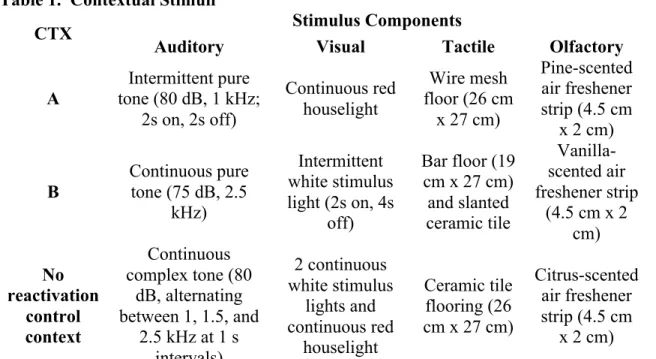
1. Contextual Stimuli ………....27
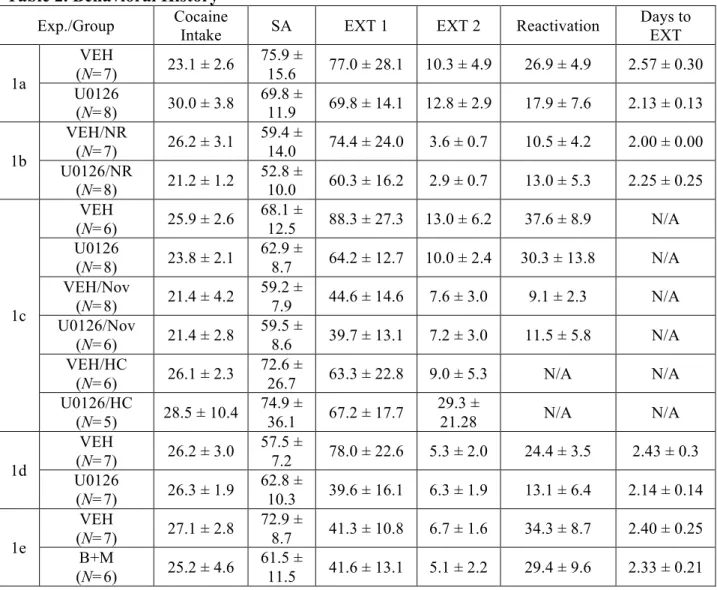
2. Behavioral History Chapter 2………..……….………….36
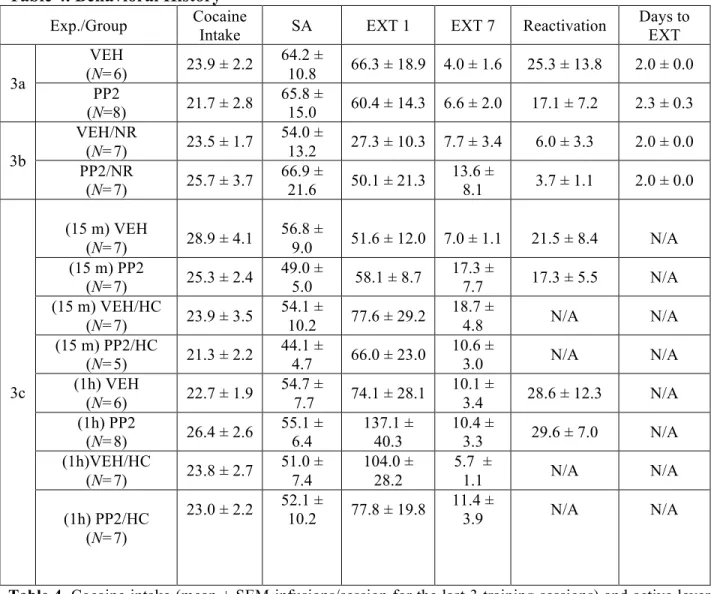
3. Behavioral History Chapter 3……….….………..…61
LIST OF FIGURES
Figure
1.1 ERK inhibition in the BLA immediately after cocaine-memory
reactivation impairs subsequent drug context-induced cocaine seeking,
relative to VEH treatment. ……….………...46
1.2 Schematics depicting cannula placementfor rats in Experiment 1c………...48
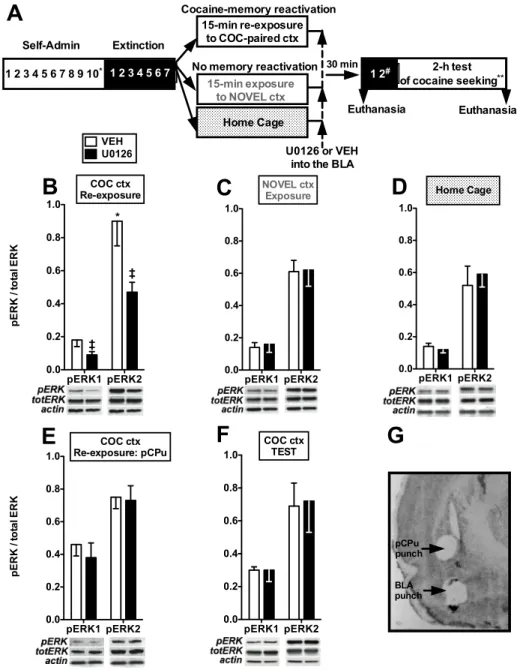
1.3 U0126 in the BLA reduces ERK1 and ERK2 phosphorylation in a
transient and reactivation-dependent manner………49
1.4 ERK inhibition in, or neuronal inactivation of, the NACc after cocaine-memory reactivation fails to disrupt subsequent drug
context-induced cocaine seeking ………...……...51
2 IKK/NF-κB inhibition in the BLA following cocaine-memory reactivation modestly, but non-significantly, alters subsequent
cocaine seeking in a dose-dependent manner………....68
3.1 SFK inhibition in the DH following cocaine-memory reactivation
attenuates subsequent drug context-induced cocaine seeking…………...……...……….91
3.2 SFK inhibition in the DH in the absence of explicit cocaine-memory reactivation fails to alter subsequent drug context-induced
cocaine seeking...…..………..…...93
3.3 SFK inhibition in the DH preferentially suppresses
phosphorylation-dependent activation of NR2a subunits in a time- and
memory reactivation-dependent fashion………..…..94
LIST OF ILLUSTRATIONS
Illustration
1. Putative MEK/ERK signaling during cocaine-memory reconsolidation…………..…...104 2. Mechanisms of Src-mediated cocaine-memory reconsolidation………...………..…....108
3. Possible mechanisms of BLA/DH interactions during
LIST OF ABBREVIATIONS ANOVA analysis of variance
AMPAR α-amino-3-hydroxy-5-methyl-4-isoxazolepropionic acid receptor AP anterior-posterior
BLA basolateral amygdala
B+M baclofen+muscimol
cAMP cyclic AMP
COC CTX cocaine-paired context
CS conditioned stimuli
DH dorsal hippocampus
DV dorsal-ventral
EC entorhinal cortex
ERK extracellular signal-regulated kinase
EXT CTX extinction context
FR1 fixed ratio 1
IL-1β interleukin-1β
iNOS inducible nitric oxide synthase
i.p. intraperitoneal
i.v. intravenous
MAPK mitogen activated protein kinase
MEK MAPK kinase
mGluR1 metabotropic glutamate receptor – Group I
NACc nucleus accumbens core
NF-κB nuclear factor- κB
NMDAR N-methyl-D-aspartate receptor
pCPu posterior caudate putamen
PKA protein kinase A
SEM standard error of the mean
SFK src family tyrosine kinase
SStr trunk region of the somatosensory cortex
CHAPTER 1
GENERAL INTRODUCTION
Significance of the Problem
Drug addiction remains a serious and inadequately addressed public health concern in the
United States, with 22.5 million current illicit drug abusers reported (Substance Abuse and
Mental Health Service Administration 2011) and an associated annual cost of $193 billion
dollars (National Drug Intelligence Center 2011)! Cocaine ranks third among the most abused
illicit substances, with 821,000 individuals meeting criteria for cocaine abuse and/or dependence
in 2011, a statistic surpassed only by marijuana and prescription pain-killers (Substance Abuse
and Mental Health Service Administration 2011). However, emergency room visits related to
cocaine use – an estimated 488,101 in 2010 - far exceeded those associated with other illicit
substance use, including marijuana and heroin (Substance Abuse and Mental Health
Administration 2011).
Negative health consequences and economic costs related to cocaine use are sustained in
part by unsuccessful rehabilitation agendas. This is reflected by the small percentage (10.6%) of
drug abusers requiring treatment who have endorsed taking part in a treatment/rehabilitation
strategy (Substance Abuse and Mental Health Service Administration 2011). Lamentably, in
addition to the small proportion of treatment-seeking addicts, efforts to eradicate cocaine
periods (Gawin and Kleber 1986). The prototypical behavioral pattern of cocaine addiction
involves alternating bouts of abstinence and binge-like, often escalating use (Gawin and Kleber
1986), which occurs in spite of diminished drug reinforcement (Gawin and Kleber 1986; Koob
and Bloom 1988), negative consequences (Everitt et al, 2008), and even volition to discontinue
drug use (Volkow and Fowler 2000).
Individuals who seek treatment outside of their typical drug-taking environment and in
the absence of drug-associated stimuli (i.e., rehabilitation clinics) are particularly vulnerable to
relapse following completion of treatment, in that exposure to discrete drug-related stimuli (e.g.,
paraphanelia) and/or environmental contexts (e.g., crackhouse, bar) are powerful promoters of
craving and relapse in humans (O'Brien et al, 1992; Childress et al, 1988; Foltin and Haney
2000; Franklin et al, 2009) and reinstatement of cocaine-seeking behavior in laboratory rats
(Alleweireldt et al, 2001; Crombag et al, 2002, 2008; Fuchs et al, 2005; Fuchs et al, 2008b).
Over the course of addiction, otherwise innocuous environmental stimuli become endowed with
conditioned reinforcing and incentive motivational properties by virtue of having been
repeatedly paired with the unconditioned motivational effects of the drug of abuse, and this
“transfer” of reinforcement and incentive value requires associative learning processes (Milton
and Everitt 2012). Environmentally-triggered relapse, per se, is thought to require the initial
acquisition and stabilization (i.e., cellular consolidation; Goelet et al, 1986), but importantly, also
the subsequent maintenance and availability of, a highly complex context-response-cocaine
associative memory trace (Fuchs et al, 2005; Crombag et al, 2008). Research into the
mechanisms of drug-memory acquisition and consolidation will likely advance addiction
prevention initiatives, whereas investigation into the processes that maintain long-term
of this, the average drug user seeks treatment 15.6 years following initial drug use and
consolidation of drug memories (Substance Abuse and Mental Health Administration 2011). As
such, the prototypical addict may benefit from treatments designed to weaken, or disrupt the
maintenance of, maladaptive drug-related memories (Taylor et al 2009; Milton and Everitt
2010). Hence, identification of the neurobiological processes required for memory maintenance,
including the reconsolidation (see below) of retrieved memories, will be paramount from an
addiction treatment perspective.
Memory Reconsolidation: History and Therapeutic Application
Recently, promising evidence supporting the memory reconsolidation hypothesis has
suggested that drug-associated memory traces are not rigidly maintained and invulnerable to
disruption. Instead, associative memories can be destabilized following their retrieval (i.e.,
memory reactivation; Ben Mamou et al, 2006; Finnie and Nader 2012) and require an obligatory
protein synthesis dependent memory reconsolidation process to be reincorporated back into
long-term memory stores (Nader et al, 2000b). Memory destabilization is thought to involve a reversal
of synaptic plasticity (Finnie and Nader 2012) and requires protein degradation (Lee et al, 2008)
and synaptic depotentiation(Clarke et al, 2010). Memory destabilization is both necessary and
sufficient for subsequent memory reconsolidation (Ben Mamou et al, 2006; Maren 2011; Milton
et al, 2013). The functional consequence of memory destabilization is the availability of an
“active,” usable memory trace (Lewis 1979). Depotentiation is suggested to allow for the
incorporation of new information (i.e., memory “updating,”; Rodriguez-Ortiz et al, 2005; Lee
2010; Sevenster et al, 2012, 2013) into, or the strengthening or weakening of, the memory trace
Following memory destabilization, the transient (i.e., 0-4 hours; Nader et al, 2000a) maintenance
of the labile engram putatively depends on cellular events akin to those involved in the
maintenance of recently acquired short-term memory, including neuronal firing and exocytosis
of the readily releasable pool of neurotransmitter (Tarnow 2008) and post-translational
modification of existing cytoplasmic proteins (Goelet et al, 1986).
The conceptual and physiological inverse process to memory destabilization, memory
reconsolidation, is associated with synaptic potentiation (Clarke et al, 2010) and the synthesis of
new proteins (Nader et al, 2000a; Debiec et al, 2002; Fuchs et al, 2009). Memory
reconsolidation is expected to begin immediately following the offset/termination of the
retrieval-eliciting CS (Perez-Cuesta and Maldonado 2009) and is complete within 6 h (Nader et
al, 2000b; Tronson and Taylor 2007). Although many of the physiological correlates of memory
reconsolidation remain poorly understood, at a minimum, this phenomenon requires one or a
combination of processes that are sensitive to anisomycin (ANI) - gene transcription, protein
synthesis, and/or post-translational modification of existing proteins (Gold 2008).
The memory reconsolidation hypothesis has challenged existing memory consolidation
dogma. The traditional view postulated that, following initial cellular consolidation, memories
are structurally integrated into hippocampally-dependent, and later rearranged into
cortically-dependent neuronal ensembles where associative information is rigidly guarded and maintained
indefinitely (Davis and Squire 1984; Squire 1992; McClelland et al, 1995; McGaugh 2000;
Frankland and Bontempi 2005; McKenzie and Eichenbaum 2011; but see review on multiple
trace theory for alternate account, Nadel and Moscovitch 1997). Hence, amnesia, according to
this view, reflects either interference at encoding (Fernandes and Moscovitch 2000) during
retrieval. However, amnesia is not considered the manifestation of an altered memory trace once
consolidation is complete, with the exception of following overt brain damage.
The view that following cellular consolidation, memories are invulnerable to disruption
(Frankland and Bontempi 2005) predominated memory research until it was challenged by a
report in 1968 (Misanin et al, 1968). This study explored whether the amnesic effects of
electroconvulsive shock therapy (ECS) were limited to recently consolidated memories (Misanin
et al, 1968). To investigate this, rats were re-exposed to a footshock-predictive CS (i.e.,
fear-memory reactivation), and suppression of licking behavior was measured as an index of
conditioned fear. Following CS re-exposure, a subset of the rats received ECS therapy. All rats
were tested in the presence of the fear-conditioned CS 24 h later. Post-reactivation ECS
treatment significantly attenuated CS-elicited suppression of licking behavior during this final
test session, relative to control conditions (Misanin et al, 1968). A novel finding for its time, this
study provided the first evidence for a post-retrieval period of memory lability and consequent
memory restabilization process (later coined “reconsolidation”; Nader et al, 2000a). This initial
evidence for memory reconsolidation, while noteworthy, was not further explored until the year
2000, when Nader and colleagues demonstrated that microinfusions of ANI into the basolateral
amygdala (BLA) following re-exposure to an auditory fear-associated CS abolish CS-evoked
conditioned freezing behavior 24 h later, relative to vehicle (VEH) (Nader et al, 2000a).
Importantly, intra-BLA ANI was without effect if administered in the absence of CS
re-exposure, demonstrating that the effects of ANI depended on the explicit reactivation of the
target memory trace and establishing a precedent for the use of this “no reactivation control”
Since publication of the aforementioned findings (Nader et al, 2000a), the existence of
the memory reconsolidation phenomenon has been demonstrated for a variety of distinguishable
forms of memory, including, but not limited to, fear memory in auditory (Nader et al, 2000a;
Debiec and LeDoux 2004; Duvarci et al, 2005; Mac Callum et al, 2013) and contextual fear
conditioning (Debiec et al, 2002; Lee et al, 2004; Einarsson and Nader 2012; Lee and Hynds
2013), as well as in inhibitory (Amaral et al, 2007; Milekic et al, 2007; Nikzad et al, 2011;
Arguello et al, 2013a) and passive avoidance (Litvin and Anokhin 2000; Gieros et al, 2012; Flint
et al, 2013) paradigms, general declarative memory in the object recognition model (Kelly et al,
2003; Silingardi et al, 2011; Clarke et al, 2010; Jobim et al, 2012), spatial memory in the Morris
Water maze task (Przybyslawski and Sara 2000; Rossato et al, 2006; Da Silva et al, 2013), and
natural and drug-related reward memories in conditioned place preference (Miller and Marshall
2005; Valjent et al, 2006; Bernardi et al, 2006; Robinson and Frankland 2007; Brown et al,
2008; Wang et al, 2008; Li et al, 2010; Theberge et al, 2010; Crespo et al, 2012) and
instrumental drug self-administration models (Lee et al, 2005, 2006; Milton et al, 2008a, b;
Fuchs et al, 2009; Ramirez et al, 2009; Sanchez et al, 2010; Theberge et al, 2010; Wells et al,
2011, 2013; Crespo et al, 2012). Additionally, the capacity for memory reconsolidation appears
to be evolutionarily conserved and is reliably demonstrated in a number of species, including the
crab Crasthamaus, the 1-day old chick, rodents, nonhuman primates, and – encouraging from a
translational perspective – in humans (reviewed in Nader and Einarsson 2010).
Disruption of Drug Memory Reconsolidation
The implication of much of the existing research into the mechanisms that support
ones, is feasible. Furthermore, this approach may be effective for the treatment of
neuropsychiatric disorders characterized by pathological memories, such as post-traumatic stress
disorder, phobias, and addiction (reviewed in Taylor et al, 2009). In particular, the growing body
of literature investigating mechanisms of drug memory reconsolidation, per se, suggests that
labile drug memories are an accessible and exploitable target for pharmacotherapies aimed at
relapse prevention (Taylor et al, 2009; Sorg 2012; Milton and Everitt 2012).
The majority of research aiming to better understand the neuroanatomical and cellular
mechanisms of drug-memory maintenance, including retrieval-induced drug-memory
reconsolidation, have utilized animal models of addiction (for a topical review on this subject,
see Sorg 2012). In preclinical models, disruption of drug-memory reconsolidation manifests as
enduring suppression of drug-conditioned behaviors that were previously elicited by the target
memory trace (Miller and Marshall 2005; Lee et al 2005, 2006; Milekic et al 2006; Fuchs et al
2009). This is paralleled in clinical studies, where in drug users, β-adrenergic receptor antagonist treatment at the putative time of memory reconsolidation preferentially disrupts target memories
for heroin-related, but not neutral, words and phrases (Zhao et al 2011). Hence, disruption of
memory reconsolidation may be a promising tool for disabling drug-associated memories
(Diergaarde et al 2008; Taylor et al 2009; Milton and Everitt 2012; Sorg 2012), and it may be a
viable method by which relapse propensity is therapeutically regulated.
Selection of Animal Models: Consideration of Boundary Conditions
According to the memory reconsolidation hypothesis, following memory retrieval, a
memory trace is permissive to modification and can be disrupted with a variety of amnesic
circumstances that impinge on the ability of a memory trace to undergo reconsolidation; Besnard
et al, 2012), including asymptotic learning (i.e., the need for memory updating; Rodriguez-Ortiz
et al, 2005; Lee 2010; Sevenster et al, 2012, 2013), extinction interference (Pedreira and
Moldonado 2003; Eisenberg et al, 2003; Suzuki et al, 2004; Duvarci et al, 2006; de la Fuentes et
al, 2012; Auber et al, 2013), and memory age and strength (Milekic and Alberini 2002; Suzuki et
al, 2004; Eisenberg and Dudai 2004; Finnie and Nader 2012), challenge this existing dogma
(Besnard et al, 2012) and underscore the importance of using animal models with exceptional
face, construct, and experimental validity. Memory strength and age are particularly relevant to
the reconsolidation of drug-related memories. Addicts typically engage in extensive drug use
followed by prolonged periods of abstinence (Gawin and Kleber 1986). Therefore, over the
course of drug use, context-drug associations undergo explicit retrieval and reconsolidation
repeatedly and this may likely lead to memory strengthening (Inda et al, 2011). Additionally,
during abstinence, context-drug memories can undergo implicit reactivation and reconsolidation,
which also reinforces the strength of the trace. A phenomenon that is consistent with this
interpretation is the so-called incubation effect – a time-dependent increase in drug
stimuli-induced drug-seeking behaviors (Tran-Nguyen et al, 1998; Grimm et al, 2001; Wells et al, 2011)
in preclinical models and a positive correlation between rumination and likelihood of relapse in
human addicts (Nolen-Hoeksema et al, 2007). Therefore, the ideal animal model for studying the
neuroanatomical and intracellular underpinnings of drug memory reconsolidation is one that uses
at least a subchronic drug administration training regimen (Fuchs et al, 2008b) and consequently
engenders remote yet strong contextual-drug associations, closely paralleling the human
Selection of Animal Models: Pavlovian versus Instrumental Models of Drug Relapse
The two most commonly used paradigms in cocaine-memory reconsolidation research are
the conditioned place preference (CPP) and extinction-reinstatement paradigms (Fuchs et al,
2008b; Sorg 2012; Milton and Everitt 2013). The former is used to measure the conditioned
rewarding properties of drugs of abuse, like cocaine (Tzschentke 2007; Sorg 2012). To this end,
animals receive passive, experimenter-administered, injections of cocaine and are subsequently
confined in one of two distinctive contexts. On alternating days, animals receive saline plus
confinement in another, distinctly dissimilar context (Tzschentke 2007; Tronson and Taylor
2007). Pavlovian conditioning, as an index of the conditioned rewarding properties of cocaine, is
ascertained following a brief conditioning regimen (i.e., typically 8 alternating days of
cocaine/saline conditioning) by measuring preference for the cocaine-associated environment in
a drug-free state (i.e., post-conditioning test; Tzschentke 2007). Conversely, in the
extinction-reinstatement paradigm, animals are trained to perform an operant response for delivery of
cocaine reinforcement that is either time-locked to the presentation of a discrete stimulus or is
independent of CS exposure in the CS- and context-based models, respectively (Everitt et al,
2008; Fuchs et al, 2008b). To determine the ability of cocaine-paired CSs or environmental
contexts to promote cocaine-seeking behavior (i.e., non-reinforced operant responses),
responding is first extinguished in the cocaine-paired or an alternate context and later reinstated,
or restored, upon response-contingent presentation of the cocaine-associated CS or passive
re-exposure to the cocaine-paired context (Fuchs et al, 2008b), respectively.
Instrumental models of cocaine seeking, like the extinction-reinstatement paradigm, may
be better suited for investigating the mechanisms of drug memory reconsolidation than the
administration and undergo reconsolidation in the CPP paradigm (i.e., context-reward
associations) may be less relevant to relapse that context-response-reward associations.
Furthermore, the brief experimental timeline and small number of stimulus-drug pairings result
in memories that significantly differ both in age and strength from cocaine memories
characteristic of human addiction (Fuchs et al 2008b). As memory age and strength impact the
ease at which long-term memories are destabilized and subsequently reconsolidated (Milekic and
Alberini 2002; Suzuki et al 2004; Finnie and Nader 2012), all experiments in this dissertation
have employed the instrumental extinction-reinstatement paradigm, in order to maximize the
translational capacity of our findings to human addiction research.
Selection of Animal Models: Cue- Versus Context-based Models
Our understanding of stimulus-triggered relapse to cocaine seeking has been substantially
furthered by the development of the discrete CS- and context-based extinction-reinstatement
models. These models possess remarkable predictive validity (Fuchs et al, 2008b). Drug
stimulus-evoked relapse to cocaine seeking in humans typically involves passive, inadvertent
exposure to cocaine-related stimuli (i.e., attending a party and unwittingly experiencing
conditions associated with previous drug use) rather than response-contingent presentation of
these cues. Therefore, the contextual model has arguably better face validity for capturing the
initiation of drug stimulus-elicited relapse to cocaine seeking, an index of incentive motivation
(i.e., desire to take drug; Robinson and Berridge 1993; Koob and Volkow 2010). Conversely, the
CS-based paradigm appears to assume that cue-induced motivation to seek drug precedes
re-exposure to drug-related stimuli. This likely provides a measure of conditioned reinforcement
2002; Everitt et al, 2008). Importantly, the initiation, per se, of cocaine seeking requires the
retrieval and utilization of cocaine-related memories (Sorg 2012) and is therefore a more
appropriate behavioral output for memory reconsolidation studies. Furthermore, the contextual
variant offers increased experimental control over the CS-based model, as exposure to contextual
stimuli during acquisition training is independent of responding and therefore invariable across
animals (Fuchs et al, 2008b). Based on these considerations, the contextual
extinction/reinstatement model is the preferred model for studying cocaine-memory
reconsolidation and has been utilized in the dissertation experiments.
The classic contextual reinstatement model (described in detail in Fuchs et al, 2009;
Wells et al, 2011, 2013 and in Methods, Chapters II) has been modified to permit investigation into cocaine-memory reconsolidation processes per se. Briefly, following self-administration
training in one distinct operant context and extinction training in a different context, rats are
re-exposed to the cocaine-paired context (i.e., cocaine-related memory reactivation) for 15-min to
destabilize, and promote the reconsolidation of, cocaine memories (Fuchs et al. 2009). Thus,
site-directed microinfusions delivered after this session are temporally suited to alter memory
reconsolidation (Fuchs et al, 2009). The effects of these manipulations on the ability of the
cocaine-paired context to reinstate extinguished cocaine-seeking behavior are tested after
additional extinction training (i.e., 72 h later). In VEH-treated rats, placement into the
cocaine-paired context during testing reliably reinstates cocaine-seeking behavior, operationalized for
subsequent analysis as non-reinforced lever responding (Fuchs et al, 2009). A memory
reconsolidation deficit is expected to manifest as a reactivation-dependent alteration of this
behavior. Specifically, it is indicated by a lack of an effect of the manipulation in rats that do not
While the contextual extinction-reinstatement model of environmentally-triggered relapse
is exceptional in many ways, its limitations are noted. First, similar to the CS-based model, the
contextual extinction-reinstatement paradigm uses explicit extinction training to reduce
cocaine-seeking behavior prior to reinstatement. With the exception of drug cocaine-seeking in the presence of
pharmacological antagonism (e.g., heroin-seeking following naltrexone treatment), human
addicts rarely receive explicit extinction training (Katz and Higgins, 2003). In animal models,
extensive extinction learning produces pronounced neuroadaptations in relapse circuitry (Sutton
et al, 2003; Self and Choi 2004; Fuchs et al, 2006; Ghasemzadeh et al, 2009). Thus, both face
and construct validity of the extinction-reinstatement paradigm are somewhat compromised by
the inclusion of explicit extinction. However, in our model, extinction training is required to
produce low level of cocaine seeking behavior, compared to which statistically significant, drug
context-elicited increases in cocaine-seeking behavior can be detected. Moreover, evaluating
responding in the extinction context ~48 h after cocaine memory reactivation allows for the
assessment of nonspecific amnesic effects of reconsolidation inhibitor manipulations – for
instance the possible disruption of context discrimination (Winocur et al, 2007; Winocur et al,
2013).
Second, in both the CS- and context-based extinction-reinstatement paradigms, rats are
typically food-restricted prior to, and often during, self-administration (Lee et al, 2006; Fuchs et
al, 2009). Food restriction increases the rewarding effects of psychostimulants (Carr et al, 2000),
and thus facilitates the acquisition of cocaine-reinforced instrumental behavior, especially in the
context-based model where the absence of a discrete, drug-associated CS increases attrition rates
(Fuchs et al, 2008b). While some drug-dependent humans experience reduced caloric intake due
as opposed to an antecedent, of long-term drug use (Cooper and Vanderhoek 1993; Ersche et al,
2010; Vanbuskirk and Potenza 2010) and is not required for a DSM V diagnosis of stimulant
dependence (American Psychiatric Association 2013). Thus, forced food restriction reduces the
face validity of the extinction-reinstatement paradigm and might engender a stronger, more
resilient cocaine memory trace, owing to its ability to augment cocaine reinforcement during
self-administration (Carr et al, 2000; Fuchs et al, 2008b). Importantly, however, the inhibition of
protein kinase A (PKA), in particular, in the BLA disrupts the reconsolidation of cocaine
memories and instrumental cocaine-seeking behavior following both food restriction or ad
libitum food access (Arguello et al, 2013b and Sanchez et al, 2010, respectively).
Finally, lever responding during the memory reactivation session is not reinforced, and
this may represent a limitation. It has been argued that extinction learning, following the
non-reinforced presentations of drug-related stimuli, produces a new memory trace (Myers and Davis
2002; Eisenberg et al, 2003; Fischer et al, 2004). Thus, it is difficult to rule out that the memory
reconsolidation manipulation strengthens the extinction trace instead of inhibiting the target drug
memory trace. Consistent with this possibility, in some paradigms, reinforced reactivation
sessions are required for full reactivation of the drug memory and subsequent disruption of
conditioned behavior by memory reconsolidation inhibitors (Valjent et al, 2006; Milekic et al,
2006; Brown et al, 2008). However, electrophysiological analysis of amygdala neurons during
fear memory reconsolidation has suggested that various elements of an associative memory are
inextricably bound such that reactivation of one element of a conditioned fear memory (i.e.,
either the CS or US) is sufficient to induce lability and subsequent reconsolidation of the full
memory trace (Diaz-Mataix et al, 2011). An unrelated argument in support of the use of
of the US, necessitates memory updating, thus increasing the probability of memory
destabilization and reconsolidation (Rodriguez-Ortiz et al, 2005; Lee 2010; Sevenster et al,
2012, 2013). Perhaps most important, drugs of abuse acutely activate synaptic and intracellular
processes involved in memory reconsolidation, thus having the drug on board during the memory
reactivation session reduces the interpretability of findings. Perhaps for this reason,
non-reinforced memory reactivation sessions are relatively conventional in this line of research (Sorg
2012). Furthermore, in our hands, a 15-min non-reinforced memory reactivation session is
optimal to elicit cocaine-memory destabilization/reconsolidation, while minimizing new
extinction learning (Fuchs et al, 2009; Ramirez et al, 2009; Wells et al, 2011, 2013; Arguello et
al, 2013b).
Neuroanatomical Substrates of Cocaine-Memory Reconsolidation
Converging lines of evidence suggest that the BLA is a critical site for memory
reconsolidation (for review see Nader and Einarsson 2010), including the reconsolidation of
drug-related associative memories in several models of stimulus-evoked drug-seeking behavior
(Lee et al 2005, 2006; Milton and Everitt 2008a, 2008b; Fuchs et al 2009; Li et al 2010; Sanchez
et al 2010; Wells et al 2011). Most relevant to this dissertation, our laboratory has shown that
microinfusions of anisomycin, a protein synthesis and post-translational modification inhibitor
(Gold 2008), into the BLA at the time of memory reconsolidation (i.e., following memory
reactivation produced by re-exposure to a previously cocaine-paired context) abolishes the
subsequent ability of the drug-paired context to trigger cocaine seeking (Fuchs et al 2009).
Remarkably, this effect is dependent on memory reactivation, in that the same treatment is
exposure to a novel, unpaired context), highlighting that disruption of memory reconsolidation
only affects the reactivated target memory as opposed to producing general amnesia or a
protracted nonspecific deficit in the expression of cocaine seeking. These studies verify the
involvement of the BLA in cocaine-memory reconsolidation; however, little is known about the
molecular mechanisms of this phenomenon.
Interestingly, while the DH is an unequivocal locus of memory consolidation and the
storage of newly acquired memories (Frankland and Bontempi 2005; Squire 2009), its role in
memory reconsolidation remains ambiguous. Reconsolidation inhibitors used in some learning
and memory paradigms have been effective in disrupting memory reconsolidation in the DH
(Debiec et al 2002; Rossato et al 2006; Jobim et al 2012); however, evidence also exists to the
contrary (Cammarota et al 2004). One possible explanation for this is that DH-dependent
memory reconsolidation seems to be highly sensitive to boundary conditions, like memory age
and strength (Nader et al 2000b; Finnie and Nader 2012). Experimentally, the influence of
boundary conditions on memory reconsolidation in the DH has manifested as an overall failure
to destabilize a memory trace (Cammarota et al 2004), spontaneous recovery of conditioned
behaviors (Amaral et al 2008), and/or parametric constraints on the effectiveness of
reconsolidation inhibitors, including the requirement for memory updating or extended memory
reactivation sessions (Rodriguez-Ortiz et al 2005).
Interestingly, we have demonstrated that, unlike the BLA, the DH does not support
ANI-sensitive cocaine-memory reconsolidation (Ramirez et al 2009), and yet the functional integrity
of the DH appears to be a requirement for successful reconsolidation within our experimental
parameters (Ramirez et al 2009). Extending these findings, we proposed that functionally
regulate the reconsolidation of instrumental cocaine memories (Wells et al 2011). Using a
disconnection manipulation, we demonstrated that unilateral microinfusions of ANI into the
BLA plus contralateral, but not ipsilateral, microinfusions of the GABAA/B agonist cocktail
baclofen + muscimol (B+M) into the DH (i.e., functional disconnection of the BLA and DH)
robustly attenuated subsequent drug-context induced cocaine-seeking behavior in a memory
reactivation-dependent manner (Wells et al 2011). Overall, identification of intracellular
mechanisms that contribute to cocaine-memory reconsolidation in the BLA and DH will
contribute to a greater understanding of the molecular mechanisms involved in the DH that
facilitate BLA-dependent cocaine-memory reconsolidation and have the potential to facilitate the
optimization of reconsolidation inhibition as a viable therapeutic tool and the development of
highly specific candidate compounds for this purpose.
Cellular signaling during memory reconsolidation
Investigation into intracellular correlates of drug-memory reconsolidation is a relatively
new area of research. Most studies so far have focused on Pavlovian drug memories underlying
the expression of drug CPP (Miller and Marshall 2005; Bernardi et al 2006; Valjent et al 2006;
Wang et al 2008; Li et al 2010; Wu et al 2011). As noted above, in the CPP paradigm,
drug-memory reconsolidation is typically manipulated after a limited experimental time-line with
relatively few stimulus-drug pairings (discussed in Fuchs et al, 2008b and above). In
comparison, in instrumental models (i.e., the extinction-reinstatement paradigm), drug memory
reconsolidation is targeted after a more extensive training regimen, consisting of ~weeks-months
of active administration of cocaine and consequently, relatively unlimited stimulus-drug pairings
presumably fundamentally different due to differences in the extent of drug-induced
metaplasticity in overlapping reward (Everitt et al, 2008) and memory circuitries (Finnie and
Nader 2012). Importantly, memory reactivation durations capable of promoting the
destabilization and reconsolidation of weakly trained or recently acquired conditioned fear
memories are insufficient when these associations are over-trained or remote, respectively
(Suzuki et al, 2004; Milekic and Alberini 2002). These, and other reports, lend credence to the
idea that there are inextricable interactions between memory age, strength, and requirements for
successful destabilization/reconsolidation (Finnie and Nader 2012). Thus, potential cellular
mechanisms of drug-memory reconsolidation may differ across paradigms. Mechanisms assessed
in CPP models must also be evaluated in instrumental models of cocaine seeking (e.g., the
extinction-reinstatement paradigm; Fuchs et al 2008). Therefore, investigation of the cellular
mechanisms of instrumental drug-memory reconsolidation is necessary in order to fill a critical
gap in our understanding of memory reconsolidation as it pertains to addiction.
Extracellular Signal-Regulated Kinase (ERK) Signaling in Cocaine-Memory Reconsolidation
Core elements of the ERK signaling pathway, including upstream activators and
downstream substrates of ERK, appear to be critical for the restabilization of retrieved memories,
in general. For instance, activation of the NMDAR or β-adrenergic receptor-mediated signaling pathways, both of which converge on ERK (Adams and Sweatt 2002), have been indicated in
other forms of memory reconsolidation (Bozon et al 2003; Kelly et al 2003; Duvarci et al 2005;
Miller and Marshall 2005; Lee et al 2005, 2006; Milton et al 2008a, 2008b; Tronson and Taylor
zincfinger268 (zif268), which is activated downstream from ERK activation (Bozon et al, 2003),
in the nucleus accumbens (NAC) have been implicated in the reconsolidation of Pavlovian
memories that support cocaine-CPP (Miller and Marshall 2005; Theberge et al 2010). However,
NAC zif268 is not required for the reconsolidation of cocaine-memories that maintain
instrumental cocaine seeking (Theberge et al 2010). NMDAR or β-adrenergic receptor stimulation, PKA activation, and zif268 expression in the BLA have been implicated in the
reconsolidation of CS-drug memories that support explicit CS-induced instrumental cocaine
seeking (Lee et al 2005; Milton et al 2008a, 2008b; Sanchez et al 2010). However, no study to
date has evaluated the role of ERK signaling or elements of the MEK/ERK signaling pathway in
the reconsolidation of contextual memories that control instrumental cocaine-seeking behavior.
Nuclear Factor-κB Signaling in Cocaine-Memory Reconsolidation
The nuclear factor κB (NF-κB) is a transcription factor whose role in synaptic plasticity and memory acquisition and consolidation has been well documented (Barger et al, 2005;
Romano et al, 2006; Oikawa et al, 2012), while its role in memory reconsolidation is gaining
appreciation (Boccia et al, 2007; de la Fuentes et al, 2011; Lee and Hynds 2012; Si et al, 2012).
In the cytoplasm of neurons, release of NF-κB from IκB, the inhibitory protein to which it is constitutively bound, requires the phosphorylation of IκB by IκB kinase (IKK; Romano et al, 2006a). Recently, a NMDAR-IKK-NF-κB signal transduction cascade was identified as being an important regulator of contextual fear memory reconsolidation, but not consolidation, in the DH
(Lee and Hynds 2013). NMDAR stimulation is required for the reconsolidation of
cocaine-related memories in both CPP (Brown et al, 2008) and instrumental models (Milton et al,
Consistent with this, transcriptional activity of NF-κB in the BLA is necessary for the reconsolidation of a morphine-associated memory underlying the expression of morphine CPP
(Yang et al, 2011), but, to date, the role of NF-κB activation in BLA-mediated instrumental contextual cocaine-memory reconsolidation is unknown.
Src Family of Tyrosine Kinases in Cocaine-Memory Reconsolidation
The Src family of tyrosine kinases (SFKs), including Src and Fyn, are thought to play an
important role in synaptic plasticity, likely related to their ability to regulate the activity of
neurotransmitter receptors (Ohnishi et al 2011). Specifically, SFKs can enhance
NMDAR-mediated currents (Wang and Salter 1994; Yu et al 1997) and promote the induction of LTP in
hippocampal slice preparations (Yu et al 1997). The SFK-mediated enhancement of NMDAR
function is likely related to the ability of SFKs to phosphorylate the NR2b NMDA receptor
subunit at tyrosine residue 1472 (Tyr-1472) or the NR2a NMDAR subunit at tyrosine residue
1325 (Tyr-1325; Ohnishi et al, 2011). The former is necessary for the successful translocation of
NMDARs to the synaptic membrane (Nakazawa et al 2001; Zhang et al 2008) and for interfering
with adaptor protein 2 complex (AP2) binding to the same residue and thus the
clatharin-mediated endocytosis of NMDARs (Prybylowski et al 2005). As such, SFKs tightly regulate the
surface expression of NR2b-containing NMDARs (Salter and Kalia 2004). With respect to NR2a
function, SFK-mediated phosphorylation of Tyr-1325 enhances NMDAR-mediated currents in
the striatum (Taniguchi et al, 2009) and in slices from the CA1 subregion of the DH (Yang et al,
2012). Additionally, SFKs phosphorylate the GABAA receptor (Vithlani and Moss 2009) and the
GluR2 subunit of the AMPA receptor (Hayashi et al 1999; Hayashi and Huganir 2004), although
Despite ample data outlining SFK-dependent interactions in cell cultures and slice preparations,
the functional role of SFKs invivo has not been well characterized. Our laboratory has recently
demonstrated that SFK activation in the DH is critical for the expression of drug context-induced
cocaine-seeking behavior, via an NR2b-dependent mechanism (Xie et al, 2013). However,
whether SFK activation in the DH similarly regulates the reconsolidation of contextual cocaine
memories remains to be determined, and the downstream substrates of putative SFK involvement
in cocaine-memory reconsolidation is unknown.
Overview of the Experiments
The overarching goal of this dissertation was to increase our understanding of the cellular
and molecular mechanisms by which the BLA and DH contribute to the reconsolidation of
contextual-cocaine memories that drive cocaine-seeking behavior in the contextual
extinction-reinstatement paradigm (Fuchs et al, 2008b). A secondary objective was to draw comparisons
between our findings and existing literature that has explored the significance of these
mechanisms in a Pavlovian model of cocaine-seeking, where possible. To accomplish these
objectives, rats were allowed to self-administer cocaine in one context and then underwent
extinction training in a different context. Rats were re-exposed to the cocaine-associated context
for 15-min to allow for memory destabilization and subsequent reconsolidation. Manipulations
were adminstered during the period of putative memory reconsolidation and subsequent drug
context-induced motivation for cocaine was measured in the cocaine-paired context after 2 or
more days of additional extinction training. Experiments in Chapter 2 evaluated whether
activation of the MEK/ERK signaling cascade in the BLA would be necessary for successful
behavior. An additional exploration into the role of ERK signaling in the NACc in this
phenomenon was also performed, to follow up on and provide comparison to an earlier study
using the CPP paradigm (Miller and Marshall 2005). Experiments in Chapter 3 explored whether
IκK-dependent activation of NF-κB would regulate cocaine-memory reconsolidation. Finally, experiments in Chapter 4 examined whether, similar to their role in regulating the expression of
drug context-induced cocaine-seeking behavior (Xie et al, 2013), SFKs in the DH would
CHAPTER 2
CONTRIBUTION OF THE MEK/ERK SIGNALING CASCADE TO THE
RECONSOLIDATION OF INSTRUMENTAL CONTEXTUAL COCAINE MEMORIES IN THE BASOLATERAL AMYGDALA
INTRODUCTION
Extracellular signal regulated kinase (ERK) is one member of a larger mitogen-activated
protein kinase (MAPK)-signaling cascade, whose role in synaptic plasticity underlying both
associative learning/memory and addiction has been well characterized (for review, see Davis
and Laroche 2006 and Lu et al, 2006, respectively). Activation of the canonical MAPK/ERK
pathway begins with receptor stimulation by growth factors at the cell surface and the successive
activation of Ras, Raf, and MAPK kinase (MEK). In turn, MEK-induced dual phosphorylation of
specific threonine and tyrosine residues in the activation loop of both ERK 1 (44 kDA) and ERK
2 (42 kDA) isoforms triggers the full activation of kinase activity of these molecules (Davis and
Laroche 2006). However, ERK activation can also be achieved via stimulation of certain
non-growth factor extracellular and upstream intracellular signals (Sweatt 200), including known
regulators of drug-memory reconsolidation - β-adrenergic (Milton et al, 2008b; Fricks-Gleason and Marshall 2008) and N-methyl aspartate receptors (Brown et al, 2008; Milton et al, 2008a), as
Several lines of evidence suggest that ERK plays a fundamental role in memory
reconsolidation. In turn, ERK phosphorylates several transcription factors (Goodman 1990;
Impey et al, 1999; Sgambato et al, 1998) that have been implicated in drug-memory
reconsolidation, including the cAMP response element binding protein (CREB) and E twenty-six
(ETS)-like transcription factor 1 (Miller and Marshall 2005). Furthermore, MEK/ERK inhibition
at the putative time of memory reconsolidation disrupts subsequent object recognition memories
(Kelly et al, 2003; Silingardi et al, 2011), conditioned-fear associations (Duvarci et al, 2005),
and importantly, Pavlovian cocaine-related memories that underlie the expression of cocaine
conditioned place preference (CPP; Miller and Marshall 2005; Valjent et al, 2006).
As noted in the Introduction (Chapter 1), there are several fundamental differences between cocaine CPP and the instrumental extinction-reinstatement paradigm, and this
necessitates further investigation into the role of the MAPK/ERK signal transduction cascade in
instrumental drug-memory reconsolidation per se. For instance, relative to instrumental
extinction-reinstatement paradigm, cocaine CPP has a shorter experimental timeline and fewer
stimulus-drug pairings. Moreover, the use of passive versus active administration of drug in CPP
and instrumental models, respectively, likely confers metaplasticity in some mutually exclusive,
albeit partially overlapping, memory circuits (Everitt et al 2008). This may impact the ease with
which drug-related memories are destabilized and reconsolidated (Finnie and Nader 2012) and
the neural mechanisms that are recruited for these phenomena. Hence, Experiment 1 utilized the
extinction-reinstatement model of environmentally-triggered drug relapse in order to determine
whether ERK signaling would be required for the reconsolidation of context-response-cocaine
memories in the basolateral amygdala (BLA) and the nucleus accumbens core (NACc), two brain
2010; Li et al, 2010; Fuchs et al, 2009) and Pavlovian models of cocaine seeking (Miller and
Marshall, 2005; Théberge et al, 2010), respectively.
METHODS Animals
Male Sprague-Dawley rats (N = 98; 275-300 g; Charles River Laboratories, Wilmington,
MA) were individually housed in a temperature- and humidity-controlled vivarium on a reversed
light-dark cycle. Rats were fed 20-25 g of rat chow per day with water available ad libitum.
Protocols detailing the housing and treatment of rats were consistent with specifications in the
Guide for the Care and Use of Laboratory Rats (Institute of Laboratory Animal Resources on
Life Sciences, 1996) and were approved by the Institutional Animal Care and Use Committee of
the University of North Carolina at Chapel Hill.
Food training
To facilitate subsequent cocaine self-administration, rats were initially trained to lever
press under a continuous schedule of food reinforcement (45 mg pellets; Noyes, Lancaster, NH,
USA) in sound-attenuated operant conditioning chambers (26 x 27 x 27 cm high; Coulbourn
Instruments, Allentown, PA, USA) during a 16-h overnight session. Responses on a designated
active lever produced one food pellet, whereas responses on an alternate, inactive lever had no
scheduled consequences. None of the contextual stimuli that would be subsequently used for
Surgery
Forty-eight h after food training, rats were fully anesthetized with a cocktail containing
ketamine hydrochloride (75 mg/kg, i.p.) and xylazine (5 mg/kg i.p.). Rats were implanted with
chronic indwelling jugular catheters that had been constructed in house, as described previously
(Fuchs et al, 2009). Following jugular catheter insertion, rats were implanted with 26-gauge
stainless steel guide cannulae (Plastics One, Roanoke, VA), aimed bilaterally at the BLA (-2.7
mm AP, ± 5.1 mm ML, -6.7 mm DV, relative to bregma) or at the NACc (angled laterally by
10°;+1.4 mm AP, ±3.1 ML, -4.8 mm DV, relative to bregma), based on Paxinos and Watson
(1997), using standard stereotaxic procedures. Stainless steel screws and cranioplastic cement
were used to secure the guide cannulae to the skull. Stylets (Plastics One) were cut to size so
they did not extend beyond the guide cannulae and were inserted into the guide cannulae to
prevent occlusion. Tygon caps and crystalline applicators (Plastics One) were used to seal the
catheter.
To extend catheter patency, catheters were flushed daily with an antibiotic solution of
cefazolin (10.0 mg/ml; Schein Pharmaceuticals, Albuquerque, NM, USA) and heparinized saline
(70 U/ml; Baxter Health Care Corp, Deerfield, IL, USA), as described previously (Fuchs et al,
2009). Rats received 5 days of post-operative recovery before the start of self-administration
training. Catheter patency was assessed several times during the experiment by administering
propofol (1mg/0.1ml, i.v. Eli Abbott Lab, North Chicago, IL, USA) intravenously and
Cocaine self-administration training
All behavioral training (self-administration, extinction, memory reactivation,
reinstatement testing) took place in sound-attenuated operant conditioning chambers configured
to one of two distinctly different contexts, as described previously (Table 1: Contexts A, B). Context A contained a continuous red house light (0.4 fc brightness) on the wall opposing the
active lever, an intermittent pure tone (80 dB, 1 kHz, 2 sec on, 2 sec off), a pine-scented air
freshener strip (4.5 x 2 cm, Car Freshener Corp, Watertown, NY, USA), and wire mesh flooring
(26 X 27 cm). Context B contained an intermittent white stimulus light located above the
inactive lever (1.2 fc brightness, 2 sec on, 4 sec off), a continuous pure tone (75 dB, 2.5 kHz), a
vanilla-scented air freshener strip (4.5 x 2 cm, Sopus Products, Moorpark, CA, USA), and a
slanted ceramic tile that bisected the bar floor (19 cm X 27 cm)
Rats were randomly assigned to Context A or Context B for self-administration training.
During daily, 2-h self-administration training sessions during the dark cycle, rats were allowed to
press the active lever for infusions of cocaine (cocaine hydrochloride; 0.15 mg/0.05 mL per
infusion, i.v.; NIDA, Research Triangle Park, NC, USA) under a fixed ratio-1 (FR-1_ schedule
of cocaine reinforcement. The rats’ catheters were connected to an infusion apparatus
(Coulbourn Instruments) via polyethylene 20 tubing and liquid swivels (Instech). Specifically,
one active lever press activated an infusion pump for 2 s, followed immediately by a 20-s
time-out period, during which active lever responses had no consequences. Throughtime-out the sessions,
responses on the other (inactive) lever were recorded but had no programmed consequences.
Training continued until rats reached a criterion of ≥10 cocaine infusions per session on at least 10 sessions (i.e., acquisition criterion). Data collection and reinforcer delivery were controlled
Table 1. Contextual Stimuli
CTX Stimulus Components
Auditory Visual Tactile Olfactory
A
Intermittent pure tone (80 dB, 1 kHz;
2s on, 2s off)
Continuous red houselight
Wire mesh floor (26 cm
x 27 cm)
Pine-scented air freshener strip (4.5 cm
x 2 cm)
B
Continuous pure tone (75 dB, 2.5
kHz)
Intermittent white stimulus light (2s on, 4s
off)
Bar floor (19 cm x 27 cm) and slanted ceramic tile
Vanilla-scented air freshener strip
(4.5 cm x 2 cm) No reactivation control context Continuous complex tone (80
dB, alternating between 1, 1.5, and
2.5 kHz at 1 s intervals) 2 continuous white stimulus lights and continuous red houselight Ceramic tile flooring (26 cm x 27 cm)
Citrus-scented air freshener strip (4.5 cm
x 2 cm)
Table 1. Multi-modal stimuli that were used in operant conditioning chambers for all experiments. Context (CTX) A and context B were used for self-administration and extinction training. The no reactivation control context was used exclusively as a novel, unpaired environment in Experiments 1b and 1c, to model the absence of explicit cocaine-memory reactivation.
Extinction Training
After meeting the acquisition criterion, rats received seven daily 2h extinction training
sessions in the context that had not been used for cocaine self-administration training. Active
and inactive lever responses were recorded but had no programmed consequences. Following
the fourth extinction-training session, rats were adapted to the intracranial microinfusion
procedure (i.e., sham infusions). To this end, 33-gauge injection cannulae (Plastics One) were
inserted into the rats’ guide cannulae to a depth 2 mm below the tip of the guide cannulae and
were left in place for 4 minutes. No liquid was infused. For rats in experiment 1c, whose brains
would be subsequently collected at the time of microinfusions for western blot analysis of
extinction training sessions, to maximize acclimation and to fully circumvent the possible effects
of infusion stress on protein expression on the day of the infusion. However, the injection
cannulae were only fully lowered once, to minimize cell loss/damage.
Experiment 1a
Experiment 1a evaluated whether intra-BLA administration of the MEK/ERK inhibitor,
U0126, which prevents the phosphorylation-dependent activation of ERK (London and Clayton
2008), would impair instrumental, context-response-cocaine memory reconsolidation. On the day
after the last extinction training session, rats were re-exposed to the cocaine-paired context for 15
min to initiate the destabilization and reconsolidation of cocaine memories (i.e., cocaine-memory
reactivation; Fuchs et al, 2009; see Fig. 1.1A). The destabilization and subsequent reconsolidation of a memory trace is highly sensitive to interactions between memory
reactivation duration and certain boundary conditions, such as the age and strength of the
memory (Suzuki et al, 2004, Inda et al, 2011, Finnie and Nader 2012). As such, 15-min was
selected in the present study based on an earlier parametric analysis, which demonstrated that
under our experimental conditions; a 15-min re-exposure session produces optimal memory
reconsolidation with minimal observable extinction learning (Fuchs et al, 2009). During the
15-min cocaine-memory reactivation session, levers were extended but cocaine was not infused
upon lever pressing given that cocaine itself stimulates ERK phosphorylation (Zhai et al. 2008).
Immediately after the session, rats received bilateral microinfusions of 5% DMSO/6% TWEEN
vehicle (VEH) or U0126 (1.0 µg/ 0.5 µl/hemisphere) into the BLA. The dose of U0126 was
chosen based on a previous report, in which this concentration of U0126, when microinfused into
2005). Treatment assignment was counterbalanced based on previous cocaine intake. During the
microinfusion procedure, injection cannulae were lowered to a depth of 2 mm below the tip of
the guide cannulae and were connected to Hamilton syringes (Hamilton Co.) that were mounted
on a microdrive pump (KD Scientific). The microinfusion was delivered over 2 min, and the
injection cannulae were left in place for 1 min before and 1 min after the infusion, in order to
minimize drug diffusion out of the BLA.
Post-reactivation Extinction and Test of Drug Context-induced Cocaine Seeking
Beginning the day following cocaine-memory reactivation, rats received additional daily
2-h extinction-training sessions (2.28±0.20 days) until they reached the extinction criterion (i.e.,
≤25 active lever responses per session on a minimum of 2 consecutive days). Twenty-four hours later, rats were returned to the cocaine-paired context for a 2-h test of drug context-induced
cocaine-seeking behavior. Cocaine-seeking behavior was operationally defined as non-reinforced
active lever presses and is considered to be a reliable index of context-elicited motivation for
cocaine. During the test session, both active and inactive lever responses were recorded but had
no programmed consequences.
Experiment 1b
A genuine memory reconsolidation impairment can only be inferred when a
reconsolidation inhibitor manipulation impairs the target memory trace without impacting
non-specific memories or general motor performance (Nader et al, 2000b; Alberini 2006; Tronson
and Taylor 2007; Sorg 2012). This can be confirmed experimentally by demonstrating that