“WE FOUGHT HARD TO BUILD THIS SCHOOL”: COMMUNITY, IDENTITY, AND DISCOURSE IN TWO BROOKLYN SCHOOL DISTRICTS
Abbey Keener
A thesis submitted to the faculty at the University of North Carolina at Chapel Hill in partial fulfillment of the requirements for the degree of Master of Arts in the department of Sociology.
Chapel Hill 2016
Approved by:
Kenneth (Andy) Andrews George Noblit
ABSTRACT
Abbey Keener: “We Fought Hard to Build this School”: Community, Identity, and Discourse in Two Brooklyn School Districts
(Under the direction of Kenneth (Andy) Andrews)
As neighborhoods change and public schools evolve to meet their community’s needs, redistricting is a common way of dealing with these changes. While the practice may be
standard, responses to these attempts are often not. I suggest attachment to one’s neighborhood, historic racial patterns coming up against recent gentrifying patterns, and strong attachment between communities and their schools in these situations create the discursive atmosphere surrounding school redistricting.
TABLE OF CONTENTS
LIST OF TABLES ...v
LIST OF FIGURES ...vi
INTRODUCTION ...1
LITERATURE REVIEW ...2
Schools and Communities ...2
Community Threat ...6
Race and Threat ...8
Organization and Segregation in New York City Schools ...11
CASE STUDIES ...12
Rezoning Debates in Two New York City School Districts ...12
ANALYSIS ...16
CEC 13: Dumbo (PS 8 & PS 307) ...18
CEC 15: Park Slope (PS 321, PS 118, & PS 39) ...25
CONCLUSION ...34
APPENDIX A: SCHOOL DEMOGRAPHIC SUMMARY PRE-REZONING ...38
APPENDIX B: SCHOOL DEMOGRAPHIC SUMMARY POST-REZONING ...39
APPENDIX C: CODING ...40
APPENDIX D: RACIAL DEMOGRAPHICS 2000-2010 ...41
LIST OF TABLES
TABLE 1: SCHOOL DEMOGRAPHICS (2014-2015) ...19 TABLE 2: SCHOOL TEST SCORE PERFORMANCE (2014-2015):
PERCENTAGE THAT MET STATE STANDARDS ...23 TABLE 3: SCHOOL DEMOGRAPHIC PROFILES BEFORE
REZONING (2011-2012) ...28 TABLE 4: SCHOOL DEMOGRAPHIC PROFILES AFTER
REZONING (2014-2015) ...29 TABLE 5: ECONOMIC NEEDS INDEX ...30 TABLE 6: SCHOOL TEST SCORE PERFORMANCE (2011-2012):
PERCENTAGE THAT MET STATE STANDARDS ...32 TABLE 7: SCHOOL TEST SCORE PERFORMANCE (2014-2015):
LIST OF FIGURES
INTRODUCTION
New York City has one of the most complicated educational systems in the United States with over 1.1 million students and more than fifteen hundred schools (O’Day, Bitter, and Gomez 2011). It also has one of the most segregated school systems in the country (Fessenden 2012; Maxwell 2014). Even while residential segregation has declined, racial isolation in schools, particularly among Americans, has persisted. Half of New York City’s African-American and Latino students are enrolled in “intensely segregated” schools with less than 10 percent white enrollment. In order to achieve integration, almost 80 percent of students would have to move to another district (Maxwell 2014). With this level of segregation, it comes as little surprise that when attempts to combine such different schools occur, it is often controversial and sparks an outpouring of discourse from many different sides of the debate.
Communities develop strong ties to their neighborhood schools, particularly elementary schools, which are more closely tied to geography than middle or high schools. Because of the high attachment to these institutions, the debate over changing whose children are allowed access to them often creates conflict. When a rezoning scheme is introduced, school systems often receive backlash from both neighborhoods about the plan to mix schools. Affected parents and residents object for a wide variety of reasons including economic consequences of changing property values and concerns over school quality.
rezoned in an effort to cut down on overcrowding. The second case occurred in 2015 in the Dumbo neighborhood with the school district containing PS 8, an elementary school also high above capacity. District 13 began an attempt to rezone in order to shift students to the less crowded PS 307, consisting of mostly African-American students due to its proximity to a large public housing project less affected by the neighborhood’s larger processes of gentrification. The debates that ensued played out prominently in both local and regional news demonstrating the strong ties between schools and communities.
Examining the last several years of stories on rezoning in the New York Times and local newspapers, the Park Slope and Dumbo cases stood out as two of the most discussed, but with distinctive tones. The Park Slope comments seemed to take on a more even-toned debate, while the Dumbo debate had more heighted conflict. In two-thirds of comments in the Dumbo case, a discourse of social antagonism is present where commenters illustrate an insider/outsider conflict in the rezoning debate. Often, the comments organizing identity are attached to comments
Schools and Communities
In everyday conversation, the term ‘community’ is often interchangeable with neighborhood. It is a versatile construct and an easy term to call on when describing group identification. The malleability of this term “points to the place-based underpinnings of the construct and how community is central to group identification.” (Collins 2010:10). However, because the concept of community is so easy to use, it is also taken-for-granted (Cohen 1985).
While the concept of community has been widely explored throughout the late twentieth century, researchers have just recently begun to develop the idea of community as a political construct useful as a means to explore social inequalities. Historically, Ferdinand Tönnies distinguished between two types of social groups, Gemeinschaft (community) and Gesellschaft (society) (Tönnies 2001). These ideal types were popularly utilized in discussions of community through his conception of the community formed through familial power structures. This idea “laid the foundation for subsequent uncritical acceptance of the idea of community as the
marginalized, nonpolitical sphere that frames more important debates about civil society, the true site of politics” (Collins 2010:9). Up until the last couple decades, conventional research has typically focused solely on regionally specific aspects of identity driven by geography (Duncan 1994). These views place community as an apolitical entity situated in a geographically specific and static state.
Despite this previous framing, current research has begun to recognize that the concept of community might perform an important function as the site of political identity and has
incorporated a political dimension to cultural studies of the community (Collins 2010; Dalby and Mackenzie 1997). Collins (2010) recognized that “no longer seen as naturally
contestation” (Collins 2010:7). Communities are important because people utilize the construct of community to organize their social situation and make sense of their everyday lives. In this way, they are critical to power relations and the reproduction of identities.
We often imagine schools in the context of their communities. Similar to Fine, my definition of communities begins with aggregations of people “characterized by shared place, common identity, collective culture, and social relations” (2012:160). In my case, this shared geographic space is also often tied with strong group feeling utilized for political engagement. School zones create place-based neighborhoods, clearly cutting lines between neighbors to determine who is a member of one school and who is a member of another. While these lines create clearly place-based neighborhoods, the cultural constructs of the communities created by these lines are more complex.
Schools are the institutional expression of community-based inequalities and tend to offer unequal opportunities. Each community is often historically tied to a school district or section of a larger neighborhood, although this has not always been the case. After World War I, increasing state control of the school resulted in centralized bureaucratic systems that standardized the school form, creating “a common understanding of a ‘real school’ and shift[ing] debates over who controls the school community into fights over access, inclusion, and exclusion from desirable communities” (Cobb-Roberts, Dorn, and Shircliffe 2006:7). As these structural
inequalities become apparent through the media or travel between neighborhoods, people use the construct of community to make sense of their own social structure and organize their political response to their situation.
occasion, destroy those of others” (Collins 2010:11). Communities are shaped by opposition and the political dynamics of conflict that play a central role in the process of the formation and reproduction of local community identities (Dalby and Mackenzie 1997). Public planning, such as in the case of zoning schools, has a social history. People fight for and against plans just as they build and preserve them (Hayden 1997). The French sociologist Henri Lefebvre (1991) explored the idea of the “production of space,” arguing that space is a complex social product and the production of urban space is fundamental to social reproduction. Through the production of space or communities, strong feelings and ties that develop lay the groundwork for
community identities.
As Fine discusses, in social groups, “identity is fundamentally interpersonal to the extent that it is based on groups to which the actor holds loyalty. Positive affiliations determine selves, but so do the social boundaries that separate ‘us’ from ‘them’” (2012:163). The same principle for identity holds true in school communities. Schools bring with them local meaning about who you are as a person and as a member of a community. They tell people about whom you know and often where you grew up. In the case of public schools, and especially neighborhood schools, schools carry with them a way to anchor individuals to a community. When a rezoning scheme is proposed, community histories can feel threatened because their orienting place and community boundary is being removed, maybe through elimination, reallocation to a different neighborhood, or division of the neighborhood into new zones.
changed. This process of shifting boundaries requires mapping which can raise political
consciousness (Hayden 1997). Redrawing school boundaries could activate consciousness about which community each side of the debate believes should be ‘in’ and which should be ‘out.’
While the proper form of schools is still often debated in current education policy, political battles, particularly in a more local context, have revolved around the ideas of inclusion and exclusion. Education policy made at a local level fixates on identifying ‘our’ children versus ‘other people’s’ children when deciding who goes where (Cobb-Roberts, Dorn, and Shircliffe 2006). As policy makers continue to create school boundaries to distinguish between students inside the school community and the ‘other,’ the demographics of the neighborhood are also changing. Economic factors such as gentrification and rising housing costs have and continue to change the social balance in many urban communities such as New York, resulting in a potential threat to the insider position of a neighborhood’s historic residents.
Community Threat
Communities may oppose redistricting and school integration due to the perceived cultural threat to the community identity. Attachment and pride in neighborhood institutions could strengthen the feeling of group threat from a fear of weakening neighborhood solidarity and ties. Schools can be the reason neighborhoods have the borders they do. This sense of place that has developed around the school district creates communities with deep public attachments. Even though these communities are stratified, the schools can be a rallying point for a sense of pride when people try to fix them up as a way to build up their community. Schools are the first place children learn to interact with their communities in institutional ways and offer a
distinct cultural threat to the community along the lines of increasing gentrification of a
neighborhood. By integrating with another neighborhood, communal identity could be at stake as the new school impacts the community’s existing structure.
Although “social capital derives from personal ties, group ties based on individuals together in a common place are an especially efficient means of generating resources to fulfill one’s goals” (Fine 2012:164). For this reason, the social capital once gained by interaction between community members becomes disjointed. Rezoning disrupts the existing school network and requires new group ties to form in order to replace lost capital. Community ties formed in previous schools could be difficult to transfer to a new institution when resources are thin. The cost of communication and cooperation is lower in an existing school community setting. Branching out to bring in former outsiders may carry risks. This perceived threat to the school community is one of the reasons that neighborhoods may oppose rezoning, particularly when it involves economic issues or school integration. In neighborhoods where existing racial and economic disparities are already present, the potential for greater disparities to emerge may heighten the sense of threat leading to more conflict.
discursive practices within communities can highlight social inequalities and the potential sources of opposition to reorganization such as the perception of threat from outsiders.
The concept of community is tied to boundary construction, a process that communities may draw on in times of social change to negotiate boundaries and shape identities. In response to threat, political struggle and mobilization are an important part in how the community negotiates resistance. The objective of this research is to explore ways in which communities face the challenges of a disruption to their educational environment. The “rhetoric of resistance” used by communities to express their opinions about zoning changes is an essential part of identifying that which they perceive as a threat and that which is endangered (Dalby and
Mackenzie 1997:101). In many cases, “the community identity is defined in terms of that which is endangered by something ‘Other’. It is often simultaneously an expression of fear and token of defiance” (Dalby and Mackenzie 1997:101). This something ‘other’ is often an aspect of
ethnoracial diversity and the consequences of residential sorting. Although district lines clearly divide the boundaries between who can and cannot attend certain schools, the historical changes in these lines and the changing nature of the neighborhoods they encompass create complicated social identities. Racial and ethnic divisions remain a key feature in many neighborhoods.
Race and Threat
as economic and cultural challenges, I argue that discourse around group threat is activated within the context of school communities and framed based on the racial histories of the neighborhoods and the integrating consequences of redistricting.
Racial attitudes and outsider threat can also have economic applications to community discourse as property and school zones are so closely tied to its interests. Research has shown that integrating minority neighborhoods with more affluent neighborhoods can have a positive effect on the educational performance of all students (Tam and Bassett 2004; Bankston and Caldas 2015; Lewis 2013). However, if minorities and their predominance in particular schools is perceived to constitute a disadvantage in the educational system, then members of the
privileged group will tend to place their children in schools that avoid the supposed liability of minority concentration, and thereby perpetuating inequality (Bankston and Caldas 2015; Caldas and Bankston 1996). In the public school system, this choice is done through housing selection, which creates stratified neighborhoods of educational advantage or disadvantage.
The white families that still participate in the public school system are often financially better equipped than minority families to invest in housing located in neighborhoods with good schools. And because schools enforce community boundaries and reproduce social structures, those neighborhoods continue to increase in economic value driving up real estate prices (Caldas and Bankston 2015; Cobb-Roberts, Dorn, and Shircliffe 2006). School exclusivity itself creates ‘snob appeal’ that drives up property costs with utility derived solely from the difficulty
accessing the institution.
create value in their education for each other and it is a benefit for those students who do not have those advantages in their home life. With students' home and community so closely linked to their school performance and educational outcomes, racial segregation has “disturbing
implications” (Caldas and Bankston 2005:1). Without a means to connect disadvantaged students to peers with more stable homes, those students will likely suffer.
Despite the fact that through the 1990s there was an increasing amount of public support for integrated schools (Bobo 2001), racial threat theories propose that whites feel increasingly threatened as the proportion of minorities in a community rises (Key 1984). Blumer (1958) examines the strong sense of emotional reaction to either real or perceived threat to a group’s position. This sense of threat impacts how education policy is received by the neighborhoods it affects. Furthermore, when a policy triggers a sense of racial threat, the ensuing conflicts can activate racial stereotypes (Mendelberg 2001). These racial attitudes may prove key to how policy debates play out, creating divides between communities. Bringing a discourse analysis on school zoning into the field of community and threat will provide some insight into how
communities interact with educational policymaking.
Looking at discourse as a chain of meaning and a map of the social space, identities can be identified and examined. Signifiers of identity, both collective and individual, can be
would likely create antagonistic dialogue. In these two Brooklyn school districts, the historic differences in racial and economic divides may create the patterns of community identity that are then used as sites of expression in divergent discursive patterns in their debates over school zoning.
Organization and Segregation in New York City Schools
The 1940s and 1950s began a shift in modern race relations in New York City, leading to an influx of new, primarily African-American and Latino immigrants and increased ethnoracial neighborhood segregation (Pritchett 2001). Decades of white flight to private or parochial schools combined with a decline in white urban population and a highly segregated residential structure has led to the continued racial isolation problems that currently exist in the city’s schools (Lewis 2013).
Census data indicates that in metropolitan areas of the United States, 62 percent of blacks and 48 percent of Latinos would need to move to another neighborhood in order to eliminate neighborhood segregation (Charles 2003; Goldsmith 2009). In New York City, this degree of racial and ethnic isolation is even higher in its schools where in order to achieve integration, almost 80 percent of students would have to move to another district (Maxwell 2014). Research has shown that high concentrations of black and Latino students in schools, but not necessarily in zip code areas, is associated with lower educational attainment for those groups of students in the long run (Goldsmith 2009). Because this segregation has persisted for so long, when
Required by state law to oversee policy for elementary and middle schools for each of the thirty-two districts in New York City, Community Education Councils (CECs) are the primary organization around which zoning debates revolve. In 2003, education reform eliminated community school boards in favor of CECs to promote parent rather than community influence over the school districts. Now, CEC members must be parents in that district rather than any community member. A central responsibility of the CEC is to hold hearings and planning meetings. They are also in charge of approving school zoning lines (O’Day, Bitter, and Gomez 2011). As the transition of power from community boards to parent-run councils demonstrates, there is often disagreement over who represents the authentic voice of the school communities.
As Caldas and Bankston (2015) suggest, parental and community involvement play important roles in education. Fostering strong school performance should not be done by disrupting the ties between schools, families, and communities. Even within districts, different zones can carry with them specific geographic, racial, and social class issues. Due to the high degree of segregation present in New York City schools, these intra-district differences can be just as important as the differences bewteen districts particularly when it comes to the
consequences of how zoning lines are drawn. Two school districts in the Brooklyn borough of New York City demonstrate how the rezoning debates that occur within districts can be shaped by racial and ethnic patterns.
Case Studies: Rezoning Debates in Two New York City School Districts
framing is incorporated into the conceptualization of the ‘other’ and schools as an economic resources, I assess the underlying rhetoric on how community identities shape conflict in school zoning debates and ultimately local education policies.
CEC 13 and CEC 15, two school districts in the Brooklyn borough of New York City, provide strong examples of how rezoning debates can evolve based on their communities’ identities. I have chosen two districts, one in the Park Slope neighborhood and one in the Dumbo neighborhood, each containing several elementary schools that faced a threat of rezoning after a proposed zoning change. Rezoning in New York City as a whole typically occurs less than a dozen times in a year, with the 2015-2016 school year seeing a total of eleven cases of successful rezoning initiatives (NYC Department of Education 2016). Within these cases, only four took place in the Brooklyn borough.
With only a small number of rezoning proposals succeeding each year, these two districts stood out due to the level of coverage they received. While it is difficult to say with certainty the total amount of coverage my cases received in comparison to other cases over the past year, the Google News search results for each zone planning change suggest that these cases are some of the extraordinary ones that gained media and public attention. While the other ten rezoning cases (excluding CEC 13) in the last year only had a handful of news results, if any at all, the rezoning of CEC 13 and CEC 15 during its 2012 debate brought up dozens of news articles, blog entries, and online forums discussing the rezoning proposal. While these two cases appear to stand out as atypical for their level of media coverage, they are also atypical in the extent to which the
rezoning impacts the neighborhood. These two zoning changes significantly alter the
public discourse, are geographically proximate, and provide a contrast to one another with one rezoning proposal creating a racial shift in school composition and one without such a shift, the discourse generated within these debates illustrates how rezoning debates are framed differently along racial, economic, and community identity lines in these neighborhoods.
Beginning by concentrating on secondhand news sources to capture the sentiment of different sides of the rezoning debates in these two districts, I identified these districts as two of the most debated recent zoning changes by searching the New York Times archives for stories on local redistricting debates within the last five years. I have particularly drawn from news sources including the New York Times, local public radio station WNYC, and online local news
organization DNA info, as a result of their extensive coverage of these rezoning debates and historic coverage of the neighborhoods. Each of these two cases spans several months from the time the rezoning proposal was introduced to its passage. For the Park Slope case, its time frame runs from October through November 2012. The timeline for the Dumbo case runs a little longer due to the increased debate over its passage with a timeframe of September 2015 though passage in January 2016.
I have coded and analyzed 99 public comments (47 from District 13 and 52 from District 15) in order to determine the overall pattern of public discourse in these debates and go beyond the rhetoric that most frequently appear in the news sources. In addition to the news coverage, I utilize comments from each district’s Community Education Council (CEC) meetings, online submissions to the Councils, and school demographic and resource data from the NYC Department of Education (DoE). Most of the discourse comes from parents (90 percent), especially those who live in the areas that will force them into another school than they
rezoning scheme before the vote took place. For public discourse, each council keeps records of CEC meetings and public forums where they have invited members of the school and community to express their opinions about the rezoning proposals. Meetings typically occur once a month but special sessions are convened for high-interest topics such as rezoning. For the Park Slope case, there were five public meetings with the rezoning plan on the agenda between its
introduction and passage vote, and the Dumbo case had six such meetings. Each meeting lasted between one and two hours and contained a section of public commentary where anyone in the audience who signed up at the beginning of the meeting could express their opinion to the council. Information on these meetings was posted online and accessible to the public.
through a chain of meaning with signifiers such as ‘Farrragut houses,’ ‘takeover,’ and ‘Dumbo parents.’
In coding, I examined signs of boundary work that allowed commenters to draw lines between insiders and outsiders, including mentions of specific neighborhoods or groups and the use of stark ‘us’ versus ‘them’ rhetoric. For example ‘our kids’ versus ‘free riders’ and ‘our community’ versus ‘the Farragut parents.’ I argue that these signifiers for diversity, school quality, and property value are often drawn upon through the lens of community to shore up arguments for or against rezoning. By utilizing the span of these news and council resources, I began to gain an understanding of how school communities reacted to zoning policy and formed divergent rhetorics of resistance.
Analysis: Narratives of Economy vs. Quality
Based on my preliminary exploration of the debates within the context of newspaper coverage, I began to see that there are different ways threat is being utilized in each zoning case as a way of expressing concern for the rezoning proposals. In both districts, it is clear that
insider/outsider conflict present in the rezoning debate. Often, the comments organizing identity are attached to comments regarding race and community groups such as Farragut Houses, a public housing project comprised of mainly African-American residents.
In contrast, less than half of the Park Slope comments create an insider/outsider dynamic in the rezoning debate. And even then, the conflict had very low vehemence. When it was referred to, the dynamic was brought up as more of a small side issue rather than a point of severe contention as in much of the Dumbo discourse. Less an issue of ‘we don’t want them in our school,’ but ‘we want to stay in our school because it is a part of our community and the free riders who do not live here are not a part of our community.’ Additionally, the outsider identity in the Park Slope discourse was applied to so-called ‘free-riders’ who briefly moved into the neighborhood to gain access to the school then moved away. The discourse focuses on these people who current residents feel exploited a loophole in the system and are not legitimate members of their neighborhood. The commentary stems from a desire to close the loophole and prevent non-neighborhood residents from accessing a community resource.
The discourse in CEC 15, while still drawing upon community identity and threat, steered away from any issues of school quality concerns and focused on the economic impact of
CEC 13: Dumbo (PS 8 & PS 307)
At the beginning of the final meeting to vote for rezoning, council member Ed Brown stated, “I don’t think, if I can remember — and I’ve been in this district forever — there’s ever been an issue this publicized … I’m having rezoning nightmares at night …I’m about to rezone my bathroom.” (Wilson 2016) The recent rezoning debate over PS 8 and PS 307 brought out very strong opinions by heightening the sense of community identities and creating a debate about who should be allowed access to each school. PS 8 Robert Fulton, a currently overcrowded elementary school in the Dumbo neighborhood in District 13, has a history of school and
community conflict as a result of shifting neighborhood demographics. A little over a decade ago, PS 8 was considered to be an underperforming school with low test scores similar to the current situation at another neighborhood school, PS 307. The section of the neighborhood serving PS 8 had yet to undergo a transition to its currently gentrified state, and for some time, Dumbo (named for its location Down Under the Manhattan Bridge Overpass) “was a decaying industrial district with relatively few families” (Taylor 2015).
TABLE 1: SCHOOL DEMOGRAPHICS (2014-2015)
PS 307 Daniel Hale Williams PS 8 Robert Fulton Address 37 Hicks Street, Brooklyn,
NY, 11201
209 York Street, Brooklyn, NY 11201
Website www.ps307.com https://ps8brooklyn.org/
Grades Served PK,0K,01,02,03,04,05,SE 0K,01,02,03,04,05,06,07,08, SE
School Type Elementary K-8
Enrollment 413 880
Student Demographics Asian: 3% | Black: 60% | Hispanic: 28% | White: 7% | American Indian: 1%
Asian: 6% | Black: 15% | Hispanic: 12% | White: 66% American Indian: 1%
English Language Learners
3% 3%
Students with Special Needs
34% 15%
Student Attendance 91% 96%
Students Chronically Absent
32% 8%
Admissions Methods Zoned Limited Unscreened*
Zoned Source: NYC Department of Education School Quality Snapshot
*Limited unscreened indicates admission to the middle school grades (5-8) is given priority to continuing 5th graders and students residing in the elementary zone, but a small number of additional spots are allocated through a lottery
PS 307 is a STEM (Science, Technology, Engineering, and Math) magnet school,
neighborhood are absorbed into the now predominately black and Hispanic section currently occupied by PS 307.
FIGURE 1: PROPOSED REZONING MAP OF PS 8 AND PS 307
Source: Taylor 2015
Because residents of Farragut Houses, a public housing complex, are a central part of PS 307’s current student base, the concern with integrating the populations of the two schools is a fear that they will be pushed out of the school they have put effort into building up. The fear of outsider threat that drove them to participate in this debate is demonstrated in comments such as these:
“No problem working with anybody, but I’m not going to let anybody take from my daughter.” – PS 307 parent (Taylor 2015)
“We fought hard to build this school. And we're not just going to let people come from outside when we worked so hard and dedicated ourselves … Our blood sweat and tears are here.” (Whitford 2015)
among minorities is not expected based on much of the theoretical set-up in threat literature which focuses on the perspective of white majority communities. This pattern is an important one that appears to be largely overlooked. In the case of gentrification, racial minority
communities are the groups with insider status threatened by changing neighborhood patterns and shifting racial dynamics so it follows that an antagonistic discourse would emerge as they seek to retain their insider status and prevent shifting neighborhood demographics from taking away the school community they built.
School communities have the ability to divide as well as unite, push people out as well as draw people in. Just as with PS 8 in the past, the fear from parents and community members in the current PS 307 zone is that they will become the unwanted ‘other’ and driven out of their school and their community. At a meeting to discuss the planned proposal, a PTA member at PS 307 stated:
“What we have seen from history, from other states and even just up at PS 8, that once that progressive movement moves into our school, there’s a push out of parents and students.” – Ben Greene, co-leads the PS 307 PTA (Khan 2015)
This sentiment reflects the admittedly historically sound fears that increasing the marginal utility of a school could result in a rise in property values, making their current community out of reach in the educational marketplace. Because this area has a history of racial change, the current gentrification appears to be activating community fears that the new school zones will force out minority communities to make room for the new residents.
Racial and diversity issues came up repeatedly in comments during the rezoning debate, although they often tended to be veiled references. Of the forty-seven comments given during the CEC 15 zoning debate, 34 percent directly brought up explicit terms of racial diversity.
used terms like the “Farragut parents” in reference to the majority-black public housing complex. One PS 307 parent supportive of the new zoning plan recognized the roundabout manner people were using to discuss racial issues commented, “I think we’re talking about things, we’re
dancing around. [My son] is the only white child in his class. And that makes me feel like, ‘how are we going to integrate in a world where I would expect more white children in his class?’” (Brooklyn Heights Blog 2015). Another parent addressed the boundary formation between Dumbo kids and Farragut kids stating, “[307 is a school that] black and brown people built… We feel disrespected. We have our second graders learning to play violin, we have a health and wellness program. But you just look at the outward appearance. You see the Farragut houses [public housing project].” (Wilson 2016). Many PS 307 parents echoed the concerns of integrating the schools and incorporating an outside community into their own. They felt PS 8 parents did not want to be a part of their school and were hesitant to allow change by those who were not invested in their success. While the parents in the current PS 307 school zone view their school community as a success, outsider parents point to test scores and claim the school is not of sufficient quality.
However, despite the backlash and residents from old zones’ fear of being pushed out of their communities, there does seem to be some acknowledged potential for student and school improvement just by integrating the two schools. One parent stated:
As Table 2 illustrates, current test scores show that there is a wide gap between PS 8 and PS 307 with a 51-point gap in the percentage of students meeting state English standards and a near 40-point gap in the percentage of math proficient students.
TABLE 2: SCHOOL TEST SCORE PERFORMANCE (2014-2015): PERCENTAGE THAT MET STATE STANDARDS
PS 307 Daniel Hale Williams PS 8 Robert Fulton
English 11% 62%
Math 21% 60%
English (City) 30% 30%
Math (City) 39% 35%
Source: NYC Department of Education School Quality Snapshot
Council member Debra Stuart recognized the problems that have occurred in schools because of the neighborhood’s historical segregation and encouraged those present at the meeting to
recognize the benefits that could come from embracing the changing neighborhood composition and using it to improve the schools. She argued:
“Schools have been systematically segregated into areas of people of color, and that hasn’t been a problem [until now] … I am tired of better things being brought into the community and the community being denied those better things.” (Wilson 2016)
This test score gap is a key point that many parents in the PS 8 district express concern about. While some parents from PS 307 are vocal about the successes they have built in their school and the quality of the education their children receive, new PS 8 zone parents are
reluctant to look past test scores for signs of school quality. One PS 8 zone parent expressed his frustration with the “problems” at PS 307, stating:
Despite insistence from school officials that PS 307’s problems are being greatly exaggerated and the school has a “wonderful learning community”, this parent’s concerns reflect a broader opinion from newly zoned parents that PS 307 is severely underperforming. (Taylor 2015). The main conflict parents express in this rezoning proposal is that these parents from PS 8 do not want their children to go to an underperforming school while the PS 307 parents worry that an influx of wealthy white parents will change their school. Almost 30 percent of the comments expressed concerns about test scores and school ratings as a reason to reject the rezoning proposal.
However, alongside the rhetoric of test scores, there runs concern about racial integration. Some Dumbo parents in public meetings worried that their children would become racial
minorities in their new school while the underlying concern for PS 307 parents is that by
allowing their school to become more white, they will open themselves up to community threat. PS 307 community members perceive this threat to mean that they will be pushed out of the neighborhood by rising housing costs and forced to move to more affordable areas with lower-quality schools. While the severe overcrowding at PS 8 means that the school zones will have to be addressed to resolve overcrowding somehow, due to neighborhood composition, and the importance of geography for elementary schools, at least for the present time, addressing
overcrowding is going to unintentionally become an experiment in school integration in a rapidly gentrifying neighborhood.
discursive community, feeding off of each other to identify the enemies without. Many of the people who commented and drew on their community view their neighborhood school as a shared way of life – a place they could rally around. As the basis for the schools was threatened, the communities aligned with them were threatened leading to the conversion of the school into a site of political contestation. During the debate, one parent, in support of the zoning proposal, spoke and said, “I think as parents in this community it is our responsibility to teach inclusion and acceptance and to be one community.” (Brooklyn Heights Blog 2015). Ultimately, the council felt the same and passed the proposal to rezone the schools.
CEC 15: Park Slope (PS 321, PS 118, & PS 39)
While the neighborhoods served by PS 8 and PS 307 have experienced significant racial and ethnic changes over the last several years, the Park Slope neighborhood in Brooklyn has been more stable in its racial composition over the last several decades. Between 2000 and 2010, the Dumbo area saw a 55.3 percent change in the white population and an 18.9 percent decline in black population as well as 11.6 percent decline in Hispanic population (see Appendix D). In the same time frame, the Park Slope-Gowanus area went from a 56.7 percent white population to 67.3 percent. While this data suggests there was some change in the neighborhood, looking closer at a map examining racial patterns by block, most of this change occurred in the western Gowanus area outside of the range of these school zones (see Appendix E).
“Switching schools disrupts education. We think all students deserve continuity.” – Parent of PS 321 student (Harris 2012)
An “abrupt proposal to break up the historic identities” of the schools – excerpt of a letter from Assemblywoman Joan Millman and Assemblyman James F. Brennan (Albrecht Nov 2012)
These statements are examples of how rezoning can be perceived as a threat to community identities. Park Slope has been a middle-class haven since the 1990s after an increase in high-quality schools and surging real estate prices from gentrification. Before the rezoning that occurred for the 2013-2014 school year, the northern section of Park Slope was primarily served by two elementary schools, PS 321 William Penn and PS 39 Henry Bristow.
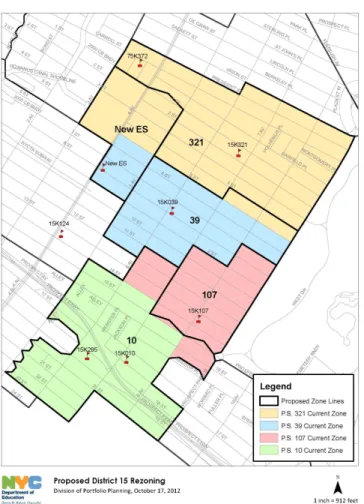
As Figure 2 shows, the new elementary school, afterward named PS 118 The Maurice Sendak Community School, spans across both former PS 39 and PS 321 districts, removing around 10 blocks to create its own district. Initial reactions from community members and parents
expressed concern that this proposal would cut out much of the diversity in the original schools. Historically, the closer to Prospect Park (on the right-side section of the map), the more
expensive the housing and the greater proportion of white residents than there are closer to the canal on the top left corner of the map. Some of the comments from the parents stated:
“The new zoning of 321 appears to flagrantly cut out the most diverse areas of the former zone and institutionalize a kind of economic segregation in the
neighborhood in a way that seems very short sided.”
“[We are] losing a potential source of diversity. Many older residents of the block attended the school when it was St Thomas Aquinas, and that fact still bonds them (and the rest of us) together today. Do we really want to send a message that “this school is for the rich kids of Park Slope – even though it’s right on your corner.” “My husband and I have recently purchased a home in Park Slope because of the excellent academic results as well as diversity of PS 321. To find out that the rezoning plan has not only cut my Asian daughter out of attending, a year before she is to, but also almost all the ethnic and socioeconomic diversity of that school.”
current PS 321 and PS 39 by a small amount, those few fears over eliminating ethnic diversity do not appear to have transpired.
Table 3 shows the demographic profiles of PS 321 and PS 39 before the rezoning and Table 4 contains the demographics after the new PS 118 was established. The small change between student racial profiles before and after the change indicates there may have been some segregating effects by splitting these sections of the neighborhood off. The following tables show there was an about 6 percent decrease in the number of black and Latino students at PS 321 and 10 percent decrease at PS 39.
TABLE 3: SCHOOL DEMOGRAPHIC PROFILES BEFORE REZONING (2011-2012)
PS 321 William Penn PS 39 Henry Bristow Address 180 7th Avenue, Brooklyn,
NY 11215 417 6
th Avenue, Brooklyn,
NY 11215
Website https://ps321.org http://www.ps39.org
Grades Served 01, 02, 03, 04, 05, 0K, SE 01, 02, 03, 04, 05, 0K, PK, SE
School Type Elementary Elementary
Enrollment 1436 344
Student Demographics 18.6% Black/Hispanic 28.2% Black/Hispanic English Language
Learners
1.3% 4.4%
Students with Special Needs
12.7% 18.3%
TABLE 4: SCHOOL DEMOGRAPHIC PROFILES AFTER REZONING (2014-2015)
PS 321William Penn
PS 39 Henry Bristow
PS 118 Maurice Sendak Community School
Address 417 6th Avenue, Brooklyn, NY 11215
180 7th Avenue, Brooklyn, NY 11215
211 8th Street, Brooklyn, NY 11215
Grades Served 01, 02, 03, 04, 05, 0K, PK, SE
01, 02, 03, 04, 05, 0K, SE
Pre-k, K, 01, 02 School Type Elementary Elementary Elementary
Enrollment 1472 408 169
Student Demographics Asian: 6% | Black: 5% | Hispanic: 8% | White: 80%
Asian: 8% | Black: 7% | Hispanic: 11% | White: 74%
Asian: 9% | Black: 7% | Hispanic: 12% | White: 72% English Language
Learners
1% 3%
Students with Special Needs
14% 16% 13.4%
Student Attendance 97% 96% 94%
Students Chronically Absent
3% 5%
Admissions Methods Zoned Zoned Zoned
Source: NYC Department of Education School Quality Snapshot, Comprehensive Educational Plan
While these results do not specifically show the breakdown of different minority groups in the earlier years, the new school appears to have absorbed these minority populations. Because the corner of the district that has been zoned for PS 118 is closer to a higher-minority neighborhood, the effect of splitting the school zones at that location could have resulted in shifting the minority populations out of the old zones. However, across each of the three new schools, the minority percentages remain fairly consistent.
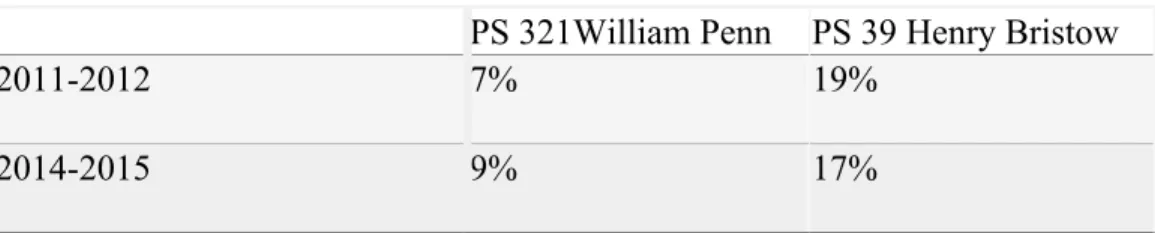
reflects the socioeconomic status of the school population and is calculated using the following formula: Economic Need Index = (Percent Temporary Housing) + (Percent HRA Eligible × 0.5) + (Percent Free Lunch Eligible × 0.5) (NYC Department of Education 2015). As shown in Table 5, the index did not change much after rezoning occurred.
TABLE 5: ECONOMIC NEEDS INDEX
PS 321William Penn PS 39 Henry Bristow
2011-2012 7% 19%
2014-2015 9% 17%
NYC Department of Education School Quality Snapshot
While there is not an index score report available for PS 118 until next year, the percentage of free and reduced lunch students at the school is 6.1 percent (2015-16 Comprehensive Education Plan). This small percentage combined with minimal changes in index at PS 321 and PS 39, indicates minimal economic segregating issues are in effect in this rezoning measure.
While there may be some small segregating issues at play in this district, mainly this historically wealthy neighborhood is relatively homogenous by race (see Appendix E) and socioeconomic status across the zoning lines. Because there is not an emphasis on racial dynamics between conflicting neighborhood profiles, the emphasis in the rezoning debate
continued substantial pattern of rising real estate prices (Harris 2012, Albrecht Dec 2012). Because real estate prices are so closely linked to school performance, the concern of this rezoning for many parents took a more economic spin than a school performance angle as it did for PS 8 and PS 307. A little under half of the commenters addressed property values as an objection to the rezoning scheme. Some comments included:
“On a personal level, like many other families on this street, we saved and planned and decided to make an investment in order to follow the rules and live within a school zone we had chosen carefully.”
“Impact on property values for families whose largest investment is in their homes…think about the impact of this proposal on the larger Park Slope
community beyond parents and students along. Many families…will lose $75,000 to $100,000 in property value (or more) overnight if this proposal goes through.” “We who bought into the 321 zone paid a pretty penny for the privilege… Our block stands to be redistricted to PS 39, a school I would not have moved to Park Slope for. Another solution must be found, one that does not have deleterious effects on children’s lives, and on the real estate values of hardworking taxpaying city residents.”
These comments express how different the predominant theme to this rezoning debate is to the debate in CEC 13. Housing prices only came up in 5 percent of the Dumbo
rezoning comments. Additionally, school quality, while a concern to some parents was only brought up 15 percent of the time in District 13.
TABLE 6: SCHOOL TEST SCORE PERFORMANCE (2011-2012): PERCENTAGE THAT MET STATE STANDARDS
PS 39 PS 321
English 62.1% 72.0%
Math 66.7% 77.1%
Source: NYC Department of Education School Progress Report
TABLE 7: SCHOOL TEST SCORE PERFORMANCE (2014-2015): PERCENTAGE THAT MET STATE STANDARDS
PS 39 Henry Bristow
PS 321 William Penn
PS 118 Maurice Sendak
English 69% 75% N/A
Math 75% 82% N/A
Source: NYC Department of Education School Progress Report (2011-2012) n.b. P.S. 118 test score report not available until 2016-2017 school year
While the precise PS 118 reports on test scores are not released until the next school year, the Department of Education’s Quality Report Overview (2014-2015) describes PS 118 as an excellent school with top marks in its curriculum and teaching quality. This result indicates PS 118 has been built with the same community support and resources as PS 321.
“We want to have an equal reputation, an equal number of special subject offerings. We want to make sure they have art and gym and music. We want to make sure they get all the resources they would have had, had they gone to P.S. 321, but without the overcrowding.” – PS 118 PTA member (Albrecht Dec 2012) This is an example of how parents in well-off school zones can maintain school quality after a zoning change by shoring up transferable political and economic resources.
Lack of a greater neighborhood shift without gentrification, combined with relatively stable levels of diversity in the schools has resulted in a very different case for how community identity is used in rezoning discourse. Parents in Park Slope describe their community as one with “great harmony and sense of community” and recognize the importance of the school in reinforcing that community identity, stating:
“Excluding children from this school will be damaging to our efforts to improve our community.”
“Including our block will mean the school can be woven into the fabric of the neighborhood more successfully (not simply know as the school built to accommodate 321 overflow).”
“As a child, I grew up on the same street as my elementary school, and I know what an amazing advantage that was for me, in terms of my safety, my
socialization, and my overall experience.”
Without the racial dynamics and threat of gentrification, the community discourse finds fewer places to identify the threat of an outsider, only looking at abstract economic threats. The social boundaries that separate the ‘us’ from ‘them’ are more difficult to distinguish. While the
Conclusion
This research began with an exploration of the divergence in community discourse during school rezoning debates, which led to the question: how does the racial composition of school districts shape discourse? Here, I utilized these two Brooklyn elementary school rezoning cases to illustrate how in both of these districts, a discursive practice serves to establish a connection and common political agenda among certain groups of people. Discourse in both cases contains the term ‘community’ used in a way to shore up each side’s arguments, as a site of identification and political expression, as well as initiate insider/outsider dynamic. In one case, community discourse is used more as an inclusion/exclusion tool though antagonistic discourse, and in the other discourse is used to call attention to the economic and social importance of the
neighborhood school.
School-based inequalities between neighborhoods have strong impacts on the
communities. The deep ties to neighborhood schools, particularly elementary schools such as the ones shown here, show how essential schools are to community identity and boundary formation. Overall, the community discourse shown here in these rezoning maneuvers suggests that racial instability and changing neighborhoods are a big concern to neighborhood schools. The
discourse here largely points to a broader pattern of community identity and pride in the neighborhood school as an essential component to educational success and community well being. Without an attachment to the social structure of its surrounding community, the school will lack the support it needs to thrive. Perhaps the latent concerns about racial integration will be eased once schools begin to grow and meld old identities, or there may be continued
By utilizing cases of school rezoning to explore how different groups perceive threat to their community through the reorganization of school boundaries, my research suggests new areas to develop community threat literature in sociology. Rezoning provides interesting cases where lines are drawn on a map to specifically delineate who is an insider and who is an outsider in an educational community. By proposing changes to the map, school districts are proposing changes to the community. How groups respond to that threat of change can reveal interesting community identities framed by racial and economic dynamics beyond the issue of school zoning.
Further studies of the direct effect of community identity on the future of school quality post-rezoning could illustrate how the communities shift and repair after rezoning breaks their original zone-based identity apart. Because the empirical data I used to map discourse was limited to the time frame of the rezoning debate, I was not able to follow parent and community commentary after the rezoning occurred to see how discourse changed once the school zones changed. Once mutual exclusion was no longer an option, it would be interesting to follow up on if and how previously antagonistic discursive patterns changed in the Dumbo schools.
Additionally, because my data only encompassed a fraction of the perspective of parents in these districts, further studies could follow rezoning cases as they happen in order to have discussions with larger numbers of parents and community members in the process of rezoning. It would have been helpful to get interview or more extensive data from parents and council members to gain greater insight into the reasoning behind their opinions and potentially
actually occurred, the totality of the discourse examined here points to an interesting impact of gentrification and racial disparities.
In order to further develop representation of the perspective of minorities, as new rezoning cases begin, in further research should identify and follow a rezoning proposal involving multiple minority-majority schools integrating zones. While I was not able to study such cases, with more time and greater access to records, I believe it would be highly beneficial in developing an understanding on how community racial histories and gentrification affects rezoning debates for these schools. This addition is particularly important as much of the previous literature in sociology on community and racial threat is devoted to the perspective of white communities.
Even while residential segregation has declined, intense racial isolation in schools, particularly among African-Americans, has persisted in New York City. As neighborhoods continue to change and increasing gentrification shifts population patterns, public schools have to change to meet their community’s new needs. However, with this level of segregation, it comes as little surprise that when attempts to combine distinctive schools and communities occur, it is often controversial. The rezoning plans, common attempts to ameliorate unbalanced school population patterns, have immense effects on both their students and their larger
communities. By examining trends in discourse from two these Brooklyn school districts, I have found that neighborhood racial history and the economic impact of schools on communities greatly influences how these commenters view the rezoning proposals. My findings help
demonstrate the strength of the relationship between these communities and their neighborhood schools. They also reveal surprising ways racial discourse operates outside of current
APPENDIX A: SCHOOL DEMOGRAPHIC SUMMARY PRE-REZONING
CEC 13 (2014-2015) CEC 15 (2011-2012)
PS 307 Daniel Hale Williams
PS 307 Daniel Hale Williams
PS 321 William Penn PS 39 Henry Bristow
Grades Served PK,0K,01,02,03,04,05,SE PK,0K,01,02,03,04,05,
SE 01, 02, 03, 04, 05, 0K, SE 01, 02, 03, 04, 05, 0K, PK, SE
Enrollment 413 413 1436 344
Student
Demographics
Asian: 3% | Black: 60% | Hispanic: 28% | White: 7% | American Indian: 1%
Asian: 3% | Black: 60% | Hispanic: 28% | White: 7% | American Indian: 1%
18.6% Black/Hispanic 28.2% Black/Hispanic
English Language Learners
3% 3% 1.3% 4.4%
Students with Special Needs
34% 34% 12.7% 18.3%
Source: NYC Department of Education School Quality Snapshot, NYC Department of Education School Quality Snapshot, Comprehensive Educational Plan
APPENDIX B: SCHOOL DEMOGRAPHIC SUMMARY POST-REZONING
CEC 15 (2014-2015)
PS 321William Penn PS 39 Henry Bristow PS 118 Maurice Sendak Community School Grades Served 01, 02, 03, 04, 05, 0K, PK, SE 01, 02, 03, 04, 05, 0K, SE Pre-k, K, 01, 02
Enrollment 1472 408 169
Student
Demographics Asian: 6% | Black: 5% | Hispanic: 8% | White: 80% Asian: 8% | Black: 7% | Hispanic: 11% | White: 74%
Asian: 9% |
Black: 7% | Hispanic: 12% | White: 72%
English Language
Learners 1% 3%
Students with Special Needs
14% 16% 13.4%
Source: NYC Department of Education School Quality Snapshot, NYC Department of Education School Quality Snapshot, Comprehensive Educational Plan
APPENDIX C: CODING
Theme Words/Phrases Number of
Comments Percentage of Comments Number of Comments Percentage of Comments CEC 13 – Dumbo CEC 15 – Park Slope
Insider/Outsider us, we/they, our/their, my, them, those, exclude
31 66% 25 48%
School Quality test scores, school scores, ratings, school crowding
13 28% 8 15%
Race/Diversity minority, black, Hispanic, integration, segregation, diversity, color, white, Asian
16 34% 8 15%
SES free lunch, well-off,
class, elite
4 9% 6 12%
Community "Farragut"/Dumbo, neighborhood, community, PTA
25 53% 20 38%
Economy Housing prices, property value, "damage
interests"
2 4% 25 48%
General Inquiry 0 0% 4 8%
Total 47 52
APPENDIX D: RACIAL DEMOGRAPHICS 2000/2010
Neighborhood Area 2010 Population Change from 2000 % Chg from 2000
DUMBO-VingrHl-DwntnBrkl-BoermHl 34,495 3,646 11.80%
Park Slope - Gowanus 67,649 386 0.60%
Neighborhood Area 2010 Population
Change from 2000
% Chg from 2000
% Black in 2010
% Black in 2000
DUMBO-VingrHl-DwntnBrkl-BoermHl 7,883 -1,841 -18.90% 22.90% 31.50%
Park Slope - Gowanus 4,334 -1,974 -31.30% 6.40% 9.40%
Neighborhood Area 2010 Population
Change from 2000
% Chg from 2000
% White in 2010
% White in 2000
DUMBO-VingrHl-DwntnBrkl-BoermHl
14,560 5,182 55.30% 42.20% 30.40%
Park Slope - Gowanus 45,529 7,361 19.30% 67.30% 56.70%
Neighborhood Area 2010
Population Change from 2000 % Chg from 2000 % Asian in 2010 % Asian in 2000
DUMBO-VingrHl-DwntnBrkl-BoermHl 2,949 1,489 101.90% 8.50% 4.70%
Park Slope - Gowanus 4,056 514 14.50% 6% 5.30%
Neighborhood Area 2010 Population
Change from 2000
% Chg from 2000 % Hispanic in 2010 % Hispanic in 2000
DUMBO-VingrHl-DwntnBrkl-BoermHl 7,981 -1,050 -11.60% 23.10% 29.30%
Park Slope - Gowanus 11,263 -5,405 -32.40% 16.60% 24.80%
Neighborhood Area 2010 Population
Change from 2000
% Chg from 2000
% "other" in 2010
% "other" in
DUMBO-VingrHl-DwntnBrkl-BoermHl 1,122 -132 -10.50% 3.30% 4.10%
Park Slope - Gowanus 2,467 -110 -4.30% 3.60% 3.80%
Source: Center for Urban Research, The Graduate Center, City University of New York (CUNY) http://www.urbanresearchmaps.org/plurality/#nabes
APPENDIX E: RACE/ETHNICITY BY CENSUS BLOCK 2000/2010
Park Slope:
Race/Ethnicity by Census Block (2000) Race/Ethnicity by Census Block (2010)
Source: http://www.urbanresearchmaps.org/comparinator/pluralitymap.htm
Dumbo:
Race/Ethnicity by Census Block (2000) Race/Ethnicity by Census Block (2010)
Source: http://www.urbanresearchmaps.org/comparinator/pluralitymap.htm
Legend:
REFERENCES
“2011-2012 School Quality Report.”NYC Department of Education. Retrieved December 11,
2015. (http://schools.nyc.gov/Accountability/tools/report/default.htm).
“2014-15 School Quality Snapshot / ES. P.S. 321 William Penn (15K321)”.NYC Department of
Education. Retrieved December 11, 2015. (http://schools.nyc.gov/OA/SchoolReports/2014-15/School_Quality_Snapshot_2015_EMS_K321.pdf).
“2014-15 School Quality Snapshot / ES. P.S. 039 Henry Bristow (15K039).” NYC Department of Education. Retrieved December 11, 2015.
(http://schools.nyc.gov/OA/SchoolReports/2014-15/School_Quality_Snapshot_2015_EMS_K039.pdf).
“2014-15 School Quality Snapshot / ES. P.S. 307 Daniel Hale Williams (13K307).” NYC Department of Education. Retrieved December 11, 2015.
(http://schools.nyc.gov/OA/SchoolReports/2014-15/School_Quality_Snapshot_2015_EMS_K307.pdf).
“2014-15 School Quality Snapshot / K-8. P.S. 008 Robert Fulton (13K008).” NYC Department of Education. Retrieved December 11, 2015.
(http://schools.nyc.gov/OA/SchoolReports/2014-15/School_Quality_Snapshot_2015_EMS_K008.pdf).
“2015-16 Comprehensive Education Plan (CEP).” NYC Department of Education. Retrieved April 30, 2016. (http://schools.nyc.gov/documents/oaosi/cep/2015-16/cep_K118.pdf).
Abascal, Maria, and Delia Baldassarri. 2015. “Love Thy Neighbor? Ethnoracial Diversity and
Trust Reexamined”. American Journal of Sociology 121 (3). University of Chicago Press:
722–82.
Albrecht, Leslie. 2012. “Controversial Rezoning for Park Slope’s P.S. 321 Approved.” DNAinfo.
Retrieved November 29, 2015. (https://www.dnainfo.com/new-york/20121129/park-slope/controversial-rezoning-for-park-slopes-ps-321-approved).
Albrecht, Leslie. 2012. “Park Slope Parents Want New School to Be as ‘Desirable’ as P.S. 321.”
DNAinfo. Retrieved December 11, 2015.
(https://www.dnainfo.com/new- york/20121211/park-slope/park-slope-parents-want-new-school-be-as-desirable-as-ps-321).
Albrecht, Leslie. 2013. “New School, New Zones, But Still Few Seats for Park Slope Pre-K.”
DNAinfo. Retrieved February 25, 2015.
Andrews, Kenneth T. and Charles Seguin. 2015. “Group Threat and Policy Change: The Spatial
Dynamics of Prohibition Politics, 1890-1919.” American Journal of Sociology
121(2):475-510.
Bankston, Carl L. and Stephen J. Caldas. 2015. Controls and Choices : The Educational
Marketplace and the Failure of School Desegregation. Lanham, Maryland: Rowman &
Littlefield.
Bankston, Carl, and Stephen J. Caldas. 1996. “Majority African American Schools and Social
Injustice: The Influence of De Facto Segregation on Academic Achievement”. Social
Forces 75 (2): 535–55.
Blumer, Herbert. 1958. “Race Prejudice as a Sense of Group Position.” Pacific Sociological
Review 1 (1): 3–7.
Bobo, Lawrence D. 2001. “Racial Attitudes and Relations at the Close of the Twentieth
Century.” Pp. 264–301 in America Becoming: Racial Trends and Their Consequences,
edited by Neil J. Smelser, William Julius Wilson, and Faith Mitchell. Washington, D.C.: National Academies Press.
Bragd, Annica, Dorit Christensen, Barbara Czarniawska, and Maria Tullberg. 2008. “Discourse
as the Means of Community Creation.” Scandinavian Journal of Management
24(3):199-208.
Brooklyn Heights Blog. 2015. “The Elephant in the Room: P.S. 8 Re-Zoning Town Hall Meeting Re-Cap.” Retrieved July 14, 2016. (http://brooklynheightsblog.com/archives/76529)
Brooklyn Heights Blog. 2015. “Official Re-Zoning Plan Unveiled at CEC Meeting-DOE Takes It On the Chin.” Retrieved July 14, 2016.
(http://brooklynheightsblog.com/archives/76831).
Brown, Hana E. 2013. “Racialized Conflict and Policy Spillover Effects: The Role of Race in the
Contemporary U.S. Welfare State.” American Journal of Sociology 119(2): 394-443.
Caldas, Stephen J. and Carl L. Bankston. 2005. Forced to Fail: the Paradox of School
Desegregation. Westport, Connecticut: Praeger.
Caldas, Stephen J. and Carl L. Bankston. 2015. Still Failing : the Continuing Paradox of School
Desegregation. Second ed. Lanham; Boulder; New York ; London: Rowman &
Littlefield.
Center for Urban Research, CUNY Graduate Center. 2011. “New York City demographic shifts, 2000 to 2010.” Retrieved June 20, 2016
Center for Urban Research, CUNY Graduate Center. 2011. “Visualizing a Changing Region, Block by Block.” Retrieved June 20, 2016
(http://www.urbanresearchmaps.org/comparinator/pluralitymap.htm).
Charles, Camille Zubrinsky. 2003. “The Dynamics of Racial Residential Segregation.” Annual
Review of Sociology 29:167-207.
Cobb-Roberts, Deirdre, Sherman Dorn, and Barbara J. Shircliffe. 2006. Schools as Imagined
Communities : the Creation of Identity, Meaning, and Conflict in U.S. History. 1st ed.
New York: Palgrave Macmillan.
Cohen, Anthony P. 1985. The Symbolic Constriction of Community. London, UK: Tavistock
Publications.
Collins, Patricia Hill. 2010. “The New Politics of Community.” American Sociological Review
75(1): 7-30.
Dalby, Simon and Fiona Mackenzie. 1997. “Reconceptualising Local Community: Environment,
Identity and Threat.” Area 29(2): 99-108.
Duncan, J.S. 1994. “The Politics of Landscape and Nature, 1992-93.” Progress in Human
Geography 18:361-70.
Fessenden, Ford. 2012. “A Portrait of Segregation in New York City Schools.” The New York
Times. Retrieved May 11, 2015.
(http://www.nytimes.com/interactive/2012/05/11/nyregion/segregation-in-new-york-city-public-schools.html).
Fine, Gary Alan. 2012. “Group Culture and the Interaction Order: Local Sociology on the
Meso-Level.” Annual Review of Sociology 38:159 -179.
Goldsmith, Pat Rubio. 2009. “Schools or Neighborhoods or Both? Race and Ethnic Segregation
and Educational Attainment”. Social Forces 87 (4): 1913–41.
Harris, Elizabeth A. 2012. “Anxious Brooklyn Parents See Proposed Redrawn School
Boundaries.” The New York Times. Retrieved October 18, 2015.
(http://www.nytimes.com/2012/10/18/nyregion/boundaries-for-popular-brooklyn-schools-are-redrawn.html).
Harris, Elizabeth A. 2012. “At an Overcrowded School in Park Slope, No One Wants to Leave.”
The New York Times. Retrieved October 29.
(http://www.nytimes.com/2012/10/30/nyregion/at-an-overcrowded-school-in-park-slope-no-one-wants-to-leave.html?_r=0).
Jørgensen, Marianne and Louise Phillips. 2002. Discourse Analysis as Theory and Method. London: SAGE Publications.
Key, V. O. 1984. Southern Politics in State and Nation. Knoxville: University of Tennessee
Press.
Khan, Yasmeen. 2015. “History Repeats Itself in Brooklyn School Rezoning.” WNYC. Retrieved
September 30, 2015. (http://www.wnyc.org/story/history-repeats-itself-two-brooklyn-schools-changing-neighborhoods/).
Lefebvre, Henri. 1991. Translated by Donald Nicholson-Smith. Oxford, UK: Blackwell.
Lewis, Heather. 2013. New York City Public Schools from Brownsville to Bloomberg :
Community Control and Its Legacy. New York: Teachers College Press.
Maxwell, Lesli A. 2014. “Study Finds N.Y. State Schools are most Racially Isolated.” Education
Week 33(27):5.
“Mayor Bloomberg, NYC Dept of Education, CEC District 15: Maintain Existing District 15 Zoning & Reject the Proposed Rezoning.” Coalition of Residents for Fair Rezoning. Retrieved July 14, 2016. (https://www.change.org/p/mayor-bloomberg-nyc-dept-of- education-cec-district-15-maintain-existing-district-15-zoning-reject-the-proposed-rezoning).
Mendelberg, Tali. 2001. The Race Card: Campaign Strategy, Implicit Messages, and the Norm
of Equality. Princeton, N.J.: Princeton University Press.
New York Schools. 2016. “Kings County School Districts.” Retrieved April 30, 2016. (http://www.newyorkschools.com/counties/kings-brooklyn.html).
NYC Department of Education. 2016. “District and Community Planning.” New York, NY. Retrieved April 30, 2016.
(http://schools.nyc.gov/community/planning/changes/default.htm).
NYC Department of Education. 2015. “School Quality Guide: Educator Guide.” New York, NY. Retrieved June 15, 2016. (http://schools.nyc.gov/NR/rdonlyres/BF3F9933-10BA-4847-9A02-62D1D8D2F513/0/EducatorGuideEMS172015.pdf).
O’Day, Jennifer A., Catherine S. Bitter, and Louis M. Gomez. 2011. Education Reform in New
York City : Ambitious Change in the Nation’s Most Complex School System. Cambridge:
Harvard Education Press.
Pritchett, Wendell E. 2001. “Race and Community in Postwar Brooklyn: The Brownsville
Neighborhood Council and the Politics of Urban Renewal.” Journal of Urban History