Fluorinated betulinic acid derivatives and evaluation of their
anti-HIV activity
Jizhen Lia,b, Masuo Gotob, Xiaoming Yangb, Susan L. Morris-Natschkeb, Li Huangc, Chin-Ho Chenc, and Kuo-Hsiung Leeb,d
aDepartment of Organic Chemistry, College of Chemistry, Jilin University, 2519 Jiefang Road,
Changchun 130023, China
bNatural Products Research Laboratories, UNC Eshelman School of Pharmacy, University of
North Carolina, Chapel Hill, NC 27599, United States
cSurgical Science, Department of Surgery, Duke University Medical Center, Durham, NC 27710,
United States
dChinese Medicine Research and Development Center, China Medical University and Hospital,
Taichung, Taiwan
Abstract
Several fluorinated derivatives of the anti-HIV maturation agent bevirimat (1) were synthesized and evaluated for anti-HIV replication activity. The modified positions were the C-2, C-3, C-28, and C-30 positions, either directly on the betulinic acid (2) skeleton or in the attached side chains. Compound 18, which has a trifluoromethyl group added to C-30 of its isopropenyl group, exhibited similar potency to 1 against HIV-1NL4-3. In total, our current studies support our prior
conclusion that C-30 allylic modification is unlikely to be a pharmacophore for anti-HIV activity, but could be a meaningful route to manipulate other properties of 2-related compounds.
Keywords
Fluorinated betulinic acid derivatives; Bevirimat; Anti-HIV activity
HIV-1 infection affects more than 30 million people worldwide, and its treatment remains a serious problem due to the emergence of drug-resistant HIV strains and deleterious side effects. Thus, the discovery and development of new drug candidates with novel anti HIV mechanisms remain important to solve the problems of this disease.
Bevirimat (DSB, 1 in Fig. 1), a triterpene natural product derivative, represents a promising class of anti-HIV agents with a novel mechanism. It inhibits HIV-1 maturation by blocking the cleavage of p25 to functional p24, resulting in the production of noninfectious HIV-1
Correspondence to: Kuo-Hsiung Lee. Supplementary data
HHS Public Access
Author manuscript
Bioorg Med Chem Lett. Author manuscript; available in PMC 2017 January 01.
Published in final edited form as:
Bioorg Med Chem Lett. 2016 January 1; 26(1): 68–71. doi:10.1016/j.bmcl.2015.11.029.
Author Manuscript
Author Manuscript
Author Manuscript
particles. In recent years, efforts to improve the anti-HIV activity of 1 have focused on modifications at the C-3 and C-28 positions, particularly, insertion of side chains containing various functional groups, such as anhydrides, amino acids, and N-heterocycles.1
Correspondingly, success was achieved by the synthesis of new compounds with better EC50 data than 1 itself. However, improving the anti-HIV potency is not necessarily the sole
driving force for modification of 1. For instance, structural changes can help define pharmacophores related to biological profile as well as potency. Also, the possibility of creating a new lead compound with action at a different HIV process/enzyme is always significant and meaningful in the field of anti-HIV research. Consequently, alteration of the activity or biological profile of a preclinical drug candidate can often be regarded as an important strategy in drug design.
Fluorinated drugs and drug candidates based on natural products are present in many therapeutic classes. Fluorine has unique physical properties, such as strong electronegativity, small atomic size, and low polarizability of the C—F bond, and can mimic either a hydrogen or hydroxy group.2–7 A recent literature review extensively discussed fluorine’s effects on
conformation, pKa, intrinsic potency, membrane permeability, metabolic pathways, and
pharmacokinetic properties, concluding that its incorporation into a molecule can be significantly important in medicinal chemistry and the design of valuable future drugs.8 Thus, the introduction of one or more fluorine atoms into the structure of 1 could dramatically influence the lipophilicity, conformational flexibility, metabolic stability, or other properties, which could be useful in modulating the biological activity or
pharmaceutical profile of 1. With this consideration in mind, herein, we report the synthesis of fluorinated derivatives of 1 and evaluation of their anti-HIV activities.
Readily modifiable positions of the betulinic acid (BA, 2) scaffold include the C-2, C-3, C-28, and C-19 positions. We introduced fluorine atoms either directly at C-2 or C-3 as shown in Scheme 1 or indirectly in the C-29, or C-3 and C-28 side chains of 2 as shown in Schemes 2 and 3 (see Supplementary data for the detailed synthetic procedures). Therefore, we could evaluate the effects of fluorine atoms in several different positions.
Firstly, as shown in Scheme 1, the CO2H group of betulinic acid (3) was protected with
CH3I to obtain the ester 4. Then, compound 4 was treated with lithium diisopropylamide
(LDA) and N-fluorobenzenesulfonimide (NFSI) at −78 °C, resulting in the introduction of one fluorine atom at the C-2 α-position (5) in 43% yield. Similarly, if the CO2H group was
esterified with 2-cyclopropyl ethanol, one fluorine atom was also introduced easily from the
α-face at the C-2 position at −78 °C. In addition, when 4 was treated with CF3Si(CH3)3, a
CF3 functional group was inserted at the C-3 position (12). Furthermore, application of
classical organic synthetic methods including reduction by NaBH4, esterification with
2,2-dimethylsuccinic anhydride, or removal of a methyl ester with LiI, the desired fluorinated products 8, 9, 11, and 13 were obtained.
Secondly, the fluorinated modification of the isopropenyl group on C-19 is shown as Scheme 2. Betulin (14) was protected as its diacetate 15. Then, a CF3 group was added at
Author Manuscript
Author Manuscript
Author Manuscript
intermediate 16. The desired product 18 was obtained in a four-step sequence, deprotection of 16 with 2 N NaOH in THF/EtOH, oxidization with CrO3/H2SO4, reduction with NaBH4,
and finally, esterification with 2,2-dimethylsuccinic anhydride.
Thirdly, fluorine atoms were introduced at various positions in the side chains on the BA C-3 and C-28 positions as shown in Scheme 3. Compounds 21 and 22, in which the C-28 side chain terminates in a trifluoromethylphenyl and difluorocyclohexyl group, respectively, were synthesized easily via esterification of 3 with 3-(trifluoromethyl)phenethyl alcohol or 4,4-difluorocyclohexane methanol, respectively. Fluorine atoms were incorporated in the C-3 side chain by esterifying 2 directly with tetrafluorosuccinic or hexafluoroglutaric anhydride to provide 23 and 24, respectively.
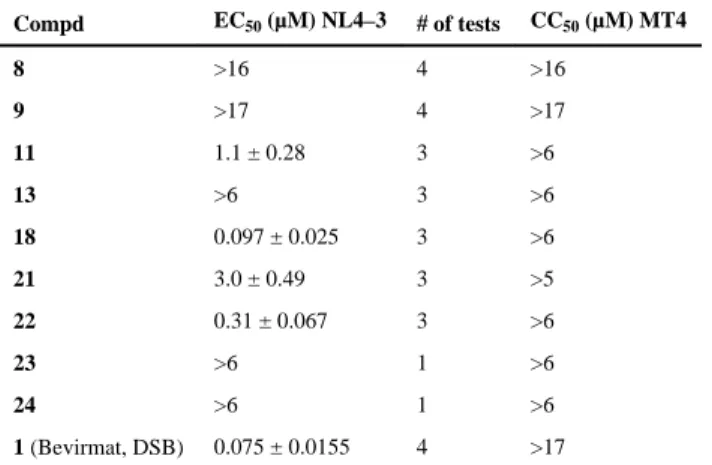
All of the synthesized new fluorinated compounds (8, 9, 11, 13, 18, 21–24) were evaluated for anti HIV activity by determining inhibition of NL4-3 virus replication in MT4
lymphocytes.9 Table 1 shows the anti-HIV results for the tested compounds, with the lead compound 1 as a positive control.
With one exception, the fluorinated compounds were much less active than the non-fluorinated lead compound 1. Five compounds (8, 9, 13, 23, and 24) did not show anti-HIV potency at the highest concentration tested. Indeed, the inactivity of 9, which differs structurally from 1 only by a fluorine rather than hydrogen at C-2, might suggest that a proton at C-2 could play a critical role for anti HIV activity. The importance of the
dimethylsuccinyl C-3 ester group to the anti-HIV activity was confirmed by the inactivity of the fluorinated esters 23 and 24. Two compounds with fluorine in the C-28 ester side chain showed only weak anti-HIV activity with (4,4-difluorocyclohexyl)methyl (22) resulting in greater potency than trifluoromethylphenethyl (21). However, compounds 1 and 18, which has a trifluoromethyl group added to C-30 of the isopropenyl group of 1, exhibited similar potency against HIV-1NL4-3. Based on the data, this position was the only one among those
tested to actually tolerate the addition of a fluorine atom. This finding was not unexpected, because prior studies had shown that certain changes in the isopropenyl group (e.g., saturation of the 20(29) double bond,10 thioether,11 or oxyether12 substitution at C-30) did not appreciably impact the anti-HIV-1 potency of derivatives of 2. Thus, our studies confirm the previous conclusion that C-30 allylic modification is unlikely to be a pharmacophore for anti-HIV activity, but could be a meaningful route to manipulate other properties of 2-related compounds.12
Supplementary Material
Refer to Web version on PubMed Central for supplementary material.
Acknowledgments
This work was supported by the National Institute of Allergy and Infectious Diseases (NIAID) Grant AI33066 (K.H.L.).
Author Manuscript
Author Manuscript
Author Manuscript
References and notes
1. See: Sun IC, Chen CH, Kashiwada Y, Wu JH, Wang HK, Lee KH. J Med Chem. 2002; 45:4271. [PubMed: 12213068] Yu D, Sakurai Y, Chen CH, Chang FR, Huang L, Kashiwada Y, Lee KH. J Med Chem. 2006; 49:5462. [PubMed: 16942019] Dang ZD, Lai WH, Qian K, Lee KH, Chen CH, Huang L. J Med Chem. 2009; 52:7887. [PubMed: 19526990] Qian K, Kuo RY, Chen CH, Huang L, Morris-Natschke SL, Lee KH. J Med Chem. 2010; 53:3133. [PubMed: 20329730] Qian K, Bori ID, Chen CH, Huang L, Lee KH. J Med Chem. 2012; 55:8128. [PubMed: 22978745] Dang Z, Ho P, Zhu L, Qian K, Lee KH, Huang L, Chen CH. J Med Chem. 2013; 56:2029. [PubMed: 23379607] 2. Nakano T, Makino M, Morizawa Y, Matsumura Y. Angew Chem, Int Ed Engl. 1996; 35:1019. 3. O’Hagan D, Harper DB. J Fluorine Chem. 1999; 100:127.
4. Murphy CD, Schaffrath C, O’Hagan D. Chemosphere. 2003; 52:455. [PubMed: 12738270] 5. Swinson J. Halocarbon Products Corp. Pharmaceuticals. 2005
6. Isanbor C, O’Hagan D. J Fluorine Chem. 2006; 127:303.
7. Wang J, Sanchez-Rosello M, Acena JL, del Pozo C, Sorochinsky AE, Fustero S, Soloshonok VA, Liu H. Chem Rev. 2014; 114:2432. [PubMed: 24299176]
8. Gillis, EP.; Eastman, KJ.; Hill, MD.; Donnelly, DJ.; Meanwell, NA. J Med Chem. 2015. http:// dx.doi.org/10.1021/acs.jmedchem.5b00258
9. Asada Y, Sukemori A, Watanabe T, Malla KJ, Yoshikawa T, Li W, Kuang X, Koike K, Chen CH, Akiyama T, Qian K, Nakagawa-Goto K, Morris-Natschke SL, Lu Y, Lee KH. J Nat Prod. 2013; 76:852. [PubMed: 23611151]
10. Kashiwada Y, Hashimoto F, Cosentino LM, Chen CH, Lee KH. J Med Chem. 1996; 39:1016. [PubMed: 8676334]
11. Evers M, Poujade C, Soler F, Ribeill Y, James C, Lelievre Y, Gueguen JC, Reisdorf D, Morize J, Pauwels R, De Clercq E, Henin Y, Bousseau A, Mayaux JF, Le Pecq JB, Derett N. J Med Chem. 1996; 39:1056. [PubMed: 8676341]
12. Qian K, Yu D, Chen CH, Huang L, Morris-Natschke SL, Nitz TJ, Salzwdedl K, Reddick M, Allaway GP, Lee KH. J Med Chem. 2009; 52:3248. [PubMed: 19388685]
Author Manuscript
Author Manuscript
Author Manuscript
Figure 1.
Author Manuscript
Author Manuscript
Author Manuscript
Scheme 1.
Reagents and conditions: (a) CH3I, K2CO3, DMF, 40 °C; (b) LDA, NFSI, THF, −78 °C–rt;
(c) NaBH4, EtOH/THF, rt; (d) 2,2-dimethylsuccinic anhydride, DMAP, pyridine, 120 °C;
(e) LiI, DMF, 140 °C; (f) CF3Si(CH3)3, Bu4N+F−, THF, rt; then 6 M HCl; (g) (CO)2Cl2,
CH2Cl2, rt; then 2-cyclopropylethanol, Et3N, CH2Cl2, rt.
Author Manuscript
Author Manuscript
Author Manuscript
Scheme 2.
Reagents and conditions: (h) Ac2O, pyridine, CH2Cl2, rt; (i)
S-(trifluoromethyl)diarylsulfonium salt, CuTc, 2,4,6-collidine, DMA, 40 °C; (j) 2 N NaOH, THF/EtOH, rt; (k) CrO3/H2SO4, acetone, 0–5 °C.
Author Manuscript
Author Manuscript
Author Manuscript
Scheme 3.
Reagents and conditions: (l) (CO)2Cl2, CH2Cl2, rt; then 3-(trifluoromethyl)phenethyl
alcohol, Et3N, CH2Cl2, rt; (m) (CO)2Cl2, CH2Cl2, rt; then 4,4-difluorocyclohexane
methanol, Et3N, CH2Cl2, rt; (n) tetrafluorosuccinic anhydride, CH2Cl2, 0 °C–rt; (o)
hexafluoroglutaric anhydride, CH2Cl2, 0 °C–rt.
Author Manuscript
Author Manuscript
Author Manuscript
Author Manuscript
Author Manuscript
Author Manuscript
Author Manuscript
Table 1
Anti-HIV data for fluorinated target compounds
Compd EC50 (μM) NL4–3 # of tests CC50 (μM) MT4
8 >16 4 >16
9 >17 4 >17
11 1.1 ± 0.28 3 >6
13 >6 3 >6
18 0.097 ± 0.025 3 >6
21 3.0 ± 0.49 3 >5
22 0.31 ± 0.067 3 >6
23 >6 1 >6
24 >6 1 >6
1 (Bevirmat, DSB) 0.075 ± 0.0155 4 >17