EVALUATING PLUTON-VOLCANO RELATIONSHIPS: AN EXAMPLE FROM THE MOUNT GIVENS GRANODIORITE
Ryan E. Frazer
A thesis submitted to the faculty of the University of North Carolina at Chapel Hill in partial fulfillment of the requirements for the degree of Master of Science in the Department of
Geological Sciences.
Chapel Hill 2013
ii ABSTRACT
RYAN E. FRAZER: Evaluating pluton-volcano relationships: an example from the Mount Givens Granodiorite
(Under the direction of Drew S. Coleman)
ACKNOWLEDGEMENTS
I would foremost like to thank my advisor, Dr. Drew S. Coleman, for his vision, direction, encouragement and humor, which were fundamental to the successful completion of this project. I would also like to thank Dr. Allen F. Glazner for his valuable knowledge and comments on the project, and Dr. Kevin S. Stewart for his insights and support.
This project benefitted greatly from conversations and technical aid from Drs. Ryan D. Mills and Jeremy Inglis. I would also like to acknowledge Miquela Ingalls for lending assistance in the lab and Courtney Beck for her cheerful help in the field. The support of my family and especially Sarah Miller were essential my work on this project. I would like to acknowledge Sigma Xi, the Geological Society of America and especially the Martin Fund of the University of North Carolina at Chapel Hill Geological Sciences Department for
iv
TABLE OF CONTENTS
LIST OF TABLES ... vi
LIST OF FIGURES ... vii
LIST OF ABBREVIATIONS ... viii
Chapter I. INTRODUCTION ...1
II. GEOLOGICAL BACKGROUND ...6
III. METHODS ...10
IV. RESULTS ...13
Northern part of the Mount Givens Granodiorite ...13
Central part of the Mount Givens Granodiorite ...16
Southern part of the Mount Givens Granodiorite ...16
V. DISCUSSION ...17
Zircon recycling in the Mount Givens Granodiorite ...17
Emplacement models for the Mount Givens Granodiorite ...19
Interpretations of magmatic and magnetic structures in plutons ...20
Origin of the sharp intrusive internal contact ...21
Magma fluxes in plutons and large ignimbrites ...22
Zircon dissolution during mush rejuvenation ...25
Large mafic sills in silicic batholiths ...29
VI. CONCLUSIONS ...36
APPENDICES ...38
1. Cathodoluminescence images ...38
2. Zircon age data for rocks from the Mount Givens Granodiorite ...41
3. Modeling mafic magma volumes necessary for rejuvenation of the Mount Givens Granodiorite ...43
vi
LIST OF TABLES Table
LIST OF FIGURES Figure
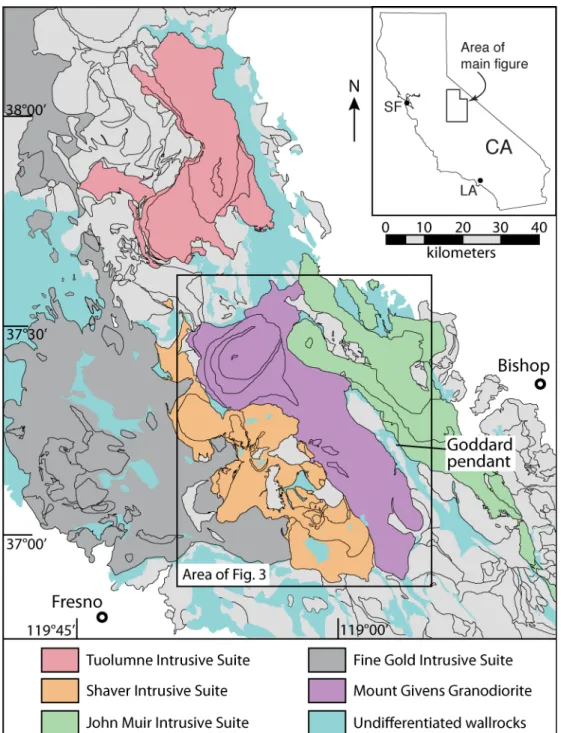
1. Generalized geologic map of the central Sierra Nevada, CA ...3
2. Relative sizes of the Mount Givens Granodiorite and large calderas ...5
3. Geologic map of the Mount Givens Granodiorite ...7
4. Compilation of new 206Pb/238U ages from the Mount Givens Granodiorite ...14
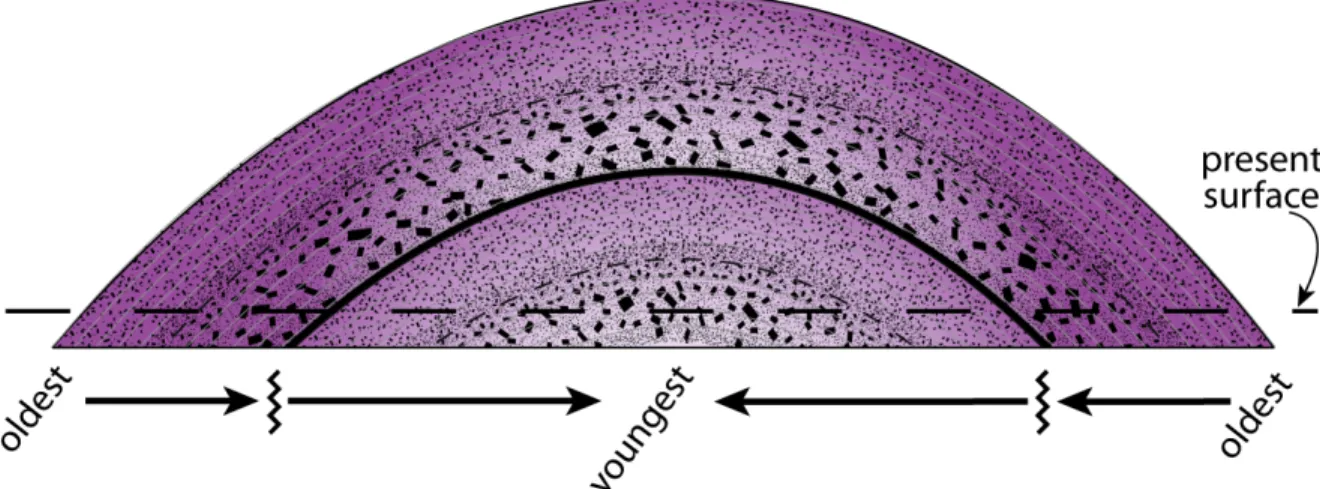
5. Schematic representation of emplacement and textural facies development in the northern Mount Givens Granodiorite ...23
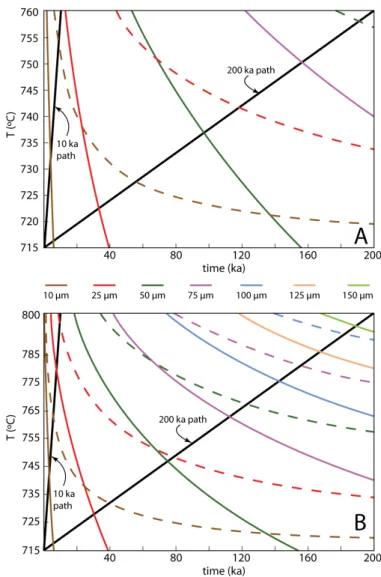
6. Results of model zircon dissolution over various periods of time ...28
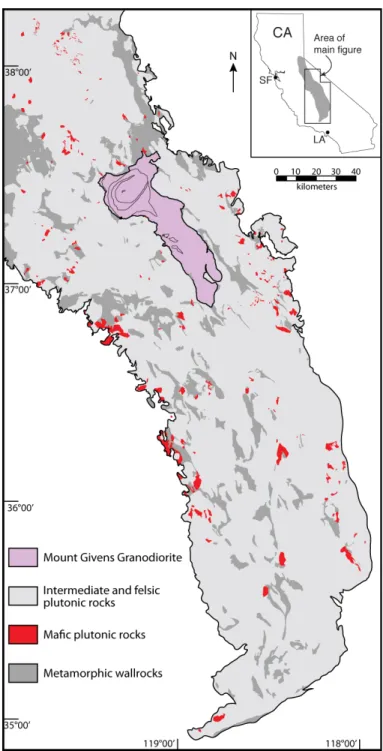
7. Generalized map of the central and southern Sierra Nevada batholith highlighting mafic plutonic rocks ...32
viii
LIST OF ABBREVIATIONS
a annum
AMS anisotropy of magnetic susceptibility
ka thousands of years/thousands of years before present
Ma millions of years/millions of years before present
MGG Mount Givens Granodiorite
MI monotonous intermediate
TIMS thermal ionization mass spectrometer
T temperature
I. INTRODUCTION
Understanding the relationships between intrusive and extrusive magmatic rocks is a fundamental problem in igneous petrology. Some large plutons and zoned intrusive suites have been interpreted to either be unerupted crystal mushes or the crystalline residues left behind after large ignimbrite eruptions (Hamilton and Myers 1967; Hildreth 2004; Bachmann et al. 2007; Lipman 2007). In this hypothesis, both plutons and ignimbrites share the same histories as they are constructed incrementally as crystal-rich mushes over hundreds of thousands to millions of years. With no further inputs of magma, the mush may cool to form a granodiorite pluton. Conversely, the mush may be rejuvenated by energy inputs, including underplating of the mush by basalts. This may cause remelting of crystals until the mush may convectively stir and finally erupt as an unzoned, homogenous crystal-rich dacite, known as a monotonous intermediate (Hildreth 1981).
In contrast, others suggested that voluminous intrusive rocks, such as those in large batholiths, do not share the same histories as monotonous intermediates. The plutons may accumulate mostly during low magma flux stages of long-lived volcanic centers. Ignimbrites could occur when power input peaks and allows for the rapid production of voluminous melts, which may preferentially erupt and leave little behind in the plutonic record (Glazner et al. 2004; Tappa et al. 2011; Zimmerer and McIntosh 2012; Mills and Coleman 2013).
2
genetic link between intrusive rocks and large ignimbrite eruptions because the existing data indicate different magma accumulation rates for the two. Emplacement rates for plutons and intrusive suites are on the order of 0.001-0.0001 km3/a (Crisp 1984; Matzel et al. 2006; Tappa et al. 2011; Davis et al. 2012; Leuthold et al. 2012). In contrast, magma flux for regions of large ignimbrite activity such as the Altiplano-Puna volcanic complex of the central Andes can episodically be an order of magnitude higher (0.06 km3/a; de Silva and Gosnold 2007). Numerical modeling of sill intrusion suggests that a magma flux greater than 0.01 km3/a is required to create enough eruptible magma to feed large (greater than 450 km3) ignimbrite eruptions (Annen 2009; Schöpa and Annen 2013).
One proposed solution to the silicic magma flux problem is the rejuvenation of magmas that are stored high at crystallinity in the upper crust. The most commonly invoked method of rejuvenation is an event during which mafic magmas underplate a silicic mush, which serves to “defrost” them (Mahood 1990). As the mafic magmas crystallize, heat and volatiles may be released into the overlying mush. Various physical mechanisms that allow for heat transport, and thus rejuvenation, include “convective self-mixing” (Couch et al 2001), “gas sparging” (Bachmann and Bergantz 2003, 2006; Huber et al 2010), and most recently “unzipping” (Burgisser and Bergantz 2011). All of these mechanisms may lead to resorption of crystals until they convect, or “stir” (Huber et al.2012), thus homogenizing the mush and allowing for eruption of a monotonous intermediate.
4
texture compared to the zoned suites (Bateman 1992). Previous work on the pluton was undertaken with the notion that the magma was emplaced rapidly (e.g., Bateman and Nokleberg 1978; Tobisch et al. 1993); the longest estimates for its emplacement range from 103-106 a (McNulty et al. 2000; Petford et al. 2000) suggesting fluxes on the order of 4.5 to 0.0045 km3/a given the pluton’s 4500 km3 volume. Given its presumed rapid intrusion, large, segmented shape and intermediate composition, the Mount Givens Granodiorite has been postulated to represent an intrusive analog to caldera-forming eruptions that produce
monotonous intermediates (Bachmann et al. 2007; de Silva and Gosnold 2007; Lipman 2007; Fig. 2). Specifically, the pluton has been compared to prominent calderas from which large ignimbrites erupted, such as the La Garita (Colorado; Bachmann et al. 2007), La Pacana (Chile; de Silva and Gosnold 2007) and Toba (Indonesia; Lipman 2007) calderas.
Figure 2. Areal extents of the Mount Givens Granodiorite and three calderas to which it has been compared (Bachmann et al. 2007; de Silva and Gosnold 2007; Lipman 2007). All features at the same scale. A Mount Givens Granodiorite (Bateman 1992); B caldera of the Youngest Toba Tuff, Indonesia (Chesner 2011); C La Pacana caldera, Altiplano-Puna volcanic complex, Chile (queries where caldera margins unknown; Lindsay et al 2001a); D
II. GEOLOGICAL BACKGROUND
The Sierra Nevada batholith of California is a composite of mostly Cretaceous-age granitoid plutons cropping out over approximately 35,000 km2 (Fig. 1; Bateman 1992). Many of the plutons in the batholith are grouped into intrusive suites on the basis of their ages, spatial relations, compositions and textures. Suites are characterized by having older, more mafic units at their margins and younger, more felsic units at their cores (Bateman 1992). Zircon U-Pb geochronology demonstrates that these suites were constructed incrementally over 7-16 Ma (Coleman et al. 2004; Frazer et al. 2009; Davis 2010; Memeti et al. 2010; Davis et al. 2012; Lackey et al. 2012). Individual plutons within suites also show evidence for incremental growth over several Ma, including the Half Dome (ca. 4 Ma, Tuolumne Intrusive Suite; Coleman et al. 2004) and Lamarck Granodiorites (ca. 3 Ma, John Muir Intrusive Suite; Davis et al. 2012).
The Mount Givens Granodiorite is located in the central Sierra Nevada batholith (Fig. 3), between the Shaver (106-98 Ma; Frazer et al. 2009) and John Muir (96-84 Ma; Davis et al. 2012) intrusive suites. Although originally included in the John Muir Intrusive Suite
(Bateman 1992), Davis et al. (2012) considered the Mount Givens pluton as distinct because it is separated from the rest of the suite by the Mount Goddard metamorphic pendant (Fig. 1).
The Mount Givens Granodiorite is one of the largest single intrusions mapped in the Sierra Nevada batholith (Fig. 1; Bateman 1992), extending approximately 80 km in its
8
compositional and textural variations in the pluton are not as significant as those documented in the zoned suites (Bateman and Nokleberg 1978; Bateman and Chappell 1979; Bateman 1992). Bateman and Nokleberg (1978) examined the northern portion of the pluton and determined that most compositional variation occurs within 2 km of the margin. The composition of the pluton ranges from tonalite to granite, but granodiorite and granite
dominate (McNulty et al. 2000). Small volumes of aplitic granite are exposed in the center of the exposed northern part of the pluton (granite of Jackass Rock; Bateman and Nokleberg 1978) and in the southern portion near Courtright Reservoir (Fig. 3).
Whereas the southern two-thirds of the pluton are dominated by equigranular granodiorite (Bateman 1992), the bulbous northern end has both equigranular and megacrystic facies (Fig. 3). The largest observed K-feldspar megacrysts are 3 cm long (Bateman and Nokleberg 1978; McNulty et al. 2000). A horseshoe-shaped body of
equigranular granodiorite (referred to herein as the granodiorite of Cow Meadow; Bateman et al. 1971) is found within the megacrystic facies and has been mapped with a sharp outer contact and a gradational inner contact (Fig. 3; Bateman et al. 1971; Bateman and Nokleberg 1978; Bateman 1992; McNulty et al. 2000). All other contacts between textural and
compositional phases are gradational (Bateman and Nokleberg 1978).
Most existing work on the pluton suggests it was assembled rapidly. Bateman and Nokleberg (1978) proposed the pluton was emplaced as a large, fractionally crystallizing magma body similar to the Tuolumne Intrusive Suite (Bateman and Chappell 1979), with aplite bodies in the northern and southern parts of the pluton crystallizing last. Bateman (1992) argued that the concentric structure of the northern portion might be the result of magma resurgence and folding.
McNulty et al. (2000) suggested a rapid (103-106 a), multi-stage assembly of the Mount Givens Granodiorite via diking and sill formation (e.g., Cruden 1998; Petford et al. 2000). Using anisotropy of magnetic susceptibility (AMS) methods, they proposed the construction of the Mount Givens pluton occurred as follows: (1) equigranular granodiorite magma ascended in N-S oriented dikes to the upper crust from a middle- to lower-crustal magma chamber. Ascent occurred in the southern part of the pluton, followed by lateral flow toward the northern portion. Space was created via floor downdrop into the emptying
III. METHODS
Twelve 5-kg samples were collected from parts of the Mount Givens Granodiorite (Fig. 3) mapped as equigranular or porphyritic granodiorite or aplitic granite. Sample
MG10-01 was collected in an area mapped as megacrystic granodiorite, but it is equigranular. Conversely, sample MG10-07 was collected in an area mapped as equigranular granodiorite, but it is megacrystic. Six samples were collected along a transect across the northern portion of the pluton including the central aplitic granite of Jackass Rock (Bateman and Nokleberg 1978). Four samples were collected from different textural and compositional phases in the middle and southern portions of the pluton. Sample MG11-04 was collected from the same general locality as a sample dated by thermal ionization mass spectrometry using mg-sized fractions, which yielded an age of 90 +3/-4 Ma (Tobisch et al. 1993).
(Parrish and Krogh 1987) and dissolved in 29M HF acid following a procedure modified after Krogh (1973) and Parrish (1987). Anion exchange (HCl) column chromatography was used to isolate U and Pb from the dissolved solution.
Analyses of U and Pb were completed using a VG Sector 54 thermal ionization mass spectrometer at the University of North Carolina at Chapel Hill. Uranium was run on single Re filaments either as a metal, after loading in graphite and H3PO4, or as an oxide, after loading in silica gel. Lead was loaded in silica gel on single Re filaments. Both U and Pb were analyzed in single-collector peak-switching mode using a Daly ion-counting system. Data processing and age calculations were completed using the applications Tripoli and U-Pb_Redux developed as part of the EARTHTIME initiative (Bowring et al. 2011; McLean et al. 2011). Decay constants used were 238U = 1.55125 × 10⁻¹⁰ a−1 and 235U = 9.8485 × 10⁻¹⁰
a−1(Steiger and Jäger 1977).
Corrections for initial Th/U disequilibrium (Schmitz and Bowring 2001) were made using U-Pb_Redux. An assumed magmatic Th/U ratio of 3.7 was used based on an average of six whole rock analyses of Th and U for the Mount Givens Granodiorite (Th/U range: 1.6-5.7; Dodge et al. 1982; Noyes et al. 1983). Sample KMG-20 of Noyes et al. (1983) is
12
IV. RESULTS
Zircon fractions from all samples contain few inclusions. Cathodoluminescence (CL) images of representative grains from each sample (except for MG10-03, which was not imaged) indicate typical magmatic oscillatory zonation (Appendix 1; Corfu 2003). CL imaging also revealed the presence of possible inherited cores in some zircons; visual
inspection suggests that MG10-01, MG10-02, MG10-04, MG11-01 and MG11-03 may have more inherited cores than other samples.
All fractions are concordant after correcting for initial Th/U disequilibrium
(accounting for analytical and decay constant uncertainties; Appendix 2; Fig. 4). Thus, I use the weighted mean 206Pb/238U age as the best estimate for crystallization ages of the samples in which there is a tight distribution of fraction ages. Several samples show significant scatter in individual fraction ages beyond analytical uncertainty; these samples are only given an approximate crystallization age. However, when a subset of three or more overlapping fractions is present at the lower age limit for the sample, a weighted mean age is reported.
Northern part of the Mount Givens Granodiorite
14
Figure 4. Compilation of new 206Pb/238U ages for individual fractions from the Mount Givens Granodiorite. Only fractions that are concordant within analytical uncertainty are included. For clarity, fraction F-5 (~102.6 Ma) from sample MG10-02 is not shown.
Weighted mean ages are calculated only for samples with three or more overlapping fractions that are interpreted to represent crystallization age; fractions not included in weighted mean calculations are faded out. All other sample ages are estimates. Weighted mean ages and 2σ
analytical error calculated using the application U-Pb_Redux (Bowring et al. 2011; McLean et al. 2011). All fraction ages are corrected for initial Th-disequilibrium assuming a
older than the others. This sample was collected near the location of the 90 +3/-4 Ma sample of Tobisch et al. (1993).
Sample MG10-01 was collected from outcrop mapped as megacrystic facies at the northern margin but the sample is equigranular in texture. Individual fraction ages spread over ca. 1 Ma of concordia, from 96-95 Ma. On the basis of three overlapping fractions at the lower end of the age spectrum, I interpret its crystallization age to be ca. 95 Ma. Sample MG10-05 was collected at the southeastern margin of the pluton. It is equigranular in texture and six zircon fractions yielded a weighted mean age of 96.47 ± 0.05 Ma with an mean square of weighted deviates (MSWD) of 5.6.
Samples MG10-02, MG10-03, MG10-04 and MG11-03 were collected inboard of the margins of the bulbous northern part of the pluton. The observed textures of all these samples matched the textures mapped for the sample locations by Bateman (1992; Fig. 3). All of the samples are younger than those collected at the margins.
Sample MG11-03 was collected in the equigranular granodiorite of Cow Meadow near the mapped location of its intrusive contact with the megacrystic facies. However, I did not observe the contact at that locality. Four fractions range from 95.2-94.4 Ma.
16
The final rock dated from the northern portion of the pluton is sample MG10-02, a megacrystic granodiorite. It yields a complicated age spectra, with seven concordant fractions ranging from 102.6-92 Ma. The four youngest fractions cluster from 93-92 Ma.
Central part of the Mount Givens Granodiorite
One sample (MG11-02) was collected in the southern part of the megacrystic granodiorite. Uranium-lead data from two fractions indicate a crystallization age of ca. 95.6 Ma, similar to ages from marginal samples in the northern part of the pluton.
Southern part of the Mount Givens Granodiorite
Whereas the entire southern portion of the pluton was previously mapped as equigranular (Bateman 1965; Bateman 1992), sample MG10-07 is megacrystic. Five fractions overlap for a weighted mean age of 90.87 ± 0.05 Ma and an MSWD of 4.1. One fraction falls below the main grouping with an age of ca. 90.15 Ma.
V. DISSCUSSION
Zircon recycling in the Mount Givens Granodiorite
Improvements in analytical methods for TIMS U-Pb zircon dating, including thermal annealing, chemical abrasion (Mattinson 2005) and error treatment (Schmitz and Schoene 2007; McLean et al. 2011) revealed that spread along concordia is a common occurrence in plutonic rocks (e.g., Coleman et al. 2004; Matzel et al. 2006; Tappa et al. 2011; Davis et al. 2012; Rioux et al. 2012). This led workers to question what causes age dispersion and what a set of zircon ages means (Miller et al. 2007; Schaltegger et al. 2009).
The significance of analyses that are hundreds to thousands of years older (or younger) than the main age group is unclear. Older ages could be the result of prolonged (antecrystic) zircon growth in a crystal mush that was periodically rejuvenated by fresh magmas (Miller et al. 2007). This scenario suggests a direct genetic link between older and younger zircons. Conversely, the ages could represent variable incorporation of minor amounts of inherited (xenocrystic) zircon that was introduced into magma batches as they ascended through different levels of the crust (Schaltegger et al. 2009). This could result in a similar spread along concordia but does not necessitate a long-lived magma mush system at the level of emplacement.
18
difficult to interpret. Though U-Pb dating of titanite from the same samples may shed light on when final zircon crystallization occurred (Schaltegger et al. 2009; Davis et al. 2012), I did not undertake those analyses in this study. As such, in samples with significant spread along concordia I choose to assign only approximate crystallization ages, favoring the
younger end of the age spectrum (e.g., MG10-01). Though I aggressively chemically abraded zircons in this study, there were infrequent fractions far below the dominant age groupings or spreads in some samples (e.g., MG10-07). I interpret these to be the results of Pb-loss – perhaps even Pb-loss that occurred during chemical abrasion. In samples with consistent overlapping ages I assign a weighted mean age (e.g., MG10-05).
The source(s) of the remaining spread in some of the samples is unclear, but I may make some inferences based on their age spectra. Miller et al. (2007) posited that zircons might be recycled (and thus result in age spread in single samples) as high-crystallinity magmas mix with new inputs and zircons are redistributed in the crystal mush. However, the results suggest that this redistribution did not occur on the pluton-scale, and if it did occur it was likely limited to local mixing. Age spectra for the youngest (MG10-07) and oldest (MG11-04) samples in the pluton, 60 km apart, do not show overlap. Sample MG10-02 has one fraction with an age of 96.3 ± 0.1 Ma and another at 94.5 ± 0.1 Ma, which bracket all the fraction ages from sample MG10-01, ~3 km away, but do not overlap (Fig. 4). However, overlap does occur between samples 1 km apart: MG10-03, an aplitic granite, is similar in age to sample MG10-04, a megacrystic granodiorite from which the aplite could have been derived.
(Schaltegger et al. 2009). If ascent was rapid (e.g., Petford et al. 2000) and magmas cooled rapidly (Davis et al. 2012), they may preserve inherited zircons incorporated during the ascent. Trace element analyses of zircons using the ID-TIMS-TEA method (Schoene et al. 2010) may be useful in helping determine the provenance of the zircons in future work.
Emplacement models for the Mount Givens Granodiorite
Many of the existing models for the formation of the Mount Givens Granodiorite call for rapid emplacement of the pluton. For example, Bateman and Nokleberg (1978) concluded that compositional patterns preserved in the Mount Givens pluton were the result of
fractional crystallization of a large magma body (similar to interpretations of the Tuolumne Intrusive Suite [Bateman and Chappell 1979]). Modeling simple conductive cooling of large magma intrusions predicts a range of U-Pb zircon ages amongst samples of less than 1 Ma (Glazner et al. 2004). The age data presented here show a range of 6 Ma amongst samples in the northern portion of the pluton alone, making single-batch intrusion unlikely.
Tobisch et al. (1993) followed the rapid emplacement model, using the 90 +3/-4 Ma age for a sample in the northwestern part of the pluton to also represent its age 60 km south near Courtright Reservoir. However, sample MG11-04, collected near Tobisch et al.’s (1993) sample, yielded an age of 97.9 Ma. The large age discrepancy between these two samples may be real, or may be the result of unresolved Pb-loss in the bulk zircon fractions by Tobisch et al. (1993), which were analyzed before development of techniques to minimize this problem.
McNulty et al. (2000) also called for rapid assembly of the Mount Givens
20
et al. (2000). Using AMS data, McNulty et al. (2000) suggested magma ascended rapidly in dikes and spread laterally, resulting in large sills of alternating texture. Further ring diking in the north would have allowed the structurally lowest equigranular magma to ascend,
resulting in the sharp outer contact of the granodiorite of Cow Meadow. This hypothesis predicts that each textural facies would have internally similar ages throughout the pluton.
However, the geochronologic data suggest that it is unlikely that the different textural facies were intruded in discrete events. Instead, equigranular samples dated here span at least 2 Ma. The age span for the megacrystic facies includes the 7 Ma range for the entire pluton and thus overlaps with the equigranular facies. Finally, the granodiorite of Cow Meadow does not appear to be the youngest part of the Mount Givens pluton. Instead, its 94.7 Ma age is between the ages of the margin and core of the pluton (Fig. 3).
Interpretations of magmatic and magnetic structures in plutons
thermal gradient (Huang et al. 2009; Lundstrom 2009; Lundstrom et al. 2011) and realignment and recrystallization during thermal cycling (Mills et al. 2011).
Thermal cycling is a process that is likely important during pluton construction because incremental emplacement should cause an oscillating temperature pattern through time (Annen et al. 2006; Davis and Coleman 2008; Annen 2009). Davis et al. (2012) used U-Pb (zircon and titanite) and 40Ar/39Ar (hornblende and biotite) thermochronology to
demonstrate that magmas in the John Muir Intrusive Suite (Fig. 1) cooled rapidly from zircon saturation through Ar closure in hornblende, then remained elevated above biotite closure for 2-11 Ma. They suggested that the prolonged period between hornblende and biotite dates could have been the result of thermal cycling due to younger pluses of magma reheating older pulses above biotite Ar closure temperatures.
It seems likely that thermal cycling (and by extension, migrating thermal gradients) would have occurred in the Mount Givens Granodiorite. The pluton shows a large spread in U-Pb zircon ages, including a general decrease in age from margin to core in the northern portion (Fig. 3). This suggests incremental emplacement of small batches of magma, which could cause oscillating temperatures in older magma batches and thus realignment of minerals important to AMS such as magnetite and (to a lesser extent) hornblende.
Origin of the sharp intrusive internal contact
22
pluton’s western margin and its core. I hypothesize that the origin of the sharp contact and the pluton’s alternating textural facies may be due to repetition of magma emplacement cycles (Fig. 5).
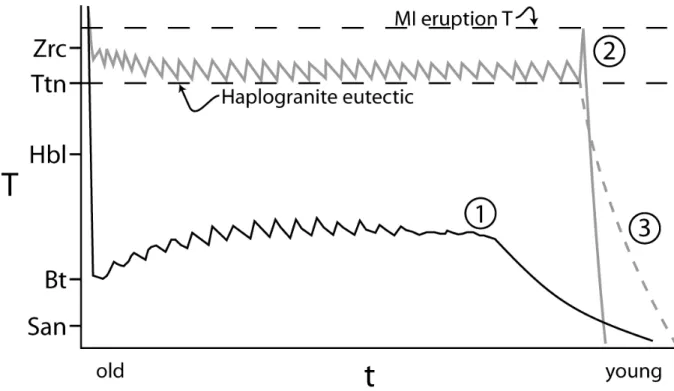
The cycles begin with the oldest magmas intruding cooler wallrocks, leading to rapid cooling and preservation of equigranular texture. As magmatism continues, the thermal gradient may increase; furthermore, successive inputs of magma will lead to thermal oscillations. The steady transition to higher, cycling temperatures may result in both the slightly younger megacrystic facies inboard of the equigranular facies, as well as the gradational contact between them (Johnson and Glazner 2010).
The sharp contact between the megacrystic facies and the outer granodiorite of Cow Meadow may be a result of the magmatic cycle ending, allowing the system to cool. When a new cycle began, Cow Meadow magma batches were emplaced against cooler wallrock, which in this case was megacrystic granodiorite. This thermal juxtaposition could result in rapid cooling, preserving the sharp intrusive contact and the equigranular texture observed in the granodiorite of Cow Meadow. The magmatic cycle continued, repeating the process of a gradual thermal gradient increase along with thermal cycling, producing another gradational contact into the innermost megacrystic granodiorite. The concentric structure of the contacts may be due to doming and flexing in the northern portion of the pluton as it grew, resulting in a laccolith-type geometry.
Magma fluxes in plutons and large ignimbrites
24
pluton has been likened to large (>2000 km3) homogenous crystal-rich dacites known as monotonous intermediates (Hildreth 1981). Bachmann et al. (2007) speculated that eruptions from the growing Mount Givens pluton were likely and thus the original vertical extent of the magma was greater than 5 km (McNulty et al. 2000), implying that even the source of the 5000 km3 Fish Canyon Tuff may have left behind a large pluton. De Silva and Gosnold (2007) suggested that pluton growth and large ignimbrite generation occur at the same rates and are thus directly linked, based on the similarity of their calculated intrusion rates for the Altiplano-Puna volcanic complex (0.012-0.06 km3/a) to Petford et al.’s (2000) filling rate model for the Mount Givens pluton (0.032 km3/a).
To evaluate these hypotheses, I calculate an average magma flux for the Mount Givens Granodiorite of 0.0006 km3/a by using the age range of the Mount Givens pluton established here (7 Ma), the area of the pluton (1500 km2) and the exposed vertical relief as a proxy for thickness (3 km). Using McNulty et al.’s (2000) thickness estimate of 5 km (based on AMS data) yields a flux of 0.0007 km3/a. These rates are similar to magma fluxes
calculated for other plutons in the Sierra Nevada (Coleman et al. 2004; Davis et al. 2012; Lackey et al. 2012) and elsewhere (Matzel et al. 2006; Tappa et al. 2011; Leuthold et al. 2012; Mills and Coleman 2013). However, this is 1-2 orders of magnitude lower than fluxes observed for large-volume ignimbrites (Schmitz and Bowring 2001; Schmitt et al. 2002; Vazquez and Reid 2004; Bachmann et al. 2007; Crowley et al. 2007), which record zircon growth on the order of 105 a rather than 106-107 a.
through time, yielding similar results. Keeping the average magmatic flux of the Tuolumne Intrusive Suite constant at 0.0014 km3/a over 7 Ma, a mobile magma chamber greater than 450 km3 can only be generated when there is a transient pulse of at least 0.05 km3/a,
delivering more than 1000 km3 of magma to emplacement level over 40 ka. These modeled fluxes are in agreement with the fluxes calculated by de Silva and Gosnold (2007) for flare-ups defined by large ignimbrite eruptions in the Altiplano-Puna volcanic complex. Thus, the difference in fluxes between large plutons and similarly-sized ignimbrites might: 1) indicate the hypothesized link between the two rock types—that plutons are either unerupted
equivalents or complementary residua of large ignimbrites—is incorrect, or 2) be a reflection of the proposed differences in their T-t histories.
Zircon dissolution during mush rejuvenation
The observation that phenocrysts in ignimbrites often record heating events prior to eruption (e.g., Bachmann and Dungan 2002; Bachmann et al. 2002; Wark et al. 2007; Molloy et al. 2008; Shane et al. 2008; Bachmann 2010) led to the hypothesis that monotonous
intermediates and other large ignimbrite eruptions occur when long-lived, crystal-rich silicic mushes (50+% crystals) are underplated by mafic magmas and rejuvenated (e.g., Mahood 1990; Bachmann et al. 2002). Though the proposed mechanisms by which the mushes may be revived differ (Bachmann and Bergantz 2003, 2006; Huber et al. 2009, 2010, 2012; Burgisser and Bergantz 2011), the final outcome—eruption—is the same. If heating events do not successfully rejuvenate a magma mush, then it may cool completely to form a granodiorite pluton (Bachmann et al. 2007).
26
would have recorded the same multi-Ma growth of the mush must be dissolved prior to eruption. The difference in apparent magmatic fluxes calculated using zircon geochronology for large plutons and monotonous intermediates would thus be a result of their different T-t histories.
Using Watson’s (1996) equation for the instantaneous dissolution of a spherical zircon, I modeled the effects of hypothetical heating events on zircons with initial radii from 30-120 µm, which are reasonable sizes for zircons in large ignimbrites (Bindeman 2003). The parameters used were similar to those suggested for the Fish Canyon magma. Temperatures were increased from 715-760°C (Bachmann and Dungan 2002) monotonically. Since proposed rejuvenation times range from less than a few centuries (Burgisser and Bergantz 2011) to 200 ka (Bachmann and Bergantz 2003), I used the equation iteratively over timespans ranging from 1 ka to 200 ka.
In order to maximize dissolution I began with the assumption of no (zero) dissolved Zr in the melt initially, and any Zr derived from the dissolving zircons was immediately removed from the system. Adding initial Zr to the magma and increasing the Zr content of the magma in response to zircon dissolution would slow zircon dissolution and may even yield zircon precipitation. The lack of dissolved Zr in the model also accounts for the
compositional differences between granodiorite magmas (M ≈ 1.7; where M ≡(2Ca+Na+
K)/(Si∙Al)) and the peraluminous experiments upon which the dissolution equation is
Results suggest that it is possible to fully dissolve zircons with radii up to nearly 100 µm under the favorable conditions of this model (Fig. 6A). A hypothetical heating event over the maximum 200 ka with no dissolved Zr present in the melt results in complete dissolution of the 10, 25, 50 and 75 µm-radius model zircons. However, a zircon with an initial radius of 100 µm would survive the event with a final radius of 28 µm. Exposing zircons to the same temperature range using the shorter rejuvenation timespans (<1 ka) that have been recently proposed (Burgisser and Bergantz 2011) results in negligible dissolution (Table 1).
The addition of Zr to the melt in this model results in less dissolution (Fig. 6A). With 60 ppm Zr held constant throughout the model (i.e., as the temperature increases, [Zr] is constant and the system becomes Zr-undersaturated), the 75 µm zircon survives over 200 ka, as compared to the Zr-free case. The addition of Zr also limits dissolution over shorter timescales, as the 10 µm zircon requires nearly twice as much time to fully dissolve.
If the rejuvenation event brings the temperature of the melt up to higher temperatures, more dissolution is possible. For example, if the temperature rises to 800°C (Lund Tuff; Maughan et al. 2002), larger model zircons will dissolve over the longer time paths (Fig. 6B). However, the increased temperature has little effect on zircons during the shorter
rejuvenation events and dissolution is further inhibited with the addition of Zr to the melt (Table 1).
28
Figure 6. Temperature-time plots contoured for timing of dissolution of spherical model zircons based on the parameterization of Watson (1996). Contours indicate the T and t at which a zircon of a given radius will fully dissolve assuming a linear T-t path beginning at the origin (T = 715ºC; t = 0 ka). Solid colored lines show results determined with zero dissolved Zr in the model; dashed colored lines are for 60 ppm dissolved Zr held constant in the melt. At any point below a given curve, that zircon will survive without complete
limited melt reservoirs (~1.5 mm), which would discourage dissolution (Watson 1996). Furthermore, the recent preferred timescales for the rejuvenation of even the largest crystal-rich mushes such as the Fish Canyon Tuff are on the order of centuries to 10 ka (Burgisser and Bergantz 2011; Huber et al. 2012), which should preserve many of the initial zircons that would record mush growth (Fig. 6; Table 1).
These results are supported by the presence of ancient xenocrystic zircon cores in monotonous intermediates (Lanphere and Baadsgaard 2001; Schmitt et al. 2002) and other large ignimbrites (Zimmerer and McIntosh 2012). It is improbable that heating events preceding ignimbrite eruption would selectively dissolve zircons recording long-term (up to 10 Ma) growth of a “proto-ignimbrite” but would preserve much older zircons that were not derived from the active magmatic system. In order for such rejuvenation events to
successfully dissolve zircon, the events must be hot, long-lived, and very Zr-poor.
Large mafic sills in silicic batholiths
A fundamental requirement of the hypotheses for erupting a crystal mush is the presence of hot basalt to underplate and rejuvenate the mush. Estimates for the volumes of basalt necessary vary widely depending on the mechanism by which the rejuvenation occurs. For example, much more mafic magma is required for “gas sparging” (Bachmann and Bergantz 2003) than for “unzipping” (Burgisser and Bergantz 2011).
30
Table 1 Results of spherical zircon dissolution modeling
ro (µm) 1 ka 50 ka 100 ka 150 ka 200 ka 715-760°C, 0 ppm Zr in melt
10 7.3 - - - -
25 24.1 - - - -
50 49.5 14 - - -
75 74.7 58 32 - -
100 99.8 88 73 55 28
125 124.8 115 105 93 78
150 149.8 142 133 125 115
maxa 6.8 48 68 83 96
715-760°C, 60 ppm Zr in melt
10 9.2 - - - -
25 24.7 - - - -
50 49.9 42 33 19 -
75 74.9 70 65 59 53
100 99.9 96 93 89 85
125 124.9 122 119 116 113
150 150.0 148 145 143 140
maxa 3.8 27 38 46 54
715-800°C, 0 ppm Zr in melt
10 - - - - -
25 22.1 - - - -
50 48.6 - - - -
75 74.1 - - - -
100 99.3 57 - - -
125 124.5 94 46 - -
150 149.5 126 95 48 -
maxa 11.6 82 116 142 164
715-800°C, 60 ppm Zr in melt
10 5.3 - - - -
25 23.5 - - - -
50 49.3 - - - -
75 74.5 45 - - -
100 99.6 80 53 - -
125 124.7 110 92 70 35
150 149.8 137 124 108 90
maxa 8.5 59.9 85 104 119.7
were underplated. Under Burgisser and Bergantz’s (2011) “standard conditions”, a sill just 5.3-m thick would unzip a 2-km thick mush. If the 4500 km3 Mount Givens magma were 2-km thick, this would require only ~12 km3 of mafic magma.
An examination of the Sierra Nevada batholith suggests that there is little potential for having remobilized significant volumes of magma via either of these mechanisms. Diorite and gabbro bodies are few in number relative to intermediate and felsic plutons (Fig. 7).
None appear to be large enough to rejuvenate a Mount Givens-sized crystal mush by gas sparging. Whereas the small mafic plutons that do exist may meet the volumetric
requirements of unzipping, they do not have the lateral extent necessary to underplate the large areas of intermediate-composition intrusive suites found in the batholith. Even the deeper crystallization depths exposed in the southern Sierra Nevada batholith (Ague and Brimhall 1988) do not reveal the volumes or areas of mafic rocks thought to be necessary to cause the eruption of large-volume ash sheets, though it is possible that mafic bodies
crystallizing at those depths may have sunk (Glazner and Miller 1997).
32
Figure 8. Schematic diagram indicating various T-t paths for intermediate magmas assuming incremental assembly of a large volume of magma. Relative closure temperatures of various thermochronometers are indicated on the y-axis; the temperature for zircon (Zrc) is a relative crystallization temperature. Ttn – titanite (U-Pb); Hbl – hornblende (40Ar/39Ar); Bt - biotite (40Ar/39Ar); San – sanidine (ignimbrites only; 40Ar/39Ar). Path 1 indicates the T-t path of a small batch of magma that is emplaced as a sill in the upper crust. Paths 2 and 3 indicate the T-t paths that magmas follow according to the magma mush hypothesis, where eventual plutons and ignimbrites share most of the same T-t histories. In path 1, the magma rapidly solidifies then slowly increases in T as subsequent sills are emplaced. As the locus of
34
given time during its emplacement. Thus, in order to cause a growing pluton similar to the Mount Givens Granodiorite to erupt such that it will result in a monotonous intermediate, volumes of underplating mafic magma even greater than those called upon by the
rejuvenation hypotheses are required.
Pluton-volcano connections
The data presented here indicate that the difference in age spans between monotonous intermediates and plutons is related to different magma accumulation rates for the two. The information recorded by zircon in monotonous intermediates is indicative of high flux events that favor magma evacuation in large eruptions. These eruptions may leave little behind in the plutonic record, as evidenced by the lack of large volumes of cogenetic intrusive rocks with the tight age spans similar to those observed in ignimbrites (Tappa et al. 2011; Mills and Coleman 2013). Conversely, the lower fluxes observed in plutons are a reflection of the incremental emplacement of magmas that are preferentially stored in the crust, because they tend to cool rapidly after emplacement (Annen 2009; Davis et al. 2012; Schöpa and Annen 2013). Thus, whereas the Mount Givens Granodiorite’s composition and volume are similar to those observed in large ignimbrites, it likely grew too slowly to support the formation of a volume of magma capable of supporting a “super-eruption”.
VI. CONCLUSIONS
New high-precision U-Pb zircon data indicate that the Mount Givens Granodiorite was emplaced over a period of at least 7 Ma, from ~98-91 Ma. Previous growth models for the pluton, such as upper-crustal fractional crystallization (Bateman and Nokleberg 1978) or rapid emplacement of large sills (McNulty et al. 2000) do not satisfy the range of
38 APPENDIX 1
Cathodoluminescence images
Photomicrographs of zircon (Fig. 1) were collected using a TESCAN scanning electron microscope operating at 15 kV equipped with a cathodoluminescence detector. Images were collected on individual zircons. Contrast and brightness were adjusted for each image to improve visual clarity. Zircon images were cropped, rotated and placed on a black background. No
40
Figure 1 (cont.). Cathodoluminescence images of typical zircon in samples dated from the Mount Givens Granodiorite. None of these specific zircons have been dated. Note that all zircons in all samples are shown at the same scale.
APPENDIX 2
Zircon age data for rocks from the Mount Givens Granodiorite
ages (Ma)e totalf sample U Pba Thb 206Pbc 206Pbd error 207Pbd error 207Pbd error 206Pb 207Pb 207Pb corr. common fraction (ppm) (pg) U 204Pb 238U (%) 235U (%) 206Pb (%) 238U 235U 206Pb coeff. Pb (pg)
MG10-01 Equigranular granodiorite (297825, 4153316)g
F-1 925 131 0.40 2296 0.0149558 0.15 0.098896 0.54 0.047959 0.48 95.79 95.76 94.8 0.501 3.6 F-2 942 65 0.38 1280 0.0148744 0.12 0.098493 0.88 0.048025 0.83 95.28 95.38 98.1 0.526 3.3 F-4 814 120 0.42 6062 0.0149081 0.08 0.098783 0.26 0.048057 0.21 95.49 95.65 99.7 0.646 1.2 F-7 1075 56 0.35 4490 0.0148368 0.09 0.098342 0.33 0.048072 0.30 95.04 95.24 100.4 0.493 0.8 F-8 922 32 0.37 1613 0.0148255 0.13 0.098044 0.79 0.047964 0.73 94.97 94.97 95.0 0.540 1.3 F-13 317 32 0.39 721 0.0149286 0.14 0.100268 1.66 0.048713 1.57 95.62 97.02 131.6 0.631 2.8
MG10-02 Megacrystic granodiorite (299119, 4150174)
F-1 470 31 0.38 946 0.0144093 0.14 0.095897 1.33 0.048268 1.23 92.32 92.98 110.0 0.702 2.1 F-5 553 42 0.39 915 0.0160345 0.22 0.107185 1.29 0.048482 1.21 102.64 103.39 120.6 0.429 3.0 F-6 1178 81 0.45 3459 0.0143706 0.14 0.094958 0.43 0.047924 0.37 92.07 92.11 93.1 0.566 1.5 F-9 243 52 0.43 1532 0.0147715 0.13 0.098209 0.78 0.048220 0.72 94.62 95.12 107.7 0.526 2.1 F-10 912 64 0.50 2077 0.0144672 0.10 0.095648 0.62 0.047950 0.57 92.69 92.75 94.4 0.583 1.9 F-11 1116 104 0.40 4437 0.0144432 0.09 0.095467 0.36 0.047939 0.31 92.54 92.58 93.8 0.641 1.5 F-14 957 86 0.48 2894 0.0150431 0.12 0.099769 0.46 0.048101 0.41 96.35 96.56 101.9 0.516 1.8
MG10-03 Aplitic granite (295531, 4144923)
F-1 1039 63 0.45 686 0.0144594 0.14 0.095729 1.64 0.048017 1.55 92.64 92.83 97.7 0.662 5.9 F-2 2118 30 0.30 1302 0.0143416 0.12 0.094672 0.89 0.047876 0.83 91.89 91.85 90.6 0.540 1.5 F-3 2600 74 0.49 3068 0.0144802 0.12 0.095742 0.45 0.047954 0.39 92.77 92.84 94.6 0.580 1.5 F-4 801 34 0.48 2169 0.0144674 0.21 0.095616 0.83 0.047933 0.77 92.69 92.72 93.6 0.371 1.0
MG10-04 Megacrystic granodiorite (296797, 4145483)
F-1 762 152 0.50 6423 0.0145414 0.09 0.096247 0.30 0.048004 0.24 93.16 93.31 97.1 0.736 1.5 F-3 1231 178 0.46 3985 0.0145218 0.09 0.095950 0.36 0.047921 0.31 93.03 93.03 92.9 0.594 2.8 F-5 118 33 0.46 2309 0.0144186 0.18 0.095680 0.63 0.048128 0.55 92.38 92.78 103.1 0.574 0.9 F-7 736 230 0.44 4572 0.0144520 0.10 0.095366 0.31 0.047859 0.26 92.59 92.49 89.9 0.615 3.2
MG10-05 Equigranular granodiorite (288528, 4136287)
F-1 820 127 0.41 5359 0.0150757 0.10 0.099691 0.29 0.047960 0.23 96.55 96.49 94.9 0.654 1.5 F-2 260 95 0.43 3913 0.0150413 0.12 0.099474 0.35 0.047965 0.29 96.34 96.29 95.2 0.583 1.5
F-4 3342 143 0.42 5401 0.0150698 0.10 0.099826 0.31 0.048044 0.26 96.52 96.62 99.1 0.602 1.7 F-5 327 94 0.42 3896 0.0150844 0.11 0.100088 0.42 0.048123 0.38 96.61 96.86 103.0 0.508 1.5 F-6 486 67 0.36 3461 0.0150633 0.21 0.099793 0.41 0.048048 0.32 96.48 96.59 99.3 0.638 1.2 F-8 313 157 0.42 8078 0.0150331 0.12 0.099688 0.39 0.048094 0.29 96.28 96.49 101.5 0.872 1.2
MG10-07 Megacrystic granodiorite (326375, 4110337)
F-1 633 105 0.63 4132 0.0140655 0.11 0.092879 0.43 0.047892 0.37 90.13 90.18 91.6 0.630 1.5 F-2 798 140 0.49 5744 0.0142032 0.11 0.093807 0.32 0.047901 0.26 91.01 91.04 91.9 0.662 1.5 F-3 696 179 0.51 6079 0.0141686 0.10 0.093480 0.33 0.047851 0.30 90.79 90.74 89.5 0.361 1.8 F-4 676 106 0.53 4422 0.0141932 0.14 0.093838 0.35 0.047951 0.29 90.94 91.07 94.4 0.617 1.5 F-7 475 94 0.68 4624 0.0141685 0.11 0.093480 0.32 0.047851 0.27 90.78 90.74 89.6 0.615 1.2 F-8 448 106 0.54 2761 0.0141954 0.32 0.093637 0.53 0.047841 0.39 90.96 90.89 89.0 0.676 2.3
MG10-08 Aplitic granite (324733, 4113647)
F-1 214 69 0.50 3171 0.0144533 0.11 0.095382 0.53 0.047863 0.47 92.60 92.50 90.1 0.646 1.3 F-2 870 58 0.69 2441 0.0142017 0.12 0.093864 0.53 0.047935 0.48 90.99 91.10 93.8 0.511 1.4 F-4 639 99 0.44 2952 0.0144307 0.10 0.094960 0.51 0.047726 0.46 92.46 92.11 83.3 0.596 2.1 F-5 798 131 0.54 2364 0.0142049 0.11 0.093700 0.51 0.047841 0.46 91.02 90.94 89.0 0.516 3.4
MG11-02 Megacrystic granodiorite (312408, 4132076)
F-3 902 121 0.45 6119 0.0149241 0.17 0.098947 0.36 0.048086 0.28 95.59 95.80 101.1 0.646 1.2 F-4 434 84 0.44 3127 0.0149194 0.13 0.098739 0.44 0.048000 0.38 95.56 95.61 96.9 0.559 1.7
MG11-03 Equigranular granodiorite (290404, 4140734)
F-1 745 303 0.48 10007 0.0148615 0.08 0.097926 0.20 0.047790 0.14 95.19 94.86 86.5 0.809 1.9 F-3 874 374 0.38 10047 0.0147955 0.08 0.097332 0.20 0.047712 0.14 94.78 94.31 82.6 0.765 2.4 F-4 748 102 0.38 4655 0.0147705 0.09 0.097329 0.29 0.047791 0.24 94.62 94.31 86.5 0.639 1.4 F-10 742 64 0.40 909 0.0147417 0.12 0.097653 1.22 0.048044 1.16 94.43 94.61 99.0 0.581 4.5
MG11-04 Megacrystic granodiorite (283917, 4149984)
F-1 148 62 0.45 2107 0.0152823 0.10 0.101211 0.57 0.048033 0.52 97.87 97.89 98.6 0.521 1.8 F-3 570 107 0.46 2657 0.0152846 0.18 0.101111 0.48 0.047978 0.41 97.88 97.80 95.9 0.537 2.5 F-4 380 80 0.48 4339 0.0153922 0.09 0.101809 0.31 0.047972 0.26 98.56 98.44 95.6 0.636 1.1 a Total mass of radiogenic Pb
b Th contents calculated from radiogenic 208Pb and the 207Pb/206Pb date of the sample, assuming concordance between U-Th and Pb systems c Measured ratio corrected for fractionation and spike contribution only
d Measured ratios corrected for fractionation, tracer, blank
e Th-corrected isotopic dates calculated using the decay constants λ
238 = 1.55125E-10 and λ235 = 9.8485E-10 (Jaffey et al. 1971), assuming Th/Umagma = 3.7 f Total mass of common Pb
g Locations in NAD 83, UTM Zone 11
APPENDIX 3
Modeling mafic magma volumes required for rejuvenation of the Mount Givens Granodiorite
The amount of mafic magma necessary to rejuvenate the Mount Givens Granodiorite is
calculated using the “gas sparging” method (Bachmann and Bergantz 2003, 2006; Huber et al.
2010). In the “gas sparging” hypothesis, basaltic magma underplates a locked silicic magma
mush (50+% crystals; Bachmann and Bergantz 2006). As the basalt crystallizes, it releases
volatiles (H2O+CO2), which may advect heat into the overlying silicic mush without leaving an
easily detectable chemical signature (Bachmann and Bergantz 2003, 2006). This may cause
resorption of crystals in the locked mush, allowing it to convect and homogenize.
The volume of mafic magma may be determined by equating the amount of energy
required to raise the temperature of the silicic mush and melt a fraction of the crystals in the
mush with the amount of sensible and latent heat released by the crystallizing mafic magma
(Bachmann and Bergantz 2003, 2006), while also accounting for conductive cooling of the mush
over the time period in question. This is represented in the following equation
mmafic=
{mmush[Cp,mushΔTmush+XmLmush]}+(−k)A ΔTmush
Δx Δt Cp,maficΔTmafic+XcLmafic
All parameters are defined in Table 1 and were taken from Bachmann and Bergantz
(2003, 2006) where applicable. Bachmann and Bergantz (2003, 2006) used an integrated form of
Fourier’s law assuming a depth between 6 and 7 km for the top of the magma chamber (Δx) to
calculate the amount of heat lost by conductive cooling over 150 ka (O Bachmann pers. comm.).
The mass of the Mount Givens crystal mush was calculated assuming a volume of 4500 km3 and
a density of 2450 kg m-3, whereas the final volume of the mafic magma was calculated assuming
44 Table 1. Parameters used in gas sparging calculations
Symbol Definition Value Sourcea
mmush Mass of the mush (kg) 1.1025 × 10¹⁶ this study mmafic Mass of mafic magma (kg)
Cp,mush Specific heat, mush (J kg-1 K-1) 1370 B and B 2003 Cp,mafic Specific heat, mafic magma (J kg-1 K-1) 1484 B and B 2003 ΔTmush Tinitial – Tfinal, in mush (K) 40 B and B 2003 ΔTmafic Tinitial – Tfinal, in mafic magma (K) 150 B and B 2003
Xm Weight fraction melted, mush 0.2 B and B 2003
Xc Weight fraction crystallized, mafic magma 0.9 B and B 2003 Lmush Latent heat of fusion, mush (J kg-1) 2.7 × 10⁵ B and B 2003 Lmafic Latent heat of fusion, mafic magma (J kg-1) 4 × 10⁵ B and B 2003
k Thermal conductivity (W m-1 K-1) 2 B and B 2006
A Cross-sectional area (m2) 1.5 × 10⁹ B and B 2003
Δx Distance between ends (m) 1000 OB pers. comm. 2010
Δt Time elapsed (s) 4.73 × 10¹² B and B 2003
REFERENCES
Ague JJ, Brimhall GH (1988) Magmatic arc asymmetry and distribution of anomalous plutonic belts in the batholiths of California: Effects of assimilation, crustal thickness, and depth of crystallization. Geol Soc Am Bull 100:912-927
Annen C (2009) From plutons to magma chambers: Thermal constraints on the accumulation of eruptible silicic magma in the upper crust. Earth Planet Sci Lett 284:409-416
Annen C, Blundy JD, Sparks RSJ (2006) The Genesis of Intermediate and Silicic Magmas in Deep Crustal Hot Zones. J Petrol 37:505-539
Bachmann O (2010) The petrologic evolution and pre-eruptive conditions of the rhyolitic Kos Plateau Tuff (Aegean arc). Cent Eur J Geosci 2:270-305
Bachmann O, Dungan MA (2002) Temperature-induced Al-zoning in hornblendes of the Fish Canyon magma. Am Mineral 87:1062-1076
Bachmann O, Bergantz GW (2003) Rejuvenation of the Fish Canyon magma body: A window into the evolution of large-volume silicic magma systems. Geology 31:789-792
Bachmann O, Bergantz GW (2006) Gas percolation in upper-crustal silicic crystal mushes as a mechanism for upward heat advection and rejuvenation of near-solidus magma bodies. J Volcanol Geotherm Res 149:85-102
Bachmann O, Bergantz GW (2008) Rhyolites and their Source Mushes across Tectonic Settings. J Petrol 49:2277-2285
Bachmann O, Dungan MA, Lipman PW (2002) The Fish Canyon Magma Body, San Juan Volcanic Field, Colorado: Rejuvenation and Eruption of an Upper-Crustal Batholith. J Petrol 43:1469-1503
Bachmann O, Miller CF, de Silva SL (2007) The volcanic-plutonic connection as a stage for understanding crustal magmatism. J Volcanol Geotherm Res 167:1-23
Bateman PC (1965) Geologic map of the Blackcap Mountain quadrangle, Fresno County, California. US Geol Surv Rep GQ-428
Bateman PC (1992) Plutonism in the Central Part of the Sierra Nevada Batholith, California. US Geol Surv Prof Pap 1483
Bateman PC, Nokleberg WJ (1978) Solidifcation of the Mount Givens Granodiorite, Sierra Nevada, California. J Geology 86:563-579
46
Bateman PC, Lockwood JP, Lydon PA (1971) Geologic map of the Kaiser Peak quadrangle, central Sierra Nevada, California. US Geol Surv Rep GQ-894
Bindeman IN (2003) Crystal sizes in evolving silicic magma chambers. Geology 31:367-370
Bowring JF, McLean NM, Bowring SA (2011) Engineering cyber infrastructure for U-Pb geochronology: Tripoli and U-Pb_Redux. Geochem Geophys Geosyst, 12:Q0AA19. doi:10.1029/2010GC003479
Burgisser A, Bergantz GW (2011) A rapid mechanism to remobilize and homogenize highly crystalline magma bodies. Nature 471:212-215
Chesner CA (1998) Petrogenesis of the Toba Tuffs, Sumatra, Indonesia. J Petrol 39:397-438
Chesner CA (2011) The Toba Caldera Complex. Quat Int 258:5-18
Coleman DS, Gray W, Glazner AF (2004) Rethinking the emplacement and evolution of zoned plutons: Geochronologic evidence for incremental assembly of the Tuolumne Intrusive Suite, California. Geology 32:433-436
Couch S, Sparks RSJ, Carroll MR (2001) Mineral disequilibrium in lavas explained by convective self-mixing in open magma chambers. Nature 411:1037-1039
Corfu F, Hanchar JM, Hoskin PWO, Kinny P. (2003) Atlas of zircon textures. In: Hanchar JM, Hoskin PWO (eds) Zircon. Rev Mineral Geochem 53:468-500
Crisp JA (1984) Rates of magma emplacement and volcanic output. J Volc Geotherm Res 20:177-211
Crowley JL, Schoene B, Bowring SA (2007) U-Pb dating of zircon in the Bishop Tuff at the millennial scale. Geology 35:1123-1126
Cruden AR (1998) On the emplacement of tabular granites. J Geol Soc Lond 155:853-862
Cruden AR, Launeau P (1994) Structure, magnetic fabric and emplacement of the Archean Lebel Stock, SW Abitibi Greenstone Belt. J Struct Geol 16:677-691
Cruden AR, Tobisch OT, Launeau P (1999) Magnetic fabric evidence for conduit-fed emplacement of a tabular intrusion: Dinkey Creek Pluton, central Sierra Nevada batholith, California. J Geophys Res 104:10511-10530
Davis JW, Coleman DS (2008) Thermal models of incremental pluton emplacement. Geochim Cosmochim Acta 72:A202
Davis JW, Coleman DS, Gracely JT, Gaschnig R, Stearns M (2012) Magma accumulation rates and thermal histories of plutons of the Sierra Nevada batholith, CA. Contrib Mineral Petrol 163:449-465
de Saint Blanquat M, Tikoff B (1997) Development of magmatic to solid-state fabrics during syntectonic emplacement of the Mono Creek granite, Sierra Nevada batholith. In:
Bouchez JL, Hutton DHW, Stephens WE (eds) Granite: From segregation of melt to emplacement fabrics. Kluwer Academic Publishers, Amsterdam, pp 231–252
de Saint Blanquat M, Horsman E, Habert G, Morgan S, Vanderhaeghe O, Law R, Tikoff B (2011) Multiscale magmatic cyclicity, duration of pluton construction, and the
paradoxical relationship between tectonism and plutonism in continental arcs. Tectonophysics 500:20-33
de Silva SL, Gosnold WD (2007) Episodic construction of batholiths: Insights from the spatiotemporal development of an ignimbrite flare-up. J Volc Geotherm Res 167:320-335
Diggles MF, Dellinger DA, Conrad JE (1987) Geologic map of the Owens Peak and Little Lake Canyon Wilderness study areas, Inyo and Kern Counties, California. US Geol Surv Rep MF-1927-A
Dodge FCW, Millard HT Jr, Elsheimer HN (1982) Compositional Variations and
Abundances of Selected Elements in Granitoid Rocks and Constituent Minerals, Central Sierra Nevada Batholith, California. US Geol Surv Prof Pap 1248
du Bray EA, Moore JG (1985) Geologic map of the Olancha quadrangle, southern Sierra Nevada, California. US Geol Surv Rep MF-1734
Frazer RE, Lackey JS, Valencia VA (2009) New U-Pb zircon ages of the granites of Dinkey Dome: Reexamining the origins of the Shaver Intrusive Suite. Geol Soc Am Abs Prog 41:14
Gilder S, McNulty BA (1999) Tectonic exhumation and tilting of the Mount Givens pluton, central Sierra Nevada, California. Geology 27:919-922
Glazner AF, Miller DM (1997) Late-stage sinking of plutons. Geology 25:1099-1102
Glazner AF, Bartley JM, Coleman DS, Gray W, Taylor RZ (2004) Are plutons assembled over millions of years by amalgamation from small magma chambers? Geol Soc Am Today 14:4-11
Grunder AL, Klemetti EW, Feeley TC, McKee CM (2006) Eleven million years of arc volcanism at the Aucanquilcha Volcanic Cluster, northern Chilean Andes: implications for the life span and emplacement of plutons. Trans R Soc Edinb Earth Sci 97:415-436
48
Hamilton W, Myers WB (1967) The Nature of Batholiths. US Geol Surv Prof Pap 554-C
Hildreth W (1981) Gradients in Silicic Magma Chambers: Implications for Lithospheric Magmatism. J Geophys Res 86:10153-10192
Hildreth W (2004) Volcanological perspectives on Long Valley, Mammoth Mountain, and Mono Craters: several contiguous but discrete systems. J Volc Geotherm Res 136:169-198
Huber C, Bachmann O, Manga M, (2009) Homogenization processes in silicic magma chambers by stirring and mushification (latent heat buffering). Earth Planet Sci Lett 283:38-47
Huber C, Bachmann O, Manga M (2010) Two Competing Effects of Volatiles on Heat Transfer in Crystal-rich Magmas: Thermal Insulation vs. Defrosting. J Petrol 51:847-867
Huber C, Bachmann O, Dufek J (2012) Crystal-poor versus crystal-rich ignimbrites: A competition between stirring and reactivation. Geology 40:115-118
Huber NK (1983) Preliminary geologic map of the Pinecrest quadrangle, central Sierra Nevada, California. US Geol Surv Rep MF-1437
Huang F, Lundstrom CC, Glessner J, Ianno A, Boudreau A, Li J, Ferré EC, Marshak S, DeFrates J (2009) Chemical and isotopic fractionation of wet andesite in a temperature gradient: Experients and models suggesting a new mechanism of magma differentiation. Geochim Cosmochim Acta 73:729-749
Johnson BR, Glazner AF (2010) Formation of K-feldspar megacrysts in granodioritic plutons by thermal cycling and late-stage textural coarsening. Contrib Mineral Petrol 159:599-619
King RF (1966) The magnetic susceptibility of some Irish granites. Geol J 5:43-66
Krogh TE (1973) A low-contamination method for hydrothermal decomposition of zircon and extraction of U and Pb for isotopic age determinations. Geochim Cosmochim Acta 37:485-494
Lackey JS, Valley JW, Chen JH, Stockli DF (2008) Dynamic Magma Systems, Crustal Recycling, and Alteration in the Central Sierra Nevada. J Petrol 49:1397-1426
Lackey JS, Cecil MR, Windham CJ, Frazer RE, Bindeman IN, Gehrels GE (2012) The Fine Gold Intrusive Suite: The roles of basement terranes and magma source development in the Early Cretaceous Sierra Nevada Batholith. Geoshpere 8:292-313
Leuthold J, Müntener O, Baumgartner LP, Putlitz B, Ovtcharova M, Schaltegger U (2012) Time resolved construction of a bimodal laccolith (Torres del Paine, Patagonia). Earth Planet Sci Lett 325-326:85-92
Lindsay JM, de Silva S, Trumbull R, Emmermann R, Wemmer K (2001a) La Pacana caldera, N. Chile: a re-evaluation of the stratigraphy and volcanology of one of the world’s largest resurgent calderas. J Volc Geotherm Res 106:145-173
Lindsay JM, Schmitt AK, Trumbull RB, de Silva SL, Siebel W, Emmermann R (2001b) Magmatic Evolution of the La Pacana Caldera System, Central Andes, Chile:
Compositional Variation of Two Cogenetic, Large-Volume Felsic Ignimbrites. J Petrol 42:459-486
Lipman PW (2007) Incremental assembly and prolonged consolidation of Cordilleran magma chambers: Evidence from the Southern Rocky Mountain volcanic field. Geoshpere 3:42-70
Lundstrom C (2009) Hypothesis for the origin of convergent margin granitoids and Earth’s continental crust by thermal migration zone refining. Geochim Cosmochim Acta 73:5709-5729
Lundstrom CC, Marshak S, DeFrates J, Mabon J (2011) Alternative processes for developing fabric and mineral compositional zoning in intrusive rocks. Int Geol Rev 53:377-405
Mahood GA (1990) Second reply to comment of R.S.J. Sparks, H.E. Huppert and C.J.N. Wilson on “Evidence for long residence times of rhyolitic magma in the Long Valley magmatic system: the isotopic record in the precaldera lavas of Glass Mountain”. Earth Planet Sci Lett 99:395-399
Matthews RA, Burnett JL (1965) Geologic map of California, Fresno sheet. State Calif Dep Conserv Div Mines Geol
Mattinson JM (2005) Zircon U-Pb chemical abrasion (“CA-TIMS”) method: Combined annealing and multi-step partial dissolution analysis for imporved precision and accuracy of zircon ages. Chem Geol 220:47-66
Matzel JEP, Bowring SA, Miller RB (2006) Time scales of pluton construction at differing crustal levels: Examples from the Mount Stuart and Tenpeak intrusions, North Cascades, Washington. Geol Soc Am Bull 118:1412-1430
Maughan LL, Christiansen EH, Best MG, Grommé CS, Deino AL, Tingey DG (2002) The Oligocene Lund Tuff, Great Basin, USA: a very large volume monotonous intermediate. J Volc Geotherm Res 113:129-157
50
McNulty BA, Tobisch OR, Cruden AR, Gilder S (2000) Multistage emplacement of the Mount Givens pluton, central Sierra Nevada batholith, California. Geol Soc Am Bull 112:119-135
Memeti V, Paterson S, Matzel J, Mundil R, Okaya D (2010) Magmatic lobes as “snapshots” of magma chamber growth and evolution in large, composite batholiths: An example from the Tuolumne intrusion, Sierra Nevada, California. Geol Soc Am Bull 122:1912-1931
Menand T (2011) Physical controls and depth of emplacement of igneous bodies: A review. Tectonophysics 500:11-19
Miller JS, Matzel JEP, Miller CF, Burgess SD, Miller RB (2007) Zircon growth and recycling during the assembly of large, composite arc plutons. J Volc Geotherm Res 167:282-299
Mills RD, Coleman DS (2013) Temporal and chemical connections between plutons and ignimbrites from the Mount Princeton magmatic center. Contrib Mineral Petrol, doi: 10.1007/s00410-012-0843-4
Mills RD, Ratner JJ, Glazner AF (2011) Experimental evidence for crystal coarsening and fabric development during temperature cycling. Geology 39:1139-1142
Molloy C, Shane P, Nairn I (2008) Pre-eruption thermal rejuvenation and stirring of a partly crystalline rhyolite pluton revealed by the Earthquake Flat Pyroclastics deposits, New Zealand. J Geol Soc 165:435-447
Moore JG (1963) Geologic map and sections of the Mount Pinchot quadrangle, California. US Geol Surv Bull 1130
Moore JG (1978) Geologic map of the Marion Peak quadrangle, Fresno County, California. US Geol Surv Rep GQ-1399
Moore JG (1981) Geologic map of the Mount Whitney quadrangle, Inyo and Tulare Counties, California. US Geol Surv Rep GQ-1545
Moore JG, Nokleberg WJ (1992) Geologic map of the Tehipite Dome quadrangle, Fresno County, California. US Geol Surv Rep GQ-1676
Moore JG, Sisson TW (1985) Geologic map of the Kern Peak quadrangle, Tulare County, California. US Geol Surv Rep GQ-1584
Moore JG, Sisson TW (1987) Geologic map of the Triple Divide Peak quadrangle, Tulare County, California. US Geol Surv Rep GQ-1636
Parrish RR (1987) An improved micro-capsule for zircon dissolution in U-Pb geochronology. Chem Geol 66:99-102
Parrish RR, Krogh TE (1987) Synthesis and purification of 205Pb for U-Pb geochronology. Chem Geol 66:103-110
Petford N, Cruden AR, McCaffrey KJW, Vigneresse JL (2000) Granite magma formation, transport and emplacement in the Earth’s crust. Nature 408:669-673
Pickett DA, Saleeby JB (1993) Thermobarometric Constraints on the Depth of Exposure and Conditions of Plutonism and Metamorphism at Deep Levels of the Sierra Nevada Batholith, Tehachapi Mountains, California. J Geophys Res 98:609-629
Renne PR, Tobisch OT, Saleeby JB (1993) Thermochronologic record of pluton
emplacement, deformation, and exhumation at Courtright shear zone, central Sierra Nevada, California. Geology 21:331-334
Rioux M, Lissenberg CJ, McLean NM, Bowring SA, MacLeod CJ, Hellebrand E, Shimizu N (2012) Protracted timescales of lower crustal growth at the fast-spreading East Pacific Rise. Nat Geosci 5:275-278
Schaltegger U, Brack P, Ovtcharova M, Peytcheva I, Schoene B, Stracke A, Marocchi M, Bargossi GM (2009) Zircon and titanite recording 1.5 million years of magma accretion, crystallization and initial cooling in a composite pluton (southern Adamello batholith, northern Italy). Earth Planet Sci Lett 286:208-218
Schmitt AK, Lindsay JM, de Silva S, Trumbull RB (2002) U-Pb zircon chronostratigraphy of early-Pliocene ignimbrites from La Pacana, north Chile: implications for the formation of stratified magma chambers. J Volc Geotherm Res, 120:43-53
Schmitz MD, Bowring SA (2001) U-Pb zircon and titanite systematics of the Fish Canyon Tuff: an assessment of high-precision U-Pb geochronology and its application to young volcanic rocks. Geochim Cosmochim Acta 65:2571-2587
Schmitz MD, Schoene B (2007) Derivation of isotope ratios, errors, and error correlations for U-Pb geochronology using 205Pb-235U-(233U)-spiked isotope dilution thermal ionization mass spectrometric data. Geochem Geophys Geosyst 8:Q08006,
doi:10.1029/2006GC001492
Schoene B, Latkoczy C, Schaltegger U, Günther D (2010) A new method integrating high-precision U–Pb geochronology with zircon trace element analysis (U–Pb TIMS-TEA). Geochim Cosmochim Acta 74:7144-7159
52
Shane P, Nairn IA, Smith VC, Darragh M, Beggs K, Cole JW (2008) Silicic recharge of multiple rhyolite magmas by basaltic intrusion during the 22.6 ka Okareka Eruption Episode, New Zealand. Lithos 103:527-549
Sisson TW, Moore JG (1994) Geologic map of the Giant Forest quadrangle, Tulare County, California. US Geol Surv Rep GQ-1751
Smith AR (1964) Geologic map of California, Bakersfield sheet. State Calif Dep Conserv Div Mines Geol
Steiger RH, Jäger E (1977) Subcommission on geochronology: Convention on the use of decay constants in geo- and cosmochronology. Earth Planet Sci Lett 36:359-362
Stern TW, Bateman PC, Morgan BA, Newell MF, Peck DL (1981) Isotopic U-Pb ages of Zircon from the Granitoids of the Central Sierra Nevada, California. US Geol Surv Prof Pap 1185
Stone P, Dunne GC, Moore JG, Smith GI (2000) Geologic map of the Lone Pine 15’ quadrangle, Inyo County, California. US Geol Surv Rep I-2617
Tappa MJ, Coleman DS, Mills RD, Samperton KM (2011) The plutonic record of a silicic ignimbrite from the Latir volcanic field, New Mexico. Geochem Geophys Geosyst 12:Q10011, doi: 10.1029/2011gc003700.
Tikoff B, de Saint Blanquat M (1997) Transpressional shearing and strike-slip partitioning in the Late Cretaceous Sierra Nevada magmatic arc, California. Tectonics 16:442-459
Tikoff B, Davis MR, Teyssier C, de Saint Blanquat M, Habert G, Morgan S (2005) Fabric studies within the Cascade Lake shear zone, Sierra Nevada, California. Tectonophysics 400:209-226
Tobisch OT, Renne PR, Saleeby JB (1993) Deformation resulting from regional extension during pluton ascent and emplacement, central Sierra Nevada, California. J Struct Geol 15:609-628
Tobisch OT, Saleeby JB, Renne PR, McNulty B, Tong W (1995) Variations in deformation fields during development of a large-volume magmatic arc, central Sierra Nevada, California. Geol Soc Am Bull 107:148-166
Vazquez JA, Reid MR (2004) Probing the Accumulation History of the Voluminous Toba Magma. Science 305:991-994
Wahrhaftig C (2000) Geologic map of the Tower Peak quadrangle, central Sierra Nevada, California. US Geol Surv Rep I-2697
Watson EB (1996) Dissolution, growth and survival of zircons during crustal fusion: kinetic principles, geological models and implications for isotopic inheritance. Trans R Soc Edinb Earth Sci 87:43-56