1.0 A, Adjustable Output
Voltage, Step-Down
Switching Regulator
The LM2575 series of regulators are monolithic integrated circuits
ideally suited for easy and convenient design of a step−down
switching regulator (buck converter). All circuits of this series are capable of driving a 1.0 A load with excellent line and load regulation. These devices are available in fixed output voltages of 3.3 V, 5.0 V, 12 V, 15 V, and an adjustable output version.
These regulators were designed to minimize the number of external components to simplify the power supply design. Standard series of inductors optimized for use with the LM2575 are offered by several different inductor manufacturers.
Since the LM2575 converter is a switch−mode power supply, its
efficiency is significantly higher in comparison with popular three−terminal linear regulators, especially with higher input voltages. In many cases, the power dissipated by the LM2575 regulator is so low, that no heatsink is required or its size could be reduced dramatically.
The LM2575 features include a guaranteed ±4% tolerance on output
voltage within specified input voltages and output load conditions, and ±10% on the oscillator frequency (±2% over 0°C to 125°C). External
shutdown is included, featuring 80 mA typical standby current. The
output switch includes cycle−by−cycle current limiting, as well as thermal shutdown for full protection under fault conditions.
Features
•
3.3 V, 5.0 V, 12 V, 15 V, and Adjustable Output Versions•
Adjustable Version Output Voltage Range of 1.23 V to 37 V ±4%Maximum Over Line and Load Conditions
•
Guaranteed 1.0 A Output Current•
Wide Input Voltage Range: 4.75 V to 40 V•
Requires Only 4 External Components•
52 kHz Fixed Frequency Internal Oscillator•
TTL Shutdown Capability, Low Power Standby Mode•
High Efficiency•
Uses Readily Available Standard Inductors•
Thermal Shutdown and Current Limit Protection•
Moisture Sensitivity Level (MSL) Equals 1•
Pb−Free Packages are Available*Applications
•
Simple and High−Efficiency Step−Down (Buck) Regulators•
Efficient Pre−Regulator for Linear Regulators•
On−Card Switching Regulators•
Positive to Negative Converters (Buck−Boost)•
Negative Step−Up Converters•
Power Supply for Battery ChargersSee detailed ordering and shipping information in the package dimensions section on page 25 of this data sheet.
ORDERING INFORMATION 1 5 TO−220 TV SUFFIX CASE 314B 1 5 1 5
Heatsink surface connected to Pin 3
TO−220 T SUFFIX CASE 314D Pin 1. Vin 2. Output 3. Ground 4. Feedback 5. ON/OFF D2PAK D2T SUFFIX CASE 936A
Heatsink surface (shown as terminal 6 in case outline drawing) is connected to Pin 3
See general marking information in the device marking section on page 26 of this data sheet.
DEVICE MARKING INFORMATION http://onsemi.com
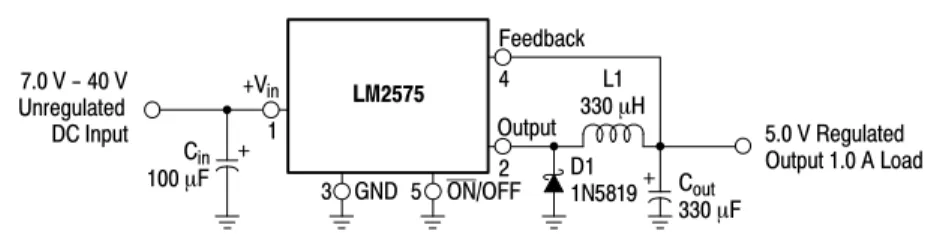
Figure 1. Block Diagram and Typical Application 7.0 V - 40 V Unregulated DC Input L1 330 mH GND +Vin 1 Cin 100 mF 3 5 ON/OFF Output 2 Feedback 4 D1 1N5819 Cout 330 mF
Typical Application (Fixed Output Voltage Versions)
Representative Block Diagram and Typical Application
Unregulated DC Input +Vin 1 Cout Feedback 4 Cin L1 D1 R2 R1 1.0 k Output 2 GND 3 ON/OFF 5 Reset Latch Thermal Shutdown 52 kHz Oscillator 1.235 V Band-Gap Reference Freq Shift 18 kHz Comparator Fixed Gain Error Amplifier Current Limit Driver 1.0 Amp Switch ON/OFF 3.1 V Internal Regulator Regulated Output Vout Load Output Voltage Versions 3.3 V 5.0 V 12 V 15 V R2 (W) 1.7 k 3.1 k 8.84 k 11.3 k For adjustable version R1 = open, R2 = 0 W
LM2575
5.0 V Regulated Output 1.0 A Load
This device contains 162 active transistors.
ABSOLUTE MAXIMUM RATINGS (Absolute Maximum Ratings indicate limits beyond which damage to the device may occur.)
Rating Symbol Value Unit
Maximum Supply Voltage Vin 45 V
ON/OFF Pin Input Voltage − −0.3 V ≤ V ≤ +Vin V
Output Voltage to Ground (Steady−State) − −1.0 V
Power Dissipation
Case 314B and 314D (TO−220, 5−Lead) PD Internally Limited W
Thermal Resistance, Junction−to−Ambient RqJA 65 °C/W
Thermal Resistance, Junction−to−Case RqJC 5.0 °C/W
Case 936A (D2PAK) PD Internally Limited W
Thermal Resistance, Junction−to−Ambient (Figure 34) RqJA 70 °C/W
Thermal Resistance, Junction−to−Case RqJC 5.0 °C/W
Storage Temperature Range Tstg −65 to +150 °C
Minimum ESD Rating (Human Body Model: C = 100 pF, R = 1.5 kW) − 2.0 kV
Lead Temperature (Soldering, 10 s) − 260 °C
Maximum Junction Temperature TJ 150 °C
Stresses exceeding Maximum Ratings may damage the device. Maximum Ratings are stress ratings only. Functional operation above the Recommended Operating Conditions is not implied. Extended exposure to stresses above the Recommended Operating Conditions may affect device reliability.
OPERATING RATINGS (Operating Ratings indicate conditions for which the device is intended to be functional, but do not guarantee specific performance limits. For guaranteed specifications and test conditions, see the Electrical Characteristics.)
Rating Symbol Value Unit
Operating Junction Temperature Range TJ −40 to +125 °C
Supply Voltage Vin 40 V
SYSTEM PARAMETERS([Note 1] Test Circuit Figure 14)
ELECTRICAL CHARACTERISTICS (Unless otherwise specified, Vin = 12 V for the 3.3 V, 5.0 V, and Adjustable version, Vin = 25 V for the 12 V version, and Vin = 30 V for the 15 V version. ILoad = 200 mA. For typical values TJ = 25°C, for min/max values TJ is the operating junction temperature range that applies [Note 2], unless otherwise noted.)
Characteristics Symbol Min Typ Max Unit
LM2575−3.3 (Note 1 Test Circuit Figure 14)
Output Voltage (Vin = 12 V, ILoad = 0.2 A, TJ = 25°C) Vout 3.234 3.3 3.366 V Output Voltage (4.75 V ≤ Vin≤ 40 V, 0.2 A ≤ ILoad≤ 1.0 A) Vout V
TJ = 25°C 3.168 3.3 3.432
TJ = −40 to +125°C 3.135 − 3.465
Efficiency (Vin = 12 V, ILoad = 1.0 A) η − 75 − %
LM2575−5 ([Note 1] Test Circuit Figure 14)
Output Voltage (Vin = 12 V, ILoad = 0.2 A, TJ = 25°C) Vout 4.9 5.0 5.1 V Output Voltage (8.0 V ≤ Vin≤ 40 V, 0.2 A ≤ ILoad≤ 1.0 A) Vout V
TJ = 25°C 4.8 5.0 5.2
TJ = −40 to +125°C 4.75 − 5.25
Efficiency (Vin = 12 V, ILoad = 1.0 A) η − 77 − %
LM2575−12 (Note 1 Test Circuit Figure 14)
Output Voltage (Vin = 25 V, ILoad = 0.2 A, TJ = 25°C) Vout 11.76 12 12.24 V Output Voltage (15 V ≤ Vin≤ 40 V, 0.2 A ≤ ILoad≤ 1.0 A) Vout V
TJ = 25°C 11.52 12 12.48
TJ = −40 to +125°C 11.4 − 12.6
Efficiency (Vin = 15V, ILoad = 1.0 A) η − 88 − %
LM2575−15(Note 1 Test Circuit Figure 14)
Output Voltage (Vin = 30 V, ILoad = 0.2 A, TJ = 25°C) Vout 14.7 15 15.3 V Output Voltage (18 V ≤ Vin≤ 40 V, 0.2 A ≤ ILoad≤ 1.0 A) Vout V
TJ = 25°C 14.4 15 15.6
TJ = −40 to +125°C 14.25 − 15.75
Efficiency (Vin = 18 V, ILoad = 1.0 A) η − 88 − %
LM2575 ADJUSTABLE VERSION (Note 1 Test Circuit Figure 14)
Feedback Voltage (Vin = 12 V, ILoad = 0.2 A, Vout = 5.0 V, TJ = 25°C) VFB 1.217 1.23 1.243 V Feedback Voltage (8.0 V ≤ Vin≤ 40 V, 0.2 A ≤ ILoad ≤ 1.0 A, Vout = 5.0 V) VFB V
TJ = 25°C 1.193 1.23 1.267
TJ = −40 to +125°C 1.18 − 1.28
Efficiency (Vin = 12 V, ILoad = 1.0 A, Vout = 5.0 V) η − 77 − % 1. External components such as the catch diode, inductor, input and output capacitors can affect switching regulator system performance.
When the LM2575 is used as shown in the Figure 14 test circuit, system performance will be as shown in system parameters section. 2. Tested junction temperature range for the LM2575 and the NCV2575: Tlow= −40°C Thigh = +125°C
DEVICE PARAMETERS
ELECTRICAL CHARACTERISTICS (Unless otherwise specified, Vin = 12 V for the 3.3 V, 5.0 V, and Adjustable version, Vin = 25 V for the 12 V version, and Vin = 30 V for the 15 V version. ILoad = 200 mA. For typical values TJ = 25°C, for min/max values TJ is the operating junction temperature range that applies [Note 2], unless otherwise noted.)
Characteristics Symbol Min Typ Max Unit
ALL OUTPUT VOLTAGE VERSIONS
Feedback Bias Current (Vout = 5.0 V Adjustable Version Only) Ib nA
TJ = 25°C − 25 100
TJ = −40 to +125°C − − 200
Oscillator Frequency Note 3 fosc kHz
TJ = 25°C − 52 −
TJ = 0 to +125°C 47 − 58
TJ = −40 to +125°C 42 − 63
Saturation Voltage (Iout = 1.0 A Note 4) Vsat V
TJ = 25°C − 1.0 1.2
TJ = −40 to +125°C − − 1.3
Max Duty Cycle (“on”) Note 5 DC 94 98 − %
Current Limit (Peak Current Notes 4 and 3) ICL A
TJ = 25°C 1.7 2.3 3.0
TJ = −40 to +125°C 1.4 − 3.2
Output Leakage Current Notes 6 and 7, TJ = 25°C IL mA
Output = 0 V − 0.8 2.0
Output = −1.0 V − 6.0 20
Quiescent Current Note 6 IQ mA
TJ = 25°C − 5.0 9.0
TJ = −40 to +125°C − − 11
Standby Quiescent Current (ON/OFF Pin = 5.0 V (“off”)) Istby mA
TJ = 25°C 15 80 200
TJ = −40 to +125°C − − 400
ON/OFF Pin Logic Input Level (Test Circuit Figure 14) V
Vout = 0 V VIH
TJ = 25°C 2.2 1.4 −
TJ = −40 to +125°C 2.4 − −
Vout = Nominal Output Voltage VIL
TJ = 25°C − 1.2 1.0
TJ = −40 to +125°C − − 0.8
ON/OFF Pin Input Current (Test Circuit Figure 14) mA
ON/OFF Pin = 5.0 V (“off”), TJ = 25°C IIH − 15 30
ON/OFF Pin = 0 V (“on”), TJ = 25°C IIL − 0 5.0
3. The oscillator frequency reduces to approximately 18 kHz in the event of an output short or an overload which causes the regulated output voltage to drop approximately 40% from the nominal output voltage. This self protection feature lowers the average dissipation of the IC by lowering the minimum duty cycle from 5% down to approximately 2%.
4. Output (Pin 2) sourcing current. No diode, inductor or capacitor connected to output pin. 5. Feedback (Pin 4) removed from output and connected to 0 V.
6. Feedback (Pin 4) removed from output and connected to +12 V for the Adjustable, 3.3 V, and 5.0 V versions, and +25 V for the 12 V and 15 V versions, to force the output transistor “off”.
TYPICAL PERFORMANCE CHARACTERISTICS (Circuit of Figure 14) V out , OUTPUT VOL TAGE CHANGE (%) 0 20 -50 3.0 0 -50 2.0 0 1.2 -50 I Q , QUIESCENT CURRENT (mA) Vin, INPUT VOLTAGE (V) I O , OUTPUT CURRENT (A) TJ, JUNCTION TEMPERATURE (°C) Vin, INPUT VOLTAGE (V) INPUT-OUTPUT DIFFERENTIAL (V) TJ, JUNCTION TEMPERATURE (°C) Vsat , SA TURA TION VOL TAGE (V)
SWITCH CURRENT (A)
V out
, OUTPUT
VOL
TAGE CHANGE (%)
Figure 2. Normalized Output Voltage
TJ, JUNCTION TEMPERATURE (°C)
Figure 3. Line Regulation
Vin = 20 V ILoad = 200 mA Normalized at TJ = 25°C
Figure 4. Switch Saturation Voltage Figure 5. Current Limit
Figure 6. Dropout Voltage Figure 7. Quiescent Current
ILoad = 200 mA TJ = 25°C 3.3 V, 5.0 V and Adj 12 V and 15 V 25°C Vin = 25 V Vout = 5.0 V Measured at Ground Pin TJ = 25°C ILoad = 200 mA ILoad = 1.0 A DVout = 5% Rind = 0.2 W 125°C -40°C 5.0 -25 0 25 50 75 100 125 10 15 20 25 30 35 40 0.8 0.4 0.4 0 0 -0.2 -0.4 0.6 0.2 1.0 0.6 0.2 -0.2 -0.6 2.5 1.5 0.5 0 2.0 1.0 14 10 6.0 4.0 18 12 8.0 16 1.1 0.9 0.7 0.5 1.0 0.8 0.6 1.2 0.8 0.4 1.0 0.6 1.8 1.4 1.6 0.4 -25 0.1 0.2 0.3 0.4 0.5 0.6 0.7 0 25 50 75 100 125 5.0 -25 0 25 50 75 100 125 10 15 20 25 30 35 0.8 0.9 1.0 40 ILoad = 200 mA ILoad = 1.0 A
OUTPUT VOLTAGE (PIN 2) OUTPUT CURRENT (PIN 2) INDUCTOR OUTPUT RIPPLE VOLTAGE Vout , OUTPUT VOL TAGE I stby , ST ANDBY QUIESCENT CURRENT ( A) μ 100 -50 -50 10 V -50 0 100 ms/DIV I FB
, FEEDBACK PIN CURRENT
(nA) TJ, JUNCTION TEMPERATURE (°C) TJ, JUNCTION TEMPERATURE (°C) 5.0 ms/DIV NORMALIZED FREQUENCY (%) TJ, JUNCTION TEMPERATURE (°C) I stby , ST ANDBY QUIESCENT CURRENT ( A) μ
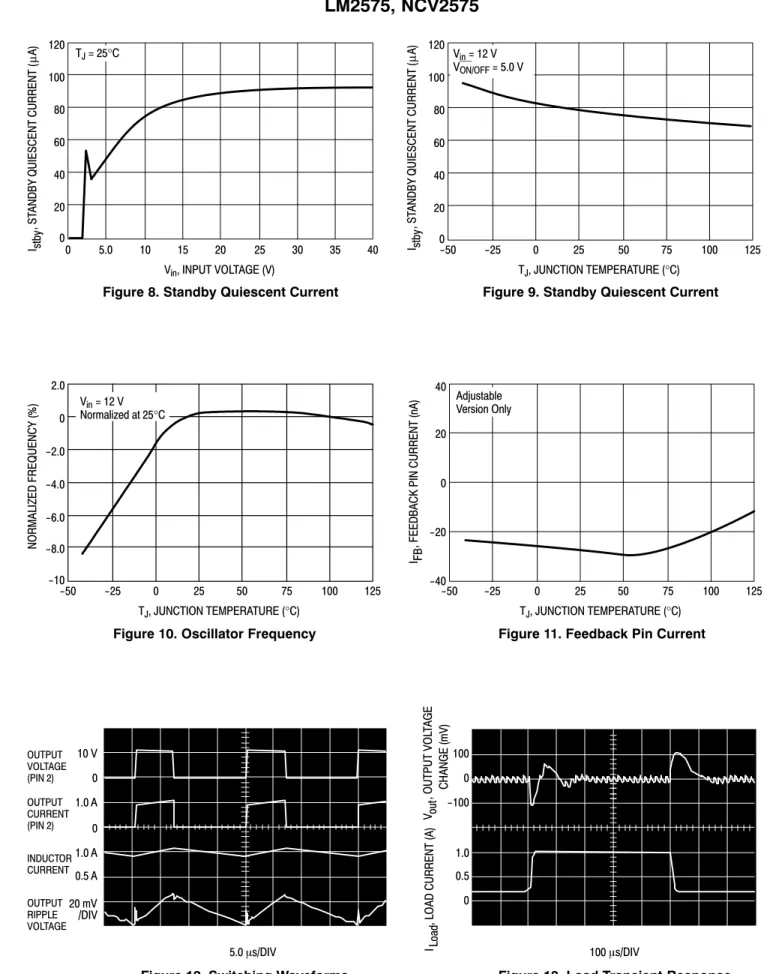
Figure 8. Standby Quiescent Current
Vin, INPUT VOLTAGE (V)
Figure 9. Standby Quiescent Current
Figure 10. Oscillator Frequency Figure 11. Feedback Pin Current
Figure 12. Switching Waveforms Figure 13. Load Transient Response
Vin = 12 V VON/OFF = 5.0 V TJ = 25°C -100 1.0 A 1.0 40 0 2.0 0.5 20 1.0 A 0 120 0 0 100 0.5 A -2.0 100 -40 80 -4.0 60 40 20 mV -8.0 20 0 -10 0 0 0 40 80 120 60 20 -6.0 /DIV I Load , LOAD CURRENT (A) -20 -25 -25 -25 5.0 0 0 0 10 25 25 25 15 50 50 50 20 75 75 75 25 100 100 100 30 125 125 125 40 35 Vin = 12 V Normalized at 25°C Adjustable Version Only CHANGE (mV) CURRENT
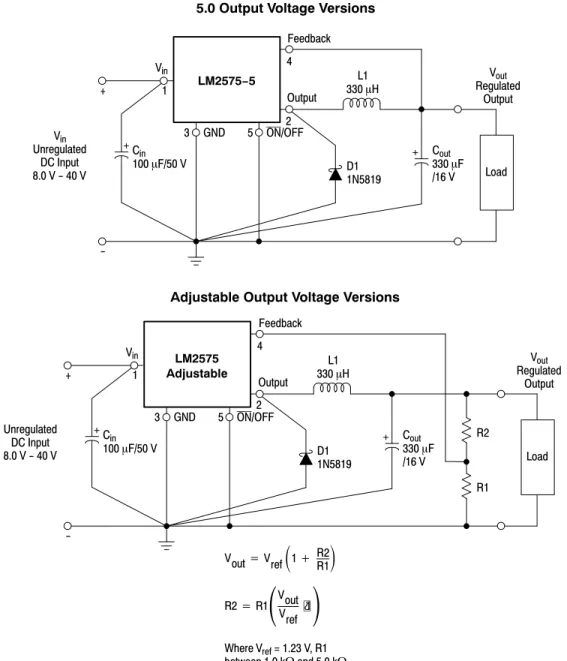
Figure 14. Typical Test Circuit D1 1N5819 L1 330 mH Output 2 4 Feedback Cout 330 mF /16 V Cin 100 mF/50 V LM2575−5 1 5 3 GND ON/OFF Vin Load Vout Regulated Output Vin Unregulated DC Input 8.0 V - 40 V D1 1N5819 L1 330 mH Output 2 4 Feedback Cout 330 mF /16 V Cin 100 mF/50 V LM2575 Adjustable 1 5 3 GND ON/OFF Vin Load Vout Regulated Output Unregulated DC Input 8.0 V - 40 V
5.0 Output Voltage Versions
Adjustable Output Voltage Versions
Vout+V ref
ǒ
1) R2R1Ǔ
R2+R1ǒ
Vout Vref1Ǔ
Where Vref = 1.23 V, R1 between 1.0 kW and 5.0 kW R2 R1 + -+ -PCB LAYOUT GUIDELINESAs in any switching regulator, the layout of the printed circuit board is very important. Rapidly switching currents associated with wiring inductance, stray capacitance and parasitic inductance of the printed circuit board traces can generate voltage transients which can generate electromagnetic interferences (EMI) and affect the desired operation. As indicated in the Figure 14, to minimize inductance and ground loops, the length of the leads indicated by heavy lines should be kept as short as possible. For best results, single−point grounding (as indicated) or ground plane construction should be used.
On the other hand, the PCB area connected to the Pin 2 (emitter of the internal switch) of the LM2575 should be kept to a minimum in order to minimize coupling to sensitive circuitry.
Another sensitive part of the circuit is the feedback. It is important to keep the sensitive feedback wiring short. To assure this, physically locate the programming resistors near to the regulator, when using the adjustable version of the LM2575 regulator.
PIN FUNCTION DESCRIPTION
Pin Symbol Description (Refer to Figure 1)
1 Vin This pin is the positive input supply for the LM2575 step−down switching regulator. In order to minimize voltage transients and to supply the switching currents needed by the regulator, a suitable input bypass capacitor must be present (Cin in Figure 1).
2 Output This is the emitter of the internal switch. The saturation voltage Vsat of this output switch is typically 1.0 V. It should be kept in mind that the PCB area connected to this pin should be kept to a minimum in order to minimize coupling to sensitive circuitry.
3 GND Circuit ground pin. See the information about the printed circuit board layout.
4 Feedback This pin senses regulated output voltage to complete the feedback loop. The signal is divided by the internal resistor divider network R2, R1 and applied to the non−inverting input of the internal error amplifier. In the Adjustable version of the LM2575 switching regulator this pin is the direct input of the error amplifier and the resistor network R2, R1 is connected externally to allow programming of the output voltage. 5 ON/OFF It allows the switching regulator circuit to be shut down using logic level signals, thus dropping the total
input supply current to approximately 80 mA. The input threshold voltage is typically 1.4 V. Applying a voltage above this value (up to +Vin) shuts the regulator off. If the voltage applied to this pin is lower than 1.4 V or if this pin is connected to ground, the regulator will be in the “on” condition.
DESIGN PROCEDURE
Buck Converter Basics
The LM2575 is a “Buck” or Step−Down Converter which
is the most elementary forward−mode converter. Its basic
schematic can be seen inFigure 15.
The operation of this regulator topology has two distinct time periods. The first one occurs when the series switch is on, the input voltage is connected to the input of the inductor. The output of the inductor is the output voltage, and the rectifier (or catch diode) is reverse biased. During this period, since there is a constant voltage source connected across the inductor, the inductor current begins to linearly ramp upwards, as described by the following equation:
IL(on)+
ǒ
Vin VoutLǓ
tonDuring this “on” period, energy is stored within the core material in the form of magnetic flux. If the inductor is properly designed, there is sufficient energy stored to carry the requirements of the load during the “off” period.
Figure 15. Basic Buck Converter
D1 Vin Vout RLoad L Cout Power Switch
The next period is the “off” period of the power switch. When the power switch turns off, the voltage across the inductor reverses its polarity and is clamped at one diode voltage drop below ground by catch dioded. Current now flows through the catch diode thus maintaining the load
current loop. This removes the stored energy from the inductor.
The inductor current during this time is:
IL(off)+
ǒ
Vout VDLǓ
toffThis period ends when the power switch is once again turned on. Regulation of the converter is accomplished by varying the duty cycle of the power switch. It is possible to describe the duty cycle as follows:
d+tonT , where T is the period of switching.
For the buck converter with ideal components, the duty cycle can also be described as:
d+Vout
Vin
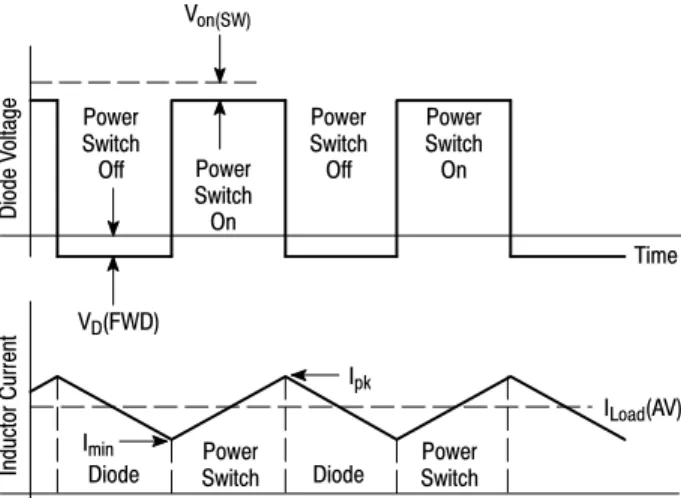
Figure 16 shows the buck converter idealized waveforms of the catch diode voltage and the inductor current.
Power Switch
Figure 16. Buck Converter Idealized Waveforms
Power Switch Off Power Switch Off Power Switch On Power Switch On Von(SW) VD(FWD) Time Time ILoad(AV) Imin Ipk
Diode Diode PowerSwitch
Diode V
oltage
Procedure (Fixed Output Voltage Version) In order to simplify the switching regulator design, a step−by−step design procedure and example is provided.
Procedure Example
Given Parameters:
Vout = Regulated Output Voltage (3.3 V, 5.0 V, 12 V or 15 V) Vin(max) = Maximum DC Input Voltage
ILoad(max) = Maximum Load Current
Given Parameters: Vout = 5.0 V Vin(max) = 20 V ILoad(max) = 0.8 A 1. Controller IC Selection
According to the required input voltage, output voltage and current, select the appropriate type of the controller IC output voltage version.
1. Controller IC Selection
According to the required input voltage, output voltage, current polarity and current value, use the LM2575−5 controller IC
2. Input Capacitor Selection (Cin)
To prevent large voltage transients from appearing at the input and for stable operation of the converter, an aluminium or tantalum electrolytic bypass capacitor is needed between the input pin +Vin and ground pin GND. This capacitor should be located close to the IC using short leads. This capacitor should have a low ESR (Equivalent Series Resistance) value.
2. Input Capacitor Selection (Cin)
A 47 mF, 25 V aluminium electrolytic capacitor located near to the input and ground pins provides sufficient bypassing.
3. Catch Diode Selection (D1)
A.Since the diode maximum peak current exceeds the regulator maximum load current the catch diode current rating must be at least 1.2 times greater than the maximum load current. For a robust design the diode should have a current rating equal to the maximum current limit of the LM2575 to be able to withstand a continuous output short B.The reverse voltage rating of the diode should be at least
1.25 times the maximum input voltage.
3. Catch Diode Selection (D1)
A.For this example the current rating of the diode is 1.0 A.
B.Use a 30 V 1N5818 Schottky diode, or any of the suggested fast recovery diodes shown in the Table 4. 4. Inductor Selection (L1)
A.According to the required working conditions, select the correct inductor value using the selection guide from Figures 17 to 21.
B.From the appropriate inductor selection guide, identify the inductance region intersected by the Maximum Input Voltage line and the Maximum Load Current line. Each region is identified by an inductance value and an inductor code.
C.Select an appropriate inductor from the several different manufacturers part numbers listed inTable 1 or Table 2. When using Table 2 for selecting the right inductor the designer must realize that the inductor current rating must be higher than the maximum peak current flowing through the inductor. This maximum peak current can be calculated as follows:
where ton is the “on” time of the power switch and
For additional information about the inductor, see the inductor section in the “External Components” section of this data sheet.
Ip(max)+ILoad(max))
ǒ
VinVout2LǓ
tonton+Vout
Vin x 1fosc
4. Inductor Selection (L1)
A.Use the inductor selection guide shown in Figures 17 to 21.
B.From the selection guide, the inductance area intersected by the 20 V line and 0.8 A line is L330.
C.Inductor value required is 330 mH. From the Table 1 or Table 2, choose an inductor from any of the listed manufacturers.
Procedure (Fixed Output Voltage Version) (continued)In order to simplify the switching regulator design, a step−by−step design procedure and example is provided.
Procedure Example
5. Output Capacitor Selection (Cout)
A.Since the LM2575 is a forward−mode switching regulator with voltage mode control, its open loop 2−pole−2−zero frequency characteristic has the dominant pole−pair determined by the output capacitor and inductor values. For stable operation and an acceptable ripple voltage,
(approximately 1% of the output voltage) a value between 100 mF and 470 mF is recommended.
B.Due to the fact that the higher voltage electrolytic capacitors generally have lower ESR (Equivalent Series Resistance) numbers, the output capacitor’s voltage rating should be at least 1.5 times greater than the output voltage. For a 5.0 V regulator, a rating at least 8V is appropriate, and a 10 V or 16 V rating is recommended.
5. Output Capacitor Selection (Cout)
A.Cout = 100 mF to 470 mF standard aluminium electrolytic.
B.Capacitor voltage rating = 16 V.
Procedure (Adjustable Output Version: LM2575−Adj)
Procedure Example
Given Parameters:
Vout = Regulated Output Voltage Vin(max) = Maximum DC Input Voltage ILoad(max) = Maximum Load Current
Given Parameters: Vout = 8.0 V Vin(max) = 12 V ILoad(max) = 1.0 A 1. Programming Output Voltage
To select the right programming resistor R1 and R2 value (see Figure 14) use the following formula:
Resistor R1 can be between 1.0 k and 5.0 kW. (For best temperature coefficient and stability with time, use 1% metal film resistors).
Vout+Vref
ǒ
1) R2R1Ǔ
R2+R1
ǒ
Vout Vref 1Ǔ
where Vref = 1.23 V
1. Programming Output Voltage (selecting R1 and R2) Select R1 and R2:
R2 = 9.91 kW, choose a 9.88 k metal film resistor. R2+R1
ǒ
VoutVref*1
Ǔ
+1.8 kǒ
8.0 V 1.23 V*1Ǔ
Vout+1.23ǒ
1) R2R1Ǔ
Select R1 = 1.8 kW2. Input Capacitor Selection (Cin)
To prevent large voltage transients from appearing at the input and for stable operation of the converter, an aluminium or tantalum electrolytic bypass capacitor is needed between the input pin +Vin and ground pin GND This capacitor should be located close to the IC using short leads. This capacitor should have a low ESR (Equivalent Series Resistance) value. For additional information see input capacitor section in the “External Components” section of this data sheet.
2. Input Capacitor Selection (Cin)
A 100 mF aluminium electrolytic capacitor located near the input and ground pin provides sufficient bypassing.
3. Catch Diode Selection (D1)
A.Since the diode maximum peak current exceeds the regulator maximum load current the catch diode current rating must be at least 1.2 times greater than the maximum load current. For a robust design, the diode should have a current rating equal to the maximum current limit of the LM2575 to be able to withstand a continuous output short. B.The reverse voltage rating of the diode should be at least
1.25 times the maximum input voltage.
3. Catch Diode Selection (D1)
A.For this example, a 3.0 A current rating is adequate.
B.Use a 20 V 1N5820 or MBR320 Schottky diode or any suggested fast recovery diode in theTable 4.
Procedure (Adjustable Output Version: LM2575−Adj) (continued)
Procedure Example
4. Inductor Selection (L1)
A.Use the following formula to calculate the inductor Volt x microsecond [V x ms] constant:
B.Match the calculated E x T value with the corresponding number on the vertical axis of the Inductor Value Selection Guide shown inFigure 21. This E x T constant is a measure of the energy handling capability of an inductor and is dependent upon the type of core, the core area, the number of turns, and the duty cycle.
C.Next step is to identify the inductance region intersected by the E x T value and the maximum load current value on the horizontal axis shown inFigure 21.
D.From the inductor code, identify the inductor value. Then select an appropriate inductor from the Table 1 or Table 2. The inductor chosen must be rated for a switching frequency of 52 kHz and for a current rating of 1.15 x IIoad. The inductor current rating can also be determined by calculating the inductor peak current:
where ton is the “on” time of the power switch and
For additional information about the inductor, see the inductor section in the “External Components” section of this data sheet.
E x T+
ǒ
Vin VoutǓ
Vout Von x 106 F[Hz][V xms]
Ip(max)+ILoad(max))
ǒ
Vin Vout2LǓ
tonton + Vout Vin x 1fosc 4. Inductor Selection (L1) A.Calculate E x T [V x ms] constant: B.E x T = 51 [V x ms] C.ILoad(max) = 1.0 A Inductance Region = L220 D.Proper inductor value = 220 mH
Choose the inductor from the Table 1 or Table 2. E x T+ ǒ12 8.0Ǔx 8.012 x 100052 +51 [V xms]
5. Output Capacitor Selection (Cout)
A.Since the LM2575 is a forward−mode switching regulator with voltage mode control, its open loop 2−pole−2−zero frequency characteristic has the dominant pole−pair determined by the output capacitor and inductor values. For stable operation, the capacitor must satisfy the following requirement:
B.Capacitor values between 10 mF and 2000 mF will satisfy the loop requirements for stable operation. To achieve an acceptable output ripple voltage and transient response, the output capacitor may need to be several times larger than the above formula yields.
C.Due to the fact that the higher voltage electrolytic capacitors generally have lower ESR (Equivalent Series Resistance) numbers, the output capacitor’s voltage rating should be at least 1.5 times greater than the output voltage. For a 5.0 V regulator, a rating of at least 8V is appropriate, and a 10 V or 16 V rating is recommended.
Coutw7.785 Vin(max) Vout x L [μH][μF]
5. Output Capacitor Selection (Cout) A.
To achieve an acceptable ripple voltage, select Cout = 100 mF electrolytic capacitor.
INDUCTOR VALUE SELECTION GUIDE Vin , MAXIMUM INPUT VOL TAGE (V) Vin , MAXIMUM INPUT VOL TAGE (V)
IL, MAXIMUM LOAD CURRENT (A) IL, MAXIMUM LOAD CURRENT (A)
0.2 60 0.2 60 0.2 60 Vin , MAXIMUM INPUT V O LT A G E (V) Figure 17. LM2575−3.3
IL, MAXIMUM LOAD CURRENT (A)
Figure 18. LM2575−5.0
Figure 19. LM2575−12 Figure 20. LM2575−15
Figure 21. LM2575−Adj NOTE: This Inductor Value Selection Guide is applicable for continuous mode only.
H1500 H1000 L680 L470 L330 L150 H1000 L100 L680 L470 L330 L220 L150 H1500 H1000 H680 H2200 H470 L680 L470 L220 L330 40 40 20 35 25 15 30 20 10 25 15 8.0 22 12 7.0 20 10 6.0 19 9.0 18 8.0 17 7.0 5.0 0.3 0.3 0.3 0.4 0.4 0.4 0.5 0.5 0.5 0.6 0.6 0.6 0.7 0.7 0.8 0.8 0.8 0.9 0.9 1.0 1.0 1.0 L220 Vin , MAXIMUM INPUT VOL TAGE (V)
IL, MAXIMUM LOAD CURRENT (A) 0.2 60 H1500 H1000 H470 H680 H2200 L680 L470 L220 L330 40 30 25 20 18 17 16 14 0.3 0.4 0.5 0.6 0.7 0.8 0.9 1.0 15 0.2 200 ET , VOL TAGE TIME (V s) μ
IL, MAXIMUM LOAD CURRENT (A) H680 H2200 H1500 H1000 H470 L330 L220 L150 L680 L470 L100 150 125 100 80 70 60 50 40 20 0.3 0.4 0.5 0.6 0.7 0.8 0.9 1.0 30
Table 1. Inductor Selection Guide
Inductor
Code InductorValue Pulse Eng Renco AIE Tech 39
L100 100 mH PE−92108 RL2444 415−0930 77 308 BV L150 150 mH PE−53113 RL1954 415−0953 77 358 BV L220 220 mH PE−52626 RL1953 415−0922 77 408 BV L330 330 mH PE−52627 RL1952 415−0926 77 458 BV L470 470 mH PE−53114 RL1951 415−0927 − L680 680 mH PE−52629 RL1950 415−0928 77 508 BV H150 150 mH PE−53115 RL2445 415−0936 77 368 BV H220 220 mH PE−53116 RL2446 430−0636 77 410 BV H330 330 mH PE−53117 RL2447 430−0635 77 460 BV H470 470 mH PE−53118 RL1961 430−0634 − H680 680 mH PE−53119 RL1960 415−0935 77 510 BV H1000 1000 mH PE−53120 RL1959 415−0934 77 558 BV H1500 1500 mH PE−53121 RL1958 415−0933 − H2200 2200 mH PE−53122 RL2448 415−0945 77 610 BV
Table 2. Inductor Selection Guide
Inductance Current Schott Renco Pulse Engineering Coilcraft
(mH) (A) THT SMT THT SMT THT SMT SMT 68 0.32 67143940 67144310 RL−1284−68−43 RL1500−68 PE−53804 PE−53804−S DO1608−68 0.58 67143990 67144360 RL−5470−6 RL1500−68 PE−53812 PE−53812−S DO3308−683 0.99 67144070 67144450 RL−5471−5 RL1500−68 PE−53821 PE−53821−S DO3316−683 1.78 67144140 67144520 RL−5471−5 − PE−53830 PE−53830−S DO5022P−683 100 0.48 67143980 67144350 RL−5470−5 RL1500−100 PE−53811 PE−53811−S DO3308−104 0.82 67144060 67144440 RL−5471−4 RL1500−100 PE−53820 PE−53820−S DO3316−104 1.47 67144130 67144510 RL−5471−4 − PE−53829 PE−53829−S DO5022P−104 150 0.39 − 67144340 RL−5470−4 RL1500−150 PE−53810 PE−53810−S DO3308−154 0.66 67144050 67144430 RL−5471−3 RL1500−150 PE−53819 PE−53819−S DO3316−154 1.20 67144120 67144500 RL−5471−3 − PE−53828 PE−53828−S DO5022P−154 220 0.32 67143960 67144330 RL−5470−3 RL1500−220 PE−53809 PE−53809−S DO3308−224 0.55 67144040 67144420 RL−5471−2 RL1500−220 PE−53818 PE−53818−S DO3316−224 1.00 67144110 67144490 RL−5471−2 − PE−53827 PE−53827−S DO5022P−224 330 0.42 67144030 67144410 RL−5471−1 RL1500−330 PE−53817 PE−53817−S DO3316−334 0.80 67144100 67144480 RL−5471−1 − PE−53826 PE−53826−S DO5022P−334 NOTE: Table 1 and Table 2 of this Indicator Selection Guide shows some examples of different manufacturer products suitable for design with the LM2575.
Table 3. Example of Several Inductor Manufacturers Phone/Fax Numbers
Pulse Engineering Inc. FaxPhone + 1+ 1−−619619−−674674−−81008262 Pulse Engineering Inc. Europe PhoneFax + 353 93 24 107+ 353 93 24 459
Renco Electronics Inc. Phone
Fax + 1+ 1−−516516−−645586−−58285562
AIE Magnetics Phone
Fax + 1−813−347−2181 Coilcraft Inc. FaxPhone + 1+ 1−−708708−−639322−−26451469 Coilcraft Inc., Europe PhoneFax + 44 1236 730 595+ 44 1236 730 627
Tech 39 Phone
Fax + 33 8425 2626+ 33 8425 2610 Schott Corp. FaxPhone + 1+ 1−−612612−−475475−−11731786
Table 4. Diode Selection Guide gives an overview about both surface−mount and through−hole diodes for an effective design. Device listed in bold are available from ON Semiconductor.
VR
Schottky Ultra−Fast Recovery
1.0 A 3.0 A 1.0 A 3.0 A SMT THT SMT THT SMT THT SMT THT 20 V SK12 1N5817 SR102 MBRD320SK32 MBR3201N5820 SR302 30 V MBRS130LT3 SK13 1N5818 SR103 11DQ03 SK33 MBRD330 1N5821 MBR330 SR303 31DQ03 MURS120T3 MUR120 11DF1 HER102 MURS320T3 40 V MBRS140T3 SK14 10BQ040 10MQ040 1N5819 SR104 11DQ04 MBRS340T3 MBRD340 30WQ04 SK34 1N5822 MBR340 SR304 31DQ04 10BF10 MURD320 MUR320 30WF10 MUR420 50 V MBRS150 10BQ050 MBR150 SR105 11DQ05 MBRD350 SK35 30WQ05 MBR350 SR305 11DQ05 31DF1 HER302
EXTERNAL COMPONENTS
Input Capacitor (Cin)
The Input Capacitor Should Have a Low ESR
For stable operation of the switch mode converter a low ESR (Equivalent Series Resistance) aluminium or solid tantalum bypass capacitor is needed between the input pin and the ground pin to prevent large voltage transients from appearing at the input. It must be located near the regulator and use short leads. With most electrolytic capacitors, the capacitance value decreases and the ESR increases with lower temperatures. For reliable operation in temperatures below −25°C larger values of the input capacitor may be needed. Also paralleling a ceramic or solid tantalum capacitor will increase the regulator stability at cold temperatures.
RMS Current Rating of Cin
The important parameter of the input capacitor is the RMS current rating. Capacitors that are physically large and have large surface area will typically have higher RMS current ratings. For a given capacitor value, a higher voltage electrolytic capacitor will be physically larger than a lower voltage capacitor, and thus be able to dissipate more heat to the surrounding air, and therefore will have a higher RMS current rating. The consequence of operating an electrolytic capacitor above the RMS current rating is a shortened operating life. In order to assure maximum capacitor operating lifetime, the capacitor’s RMS ripple current rating should be:
Irms > 1.2 x d x ILoad
where d is the duty cycle, for a buck regulator
d+tonT +Vout
Vin and d+tonT + |Vout|
|Vout| ) Vin for a buck*boost regulator.
Output Capacitor (Cout)
For low output ripple voltage and good stability, low ESR output capacitors are recommended. An output capacitor has two main functions: it filters the output and provides regulator loop stability. The ESR of the output capacitor and the peak−to−peak value of the inductor ripple current are the main factors contributing to the output ripple voltage value. Standard aluminium electrolytics could be adequate for some applications but for quality design low ESR types are recommended.
An aluminium electrolytic capacitor’s ESR value is related to many factors such as the capacitance value, the voltage rating, the physical size and the type of construction. In most cases, the higher voltage electrolytic capacitors have lower ESR value. Often capacitors with much higher voltage ratings may be needed to provide low ESR values that are required for low output ripple voltage.
The Output Capacitor Requires an ESR Value That Has an Upper and Lower Limit
As mentioned above, a low ESR value is needed for low output ripple voltage, typically 1% to 2% of the output voltage. But if the selected capacitor’s ESR is extremely low
(below 0.05 W), there is a possibility of an unstable feedback loop, resulting in oscillation at the output. This situation can occur when a tantalum capacitor, that can have a very low ESR, is used as the only output capacitor.
At Low Temperatures, Put in Parallel Aluminium Electrolytic Capacitors with Tantalum Capacitors
Electrolytic capacitors are not recommended for temperatures below −25°C. The ESR rises dramatically at cold temperatures and typically rises 3 times at −25°C and as much as 10 times at −40°C. Solid tantalum capacitors have much better ESR spec at cold temperatures and are
recommended for temperatures below −25°C. They can be
also used in parallel with aluminium electrolytics. The value of the tantalum capacitor should be about 10% or 20% of the total capacitance. The output capacitor should have at least 50% higher RMS ripple current rating at 52 kHz than the peak−to−peak inductor ripple current.
Catch Diode
Locate the Catch Diode Close to the LM2575
The LM2575 is a step−down buck converter; it requires a fast diode to provide a return path for the inductor current when the switch turns off. This diode must be located close to the LM2575 using short leads and short printed circuit traces to avoid EMI problems.
Use a Schottky or a Soft Switching Ultra−Fast Recovery Diode
Since the rectifier diodes are very significant source of losses within switching power supplies, choosing the rectifier that best fits into the converter design is an important process. Schottky diodes provide the best performance because of their fast switching speed and low forward voltage drop.
They provide the best efficiency especially in low output voltage applications (5.0 V and lower). Another choice could be Fast−Recovery, or Ultra−Fast Recovery diodes. It has to be noted, that some types of these diodes with an abrupt turnoff characteristic may cause instability or EMI troubles.
A fast−recovery diode with soft recovery characteristics can better fulfill a quality, low noise design requirements. Table 4 provides a list of suitable diodes for the LM2575 regulator. Standard 50/60 Hz rectifier diodes such as the
1N4001 series or 1N5400 series are NOT suitable.
Inductor
The magnetic components are the cornerstone of all switching power supply designs. The style of the core and the winding technique used in the magnetic component’s design has a great influence on the reliability of the overall power supply.
Using an improper or poorly designed inductor can cause high voltage spikes generated by the rate of transitions in current within the switching power supply, and the possibility of core saturation can arise during an abnormal operational mode. Voltage spikes can cause the semiconductors to enter avalanche breakdown and the part can instantly fail if enough energy is applied. It can also
cause significant RFI (Radio Frequency Interference) and
EMI (Electro−Magnetic Interference) problems.
Continuous and Discontinuous Mode of Operation
The LM2575 step−down converter can operate in both the continuous and the discontinuous modes of operation. The regulator works in the continuous mode when loads are relatively heavy, the current flows through the inductor continuously and never falls to zero. Under light load conditions, the circuit will be forced to the discontinuous mode when inductor current falls to zero for certain period of time (see Figure 22 and Figure 23). Each mode has distinctively different operating characteristics, which can affect the regulator performance and requirements. In many cases the preferred mode of operation is the continuous mode. It offers greater output power, lower peak currents in the switch, inductor and diode, and can have a lower output ripple voltage. On the other hand it does require larger inductor values to keep the inductor current flowing continuously, especially at low output load currents and/or high input voltages.
To simplify the inductor selection process, an inductor selection guide for the LM2575 regulator was added to this data sheet (Figures 17through21). This guide assumes that the regulator is operating in the continuous mode, and selects an inductor that will allow a peak−to−peak inductor ripple current to be a certain percentage of the maximum design load current. This percentage is allowed to change as different design load currents are selected. For light loads (less than approximately 200 mA) it may be desirable to operate the regulator in the discontinuous mode, because the inductor value and size can be kept relatively low.
Consequently, the percentage of inductor peak−to−peak
current increases. This discontinuous mode of operation is perfectly acceptable for this type of switching converter. Any buck regulator will be forced to enter discontinuous mode if the load current is light enough.
Figure 22. Continuous Mode Switching Current Waveforms POWER SWITCH 1.0 0 0 CURRENT (A)
HORIZONTAL TIME BASE: 5.0 ms/DIV 1.0
INDUCT
OR
CURRENT
(A)
Selecting the Right Inductor Style
Some important considerations when selecting a core type are core material, cost, the output power of the power supply,
the physical volume the inductor must fit within, and the
amount of EMI (Electro−Magnetic Interference) shielding
that the core must provide. The inductor selection guide covers different styles of inductors, such as pot core, E−core, toroid and bobbin core, as well as different core materials such as ferrites and powdered iron from different manufacturers.
For high quality design regulators the toroid core seems to be the best choice. Since the magnetic flux is completely contained within the core, it generates less EMI, reducing noise problems in sensitive circuits. The least expensive is the bobbin core type, which consists of wire wound on a ferrite rod core. This type of inductor generates more EMI due to the fact that its core is open, and the magnetic flux is not completely contained within the core.
When multiple switching regulators are located on the same printed circuit board, open core magnetics can cause interference between two or more of the regulator circuits, especially at high currents due to mutual coupling. A toroid,
pot core or E−core (closed magnetic structure) should be
used in such applications.
Do Not Operate an Inductor Beyond its Maximum Rated Current
Exceeding an inductor’s maximum current rating may cause the inductor to overheat because of the copper wire losses, or the core may saturate. Core saturation occurs when the flux density is too high and consequently the cross sectional area of the core can no longer support additional lines of magnetic flux.
This causes the permeability of the core to drop, the inductance value decreases rapidly and the inductor begins to look mainly resistive. It has only the dc resistance of the winding. This can cause the switch current to rise very rapidly and force the LM2575 internal switch into cycle−by−cycle current limit, thus reducing the dc output load current. This can also result in overheating of the inductor and/or the LM2575. Different inductor types have different saturation characteristics, and this should be kept in mind when selecting an inductor.
Figure 23. Discontinuous Mode Switching Current Waveforms
0.1
0.1 0 0
HORIZONTAL TIME BASE: 5.0 ms/DIV
POWER SWITCH CURRENT
(A)
INDUCT
OR
CURRENT
GENERAL RECOMMENDATIONS
Output Voltage Ripple and Transients Source of the Output Ripple
Since the LM2575 is a switch mode power supply regulator, its output voltage, if left unfiltered, will contain a sawtooth ripple voltage at the switching frequency. The output ripple voltage value ranges from 0.5% to 3% of the output voltage. It is caused mainly by the inductor sawtooth ripple current multiplied by the ESR of the output capacitor.
Short Voltage Spikes and How to Reduce Them
The regulator output voltage may also contain short voltage spikes at the peaks of the sawtooth waveform (see Figure 24). These voltage spikes are present because of the fast switching action of the output switch, and the parasitic inductance of the output filter capacitor. There are some other important factors such as wiring inductance, stray capacitance, as well as the scope probe used to evaluate these transients, all these contribute to the amplitude of these spikes. To minimize these voltage spikes, low inductance capacitors should be used, and their lead lengths must be kept short. The importance of quality printed circuit board layout design should also be highlighted.
Figure 24. Output Ripple Voltage Waveforms
HORIZONTAL TIME BASE: 10 ms/DIV
UNFILTERED OUTPUT VOLTAGE VERTICAL RESOLUTION: 20 mV/DIV FILTERED OUTPUT VOLTAGE
Voltage spikes caused by switching action of the output switch and the parasitic inductance of the output capacitor
Minimizing the Output Ripple
In order to minimize the output ripple voltage it is possible to enlarge the inductance value of the inductor L1 and/or to use a larger value output capacitor. There is also another way to smooth the output by means of an additional LC filter
(20 mH, 100 mF), that can be added to the output (see
Figure 33) to further reduce the amount of output ripple and transients. With such a filter it is possible to reduce the output ripple voltage transients 10 times or more. Figure 24 shows the difference between filtered and unfiltered output waveforms of the regulator shown in Figure 33.
The upper waveform is from the normal unfiltered output of the converter, while the lower waveform shows the output ripple voltage filtered by an additional LC filter.
Heatsinking and Thermal Considerations The Through−Hole Package TO−220
The LM2575 is available in two packages, a 5−pin
TO−220(T, TV) and a 5−pin surface mount D2PAK(D2T).
There are many applications that require no heatsink to keep the LM2575 junction temperature within the allowed
operating range. The TO−220 package can be used without
a heatsink for ambient temperatures up to approximately
50°C (depending on the output voltage and load current).
Higher ambient temperatures require some heatsinking, either to the printed circuit (PC) board or an external heatsink.
The Surface Mount Package D2PAKand its
Heatsinking
The other type of package, the surface mount D2PAK, is designed to be soldered to the copper on the PC board. The copper and the board are the heatsink for this package and the other heat producing components, such as the catch diode and inductor. The PC board copper area that the package is soldered to should be at least 0.4 in2 (or 100 mm2) and ideally should have 2 or more square inches (1300 mm2) of 0.0028 inch copper. Additional increasing of copper area beyond approximately 3.0 in2 (2000 mm2) will not improve heat dissipation significantly. If further thermal improvements are needed, double sided or multilayer PC boards with large copper areas should be considered.
Thermal Analysis and Design
The following procedure must be performed to determine whether or not a heatsink will be required. First determine: 1. PD(max) maximum regulator power dissipation in
the application.
2. TA(max) maximum ambient temperature in the application.
3. TJ(max) maximum allowed junction temperature
(125°C for the LM2575). For a conservative
design, the maximum junction temperature should not exceed 110°C to assure safe operation. For every additional 10°C temperature rise that the junction must withstand, the estimated operating lifetime of the component is halved.
4. RqJC package thermal resistance junction−case.
5. RqJA package thermal resistance junction−ambient.
(Refer to Absolute Maximum Ratings in this data sheet or RqJC and RqJA values).
The following formula is to calculate the total power dissipated by the LM2575:
PD = (Vin x IQ) + d x ILoad x Vsat
d+tonT +VO
Vin,
IQ (quiescent current) and Vsat can be found in the
LM2575 data sheet,
Vin is minimum input voltage applied,
VO is the regulator output voltage,
ILoadis the load current.
The dynamic switching losses during turn−on and
turn−off can be neglected if proper type catch diode is used.
Packages Not on a Heatsink (Free−Standing)
For a free−standing application when no heatsink is used, the junction temperature can be determined by the following expression:
TJ = (RqJA) (PD) + TA
where (RqJA)(PD) represents the junction temperature rise caused by the dissipated power and TA is the maximum ambient temperature.
Packages on a Heatsink
If the actual operating junction temperature is greater than the selected safe operating junction temperature determined in step 3, than a heatsink is required. The junction temperature will be calculated as follows:
TJ = PD (RqJA + RqCS + RqSA) + TA
where RqJC is the thermal resistance junction−case, RqCS is the thermal resistance case−heatsink, RqSA is the thermal resistance heatsink−ambient. If the actual operating temperature is greater than the selected safe operating junction temperature, then a larger heatsink is required.
Some Aspects That can Influence Thermal Design
It should be noted that the package thermal resistance and the junction temperature rise numbers are all approximate, and there are many factors that will affect these numbers, such as PC board size, shape, thickness, physical position, location, board temperature, as well as whether the surrounding air is moving or still.
Other factors are trace width, total printed circuit copper area, copper thickness, single− or double−sided, multilayer board, the amount of solder on the board or even color of the traces.
The size, quantity and spacing of other components on the board can also influence its effectiveness to dissipate the heat.
Figure 25. Inverting Buck−Boost Regulator Using the LM2575−12 Develops −12 V @ 0.35 A D1 1N5819 L1 100 mH Output 2 4 Feedback Unregulated DC Input 12 V to 25 V Cin 100 mF /50 V 1 5 3 GND ON/OFF +Vin Regulated Output -12 V @ 0.35 A Cout 1800 mF /16 V LM2575−12 ADDITIONAL APPLICATIONS Inverting Regulator
An inverting buck−boost regulator using the LM2575−12 is shown in Figure 25. This circuit converts a positive input voltage to a negative output voltage with a common ground by bootstrapping the regulators ground to the negative output voltage. By grounding the feedback pin, the regulator senses the inverted output voltage and regulates it.
In this example the LM2575−12 is used to generate a
−12 V output. The maximum input voltage in this case
cannot exceed +28 V because the maximum voltage appearing across the regulator is the absolute sum of the input and output voltages and this must be limited to a maximum of 40 V.
This circuit configuration is able to deliver approximately 0.35 A to the output when the input voltage is 12 V or higher. At lighter loads the minimum input voltage required drops
to approximately 4.7 V, because the buck−boost regulator
topology can produce an output voltage that, in its absolute value, is either greater or less than the input voltage.
Since the switch currents in this buck−boost configuration are higher than in the standard buck converter topology, the available output current is lower.
This type of buck−boost inverting regulator can also
require a larger amount of startup input current, even for light loads. This may overload an input power source with a current limit less than 1.5 A.
Such an amount of input startup current is needed for at least 2.0 ms or more. The actual time depends on the output voltage and size of the output capacitor.
Because of the relatively high startup currents required by this inverting regulator topology, the use of a delayed startup or an undervoltage lockout circuit is recommended.
Using a delayed startup arrangement, the input capacitor
can charge up to a higher voltage before the switch−mode
regulator begins to operate.
The high input current needed for startup is now partially supplied by the input capacitor Cin.
Design Recommendations:
The inverting regulator operates in a different manner than the buck converter and so a different design procedure has to be used to select the inductor L1 or the output capacitor Cout.
The output capacitor values must be larger than is normally required for buck converter designs. Low input voltages or high output currents require a large value output capacitor (in the range of thousands of mF).
The recommended range of inductor values for the inverting converter design is between 68 mH and 220 mH. To select an inductor with an appropriate current rating, the inductor peak current has to be calculated.
The following formula is used to obtain the peak inductor current:
where ton + |VO|
Vin ) |VO| x 1fosc, and fosc + 52 kHz. Ipeak [ ILoad (Vin ) |VO|)
Vin ) Vin x ton2L1
Under normal continuous inductor current operating conditions, the worst case occurs when Vin is minimal.
Note that the voltage appearing across the regulator is the absolute sum of the input and output voltage, and must not exceed 40 V.
Figure 26. Inverting Buck−Boost Regulator with Delayed Startup
D1 1N5819 L1 100 mH Output 2 4 Feedback Unregulated DC Input 12 V to 25 V Cin 100 mF /50 V 1 3 5 ON/OFF GND +Vin Regulated Output -12 V @ 0.35 A Cout 1800 mF /16 V LM2575−12 C1 0.1 mF R1 47 k R2 47 k
It has been already mentioned above, that in some situations, the delayed startup or the undervoltage lockout features could be very useful. A delayed startup circuit applied to a buck−boost converter is shown in Figure 26.
Figure 32 in the “Undervoltage Lockout” section describes an undervoltage lockout feature for the same converter topology.
Figure 27. Inverting Buck−Boost Regulator Shut Down Circuit Using an Optocoupler
LM2575−XX 1 3 5 GND ON/OFF +Vin R2 47 k Cin 100 mF
NOTE: This picture does not show the complete circuit.
R1 47 k R3 470 Shutdown Input MOC8101 -Vout Off On 5.0 V 0 +Vin
With the inverting configuration, the use of the ON/OFF pin requires some level shifting techniques. This is caused by the fact, that the ground pin of the converter IC is no longer at ground. Now, the ON/OFF pin threshold voltage (1.4 V approximately) has to be related to the negative output voltage level. There are many different possible shut
down methods, two of them are shown in Figures 27and28.
Figure 28. Inverting Buck−Boost Regulator Shut Down Circuit Using a PNP Transistor
NOTE: This picture does not show the complete circuit.
R2 5.6 k Q1 2N3906 LM2575−XX 1 3 5 ON/OFF GND R1 12 k -Vout +Vin Shutdown Input Off On +V 0 +Vin Cin 100 mF
Negative Boost Regulator
This example is a variation of the buck−boost topology and is called a negative boost regulator. This regulator experiences relatively high switch current, especially at low input voltages. The internal switch current limiting results in lower output load current capability.
The circuit in Figure 29 shows the negative boost configuration. The input voltage in this application ranges from −5.0 V to −12 V and provides a regulated −12 V output.
If the input voltage is greater than −12 V, the output will rise above −12 V accordingly, but will not damage the regulator.
Figure 29. Negative Boost Regulator
1N5817 150 mH Output 2 4 Feedback Regulated Output Vout = -12 V
Load Current from 200 mA for Vin = -5.2 V to 500 mA for Vin = -7.0 V Unregulated DC Input -Vin = -5.0 V to -12 V L1 D1 Cout 1000 mF /16 V Cin 100 mF /50 V LM2575−12 1 5 3 GND ON/OFF +Vin Design Recommendations:
The same design rules as for the previous inverting buck−boost converter can be applied. The output capacitor Cout must be chosen larger than would be required for a standard buck converter. Low input voltages or high output currents require a large value output capacitor (in the range
of thousands of mF). The recommended range of inductor
values for the negative boost regulator is the same as for inverting converter design.
Another important point is that these negative boost converters cannot provide current limiting load protection in the event of a short in the output so some other means, such as a fuse, may be necessary to provide the load protection.
Delayed Startup
There are some applications, like the inverting regulator already mentioned above, which require a higher amount of startup current. In such cases, if the input power source is limited, this delayed startup feature becomes very useful.
To provide a time delay between the time the input voltage is applied and the time when the output voltage comes up, the circuit in Figure 30 can be used. As the input voltage is applied, the capacitor C1 charges up, and the voltage across the resistor R2 falls down. When the voltage on the ON/OFF pin falls below the threshold value 1.4 V, the regulator starts up. Resistor R1 is included to limit the maximum voltage applied to the ON/OFF pin, reduces the power supply noise sensitivity, and also limits the capacitor C1 discharge current, but its use is not mandatory.
When a high 50 Hz or 60 Hz (100 Hz or 120 Hz respectively) ripple voltage exists, a long delay time can
cause some problems by coupling the ripple into the ON/OFF pin, the regulator could be switched periodically on and off with the line (or double) frequency.
Figure 30. Delayed Startup Circuitry
R1 47 k LM2575−XX 1 3 5 ON/OFF GND R2 47 k +Vin +Vin C1 0.1 mF Cin 100 mF
NOTE: This picture does not show the complete circuit.
Undervoltage Lockout
Some applications require the regulator to remain off until the input voltage reaches a certain threshold level. Figure 31 shows an undervoltage lockout circuit applied to a buck regulator. A version of this circuit for buck−boost converter is shown in Figure 32. Resistor R3 pulls the ON/OFF pin high and keeps the regulator off until the input voltage reaches a predetermined threshold level, which is determined by the following expression:
Vth[VZ1)
ǒ
1)R2R1Ǔ
VBE (Q1)Figure 31. Undervoltage Lockout Circuit for Buck Converter R2 10 k Z1 1N5242B R1 10 k Q1 2N3904 R3 47 k Vth≈ 13 V Cin 100 mF LM2575−5.0 1 3 5 ON/OFF GND +Vin +Vin
Figure 32. Undervoltage Lockout Circuit for Buck−Boost Converter
R2 15 k Z1 1N5242B R1 15 k Q1 2N3904 R3 68 k Vth≈ 13 V Cin 100 mF LM2575−5.0 1 3 5 ON/OFF GND +Vin +Vin Vout = -5.0 V
NOTE: This picture does not show the complete circuit.
Adjustable Output, Low−Ripple Power Supply
A 1.0 A output current capability power supply that features an adjustable output voltage is shown in Figure 33. This regulator delivers 1.0 A into 1.2 V to 35 V output. The input voltage ranges from roughly 8.0 V to 40 V. In order to achieve a 10 or more times reduction of output ripple, an additional L−C filter is included in this circuit.
Figure 33. Adjustable Power Supply with Low Ripple Voltage
D1 1N5819 L1 150 mH Output 2 4 Feedback R2 50 k R1 1.1 k L2
20 mH RegulatedOutput Voltage 1.2 V to 35 V @1.0 A Optional Output Ripple Filter Unregulated DC Input + Cout 2200 mF C1 100 mF Cin 100 mF /50 V LM2575−Adj 1 5 3 GND ON/OFF +Vin R , THERMAL RESIST ANCE JA θ JUNCTION‐T O‐AIR ( C/W) ° 30 40 50 60 70 80 1.0 1.5 2.0 2.5 3.0 3.5 0 5.0 10 15 20 25 30 L, LENGTH OF COPPER (mm) Minimum Size Pad 2.0 oz. Copper L L ÎÎÎÎ ÎÎÎÎ ÎÎÎÎ ÎÎÎÎ Free Air Mounted Vertically P D
, MAXIMUM POWER DISSIP
A
TION
(W)
Figure 34. D2PAK Thermal Resistance and Maximum Power Dissipation versus P.C.B. Copper Length
PD(max) for TA = 50°C
THE LM2575−5.0 STEP−DOWN VOLTAGE REGULATOR WITH 5.0 V @ 1.0 A OUTPUT POWER CAPABILITY. TYPICAL APPLICATION WITH THROUGH−HOLE PC BOARD LAYOUT
DC-DC Converter
Figure 35. Schematic Diagram of the LM2575−5.0 Step−Down Converter
Figure 36. Printed Circuit Board
Component Side Figure 37. Printed Circuit BoardCopper Side
D1 1N5819 L1 330 mH Output 2 4 Feedback Unregulated DC Input +Vin = +7.0 V to +40 V Cout 330 mF /16 V C1 100 mF /50 V LM2575−5.0 1 5 3 GND ON/OFF +Vin J1 Regulated Output +Vout1 = 5.0 V @ 1.0 A GNDin GNDout C1 − 100 mF, 50 V, Aluminium Electrolytic C2 − 330 mF, 16 V, Aluminium Electrolytic D1 − 1.0 A, 40 V, Schottky Rectifier, 1N5819
L1 − 330 mH, Tech 39: 77 458 BV, Toroid Core, Through−Hole, Pin 3 = Start, Pin 7 = Finish
NOTE: Not to scale. NOTE: Not to scale.
+Vout1 +Vin GNDin GNDout C1 L1 C2 D1 J1 U1 LM2575
THE LM2575−ADJ STEP−DOWN VOLTAGE REGULATOR WITH 8.0 V @ 1.0 A OUTPUT POWER CAPABILITY. TYPICAL APPLICATION WITH THROUGH−HOLE PC BOARD LAYOUT
C1 − 100 mF, 50 V, Aluminium Electrolytic C2 − 330 mF, 16 V, Aluminium Electrolytic C3 − 100 mF, 16 V, Aluminium Electrolytic D1 − 1.0 A, 40 V, Schottky Rectifier, 1N5819
L1 − 330 mH, Tech 39: 77 458 BV, Toroid Core, Through−Hole, Pin 3 = Start, Pin 7 = Finish L2 − 25 mH, TDK: SFT52501, Toroid Core, Through−Hole
R1 − 1.8 k R2 − 10 k
Figure 38. Schematic Diagram of the 8.0 V @ 1.0 V Step−Down Converter Using the LM2575−Adj
(An additional LC filter is included to achieve low output ripple voltage)
Figure 39. PC Board Component Side Figure 40. PC Board Copper Side
Vref = 1.23 V R1 is between 1.0 k and 5.0 k D1 1N5819 L1 330 mH Output 2 R2 10 k R1 1.8 k L2
25 mH RegulatedOutput Filtered Vout2 = 8.0 V @1.0 A Unregulated DC Input C2 330 mF /16 V C3 100 mF /16 V C1 100 mF /50 V LM2575−Adj 1 5 3 GND ON/OFF +Vin +Vin = +10 V to + 40 V 4 Feedback Regulated Output Unfiltered Vout1 = 8.0 V @1.0 A Vout+V ref)
ǒ
1)R2R1Ǔ
+Vout1 +Vin GNDin C1 L1 C2 D1 J1 U1 LM2575 L2 C3 +Vout2 R2 R1 GNDoutNOTE: Not to scale. NOTE: Not to scale.
References
•
National Semiconductor LM2575 Data Sheet and Application Note•
National Semiconductor LM2595 Data Sheet and Application Note•
Marty Brown “Practical Switching Power Supply Design”, Academic Press, Inc., San Diego 1990ORDERING INFORMATION Device
Nominal
Output Voltage Temperature RangeOperating Package Shipping†
LM2575TV−ADJG
1.23 V to 37 V TJ = −40° to +125°C
TO−220 (Vertical Mount) (Pb−Free)
50 Units/Rail
LM2575T−ADJG TO−220 (Straight Lead)
(Pb−Free)
LM2575D2T−ADJG D2PAK (Surface Mount)
(Pb−Free)
LM2575D2T−ADJR4G D2PAK (Surface Mount)
(Pb−Free) 800 Tape & Reel
NCV2575D2T−ADJG D2PAK (Surface Mount)
(Pb−Free) 50 Units/Rail
NCV2575D2T−ADJR4G D2PAK (Surface Mount)
(Pb−Free) 800 Tape & Reel LM2575TV−3.3G 3.3 V TJ = −40° to +125°C TO−220 (Vertical Mount) (Pb−Free) 50 Units/Rail LM2575T−3.3G TO−220 (Straight Lead) (Pb−Free)
LM2575D2T−3.3G D2PAK (Surface Mount)
(Pb−Free)
LM2575D2T−3.3R4G D2PAK (Surface Mount)
(Pb−Free) 800 Tape & Reel LM2575TV−5G 5.0 V TJ = −40° to +125°C TO−220 (Vertical Mount) (Pb−Free) 50 Units/Rail LM2575T−5G TO−220 (Straight Lead) (Pb−Free)
LM2575D2T−5G D2PAK (Surface Mount)
(Pb−Free)
LM2575D2T−5R4G D2PAK (Surface Mount)
(Pb−Free) 800 Tape & Reel
NCV2575D2T−5G D2PAK (Surface Mount)
(Pb−Free) 50 Units/Rail
NCV2575D2T−5R4G D2PAK (Surface Mount)
(Pb−Free) 800 Tape & Reel LM2575TV−012G 12 V TJ = −40° to +125°C TO−220 (Vertical Mount) (Pb−Free) 50 Units/Rail LM2575T−012G TO−220 (Straight Lead) (Pb−Free)
LM2575D2T−012G D2PAK (Surface Mount)
(Pb−Free)
LM2575D2T−12R4G D2PAK (Surface Mount)
(Pb−Free) 800 Tape & Reel
NCV2575D2T−12G D2PAK (Surface Mount)
(Pb−Free) 50 Units/Rail
NCV2575D2T−12R4G D2PAK (Surface Mount)
(Pb−Free) 800 Tape & Reel †For information on tape and reel specifications, including part orientation and tape sizes, please refer to our Tape and Reel Packaging
ORDERING INFORMATION
Device Output VoltageNominal Temperature RangeOperating Package Shipping†
LM2575TV−015G 15 V TJ = −40° to +125°C TO−220 (Vertical Mount) (Pb−Free) 50 Units/Rail LM2575T−015G TO−220 (Straight Lead) (Pb−Free)
LM2575D2T−015G D2PAK (Surface Mount)
(Pb−Free)
LM2575D2T−15R4G D2PAK (Surface Mount)
(Pb−Free) 800 Tape & Reel †For information on tape and reel specifications, including part orientation and tape sizes, please refer to our Tape and Reel Packaging
Specifications Brochure, BRD8011/D. xxx = 3.3, 5.0, 12, 15, or ADJ A = Assembly Location WL = Wafer Lot Y = Year WW = Work Week G = Pb−Free Package TO−220 TV SUFFIX CASE 314B 1 MARKING DIAGRAMS 5 TO−220 T SUFFIX CASE 314D D2PAK D2T SUFFIX CASE 936A LM 2575T−xxx AWLYWWG LM 2575T−xxx AWLYWWG LM 2575−xxx AWLYWWG 1 5 1 5 D2PAK D2T SUFFIX CASE 936A NC V2575−xxx AWLYWWG 1 5
PACKAGE DIMENSIONS TO−220 TV SUFFIX CASE 314B−05 ISSUE L V Q K F U A B G −P− M 0.10 (0.254) T P M 5X J M 0.24 (0.610) T OPTIONAL CHAMFER S L W E C H N −T− SEATING PLANE NOTES:
1. DIMENSIONING AND TOLERANCING PER ANSI Y14.5M, 1982.
2. CONTROLLING DIMENSION: INCH. 3. DIMENSION D DOES NOT INCLUDE
INTERCONNECT BAR (DAMBAR) PROTRUSION. DIMENSION D INCLUDING PROTRUSION SHALL NOT EXCEED 0.043 (1.092) MAXIMUM.
DIM MIN MAX MIN MAX MILLIMETERS INCHES A 0.572 0.613 14.529 15.570 B 0.390 0.415 9.906 10.541 C 0.170 0.180 4.318 4.572 D 0.025 0.038 0.635 0.965 E 0.048 0.055 1.219 1.397 F 0.850 0.935 21.590 23.749 G 0.067 BSC 1.702 BSC H 0.166 BSC 4.216 BSC J 0.015 0.025 0.381 0.635 K 0.900 1.100 22.860 27.940 L 0.320 0.365 8.128 9.271 N 0.320 BSC 8.128 BSC Q 0.140 0.153 3.556 3.886 S --- 0.620 --- 15.748 U 0.468 0.505 11.888 12.827 V --- 0.735 --- 18.669 W 0.090 0.110 2.286 2.794 5X D TO−220 T SUFFIX CASE 314D−04 ISSUE F −Q− 1 2 3 4 5 U K D G A B1 5 PL J H L E C M Q M 0.356 (0.014) T SEATING PLANE −T−
DIM MIN MAX MIN MAX MILLIMETERS INCHES A 0.572 0.613 14.529 15.570 B 0.390 0.415 9.906 10.541 C 0.170 0.180 4.318 4.572 D 0.025 0.038 0.635 0.965 E 0.048 0.055 1.219 1.397 G 0.067 BSC 1.702 BSC H 0.087 0.112 2.210 2.845 J 0.015 0.025 0.381 0.635 K 0.977 1.045 24.810 26.543 L 0.320 0.365 8.128 9.271 Q 0.140 0.153 3.556 3.886 U 0.105 0.117 2.667 2.972 NOTES:
1. DIMENSIONING AND TOLERANCING PER ANSI Y14.5M, 1982.
2. CONTROLLING DIMENSION: INCH. 3. DIMENSION D DOES NOT INCLUDE
INTERCONNECT BAR (DAMBAR) PROTRUSION. DIMENSION D INCLUDING PROTRUSION SHALL NOT EXCEED 10.92 (0.043) MAXIMUM.
B1 0.375 0.415 9.525 10.541 B
DETAIL A-A
B1 B