FAO
Fisheries and
Aquaculture
CircularISSN 2070-6065
BLOCKCHAIN APPLICATION IN SEAFOOD VALUE CHAINS
Francisco Blaha
Consultant fisheries expert
Food and Agriculture Organization of the United Nations Kenneth Katafono
Consultant ICT expert
Food and Agriculture Organization of the United Nations
FOOD AND AGRICULTURE ORGANIZATION OF THE UNITED NATIONS Rome, 2020
The designations employed and the presentation of material in this information product do not imply the expression of any opinion
whatsoever on the part of the Food and Agriculture Organization of the United Nations (FAO) concerning the legal or development status of any country, territory, city or area or of its authorities, or concerning the delimitation of its frontiers or boundaries. The mention of specific companies or products of manufacturers, whether or not these have been patented, does not imply that these have been endorsed or recommended by FAO in preference to others of a similar nature that are not mentioned.
The views expressed in this information product are those of the author(s) and do not necessarily reflect the views or policies of FAO.
ISBN 978-92-5-132453-0 © FAO, 2020
Some rights reserved. This work is made available under the Creative Commons Attribution-NonCommercial-ShareAlike 3.0 IGO licence (CC BY-NC-SA 3.0 IGO; https://creativecommons.org/licenses/by-nc-sa/3.0/igo/legalcode).
Under the terms of this licence, this work may be copied, redistributed and adapted for non-commercial purposes, provided that the work is appropriately cited. In any use of this work, there should be no suggestion that FAO endorses any specific organization, products or services. The use of the FAO logo is not permitted. If the work is adapted, then it must be licensed under the same or equivalent Creative Commons licence. If a translation of this work is created, it must include the following disclaimer along with the required citation: “This translation was not created by the Food and Agriculture Organization of the United Nations (FAO). FAO is not responsible for the content or accuracy of this translation. The original [Language] edition shall be the authoritative edition.”
Disputes arising under the licence that cannot be settled amicably will be resolved by mediation and arbitration as described in Article 8 of the licence except as otherwise provided herein. The applicable mediation rules will be the mediation rules of the World Intellectual Property Organization http://www.wipo.int/amc/en/mediation/rules and any arbitration will be conducted in accordance with the Arbitration Rules of the United Nations Commission on International Trade Law (UNCITRAL).
Third-party materials. Users wishing to reuse material from this work that is attributed to a third party, such as tables, figures or images, are responsible for determining whether permission is needed for that reuse and for obtaining permission from the copyright holder. The risk of claims resulting from infringement of any third-party-owned component in the work rests solely with the user.
Sales, rights and licensing. FAO information products are available on the FAO website (www.fao.org/publications) and can be purchased through [email protected]. Requests for commercial use should be submitted via: www.fao.org/contact-us/licence-request. Queries regarding rights and licensing should be submitted to: [email protected].
PREPARATION OF THIS DOCUMENT
Preparation of this circular was coordinated by the Products, Trade and Marketing Branch, FAO Fisheries and Aquaculture Department, as part of FAO’s Strategic Objective (SO4): strategic programme for enabling more inclusive and efficient agricultural and food systems. This publication will contribute to equipping value chain actors with technical and managerial capacities to develop inclusive, efficient and sustainable agricultural and food value chains. It is an effort to share knowledge on the use of blockchain initiatives in the seafood sector. The publication was produced as part of the project Fisheries Management and Marine Conservation within a Changing Ecosystem Context (GCP/INT/JPN/228), funded by the Government of Japan and implemented by FAO.
The paper was written by Francisco Blaha, fisheries expert and FAO consultant, and Kenneth Katafono, ICT expert and FAO consultant, under the lead of Nianjun Shen, Senior Fishery Officer, and Nada Bougouss, FAO consultant. Technical review was provided by Anton Ellenbroek, FAO Consultant, and Melania Borit and Petter Olsen, FAO traceability experts and consultants. Assistance from Alessia Capasso and Gloria Loriente in the preparation of the final document is gratefully acknowledged.
ABSTRACT
Innovation through information and communication technologies is a key enabler in transforming food systems and holds great potential to achieve the Sustainable Development Goals. Recent developments, such as mobile technologies, smart networks, drones, remote-sensing, distributed computing, as well as disruptive technologies, such as blockchain, the Internet of things and artificial intelligence, are serving as the premise for a “digital revolution” whereby management of resources can potentially be highly optimized, intelligent and anticipatory.
This publication establishes chain traceability as the substrate over which digital solutions need to operate. It provides a comprehensive introduction to blockchain, and covers smart contracts, explores how they relate to blockchain with an example of their use in seafood value chains, and then examines major development and operational considerations for blockchain applications.
The publication also analyses the seafood supply chain with considerations on flag, coastal, port, processing and market States. It identifies general control elements (critical tracking events and corresponding key data elements) that form the basis for traceability monitoring and acquisition, and summarizes suitability for blockchain. It also investigates considerations for legality, transparency, species fraud and food safety.
The strategic fit of blockchain technology in seafood value chains is further investigated, with review and analysis of seven initiatives/projects. The publication then provides a key analysis as to whether blockchain for seafood traceability is the right tool, and a comprehensive investigation of operational opportunities with the use of blockchain. The publication concludes by providing a set of potential trade and public policy implications and recommendations.
CONTENTS
Preparation of this document ... iii
Abstract ... iv
List of figures and tables ... vi
Abbreviations and acronyms ... vii
1. Introduction ...1
1.1 Justification for this study ...1
1.2 Scope and limitations of the study ...1
1.2.1 Scope ...1
1.2.2 Limitations ...1
2. Fish and fishery products value chains ...3
2.1 Traceability in the seafood sector ...3
2.1.1 Traceability based on a continuous data acquisition solution ...6
3. Blockchain technology ...8
3.1 Principles ...9
3.1.1 No single blockchain platform ...9
3.1.2 Consensus algorithms ...9
3.1.3 Types of blockchains ... 10
3.2 Smart contracts ... 10
3.3 Development and operational considerations ... 12
3.3.1 Blockchain development ... 12
3.3.2 Regulatory uncertainty ... 13
3.3.3 Costs ... 14
3.3.4 Increased responsibility on the user ... 15
4. The regulatory and private initiatives environment ... 16
4.1 The role of compliance at different types of States for data source ... 16
4.1.1 Flag State... 17
4.1.2 Coastal States ... 20
4.1.3 Port States ... 22
4.1.4 Processing State ... 25
4.1.5 End-market State ... 28
4.2 Private certifications and non-governmental organizations lead initiatives ... 30
4.2.1 The case of ecolabels ... 30
4.3 Present status of blockchain in the wild-caught seafood value chain ... 31
4.3.1 Provenance project ... 31
4.3.2 WWF-New Zealand, ConsenSys, Sea Quest (Fiji) Ltd, and TraSeable Solutions ... 31
4.3.3 Pacifical and Atato – purse-seine-caught, MSC-certified, canned skipjack tuna ... 32
4.3.4 OpenSC – WWF-Australia and BCG Digital Ventures – Patagonian toothfish ... 32
4.3.5 Bumble Bee Foods – “Fair Trade” yellowfin tuna ... 33
4.3.6 Fishcoin ... 33
4.3.7 Sustainable Shrimp Partnership ... 33
4.4 Commonality analysis of blockchain projects ... 33
5. Operational opportunities with the use of blockchain ... 36
6. Potential trade and public policy implications ... 38
7. Recommendations ... 40
FIGURES
1. Centralized and decentralized ledgers ...8
2. Example of a blockchain smart contract ... 11
3. Main barriers to blockchain adoption ... 14
4. Seafood supply chain traceability from traditional records to blockchain ... 17
5. The Gartner decision tree for ledger technology use cases ... 36
6. Potential global seafood trade digitization structure ... 38
TABLES 1. Standardized supply chain with the segments covered or controlled by the various types of State ... 16
2. Supply chain points, critical tracking events and key data elements at the level of the flag State ... 19
3. Supply chain points, critical tracking events and key data elements at the level of the coastal State ... 21
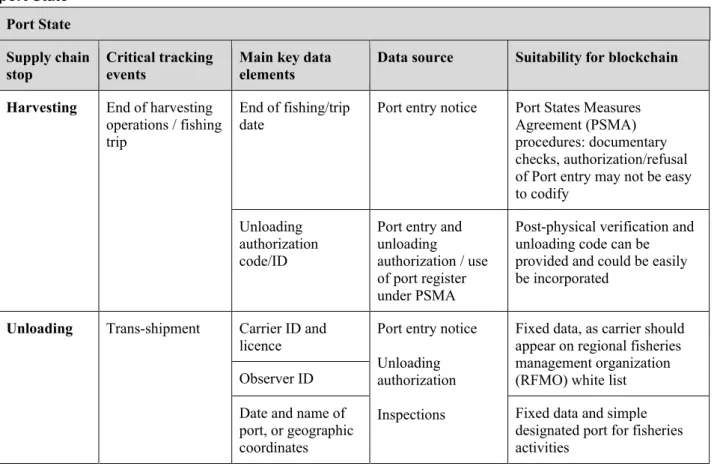
4. Supply chain points, critical tracking events and key data elements at the level of the port State ... 23
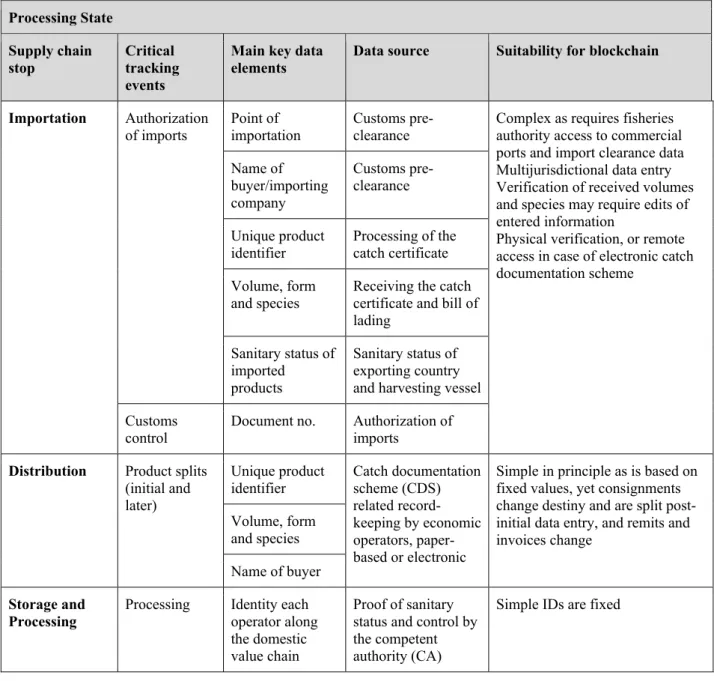
5. Supply chain points, critical tracking events and key data elements at the level of the processing State ... 27
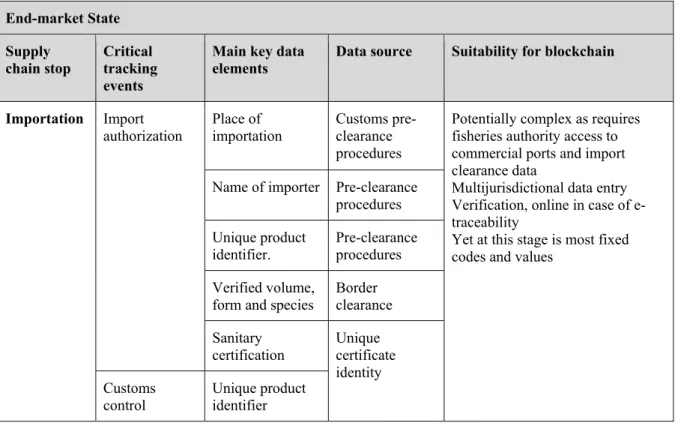
6. Supply chain points, critical tracking events and key data elements at the level of the end-market State ... 29
ABBREVIATIONS AND ACRONYMS
AI artificial intelligence
AIS automatic identification system
BaaS blockchain as a service
CA competent authority
CDS catch documentation scheme
CoC chain of custody
CTE critical tracking event
dApp decentralized application
DNA deoxyribonucleic acid
EEZ exclusive economic zone
ERP enterprise resource planning
FAD fish aggregating device
HACCP hazard analysis and critical control points (system)
ICT information and communications technologies
IMS information management system
IoT Internet of things
IP intellectual property
IUU illegal, unreported, and unregulated (fishing)
KDE key data element
MCS monitoring, control and surveillance
MSC Marine Stewardship Council
NFC near-field communication
NGO non-governmental organization
PNAO Parties to the Nauru Agreement Office
PoS proof of stake
PoW proof of work
PSMA Agreement on Port State Measures to Prevent, Deter and Eliminate Illegal, Unreported and Unregulated Fishing (Port State Measures Agreement)
QR Quick Response (code)
RFID radio-frequency identification
RFMO regional fisheries management organization
SPP Sustainable Shrimp Partnership
SPS Agreement Agreement on the Application of Sanitary and Phytosanitary Measures (Sanitary and Phytosanitary Agreement)
TBT Agreement Technical Barriers to Trade Agreement
TFA Trade Facilitation Agreement
TRU traceable resource unit
VMS vessel monitoring system
WTO World Trade Organization
1. INTRODUCTION
1.1 Justification for this study
The growth of information and communications technologies (ICT) in the last decade has provided many opportunities to overcome some of the challenges faced in the seafood sector, especially in relation to traceability and compliance for illegal, unreported, and unregulated (IUU) fishing and seafood safety. Recent developments, such as the increase in the use of mobile broadband access devices, the Internet of Things (IoT), drones, smart networks, capacity for big data analytics, and artificial intelligence (AI) have provided stakeholders in other primary production industries with some key tools and technologies to improve production and marketing processes.
One of the most discussed technologies is blockchain technology, which is likely to deeply modify the traceability landscape and stakeholder behaviour along the value chain in fisheries and aquaculture. This publication aims to demystify the technology, provide some thoughts on the opportunities and challenges in implementing blockchain-based systems, and document some case studies on the use of blockchain for seafood value chains. In addition, it investigates – based on existing initiatives – public policy and trade implications to set the basis for recommendations for governments and international organizations.
1.2 Scope and limitations of the study 1.2.1 Scope
This study is intended for governments and international organizations, and it uses a two-pronged analysis based on the expertise of the authors. One prong discusses the role of traceability (both for official assurances and private verification purposes) over the seafood value chain as the substrate over which electronic traceability-type solutions, such as those based on blockchain technology, need to operate. The other presents the state of play of the application of the technology and some current examples of its use.
The value chain component dives into the sources of data along the value chain, analysing in detail the critical tracking events (CTEs) as “points within a business and along the value chain where the product is moved between premises or is transformed, or is determined to be a point where data capture is necessary to maintain traceability”, “key data elements” (KDEs) – “the data elements required to successfully trace a product and/or its ingredients through all relevant CTEs” (Bhatt et al., 2016; Hosch and Blaha, 2017) –and the best practices for verification of these data.
The segments of the analysis consider the types of “States” (flag, coastal, port, processing and end-market) that have custody of fishery products moving through national supply chains from harvesting, trans-shipment, landing and processing to the consumer end-market. Each section on a type of State identifies general control elements that should be in place and that often form the unconditional basis for traceability monitoring and data acquisition.
The technology component presents the basis of the technology, and a description of some of the initiatives using it, together with a comparative analysis of them.
1.2.2 Limitations
This study is a desktop study based on secondary sources, bibliographies and consultations with non-governmental organizations (NGOs), governments, the private sector and independent experts. No site visits or travel were undertaken, which limits the analysis to some extent in terms of specific and recent traceability solutions implemented at the country level. Moreover, the study does not elaborate on the potentiality of applications yet to be developed and future forecasting.
The authors are familiar with seafood value chains, traceability, overseas market access requirements, and blockchain solutions developments and application, and they have extensive knowledge of the ways in which they are applied in many countries. This knowledge is utilized as applicable.
2. FISH AND FISHERY PRODUCTS VALUE CHAINS
Fish and fish products are some of the most traded food items in the world today, and most of the world’s countries report some fish trade. In 2016, about 35 percent of global fish production entered international trade in various forms for human consumption or non-edible purposes. The rapid rate of expansion of international trade in fish and fish products in recent decades has taken place in the context of a broader process of globalization – a large-scale transformation of the world economy driven by trade liberalization and technological advancements. Developing countries play a key role in this trade and, in the past 40 years, the growth rate of exports from developing countries has increased faster than that of developed ones. In 2016 and, according to preliminary figures, also in 2017, developing country exports made up about 54 percent of the total value and about 59 percent of the total quantity (in live weight equivalent) of exports of fish and fish products (FAO, 2018).
In this context of fisheries and aquaculture, this study considers (in line with a study prepared for FAO [De Silva, 2011]) that value chains for capture and culture fisheries differ from fish to fish and from country to country, and frequently within regions. Moreover, a fishery value chain can be defined as interlinked value-adding activities that convert inputs into outputs, which, in turn, add to the bottom line and help to create competitive advantage. A value chain typically consists of inbound distribution or logistics, manufacturing operations, outbound distribution or logistics, marketing and selling, and after-sales service. These activities are supported by purchasing or procurement, research and development, human resource development and corporate infrastructure.
Traceability is not a trivial term, and its absence or incorrect utilization is at the basis of many issues affecting today’s seafood value chains, such as lack of transparency, trade in IUU-originated fish, fraud and species substitution, integrity and seafood safety. Traceability is required in order to ensure these latter attributes, yet per se does not guarantee them. Hence, it is important not to confuse traceability, which is a system, with verification, which is an action.
Language and technological barriers have hindered the use of standardized electronic systems for end-to-end traceability within supply chains. Moreover, scale varies greatly among them; hence, one solution may not work best for all companies within one supply chain. In addition, technical systems need to be functional and up-to-date to meet traceability needs across jurisdictions.
2.1 Traceability in the seafood sector
A typical misconception is that traceability is only a numeric code attached to products, that it actually means place of origin, or that it is a method to ensure that information about the product is true. The professional controversy continues with the granularity and the depth of traceability – how small should the identified unit be (e.g. a crate of shrimps or “a season of skipjack tuna harvest”). This subject is followed by whether the entire supply chain (e.g. from field/farm/hook to plate) or only parts of the supply chain should be covered by traceability requirements, and whether this coverage should be based on risk assessment (e.g. steps in production in which pathogens are inactivated).
Other points of disagreement include the breadth of traceability, i.e. the amount of information the system records, and the body that should be responsible for implementing traceability, i.e. the legislature or the industry. In conclusion, traceability has been both a politically and strategically controversial issue and has acted as a major deterrent for multidisciplinary cooperation and understanding.
On a deeper level, the multiple perceptions about the meaning and applicability of traceability held by different people may be related to idiosyncratic cultural backgrounds and, therefore, to their basic notions of trust and transparency requirements. In this regard, it has been noted that transparency does not equate to traceability because the latter only sets the framework for the former.
The present work uses the definition of traceability from ISO 8402:1994 (ISO, 1994), as this incorporates all the critical properties of a traceability system as described in the scientific literature. Thus, traceability of any given product refers to “the ability to trace the history, application or location of an entity by means of recorded identifications.”
In a product sense, traceability may relate to: the origin of materials and parts; the product processing history; and the distribution and location of the product after delivery. This definition clearly states what should be traced (history, application and location) and how the tracing should be done (by means of recorded identifications).
There are several principles (or requirements) that must be followed in order for the traceability system to be effective. It is critical that these recordings be interconnected and in a format that allows the product to be tracked along the entire supply chain. Thus, units that are traced (traceable resource units [TRUs], e.g. a box of mackerel) and identification/numbering schemes that provide codes/numbers used for the unique identification of TRUs (e.g. GS1 barcodes) are parts of a traceability system.
For this system to be effective, it is essential that the codes of a TRU (either as a raw material or semi- finished product) entering a link in the supply chain are associated uniquely with those of the same item (semi-finished or end product) leaving the link. This ability to identify products individually is the basis of product traceability. Equally critical is maintaining accurate records of the transformations (e.g. splitting, joining) that the TRU undergoes, and sharing the TRU identification code with partners in the supply chain. This approach is consistent with the FAO guidelines on traceability (FAO, 2014). Based on these arguments, this study maintains that traceability is an infrastructure that can be used by control agencies for two purposes. The first purpose is to retrieve different data for various reasons (such as legal harvest, origin, eligibility and food safety). The second purpose is to support the verification of these data with other specific tools; for example, genetic identification of species such as in the seafood mislabelling cases.
As discussed in the literature, “a traceability system is quite similar to a filing cabinet in that they both deal with systematic storing and retrieving of data. Importantly, neither a traceability system nor a filing cabinet care about what types of data are being stored” (Olsen and Borit, 2013). This notion has several important consequences.
For example, there is no guarantee that the recordings are true or complete, as both error and fraud can lead to false claims about the properties of the food product, including its origin. There is a clear need to verify these claims, and in this area, analytical methods and instruments play a crucial role. Similarly, documenting traceability and documenting ecolabel-type chain of custody (CoC) are two different concepts. Although traceability can be used as a tool in the certification process, traceability and certification are nonetheless different processes (Borit and Olsen, 2012).
Traceability by itself makes no claim as to the state of the product or information that can be followed from one point to another through a system. In order to claim that a product has certain values, such as being from a sustainable fish stock and being free of IUU-caught fish, that it is a safe product or has not been substituted, etc., all these claims have to be verified, even if the product is traceable back to a specific vessel.
There are solutions that are simpler than traceability for partial product tracking, such as when the regulator only requires operators to identify their suppliers or customers. This process is less efficient and more inaccurate because tracing product sources can only be attempted by means of a formal, and often lengthy, examination of each link in the chain.
The principle of the correct denomination of traceability systems should also be complied with by certification and documentation schemes, which are also becoming increasingly common among private actors and governments. These requirements for correct denomination of procedures also involve the responsibility to inform producers and consumers of the concepts applied and their limitations.
A further very important criterion associated with traceability, in the case of official guarantees for exports (as in the case of the European Union), is the issue of eligibility2 of products and raw materials, as an outcome of official controls over the value chain. The nature of the official controls implies that all elements in the production chain need to be approved for the purpose by the competent authorities (CAs) for either food safety or fish legality. Hence, traceability is used to prove the eligibility
of every operator in every jurisdiction for a particular product to be exported, from the fishing vessel to the final processor prior to importation into the European Union.
Good information management systems (IMS) are increasingly the norm in terms of proving traceability, inspection results and certification of food products. In particular, the design and maintenance of proper database structures enhancing the information sharing and integration between the CAs can be very important to providing consistency in the certification process.
A systematic analysis of the traceability scenarios in ten countries by FAO (Blaha, Borit and Thompson, 2015) shows that there is much confusion and many inconsistencies regarding the meaning, scope, legal status, implementation capacity and control of traceability systems.
Implementation of traceability systems was catalysed by market access requirements. Initially, these were the domain of health certification of the European Union, and later on (after 2010) supplemented by the catch certification of the European Union.
However, most of the countries analysed have not legislated and standardized traceability as a requirement. Moreover, there seems to be little interaction between the health CA and the fisheries CA in terms of their assessment.
It seems that efforts towards the implementation of traceability systems in countries and across countries have not been supported in an interdisciplinary and standardized way. Ensuring traceability through the seafood production chain can be accomplished by careful planning, taking the time to gain consensus among the operators and authorities. In order to gain trust, the traceability system in place must meet the set standards.
Although many countries lack specific legislation on food traceability, the global tracing and tracking of imported products is being achieved (often with difficulty) through record-keeping (much of it manual), lot identification, labelling laws, and requirements for exporting countries to meet the standards of the domestic industries in those countries.
Bhatt et al. (2016) note that the terms “critical tracking events” (CTEs) and “key data elements” (KDEs) are gaining acceptance in the traceability arena. Their definitions are: (i) CTEs – “points within a business and along the value chain where the product is moved between premises or is transformed, or is determined to be a point where data capture is necessary to maintain traceability”; and (ii) KDEs – “the data elements required to successfully trace a product and/or its ingredients through all relevant CTEs.” They also note that the “one step forward, one step back” requirement is CTE/KDE capture in its simplest form. Best traceability practices require that data be maintained from all points backward and through all points forward within the supply chain of a company or trading partner.
2 In terms of European Union market access for seafood, eligibility compromises the coverage of “official controls” (as defined
by regulations of the European Union) for the specific traceable unit along the entirety of the value chain. If the raw materials harvested or at any production stage were conducted in a non-compliant manner or in a non-verified establishment, then that raw material or product is not eligible for export to the European Union; hence, it cannot receive a European Union health certificate. For example, if an establishment listed with the European Union holds products that are not eligible by origin (i.e. from a non-approved vessel) or conditions (approved but in non-compliance), then the operator must ensure the physical separation of seafood product that is eligible for European Union markets from that which is ineligible. For more on this, refer to Blaha, 2015.
Increasingly, companies are publicly committing to sustainable seafood sourcing policies, and the challenge is now for those companies to be able to track the origin of their products to ensure that the species and attributes of the products are meeting their policies and communicated to the customer accurately (FishWise, 2018).
For companies that buy and sell seafood, the lack of product origin information and supply chain transparency can pose significant risks. In the past, industry’s traceability focus was primarily on food safety concerns. However, the increase in media coverage about the environmental, social and legal issues associated with seafood has led to significant shareholder concerns, potential impacts on brand value, and challenges to the corporate social responsibility initiatives of companies.
The recent attention on social responsibility also creates an opportunity for companies with traceability to actively promote the many benefits of their products, such as social and fair trade compliance, and engagement in fishery improvements.
The first step towards mitigating and eventually eliminating these risks is to ensure that end-to-end, electronic, interoperable traceability systems are in place throughout the supply chain. This work is already under way with some companies that are instituting traceability policies and setting goals, often with the assistance of NGOs, government bodies, and technology companies.
2.1.1 Traceability based on a continuous data acquisition solution
A fundamental challenge for data acquisition in this area is that it should apply to any information about the history, application or location of a traceable item. These may be either master data or transactional data, where the latter describe time-bound events (usually relevant in the transportation phases of the value chain).
Hence, an ideal solution for traceability has been proposed by Hosch and Blaha (2017) as an online platform, whose core functions are to identify and log:
product when it enters the supply chain; all supply chain transactions;
transactions relating to products leaving the supply chain.
Product movements are logged in real time as products migrate from a seller to a buyer or custodian. A purchase must be logged by a buyer, and the product will be deducted from the seller so that the buyer can subsequently pass it on legally. Unless it is properly recorded, it is as if the transfer never occurred and the buyer is officially not in possession of any product.
In this way, an importer may, for example, acquire a large volume of tuna from a fishing vessel in a port in Asia and store it in a warehouse. If the importer splits and sells the product to three processing plants, they record the volume purchased on the electronic platform, naming the seller and recording the necessary details. The system automatically verifies that no more product than that acquired by the importer under the specific transaction can be forwarded, and that the sum of products forwarded to the three buyers complies with this rule.
If the rules are breached and the importer sells more product to the factories than it has imported – a form of laundering – an alarm is triggered when one of the factories tries to log the transaction, and the system automatically identifies the party supplying false information. Instead of a lengthy inspection triggered when product leaves the value chain and someone detects the imbalance, this online system forces operators to comply with the regulations by not accepting inconsistent transactions. Thus, an automated system will come close to eliminating the need for national law enforcement at this level.
There are various challenges with regard to centralized online platforms:
A platform has to be designed that can accommodate all supply chain permutations and scenarios as they occur in reality, so that all movements and transaction types can be logged. Industry has to be persuaded to accept the technology and its requirements.
The cost of developing and rolling out the system and related training can be substantial, and there may be issues related to ownership and intellectual property (IP).
This is the scenario where blockchain technology is offering some ground-breaking potential, yet not without challenges.
3. BLOCKCHAIN TECHNOLOGY
Blockchain technology is a decentralized and distributed digital ledger of transactions that is replicated on every node, or participant, in the network. It is decentralized in the sense that there is no single authority with control over the whole network, and distributed because it is spread out across numerous participants worldwide.
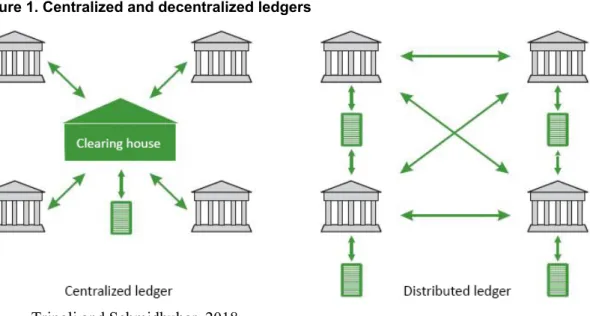
Figure 1. Centralized and decentralized ledgers
Source: Tripoli and Schmidhuber, 2018.
As depicted in Figure 1, in a centralized ledger, one or more parties record transactions into a central database that acts as the ledger, while in a decentralized ledger each party has its own copy of the ledger transactions that is synchronized with the entire network, i.e. each party’s ledger is exactly the same as everyone else’s. As transactions occur in the decentralized network and each transaction is validated, then that transaction is added to everyone’s ledger.
Centralized ledgers may be susceptible to tampering as they are typically owned by a single party. Once a transaction has been recorded on the blockchain it becomes immutable – it cannot be changed without the majority of the blockchain network agreeing to the change. This ensures the security of the transaction data on the blockchain and the entire network.
Aside from decentralization, other characteristics of blockchains include persistency, where data is recorded across all nodes of the blockchain, leading to immutability, which ensures that data cannot be corrupted. Persistency also provides fault-tolerance where the loss of any node in the blockchain network will not make it unusable. Auditability and transparency are other important characteristics – noting that every single transaction is recorded on the blockchain, which can then be audited later, and transparent in the case of permissionless blockchains, which are open for anyone to view the transactions.
These properties make the use of blockchain technology an exciting prospect for traceability systems that can encompass and link seafood supply chains. It could provide an online traceability infrastructure that caters for the permanent storage and sharing of KDEs along CTEs; and the fact that it is already a digital ledger makes it suitable for recording transactions of products between supply chain actors.
3.1 Principles
To determine the suitability of using blockchain technology in seafood supply chains, it is important to understand some of the underlying principles of the technology.
3.1.1 No single blockchain platform
It is important to know that there is no single blockchain platform. Instead, there are multiple platforms, each with its own unique technical properties and value propositions.
The most commonly used blockchains in seafood value chains today are the Ethereum and Hyperledger blockchains:
● Ethereum: promotes itself as “the world’s leading programmable blockchain” (Ethereum,
2020) and has a native cryptocurrency, Ether. It provides a platform on top of which decentralized applications (dApps) can be built and has one of the largest active developer communities building solutions on it.
● Hyperledger: is an “open source collaborative effort created to advance cross-industry blockchain technologies” (The Linux Foundation, 2020) hosted by the Linux Foundation. Unlike Ethereum, it does not have a native cryptocurrency associated with it. It has been made popular by use of the platform in IBM’s blockchain solutions.
3.1.2 Consensus algorithms
Blockchains are made up of numerous nodes (participants) in a network, with each node containing an exact copy of the digital ledger. These nodes can number in the thousands and exist across the world. Consensus algorithms are key to the operation of blockchain networks and are responsible for maintaining the integrity and security of the network. These algorithms ensure that the blockchain protocol rules are followed, that all the nodes in the network are synchronized with one another, and they are key in preventing any single entity from controlling the blockchain network.
Proof of work (PoW) and proof of stake (PoS) are two of the leading consensus algorithms in use:
● Proof of work (PoW): was the first consensus algorithm implemented in a blockchain and is
used in the Bitcoin blockchain. It requires nodes, known as “miners”, in the network to compete to solve a complex mathematical problem, the solution of which is known as a hash value. Once a miner finds the correct hash value, the nodes in the network verify that it is correct before executing the transaction and adding it to the blockchain. The miner that finds the correct hash value will receive a reward, known as a “block reward”. Due to the computations that miners perform to achieve the correct hash value, PoW utilizes a lot of energy to confirm transactions onto the blockchain. This is by design to enhance the security of this consensus algorithm.
● Proof of stake (PoS): is an alternative to PoW where a node, known as a “validator”, is chosen to confirm a block based on its economic stake (number of tokens) in the network together with a randomization function. A token is a unit of value issued by the blockchain. The randomization function prevents centralization and avoids the possibility that the validator with the highest economic stake will always validate transactions. The validator is disincentivized from malicious action because a portion of its stake will be at risk. As with PoW, the validator receives a reward, and PoS is considered a better option than PoW because it uses far less energy to confirm transactions.
There are numerous other types of consensus algorithms not covered in this study, such as Byzantine fault tolerance, proof of authority, and delegated proof of stake.
3.1.3 Types of blockchains
There are three types of networks that offer different propositions based on blockchain’s inherent properties. Each type offers varying levels of control and access to participate in the network.
Public
As the name implies, a public or permissionless blockchain is publicly accessible with no restrictions on who can participate as a user, miner or validator in the network. No single entity has complete control over a public blockchain, making it highly censor resistant. It is fully distributed, and all the transactions are transparent – allowing anyone to examine the details of any transaction.
Public blockchains have a token associated with them that is typically designed to incentivize and reward participants in the network. Examples of public blockchains include Bitcoin, Ethereum and Litecoin. The challenges associated with public blockchains have been well documented, particularly those that employ the PoW consensus algorithm, where there is a high energy cost to validate transactions.
Private or permissioned
Unlike a public blockchain, a private or permissioned blockchain has restrictions on who can access it and participate in performing transactions and validations. This type of blockchain is more centralized than public blockchains, and the entities that run the network have significant control over the participants and governance structure.
Transactions are private and only available to participants in the network. This type of network is often valuable for organizations that want to collaborate and share data but do not want their sensitive business data publicly visible. Tokens may or may not be utilized in this type of blockchain.
Consortium
A consortium blockchain is almost a hybrid of a public and private blockchain where the network is governed by a group rather than a single entity. Some nodes in the network control the consensus process, while others can participate in the transactions.
This type of blockchain can be an attractive option to entities that operate in a similar space, for example, seafood supply chains, that would allow them to collaborate on some aspects of their businesses. Collaborating in this way allows them to leverage blockchain technology to achieve workflow efficiencies, shared information and resources, accountability, and transparency across their business processes.
3.2 Smart contracts
In its basic form, a smart contract is computer code within a blockchain network that can automatically execute when certain conditions are met without the need for a trusted third party to intervene. People liken smart contracts to an agreement between the different parties represented in computer code that is self-executing.
The executed code in smart contracts can do many things based on the conditions programmed into it, including transferring the ownership of a digital asset from one entity to another and automating payments to one or more parties. It can also be used as a form of escrow.
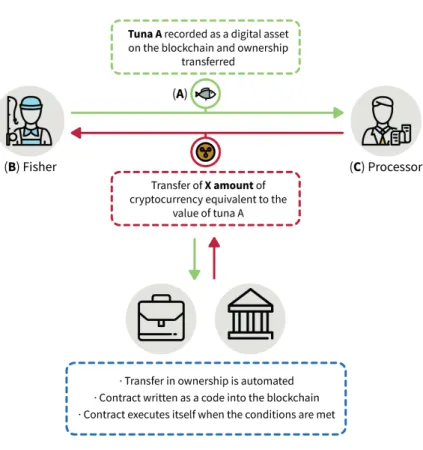
Figure 2. Example of a blockchain smart contract
Figure 2 shows a simple example of how a blockchain smart contract can be used in seafood value chains: if a tuna (Tuna A) is caught by Fisher B and recorded as a digital asset on the blockchain, then Processor C transfers an agreed X amount of cryptocurrency equivalent to the value of Tuna A to Fisher B; ownership of Tuna A as a digital asset can automatically be transferred to Processor C. The transfer in “ownership” is automated on the blockchain based on the conditions (transfer of X amount between Fisher B and Processor C) being met.
However, the above example ignores the reality of seafood value chains, especially the logistics involved in moving a physical asset, such as tuna, from seller to buyer. It also requires there to be a physical medium to uniquely identify the tuna sold and to associate it with the digital asset on the blockchain. A key link between the physical world and blockchain is an oracle – a trusted intermediary and an integral part of the smart contract ecosystem that facilitates data feeds to the blockchain ecosystem. By design, a blockchain cannot access data from outside its system and, thus, data to make the blockchain are supplied through a predefined entity called an oracle. An oracle can be hardware-based, software-based or consensus-software-based. Examples of hardware oracles are sensors, IoT and weather stations, while software examples are a New York Stock Exchange index, expiration date, or output of some computation. A consensus-based oracle works on the basis of consensus from a group of predefined nodes on a particular question. A consensus-based oracle can also source data from several other oracles to trigger an event in a smart contract. Moreover, inbound oracles pass external data to smart contracts, and outbound oracles communicate smart-contract-based data to the outside world.
Ethereum is the first blockchain platform that focuses on providing a Turing-complete3 smart
contracts-based system and decentralized applications. Hyperledger Fabric and R3 Corda are some of the other distributed ledger technologies that are used to create smart contracts.
3.3 Development and operational considerations
While many large technology providers, including Amazon, Microsoft and SAP, are starting to offer “blockchain as a service” (BaaS) options that will enable companies to build and deploy blockchain solutions quickly, these services are still relatively new in the marketplace.
However, these BaaS solutions will help reduce the burden of needing specialized skills to trial blockchain technology, which could potentially lead to greater adoption of blockchain in seafood value chains.
Many projects in the seafood value chain space utilize dedicated development teams with specialized blockchain developers. The different flavours of blockchain platforms also require different skill sets among blockchain developers. Given the global interest and growth in blockchain technology, there is high demand for blockchain engineers.
3.3.1 Blockchain development
From a technical perspective, designing and developing a blockchain solution is not difficult. Experienced computer programmers familiar with object-oriented programming can learn the required blockchain programming languages relatively easily as they are based on programming languages that are quite mature and well known.
For example, the Solidity language is used to write smart contracts in the Ethereum blockchain and is very similar to the C++ and JavaScript languages. While the smart contract is written in Solidity and deployed to the blockchain, the dApp that the user interacts with can be built with any number of modern web programming languages (e.g. React) and can be deployed to traditional web servers.
The major difference with blockchain development is the fact that the written code will reside and execute in a decentralized network. It requires greater attention to detail and mitigation of potential security threats as the code could be open to anyone in the case of a public blockchain. The way in which smart-contract versions and releases are deployed is also different from traditional computer programs. There is also a new element to blockchain development in that many networks use tokens as an integral part of their network, and there is a cost (transaction fee) associated to executing transactions on the blockchain. Smart-contract designs will have to account for these costs in order to minimize the overall cost of making a transaction. The use of tokens adds the need for secure digital wallets that hold the tokens to be used in transactions. These add greater complexity to blockchain development and require stronger security considerations as tokens are associated to fiat currencies.
Tools for developing blockchain solutions continue to improve, and solutions for easier implementation continue to grow as well. Coupled with a growing global blockchain developer community, it will become easier for organizations involved in the seafood value chain to implement and test blockchain solutions.
3A Turing-complete language means a language that can approximately simulate the computational aspects of any other
Operational considerations
It is important to consider the operating requirements of a specific use case in which a blockchain can be used. Blockchains are often compared with traditional relational databases with the difference being that while a blockchain is good at recording transactions, databases can record both transactions and final state values or balances.
Data retrieval and transaction times in databases are much faster than compared with a blockchain; hence, the speed of a traceability system should be an operational consideration. Most of the projects analysed later in this study recognize this speed penalty and mitigate it by using a combination of a database that initially captures the data with a smart contract recording the transactions on the blockchain in the background.
Once a smart contract is deployed on a blockchain, it should work as designed without interference. Developers will have to ensure that they have effective protocols to update a smart contract, which often is the case for any piece of software.
In the case of a public blockchain that utilizes tokens, the respective participants in the network will have to ensure that they have enough tokens to participate effectively. Tokens are typically purchased in exchange for fiat currency through token exchanges. This may be an issue in developing States where token exchanges do not exist, which would effectively limit the participation in the blockchain of seafood value chain actors in those countries.
Security considerations
Blockchain applications, as any other software, can be vulnerable to security threats. There have been numerous attacks on cryptocurrency exchanges that stored tokens used in blockchains as well as attacks that targeted weaknesses in dApps. Due to the nature of the technology, once tokens have stolen, it can be very difficult to identify the attacker.
Much like the improvement in blockchain development tools, there is also improvement in the security tools used to secure dApps and smart contracts.
Electronic data interchange
By its very nature of being an immutable and decentralized ledger, blockchains lends itself very well to being an electronic data interchange of sorts. This application is very relevant to seafood value chains, where the blockchain could be the “central” repository through which agreed sets of seafood product KDEs are shared and access is facilitated among various actors in the value chain. It also has the potential to provide a transactional ledger for mass balance reconciliation of fish entering and leaving a processing factory or State.
3.3.2 Regulatory uncertainty
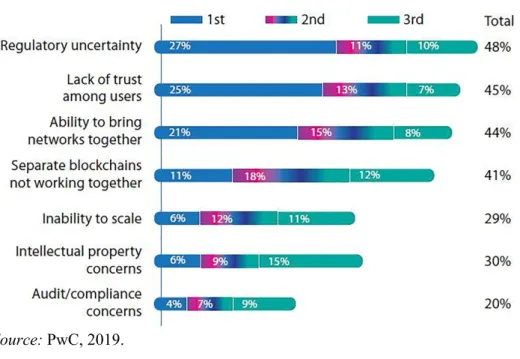
According to one multinational professional services network (PwC, 2019), the financial sector stands to gain the most from blockchain-based service implementations, followed by industrial products and the manufacturing sector, energy and utilities, and then the healthcare sector. Nevertheless, its survey of about 600 blockchain-savvy executives revealed that the biggest barrier to blockchain adoption was regulatory uncertainty (Figure 3). Interoperability and the potential failure of different blockchains to work together were identified as major challenges.
Figure 3. Main barriers to blockchain adoption
Source: PwC, 2019.
3.3.3 Costs
In considering the use of blockchain solutions for seafood value chains, it is important to be aware of the costs involved.
Build or buy
Building a blockchain solution from scratch can be costly given the shortages in experienced blockchain developers and the likelihood that there are limited developers with deep knowledge of seafood value chains. Development costs for blockchain traceability solutions start from about USD 50 000, and time frames to build a solution start from about 3 months or longer.
It is easier now to subscribe to an existing blockchain service or even to a dedicated blockchain traceability service without needing to make a huge investment. This option is also faster to set up and test the technology in a seafood value chain.
Prices for the SAP Cloud Platform Blockchain Service range from USD 280 to USD 3 000 per month depending on the type of blockchain instance required (SAP, 2020). In contrast, IBM Blockchain Platform pricing can start from USD 1 500 per month.
For blockchain traceability service providers, Provenance offers its Enterprise product for from USD 980 per month, with an onboarding fee of USD 3 500 (Provenance, 2020), while TraSeable Solutions offers its solution for from USD 160 per month with an onboarding fee of USD 230 (TraSeable Solutions, 2020).
Integration and peripherals
The other key costs to account for are software integration costs if a value chain actor has existing enterprise resource planning (ERP) software. Hardware costs also need to be factored in, and this involves data capture devices such as tablets, laptop computers, radio-frequency identification (RFID) scanners, and near-field communication (NFC) readers. Fish tagging and label printing solutions are added hardware costs.
Staffing costs should also be considered, especially the need to train fishers, processing-factory workers, and other staff involved across the seafood value chain.
Technical infrastructure
The technical infrastructure to maintain blockchains in near real time is challenging. Receiving and sending large data volumes at sea is only possible via satellite communication in many parts of the ocean. Installing satellite communication devices may be not feasible in small-scale fisheries or fisheries with limited financial resources. Transmission prices could still be too high and the available bandwidth still too narrow to support the transmission demands of electronic logbooks and synchronized blockchains.
Blockchains require intense and frequent communication between the nodes of the blockchain network. Thus, the synchronization of blockchains can be tardy and may not work well in situations in which a large proportion of network nodes are faced with unstable network connections.
3.3.4 Increased responsibility on the user
By its very design, blockchain implementation may not have a central authority (FAO and ITU, 2019), which puts additional responsibility on the user. There is no entity to go to in the event of individuals losing private keys (or incurring losses as a result of revealing a private key). Moreover, there is no feature to restore forgotten passwords and usernames, something that individuals are used to. Individuals need to exercise great caution, just as on the Internet, before publishing anything. The importance of entering the correct data is very important too, as it is very difficult to make corrections later.
4. THE REGULATORY AND PRIVATE INITIATIVES ENVIRONMENT 4.1 The role of compliance at different types of States for data source
Any form of standardized validation and verification structure for data that is to be part of a traceability framework along the value chain needs to be based on regulatory oversight by the authorities in the different types of States, as the concept of “official guarantees” still holds strong in trade and social governance as does that of market access under the Agreement on the Application of Sanitary and Phytosanitary Measures (SPS Agreement) and the Agreement on Technical Barriers to Trade (TBT Agreement) of the World Trade Organization (WTO).
This highlights the importance of identifying CTEs in the value chain – from the point of capture to the final point of importation – where information is to be collected and of proposing measures to address weaknesses, inefficiencies and gaps.
One FAO study (Hosch and Blaha, 2017) investigated the identification of these CTEs and KDEs along a value chain segmentation for catch documentation schemes (CDS) based on the types of “State” (flag, coastal, port, processing and end-market) as a contribution to the FAO Voluntary Guidelines for Catch Documentation Schemes approved in July 2017 (FAO, 2017). To these analyses, elements related to the general aspects of traceability from the food safety and fraud4 perspectives have been added. However, it is important to state that this analysis does not claim to be totally inclusive, and there are aspects that may have not been covered.
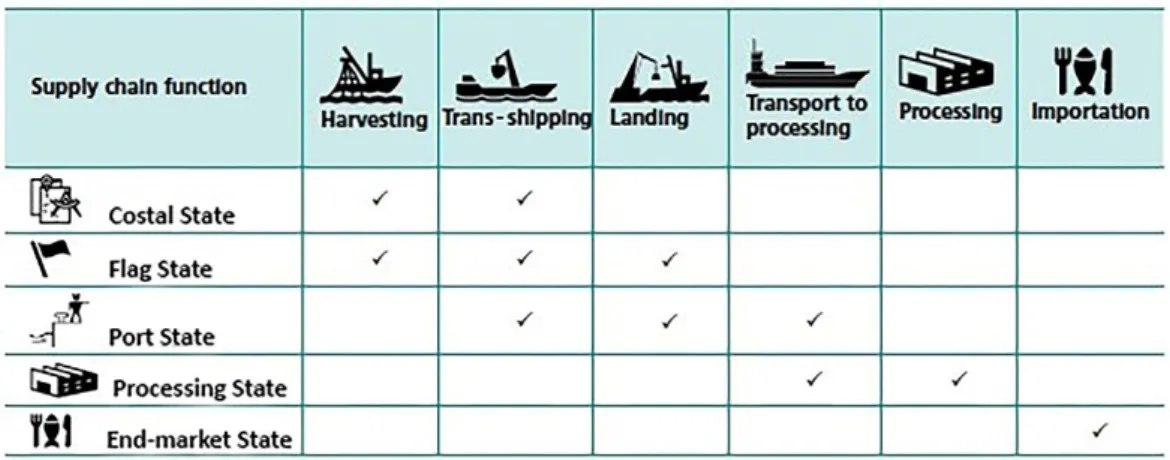
Table 1 shows a fishery supply chain with the segments covered or controlled by the various types of State. It is clear that few operations or CTEs along the supply chain are under the exclusive purview of a single type of State and that a large number of operations fall under the purview of different types of State along the supply chain. Note that a single State can act as all of the types of State at once.
Table 1. Standardized supply chain with the segments covered or controlled by the various types of State
Source: Hosch and Blaha, 2017.
While an in-depth investigation of CTEs and KDEs per segment as well as an analysis of blockchain suitability is covered in the following sections, Figure 4 provides a generic example of how data recording in the traditional quality assurance for traceability can be translated into blockchain.
Figure 4. Seafood supply chain traceability from traditional records to blockchain
Source: Reproduced courtesy of Bureau Veritas. Food traceability: the blockchain revolution. White
Paper (2017). (available at: http://origin.bureauveritas.com/assets/vendor/white_paper_food_ blockain.pdf)
4.1.1 Flag State
Considerations for legality, transparency and species fraud
Under Article 94 of the United Nations Convention on the Law of the Sea, flag States must oversee the operations of fishing vessels flying their flags. The 1995 United Nations Agreement for the Implementation of the Provisions of the United Nations Convention on the Law of the Sea of 10 December 1982 relating to the Conservation and Management of Straddling Fish Stocks and Highly Migratory Fish Stocks also mandates this and obliges flag States to investigate alleged violations of conservation and management measures and apply sanctions against non-compliant fishing vessels. The 1995 Code of Conduct for Responsible Fisheries also mandates this approach, and places more emphasis on the enforcement regimes of flag States.
Vessel registrations, licence registers, vessel monitoring systems (VMS), logbooks, observer programmes, and trans-shipment and landing authorizations enable flag States to discharge their responsibilities under international law and to oversee fishing vessels flying their flags.
To provide sound assurances that vessels are operating legally, flag States must ensure that they have verified data that can be supplied to traceability systems, through the following mechanisms:
● Registration and licensing of fishing vessels are conditionally linked, and the registration and licence lists are accessible and shared by the CA.
● Fishing vessels are controlled through licences, authorizations or permits, which may vary in scope and according to the type of fishery.
● There is implementation and enforcement of VMS, automatic identification systems (AIS) and logbook regimes for fishing vessels operating in waters beyond national jurisdiction.
● Standard logbooks recording fishing operations are also a licensing requirement in coastal States and regional fisheries management organizations (RFMOs).
● A fisheries observer programme is implemented and coordinated with those operated by RMFOs or coastal States in which the fleet operates;
● Unloadings are communicated and, where appropriate, authorized by the relevant authorities.
● Trans-shipments, transfers and landings are regulated, directly or indirectly monitored and recorded.
The more efficiently flag States carry out their functions, the stronger the assurances are that IUU catches are denied entry into supply chains.
Considerations for food safety
The role of the flag State in food safety is based on the sanitary requirements for fishing vessels, either nationally or by market access conditions, as in the case of the European Union.
In general terms, fish processing establishments in a country intending to export its products should be registered and approved under the control of the national CA against the applicable standards (which include specific requirements normally referring to infrastructure, hygienic conditions, hazard analysis and critical control points [HACCP], operations, traceability, labelling, etc). The same principle applies to fishing vessels where processing takes place (i.e. freezer vessels and factory vessels). Non-processing vessels (ice vessels, small-scale craft, etc.) may also need to be registered and approved before they can be used to supply exporting establishments.
To provide sound assurances that vessels are processing the captured products in compliance with the required standards, flag States must ensure that they have validated data that can be supplied to traceability systems, through the following mechanisms:
● Fishing vessels are controlled through sanitary inspections and, if in compliance, their processing licences, authorizations or permits under a unique ID are maintained.
● The implementation and enforcement sanitary regimes for fishing vessels should be independent of whether the vessels are operating in waters of the flag State in waters beyond national jurisdiction.
● Standard food safety plans and their records are kept for verification.
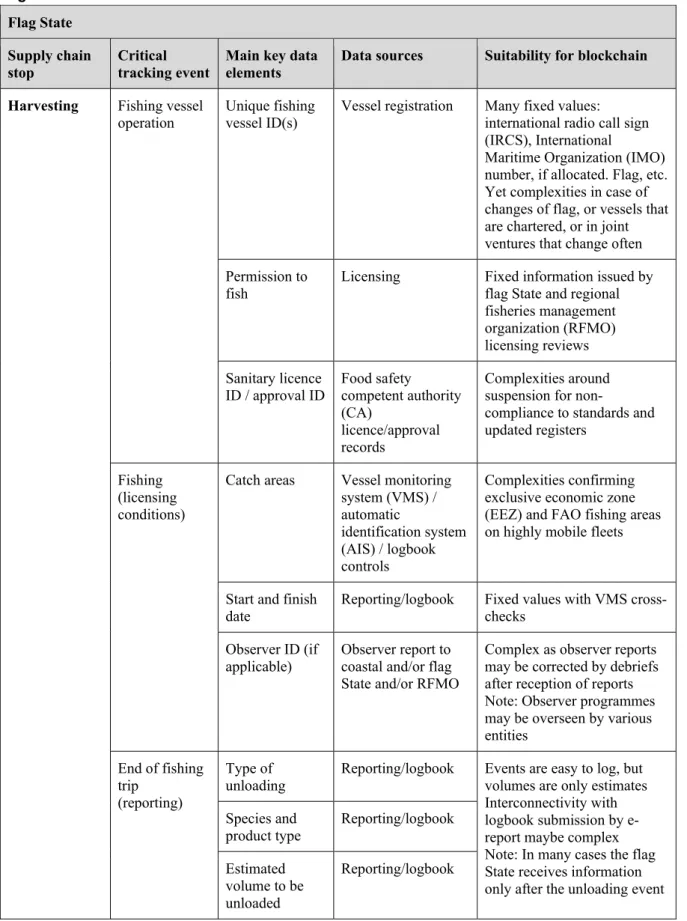
Summary
Table 2 shows the main supply chain stops, CTEs and KDEs in a typical supply chain overseen by a flag State.
Table 2. Supply chain points, critical tracking events and key data elements at the level of the flag State
Flag State Supply chain
stop Critical tracking event Main key data elements Data sources Suitability for blockchain Harvesting Fishing vessel
operation Unique fishing vessel ID(s) Vessel registration Many fixed values: international radio call sign (IRCS), International
Maritime Organization (IMO) number, if allocated. Flag, etc. Yet complexities in case of changes of flag, or vessels that are chartered, or in joint ventures that change often Permission to
fish Licensing Fixed information issued by flag State and regional fisheries management organization (RFMO) licensing reviews Sanitary licence
ID / approval ID Food safety competent authority (CA)
licence/approval records
Complexities around suspension for
non-compliance to standards and updated registers
Fishing (licensing conditions)
Catch areas Vessel monitoring system (VMS) / automatic identification system (AIS) / logbook controls Complexities confirming exclusive economic zone (EEZ) and FAO fishing areas on highly mobile fleets
Start and finish
date Reporting/logbook Fixed values with VMS cross-checks Observer ID (if
applicable)
Observer report to coastal and/or flag State and/or RFMO
Complex as observer reports may be corrected by debriefs after reception of reports Note: Observer programmes may be overseen by various entities
End of fishing trip
(reporting)
Type of
unloading Reporting/logbook Events are easy to log, but volumes are only estimates Interconnectivity with logbook submission by e-report maybe complex Note: In many cases the flag State receives information only after the unloading event Species and
product type Reporting/logbook Estimated
volume to be unloaded
4.1.2 Coastal States
Considerations for legality, transparency and species fraud
Although international law provides that coastal States have the sovereign right and duty to manage fisheries in waters under their jurisdiction, their role in current traceability for compliance arena is minimal.
Vessels registered in coastal States or foreign vessels operating in the coastal State’s waters may fish illegally: it is the duty of coastal and flag States to ensure that fishing operations are legal and monitored. Access for foreign vessels is to be established in a supportive manner with other flag and port States in the same fishery, particularly if transboundary and straddling stocks are involved. Participation by coastal States in RFMO decision-making and the incorporation of the resulting conservation and management measures into their legal frameworks is a basic way in which coastal States can control the operations of foreign vessels in the way flag States do.
The most common approach to access is through fisheries agreements between coastal and flag States that set out the terms and conditions of individual fishing permits, and definition of the obligations of flag States with respect to fishing operations carried out by their vessels.
From a perspective of traceability for compliance, the coastal State’s CTEs and main KDEs relate to fishing operations. The licences issued by coastal States impose operational conditions on vessels operating in their waters – these established the legality of catches. Monitoring, control and surveillance (MCS) tools such as VMS, logbooks and zone entry and exit conditions, supplemented by an observer or e-monitoring programme, enable a coastal State to determine the legality of harvests in waters under its jurisdiction.
However, the enforcement capacities of coastal States are limited in cases of suspected infringements, particularly when vessels unload in jurisdictions outside a coastal State. Hence, it is essential that coastal States participate in decisions as to the validation of data available for traceability initiatives on the basis of their control of foreign fishing operations in their exclusive economic zone (EEZs).
Considerations for food safety
The role of the coastal State on this aspect have been generally very minimal, as the sanitary conditions of the vessel are normally the responsibility of flag State.
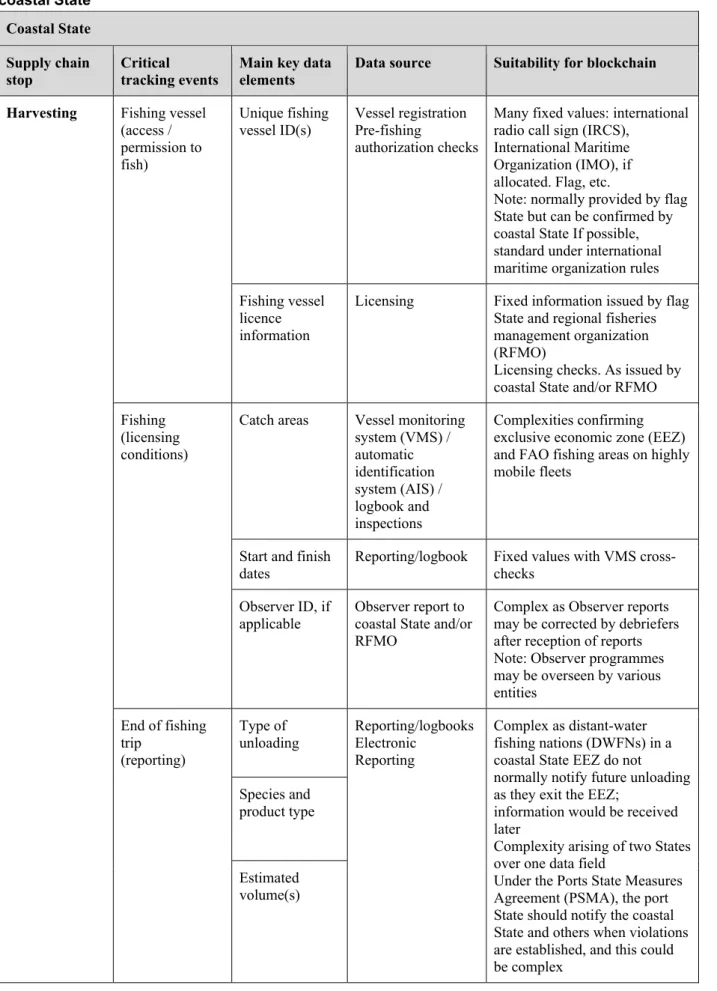
Summary
Table 3 shows the main supply chain stops, CTEs and KDEs in a typical supply chain overseen by a coastal State.
Table 3. Supply chain points, critical tracking events and key data elements at the level of the coastal State
Coastal State Supply chain
stop Critical tracking events Main key data elements Data source Suitability for blockchain Harvesting Fishing vessel
(access / permission to fish)
Unique fishing
vessel ID(s) Vessel registration Pre-fishing authorization checks
Many fixed values: international radio call sign (IRCS),
International Maritime Organization (IMO), if allocated. Flag, etc.
Note: normally provided by flag State but can be confirmed by coastal State If possible, standard under international maritime organization rules Fishing vessel
licence information
Licensing Fixed information issued by flag State and regional fisheries management organization (RFMO)
Licensing checks. As issued by coastal State and/or RFMO Fishing
(licensing conditions)
Catch areas Vessel monitoring system (VMS) / automatic identification system (AIS) / logbook and inspections Complexities confirming exclusive economic zone (EEZ) and FAO fishing areas on highly mobile fleets
Start and finish
dates Reporting/logbook Fixed values with VMS cross-checks Observer ID, if
applicable
Observer report to coastal State and/or RFMO
Complex as Observer reports may be corrected by debriefers after reception of reports Note: Observer programmes may be overseen by various entities
End of fishing trip
(reporting)
Type of
unloading Reporting/logbooks Electronic Reporting
Complex as distant-water fishing nations (DWFNs) in a coastal State EEZ do not normally notify future unloading as they exit the EEZ;
information would be received later
Complexity arising of two States over one data field
Under the Ports State Measures Agreement (PSMA), the port State should notify the coastal State and others when violations are established, and this could be complex
Species and product type
Estimated volume(s)
4.1.3 Port States
Considerations for legality, transparency and species fraud
Fishing vessels bring their catch to port for landing directly as catchers or indirectly as reefers. The port is the point at which fisheries products move from the seaborne to the land-based supply chain. Few other points are as important for a full traceability of fish and fishery products.
The use of port State measures to enforce domestic and international fishery laws is now understood as a right and a duty of port States.
The FAO 2009 Port State Measures Agreement (PSMA) requires that port States designate their fishing ports as the ports to which fishing vessels are limited. The PSMA requires that foreign fishing vessels must be consistently monitored in such ports, and that full dockside inspections may be carried out. The inspections should not be limited to foreign fishing vessels even although in practice they are a particular concern, because port States and flag State are distinct entities in this respect and because the fishing operations are at least part conducted in distant waters. This complicates oversight by flag States, and increases the relevance of port States with regard to foreign fishing vessels.
International law recognizes that States have full sovereignty with respect to ports in their territories, and a State may:
● deny port access to vessels registered in other States;
● prohibit vessels registered in other States from landing or trans-shipping fish in its ports;
● require vessels seeking port access to provide information as to their identity and activities;
● inspect vessels that are voluntarily in one of its ports.
In port, fishing vessels can be fully overseen because they are close to land-based facilities, and the authorities can access the vessels themselves. It is largely the quality of port State monitoring and the work of its port-based fisheries officers that determine the risk of illegally sourced fish entering the land-based supply chain.
Hence, port States must be in a position to monitor all fishery transactions in their ports – mainly landings and trans-shipments – and subject selected transactions to full-scale inspections, as they are the last line of defence in terms of detecting infringements and denying certification of IUU-derived catches and preventing their entry into land-based supply chains.
Fundamentally, a system of authorizations for unloading should be in place to ensure that permissions are denied in cases of suspected or established IUU fishing and recorded for traceability purposes. Certain supply chain points overseen by port States are particularly important for traceability.
End of fishing trip and port entry – submission of information to the port State authority where the landing is planned prior to the arrival in port of any fishing vessel.
Authorization to unload against compliance to minimal PSMA conditions and evaluation of legality of catches linking fishing trip to volumes and species unloaded.
Unloading – can happen in two ways:
● Trans-shipment in port – Catch information must be handed from the fishing vessel to the reefer master, and counter-validated by the port State and entered into the traceability system. Therefore, Port State authorities need a sound understanding of the fishery and its regulatory framework governing in-port trans-shipments, standard MCS routines and inspections.
● Landings, verified weights and first buyers – Because fishing vessels unload their own catch whereas reefers unload several harvests, checking the paperwork and data for the former is