A Cost Analysis Overview
OpenText Exceed onDemand
Managed Application Access Solutions for Enterprise
OpenText Connectivity Solutions Group
February 2011
Abstract
This whitepaper presents a simulated study using a fictional multi
-
national manufacturing company. The
objective is to evaluate both decentralized and centralized scenarios within this company. In the
decentralized scenario, the cost of delivering and maintaining X applications in branch offices is
evaluated. In the centralized scenario, we appraise the effectiveness of Exceed onDemand in the quest to
cut down IT costs.
Contents
Overview ...
3
ACME Corporation: A World Premier Semiconductor Company ...
4
Scenario A: Decentralized System ...
5
Cost Breakdown ...
7
Acquisition Costs
...
7
Setup Costs
...
7
Ongoing Costs
...
7
Scenario B: A Centralized System Using Exceed onDemand ...
9
Cost Breakdown ...
11
Acquisition Costs
...
11
Setup Costs
...
11
Ongoing Costs
...
12
Overview
Centralization and decentralization are two opposing management concepts. One suggests that the
control of resources or decision
-
making power lies in the hands of one person, department, or governing
entity. The other advocates empowering discrete branches or regional satellite offices to control resources
or make decisions.
Choosing one management style over the other depends on a number of factors. In the real business
world, rarely is there one single factor that triggers the change of management style; rather it is a
combination of external industry influences and internal corporate strategic objectives that determine the
structure of the company. Often, centralized systems are formed to manage costs and exploit economies
of scale, while decentralized systems seek to decrease process inefficiencies in an attempt to increase
productivity.
This whitepaper demonstrates a business environment where the geographical barriers between users
and servers are no longer a deciding factor in determining the architecture of a business’ IT infrastructure.
By harnessing a solution that eliminates both the latency and performance degradation associated with
long
-
distance Internet communication, while maintaining centralized control, companies will be in a
unique position to increase productivity and cost benefits.
We propose and prove that OpenText Exceed
onDemand® provides this solution for X Window
applications because of its sophisticated architecture, which gives it power, flexibility, and security to meet
business needs.
To illustrate our hypothesis, we provide the results of a simulated study using a test multinational
manufacturing company. The objective is to evaluate both decentralized and centralized scenarios within
this company. In the decentralized scenario, the cost of delivering and maintaining X applications in
branch offices is evaluated. In the centralized scenario, we appraise the effectiveness of
Exceed
onDemand in the quest to cut down IT costs.
While this study is simulated, we use techniques to accurately represent a real
-
world company with real
-world challenges.
This document is part of the OpenText Managed Application Access Solutions for Enterprise Whitepaper
series. For other technical topics, please visit http://connectivity.opentext.com.
ACME Corporation: A World Premier Semiconductor
Company
ACME Corporation is a multi
-
national company, and its core business is design and manufacture of high
-performance semiconductor products for multiple markets. With research and development centers
spread out across the globe, ACME develops some of the most advanced and sophisticated designs. Like
most companies in the business world, ACME is under constant pressure from upper management and
shareholders to increase efficiency and the monetary return on each dollar that is invested. Because of
this pressure, they need to evaluate operational strategies that support this objective.
Scenario A: Decentralized System
ACME has 10 Research & Design (R&D) centers in total―five in the US and the rest in the Pacific Rim.
There are 10 design engineers in each R&D center, and these are divided into multiple groups; some
groups are working on projects independently, while other groups are collaborating on projects. Because
of the dispersed user population and the poor performance of UNIX
-
based EDA (Electronic Design
Automation) and CAD/CAM (Computer
-
Aided Design and Computer
-
Aided M
anufacturing
) tools over the
WAN, the company has decided to create identical IT infrastructures in each branch office. By doing this,
users have faster access to local applications and data instead of being subjected to the unpredictable
performance caused by Internet traffic.
Each site is outfitted with three mid
-
level servers equipped with the EDA Tools needed to support 7 EDA
engineers out of the 10 design engineers in total. Because of the high graphic demand of CAD/CAM
tools, one high
-
level server can support 3 CAD/CAM engineers. The company also invests in a storage
server on each site in order to safeguard the project data. Setting up the hardware and applications on
each site requires professional services provided by vendors. Administrators also need the appropriate
training in order to provide basic support and perform regular maintenance on the hardware and
applications.
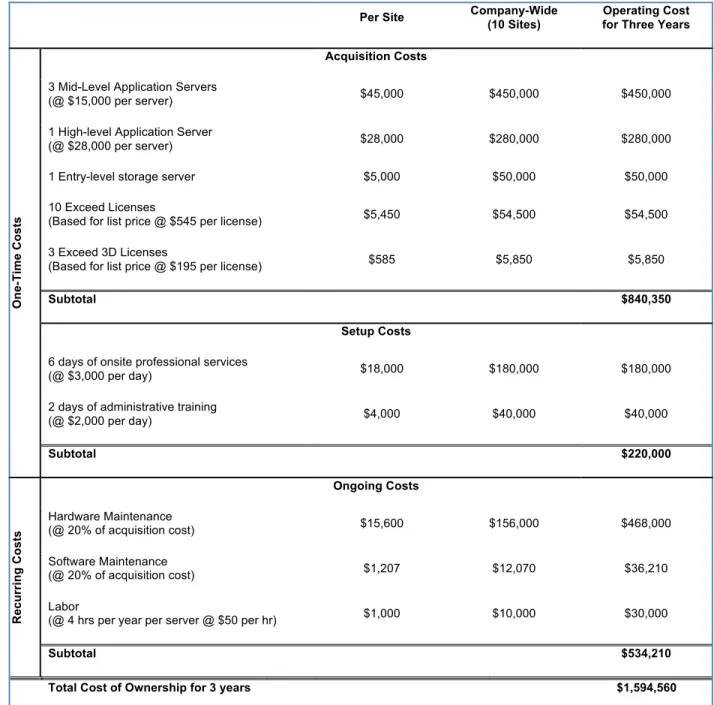
The following table is a summary of various costs:
Table 1 - Operating costs for the decentralized deployment strategy
Per Site Company-Wide (10 Sites) for Three Years Operating Cost
On e -Ti m e C o s ts Acquisition Costs 3 Mid-Level Application Servers
(@ $15,000 per server) $45,000 $450,000 $450,000
1 High-level Application Server
(@ $28,000 per server) $28,000 $280,000 $280,000
1 Entry-level storage server $5,000 $50,000 $50,000
10 Exceed Licenses
(Based for list price @ $545 per license) $5,450 $54,500 $54,500 3 Exceed 3D Licenses
(Based for list price @ $195 per license) $585 $5,850 $5,850
Subtotal $840,350
Setup Costs 6 days of onsite professional services
(@ $3,000 per day) $18,000 $180,000 $180,000
2 days of administrative training
(@ $2,000 per day) $4,000 $40,000 $40,000
Subtotal $220,000
Re c u rr in g Co s ts Ongoing Costs Hardware Maintenance
(@ 20% of acquisition cost) $15,600 $156,000 $468,000
Software Maintenance
(@ 20% of acquisition cost) $1,207 $12,070 $36,210
Labor
(@ 4 hrs per year per server @ $50 per hr) $1,000 $10,000 $30,000
Subtotal $534,210
Cost Breakdown
There are three types of costs associated with setting up the IT infrastructure in a new office: acquisition,
setup, and ongoing. Only variable costs, which are costs that are affected by specific structural changes,
are included. Fixed costs are omitted.
Acquisition Costs
Acquisition costs are the investments made for the acquisition of hardware and software necessary to set
up the infrastructure. Please note that the software license cost for EDA and CAD/CAM tools are
deliberately excluded from Table 1, because the number of licenses required by the company is almost
solely dictated by the number of engineers employed or engaged in projects. The shifting of the IT
paradigm, as suggested in this whitepaper, has a localized impact only on the IT structure, not the R&D
structure; therefore, the number of engineers is unchanged. As a result, the software license cost for EDA
and CAD/CAM applications is not affected. In other words, if the company has to purchase 70 licenses of
an EDA tool and 30 licenses of a CAD/CAM tool for all engineers under the current setup, these 100
engineers still need the same number of licenses to run those EDA and CAD/CAM tools after the
paradigm change.
The hardware acquisition cost is shared between application and storage serv
ers. Since the user base is
small on each site (10 engineers) it is sufficient to have entry and mid
-
level application servers and one
entry
-
level storage server.
Setup Costs
It is mostly the cost of professional services that makes up the setup costs: an onsite service to set up
application servers, the storage server, and the applications. Assuming that vendors need one day to set
up each server and one day to set up applications, a total of six days of professional services are needed.
The company also
has to provide knowledge transfer for the administrators in each branch office, so they
must be trained to handle some of the day
-
to
-
day routine maintenance, and to provide basic first
-
level
support.
Ongoing Costs
This category is divided into two types: maintenance costs and labor costs. The maintenance costs for the
EDA and CAD/CAM tools are excluded from Table 1 as they are fixed and unaffected by the paradigm
change. The only software maintenance cost included is for Exceed and Exceed 3D and, as we will
demonstrate in this document, their needs for Exceed and Exceed 3D can be replaced by
Exceed
onDemand, hence it is important to include their acquisition and maintenance costs in this table.
Hardware maintenance costs represent 29 percent of the first 3
-
year operating costs.
The labor costs account for a portion of the salary of an administrator. An average administrator has a
multitude of job responsibilities, and supporting the engineering department is just one of them. We are
calculating that each s
erver in each site will require 4 hours of regular administration throughout the year,
and the labor cost is $50 per hour.
The main advantage of ACME’s current setup is proximity. It is a well known fact that the performance of
an X Windows application, such as an EDA tool, is directly related to the network performance; the slower
the performance of the network (high latency and limited bandwidth) the poorer the responsiveness of the
X application. By placing users and applications in the same physical location, higher performance is
almost guaranteed. However, the cost of proximity is high
—
setting up and maintaining additional
hardware, acquiring additional software licenses, and administering and supporting applications and data
are all costly and ultimately affect the organization’s bottom line.
As shown, over a three
-
year period, the decentralization strategy costs the company $1.6
million
—
52.5
percent of which is the one
-
time cost of hardware and software acquisition and setup. The ongoing
support
and maintenance cost is 33
percent of the three
-
year spending. In five years, this ongoing
spending increases to 46 percent of the overall operating cost.
ACME, like any other company, is trying to keep costs under control, and any product or technology that
Scenario B: A Centralized System Using Exceed
onDemand
The strongest argument for using a decentralized architecture is its ability to circumvent the effects of the
poor performance of X applications over a slow network. The root of the performance issue can be found
in the X
Window protocol itself. The X Window system was developed in 1984. The goal was to create an
operating environment that was truly hardware and vendor independent. The protocol it used was called
X Protocol
. It was designed to run on a Local Area Network (LAN), where bandwidth was high and latency
was low. However, the terms “high bandwidth” and “low latency
” can rarely be used to describe Wide Area
Network (WAN) or Internet connections. A new protocol was urgently needed in order to create a server
-based PC X server that could efficiently link the users to applications over any type of network
connection, hence the birth of Thin X Protocol (TXP)
by OpenText Connectivity Solutions Group.
Exceed
onDemand is designed to remove the technical barrier imposed by distances. Armed with TXP,
Exceed
onDemand allows engineers from afar to access complicated and graphically intensive X Window
applications, such as EDA and CAD/CAM tools, while maintaining a high level of performance that can
rival that of running tools on a local network. Exceed
onDemand can nullify one of the strongest
arguments for using a decentralized architecture.
Instead of creating pockets of servers to service a small number of users, IT managers can now exploit
economies of scale by creating an application center outfitted with fewer but more powerful application
and storage servers. With the reduced number of physical machines, the company can also
reduce
administrative costs.
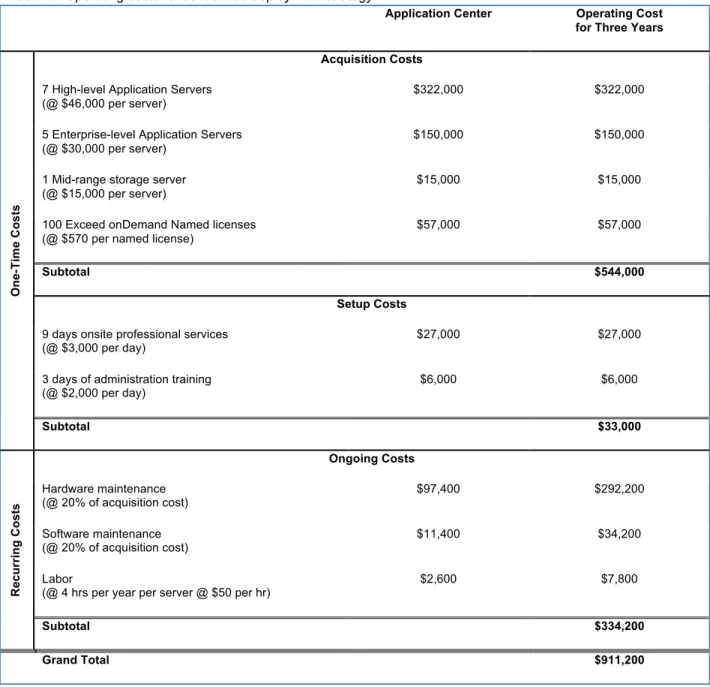
The following table is the summary of IT expenses after the transformation:
Table 2 - Operating costs for centralized deployment strategy
Application Center Operating Cost for Three Years
On e -Ti m e Co s ts Acquisition Costs 7 High-level Application Servers
(@ $46,000 per server)
$322,000 $322,000
5 Enterprise-level Application Servers (@ $30,000 per server)
$150,000 $150,000
1 Mid-range storage server (@ $15,000 per server)
$15,000 $15,000
100 Exceed onDemand Named licenses (@ $570 per named license)
$57,000 $57,000
Subtotal $544,000
Setup Costs 9 days onsite professional services
(@ $3,000 per day)
$27,000 $27,000
3 days of administration training (@ $2,000 per day)
$6,000 $6,000
Subtotal $33,000
Re c u rr in g Co s ts Ongoing Costs Hardware maintenance
(@ 20% of acquisition cost)
$97,400 $292,200
Software maintenance (@ 20% of acquisition cost)
$11,400 $34,200
Labor
(@ 4 hrs per year per server @ $50 per hr)
$2,600 $7,800
Subtotal $334,200