FILE: REVISION: DRAWN BY: PAGE OF TITLE V1 120V R2
15 120VV1
I
R215 120VV1I
R215Vr1 Vr2 start here R1 30 V1 120V V2 30V R2 15
I
Vr1 Vr2 start here 120V 120VI=2A I = −2A
voltage source with reference current direction as initially assumed
voltage source with current reference arrow placed for computing power dissipation
V I
model for computing power dissipated R1 30 V1 120V V2 30V R2 15 Veq
90 Req15
I
I
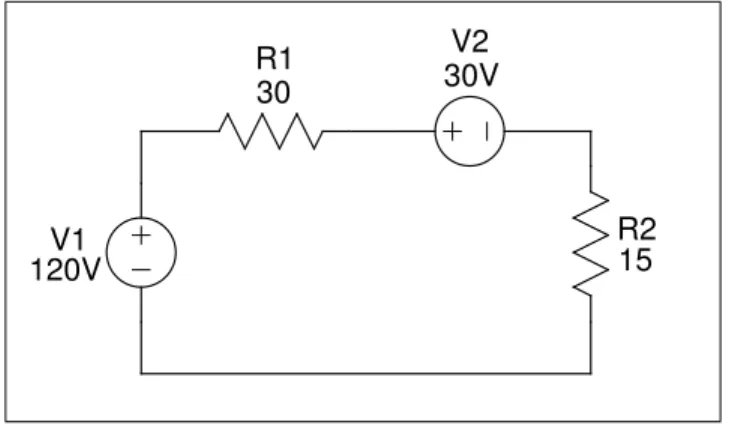
Figure 1: Single loop circuit.The first step in the analysis is toassume a reference direction for the unknown current. We do not know apriori what the direction is, nor does it matter. If our assumption is wrong, the current will simply have a minus sign associated with it. The circuit below is shown with an arbitrary direction for the current I.
TITLE R1 30 V1 120V V2 30V R2 15 R1 30 V1 120V V2 30V R2 15
I
R1 30 V1 120V V2 30V R2 15I
Vr1 Vr2 start here R1 30 V1 120V V2 30V R2 15I
Vr1 Vr2 start here 120V 120VI=2A I = −2A
voltage source with reference current direction as initially assumed
voltage source with current reference arrow placed for computing power dissipation
V I
model for computing power dissipated R1 30 V1 120V V2 30V R2 15 Veq
90 Req15
I
I
Figure 2: Single loop circuit with I direction.
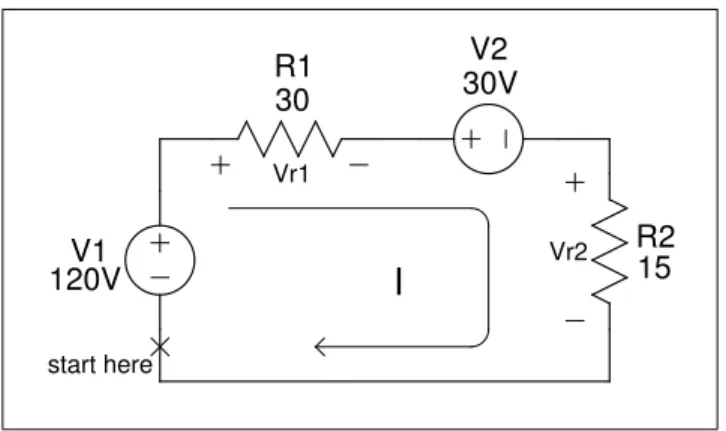
The second step in the analysis is toassign the voltage references(where needed) for each element in the circuit. We already know that the passive sign convention for resistors demands that the sense of the current and voltage be selected such that the current enters the more positive terminal.
The choice of direction in which we draw the current arrow isarbitrary,but once the direction is chosen, the polarity orientation across the resistors is thenfixed. The voltages across the voltage sources and their polarities are taken as given and cannot be altered as they are independent sources. Therefore, voltagesVr1andVr2in this loop must be assigned as shown in figure 4.
R1 30
V1 120V
V2 30V
R2 15
R1 30
V1 120V
V2 30V
R2 15
I
R1 30
V1 120V
V2 30V
R2 15
I
Vr1
Vr2
start here
R1 30
V1 120V
V2 30V
R2 15
I
Vr1
Vr2
start here
120V 120V
I=2A I = −2A
voltage source with reference current direction as initially assumed
voltage source with current reference arrow placed for computing power dissipation
V I
model for computing power dissipated
R1 30
V1 120V
V2 30V
R2 15
Veq
90 Req15
I
I
Figure 3: Single loop circuit, with V signs.
Next, we applyKirchhoffs voltage law to the single closed path. We may sum the voltages by traversing the circuit in either direction, but lets do so in the clockwise direction, beginning at the lower left corner, (where it says start here) and write down each voltage first encountered at its positive reference and write down the negative of every voltage encountered at its negative terminal. Thus we get,
−120 +Vr1+ 30 +Vr2 = 0.
This is a single equation with two unknowns. To solve this equation, we must find some way to express Vr1 and Vr2 in one variable. Since this is a series circuit and the same current flows through all elements, we may expressVr1 andVr2 in terms of the current I and the individual
resistances using Ohms law. So weapply the ohms law substitution step. We know that forR1andR2, Ohms law states that:
Vr1 =I×30, andVr2=I ×15.
If we substitute these expressions forVr1andVr2into the first equation, we get:
−120 + 30I+ 30 + 15I = 0. Solving for I, we obtain:
45I = 90, thusI = 2A.
Since the solution for current is a positive value, we know that the assumed direction for current is correct. If the answer had been -2A, we would know that the current would be actually flowing the opposite direction.
Before we proceed to compute the power for the components in this circuit, lets repeat the problem but reverse the assumed direction of current flow. Therefore we have the situation shown in figure ??.
FILE: REVISION: DRAWN BY:
PAGE OF
TITLE
R1 30
V1 120V
V2 30V
R2 15
I
Vr1
Vr2
start here
120V 120V
I=2A I = −2A
voltage source with reference current direction as initially assumed
voltage source with current reference arrow placed for computing power dissipation
V I
model for computing power dissipated
R1 30
V1 120V
V2 30V
R2 15
Veq
90 Req15
I
I
Figure 4: Single loop circuit, with V signs.We will now write the KVL equation by traversing the circuit in the clockwise direction as we did before. Again we write down each voltage first encountered at its positive reference and write down the negative of every voltage encountered at its negative terminal. Thus we get,
−120−Vr1+ 30−Vr2 = 0.
Applying the Ohms law substitution step we get:
−120−30I+ 30−15I = 0. Solving for I, we obtain:
−45I = 90, thusI = 2A.
Since the resulting current is negative, we know that the assumed direction for current is incorrect. However, our answer is correct considering the direction of the arrow.
To compute the power dissipation, we will assume that a positive current was obtained as in the first example. Knowing the equation for power dissipation;P =I2R, we can calculate the power dissipated by the resistors.
For the 30Ωresistor: P = 2×2×30 = 120Watts. For the 15Ωresistor: P = 2×2×15 = 60Watts. Resistors always dissipate positive power. They can never generate power.
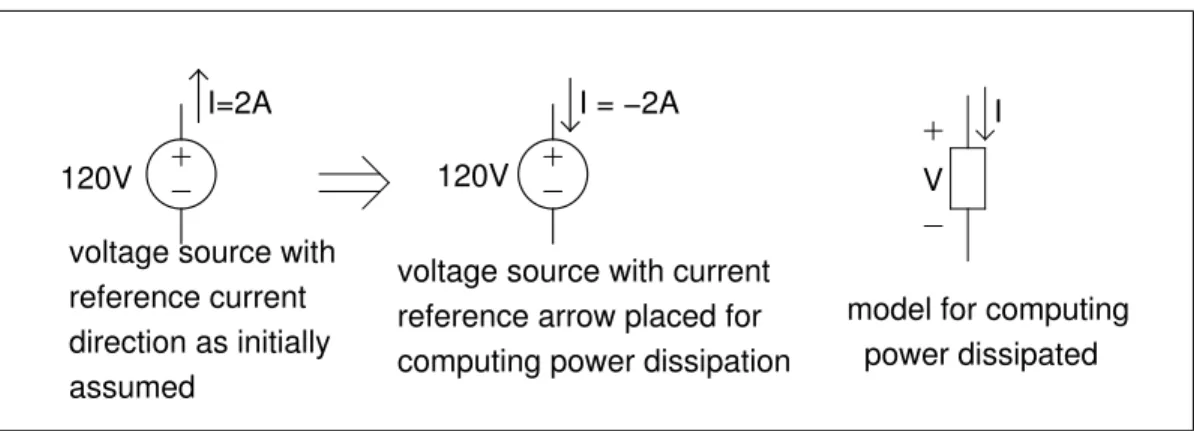
How much power is generated or consumed by the voltage sources? Remember to compute power dissipated, we must take each element and redefine the voltage reference sign and the current reference arrow so that the arrow points into the positive terminal of the component such that it looks like the model for computing power dissipated shown below.
In figure??we see the progression of taking the 120V source and transforming its current arrow so that the arrow points into the positive terminal just like the model for computing power.
FILE: REVISION: DRAWN BY:
PAGE OF
TITLE
R1 30
V1 120V
V2 30V
R2 15
R1 30
V1 120V
V2 30V
R2 15
I
R1 30
V1 120V
V2 30V
R2 15
I
Vr1
Vr2
start here
R1 30
V1 120V
V2 30V
R2 15
I
Vr1
Vr2
start here
120V 120V
I=2A I = −2A
voltage source with reference current direction as initially assumed
voltage source with current reference arrow placed for computing power dissipation
V I
model for computing power dissipated
R1 30
V1 120V
V2 30V
R2 15
Veq
90 Req15
I
I
Figure 5: Orient the voltage source to match the PSC model
Note that the current arrow for the 120V source is now drawn as the passive sign convention demands; it points into the positive terminal. The voltage references are identical to the model so they were not changed. Now we can compute the power dissipation directly as:
P120V =−2×120 =−240Watts.
The negative power dissipation indicates that the source is actually delivering power, not dissi-pating it. For the 30V source, again the current arrow is drawn as the passive sign convention demands. However in this case, the current into the source is in the same direction as the model dictates, thus:
P30V = 2×30 = 60Watts.
In this case, the 30 volt voltage source is dissipating power.
A useful check of your calculations may be accomplished by using the power check. This method relies on the fact of the conservation of energy. In other words, the power dissipated by all the elements must equal the power supplied by all the elements. In our example:
P120V +PR1+P30V +PR2 = 0
−240 + 120 + 60 + 60 = 0 0 = 0. Thus, our calculations are correct.
To summarize the KVL method:
1. Assign a reference direction for the unknown current 2. Assign voltage references to the elements