Received for publications February 15, 2019; Editorial Decision May 23, 2019. From the *Division of Gastroenterology, Hepatology and Nutrition, Department of Medicine, †Division of Psychology, Department of Psychiatry and Behavioral Science, and ‡Department of Biostatistics, Vanderbilt University Medical Center, Nashville, Tennessee, USA; §Division of Gastroenterology, Hepatology and Nutrition, Department of Medicine, and ¶Division of Pediatric Gastroenterology, Department of Pediatrics, University of North Carolina, Chapel Hill, North Carolina, USA
Supported by: This research was supported, in part, by awards from the National Center for Advancing Translational Science/National Institutes of Health (UL1TR000445), Crohn’s and Colitis Foundation of America, and the National Institutes of Health (P30 DK034967).
Disclaimer: The funding sources had no role in the design, analysis and interpre-tation of the data, review, or approval of the manuscript.
Conflicts of interest: None.
Author contributions: study concept and design: L.S.G.; acquisition of data: R.S.S., M.D.K.; drafting of the manuscript: L.S.G., J.C.S.; statistical analysis: J.C.S. All authors engaged in the critical revision of the manuscript for important intel-lectual content. L.S.G. and J.C.S. had full access to all of the data in the study and take responsibility for the integrity of the data and the accuracy of the data analysis. Guarantor of the article: Lawrence S. Gaines, PhD.
Address correspondence to: Lawrence S. Gaines, PhD, Inflammatory Bowel Disease Clinic, Division of Gastroenterology, Hepatology and Nutrition, Department of Medicine, Vanderbilt University Medical Center, Suite 2200, 1211 21st Avenue South, Nashville, TN 27212 ([email protected]).
Does Reverse Causality Underlie the Temporal Relationship
Between Depression and Crohn’s Disease?
Lawrence S. Gaines, PhD,
*
,†James C. Slaughter, DPH,
‡David A. Schwartz, MD,
*
Dawn B. Beaulieu, MD,
*
Sara N. Horst, MD, MPH,
*
Robin L. Dalal, MD,
*
Elizabeth A. Scoville, MD,
*
Robert S. Sandler, MD,
§and
Michael D. Kappelman, MD
¶Background: Studies suggest that there is a temporal relationship between depression and Crohn’s disease (CD) activity. However, these studies assumed a unidirectional relationship and did not examine the possibility of reverse causality and the risk of a spurious association due to the overlap of symptoms underlying the depression–CD relationship. We evaluated the existence of reverse causality reflected in a possible bidirec-tional relationship between patient-reported CD activity and an affective–cognitive dimension of depression.
Methods: We studied 3307 adult volunteers with a self-reported diagnosis of CD who completed a baseline survey that included demographics, CD activity, and an affective–cognitive index of depression. Crohn’s disease status and the affective–cognitive index of depression were also meas-ured 6 and 12 months after the baseline evaluation. We used structural equation models to evaluate whether the effect of depression on future CD activity is stronger than the effect of CD activity on future depression. We calculated the likelihood that each of these hypotheses is supported by the data and calculated the likelihood ratio to provide a relative measure of which hypothesis best accounts for the data.
Results: The results of the informative hypothesis testing showed the most support for the hypothesis stating that an affective–cognitive dimen-sion of depresdimen-sion is a stronger predictor of patient-reported CD activity than the converse.
Conclusions: The hypothesis that an affective–cognitive dimension of depression predicts patient-reported exacerbation of CD is 218 times more likely to account for the data than the converse.
Key Words: depression, patient-reported CD activity, temporal relationship
INTRODUCTION
The rates of depression among Crohn’s disease (CD) patients appear to be higher than in the general popula-tion.1 Depression is an important comorbid condition for
patients with CD, in part because it adversely affects quality of life,2 reduces adherence to disease management,3 and
pos-sibly contributes to intestinal inflammation.4 This suggests
that the recognition and treatment of comorbid depression may positively influence the clinical course of CD. However, more data are needed to fully evaluate whether depression is a consequence of suffering from a chronic debilitating bowel disease, whether depression influences the course of CD, or both.
Although there is evidence from clinic- and Internet-based longitudinal studies that depression is associated with worsening of CD,5, 6 these studies are limited because they were designed to
examine the relationship between depression and CD unidirec-tionally. However, it is also possible that worsening of CD may lead to depression, in addition to or instead of the effect of de-pression on CD, that is, reverse causality. This is a challenging area of research because both CD and depressive symptoms gen-erally have long induction periods, making it difficult to estab-lish the precise period “at risk.” Yet, there are clear implications for both pathophysiology and treatment. Indeed, if depression
applyparastyle "fig//caption/p[1]" parastyle "FigCapt"
is a stronger predictor of CD activity than the converse, then this would further support the need to screen and treat for depression early in the clinical course of CD. In addition, most prospective studies of depressive state and CD activity do not provide a ra-tionale for how exposure is conceptualized and operationalized and thus frequently use measures of depression with somatic symptoms, such as poor sleep or appetite, that could overlap with symptoms of CD and thus lead to a spurious relationship between depression and CD. Additionally, when the diagnostic category of depression is the desired measure of exposure, there is a greater chance of overlooking the specific depressive symptoms that may be responsible for the temporal relationship between a depressive state and the clinical course of CD. A recent study of possible bi-directional relationships between anxiety and depression and in-flammatory bowel disease measured depression with the Hospital Anxiety and Depression’s Depression subscale, which focuses on anhedonia, but it did not find evidence of bidirectionality be-tween anhedonia qua depression and CD activity inferred from evidence of prescription of steroid medication, physicians’ global assessment of flares, escalation of medical therapy, or hospitaliza-tion secondary to objectively confirmed IBD activity or intestinal resection.7 Another recent study, although not examining
depres-sion, reported a bidirectional relationship between self-reported stress, often an antecedent to depression, and patient-reported IBD symptoms, but no relationship between perceived stress and change in intestinal inflammation.8 The current study proposes to
evaluate whether reverse causality underlies the relationship be-tween patient-reported CD activity and depression in a previously published Internet-based study.6 Ascertainment of depression
was restricted to 1 dimension of depression—affective–cognitive symptoms—because we wanted to eliminate the possibility of a spurious relationship resulting from the overlap between somatic symptoms of depression and CD. We used data from a sample of subjects in the Crohn’s and Colitis Foundation’s IBD Partners Internet cohort study. Analyses were conducted on data covering a 12-month period, providing an extended period to capture change in affective–cognitive symptoms of depression and CD. The objective of this study was to test whether a published finding of a temporal relationship between an affective–cognitive dimen-sion of depresdimen-sion and patient-reported CD activity6 may have
been the result of reverse causality. We hypothesized that there is a temporal relationship between an affective–cognitive dimension of depression and subsequent patient-reported CD activity be-cause of the earlier finding.6 More specifically, the aim was to test
the hypothesis that the influence of an affective–cognitive dimen-sion of depresdimen-sion on patient-reported CD activity is stronger than the effect of CD activity on subsequent depression.
METHODS
Study Sample
IBD Partners, formerly known as CCFA Partners, is a longitudinal Internet-based cohort study sponsored by the
Crohn’s and Colitis Foundation that has been described in detail in previous publications.9 In brief, participants had
been invited to participate in the cohort through the Crohn’s and Colitis Foundation email roster, social media, and at ed-ucational and fundraising events. Inclusion criteria included age >18 years, a self- reported diagnosis of IBD (Crohn’s di-sease, ulcerative colitis, or indeterminate colitis), access to the Internet, and the ability to complete informed consent and surveys in English. There were no exclusion criteria. After en-rollment, participants completed surveys at baseline and at 6-month intervals to capture health behaviors, treatments, and patient-reported outcomes. For this study, we analyzed data on all participants with CD in the IBD Partners cohort who had completed a baseline and 2 or more follow-up surveys.
Measures
Depression was measured using the National Institutes of Health’s Patient-Reported Outcomes Measurement Information Systems (PROMIS) 4-item form on Depression.10
The PROMIS Depression questionnaire used in this study did not include items assessing somatic symptoms that overlap with symptoms of CD such as poor sleep, fatigue, and lack of appetite. The short form was composed of 4 Likert-type 5-point items measuring the frequency of negative mood (I felt depressed) and cognition, including negative beliefs about the self (I felt worthless, I felt helpless) and decreased life en-gagement/negativity toward the future (I felt hopeless), during the previous 7 days. All responses were summed to form a raw score ranging from 4 to 20, which was then converted to a standardized score (t-score). For all PROMIS measures, the t-score for the standardized population is 50 with an SD equal to 10. Thus, a t-score change from 55 to 65 represents a change from 0.5 SDs to 1.5 SDs above the standardized population mean. Disease activity was assessed by the short CD Activity Index (SCDAI),11 a patient-reported measure. Disease activity
was modeled as both a continuous SCDAI t-score and a binary outcome, with active disease being defined as a SCDAI t-score >150. The SCDAI was developed to provide a shortened and simplified CD Activity Index (CDAI) using patient self-report.
Covariates
The following variables were included in the regression models as potential confounders of the association between de-pression and CD activity: age, sex, race, baseline SCDAI, di-sease duration, use of biologic medication, body mass index, current smoking, level of educational attainment, and sleep quality.
Statistical Analysis
estimate the bivariate associations between depression and di-sease activity at each time point.
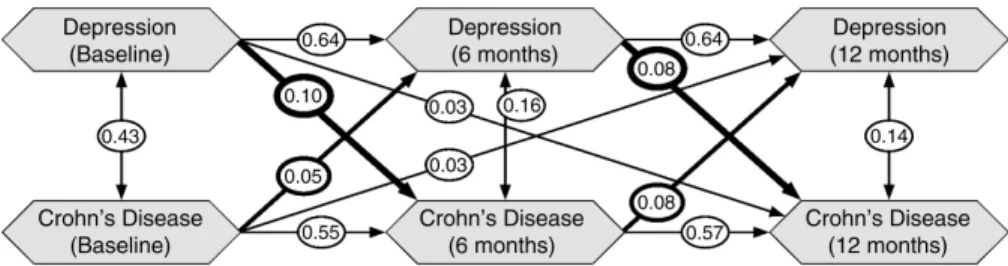
We conducted structural equation modeling using the lavaan package with R. We fit a 3-wave cross-lagged model (Fig. 1) with autoregression control paths and cross-lagged paths be-tween time periods. The measures of depression and disease activity were log-transformed, centered, and scaled to have var-iance of 1 so that all coefficient estimates correspond to a 1-SD increase on the log scale in depression or disease activity.
To phrase the research hypotheses in statistical notation, we represent the standardized regression estimates between de-pression (d) at wave i and the CD activity index (c) at wave j by β dicj. The composite hypothesis that the effect of depression on future CD activity is always stronger than the effect of CD ac-tivity on future depression is given by:
HA: β d2c3 > β c2d3 and β d1c3 > β c1d3 and β d1c2 > β c1d2,
whereas the hypothesis that the effect of CD activity on future depression is always stronger than the effect of depres-sion on future CD activity is given by:
HB: β d2c3 < β c2d3 and β d1c3 < β c1d3 and β d1c2 < β c1d2.
We calculated the likelihood that each of these hypotheses is supported by the data and calculated the likelihood ratio to provide a relative measure of which was more likely.
RESULTS
We analyzed data from a total of 3307 CD volunteers who continued to participate to at least the second follow-up assessment. Baseline demographics and clinical characteristics are shown in Table 1. At baseline, the median age was 43 years. The median age at IBD diagnosis was 25 years, and the median period from initial diagnosis was 11 years. The sample was pre-dominantly white females who were well educated, were taking immunosuppression therapy, and did not smoke. Pairwise correlations among depression and disease activity measures are shown in Table 2. We observed large correlations among depression measures at each of the 3 time points (r = 0.63 to 0.67) and among the disease activity measures at 3 time points (r = 0.55 to 0.61). There were medium correlations between de-pression and disease activity (r = 0.32 to 0.42), with somewhat higher correlations when measurements were obtained contem-poraneously. All correlations were statistically significant due to the large sample size (all P < 0.001).
We estimated that the path from depression to disease activity was, on average, stronger than the path from di-sease activity in a joint structural model. Table 3 shows the standardized parameter estimates with corresponding 95% confidence intervals from the proposed research model (Fig. 1). The strongest paths were between depression at T2 and depres-sion at T1 (β, 0.64; 95% confidence interval [CI], 0.62 to 0.67) and depression at T3 and depression at T2 (β, 0.64; 95% CI, 0.61 to 0.67). We also observed strong paths between disease activity at T2 and disease activity at T1 (β, 0.55; 95% CI, 0.52 to 0.58) and depression at T3 and depression at T2 (β, 0.57; 95%
CI, 0.54 to 0.60). For relationships between depression and di-sease activity, all paths 1 time period apart had estimated confi-dence intervals that did not contain 0. However, for association 2 time periods apart, there was no evidence that T1 depression was associated with T3 disease activity (β, 0.03; 95% CI, –0.01 to 0.06) and no evidence that T1 disease activity was associated with T3 depression (β, 0.02; 95% CI, –0.01 to 0.05) when ac-counting for associations 1 time period apart. Disease activity at time 1 was associated with depression at time 2 (β, 0.05; 95% CI, 0.03 to 0.08), and depression at time 1 was associated with disease activity at time 2 (β, 0.10; 95% CI, 0.07 to 0.13). Disease activity at time 2 was associated with depression at time 3 (β, 0.08; 95% CI, 0.05 to 0.11), and depression at time 2 was associated with disease activity at time 3 (β, 0.08; 95% CI, 0.05 to 0.12). That is, the estimated paths from depression to disease activity were larger than the paths from disease activity to de-pression, with overlap of the confidence intervals. Confidence intervals for paths measured 2 time periods apart (depression at T3 with disease activity at T1 and disease activity at T3 with depression at T1) each contained the null value of 0, indicating a lack of evidence of a significant path. Finally, we formally compared the hypothesis that the effect of depression on future CD activity is always stronger than the effect of CD activity
TABLE 1.
Patient Demographics at Baseline (n = 3307)
a b c
Age at baseline, y 30 43 56
Age at IBD diagnosis, y 19 25 36
Years since diagnosis 4 11 23
Sex, %
Male 28
Female 72
Race, %
White 95
Other 5
Height, in 63 66 69
Weight, lb 130 150 180
Current smoker, %
No 93
Yes 7
Education level, %
Less than high school 1
High school graduate 7
Some college 20
Graduated college 43
Graduate school 31
Any immunosupression drug, %
No 34
Yes 66
on future depression (Ha) vs the hypothesis that the effect of CD activity on future depression is always stronger than the effect of depression (Hb). We found that Ha was 218 times more likely than Hb, meaning that an affective–cognitive dimension of depression is a much stronger predictor of patient-reported disease activity over time than the converse.
DISCUSSION
Most of the earlier epidemiological studies of CD and comorbid depression5 suggest that there is a temporal
relation-ship between depression and CD activity. However, the results of earlier studies may be biased because of unexamined reverse causality, where CD might exert an influence on depression,
in addition to or instead of the effect of depression on CD. As the assumption of unidirectional causality may seem un-tenable in studying the association of depressive symptoms and exacerbation of CD,12, 13 we conducted a study that
simul-taneously analyzed the predictive role of depression on CD activity while also examining the role of CD activity on subse-quent depression. In effect, our study attempted to answer the chicken-or-egg causality question in regard to the relationship of patient-reported CD activity and an affective–cognitive di-mension of depression.
Our results support the hypothesis that affective–cog-nitive aspects of depression brought about increased patient-reported CD activity. We used a structural equation model
TABLE 2.
Correlations Among Depression and Disease Activity Measures at 3 Time Points
Variable Depression 1 SCDAI 1 Depression 2 SCDAI 2 Depression 3 SCDAI 3
Depression 1 1.00
SCDAI 1 0.42 1.00
Depression 2 0.66 0.32 1.00
SCDAI 2 0.34 0.60 0.41 1.00
Depression 3 0.63 0.32 0.67 0.36 1.00
SCDAI 3 0.32 0.55 0.33 0.01 0.41 1.00
SCDAI is the short form of the Crohns Disease Activity Index; Depression is the abbreviated short form of the PROMIS Depression scale.
TABLE 3.
Parameter Estimates With 95% Confidence Intervals for the 3 Time Points Model
lhs rhs est se z P Lower CI Upper CI
Depression 2 Depression 1 0.644 0.014 45.0 <0.001 0.6162 0.672
Depression 2 SCDAI 1 0.053 0.014 3.7 0.002 0.0251 0.081
Depression 3 Depression 2 0.639 0.014 45.8 <0.001 0.6114 0.666
Depression 3 SCDAI 2 0.079 0.016 4.9 <0.001 0.0475 0.111
Depression 3 SCDAI 1 0.026 0.015 1.7 0.09 –0.0043 0.056
SCDAI 2 Depression 1 0.103 0.015 6.7 <0.001 0.0729 0.133
SCDAI 2 SCDAI 1 0.554 0.015 36.2 <0.001 0.5237 0.584
SCDAI 3 Depression 2 0.084 0.019 4.5 <0.001 0.0474 0.121
SCDAI 3 SCDAI 2 0.570 0.015 38.0 <0.001 0.5407 0.599
SCDAI 3 Depression 1 0.029 0.018 1.6 0.11 –0.0064 0.063
SCDAI is the short form of the Crohn’ Disease Activity Scale; Depression is the abbreviated short form of the PROMIS Depression Scale.
framework to examine inequality-constrained hypotheses that depression is a stronger predictor of CD than the converse. The results indicate that 1 model, that a selected dimension of de-pression predicts exacerbation of CD, is 218 times more likely to account for the data than the converse.
These results are specific to a particular aspect of de-pression and may not be found in other studies using measures with depression-related somatic symptoms such as appetite, fatigue, and sleep. The finding of a unidirectional relationship between an affective–cognitive dimension of depression and patient-reported CD activity provides new insights into the mechanisms underlying the temporal relationship. Heightened depression, especially the cognitive characteristics of negativity to the self and the future examined in this study, may be a psy-chological condition that influences CD morbidity through intervening lifestyle behaviors and related epigenetic and im-munological processes. For example, the CD volunteers who reported the greatest negativity to the self and the future and sadness at baseline were also more likely to be smokers who were overweight and less educated.6 Smoking and body weight
are lifestyle characteristics that have relationships with epige-netic and immune system processes underlying inflammatory bowel disease.14, 15 These potential mediators may be associated
with other intermediary processes underlying dysfunction in the hypothalamic–pituitary–adrenal axis, which is theorized to account for the influence of depression on inflammatory bowel disease.16 A potentially destructive feedback loop may exist
whereby increased depression leads to poor self-care/high levels of illness behavior and then to poor immune system function, which in turn triggers flare-ups of CD.
The results of this study confirm the results of earlier pro-spective studies indicating some deterioration of CD reflecting the impact of depressive state. However, this study was the first to test for possible bias from reverse causality in a published study of patient-reported CD activity and a single dimension of depressive symptoms instead of categorical depression per se. Our more detailed approach to understanding depression in examining the CD–depression relationship allows us to begin to consider what characteristics of depression affect patient-reported CD or, more proximally, the underlying lifestyle mediators of the depression–CD relationship. In this study, the measure of exposure represents what we believe to be the de-fining feature of depression, a loss of self-esteem and self-regard.
This study strongly supports the need for gastroenterologists to attend to their CD patients’ depression. Heightened depression, especially the cognitive characteristics of negativity to the self and the future, may be a psychological condition that influences CD morbidity through physiological processes and indirectly via behavioral pathways.6 The health
risk behaviors and psychobiological changes associated with depression-related lifestyles increase the risk for chronic med-ical disorders.17 Now with greater confidence in the temporal
relationship between an easily measurable aspect of depression
and subsequent patient-reported CD exacerbation, the next step is to study what proximate factors such as lifestyle variables mediate the relationship between these 2 comorbid conditions. Maximizing the clinical usefulness of an established temporal relationship between depression and CD will require identifi-cation of the proximate lifestyle processes intervening between depression as studied here and patient-reported CD activity level so that interventions can be focused and more effective at reducing flares.
The major strengths of this study are the large sample size and use of a patient-reported outcome measure that has been used with great usefulness by clinical researchers. The short CDAI is a valid, reliable, and responsive tool for the measurement of patient-reported CD activity. However, future observational studies of CD would benefit from the use of a multimethod approach to outcome measurement that would include objective measurement of inflammation in addition to the patient-reported level of disease activity, as has recently been used in the longitudinal study of stress and IBD.8 Also,
the likelihood is high that patient-reported diagnosis of CD is valid, because prior CCFA Partners research found the match between patient and physician reports to be 97% for CD.18
Appropriate methods for measuring exposure were achieved. In particular, the study provided a rationale for the selection of the exposure measure that represents what we believe to be the defining feature of depression and that allowed us to eliminate the possibility of a spurious relationship as a result of overlap in neurovegetative symptoms of depression and CD such as appetite and sleep. At this early stage in the history of under-standing the depression–CD relationship, the use of a conven-ience sample, although possibly restricting the generalizability of the finding of a unidirectional relationship, provides us with the opportunity to understand the depression–CD relation-ship in a sample that may be rather typical as Internet-based studies become more common. Certainly the greater frequency of women using medical therapy in this study is consistent with data from epidemiological studies indicating that CD is more frequent in women.19 As to controlling bias due to attrition and
In conclusion, this study is an early answer to the ques-tion of whether there is a temporal relaques-tionship between de-pression and patient-reported CD activity. Our findings suggest that CD patients’ negative self-regard is clinically important to understanding change in patient reports of their CD ac-tivity. Gastroenterologists should screen for affective–cognitive symptoms of depression in CD patients. Evaluation and treat-ment of depression may improve the course of CD.
ACKNOWLEDGMENTS
The authors thank Sara Ioannou and Rachel Muscatello for their assistance in the preparation and submission of the paper.
REFERENCES
1. Walker JR, Ediger JP, Graff LA, et al. The Manitoba IBD Cohort Study: a population-based study of the prevalence of lifetime and 12-month anxiety and mood disorders. Am J Gastroenterol. 2008;103:1989–1997.
2. Zhang CK, Hewett J, Hemming J, et al. The influence of depression on quality of life in patients with inflammatory bowel disease. Inflamm Bowel Dis. 2013;19:1732–1739.
3. Calloway A, Dalal R, Beaulieu DB, et al. Depressive symptoms predict anti-tumor necrosis factor therapy noncompliance in patients with inflammatory bowel disease. Dig Dis Sci. 2017;62:3563–3567.
4. Persoons P, Vermeire S, Demyttenaere K, et al. The impact of major depressive disorder on the short- and long-term outcome of Crohn’s disease treatment with infliximab. Aliment Pharmacol Ther. 2005;22:101–110.
5. Alexakis C, Kumar S, Saxena S, et al. Systematic review with meta-analysis: the impact of a depressive state on disease course in adult inflammatory bowel di-sease. Aliment Pharmacol Ther. 2017;46:225–235.
6. Gaines LS, Slaughter JC, Horst SN, et al. Association between affective–cognitive symptoms of depression and exacerbation of Crohn’s disease. Am J Gastroenterol. 2016;111:864–870.
7. Gracie DJ, Guthrie EA, Hamlin PJ, et al. Bi-directionality of brain-gut interactions in patients with inflammatory bowel disease. Gastroenterology. 2018;154:1635–1646.e3.
8. Sexton KA, Walker JR, Graff LA, et al. Evidence of bidirectional associations between perceived stress and symptom activity: a prospective longitudinal investi-gation in inflammatory bowel disease. Inflamm Bowel Dis. 2017;23:473–483. 9. Long MD, Kappelman MD, Martin CF, et al. Development of an Internet-based
cohort of patients with inflammatory bowel diseases (CCFA Partners): method-ology and initial results. Inflamm Bowel Dis. 2012;18:2099–2106.
10. Pilkonis PA, Choi SW, Reise SP, et al; PROMIS Cooperative Group. Item banks for measuring emotional distress from the Patient-Reported Outcomes Measurement Information System (PROMIS®): depression, anxiety, and anger. Assessment. 2011;18:263–283.
11. Thia K, Faubion WA Jr, Loftus EV Jr, et al. Short CDAI: development and val-idation of a shortened and simplified Crohn’s disease activity index. Inflamm Bowel Dis. 2011;17:105–111.
12. Keefer L, Kane SV. Considering the bidirectional pathways between depression and IBD: recommendations for comprehensive IBD care. Gastroenterol Hepatol (N Y). 2017;13:164–169.
13. Bernstein CN. Psychological stress and depression: risk factors for IBD? Dig Dis. 2016;34:58–63.
14. Stasi C, Orlandelli E. Role of the brain-gut axis in the pathophysiology of Crohn’s disease. Dig Dis. 2008;26:156–166.
15. Katon WJ. Epidemiology and treatment of depression in patients with chronic medical illness. Dialogues Clin Neurosci. 2011;13:7–23.
16. Yadav P, Ellinghaus D, Rémy G, et al; International IBD Genetics Consortium. Genetic factors interact with tobacco smoke to modify risk for inflammatory bowel disease in humans and mice. Gastroenterology. 2017;153:550–565. 17. Randell RL, Long MD, Cook SF, et al. Validation of an Internet-based
co-hort of inflammatory bowel disease (CCFA Partners). Inflamm Bowel Dis. 2014;20:541–544.
18. Hovde Ø, Moum BA. Epidemiology and clinical course of Crohn’s disease: results from observational studies. World J Gastroenterol. 2012;18:1723–1731. 19. Harper JW, Zisman TL. Interaction of obesity and inflammatory bowel disease.