Scholarly Comments on Academic Economics
Volume 8, Issue 2, May 2011COMMENTS
CHARACTER ISSUES
WATCHPAD
Adam Smith and Liberal Economics: Reading the Minimum Wage Debate of 1795-96
Christopher Martin 110-125
Economics Professors’ Favorite Economic Thinkers, Journals, and Blogs (along with Party and Policy Views)
William L. Davis, Bob G. Figgins, David Hedengren, and Daniel B. Klein 126-146
Richard T. Ely: The Confederate Flag of the AEA?
Clifford F. Thies and Ryan Daza 147-156
Economic Enlightenment Revisited: New Results Again Find Little Relationship Between Education and Economic Enlightenment but Vitiate Prior Evidence of the Left Being Worse
Daniel B. Klein and Zeljka Buturovic 157-173
Remarks from 1809 by Dupont de Nemours on Adam Smith
Pierre-Samuel Dupont de Nemours, translated by Frederic Sautet 174-184
An Award for Calling the Crash
Adam Smith and Liberal
Economics: Reading the Minimum
Wage Debate of 1795-96
Christopher Martin
1LINKTO ABSTRACT
Mention Adam Smith to someone on the street and she might envision the inspirer of the Adam Smith necktie, an apologist for big business, and an icon of conservatives. In scholarly circles, however, a rival interpretation of Smith has gained ground in recent decades. This Smith is friendlier to the poor than the Smith imagined by our woman in the street, and also less unfriendly to government intervention. Leading exponents of this new view include the modern scholars Samuel Fleischacker and Emma Rothschild, who suggest that Smith’s vision of society could be compatible with policies and attitudes in deep tension with laissez-faire. Fleischacker, for example, advocates “education, health care, unemployment protection, etc. for everyone,” severe financial penalties for factory closings, mandatory stakeholder democracy within corporations, and strong antitrust restrictions targeted at “labor monopsonies” (Fleischacker 2004, 208, 276-277). Rothschild argues that progressive taxation and “intervention in markets for labor, land rental, and public works” are consonant with Smith’s mindset (Rothschild 2001, 82-83) and strongly implies that minimum wage legislation is so as well (Rothschild 1992, 92-93).
A close look at Rothschild’s discussion of Adam Smith and minimum wages serves as a kind of case study of the power and danger of the “left Smithian” perspective. The historical debate over a minimum wage proposal in 1790s Britain plays a central role in her remarkable essay “Adam Smith and Conservative Eco-Econ Journal Watch Volume 8, Number 2 May 2011, 110-125
nomics” and is discussed by other contemporary authors as well (Lux 1990, 31-32; Fleischacker 2004, 264; McLean 2006, 90-91). Rothschild’s overall argument is that conservatives hijacked the true legacy of Adam Smith and transformed him into a two-dimensional “hero of commerce” whose works conveyed one and only one lesson: that “all trade should be free.” The real Smith, she contends, was warmly sympathetic to the poor, favored political as well as economic liberty, and tolerated “government interference, especially when the object is to reduce poverty” (Rothschild 1992, 93). The two rival interpretations of Smith clashed when the British parliament discussed the correct response to the grain crisis of 1795-96. In the winter of 1795, in response to abnormally high food prices, a Whig reformer named Samuel Whitbread proposed a bill to establish what Rothschild describes as a minimum wage for agricultural workers. The idea’s defeat at the hands of the then-premier, William Pitt, marks in her view the triumph of the “conservative” interpretation of Smith—namely, a Smith rigidly bound by “general principles” —over the left interpretation represented by Whitbread—namely, a Smith warmly compassionate toward the poor and quite open to contravening free-market principles on their behalf. Although Rothschild acknowledges, fairly, that “there is something of Smith in both sides of the parliamentary debate,” she clearly believes that Whitbread “is in many respects closer to the ‘real’ Smith, or to the realWealth of Nations” (Rothschild 1992, 86).
Rothschild’s overall historical argument, it should be said at this point, is intriguing. Adam Smith, during his lifetime, was friendly to the radical ideas about human equality then associated with French intellectuals. He died, however, before the French Revolution entered its more sanguinary phase. Smith was then initially (and posthumously) “claimed” by the pro-French side of the Revolution Controversy—a side which included Thomas Paine and Mary Wollstonecraft. However, once the French Revolution began to spin out of control, a fearful reaction seized Great Britain. Men were actually tried and punished in Scotland for expressing opinions, such as opposition to jingoism and excessive public debt, which were very close to Smith’s own opinions. Out of self-preservation, Smith’s intellectual heir—Dugald Stewart—minimized the political side of Smith’s view of liberty and highlighted only a truncated message of economic freedom that would not be threatening to the authorities. This maneuver laid the groundwork, according to Rothschild, for “left” and “right” streams of Smithian interpretation in the nineteenth and twentieth century; the one associated with the common man, political liberty, and equality and the other with the political status quo, employers, and laissez faire (Rothschild 1992, 78-82).
poor is a key element of orthodox economics, to claim that advocating such a policy accurately channels Adam Smith requires at least some acknowledgement of the incongruity. Rothschild could, for instance, have argued that a “Smithian” analysis of such a policy would differ from the later neoclassical one. She could then have argued that this Smithian analysis was simply wrong; or, alternatively, that Smith or his interpreters grasped on an inarticulate level the case for minimum wage legislation advanced in the late twentieth century. It would not be the only time Smith correctly differed from later orthodoxy. Special theoretical situations where a minimum wage could—conceivably—help workers have long been acknowledged (Stigler 1946). And of course the empirical controversy sparked by Card and Krueger’s 1994 paper still sways back and forth, with first one side then another claiming victory (Neumark and Wascher 2008 defend the view that the regulations are counterproductive). Rothschild however makes no attempt to address the incongruity at all. She must be aware of the view that minimum-wage laws give rise to employee-adverse alterations in job offers and in non-wage job attributes. This omission would be less of a problem if her article did not favor Whitbread (as characterized in the article) and the associated interpretation of Adam Smith. She calls for “modern economic inquiry” to “move…beyond the 1790s, to something closer to Smith’s own conception” and implies that this conception could entail considerable government intervention, of which the minimum wage is only one example. In this view of Smith, a presumption in favor of free markets must often be balanced with concern for the poor (Rothschild 1992, 86, 92, 94).
Pitt Versus Whitbread Reread
Starting around May of 1795, grain prices in Britain began to climb signif-icantly and stayed between 66 and 100% higher than usual until October of 1796 (Stern 1964, 169). The rural poor were seriously affected by the increase in living costs. To assist them, the MP Samuel Whitbread introduced legislation, in December of 1795, that justices of the peace (that is, county-level officials) should have the ability to fix minimum wages for “labourers in husbandry” (Parliamentary History[PH], XXXII, 700-705). After a Parliamentary recess, discussion of the bill resumed in February 1796 with another speech from Whitbread. In Rothschild’s characterization, Whitbread “…was strongly influenced by Smith…[and] followed theWealth of Nations[WN] closely in his parliamentary presentation.” She bolsters Whitbread’s Smithian credentials with several passages from the WN in which Smith’s sympathies lay with the laborers over the “masters”, and seemingly smiled on “regulation[s]…in favour of the workmen” (Rothschild 1992, 84).
William Pitt, at that time both the prime minister and the Chancellor of the Exchequer, answered Whitbread with a long speech. For Rothschild, Pitt’s interpretation of political economy was “very different” from Whitbread’s, relying on the “unassisted operation of principles.” His alternative solution, a reform of the poor laws to allow workers to circulate freely throughout the country, was attacked by Whitbread and his allies as too slow given the urgency of the crisis; and Rothschild implies that Smith wouldn’t have approved of his rigid adherence to “general principles” and “systematical” policies (Rothschild 1992, 85).
which first compelled every poor man to dependence, and then reduced him to servitude?” (PH, XXXII, 702).
However, Whitbread’s proposed policy bore little resemblance to the uniform minimum wages set by modern governments and adjusted infrequently by statute. His proposal was, instead, linked to an existing 16th-century act that allowed justices of the peace to fix maximum wages for agricultural labor in their county at their quarterly administrative sessions. He did not “[commend] the principle of these statutes …[which] operated as a clog to industry, by permitting justices to fix the maximum of labour” and indeed they gave the magistrates power to “oppress the labourer” (PH, XXXII, 704-705). However, given that such statutes existed, at least the justices of the
peace could be given power to fix a minimum wage rate as well and relieve the immediate suffering of laborers. Whitbread’s idea was therefore much more flexible than modern minimum wages in both duration (quarterly adjustments) and geographic extent (counties). More importantly, it was presented in the context of an existing power by the same officials to set maximum wages. Rothschild’s essay does note Whitbread’s low opinion of this law in passing (1992, 84) but not his express hope that, even if his full proposal is rejected, Parliament should at least repeal the existing act (PH, XXXII, 701). Even if they actually were “Smithian,” then, Whitbread’s wage proposals in context seem much lessdirigistethan modern laws.
Limited English labor mobility at the time suggests another way in which Whitbread’s proposal seems less interventionist. Charles Fox, Whitbread’s ally and party leader, complained that “a griping and avaricious employer…might be disposed to take advantage of their [workers’] necessities, and undervalue the rate of their service” (PH, XXXII, 701-702). Although he would not have thought in such terms, what Fox really describes is market power on the part of the employer. In this situation, a minimum wage has at least a chance of theoretical justification (Stigler 1946). Such a response seems much less unreasonable if the market power results from workers being tied to a parish and unable to move in search of better wages and conditions—the possibility explicitly discussed by Smith with respect to the Law of Settlements (WN I.x.c, 152-157).
“prevented the workman from going to that market where he could dispose of his industry to the greatest advantage, and the capitalist, from employing the person who was qualified to procure him the best return for his advances.” These effects of the law of settlements were themselves a warning against Whitbread’s wage-fixing proposal; Pitt notes that “such were the institutions thatmisguidedbenevolence had introduced, and, with such warnings to deter, it would be wise to distrust a similar mode of conduct” (PH, XXXII, 707-708; emphasis added).
Rothschild does acknowledge Pitt’s reform proposals in passing, but doesn’t remind the reader what the law of settlements actually was. Out of this context, Pitt’s proposed reform sounds like technocratic tinkering—a cold “defence of the ‘unassisted operation of principles’” more important to him than the immediate suffering of the poor, whose plight “was [not] strong enough for the exception [to the general rule of non-interference].” Nor does Rothschild mention the strongest part of Pitt’s case—his question “whether the means proposed [i.e., a minimum wage] were suited to the object intended” (PH, XXXII, 706). To all appearances, Pitt was sincere in his belief that the minimum wage proposal would have unin-tended negative consequences. His speech on February 12, 1796 was more than three times as long as Whitbread’s, much longer and more carefully composed than it needed to be if dismissing the concern was his only goal. Pitt openly acknowledged that a problem existed, and expressed his goal to “find out the causes of the evil, and…remov[e] the causes…” by a “remedy…more general in its object, less exceptionable in its example, and less dangerous in its application.” (PH, XXXII, 707).
Pitt’s proposed reforms were actually quite radical, fracturing any portrait of him as heartless or unimaginative. He proposed to alter the Poor Law so that a workman would not be forced to move to his parish of birth just because he applied for relief—a major benefit if unemployment was only temporary or the worker’s home parish had little demand for labor (PH, XXXII, 707). He clearly was not opposed to emergency relief in principle; he wanted the law to “make relief in cases where there are a number of children, a matter of right and an honour, instead of a ground for opprobrium and contempt … [while at the same time] engraft upon [the law] resolutions to
from becoming a burthen upon the public, and, if necessary, be enabled to subsist upon a fund which their own industry contributed to raise.” He opposed a requirement that the poor have no assets before receiving aid, and spoke in favor of what we would call trade schools. With the exception of his advocacy of “the industry of children” his proposals would not be far out of place in a modern democracy. Orthodox economics would agree that his policies would “tend … to remove every complaint to which the present partial remedy [i.e., Whitbread’s legislation] could be applied” (PH, XXXII, 710-711). Although it is difficult to know if a more flexible labor market on its own would have raised real wages enough to prevent hunger, Pitt’s direct relief proposals would seem a sufficient backstop against that contingency. Whitbread’s minimum wage idea, by contrast, was not nearly as comprehensive and much more hazardous.
The glaring flaw in Whitbread’s idea, from the perspective of modern labor economics, was pointed out even by a backbench participant in the debate. The MP, Buxton, argued that
… the bill did not appear likely to be of much service, for if the price of labour were to be fixed by the justices of the peace, he feared many industrious people would be thrown out of employ…those who by sickness or old age were rendered incapable of doing so much as a common labourer, and who would consequently be rejected for persons of more strength and activity. (PH, XXXII, 712)
Ultimately, even Whitbread partly recognized the force of this reasoning. He con-gratulated Pitt on his “able and eloquent speech” and strikingly acknowledged that “If the poor laws were actually such, as the right hon. gentleman has stated they ought to be, it would not have been necessary for me to have brought forward any proposition.” In other words, Whitbread himself conceded that Pitt’s measures were the correct long-term policy, although he still thought his bill useful as a form of immediate relief. Fox, too, acknowledged the superiority of Pitt’s long-term analysis: “If what [Whitbread] had brought forward should induce the House to go into a full examination of the subject [of the Poor Laws]…he would not only have accomplished his own benevolent intentions, but would have done a much greater service to the country, than even if the bill which he had now brought forward were adopted” (PH, XXXII, 713-715). It is difficult to argue that Whitbread was the true heir of Smith in this debate, when both he and his party leader paid such tributes to their opponent.
“What an extraordinary man Pitt is—he makes me understand my own ideas better than before” (Pellew 1847, 151).
Smith’s Views on Wages
What were Smith’s own views on wages and the well-being of the poor? Rothschild appeals to quotes from the Wealth of Nations and Smith’s lectures on jurisprudence to suggest that the real Smith was closer to Whitbread’s minimum wage stance than to Pitt’s defense of general principles (Rothschild 1992, 86). However, as many commentators on similar left-Smithian maneuvers have already pointed out (Den Uyl 2005; Muller 2006; C. Smith 2007; Otteson 2011, chs. 6,9), the conflict between “principles” and compassion that Rothschild tries to establish is spurious, in the main. A better explanation is that Smith believed that his principles, or, better put, the operation of the market system of natural liberty,
weregood for the poor. In this framework, it seems likely that Smith (had he lived) would have had a just regard for the workers and simultaneously resisted demands for a minimum wage. A closer look at the quotes from Smith that Rothschild employs supports this interpretation.
The first “proof text,” to speak loosely, comes from Book One of theWealth of Nations. Here Rothschild cites Smith’s observation that “[w]hen the regulation, therefore, [of wages or working conditions] is in favor of the workmen, it is always just and equitable; but it is sometimes otherwise when in favor of the masters” (WN, I.x.c.61, 157-158). Rothschild seems to take this as a forward-looking benediction on any regulations in favor of workmen, but the context makes it clear that Smith is mainly assessing political experience. The passage opens with a discussion of themaximumwage laws, and then observes that “[w]henever the legislature attempts to regulate the differences between masters and their work-men, its counsellors are always the masters” (WN, I.x.c.61, 157). This sentence was the reference of the word “therefore” in the passage cited by Rothschild (“When the regulation, therefore”) although she actually omits it in an ellipsis. As George Stigler points out, the paragraph is puzzling—why would the legislature, dominated by the interests of the employers, ever pass a just and equitable law in favor of the workers (Stigler 1971, 139-140)? The most reasonable answer seems to be that the best workmen could hope for was “merely” justice and equity, since they would never get actively favorable treatment and in fact often suffered from active
Furthermore, it is possible that in practice Smith’s proposal would not actually restrict employment contracts (for if the worker is agreeable to receiving payment in-kind, what bite would the law have?) but rather would empower workers to appeal to law to receive cash payments as agreed (Clark 2010, 2011). Nothing in the passage suggests that Smith wants active government interference (in a modern social democratic sense) on behalf of the workers; we infer that he would simply like to see them treated as legal equals to employers, with respect to “combi-nations” for instance.
Before passing on, it is worth noting that in the paragraph immediately preceding the first “proof text” Smith had approvingly quoted a passage opposed to wage regulations. “[I]t seems time to lay aside all endeavors to bring under strict regulations, what in its own nature seems incapable of minute limitation” (WN, I.x.c.60, 157). And elsewhere Smith says that “experience seems to show that law can never regulate [wages] properly, though it has often pretended to do so” (WN, I.viii.34, 95). Likewise on the assize (price control) of bread he comments that “[w]here there is an exclusive corporation [monopoly], it may perhaps be proper to regulate the price of the first necessity of life. But where there is none, the competition will regulate it much better than any assize” (WN, I.x.c.62, 158). Though these comments do not refer to minimum wages specifically, there seems to be no reason Smith would have changed his analysis when thinking about a price floor.
Rothschild next appeals to a famous passage from Smith’s “Wages of Labour” chapter:
No society can surely be flourishing and happy, of which the far greater part of the members are poor and miserable. It is but equity, besides, that they who feed, cloath and lodge the whole body of the people, should have such a share of the produce of their own labor as to be themselves tolerably well fed, cloathed and lodged. (WN, I.viii..36, 96)
the labouring poor will not now be contented with the same food, cloathing and lodging which satisfied them in former times…” (WN, I.viii.c.35, 96). Just as in the earlier passage about “regulations” Smith is concerned to put the poor on a footing of equal dignity with the rest of society, able to enjoy what they have rightfully earned.
The final passage Rothschild cites in the immediate context of the wage debate is Smith’s claim that wages are “regulated” by “common humanity” (Rothschild 1992, 85). It is not easy to unpack what Smith means here, but whatever is doing the regulating certainly does not seem to be government. The full passage is
…the wages of labour seem, in the present times, to be evidently more than what is precisely necessary to enable the labourer to bring up a family … [t]here are many plain symptoms that the wages of labour are no-where in this country regulated by this lowest rate which is consistent with common humanity. (WN, I.viii.28, 91)
Smith’s phrasing here—and particularly the words “this lowest rate”—strongly suggest that “common humanity” means only subsistence wages. This conclusion is consistent with Smith’s discussion of wages in China, which he thought was not experiencing economic growth (WN, I.viii.24, 89). From his description of the extreme poverty of the Chinese it is clear that the forces that Smith thought “regulated” wages were population growth and famine. In Smith’s view, increased population growth would tend to drive wages towards subsistence. This, to him, was just a fact about the world. There is little ground for reading any moral or political decision into the phrase “common humanity.”
The only way that workers could become prosperous was if wages raced ahead faster than increasing population. The mechanism by which this could happen obviously matters for this discussion: it is another clear test of the conflict, and of the concord, between Rothschild’s twin themes of “general principles” and concern for the poor. Wages rise, Smith thought, with increases in the demand for labor:
Rising “demand for labour” therefore promotes higher wages, without any need for outside intervention. And the demand for labor itself comes from “the increase of the revenue and stock of every country,and cannot possibly increase without it” (WN, I.viii.21, 86-87, emphasis added). When a landlord or rentier achieves a surplus over immediate maintenance, he hires a servant; when a workman accumulates more stock than he needs personally, he hires a journeyman. Smith clearly thinks that this beneficial process proceeds best when not meddled with by the government. He writes that “the general industry of the society never can exceed what the capital of the society can employ … no regulation of commercecan increase the quantity of industry in any society beyond what its capital can maintain” (WN, IV.ii.3, 453, emphasis added), and he generally trusts individuals to be good stewards of their own business decisions.2He argues “…the study of his own advantage naturally, or
rather necessarily leads [the holder of capital] to prefer that employment which is most advantageous to society” (WN, IV.ii.4, 454) and explicitly rejects government meddling: “…every individual, it is evident, can, in his local situation, judge much better than any statesman or lawgiver can do for him” (WN, IV.ii.10, 456). Smith explicitly views the accumulation of capital as beneficial to the less well off; when someone saves, he “not only affords maintenance to an additional number of productive hands, for that or the ensuing year, but, like the founder of a publick workhouse, he establishes as it were a perpetual fund for the maintenance of an equal number in all times to come” (WN, II.iii.19, 338). Finally, Smith notes that only profit can give owners the incentive to invest their stock in this way (WN, I.viii.7-8, 82-83). Although he was suspicious toward the political power of merchants and the rich, in the economy of an enlightened and virtuous society Smith saw a tolerable harmony of interests between those who live by wages and the owners of inanimate capital.
A Reunified Smithian Point of View
Should anyone besides historians really worry about what Adam Smith thought about such-and-such an issue? No one would consult Copernicus on string theory; why parse Smith on minimum wages? Kenneth Boulding (1971) observed that economics is not one of the disciplines—such as theology or literature—in
which ancient texts remain completely relevant to the present conversation. Neither, though, is economics like physics or biology in which only the most up to date contributions matter. The presence of interpretation and judgment in eco-nomics means that Smith, and other canonical authors, can still inspire broad
directions for modern scholars even though we do not consult them any longer for up-to-date technique. With this outlook, whether Smith would have opposed minimum wages or not does not, of course, close the modern debate. But it does outline a point of view that later scholars can enter into and try to refresh with modern tools.
With respect to a crisis of subsistence, then,—which is what the 1795-96 debate was really about—the Smithian point of view might well contain the following elements. First, do no harm. Do not impose a counterproductive policy, such as a minimum wage. Next, as Pitt argued with respect to the law of settle-ments, remove any existing restrictions on natural liberty that are making the situation worse. Finally, if the above measures are either infeasible or insufficient to relieve present suffering, consider well-designed private or public relief as Pitt did in his reform proposals. This policy solution is inevitably somewhat speculative, since Smith never confronted the exact circumstances of 1795-96, but the first and second elements in particular are clearly compatible with his writings. Discussing the effects of sudden sectoral disruptions in the labor market, for example (such as came from military demobilization, or might come from the restoration of free trade) Smith’s prescription was to reform the law of settlements and break down the restrictive apprenticeship and corporation laws (WN IV.ii.42, 470). Here and elsewhere, with only slight exception,3 he opposed interferences with workers’
natural liberty (the freedom to move and contract wherever they chose). His stance on tax-financed relief is less clear; although he never explicitly advocates it, he never explicitly opposes it either.4
How would this ostensibly Smithian approach have fared in the crisis of 1795-96? Frost and floods led to a poor 1795 harvest, and war with France of course raged in Continental Europe. Whitbread’s proposal, a violation of the “first do no harm” principle, was indeed voted down; but other forms of government interference may have worsened or even caused the crisis. The British government
it points to a basic danger: Combing Smith’s texts for support for intervention can distract from his simple, obvious, yet extremely important maxims and presumptions about not tampering with free markets.
To sum up, we have seen how two sets of considerations—further details from the Parliamentary debate between Pitt and Whitbread, and a close reading of Smith’s own views on wages—serve to complicate Rothschild’s implication that a “warm” Smithian tradition favored the poor, and a degree of government intervention, while a “cold” tradition adhered to free-market principles at the poor’s expense. It may well be true, as Rothschild argues, that the French Revolution made it safer to advocate economic rather than political freedom in the Britain of the 1790s—and that this historical circumstance helped to associate free-market economics with political conservatism. But there is a wide gap between this claim and the implication that Pitt’s defense of market principles was less true to Smith—and less compassionate towards the poor—than Samuel Whitbread’s ideas. Smith believed that the market system of natural liberty was good for everyone, rich and poor alike. He opposed government intervention in the price system, not merely because principles are important, but also because he did not think that intervention would work. Pitt’s impulse to remove the restrictions on natural liberty harming the workers was deeply Smithian, as was his fear of causing harm with a well-intentioned but ultimately destructive policy. His opponent Whitbread, of course, was no villain, and the two men ended their debate in tolerable agreement and cordiality. Rothschild’s narrative misses this rough concord between the two British parliamentarians just as it misses the possibility of concord between concern for the poor and concern for free-market principles. Smith himself would not have split his thought in the way expounded by Rothschild. He held that free-market principles, the principles of natural liberty, were presumptively better for the poor than any contravention of those principles. To conclude by paraphrasing Rothschild’s own closing words from “Adam Smith and Conservative Economics”: The interesting project, for both economics and intellectual history, is to move back in time and reunify the two sundered strands of Smith’s thought in a way faithful to his own ideas.
References
Boulding, Kenneth. 1971. After Samuelson, Who Needs Adam Smith?History of Political Economy3(2): 225-237.
Card, David, and Alan B. Krueger. 1994. Minimum Wages and Employment: A Case Study of the Fast-Food Industry in New Jersey and Pennsylvania.
Clark, Michael J. 2010. Adam Smith’s Approach to Public Policy: Astounding Deviation or Artful Moderation? Working paper.Link
Clark, Michael J. 2011. The Virtuous Discourse of Adam Smith: A Liberal Regard for Prevailing Prejudice.Mercatus Center Working Paper No. 11-16. George Mason University, Fairfax, VA.Link
Cobbett, William, and Thomas Hansard. 1818. The Parliamentary History of England from the Earliest Period to the Year 1803. Vol. 32. London: T.C. Hansard.
Den Uyl, Douglas. 2005. Review of Samuel Fleischacker’sOn Adam Smith’s Wealth of Nations.Journal of Scottish Philosophy3(2): 171-180.
Fleischacker, Samuel. 2004. On Adam Smith’s Wealth of Nations. Princeton: Princeton University Press.
Lux, Kenneth. 1990. Adam Smith’s Mistake: How a Moral Philosopher Invented Economics and Ended Morality. Boston: Shambhala.
McLean, Iain. 2006. Adam Smith, Radical and Egalitarian: An Interpretation for the Twenty-First Century. Edinburgh: Edinburgh University Press.
Muller, Jerry Z. 2006. The Portrait and the Painter. (A comment on Samuel Fleischacker’s On Adam Smith’s Wealth of Nations.) Adam Smith Review 2: 226-232.
Neumark, David, and William L. Wascher. 2008.Minimum Wages. Cambridge: MIT Press.
Otteson, James R. 2011.Adam Smith. New York: Continuum.
Pellew, George. 1847. The Life and Correspondence of the Right Honorable Henry Addington, First Viscount Sidmouth. London: Murray.
Rothschild, Emma. 1992. Adam Smith and Conservative Economics.Economic History Review45(1): 74-96.
Rothschild, Emma. 2001. Economic Sentiments: Adam Smith, Condorcet, and the Enlightenment. Cambridge: Harvard University Press.
Smith, Adam. 1981 [1776]. An Inquiry Into the Nature and Causes of the Wealth of Nations. Ed. R. H. Campbell and A. S. Skinner. Indianapolis: Liberty Fund.
Smith, Craig. 2007. Review of Iain McLean’sAdam Smith: Radical and Egalitarian.
Economic Affairs27(1): 91-92.
Stern, Walter M. 1964. The Bread Crisis in Britain, 1795-96.Economica 31(122): 168-187.
Stigler, George J. 1946. The Economics of Minimum Wage Legislation.American Economic Review36(3): 358-365.
Stigler, George J. 1971. Smith’s Travels on the Ship of State. History of Political Economy3(2): 265-277.
Webb, Sidney, and Beatrice Webb. 1904. The Assize of Bread.Economic Journal
Chris Martinis a Ph.D. student in George Mason University’s economics program, and he also holds an M.Phil. in European Studies from Cambridge University in the UK. He was formerly the director of educational programs at the Institute for Humane Studies and continues to be associated with IHS during his doctoral work. His email is [email protected].
About the Author
Go to Archive of Comments section
Economics Professors’ Favorite
Economic Thinkers, Journals, and
Blogs (along with Party and Policy
Views)
William L. Davis
1, Bob Figgins
2, David Hedengren
3,
and Daniel B. Klein
4LINKTO ABSTRACT
We sent a survey to economics professors through out the United States, and 299 returned a completed survey. The survey asked about favorites in the following areas:
• economic thinkers
– who wrote prior to the twentieth century – of the twentieth century, now deceased – alive today
• age 60 or over • under the age of 60 • economics journals
• economics blogs
Econ Journal Watch Volume 8, Number 2 May 2011, 126-146
1. Professor of Economics, University of Tennessee at Martin, Martin, TN 38238. 2. Professor of Economics, University of Tennessee at Martin, Martin, TN 38238.
3. Graduate student, Department of Economics, George Mason University, Fairfax, VA 22030. 4. Professor of Economics, George Mason University, Fairfax, VA 22030.
Other questions, as well, were asked, but it is those about favorites that make the focus of the present paper. We relate those responses to party-voting and a score on a policy index based on 17 policy questions.
First-place positions as favorite economist in their respective categories are Adam Smith (by far), John Maynard Keynes followed closely by Milton Friedman, Gary Becker, and Paul Krugman. For journals, the leaders areAmerican Economic
ReviewandJournal of Economic Perspectives. For blogs, the leaders are Greg Mankiw
followed closely by Marginal Revolution (Tyler Cowen and Alex Tabarrok). We report the results without any elaborate interpretation. We draw no particular inference, nor push one on the reader. We do not relate our results to any existing hypothesis, nor develop hypotheses of our own. We have posted online the survey instrument, cover letter, and Excel files pertaining to this paper (link). The survey included questions not used here.5Those questions will be used in future
papers. At present we refrain from posting the raw data but expect to by February 2012.
The Conducting of the Survey
We embarked on the survey from a variety of motivations, reflected by the varied questions it contains. Working from their home institution at the Martin campus of the University of Tennessee, William Davis and Bob Figgins arranged the funding for the survey and handled the mailing, receiving, and data entry. The survey instrument itself was designed and written by Davis and Daniel Klein. After collecting the data, the team recruited David Hedengren for his data skills.
To create a list of 300 economics departments, we used a ranking of in-stitutions by Tom Coupé (undated), supplemented by a ranking by Grijalva and Nowell (2008). Those sources generated a list of 141 departments. We then sup-plemented the list with an additional 159 departments from Christian Zimmer-mann’s listing of economics departments (link), thus making a list of 300 departments in all. Details of the procedure are available in of the Excel sheet con-taining the list of 300 economics departments (link—see the comment at cell A1).
Using the website of each of the departments, William Davis and his sistants generated a random list of 2000 individual professors (tenure-track, as-sistant to full professors, excluding emeriti) belonging to the 300 departments, in proportion to the size of the department. Thus, the assembly of the mailing list is
original, not based on association lists. At the end of March 2010, Davis mailed out the surveys, and later a reminder postcard. Over the next several weeks, a completed survey was sent back by 299 respondents. Adjusting for a fairly small number of PO returns and the like, the response rate was 15.2 percent (that is, 299/1969). Possible factors for the disappointingly low response may include the following: (1) The survey was six pages and involved complex philosophical questions; (2) it asked about policy views and voting; (3) economists are growing tired of responding to surveys.
A response rate of only 15.2 percent heightens the usual concerns about response bias. The party-voting results conform neatly to those of other surveys (as noted below), and the women percentages are close for addressees (21.2 percent women)6and respondents (19.3 percent women).7The mailings numbered 2000,
so even with the low response rate we have 299 responses, which, supposing no serious response bias, would certainly be enough to form an accurate repre-sentation of the population of U.S. economics professors.
The mean age of our 299 respondents is about 59, and the median 58, so the group is older than one might expect. Of the 299 respondents, 239 were men, 57 women, and 3 did not report gender.
The Party-Voting and Policy-Views Variables
Before reporting the results on favorites, we explain two variables used in our reporting. These variables are useful in characterizing the kinds of economists that a favorite appeals to. These variables reveal, for example, that admiration for Adam Smith is ideologically diverse.
The party-voting question appeared as follows:
To which political party have the candidates you’ve voted for in the past ten years mostly belonged?
Democratic Green Libertarian Republican other
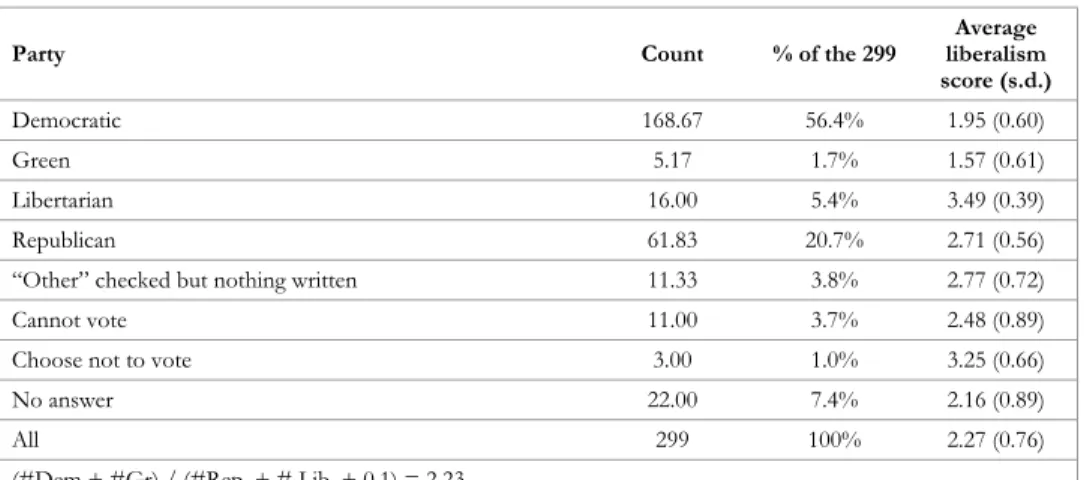
The results, shown in Table 1, are in line with previous literature on the party leanings of U.S. economists.8—a fact that helps us to discount worries of a
response bias of an ideological sort.
6. That is, 424 women addressees, of 2000 total addressees.
Table 1: Party-voting and Liberalism Score
Party Count % of the 299 liberalismAverage score (s.d.)
Democratic 168.67 56.4% 1.95 (0.60)
Green 5.17 1.7% 1.57 (0.61)
Libertarian 16.00 5.4% 3.49 (0.39)
Republican 61.83 20.7% 2.71 (0.56)
“Other” checked but nothing written 11.33 3.8% 2.77 (0.72)
Cannot vote 11.00 3.7% 2.48 (0.89)
Choose not to vote 3.00 1.0% 3.25 (0.66)
No answer 22.00 7.4% 2.16 (0.89)
All 299 100% 2.27 (0.76)
(#Dem + #Gr) / (#Rep. + # Lib. + 0.1) = 2.23
Note: Someone who, for example, checked Democratic, Green, and Republican was counted as 0.33 each.
In reporting the results on favorites, we will use the following party-voting index: (#Democratic + #Green)/(#Republican + #Libertarian + 0.1). The “+ 0.1” appearing in the denominator is there to solve the problem that arises when it is otherwise zero. In reading the reporting that follows, when you see a party-ratio score that is wildly large, it is because there is nothing in the denominator except the 0.1. Crudely speaking, the index is the ratio of Left to Right. As shown in the bottom row of Table 1, the Left to Right ratio within the entire sample is 2.23.
The second variable comes from the policy-view questions. All of them took the form shown here:
Higher minimum wages:
support
strongly support,not strongly
neutral oppose, not strongly
oppose
strongly haveno opinion
The question posits a reform that ratchets up restrictions on individual liberty or that expands tax-funded government activism.9The respondent is asked
to mark his position over the responses ranging from “support strongly” to “oppose strongly”. The 17 reforms follow:
1. Higher minimum wages
2. Tighter restrictions (e.g., tariffs and quotas) on imported goods 3. Tighter requirements for the permitting of new pharmaceuticals and
medical devices
4. Tighter restrictions on private parties engaging in discrimination (on the basis of race, gender, age, ethnicity, religion or sexual-orientation) against other private parties, in employment or accommodations 5. Tighter restrictions on the buying and selling of human organs 6. Tighter workplace safety regulation (e.g., by the Occupational Safety
and Health Administration (OSHA))
7. Tighter air-quality and water-quality regulation (e.g., by the Env. Protection Ag. (EPA))
8. Tighter requirements on occupational licensing 9. Tighter restrictions on prostitution
10. Tighter restrictions on gambling 11. Tighter controls on immigration
12. Tighter restrictions on adult women having an abortion
13. Tighter restrictions on “hard” drugs such as cocaine and heroin 14. More redistribution (e.g., transfer and aid programs and tax
progressivity)
15. More funding of the public school system 16. More benefits and coverage by Medicaid
17. More American military aid or presence abroad to promote democracy and the rule of law
We scored the responses to create for each respondent a liberalism score of domain [0, 4], that is, “support strongly” was scored as 0, “support, not strongly” as 1, “neutral” as 2, “oppose, not strongly” as 3, and “oppose strongly” as 4 (and “have no opinion” as missing data, not as “neutral”). Using the termliberalismin
its original or classical sense, we say, the higher the score the more liberal the respondent. We are aware of the gray areas, the semantic controversies, and the other controversies (“Doesn’t abortion violate the liberty of the fetus?,” “What about when immigrants support interventionist policies?,”; “Doesn’t the Amer-ican military promote liberty abroad?”), but we simply exercise our judgment10
and move on. The final column of Table 1 shows the mean liberalism score for the various party-voting categories. As expected, Green voters are least liberal, Libertarian voters are most liberal, and Democrat and Republican voters are in between.
Table 2 shows the results by gender. The findings are in line with what researchers usually find,11that women are less liberal and more Democratic than
men.
Table 2: Party Ratio and Average Liberalism Score, by
Gender
N % of 299 Party ratio liberalismAverage score (s.d.)
Men 239 80.0% 2.00 2.33 (0.75)
Women 57 19.1% 3.8 2.02 (0.75)
Declined to report gender 3 1.0% 1 2.61 (1.22)
All 299 100.0% 2.23 2.27 (0.76)
Economics Professors’ Favorite Economic
Thinkers
Are there any economic thinkers who wrote prior to the twentieth century whom you regard with great respect, admiration, or reverence? If so, please list, up to three:
10. In as much as any of these reforms point up possible disagreements between what Klein and Clark (2010) distinguish asdirectliberty andoverallliberty, in constructing the liberalism index we are following direct liberty. This practice is not to deny such disagreements, but it does imply that we do not think that the disagreements are very many and/or significant. Political discourse proceeds on the basis of “by and large.”
First:Adam Smith
Second:David Ricardo
Third:Alfred Marshall
In this case, we awarded Smith six points, Ricardo five points, and Marshall four points. Using such scoring we get the results shown in Figure 1.
Figure 1: 17 Favorite Pre-Twentieth Century economists
Perhaps no one is surprised, but that a man who died in 1790 would tower over the field of all economic thinkers working principally prior to 1900 the way Smith does here is really something. Footnotes detail how we fit an economist to a question (for example, Alfred Marshall as pre-twentieth century)12and how we
decided how many economists to display in a figure and a table.13
Table 3: 17 Favorite Pre-Twentieth Century economists, with
Respondent Political Variables
Mentions
N % of 299 Total points Party ratio score (s.d.)Ave. lib.
1 Smith, Adam 221 73.9% 1265 2.0 2.36 (0.76)
2 Ricardo, David 106 35.5% 520 2.0 2.27 (0.74)
3 Marshall, Alfred 67 22.4% 329 1.7 2.33 (0.70)
4 Mill, John Stuart 56 18.7% 274 3.1 2.04 (0.73)
5 Marx, Karl 47 15.7% 225 20.3 1.70 (0.62)
6 Malthus, Thomas 24 8.0% 114 1.5 2.39 (0.84)
7 Walras, Leon 15 5% 73 2.9 2.33 (0.56)
8 Hume, David 12 4.0% 60 5.5 2.45 (0.55)
9 Pareto, Vilfredo 12 4.0% 52 8.2 2.58 (0.83)
10 Bastiat, Frédéric 8 2.7% 40 0.2 3.33 (0.41)
11 Cournot, August 7 2.3% 36 3.6 2.57 (0.39)
12 Menger, Carl 7 2.3% 32 0.5 3.50 (0.57)
13 Wicksell, Knut 5 1.7% 24 2.7 2.41 (1.16)
14 Say, J.B. 4 1.3% 20 0.3 2.75 (0.16)
15 Jevons, W.S. 4 1.3% 19 1.8 2.63 (1.13)
16 Edgeworth, Francis 4 1.3% 18 1.0 2.65 (0.39)
17 Thunen, J.H. von 4 1.3% 18 0.5 2.58 (0.58)
We see that the admirers of Adam Smith—221 of the entire sample of 299—have a party ratio of 2.0, which is only a little below the sample average of 2.23, and an average liberalism score of 2.36 which is only slightly above the sample mean of 2.27. It is unsurprising that the admirers of Karl Marx are more Democratic and less liberal. Carl Menger, were he to see the results, would no doubt be surprised that his admirers are more plumb-line free-marketeers than are
12. To deal with the problem that Alfred Marshall was treated as pre-twentieth by some and twentieth by others, and all similar problems, we first applied a mechanical rule that if an economist had more than three times as many points for one question as for the bordering question, all of the latter points were shifted to the former question. In the still divided cases, we simply researched the matter so as to assignallthe points to the correct category (that is, whether deceased/60 years old as of April 2010), and made judgment calls on the century question, for example making Marshall pre-twentieth and Veblen twentieth. Thus we have effectively assisted the respondent in properly categorizing the admired economist.
the admirers of Frédéric Bastiat. Data on all economists mentioned, down to those receiving a single mention, are available in the Excel file (link).
Are there any economic thinkersof the twentieth century and now deceased
whom you regard with great respect, admiration, or reverence? If so, please list, up to three:
First:John Maynard Keynes
Second:Milton Friedman
Third:Paul Samuelson
Here, Keynes would get six points, Friedman five points, and Samuelson four points. The top 14 of the twentieth century, now deceased, are shown in Figure 2.
Table 4 shows the top 24 economists of the twentieth century, now de-ceased, along with the associated party-voting and liberalism score of the associated respondents.
Table 4: 24 Favorite Twentieth-Century economists,
de-ceased, with Respondent Political Variables
Mentions
N % of 299 Total points Party ratio score (s.d.)Ave. lib.
1 Keynes, J.M. 134 44.8% 726 4.6 1.96 (0.61)
2 Friedman, Milton 124 41.5% 654 0.8 2.66 (0.68)
3 Samuelson, Paul 90 30.1% 460 4.4 2.16 (0.57)
4 Hayek, Friedrich 44 14.7% 216 0.5 2.97 (0.64)
5 Schumpeter, Jos. 31 10.4% 138 2.1 2.37 (0.71)
6 Galbraith, John K. 22 7.4% 107 6.7 1.50 (0.48)
7 Veblen, Thorstein 22 7.4% 103 4.6 1.67 (0.70)
8 Stigler, George 22 7.4% 102 0.5 2.85 (0.59)
9 Robinson, Joan 18 6.0% 89 9.1 1.58 (0.65)
10 Tobin, James 12 4.0% 55 2.5 2.09 (0.55)
11 Hicks, John 10 3.3% 50 2.9 1.91 (0.79)
12 Fisher, Irving 10 3.3% 41 1.3 2.48 (0.65)
13 Boulding, Kenneth 7 2.3% 35 2.4 2.16 (0.75)
14 Mises, Ludwig von 7 2.3% 35 0.0 3.41 (0.51)
15 Hotelling, Harold 6 2.0% 30 1.0 2.62 (0.77)
16 Polanyi, Karl 5 1.7% 29 50.0 1.77 (1.14)
17 Granger, Clive 6 2.0% 27 1.0 2.62 (0.77)
18 Pigou, Arthur 6 2.0% 26 6.2 2.29 (0.45)
19 Olson, Mancur 5 1.7% 25 1.6 2.00 (0.76)
20 Griliches, Zvi 5 1.7% 22 3.6 2.01 (0.77)
21 Leontief, Wassily 4 1.3% 21 20.0 1.49 (0.34)
22 Minsky, Hyman 4 1.3% 21 30.0 1.09 (0.10)
23 Simon, Herbert 4 1.3% 20 1.6 2.19 (0.51)
24 Hurwicz, Leonid 4 1.3% 19 10.0 2.75 (0.46)
Are there any economic thinkers alive todayover the age of 60/under the
age of 60whom you regard with great respect, admiration, or reverence?
If so, please list, up to three:
Economist over the
age of 60 Economist under theage of 60
First: Gary Becker Paul Krugman
Second: Kenneth Arrow Greg Mankiw
Third: Robert Solow Daron Acemoglu
The top 19 over-60 living economists are shown in Figure 3, and the top 26 over-60 living economists are listed in Table 5, along with associated party-voting and liberalism scores.
Table 5: 26 Favorite Living economists, Age 60 or Older,
with Respondent Political Variables
Mentions
N % of 299 Total points Party ratio score (s.d.)Ave. lib.
1 Becker, Gary 65 21.7% 353 0.9 2.56 (0.67)
2 Arrow, Kenneth 41 13.7% 226 16.6 2.08 (0.57)
3 Solow, Robert 35 11.7% 188 5.5 2.09 (0.55)
4 Coase, Ronald 29 9.7% 144 0.5 3.01 (0.79)
5 Stiglitz, Joseph 28 9.4% 144 250.0 1.77 (0.60)
6 Sen, Amartya 25 8.4% 128 6.7 1.65 (0.42)
7 Lucas, Robert 24 8.0% 124 1.0 2.61 (0.54)
8 Buchanan, James 20 6.7% 104 0.1 3.25 (0.55)
9 Heckman, James 19 6.4% 97 2.0 2.49 (0.55)
10 Akerlof, George 17 5.7% 83 2.7 1.98 (0.53)
11 North, Douglas 14 4.7% 73 1.0 2.75 (0.75)
12 Smith, Vernon 9 3.0% 49 4.7 2.16 (0.42)
13 Nash, John 8 2.7% 42 2.2 2.32 (0.68)
14 McFadden, Daniel 7 2.3% 39 50.0 1.83 (0.52)
15 Sowell, Thomas 6 2.0% 32 0.0 3.17 (0.24)
16 Feldstein, Martin 6 2.0% 31 0.5 2.72 (0.65)
17 Alchian, Armen 6 2.0% 28 0.0 3.32 (0.46)
18 Fogel, Robert 6 2.0% 28 1.4 2.6 (0.62)
19 Tullock, Gordon 6 2.0% 28 0.0 3.58 (0.52)
20 Blinder, Alan 5 1.7% 24 50.0 1.64 (0.49)
21 Sargent, Tom 5 1.7% 24 30.0 2.13 (0.52)
22 Schelling, Thomas 5 1.7% 23 3.6 2.39 (0.35)
23 Barro, Robert 4 1.3% 22 0.9 2.71 (0.55)
24 Romer, Paul 4 1.3% 22 2.7 2.44 (0.76)
25 Spence, Michael 4 1.3% 22 0.3 2.44 (0.82)
26 Freeman, Richard 4 1.3% 20 40.0 2.04 (0.74)
Of those with at least 14 mentions (the next position drops to nine mentions), we see that the most liberal admirers are those of James Buchanan, Ronald Coase, Douglass North, and Robert Lucas, and the least liberal admirers are those of Amartya Sen, Joseph Stiglitz, and George Akerlof.
economists, the results might raise the questions: Is there a Milton Friedman on the horizon? And: If not, why not? Some answers are suggested by Klein (2009).
Table 6: 23 Favorite Living economists under Age 60, with
Respondent Political Variables
Mentions
N % of 299 Total Points Party ratio score (s.d.)Ave. lib.
1 Krugman, Paul 60 20.1% 338 12.4 1.74 (0.55)
2 Mankiw, Greg 22 7.4% 123 1.7 2.72 (0.60)
3 Acemoglu, Daron 22 7.4% 114 2.9 2.51 (0.74)
4 Levitt, Steve 20 6.7% 105 0.8 2.51 (0.54)
5 Card, David 10 3.3% 52 7.3 1.89 (0.22)
6 Easterly, William 9 3.0% 46 0.7 3.05 (0.91)
7 Glaeser, Edward 8 2.7% 42 1.4 2.01 (0.76)
8 Galbraith, James K. 8 2.7% 41 70.0 1.18 (0.34)
9 Folbre, Nancy 7 2.3% 38 66.7 1.40 (0.38)
10 List, John 7 2.3% 36 1.4 2.43 (0.80)
11 Bernanke, Ben 7 2.3% 35 2.7 2.42 (0.79)
12 Tirole, Jean 6 2.0% 32 3.6 2.53 (0.49)
13 Poterba, James 6 2.0% 31 0.7 2.68 (0.72)
14 Rodrik, Dani 5 1.7% 27 40.0 1.78 (0.45)
15 Frank, Robert 5 1.7% 26 2.7 1.91 (0.23)
16 Cowen, Tyler 5 1.7% 25 1.0 3.09 (1.14)
17 Krueger, Alan 5 1.7% 25 3.6 2.08 (0.61)
18 Shleifer, Andrei 4 1.3% 22 0.9 3.59 (0.68)
19 Murphy, Kevin 4 1.3% 21 0.0 3.14 (0.32)
20 Rabin, Matthew 4 1.3% 19 1.8 2.15 (0.18)
21 Fehr, Ernst 4 1.3% 18 1.6 2.37 (1.25)
22 Gruber, Jonathan 4 1.3% 17 2.7 2.27 (0.76)
23 Sachs, Jeffrey 4 1.3% 17 40.0 1.98 (0.71)
Economics Professors’ Favorite Economics
Journals
List the three economics journals (broadly defined) that you read most avidly when a new issue appears:
First:American Economic Review
Second:Journal of Economic Perspectives
Third:Journal of Political Economy
The top 14 journals are shown in Figure 5, and the top 33 journals are listed in Table 7, along with associated party-voting and liberalism scores.
Table 7: 33 Favorite Economics Journals, with Respondent
Political Variables
Mentions
N % of 299 pointsTotal Party ratio score (s.d.)Ave. lib.
1 American Ec. Rev. 111 37.1% 598 2.6 2.31 (0.63)
2 J. of Ec. Perspectives 77 25.8% 399 2.5 2.22 (0.67)
3 J. of Political Economy 40 13.4% 195 2.3 2.45 (0.56)
4 J. of Ec. Literature 35 11.7% 173 3.7 2.30 (0.67)
5 Econometrica 24 8.0% 124 2.8 2.11 (0.54)
6 Quarterly J. of Ec. 25 8.4% 124 7.9 2.23 (0.57)
7 J. of Labor Ec. 17 5.7% 91 1.8 2.50 (0.80)
8 J. of Ec. Issues 11 3.7% 62 90.0 1.62 (0.77)
9 J. of Human Resources 12 4.0% 59 4.8 2.20 (0.57)
10 The Economist 11 3.7% 57 1.8 2.02 (0.66)
11 J. of Urban Ec. 9 3.0% 49 1.7 2.07 (0.61)
12 National Tax J. 9 3.0% 45 0.8 2.57 (0.71)
13 J. of Ec. History 8 2.7% 44 0.7 2.90 (0.50)
14 Rev. of Ec. and Statistics 9 3.0% 41 6.4 2.34 (0.75)
15 American J. of Agricultural Ec. 7 2.3% 38 60.0 2.18 (0.54)
16 J. of Environmental and Ec.Management 7 2.3% 36 60.0 1.84 (0.29)
17 Cambridge J. of Ec. 6 2.0% 34 50.0 1.25 (0.21)
18 Ec. Inquiry 7 2.3% 33 3.4 2.32 (0.94)
19 History of Political Economy 6 2.0% 33 1.0 2.62 (0.96)
20 Public Choice 6 2.0% 32 0.0 3.08 (0.75)
21 Rand J. of Ec. 6 2.0% 32 1.8 2.43 (0.85)
22 J. of Ec. Behavior andOrganization 5 1.7% 29 3.6 2.15 (0.92)
23 J. of Sports Ec. 6 2.0% 29 0.7 2.33 (0.73)
24 J. of Money, Credit, andBanking 6 2.0% 28 2.7 2.4 (0.69)
25 J. of Public Ec. 7 2.3% 28 2.4 2.44 (0.75)
26 Feminist Ec. 5 1.7% 27 46.7 1.14 (0.19)
27 J. of International Ec. 6 2.0% 25 60.0 1.81 (0.63)
28 J. of Management Education 5 1.7% 25 30.0 1.91 (0.41)
29 Independent Rev. 4 1.3% 21 0.0 3.94 (0.12)
30 J. of History of Ec. Thought 4 1.3% 21 0.3 2.47 (0.76)
31 J. of Development Ec. 4 1.3% 20 30.0 2.10 (0.43)
32 Southern Ec. J. 4 1.3% 19 0.5 2.80 (1.25)
Economics Professors’ Favorite Economics Blogs
Do you occasionally or regularly read any economics blogs? If so, what are your top 3 favorite economics blogs:
x I do read. Here are the top three (listing fewer than three is OK).
First:Greg Mankiw
Second:Marginal Revolution Third:Paul Krugman
I do not read any economics blogs.
Blogs are now a major form of expression and discussion, and surely the timeliest form. While we show the results in Figure 6 and Table 8, it should be born in mind that even the top mentioned blog, Greg Mankiw’s, received only 41 mentions (of 299 respondents). It appears that most economists do not make a habit of reading economics blogs.
Table 8: 15 Favorite Economics Blogs, with Respondent
Political Variables
Mentions
N % of 299 Total points Party ratio score (s.d.)Ave. lib.
1 Mankiw, Greg 41 13.7% 229 1.2 2.65 (0.61)
2 Marginal Revolution 38 12.7% 208 0.9 2.96 (0.74)
3 Krugman, Paul 24 8.0% 126 20.0 2.02 (0.51)
4 DeLong, J. Bradford 20 6.7% 103 5.2 2.08 (0.54)
5 Freakonomics 14 4.7% 70 3.6 2.44 (0.58)
6 Becker, Posner 11 3.7% 58 0.6 3.13 (0.59)
7 EconLog 11 3.7% 55 0.2 3.26 (0.52)
8 Coordination Problem 5 1.7% 26 0.9 3.61 (0.56)
9 The Economist’s View 5 1.7% 26 50 1.73 (0.21)
10 Voxeu 5 1.7% 25 3.6 1.81 (0.68)
11 Café Hayek 5 1.7% 24 0.0 3.2 (0.72)
12 Environmental Economics 4 1.3% 22 40.0 1.96 (0.43)
13 Baseline Scenario 4 1.3% 21 30.0 2.12 (0.76)
14 Hamilton, James 4 1.3% 21 1.8 2.37 (0.73)
15 Rodrik, Dani 4 1.3% 19 20.0 1.65 (0.54)
Of those with at least 11 mentions, we see that most liberal admirers are those of EconLog, Becker-Posner, and Marginal Revolution, and the least liberal admirers are those of J. Bradford DeLong and Paul Krugman (also, again we see that Krugman admirers are remarkably preponderantly Democratic).
Table 9 compares economists who read blogs and those who do not. We were surprised to find that the readers of blogs are older than the non-readers. They are also more liberal.
Table 9: Readers and Non-readers of Blogs, Age and
Political Variables
N % of 299 Ave. age Median Age Party ratio liberalismAverage score (s.d.)
I do read blogs 133 44.0% 62.1 65 2.04 2.45 (0.76)
I do not read blogs 156 52.0% 56.7 55 2.56 2.12 (0.73)
No response 10 3.0% 49.4 43 0.73 2.33 (0.88)
Concluding Remark
Michael Polanyi (1959) wrote: “We need reverence to perceive greatness, even as we need a telescope to observe spiral nebulae” (96). Asking economists whom they revere or admire provides a basis for characterizing them, for it tells us toward whom they direct that special telescope, and to what characterizations of greatness they are most attuned.
Appendices
At the survey homepage (link), one can download the survey instrument (link), the cover letter that accompanied the survey (link), the follow-up postcard (link), the listing of 300 economics departments (link), and data (in Excel) displayed in this paper (link).
References
Coupé, Tom. Undated. Revealed Performance: World Wide Rankings of Economics Departments and Economists: 1969-2000. Mimeo, ECARES. Université Libre de Bruxelles.Link
Grijalva, Therese, and Clifford Nowell. 2008. A Guide to Graduate Study in Economics: Ranking Economics Departments by Fields of Expertise.
South-ern Economic Journal74(4): 971-996.
Hedengren, David, Daniel B. Klein, and Carrie Milton. 2010. Economist Petitions: Ideology Revealed.Econ Journal Watch7(3): 288-319.Link
Klein, Daniel B. 2009. A Milton Friedman on the Horizon? (Blog post.) Coor-dination Problem August 30.Link
Klein, Daniel B., and Charlotta Stern. 2009. By the Numbers: The Ideological Profile of Professors. In The Politically Correct University: Problems, Scope, and
Reforms, ed. Robert Maranto, Richard Redding, and Frederick Hess,
Amer-ican Enterprise Institute, 2009: 15-33.Link
Klein, Daniel B., and Michael J. Clark. 2010. Direct and Overall Liberty: Areas and Extent of Disagreement.Reason Papers32: 41-66.Link
May, Ann Mari, and Robert F. Whaples. 2010. Are Disagreements among Male and Female Economists Marginal at Best? Unpub. ms.
Norrander, Barbara, and Clyde Wilcox. 2008. The Gender Gap in Ideology.
William L. Davisis Professor of Economics at the University of Tennessee at Martin where he has taught undergraduate and graduate courses for the last 22 years and currently serves as the managing editor for the Journal of Business and Economic
Perspectives. During his tenure at UT he has been a member of
the Editorial Review Board for the University of Tennessee Press for many years and was past Director of Graduate Programs in Business Administration. He has been a visiting research fellow at the American Institute for Economic Research in Great Barrington, Massachusetts, and has received research grants from the Tennessee Valley Authority, Goodyear Tire and Rubber Company, and Kerr McGee Oil Company and other organizations. His articles have appeared in various social science and economics journals on topics ranging from drug prohibition to education reform. He earned his Ph.D in economics at Oklahoma State University. His email is [email protected].
Bob Figginsis Professor of Economics at the University of Tennessee at Martin where he has taught economics courses for the last 40 years. He served as Chairman of the Economics and Finance Department up until four years ago when he returned to a full-time teaching/research assignment with the university. For 35 years Dr. Figgins has been Senior Editor of
the Journal of Business and Economic Perspectives. Currently his
research interests include public policy effectiveness and economic development. He earned his Ph.D in Economics at the University of Arkansas at Fayetteville. His email is [email protected].
Polanyi, Michael. 1959.The Study of Man. Chicago: University of Chicago Press.
Stastny, Daniel. 2010. Czech Economists on Economic Policy: A Survey.Econ
Journal Watch7(3): 275-287.Link
David Hedengren is a PhD student at George Mason University where he is a recipient of the Walter E. Williams fellowship. His interests include economic history and applied econometrics. His email is [email protected].
Daniel Klein is professor of economics at George Mason University, fellow of the Ratio Institute, and chief editor of
Econ Journal Watch.
Go to Archive of Character Issues section
Richard T. Ely: The Confederate
Flag of the AEA?
Clifford F. Thies
1and Ryan Daza
2LINKTO ABSTRACT
It’s one thing for the American Economic Association to have the keynote address at its annual meeting entitled the Richard T. Ely Lecture. Ely was, after all, a founder of the organization, its first Secretary (1886-92), and its sixth President (1900-01); and, besides, nobody feels much compelled by reason of giving the lecture to associate himself with the man.
But it’s another thing for the Association, in its recentEconomists’ Calendar, to give Ely a prominent place in the pantheon of economists therein assembled. Yet, there he is among the 18 on the cover; again on the first page, along with a selection of quotations; and, yet again on the page for the month of April, his birth month. As to the selection of quotations, it is highly selective, with no quotations touching on the following issues: race, eugenics, the rights of individuals versus the rights of the state, freedom of speech and of religion, equal rights, the rights of property, contract and free association, the use of public schools to indoctrinate the youth, labor colonies, nationalism, colonialism, militarism and war. Ignoring Ely’s positions on these issues would be like claiming that the Confederate flag was not merely part of the heritage of a section of the country, but that it represents something good and wholesome—without apologizing for or even acknowledging what it actually represents.
A few individuals have helped to recover the untoward positions of the Progressives on race and eugenics (Bateman 1998, 2003, Cherry 1976, Leonard 2003, 2005a, 2005b, Luker 1991). As to why we have to recover this history, no doubt it is because the midcentury experience with the National Socialists of Econ Journal Watch Volume 8, Number 2 May 2011, 147-156
Germany made us of aware of how terrible were the mistakes of the Progressives. Embarrassment and the desire to let the dead rest in peace resulted in a white-washing of history. For example, a prominent biography of Ely (Rader 1966; see also Gonce 1996, Lowe 1987, Samuels 2002) makes only a few obtuse references to Ely’s positions on evolution, and does not at all mention his positions on race, eugenics, and so forth. The effect of the whitewashing was that, eventually, the problematic aspects of the Progressive movement came to be lost. Consequently, others might fail, where the Progressives failed, to temper their desire to do good with a due consideration for the possible evil that might result from the denigration of lesser people and from the aggrandizement of the state. The tensions between immigration and welfare statism, for example, are familiar enough.
What follows is a selection of quotations expressing the perspective and positions of one of the original leading lights of the AEA. The quotations span a wide variety of issues and the man’s entire professional career. Perhaps some of these will appear in a futureEconomists’ Calendar.
* * *
At bottom, it [supply-and-demand analysis] is only a truism proved by the experience of cooks. When fish is scarce it is dear. In sooth, a beautiful discovery! Nevertheless, there is nothing necessary in this. Suppose a religious law which forbids one to eat fish; it might be very scarce and at the same time cheap. (1884, 39)
A concrete example of the fruits of this new method [historicism] is found in the almost complete reversal of opinion concerning the policy advocated by those we call Mercantilists. (1884, 48)
In opposition to individualism, they [Mercantilists] emphasize…man was formed for society. They recognize a kind of divine right in the associations we call towns, cities, states, nations… (1884, 48)
Economic freedom must be regarded as merely relative. It has been absolute only in that condition of anarchy in which savages have lived… (1889,Introduction to Political Economy, 71)
[O]bedience to law is, in civilized nations, unconscious. Law has to such an extent formed us that we, for the most part, spontaneously obey it. (1889,Introduction, 71)
There seems in the nature of things no more reason why the State should do one thing rather than another except that it is more useful. (1889,
Introduction, 87)
An older conception, inherited from European despotisms, pronounces State action ‘paternalism,’ but … [with] modern democracy, … govern-ment is not something apart from us and outside of us, but we ourselves. (1889,Introduction, 89)
[T]here is no limit to the right of the State, the sovereign power, save its ability to do good. Duty, function, is co-extensive with power. The State is a moral person. (1889,Introduction, 92)
The idea of a stock exchange is sound, but it is inevitably so fruitful of mischief and all matter of inequity that we can regard it only as a necessary evil… (1889,Social Aspects, 22)
Christianity is primarily concerned with this world. (1889,Social Aspects, 53)
A church state…must adopt in its attempt to influence rightly this inner individual life [religious life] the methods of persuasion and not coercion … A church state must be regarded as occupying essentially the large and generous ground of the public schools … It must serve the state … [Because of the multitude of denominations] it is manifestly impossible to reestablish a church state among us, [the solution lay] in the conception of the state as the true church of the future. (1890; quoted in Handy (1990, 37))
The remedy [to the contribution of environment to pauperism] is to break up these pauper and criminal bands, and at the earliest age to remove the children from their poisonous atmosphere. (1891, 406)
Germany has a large number of ‘Laborers’ Colonies’ for the dependent classes, and these colonies have succeeded well, on the whole. It seems clear that there is a class which must be kept permanently isolated in asylums and subjected to kind but firm discipline. (1891, 407)
Th[ose who are] more hopelessly lost…should not be allowed to propagate their kind. (1891, 407)
Giving up one’s individualism means a growth in individuality. (1894, Socialism, 351)
[W]e may contemplate a society with real, not merely nominal, freedom, to pursue the best; a society in which men shall work together for common purposes, and in which this wholesome co-operation shall take place largely through government… (1894, Socialism, 352)
[T]he fullest unfolding of our national faculties requires the exclusion of discordant elements—like, for example, the Chinese. (1894, “Thoughts on Immigration, No. I”)
Too many diverse elements, especially when the variation in important characteristics is great, render difficult the growth of a powerful nationality. (1894, “Thoughts on Immigration, No. I”)
[W]e must notice the deterioration in the character of our immigration and ponder well the effects which a large admixture of baser foreign elements is likely to have upon American nationality. Going back to our early immigration we find men of intellect and conscientious conviction… As late as 1848 Germans of a fine class came to this country… (1894, “Thoughts on Immigration, No. II”)
Transportation has become so cheap that even an industrially inferior class is able to secure means to come to our shores. (1894, “Thoughts on Immigration, No. II”)
God works through the State in carrying out his purposes more universally than through any other institution. (1896, 162-63)
Christ and his apostles always recognized the authority of the state as divine in character even under the most trying and perplexing circum-stances. (1896, 165)
The Protestant Reformation meant the exaltation of the state. (1896, 168)
The distinction of ecclesiastical and profane laws can find no place among Christians. (1896, 169)
The main purpose of the State is the religious purpose. Religious laws are the only laws which ought to be enacted. (1896, 173)
When men try to prevent the advance of the temperance movement and other great moral enterprises, they are very fond of rattling off that sentence [you cannot make men moral by act of Parliament]. (1896, 179)
The state, which stands for organized society, is the organ of liberty. (1897, 672)
[T]he state, like the church, has divine rights. (1898, 780)
[T]here are classes in every modern community composed of those who are virtually children, and who require paternal and fostering care, the aim of which should be the highest development of which they are capable. We may instance the negroes, who are for the most part grownup children, and should be treated as such. (1898, 781)
The great word is no longer natural selection, but social selection. (1901, 61)
[W]e should undertake this [public schools] with as great care as a powerful military nation like Germany devotes to the preparation of each individual soldier for warfare. (1901, 62)
The problem of liberty includes the problem of suitable control over the relations which exist among men. (1902, 68)