
TECHNICAL UNIVERSITY OF CLUJ-NAPOCA
ACTA TECHNICA NAPOCENSIS
Series: Applied Mathematics, Mechanics, and Engineering Vol. 61, Issue Special, September, 2018
ONLINE DISCLOSURE OF NON-FINANCIAL INFORMATION IN
ROMANIAN LARGE COMPANIES
Adriana SAVA, Monica BOGDAN, Kinga KOCSI
Abstract: Nowadays, all companies are facing increasing demands to prove their commitment to sustainable development and to disclose information about their social and environmental performance. In particular, significant pressure is placed on the European large companies, as they have to start applying the Directive 2014/95/EU on disclosure of non-financial and diversity information. This paper focuses on the companies from Romania that fall under the incidence of this directive, by analyzing what they disclose on their corporate websites in relation to their non-financial performance. Starting from a list of all 680 companies from Romania for which non-financial disclosure becomes mandatory in 2018, the results revealed that only approximately one quarter of them practiced disclosure of non-financial information on their corporate websites in 2017, the last year when non-financial reporting was voluntary for these organizations.
Key words: sustainability reporting, non-financial information, Romanian large companies
1. INTRODUCTION
The practice of sustainability reporting has become a very important issue at global level, with an increasing number of reporting companies from year to year. This type of reporting refers to providing information, both to organization’s internal and external stakeholders, about the organizational results obtained for the economic, environmental and social dimensions of company’s performance [3]. The literature and business practice are quite generous concerning the terminology used for these types of practices – sustainability reporting, corporate social responsibility (CSR) reporting, triple bottom line reporting, environment, social and governance (ESG) reporting and others [2,3].
The landscape of sustainability reporting in the European Union and in Romania is going to change to an even greater extent, given the Directive 2014/95/EU regarding disclosure of non-financial and diversity information by certain large undertakings and groups, as it will impact approximately 6.000 companies in the European Union, 680 of these being in Romania [6]. The rules on non-financial
reporting apply only to large public-interest entities, with over 500 employees, which have to prepare a non-financial statement containing information related to, ‘at a minimum, environmental, social and employee matters, respect for human rights, anti-corruption and bribery matters.’ [4] These companies will start applying the Directive as of 2018, on information related to the 2017 fiscal year [5].
that it was quite likely. Cumulating these percentages leads to an encouraging result, as in the case of 77% of the analyzed companies a significant likelihood exists for preparing such reports in the near future. In addition, in 69% of the investigated companies internal discussions about the directive 2014/95/EU and its impact on the company have taken place and following these discussions, half of these companies realised that they will have to report non-financial information, while the other half concluded that they do not fall under the incidence of this directive. In other 20% of the sample no such discussions have taken place at internal level [8].
In January 2016, the Azores agency launched the first CSR index in Romania. The Romania CSR Index 2015 was an analysis of corporate social responsibility among the 100 largest companies in Romania, by turnover [7]. The sources used for the analysis were the companies’ websites and their financial and CSR reports, only the information published in Romanian being taken into account. The index used for companies’ ranking comprised 36 indicators grouped into 9 categories. The results revealed a low interest of the investigated companies in what concerns CSR strategy and activities, with only one third of the top 100 companies disclosing information about social responsibility in the national language. On the other hand, the companies that ranked on the first positions have published highly complex CSR reports. Of the 100 analysed companies, those that have occupied the best rankings according to the CSR index were those belonging to the beverages and beer industries, followed by those from building materials industry and oil and gas respectively. The companies least preoccupied to disclose sustainability-related information were those from the pharmaceutical, tobacco or distribution industries.
2. RESEARCH REGARDING THE
ONLINE DISCLOSURE OF
NON-FINANCIAL INFORMATION BY
ROMANIAN LARGE COMPANIES
This section presents the main coordinates of a research about online disclosure of
non-financial information among large companies in Romania.
2.1 Research objectives and methodology
This research aimed to investigate the disclosure of sustainability-related information among the companies from Romania that fall under the incidence of the Directive 2014/95/EU, through their corporate websites. The research investigated what these companies report in the field of sustainability and how prepared they are in this respect, one year before non-financial reporting became mandatory for them. More specifically, among the research objectives were the following ones:
● Assessing the extent to which these
companies disclose on their corporate websites information about their involvement in sustainability.
● Determining the extent to which they
assign a strategic dimension for sustainability, by having a sustainability strategy and by including sustainability in the company’s vision, mission or values.
● Identifying various aspects regarding
sustainability reporting used by these companies, like type of reports, languages used, disclosing information about their stakeholders, use of key performance indicators in this field and others.
● Identifying to what extent the companies
disclose information about various sustainability areas, from environment to employees, diversity and others.
The investigated population comprised all the companies identified by the CSR Agency as the companies in Romania that have to disclose non-financial information starting with 2018, according to the Directive 2014/95/EU. The CSR Agency compiled a list of 680 companies, for which non-financial reporting becomes mandatory starting with the year 2018 and which they consider to be ‘the companies that change Romania’ [6].
Firstly, for each of the 680 companies the authors tried to identify its corporate website. For 127 companies (representing 18.7% of the sample) it was not possible to identify a website, therefore the analysis next focused only on the 553 companies (81.3% of the sample) for which corporate websites have been identified. In the next step, starting from the landing page of each website, the authors attempted to identify a distinct section dedicated to sustainability. This search was not limited to the term ‘sustainability’, but rather a related terminology was used, like ‘sustainable development’, ‘corporate social responsibility’, ‘environmental responsibility’, ‘community involvement’, etc. In the cases where the direct identification of such sections was not possible, the website search engine was used to search the website for the key concepts previously mentioned. Following this step, it was noted that for 371 companies there was no mention of sustainability on their websites. Hence the final investigated sample was composed of 182 companies from the initial list of 680 companies, namely those companies which had corporate websites and for which it was possible to identify at least a piece of sustainability-related information on the website. The 182 company websites were next analyzed for the presence of various aspects related to sustainability reporting, these
elements being selected based on previous literature suggestions [1,7]. Website analysis was conducted in May-June 2017. Finally, based on the information provided by the CSR Agency [6], various demographic data were collected for each company – field of activity, number of employees, turnover, ownership form, multinational presence, etc.
2.2 Characteristics of the investigated companies
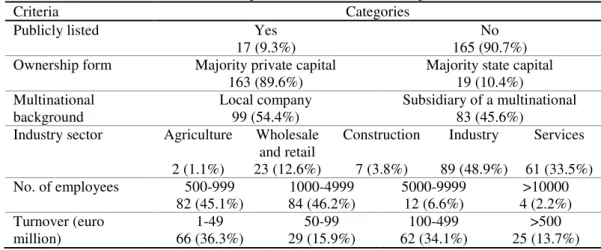
All the results presented hereinafter are valid at the level of the sample comprising the 182 companies that report sustainability information on their website. First of all, some demographic characteristics of this sample are presented in Table 1. Only 17 companies, representing 9.3% of those 182 in the final sample, are publicly listed, while the remaining 90.7% are not publicly listed. The majority of the sample (89.6%) comprises private-owned companies, while only 19 companies (10.4%) are state-owned companies. This result could suggest that the organizations controlled by the state are less preoccupied to communicate their activities and results in the field of sustainability than privately held ones. Over half of the companies (54.4%) are local companies, while the remaining 45.6% are Romanian subsidiaries of multinational corporations.
Table 1: Sample characteristics (182 companies)
Criteria Categories
Publicly listed Yes
17 (9.3%)
No 165 (90.7%) Ownership form Majority private capital
163 (89.6%)
Majority state capital 19 (10.4%) Multinational
background
Local company 99 (54.4%)
Subsidiary of a multinational 83 (45.6%)
Industry sector Agriculture
2 (1.1%)
Wholesale and retail 23 (12.6%)
Construction
7 (3.8%)
Industry
89 (48.9%)
Services
61 (33.5%) No. of employees 500-999
82 (45.1%)
1000-4999 84 (46.2%)
5000-9999 12 (6.6%)
>10000 4 (2.2%) Turnover (euro
million)
1-49 66 (36.3%)
50-99 29 (15.9%)
100-499 62 (34.1%)
>500 25 (13.7%)
Almost half of the companies (48.9% of the sample) belong to the industry sector, followed by one third of the sample (33.5%) in the services sector. Much smaller shares of the sample are comprised of companies operating
employees, 45.1% of the sample have between 500 and 999 employees, while 6.6% have between 5000 and 9999 employees and only 2.2% of the companies have more than 10000 employees. Finally, the distribution of the 182 companies by their turnover in 2015, in million euro, showed that 36.3% of the sample had a turnover between 1-49 million euro and 34.1% between 100-499 million euro; in addition, smaller shares of the sample had a turnover between 50-99 million euro (15.9%) and over 500 million euro (13.7%) respectively.
2.3 Research results
As previously mentioned, from the 553 companies for which websites were identified, in the case of approximately two thirds (67.1%, 371 companies) there was no mention of sustainability on their websites, while the remaining 182 companies (32.9%) disclose sustainability - related information on the website. Most of these companies have a distinct website section that refers to sustainability, but the name of this section varies from one company to another, for example ‘sustainable development’, ‘sustainability’, ‘environment’, ‘corporate social responsibility’, ‘our responsibility’, ‘sustainable mobility’ and others.
From the 182 companies which refer to sustainability on their websites, only 35 companies, representing 19.2% of the sample, include sustainability in the company’s vision, mission or values.
Nevertheless, 75 companies (41.2% of the sample) have sustainability strategies. This result could be considered encouraging, reflecting an increasing preoccupation of the companies to include sustainability in the corporate strategies. For example, for Coca-Cola HBC Romania [9] ‘sustainable development has always been an integrant part of our strategy and value system. Our strategic framework Play to Win integrates our long term commitment towards sustainability in what concerns a sustainable future for the new generations. Our priorities target environmental protection, youth empowerment, local communities and responsible partnerships.’ On
the other hand, the majority of the investigated companies (58.8%) do not have such strategies.
Regarding the reporting form of non-financial information related to sustainability, the results revealed that the majority of the analyzed companies (120. Only approximately one quarter of the companies (26.9%) publishes sustainability/CSR reports. Much smaller shares of the total number of companies disclose non-financial information in environmental reports (3.3%), social reports (2.2%) or as part of the annual reports (1.6%).
The distribution of the investigated sample according to the languages used for non-financial information disclosure is relatively balanced: 36.81% of the companies disclose these information only in Romanian, 32.97% disclose non-financial information only in English, while the remaining 30.22% of the sample disclose information in both languages.
Over half of the companies (56.6%) report sustainability-related information at country level, meaning they disclose information directly related to their operations in Romania. More than one third of the sample (37.9%) is held by companies whose non-financial information is included only in the global report of the group they belong to. The smallest share, of just 5.5% of the sample, is that of companies who disclose their sustainability information in a regional report.
vigilantes (academia, NGO), value creators (suppliers, business partners, local communities), value makers (employees, managers), and value purchasers (clients, consumers) according to their role in our value chain.
More than half of the companies (57.1%) do not use key performance indicators for measuring the company’s results and progress in the sustainability field, while 42.9% of the companies use these indicators. When it comes to disclosing relevant information for the industry the company belongs to, almost 40% of the analyzed companies disclose this type of information, while the majority (60%) does not disclose industry-specific sustainability information.
It was next intended to determine about which of the various sustainability aspects the investigated companies communicate the most. Nine dimensions of sustainability, those proposed by the Azores [7], were selected in this respect, namely corporate governance and transparency, diversity, economic impact, environment, human rights and anti-corruption policy, employees, consumers, community and supply chain. For each of these sustainability categories, the companies’ websites were searched for the presence of at least one of the aspects below, using the indicators proposed by the Azores [7], as it follows:
● corporate governance and transparency – relevant aspects for social responsibility (material aspects), stakeholders’ involvement, disclosure on management approach, publishing of a sustainability report, auditing of sustainability-related information;
● economic impact – investments for local communities development, information about employees’ average salary, local representatives in the management board, local purchasing policy;
● environment – total energy consumption, quantity of used energy from renewable sources, direct and indirect GHG emissions, water used, recycled or reused water, generated hazard, reused or recycled hazard, responsible use of raw materials, responsible use of soil;
● human rights and anti-corruption policy – preventing abuses in the field of human rights, trainings on human rights policies, fighting corruption and bribing;
● employees – health and safety at the workplace, employees’ professional development, freedom of association and collective negotiation;
● consumers – availability of sustainable products or services, responsible marketing, customer satisfaction;
● community – dialogue with local community members, programs for local community’s development and protection, social impact assessment, employees volunteering, developing the competences of the members from the local community. The results presented in Figure 1 reveal that the main sustainability categories for which the companies disclose information are the environment (90.1% of the 182 companies disclose information from this area), community and philanthropy (82.4%), consumers (74.7%), employees (72.5%) and diversity (68.1%). The sustainability categories about which the companies report in a lesser extent are corporate governance and transparency (58.8%), supply chain (51.1%), human rights and anti-corruption policy (40.7%) and economic impact respectively (35.2%).
3. CONCLUSIONS
Starting with 2018, the European Union law requires large companies, with more than 500 employees, to disclose non-financial information and diversity information, to prove how they manage environmental and social challenges. From the initial sample of 680 companies that should disclose non-financial information, it was revealed that roughly one quarter (182 companies) disclosed this type of information on their corporate websites.
approximately one quarter develops sustainability/ CSR reports. Only half of the companies disclose information about their stakeholders and less than half (40%) disclose relevant information for the company’s industry.
In this context, an interesting path for future research could consist in conducting the research again in 2018 and then performing a comparative and dynamic analysis between these companies’ online non-financial disclosure in 2017, the last year when reporting was voluntary (as presented in this paper) and 2018, the first year when non-financial disclosure becomes mandatory.
4. REFERENCES
[1] Băleanu, T.E., Chelcea, L. Stancu, A., The social responsibility of top 100 Romanian companies. An analysis of corporate websites, Amfiteatru Economic,
Vol. XIII, No. 29, pp. 235-248, 2011.
[2] Ogrean, C., The Directive 2014/95/EU – Is there a “new” beginning for CSR in Romania?, Studies in
Business and Economics, No. 12(1), pp.141-147, 2017.
[3] Wolniak, R., Habek, P., Quality assessment of CSR reports – factor analysis, Procedia – Social and
Behavioral Sciences, Vol. 220, pp. 541-547, 2016.
[4] European Commission, Directive 2014/95/EU of the European Parliament on disclosure of non-financial and diversity information by certain large undertakings and groups, https://eur-lex.europa.eu,
2014.
Fig. 1. Disclosure of various sustainability dimensions [5] European Commission, Guidelines on non-financial
reporting (methodology for reporting non-financial information), 2017.
[6] The CSR Agency, The CSR Report – Companiile care schimba Romania, no. 3, 2017.
[7] The Azores, Romania CSR Index 2015 –Topul celor mai responsabile companii mari din Romania, 2016.
[8] CSRmedia.ro and Valoria, Dinamica si perspectiva domeniului CSR in Romania, 2017.
[9] https://ro.coca-colahellenic.com [10] https://ursus-breweries.ro
Raportarea online a informaţiilor nefinanciare în companii mari din România
Rezumat: În prezent, toate companiile se confruntă cu presiuni crescânde de a-şi dovedi angajamentul faţă de
dezvoltarea durabilăşi de a dezvălui informaţii despre performanţele lor sociale şi de mediu. În particular, o presiune
semnificativă este plasată asupra companiilor europene mari, deoarece acestea trebuie să înceapă să aplice Directiva
2014/95/UE în ceea ce priveşte prezentarea de informaţii nefinanciare şi privind diversitatea. Lucrarea se axează pe
companiile din România care intră sub incidenţa acestei directive, analizând ceea ce raportează pe website-urile lor
corporatiste în legătură cu performanţele lor nefinanciare. Plecând de la o listă a tuturor celor 680 de companii din
România pentru care raportarea nefinanciară devine obligatorie în 2018, rezultatele au dezvăluit că doar aproximativ un
sfert dintre acestea a practicat raportarea informaţiilor nefinanciare pe website-urile corporatiste în 2017, ultimul an în
care raportarea nefinanciară a fost voluntară pentru aceste organizaţii.
Adriana SAVA, PhD. Eng., Ec., Lecturer, Technical University of Cluj-Napoca, Faculty of
Machine Building, Department of Management and Economic Engineering, 103-105 Muncii Blvd., 400641 Cluj-Napoca, Romania, [email protected]
Monica BOGDAN, PhD. Ec., Lecturer, Technical University of Cluj-Napoca, Faculty of Machine
Building, Department of Management and Economic Engineering, 103-105 Muncii Blvd., 400641 Cluj-Napoca, Romania, [email protected]
Kinga KOCSI, Eng., Industrial Economic Engineering, Graduate of the Technical University of
Cluj-Napoca, Faculty of Machine Building, Department of Management and Economic Engineering, 103-105 Muncii Blvd., 400641 Cluj-Napoca, Romania, [email protected]
0% 50% 100%
Supply chain Community and…
Consumers Employees Human rights…
Environment Economic impact Diversity Corporate…
51.1% 82.4% 74.7% 72.5% 40.7%
90.1% 35.2%
![Fig. 1. Disclosure of various sustainability dimensions [5] European Commission, Guidelines on non-financial](https://thumb-us.123doks.com/thumbv2/123dok_us/7996942.2120476/6.892.453.721.235.443/disclosure-various-sustainability-dimensions-european-commission-guidelines-financial.webp)
