TECHNICAL UNIVERSITY OF CLUJ-NAPOCA
ACTA TECHNICA NAPOCENSIS
Series: Applied Mathematics, Mechanics, and Engineering Vol. 61, Issue III, September, 2018
EXPERIMENTAL ANALYSIS OF A MECHANICAL SYSTEM COMPOSED
BY TWO IDENTICAL PARTS
Ovidiu VASILE, Sorin VLASE, Cristi NĂSTAC, Maria Luminița SCUTARU
Abstract: - The paper present an experimental analysis of a symmetric structure to validate some theoretically obtained properties of such mechanical systems. A real structure, used in the field of construction for fixing an industrial cooler, is studied. The structure is made of trusses, rigidly connected to each other. The vibrations of this system were determined and compared with the theoretical values. Thus, the experimental model has been validated, which then allows the determination of its eigenfrequencies and its eigenmodes of vibration considering the symmetry properties of the structure. Key words: Vibration, Eigenvalue, Eigenmode, Bar, Symmetry, Truss.
1. INTRODUCTION
In engineering practice, there are many times encountered situations in which identical components or parts are used within a structure. The use of identical parts may be useful for several reasons: less information will be required to describe the system, to make a project faster and easier, to make components easier and, finally, the time to achieve the mechanical structure and the cost of manufacturing falls.
For such systems, some interesting properties have been established in the literature concerning the vibrations, eigenvalues and eigenmodes. For discrete systems these properties are presented in [7], [20]-[23]. For continuous systems, analyzed with the finite element method, the analysis of some systems with symmetries led to the determination of these properties [1], [2], [6], [8], [9],[24],[25].
In the paper we make a study, on a structure, made of trusses, rigidly linked, these properties. The structure is made up of two identical parts, symmetrical in the mirror, linked together by common elements. In the paper is verified the validity of the finite element model used to study the mentioned properties.
2. FINITE ELEMENT MODEL
Figure 1
Figure 2
Figure 3
The motion equations of the free vibration are ([3]- [5], [10]-[19]):
{ }
00 0 0 0 2 1 1 22 12 12 12 11 12 11 2 1 1 22 12 12 12 11 12 11 = ∆ ∆ ∆ + ∆ ∆ ∆ d s T T d s T T K K K K K K K M M M M M M M & & & & & & (1) where: 11
M - the inertial matrix for the structure presented in Fig.5;
12
M - the inertial coupling matrix between the two identical parts and the liaisons elements;
22
M - the inertial matrix for the liaisons elements;
11
K - the rigidity matrix for the structure presented in Fig.5;
12
K - the rigidity matrix between the two identical parts and the liaisons elements;
22
K - the inertial matrix for the liaisons elements;
s
1
∆ - the vector of the independent coordinates of the left part of the structure;
d
1
∆ - the vector of the independent coordinates of the right part of the structure;
2
∆ - the vector of the independent coordinates of the liaisons elements.
Figure 4
The equations (1) can be written, in a short form, as:
[ ]
M{ }
∆
&& +[ ]
K{ } { }
∆
= 0 (2)Figure 5
3. EIGENVALUES AND EIGENMODES OF
VIBRATION
0 0
0
22 2 22 12 2 12 12 2 12
12 2 12 11 2 11
12 2 12 11
2 11
= −
− −
− −
− −
M p K M p K M p K
M p K M p K
M p K M
p K
T T
T T
(3)
Figure 6. The measurement points
Table 1. Eigenfrequencies
Computed aigenfrequencies
Measured eigenfrequencies Mode
No.
Frequency (Hz)
Mode No.
Frequency (Hz) 1 3,71 1 3,65 2 6,39 2 6,46 3 7,04 3 7,42 4 11,95 4 11,96 5 12,52 5 13,18 6 15,37 6 undetected 7 15,51 7 undetected 8 18,47 8 17,92 9 19,74 9 19,07 10 21,92 10 21,91 11 22,63 11 22,60 12 24,90 12 24,77 13 26,98 13 26,97 14 35,82 14 36,66
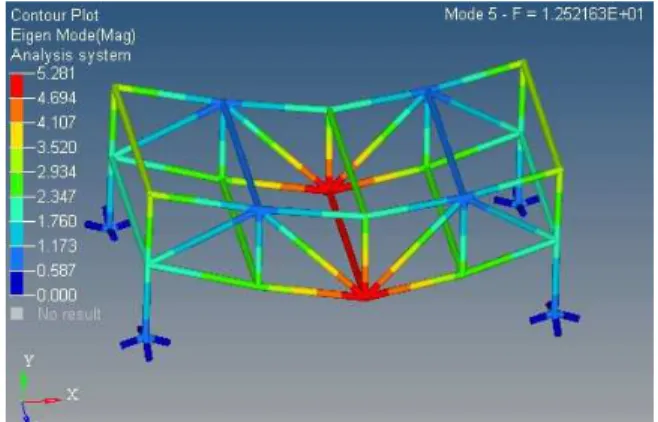
In Table 1 are presented the computed and experimental obtained eigenfrequencies for the structures from Fig.1. Generally, there are a good accordance between the experimental and computed values. In Figs. 7-10 are shown, for example, several modes of vibration. For two mode of vibration we have obtain not results (in the limits of errors).
Figure 7. Eigenmode 5 (symmetric)
Figure 8. Eigenmode 6 (vibration as a rigid)
Figure 9. Eigenmode 7 (symmetric)
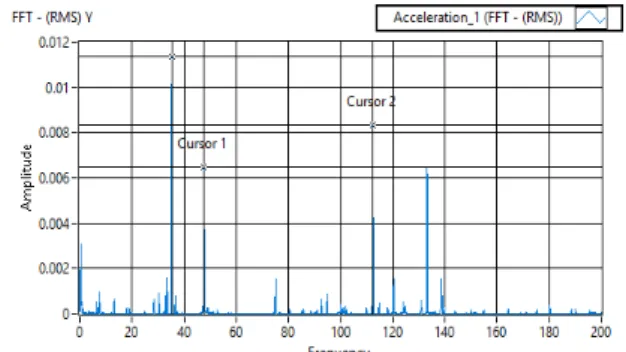
This problem happens for the eigenmodes 6 and 7. For the eigenmode 6 there is a possible explanation. All the structure has a rigid vibration on the rubber support. The excitation being in a perpendicular direction, it is possible that the amplitude of the vibration to be small. But we can see, in the Fig.17 two small frequencies around the value of 15 Hz. For this reason we consider that a new experiment can confirm these two missing values.
Figure 11. Eigenmode 13 (skewsymmetric)
Figure 12. Eigenmode 19 (skewsymmetric)
Figure 13. Frequencies chart for accelerations
Figure 14. Amplitude of acceleration [m/s2]
Figure 15. Frequencies chart for velocity
Figure 16. Amplitude of velocity [m/s2]
Table 2. Eigenfrequencies.Measured values
4. CONCLUSIONS
In the case of the mechanical systems presenting certain symmetries, the theoretical model shows the existence of some properties concerning the eigenvalues and eigenmodes of vibration.
Frequency
Eigen-value Acceleration Velocity [ Hz ] [ rad/s ] [ m/s2 ] [ mm/s ] 3.67 23.08 0.0005 0.0201 6.50 40.87 0.0010 0.0236 7.46 46.93 0.0017 0.0367 11.98 75.31 0.0018 0.0239 17.95 112.78 0.0003 0.0028 19.03 119.59 0.0024 0.0204 24.75 155.55 0.0012 0.0076 33.12 208.15 0.0034 0.0162
33.49 210.42 0.0072 0.0342
Figure 17. Eigenfrequency spectrum for the point P4
The literature provides for such properties for different type of mechanical systems. The paper presents an experimental validation of the theoretic finite element model [27]. To achieve this, a real structure has been studied that can be used in practice to provide a support for an industrial cooler. The structure is made of rigid trusses. Experimental determinations of the structure's eigenvalues were made. These results were presented in section 3. A good accordance can be observed between the theoretical values and the measured values.
5. REFERENCES
[1] Bratu, P., Stuparu, A., Popa, S., Iacob, N., Voicu, O., The assessment of the dynamic response to seismic excitation for constructions equipped with base isolation systems according to the Newton-Voigt-Kelvin model. Acta Technical Napocensis,
Series: Applied Mathematics, Mechanics,
and Engineering Vol. 60, Issue IV, November, 2017,pp.459.
[2] Ciuncanu, M., Chiroiu, V., On the post-earthquake damage detection of structures.
Ro. J. Techn. Sci.
−
Appl. Mechanics, Vol. 61,N° 3, pp. 189−205, Bucharest, 2016.
[3] Cristea, A.F., Farcaș, A.E., Arghir, M., Study regarding the vibration transmission of the autovehicle about human body. Acta
Technical Napocensis, Series: Applied
Mathematics, Mechanics, and Engineering, Nr. 59, Vol. IV, pp.379-382, 2016.
[4] Douglas, Th., Structural Dynamics and Vibrations in Practice: An Engineering
Handbook, CRC Press, 2012.
[5] Gillich,G.-R., Praisach,Z.-I., Iavornic,C.M., Reliable method to detect and assess damages in beams based on frequency changes. ASME
2012 International Design Engineering Technical Conferences and Computers and
Information in Engineering Conference. pp.
129-137, 2012.
[6] Ioan, R., Munteanu, L., Dumitru, D., Determination of dynamic Young’s modulus for steel alloys. Romanian Journal of
Mechanics, [S.l.], V. 1, N. 1, pp. 3-12, 2016.
ISSN 2537-5229.
[7] Mangeron, D., Goia, I., Vlase, S., Symmetrical Branched Systems Vibrations.
Scientific Memoirs of the Romanian
Academy, Bucharest, Serie IV, Tom XII,
Nr.1, 1991,pp.232-236.
[8] M. Marin, On weak solutions in elasticity of dipolar bodies with voids, J. Comp.
Appl. Math., vol. 82 (1-2), pp.291-297,
1997.
[9] M. Marin, D. Baleanu, On vibrations in thermoelasticity without energy dissipation for micropolar bodies, Bound Value Probl, vol. 2016, Art. No. 111, pp. 1-19, 2016. [10] M. Marin, An approach of a heat-flux
dependent theory for micropolar porous media, Meccanica, vol.51, No.5, pp.1127-1133, 2016.
[11] Meirovitch, L., Principles and Techniques
of Vibrations. Pearson (1996).
[12] Negrean, I., Advanced notions in analytical dynamics of systems. Acta Technical
Napocensis, Series: Applied Mathematics,
Mechanics, and Engineering Vol. 60, Issue IV, November, 2017,pp.491.
[13] Negrean, I., Mass distribution in analytical dynamics of systems. Acta Technical
Napocensis, Series: Applied Mathematics,
Mechanics, and Engineering Vol. 60, Issue II, June, 2017, pp.175.
[14] Rades, M., Mechanical Vibrations, II. Ed. PRINTECH, 2010
[15] Shi, C.Z., Parker, R.G., Modal structure of centrifugal pendulum vibration absorber systems with multiple cyclically symmetric groups of absorbers. Journal of Sound and
Vibration. DI 10.1016/j.jsv.2013.03.009.
[16] Timoshenko, P.S., M. Gere, J.M., Theory of
Elastic Stability, McGraw-Hill,New York,
London, 2nd Edition, 2009.
[17]. Tyn Myint-U, Ordinary Differential
[18] Vlase, S., Finite element analysis of a linear elastic body in a centrifugal field. Romanian
Journal of Mechanics, V. 2, N. 1, pp. 51-62,
2017. ISSN 2537-5229.
[19] Vlase, S., A method of eliminating Lagrangian-multipliers from the equation of motion of interconnected mechanical systems. Journal of Applied Mecanics-
Transactions of The ASME, Vol: 54 Issue: 1,
pp.235-237 DOI: 10.1115/ 1.3172969. [20] Vlase, S., Some properties of the
Eigenvalues and Eigenvectors of the Elastic Systems with Three Identical Parts.
Proceeding of the ASVM Conference, ISBN
973-625-238-8, Timişoara, pp.227-231, 2005.
[21] Vlase, S., Cândea,I., Mihălcică,V., Ambruş, C., Vibration of the transmission of a truck with two identical engines. Proceedings of
the 3rd International Conference EpsMsO,
Athens, Greece, 8-11 July, 2009.
[22] Vlase, S., Chiru, A., Symmetry in the study of the vibration of some engineering mechanical systems. Proceedings of the 3rd International Conference 3rd International
Conference EpsMsO, Athens, Greece, 8-11
July, 2009.
[23] Vlase, S., Paun, M., Vibration Analysis of a Mechanical System consisting of Two
Identical Parts. Ro. J. Techn. Sci. - Appl.
Mechanics, Vol. 60, No 3, pp. 216-230,
Bucharest, 2015.
[24] Vlase, S., Năstac, C., Marin, M., Mihălcică, M., A method for the study of the vibration of mechanical bars systems with symmetries.
Acta Technical Napocensis, Series: Applied
Mathematics, Mechanics and Engineering Vol. 60, Issue IV, November, pp.539, 2017. [25] Vlase, S., Mihălcică,M., Scutaru, M.L.,
Năstac, C., Coupled transversal and longitudinal vibrations of a plane mechanical system with two identical beams, Ro. J.
Techn. Sci.
−
Appl. Mechanics, Vol. 61, N° 3,pp. 276−289, Bucharest, 2016.
[26] Vlase, S., Danasel, C, Scutaru, M.L., Mihalcica, M., Finite element analysis of a two-dimensional linear elastic systems with a plane "rigid motion". Romanian Journal of
Physics, Vol: 59 Issue: 5-6, pp.476-487,
2014.
[27]. Vlase, S., Itu, C., Vasile, O., Năstac, C., Stanciu, M.D., Scutaru, M.L., Vibration Analysis of a Mechanical System Composed by Two Identical parts. Romanian Journal of Accoustic and Vibration. Vol. XV, Issue 1, 2018.
Analiza experimentală a unui sistem mecanic alcătuit din două părți identice
Lucrarea prezintă o analiză experimentală a unei structuri simetrice, realizată pentru validarea modelului cu elemente finite utilizat pentru evidențierea unor proprietăți obținute teoretic ale unor astfel de sisteme mecanice. Se studiază o structură reală, utilizată în domeniul construcțiilor utilizată pentru fixarea unui răcitor industrial. Structura este realizată
din ferme, rigid conectate una cu alta. Vibrațiile acestui sistem au fost determinate și comparate cu valorile teoretice. Astfel, modelul experimental a fost validat, ceea ce permite apoi determinarea frecvențe propii și a modurilor proprii de vibrație, având în vedere proprietățile de simetrie ale structurii.
Ovidiu VASILE, Assoc. Prof. Ph. D. Eng., Politechnica University of Bucharest, Depăartment of Mechanics, e-mail: [email protected].
Sorin VLASE, Prof. Dr. hab. Eng.TRANSYLVANIA University of Brașov, Head of Department of Mechanical Engineering, e-mail: [email protected].
Cristi NĂSTAC, Lector Eng., TRANSYLVANIA University of Brașov, Department of Civil Engineering, e-mail: [email protected].