TECHNICAL UNIVERSITY OF CLUJ-NAPOCA
ACTA TECHNICA NAPOCENSIS
Series: Applied Mathematics, Mechanics, and Engineering Vol. 61, Issue IV, November, 2018
DIGITAL LEADERSHIP 4.0
Sophia BOLTE, Joanna DEHMER, Jörg NIEMANN
Abstract: The concept of leadership has changed throughout the years. Coming from strong hierarchically organized businesses up to very flat hierarchies. In the era of digitalisation and cyber-physical systems, companies face new challenges: fast product cycles originating from changing customer needs. These challenges must be contradicted through agile production and development cycles, which implies a new type of leadership and culture within companies. Since leadership is found to be essential for companies’ success and innovation, this paper determines the prerequisites and potentials of digital leadership.
Key words: Leadership, digitalisation, employee leadership, company leadership, industry 4.0
1. INTRODUCTION
Digitalisation has changed the way companies communicate, manufacture and organize themselves. In the first phase of digitalisation, companies mainly focus on the increase of productivity, efficiency and profitability through the integration of new technology to connect devices and machines, digital tools such as platforms, digitalized distribution channels or even digital business models. Only in the second phase, they realize, that not only the machines and methods must adapt to the changes resulting from digitalisation, but also the ways of leadership within the company and its culture. This means that the communication, orchestration and working methods change too and new ways and standards must be set [1]. Adequate leadership is essential to react to the changing customer demands and agile production cycles and determines the success of a company.
This paper will answer the question, what leadership must consist of in the digital age and during industry 4.0 - therefore, Digital Leadership 4.0 - and how companies can support the digitalisation of their company through adequate leadership. The results are based on a survey that was held in various German companies.
2. LEADERSHIP DIMENSIONS
In this paper, two types of leadership can be differentiated within a business: company leadership, which is indirect and influences the whole company through company culture, corporate identity and company goals – and employee leadership which describes the direct leadership of individual employees and designs the relationship and communication between the boss and the employee.
2.1 Company leadership
Company leadership focuses on the leadership behaviours that sets the general framework in a business and influences the company culture, while not focussing on the individuals of a company. The aspects are valid for every employee in the company and have an impact on the customers, suppliers and partners [2].
• Transparent communication tools such as
e.g. internal chat rooms, regular meetings or company social media (social company), where employees and managers can be directly addressed, decision-making processes become transparent and the company visons and goals are frequently expressed.
• Customer integration early on and close
communication and collaboration with them and external partners.
• Digital tools to develop new ideas and
innovations. They require standards that must be defined by the company.
• Innovation and idea centres, where
employees can experiment and design new ideas and prototypes inexpensively.
• Open mindset within the company culture
that must be lived by all executives and employees.
• Self-management opportunities and flexible
work places. Employees must be allowed to do home office and their personal life must be considered too (e.g. children, volunteer work, etc.).
• Knowledge exchange and lifelong learning
possibilities, for everyone to share knowledge and access information quickly. This can be realized through databases and chatrooms.
• Flat hierarchies, decisions are made
together and the authoritative power is only used in exceptional cases.
• Introduction of a Chief Digital Officer and
digital experts who require strong support from the executive level and help to push forward in digital topics, new methods and standards [1] [2].
2.2 Employee leadership
An employee in the digital age can be defined as a knowledge worker. Rather than relying on his hands to perform tasks, he must rely on the ability to apply his knowledge. Research has shown, that what such an employee expects is the ability to communicate and participate in a team which allows them to focus on their own needs [3]. These new types of employees work autonomously and require a
large amount of trust from theirs bosses, while experiencing higher degrees of responsibility [1]. To extract their creativity and intellectual knowledge they need self-organisation opportunities and must be prepared to independently increase their knowledge. Furthermore, these new workers require flat hierarchies and as they are still very rare, they will more easily switch companies, if they are unsatisfied. Often these aspects are summarized within the word “new work” [1]. These new working conditions and methods can be summarized by the term “agile organisation”. One requirement for agile working is openness, transparency as well as a lived error culture to keep the velocity high and stay flexible to drive innovations [1]. Consequently, leaders are in the position to realize that they need to trust their teams since the leader is not the expert for the new complex tasks but instead it is his challenge to esteem and develop each of the team members so that they understand on what they are working and why [3].
3. RESEARCH & SURVEY
The research on which this paper builds upon is based on surveys e.g. performed by consultancies dealing with leadership and digitalisation topics, literature on methods of leadership and beneficial company culture and interviews with experienced leaders in the digital age.
3.1 Values of Digital Leadership 4.0
Based on the leadership dimensions mentioned in Chapter 2, the most impacting attributes of successful company and employee leadership are:
1. Communication: Intense communication between the management and employees [5] [3] [1]
2. Knowledge & Understanding: Knowledge about the importance of change initiated by digitalisation [1] [3] [6]
4. Coaching: Mangers with coaching skills and becoming good examples [5] [3] 5. Expectations & Orientation: Guidance of
the management level and meeting expectations of the company [1] [7] 6. Openness & Transparency: Open and
transparent atmosphere between the employees and management [1] [3] [7] 7. Trust: Trust and freedom within the
workplace regarding time, place and content of work [8] [7] [9]
8. Focus on employees: Focus on employee growth and wellbeing [10]
9. Error culture: Living an open error culture to enable innovations [7] [10] [1]
3.2 Creation and execution of the survey
Based on the nine identified attributes described before, a survey was developed and executed to find out what the current state of leadership in German companies is in comparison to the new requirements that Industry 4.0 and agile organisations will demand in the future. The result will show the gap between today and the future.
Four categories of companies were asked to do the survey:
• Small companies
• Middle sized companies • Large companies
• Start-ups
This was done, to be able to compare between the different types of companies, keeping in mind that larger companies will have higher investment potential in new technology or new business models and that start-ups are not conform to the traditional “rules” that an enterprise will have.
Statements were designed, to find out about the existence of the 9 concepts of digital leadership discussed in Chapter 3.1. They were to be rated relating to the degree of agreement with the statements regarding the company (“I fully agree” to “I totally disagree”).
Furthermore, a differentiation was made between the statements for employees and for executives as these have two different perspectives on leadership. The statements
related to company leadership however were directed to both.
4. SURVEY RESULTS
The following chapters discuss and display the various results of the survey. In total there were 72 survey participants which can be divided in 59 employees and 13 executives. The participants stated in what type of company they work: start-up, small, medium or large company. For the later comparison of the results one challenge was, that the ratio of participants for each type of company had to be similar for the two groups: employees and executives. Therefore, relevant survey participants had to be found.
4.1 Small Companies
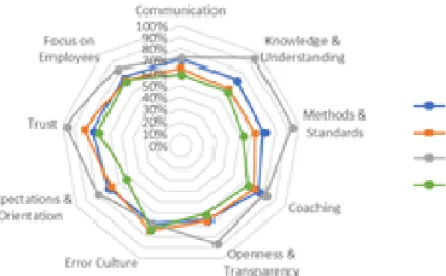
Noticeable in the result of executives in small companies which can be seen in Figure 1 is, that communication and trust have the
highest ratings. This means that the executives believe to have a high degree of communication between themselves and the employees. Furthermore, they trust their employees with tasks or give them freedom in the work place regarding home office and so on. The aspect
knowledge & understanding and error culture
are not as prominent from the point of view of the executives. This means that the goals regarding digitalisation are not fully conveyed or understood and that there are mixed feelings regarding errors. Of course, in a small company which depends on their range of customers, errors will have a higher impact on their relationship.
4.2 Medium Sized Companies
the executive said that they trust their direct employees however, the company promotes trust and has established some elements of freedom and self-efficiency. Here the fulfilment rate is 75%. The results show that there are opportunities for trainings and self-development in the company but that the executives do not necessarily coach and guide their employees very well. The lowest value was given to Expectations & Orientation with
under 20% fulfilment in terms of company leadership. This means, that executives and managers do not get full guidance and input of the general company goals and what is expected from them in terms of digitalisation, which also reflects in the lack of transparency
& openness in the same called evaluation
criterium. Furthermore, there are not sufficient methods and standards in place, to properly execute means of digitalisation and use modern working tools.
4.3 Large Companies
In large companies no outstanding criteria can be found which deviates from the average. The lowest value is represented by Error
Culture with 65% of fulfilment whereas
communication as the highest value achieves
72% as shown in Figure 1. The highest gap between the company and employee leadership is reached by trust with 29% which means that
the executives perceive a trustworthy atmosphere, but the company itself does not support or stand for this atmosphere.
Another fact is that openness &
transparency rank lowest within company
leadership. This might be due to very complex processes and more bureaucracy in large companies. When it comes to the leadership of the employees there might be a potential of improving the error culture since only 61 %
think that errors are directly addressed and used to improve further.
Similar to the executive perspective, in the employees’ perspective all criteria is balanced, and no peaks can be observed.
4.4 Start-up Companies
In start-ups, there are very flat hierarchies and they are said to be very modern in terms of their leadership ways. This can be seen in Figure 1. They have a broad knowledge &
understanding of the digital age and use the
according methods and tools fully. Also, there is a high level of trust among the people in the start-ups, as they depend on each other’s skills and productivity to grow as a company and become successful. The communication factor however, does not have full fulfilment, but it is still much better, than in comparison to the other companies. Interestingly, the error
culture is understood and known to be part of a
process and necessary to develop as a company and brand. However, errors are still crucial to not occur too often, as the income levels of start-ups is usually low and every mistake will cost money and time.
4.5 Total comparison
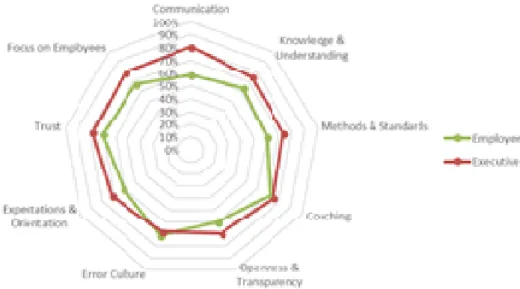
Considering the results of employees and executives in total, the current state in all types of companies can be derived. This shows that start-ups show the highest values, directly followed by large companies. The lowest fulfilment is reached by small companies and middle size companies. Also, a clear trend can be seen, if the results of all companies are summed up and differentiated by the
perspective of employees and executives shown in Figure 2. Employees rated the fulfilment in all 9 categories worse than the executives. One exception in this negative trend is the error culture which is perceived a slightly better by the employees than by the executives. All gaps must be addressed, otherwise this will lead to high dissatisfaction since executives maintain their leadership and don’t recognise that employees have another view on these topics.
Fig. 2. Total perspective of employees and executives.
5. SOLUTIONS & IMPROVEMENT POTENTIAL
Based on the results in Chapter 4 solutions are needed to change the perspectives and reach higher fulfillment rates as a requirement to drive the digitalisation. As a starting point the most important topics must be addressed. Therefore, it was defined which leadership aspect should be improved first. This resulted in two main problems which can be focused on. One improvement focus should be to close the highest gaps between executives and employees because both employees and executive should have a realistic perspective so that they can develop together in the same direction. All the gaps should present at least a delta of 10%. The second improvement focus is on the leadership categories of Chapter 3.1, which in total present the highest potentials for improvements, since they represent the weakest points in terms of digital leadership.
Since these are still too many topics to examine a second consolidation is needed. The counting of the indications for each category resulted in the identification of three main categories:
• Communication (5 indications),
• Expectations & Orientation (5
indications) and
• Methods and Standards (4 indications).
5.1 Communication solutions
Communication is not only verbally but can also be physically. A good example of giving a physical message to emphasize the change is Robert Bosch GmbH, which is well known for its innovations and cultural change efforts. Mr Robert Denner, the CEO in 2017, introduced a change in the dress code, in which ties were no longer obligatory. He did this to convey the message that the company wants a cultural change [4]. Another physical evidence to communicate change is a new communication and cooperation style and even a more innovative work environment. This can be done by e.g. changing the office set up or the corporate logo and colours [4].
A solution to make communication less time intensive is the usage of digital communication tools like chat rooms, digital info boards that inform about KPIs and the company strategy or even a communication department that deals with internal and external communication. However, this brings us to the next reason why there is a lack of communication: the financial efforts of communication. The traditional employee magazine or newspaper was introduced a long time ago. But only some companies started using them. Today with the large amounts of information it is difficult to select the right messages and to invest the time to produce valuable information for the employees. An entire communication department costs a lot of money as it needs employees to collect and produce the information. Also, the introduction of new tools and software is price intensive and usually only possible in financially strong companies. Moreover, sometimes the executives do not think of communication as a valid investment and rather use the money on other company goals[11].
Some solutions for this are daily 5-minute morning meetings or weekly emails, where important decisions, current challenges and general information is given. Furthermore, the mentality must change as employees are an investment. A happy employee will be more productive and put in more effort than an employee who does not feel that he is treated well [12].
Another reason why sometimes communication does not work well in companies, is that bosses want to maintain their exclusiveness or employees fear to lose their position by sharing information with their colleagues and bosses. An example, to flatten hierarchies by the Lidl CEO was by changing the language between bosses and employees. The policy was introduced, that bosses and employees must use their first names when talking to each other. However, many bosses feared that they would lose their authority and respect among the employees. This example shows, that often the personal ego or position is tried to be protected and explains, why some people refuse to communicate strongly with their employees and share their knowledge [4]. Resolving this problem is very difficult, as it requires a change in the behaviour and habits of people. One approach could be the introduction of more evaluations and setting policies in the leadership guidelines. A greater impact is by setting examples and identifying key people in the company to drive the change in communication. Borgmaier and Grohmann [4] identified three key groups of people, who play a relevant role in the digital and also cultural transformation: the initiator, the multiplier and
the person of action. Theinitiator must not only
strategically initiate the digital project but must also push forward the cultural change and new policies. This means, that the executives included must critically rethink their behaviour and develop or adapt new ways and be open to new ideas and change. The multiplier must make sure he influences the employees and drives them to be open to the change in the company and the new style of communication [4].
than 10% […] want to do new things and push them forward independently. 30% are only focused on their tasks and goals […]. The other 60% need a lot of guidance and want their boss to tell them exactly what to do and when all the time.” [14]
The person of action must implement the ideas, policies and standards that the executives have defined. This includes involving the employees in the creative process and trying to establish the “Start-up mentality”, which will be further elaborated in Chapter 5.3. Also, by influencing colleagues and motivating them by being a good example can benefit the change [4].
5.2 Solutions to challenges in Expectations & Orientation
Communication can also be a key factor for the successful distribution of expectations. But besides insufficient communication there are other possible origins for poor leadership orientation or missing expectations in an organization. It can be mainly traced back to two main aspects: the visions and the related values [1] [7].
The visions should inspire everyone so that the meaning of the work and the related expectations are understood [4]. Often the executives must interpret the vision on their own and pass the information on to the employees. The challenge is to map the vision to the individual’s situation [14]. In order to transfer the vision to the employees it can be one solution to derive an appropriate set of values, which can be interpreted easier.
Supporting the vision of the company, the set of values will give orientation in which direction the company may develop and at the same time the values will motivate people [15]. Sometimes, values can also be used by individuals to make the right decisions without much coordination with other entities [13]. The way values support an agile work environment by enabling faster decisions is explained by the following example:
Alina works as a product manager for a platform which enables music streaming. She mainly works on the design of how to present
new songs to the users. Her colleague Sarah proposed one day in a team meeting to invest more time and research in algorithms to predict new songs based on the preferences of the users. Although this is not part of the team’s main work, Alina decides to follow the idea. She is convinced that she made the right decision since the company represents the values curiosity and therefore seeks innovations [13].
This example shows that the values need to be known and recognized by everyone. One solution can be to improve communication or document the values in a guideline, which everybody has access to [13]. It can be helpful to have a printed document or to store information on an intranet webpage or a SharePoint. Another way of raising awareness about values and the related expectations can be to offer meetings or calls on that topic. An executive pointed out that this could improve the employee’s orientation because most of the time meetings deal with the content of the work and hard facts. This leads to the point that visions or values are less known [14].
Another point is the that if the values are not accepted by the employees, the expectations and vision can’t be achieved and employees can’t identify with the company [1]. Nevertheless, this is needed to retain them to the company and drive the digitalisation with them. One solution can be to offer training or make campaigns to raise awareness about specific topics, for example why quality is important for the company. Thinking about this a little further, it could lead to another strategy in the human resource department. When hiring a new employee, the executive could consider focusing more on finding an employee, which fits to the leadership culture or who identifies with the company vision instead of only focusing on the competences [1].
5.3 Solutions for challenges in Methods & Standards
As described in Chapter 5.1 the “Start-up mentality” must be established. The latter means that the employees become open for new things, such as the work in self-organized teams. The employees can work in different competence fields or across different departments. Also, professional cooperation with external partners are valued. Furthermore, there is a higher personal flexibility, for example through home office possibilities or project selection opportunities. The goal is to make the employees part of a communication network and to make them self-efficient and willing to change and learn new things. A prerequisite is the introduction of new standards, policies, tools and methods [4]. The interview with a Team Leader from a large company revealed, that “there are certain agile work methods (e.g. communication and collaboration tools) established, however only some are used. Often the performance and technical maturity of the new tools are not good. Then there is the missing knowledge of certain functionalities and thus there is an insufficient understanding of the (tools’) benefits” [14].
Derived for this quote, some tools are not selected effectively, meaning that the top-level management has decided to use a certain tool, however in practice it is not very useful. This is also due to the fact, that there is not sufficient knowledge about the tools and effective methods and standards, as they are new to most companies. Before introducing a tool, a company should run a test phase and make sure it will benefit the work of its employees and not disrupt it. In order to enable more flexibility in the company and the work, Scrum teams can be allowed, where teams organize themselves according to the methodology. [13].
Furthermore, the interview revealed, that people do not understand the benefits of certain tools, which indicates, that there is not sufficient training and information about them (see Chapter 5.1 for communication solutions). Board members and managers must ensure that the company constantly develops and expands its digital competence to discover new growth potentials and to survive in competition. However, trainings and new tools require investments and can only be conducted or
implemented by financially strong companies, who have the right infrastructure. [1]
The right selection of tools can be supported by newly introduced positions in the company, for example, Chief Digital Officer, Chief Innovation Officer and similar functions. These positions should be filled by people who are knowledgeable about digitalisation efforts, new digital business models and company culture requirements. They should create the conditions for a company to grow digitally. However, they need the strong support from the board and require the power to implement change (see Chapter 5.1 for initiators and the role of the
people. [1]
6. CONCLUSION
After explaining the meaning of leadership in the digital age, this paper revealed that digitalized companies need a new type of leadership, called leadership 4.0. This should support an agile environment, which is the basis for driving fast innovations forward and to create higher customer satisfaction.
Through leadership 4.0, on the one hand the culture of the company is affected and on the other hand the work itself. Therefore, company and employee leadership were distinguished. Further research showed that nine attributes for successful leadership in the digitalized company are predominant.
In order to find out how companies can support digitalisation of a company through adequate leadership these attributes were analysed in a survey. The survey was conducted with 72 participants which work in different sized companies. The analysis of the results revealed the three most important potentials for improvements, which are
Communication, Expectation & Orientation
and Methods & Standards. These categories
In the paper solutions and improvements related to the above-mentioned categories were developed. They can be a starting point for companies who want to change towards leadership 4.0. Implementing leadership 4.0 requires investments and openness towards cultural changes. Even if the direct impact of changes in leadership are not measurable, leadership is a topic which needs to be focused on, since not only new technology drives the digitalisation.
Therefore, this paper offers insights for employees or leaders and helps to raise the awareness of new leadership attributes in digitalised companies. Lastly companies could use the questions of a survey to find out regularly what already has improved or in which aspect they need to improve further. In the future it would be beneficial to further analyse the improvement potentials. After the implementation of proposed solutions further analysis of the relation between changes in leadership and the economic situation of the company may lead to new knowledge towards the importance of the topic. Another detailed approach would be to analyse specific branches to see on which level the leadership status is and then compare the branches to others. From this a benchmark could be established so that the branches can learn from best practices in others.
7. REFERENCES
[1.] Creusen, Utho; Gall, Birte; Hackl, Oliver,
Digital Leadership. Führung in Zeiten des
digitalen Wandels. Wiesbaden: Springer
Gabler. pp. 2-134, (2017).
[2.] Wagner, David Jonathan, Digital
Leadership. Wiesbaden: Springer
Fachmedien Wiesbaden, pp. 36-47 (2018). [3.] Au, Corinna von, Führung im Zeitalter
von Veränderung und Diversity.
Wiesbaden: Springer Fachmedien
Wiesbaden, pp. 24-75, (2017).
[4.] Borgmaier, Arndt; Grohmann, Alexander,
Smart Services und Internet der Dinge.
Geschäftsmodelle, Umsetzung und best practices: Industrie 4.0, Internet of things
(IoT), machine-to-machine, big data, Augented reality Technologie. München: Carl Hanser Verlag. p. 136, (2017).
[5.] Duwe, Julia, Beidhändige Führung.
Berlin, Heidelberg: Springer Berlin Heidelberg, p. 42-101, (2018).
[6.] van Dick, R.; Helfritz, K.; Stickling, E.,
Die Zukunft der Fürhung in Unternehmen.
Edited by DGFP GmbH, p. 22, (2017). [7.] Keuper, Frank; Schomann, Marc; Sikora,
Linda Isabell; Wassef, Rimon (Eds.),
Disruption und Transformation
Management. Digital Leadership –
Digitales Mindset – Digitale Strategie.
Wiesbaden: Springer Gabler, pp. 54-63, (2018).
[8.] Luhmann, Niklas, Vertrauen. Ein
Mechanismus der Reduktion sozialer
Komplexität. 5. Aufl. Konstanz:
UVK-Verl. -Ges. [u.a.] (UTB, 2185), p. 40, (2014).
[9.] Böhle, Fritz; Bolte, Annegret; Huchler, Norbert; Neumer, Judith; Porschen-Hueck, Stephanie; Sauer, Stefan, Vertrauen und
Vertrauenswürdigkeit. Arbeitsgestaltung
und Arbeitspolitik jenseits formeller
Regulierung, p. 74, (2014).
[10.] Kreutzer, Ralf T.; Neugebauer, Tim; Pattloch, Annette, Digital Business Leadership. Digitale Transformation --
Geschäftsmodell-Innovation -- agile
Organisation -- Change-Management.
[Place of publication not identified]: Springer Science and Business Media; Springer Gabler. p.97-240, (2016).
[11.] West, Sue, Schlechte Interne
Kommunikation. Available online at
https://suewest.de/schlechte-interne-kommunikation/, checked on 24.06.2018, (2017).
[12.] Forbes Magazin, Promoting employee
happiness benefits everyone. Available
online at
https://www.forbes.com/consent/?toURL= https://www.forbes.com/sites/forbescoache scouncil/2017/12/13/promoting-employee-happiness-benefits-everyone/, checked on 24.06.2018, (2016).
reduzierten Hierarchien. Praxiswissen für
die Führungsaufgabe. Wiesbaden: Springer Gabler (Essentials), pp. 30-35, (2018). [14.] Self-conducted interviews with a senior
vice president, a team captain and a controller from a large company, (2018).
[15.] Schwartz, Shalom H., An Overview of
the Schwartz Theory of Basic Values. In
Online Readings in Psychology and Culture 2 (1), pp. 3-5, (2012).
Leadership digital 4.0
Rezumat: Conceptul de leadership s-a schimbat de-a lungul anilor. Venind de la întreprinderi
puternice organizate ierarhic până la ierarhii foarte plate. În epoca digitalizării și a sistemelor
cibernetice fizice, companiile se confruntă cu noi provocări: cicluri rapide de produse care provin
din schimbarea nevoilor clienților. Aceste provocări trebuie contrazise prin cicluri agile de
producție și dezvoltare, ceea ce implică un nou tip de conducere și cultură în cadrul companiilor.
Deoarece conducerea se dovedește a fi esențială pentru succesul și inovația companiilor, acest
document stabilește premisele și potențialul conducerii digitale.
Sophia BOLTE, University of Applied Sciences Düsseldorf, [email protected] Joanna DEHMER, University of Applied Sciences Düsseldorf,