http://espace.library.curtin.edu.au/R?func=dbin-jump-full&local_base=gen01-era02&object_id=20892
choose their profession?, Women in Social and Economic Research Working Paper Series: no. 41, Curtin University of Technology, Curtin Business School.
Additional Information:
If you wish to contact a Curtin researcher associated with this document, you may obtain an email address from: http://find.curtin.edu.au/staff
Permanent Link:
The attached document may provide the author's accepted version of a published work. See Citation for details of the published work.
Nursing careers:
What motivated nurses to choose their
profession?
By
Rebecca McCabe, Margaret Nowak &
Scott Mullen
Working Paper No 41
September 2005
Working Paper Series of
Women in Social & Economic Research
Curtin University of Technology
Perth Western Australia
http://www.cbs.curtin.edu/wiser
Nursing Careers: What Motivated Nurses to Choose their
Profession?
Rebecca McCabe, Margaret Nowak & Scott Mullen Women in Social & Economic Research
http://www.cbs.curtin.edu.au/wiser September 2005
This working paper was subsequently published in a Special Edition of the Australian Bulletin of Labour 31(4):321-349 which can be obtained from WiSER or the Flinders University of South Australia.
Acknowledgement
Research for this paper was financed, in part, by an ARC SPIRT Grant (C100107735) which the authors gratefully acknowledge.
This paper considers self-reported reasons for choosing to be a nurse and intentions related to remaining in the profession. The data are drawn from a survey of Western Australian Registered Nurses which was part of a broader study of issues for recruitment and retention of nurses in the context of current labour market opportunities for women. The paper finds that what we have termed the ‘intrinsic attraction’ of nursing has been a key element in the decision to enter nursing for the bulk of nurses while ‘employment security’ aspects of the job are also a focus. Interestingly only a minority of nurses rated the ‘extrinsic rewards’ highly as a factor in decision making. The paper notes that there are some areas of significant difference in nursing career selection motivation between older and younger nurses; this finding does have policy implications for both health authorities and employers.
Introduction
In the last decades of the twentieth century the female workforce participation rate, especially that of married women, continued to grow (ABS 2001) and women moved in increasing numbers into professional and Para-professional occupations (ABS 2001). Traditional feminised occupations such as nursing and teaching have increasingly been in the media in relation to recruitment and retention problems ('Nurses Press on with Pre-Poll Strike' 2005). Politicians, aware of the electoral sensitivity of health, have campaigned on policy platforms which promise to reduce the ‘shortage’. Their proposals have included promises to improve pay ('Libs Pin Their Hopes on Power - Western Australia Decides' 2005), fund many new student places (Nelson 2004), quarantine nursing places from the Higher Education Contribution Scheme (HECS) fee increases, and target immigration to recruit skilled nurses from overseas.
Such simplistic solutions, however, overlook the complexities underpinning the apparent ‘shortage’ (Nowak 2000). These include the labour supply/hours of work decisions of those with nursing qualifications who are either not currently working in nursing or do so part-time. The term shortage also carries with it “… the presumption those ‘reasonable’ recruitment efforts have been made, and ‘reasonable’ wages and training prospects offered …” (Green, Machin & Wilkinson 1998: p.167) Apparently, simple solutions such as preferential university places and immigration have their own costs and, without attention to workplace and marketplace realities, may not provide long-term solutions.
While the focus of many of the government initiated responses is on increasing the supply of people with nursing qualifications, the set of factors which contribute to the renewal of the workforce via new entrants to the profession is complex. Dockery & Barns, (Dockery, M. & Barns, A. 2005 pp. 350-383) explore the elements of the decision to be a nurse with particular emphasis on those who have just made or are in the process of making that decision.
Long lead times in the development of experienced professionals and the requirement to make provision for the training of professionals mean that we cannot rely on market signals to provide an immediate response in terms of supply. Thus it is also important to understand the motivating factors and intentions of existing nursing qualified workers to assist in targeting retention strategies and to encourage those working part-time to expand their hours of work. It is interesting to note in this latter regard that Shanahan
(1993), in discussing rising nurse incomes, proposes that in the United States the overall supply curve of nurses is backward bending.
One overall focus of the research program within which this work was undertaken was on whether the increasing career options open to young women (Boughn 2001)in the twenty first century compared with 20 to 30 years ago have brought about significant changes in market supply conditions in nursing.
In this paper we seek to expand our understanding of one aspect of the motivation of the current registered nurse (RN) workforce through an examination of self-reported reasons for entering the profession and intentions relating to remaining in the profession. The paper argues that an understanding of the motivation behind those choosing nursing is important input for managers seeking to recruit and retain nurses in their workplace.
Following a brief discussion of the job matching literature we then look at the motivating factors for choosing nursing from the survey respondents. We report the results using six components or themes identified using factor analysis. Inter-generational differences in motivation are explored using the device of cohort analysis and two cohorts representative of the changing career opportunities for women. Finally data on decisions to leave nursing are compared with those identified as continuing in nursing and those who would choose nursing again compared with those who would not. The implications for recruitment to and retention in the health system are discussed.
Background
The literature on job shopping/employment matching gives some insight into the relationship between prior beliefs about jobs, experience of those jobs and employment mobility. Miller (1984) was the first to depart from the assumption in these models that worker’ prior beliefs about the utility of all jobs were homogeneous. Miller assumed that prior beliefs about jobs differ and that workers then sample information about job characteristics on-the-job. This sampling serves to allow the worker to better forecast expected future returns, including non-pecuniary returns. The model was used by Miller to explain mobility of workers.
Price and Mueller argued that intention to leave an occupational field is an emotional response toward work or the profession (Price & Mueller 1981). (Leong, Huang & Hsu 2003) found “job involvement” which measures active participation, psychological and values identification with the job being performed is positively related to commitment to the profession. Intention to leave the profession of nursing was found by Krausz, Koslowsky, Shalom & Elyakim (1995) to be the cumulative effect of intention to leave the ward or the hospital. Their additive model suggests nurses most prone to leave the hospital of employment perceive their work as offering little challenge, autonomy or opportunity to express their abilities and skills and where burnout is high. They propose that intention to leave the hospital is a sequential step in the decision to leave the profession.
It is important to consider initial expectations of the match between personal motivating factors in the choice of a profession and the experience of that match by nursing professionals. In this study that is reflected in variables such as intention to remain in nursing and whether nurses would make the same decision, given the decision to make again. Current initiatives to address perceived supply problems at both the Commonwealth level and by state health authorities include increasing student numbers in nursing courses. The literature on job matching suggests that, in part, the potential impact on supply of these initiatives will depend on a match between the motives for the choice of profession by prospective nurses and their subsequent experience of nursing positions. Mismatches are expected to result in increased turnover and wastage from among the new graduates. As a guide to expectations it will be useful to understand the reported motivation for undertaking nursing training as reported by those currently registered as professional nurses.
The 2002 RN survey
The 2002 RN Survey was a comprehensive instrument covering a range of issues relating to becoming a nurse, nursing practice, work and family balance, and intention to cease nursing. For this paper, we focus primarily on the factors which influenced respondents when choosing nursing as their career,1 whether participants intend to
remain in nursing and whether, if they could go back in time, they would choose nursing again. The data all relate to nurses who were registered with the Nurses Registration Board in Western Australia in 2002. The question on the decision to become a nurse included 28 statements about career decision motivations drawn from the literature on career choice, nursing literature and from discussion during the pilot study. Responses were on with a 5 point scale from 1, ‘no importance’ to 5, ‘very important’.
The data enable us to consider the most important contributing factors for survey respondents in the initial decision to enter nursing. We use factor analysis to identify the dominant themes. The data enable us to compare the responses of those we term ‘lost to nursing’ with those who identify they will remain in nursing. The respondents were asked a question relating to whether they would still choose to be a nurse with hindsight. The important career choice factors for those who would are analysed relative to those who say they would not.
The findings presented also include disaggregated data to enable an intergenerational comparison of the newest entry cohort of nurses (up to and including 30 years) and the cohort who made decisions to train for nursing between 25 and 35 years ago (those 40 to 50 years of age). While providing an intergenerational view of the decision to become a nurse we recognise that differences in responses between the age groups might also reflect differences in the nature of respondents’ education and their experience in nursing. The vast majority of those in the 40 to 50 years cohort (and those above 50 years) would almost certainly have undertaken hospital based training for the profession while those 30 and under would have all undertaken university based initial training2.
In our disaggregation of the data 40 years of age was chosen as the lower end of the older cohort as survey data reflect this to be the age at which this marked shift occurred from hospital based training to university education. We used 30 years as the
upper age of the younger cohort to reduce the influence of the overlap of hospital based and tertiary education based training and education. The younger cohort represents 10% of all RN Survey participants while the older cohort represents 37.3% of the sample; participants in the age categories of 31 to 39 years were 25.4% of the sample and over 50 years 27.3%. As a point of reference, we note that the age profile of nurses in Australia is significantly skewed with the majority being over 40 years of age (Shah & Burke 2001).
Initial career expectations
Myer, Allen, & Smith, (1993) note that personal characteristics and work experiences are included in the antecedents of commitment, particularly affective commitment. They note that:
“Employees whose experiences with organisations are consistent with their expectations and satisfy their basic needs tend to develop a stronger affective attachment to the organisation than do those whose experiences are less satisfying” Meyer et al. p.539. Meyer et al. go on to say that factors associated with affective attachment are equally applicable to occupation.
In the 2002 RN Survey respondents were asked to indicate the extent to which each of 28 statements was a consideration in their initial decision to become a nurse. We are aware that participants in the survey represent differing lengths of experience and varying ages and that their responses to these statements are based on their recollections of themselves at that earlier time in their lives. Hopper & van der Kolk (2001) studied extensively the limitations of memory recall questions when searching retrieval of traumatic memories. Many of their findings covered general memory retrieval questions and could be applied to any memory recall survey methodology. They indicate that the major limitation of recall oriented studies concerns the environment created for retrieval of memories. In general terms, memory triggered by survey questions, or cued memory, may not be the same as memories recalled under other circumstances. In addition, they noted that police studies have found that ‘directing’ a subject’s recall can produce different memories of events compared with what actually happened. Further, memory characteristics can change over time, depending on the individual’s cumulative experiences. This latter issue is particularly pertinent to the responses to this set of questions around choice of nursing, since the respondents have subsequently had experience of the profession.
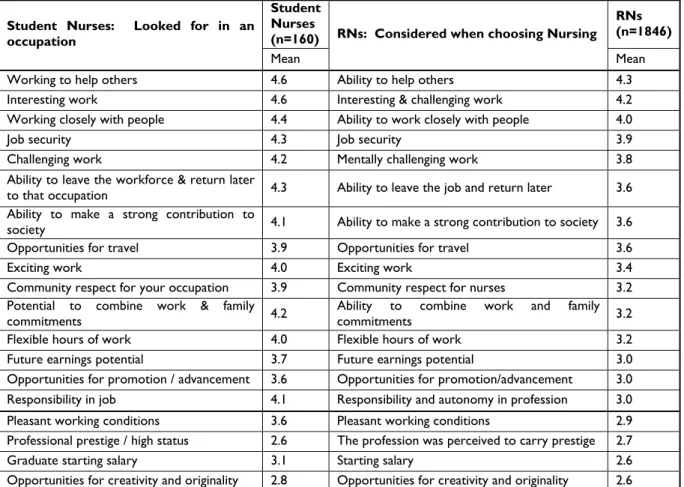
Nevertheless our confidence that these responses reasonably reflect those decisions at the time is boosted by the consistency they have with our 2003 Student Survey data which investigates the occupational choice of first year university students (Nowak, Preston, Dockery & McCabe 2003). This survey, which over-sampled nursing students, provided 20 statements/factors to students and asked them to rate how important each factor was in what they were looking for in an occupation. Nineteen of the statements provided were either identical or very similar to the statements used in the 2002 RN Survey. Table 1 compares those replicated statements, using a mean score, to demonstrate there is reasonable consistency in responses between individuals who had just made their decision to enter nursing and the recollections of qualified nurses relating to the factors they considered when choosing to enter nursing.
Table 1: Comparison of factors Student Nurses look for in an Occupation with Factors RNs considered when choosing Nursing.
Student Nurses (n=160)
RNs (n=1846) Student Nurses: Looked for in an
occupation
Mean
RNs: Considered when choosing Nursing
Mean Working to help others 4.6 Ability to help others 4.3 Interesting work 4.6 Interesting & challenging work 4.2 Working closely with people 4.4 Ability to work closely with people 4.0 Job security 4.3 Job security 3.9 Challenging work 4.2 Mentally challenging work 3.8 Ability to leave the workforce & return later
to that occupation 4.3 Ability to leave the job and return later 3.6 Ability to make a strong contribution to
society 4.1 Ability to make a strong contribution to society 3.6 Opportunities for travel 3.9 Opportunities for travel 3.6 Exciting work 4.0 Exciting work 3.4 Community respect for your occupation 3.9 Community respect for nurses 3.2 Potential to combine work & family
commitments 4.2 Ability to combine work and family commitments 3.2 Flexible hours of work 4.0 Flexible hours of work 3.2 Future earnings potential 3.7 Future earnings potential 3.0 Opportunities for promotion / advancement 3.6 Opportunities for promotion/advancement 3.0 Responsibility in job 4.1 Responsibility and autonomy in profession 3.0 Pleasant working conditions 3.6 Pleasant working conditions 2.9 Professional prestige / high status 2.6 The profession was perceived to carry prestige 2.7 Graduate starting salary 3.1 Starting salary 2.6 Opportunities for creativity and originality 2.8 Opportunities for creativity and originality 2.6 a. Q20 Nowak et al 2003 “What are you looking for in an occupation? Please indicate the importance, if any, you attach to each of the following job characteristics.” (1= No Importance at all, 2= Minor, 3=some, 4=Important, 5=Very Important)
b. Q6 Nowak et al 2002 “When choosing nursing as your career, how important, if at all, were the following:” (1= No Importance at all, 2= Minor, 3=some, 4=Important, 5=Very Important)
Notably, student nurses and qualified nurses from the two studies both rated the same three factors most highly: working to help others; interesting (& challenging) work; and working closely with people. Dockery and Barns (2005) present findings which draw on the above mentioned survey of occupational choice, comparing nursing students with male students and other female (non-nursing) students. With the exception of ‘Interesting work’, Dockery & Barns found a significant difference between nursing students and both male students and female non-nursing students in relation to the factors rated highly as important in the decision to choose an occupation.
Motivating factors for choosing nursing
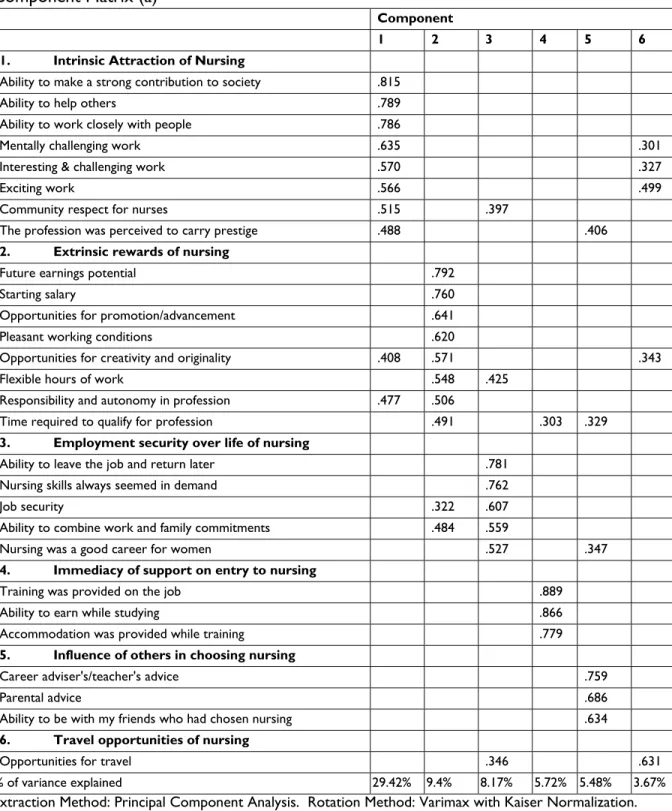
To explore the grouping of responses by all respondents a factor analysis was undertaken. Using the SPSS program a Principal Component Analysis was run. Six components with Eigen values greater than one were identified. All 28 variables loaded with a correlation coefficient greater than 0.3. The Kaiser-Meyer-Olkin Measure of Sampling Adequacy value was .897 and Bartlett’s Test of Sphericity was significant (p=.000). (See Appendix 1 for the table presenting the components identified and associated loadings.)
The six factors which appeared to reflect the common themes in how the statements loaded onto the components were identified as:
• Intrinsic attraction of nursing
• Extrinsic rewards of nursing
• Employment security over life of nursing
• Immediacy of support on entry to nursing
• Influence of others in choosing nursing
• Travel opportunities of nursing
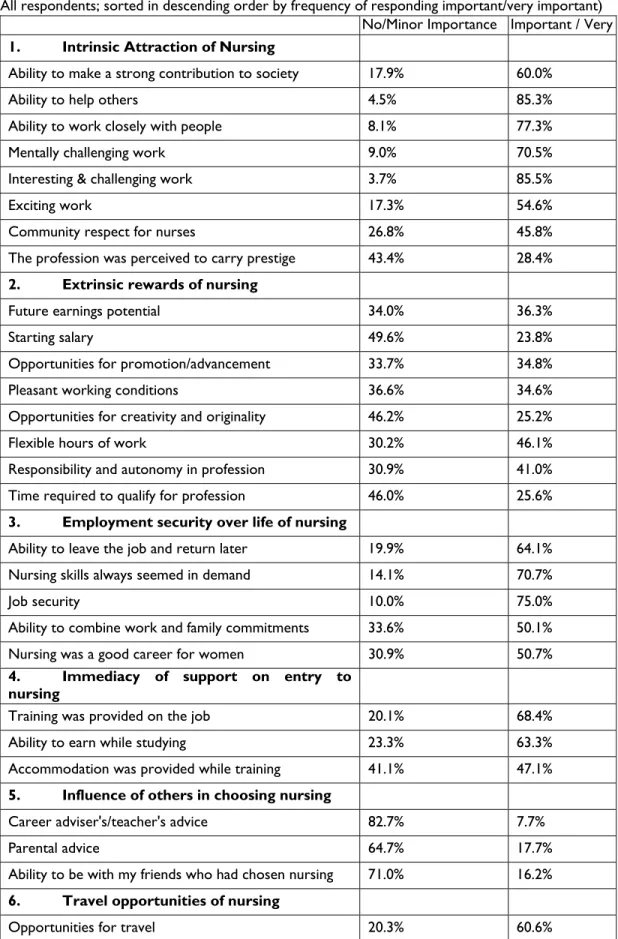
Of the six factors ‘intrinsic attraction of nursing’ explained 29.4% of variance; the remaining factors accounted for 32.5 % of variance, with ‘extrinsic rewards’ accounting for 9.4% and ‘employment security’ 8.2%, ‘support on entry’ 5.7%, ‘influence of others’ 5.5% and ‘travel opportunities’ (a single statement) 3.7%. Table 2 sorts the 28 statements from the questionnaire under the 6 components. It also reports the strength of support for the individual statements in terms of frequency, focusing on both ends of the scale, ‘no importance/minor importance’, and ‘important/very important’. The remaining responses which fell into the mid-range ‘some importance’ category have been excluded from this table.
From this table we can see that predominantly the statements falling into the component we have named ‘intrinsic attraction of nursing’ are also those rated most highly as ‘important/very important’. ‘Interesting and challenging work’ and ‘ability to help others’, both loading on the intrinsic factor, were reported as ‘important/very important’ influences on their choice of profession by over 80% of all respondents. Four other responses rate over 70% ‘important/very important’: with the exception of ‘job security’ these items all loaded on the factor we have identified as the ‘intrinsic attractions of nursing’. Issues around employment security/flexibility were also rated quite highly by nurses. Within this category there was strong support for statements relating to ‘job security’ ‘skills in demand’ and ‘ability to leave and return’.
It is also interesting to note that within the component we have labelled ‘extrinsic rewards’ starting salary was ‘important/very important’ to only 24% of the total respondents while future earnings potential was reported as ‘important/very important’ for only 36% of the respondents and ‘opportunities for advancement’ by 34.8%. ‘Flexible hours’ and ‘responsibility and autonomy’, rated by 46 % and 41 % respectively as ‘important/very important’ were the individual statements with strongest positive support within the ‘extrinsic rewards’ component. The items in the component ‘support on entry to nursing’ reflect the conditions applying for hospital based training which no longer apply. Nevertheless it is important to note that this support was perceived to be of importance in the decision to enter nursing at that time when such support was a component of the hospital based training system.
Table 2: The Importance of various motivating reasons in the decision to enter nursing
(All respondents; sorted in descending order by frequency of responding important/very important)
No/Minor Importance Important / Very
1. Intrinsic Attraction of Nursing
Ability to make a strong contribution to society 17.9% 60.0%
Ability to help others 4.5% 85.3%
Ability to work closely with people 8.1% 77.3%
Mentally challenging work 9.0% 70.5%
Interesting & challenging work 3.7% 85.5%
Exciting work 17.3% 54.6%
Community respect for nurses 26.8% 45.8%
The profession was perceived to carry prestige 43.4% 28.4%
2. Extrinsic rewards of nursing
Future earnings potential 34.0% 36.3%
Starting salary 49.6% 23.8%
Opportunities for promotion/advancement 33.7% 34.8%
Pleasant working conditions 36.6% 34.6%
Opportunities for creativity and originality 46.2% 25.2%
Flexible hours of work 30.2% 46.1%
Responsibility and autonomy in profession 30.9% 41.0%
Time required to qualify for profession 46.0% 25.6%
3. Employment security over life of nursing
Ability to leave the job and return later 19.9% 64.1%
Nursing skills always seemed in demand 14.1% 70.7%
Job security 10.0% 75.0%
Ability to combine work and family commitments 33.6% 50.1%
Nursing was a good career for women 30.9% 50.7%
4. Immediacy of support on entry to
nursing
Training was provided on the job 20.1% 68.4%
Ability to earn while studying 23.3% 63.3%
Accommodation was provided while training 41.1% 47.1%
5. Influence of others in choosing nursing
Career adviser's/teacher's advice 82.7% 7.7%
Parental advice 64.7% 17.7%
Ability to be with my friends who had chosen nursing 71.0% 16.2%
6. Travel opportunities of nursing
Opportunities for travel 20.3% 60.6%
Intergenerational differences in career choice motivation
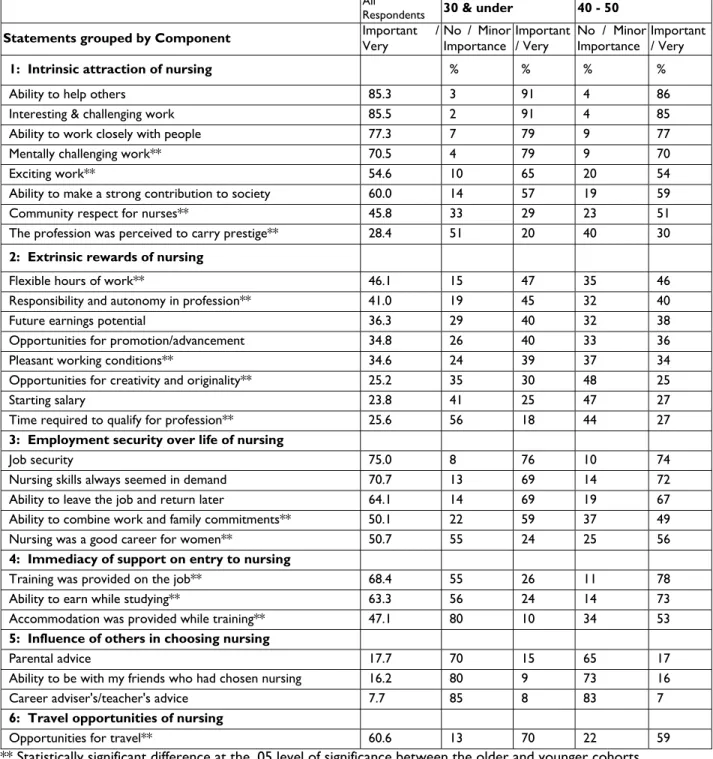
When we look for intergenerational similarities and differences through a disaggregation of the data we can see marked similarities between the statements most frequently reported as being ‘important/very important’. However, we also start to see variations in motivating factors. Table 3 presents the responses of the younger and older cohorts we selected to study, with a comparative figure for each statement reflecting attribution of very important/important by all participants in the survey. The statements are grouped against the six components identified through our earlier factor analysis.
Table 3: Importance of motivating reasons in the decision to enter nursing – by cohort, grouped by factors (Sorted in descending order by: Frequency of responding; Very/Important.)(% are rounded)
All Respondents 30 & under 40 - 50
Statements grouped by Component Important / Very No / Minor Importance Important / Very No / Minor Importance Important / Very 1: Intrinsic attraction of nursing % % % % Ability to help others 85.3 3 91 4 86
Interesting & challenging work 85.5 2 91 4 85 Ability to work closely with people 77.3 7 79 9 77 Mentally challenging work** 70.5 4 79 9 70 Exciting work** 54.6 10 65 20 54 Ability to make a strong contribution to society 60.0 14 57 19 59 Community respect for nurses** 45.8 33 29 23 51 The profession was perceived to carry prestige** 28.4 51 20 40 30
2: Extrinsic rewards of nursing
Flexible hours of work** 46.1 15 47 35 46 Responsibility and autonomy in profession** 41.0 19 45 32 40 Future earnings potential 36.3 29 40 32 38 Opportunities for promotion/advancement 34.8 26 40 33 36 Pleasant working conditions** 34.6 24 39 37 34 Opportunities for creativity and originality** 25.2 35 30 48 25 Starting salary 23.8 41 25 47 27 Time required to qualify for profession** 25.6 56 18 44 27
3: Employment security over life of nursing
Job security 75.0 8 76 10 74 Nursing skills always seemed in demand 70.7 13 69 14 72 Ability to leave the job and return later 64.1 14 69 19 67 Ability to combine work and family commitments** 50.1 22 59 37 49 Nursing was a good career for women** 50.7 55 24 25 56
4: Immediacy of support on entry to nursing
Training was provided on the job** 68.4 55 26 11 78 Ability to earn while studying** 63.3 56 24 14 73 Accommodation was provided while training** 47.1 80 10 34 53
5: Influence of others in choosing nursing
Parental advice 17.7 70 15 65 17 Ability to be with my friends who had chosen nursing 16.2 80 9 73 16 Career adviser's/teacher's advice 7.7 85 8 83 7
6: Travel opportunities of nursing
Opportunities for travel** 60.6 13 70 22 59
From Table 3 we see that the younger cohort placed significantly more emphasis on such intrinsic work factors as mentally challenging and exciting work. By contrast, this cohort placed less prominence on prestige of the profession and community respect for the profession, also considered intrinsic factors of nursing.
As remarked earlier for the total sample, substantially less than 50% of both younger and older cohorts reported starting salary as important/very important (25% and 27% respectively);this observation is also true for future earnings potential (40% and 38% respectively). The younger cohort did however, place greater emphasis than older nurses on a number of extrinsic rewards which they anticipated within the profession including responsibility and autonomy, pleasant working conditions, opportunities for creativity and originality, and flexibility of hours. However, these still rated important/very important for less than 50% of the cohort.
Although not an issue rated particularly highly by either the younger or older cohort (18% and 27% respectively), there was a significant difference between the two in relation to the emphasis they placed on time required to qualify for the profession. The older cohort placed greater emphasis on this issue in considering nursing as an occupation. There may be a link between this and the opportunities for independence noted below.
Importantly, 56% of the older cohort report that their decision to become a nurse was influenced by the consideration that nursing was perceived as a good career for women compared to 24% of the younger cohort. This confirms what we expected in relation to the influence of increasingly wide career options for younger women and less emphasis on stereo-typical roles in their career decisions. Considering the increased options available to young women, it is interesting to note that the younger cohort placed greater value on the expected ability that nursing would allow them to combine work and family commitments than did the older cohort. This may reflect the current work/life balance issues for the two age cohorts. On the other hand, it may be that the older cohort had such limited choice that balancing work and family was not a particular issue in their decision of occupation, whereas many of the options now available to younger women as a career are, or are perceived by this group of nurses, to be less conducive to successfully combining work and family commitments.
The statements relating to immediacy of support on entry to nursing all reflect a significant difference between the older and younger cohorts. The statements associated with this factor suggest part of the attraction of nursing may have been the ability to live relatively independent of family or other support. The much greater importance attributed to this factor by the older cohort than the younger is likely to reflect the fact that these support mechanisms were removed when nursing education changed to a university qualification. As indicated earlier, the majority of the older cohort would be a product of the earlier hospital based training and may well have utilised those support mechanisms.
Reasons for choosing nursing and the decision to leave
As indicated in reviewing the literature, a mismatch between expectations of a professional role and career and the reality experienced by those in that role and career may have implications for retention in the profession. The 2002 RN Survey included a number of questions to identify participants who, although still registered with the WA Nurses Registration Board, no longer actually practise nursing, or who anticipate ceasing
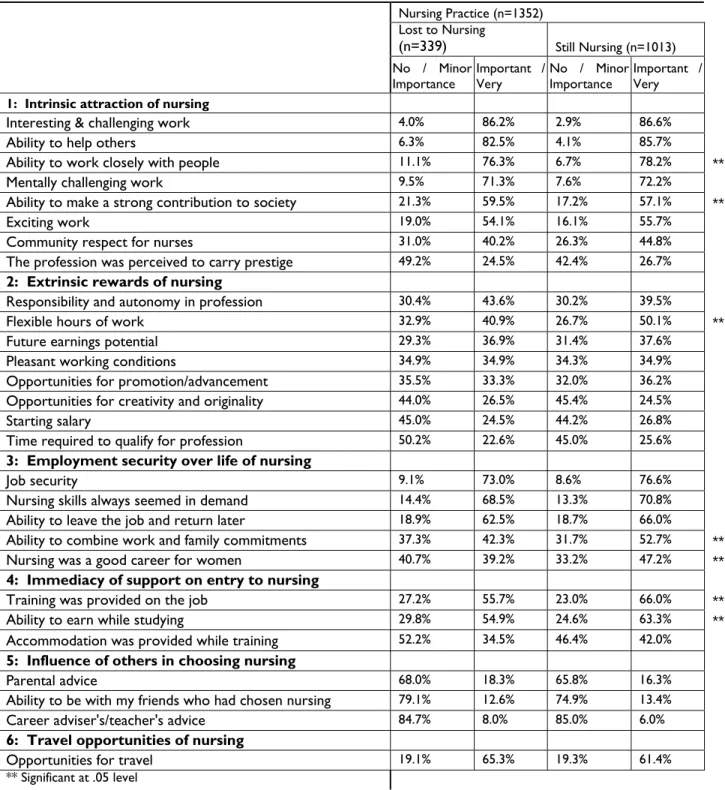
to practice within five years of the survey or, if they are currently not working at all, do not plan to return to nursing within five years. Table 4 presents the factors associated with the decision to enter nursing by those survey participants who do not plan to cease nursing within five years (‘still nursing’) and those who have either already ceased to practise or plan to do so within five years (‘lost to nursing’). In order to avoid undue influence on the findings caused by normal or early retirement, the table excludes responses from those aged over 50 years and the 25 participants who did not indicate their age.
Table 4: All respondents, excluding those aged over 50 years, by intention to practise nursing.
Nursing Practice (n=1352)
Lost to Nursing
(n=339) Still Nursing (n=1013)
No / Minor Importance Important / Very No / Minor Importance Important / Very
1: Intrinsic attraction of nursing
Interesting & challenging work 4.0% 86.2% 2.9% 86.6%
Ability to help others 6.3% 82.5% 4.1% 85.7%
Ability to work closely with people 11.1% 76.3% 6.7% 78.2% **
Mentally challenging work 9.5% 71.3% 7.6% 72.2%
Ability to make a strong contribution to society 21.3% 59.5% 17.2% 57.1% **
Exciting work 19.0% 54.1% 16.1% 55.7%
Community respect for nurses 31.0% 40.2% 26.3% 44.8%
The profession was perceived to carry prestige 49.2% 24.5% 42.4% 26.7%
2: Extrinsic rewards of nursing
Responsibility and autonomy in profession 30.4% 43.6% 30.2% 39.5%
Flexible hours of work 32.9% 40.9% 26.7% 50.1% **
Future earnings potential 29.3% 36.9% 31.4% 37.6%
Pleasant working conditions 34.9% 34.9% 34.3% 34.9%
Opportunities for promotion/advancement 35.5% 33.3% 32.0% 36.2%
Opportunities for creativity and originality 44.0% 26.5% 45.4% 24.5%
Starting salary 45.0% 24.5% 44.2% 26.8%
Time required to qualify for profession 50.2% 22.6% 45.0% 25.6%
3: Employment security over life of nursing
Job security 9.1% 73.0% 8.6% 76.6%
Nursing skills always seemed in demand 14.4% 68.5% 13.3% 70.8%
Ability to leave the job and return later 18.9% 62.5% 18.7% 66.0%
Ability to combine work and family commitments 37.3% 42.3% 31.7% 52.7% **
Nursing was a good career for women 40.7% 39.2% 33.2% 47.2% **
4: Immediacy of support on entry to nursing
Training was provided on the job 27.2% 55.7% 23.0% 66.0% **
Ability to earn while studying 29.8% 54.9% 24.6% 63.3% **
Accommodation was provided while training 52.2% 34.5% 46.4% 42.0%
5: Influence of others in choosing nursing
Parental advice 68.0% 18.3% 65.8% 16.3%
Ability to be with my friends who had chosen nursing 79.1% 12.6% 74.9% 13.4%
Career adviser's/teacher's advice 84.7% 8.0% 85.0% 6.0%
6: Travel opportunities of nursing
Opportunities for travel 19.1% 65.3% 19.3% 61.4%
As can be seen, there are seven factors returning a significant difference in the level of importance placed on them in the decision to choose nursing between those RNs who are effectively lost to nursing and those who plan to continue nursing. In only one instance is there greater emphasis on a factor’s importance associated with those who are lost to nursing: that factor is ability to make a strong contribution to society. Based purely on reasons for entering the profession and the decision to cease practising, there is little to indicate that those who are considered lost to nursing had any greater expectations of their profession than their counterparts remaining.
An analysis of the frequency distributions identified that those aged under 35 years were significantly more likely to be ‘lost to nursing’ than those in the age group 35-50 years. One possible explanation for this is that the data for the younger group is capturing the impact of job matching decisions in relation to occupational choice (Miller 1984), while for the older cohorts these decisions have been made and those who found the rewards did not meet expectations have already left the profession. A second related explanation is that older nurses have less time to realise returns to investments in alternative occupations while they do have important investment in the nursing profession.
Impact of experience on the decision to choose nursing
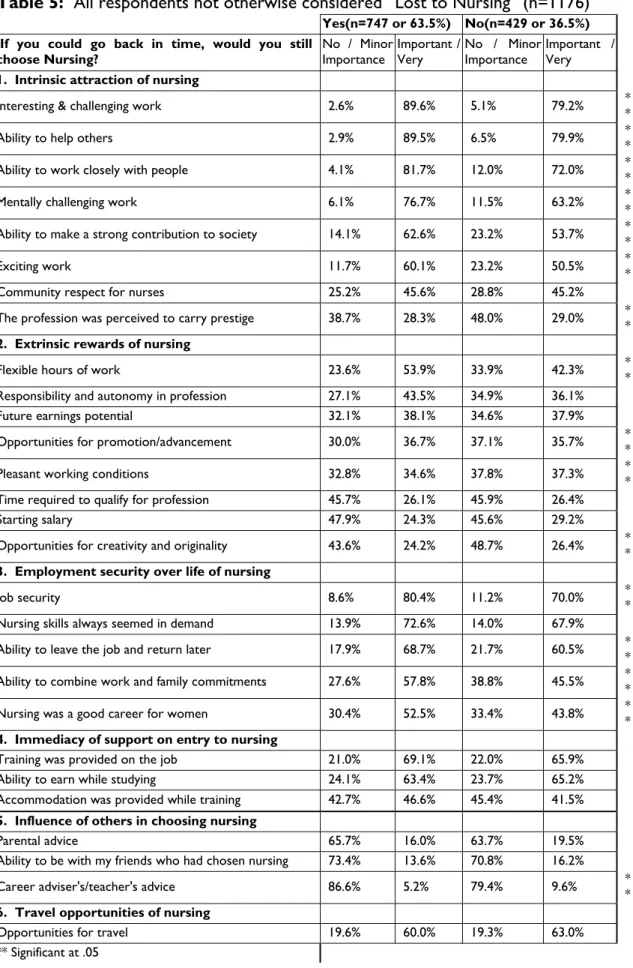
Using the data from the 2002 RN Survey we are able to consider how survey participants, with the benefit of their experience, would now look at the decision to enter nursing should they have the opportunity to make that choice again. Participants were asked “If you could go back in time, would you still choose nursing?” Using responses from only those participants intending to continue in nursing, Table 5 presents the motivating factors on deciding to become a nurse broken down into the ‘yes’ or ‘no’ response options permitted by the question.
Table 5: All respondents not otherwise considered “Lost to Nursing” (n=1176)
Yes(n=747 or 63.5%) No(n=429 or 36.5%)
If you could go back in time, would you still
choose Nursing? No / Minor Importance Important / Very No / Minor Importance Important / Very
1. Intrinsic attraction of nursing
Interesting & challenging work 2.6% 89.6% 5.1% 79.2% ** Ability to help others 2.9% 89.5% 6.5% 79.9% ** Ability to work closely with people 4.1% 81.7% 12.0% 72.0% ** Mentally challenging work 6.1% 76.7% 11.5% 63.2% ** Ability to make a strong contribution to society 14.1% 62.6% 23.2% 53.7% ** Exciting work 11.7% 60.1% 23.2% 50.5% ** Community respect for nurses 25.2% 45.6% 28.8% 45.2% The profession was perceived to carry prestige 38.7% 28.3% 48.0% 29.0% **
2. Extrinsic rewards of nursing
Flexible hours of work 23.6% 53.9% 33.9% 42.3% ** Responsibility and autonomy in profession 27.1% 43.5% 34.9% 36.1% Future earnings potential 32.1% 38.1% 34.6% 37.9% Opportunities for promotion/advancement 30.0% 36.7% 37.1% 35.7% ** Pleasant working conditions 32.8% 34.6% 37.8% 37.3% ** Time required to qualify for profession 45.7% 26.1% 45.9% 26.4% Starting salary 47.9% 24.3% 45.6% 29.2% Opportunities for creativity and originality 43.6% 24.2% 48.7% 26.4% **
3. Employment security over life of nursing
Job security 8.6% 80.4% 11.2% 70.0% ** Nursing skills always seemed in demand 13.9% 72.6% 14.0% 67.9% Ability to leave the job and return later 17.9% 68.7% 21.7% 60.5% ** Ability to combine work and family commitments 27.6% 57.8% 38.8% 45.5% ** Nursing was a good career for women 30.4% 52.5% 33.4% 43.8% **
4. Immediacy of support on entry to nursing
Training was provided on the job 21.0% 69.1% 22.0% 65.9% Ability to earn while studying 24.1% 63.4% 23.7% 65.2%
Accommodation was provided while training 42.7% 46.6% 45.4% 41.5%
5. Influence of others in choosing nursing
Parental advice 65.7% 16.0% 63.7% 19.5% Ability to be with my friends who had chosen nursing 73.4% 13.6% 70.8% 16.2%
Career adviser's/teacher's advice 86.6% 5.2% 79.4% 9.6% **
6. Travel opportunities of nursing
Opportunities for travel 19.6% 60.0% 19.3% 63.0%
The level of importance placed on the motivating factors differs significantly between those who would choose nursing again and those who wouldn’t on sixteen statements. Using frequency of responses to indicate emphasis, we can see that those who would not take up nursing again placed greater emphasis on four motivating factors (percentage of respondents attributing a very important/important rating is shown in brackets): pleasant working conditions (37.3% versus 34.6%), the profession being perceived to carry prestige (29% versus 28.3%), opportunities for creativity and originality (26.4% versus 24.2%) and career adviser's/teacher's advice (9.6% versus 5.2%). Applying the components generated by factor analysis as a reference point there appears to be no clear grouping of the factors which have greater significance to those who would not choose nursing again.
The remaining 12 statements reflecting a significant difference between the two groups suggest that those who would choose nursing again placed a substantially higher level of importance on factors intrinsic to nursing (component 1). Of component 2 (extrinsic rewards of nursing) frequencies only differed substantially in relation to flexible hours of work. Interestingly, of the five factors comprising component 3 (employment security over life of nursing), four reflected a significant difference between the two groups; in every instance those who would choose nursing again reported a substantially higher frequency of very important/important than those who would not.
These nurses have all indicated that they have no intention to cease practising nursing within five years of the survey. However, 36.5% clearly stated that if they had the decision to make over again, they would not choose nursing. A key question which remains largely unanswered here is what keeps these individuals in nursing. However, these existing nurses do have an investment in a nursing qualification. We have also noted earlier that the younger nurses were significantly more likely to be ‘lost to nursing’. One possible explanation is that these nurses are ‘rusted-on’; they do not have sufficient incentive and opportunity now to undertake new occupational training and obtain the rewards. We may need to be concerned however, that almost 40% of respondents who expect to remain in nursing would not have chosen to nurse had they been making the decision with hindsight. Such disaffection is an important issue.
Conclusion
Drawing on the data of the 2002 RN Survey, the nursing profession would appear to have three current key initial areas of appeal for those choosing to train for the profession: (1) the factors perceived to be intrinsic attractions of nursing such as interesting and challenging work, the ability to help others, and the ability to work closely with people; (2) aspects pertaining to employment security whereby work can be obtained when wanted or needed and the facility to combine work and family commitments; and (3) the travel opportunities available to those with a nursing qualification. Reinforcing the importance of intrinsic attraction of nursing and those elements which have been labelled ‘employability’ is the fact that when responses are compared between those who would and would not choose nursing again, there is a substantially higher value placed on these factors by those who would choose nursing
again. This suggests that for those strongly motivated by such factors, the nursing profession may be providing returns in line with their expectations.
We have excluded from the above ‘support on entry to nursing,’ because the conditions involved related to those available for hospital based training. However, it remains a consideration in relation to those aspects of choosing to be a nurse which may be subject to policy change. In particular, while it is clear that nursing qualifications will remain in the tertiary education sector, support for training can be increased.
It is also important to note that there appear to be significant differences in the elements of attraction to nursing between younger and older nurses. In particular younger nurses have placed greater value on mentally challenging work and exciting work than their older colleagues. In addition, while extrinsic rewards were not frequently reported by either the younger or older cohort, there was a significant difference between the two on several of the extrinsic factors. Notably, the younger cohort had greater concern for flexible hours of work, responsibility and autonomy, pleasant working conditions, and opportunities for creativity and originality. All of these factors have implications for management in their consideration of the work environment and structure of work which they support.
Appendix 1
Statements reflecting an intrinsic attraction of nursing (component 1) explain 29.42% of the variance. Components 2 (extrinsic rewards of nursing) and 3 (employment security over life of nursing) explain 9.4% and 8.17% respectively of the total variance. It is noted that individual statements were only grouped into one factor, that which reported the highest loading for that statement.
Table A1: Motivating Reasons in the Decision to Enter Nursing - Varimax Rotated Component Matrix (a)
Component
1 2 3 4 5 6
1. Intrinsic Attraction of Nursing
Ability to make a strong contribution to society .815 Ability to help others .789 Ability to work closely with people .786
Mentally challenging work .635 .301 Interesting & challenging work .570 .327
Exciting work .566 .499
Community respect for nurses .515 .397
The profession was perceived to carry prestige .488 .406
2. Extrinsic rewards of nursing
Future earnings potential .792
Starting salary .760
Opportunities for promotion/advancement .641 Pleasant working conditions .620 Opportunities for creativity and originality .408 .571 .343 Flexible hours of work .548 .425
Responsibility and autonomy in profession .477 .506
Time required to qualify for profession .491 .303 .329
3. Employment security over life of nursing
Ability to leave the job and return later .781 Nursing skills always seemed in demand .762
Job security .322 .607
Ability to combine work and family commitments .484 .559
Nursing was a good career for women .527 .347
4. Immediacy of support on entry to nursing
Training was provided on the job .889
Ability to earn while studying .866 Accommodation was provided while training .779
5. Influence of others in choosing nursing
Career adviser's/teacher's advice .759
Parental advice .686
Ability to be with my friends who had chosen nursing .634
6. Travel opportunities of nursing
Opportunities for travel .346 .631 % of variance explained 29.42% 9.4% 8.17% 5.72% 5.48% 3.67%
Extraction Method: Principal Component Analysis. Rotation Method: Varimax with Kaiser Normalization. A: Rotation converged in 9 iteration
1 Participation in the survey required only that the recipient be currently registered as a nurse.
Accordingly the survey was designed to allow meaningful answers by participants regardless of whether or not they were in paid work or whether they were practising as a nurse.
2 Transferring registered nurse education to higher education sector was announced by Commonwealth
ministers in 1984. The move to the higher education sector was begun by the State Grant Act of 1985 and was to be completed by 1993. (Francis & Humphreys, 1999). In WA the West Australian School of Nursing was the last to close - December 1994 - mental health nursing. That would have meant the last intake was 1992. as it was a three year program.
REFERENCES
ABS 2001, 1380.0.55.001 Perspectives on Regional Australia: Women's Employment in Urban, Rural and Regional Australia, 2001 Census, Australian Bureau of Statistics, Canberra, Australia from
http://www.abs.gov.au/ausstats/[email protected]/b06660592430724fca2568b5007b8619/68ccb7d
8a9d3bc93ca256ef200772bb3!OpenDocument Report.
Boughn, S 2001, 'Why Women and Men Choose Nursing', Nursing and health care perspectives, vol. 22, no. 1, pp. 14-20.
Dockery, M. & Barns, A. 2005 “Who’d be a nurse? Some evidence on career choice in Australia.” in Special Edition, Australian Bulletin of Labour vol. 31 no. 4, pp. 350-383 Francis, B & Humphreys, J 1999, 'Rationalisation and Professionalisation: A Comparison of the Transfer of Registered Nurse Education to Higher Education in Australia and the UK', Comparative Education, vol. 35, no. 1, pp. 81-96.
Green, F, Machin, S & Wilkinson, D 1998, 'The Meaning and Determinants of Skills Shortages', Oxford Bulletin of Economics and Statistics, vol. 60, no. 2, pp. 165-187.
Hopper, JW & van der Kolk, BA 2001, 'Retrieving, Assessing and Classifying Traumatic Memories: A Preliminary Report on Three Case Studies of a New Standardized Method. Co-published simultaneously in Journal of Aggression, Maltreatment & Trauma, Haworth Press inc., vol.4, no.2, pp.33-71 and Trauma and Cognitive Science: A Meeting of Minds, Science and Human Experience (ed. Freyd, JJ & De Prince, AP), Haworth Press Inc. pp.33-71.
Krausz, M, Koslowsky, M, Shalom, N & Elyakim, N 1995, 'Predictors of Intentions to Leave the Ward, the Hospital and the Nursing Profession: A Longitudinal Study', Journal of Organizational Behaviour, no. 16, pp. 277-288.
Leong, L, Huang, S & Hsu, J 2003, 'An Empirical Study on Professional Commitment, Organizational Commitment, and Job Involvement in Canadian Accounting Firms', Journal of American Academy of Business, vol. 2, no. 2, pp. 360-370.
'Libs Pin Their Hopes on Power - Western Australia Decides' 2005, The Australian, Local, 24 January, p. 4. from News.
Meyer, JP, Allen, NJ & Smith, CA 1993, 'Commitment to Organizations and
Occupations: Extension and Test of a Three-Component Conceptualization', Journal of Applied Psychology, vol. 78, no. 4, pp. 538-551.
Miller, R 1984, 'Job Matching and Occupational Choice', Journal of Political Economy, vol. 92, no. 6, pp. 1086-1117.
Nelson, B 2004, The Facts on University Places in Victoria More Places Allocated – Not Less, ACT Government, Department for Education, Science, and Training, Canberra,
Australia. Retrieved: 27 December, 2004, from
http://www.dest.gov.au/minimas/live/nelson/2004/12/n1040241204.asp
Nowak, M 2000, The Nursing Labour Market in WA: The Story of a Complex Micro-Labour Market in a Deregulating Environment, WEPAU, Discussion Paper Number 06, Curtin University of Technology, Perth, Australia. from
http://www.cbs.curtin.edu.au/research/wepau
Nowak, M, Preston, A, Dockery, M & McCabe, R 2003, Study of Occupational Choice: 2003 Survey of 1st Year University Students in Western Australia, [Computer File], WEPAU, Curtin University of Technology, Perth. from.
http://www.cbs.curtin.edu.au/research/wepau
Nowak, M, Preston, A, Dockery, M, McCabe, R & Naude, M 2002, 2002 Survey of Registered Nurses, WEPAU, Technical Paper, Curtin University of Technology, Perth, Australia. from http://www.cbs.curtin.edu.au/research/wepau
'Nurses Press on with Pre-Poll Strike' 2005, The Australian, Local, 18 February, p. 7. Price, JL & Mueller, CW 1981, 'A Casual Model of Turnover for Nurses', Academy of Management Journal, no. 24, pp. 543-565.
Shah, C & Burke, G 2001, National Review of Nursing Education: Job Growth and Replacement Needs in Nursing Occupations, Training, Evaluations and Investigations Programme, Higher Education Division, Commonwealth of Australia 2001, DEST No. 6792.HERC01A, Department of Education, Science and Training, Canberra, Australia. from http://www.dest.gov.au/archive/highered/eippubs/eip01_18/3.htm
Shanahan, MM 1993, 'A Comparative Analysis of Recruitment and Retention of Health Care Professionals', Health Care Management Review, vol. 18, no. 3, pp. 41-52.