Public Safety Communication using Commercial Cellular Technology
Rolf Blom, Peter de Bruin, Jesper Eman, Mats Folke, Hans Hannu, Mats Näslund,
Marika Stålnacke and Per Synnergren
Ericsson Research, Sweden
[email protected]
Abstract
We propose a concept for public safety communication realized with IMS (IP Multimedia Subsystem), the cellular standards of 3GPP and packet switched transmission. Basing the solution on mainstream cellular technology leverages the economy of scale of today’s commercial networks and enables migration of technical solutions and applications.
Important requirements of the Public Safety sector are group communication, low latency, high capacity, security, reliability and interoperability for voice and broadband data services. Our analysis shows that the concept has the technology potential to meet these public safety requirements.
1. Introduction
Well functioning communication systems are crucial for public safety organizations such as the police, ambulance and fire brigades to communicate and coordinate resources both during daily routine work and in emergencies. Today they typically use dedicated communication systems designed for their particular use cases with a strong focus on voice services. Public safety specific technology standards exist, for example TETRA [1] and P/25 [2], but it is fair to say that none of them dominates the market. This fragmentation and the relatively small market size have made public safety communication technology rather expensive, short on advanced functionality or both.
Modern public safety users have identified the need for advanced data services to complement voice communication with, for example, advanced queries, transfer of maps or photographs, and surveillance video. Such services are generally available over the fixed Internet, and to some extent over cellular networks, but cannot be provided in existing public
safety systems, due to very limited data capabilities, see for example [3].
In an envisioned future, public safety organizations use the same communication technologies as the consumer market, allowing cost reductions and improved data service capabilities. The open 3GPP (3rd Generation Partnership Project) standards - GSM/EDGE, WCDMA/HSPA (High Speed Packet Access) and 3G LTE (Long-Term Evolution) - deliver ever-increasing functionality to a wide diversity of users and have enabled a large eco-system of vendors whose products can be combined in the same networks. There is also the potential for Public Safety to use already existing commercial infrastructure through roaming agreements.
In this paper we outline a concept for public safety communications based on packet switched transmission and mainstream cellular technology. Initially, we analyze the particular requirements of public safety organizations. We then describe the technical solution and finally analyze how the solution has the potential to meet the public safety requirements.
2. Requirements
The requirement analysis focuses on the mission critical communication needs of first responders and their command and control centers during major emergency response events. Communication solutions meeting the high demands of those situations will provide efficient service also in day-to-day operations.
Requirements described here have been identified based on input material from various public safety and government organizations in the form of requirement specifications, government documents, reports, etc., for example [4]. The most important requirement areas are group and individual voice and data communication, messaging, support for large groups, extensive coverage, high capacity and system reliability, and
flexible group configuration. Security requirements are discussed in detail in section 5.
Voice group communication is and will continue to be the key service for public safety operations. An emergency response voice group service requires push-to-talk mode of operation, fast call set-up and low latency.
Priority and pre-emption functionality is needed to ensure access for the most important users and call types. Emergency call, viewed as a separate requirement, is a special priority case. For example, a police officer under fire activates an emergency call, which is prioritized over all other call types and users in the network.
Individual, one-to-one voice communication is a required service as well as various forms of messaging. Modern public safety organizations also request access to high-speed data communication services, one-to-one and in groups, to help carry out missions faster and better. For example, an ambulance crew transporting a patient in critical condition may transmit heart rate, ECG or other sensor data to the hospital and retrieve patient information from records. Expected applications include information sharing and retrieval, live surveillance and monitoring, reporting and further in the future even video communication.
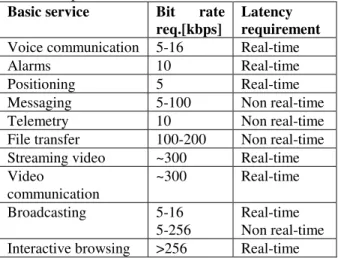
It is possible to identify a set of basic services, on top of which all required high-level applications can be built. The basic services are listed in table 1, along with the bit rate and latency requirements derived from analysis of requirements and expected use cases described in our source material.
Table 1 Summary of bit rate and latency requirements for some basic services
Basic service Bit rate req.[kbps]
Latency requirement
Voice communication 5-16 Real-time
Alarms 10 Real-time
Positioning 5 Real-time Messaging 5-100 Non real-time Telemetry 10 Non real-time File transfer 100-200 Non real-time Streaming video ~300 Real-time Video communication ~300 Real-time Broadcasting 5-16 5-256 Real-time Non real-time Interactive browsing >256 Real-time
Communication groups, both pre-defined and created dynamically to suit the situation at hand, should be possible to configure based on individual identities, organization role, current location or combinations of
these. Users need to be members of several groups, with the possibility to scan between them. The system must handle high numbers of communication groups, each extending in size up to several hundred users.
Requirements on network availability, coverage and capacity are stringent, in some cases even higher than for commercial mobile users. A situation particular to public safety is the (un-planned) gathering of very large numbers of users in a small area for a limited period of time, during a major incident. Such capacity peaks must be handled by the public safety communication system. Sometimes parts of the responders only need to listen, while some communicate actively. For example, at a large structural fire, involving hundreds of responders, quite a few will be on stand-by at the perimeter of the incident site. Using broadcast or multicast is a possible solution here.
A new communication system must be interoperable in some sense with existing public safety systems. Voice interoperability is the most important and means that voice communication groups can include participants using terminals with varying functionality and networks of different radio technology. Public safety users must also be able to communicate with users outside of the public safety system, including ordinary telephony users.
To summarize, there are explicit requirements from public safety organizations on voice and data communication, group configuration, large groups, coverage, capacity and service availability, some of which may be stronger than for commercial networks.
3. Technical solution
3.1. System Architecture
In the proposed concept, all services, including voice communication, are based on packet switched transmission. As an example, we use IMS (IP Multimedia Subsystem) [5] and PoC (Push-to-talk over Cellular) [6] for service realization. These solutions are selected mainly because they are related to the standardization of cellular technologies in 3GPP. Standardized solutions are preferred, but proprietary and dedicated solutions, fulfilling the same functional requirements, could be considered in an early phase.
The solution is designed to work over several different 3GPP radio access technologies, such as HSPA [7] or 3G LTE [8]. Public safety applications will run on top of any radio network connected to the IMS core. Some tuning of the radio network may be necessary to meet the strict latency requirements.
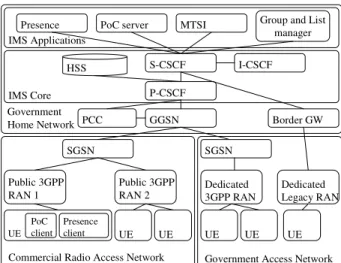
UE UE UE UE UE UE Public 3GPP RAN 1 Public 3GPP RAN 2 Dedicated 3GPP RAN Dedicated Legacy RAN Government Home Network IMS Applications
Presence PoC server Group and List manager S-CSCF P-CSCF I-CSCF IMS Core GGSN SGSN Border GW PoC client Presence client HSS MTSI PCC SGSN
Commercial Radio Access Network Government Access Network Figure 1 Functionalarchitecture overview.
Figure 1 shows the different entities of our architecture. The UE (User Equipment) is the mobile terminal, with which the users interact. The applications in the UE are IMS-based. For example, the PoC service consists of a PoC client running in the UE and an IMS application server, called the PoC server, in the network. It may also contain other user applications, such as a Presence client, MTSI (Multimedia Telephony Service over IMS) [9], video conferencing and data base lookup tools. Different UEs may be designed to suit the needs of different users. The UE connects over the air to the Radio Access Network (RAN).
In our solution commercial operators and governmental agencies cooperate to create the public safety network. With the commercial RANs sufficient coverage is achieved in populated areas. A government RAN complements the commercial RANs where the coverage is insufficient. It may also increase the capacity where necessary. Both commercial and government RANs are connected to the government home network. The RANs could use different technologies; belong to different operators, or both. Our solution is flexible supports many different configurations.
The core network (referred to as the government home network) is run by a governmental agency in the scenario of a national public safety system. Its nodes, GGSN (Gateway GPRS Support Node), PCC (Policy and Charging Control) and the IMS core are all standardized 3GPP nodes. The IMS core contains a number of SIP-proxies/registrars. Because the solution uses standardized 3GPP equipment, it will benefit from development of new technologies by 3GPP. This means that commercial, off-the-shelf (COTS)
equipment can be used, which decreases deployment costs.
Legacy public safety systems can be connected using a border gateway, in turn connecting to the IMS core. Legacy terminals like TETRA or P/25 terminals, can then still be used where such networks exist.
3.2. Applications
As previously mentioned, a public safety system must support one-to-one communication, group communication, video streaming, data sharing or text messaging. In standardized 3GPP technology, MTSI is the service defined for regular telephony and interoperability with circuit switched telephony systems. MTSI also supports multimedia enhancements like video telephony, real-time text chat, text messaging and sharing of images or video clips. Thus, MTSI fulfills the demands for one-to-one communication.
For mission critical group communication we chose OMA PoC. Open Mobile Alliance (OMA) is an industry forum to promote the use of data services in mobile networks. The current version of OMA PoC includes support for dispatcher functionality and inter-working with legacy public safety systems. Lately, OMA has started discussions to add multicast support.
OMA PoC supports a number of different PoC group session types, including ad-hoc group sessions, pre-determined sessions and chat group sessions.
In an ad-hoc group session, the calling user selects a number of callees that are all invited when the session is established. A pre-determined group session is defined by a group identifier that relates to a group list, stored in the group and list manager. A chat group session hosted by the PoC server and is associated with a group identifier, which needs to be provisioned to the PoC clients prior to communication.
The main differences between a chat group session and a pre-determined group session are that users in a chat group session are not invited when the chat group session is created but instead they must explicitly join. Also, the session is, in general, long-lived (not terminated by inactivity) and, because of this, radio connection re-establishment is not needed when the user wants to send.
All supported PoC group session types could be useful for public safety users, but for mission critical group communication the chat group session seems most promising due to its similarities with the operation of legacy public safety systems. The various PoC clients in the field can join the session at different points in time, for example at power on or at work shift
start. The dispatcher controls which users that are allowed to join the group. OMA PoC also supports simultaneous sessions, which allows a PoC client to listen to several sessions, much like an analogue radio terminal that scans a number of frequency channels.
Besides MTSI and OMA PoC, end users should have access to the presence enabler and the group and list manager. The presence enabler can be used to keep track of important information such as other users’ current availability to communicate and their geographical location. The group and list manager makes user-specific, service-related information accessible to the services that need the information. The communication groups used in OMA PoC are stored and managed in this network entity.
3.3. Security solutions
A public safety solution over cellular access will benefit from a rich service environment, as mentioned above. However, there are a number of threats like passive eavesdropping, active tampering with control messages and user traffic data, replay of valid intercepted messages and traffic and man-in-the-middle attacks, which the system has to cope with. For all services, the security requirements have to be further specified for a public safety context. An obvious (minimum) requirement is that all media is protected over the air, that signaling is secure, and that terminals and network have mutual authentication. These basic requirements are fulfilled by the underlying cellular system carrying the traffic. The cellular system is de-signed to offer a strong over-the-air protection of user and signaling traffic and also to provide a certain level of user privacy. The security mechanisms rely on mutual authentication between the user and the network, uses 128-bit keys, and is performed according to the 3GPP standard. There are also needs for end-to-end media security for MTSI, PoC and other IMS-based services, as discussed below.
The trust model used in 3GPP is basically built upon the assumption that core- and access networks nodes can be trusted to behave according to the defined protocols when communicating with each other, and that threats only come from outsiders and mainly focus on attacks over the radio path. The concept for public safety communication presented here is based on IMS and it should be noted that an implicit assumption for IMS security in 3GPP often is that the access network is trusted, at least with respect to user traffic protection.
For user authentication, IMS specifies a scheme called IMS AKA (Authentication and Key Agreement), which similarly to 3GPP cellular systems provides
mutual authentication between network and user. IMS Signaling traffic is integrity and optionally confidentiality protected from the terminal to the edge of the IMS domain and then hop-by-hop within the domain. User credentials and algorithms used for user authentication and registration are held in an ISIM (IP Multimedia Service Identity Module) similar to a SIM or USIM (UMTS SIM) used in the access domain.
In public safety environments, stronger requirements for security against attacks within the core of the system may be expected. The access network may not be completely trusted by the public safety organization. This leads to, as previously stated, requirements on end-to-end security, or at least security between the terminal and the domain trusted by the public safety operator. New security solutions for group-oriented services such as PoC are also needed. Such secure group communication poses special requirements on group key management schemes.
There are standardization activities already ongoing in both 3GPP and IETF to agree on MTSI media security solutions to complement the standardized signaling security solutions. Further standardization activities, directed at providing end-to-end security and group key management for PoC and other IMS services, will be necessary.
3.4. Radio access network aspects
For a flexible Public Safety service, an efficient high-quality voice service over packet switched (PS) transmission is required. A PS voice service has been a great challenge since RANs traditionally are optimized for circuit switched (CS) voice communication and best-effort PS data services. With current technologies such as EDGE or WCDMA, it is however possible to realize a conversational PS voice service and with the introduction of HSPA [7], the service performance and efficiency is further improved. Functionality is currently being standardized in the evolution of HSPA to handle the stricter requirements on low latency, imposed by the real-time nature of the group communication service. This means that additional efforts (compared to the standard) to comply with public safety requirements are none or small.
The push-to-talk service requires separate SIP (Session Initiation Protocol) signaling, which is performed over a different and separate logical channel. However, multiple data flows to one terminal are already supported, since the combination of different data flows for best effort was foreseen many years ago. Other parallel data flows, like additional services, can also be supported.
One benefit with PS services is that they are more flexible than corresponding CS services, which consumes a predetermined amount of radio resources. For our all-PS solution, a more flexible approach to make best use of existing radio conditions can be used. Link quality control schemes (LQC) that select the most appropriate modulation and coding scheme for current radio conditions, are used in HSPA and EDGE. This means that more robust coding is used when radio conditions are poor and less robust coding is used during good radio conditions. In this way, users in good radio conditions use less radio resources, thereby allowing users in worse conditions to use more. When the LQC is used in combination with hybrid ARQ (Automatic Re-transmission request) – HARQ – or incremental redundancy – IR – retransmissions are even more efficient since the retransmitted data is then combined with data from previous transmissions, which increases the likelihood that the data is correctly received.
In HSPA, the functionality of retransmissions is in the Node B. This is close to the user, reducing the end-to-end latency. Another improvement in HSPA is a transmit time interval (TTI) of 2 ms compared to 10 ms for WCDMA. This reduction further improves flexibility and latency performance. In short, with a suitable link quality control scheme, faster retransmissions and a shorter TTI, we can meet the requirements on low delay.
For public safety systems, the possibility to give different priority to different data streams (users) is of utmost importance. Priorities must be provided in the RAN as well as in the core network. Therefore priorities and pre-emption are supported by both the OMA PoC specifications [6] and the 3GPP QoS architecture [10]. In OMA PoC, there are four levels of talk burst request priority (Listen-only priority, Normal, High and Pre-emptive). For the RAN, Quality of Service in 3GPP Release 99 defines two kinds of priority; allocation and retention priority (ARP) and traffic handling priority (THP). THP can be used to give scheduling priority to certain data users. Four traffic classes are defined in 3GPP (Background, Interactive, Streaming and Conversational) and ARP can be used to prioritize different media flows over each other or for pre-emption of users in the access network in case of bandwidth shortage. The QoS concept will be further improved regarding the handling of both user and usage priority by standardizations in 3GPP Release 8.
In certain situations like large accidents, sporting events or concerts where a large number of public safety workers are in a small area the requirements for
capacity could be huge. For these cases the concept of MBMS (Multimedia Broadcast and Multicast services) could be used to reach all users at the same time. MBMS is standardized in 3GPP Release 6.
4. System performance analysis
As with any system for communication between individuals, capacity and latency are two important performance challenges. Compared to commercial systems, public safety systems must also support large groups of users communicating at the same time at a relatively small area, for example at an incident site. Recent investigations show that PS voice services over HSPA have the potential of matching or even exceeding CS speech capacity, [11], and it is expected that the capacity for PoC traffic will be in the same range. The reason is that HSPA is very efficient, with fast feedback, HARQ and radio link quality assisted scheduling. With current EDGE RAN, capacity is not in the same range, but the PoC service can still be served with satisfactory quality. Mobile base stations could also be used to temporarily improve capacity or coverage in incident areas.
Latency depends on the configuration and hardware capabilities of numerous nodes and interfaces, such as, the client application, mobile terminal processing, radio interface transport, core and service network processing and transport. Latency means, for example, how fast a user can get access in a PoC session, how fast a PoC session can be established or how quickly a file transfer can be made. OMA PoC has defined four Quality of Experience (QoE) factors to help benchmark the OMA PoC solution [6];
• QoE1: Right-to-speak response times during PoC
session establishment.
• QoE2: Start-to-Speak response time after PoC
session establishment.
• QoE3: End-to-end channel delay. • QoE4: Voice quality.
Due to different service situations between public safety users and general public users, we must carefully analyze the performance indicators as to what they actually mean and how we can realize the solution to decrease the experienced latency.
As an example, we take the situation where a policeman starts his mobile terminal at work shift start. The PoC application in the terminal would automatically register to the service network and join default groups, such as the general command center group or his patrol team group. Hence, the session is established prior to the time a crucial event may occur.
Thus, for this type of group realization QoE2 is relevant rather than QoE1.
HSPA has the potential to deliver media streams with excellent speech quality and very low end-to-end delays. With coming features, such as continuous packet connectivity (CPC) [12], it is expected that the QoE1 will be well below 1 second and QoE2 below 0.5 seconds. The transmission time for the voice data, QoE3, will reach 200-300 ms.
Measurements, in lab as well as live networks, for basic EDGE systems indicate QoE1 duration below 2 seconds. Single-phase access, that is, immediately requesting an EDGE channel rather than doing a first access over GPRS, and faster processing in network nodes and terminals are anticipated to bring QoE1 times to around 1 second. Measurements also show that QoE2, the more relevant QoE for emergency groups, will reach below 0.5 seconds. The transmission time, QoE3, over EDGE will be slightly higher than for HSPA, but less than 0.5 seconds. EDGE Evolution, [13], will further improve access times and latency performance.
Voice quality, QoE4, depends largely on choice of speech codec. It is believed that the voice codecs of the AMR (adaptive multi-rate) family, used in all 3GPP cellular systems, will deliver sufficient performance.
Another important benefit of HSPA is that it delivers high bitrates for file download, even when users are simultaneously involved in a PoC session. This is highly attractive in the scenario where a user takes road directions to an emergency site and can at the same time download maps of buildings or images of suspects. Currently, HSPA offers peak rates of 14 Mbps in downlink and 5 Mbps in uplink [14]. At the same time, EDGE offers peak rates of 250 kbps and with EDGE Evolution peak rates of 1 Mbps can be expected [13]. Many different service performance studies for HSPA have been conducted throughout the last years, see for example [11] for an evaluation of MTSI and [15] for TCP performance.
5. Conclusions
In this paper we propose a public safety communication system realized by COTS equipment standardized by 3GPP. In detail, our system uses a radio access network (EDGE, WCDMA or HSPA) and a core network based on IMS and SIP. It is possible to have parts of the system owned by commercial operators and complemented by governmental agencies for increased performance.
Our system supports several services such as one-to-one communication (realized by MTSI), group
communication (realized by OMA PoC), video services and data services.
The requirements on a public safety communication system are in many aspects tougher than on commercial systems. For example, the maximum capacity must be much higher, the latency must be very low, and all parts of the geography must be covered. This makes it very challenging to build a system for public safety communication.
Our analysis shows that mainstream cellular technology can be designed to meet the requirements on coverage, latency and capacity for the required services
6. References
[1] ETSI EN 300 392-1, V 1.2.1 “Terrestrial Trunked Radio (TETRA); Voice plus Data (V+D); Part 1: General network design”, January 2003
[2] http://www.project25.org
[3] D. Axiotis, D. Xenikos “UDP Performance
Measurements over TETRA IP”, in proceedings of VTC 2007 Spring.
[4] SAFECOM, Statement of Requirements for Public Safety Wireless Communications & Interoperability, Version 1.0, March 2004.
[5] G. Camarillo, M. García-Martín, ”The 3G IP
Multimedia Subsystem (IMS): Merging the Internet and the Cellular Worlds”, Wiley, 2006.
[6] Open Mobile Alliance, “Push to Talk over Cellular requirements, Approved Version 1.0”, June 2006 [7] H. Holma, A. Toskala, “HSDPA/HSUPA for UMTS –
High Speed Radio Access for Mobile
Communications”, Wiley, 2006.
[8] E. Dahlman et al. “3G evolution: HSPA and LTE for mobile broadband”, Elsevier Academic Press, 2007 [9] S. Chakraborty et al., ”IMS Multimedia Telephony over
Cellular Systems”, Wiley, 2007.
[10]3GPP, “Quality of Service (QoS) concept and architecture”, TS 23.107 v6.4.0, March 2006.
[11]M. Ericson et al., “Mixed Traffic HSDPA scheduling – Impact on VoIP Capacity”, in proceedings of VTC 2007 Spring.
[12]J. Bergman, M. Ericson, D. Gerstenberger, B. Göransson, J. Peisa, S. Wager, “HSPA Evolution – Boosting the performance of mobile broadband access.” Ericsson Review no 1, 2008
[13]ERICSSON, “The Evolution of EDGE”, White Paper, February 2007.
[14]ERICSSON, “Basic Concepts of HSPA”, White Paper, February 2007.
[15]J. Peisa et al., “End-to-End Performance of WCDMA Enhanced Uplink”, in proceedings of VTC 2005 Spring.