48
H
ow does academic development relate to teach-ing? This paper references surveys conducted by David Gosling in the UK and in South Africa on academic development in Australia to provide a basis for international comparison. While many parties in a university contribute to the enhancement of learn-ing and teachlearn-ing, in most universities at least one organizational unit is established. The generic term for the enterprise can be said to be an ‘academicde-velopment centre’ (ADC) – the body representing the heads of organizational units in Australia is the Council of Australian Directors of Academic Devel-opment (CADAD). The data referred to in this pa-per indicates that, while ‘academic’ could embrace all aspects of the role of academics, including research, innovation, and contributions to community and professional bodies, the focus will be on learning and teaching.
8
Strategic Approaches to Academic Development:
Relationship to Learning and Teaching
Peter Ling
Swinburne University of Technology
Most universities in Australia have established at least one organizational unit with a
responsibil-ity for academic development. While ‘academic’ could embrace all aspects of the role of academics,
including research, innovation, and contributions to community and professional bodies, the
expec-tation is that the focus will be on learning and teaching. In this paper, I address the extent to which
– and the sense in which – this is true. I use the results of several surveys conducted in Australia in
2007 and information emerging from a forum of Australian university personnel associated with
the development of academics. These sources show that academic development units often perform a
range of functions that go beyond the development of learning and teaching. Reviewing the available
data, I conclude that the current role of academic developers is very much influenced by strategic
pursuits of universities. In this climate, the potential for academic development to operate with the
integrity of a practice informed by the disciplined study of learning and teaching is more limited
than it was during periods where the understanding of learning and teaching drove the enterprise.
Purpose of Curriculum Mapping
In the English and Australian context, three broad approaches to academic development have been distinguished. They emerged in a chronological se-quence, but now they co-exist. They have been classed as teaching-oriented, learning-oriented, and strategically-oriented (Table 1; Ling, 2005).
Teaching-oriented approaches focus on teaching techniques underpinned in Australia by the HERD-SA Green Guides series that includes booklets like Conducting Tutorials (Lublin, 1987) and Lecturing (Cannon, 1992). In the UK, there are books like 53 Interesting Things to do In Your Lectures (Gibbs, Habeshaw, & Habeshaw, 1987) and similar pub-lications of Bristol, Technical, and Educational Services, later surpassed by 2000 Tips for Lectur-ers (Race, 1999). The learning-oriented approach, on the other hand, is epitomized by the UK Staff and Education Development Association (SEDA) publication, Nevermind the Teaching, Feel the Learn-ing (Race, 1993), and by the writing of John Biggs (1999), which focuses on what the learner does rather than what the teacher does. Learning-orient-ed approaches have been informLearning-orient-ed by research into learning in higher education, such as those based on phenomenography, associated with the work of Fe-rence Marton (Svensson, 1997). With this concep-tual underpinning, academic development could be said to be a discipline in its own right.
In the current context, academic develop-ment is also influenced by strategic concerns in universities as they come to operate in a competi-tive environment (Marginson & Considine, 2000). In appealing to the clientele of universities and to their prospective employers, strategic approaches may address aspects of the learning environment ranging from online and library facilities to student support and the management of learning resources, including the management of staff. They are like-ly to involve quality assurance and improvement measures.
Methodology
In this paper, I take an interpretative, descriptive ap-proach using literature and available data derived from surveys, expert input, and focus groups. The survey data includes:
• Data from a survey of directors of academic development in Australia. The survey was conducted by David Gosling (2008) and is largely based on previous surveys he conduct-ed with directors of conduct-educational development units in the UK.
• Data collected from CADAD members by Sharon Parry and Yoni Ryan on the Roles and Responsibilities of Academic Development Units in Australia, November 2006.
• Data from a September 2007 survey of Aus-tralian academic developers on their roles in the development of academics as teachers and the strategies they employ. The survey was un-dertaken by the project team for the Austra-lian Learning and Teaching Council (ALTC) project, the Development of Academics and Higher Education Futures (DAHEF) (Ling and Council of Australian Directors of Aca-demic Development, in press). Support for the original work was provided by the Aus-tralian Learning and Teaching Council, an initiative of the Australian Government De-partment of Education, Employment, and Workplace Relations.
Table 1
Approaches to Academic Development Approach Focus of academic
development activities
Teaching-oriented Teaching strategies/teaching tips
Learning-oriented How students learn and what students learn
Strategic-oriented Strategies to assure institutional objectives are met
Expert opinion and focus group reflections are de-rived from records of a forum on academic develop-ment representatives of all universities in Australia involving academic developers and other key players in the development of academics. The forum was an element of the DAHEF project.
Data
Key components of the survey data informing the findings relate to the actual activities of academic de-velopment units placed against the importance given to possible functions of units.
Data for Australian directors of academic development derived from David Gosling’s survey are provided in Table 2 (data is given in percentage of responses). The table compares the extent of the provision with the importance directors attribute to activities. Responses given are those at the upper end of a five-point scale classified as provided to ‘a great extent’ and ‘moderate extent’ against those rated as ‘very’ or ‘moderately important.’
Data for Australian academic developers de-rived from the DAHEF project survey is provided in Table 3 (data is given in percentage of responses). The table compares the extent of the provision with the im-portance academic developers attribute to activities.
Data from other questions in the surveys and from the forum also inform the findings below.
Findings
Academic development in Australia is a complex busi-ness. ADCs engage in functions such as provision of formal and informal professional development pro-grams on learning and teaching, curriculum devel-opment, and support of individual or team learning and teaching initiatives. Some engage in educational research. They may also be responsible for: learning resources’ design and production; provision of edu-cational media services and online learning manage-ment system support; study skills and student sup-port; support of graduate attribute initiatives; and leadership and management development.
ADCs then have a strong but not exclusive focus on learning and teaching. Gosling’s (2008) survey of Australian directors of ADCs and the CA-DAD survey of its members indicate that the orga-nizational units involved include the terms learning and teaching in their unit names in about a quarter of the cases reported. Just as many have titles that re-fer to professional development or staff development. Fewer have the label ‘academic development.’ Some have titles that indicate a wider charter being
associ-Table 2
Survey of Directors on Academic Development (n=19)
Activity Provided Important
Promote scholarship of teaching and learning 84 84 Assist in planning and policy development 74 90 Advice on learning and teaching in higher education 68 79 Promote research in learning and teaching in higher education 63 79 Training in use of ICT/e-learning 63 79 Design of online learning materials 53 58 Post-grad course in learning and teaching in higher education 53 79 Engage in planning and policy development 53 90 Administer student feedback on teaching units 37 63
ated either with flexible or distance education or with research. The nature of their engagement with learn-ing and teachlearn-ing appears more aligned to the ‘strate-gic’ category, referred to in the section above, than to the ‘learning’ or ‘teaching’ categories. Their goals or mission statements indicate an orientation to the strategic approach. Most relate to assisting the uni-versity in fulfilling its strategic plan or goals relating to learning and teaching. Few of the units cite mis-sions independent of their university’s central plan or strategy. Gosling (2008) reported:
Managers [of universities] often look to ADCs to produce policies because they are themselves under pressure from external (regional or federal) policies. These external pressures increasingly require ADCs to be-have in ways that fit institutional priorities. The core elements expressed in the mission of the majority of centres whose directors responded to the survey were:
• supporting the institutions’ strategic goals; • providing professional development of staff.
Under this heading are included in provision of courses, mentoring, staff induction. A few mission statements specifically included
man-agement and leadership development; and • facilitating learning and teaching initiatives to
improve the quality of teaching and learning. An alternative approach to determining ADC per-formance is to use external measures of success. Ex-ternal measures – such as university performance on the Learning and Teaching Performance Fund, the number of ALTC awards, citations, or grants re-ceived by members of the university, or new learning technologies – were cited by ADC directors as having a very high impact on their work. Few use internal measures such as the completion of professional de-velopment sessions or participation in graduate cer-tificate programs in university teaching conducted by the centre.
While the ADC directors and academic de-velopers report that publications on learning and teaching have the most influence on them, other topics that rate highly include staff development and organizational change. Many state journals relating to academic development generally influence them. These cover a range of issues in the development of higher education (Gosling, 2008).
Distinctions between what both ADC direc-tors and academic developers rate as important, and the activities they actually engage in, suggest some
Table 3
Survey of Academic Developers (n=53)
Activity Provided Important
Promote scholarship of teaching and learning 81 92 Assist in planning and policy development 70 85 Advice on learning and teaching in higher education 88 91 Promote research in learning and teaching in higher education 73 95 Training in use of ICT/elearning - -Design of online learning materials 51 54 Post grad course in learning and teaching in higher education 40 82 Engage in planning and policy development 63 88 Administer student feedback on teaching units 11 55
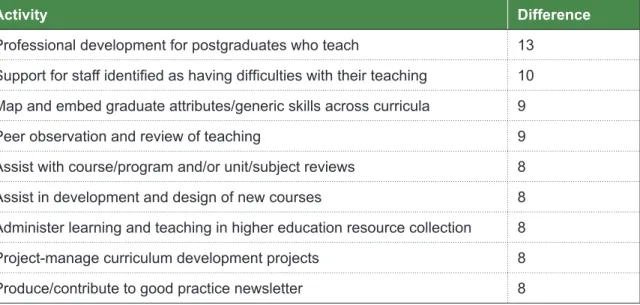
disjunction between the priorities of academic de-velopment professionals and institutional practices. ADC directors and academic developers are generally not opposed to taking a strategic approach (and they rate the current external and internal environments, which support a strategic approach as favourable), but they would like to have more input in determin-ing priorities. They also think that it is important to emphasize the professional development of academic staff, evaluation and review activities, curriculum development, and research and scholarship than is currently the case. The data in table 4 indicates that ADC directors see that matters relating more directly to the development of academics as teachers and to curriculum development are underprovided against matters relating to institutional strategic interests.
Table 4 represents the number of respon-dents who rated the activity as very or moderately important against the number who said the activity was provided to a great or moderate extent.
This is not to say that a strategic approach to academic development has led to a diminished fo-cus on learning and teaching in universities. On the contrary, learning and teaching performance and/or involvement in the scholarship of learning and teach-ing are now likely to be explicitly valued in academic promotion policies and in performance review
proce-dures. In addition, most ADC directors and academ-ic developers are engaged as academacadem-ics rather than as general staff, indicating recognition of this area as academic. The issue is the extent to which these de-velopments are driven by an informed concern with development of learning and teaching rather than a concern with strategic positioning of institutions.
Conclusion
The question I addressed in this paper was how does academic development relate to teaching? A func-tional answer and a qualitative answer are proffered. On the functional side, the data available suggests that organizational units associated with academic development often perform a range of functions that go beyond the development of learn-ing and teachlearn-ing. Activities in which they also engage include: educational media production and support; provision of student study skills programs; leadership and management development; preparation for ex-ternal teaching awards; student evaluation of teach-ing and workteach-ing with quality assurance measures; and contributing to the broad policy environment of a university and to its strategic directions.
On the qualitative side, I return to the
differ-Table 4
Discrepancies in Ranking of Provision of Activities and Importance
Activity Difference
Professional development for postgraduates who teach 13 Support for staff identified as having difficulties with their teaching 10 Map and embed graduate attributes/generic skills across curricula 9 Peer observation and review of teaching 9 Assist with course/program and/or unit/subject reviews 8 Assist in development and design of new courses 8 Administer learning and teaching in higher education resource collection 8 Project-manage curriculum development projects 8 Produce/contribute to good practice newsletter 8
ences between teaching-oriented, learning-oriented, and strategically-oriented approaches to academic development (Table 1). The categories are not ex-clusive but information supplied by ADC directors and academic developers through surveys and fo-cus groups suggests that the current orientation of academic development in Australia is, in the main, strategic. While the input of academic developers to universities may be informed by their understand-ing of learnunderstand-ing and teachunderstand-ing in higher education, the agenda and measures of success are determined by institutional priorities – an area in which ADC directors would like to have a greater say than they currently do. In that sense, the potential for academic development to operate with the integrity of a prac-tice informed by a disciplined study of learning and teaching is more limited than it was during periods where understandings of learning and teaching drove the enterprise. The current approach is instrumental and geared to performance measures rather than to the enhancement of learning per se.
Acknowledgements
The author acknowledges the contributions of all in-volved in the DAHEF project, particularly the refer-ence group – Sharon Parry, Yoni Ryan, Allan Goody, Margaret Hicks, and Lynne Hunt – along with the research contributions of David Gosling and Jenny Bird.
References
Biggs, J. (1999). What the student does: Teaching for enhanced learning. Higher Education Research & Development, 18(1), 57 – 75.
Cannon, R. (1992). Lecturing. Canberra: HERDSA. Gibbs, G., Habeshaw, S., & Habeshaw, T. (1987). 53
interesting things to do in your lectures. Bristol: Technical and Educational Services.
Gosling, D. (2008) Survey of directors of academic
de-velopment in Australian universities: Final re-port. Retrieved from http://www.swinburne. edu.au/spl/dahef/survey.html
Ling, P. and Council of Australian Directors of Aca-demic Development (in press). Development of academics and higher education futures, Vol. 2 data and analysis. Sydney: Australian Learn-ing and TeachLearn-ing Council.
Ling, P. (2005). From a community of scholars to a company. In K. Fraser (Ed.), Educational de-velopment and leadership in higher education (pp. 6-15). London: RoutledgeFalmer.
Lublin, J. (1987). Conducting tutorials. Canberra: HERDSA.
Marginson, S., & Considine, M. (2000). The enter-prise university: Power, governance and rein-vention in Australia. Cambridge: Cambridge University Press.
Race, P. (1999). 2000 tips for lecturers. London: Ko-gan Page.
Race, P. (Ed.). (1993). Never mind the teaching, feel the learning. London: SEDA.
Svensson, L. (1997). Theoretical foundations of phe-nomenography. Higher Education Research & Development, 16(2), 159 - 171.
Biography
Peter Ling is an Associate Professor and the Associate Dean in Swinburne Professional Learning at Swin-burne University of Technology, Melbourne, Austra-lia. Peter has performed as principal researcher in sev-eral national projects including The Development of Academics and Higher Education Futures, Australian Learning and Teaching Council, 2009.