An E-Business Strategy
Bogdan GHILIC-MICU, Bucharest, Romania, [email protected]
Marinela MIRCEA, Bucharest, Romania, [email protected]
On the last decade the integration of e-business into organizations has increased, but there are still difficulties during this process. In the present environment any organization must in-clude into their business plan the possibility of identifying the e-business integration method, the implementation cost, and the expected results. The article’s aim is to analyze the neces-sary means and steps in e-business integration into the business plan of an organization.
Keywords: e-business, e-strategy, business plan, digital economy.
t the present there are many organiza-tions, mostly small and middle-sized, which do not use at full capacity the avail-able technology and knowledge. They did not include in their business plan methods of cre-ating e-business strategies that would align to present standard of organization strategy.
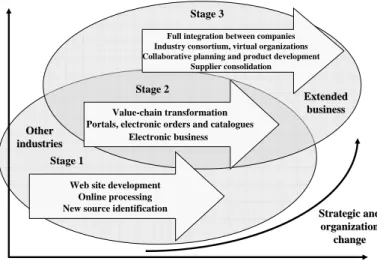
Development of e-business imposes integra-tion and alignment of business processes and staff to the present organization strategy. Within the present business environment, an organization may be situated in one of the following stages of e-business integration process [Jatko & Proksch, 2004] (figure 1): Business value
Time
Web site development Online processing New source identification
Value-chain transformation Portals, electronic orders and catalogues
Electronic business
Full integration between companies Industry consortium, virtual organizations Collaborative planning and product development
Supplier consolidation Stage 1 Stage 2 Stage 3 Strategic and Strategic and organization organization change change Extended Extended business business Other Other industries industries
Figure 1. Leverage of e-business
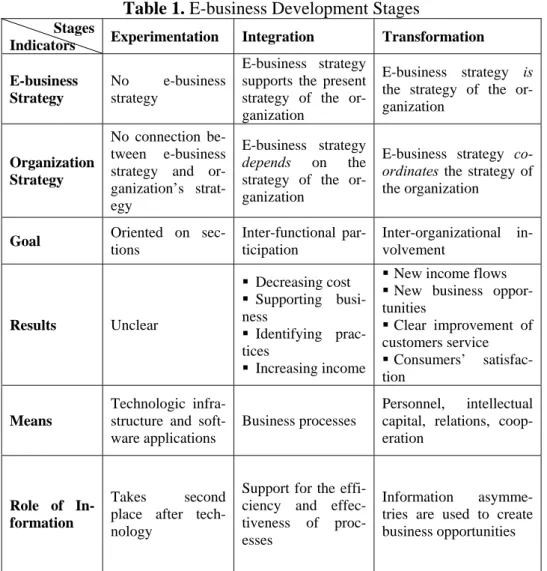
1) Experimentation. Many organizations
are still in the experimentation stage. At this stage, the individual departments of the or-ganization develop separate Internet applica-tions that are not connected to the business or e-business strategy of the organization.
2) Integration. At this stage the integration
of e-businesses takes place. It must support the current business strategies by integration of function departments. Organizations focus on the direct support given by the present businesses. Their goals are decreasing costs, increasing income and implementing the business support given by the existing
mod-els.
3) Transformation. Organizations use
e-business strategy to coordinate the organiza-tion’s strategy. Inter-organizational processes are enlarged to the level of business custom-ers, suppliers and partners. The organiza-tions’ value channel becomes interconnected, leading to identification of new sources of income and the increase of customers’ satis-faction. Passing to the transformation stage involves understanding of business processes of company, customers, suppliers and com-petitors.
Table 1. E-business Development Stages Stages
Indicators Experimentation Integration Transformation
E-business Strategy
No e-business strategy
E-business strategy supports the present strategy of the or-ganization
E-business strategy is the strategy of the or-ganization
Organization Strategy
No connection be-tween e-business strategy and or-ganization’s strat-egy
E-business strategy depends on the strategy of the or-ganization
E-business strategy co-ordinates the strategy of the organization
Goal Oriented on
sec-tions Inter-functional par-ticipation Inter-organizational in-volvement Results Unclear Decreasing cost Supporting busi-ness Identifying prac-tices Increasing income
New income flows New business oppor-tunities Clear improvement of customers service Consumers’ satisfac-tion Means Technologic infra-structure and soft-ware applications
Business processes
Personnel, intellectual capital, relations, coop-eration
Role of In-formation
Takes second place after tech-nology
Support for the effi-ciency and effec-tiveness of proc-esses
Information asymme-tries are used to create business opportunities
Source: Hackbarth, G. and Kettinger, W. J., Building an E-business strategy, 2000, Information Systems Man-agement, vol 17, page 78
In adopting the e-business strategy a main factor is products specificity. For products that do not have a fixed relative degree of value to be added (automobile industry), the objective that determines evolution of busi-ness models tends to be limited. On the other hand, when new types of products ad ser-vices may appear (advertising, food produc-tion), there are a great variety of e-business models that can be implemented [Barsauskas & Sarapovas, 2004].
The integration process of e-business into the business plan may be achieved by getting through two stages: a) creation of e-business strategy, and b) development of application environment and implementation.
A. Creation of E-business Strategy
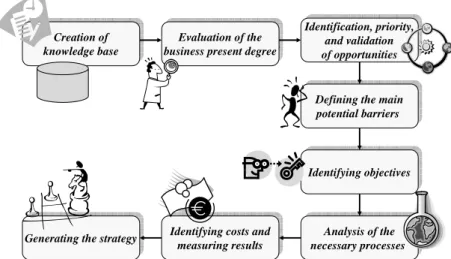
Starting from the present trend of customer oriented business, we present below the main stages needed for creation of e-business strategy (figure 2).
Creation of knowledge baseCreation of knowledge base
Evaluation of the business present degreeEvaluation of the business present degree
Identification, priority, and validation of opportunities Identification, priority, and validation of opportunities
Defining the main potential barriers Defining the main potential barriers
Generating the strategy Generating the strategy
Identifying costs and measuring results Identifying costs and
measuring results
Analysis of the necessary processesAnalysis of the necessary processes
Identifying objectives Identifying objectives
Figure 2. Creation of E-business Strategy
A.1. Creation of knowledge base. The
or-ganization’s knowledge base allows a com-prehensive view on the customers’ needs and organization’s capacity to satisfy them. The knowledge base represents the starting point in settling the value that may be added for the customers. It must include at least informa-tion on [Singh, ****]:
- customers: identifying the customers on the
target market, the customers’ profile, the change options, the value to be added to cus-tomers, customers relation trends;
- competition: identifying direct competitors
and strong/weak points;
- technological tendencies: technological
evolution and implications;
- economic and environment tendencies.
A.2. Evaluation of the present degree of
business by identifying the strong and weak
points and the difficulties in solving possible problems of the organization. This stage helps finding the competence that serves the best customers needs and create the starting point in restructuring the value chain of the organization. Within the organization must be evaluated at least the following domains [Singh, ****]:
- the interface with the customer: selling
process, e-commerce, marketing, service, distribution channels;
- production: creation, distribution, supply
channels, production programming, stock management;
- human resources: culture, knowledge,
knowledge management;
- technology: resource planning systems,
networks, web sites, intranet, security, IT knowledge;
- infrastructure: financial systems, research
and development, human resources;
- stakeholders: identifying main, analysis of
target stakeholders’ processes, distribution of power between stakeholders.
At this stage the function strategies and the management strategy of the organization must be framed. If the management strategy of the organization entails diversifying the market or new products/services for new markets, the level of costs for these markets must be evaluated.
A.3. Identification, priority, and validation of
opportunities for the organization in
e-business integration. One of the possibilities
that organizations have in finding e-business opportunities is focusing on factors CTQ (Critical To Quality) of each stage of buyer’s experience. These stages may be [Barsauskas & Sarapovas, 2004]:
1. the buying experience: information
ob-tained when interaction with the company is made within the present process and mecha-nism of buying;
2. delivery, installation, and use of the
product or service;
3. supplements (activities that are needed to
extend the value of the product/service).
4. product maintenance and service (simple
and quick process);
5. disposal (presence of useless features of
The five stages of buyer’s experience may be analyzed from the point of view of means of approaching the customer on increasing qual-ity features. The means by which products and services increase quality for the custom-ers must be identified at this stage [Bar-sauskas & Sarapovas, 2004]:
- customer’s productivity: the product allows
the customer to achieve more with lesser re-sources in a shorter time;
- simplicity: the product is easy to buy, use
and maintain;
- convenience: the product is easy to get,
suitable to use;
- risk: the product reduces the legal,
physi-cal, and financial risk for the buyer;
- entertainment and image: the product
cre-ates a new entertainment;
- Environmental friendliness: the diminishes
frustration of previous stage of use or de-struction.
This approach helps the organization focus on developing strategies for the most critical stages of the buyer’s experience and on creat-ing exceptional value to the customer. Among the opportunities that organizations may find by integrating e-business are:
new markets, eliminate territorial
barri-ers;
new sources of income from publicity,
online services, and virtual communities, selling data on customers;
access to complete information on
cus-tomers profile;
creating value by providing new ways of
payment;
decreasing costs;
rapid decision making and reaction
ca-pacity;
continuous flow of new business
oppor-tunities generated by significant absence of qualified selling resources, and by low de-fined selling processes (generally with no technological support);
electronic marketing.
Priority of opportunities must be achieved according to the capacities of the organiza-tion, to the way the e-business integration strategy is aligned to the present strategy of the organization and to the results that may
be reached. Opportunities that have been found and organized must be validated by comparison to similar experience etc.
A.4. Defining the main potential
barri-ers/problems and finding new ways of
solv-ing them. Any organization, especially the
small and the middle-sized ones, may face problems in the process of adopting e-business. Therefore, finding and defining the main potential barriers/problems and finding new ways of solving them represents an im-portant stage in the e-business integration strategy. In the process of e-business integra-tion an organizaintegra-tion may face problems gen-erated by:
organizational culture, the personnel cost
and training;
conflict between channels;
lack of integrated approach for the
sys-tem infrastructure;
lack of technical standardization;
lack of consistency and convenience of
user interface;
old legal systems;
lack of technical knowledge on
com-puters and e-business, both at the managerial and the executive levels;
lack of methodology on e-business
pro-ject development.
At the level of the small and the middle-sized enterprises, the main barriers in adopting B2B business may be the following [Bar-sauskas & Sarapovas, 2004]:
- Small and the middle-sized enterprises
have reduced opening towards new concepts. They cannot afford experiment the new con-cepts.
- Style of business is different; the business
relations are based on personal relations and community bonds;
- Small and the middle-sized enterprises
have a big opportunity cost. They cannot af-ford to make mistakes, as any mistake may be fatal.
- Difficulties in getting access to successful
experiences of other organizations;
- Small and the middle-sized enterprises
have different features of competition pres-sure;
- Narrow band of Internet;
- Small and the middle-sized enterprises
are under smaller pressure to reduce opera-tional costs;
- Lack of experience
/education/understanding of e-business
- ICT Infrastructure implemented at the
present is generally based on individual ICT systems while solutions increase year after year;
- Technological cycles are rapidly
chang-ing.
Solutions must be found for each prob-lem/barrier in order to solve/eliminate them. In order to successfully implement an e-business initiative it is necessary that strategy development cover the adoption difficulty.
A.5. Identifying objectives for e-business
in-tegration involves finding opportunities that
can bring the highest value to the customers
and for which exist the necessary compe-tence. Identifying of objectives is based on the results of previous stages.
A.6. Analysis of the necessary processes for
e-business introduction and integration. At
this stage the necessary processes for e-business introduction and integration (change and/or elimination of existing processes, ex-ternalization of certain processes, - redesign organization processes; new processes) must be identified and analyzed with regard to the general impact on the organization.
A.7. Identifying costs and measuring results.
In choosing the e-business implementation strategy, a decisive factor is represented by its costs and results. In measuring these re-sults there must be taken into account the in-dicators of performance (that show the plan of business value to be provided in order to take the advantages of digital capacities, the way this value will be incorporated into products, services or experience), as well as the resulted advantages/disadvantages.
The main advantages of e-business are:
• extension of the market and global access
by eliminating traditional frontiers;
• larger visibility, as the internet is an open
door for information;
• improved receptivity, leading to better
rela-tions with customers and partners; low cost
in-terconnectivity as an efficient method to re-spond to costumers demands.
• new services by Internet with the
oppor-tunity to introduce lowest cost services for customers, partners and employees (e-payment, online service, online advertising, etc.) [Singh, ****].
• intensifying and improving business
rela-tions as the electronic environment facilitates communication between organizations and
customers (open standards associated to
internet provide interoperability between companies and sites) [Singh, ****].
• low costs.
• Disadvantages of e-business are mainly:
• conflicts between channels, competition
(www intensifies competition and globaliza-tion);
• customer’s loyalty: one of the effects of
ICT is th easiness with which a customer may surf the internet in order to satisfy its needs; on the other hand, the internet reduces the cost of customer’s transfer from one pro-vider to the other, and when the business does not creates customer experience this problem amplifies [Singh, ****];
• the legal environment and copying: the
electronic copying environment and any in-formation published on the net is accessible to be copied; in such a situation there is little protection (at the present there is no global jurisdiction for the www) [Singh, ****];
• security and confidentiality of
informa-tion.
A.8. Generating the strategy based on the
re-sults of previous stages. Strategy must in-clude at least the description of the project, the estimation and eventual risks. In order to implement a successful e-business, organiza-tions must provide interfaces relating to the partners (suppliers, customers).
B. Development of application environ-ment.
B.1. E-business design. This stage relates the
e-business project, the business objective, and the technologic base, helping at the find-ing the environment needed by the applica-tion. The detailed e-business project or appli-cation environment strategy ensures the pass-ing from what to how it has to be done in
or-der to create value. The application must take the capacities offered by Internet and trans-form them into value to the customers in or-der to achieve a clear competition advantage.
B.2. Development and integration of the
ap-plication. After application development
stage, according to the detailed e-business project, takes place the integration of the ap-plication at all levels of organization. Integra-tion means aligning the business processes and the personnel to the present strategy of the organization.
Conclusion
One of the main objectives within the trans-formation process of the organization is get-ting competition advantage in entering new markets and attracting new customers. The question is what strategy the organization must adopt in order to create an e-business strategy that would transform the advantages offered by the electronic environment into value to the customers. The organization must adopt an e-strategy that can bring the
highestvalue to the customers and for which
exist the necessary competence.
References
[1] [Alonso & Fitzgerald, 2004] Fernando
Alonso and Guy Fitzgerald, AN ANALYSIS OF STAGES OF GROWTH MODELS IN SMES E-BUSINESS PROGRESSION, European & Mediterranean Conference on Information Systems, 25-27 July 2004, Tu-nis, Tunisia
[2] [Barsauskas & Sarapovas, 2004] Petras
Barsauskas, Tadas Sarapovas, „Problems of e-business implementation in SMEs”, ISSN 1392-1258 Economika 2004, 65, http://www.leidykla.vu.lt/inetleid/ekonom/65 /straipsniai/str1.pdf
[3] [Jatko & Proksch, 2004] Ulrika Jatko,
Tobias Proksch, Expanding Businesses by Intergrating E-business Strategies, 2004, ISSN 1404 – 5508, http://epubl.ltu.se/1404-5508/2004/115/LTU-SHU-EX-04115-SE.pdf [4] [Jutla et. al, 2001] D. N. Jutla, J. Craig, P. Bodorik, A Methodology for Creating e-Business Strategy, Proceedings of the 34th Hawaii International Conference on System Sciences – 2001, 0-7695-0981-9/01 $10.00
(c) 2001 IEEE, http://csdl2.computer.org/comp/proceedings/
hicss/2001/0981/07/09817042.pdf
[5] [Singh, ****] Mandeep Singh, A Primer
on Developing An E-Business Strategy http://www.illinoisbiz.biz/nr/rdonlyres/36081