AUSTRALIAN JOURNAL OF BASIC AND
Open Access Journal
Published BY AENSI Publication
© 2016 AENSI Publisher All rights reserved
This work is licensed under the Creative Commons Attribution International License (CC BY). http://creativecommons.org/licenses/by/4.0/
To Cite This Article: Balajee Maram K. and J.M. Gnanasekar., Generation of a Dynamic Random 16x16 S Prime Numbers and Secret-Key. Aust. J. Basic & Appl. Sci.,
UNICODE Text Security
BOX
1Balajee Maram K. and 2J.M. Gnanasekar
1Ph.D(CS) Scholar, Research and Development Centre, Bharathiar University,
INDIA
2Professor, Department of Computer Science & Engineering,
Address For Correspondence:
Balajee Maram K., Ph.D(CS) Scholar, Research and Development Centre, Bharathiar University, Coimbatore, Sr. Asst. Prof., Dept GMRIT, Rajam, INDIA.
E-mail: [email protected].
A R T I C L E I N F O
Article history:
Received 10 November 2015 Accepted 30 December 2015 Available online 18 January 2016
Keywords:
UNICODE, S-box, UTF, ASCII, Cryptography.
In the public internet, information is being attacked and misused by hackers at different levels in the digital communication (William Stallings, 2004
(Charles, P., 2004). There are two types of encryption are called as Symmetric
key encryption. Symmetric-encryption algorithms are 1000 times faster than Asymmetric algorithms. Still, Symmetric-key cryptography algorithms are
communication channels (Dragos Trinca, 2006 AES (Advanced Encryption Standard)
Encryption Standard) (http://csrc.nist.gov/publications/fips/fips1185/ worldwide. The Tiny Encryption Algorithm (TEA)
the fastest and efficient algorithm which uses op
SHIFT. TEA satisfies Shannon’s properties confusion and diffusion which are important for a security of block ciphers. But TEA suffers from equivalent keys, because its key size is only 126
Literature (Gupta, V. and S. Gupta, 2001
cryptography algorithms are not suitable to low processing devices like mobile devices, because low processing devices have slow processor, limited battery and limited memory.
AUSTRALIAN JOURNAL OF BASIC AND
APPLIED SCIENCES
ISSN:1991-8178 EISSN: 2309-8414 Journal home page: www.ajbasweb.com
© 2016 AENSI Publisher All rights reserved
This work is licensed under the Creative Commons Attribution International License (CC BY). http://creativecommons.org/licenses/by/4.0/
Balajee Maram K. and J.M. Gnanasekar., Generation of a Dynamic Random 16x16 S-Box for Unicode Text Using
Aust. J. Basic & Appl. Sci., 10(1): 26-36, 2016
Security Using Dynamic and Key-Dependent 16x16 S
Ph.D(CS) Scholar, Research and Development Centre, Bharathiar University, Coimbatore, Sr. Asst. Prof., Dept. of CSE, GMRIT, Rajam,
Professor, Department of Computer Science & Engineering, Sri Venkateswara College of Engineering, Sriperumbudur
Balajee Maram K., Ph.D(CS) Scholar, Research and Development Centre, Bharathiar University, Coimbatore, Sr. Asst. Prof., Dept
A B S T R A C T
The tremendous development in digital communication/data transmission over internet and severe threats from eavesdroppers/cyber attackers leads to concentrate on robust cryptography algorithms. In data transmission over internet, many symmetric cryptography algorithms have been introduced using S-box which provides security. S box is very important component for some cluster of Cry
cryptography algorithms depend on static S-box, which yields insecurity to the digital data. The existing S-box generation algorithms are able to handle ASCII text only. This research paper presents the Substitution Box(S-box) th
dependent. Dynamic and key-dependent S-box wraps the data with high security. The proposed S-box works with UNICODE text which includes UTF
32 versions. It was tested on UNICODE text using PYTHON language. The result conclude that the proposed S-box is suitable for UNICODE text and shown better performance.
INTRODUCTION
In the public internet, information is being attacked and misused by hackers at different levels in the digital William Stallings, 2004). Such type of attacks can be avoided through Data Encryption . There are two types of encryption are called as Symmetric-key encryption and Asymmetric
encryption algorithms are 1000 times faster than Asymmetric
key cryptography algorithms are being used to exchange data over insecure Dragos Trinca, 2006). The block ciphers such as DES (Data Encryption Standard), AES (Advanced Encryption Standard) (http://csrc.nist.gov/publications/fips/fips197/), and EES (Escrowed http://csrc.nist.gov/publications/fips/fips1185/) are being used by many companies in worldwide. The Tiny Encryption Algorithm (TEA) (Hernández, 2002; Hernández, 2003;
the fastest and efficient algorithm which uses operations from orthogonal algebraic groups like XOR, ADD and SHIFT. TEA satisfies Shannon’s properties confusion and diffusion which are important for a security of block ciphers. But TEA suffers from equivalent keys, because its key size is only 126-bits
Gupta, V. and S. Gupta, 2001; Daswani, N. and D. Boneh, 1999) suggests the traditional cryptography algorithms are not suitable to low processing devices like mobile devices, because low processing devices have slow processor, limited battery and limited memory.
Box for Unicode Text Using
Dependent 16x16
S-Sr. Asst. Prof., Dept. of CSE, GMRIT, Rajam,
Sriperumbudur, Tamil Nadu.
Balajee Maram K., Ph.D(CS) Scholar, Research and Development Centre, Bharathiar University, Coimbatore, Sr. Asst. Prof., Dept. of CSE,
The tremendous development in digital communication/data transmission over internet attackers leads to concentrate on robust cryptography algorithms. In data transmission over internet, many symmetric box which provides security. S-box is very important component for some cluster of Cryptography algorithms. Some
box, which yields insecurity to the digital box generation algorithms are able to handle ASCII text only. This box) that is dynamic and key-box wraps the data with high security. The box works with UNICODE text which includes 8, 16 and UTF-32 versions. It was tested on UNICODE text using PYTHON language. The results
box is suitable for UNICODE text and shown better
In the public internet, information is being attacked and misused by hackers at different levels in the digital . Such type of attacks can be avoided through Data Encryption key encryption and Asymmetric-encryption algorithms are 1000 times faster than Asymmetric-Asymmetric-encryption
Confusion and Diffusion is an important characteristic for Information Security. Confusion is being provided by different forms of existing Substitution Boxes (S-Box) S-Box is a building block of Information Security. S-Box is a desirable and important component in symmetric cryptography. S-Box is a mapping table which translates n-bits to m-bits. The design and analysis of a strong S-Box is a time consuming process, because it supports nonlinearity to the cryptosystems. But the limitations in the S-Box leads to break easily (Adams, C. and S. vTavares, 1990; Hussain, I., 2010). The S-Box design is being suffered from two major challenges. They are S-Box Searching and Verification of S-Box against the desired properties for an S-Box (Ahmed, N.,).
The block ciphers are depends on the Substitution-Permutation (SP) concept. S-Box is a nonlinear component which enables block cipher is resistant to various attacks suck as linear and differential cryptanalysis. This is achieved in SP networks when S-Box satisfies the criteria like Avalanche Effect, Strict Avalanche (SAC) and Bit Independence Criteria (BIC), nonlinearity and maximum expected linear probability (MELP) etc. These are the desirable properties for S-Box design (Vergili, I.l., Yücel, M.D. (Eds.), 2000; Vergili, I., M.D. Yücel, 2001; Keliher, L., 1997; Keliher, L., 2005).
Instead static S-Box, random key-dependent S-Boxes are being generated for encryption process and S-Box are generated and checked until a strong S-Box is found (Mroczkowski, P., 2009). Recent technology supports static or dynamic S-box generation that supports ASCII values only. Many S-box generation techniques have been introduced that supports ASCII characters only. The traditional coding Scheme ASCII supports 256 characters and extended ASCII supports 512 characters only. Many countries developing their own character coding techniques which support their national languages. Latest technology introduces a consistent encoding system is called UNICODE (http://www.unicode.org). No S-box generation technique is available for UNICODE characters.
Design a robust encryption method for multilingual message is not a simple task. Multilingual languages are generated by UNICODE character set. UNICODE (Maram Balajee, 2011) is a new character encoding scheme. The main objective of UNICODE is to unify all the different encoding schemes and it reduces the confusion between different character encoding schemes. UNICODE has been used in data hiding (Shahreza, H., M. (Shahreza, 2008) proposed by M. H. (Shahreza, and Mohammad Shirali-Shahreza proposed new method for hiding information in Persian and Arabic Unicode texts. Another method proposed by Lip Yee Por and et al. (2012) which worked on UNICODE space characters.
The proposed system is able to handle and solve the limitations in existing light-weight cryptography algorithms. It is based on two large prime numbers for generating Pseudo-Random Numbers. For different seeds (different large primes), it can generate different Pseudo-Random Numbers. The proposed system can use two large primes, bitwise-XOR operation and some mathematical methods. This paper works on the properties like Hamming-Distance, Balanced-Output and Avalanche-Effect. A preliminary result shows that the proposed algorithm supports the good cryptographic algorithm properties, with the added benefit that is resistant to linear and differential cryptanalysis.
This paper is organized as follows to explain the proposed work. Section 2 presents the properties of S-box. Section 3 presents Literature Survey. Section 4 presents the proposed algorithm for S-box construction. Section 5 gives the Results comparison between the existing and proposed algorithms. Section 6 concludes the benefits of the proposed systems and future enhancements.
2. Literature Survey:
In this section, some of the existing algorithms are presented to discuss:
A new algorithm for S-Box generation “DESIGNING THE S BOXES OF BLOWFISH ALGORITHM USING LINEAR CONGRUENTIAL GENERATOR” has been proposed. In this paper, the S-BOX is generated using a pi value which leads to easier cryptanalysis. The pi values are replaced with Linear Congruential Generator. The proposed algorithm yields better results than original blowfish algorithm. But the maximum period of Linear Congruential Generator is M-1, which is much too small for 32-bit generators where M≤232≈109, since this can be exhausted in a few minutes on a workstation.
“Efficient Implementation of AES By Modifying S-Box” (Vijay, L.,) has been proposed. The performance
of the original AES algorithm using S-BOX which is based on polynomial is very good. In this paper, S-box and Inv S-box have been modified by swapping each word of S-box and Invs-box generated by new polynomial. The result shows the modified AES yields better results.
Dynamic AES-128 with Key-Dependent S-box (Eman Mohammed Mahmoud, 2013) presents a new algorithm that generates a dynamic AES with key-dependent S-Boxes. Any change of the secret key reflects the structure of the S-Box. Here the s-box is based on permutations only. Here s-box rows and columns are interchangeable is based on S1 vector and S2 vector. The result shows the proposed algorithm improves the AES security.
Cryptographically strong S-Box is proposed in “Construction of Cryptographically Strong 8x8 S-boxes”
(Iqtadar Hussain, 2011). The construction of S-box is the action of PGL (2, GF (28)) group on GF(28),The
proposed S-box is comparable with AES S-box, Affine Power Affine S-box, Gray S-box. And it is better than Prime S-box.
In this paper, a new algorithm “KEY-DEPENDENT S-BOX IN LIGHTWEIGHT BLOCK CIPHERS” (Sufyan Salim Mahmood Aldabbagh, 2014) to generate S-BOX based on the secret key is proposed. This research showed the intensive analysis for cost and security for 1bit, 2bits, 4bits and more than 4 bits. Depending on the application, the suitable method can be selected.
Key-dependent S-box has been proposed in “Key-Dependent S-Box Generation in AES Block Cipher System” (Kazys Kazlauskas, Jaunius Kazlauskas, 2009). The static boxes are vulnerable. So the dynamic s-boxes are resistant to different attacks. The proposed system is used to generate large number of s-s-boxes by changing the secret-key.
A new strategy has been proposed in “A novel design for the construction of safe S-boxes based on TDERC sequence” (Huss Ain, A., Alkh aldi, 2015) for developing cryptographically strong 8X8 S-boxes. These proposed S-boxes satisfy bijective and nonlinearity properties.
A new box was constructed in “Performance Efficiency of Modified AES Algorithm Using Multiple
S-Boxes” (Felicisimo, V.,) using XOR operation and affine transformation. The speed performance test in the
encryption and decryption processes, the AES-2SBox was more efficient by 22.986% and 109.79% respectively than the original AES algorithm. From these results, we observed that the speed performance significantly increased in the modified AES algorithm using multiple S-Boxes, while the security side has slightly weakened.
The extra stage is known as S-Box Rotation has been added in “Enhancing Advanced Encryption Standard
S-Box Generation Based on Round Key” (Julia Juremi Ramlan Mahmod Salasiah Sulaiman Jazrin Ramli,) and
is introduced at the beginning of the round function. The rotation value is now dependent on the entire round key. This property holds for all possible 256 rotations, and this property can be used to make the S-box key-dependent.
A new way of generating the elements in and P arrays and S box has been proposed in (Jeyamala Chandrasekaran, B., 2011). Experimental results clearly show that the algorithm generates highly non linear S boxes and P arrays while preserving the same level of security as in Blowfish. Also the algorithm offers sufficient resistance towards Brute force attack and statistical crypt analysis of original and encrypted images.
The masked S-box has been proposed in (Lekshmi, R., Sajan Xavier, 2014) and has the ability to defend
against DPA and glitch attacks, thereby offering high security level. The masked S-box maps the plaintext and
masking values from GF (28) to GF (24) and vice-versa. Thus the implementation of masked s-box increases the
system security and hence increases the algorithm’s performance.
A New nonlinear transformation for AES S-box has been presented in (Vinoth John Prakash, S., A. Arun, 2013) which enhance the complexity of the S-box structure. The enhanced S-box structure provides a strong and expanded security. The alignment of the biometrics scheme with AES algorithm provides an additional protection in authentication system.
The concept of using key-dependent s-box manipulations to strengthen specific block ciphers against attacks which depend upon knowledge of the s-box contents has been proposed in (Sandy Harris and Carlisle Adams, 1999). Cryptographic strength may be substantially increased with hidden s-box contents.
TAYSEER S. ATIA et.al (2015) presents a novel S-box generation algorithm. It depends on initial value. It analyzes the performance in terms of time with existing algorithms.
Kazys KAZLAUSKAS, Gytis VAICEKAUSKAS, Robertas SMALIUKAS et.al (2015) explains, the key dependent S-box was proposed. This proposed algorithm is resistant to linear and differential cryptanalysis. It can generate huge number of S-boxes by changing the secret-key
TAYSEER S. ATIA et.al (2014) presents in this paper, a novel S-box generation algorithm was proposed. It depends on initial value. It analyzes the performance in terms of time with existing algorithms.
Razi Hosseinkhani, H. Haj Seyyed Javadi et.al (2012) proposes the S-box generation is based on cipher key. This proposed algorithm can generate as many as S-boxes which gives high security to AES algorithm.
C.P.Ronald Reagan, S.Selvi, Dr.S.Prasanna Devi, Dr.V.Natarajan et.al [46] presents the generation of dynamic S-box for AES algorithm is proposed. The time required to generate the dynamic S-box is less than 0.5 ms. It satisfies Avalanche Criteria.
Grasha Jacob,Dr. A. Murugan, Irine Viola et.al presents the generation of S-box is based on dynamic key. It satisfies various S-box properties like bijection, non-linearity, Strict Avalanche Criterion, Balance etc.
Hristina Mihajloska, Danilo Gligoroski et.al (2011) explains the Quasi-groups based S-boxes has been proposed. This S-box satisfies the first characteristic of S-box is Linearity.
A. Hussain Alkhaldi et al. (2015) presents a novel method for generating cryptographically 8X8 S-boxes is proposed. The proposed S-box is bijective.
Dragan Lambić and Miodrag Živković (2013) presents the advantage is a possibility to achieve a large key
space.
3. Proposed System:
Here Pseudo-Random Numbers are generated that are needed for Encryption/Decryption process. The generation process of Pseudo-Random Numbers is as follows:
3.1 Pseudo-code for Generation of Pseudo-Random Numbers: 1: Take two large prime number p and q.
2: for all i=0, 1, …, 255 do 3: p=(p*q+1) mod 256
4: a(i) p
5: end for
3.2 Pseudo-code for Generation of Random Numbers for positions in S-Box:
Here Pseudo-Random Numbers are generated that are needed for positions to keep the Pseudo-Random Numbers in S-box for Encryption/Decryption process. The generation process of Pseudo-Random Numbers for position is as follows:
1: Calculate next primes of p and q are p1 and q1 2: for all i=0, 1, …, 255 do
3: p1=(p1*q1+1) mod 256
4: pos(i) p1
5: end for
3.3 Algorithm for Key-Dependent Random S-Box1 Generation: Input:
a) The secret key key[i], i= 1, 2, …, n is the vector of n integer numbers from the interval [0..255]. b) Array of Random Numbers i.e. a() for S-Box values
c) Number of rounds ‘rounds’
Output:
a)The key-dependent substitution box SBox(i)(j),i=0,1,…,15 and j=0,1,…,15 is the 2-Dimensional vector of the different integer numbers(bytes) from the range [0,255].
b) The key-dependent inverse substitution box invS-Box(i)(j), i= 0,1,…,15 and j=0,1,…,15 is the 2-Dimensional vector of the different integer numbers(bytes) from the range [0,255].
Algorithm:
Step 1: Make S-Box(i)(j) from the array a(),i= 0,1,…,15 and j=0,1,…,15 is the 2-Dimensional vector of the different integer numbers(bytes) from the range [0,255].
Step 2: Each row in S-Box()() is circularly shifted to Left/Right according to the values of Key() Step 3: for round=1 .. rounds do
Step 4: for all row=0, 1, …, 16 do
Step 5: if key(index) is even then row in S-Box()() is circularly shifted to Left of key(index) mod 16 positions Step 6: if key(index) is odd then row in S-Box()() is circularly shifted to Right. Of key(index) mod 16 positions Step 7: end of Step 4 for loop
Step 8: end of Step 3 for loop Step 9: Now S-Box()() is ready.
3.4 Algorithm for Generation of Key-Dependent Random S-Box2: Input:
a) The secret key key[i], i= 1, 2, …, n is the vector of n integer numbers from the interval [0..255]. b) Array of Random Numbers i.e. a() for S-Box values
Output:
a)The key-dependent substitution boxSBox(i)(j),i=0,1,…,15 and j=0,1,…,15 is the 2-Dimensional vector of the different integer numbers(bytes) from the range [0,255].
b) The key-dependent inverse substitution box invS-Box(i)(j), i= 0,1,…,15 and j=0,1,…,15 is the 2-Dimensional vector of the different integer numbers(bytes) from the range [0,255].
Algorithm:
Step 1: Make S-Box(i)(j) from the array a(),i= 0,1,…,15 and j=0,1,…,15 is the 2-Dimensional vector of the different integer numbers(bytes) from the range [0,255].
Step 2: Each row in S-Box()() is circularly shifted to Left/Right according to the values of Key() Step 3: for round=1 .. rounds do
Step 4: for all row=0, 1, …, 16 do
Step 5: if key(index) is even then row in S-Box()() is circularly shifted to Left of key(index) mod 16 positions Step 6: if key(index) is odd then row in S-Box()() is circularly shifted to Right. Of key(index) mod 16 positions Step 7: end of Step 4 for loop
Step 8: end of Step 3 for loop
Step 9: All the elements in S-Box()() are permuted according to values in pos() array. Step 10: Now S-Box()() is ready.
3.5 Algorithm for Inverse S-Box
Step 1: Arrange all the elements from S-Box()() to a() Step 2: for all i=0,1,…,255 do
Step 3: Calculate inva(a(i)) i
Step 4: end for
Step 5: Arrange all the elements from inva() to invS-Box()() Step 6: Inverse of S-Box()() is ready.
All the elements in S-box are rearranged from 2-dimensional array to 1-dimensional array ‘a’. The inverse of ‘a’ is calculated using the following formula: Inva(a[index])=index. Then all 256 elements are rearranged from 1-dimensional to 2-dimensioal array is called invS-Box.
3.6 Encryption and Decryption technique for UNICODE using S-box, 3.3 & 3.4 Algorithms: 3.6.1 Encryption:
Step 1: Take Input “Plain-text”, which is UNICODE text Step 2: Convert each UNICODE character into decimal form Step 3: quotient = (Decimal value of UNICODE character)/256 Step 4: remainder = (Decimal value of UNICODE character) % 256 Step 5: Intermediate_value= pass remainder through S-box1 in 3.3 Step 6: Cipher-decimal = (quotient*256) + Intermediate_value
Step 7: Cipher-character = UNICODE form of Cipher-decimal in Step 6 Step 8: if (characters in plain-text) then go to Step 3
Step 9: stop
3.6.2 Decryption:
Step 1: Take Input “Cipher-text”, which is UNICODE text Step 2: Convert each UNICODE character into decimal form Step 3: quotient = (Decimal value of UNICODE character)/256 Step 4: remainder = (Decimal value of UNICODE character) % 256 Step 5: Intermediate_value= pass remainder through Inverse-S-box in 3.5 Step 6: Plain-decimal = (quotient*256) + Intermediate_value
Step 7: Plain-character = UNICODE form of Plain-decimal in Step 6 Step 8: if (characters in Cipher-text) then go to Step 3, else “stop”
3.7 Experimental Results using S-box1:
3.7.1 Example:
key[]={65,177,99,34,60,189,222,200,187,155,23,9,13,68,14,0,35,161,171,201,229,254,49,52,90,111,119,1 17,131,137,129,163,217,229,246,65,177,99,34,60,189,222,200,187,155,23,9,13,68,14,0,35,161,171,201,229,25 4,49,52,90,111,119,117,131,137};
Here the following prime numbers have been taken: p=7927, q=8161. And the Plain-text is as follows:
Here the S-box is generated using the proposed algorithm 3.5. The generated algorithm is as follows: S-box:
0 1 2 3 4 5 6 7 8 9 a b c d e f
0 a0 a1 82 43 e4 65 c6 7 18 19 fa bb 5c dd 3e 7f
1 f4 75 d6 17 28 29 a cb 6c ed 4e 8f b0 b1 92 53
2 7c fd 5e 9f c0 c1 a2 63 4 85 e6 27 38 39 1a db
3 d0 d1 b2 73 14 95 f6 37 48 49 2a eb 8c dd 6e af
4 58 59 3a fb 9c 1d 7e bf e0 e1 c2 83 24 a5 6 47
5 34 b5 16 57 68 69 4a bf ac 2d 8e cf f0 f1 d2 93
6 0 1 e2 a3 44 c5 26 67 78 79 5a 1b bc 3d 9e df
7 88 89 6a 2b cc 4d ae ef 10 11 f2 b3 54 d5 36 77
8 dc 5d be ff 20 21 2 c3 64 e5 46 87 98 99 7a 3b
9 ec 6d ce f 30 31 12 d3 74 f5 56 97 a8 a9 8a 4b
a fc 7d de 1f 40 41 22 e3 84 5 66 a7 b8 b9 9a 5b
b 94 15 76 b7 c8 c9 aa 6b c 8d ee 2f 50 51 32 f3
c a4 25 86 c7 d8 d9 ba 7b 1c 9d fe 3f 60 61 42 3
d e8 e9 ca 8b 2c ad e 4f 70 71 52 13 b4 35 96 d7
e 80 81 62 23 c4 45 a6 e7 f8 f9 da 9b 3c bd 1e 5f
f 8 9 ea ab 4c cd 2e 6f 90 91 72 33 d4 55 b6 f7
The above Plain-text is converted into the following Cipher-text through the above S-box. The resultant Cipher-text is as follows:
The Cipher-text is translated into Plain-text is explained in 3.6.2. For Decryption the Inverse S-box is generated using the algorithm 3.5. The resultant Inverse S-box is as follows:
Cipher-Text:
Inverse S-box:
0 1 2 3 4 5 6 7 8 9 a b c d e f
0 60 61 86 cf 28 a9 4e 7 f0 f1 16 57 b8 3d d6 93
1 78 79 96 db 34 b1 52 13 8 9 2e 6b c8 45 ee a3
2 84 85 a6 e3 4c c1 66 2b 14 15 3a 73 d4 59 f6 bb
3 94 95 be fb 50 dd 7e 37 2c 2d 42 8f ec 6d ee cb
4 a4 a5 ce 3 64 e5 8a 4f 38 39 56 9f f4 75 1a d7
5 bc bd da 1f 7c fd 9a 53 40 41 6a af c8 81 22 ef
6 cc cd e2 27 88 5 aa 67 54 55 72 b7 18 91 3e f7
7 d8 d9 fa 33 98 11 b2 7f 68 69 8e c7 20 a1 46 f
8 e0 e1 2 4b a8 29 c2 8b 70 71 9e d3 3c b9 5a 1b
9 f8 f9 1e 5f b0 35 de 9b 8c 8d ae eb 44 c9 6e 23
a 0 1 26 63 c0 4d e6 ab 9c 9d b6 f3 58 d5 76 3f
b 1c 1d 32 7b dc 51 fe b3 ac ad c6 b 6c ed 82 47
c 24 25 4a 87 e4 65 6 c3 b4 b5 d2 17 74 f5 92 5b
d 30 31 5e 97 fc 7d 12 df c4 c5 ea 2f 80 d5 a2 6f
e 48 49 62 a7 4 89 2a e7 d0 d1 f2 3b 90 19 ba 77
f 5c 5d 7a bf 10 99 36 ff e8 e9 ae 43 a0 21 ca 83
3.8 Experimental Results using S-box2: 3.8.1 Example:
Input:
Key: :
Prime Numbers:
a) For generating Pseudo-Random-Numbers
p=7927,q=8161
b) For generating positions of Pseudo-Random-Numbers
p1=9901,q1=10009
Plain-Text:
S-box:
0 1 2 3 4 5 6 7 8 9 a b c d e f
0 62 23 b8 51 12 6b fc e9 fe bb 28 c5 36 d7 18 11
1 76 73 54 dd 26 7 88 fd 56 cf c4 c9 6 db 70 9d
2 be ff 24 f1 f6 b 58 89 5a a7 c8 65 92 77 84 ed
3 16 8b b0 b9 c6 e3 f4 25 2a 33 20 69 1e 3 10 79
4 5e 9f 3c 55 e 6f 80 75 fa 83 68 41 32 53 e0 8d
5 ea 2b 50 a5 22 bf 94 1 52 97 c0 cd 7a df 6c 19
6 86 c7 98 a9 ae d3 dc 15 66 9b 4c 1d d2 f3 f8 2d
7 ce 17 f0 bd 7e e7 34 a1 f2 eb d8 31 1a 7f c 5
8 e2 a3 38 d a 37 7c b5 c2 87 30 45 b6 93 64 91
9 b2 b7 d4 99 a6 c3 8 7d 4e 13 44 95 42 5b ac e1
a 82 43 60 35 aa 4f a4 9 da 27 14 21 8a f7 4 f5
b ca 57 a8 39 2 63 ec 59 ee b3 e4 ad 9e 47 90 f9
c de 1f bc d5 4a ef 0 6d 46 3f 2c c1 6e 4b 1c 49
d 6a ab 8c 61 a2 7b d0 81 8e 8f 40 4d 3e 5f 74 e5
e 3a fb 5c b1 2e cb a0 d1 e6 1b cc d9 96 af 78 71
f d6 f b4 3d ba 67 e8 5d 72 2f 9c 29 9a 3b 48 85
Cipher-Text:
Inverse S-box:
0 1 2 3 4 5 6 7 8 9 a b c d e f
0 c6 57 b4 3d ae 7f 1c 15 96 a7 84 25 7e 83 44 f1
1 3e f 4 99 aa 67 30 71 e 5f 7c e9 ce 6b 3c c1
2 3a ab 54 1 22 37 14 a9 a fb 38 51 ca 6f e4 f9
3 8a 7b 4c 39 76 a3 c 85 82 b3 e0 fd 42 f3 dc c9
4 da 4b 9c a1 9a 8b c8 bd fe cf c4 cd 6a db 98 a5
5 52 3 58 4d 12 43 18 b1 26 b7 28 9d e2 f7 40 dd
6 a2 d3 0 b5 8e 2b 68 f5 4a 3b d0 5 5e c7 cc 45
7 1e ef f8 11 de 47 10 2d ee 3f 5c d5 86 97 74 7d
8 46 d7 a0 49 2e ff 60 89 16 27 ac 31 d2 4f d8 d9
9 be 8f 2c 8d 56 9b ec 59 62 93 fc 69 fa 1f bc 41
a e6 77 d4 81 a6 53 94 29 b2 63 a4 d1 9e bb 64 ed
b 32 e3 90 b9 f2 87 8c 91 2 33 f4 9 c2 73 20 55
c 5a cb 88 95 1a b 34 61 2a 1b b0 e5 ea 5b 70 19
d d6 e7 6c 65 92 c3 f0 d 7a eb a8 1d 66 13 c0 5d
e 4e 9f 80 35 ba df e8 75 f6 7 50 79 b6 2f b8 c5
f 72 23 78 6d 36 af 24 ad 6e bf 48 e1 6 17 8 21
Plain-Text:
4. Discussion On Security Parameters: 4.1. Security Analysis:
The privacy of data is measured by the variance between the actual and the perturbed values which is given by the following formula:
A= (
′
)
Table 1: Relationship between Plain-text and Cipher-text.
Plain-char Cipher-char using S-box1 Cipher-char using S-box2
3116 3128 3218
3134 3182 3088
3122 3250 3248
3134 3182 3088
3100 3248 3078
3136 3160 3166
3098 3150 3268
3134 3182 3088
3122 3250 3248
3134 3182 3088
3118 3098 3204
3074 3202 3256
3098 3150 3268
3135 3247 3193
3125 3221 3299
3134 3182 3088
3105 3325 3327
3137 3161 3231
The Plain-UNICODE-Text is translated into Cipher-UNICODE-Text using the algorithms 6.3 and 6.4 as shown in Table-1. All Plain-UNICODE-characters are scrambled, mean and variance is very effective.
4.2 Avalanche Effect:
An S-box satisfies SAC if a single bit changes on the input results in a change on a half of output bits. Note that when S-box is used to build an S-P network, then a single change on the input of network causes an avalanche of changes.
Table 2: Avalanche Effect of Plain-text characters and Cipher-text characters.
Plain-Char 65 66 67 68 69 70 71 72 73 74 75 76 77
78 79 80 81 82 83 84 85 86 87 88 89 90
Cipher-Char using S-box1
89 58 251 156 29 126 191 224 225 194 131 36 165
6 71 52 181 22 87 104 105 74 11 172 45 142
Cipher-Char using S-box2
159 60 85 14 111 128 117 250 131 104 65 50 83
224 141 234 43 80 165 34 191 148 1 82 151 192
All Plain-UNICODE-characters are scrambled according to proposed algorithms 6.3 and 6.4. The Table-2 concludes that the Avalanche-effect is very effective comparatively existing algorithms.
4.3 Balanced Output:
Balanced output is the output which has the number of 1’s & 0’s should be nearly same.
Table 3: Balanced-Output of existing algorithms based on Pi[13] and LCG[13].
.DATA Pi Pi LCG LCG
0’S 1’S 0’S 1’S
RJ45JACK 37 27 30 34
FUNCTION 29 39 32 32
FRAGMENT 31 33 31 33
ZXQRASPK 29 35 30 34
INVERTER 32 32 26 38
ELECTRON 36 28 34 30
Table 4: Balanced-Output of Proposed algorithm using S-box1 and S-box2.
Plain-text Cipher-text Using S-box1 Using S-box2
0’s 1’s 0’s 1’s
104 113 123 94
167 146 170 143
135 130 129 136 122 119 126 115
The Balanced Output in is not good because total number of 0’s and 1’s are not synchronized. The Table 3 concludes that the Balanced output of the proposed Algorithm is good comparatively existing algorithms. From Table 3, the total number of 0’s and 1’s are synchronized in the proposed system.
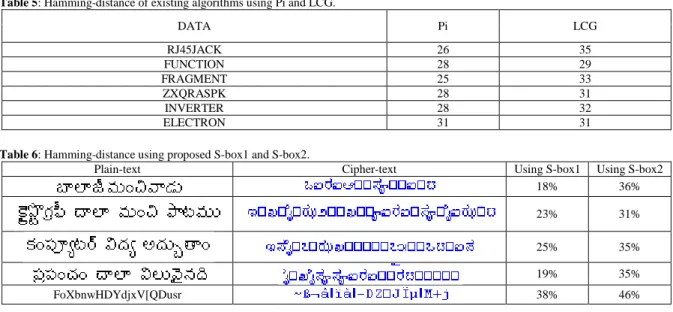
4.4 Hamming Distance:
The Hamming distance between two strings of equal length is the number of positions at which the corresponding symbols are different.
Table 5: Hamming-distance of existing algorithms using Pi and LCG.
DATA Pi LCG
RJ45JACK 26 35
FUNCTION 28 29
FRAGMENT 25 33
ZXQRASPK 28 31
INVERTER 28 32
ELECTRON 31 31
Table 6: Hamming-distance using proposed S-box1 and S-box2.
Plain-text Cipher-text Using S-box1 Using S-box2
18% 36%
23% 31%
25% 35%
19% 35%
FoXbnwHDYdjxV[QDusr 38% 46%
From Ref, the Hamming Distance using pi and LCG is shown in Table 5. The Table 6 shows the Hamming Distance of different strings using proposed algorithms. The Table 6 concludes that the Hamming Distance of the proposed algorithm is best in 4 cases from 6 samples. The Hamming Distance using pi and LCG is less than the Hamming Distance of proposed system. From 6 samples, the proposed system is best in 5 cases.
Conclusion:
Till now many cryptography algorithms have been introduced to the digital world. All the existing algorithms are limited to handle ASCII text only. But in digital world, UNICODE plays a vital role in digital communication and solves the confusion among different character encoding techniques. It covers around 100 languages in the world. A novel cryptographically secure Pseudo-Random-Number based S-box has been proposed. The proposed S-box handles all UNICODE characters which cover various languages like English, French, Telugu, Tamil, Hindi, Malayalam, Bengali, Punjabi etc. It compares the results of Hamming Distance, Balanced Output, Avalanche Effect and Security Analysis. The performance of proposed S-box is good for the parameters like Balanced Output, Avalanche Effect and Security Analysis. The performance of Hamming Distance is better in existing systems. But the existing systems’ S-box is not able to handle UNICODE text. The proposed algorithm solves the limitations in existing algorithms. The future enhancement is to get best results for Hamming Distance as well as other parameters.
Application:
This proposed algorithm can be applied to various Character encoding systems. It can embed into various encryption/decryption algorithms. In near future, it can be applied to various software packages like banking, government, educational system etc.
Limitation:
The proposed algorithm is not a strong encryption/decryption algorithm. It is based on new S-BOX which can be used for UNICODE characters along with normal ASCII. The combination of proposed S-BOX and strong cryptography algorithm yields good results.
REFERENCES
Adams, C. and S. vTavares, 1990. The structured design of cryptographically good S-boxes, journal of Cryptology, 3(1): 27-41.
Ahmed, N., Testing an S-Box for Cryptographic Use, International Journal of Computer and Electrical Engineering, 1-5.
Balajee Maram K, J M Gnanasekar, Construction Of A Dynamic Random S-Box For Data Security Using
Large Prime Numbers And Secret-Key, TEM Journal,
ISSN: 2217-8309,(Print). eISSN: 2217-8333
(Online),
Vol.5, No.1.Balajee Maram K, J M Gnanasekar, Light Weight Cryptographic Algorithm To Improve Avalanche Effect For Data Security Using Prime Numbers And Bit Level Operations, International Journal of Applied Engineering Research, ISSN 0973-4562 Volume 10, Number 21 (2015) pp:41977-41983.
Basavaraj, P., Halagali, Vijay, L. Hallappanavar, Veena V. Desai, Designing The S Boxes Of Blowfish Algorithm Using Linear Congruential Generator, ASM’s International e-journal of Ongoing Research in Management and IT.
Charles, P., Pfleeger, Shari Lawrence Pfleeger, 2004. “Security in Computing”, Pearson Education, 642-666.
Daswani, N. and D. Boneh, 1999. “Experimenting with Electronic Commerce on the PalmPilot”, Proc. Eurocrypt’99, LNCS 1648, Springer Verlag, 1-16.
Data Encryption Standard: http://csrc.nist.gov/publications/fips/fips46-3/fips- 46-3.pdf
Dragan Lambić and Miodrag Živković, 2013. comparison of random s-box generation methods in
publications de l’institut mathématique, 109–115.
Dragos Trinca, 2006. “Sequential and Parallel Cascaded Convolution Encryption with Local Propagation: Toward future Directions in Cryptography,” Proceedings of The third International Conference on Information Technology-New Generations. (ITNG’06), 0-7695-2497- 4 /, IEEE Computer Society.
Eman Mohammed Mahmoud, Ahmed Abd El Hafez, Talaat A.Elgarf, AbdelhalimZekry, 2013. dynamic AES-128 with Key-Dependent S-box, International Journal of Engineering Research and Applications (IJERA) ISSN: 2248-9622, 3(1): 1662-1670.
Escrowed Encryption Standard: http://csrc.nist.gov/publications/fips/fips1185/ fips-185.txt
Felicisimo, V., Wenceslao, Jr., Performance Efficiency of Modified AES Algorithm Using Multiple S-Boxes, International Journal of New Computer Architectures and their Applications (IJNCAA), 5(1): 1-9.
Grasha Jacob, Dr. A. Murugan, Irine Viola,” Towards the Generation of a Dynamic Key- Dependent S-Box to Enhance Security”, Cryptology ePrint Archive
Gupta, V. and S. Gupta, 2001. “Securing the Wireless Internet”, IEEE Communications, 39(12): 68-74. Hamdi, M., R. Rhouma, S. Belghith, 2015. “A Very Efficient Pseudo-Random Number Generator Based On Chaotic Maps and S-Box Tables”, World Academy of Science, Engineering and Technology, International Journal of Computer, Electrical, Automation, Control and Information Engineering, 9-2.
Hernández, Julio César, Isasi, Pedro, Ribagorda, Arturo, 2002. "An application of genetic algorithms to the cryptoanalysis of one round TEA". Proceedings of the Symposium on Artificial Intelligence and its Application. Hernández, Julio César, Sierra, José María, Isasi, Pedro, Ribargorda. Arturo, 2003. "Finding efficient distinguishers for cryptographic mappings, with an application to the block cipher TEA". Proceedings of the Congress on Evolutionary Computation.
Hernández, Julio César, Sierra, José María, Ribagorda, Arturo, Ramos, Benjamín, J.C. Mex-Perera, " Distinguishing TEA from a Random Permutation: Reduced Round Versions of TEA Do Not Have the SAC or Do Not Generate Random Numbers”, Cryptography and Coding Volume 2260 of the series Lecture Notes in Computer Science, 374-377.
Hristina Mihajloska, Danilo Gligoroski, 2011. A New Approach Into Constructing S-Boxes For Lightweight Block Ciphers, 8th Conference on Informatics and Information Technology with International Participation (CIIT 2011).
Huss Ain, A., Alkh aldi, 2015. A novel design for the construction of safe S-boxes based on TDERC seque nce, Alexa ndria Eng. J.
Hussain Alkhaldi, A., 2015. A novel design for the construction of safe S-boxes based on TDERC sequence, Alexandria Eng. J., http://dx.doi.org/10.1016/j.aej.2015.01.003
Hussain, I., T. Shah, H. Mahmood and M. Afzal, 2010. Comparative analysis of S-boxes based on graphical SAC ,International Journal of ComputerApplications, 2(5): 1-7.
Iqtadar Hussain, Tariq Shah, Muhammad Asif Gondal and Waqar Ahmad Khan, 2011. Construction of Cryptographically Strong 8x8 S-boxes, World Applied Sciences Journal 13 (11): 2389-2395, ISSN 1818-4952
Jeyamala Chandrasekaran, B., Subramanyan and G.S. Raman, 2011. Ensemble Of Blowfish With Chaos Based S-Box Design For Text And Image Encryption, International Journal of Network Security & Its Applications (IJNSA), 3-4.
Kazlauskas, K., 2009. Key-dependent S-box generation in AES block cipher system, Informatica, 20: 23– 34
Kazys Kazlauskas, Gytis Vaicekauskas, Robertas Smaliukas, 2015.” An Algorithm for Key-Dependent S-Box Generation in Block Cipher System”, INFORMATICA, 26(1): 51–65. Vilnius University, DOI: http://dx.doi.org/10.15388/Informatica.2015.38
Kazys Kazlauskas, Jaunius Kazlauskas, 2009. Key-Dependent S-Box Generation in AES Block Cipher System, INFORMATICA, 20(1): 23–34.
Keliher, L., 2005. Refined analysis of bounds related to linear and differential and linear cryptanal-ysis for
the AES, (In: H. Dobbertin et al., eds. Advanced Encryption StandardŮAES Š04, Bonn, 2004, Lect. Notes
Comput. Sci., 42–57.
Keliher, L., H. Meijer, S. Tavares, 1997. A new substitution-permutation network cryptosystem using key-dependent s-boxes, In: Proc. SAC’97, Canada, 13–26
Kelsey, John, Schneier, Bruce,Wagner, David, 1997. "Related-key cryptanalysis of 3-WAY, Biham-DES, CAST, DES-X NewDES, RC2, and TEA". Lecture Notes in Computer Science, 1334: 233–246.
Lecture Notes on “Computer and Network Security” by AviKak.Pdf http:// junicholl.org/Crypt analysis /Data / EnglishData.php
Lekshmi, R., Sajan Xavier, 2014. FPGA Based Design of AES with Masked S-Box for Enhanced Security, International Journal of Engineering Science Invention ISSN (Online): 2319 – 6734, ISSN (Print): 2319 – 6726, 3(5): 01-07
Mar, P.P. and K.M. Latt, 2008. New analysis methods on strict avalanche criterion of S-boxes, World Academy of Science, Engineering and Technology, 48: 150-154.
Maram Balajee, 2011. “UNICODE and Colors Integration tool for Encryption and Decryption “published in International Journal on Computer Science and Engineering (IJCSE). ISSN: 0975-3397, 3-3.
Mroczkowski, P., 2009. Generating Pseudorandom S-Boxes Ű– a Method of Improving the Security of
Cryptosystems Based on Block Ciphers, J. Telecommun. Inform. Technol, 74–79.
Piotr Mroczkowski, 2009. Generating Pseudorandom S-Boxes – a Method of Improving the Security of Cryptosystems Based on Block Ciphers, Journal of Telecommunications and Information Technology.
Por, L., K. Wong, K. Chee, 2012. UniSpaCh: A text-based data hiding method using Unicode space characters, The Journal of Systems and Software, 85(5), 1075– 1082.
Razi Hosseinkhani, H., Haj Seyyed Javadi, 2012. “Using Cipher Key to Generate Dynamic S-Box in AES Cipher System”, International Journal of Computer Science and Security (IJCSS), 6(1).
Ronald Reagan, C.P., S. Selvi, Dr. S. Prasanna Devi, Dr.V.Natarajan, 2014.” Enhancing DES Using Local Languages”, International Journal of Engineering Science and Innovative Technology (IJESIT), 3-1.
Sandy Harris and Carlisle Adams, 1999. Key-Dependent S-Box Manipulations, SAC’98, LNCS 1556, 15– 26, c Springer-Verlag Berlin Heidelberg.
Schneier, B., 1994. Description of a new variable-length, 64-bit block cipher (Blowfish), (In: Proc.Fast Software Encryption, Springer, 191–204.
Shirali-Shahreza, H., M. Shirali-Shahreza, 2008. Steganography in Persian and Arabic unicode texts using pseudo-space and pseudo-connection characters, Journal of Theoretical and Applied Information Technology, 4(8): 682-687.
Sufyan Salim Mahmood Aldabbagh, Imad Fakhri Taha Al Shaikhli, 3muhammad Reza Zaba, 2014. Key-Dependent S-Box In Lightweight Block Ciphers, Journal of Theoretical and Applied Information Technology 20th April, 62-2.
Tayseer S., Atia, 2014.” Development Of A New Algorithm For Key And S-Box Generation In Blowfish Algorithm”, Journal of Engineering Science and Technology, 9(4): 432-442.
The Unicode Consortium, The Unicode Standard, http://www.unicode.org.
Vergili, I., M.D. Yücel, 2001. Avalanche and Bit Independence Properties for the Ensembles of Randomly Chosen n ×n S-Boxes, Turk J Elec Engin, 9(2): 137-145.
Vergili, I.l., Yücel, M.D. (Eds.), 2000. On Satisfaction of Some Security Criteria for Randomly Chosen S-Boxes, in Proc. 20th Biennial Symp. on Communications, Kingston, 64-68.
Vijay, L., Hallappanavar, Basavaraj P. Halagali, Veena V. Desai, Efficient Implementation of Aes By Modifying S-Box, IOSR Journal ofComputer Science (IOSR-JCE), 35-39.
Vinoth John Prakash, S., A. Arun, 2013. A Secure Software Implementation of Nonlinear advanced Encryption Standard, IOSR Journal of VLSI and Signal Processing (IOSR-JVSP) ISSN: 2319 – 4200, ISBN: 2319-4197, 1- 5: 44-48