ORIGINAL ARTICLE
Assessing the effects of different
agro-residue as substrates on growth cycle
and yield of
Grifola frondosa
and statistical
optimization of substrate components using
simplex-lattice design
Bing Song
1†, Jianqiang Ye
1,2†, Frederick Leo Sossah
1†, Changtian Li
1, Dan Li
1, Lingsi Meng
1, Shuai Xu
1,
Yongping Fu
1*and Yu Li
1*Abstract
Grifola frondosa is an economically important edible and medicinal mushroom usually produced on substrate consisting of sawdust supplemented with wheat bran. Cultivation of G. frondosa on crop straw (corn cob, corn straw, rice straw, and soybean straw) as a substrate was optimized by using the D-optimum method of the simplex-lattice design, and the alternative of crop straw as a substitute for sawdust in the substrate composition was determined by the optimized model. The results showed that there was a significant positive correlation existing between the yield and corn cob. The growth cycle was negatively correlated with sawdust, corn cob and soybean straw, with sawdust significantly shortening the growth cycle of G. frondosa. The optimized high-yielding formula included 73.125% corn cob, 1.875% rice straw, 23% wheat bran and 2% light calcium carbonate (CaCO3) (C/N = 48.40). The average yield of the first flush was 134.72 ± 4.24 g/bag, which was increased by 39.97% compared with the control formula. The biological efficiency (BE) was 44.91 ± 1.41%, which was increased by 38.53% compared with the control. Based on the results of this study, corn cob can replace sawdust as one of the main cultivation substrates of G. frondosa.
Keywords: Grifola frondosa, Crop straw, Simplex-lattice design, Yield and growth cycle, High-yielding formula, Biological efficiency
© The Author(s) 2018. This article is distributed under the terms of the Creative Commons Attribution 4.0 International License (http://creativecommons.org/licenses/by/4.0/), which permits unrestricted use, distribution, and reproduction in any medium, provided you give appropriate credit to the original author(s) and the source, provide a link to the Creative Commons license, and indicate if changes were made.
Introduction
Grifola frondosa (Dicks.) Gray, named “Maitake” in Japan, is a rare edible and medicinal fungi mainly cultivated in China, Japan and Korea (Park et al. 2015). It has a high nutritional composition with compounds such as poly-saccharides, proteins, unsaturated fatty acids, vitamins, and trace elements (Gu et al. 2007; Illana-Esteban 2008; Montoya et al. 2012). It also has a wide range of bioactive
compounds (Shin and Lee 2014) which has been reported to have hypoglycaemic effects, anti-cancer properties, antiviral properties, antioxidant effects, immunomodula-tory effects, anti-inflammaimmunomodula-tory activities, anti-cholesterol or cholesterol-lowering effects, as well as the ability to reduce blood pressure and protect the liver (Vetvicka and Vetvickova 2014; Ding et al. 2016; Lin et al. 2016). Due to the unique properties of G. frondosa, it has become a reg-ular healthy food for consumption with a high demand in many countries such as the USA, Canada, Australia and some countries in Europe (Mayell 2001). The commercial profitability of this mushroom has significantly increased, necessitating a rapid expansion in its cultivation in China and other parts of the world.
Open Access
*Correspondence: [email protected]; [email protected] †Bing Song, Jianqiang Ye and Frederick Leo Sossah contributed equally to this work
1 Engineering Research Centre of Chinese Ministry of Education for Edible and Medicinal Fungi, Jilin Agricultural University, Changchun 130118, People’s Republic of China
Grifola frondosa is a wood-rot fungus, which grows on standing and dead wood. It acquires nutrients for growth and development by the degradation of lignocellulosic materials (Montoya et al. 2012; Yang et al. 2013a). Con-ventional cultivation is on deciduous hardwood sawdust or a mixture of assorted sawdust and cottonseed hulls (Ainsworth et al. 2008). However, recent efforts concern-ing the protection of forest resources, together with the high demand and rising price of both sawdust and cot-tonseed hulls have posed a challenge to commercial culti-vation of G. frondosa using sawdust.
It is therefore important to find the above substrate alter-natives that are equally suitable and cost-effective for the commercial production of G. frondosa. Currently, large tonnages of unexploited lignocellulosic agro-residues are available globally. For example, in China agro-residues are abandoned to decay in the field and sometimes disposed of through mass burning which is a major cause of air pollu-tion in China (Yang et al. 2012; Hu et al. 2017; Teng et al.
2017). Utilization of these by-products as substrates for cultivating mushrooms will offer one of the best solutions for converting these inedible organic wastes into impor-tant edible biomass. At present, corn straw, soybean straw, rice straw and corn cobs are widely used in the cultivation of edible mushrooms, including Lentinula edodes, Pleu-rotus ostreatus and Pleurotus eryngii (Moonmoon et al.
2010; Yang et al. 2013b; Hoa et al. 2015; Pedri et al. 2015). Few studies exist where straw or straw mixtures were used as the cultivation substrates of G. frondosa; also only coffee grounds (Barreto et al. 2008) and olive oil residues (Gregori et al. 2009) have been reported as substrates for G. frondosa. But these two substrates are subject to the restrictions of the place of production and thus have not made gains in pro-motion and application. Also, these substrates are extremely variable and traditional techniques often do not guarantee a standardized product.
Mushroom growers commonly add different ratios of natural nutrient sources from corn meal, wheat bran and rice bran to sawdust to enhance G. frondosa colonization and formation of superior quality fruiting body (Mon-toya et al. 2012). In order to produce consistent high yield and maintain/increase profitability, a commercial grower must determine the processing conditions. These condi-tions include quality spawn, temperature, humidity and consider the addition of an additive that is readily avail-able, cheap and proven to increase yield and produce high quality G. frondosa in a short period of time (Montoya et al. 2012; Kraisit et al. 2017). Mixture design is one of the most widely used methods for screening formulas (the sum of the main ingredients is a unit, 1 or 100%) and has been widely used in the feed, medicine and food industries (Kraisit et al. 2017; Pires et al. 2017; Saoudi et al. 2017). Among all mixture-design methods, the simplex-lattice
design is the most commonly used method for substrate screening; it allows for good analysis of correlations of the different factors and the target values, and with regres-sion analysis, the quantitative relations between the differ-ent substrates and assessmdiffer-ent indicators can be obtained (Yang et al. 2016). The optimized formula and the impact of each substrate on the indicators can then be deter-mined. Although some published studies (Shen and Royse
2001) have dealt with the effect of cereal agro-residue on growth and yield of G. frondosa, not much data is avail-able on the use of statistical modelling for optimization of substrate composition to standardize yield in commercial cultivation as well as the presentation of alternatives to sawdust for sustainable production of G. frondosa.
The aim of the present study was to evaluate differ-ent agro-residues (sawdust, corn cob, rice straw, soy-bean straw and corn straw) as a substrate for cultivation of G. frondosa; and use simplex-lattice design method to model, optimize substrate composition and evalu-ate the combined effects on growth and yield of G. fron-dosa. Also, the agro-residue that can replace sawdust in the model for G. frondosa cultivation was investigated, thereby providing a reference for the further develop-ment and utilization of agricultural wastes.
Materials and methods
Study area
The study was conducted in Jilin Agricultural University, Changchun, China. The mycelial culture on potato dex-trose agar slants, pre-screening of mycelial growth, and extracellular lignocellulolytic enzymes activity profiles were conducted at the Engineering Research Centre of the Chinese Ministry of Education for Edible and Medici-nal Fungi, Jilin Agricultural University, Changchun, China. Whereas substrate preparation, fruiting body cul-tivation and optimization of fruiting body culture devel-opment were completed in the Mushroom base of Jilin Agricultural University, Changchun, China.
Fungal culture and spawn preparation
and incubated for seven days at a temperature of 25 °C and cultured slants were stored at 4 °C, until further use. G. frondosa liquid spawn was prepared by cultur-ing (0.5 cm2) mycelial plugs in 500 ml Erlenmeyer flasks
containing 200 ml Yeast malt broth (YM liquid medium), and incubated at 25 °C with shaking (120 rpm) on a rota-tory shaker for 20 days. The YM liquid medium consisted of yeast extract 2.0 g/l, malt extract 20.0 g/l, corn flour 25.0 g/l, peptone 5.0 g/l, KH2PO4 5.0 g/l, MgSO4 2.5 g/l,
sucrose 25.0 g/l, vitamin B1 25 mg/l and nature pH.
Substrates preparation
The various agro-residues (oak wood sawdust, corn cobs, corn straw, soybean straw and rice straw) and supple-ments [wheat bran and light calcium carbonate (CaCO3,
average particle size is 1–3 μm)] for the cultivation of G. frondosa were purchased from the Mushroom base of the Jilin Agricultural University, Changchun, China. All agro-residues were chopped into pieces, dried, and ground into fine powder.
Substrate formulation
The various independent variables were first studied using one-factor-at-a-time method to determine the ini-tial range of the variables. This was achieved by preparing the substrates from the various agro-residues compo-nents first in petri dishes consisting of single substrate component with sterilized water added to ± 62.5% prior to autoclaving at 121 °C for 1 h, allowed to cool and inoc-ulated with 5 cm2 mycelial plug to determine the radial
mycelial growth rate followed by fruiting body cultiva-tion in bags. Based on the preliminary results the vari-ables (X1= sawdust, X2= corn cobs, X3= soybean straw, X4= rice straw and X5= corn straw) were selected for the
simplex-lattice design. These were then mixed in various combinations to determine a good fruiting substrate for the cultivation of G. frondosa.
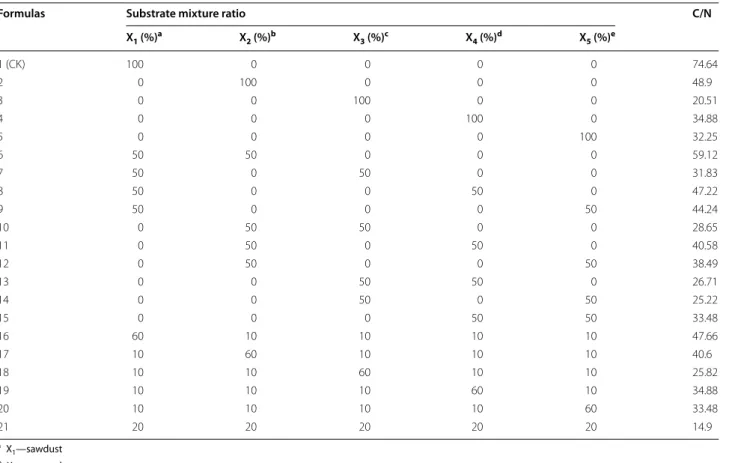
A total of 21 mixture schemes were designed, and the design details are shown in Table 1. All possible combi-nations (mixtures) of the proportions from this equa-tion were used. The 21 formulae were prepared following the 21 mixture schemes listed in Table 1; with the main ingredient accounting for 75%, scheme 1 is the control substrate mixture (CK) composed of 75% hardwood saw-dust, 23% wheat bran and 2% light CaCO3, with water
content of materials adjusted to 62.5%, with pH 7. The substituting ingredients were oak wood sawdust, corn cobs, corn straw, soybean straw and rice straw. All for-mulae contained 23% wheat bran, 2% light CaCO3 and
62.5% water with pH 7.0 and environmental conditions remained constant for all. All experiments were tested in three replicates and randomized to minimize the effects of unexpected effects in the observed response.
Model analysis
The Scheffé model was fitted using a polynomial quad-ratic equation in order to correlate the response vari-able (Y) to the independent variables (X). The Eq. (1) is as follows:
In a mixture experiment, it is not the volume of the actual amount of the single ingredient that matters, but rather its proportion in relation to other ingredients. The sum of all the ingredients is a constant total T, which is equal to 100% or 1 unless any constant mixture factors are present (Lundstedt et al. 1998).
Therefore, if X1, X2, X3, …Xi denote the proportions of
components of a mixture, then:
and
where X1 represents sawdust, X2 represents corn cob, X3
represents soybean straw, X4 represents rice straw, and X5
represents corn straw.
Optimization design
Simplex lattice (D-Optional method) design was employed to determine the optimum mixture ratio, the number of experimental runs and the proportion of five agro-residues in each experimental run (Table 1) using the Design-Expert 8.05b software (Scheffé 1963; Yang et al. 2016).
Substrate analyses
The carbon (C) and nitrogen (N) contents of the vari-ous substrate mixtures were measured using the furnace (Wang et al. 2015) and the Kjeldahl method (Verma et al.
2007) respectively. The carbon to nitrogen ratio of each substrate was calculated and are shown in Table 1.
Cultivation method
For each formula, the ingredients, the wheat bran and the light CaCO3 were first mixed evenly per the
respec-tive mixture ratio scheme; water was then added to adjust the moisture content to approximately 62.5%. A total of 800.0 g of such mixed substrates (dry material 300.0 g) was used to fill a 33 cm × 17.5 cm × 0.05 cm polypropyl-ene bag, with a 2.5 cm collar at the bag mouth. A column-shaped Polyvinylchloride (PVC), 2.5 cm in diameter and 12 cm in depth, was inserted into the collar to allow even distribution and colonization of the mycelia. The bags (1)
Y =
1≤i≤q
βiXi+
1≤i<j≤q
βijXiXj
(2) Sq−1
: q
i=1
Xi=1, 0≤Xi≤1, i=1, 2,. . ., q
(3)
were heat sterilized by autoclaving at a temperature of 121 °C for 85 min and then cooled to room temperature. Further, each cooled bag was inoculated with 10 ml liq-uid spawn of G. frondosa. Upon inoculation, incubation occurred at 23–26 °C, the carbon dioxide (CO2)
concen-tration at < 3000 ppm and in darkness, until the forma-tion of primordia. Next, the breathable cover (diameter: 38 mm) was removed, and the bag was transferred to a fruiting chamber where temperature was maintained at 19–21 °C, the humidity at 93–97%, the carbon dioxide (CO2) concentration at 400–700 ppm and the light at
200 l×/12 h. After fruiting harvest, the yield of each bag was recorded (only the first flush); 10 bags from each mix-ture scheme were used for statistical analysis.
Data collection
Data collected include growth cycle (time of inoculation to the first harvest of the fruiting body), growth param-eters (length and width of a single fruiting body using a Vernier caliper), Yield parameters including total fresh weight (g) of mushroom and number of fruiting bodies
per bunch were also recorded at harvest time. The BE was calculated as follows:
Statistical analysis
The inoculated bags were arranged in complete rand-omized block design comprising of each treatment in the growth room. All experiments were in three replicates. Design Expert statistical software package version 8.05 b was used for regression analysis. The Scheffé quad-ratic polynomial regression model was used to perform a quadratic multiple regression fitting of the yield per bag and the growth cycle against the formula ingredients, and a quadratic regression model of the yield and growth cycle was constructed against each ingredient in the mix-ture scheme. The effects of each ingredient on the yield and on the growth cycle were analyzed, and the correla-tions between each ingredient and the yield and between each ingredient and the growth cycle were analyzed by SPSS Statistics 17. The optimization function was used to
BE(%)= Fresh weight of mushroom
Dry weight of substrate ×100
Table 1 Formula design of the cultivation materials and C/N
a X
1—sawdust b X
2—corn cob c X
3—soybean straw d X
4—rice straw e X
5—corn straw
Formulas Substrate mixture ratio C/N X1 (%)a X
2 (%)b X3 (%)c X4 (%)d X5 (%)e
1 (CK) 100 0 0 0 0 74.64
2 0 100 0 0 0 48.9
3 0 0 100 0 0 20.51
4 0 0 0 100 0 34.88
5 0 0 0 0 100 32.25
6 50 50 0 0 0 59.12
7 50 0 50 0 0 31.83
8 50 0 0 50 0 47.22
9 50 0 0 0 50 44.24
10 0 50 50 0 0 28.65
11 0 50 0 50 0 40.58
12 0 50 0 0 50 38.49
13 0 0 50 50 0 26.71
14 0 0 50 0 50 25.22
15 0 0 0 50 50 33.48
16 60 10 10 10 10 47.66
17 10 60 10 10 10 40.6
18 10 10 60 10 10 25.82
19 10 10 10 60 10 34.88
20 10 10 10 10 60 33.48
set the variation range and the expected response value of each ingredient. Beginning with a random combina-tion, the steepest slope prediction was performed until the target response value was reached. The optimized yield formula derived from the regression analysis was verified, and ANOVA analysis was performed to estimate statistical parameters using SPSS (Yang et al. 2016). Results
Effects of different straw formulations on yield
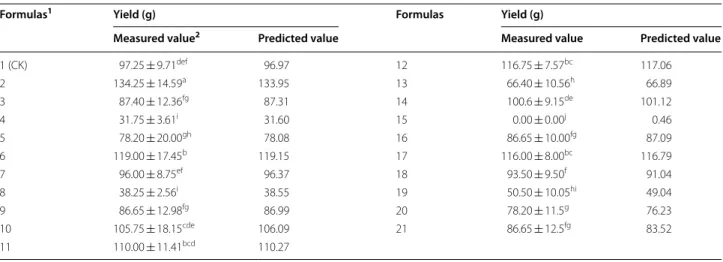
By statistical analysis of the yield for each formula (Table 2), the regression model equation between the yield and each ingredient was developed as follows:
With the regression model, the predicted yield can be calculated for each formula, and the measured yield and the predicted yield were basically the same. The statisti-cal analysis showed that the P values of the mixed linear model and the quadratic regression model were both less than 0.0001, indicating that these two models were very significant (P < 0.0001) and well fitted the relationship between ingredients and yield. In addition, the correla-tion coefficient (R2= 0.9956) indicated that the equation
model had 99.56% goodness-of-fit with the experimental data (Tables 2 and 3).
The coefficients of the independent variables in the equation reflect the degree of influence of the independ-ent variable in the equation, i.e. the degree of contribution. As seen in the regression model, the equation coefficients
Y =96.97X1+133.95X2+87.31X3+31.60X4+78.08X5
+14.76X1X2+16.90X1X3−102.94X1X4−2.17X1X5
−18.16X2X3+110.01X2X4+44.18X2X5+29.74X3X4
+73.71X3X5−217.52X4X5
R2=0.9956.
K(X2)=133.95>K(X1)=96.97>K(X3)=87.31>
K(X5)=78.08>K(X4)=31.60, which indicate that
the degree of contribution of each ingredient to the yield is as follows: X2 (corn cob) > X1 (sawdust) > X3 (soybean
straw) > X5 (corn straw) > X4 (rice straw). This result
indi-cated that corncobs have the greatest degree of contribu-tion to the yield of G. frondosa and can replace sawdust to serve as the main cultivation substrate of G. fron-dosa. The Pearson correlation coefficients between each of the substrates and the yield determined by the SPSS
Table 2 Measured values and predicted values of yield
1 Notes are the same as Table 1
2 Means followed by the same letter are not significantly different at a level of 5% (P < 0.05)
Formulas1 Yield (g) Formulas Yield (g)
Measured value2 Predicted value Measured value Predicted value
1 (CK) 97.25 ± 9.71def 96.97 12 116.75 ± 7.57bc 117.06
2 134.25 ± 14.59a 133.95 13 66.40 ± 10.56h 66.89
3 87.40 ± 12.36fg 87.31 14 100.6 ± 9.15de 101.12
4 31.75 ± 3.61i 31.60 15 0.00 ± 0.00j 0.46
5 78.20 ± 20.00gh 78.08 16 86.65 ± 10.00fg 87.09
6 119.00 ± 17.45b 119.15 17 116.00 ± 8.00bc 116.79
7 96.00 ± 8.75ef 96.37 18 93.50 ± 9.50f 91.04
8 38.25 ± 2.56i 38.55 19 50.50 ± 10.05hi 49.04
9 86.65 ± 12.98fg 86.99 20 78.20 ± 11.5g 76.23
10 105.75 ± 18.15cde 106.09 21 86.65 ± 12.5fg 83.52
11 110.00 ± 11.41bcd 110.27
Table 3 Variance analysis of the quadratic polynomial regression model for yield
a Notes are the same as Table 1
Variation
sources Sum of squares DF Mean square F P
Model 3,760,676 14 2686.20 397.07 < 0.0001
Linear mixed
model 29,142.60 4 7285.65 1076.96 < 0.0001
X1X2a 14.08 1 14.08 2.08 0.0079
X1X3 18.01 1 18.01 2.66 0.0027
X1X4 918.75 1 918.75 135.81 < 0.0001
X1X5 1.54 1 1.54 0.23 0.6823
X2X3 34.34 1 34.34 5.08 0.0014
X2X4 972.00 1 972.00 143.68 < 0.0001
X2X5 147.70 1 147.70 21.83 < 0.0001
X3X4 62.11 1 62.11 9.18 < 0.0001
X3X5 422.45 1 422.45 62.45 < 0.0001
X4X5 4029.67 1 4029.67 595.66 < 0.0001
Residual 128.86 36 3.58
Lack of fit 27.38 6 4.56 1.35 0.2669
Error 101.48 30 3.38
software were as follows: corn cob (0.665) > soybean straw (0.112) > sawdust (0.084) > corn straw (− 0.145) > rice straw (− 0.706). The yield was positively correlated with sawdust, corn cob and soybean straw, among which a sig-nificantly positive correlation existed between the yield and corn cob. However, yield was negatively correlated with the rice straw and corn straw, among which a sig-nificantly negative correlation existed between the yield and rice straw. The details can be seen in Table 4.
The coefficients of the mixed schemes in the equation indicate the degree of influence of the different substrate combinations on the yield. The results showed that
Accordingly, the degree of contribution was as follows: X2X4 (corn cob and rice straw) > X3X5 (soybean straw
and corn straw) > X2X5 (corn cob and corn straw) > X3X4
K(X2X4) = 110.01 > K(X3X5) = 73.71 > K(X2X5)
= 44.18 > K(X3X4) = 29.74 > K(X1X3)
= 16.90 > K(X1X2) = 14.76 > K(X1X5)
= −2.17 > K(X2X3) = −18.16 > K(X1X4)
= −102.94 > K(X4X5) = −217.52.
(soybean straw and rice straw) > X1X3 (sawdust and
soybean straw) > X1X2 (sawdust and corn cob) > X1X5
(sawdust and corn straw) > X2X3 (corn cob and soybean
straw) > X1X4 (saw dust and rice straw) > X4X5 (rice straw
and corn straw). Combined with the interaction analysis, mixing corn cob with sawdust, soybean straw, rice straw or corn straw significantly affected yield, and the yield increases with the corresponding increase of corn cob. Conversely, mixing rice straw with saw dust, corn cob, soybean straw or corn straw significantly reduced yield, and the yield decreases with the corresponding increase of rice straw (Table 2).
Effects of different straws on the growth cycle of G. frondosa
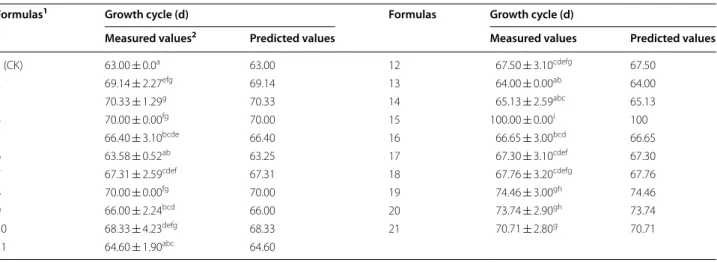
The growth cycles for each formula (Table 5), the regres-sion model between the growth cycle and each ingredient is as follows:
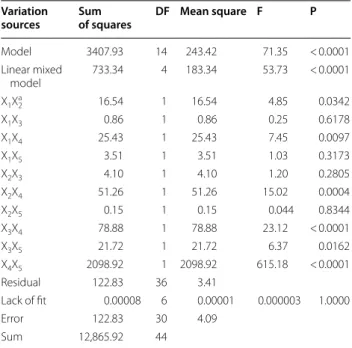
With the above regression equation, the predicted growth cycle can be calculated for each formula, and the measured growth cycle and the predicted growth cycle were basically the same. The statistical analysis showed that the P values of the mixed linear model and the quad-ratic regression model were both less than 0.0001, indi-cating that these two models both had a very significant level (P < 0.01) and fitted the relation between ingredi-ents and growth cycle well. In addition, the correlation
Y = 63.00X1 + 69.14X2 + 70.33X3 + 70.00X4
+ 66.40X5−11.29X1X2 + 2.58X1X3
+ 14.00X1X4 + 5.20X1X5−5.62X2X3
−19.88X2X4−1.08X2X5−24.66X3X4
−12.94X3X5 + 127.20X4X5(R2 = 0.9652) Table 4 Correlation analysis between yield and the
differ-ent ingredidiffer-ents
a Notes are the same as Table 1
b Mean values followed by no letters are not significantly different at a level of 5% (P < 0.05)
** Significantly different at a level of 1% (P<0.01)
X1a X2a X3a X4a X5a Yieldb
Pearson 0.084 0.665** 0.112 − 0.706** − 0.145
Significance 0.767 0.008 0.692 0.003 0.607
N 21 21 21 21 21
Table 5 Measured values and predicted values of the growth cycle
1 Notes are the same as Table 1
2 Means followed by the same letter are not significantly different at a level of 5% (P < 0.05)
Formulas1 Growth cycle (d) Formulas Growth cycle (d)
Measured values2 Predicted values Measured values Predicted values
1 (CK) 63.00 ± 0.0a 63.00 12 67.50 ± 3.10cdefg 67.50
2 69.14 ± 2.27efg 69.14 13 64.00 ± 0.00ab 64.00
3 70.33 ± 1.29g 70.33 14 65.13 ± 2.59abc 65.13
4 70.00 ± 0.00fg 70.00 15 100.00 ± 0.00i 100
5 66.40 ± 3.10bcde 66.40 16 66.65 ± 3.00bcd 66.65
6 63.58 ± 0.52ab 63.25 17 67.30 ± 3.10cdef 67.30
7 67.31 ± 2.59cdef 67.31 18 67.76 ± 3.20cdefg 67.76
8 70.00 ± 0.00fg 70.00 19 74.46 ± 3.00gh 74.46
9 66.00 ± 2.24bcd 66.00 20 73.74 ± 2.90gh 73.74
10 68.33 ± 4.23defg 68.33 21 70.71 ± 2.80g 70.71
coefficient (R2= 0.9652) indicated that the equation
model had 96.52% goodness-of-fit with the experimental data (Tables 5 and 6).
The regression equation showed that for the equation coefficients, K(X3) = 70.33 > K(X4) = 70.00 > K(X2)
= 69.14 > K(X5) = 66.40 > K(X1) = 63.00; that is, the degree of contribution of each substrate to the growth cycle is X3 (soybean straw) > X4 (rice straw) > X2 (corn
cob) > X5 (corn straw) > X1 (sawdust), indicating that the
contribution of crop straw to the growth cycle is greater than that of the sawdust. Correlation in terms of how each substrate impacted the growth cycle analyzed by SPSS soft-ware, and the Pearson correlation coefficients between the substrate and the growth cycle were as follows: rice straw (0.334) > corn straw (0.235) > soybean straw (− 0.126) > corn cob (− 0.168) > sawdust (0.283). Among these, the rice straw and corn straw were both positively correlated with the growth cycle; that is, the rice straw and corn straw could extend the growth cycle of G. frondosa. The growth cycle was negatively correlated with the sawdust, corn cob and soybean straw, indicating that these three types of sub-strates can shorten the growth cycle of G. frondosa, with sawdust significantly shortening the growth cycle of G. frondosa. Details can be seen in Tables 5 and 7.
The equation coefficients of the mixed schemes showed the degree to which the different straw combinations impacted the growth cycle. The results showed that
The degree of contribution was X4X5 (rice straw and
corn straw) > X1X4 (sawdust and rice straw) > X1X5
(sawdust and corn straw) X1X3 (sawdust and soybean
straw) > X2X5 (corn cob and corn straw) > X2X3 (corn cob
and soybean straw) > X1X2 (sawdust and corn cob) > X3X5
(soybean straw and corn straw) > X2X4 (corn cob and rice
straw) > X3X4 (soybean straw and rice straw). When
com-bined with the interaction analysis, the results showed that mixing rice straw with the sawdust, corn cob, soy-bean straw or corn straw could significantly increase the growth cycle, and the life cycle increased with the increase of rice straw (Table 5).
High‑yielding formula and verification test
Using the yield as the evaluation index and setting the variation range and expected response value of each ingredient, steepest slope prediction was carried out based on the regression equation beginning from a ran-dom combination, and a high-yielding formula with no sawdust was generated. The formula was as follows: corn cob (X2) 97.5% and rice straw (X4) 2.5%, which were
mul-tiplied by the coefficient of 0.75 and converted to 73.125% corn cob and 1.875% rice straw, respectively, combined with 23% wheat bran and 2% light CaCO3 (C/N = 48.40).
The predicted yield was 134.07 g/bag. The measured yield of the first flush reached 134.72 ± 4.24 g/bag, which basically verified the predicted fitted value. The results showed that the formula had a yield 39.97% higher than the control, with a BE of 44.91 ± 1.41%. In addition to yield and BE, single-fruiting-body length and width, the growth cycle of the high-yielding formula was also
K(X4X5) = 127.20 > K(X1X4) = 14.00 > K(X1X5)
= 5.20 > K(X1X3) = 2.58 > K(X2X5)
= −1.08 > K(X2X3) = −5.62 > K(X1X2)
= −11.29 > K(X3X5) = −12.94 > K(X2X4)
= −19.88 > K(X3X4) = −24.66. Table 6 Variance analysis of the quadratic polynomial
regression model for the growth cycle
a Notes are the same as Table 1
Variation
sources Sum of squares DF Mean square F P
Model 3407.93 14 243.42 71.35 < 0.0001
Linear mixed
model 733.34 4 183.34 53.73 < 0.0001
X1X2a 16.54 1 16.54 4.85 0.0342
X1X3 0.86 1 0.86 0.25 0.6178
X1X4 25.43 1 25.43 7.45 0.0097
X1X5 3.51 1 3.51 1.03 0.3173
X2X3 4.10 1 4.10 1.20 0.2805
X2X4 51.26 1 51.26 15.02 0.0004
X2X5 0.15 1 0.15 0.044 0.8344
X3X4 78.88 1 78.88 23.12 < 0.0001
X3X5 21.72 1 21.72 6.37 0.0162
X4X5 2098.92 1 2098.92 615.18 < 0.0001
Residual 122.83 36 3.41
Lack of fit 0.00008 6 0.00001 0.000003 1.0000
Error 122.83 30 4.09
Sum 12,865.92 44
Table 7 Correlation analysis between the growth cycle and different ingredients
a Notes are the same as Table 1
b Mean values followed by no letters are not significantly different at a level of 5% (P < 0.05)
** Significantly different at a level of 1% (P<0.01)
X1a X2a X3a X4a X5a Growth cycleb
Pearson − 0.283** − 0.168 − 0.126 0.334** 0.235
Significance 0.213 0.468 0.586 0.139 0.305
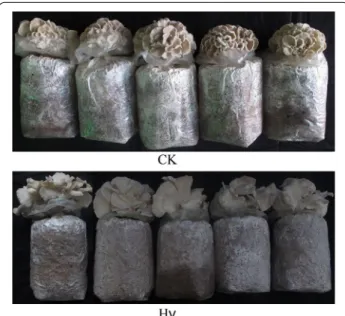
examined. The single-fruiting-body length and width of G. frondosa for the high-yield (5.15 and 3.45 respectively) formula were higher than those for the control (2.58 and 2.34 respectively), but the growth cycle was longer than that of the control (Table 8 and Fig. 1).
Discussion
Interest in G. frondosa production has increased sig-nificantly in the last decade due to their nutritional and health-promoting benefits (Vetvicka and Vetvickova
2014; Ding et al. 2016). G. frondosa is traditionally cul-tivated on forest wood (sawdust) however due to recent efforts in managing forest resources the use of agro-for-estry products for its cultivation is not sustainable. Most edible fungi can be cultivated with agro-residues such as crop straws (Barreto et al. 2008; Philippoussis 2009) either by composting or non-composting. However, due to the differences in nutritional requirements, growth specificity, inheritance characteristics and activities of the secreted extracellular enzymes among edible fungi (Montoya et al. 2012; Yang et al. 2013a), differences exist
in the utilization capacity of the different crop straws. In this work, we investigated the use of different crop straw (corn cob, soybean straw, rice straw and corn stalk) as alternate substrate to sawdust for cultivating G. frondosa and developed a statistical model for optimizing produc-tion and evaluated its effect on yield and growth cycle.
In our work, all substrate formulae contained 23% wheat bran and 2% light CaCO3. Substrates
supple-mented with wheat bran produces better quality mush-rooms (Moonmoon et al. 2011) while the limited amount of CaCO3 improves calcium metabolism, adjust pH of
substrates and makes mushroom production more con-sistent from crop to crop (Royse and Sanchez-Vazquez
2003).
This study showed that in optimizing the formula of G. frondosa production, the yield could be increased by add-ing a certain proportion of corn cob (50%), such as used in formula 6, which had a yield of 22.37% higher than the control. The use of rice straw negatively correlated with yield; however, it can still be increased by the addition of a certain proportion (50%) of corn cob to rice straw, such as used in formula 11. For instance, formula 11 (110.00 ± 11.41 g) showed a yield increase of 246.45% compared with formula 4 (31.75 ± 3.61 g), which had rice straw alone, and showed a yield increase of 13.72% compared with the control group (Table 2). Therefore, in places where the rice resources are rich, adding an appro-priate proportion of corn cob to replace sawdust can achieve the same effect in G. frondosa cultivation. Soy-bean straw and corn straw in a reasonable mixture ratio, or combined with substrates such as corn cob, can also replace sawdust to achieve the same effect in cultivation. When the yield is considered the priority indicator in the production of G. frondosa, using corn cob powder as the main cultivation substrate substitute for sawdust will not only increase the yield but also increase the single-fruit-ing-body area.
When the growth cycle is used as the sole evalua-tion index, sawdust, soybean straw and corn cob can significantly shorten the growth cycle of G. frondosa, with sawdust having the greatest effect. For instance, with formula 6, which had 37.5% sawdust and 37.5% corn cob, the growth cycle was nearly the same as that
Table 8 Comparison of the main agronomic traits between the high-yield straw-substrate formula and the control
1 Hy high-yield
2 Mean values followed by no letters are not significantly different at a level of 5% (P < 0.05)
Formulas Single‑fruiting‑body
length (cm)2 Single‑fruiting‑body width (cm) Yield (g) Growth cycle (d) BE (%)
Predicted value Measured value Predicted value Measured value
1 (CK) 2.58 ± 0.37b 2.34 ± 0.37b 96.97 97.25 ± 9.71b 63.00 63.00 ± 0.0a 32.42 ± 3.24b
Hy1 5.15 ± 0.148a 3.45 ± 0.24a 134.07 134.72 ± 4.24a 68.68 68.68 ± 2.32b 44.91 ± 1.41a
in control, and its yield was higher than that in control. Although G. frondosa had a long growth cycle with the soybean straw substrate, the growth cycle can be signifi-cantly shortened by combining soybean straw with rice straw and corn straw, as evidenced in formulae 13 and 14 (Table 5). Therefore, when taking both growth cycle and yield into account, a certain percentage of sawdust can be added to the straw formula to shorten the growth cycle and increase the yield of G. frondosa as well. Since lignin content in sawdust was higher than that in crop straws, the substrate with high lignin content is observed to promote mycelial growth and thus shorten the growth cycle. The rapid colonization of substrate during spawn run prevents competition from other competitive molds and pathogenic microorganisms. Also, the shortened duration of the growth cycle saves costs, improve income and it is suitable for commercial producers of G. frondosa (Gaitan-Hernandez et al. 2006).
The effects of different ingredients on the agronomic traits of G. frondosa were different. This can be attrib-uted to their nutrient composition and structure of the different ingredient. The materials used in the cultivation medium, such as sawdust, corn cob and cottonseed shell are composed of lignin, cellulose and minerals, which provides sufficient carbon and nitrogen sources for the growth and development of edible fungi (Naraian et al.
2009). In accordance with the production needs, these ingredients can be mixed to achieve the desired goal of cultivation. The C/N ratio as an index must be consid-ered in the choice of raw materials to include substrate formulation because it plays a vital role in the growth of edible fungi.
The study showed that substrates with low carbon– nitrogen ratios result in significant reduction in the yield of Grifola frondosa, observed with formulae 3–5, 13, 15, and 18–21. Also higher carbon and nitrogen ratios did not improve G. frondosa yield, as with the use of sawdust in formula 1. However, some of the low car-bon–nitrogen formulations yield higher than control, such as formula 10 (C/N = 28.65) and the formula 14 (C/N = 25.22). A high carbon–nitrogen ratio is beneficial to the growth of mycelia, and thus shortens the growth period of G. frondosa, as in formulae 1 (C/N = 74.64) and 6 (C/N = 59.81), the shortest growth period, of 63 and 63.58 days respectively (Tables 1, 5). Low carbon and nitrogen sources leads to premature senescence and slow mycelial growth respectively. On the other hand, high nitrogen levels lead to vigorous mycelial growths result-ing in the accumulation of unwanted metabolic prod-ucts, which affected the yield (Naraian et al. 2009; Hoa et al. 2015). These findings were consistent to the results reported by Naraian (Naraian et al. 2009). Therefore a reasonable C/N ratio plays a crucial role in the yield and
growth cycle of edible fungi (Naraian et al. 2009; Hoa et al. 2015).
The results of this study can be directly applied in the industrial production of G. frondosa, which is more suit-able for the developmental requirements of the edible fungi industry. However, formulae and techniques need to be optimized, and the economic balance needs to be improved before commercial development is achieved (Gaitan-Hernandez et al. 2006). Hence, the need to use a statistical method to optimize and standardize substrate mixtures for optimal growth and yield.
The use of the simplex-lattice method for formula design has been less applied in the field of edible fungi (Yang et al. 2016). However, as the most basic design scheme in the mixture design, this method is widely used in feed, medicine and food industries because the test points can be taken on the lattice points in the regu-lar simplex to ensure that the test points are evenly dis-tributed and that the calculation is simple and accurate since the regression coefficient is only a simple func-tion of the response values at the corresponding lattice points. In this study, by using the simplex-lattice design, the purpose of testing the effects of different mixture ratios of crop straws and sawdust on the cultivation of G. frondosa was achieved; this was affirmed by the high R2
value (0.956), indicating the percentage of the variabil-ity explained by the model (Table 1). In all cases the R2
was higher than 0.8, with values over ~ 0.9 in almost all responses.
Consequently, the optimized formula obtained was effective, and the yield and growth cycle equations allow effective prediction of the production effect of the for-mula. Therefore, the simplex-lattice design can be applied designing experiments for the formulation of substrates for edible fungi cultivation.
Our results show that corn cob was the best alternative to sawdust as a substrate for producing a high yield of G. frondosa. This is because corn cob does not only provide nutrients for the growth but as a substrate, it supports and facilitates the attachment of the fungi and allows oxygen transfer, heat dispersion and has the suitable C/N ratio to promote the induction of fruiting bodies among other conditions (Hoa et al. 2015; Pérez-Rodríguez et al.
2016). Compared to rice straw, corn cob has high lignin content, certain proportions of soluble polysaccharides, which can be directly utilized by the mycelia, and it is beneficial to the growth of edible fungi.
industry and agriculture. Its composition indicates the potential utilization as substrate for fungal growth as well as the production of industrial enzymes such as xyla-nase and xylose among others (Amaro-Reyes et al. 2016; Kashid and Ghosalkar 2017).
In conclusion, corn cob significantly increases the yield of G. frondosa and can replace sawdust as the main cultivation substrate of G. frondosa, but sawdust sig-nificantly shortens the growth cycle of G. frondosa. The optimized high-yield formula was 73.125% corn cob, 1.875% rice straw, 23% wheat bran, and 2% light CaCO3
(C/N = 48.40); the average yield of the first flush was 134.72 ± 4.24 g/bag, and the BE was 44.91 ± 1.41%. The results of this study reinforce the use of crop straw for cultivation of G. frondosa and provide a scientific basis for the production of G. frondosa using corn cob as the main substrate.
Abbreviations
ANOVA: one-way analysis of variance; BE: biological efficiency; C/N: carbon to nitrogen ratio; SPSS: statistical product and service solutions.
Authors’ contributions
BS, JQY and FLS conceived and designed the experiments, performed the experiments, analyzed the data, wrote the paper, prepared figures and/or tables, these authors contributed equally to this work; CTL and DL conceived and designed the experiments; LSM and SX performed the experiments; YPF and YL conceived and designed the experiments, analyzed the data, contrib-uted reagents/materials/analysis tools, wrote the paper, prepared figures and/ or tables, reviewed drafts of the paper. All authors read and approved the final manuscript.
Author details
1 Engineering Research Centre of Chinese Ministry of Education for Edible and Medicinal Fungi, Jilin Agricultural University, Changchun 130118, People’s Republic of China. 2 Microbiology Research Institute, Guangxi Academy of Agricultural Sciences, Nanning 530007, Guangxi, People’s Republic of China.
Acknowledgements
We thank David Hawksworth and Odeshnee Moodley for their kind-hearted and excellent technical assistance with the English language correction.
Competing interests
The authors declare that they have no competing interests.
Availability of data and materials
The datasets supporting the conclusions of this article are included within the article.
Ethics approval and consent to participate
This article does not contain studies with human participants or animals performed by any of the authors.
Funding
This work was supported by the Special Fund for Agro-scientific Research in the Public Interest (No. 201503137), National Key Research and Development Program of China (No. 2017YFD0601002), the program of creation and utiliza-tion of germplasm of mushroom crop of “111” project (No. D17014), Nautiliza-tional Basic Research Program of China (No. 2014CB138305), University S & T Innova-tion Platform of Jilin Province for Economic Fungi (No. #2014B-1) and NaInnova-tional Natural Science Foundation of China (No. 31471926).
Publisher’s Note
Springer Nature remains neutral with regard to jurisdictional claims in pub-lished maps and institutional affiliations.
Received: 18 January 2018 Accepted: 3 March 2018
References
Ainsworth GC, Bisby GR, Kirk PM (2008) Ainsworth and Bisby’s dictionary of the fungi, 10th edn. CABI Bioscience, Wallingford
Amaro-Reyes A, Gracida J, Huizache-Pena N, Elizondo-Garcia N, Salazar-Martinez J, Garcia Almendarez BE, Regalado C (2016) On-site hydrolytic enzymes production from fungal co-cultivation of Bermuda grass and corn cob. Biores Technol 212:334–337. https://doi.org/10.1016/j. biortech.2016.04.070
Barreto S, López M, Levin L (2008) Effect of culture parameters on the produc-tion of the edible mushroom Grifola frondosa (maitake) in tropical weath-ers. World J Microbiol Biotechnol 24(8):1361–1366
Ding Y, Xiao C, Wu Q, Xie Y, Li X, Hu H, Li L (2016) The mechanisms underlying the hypolipidaemic effects of Grifola frondosa in the liver of rats. Front Microbiol 7:1186. https://doi.org/10.3389/fmicb.2016.01186 Gaitan-Hernandez R, Esqueda M, Gutierrez A, Sanchez A, Beltran-Garcia M,
Mata G (2006) Bioconversion of agrowastes by Lentinula edodes: the high potential of viticulture residues. Appl Microbiol Biotechnol 71(4):432–439. https://doi.org/10.1007/s00253-005-0241-1
Gregori A, Svagelj M, Berovic M, Liu Y, Zhang J, Pohleven F, Klinar D (2009) Cul-tivation and bioactivity assessment of Grifola frondosa fruiting bodies on olive oil press cakes substrates. New Biotechnol 26(5):260–262. https:// doi.org/10.1016/j.nbt.2009.08.001
Gu CQ, Li JW, Chao F, Jin M, Wang XW, Shen ZQ (2007) Isolation, identification and function of a novel anti-HSV-1 protein from Grifola frondosa. Antiviral Res 75(3):250–257. https://doi.org/10.1016/j.antiviral.2007.03.011 Hoa HT, Wang CL, Wang CH (2015) The effects of different substrates on the
growth, yield, and nutritional composition of two oyster mushrooms (Pleurotus ostreatus and Pleurotus cystidiosus). Mycobiology 43(4):423–434. https://doi.org/10.5941/MYCO.2015.43.4.423
Hu Y, Wang LS, Li Y, Li QH, Li CL, Chen JM, Weng D, Li HP (2017) Effects of particulate matter from straw burning on lung fibrosis in mice. Environ Toxicol Pharmacol 56:249–258. https://doi.org/10.1016/j.etap.2017.10.001 Illana-Esteban C (2008) The fungus maitake (Grifola frondosa) and its
therapeu-tic potential. Revista iberoamericana de micologia 25(3):141–144 Kashid M, Ghosalkar A (2017) Evaluation of fermentation kinetics of
acid-treated corn cob hydrolysate for xylose fermentation in the presence of acetic acid by Pichia stipitis. 3 Biotech 7(4):240. https://doi.org/10.1007/ s13205-017-0873-8
Kraisit P, Limmatvapirat S, Nunthanid J, Sriamornsak P, Luangtana-Anan M (2017) Preparation and characterization of hydroxypropyl methylcel-lulose/polycarbophil mucoadhesive blend films using a mixture design approach. Chem Pharm Bull 65(3):284–294. https://doi.org/10.1248/cpb. c16-00849
Lin CH, Chang CY, Lee KR, Lin HJ, Lin WC, Chen TH, Wan L (2016) Cold-water extracts of Grifola frondosa and its purified active fraction inhibit hepatocellular carcinoma in vitro and in vivo. Exp Biol Med (Maywood) 241(13):1374–1385. https://doi.org/10.1177/1535370216640149 Lundstedt T, Seifert E, Abramo L, Thelin B, Nyström Å, Pettersen J, Bergman
R (1998) Experimental design and optimization. Chemometr Intell Lab 42(1–2):3–40
Mayell M (2001) Maitake extracts and their therapeutic potential. Altern Med Rev J Clin Ther 6(1):48–60
Montoya S, Orrego CE, Levin L (2012) Growth, fruiting and lignocellulolytic enzyme production by the edible mushroom Grifola frondosa (maitake). World J Microbiol Biotechnol 28(4):1533–1541. https://doi.org/10.1007/ s11274-011-0957-2
Moonmoon M, Shelly NJ, Khan MA, Uddin MN, Hossain K, Tania M, Ahmed S (2011) Effects of different levels of wheat bran, rice bran and maize powder supplementation with saw dust on the production of shiitake mushroom (Lentinus edodes (Berk.) Singer). Saudi J Biol Sci 18(4):323–328. https://doi.org/10.1016/j.sjbs.2010.12.008
Naraian R, Sahu R, Kumar S, Garg S, Singh C, Kanaujia R (2009) Influence of different nitrogen rich supplements during cultivation of Pleurotus florida on corn cob substrate. Environmentalist 29:1–7
Niu WJ, Han LJ, Liu X, Huang GQ, Chen LJ, Xiao WH, Yang ZL (2016) Twenty-two compositional characterizations and theoretical energy potentials of extensively diversified China’s crop residues. Energy 100(1):238–250 Park HS, Hwang YH, Kim MK, Hong GE, Lee HJ, Nagappan A, Yumnam S, Kim
EH, Heo JD, Lee SJ, Won CK, Kim GS (2015) Functional polysaccharides from Grifola frondosa aqueous extract inhibit atopic dermatitis-like skin lesions in NC/Nga mice. Biosci Biotechnol Biochem 79(1):147–154. https://doi.org/10.1080/09168451.2014.963500
Pedri ZC, Lozano LM, Hermann KL, Helm CV, Peralta RM, Tavares LB (2015) Influ-ence of nitrogen sources on the enzymatic activity and grown by Lenti-nula edodes in biomass Eucalyptus benthamii. Braz J Biol Revista brasleira de biologia 75(4):940–947. https://doi.org/10.1590/1519-6984.03214 Pérez-Rodríguez N, Torrado-Agrasar A and Domínguez J M (2016) Use
of Aspergillus niger Extracts Obtained by Solid-State Fermentation In: Mushroom Biotechnology pp.173–190. https://doi.org/10.1016/ B978-0-12-802794-3.00010-2
Philippoussis A (2009) Production of mushrooms using agro-industrial resi-dues as substrates. Springer, Northern Ireland
Pires FQ, Angelo T, Silva JK, Sa-Barreto LC, Lima EM, Gelfuso GM, Gratieri T, Cunha-Filho MS (2017) Use of mixture design in drug-excipient compat-ibility determinations: thymol nanoparticles case study. J Pharm Biomed Anal 137:196–203. https://doi.org/10.1016/j.jpba.2017.01.037
Royse DJ, Sanchez-Vazquez JE (2003) Influence of precipitated calcium car-bonate (CaCO3) on shiitake (Lentinula edodes) yield and mushroom size. Biores Technol 90(2):225–228
Saoudi S, Chammem N, Sifaoui I, Jimenez IA, Lorenzo-Morales J, Pinero JE, Bouassida-Beji M, Hamdi M, L Bazzocchi I (2017) Combined effect of carnosol, rosmarinic acid and thymol on the oxidative stability of soybean oil using a simplex centroid mixture design. J Sci Food Agric 97(10):3300– 3311. https://doi.org/10.1002/jsfa.8179
Scheffé H (1963) The simplex-centroid design for experiments with mixtures. J R Stat Soc Series B Stat Methodol 25(B):235–263
Shen Q, Royse DJ (2001) Effects of nutrient supplements on biological efficiency, quality and crop cycle time of maitake (Grifola frondosa). Appl Microbiol Biotechnol 57(1–2):74–78
Shin YJ, Lee SC (2014) Antioxidant activity and β-glucan contents of hydro-thermal extracts from maitake (Grifola frondosa). Food Sci Biotechnol 23(1):277–282
Teng B, Zhang X, Yi C, Zhang Y, Ye S, Wang Y, Tong DQ, Lu B (2017) The associa-tion between ambient air polluassocia-tion and allergic rhinitis: further epidemio-logical evidence from changchun, northeastern china. Int J Environ Res Public Health 14(3):1–18
Verma P, Rastogi RK, Ramakumar KL (2007) Determination of trace amounts of nitrogen in uranium based samples by ion chromatography (IC) without Kjeldahl distillation. Anal Chim Acta 596(2):281–284. https://doi. org/10.1016/j.aca.2007.06.019
Vetvicka V, Vetvickova J (2014) Immune-enhancing effects of Maitake (Grifola frondosa) and Shiitake (Lentinula edodes) extracts. Ann Transl Med 2(2):14. https://doi.org/10.3978/j.issn.2305-5839.2014.01.05
Wang H, Yuan S, Zhan J, Wang Y, Yu G, Deng S, Huang J, Wang B (2015) Mecha-nisms of enhanced total organic carbon elimination from oxalic acid solutions by electro-peroxone process. Water Res 80:20–29. https://doi. org/10.1016/j.watres.2015.05.024
Yang B, Chen Z, Zhang C, Dong J, Peng X (2012) Distribution patterns and major sources of dioxins in soils of the Changsha-Zhuzhou-Xiangtan urban agglomeration, China. Ecotoxicol Environ Saf 84:63–69. https://doi. org/10.1016/j.ecoenv.2012.06.021
Yang L, Qu H, Mao G, Zhao T, Li F, Zhu B, Zhang B, Wu X (2013a) Optimization of subcritical water extraction of polysaccharides from Grifola frondosa using response surface methodology. Pharm Mag 9(34):120–129. https:// doi.org/10.4103/0973-1296.111262
Yang W, Guo F, Wan Z (2013b) Yield and size of oyster mushroom grown on rice/wheat straw basal substrate supplemented with cotton seed hull. Saudi J Biol Sci 20(4):333–338. https://doi.org/10.1016/j.sjbs.2013.02.006 Yang J, Zhang G, Yang Q, Hu J (2016) Biology research of Pleurotus