R E S E A R C H
Open Access
“
Confidence comes with frequent practice
”
:
health professionals
’
perceptions of using
manual vacuum aspiration after a training
program
Maria Lisa Odland
1*, Gladys Membe-Gadama
2, Ursula Kafulafula
3, Jon Øyvind Odland
1,4,5and Elisabeth Darj
1,6,7Abstract
Background:Malawi has one of the highest maternal mortality rates in the world, with unsafe abortion as a major contributor. Curettage is most frequently used as the surgical method for treating incomplete abortions, even though it is costly for an impoverished health system and the less expensive and safe manual vacuum aspiration (MVA) method is recommended.
Methods:The aim of this 2016–17 study is to explore health worker’s perception of doing MVA 1 year after an educational intervention. Focus group discussions were recorded, transcribed verbatim, and analyzed using content analysis for interpreting the findings. A knowledge, attitude and practice survey was administered to health
professionals to obtain background information before the MVA training program was introduced.
Results:Prior to the training sessions, the participants demonstrated knowledge on abortion practices and had positive attitudes about participating in the service, but preferred curettage over MVA. The training was well received, and participants felt more confident in doing MVA after the intervention. However, focus group discussions revealed obstacles to perform MVA such as broken equipment and lack of support. Additionally, the training could have been more comprehensive. Still, the participants appreciated task-sharing and team work. Conclusion:Training sessions are considered useful in increasing the use of MVA. This study provides important insight on how to proceed in improving post-abortion care in a country where complications of unsafe abortion are common and the health system is low on resources.
Keywords:Manual vacuum aspiration, MVA, Incomplete abortions, Post-abortion care, Health care providers
Plain English summary
The aim of this study was to explore health worker’s per-ception of using manual vacuum aspiration (MVA) 1 year after an educational intervention. The health personnel in Malawi who treat women with incomplete abortions are medical interns, clinical officers and nurses/midwives. The training was designed as a refresher course as health personnel usually are trained how to do MVA during their studies. Altogether, 53 health personnel received the train-ing and filled out questionnaires on knowledge, attitude
and practice before the training had started. After 1 year, focus group discussions were arranged with 33 of the pre-viously trained health personnel. There was an almost equal number of nurses, clinical officers and medical terns in the survey and in the focus groups, which in-cluded fairly equal numbers of male and female participants and a good age spread among the partici-pants. Even though the participants demonstrated know-ledge on the benefits of using MVA prior to the training, most of the health personnel used curettage because of a lack of confidence, broken equipment and high gestational age of the expectant mothers. The training sessions were considered useful, but could have been extended to several days and have included actual patients. Our findings * Correspondence:[email protected]
1Department of Public Health and Nursing, Norwegian University of Science
and Technology, Trondheim, Norway
Full list of author information is available at the end of the article
provide important insight on how to proceed in improving post-abortion care in a country where complications of unsafe abortion are common and the health system is low on resources.
Background
Malawi is a small landlocked country in the southeastern part of Africa with a population of about 18 million [1]. It is a poor country with limited resources [2,3]. Its ma-ternal mortality ratio of 439 per 100,000 is one of the highest in the world [2–5]. A major contributor to this is unsafe abortion [6–8], and it has been estimated to be the cause of up to a quarter of the maternal mortalities in the country [9]. Unsafe abortion is defined by the World Health Organization (WHO) as“a procedure for termination of a pregnancy done by an individual who does not have the necessary training or in an environ-ment not conforming to minimal medical standards”, and worldwide around 25 million unsafe abortions are performed every year [10]. It occurs most commonly in countries where there is a restrictive abortion law, like Malawi. Even though there are ongoing discussions about liberalizing the abortion law in this country, cur-rently it is only legal to terminate a pregnancy in order to save a pregnant woman’s life [11, 12]. Nevertheless, there are about 140,000 induced abortions performed in Malawi every year [13]. Considering its restrictive abor-tion law many of these are unsafe and lead to complica-tions that create a big burden for an already impoverished health system. A common issue involves retained products of conception that can lead to ongoing bleeding and infections that in the worst-case scenario can lead to hypovolemic shock and death [14]. Even though complications can happen after normal miscar-riages or safe abortions, it is more likely to occur when pregnancy termination is conducted in an unsafe man-ner. In order to avoid further complications, incomplete abortions need to be treated with uterine evacuation. Medical treatment with misoprostol and vacuum aspir-ation is the preferred treatment in high-income coun-tries, and their use is increasing in many parts of the developing world [15, 16]. However, in countries where misoprostol is accessible it has been used to induce abortions illegally [17]. A recent systematic review re-vealed several barriers to using misoprostol such as fear and apprehensions at policy, provider and community level, shortage of staffing and stock depletion [18]. These are factors that could contribute to most incomplete abortions in Malawi being treated surgically. Another concern is that patients can be lost to follow up and sub-sequently need attention because of serious septic abor-tions. Stock depletion of medicines is a common problem in Malawi [19], and thus it makes sense to treat patients surgically.
Surgical evacuation of the uterus can be done using traditional dilatation and curettage (D&C) or using vac-uum aspiration [20]. According to the WHO vacuum as-piration is the recommended treatment in the first trimester, and can be achieved using electrical equip-ment or by using manual vacuum aspiration (MVA) [20–22]. Considering that MVA can be carried out with-out electricity and under local anesthetics, it is a cheaper and easier way to evacuate the uterus. It is also safer with less risks of complications such as uterine perfor-ation, bleeding and Asherman’s Syndrome [20, 21]. Nurses/midwives are trained and allowed to evacuate the uterus with MVA in addition to clinical officers and doctors. It is the recommended surgical treatment in Malawi for incomplete abortions in the first trimester [23]. This option is also important in other low-income countries with huge patient loads and sparse resources. Unfortunately, studies have shown that the use of MVA is decreasing in Southern-Malawi and, concomitantly, the use of D&C is on the increase in many hospitals in spite of the mentioned guidelines [21, 23–25]. A follow-up study in the same area suggested that one rea-son for this is lack of trained perrea-sonnel [26]. The latter constituted an incentive for initiating MVA-training of health personnel in a number of hospitals in Southern Malawi.
The use and implementation of MVA involves inter-play between personal and contextual factors.
Our primary aim of the present study was to explore Malawian health workers’ perceptions about the use of MVA in post-abortion care (PAC) at three public hospi-tals 1 year after an educational intervention.
Materials and methods
Study design
about being comfortable conducting MVAs and the need for additional training. At the end of the session, add-itional thoughts and discussion on the implementation of MVA were encouraged.
Study setting
The selection of the study sites was opportunistic as all three hospitals had previously been shown to have a low use of MVA [24, 25]. The southern region of Malawi is the most populated region and features a high unmet need of family planning (20%) [5]. At least half of the complications after abortions are treated in public facil-ities [28], and the central hospital included in this study treats around 200 patients with incomplete abortions every month [24, 25]. A high number of incomplete abortions are also treated in the district hospitals. There-fore, one tertiary central hospital and two smaller district hospitals in the southern region of Malawi were in-cluded. The MVA-training program was initiated in April 2016, and constitutes an intervention study. The training was only provided in the selected hospitals and not in other hospitals in the country.
Study participants
The intervention targeted all pertinent health personnel allowed to treat patients with incomplete abortions and included registered nurses, clinical officers, and recently graduated doctors (medical interns). Clinical officers have a separate and shorter training program than doc-tors, but do have many of the same responsibilities such as anesthesia, diagnosis and treatment. They are an im-portant cadre, especially in the district hospitals where there are few doctors. A meta-analysis has shown that they are capable of carrying out physician’s procedures such as caesarean sections [29, 30]. The training pro-gram was offered to nurses and clinical officers at the se-lected district hospitals and medical interns at the referral hospital. The training was planned for 12 partici-pants per session and enrolment was voluntary. One training session was conducted at each hospital in April 2016, and one extra session was added at the referral hospital to accommodate a new rotation of interns later that year. All of the participants completed the KAP questionnaire prior to receiving their training, and were invited to participate in FGDs 1 year after the interven-tion. None declined, but some participants were missing in the follow up interviews due to rotations to different departments/facilities or they were unable to leave duty at the given time period for the interviews.
The training intervention
The training was organized as a refresher course as basic knowledge about MVA should have been obtained within their respective curricula in medical or nursing
school. It included basic theory and practice for con-ducting MVA using the ten-step guidelines recom-mended by Ipas [31], as well as bimanual examination in order to determine uterine size, estimating the gesta-tional age, choosing the right size of the MVA cannula, antiseptic preparations and the procedure itself. Infor-mation on sterilizing equipment was given. The proced-ure was carried out on pelvic models that were specially made for MVA-training [32]. There was no formal prac-tical examination for the participants, but all had to demonstrate the whole MVA procedure using the pelvic models in the presence of the course providers. The training course was delivered by a local gynecology con-sultant with previous teaching experience and was su-pervised by the principal investigator – both of whom are physicians experienced in treating incomplete abor-tions. Nurses experienced in doing MVA also assisted in the training sessions.
Data collection
Knowledge, attitude and practice
Before the training session commenced, all of the partic-ipants completed a questionnaire on KAP to assess their knowledge, attitudes and practices of PAC and MVA. It also sought information on providers sociodemographic information, background knowledge on abortions and incomplete abortions in Malawi, attitudes about treating patients with incomplete abortions and previous experi-ence conducting uterine evacuation of any kind.
Focus group discussions
One year after the training sessions, six focus group discus-sions were conducted among the participants. At the dis-trict hospitals, separate groups were organized for clinical officers and nurses to enable them to discuss freely and thereby avoiding any influence related to social norms and hierarchy. Since English is an official language in Malawi and the main language in the work setting, it was used for the FGDs and thereby circumventing the need of a transla-tor. All the FGDs took place in non-public hospital meeting rooms and had a duration of 45–60 min. At the outset of a session the participants were informed of its intent and that they could withdraw at any time without giving a reason. They were told to share as much information as they felt comfortable with. Only their age, gender and professions were recorded, but not their names.
The first and last author of the current paper served as moderators, and alternated in taking notes. With the permission of the participants, the FGD discussions were audio recorded.
Data analysis
from the FGDs was analyzed using qualitative content analysis as outlined by Graneheim and Lundman [33]. The interviews were transcribed verbatim by the first au-thor. The first step in the analysis was to distill meaningful units from these transcriptions, which were then con-densed and coded by the first author. All authors read the transcripts, discussed how to interpret the data, and sug-gested subcategories, which were then formalized and re-reviewed to reach final consensus agreement. This was done to capture the manifested meanings. In addition, se-lected statements by the participants and pertinent quotes were selected to illustrate important perceptions about MVA and related clinical practices.
Results
Knowledge, attitude and practice
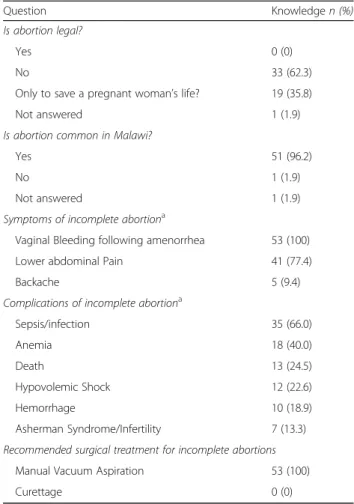
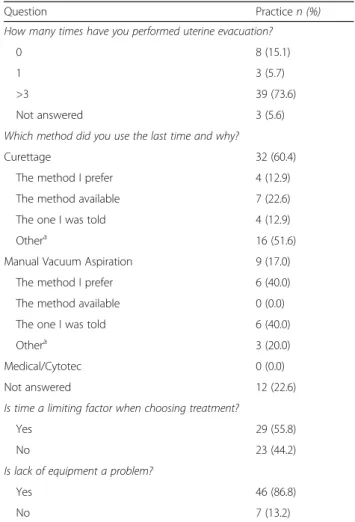
Summaries of KAP questionnaire answers are presented in Tables 1, 2 and 3. All health personnel (100%) were aware of symptoms, and the recommended treatment for incomplete abortions (Table1). However, only a third knew what the actual Malawian abortion law was, and two thirds believed that abortion was not legal under any circumstance. A positive attitude regarding treat-ment of incomplete abortions as an important part of the job was stated by 96.2% of the participants, while 56.6% of the participants preferred MVA to D&C and regarded it as easier to use and safer (Table2). However, only 17% of them used MVA the last time they per-formed uterine evacuation (Table3).
Focus group discussions
There was an even distribution of nurses, clinical officers and medical interns who attended the FGDs, as well as of gender and age (Table4). The key issues that emerged from them about training and MVA practices are sum-marized in Table5.
Previous experience
It is clear that the health personnel had different experi-ences in the past with MVA, and this seems to be reflected in their views of the training refresher program. Some participants had learned how to conduct MVA during their studies and had considerable practical ex-perience with it. Nevertheless, they were not feeling confident about it. Several nurses had not performed any MVAs since finishing nursing school, while a few were very experienced.
“It was like a refresher. I did not have any experience of how to do a MVA, but now I have been reminded of how to do it.”(Nurse 1, 2nd District Hospital).
Not all health personnel had received extensive train-ing in the past. On the other hand, they had gained
working experience. As mentioned the health system in Malawi is low on resources and personnel, and therefore it is common to “see one, do one and teach one”. The common path for them was to learn MVA procedures from senior staff and colleagues, who thus served as role models. This had influenced their MVA treatment and performance skills. In this context, it was beneficial to review MVA theory and procedures.
“It seems the interns were doing more evacs than MVA back then, so we weren’t really exposed to a lot of MVAs as students.”(Intern 8, 1st Session Central Hospital).
Feedback indicated that the training sessions provided were appreciated. It was evident that they were reminded of skills they had forgotten, and thereby be-came more confident. Hence, the refresher training was regarded as helpful, and had provided them with the additional knowledge and confidence needed to perform MVA procedures.
Table 1Background knowledge about abortion care among the participants in the Malawian studyprior toreceiving their MVA training (n= 53)
Question Knowledgen (%)
Is abortion legal?
Yes 0 (0)
No 33 (62.3)
Only to save a pregnant woman’s life? 19 (35.8)
Not answered 1 (1.9)
Is abortion common in Malawi?
Yes 51 (96.2)
No 1 (1.9)
Not answered 1 (1.9)
Symptoms of incomplete abortiona
Vaginal Bleeding following amenorrhea 53 (100)
Lower abdominal Pain 41 (77.4)
Backache 5 (9.4)
Complications of incomplete abortiona
Sepsis/infection 35 (66.0)
Anemia 18 (40.0)
Death 13 (24.5)
Hypovolemic Shock 12 (22.6)
Hemorrhage 10 (18.9)
Asherman Syndrome/Infertility 7 (13.3)
Recommended surgical treatment for incomplete abortions
Manual Vacuum Aspiration 53 (100)
Curettage 0 (0)
a
“We increased our knowledge with the training. We became more confident in doing the procedure.” (Clinical Officer 3, 1st District Hospital).
Obstacles encountered in conducting MVAs
Even though the FDG participants described the training as useful and important, they mentioned several obstacles they encounter in their work setting such as a lack of properly working MVA kits and of other equipment such as protect-ive gear.
“Sometimes we don’t have sterile gloves and
speculums. And sometimes we don’t have water and electricity. Then it’s difficult to do MVAs.”(Nurse 3, 2nd District Hospital).
One opinion was that MVA is a time-consuming pro-cedure. Even though they were aware that this procedure was safer and better for the patients, their overall work-load and lack of staff made them continue using curettage.
“I think MVA is simple, but it requires patience.” (Nurse 3, 2nd District Hospital).
Doctors and clinical officers are called to operating theaters when everything is prepared for them, including general anesthesia, and their involvement in doing a D&C is of short duration. However, an MVA requires the administration of pain relief, and time to take effect, and the cannula needs to be prepared. Moreover, the equipment requirement was mentioned as another rea-son that rendered MVA a time-consuming process.
“I think it’s good to have training, but the MVAs we have do not have enough suction so it takes longer for Table 3Study participants’practice withMVA priorto the training sessions (n= 53)
Question Practicen (%)
How many times have you performed uterine evacuation?
0 8 (15.1)
1 3 (5.7)
>3 39 (73.6)
Not answered 3 (5.6)
Which method did you use the last time and why?
Curettage 32 (60.4)
The method I prefer 4 (12.9)
The method available 7 (22.6)
The one I was told 4 (12.9)
Othera 16 (51.6)
Manual Vacuum Aspiration 9 (17.0)
The method I prefer 6 (40.0)
The method available 0 (0.0)
The one I was told 6 (40.0)
Othera 3 (20.0)
Medical/Cytotec 0 (0.0)
Not answered 12 (22.6)
Is time a limiting factor when choosing treatment?
Yes 29 (55.8)
No 23 (44.2)
Is lack of equipment a problem?
Yes 46 (86.8)
No 7 (13.2)
a
Other factors given included safer, 2nd trimester, easier, and most familiar method
Table 2Study participants’attitudes about incomplete abortionsprior totheir MVA training (n= 53)
Issue Attituden (%)
Treating women with incomplete abortions is an important part of my joba
Strongly agree 42 (79.2)
Agree 9 (17.0)
Disagree 1 (1.9)
Strongly disagree 0 (0)
Not answered 1 (1.9)
I wish it was not part of my job?
Strongly disagree 34 (66.7)
Disagree 9 (17.6)
Agree 6 (11.8)
Strongly agree 2 (3.9)
I prefer not to treat these women because abortion is a sin
No 52 (98.1)
Yes 1 (1.9)
Which method do I prefer for uterine evacuation and why?
Manual Vacuum Aspiration 30 (56.6)
Easier 14 (46.7)
Safer 12 (40.0)
The one taught 3 (10.0)
Othera 1 (3.7)
Curettage 22 (41.5)
The one taught 9 (40.9)
Othera 5 (22.8)
Easier 5 (22.7)
Safer 3 (13.6)
Medical/Cytotec 1 (1.9)
The one taught 1 (100)
a
one to do MVA than curettage, and with the number of patients one has waiting you prefer to do curettage. Not because you are not comfortable doing an MVA, but because it takes longer than curettage.”(Intern 4, 1st FGD Central Hospital).
Lack of encouragement from the hospital leaders also influenced what treatment method was being used. It became evident that they do not care what treatment was chosen as long as the patient was treated and dis-charged. Support from the leadership would also facili-tate the provision of the proper equipment and guidance about what treatment method is recommended.
“We cannot say there is any specific support from the management. We only report. The policy is there, they encourage us, but maybe the implementation down here is different. Before the training was done, it was long time since we had any training. So, even though the policy is there, the capacity is not.”(Nurse 1, 2nd District Hospital).
“Confidence comes with frequent practice. We had a debate among a number of nurses. We are trained to do MVAs, but they were not done. The clinical officers had to push until we got a room to do MVAs. Then we got more training and top up with a number of nurses.
However, they have not got enough practice and no confidence.”(Clinical Officer 1, 1st District Hospital).
Task-shifting
There was agreement that MVA was a safer and cheaper method of treating incomplete abortions, even though obstacles to doing the procedure existed. Another aspect that proved to be valuable was the idea of task shifting. Since nurses can do MVA, but not curettage, it might reduce the heavy workload of clinical officers and doctors.
“For me it has improved because the nurses can do some of our workload. We can divide the work between us”.(Clinical Officer 2, 1st District Hospital).
Clearly it is of value that clinical officers get more time for other critical patients. It is also better for patients with incomplete abortions to be treated forthwith so that they do not have to wait for the clinical officers to be available. Nurses felt that this was a positive option and enjoyed the extra responsibility.
“I think the training was important. In the past, abortions were only treated by clinicians who are not available in the wards all the time. While nurses are always in the ward”.(Nurse 2, 1st District Hospital)
It was also an impression that the health personnel were now working more as a team. It was not just an issue of task-shifting, but also task-sharing. They were now able to work as a team to ensure patients were get-ting the most appropriate treatment and when they needed it.
“We cannot say it is shifting from clinical officers to nurses. It’s more about collaboration.”(Clinical Officer 3, 1st District Hospital)
Unfortunately, collaboration was not evident in all the hospitals. In the referral hospital, evacuations were described more as an intern’s tasks, and the nurses could not perform any MVAs even though they had the skills.
Table 5Overview of the main categories and subcategories emerging from the follow-up FDGs with Malawian health care providers
Categories Subcategories
Previous experience Learned it in school
Learned by practice
Training session
Obstacles encountered in conducting MVAs
Lack of equipment
Lack of time
Lack of encouragement
Task-shifting Positive that nurses can do MVA
Nurses liking the responsibility
Better teamwork
Motivation for doing MVA It is better for the patient
Following guidelines
Table 4Identity of the participants in the follow-up FGD sessions (n= 33)
Hospital Clinical Officers Nurses Interns Age Male Female
District Hospital 1 5 6 0 24–48 7 4
District Hospital 2 4 6 0 28–40 4 6
Central Hospital 0 0 12 20–30 7 5
“They are registered to do so, but it is more about that it is the intern’s job to do it, so I haven’t come across a nurse who has offered to do it. They have the
knowledge, but they leave it to us.”(Intern 4, 2nd FGD Central Hospital).
One intern in the same group had a different take on the situation. Lack of time and personnel could be rea-sons why these nurses did not do MVAs and help the in-terns with their heavy workload. Also, the ratio of patients per nurse is very high at the central hospitals, and most likely higher than patients per doctor in the gynecological ward.
…it might be wrong to say they have a lot of time, because sometimes they have staff shortages [too]. (Intern 1, 2nd FGD Central Hospital).
Motivation for doing MVA
Motivation seems to be an important factor for doing MVA. Since the health care providers were working in busy hospitals with a big patient load, they were not mo-tivated to perform a procedure that is more time con-suming than others. On the other hand, participants knew that MVA is safer and should be done according to the guidelines. MVA can also be done as an out-patient procedure, which means out-patients do not have to wait so long before the procedure nor stay overnight.
“It’s much better to do MVA. Normally when we do evacuations there is more risk of complications. When you do MVA you don’t have the same risk of
complications.”(Clinical Officer 2, 2nd District Hospital)
The nurses were motivated and content about having this extra task which could improve the situation for the patients and help the clinical officers.
“I feel MVAs will help improve the situation because these MVA can be done without clinicians. It helps many patients and a clinician doesn’t have to be around. We really have a very experienced team here to take care of the patients. We are ready to take care of them.”(Nurse 5, 1st District Hospital)
“MVA is safer and nurses can also do it which saves your time.”(Clinical Officer 2, 2nd District Hospital)
Discussion
Our study shows that conducting a refresher training among health personnel was well received by the
participants. The health workers are well aware of the high prevalence of abortions and the possible complica-tions. They also have knowledge of MVA as the recom-mended and preferred treatment, but the majority use curettage due to obstacles at different levels. The partici-pants felt more confident after the training, and were content that they now had more treatment options. An additional benefit was more teamwork and task-sharing at the district hospitals, where the nurses can care for many of the patients with incomplete abortions. The ex-tensive shortage of healthcare workers made the WHO develop global recommendations and guidelines on task-sharing as a tool for countries to implement safe task-sharing processes [34]. Training with task-shifting has already been proven successful in other developing countries, regarding processes like cesarean sections and hernia repair [35,36]. Our analysis of the material made us see other factors than just the training which influ-enced the practice; direct factors, like lack of equipment, number of staff and current policies, and indirect fac-tors, like team-work and leadership [37].
The individual health worker’s experience and previ-ous education, practice, support, access to supervision and acceptance of MVA influences the confidence of using the suggested tool, irrespective of their appreci-ation of the training given. The KAP survey revealed that health personnel think that treating patients with incomplete abortions is an important part of their job. They did not oppose to treating these patients because of personal moral beliefs in contrast to a study from Zimbabwe where the health personnel referred to the women in negative terms [38]. The health workers in our study did not regard such patients as immoral, and were dedicated to providing them with the best possible treatment. Lack of time, lack of experience and a high patient load were seen as obstacles similar to another study [39]. The nurses were content to have a task they can perform on their own, and enjoyed the extra respon-sibility of sharing the treatment of incomplete abortions with clinical officers as also seen in a previous qualitative study from Uganda [39].
built on by the leadership nor was MVA use imple-mented. In our assessment, this constitutes a missed op-portunity to improve PAC.
A previous Malawian study has shown that training and task-shifting efforts seem to have had a positive effect on maternal mortality [40]. Furthermore, experiences with task-shifting in other developing countries such as India and Sierra Leone yielded comparable results when surgery was performed by less educated health personnel [34–36]. Another study has also shown that the outcomes are com-parable when incomplete abortions are diagnosed and treated by midwives instead of physicians [41].
Most specialists work at the larger hospitals, and have the opportunity to engage and ensure that their patients are being treated according to the existing guidelines. Concurrently, specialists have an overarching responsibil-ity to the rural District Hospitals in supervising clinical ac-tivities there. However, the lack of consultants in gynecology makes it very hard to adequately supervise all such facilities. Nevertheless, it is essential for all countries to insert a continuum of care, and this is especially so in low-income regions with high maternal mortality.
The guidelines by the WHO, International Federation of Gynecology and Obstetrics (FIGO) and the Malawi Minis-try of Health clearly state that vacuum aspiration is the preferred surgical method for treatment of incomplete abortions in the first trimester and that the use of curet-tage should be decreased to the minimum [21, 23, 42]. Our experience is that training can be done repeatedly and effectively with little cost. One or two experienced in-dividuals in a hospital can be enough to conduct regular training sessions for their co-workers, while lack of equip-ment needs to be solved at the administrative level. A pre-vious study from Malawi has shown that MVA is 29% cheaper than performing curettage [43] in addition to be-ing safer and havbe-ing fewer complications [20]. Its formal adoption would help to reduce maternal mortality and the costs of treating serious complications after abortions within health systems with limited resources [20,21,43].
Trustworthiness
The collaboration between Norwegian and Malawian re-searchers, obstetricians, gynecologists and midwives with experiences of treating patients with incomplete abor-tions was important for gaining an in-depth understand-ing of the data and to ensure credibility. The different personal and professional backgrounds of the authors were also helpful in the indicated classification/illustra-tion/interpretation exercises. The first author lived in Malawi for several years and was onsite during the entire data collection process to ensure consistency, depend-ability and thereby building trust. During the whole process, she kept in mind how her role as a medical doc-tor, and a white expatriate woman, could have affected
the data collection. To enhance the transferability of the project full details on the setting, the participants, data collection and qualitative analyses procedures are provided.
Strengths and limitations
A strength of our study is that the follow-up FGDs were employed to explore the views on MVA and PAC of local health personnel. It supplemented the KAP survey data and gave us insight not only about the participants’ knowledge on the Malawian abortion law, symptoms and complications after abortions, but also their atti-tudes about abortions and the methods and practices in use at a community/hospital level. Training sessions are common in Malawi and other developing countries, but there is little data on follow ups. A possible limitation is whether the participants were sharing their actual per-ceptions rather than what they thought the researchers wanted to hear, or what was expected of them. However, the participants were speaking in a freely and uninhib-ited manner, and were encouraged by the moderator to be honest and give critical feedback.
Conclusions
Our study shows that the organized MVA-training pro-vided was well received the health personnel and had a role in increasing the use of MVA in the treatment of in-complete abortions. A lack of properly working equip-ment, insufficient staff and time, and an absence of leadership support were major obstacles to employing MVA. Furthermore, our study suggests that attitudes and change in practices to use another and recom-mended uterine evacuation method is complex as it challenges various concerns, such as the individual health provider’s perspective, team work, leadership and policy issues. Change in behavior therefore needs to be addressed at several levels, and a health systems ap-proach is recommended.
Abbreviations
D&C:Dilatation and Curettage; FIGO: International Federation of Gynecology and Obstetrics; MVA: Manual Vacuum Aspiration; PAC: post-abortion care
Acknowledgments
We hereby thank our collaborators at the College of Medicine and the Kamuzu College of Nursing, Blantyre, Malawi, as the research assistants at the Queen Elizabeth Central Hospital (QECH), Chikwawa District Hospital and Chiradzulu District Hospital located in Southern Malawi, and all health personnel who participated in the study. With thanks, we acknowledge Evert Nieboer, Emeritus Professor, McMaster University (Hamilton, Ontario, Canada) for his editing of the text.
Funding
Availability of data and materials
The authors declare that the qualitative data supporting the findings of this study are available. The datasets used and/or analyzed during the current study are available from the corresponding author upon receiving a reasonable request.
Authors’contributions
MO and ED conceived and designed the study and carried out the interviews. MO and ED analyzed the data. MO wrote the paper; ED, GD, UK and JO gave substantial input during the data analyses and the manuscript preparation. All authors read and approved the final manuscript.
Ethics approval and consent to participate
Ethical approvals were given from The Regional Committee for Medical and Health Research Ethics of Central Norway (REK) (reference 2015/455) and the College of Medicine Research Ethics Committee in Malawi, (reference P.06/ 15/1748/ MVA Study). We anticipated no risks for the participants, and the project guidelines were designed not to release any sensitive personal information. All participants signed an informed consent form.
Consent for publication
Not applicable.
Competing interests
The authors declare no conflict of interest. The funding sources had no role in the study design, in the data collection, analyses and interpretation, nor in the writing of the manuscript and the decision to publish the results.
Publisher’s Note
Springer Nature remains neutral with regard to jurisdictional claims in published maps and institutional affiliations.
Author details
1Department of Public Health and Nursing, Norwegian University of Science
and Technology, Trondheim, Norway.2Queen Elizabeth Central Hospital, Blantyre, Malawi.3Kamuzu College of Nursing, Blantyre, Malawi.4College of Medicine, University of Malawi, Blantyre, Malawi.5University of Pretoria, Pretoria, South Africa.6Department of Obstetrics and Gynecology, St Olav’s Hospital, Trondheim, Norway.7Department of Women’s and Children’s Health, Uppsala University, Uppsala, Sweden.
Received: 14 March 2018 Accepted: 7 February 2019
References
1. The World Bank. 2017.http://databank.worldbank.org/data/Views/Reports/
ReportWidgetCustom.aspx?Report_Name=CountryProfile&Id= b450fd57&tbar=y&dd=y&inf=n&zm=n&country=MWI. Accessed 13 Mar 2018.
2. United Nations. Human development index and its components: United
Nations development Programme; 2015.
http://hdr.undp.org/en/2018-update. Accessed 13 Mar 2018.
3. World Health Organization. WHO country cooperations strategy at a glance:
Malawi Geneva: World Health Organization; 2014.http://www.who.int/iris/
handle/10665/136935. Accessed 13 March 2018.
4. World Health Organization. Global Health Observatory data repository 2015.
http://apps.who.int/gho/data/view.main.1390?lang=en. Accessed 13 Mar 2018.
5. National Statistics Office. Malawi Demographic and Health Survey
2015-2016 Zomba, Malaw 2015-2016.https://dhsprogram.com/pubs/pdf/FR319/FR319.
pdf. Accessed 13 Mar 2018.
6. World Health Organization. Maternal Mortality 2016.http://www.who.int/
mediacentre/factsheets/fs348/en/. Accessed 13 Mar 2018.
7. Jackson E, Johnson BR, Gebreselassie H, Kangaude GD, Mhango C. A
strategic assessment of unsafe abortion in Malawi. Reprod Health Matters.
2011;19(37):133–43.
8. Geubbels E. Epidemiology of maternal mortality in Malawi. Malawi Med J.
2006;18(4):206–25.
9. Lema VM, Changole J, Kanyighe C, Malunga EV. Maternal mortality at the
queen Elizabeth central teaching hospital, Blantyre, Malawi. East Afr Med J.
2005;82(1):3–9.
10. Ganatra B, Gerdts C, Rossier C, Johnson BR Jr, Tuncalp O, Assifi A, et al. Global,
regional, and subregional classification of abortions by safety, 2010-14: estimates
from a Bayesian hierarchical model. Lancet. 2017;390(10110):2372–81.
11. Malawian Penal Code. Laws of Malawi. Chapter 7:01; Blackhall Publishing:
Online. 1930.
12. Malawi Government. The law commission discussion paper on review of
abortion law in Malawi. 2013.
13. Polis CB, Mhango C, Philbin J, Chimwaza W, Chipeta E, Msusa A. Incidence
of induced abortion in Malawi, 2015. PLoS One. 2017;12(4):e0173639.
14. Kalilani-Phiri L, Gebreselassie H, Levandowski BA, Kuchingale E, Kachale F,
Kangaude G. The severity of abortion complications in Malawi. Int J
Gynaecol Obstet. 2015;128(2):160–4.
15. Gemzell-Danielsson K, Fiala C, Weeks A. Misoprostol: first-line therapy for
incomplete miscarriage in the developing world. BJOG. 2007;114(11):1337–9.
16. Cleeve A, Byamugisha J, Gemzell-Danielsson K, Mbona Tumwesigye N,
Atuhairwe S, Faxelid E, et al. Women's acceptability of misoprostol treatment for incomplete abortion by midwives and physicians - secondary outcome analysis from a randomized controlled equivalence trial at district level in Uganda. PLoS One. 2016;11(2):e0149172.
17. Zordo SD. The biomedicalisation of illegal abortion: the double life of
misoprostol in Brazil. Hist Cienc Saude Manguinhos. 2016;23(1):19–36.
18. Samnani A, Rizvi N, Ali TS, Abrejo F. Barriers or gaps in implementation of
misoprostol use for post-abortion care and post-partum hemorrhage prevention in developing countries: a systematic review. Reprod Health. 2017;14(1):139.
19. Lufesi NN, Andrew M, Aursnes I. Deficient supplies of drugs for life threatening
diseases in an African community. BMC Health Serv Res. 2007;7:86.
20. Tuncalp O, Gulmezoglu AM, Souza JP. Surgical procedures for evacuating
incomplete miscarriage. Cochrane Database Syst Rev. 2010;9:CD001993.
21. World Health Organization. Safe abortion: technical and policy guidance for
health systems 2012.http://apps.who.int/iris/bitstream/10665/70914/1/
9789241548434_eng.pdf?ua=1. Accessed 13 Mar 2018.
22. World Health Organization. Clinical practice handbook for Safe abortion
2014.http://apps.who.int/iris/bitstream/handle/10665/97415/
9789241548717_eng.pdf?sequence=1. Accessed 8 Aug 2018.
23. The Association of Obstetricians & Gynaecologists of Malawi. Obstetrics &
Gynaecology Protocols and Guidelines. Version 1.0. 2014.
24. Odland ML, Rasmussen H, Jacobsen GW, Kafulafula UK, Chamanga P,
Odland JO. Decrease in use of manual vacuum aspiration in postabortion care in Malawi: a cross-sectional study from three public hospitals, 2008-2012. PLoS One. 2014;9(6):e100728.
25. Odland ML, Membe-Gadama G, Kafulafula U, Jacobsen GW, Kumwenda J,
Darj E. The Use of Manual Vacuum Aspiration in the Treatment of Incomplete Abortions: A Descriptive Study from Three Public Hospitals in Malawi. Int J Environ Res Public Health. 2018;15:2.
26. Cook S, de Kok B, Odland ML. It's a very complicated issue here’:
understanding the limited and declining use of manual vacuum aspiration for postabortion care in Malawi: a qualitative study. Health Policy Plan. 2017;
32(3):305–13.
27. World Health Organization. Knowledge, Attitudes and Practice surveys Zika
virus disease and potential complications 2016http://apps.who.int/iris/
bitstream/10665/204689/1/WHO_ZIKV_RCCE_16.2_eng.pdf?ua=1. Accessed 8 Aug 2018.
28. Levandowski BA, Mhango C, Kuchingale E, Lunguzi J, Katengeza H,
Gebreselassie H, et al. The incidence of induced abortion in Malawi. Int
Perspect Sex Reprod Health. 2013;39(2):88–96.
29. Wilson A, Lissauer D, Thangaratinam S, Khan KS, MacArthur C, Coomarasamy
A. A comparison of clinical officers with medical doctors on outcomes of caesarean section in the developing world: meta-analysis of controlled studies. BMJ. 2011;342:d2600.
30. Tyson AF, Msiska N, Kiser M, Samuel JC, McLean S, Varela C, et al. Delivery of
operative pediatric surgical care by physicians and non-physician clinicians
in Malawi. Int J Surg. 2014;12(5):509–15.
31. Ipas. Performing Manual Vacuum Aspiration (MVA) Using the Ipas MVA
Plus®, Ipas 3mm and Ipas EasyGrip® Cannulae.
http://hdr.undp.org/en/2018-updatePublications/PACMVAE08.ashx. Accessed 8 Aug 2018.
32. Ipas. Training tips for using pelvic models in manual vacuum aspiration
(MVA) clinical training 2009.https://iawg.net/wp-content/uploads/2017/08/
10.-PELMOTRN-E14_lr.pdf. Accessed 8 Aug 2018.
33. Graneheim UH, Lundman B. Qualitative content analysis in nursing research:
concepts, procedures and measures to achieve trustworthiness. Nurse Educ
34. World Health Organization. Task Shifting: Global Recommendations and
Guidelines 2008.http://www.who.int/healthsystems/TTR-TaskShifting.pdf.
Accessed 8 Aug 2018.
35. Bolkan HA, van Duinen A, Waalewijn B, Elhassein M, Kamara TB, Deen GF,
et al. Safety, productivity and predicted contribution of a surgical
task-sharing programme in Sierra Leone. Br J Surg. 2017;104(10):1315–26.
36. Bhushan H, Bhardwaj A. Task shifting: a key strategy in the multipronged
approach to reduce maternal mortality in India. Int J Gynaecol Obstet. 2015;
131(Suppl 1):S67–70.
37. Heise LL. Violence against women: an integrated, ecological framework.
Violence Against Women. 1998;4(3):262–90.
38. Chiweshe M, Macleod C.‘If you choose to abort, you have acted as an
instrument of Satan’: Zimbabwean health service Providers’negative
constructions of women presenting for post abortion care. Int J Behav Med.
2017;24(6):856–63.
39. Paul M, Gemzell-Danielsson K, Kiggundu C, Namugenyi R, Klingberg-Allvin
M. Barriers and facilitators in the provision of post-abortion care at district level in Central Uganda - a qualitative study focusing on task sharing between physicians and midwives. BMC Health Serv Res. 2014;14:28.
40. Ellard DR, Chimwaza W, Davies D, Simkiss D, Kamwendo F, Mhango C, et al.
Up-skilling associate clinicians in Malawi in emergency obstetric, neonatal care and clinical leadership: the ETATMBA cluster randomised controlled trial. BMJ Glob Health. 2016;1(1):e000020.
41. Klingberg-Allvin M, Cleeve A, Atuhairwe S, Tumwesigye NM, Faxelid E,
Byamugisha J, et al. Comparison of treatment of incomplete abortion with misoprostol by physicians and midwives at district level in Uganda: a
randomised controlled equivalence trial. Lancet. 2015;385(9985):2392–8.
42. International Federation of Gynecology and Obstetrics. Uterine evacuation: use
vacuum aspiration or medications, not sharp curettage 2011.https://www.figo.
org/sites/default/files/FIGO%20DC%20Statement.pdf. Accessed 8 Aug 2018.
43. Benson J, Gebreselassie H, Manibo MA, Raisanen K, Johnston HB, Mhango C,