R E S E A R C H A R T I C L E
Open Access
Social capital in vulnerable urban settings:
an analytical framework
Desire Mpanje, Pat Gibbons and Ronan McDermott
*Abstract
Social capital has been identified as crucial to the fostering of resilience in rapidly expanding cities of the Global South. The purpose of this article is to better understand the complexities of urban social interaction and how such interaction can constitute‘capital’in achieving urban resilience. A concept analysis was conducted to establish what constitutes social capital, its relevance to vulnerable urban settings and how it can be measured. Social capital is considered to be constituted of three forms of interaction: bonds, bridges and linkages. The characteristics of these forms of interaction may vary according to the social, political, cultural and economic diversity to be found within vulnerable urban settings. A framework is outlined to explore the complex nature of social capital in urban settings. On the basis of an illustrative case study, indicators are established to indicate how culturally specific indicators are required to measure social capital that are sensitive to multiple levels of analysis and the development of a multidimensional framework. The framework outlined ought to be adapted to context and validated by future research.
Keywords:Social capital, Concept analysis, Urbanisation, Urban vulnerability, Slums
Introduction
Urban areas can be rendered vulnerable due to multiple exacerbating factors such as rapid and unplanned devel-opment, environmental degradation, precarious liveli-hoods and resource pressures. These challenges are likely to grow given that the proportion of the world’s population living in urban areas is projected to increase from the current 53% to a projected 70% by 2050 (IDMC & NRC 2014; UNISDR 2014). Over the past 40 years, the urban population in lower income and fra-gile countries has increased by 326% (UNISDR 2014). Approximately one billion people or one third of the de-veloping world’s urban population live in slums, mostly in highly vulnerable areas (UN-Habitat 2009; Lall and Deichmann2012). Among displaced persons, more than half seek safety and opportunity in urban areas, often living alongside the urban poor and other migrants and exposed to the risk of abuse, exploitation and a range of hazards (Global CCCM Cluster2014).
The ‘typical’humanitarian crisis of the future is likely to be urban rather than rural with all the attendant
systemic complexity that cities present (Apraxine et al.
2012; Pantuliano et al.2012; Pavanello2012; Parker and Maynard2015; World Humanitarian Summit Secretariat
2015). This sentiment is echoed in a raft of recent global policy documents that warn of the future urban threat, including the Sendai Framework for Disaster Risk Re-duction 2015–2030; Sustainable Development Goals (Murshed2015); World Humanitarian Synthesis Report, October 2015 (World Humanitarian Summit Secretariat
2015); Secretary General’s Report in preparation for the World Humanitarian Summit (UN General Assembly,
2016); UN-Habitat III, October 2016 (UN-Habitat2016); and the IFRC World Disasters Report 2016 (IFRC2016). Against this policy backdrop, there are calls to build urban resilience.
While the debate concerning the definition and prac-tice of urban resilience1continues, a growing number of academics and policymakers are suggesting that the so-lutions to humanitarian needs should come from within affected communities or what is being termed ‘localised response’ (Gingerich and Cohen 2015; Wall and Hedlund 2016). In this vein, the World Humanitarian Summit (WHS) consultations recommended that hu-manitarian aid organisations invest in building social * Correspondence:[email protected]
Centre for Humanitarian Action, School of Agriculture and Food Science, University College Dublin, Belfield Campus, Dublin 4, Ireland
capital and strengthening local structures (World Humanitarian Summit Secretariat 2015, p.57). Simi-larly, Gibbons et al. (2017, p.10) advise that recognising re-sources and capacities of beneficiaries requires close engagement and the building of a sense of empathy with affected populations that recognises their agency as they bid to recover and return to normality. However, urban contexts, especially in such places as informal settlements and slum areas, are extremely diverse and complex such that enhancing the absorptive, adaptive or transformative capacity requires a deep understanding of the social con-text. Contemporary approaches and strategies do not fully consider the community institutions and the relationships that shape the quality and quantity of social interactions in urban settings that ultimately impact on the lives and livelihoods of vulnerable urban dwellers (Concern Worldwide and USAID2014). Such community institu-tions and relainstitu-tionships emerge and develop under con-ditions characterised by the increased transience of populations, greater communication possibilities, in-creased marketisation of relations and stark economic, and social and ethnic heterogeneity (Knox-Clarke and Ramalingam2012). While a link between social capital and improved individual, household and community welfare in resource-poor settings has been identified, the contribution that social capital makes to resilience is still unclear (Aldrich 2012a, b; Story 2013; Béné et al.
2015; Aldrich and Smith 2015; Pfefferbaum et al. 2015; Béné et al.2016).
The complexity and diversity of urban social systems combined with the recognition of increasing urban vul-nerability provide an ideal testbed for exploring this rela-tionship. Nevertheless, it is important to be cognisant that the measurement of social capital remains problem-atic. This is especially the case in informal urban settle-ments where aggregated data can mask stark inequalities within populations which in turn can undermine social capital (Concern Worldwide and USAID 2014). The adaptation and validation of approaches to measuring social capital at various levels of analysis, in particular in the multifaceted complexity of informal urban settle-ments, is thereby urgently warranted.
Within the current context in which the humanitarian sector has been exhorted to recalibrate their approaches to take into account the urban dimension, Aldrich and Smith (2015, p. 6) identify the need to guide the aid community concerning the form of social capital—bonding, bridging or linking—that should be emphasised according to the particularities of a variety of humanitarian settings. However, various research studies conducted in urban areas, in slums and in informal settlements on social capital do not adequately provide theoretical basis hence lacks suf-ficient presentation and use of social capital conceptual and analytical framework. Differentiating the forms of social
capital is important given the emergence of literature that eschews the unmitigated celebration of social capital and highlights its potential dark side, arising from bonding so-cial capital (Portes1998,2014). By exploring the complex nature of social capital in vulnerable urban settings, in-formed recommendations can be provided to the aid com-munity to build on social capital in their programming.
This article by way of concept analysis advances the debate concerning the building of social capital in vul-nerable urban areas, in particular the value of social cap-ital in localising humanitarian response2 in slums and informal settlements. The aim is to develop a framework to exploit existing potential social capital that can en-hance efforts to build resilience in vulnerable urban settings. Therefore, the objectives are twofold: (a) to es-tablish what constitutes social capital, its relevance to vulnerable urban settings and how it can be measured and (b) to develop a multilevel and multidimensional framework to aid in exploring the complex nature of so-cial capital in vulnerable urban settings. In pursuing this latter objective, an illustrative case study is presented that serves to demonstrate the operationalisation of a conceptual/theoretical framework of social capital in vulnerable urban settings. It does so by drawing on pre-liminary findings from a research project conducted in informal settlements in Nairobi.
Research approach: concept analysis in humanitarian action
Concept analysis as a research method is a process of determining the similarities and contrasts between con-cepts (Walker and Avant 1995, 2005, 2011; Gibbons
2017). In that manner, it helps to clarify and describe the concepts belonging to the whole, their characteristics and relations they hold within systems of concepts (Nuopponen 2010). The methods of Walker and Avant (1995,2005,2011) and Gibbons (2017) were used as the framework to guide the analysis. The steps involved in the concept analysis were as follows:
(1)The analysis of ‘social capital’was conducted to clarify the meaning of the concept, to develop an operational definition and to distinguish the relevance of the concept in vulnerable urban contexts.
(2)The defining attributes of social capital were determined including the instrumental and emancipatory rationale for its application in urban settings.
(3)Appropriate indicators for the attributes of social capital were developed to establish a framework. (4)An illustrative case of social capital that assigns
in a context-specific vulnerable urban setting is presented.
Although social capital has become increasingly in-voked in humanitarian discourse in recent times, the term has been in use for decades. Keeley (2007) indicates that the term‘social capital’may first have appeared in a book authored by Lyda Hanifanin published in 1916. The book discussed how neighbours could work to-gether to oversee schools. The term was used to describe what counts in the daily lives of people: namely good will, fellowship, sympathy and social intercourse (Keeley
2007). Its understanding has evolved over these decades resulting in a rich body of literature on social capital. In its most generic sense, social capital can be defined as the ‘networks of relationships among people who live and work in a particular society, enabling that society to function effectively’(Oxford English Dictionary, 2017 on-line). However, scholars who popularised the concept like Bourdieu, Coleman and Putnam emphasised social capital as a collective asset (Lin 1999a). Bourdieu’s (1986) contribution concerned the size and strength of networks, while Coleman (1990) considered social cap-ital as a resource that can be deployed by social actors and transformed into other forms of capital, including human capital. Putnam (1993,2000), on the other hand, was interested in social organisations emphasising the importance of features including norms, trust and networks.
More recent definitions focus on the positive links, shared values and understanding of social interaction (Keeley2007). For instance, Siegler (2014) contends that social capital brings about connections that generate benefits due to tolerance, solidarity and trust. Scrivens and Smith (2013) argue that the term social capital conveys the idea that human relations and norms of be-haviour have instrumental value in improving different aspects of people’s lives. Such aspects play a significant role in shaping individual as well as collective well-being outcomes. However, one should be cognisant that not all social interaction constitutes social capital. Portes (1998,2014) notes how social interaction can re-sult in‘social liabilities’. Typical examples of such social liabilities include organised crimes, nepotistic practices, social stratification and corruption that can arise from dense networks of social interaction.
In bringing together the disparate and rich under-standings of social capital, the study recognises both the quantity and quality of the social interactions, the varying levels of such social interaction (individual, community and locality) and the value of the inter-action in achieving individual and collective goals.
Moreover, the urban3setting provides a particular type of locality typified by high population density, higher
mobility and high interdependency as compared to the self-sufficiency of the rural. The population in vulnerable urban settings, especially in informal settings and slums, rely on each other to fulfil basic needs and access ser-vices. There is greater interdependence on existing infra-structure, social, political and economic systems, e.g. access to water, security, and microfinance (Parker and Maynard 2015). In rural areas, the households and population may be self-dependent as long as they are food secure and have disposable income.
Social relations may be more instrumental in urban settings than tangential towards achieving basic needs. This leads us to an interesting question of what social capital means in vulnerable urban environments. There-fore, by combining significant contributions on the meaning of social capital and the urban, the authors propose that social capital in vulnerable urban contexts can be understood as:
‘the institutions and relationships that shape the quality and quantity of social interactions in vulnerable urban set-tings, which in the end enhance individual, community and society’s capacity to collaborate in the achievement of both individual and collective aims before, during and after a humanitarian crisis.’
Understanding the concept and its relevance in complex urban settings
Walker and Avant (1995,2011) indicated that establish-ing the definestablish-ing attributes of the concept under analysis is the most critical part of concept analysis research. The process of defining attributes involves examining the clusters of elements associated with the concept. Therefore, the starting point to analysing attributes of social capital is to examine the relationships that shape the quality and quantity of social interaction that is relevant and appropriate in vulnerable contexts. The lit-erature identifies that such relationships are embedded in three forms of social capital: bonding, bridging and linking capitals (Lin 1999b; Narayan 1999; Dasgupta and Ismail 1999; Lofors and Sundquist 2007; Keeley
2007; Ledogar and Fleming2008; Hawkins and Maurer
2010; Álvarez and Romaní2017).
Bonding (social) capital
(1999a) argued to be the outcomes or in other words the returns of social capital due to expressive actions. Fur-thermore, the urban poor in the developing world relies heavily on bonding capital to help them ‘get ahead’ (Woolcock1998,2005). It is not self-evident to the out-sider that such reliance would remain the same in the situation of extreme vulnerability arising due to human-made or natural hazards. The next three sections present the attributes of bonding capital. These attributes are the quantity of relationships (structure and nature), the quality of relationships (norms of trust and reciprocity) and the degree of social influence in vulnerable urban settings.
Quantity of relationships (structure and nature of relationships)
The nature of relationships mainly refers to the structure and strength of the connections among and between in-dividuals. Social fabric is made up of a network of indi-viduals or groups connected by one or more specific types of interdependency, such as friendship, kinship, common interest, financial exchange, sexual relation-ships or relationrelation-ships of beliefs, knowledge or prestige (Wasserman and Faust1994; Freeman 2004). In drawing on the social network4 analysis (SNA) technique, one can assess the ‘quantity’ or frequency of the social rela-tionships (interdependence) in terms of both— ego-cen-tric analysis,5 also referred to as personal network analysis, and socio-metric analysis or whole network analysis6 (Freeman 2004; Rice and Yoshioka-Maxwell
2015). Fay (2005) indicates that social networks are less stable in urban areas, with relationships more likely to be based on the quality of reciprocal links between and among individuals and friends than on familial obliga-tions. Understanding the value and stability of social networks in the urban context will contribute to the much-needed knowledge required to realise and en-hance the localisation of humanitarian response. It will, therefore, be interesting in this study to find out how slum dwellers use social networks (connections and interdependencies) to enhance preparedness and resilience.
Quality of relationships (norms of trust and reciprocity)
Putnam (2000) and Stone (2001) indicate that bonding social capital involves trust and reciprocity in closed net-works and helps the process of ‘getting by’ in life on a daily basis. Siegler (2014) argues that the quality of re-lationships (trust and values) that are beneficial for so-ciety, and therefore constitute capital, can determine how much people in society are willing to cooperate with one another. Also, through social influence, people obtain normative and informative guidance by relating their behaviour to others within the same group or among different groups (Coleman et al. 1957). The
terms normative and informative guidance are used neutrally due to the capacity of bonding capital to lend itself towards negative as well as positive outcomes (Scrivens and Smith2013).
Sako (1992: 69) defines trust as‘a state of mind an ex-pectation held by one trading partner about another that the other behaves or responds in a predictable and mu-tually expected manner’. Trust is achieved when there is both commitment and intimacy (Drew et al. 2012), in the social interaction irrespective of the context or do-main over which it is conferred (Kramer and Tyler1996; Hardin 2002; Nooteboom 2002). Literature identifies three types of trust (Cook2001; Smith2010; Paliszkiewicz
2011), namely, (a) generalised trust, a kind of trust that is based largely on social learning and developmental pro-cesses; (b) particularised trust, the idea that people ‘like me’can be trusted, but that other groups may not share my moral values; and (c) strategic trust, the idea that spe-cific others have the appropriate motives and intentions in the belief that significant others can be relied upon to act in one’s interests in specific situations and around specific issues. Stone (2001) likened strategic trust to public trust. An example of this kind of trust is the trust in the institu-tion, the belief that police officers have appropriate mo-tives towards citizens and are technically competent to protect citizens (Jackson et al. 2011, p. 270). Klinenberg (2002; as cited in Woolcock2005) contends that even the most isolated individuals are better off if they happen to live in communities with high levels of trust and participation. The World Bank (2003) indicates that in poor urban areas, social fragility due to high ethnic di-versity and profound economic inequality creates low-level generalised trust. The relative importance of these three types of trust (generalised, particularised and strategic) needs further investigation within vul-nerable urban contexts, notwithstanding that indicator of trust may manifest itself differently across cultures (Keeley2007).
volunteering). Nevertheless, the extent to which such reciprocal links and the effect or influence of in times of stress in vulnerable urban contexts requires further investigation.
Bridging (social) capital
Bridging capital concerns the peoples’relations or links that stretch beyond a shared sense of identity, for ex-ample to distant friends, colleagues and associates. Drawing on Lin (1999a), it can be argued that bridges give rise to instrumental actions with three possible out-comes. These outcomes include economic (material re-sources such as wealth), political and social. Kreuter and Lezin (2002) argue that bridging social capital is compar-able to institutional infrastructure; therefore, it should be detected at the organisational level, where norms, values and social structures facilitate more macro-connections. These values could be formal or informal and well-articulated. Bridging capital, as opposed to bonding capital, is about ‘getting ahead’, involving mul-tiple networks which may make resources and oppor-tunities which exist in one network accessible to a member of another network or locality (Stone 2001; Woolcock 2005). Furthermore, Woolcock (2005) argue that the urban poor in the developing world rely heavily on their friends and relatives to help them ‘get ahead’. However, it is not clear whether such reliance re-mains the same in a situation of vulnerable urban contexts that are characterised by high mobility and greater interdependencies.
Quality and quantity of meso-level connections
Bridging capital facilitates collective action, civic engage-ment or citizen participation. Such actions and behav-iours contribute positively to the collective life of a locality, community or society (Scrivens and Smith2013; Siegler 2014). Civic engagement includes activities such as volunteering, political participation and other forms of community actions (Grootaert and Bastelaer 2001; Siegler 2014). Evaluation of bridging capital requires examination of such aspects of community governance and decision making, identification of community insti-tutions, characterisation of community-institutional rela-tionship and assessment of institutional networks and organisational density (Krishna and Shrader1999,2000). This means that bridging capital is mainly assessed at the meso level to achieve a more focused observation of local institutions, collective actions and civic engagement (Grootaert and Bastelaer 2001; Scrivens and Smith 2013; Siegler2014).
The literature on measurement of bridging social cap-ital in institutions, especially local associations, includes the examination of their internal heterogeneity and their wider networks, including their horizontal7 and vertical
connections. Examining heterogeneity entails assessing the differences that exist between and among members of a locality/institution regarding gender, religion, ethni-city, wealthy and age (Grootaert and Bastelaer 2001; Stone 2001). Socio-structural issues might include or-ganisational density and related characteristics, networks and mutual support mechanisms, exclusion or engage-ment barriers, collective action including formal and in-formal groups and conflict resolution systems. For example, Grootaert (1999), through his study of social capital, household welfare and poverty in Indonesia, found that greater heterogeneity of local associations (along with factors such as education, occupation and economic status) confers the greatest benefits of sharing information and knowledge. However, the effect of homogeneity and heterogeneity on the quality of social relations would also be useful in understanding the im-pact of bridging social capital on addressing urban vul-nerabilities in informal settlements. For example, in the aftermath of the 1995 earthquake in Kobe, Japan, com-munity groups in long-established areas of the city were shifted to temporary shelters. Shaw and Goda (2004) argue that such movement had a negative impact on community links, thereby hampering the rebuilding interpersonal relationships. It follows that it would be very interesting to determine how community links are developed and used in vulnerable urban settings.
Linking (social) capital
Linking capital concerns relations of individuals and communities with societal institutions—links to people or groups further up or lower down the social ladder (Keeley, 2007, p.102). Linking social capital is used to define relations that are characterised by power differ-ences, the accumulation of ties with individuals in power and institutions of influence (Titeca and Vervisch 2008; Manzano Nunez2016).
engagement facilitates and promotes linking social cap-ital (ibid). It has also been argued that the connections between survivors and national and international non-governmental organisations (NGOs) can play a vital role in helping to secure necessities and broader com-munity recovery (Aldrich 2012b p. 173; Hawkins and Maurer2010). Again, assessing vertical connections be-tween vulnerable populations and those in power would also help to identify the impact of expectations the af-fected population may have during preparedness for, re-sponse to and recovery from disasters. Different typologies around expectations of response to the disas-ter can affect recovery processes as demonstrated by Chamlee-Wright and Storr (2010), which drew on a case of rebuilding processes by communities in New Orleans in the aftermath of Hurricane Katrina. Linking capital describes the amount of trust between individ-uals and societal institutions, in our case vulnerable urban societies (Sundquist et al.2014). The importance of trust in addressing vulnerability to disasters has been highlighted in the literature relating to the disaster. Reinhardt (2015), who examined the political drivers of post-disaster resettlement in post-Katrina New Orleans, found that survivors exhibited less trust in public offi-cials to manage disasters than those who were not affected.
Quality and structure of linkages and institutions
North (1990) states that institutions and organisations are different but related terms. Institutions comprise of rules, norms of behaviour, conventions and values that bind individuals together, structures that humans impose on their dealings with each other. On the other hand, or-ganisations consist of groups of individuals engaged in a purposive activity (North 1990, 1992). Institutions are frequently viewed by sector such as the economic, social and political environments that shape the social struc-ture (Grootaert and Bastelaer 2001). Such institutions encompass informal [local and horizontal] and formal [hierarchical and vertical] associations and relationships. Societal, institutional structures (organisations) include education, health services, the economy, and political and juridical sectors. Institutional relationships include macro-level governance, political regime, the rule of law, the court system and civil and political liberties [as part of quality]. Adger (2003) argues that the relations be-tween actors and institutions play a significant role in shaping people’s ability to act when collectively adapting to and recovering from natural disasters. Situations of humanitarian crisis require greater openness of institu-tions to engage with individuals or organisainstitu-tions. An un-derstanding of the existing institutions and organisations and the linkages with individuals in vulnerable urban settings would then provide an opportunity for both
national and international aid organisations to engage better with the affected population. Therefore, analysing linking capital in vulnerable urban settings would aid in obtaining not only a better understanding of the existing institutions and organisations but also the amount of trust people may have in these institutions and the ac-cess to the services (e.g. jobs, microfinance, education and justice) they provide in vulnerable urban settings.
Study framework and selection of indicators for vulnerable urban contexts
Scholars agree that obtaining a single or universal means of measuring social capital at local, national or inter-national level is still challenging (Gallaher et al. 2013; Siegler 2014; Babcicky and Seebauer 2016). This is due to a number of reasons, including the following: (a) most of the definitions highlight that social capital is a multi-dimensional concept with different levels of analysis, (b) the nature and form of social capital changes over time, (c) the application of the concept is still essentially in its infancy (Keeley 2007) and (d) a wide range of ap-proaches are taken in defining and measuring social capital8(Gallaher et al.2013; Siegler 2014). Critics also argue that the term social capital is vague, hard to measure and poorly defined while others challenge whether it can be considered a form of capital at all (ibid.). Against this backdrop, the authors argue that it is even more challenging to try to measure social capital in vulnerable urban contexts such as slums and informal settlements exposed to a wide range of disas-ters (including those arising from urban violence, natural hazards and extreme poverty) without a well-defined framework.
This study proposes the designing of the broader framework based on the understanding of social capital forms as bonds, bridges and linkages as they relate to urban slums. Nevertheless, both qualitative and quanti-tative indicators need to be developed according to the relevant vulnerable urban setting so that there is an in-ductive construction of indicators (Béné et al. 2012; Mitchell 2013). Such an approach would enable the es-tablishment of context-specific indicators on the basis of culturally informed indicators that give meaning to the contribution of social capital to the provision of basic needs across several universal domains such as water, food, educa-tion, security and health in vulnerable urban settings.
Understanding how to measure social capital in slum areas of for example Jakarta, Bogotá and Nairobi for ef-fective humanitarian action does require focusing on not only cognitive or collective actions but also structural factors such as macro-level governance and the quality of institutions. Figure1demonstrates this multilevel and multidimensional conceptualisation of the nature of so-cial capital. The figure shows that soso-cial capital ranges from the cognitive to the structural and the micro to the macro as defined by Grootaert and Bastelaer (2001) while depicting the multidimensional factors as argued by Stone (2001). It also ranges from the individual, through collective, to the societal level, reflecting the multilevel nature of the concept (Scrivens and Smith
2013; Siegler 2014). Such an approach will help to understand how in a particular historical, cultural, political and economic context (Woolcock 2005), bonds, bridges and linkages are used for greater preparedness and enhan-cing resilience to address urban vulnerabilities.
An illustrative case of measuring social capital in
vulnerable urban contexts: Concern Worldwide’s
engagement in Nairobi, Kenya
The purpose of the case study is to illustrate the opera-tionalisation of a conceptual/theoretical framework in diverse, vulnerable urban settings. As indicated in the re-search approach section, concept analysis research method requires that a case should assign appropriate and relevant indicators to give meaning to the attributes of the concept under study, in this case, social capital in vulnerable urban settings. This case, therefore, illustrates the attributes of social capital set out in this paper by drawing on preliminary findings from a research project being conducted in informal settlements in Nairobi. While not setting out to measure social capital per se, the Indica-tor Development for Surveillance of Urban Emergencies11 (IDSUE) study provides some guidance as to the indica-tors of social capital in urban slums—especially about vul-nerability. The IDSUE study has responded to the need for more disaggregated data in informal urban settlements that would allow for the identification of the threshold whereby chronic poverty tips into an urban emergency. Conducted in slums and informal urban settlements of Nairobi from 2012 to 2015, the study involved a baseline study and subsequent quarterly surveillance12 rounds. Approximately 30,000 households were surveyed. In all the surveys and rounds of surveillance, quantitative data were collected about household livelihoods, household in-come and expenditure, shocks and coping strategies. This illustrative case is based on the quantitative baseline data that was collected in Nairobi in the year 2015 (n= 1153) in the slums of Kibera, Kawangware and Eastleigh.
The livelihood context
Estimates of the population size of Nairobi’s informal settlements are highly contested. Kibera, which in 2009 had a population size of about 170,000 people,13 is one of the biggest slums and‘informal economies’in Africa.14 Kawangware, a densely populated, impoverished informal settlement in eastern Nairobi, has a population size of around 150,000 to 200,000 people. On the other hand, Eastleigh, regarded as the second largest slum in Kenya, had a population size of about 174,000 in 2012 according to UNHCR.15 In the slums, daily labour and street hawkers (casual and temporary, e.g. dumpsites for scaven-ging) are part of the livelihood opportunities. The use of negative coping strategies is part of survival mechanisms in most of the slums. Housing and decent accommodation are common problems. The complexity of land ownership and security plays a significant role in slum development and the possibilities for upgrading the provision of essen-tial services. Constant threats of eviction by landowners means that residents, NGOs and government are hesitant to improve or provide services to most of the slums. Water supply by the city authorities is not adequately available or at least expensive. Solid waste management (household, medical, other waste), drainage and excreta disposal (toilet facilities) remains a challenge.
Preliminary findings have shown us that quantitative indicators, where appropriately adapted to context, can provide insights into aspects of the social capital frame-work. The indicators are captured based on bonding, bridging and linking capital gleaned from IDSUE in the Nairobi survey.
Bonding capital
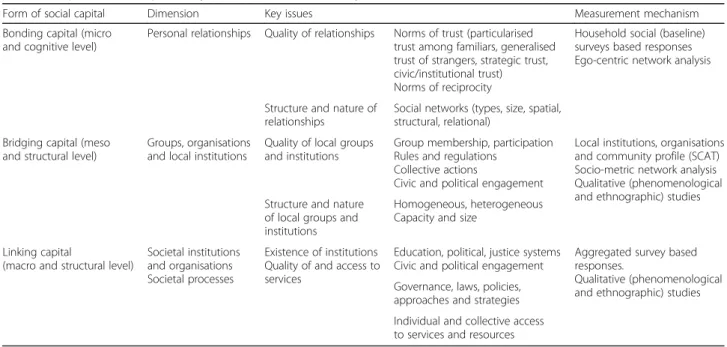
Applying the framework set out in Table1, several indi-cators of bonding capital are identified in Table2.
More than half of the residents (67%) in the slums rely on only one breadwinner16 to provide for the needs of the household. The household size ranges from three members to more than 12 members. This indicates how strong ties are required for the survival of the families. Relations such as brother, brother-in-law, sister, sister-law and cousins were evident in the survey, which in-dicate that the residents tend to rely on extended families to survive. At the time of the survey, 50.5% of the households reported having a member of the house-hold who was sick in the last 2 weeks. The majority of those who fell sick relied on close friends and family members for care and support.
Though only 17% of the households indicated to have removed a child from school, this is significant regarding bonding capital as the children may have been with-drawn either because of lack of support or because the child has to help in obtaining food or money to support the family. More than half of the respondents (56%) re-ported being worried about food when asked to rate their distress about adjustment in food consumption they may have to make due to food insecurity. Even though some of the residents indicated they would never worry about spending a day or night hungry, those worrying about eating smaller or fewer meals, unwanted food and limited variety of food were in the majority. This shows the limited existence of social capital as people with high social support should be able to use
Table 1Proposed social capital analytical framework (from theory to measurement)
Form of social capital Dimension Key issues Measurement mechanism
Bonding capital (micro and cognitive level)
Personal relationships Quality of relationships Norms of trust (particularised trust among familiars, generalised trust of strangers, strategic trust, civic/institutional trust) Norms of reciprocity
Household social (baseline) surveys based responses Ego-centric network analysis
Structure and nature of relationships
Social networks (types, size, spatial, structural, relational)
Bridging capital (meso and structural level)
Groups, organisations and local institutions
Quality of local groups and institutions
Group membership, participation Rules and regulations
Collective actions
Civic and political engagement
Local institutions, organisations and community profile (SCAT) Socio-metric network analysis Qualitative (phenomenological and ethnographic) studies Structure and nature
of local groups and institutions
Homogeneous, heterogeneous Capacity and size
Linking capital
(macro and structural level)
Societal institutions and organisations Societal processes
Existence of institutions Quality of and access to services
Education, political, justice systems Civic and political engagement
Aggregated survey based responses.
Qualitative (phenomenological and ethnographic) studies Governance, laws, policies,
approaches and strategies
their ties and cope with distressful moments. Regarding coping strategies, the most frequently observed coping strategy among inhabitants of the slums of Eastleigh, Kawangware and Kibera was the purchase of food on credit—36.4%. The second most commonly resorted to coping strategy was found to be asking for support from neighbours or relatives (28.8%) and removing children from school. This indicates that a high proportion of vulnerable urban dwellers relied on people familiar to themselves for help and support in times of need. How-ever, several other aspects of bonding capital need to be further explored in vulnerable urban contexts as per the framework, for example, the implication of network size on coping strategies and food security.
Bridging capital
The indicators detailed in Table3were found to be rele-vant for bridging capital.
The findings indicate at least some of the surveyed slum dwellers participate in local initiatives and are members of merry-go-round associations. Nonetheless, the influence or the impact of the internal heterogeneity and decision-making mechanisms of such organisations are not clear. Also, the proportion of slum dwellers who participate in social clubs, youth groups, political parties and other local institution is not apparent. Further ex-ploration of bridging capital in vulnerable urban con-texts is required.
Linking capital
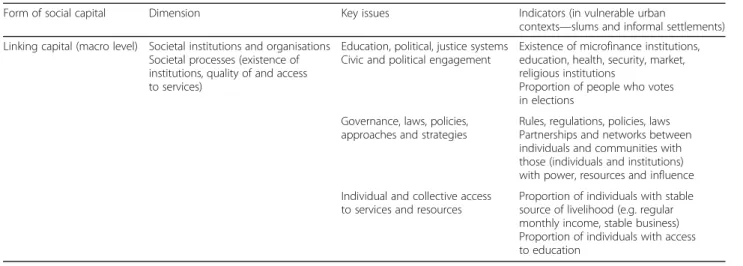
Applying the framework set out in Table 1, the indica-tors of linking capital detailed in Table4were evident.
Concern Worldwide, through the IDSUE study and other programmes they have been implementing in the slums, have managed to establish partnerships and link-ages with key stakeholders. The international organisa-tion managed to establish links with Kenya Red Cross
Table 2Attributes of bonding capital in vulnerable urban contexts
Form of social capital Dimension Key issues Indicators (in vulnerable urban
contexts—slums and informal settlements)
Bonding capital (micro and cognitive level)
Personal relationships (quality of relationships structure and nature of relationships)
Norms of trust (particularised trust among familiars, generalised trust of strangers, strategic trust, civic/institutional trust) Norms of reciprocity
Proportion of households relying on others for help (e.g. for treatment, care and support)
Proportion of individuals who believe in the ability of others (e.g. breadwinners and other income earners)
Proportion of individuals who provided and received support (e.g. sharing food, remittances)
Proportion of individuals or households relying on assets as a coping strategy Proportion of individuals purchasing food on credit as a coping strategy Proportion of households worrying about food
Social networks (types, size, spatial, structural, relational)
Centrality (degree, betweenness, closeness) perceived importance of individuals
Distance, i.e. connectedness of individuals
Attributes of networks
(e.g. successfulness and attractiveness)
Social influence (conformity obedience compliance)
Normative (change to fit in a group—to be liked or accepted) Informational (change because of desire to be correct, belief that others have right information)
Proportion of individuals who changed thoughts, attitudes, feelings and behaviour because of interaction with others; doing things for others with a choice to deny; doing things for others without an opportunity to refuse
Table 3Attributes of bridging capital in vulnerable urban contexts
Form of social capital Dimension Key issues Indicators (in vulnerable urban
contexts—slums and informal settlements)
Bridging capital
(meso and structural level)
Groups, organisations and local institutions (quality of local groups and institutions)
Group membership, participation Rules and regulations
Collective actions
Civic and political engagement
Participation in political parties, social clubs, associations, youth groups, voluntary activities, e.g. voting
Society (KRCS) and World Vision Kenya among others. However, the partnerships and networks of slum resi-dents with national and international organisations need further exploration. Also, linkages between individuals and societal institutions require further examination. Regarding access to education, the preliminary findings of the study indicate that just slightly more than half of the household heads (56%) had completed primary edu-cation. Only 7.3% reported having attended tertiary education. This shows some disconnect between slum dwellers and institution of higher learning. 40.8% of the surveyed slum dwellers reported having a regular source of livelihood, an indication of some access and connections to people with resources, power and influence. The households which did not have any source of livelihood depended on well-wishers and non-governmental organisations for food and other fi-nancial support. The majority of the residents partici-pate in local and national elections even though ethnicity and tribal inclinations often influence the par-ticipation and voting pattern. However, partnerships and networks between individuals and communities with those (individuals and institutions) with power, re-sources and influence need to be further explored. Moreover, other aspects of linking social capital, par-ticularly those relating to the existence of microfinance, education, health, security, market, religious and justice institutions, merit further exploration.
Implications for future research
Based on certain attributes of bonding, bridging and linking social capital detailed in Tables 1, 2, 3 and 4
above, the IDSUE study findings indicate that some indi-viduals in informal settlements have higher social capital than others. This highlights that quantitative indicators, where appropriately adapted to context, can provide in-sights into aspects of the social capital framework.
However, quantitative indicators alone are insufficient for applying the comprehensive social capital framework. Ego-centric networks17 should be investigated to deter-mine the strength of the social ties and to deterdeter-mine the perceived importance of individuals in vulnerable urban settings. Such an assessment demands the deployment of methods that are more interpretive in nature. Further exploration of bridging capital in vulnerable urban con-texts through socio-metric network analysis, profiling of local institutions18and qualitative (phenomenological and ethnographic)19 studies is essential to better understand-ing bridgunderstand-ing capital in slums. Similarly, there are many factors at play including the strength of linkages to socio-economic institutions and connections of individuals with those with power, resources and influence. Therefore, mechanisms of engagement between individuals and the people with power, resources and influence need further exploration. Such exploration can take the form of aggre-gated survey-based responses and qualitative studies.
While an important step in contributing aggregated data concerning urban emergencies in urban settle-ments, future research ought to be conducted that draws on the broader social capital framework. Data availability is crucial to obtaining a full picture of social capital. The Preparedness and Resilience to address Urban Vulner-abilitiesproject in which the authors are engaged builds on the IDSUE project and aims to collect data relating to bridging and linking capitals in addition to bonding capital that will allow for a better understanding of social capital in urban settings. It will do so by exploring the relevance of such forms of capital not only in absorbing recurrent shocks but also in adapting and transforming in response to such shocks. Comparisons of Nairobi with vulnerable settings in Bogotá and Jakarta with vastly dif-ferent cultural, economic, social and political settings will be facilitated. In so doing, it is recognised that it can be challenging to collect data, for security reasons and
Table 4Attributes of linking capital in vulnerable urban contexts
Form of social capital Dimension Key issues Indicators (in vulnerable urban
contexts—slums and informal settlements)
Linking capital (macro level) Societal institutions and organisations Societal processes (existence of institutions, quality of and access to services)
Education, political, justice systems Civic and political engagement
Existence of microfinance institutions, education, health, security, market, religious institutions
Proportion of people who votes in elections
Governance, laws, policies, approaches and strategies
Rules, regulations, policies, laws Partnerships and networks between individuals and communities with those (individuals and institutions) with power, resources and influence
Individual and collective access to services and resources
because of the high turnover of populations living in such areas. Relationships with key stakeholders need to be established to ensure access to the informal settle-ments. Once partners rooted in the informal settlements have been identified and engaged, seminars ought to be conducted concerning how the indicators from the IDSUE project can be adapted. In applying the social capital framework, the project has served to highlight the importance of adapting indicators according to the context to measure the same attributes. The project has also served to highlight that exploring social capital in vulnerable urban settings requires a holistic approach and the use of a mixed methods approach as well as the estab-lishment of relationships with key local stakeholders.
Conclusion
Understanding social capital (bonding, bridging and linking capitals) is the key to understanding the value of social interaction for effective localisation of humanitar-ian response in vulnerable urban contexts. However, what constitutes such capitals and how they can be mea-sured need to be understood based on context-specific issues and indicators. This article has developed and provided the understanding of the attributes of the social capital concept, giving rise to a multilevel and multidi-mensional framework that ought to be adapted to vul-nerable urban contexts. In particular, the indicators for the measurement of bonds, bridges and linkages need to be adapted to each context in which social capital is to be measured. In line with the concept analysis approach, further most likely and least likely cases of social capital in humanitarian action, particularly in urban areas, ought to be studied to clarify the concept and its rele-vance to humanitarian action further.
Endnotes 1
Urban resilience in this paper is understood as refer-ring to ‘the ability of an urban system-and all its con-stituent socio-ecological and socio-technical networks across temporal and spatial scales-to maintain or rapidly return to desired functions in the face of a disturbance, to adapt to change and to quickly transform systems that limit current or future adaptive capacity’ (Meerow et al.
2016, p.45). Resilience is a measure of households’, com-munities’and societies’ability to both address their vul-nerabilities by improving their capacitiesto absorb and adapt to existing and anticipated shocks and stresses while strengthening their capacities to transform/overcome to a level where these stresses are no longer relevant. Resilience is to be considered a concept that is ‘co-created’ by all actors in the research process, both researchers and participants.
2
Gibbons et al. (2017) argues that localising humani-tarian response demands that humanihumani-tarian action
should always endeavour to build on the capacities and abilities of affected populations to provide assistance and protection to vulnerable populations in their own com-munities and societies. With the recognition that its ac-tion is subsidiary to the people, it purports to support and not simply a tool of aid donors (page 10).
3
Urban is defined in relation to the capacities and vulnerabilities arising from the interdependencies that characterise highly complex and interlinking social, pro-tection, legal, security and health systems. Urban areas feature high population density, diverse livelihoods and means of production and are often sites of government-provided facilities/infrastructure.
4
Social network is an‘enumeration of the relationships that exist between groups of individuals or organizations (i.e. who knows whom). The structure of these networks and the character of these links between those individuals (or nodes), influence such things as how effectively the network can produce various results, its vulnerability, whether the network is well integrated or balkanized’. (Harvard Kennedy School, Harvard University).
5
For more detailed discussion, see among others, Grund (2014) and Eom and Jo (2014).
6
On this point, see Watts (1999) and Granovetter (1973a,b).
7
Vertical and horizontal terms are used in the sense to describe and distinguish institutions and associations based on motivations that led to their formation and their functions. Governmental/non-governmental initi-ated macro institutions are in some studies referred to as vertical and locally initiated, informal associations as horizontal. For further description, see Grootaert and Bastelaer (2001).
8
A salient example is a study done by Gallaher et al. (2013) which examined the relationship among urban agriculture, social capital and food security in Kibera slum of Nairobi Kenya. The study findings indicate that sack gardening increases social capital. However, it does not specify the form of social capital which is mainly increased that is whether bonding, bridging or linking capital. Their measurement for social capital focused on the exchange of goods and quality of rela-tionships which according to us, such dimensions are for bonding capital.
9
More details can be found in the working papers of the World Bank Social Capital Initiative.
10
Organisation for Economic Co-operation and Devel-opment (OECD) Economic and Well-being study
11
identify slow-onset humanitarian emergencies in urban slums. Several baseline surveys and rounds of surveil-lance were conducted in the informal settlements in Nairobi (Kibera, Eastleigh, Kawangware, Viwandani and Mukuru) in partnership with Kenya Red Cross Society (KRCS) and World Vision Kenya (WVK) in informal settlements in Mombasa (Bangladesh and Moroto). For more details on the urban surveillance study, see Con-cern Worldwide-Indicator Development for Surveillance of Urban Emergencies-IDSUE Project Research reports.
12
Surveillance refers to regular monitoring of those areas/households that are particularly vulnerable to po-tential shocks and stresses.
13
That is according to Kenya National Bureau of Sta-tistics housing and population census report of 2009. However, other sources indicate the population may vary
‘widely from 500,000 to 1,000,000’. See for example Erulkar and Matheka (2007a,b) and Mutisya and Yarime (2011a,b).
14
UN-Habitat (2016) and World Cities Report (2016) 15
UNHCR obtained the population size from the Eastleigh local administrative authorities. However, other sources indicate the population of Eastleigh may be over 350,000 at that time (see for example Asoka et al.2013).
16
The data findings also indicate that in most cases (more than 85%), the breadwinner is also the head of the household.
17
The social network analysis (SNA) is intended to elicit the networks and contacts that are deemed essen-tial in the locality for the slum and informal settlement dwellers to address vulnerabilities and enhance their re-silience. The SNA tool questions focus on personal net-works and group netnet-works referred to as ego-centric networks and socio-metric networks respectively. In-depth interviewswith residents can be conducted in each locality of the selected testbeds. Key or influential people could be identified through consultation with the princi-pal local stakeholders involved in various programme and projects. The questions regarding the organisation influence net-map should not be intended to rank the organisations working in the area but to highlight to organisations that have influence when it comes to ad-dressing urban vulnerabilities thereby helping the resi-dents to be aware of which organisations to contact in times of need.
18
The overall objective of the institutional profileis to delineate the relationships and networks that exist among formal and informal institutions operating in the locality, as a measure of bridging social capital. Specifi-cally, the profile assesses the organisations’ origins and development (historical and locality context, longevity and sustainability), quality of membership (reasons people join, degree of inclusiveness of the organisation), institutional capacity (quality of leadership,
participation, organisational culture and organisational capacity) and institutional linkages. Between three and six institutions per locality can be profiled. For more on institutional profiles, see Krishna and Shrader (1999).
19
Qualitative semi-structured questions can be asked during the focus groups and during the key informant’s interviews to get rich data on bonding capital. Issues ex-plored can be mainly on norms of trust (particularised, generalised and strategic trust), norms of reciprocity (re-ceiving and giving help in kind) and network support among others. Regarding bridging capital, question to be asked could be around collective actions, civic engage-ment, association membership and participation among other attributes of bridging social capital. Likewise, issues of interest for linking capital could be mainly on individual and collective access to opportunities, individual and col-lective connections to people with power, resources and influence.
Abbreviations
CCCM:Camp Coordination and Camp Management; IDMC: The Internal Displacement Monitoring Centre; IDSUE: Indicator Development for the Surveillance of Urban Emergencies; NRC: Norwegian Refugee Council; UNISDR: United Nations Office for Disaster Risk Reduction; USAID: United States Agency for International Development; WHS: World Humanitarian Summit
Availability of data and materials
Data from the IDSUE project is in the possession of Concern Worldwide (Kenya).
Funding
This article has been written as part of the Preparedness and Resilience to address Urban Vulnerabilities (PRUV) project. The project has received funding from the European Union’s Horizon 2020 research and innovation programme under the Marie Skłodowska-Curie grant agreement no. 691060.
Authors’contributions
DM conducted the literature review and developed the framework. He also developed the initial draft and made changes based on deliberations with co-authors. PG provided the outline and scope of the paper and provided considerable guidance to the lead author in developing the paper. RMD contributed to the writing of the introduction and illustrative case study sections in particular and assisted with the overall writing process. All authors read and approved the final manuscript.
Ethics approval and consent to participate
Ethical approval was obtained for this study and informed consent of participants obtained.
Consent for publication
The study respondents provided consent to use the data for publication purposes.
Competing interests
The authors declare that they have no competing interests.
Publisher’s Note
Received: 23 August 2017 Accepted: 26 February 2018 /
References
Adger WN (2003) Social Capital, Collective Action, and Adaptation to Climate Change. Econ Geogr 79:387–404.https://doi.org/10.1111/j.1944-8287.2003. tb00220.x
Aldrich D (2012b) Social, not physical, infrastructure: the critical role of civil society after the 1923 Tokyo earthquake. Disasters 36(3):398–419 Aldrich DP (2012a) Social capital in post disaster recovery: towards a
resilient and compassionate East Asian community. In: Sawada Y, Oum S (eds) Economic and welfare impacts of disasters in East Asia and policy responses. ERIA research project report 2011-8. ERIA, Jakarta, pp 157–178
Aldrich, D.P., & Smith, R. E. (2015). Social Capital and Resilience. World Humanitarian Summit (WHS) Policy, retrieved February 2017 fromhttp:// works.bepress.com/daniel_aldrich/31/
Álvareza EC, Romaní JR (2017) Measuring social capital: further insight. Ganceta Sanitaria 31(1):57–61
Apraxine, P., Duquenne, A., Fetta, S. & Helly, D. (2012). Urban violence and humanitarian challenges. European Union Institute for Security Studies and International Committee of the Red Cross Joint Report EUISS-ICRC Colloquium, Brussels, 19 January 2012 (Paris, Institute for Security Studies)
Asoka WN, Thuo A, Martin B (2013) Effects of Population Growth on Urban Infrastructure and Services: A Case of Eastleigh Neighborhood Nairobi, Kenya. J Anthropol Archaeology 1:41–56
Babcicky P, Seebauer S (2016) The two faces of social capital in private flood mitigation: opposing effects on risk perception, self-efficacy and coping capacity. J Risk Res.https://doi.org/10.1080/13669877.2016.1147489
Béné C, Al-Hassan RM, Amarasinghe O, Fong P, Ocran J, Onumah E et al (2016) Is resilience socially constructed? Empirical evidence from Fiji, Ghana, Sri Lanka, and Vietnam. Glob Environ Chang 38:153–170
Béné C, Frankenberger T, Nelson S (2015) Design, monitoring, and evaluation of resilience interventions: conceptual and empirical considerations, IDS working paper 459. Institute of Development Studies, Brighton
Béné C, Godfrey-Wood R, Newsham A, Davies M (2012) Resilience: new utopia or new tyranny?—reflection about the potentials and limits of the concept of resilience about vulnerability reduction programmes. In: IDS working Paper 405. Institute of Development Studies, Brighton
Bourdieu, P. (1986). In J. G. Richardson, & C. T. Westport (Eds.) Forms of capital in Handbook of theory for the sociology of education (pp. 241–258). Greenwood Press
Chamlee-Wright E, Storr VH (2010) Expectations of government’s response to disaster. Public Choice 144(1-2):253–274
Coleman J (1990) Foundations of social theory. Harvard University Press, Cambridge
Coleman J, Katz E, Menzel H (1957) The diffusion of innovation among physicians. Sociometry 20(4):253–720
Concern Worldwide & USAID (2014) Indicator development for surveillance of urban emergencies-IDSUE. Year 4 annual research report. Concern Worldwide, Dublin
Cook KS (2001) Trust in Society. In: Russell Sage Foundation
Dasgupta P, Ismail S (eds) (1999) Social capital: a multifaceted perspective. World Bank, Washington D C
Drew, A., Kriz, A., Keating, B, & Rowley, R. (2012). Beyond cronyism: in pursuit of deep trust. Cass Knowledge, retrieved fromhttp://www.cassknowledge.com/
Eom Y, Jo H (2014) Generalized friendship paradox in complex networks: the case of scientific collaboration. Sci Rep 4(4603):1–6
Erulkar AS, Matheka JK (2007a) Adolescence in the Kibera Slums of Nairobi, Kenya. Population Council, New York
Erulkar AS, Matheka JK (2007b) Adolescence in the Kibera Slums of Nairobi, Kenya. Population Council, New York
Fay M (ed) (2005) The urban poor in Latin America. Directions in development. World Bank, Washington, DC
Freeman LC (2004) The development of social network analysis: a study in the sociology of science. Empirical Press, Vancouver
Gallaher CM, Kerr JM, Njenga M, Karanja NK, WinklerPrins AM (2013) Urban agriculture, social capital, and food security in the Kibera slums of Nairobi, Kenya. Agric Hum Values 30(3):389–404
Gibbons P (2017) Humanitarian concept analysis. [Lecture notes—issues and strategies of transition intervention module]. University College Dublin, Dublin
Gibbons P, McDermott R, Maitra S, Herman J (2017) Building on the capacities of crisis-affected populations: from victims to actors. Dev Policy Rev:1467–7679.
https://doi.org/10.1111/dpr.12239
Gingerich, T. R., & Cohen, M. J. (2015). Turning the humanitarian system on its head: saving lives and livelihoods by strengthening local capacity and shifting leadership to local actors. OXFAM America, retrieved fromhttps:// www.oxfam.org/sites/www.oxfam.org/files/file_attachments/rr-turning-humanitarian-system-local-capacity-270715-en.pdf
Global CCCM Cluster (2014). Desk review: urban displacement and outside of camp. Retrieved fromhttps://www.dropbox.com/s/p32dsdnl9e9gb9g/ UDOC%20Desk%20Review_Digital%20publishing.pdf?dl=0
Granovetter M (1973a) The Strength of Weak Ties. Am J Sociol 78(6):1360–1380
doi.org/10.1086/225469
Granovetter MS(1973b) The strength of weak Ties
Grootaert, C. (1999) Social capital, household welfare, and poverty in Indonesia. World Bank policy research working paper no. 2148. Retrieved fromhttps:// ssrn.com/abstract=569207
Grootaert C, Bastelaer T (2001) Understanding and measuring social capital: a synthesis of findings and recommendation from the social capital initiative. Working paper no. 24. World Bank, Washington D.C
Grund T (2014) Why your friends are more important and special than you think. Sociol Sci 1:128–140
Hardin R (2002) Trust and trustworthiness. Russell Sage, New York
Hawkins RL, Maurer K (2010) Bonding, bridging and linking: how social capital operated in New Orleans following Hurricane Katrina. Bri J Soc Work 40: 1777–1793
IDMC, and NRC (2014) Internal displacement monitoring centre and Norwegian refugee council report, global estimate 2014. People Displaced by Disasters, Geneva
IFRC (2016) World disasters report 2016: resilience: saving lives today, investing for tomorrow. IFRC, Geneva
Jackson J, Bradford B, Hough M, Kuha J, Stares S, Widdop S, Galev T (2011) Developing European indicators of trust in justice. Eur J Criminol 8(4):267–285 Keeley B (2007) Human capital how what you know shapes your life. OECD
Insights, OECD Publishing, Paris
Klinenberg E (2002) Heat Wave: A Social Autopsy of Disaster in Chicago. University of Chicago Press, Chicago
Knox-Clarke P, Ramalingam B (2012) Meeting the urban challenge: adapting humanitarian efforts to an urban world. ALNAP meeting paper. ALNAP/ODI, London
Kramer RM, Tyler TR (eds) (1996) Trust in organizations: frontiers of theory and research. Sage Publications, Thousand Oaks
Kreuter MW, Lezin N (2002) Social capital theory: implications for community-based health promotion. In: DiClemente RJ, Crosby RA, Kegler MC (eds) Emerging theories in health promotion practice and research. Jossey-Bass, New York
Krishna A, Shrader E (1999) Social capital assessment tool. Paper prepared for the conference on social capital and poverty reduction. The World Bank, Washington D.C. June 22-24
Krishna A, Shrader E (2000) Cross-cultural measures of social capital: a tool and results from India and Panama. Social capital initiative working paper no. 21. World Bank, Washington D.C
Lall SV, Deichmann U (2012) Density and disasters: economics of urban hazard risk. World Bank Research Observer, World Bank Group 27(1):74–105 Ledogar RJ, Fleming J (2008) Social capital and resilience: a review of concepts
and selected literature relevant to aboriginal youth resilience research. Pimatisiwin 6(2):25–46
Lin N (1999a) Building a network theory of social capital. Connect 22(1):28–51 Lin N (1999b) Social networks and status attainment. Annu Rev Sociol 25:467–487 Lofors J, Sundquist K (2007) Low-linking social capital as a predictor of mental
disorders: a cohort study of 4.5 million Swedes. Soc Sci Med 64(1):21–34 Manzano Nunez R (2016) Linking social capital: a forgotten component of social
capital. J Epidemiol Community Health 70(5):526.https://doi.org/10.1136/ jech-2015-207100
Meerow S, Newell JP, Stults M (2016) Defining urban resilience: a review. Landsc Urban Plan 147(2016):38–49
committee: enabling effective development a scoping study for the experts group on risk and resilience. OECD, Paris
Murshed, Z., (2015). United Nation Development Programme. Retrieved January 12, 2016, fromhttp://www.undp.org/content/undp/en/home/blog/2015/1/ 29/Bigger-cities-don-t-have-to-mean-bigger-risks.html
Musinguzi LK, Turinawe EB, Rwemisisi JT, de Vries DH, Mafigiri DK, Muhangi D et al (2017) Linking communities to formal health care providers through village health teams in rural Uganda: lessons from linking social capital. Hum Resour Health 15:4https://doi.org/10.1186/s12960-016-0177-9
Mutisya E, Yarime M (2011a) Understanding the grassroots dynamics of slums in Nairobi: the dilemma of Kibera informal settlements. International Transaction Journal of Engineering, Management, & Applied Sciences & Technologies 2(2):197–213
Mutisya E, Yarime M (2011b) Understanding the Grassroots Dynamics of Slums in Nairobi: The Dilemma of Kibera Informal Settlements. Int Trans J Eng Manage Appl Sci Technol 2(2):197–213
Narayan D (1999) Bonds and bridges: social capital and poverty. Policy research working paper 2167. Poverty reduction and economic management network. World Bank, Washington, D.C.
Nooteboom B (2002) Trust: forms, foundations, functions, failures and figures. Elgar, Cheltenham
North D (1990) A transaction cost theory of politics. J Theor Polit 2(4):355–367 North D (1992) Institutions and economic theory. Am Econ 36(1):3–6 Retrieved
fromhttp://www.jstor.org/stable/25603904
Nuopponen A (2010) Methods of concept analysis—a comparative study. LSP Journal 1(1) Retrieved fromhttp://lsp.cbs.dk
Paliszkiewicz JO (2011) Trust management: literature review. Management 6(4): 315–331
Pantuliano S, Metcalfe V, Haysom S, Davey E (2012) Urban vulnerability and displacement: a review of current issues. Disasters 36:s1
Parker E, Maynard V (2015) Humanitarian response to urban crises: a review of area-based approaches. IIED working paper. London, IIED
Pavanello, S. (2012). Rethinking the humanitarian response: emerging approaches for engagement in urban crises. ATHA, retrieved fromhttp://www.alnap.org/ resource/20067.aspx
Pfefferbaum, B., Van Horn, R.L., & Pfefferbaum, R.L., (2015). A conceptual framework to enhance community resilience using social capital. Clin Soc Work Journal, Springer Published Online
Portes A (1998) Social capital: its origins and applications in modern sociology. Annu Rev Sociol 24:1–24
Portes A (2014) Downsides of social capital. Proc Natl Acad Sci 111(52):18407– 18408
Putnam RD (1993) Making democracy work—civic traditions in modern Italy. Princeton University Press, Princeton
Putnam RD (2000) Bowling alone: the collapse and revival of American community. Simon & Schuster, London
Reinhardt GY (2015) Race, trust, and return migration—the political drivers of post-disaster resettlement. Polit Res Q 68(2):350–362
Rice E, Yoshioka-Maxwell A (2015) Social network analysis as a toolkit for the science of social work. J Soc Soc Work Res 6(3):369–383
Roberts BR (1973) Organizing Strangers. University of Texas Press, Austin Sako M (1992) Prices, quality, and trust: inter-firm relations in Britain and Japan.
Cambridge University Press, Cambridge
Scrivens, K., & Smith C. (2013). Four interpretations of social capital: an agenda for measurement. OECD Statistics Working Papers, 2013/06, OECD Publishing Shaw R, Goda K (2004) From disaster to sustainable civil society: the Kobe
experience. Disasters 28(1):16–40
Siegler V (2014) Measuring social capital. Office for National Statistics, London Siegler V (2015) Measuring social capital. Office for National Statistics, London Smith SS (2010) Race and trust. Annu Rev Sociol 36:453–475
Stone W (2001) Measuring social capital: towards a theoretically informed measurement framework for researching social capital in family and community life. Australian Institute of Family Studies, Melbourne Research Paper 24 Story, W. (2013). Social capital and health in the least developed countries: a critical
review of the literature and implications for a future research agenda, Global Sundquist K, Hamanoc T, Kawakami N, Shiwaku K, Sundquist J (2014) Linking
social capital and mortality in the elderly: a Swedish national cohort study. Exp Gerontol 55(2014):29–36
Titeca K, Vervisch T (2008) The dynamics of social capital and community associations in Uganda: linking capital and its consequences. World Dev 36(11):2205–2222
UN General Assembly, (2016). One humanity: shared responsibility: report of the Secretary-General for the World Humanitarian Summit, UN Doc. A/70/709, 2nd February 2016
UN-Habitat (2009) Planning sustainable cities. United Nations, Nairobi UN-Habitat, (2016). UN-Habitat III, adoption of the final outcome of the
conference, Quito, 17-20 October 2016, A/CONF.226/4
UNISDR (2014) Progress and challenges in disaster risk reduction: a contribution towards the development of policy indicators for the post-2015 framework on disaster risk reduction. The United Nations Office for Disaster Risk Reduction, Geneva
Walker L, Avant K (1995) Strategies for theory construction in nursing, 3rd edn. Appleton-Century-Crofts, Norwalk
Walker L, Avant K (2005) Strategies for theory construction in nursing, 4th edn. Prentice Hall, New Jersey
Walker LO, Avant KC (2011) Concept analysis. In: Walker LO, Avant KC (eds) Strategies for theory construction in nursing, 5th edn. Pearson Prentice Hall, Upper Saddle River, pp 157–179
Wall, I., & Hedlund, K. (2016). Localisation and locally-led crisis response: a literature review. Local to Global Protection (L2GB). Swiss Agency for Development and Cooperation
Wasserman S, Faust K (1994) Social network analysis: methods and applications. Cambridge University Press, Cambridge
Watts DJ (1999) Networks, Dynamics, and the Small‐World Phenomenon. Am J Sociol 105(2):493–527.https://doi.org/10.1086/210318
Woolcock M (1998) Social capital and economic development: toward a theoretical synthesis and policy framework. Theory Soc 27(2):151–208 Woolcock M (2005) Calling on friends and relatives: social capital. In: Fay M (ed)
The urban poor in Latin America. Directions in development. World Bank, Washington, DC, pp 219–238
Woolcock M, Narayan D (2000) Social capital: its implications for development theory, research and policy. World Bank Res Obs 15(2):225–249
World Bank (2003) Poverty in Guatemala. Report No. 24221-GU. World Bank, Latin America and Caribbean Region, Washington, DC
World Cities Report (2016) Urbanization and Development: Emerging Futures. Nairobi, United Nations Human Settlement Programme