Address for correspondence Dr. Sajad Ahmad Salati
Associate Professor , Department of Surgery Unaizah College of Medicine, Qassim University, Saudi Arabia.
Email: [email protected]
Original Article
Awareness about skin cancer in expatriates from the
Indian subcontinent in the Middle East: a study
Introduction
Skin is the largest organ of the human body and adults carry about 2 square meters of it. Since the last few decades, incidence of melanoma and non-melanoma skin cancers has been increasing worldwide.1,2 According to World Health Organization statistics, currently annual global incidence for non-melanoma skin cancers is between 2 and 3 million and 132,000 for melanoma skin cancers.3
Surveys conducted on the population of Northern Pakistan, comprising Northern Punjab, Northern Baluchistan, North Western Frontier Province and FATA indicate that skin cancer is among the first three cancers in these regions
according to incidence and prevalence.4.5 In North Western Frontier Province, skin cancer is the commonest cancer in males, accounting for 8.9% of all cancers and the second most common cancer in females.5 Similar is the situation in other countries of Indian subcontinent.2,6
Kingdom of Saudi Arabia (KSA), the largest country in the Middle East, with an area of 2.24 million sq. km. (nearly 2/3rd the size of India), is the 14th largest country in the world. It occupies 80% of the Arabian Peninsula. One-third of the land is desert which includes a major portion of the world’s largest contiguous sand desert known as the Empty Quarter (Rub-al-Khali). In the inland regions including Capital Riyadh, the summer (May to September) day temperatures average around 45ºC, with readings over 50ºC not being unusual. There are about 11.67 million expatriates in the country, mainly from South and Southeast Asian countries. Indians are the
Sajad Ahmad Salati
Department of Surgery, Unaizah College of Medicine, Qassim University, Saudi Arabia
Abstract Objective The study was conducted to understand the level of awareness about skin cancer in expatriates from the Indian subcontinent in the Middle East.
Methods A cross-sectional survey was conducted in a random sample of outdoor working
expatriates of the Indian subcontinent in Al-Qassim region of Saudi Arabia. A self-designed questionnaire with high quality images was used to study the awareness and work related practices. Results Awareness related to skin cancer and skin protection was poor in the study group. There was however very encouraging skin protecting dress usage by the participants. The participants had poor understanding and knowledge of the skin lesions that need medical care on priority basis. Conclusion Awareness related to skin cancer and skin protection needs to be raised among the expatriates of Indian sub-continental origin in the Middle East.
Key words
largest expatriate community, numbering over 3 million (March 2017), of which, it is estimated that about 70% are blue collar category (labor) workers and hence exposed to extremes of sunlight and temperature. Other major expatriate communities from Indian subcontinent are: Pakistan-1.5 million, Bangladesh–1.3 million and Sri Lanka -0.5 million.7
Chronic exposure to ultraviolet (UV-B) radiation present in sunlight is responsible for the induction of most non-melanoma skin cancer (NMSC) in humans. Wavelengths in the UV-B (290–320 nm) region of the solar spectrum are absorbed into the skin, producing erythema, burns and eventually skin cancer. Recent studies indicate that 70% of new cases of skin cancer, i.e. around one million, diagnosed each year in the United States, result from repeated exposure of the skin to sunlight.8
The results of UV measurements and biological studies by Hannan et al.9 suggest that an appreciable amount of potentially carcinogenic UVB is present in sunlight in the Riyadh area even though incidence of sunburn and skin cancers is lower in local population. Numerous studies have been conducted in various countries to assess the knowledge, attitudes and practices (KAP) of the public toward sun exposure and sun-protection measures.10-12 In local Saudi population studies conducted on this subject have found that sun awareness and protection are generally inadequate that need to be addressed by health education programs.13 However, there is scarce data related to this aspect, about the expatriates of Indian subcontinent origin. It was in this background that the current pilot study was undertaken in that segment of population to assess the knowledge, attitude and practices.
Materials and Methods
A descriptive cross-sectional study with purposive sampling was conducted on 2500 male expatriates of Indian sub-continental origin, working outdoors in various sectors in the twin cities of Buraidah and Unaizah of Al Qassim region of Saudi Arabia from May 2018-August 2018. A random sample was taken for study and the sample size was estimated by using a single proportion formula with an acceptable margin of error (d) at 5%. Analysis of data was done with SPSS (Statistical Package for Social Sciences) for Windows version 11.5 and Microsoft Excel-2013 and the data were expressed as mean, range and numbers (with percentages). For the analysis, the significance level was set at p-value less than 0.05, with a confidence interval of 95%.
The participants were explained the purpose of the study as per the ethical guidelines of Helsinki and the ones who agreed to participate in the study were requested to answer a self-designed questionnaire after assuring them of confidentiality. Workers associated with health care were excluded from the study.
The third section studied the job related practices that are related to the disease as shown in Table 2 and the responses were recorded as ‘Yes’ or ‘No’.
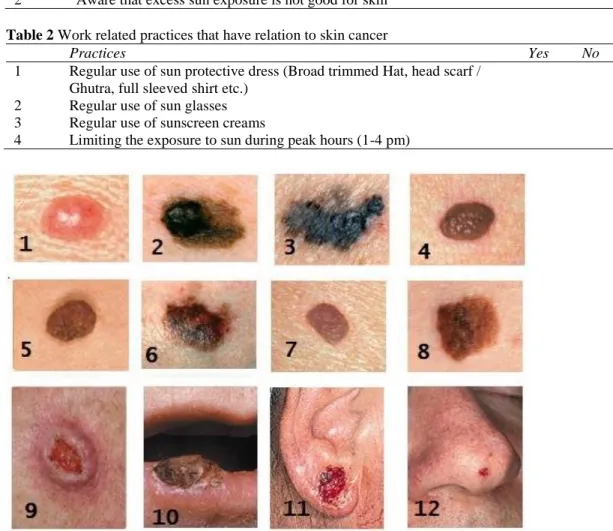
The fourth section focused on pictorial assessment of the practical knowledge about skin cancer and was assessed by asking the subjects if they would consider to see a medical practitioner on high priority basis, if they notice the lesions as shown in a series of twelve randomly sequences images showing four benign skin disorders (moles) [Fig 1, four non-melanoma skin cancers and four images depicting ABCDE (asymmetry, irregular
borders, variation of color, size greater than 6 mm, evolving by changes). The images were downloaded from the official website (https://www.skincancer.org/) of The Skin Cancer Foundation, 205 Lexington Avenue, 11th Floor, New York, NY 10016 and prior permission was sought for the non-commercial/ academic usage of their copyrighted images. For each correct entry (No for benign and Yes for malignant lesions), the subjects were awarded one point and on the basis of the total achieved, the subjects were divided into No knowledge (less than 3), poor knowledge (4-6), fair knowledge (7-9) and good knowledge (10-12) groups.
Table 1 Parameters in questionnaire to study awareness regarding skin cancer
Awareness Parameter Yes No
1 Aware that skin can get cancer
2 Aware that excess sun exposure is not good for skin Table 2 Work related practices that have relation to skin cancer
Practices Yes No
1 Regular use of sun protective dress (Broad trimmed Hat, head scarf / Ghutra, full sleeved shirt etc.)
2 Regular use of sun glasses 3 Regular use of sunscreen creams
4 Limiting the exposure to sun during peak hours (1-4 pm)
Figure 1 Images of skin lesions used to test the awareness of subjects;
Results
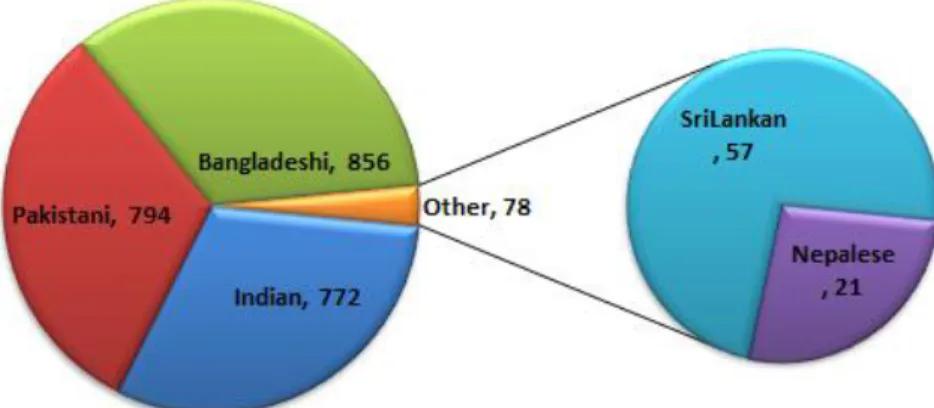
The subjects participating in study ranged in age from 23–52 years (mean 33.1 years, range 21-53 years, standard deviation ±7.94). The nationality of the subjects is shown in Figure 2. They belonged to Bangladesh (n 856; 34.2%), Pakistan (n 794; 31.8%), India (n 772; 30.9%), Sri Lanka (n 57; 2.3%) and Nepal (n 21: 0.84%). They belonged to a wide range of occupations that require outdoor activities as shown in Table
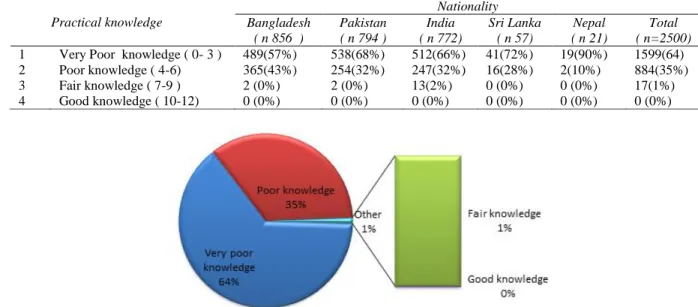
3. The results of the four sections in the questionnaire are shown in Tables 4-6 and
Figure 3. The level of education of the subjects in this study was found out to be: Graduates (n - 734; 29%) or above, secondary/higher secondary school (n- 845; 34%) and below secondary school (n- 921; 37%). The relationship of the level of education to responses to forth component (pictorial assessment) is shown in
Table 7.
Figure 2 Sample composition based upon nationality Table 3 Sample composition based upon Occupation
Profession Nationality Total
(n ; %age)
Bangladesh Pakistan India Sri Lanka Nepal
Construction workers 34 359 156 2 0 551 (22.1%)
Farmers 56 38 257 5 0 356 (14.2%)
Casual labors /Cleaners 612 15 26 11 0 664 (26.6%)
Transport ( Drivers , helpers) 13 175 45 32 3 268 (10.7%)
Shopkeepers/salespersons 141 197 278 27 18 661(26.4%)
Total 856 784 762 77 21 2500 (100%)
Table 4 Results of studied parameters regarding awareness related to skin cancer
Awareness
Nationality
Total (n=2500) Bangladesh
( n 856 )
Pakistan (n 794 )
India ( n 772)
Sri Lanka ( n 57)
Nepal ( n 21)
1 Aware that skin can get cancer 121 (14%) 237 (30%) 278 (36%) 13 (23%) 6 (29%) 655 (26%)
2 Aware that excess sun exposure
is not good for skin 214 (25%) 317 (40%) 355 (46%) 24 (42%) 9 (43%) 919 (38%)
Table 5 Results of work related practices that have relation to skin cancer
Practices
Nationality Bangladesh
( n 856 )
Pakistan ( n 794 )
India ( n 772)
Sri Lanka ( n 57)
Nepal ( n 21)
Total (n=2500)
1
Regular use of sun protective dress (Broad trimmed Hat, head scarf / Ghutra, full sleeved shirt etc.)
836(98%) 784(99%) 745(96) 54(95%) 20(95) 2439(98)
2 Regular use of sun glasses 15(2%) 38(5%) 46(6%) 5(9%) 0(0%) 104(4%)
3 Regular use of sunscreen creams 2(0%) 8(1%) 23(3%) 1(2%) 0(0%) 34(1%)
4 Limiting the exposure to sun during peak hours (12 pm - 3 pm)
Table 6 Level of practical knowledge related to skin cancer
Practical knowledge
Nationality Bangladesh
( n 856 )
Pakistan ( n 794 )
India ( n 772)
Sri Lanka ( n 57)
Nepal ( n 21)
Total ( n=2500)
1 Very Poor knowledge ( 0- 3 ) 489(57%) 538(68%) 512(66%) 41(72%) 19(90%) 1599(64)
2 Poor knowledge ( 4-6) 365(43%) 254(32%) 247(32%) 16(28%) 2(10%) 884(35%)
3 Fair knowledge ( 7-9 ) 2 (0%) 2 (0%) 13(2%) 0 (0%) 0 (0%) 17(1%)
4 Good knowledge ( 10-12) 0 (0%) 0 (0%) 0 (0%) 0 (0%) 0 (0%) 0 (0%)
Figure 3 Level of practical knowledge related to skin cancer Table 7 Level of knowledge in relation to the level of education
Level of practical knowledge Graduate or above; n- 734
Secondary and higher secondary school ; n- 845
Below secondary school ; n- 921
Total ; n- 2500
Very poor knowledge 448 (61 %) 530 (63%) 621 (67%) 1599 (64%)
Poor knowledge 277 (38%) 307 (36 %) 300 (33%) 884 (35%)
Fair knowledge 9 (1 %) 8 (1%) 0 17 (1%)
Good knowledge - - - -
Discussion
Skin cancer is on a rise globally.1-3,14 In Indian subcontinent similar trend has been documented in multiple surveys conducted in recent years.4-6 Sun exposure is a well-documented risk factor for development of skin cancer15 and a major chunk of the expatriates in the Middle-East, hailing from the Indian continent are exposed to sun due to the nature of their job.
Outdoor workers have been proven to be at a higher risk for developing skin cancer due to their increased sun exposure.16
Studies have been conducted to understand the level of knowledge, attitudes and practices of the local population toward sun exposure and protection but data is very limited as far as the expatriates are concerned. Hence this pilot study was conducted to address this issue.
The 2500 subjects involved in this study were employed in wide range of jobs that involved exposure to sun. But only 655 (26%) were aware that skin can get cancer and 919 (38%) were aware of the fact that exposure to sun has harmful effects on skin. These figures are significantly low even when compared with the figures related to the local Saudi population. Al Robaee17 in his study conducted in 2010 found that 56% of Saudis participating in his study were aware of the association between sun exposure and skin cancer. Al Ghamdi et al.13 also got similar results in Saudi population and found that 55% (1406/2544 of participants in study) were aware of this association.
Islamic traditions and culture of dressing up modestly in the Middle East. Al Ghamdi et al13. also found that protective clothes to be the most commonly used sun protection measure and reported by more than 90% of local Saudi population. Studies from the western world show inadequate usage of sun protective clothing. Reinau et al.18 in 2013 published the results of an extensive systematic review of the literature and found that reported sun-protective behaviors in outdoor workers were largely inadequate, with many workers either never or only rarely wearing a long-sleeved shirt (50-80%), sun-protective headgear (30-80%) and sunscreen (30-100%) while working in the sun.
90% of the subjects (2256/ 2500) limit their exposure to sun during peak hours (12pm-3pm). This can be explained by the traditions, culture and lifestyle in Saudi Arabia wherein most of the outdoor activities stop or get reduced during those hours. Furthermore, Saudi Arabia’s Ministry of Labor and Social Development in order to guarantee the safety of employees, issues and enforces guidelines wherein companies are banned from having their outdoor staff work under the sun from 12:00 pm to 3:00 pm from June until September when temperatures are souring high. This is very encouraging when we compare with the work conditions as depicted in some of the western literature. Janda et al.19 in the study published in 2014 found that in only 43% of instances, work was scheduled outside peak sun hours.
In this study, 4% (104/2500) subjects were found to wear sunglasses and only 1% (34/2500) reported use of sunscreen lotions/creams regularly. Al Robaee17 in his study on local Saudi population has found low rate of sunscreen use (8.3%) despite reasonably good knowledge about the hazards of sun exposure. He further found certain socio-demographic factors to be linked with sunscreen use and the
factors included female gender, higher social class and higher levels of education. These factors are not present in the participants of our study. Peters et al.20 studied the sun protection practices of outdoor construction workers in British Columbia and found that 29% workers used sunscreens.
Nahar et al.16 after an extensive review of literature, also found that despite regular and prolonged sun exposure, a great number of outdoor workers fail to engage in sufficient sun protection behaviors. He linked this failure to socio-demographic factors like female gender, older age, being white, personal skin cancer history, time (hours/years) spent at work, sun safety training, perceived prioritization of sun protection, concern about sun exposure, workplace support, families' expectations, and familial information giving. They stressed upon the need for meaningful research on this aspect.
awareness.22 Reeder et al.23 found that occupational sun protective practices has no relation with education level though Reinau D et al18 found that specific sun-safety education does result in improvement on this front. Al Ghamdi et al.13 and Al Robaee17 had found positive impact of education level on sun protection practices in the local Saudi population.
The present study does not have any backing of institutions that can bring in change or legislations but it is hoped that the study may inspire more studies on the subject and initiate innovative occupational sun-safety education programs. This subject is of great importance and globally, appreciable work is being done in order to promote the concept of sun safe workplace practices and a good magnitude of studies are being conducted on the subject due to increased sun exposure and subsequent risk of skin cancer in outdoor workers.24-25 The present study made use of good quality printed images to study if patients can identify the moments when medical care is need on priority basis. This component of study is expected to inspire similar studies in various sections of general population and thereby promote the concept of skin self-examination for early detection of skin cancers.
Studies on local Saudi population by Al Ghamdi et al.13 and Al Robaee17 have also stressed upon the need for such education and programmes. Studies have proven that interventions to promote the concepts of sun-safe practices and sun-protective workplace culture provide encouraging results and such interventions are possible only by promoting sun safety education. The expatriates before entry into the Middle East have to undergo mandatory medical clearance in designated clinics and such interactions can be used in health related education. The medicos of Indian subcontinent, due to absence of language and cultural barriers, can also play fruitful role
in basic health education of expatriates in their respective localities.
Conclusion
There is low level of awareness about skin cancers in expatriates of Indian subcontinent working in the Middle East. There is widespread use of sun protective clothing due to the prevalent cultural practices in the region. The participants of the study have very low understanding of the skin lesions that need medical care on priority basis.There is need for specific skin health education programs to address the areas of deficient practices and knowledge.
Acknowledgements
The author would like to thank all the participants for their contribution to the study. The author expresses gratitude to “The Skin Cancer Foundation 205 Lexington Avenue, 11th Floor New York, NY 10016” for allowing the free-of-cost, usage of the images for this project and publication for academic/non-commercial purposes. The images used in the study as shown in Figure 1, has “Copyright the Skin Cancer Foundation All Rights Reserved.” This research received no specific grant from any funding agency in the public, commercial or not-for-profit sectors nor is there any conflict of interests.
References
1. Leiter U, Eigentler T, Garbe C. Epidemiology of skin cancer. Adv Exp Med Biol 2014; 810: 120-40.
2. Nonmelanoma skin cancer in India: Current scenario. Indian J Dermatol 2010; 55(4): 373–8.
3. http://www.who.int/uv/faq/skincancer/en/ind ex1.html
Pakistan. J Pak Med Assoc. 1991; 41(11): 270-3.
5. Khan SM., Gillani J, Nasreen S, Zai S. Cancer in North West Pakistan and Afghan refugees. J Pak Med Assoc. 1997; 47(4):122-4.
6. Kumar A, Shrestha PR, Pun J, Thapa P, Manandhar M, Sathian B. Profile of skin biopsies and patterns of skin cancer in a tertiary care center of Western Nepal. Asian Pac J Cancer Prev. 2015; 16(8): 3403-6. 7. http://www.indianembassy.org.sa/images/do
cuments/GUIDELINES-FOR-INDIAN- WORKERS-GOING-TO-SAUDI-ARABIA-1.pdf
8. Ananthaswamy H N. Sunlight and skin cancer. J Biomed Biotechnol. 2001; 1(2): 49.
9. Hannan MA, Paul M, Amer MH, Al-Watban FH. Study of ultraviolet radiation and genotoxic effects of natural sunlight in relation to skin cancer in Saudi Arabia. Cancer Res. 1984; 44(5): 2192-7.
10. Mousavi F, Golestan B, Vaseie M, Vaseie L, Khajeh-Kazemi R. Knowledge, attitude, and practice of adults to the protective actions against sun in northwest Tehran, Iran. Arch Iran Med. 2011; 14(2): 126-31.
11. Stoebner-Delbarre A, Thezenas S, Kuntz C, Nguyen C, Giordanella JP, Sancho-Garnier H, Guillot B; Groupe EPI-CES. Sun exposure and sun protection behavior and attitudes among the French population. Ann Dermatol Venereol. 2005; 132(8-9 Pt 1): 652-7.
12. Kirk L, Greenfield S. Knowledge and attitudes of UK university students in relation to ultraviolet radiation (UVR) exposure and their sun-related behaviours: a qualitative study. BMJ Open 2017; 7(3): e014388.
13. Al Ghamdi K M, Al Aklabi A S, Al Qahtani A Z . Knowledge, attitudes and practices of the general public toward sun exposure and protection: A national survey in Saudi Arabia. Saudi Pharm J 2016; 24(6): 652–7. 14. Muzic JG, Schmitt AR, Wright AC, Alniemi
DT, Zubair AS, Olazagasti Lourido JM, Sosa Seda IM, Weaver AL, Baum CL. Incidence and Trends of Basal Cell Carcinoma and Cutaneous Squamous Cell Carcinoma: A Population-Based Study in Olmsted County, Minnesota, 2000 to 2010. Mayo Clin Proc 2017; 92(6): 890-8. 15. Green A, Williams G, Neale R, Hart V,
Leslie D, Parsons P, Marks GC, Gaffney P,
Battistutta D, Frost C, Lang C, Russell A. Daily sunscreen application and beta-carotene supplementation in prevention of basal-cell and squamous-cell carcinomas of the skin: a randomized controlled trial. Lancet. 1999; 354(9180): 723-9.
16. Nahar VK, Ford MA, Hallam JS, Bass MA, Vice MA. Socio-demographic and psychological correlates of sun protection behaviors among outdoor workers: A review. J Skin Cance 2013, Article ID 453174, 10 pages.
17. Al Robaee AA. Awareness to sun exposure and use of sunscreen by the general population. Bosn J Basic Med Sci. 2010; 10(4): 314-8.
18. Reinau D, Weiss M, Meier CR, Diepgen TL, Surber C. Outdoor workers' sun-related knowledge, attitudes and protective behaviours: a systematic review of cross-sectional and interventional studies. Br J Dermatol 2013; 168(5):928-40.
19. Janda M, Stoneham M, Youl P, Crane P, Sendall MC, Tenkate T, Kimlin M. What encourages sun protection among outdoor workers from four industries? J Occup Health 2014; 56(1): 62-72.
20. Peters C E ,Koehoorn M W, Demers P A, Nicol A, Kalia S. Outdoor workers' use of sun protection at work and leisure. Saf Health Work 2016; 7(3): 208–12.
21. Hammond V, Reeder AI, Gray AR, Bell ML. Are workers or their workplaces the key to occupational sun protection? Health Promot J Austr. 2008; 19(2): 97-101. 22. Salati SA, Rather A. Awareness regarding
female breast cancer in Kashmiri males - A study. Online J Health Allied Scs. 2009; 8(4): 11.
23. Reeder AI, Gray A, McCool JP. Occupational sun protection: workplace culture, equipment provision and outdoor workers' characteristics. J Occup Health. 2013; 55(2): 84-97.
24. Wallis A, Andersen PA, Buller DB, Walkosz B, Lui L, Buller M, Scott MD, Jenkins R. Adoption of sun safe workplace practices by local governments. J Public Health ManagPract. 2014; 20(6): 608-16. 25. Glanz K, Buller DB, Saraiya M. Reducing