RESEARCH ARTICLE
G.A.M.E.: GPU-accelerated mixture
elucidator
Alioune Schurz
1, Bo‑Han Su
2, Yi‑Shu Tu
1, Tony Tsung‑Yu Lu
1, Olivia A. Lin
1and Yufeng J. Tseng
1,2,3*Abstract
GPU acceleration is useful in solving complex chemical information problems. Identifying unknown structures from the mass spectra of natural product mixtures has been a desirable yet unresolved issue in metabolomics. However, this elucidation process has been hampered by complex experimental data and the inability of instruments to completely separate different compounds. Fortunately, with current high‑resolution mass spectrometry, one feasible strategy is to define this problem as extending a scaffold database with sidechains of different probabilities to match the high‑resolution mass obtained from a high‑resolution mass spectrum. By introducing a dynamic programming (DP) algorithm, it is possible to solve this NP‑complete problem in pseudo‑polynomial time. However, the running time of the DP algorithm grows by orders of magnitude as the number of mass decimal digits increases, thus limit‑ ing the boost in structural prediction capabilities. By harnessing the heavily parallel architecture of modern GPUs, we designed a “compute unified device architecture” (CUDA)‑based GPU‑accelerated mixture elucidator (G.A.M.E.) that considerably improves the performance of the DP, allowing up to five decimal digits for input mass data. As exempli‑ fied by four testing datasets with verified constitutions from natural products, G.A.M.E. allows for efficient and auto‑ matic structural elucidation of unknown mixtures for practical procedures.
Keywords: Natural product, Mass spectrum, Structure elucidator, GPU acceleration
© The Author(s) 2017. This article is distributed under the terms of the Creative Commons Attribution 4.0 International License (http://creativecommons.org/licenses/by/4.0/), which permits unrestricted use, distribution, and reproduction in any medium, provided you give appropriate credit to the original author(s) and the source, provide a link to the Creative Commons license, and indicate if changes were made. The Creative Commons Public Domain Dedication waiver (http://creativecommons.org/ publicdomain/zero/1.0/) applies to the data made available in this article, unless otherwise stated.
Background
Mass spectrometry (MS) is one of the most widely used analytical methods for identifying the components of unknown mixtures or natural products. Elucidation of chemical structures, especially from natural prod-ucts, is important to identify potential drug candidates with fewer adverse effects and structural novelty for drug discovery [1]. Mass spectra indicate the mass-to-charge ratio of each component, and the amplitude of each peak roughly represents the relative abundance of the molecule. However, additional techniques such as nuclear magnetic resonance (NMR) [2], a time-consum-ing and complex procedure, are needed to fully identify each component in the mixture. Furthermore, MS itself cannot elucidate the structure of a partially or com-pletely unknown compound [3–5]. Therefore, successful
structure elucidation of unknown compounds depends on the development of advanced computational tools for analyzing mass spectral data [6].
Several NMR-based expert systems have been devel-oped to facilitate automated structure elucidation [7– 15]. This type of computer-aided structure elucidation (CASE) approach suffers from the complex and time-consuming nature of NMR experiments, which usually involve multiple runs of different 2D NMR [16]. Moreo-ver, the required NMR protocols may differ for different compounds, especially those with few hydrogen atoms or a diverse array of heteroatoms [14]. Additionally, the limited sensitivity of NMR relative to vibrational spec-troscopy and mass specspec-troscopy further limits the devel-opment of high-throughput automated CASE expert systems [17, 18]. Recently, Harn et al. [19] have developed a new CASE method (NP-StructurePredictor) that can efficiently and accurately predict individual components in a mixture (The detailed method of NP-StructurePre-dictor is included in the Additional file 1); this approach is based on a model generated by referencing a collection
Open Access
*Correspondence: [email protected]
2 Department of Computer Science and Information Engineering,
National Taiwan University, No. 1 Sec. 4, Roosevelt Road, Taipei 106, Taiwan
of 226,949 natural products. NP-StructurePredictor divides each compound into a major scaffold and its side-chains. The relationship between each scaffold is initially constructed, and the probabilities of each sidechain on different possible scaffolds are evaluated. The model then takes the input seed scaffolds provided by users to match scaffolds in the model and automatically generates a list of most probable matching compounds sorted on the basis of evaluated probabilities for a given mass peak. The list is populated by combining possible sidechains at each position of the scaffold and evaluating the probability of the resulting compounds by using the natural products database (NPDB) probability data. Only the resulting compounds whose weight corresponds to the mass peak are retained. Experiments involving real test cases have shown that NP-StructurePredictor can correctly predict most of the compounds in mixtures, but it does so in a computationally inefficient manner.
The computational problem defined in the NP-Struc-turePredictor system has been formally proven to be NP-complete; it constitutes a chemical substituent core
combinatorial problem (CSCCP) [20]. Because of the
NP-completeness of CSCCPs, the branch and bound strategy used in NP-StructurePredictor lead to long run-ning time for complex scaffolds. To resolve this issue, Su has developed a dynamic programming (DP) algorithm [20] to increase computational efficiency (the detailed method of DP algorithm is included in the Additional file 1). Although the DP algorithm allowed optimization of the NP-complete problem into pseudo-polynomial time, the search for optimal solutions can still be com-pleted in exponential time complexity in the worst-case scenario. Each additional decimal digit of mass in the DP algorithm increases the running time tenfold. For exam-ple, the required computational time in the challenging case of C. chinensis would exceed 1 month if the num-ber of decimal digits was set to 5. For high-resolution LC–MS experiments, the unreasonable execution time required to elucidate unknown chemical structures based on the DP strategy is still not functional in many cases.
To overcome the computational bottleneck of automat-ically identifying chemical components of mixtures with the DP algorithm, hardware acceleration via graphical processing units (GPUs) can be directly used to substan-tially improve the time performance. Indeed, the use of GPUs has recently attracted broad attention in the field of computer science. GPUs are not merely specialized video rendering devices to assist in accelerating the visu-alization of 3D graphics; they can also be used as a pro-gramming interface to support high-performance parallel computing [21]. The traditional CPU-based algorithm is no longer an effective way to solve extremely computa-tionally demanding tasks [22]. A modern GPU contains
thousands of efficient threads that can simultaneously perform multitasking optimization. Consequently, GPU methods are faster than conventional CPU methods and can provide an increase of one or two orders of
magni-tude [23]. Most importantly, the CUDA programming
toolkit released by NVIDIA facilitates the development of software parallelism via GPUs. CUDA is an exten-sion of the standard C/C++-like programming language, allowing researchers to implement and explore the paral-lel computing ability of GPUs. An increasing number of applications for GPU computing have been developed in different fields of cheminformatics, including free energy calculations [24], molecular docking [25, 26], molecular dynamics simulations [27, 28], high-throughput screen-ing [29], similarity searching [30], and classification [31]. Therefore, the use of massively GPU parallel architecture is a feasible way to minimize the effects of NP-complete-ness complexity in CSCCP.
In this study, we present a GPU-accelerated algorithm, the GPU-accelerated mixture elucidator (G.A.M.E.), that can efficiently promote performance improvements of DP algorithms used to resolve chemical structures in the mass spectra of an unknown mixture. G.A.M.E. is a novel GPU-accelerated method implemented by the CUDA toolkit on NVIDIA cards that uses the heavily parallel architecture of modern GPUs. This method significantly decreases the computational time when five decimal dig-its of mass are required, thus allowing for efficient and automatic structure elucidation in practical cases. All datasets and source code of G.A.M.E. are available on
GitHub at https://github.com/CMDM-Lab/GAME.
Methods
Datasets
The G.A.M.E. algorithm searches for possible compounds matching the input molecular weights by expanding a seed scaffold with suitable sidechains. For comparing the feasibility and processing time between G.A.M.E. and its original CPU version, a natural product database (NPDB) was built from curating all of the known struc-tures from the Dictionary of Natural Products (DNP) [32], the “ZINC natural products” subset of ZINC [33], and the Traditional Chinese Medicine Database [34]. The scaffolds are the remaining core structures after all termi-nal side chains have been deleted. Then, a total of 83,242 scaffold files were generated from the collected 243,130 natural products in the NPDB. The side chains excluded from the natural products were separated curated as our side chain database. Furthermore, we also analyzed pos-sible sets of atoms (positions) on each scaffold structure that can be linked by the side chains, and evaluated link-ing probabilities of the sidechains to the scaffold. The possible sets of positions on the scaffold were defined as configuration of scaffolds, and were denoted by Nr in this study. G.A.M.E. uses the configurations of the selected scaffold by linking possible side chains to elucidate suit-able chemical structures corresponding to the input molecular weights of a mixture. All datasets are available on GitHub at https://doi.org/10.5281/zenodo.237579. After dataset curation, only 26,641 scaffold files are suit-able for the following test with wmax = 500, with total configuration number of 51,562.
In addition, for comparisons with the CPU DP algo-rithm in real study cases, verified constitutions from four natural products (Cuscuta chinensis, Ophiopogon japoni-cus, Polygonum multiflorum and Angelica sp.) obtained from the Natural Product Laboratory of Taiwan Medi-cal and the PharmaceutiMedi-cal Industry Technology and Development Center were used as testing datasets. The numbers of verified constitutions in the Cuscuta chinen-sis, Ophiopogon japonicus, Polygonum multiflorum, and Angelica sp. datasets were 5, 7, 7, and 45, respectively; the corresponding molecular ranges were from 286.24 to 478.41, from 328.32 to 370.36, from 270.24 to 578.53 and from 162.03 to 574.29, respectively.
GPU configuration
Computations were performed on an ASUS® ESC4000
G2 Server with two Intel® Xeon E5-2630 v2 processors (3.10 GHz) running under CentOS 6.7. We used Python 2.7 and CUDA 7.5 in combination with PyCuda 2017.1.
Our graphic card was an NVIDIA® Tesla K40c with a
compute capability of 3.5, equipped with 15 streaming multiprocessors of 192 cores each, 11,439 MB of global memory and 49 kB of shared memory. The computational
resources were provided by Computer and Networking Center, National Taiwan University.
Problem definitions
Before introducing the GPU algorithm in later sections, we first defined notations used in the algorithms, and illustrated the problem of structural elucidation in this section.
Input data notations (n, wmin, wmax, D, R, K, h, W, P)
The algorithm takes as input nine parameters: six scalars and three matrices. They are defined as follows: n ∈ N, wmin ∈ R+, wmax ∈ R+ (wmax ≥ wmin), D ∈ N, R ∈ N, K = {k0, …, kn−1} ∈ Nn, h = max(K), W = {ws,j}(s,j)∈[|0,n|]×[|
0,h−1|] ⊂ (R+)h×n and P = {ps,j}(s,j)∈[|0,n|]×[|0,h−1|] ⊂ [0,1]h×n.
Moreover, we define ∀s∈[|0,n|], j ≥ ks ⇒ ps,j = ws,j = 0. All necessary information in a scaffold used in G.A.M.E. is represented by (n, K, W, P). n is the number of pos-sible atoms (positions) in the scaffold that can be linked by side chains. K = {k0, …, kn−1} contains the sidechain
counts, defined such that ks is the number of possible sidechains that can be extended at a position s in the scaffold. W = {ws,j}(s,j) represents molecular weights of
the possible extended sidechains, defined such that ws,j is the weight of the jth sidechain at position s. P = {ps,j}(s,j)
denotes probabilities of the extended sidechains to the scaffold, defined such that ps,j is the probability of the jth sidechain linked at position s of the scaffold. Given a scaffold, S = (n, K, W, P), Ψ(S) = [|0, k0 − 1|] × … × [|0, kn−1 − 1|] is defined as a set of all structures that can be
generated by extending the possible sidechains on this scaffold. Furthermore, Ψs(S) = [|0, k0 − 1|] × … × [|0, ks − 1|] denotes a set of all structures that can be gener-ated on the sub-scaffold Ss, containing only the first s sub-stituted positions of the scaffold S (from position 0 to s). Given a compound x ∈ Ψ(S), the mass of x is designated as g(x) = Σ ws,j, and the probability of x that was gener-ated by extending sidechains to the scaffold S is defined by f(x) = Π ps,j. (wmin, wmax, D) represents a set of mass information. [wmin, wmax] is the interval of masses corre-sponding to the mass peak from the MS experiment in a mixture. This interval depends on the resolution of the mass spectrometer. D is the number of mass decimal dig-its available for wmin and wmax. In the DP algorithm [20] for structure elucidation, the molecular weights (mass) has to be converted to a value of integers format multi-plied by 10D. The converted value of mass will lead to no loss of significant digits in the DP algorithm.
Optimization problem
the definition of the optimization problem is same with the CSCCP [20]. Given a scaffold S = (n, K, W, P) and a mass peak M = (wmin, wmax, D), the CSCCP is to find the top R most probable compounds in Ψ(S) having weights inside the interval [wmin, wmax]. We have noted that a scaffold might contain different configurations in “Datasets” section. In one CSCCP, we only manipulate one configuration of the scaffold. The CSCCP is to search optimal chemical structures, x ∈ Ψ(S), that extend the possible substituents to a configuration of the given scaf-fold while maximizing the objective function, f(x), such that two constraints, x ∈ Ψ(S) and g(x) ∈ [wmin, wmax], are fulfilled. The R compounds, x ∈ Ψ(S) having highest val-ues of f(x), and containing total weights between wmin and wmax are regarded as the best predicted structures in a CSCCP. The previous studies [20] used the DP algorithm to solve the optimization problem, and we modified the DP algorithm based on the GPU parallelism.
Transformed input (w′
min, wmax′ ,W′)
Because the generated structures must be indexed by its weights in the design of DP algorithm, all mass values must be converted to integers by multiplying 10D in the program. We therefore define w′min = wmin × 10D∈ N, w′max = wmax × 10D ∈N, and W′ = {w′s,j}s,j, such that ws,j′ = ws,j × 10D. (wmin′ , w
′ max, W′) is the integer format of a mass peak.
Intermediated variables (C, L)
The DP algorithm used two important matrices to traverse a list of selected sidechains, and extend the sidechains to the given scaffold during the process of gen-erating possible structures in a mixture: the cost matrix C = {cs,w,r}s,w,r ∈[0, 1](n×w
′
max×R) and the sidechain
infor-mation matrix L = {ls,w,r}s,w,r ∈0,h
[|0,R|](n×w′max×R), with (s,w,r) ∈ [|0,n|] × [|0, w′max |] × [|0,R|]. The value of cs,w,r represents the probability of the rth highest value of f(x) when only s out of n substituted positions on a given scaffold S has been traversed by the DP program, and the mass of compounds in Ψs(S) generated by the selected
sidechains linking on the S is equal to w÷10D as well. w denotes the molecular weight ranging from 0 to w′max in integer format. The DP algorithm iteratively evaluates the possible extended sidechains on scaffold S from position 0 to s, and calculates the values in C for all the molecular weight from 0 to w′max and R values from 0 to R for each s substituted positions. When all the values in C have been calculated by the DP algorithm, the generated com-pounds with the values of cn,w,r, where w ∈ [w′min, w
′ max], and r ∈ [0,R], are the optimal predicted results. The ls,w,r is the tuple
ks,w,r,rprevs,w,r
, where ks,w,r is a sidechain index at position s of the compound in Ψs(S) with rth highest
probability and total weight w, and rsprev,w,r is the rank of the
compound in Ψs-1(S) with the total weight w−w′s,ks,w,r that was used to construct the rth compound in Ψs(S).
ls,w,r were used to traverse a list of selected sidechains generating the cs,w,r in the DP algorithm. The detailed DP algorithm is introduced in the next section.
GPU algorithm implementation
To solve the CSCCP, the DP algorithm that was applied in our GPU system can be implemented in the following two phases.
First phase: the first phase comprises four imbricated loops indexed by (s,w,r,k). For a loop state, (s,w,r) ∈
[|0,n|] × [|0, w′max|] × [|0,R|], we have k ∈ [|0,ks-1|]. In
the first loop, the algorithm evaluates the values of C from position 0 to s on the given scaffold. At each iteration on s, the algorithm computes all the values cs,:,: = {cs,w,r|(w,r) ∈ [|0, wmax′ |] × [|0,R|]}. The second loop is the traverse of all possible weight w from 0 to w′max. This aim is achieved
as follows. For each possible weight w, the next (k,r) loops
compute the set Tmp=
k,r,ps,k×cs−1,w−w′s,ks,w,r
k.r .
The set is then sorted according to the updated prob-ability in the 3rd component of Tmp. Let (T0,T1,…,TR-1)
be the highest R ranked elements for the Tmp calcula-tion with the following notacalcula-tion: ∀r ∈ [|0,R|], Tr = (t0(r), t1(r), t2(r)), cs,w,r = t2(r) and ls,w,r = (t0(r),t1(r)). Then, Tr is used to update C and L in each iteration.
This phase is the main computational part of the DP algorithm. Because the loop on w goes from 0 to
wmax′ = wmax × 10D, the complexity of the algorithm is proportional to 10D; for each additional decimal digit required, the running time extends ten times longer.
Second phase: the second phase outputs the final rank-ing of the generated structures in the first phase corre-sponding to the mass peak. The top R probabilities are simply the top R elements in the set {cn,w,r|(w,r) ∈ [|w′min ,
wmax′ |] × [|0,R|]}. Because of a simple recursive back-tracking algorithm, the matrix L can be used to compute the compound corresponding to each probability of the above top R probabilities. This phase is not computation-ally demanding and does not require acceleration.
Memory usage reduction
Given that the sizes of C and L matrix are proportional to 10D (as well as n and r), they become too large to fit in GPU memory for larger values of D. In fact, only certain values of C are required to be accessible at any time during the execution of the algorithm. At a loop state s, only the sub matrices cs-1,:,: and cs,:,: are used to
update the matrix C; we denote these two matrices as C−=
Cw−,r
w,r and C
+=
Cw+,r
w,r respectively. At
the iteration on position s, the size of C− and C+ are
each wmax′ × R. Since we used the C− and C+ to replace
C, we only required 2 × wmax′ × R values instead of
n × wmax′ × R, thus representing 100(1 − 2/n)% of saved
memory. Because the number of bytes per floating type value is 4, 8 × w′max × R bytes of global memory are
used to store C. For a scaffold with 10 substituted posi-tions, 80% of the memory can be reduced. On the other hand, all values of L from s = 0 to n must be kept in the
device memory until the end of the execution because L must be traversed to retrieve the lists of the selected sidechains for generation of compounds having the high-est probability values in C. To reduce memory usage, we designed a compression technique. We created a com-pressed matrix Lc, denoted Lc=
lcw,r
w,r, defined by ∀(w,r),lwc,r =l1,w,r·l2,w,r· · ·ln−1,w,r·ln,w,r, where ls,w,r refers to the binary code of ls,w,r, and denotes the string concatenation. For a given value (w,r), since each of ks,w,r and rs,w,rprev is declared as 16-bits integer in DP algorithm, we totally require n × 32-bits integer to store n values
of ks,w,r and rprevs,w,r without compression. In G.A.M.E., we merged totally n values of
ks,w,r,rs,w,rprev
(s = 0 to n for a
given (w,r)) into two 32-bits integers. The number of bits required to store ks,w,r and rs,w,rprev are ⌊log2(ks) + 1⌋ and ⌊log2(R) + 1⌋, respectively. By summation of the total n
values of bits for
ks,w,r,rprevs,w,r
, this compression tech-nique were then be limited to the constraints described in Eqs. 1 and 2. After using the Lc compression technique, only two 32-bit integers are used for each lcw,r. Therefore, only 8 × wmax′ × R bytes of global memory are needed to
store L instead of 8 × n × w′max × R bytes. In this case,
100 (1 − 1/n)% memory is saved.
Parallelization on the GPU
According to the iterative nature of the dynamic pro-gramming, it is not possible to parallelize over n in the first loop of the DP algorithm. Nevertheless, it would be possible to parallelize the DP program in the following designs: (a) have each block handle a range of w values, (1) n−1
s=0
⌊log2(ks)+1⌋ ≤32
(2)
n⌊log2(R)+1⌋ ≤32
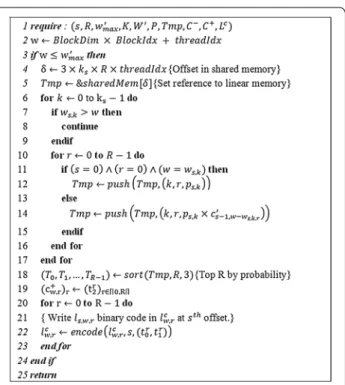
and have each thread in this block process a w value, (b) have each block handle a w value, and have each thread in this block process a k value, or (c) have each block handle a w value, and have each thread in this block process a r value. In this study, we implemented the GPU paralleliza-tion based on the design (a) because it enabled the high-est degree of parallelism. According to design (a), the pseudocode of our DP CUDA kernel is provided in Algo-rithm 1 (Fig. 1). Each thread with thread index (thread-Idx) processes Algorithm 1, and the loops for (k,r) ∈
[|0,h|] × [|0,R|] are implemented sequentially from lines 6 to 17. BlockDim is the number of threads per block, and BlockIdx represents the Block index of the processing thread on threadIdx. Thus, the code in line 2 evaluates the required mass (molecular weight) that is processed by the thread on threadIdx. C−, C+ and Lc are allocated in the GPU global memory, whereas K, W′, P are stored in GPU Constant memory (i.e., the constant memory provides a cached access to constants). The pseudocode from lines 18 to 22 is similar to Su’s DP [20], which uses a sort algorithm to retrieve the top R values of Tr and updates the C and L matrices. The parameter limitations in the G.A.M.E. were described in the Additional file 1.
Fig. 1 The Algorithm 1 Kernel. The sharedMem variable is a pointer to the dynamically allocated shared memory. The push(X,y) function appends element y to array X and returns X. sort(X,R,i) returns the top
R elements when the elements of X are sorted by their ith compo‑ nent. encode(X,s,y) writes the binary code of y at the sth offset of
X
slog2(R)+ni=0⌊log2(ki)+1⌋
Results and discussion
Parameter tuning of GPU computing
Before exploiting the advantages of GPU computing, sev-eral parameters must be determined to ensure the opti-mal performance of G.A.M.E. We preliminarily analyzed our datasets and inferred the optimal values of R, D and wmax, which are all related to the memory usage and time complexity of G.A.M.E. Among them, R is the output number of structures, D is the number of decimal dig-its of mass for computing, and wmax is the maximal total molecular weight of extended side chains on a given scaf-fold. On the basis of the 83,242 scaffold files, the average number of summation of the molecular weights from all possible substituents in each compound was 89.42, and the average number of maximum possible sidechains of scaffolds, h, was 4. Additionally, the average number of required ranks, R, that matched the verified searched ground truth data among the four testing datasets was 8. To calculate the top R solutions of a given scaffold, the CSCCP program outputs R × Nr solutions, where Nr is the number of configurations in one given scaffold; on average, Nr is 5. According to the previous studies [20], the value of R in 3 is sufficient to identify the correct structures in four testing datasets. The number of deci-mal digits, D, with a value of 5 is also sufficient to pro-duce the real optimal solutions among the four testing cases. Therefore, the values 3, 5, and 500 for R, D, and wmax, respectively, were adequate to solve the CSCCP using our algorithm.
Performance of GPU‑based G.A.M.E. compared with that of CPU DP
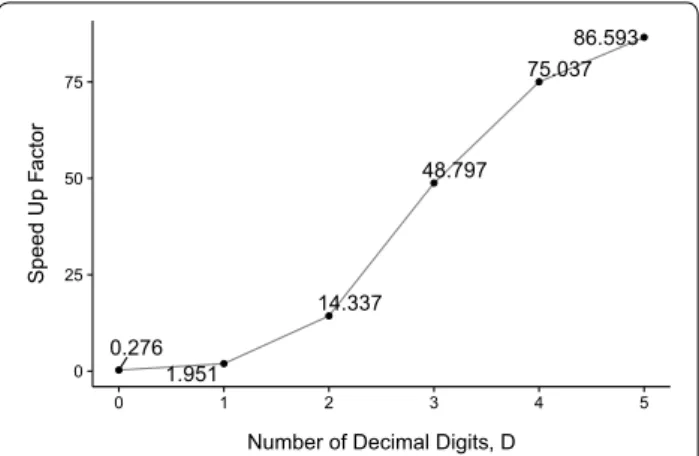
To compare the performance of our G.A.M.E. algorithm with Su’s original CPU DP algorithm, analyses were performed on NPDB, with different D and number of threads per block in GPU kernel, as shown in Figs. 2 and 3. Figure 2 illustrates that the acceleration of G.A.M.E. with respect to CPU DP becomes increasingly signifi-cant as D increases and is the most signifisignifi-cant at D = 5.
The execution time was calculated from averaging the running time of 1713 suitable scaffolds from the NPDB. The parameters of ThreadsPerBlock, wmax, and R are set to 64, 500 and 3, respectively. As expected, the perfor-mance of G.A.M.E. grew with the number of decimal digits, D, because the amount of computation is propor-tional to 10D. By increasing the value of D, the amount of
parallelism was maximized. When D = 0, the GPU was
under-utilized, thus leading G.A.M.E. to be slower than the CPU DP. The average running time of G.A.M.E. was 0.0108 s when D = 0, whereas the CPU DP average
run-ning time was 0.0029 s. When D = 5, the average
run-ning time of G.A.M.E. was 1.54 s. By comparison, CUP DP had an average running time of 146.77 s. In fact, the
running time of CPU DP dramatically increased, whereas G.A.M.E. remained within an appropriate time when D increased. Overall, G.A.M.E. showed a successful hard-ware-accelerated performance increase relative to the performance of Su’s original DP algorithm. Furthermore, since the accuracy of the DP algorithm has been demon-strated by Su [20], and we did not change the core of the original DP algorithm [20] in the G.A.M.E. algorithm, our system must maintain the same accuracy.
Whereas Fig. 2 focused on the effect of the number of decimal digits, D, on performance, Fig. 3 shows that G.A.M.E. is stable in every case and provides over 64-fold acceleration when the number of threads per block in GPU kernel is 32. In the GPU programming environ-ment, a GPU kernel launches a grid of thread blocks to
0.276 1.951
14.337
48.797
75.037 86.593
0 25 50 75
0 1 2 3 4 5
Number of Decimal Digits, D
Speed Up
Fa
ctor
Fig. 2 Acceleration of G.A.M.E. relative to Su’s CPU DP as a function of the number of decimal digits, D. Each data point is obtained by aver‑ aging the running time of 1713 suitable scaffolds from the NPDBs. Fixed parameters: ThreadsPerBlock = 64
8.01 513.39
2.72 265.82
1.52 153.75
1.09 87.84
0.98 66.65
0 100 200 300 400 500
32 64 128 256 512
Number of Threads per Block
Running Time (Seconds
)
CPU DP GAME
Fig. 3 Running time of G.A.M.E. compared with Su’s CPU DP. Each bar was obtained by averaging the running time of the 500 different randomly selected scaffold configurations from the NPDBs, sharing the same number of threads per block. Fixed parameters: D = 5,
attain parallel computing. The number of threads in each thread block was denoted by ThreadsPerBlock in this study. ThreadsPerBlock will dominate both the time performance and memory limitation of the computa-tion. (Detailed definition and relation of blocks, threads, and memory in GPU kernel was described in Additional file 1). For evaluation of time performance with different ThreadsPerBlock in G.A.M.E., the average running time in seconds was calculated by averaging the running time with samplings of 500 randomly chosen scaffold configu-rations among the NPDB for cases with 32, 64, 128, 256 and 512 threads per block. In all cases with more than 32 threads per block, the running time was below 3 s, whereas Su’s CPU DP ran in 144 s on average. Among these cases, we obtained an average acceleration factor of 82.38. Therefore, we can expect that for compounds with higher h and a larger wmax, the DP algorithm required longer execution time to solve CSCCP, whereas G.A.M.E. continued to execute in relatively lower running time. Given the different ThreadsPerBlock, the average execu-tion time of G.A.M.E. were all similar, stable, and suffi-ciently short to solve CSCCP in practical cases because of the successful parallel computations.
Optimal number of mass decimal digits for G.A.M.E. To determine the applicability of our G.A.M.E. imple-mentation, we first performed a series of tests to estimate what proportion of the NPDB scaffolds could be used as an input for G.A.M.E. We listed the different reasons causing the CSCCP to be non-feasible and evaluated the proportions of unique non-feasible cases. Table 1 illus-trates the percentage of feasible cases within all con-figurations of scaffolds of the NPDB for a target weight
w′
max = 500 × 10D and with the value of D increasing
from 0 to 7. The feasible cases indicate the configura-tions of given scaffolds that could be performed well in G.A.M.E., adhering to all hardware-imposed constraints. The proportions were obtained by analyzing 51,562 suit-able configurations of all 83,242 scaffolds of the NPDB when wmax = 500. We found that 99.28% of the cases were feasible for D ≤ 5. For D = 6, only 32.94% of the cases were feasible, and for D = 7, the proportion of fea-sible cases was 1.06%. In other words, cases with D values larger than 6 are beyond the limit of G.A.M.E. Never-theless, the previous studies [20] showed that a value of
D = 5 is sufficient to identify the correct structures in four testing datasets. It is unnecessary to waste the mem-ory space and delay the execution time by using too many decimal digits, because statistically real solutions can still be output when D is less than 6.
We then analyzed the reason why some cases are not feasible, using the case in which wmax = 500. Table 2 illus-trates the different types of problems distributed among non-feasible cases. Most of the cases were not feasible when D ≥ 6 because the usage of total global memory exceeded maximal resource of the system. Furthermore, since the design of compression technique (described in “Memory usage reduction” section) for memory reduc-tion in G.A.M.E. was limited in Eq. 1 and 2, the compres-sion restraints made 369 configurations were not feasible in all cases of D.
Hardware‑imposed limitations
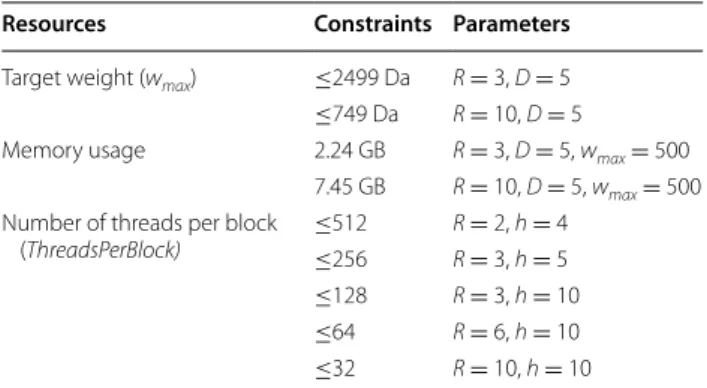
By means of hardware acceleration to speed up the CPU DP algorithm for CSCCP, certain parameters of the developed G.A.M.E. suffered from hardware-imposed constraints. Table 3 lists three types of constraints of the observed resources for different parameters on the NVIDIA® Tesla K40c. The first row in Table 3 shows the evaluated maximum molecular weight (wmax) for differ-ent values in R and D, according to an assessmdiffer-ent of the parameter constraints (see Additional file 1: Eq. 3). The wmax must be less than or equal to 2499 (Da) for R = 3, compared with 749 (Da) for R = 10. The total required global memory based on different R values when D = 5 and wmax = 500 is listed in the second row of Table 3. Whenever the value of R is 3 or 10, the required memo-ries (2.24 GB or 7.45 GB) are still under the capacity of
the 11,440 MB global memory of the NVIDIA® Tesla
K40c. From the parameter constraint assessment (See Additional file 1: Eq. 4), the possible maximum number of threads per block for parallel computation given by different R and h are shown in the third row of Table 3. Lower values of R and h correspond to a higher number of threads per block that the algorithm can execute for parallelization. To ensure stable computing, our algo-rithm automatically calculates the possible maximum number of threads per block according to the parameters
Table 1 The percentage of feasible cases within all config-urations of scaffolds of the NPDBs
The statistics were obtained from all scaffolds of the NPDBs. Fixed parameters:
wmax = 500
Number of decimal digits, D ≤5 6 7
Proportion of feasible cases (%) 99.28 32.94 1.06
Table 2 Statistics on non-feasible cases
The statistics were obtained on the non-feasible configurations of Table 1. Fixed parameters: wmax = 500
Configurations with specific problem types D ≤ 5 D = 6 D = 7
R and h. If there are cases that exceed the constraint
of the maximum molecular weight (wmax = 500) and
the compression technique of Eqs. 1 and 2, the system ignores those non-feasible calculations.
Acceleration validation in real cases
In order to validate the accelerated G.A.M.E. system, we used four testing sets from real analysis data of four natural products: Cuscuta chinensis, Ophiopogon aponicas, Polygo-num multiflorum, and Angelica sp. The execution time was calculated from averaging the running time of 10 random samplings of 20 cases in each sampling within these four testing datasets. The R parameter was set to 3; the wmax parameter was from molecular weights detected from real MS experiments; and the ThreadsPerBlock parameter was automatically calculated with the most blocks feasi-ble calculated by the parameter assessment equation (see Additional file 1: Eq. 4). The speed up factors, the CPU DP average running time divided by GPU running time, was illustrated in Fig. 4. In this testing analysis, the GPU was under-utilized when D = 0. The average running time of G.A.M.E. was 0.0207 s when D = 0, whereas the CPU DP average running time was 0.0047 s. Although G.A.M.E. cannot show the improved performance when D = 0, the GPU programming showed the significant accelerations when D is greater than 0. When D = 5, the average run-ning time of G.A.M.E. was 20.72 s. By comparison, CUP DP had an average running time of 324.16 s. As a result, in real cases that wmax values were set from real experiments, the G.A.M.E. also dramatically accelerated the perfor-mance compared with Su’s original DP algorithm. In this section, we have sufficiently demonstrated that G.A.M.E. outperformed the process of the CSCCP problem in real cases, compared with the original DP algorithm.
Conclusions
Our G.A.M.E. method is executed in silico to predict the constituents of a mixture on the basis of its mass spec-tral data by exploiting a scaffold database with sidechain
probability information, such as Harn’s Natural Product Scaffold database. By harnessing the power of modern GPU graphic cards, G.A.M.E. outperforms Su’s DP algo-rithm with an average acceleration factor of 33 in 99% of the cases. It can be applied to situations in which up to 5 decimal digits are required. Our studies demonstrate three advantages in using a GPU-accelerated algorithm to solve CSCCP: (a) the algorithm can be implemented easily, (b) CSCCP can be appropriately divided into many small tasks to perform parallel computations, and (c) a stable running time is achieved. We conclude that our hardware-accelerated algorithm is an excellent method to solve CSCCP. As expected, with the rapid development of PC hardware, the use of GPU acceleration or even the application of distributed systems will be a practical way to directly and efficiently identify the components of an unknown mixture.
Abbreviations
G.A.M.E.: GPU‑accelerated mixture elucidator; DP: dynamic programming; CUDA: compute unified device architecture; MS: mass spectrometry; NMR: nuclear magnetic resonance; CASE: computer‑aided structure elucidation; NPDB: natural products database; CSCCP: chemical substituent core combina‑ torial problem; VGA: video graphics array.
Authors’ contributions
AS designed and implemented the algorithm. AS, BHS, and YST ran tests. YJT provided guidance to the work. AS drafted the manuscript. BHS, YST, TTL, OAL, and YJT revised the manuscript. All authors read and approved the final manuscript.
Additional file
Additional file 1. Contains the supplementary information of the manu‑ script. This includes (1) overview of GPU programming framework with CUDA; (2) parameter limitations assessment imposed by hardware; (3) an introduction for the prediction procedure in NP‑StructurePredictor; (4) an introduction of dynamic algorithm for structure elucidation.
Table 3 Parameter constraints on the NVIDIA® Tesla K40c
Resources Constraints Parameters
Target weight (wmax) ≤2499 Da R = 3, D = 5 ≤749 Da R = 10, D = 5
Memory usage 2.24 GB R = 3, D = 5, wmax = 500 7.45 GB R = 10, D = 5, wmax = 500 Number of threads per block
(ThreadsPerBlock) ≤512
R = 2, h = 4 ≤256 R = 3, h = 5 ≤128 R = 3, h = 10 ≤64 R = 6, h = 10 ≤32 R = 10, h = 10
0.251
1.243
5.792
19.346
29.86833.092
0 10 20 30
0 1 2 3 4 5
Number of Decimal Digits, D
Speed Up
Fa
ctor
Author details
1 Graduate Institute of Biomedical Electronics and Bioinformatics, National
Taiwan University, No. 1 Sec. 4, Roosevelt Road, Taipei 106, Taiwan. 2 Depart‑
ment of Computer Science and Information Engineering, National Taiwan University, No. 1 Sec. 4, Roosevelt Road, Taipei 106, Taiwan. 3 Drug Research
Center, National Taiwan University College of Medicine, No. 1 Sec. 1, Jen Ai Rord, Taipei 106, Taiwan.
Acknowledgements
The authors thank Yuan Ling Ku, Ph.D. (Medical and Pharmaceutical Industry Technology and Development) for providing the natural product test cases used in our experiments. The authors are also grateful to Computer and Information Networking Center, National Taiwan University for the support of high‑performance computing facilities.
Competing interests
The authors declare that they have no competing interests.
Funding
Taiwan Ministry of Science and Technology (105‑3011‑F‑002‑010‑) and the Department of Computer Science and Information Engineering of National Taiwan University.
Publisher’s Note
Springer Nature remains neutral with regard to jurisdictional claims in pub‑ lished maps and institutional affiliations.
Received: 12 January 2017 Accepted: 5 September 2017
References
1. Harvey AL, Edrada‑Ebel R, Quinn RJ (2015) The re‑emergence of natural products for drug discovery in the genomics era. Nat Rev Drug Discov 14(2):111–129
2. Kim HK, Choi YH, Verpoorte R (2010) NMR‑based metabolomic analysis of plants. Nat Protoc 5(3):536–549
3. Corcoran O, Mortensen RW, Hansen SH, Troke J, Nicholson JK (2001) HPLC/1H NMR spectroscopic studies of the reactive alpha‑1‑O‑acyl isomer formed during acyl migration of S‑naproxen beta‑1‑O‑acyl glucu‑ ronide. Chem Res Toxicol 14(10):1363–1370
4. Corcoran O, Spraul M (2003) LC‑NMR‑MS in drug discovery. Drug Discov Today 8(14):624–631
5. van der Hooft JJJ, Mihaleva V, de Vos RCH, Bino RJ, Vervoort J (2011) A strategy for fast structural elucidation of metabolites in small volume plant extracts using automated MS‑guided LC‑MS‑SPE‑NMR. Magn Reson Chem 49:S55–S60
6. Kind T, Fiehn O (2010) Advances in structure elucidation of small mol‑ ecules using mass spectrometry. Bioanal Rev 2(1–4):23–60 7. Elyashberg ME, Gribov LA (1968) Formal‑logical method for interpret‑
ing infrared spectra from characteristic frequencies. J Appl Spectrosc 8(2):189–191
8. Lederberg J, Sutherland GL, Buchanan BG, Feigenbaum EA, Robertson AV, Duffield AM et al (1969) Applications of artificial intelligence for chemical inference. I. The number of possible organic compounds. Acyclic struc‑ tures containing C, H, O, and N. J Am Chem Soc 91(11):2973–2976 9. Nelson DB, Munk ME, Gash KB, Herald DL (1969) Alanylactinobicyclone.
Application of computer techniques to structure elucidation. J Org Chem 34(12):3800–3805
10. Sasaki S, Abe H, Ouki T, Sakamoto M, Ochiai S (1968) Automated structure elucidation of several kinds of aliphatic and alicyclic compounds. Anal Chem 40(14):2220–2223
11. Christie BD, Munk ME (1991) The role of 2‑dimensional nuclear‑magnetic‑ resonance spectroscopy in computer‑enhanced structure elucidation. J Am Chem Soc 113(10):3750–3757
12. Peng C, Yuan SG, Zheng CZ, Hui YZ (1994) Efficient application of 2D NMR correlation information in computer‑assisted structure elucidation of complex natural‑products. J Chem Inf Comput Sci 34(4):805–813
13. Lindel T, Junker J, Kock M (1999) 2D‑NMR‑guided constitutional analysis of organic compounds employing the computer program COCON. Eur J Org Chem 3:573–577
14. Blinov KA, Carlson D, Elyashberg ME, Martin GE, Martirosian ER, Molodtsov S et al (2003) Computer‑assisted structure elucidation of natural products with limited 2D NMR data: application of the StrucEluc system. Magn Reson Chem 41(5):359–372
15. Elyashberg ME, Blinov KA, Williams AJ, Molodtsov SG, Martin GE, Martirosian ER (2004) Structure elucidator: a versatile expert system for molecular structure elucidation from 1D and 2D NMR data and molecular fragments. J Chem Inf Comput Sci 44(3):771–792
16. Elyashberg ME, Williams A, Martin GE (2008) Computer‑assisted structure verification and elucidation tools in NMR‑based structure elucidation. Prog Nucl Magn Reson Spectrosc 53(1–2):1–104
17. Butler MS (2004) The role of natural product chemistry in drug discovery. J Nat Prod 67(12):2141–2153
18. Elyashberg M, Blinov K, Molodtsov S, Williams A (2012) Elucidating ‘undecipherable’ chemical structures using computer‑assisted structure elucidation approaches. Magn Reson Chem 50(1):22–27
19. Harn Y‑C (2011) Structure hunter: prediction of novel chemical structures in a mixture [Master Dissertation]. Taipei, Taiwan: National Taiwan University
20. Su B‑H (2012) A chemical substituents‑core combinatorial optimization and hERG toxicity prediction in drug design [Ph.D. Dissertation]. Taipei, Taiwan: National Taiwan University
21. Owens JD, Houston M, Luebke D, Green S, Stone JE, Phillips JC (2008) GPU computing. Proc IEEE 96(5):879–899
22. Asanovic K, Bodik R, Demmel J, Keaveny T, Keutzer K, Kubiatowicz J et al (2009) A view of the parallel computing landscape. Commun ACM 52(10):56–67
23. Owens JD, Luebke D, Govindaraju N, Harris M, Kruger J, Lefohn AE et al (2007) A survey of general‑purpose computation on graphics hardware. Comput Graph Forum 26(1):80–113
24. Miao Y, Sinko W, Pierce L, Bucher D, Walker RC, McCammon JA (2014) Improved reweighting of accelerated molecular dynamics simulations for free energy calculation. J Chem Theory Comput 10(7):2677–2689 25. Clark AJ, Tiwary P, Borrelli K, Feng S, Miller EB, Abel R et al (2016) Prediction
of protein‑ligand binding poses via a combination of induced fit docking and metadynamics simulations. J Chem Theory Comput 12(6):2990–2998 26. Gowthaman R, Lyskov S, Karanicolas J (2015) DARC, 2.0: improved
docking and virtual screening at protein interaction sites. PLoS ONE 10(7):e0131612
27. Galindo‑Murillo R, Roe DR, Cheatham TE III (2014) On the absence of intrahelical DNA dynamics on the μs to ms timescale. Nat Commun 5:5152
28. Chen W, Zhu Y, Cui F, Liu L, Sun Z, Chen J et al (2016) GPU‑accelerated molecular dynamics simulation to study liquid crystal phase transi‑ tion using coarse‑grained gay‑berne anisotropic potential. PLoS ONE 11(3):e0151704
29. Johnson DK, Karanicolas J (2016) Ultra‑high‑throughput structure‑based virtual screening for small‑molecule inhibitors of protein–protein interac‑ tions. J Chem Inf Model 56(2):399–411
30. Korpar M, Šošić M, Blažeka D, Šikić M (2015) SW# db: GPU‑accelerated exact sequence similarity database search. PLoS ONE 10(12):e0145857 31. Tyzack JD, Mussa HY, Williamson MJ, Kirchmair J, Glen RC (2014)
Cytochrome P450 site of metabolism prediction from 2D topological fingerprints using GPU accelerated probabilistic classifiers. J Cheminform 6:29
32. (2010) The Dictionary of Natural Products database is available from Chapman & Hall/CRC. http://dnp.chemnetbase.com/ [updated 2017; cited 2017]
33. Irwin JJ, Shoichet BK (2004) ZINC—a free database of commercially avail‑ able compounds for virtual screening. J Chem Inf Model 45:177–182 34. Chen CY‑C (2011) TCM Database@Taiwan: the world’s largest traditional