Associate Degree Scheme in Science and Technology
(Programme Code 8C012)
comprising
Associate in Engineering
工程學副學士
Associate in Information Technology
資訊科技副學士
Associate in Statistics and Computing for Business
商業統計及電子計算副學士
Associate of Science
理科副學士
Definitive Scheme Document
September 2007
This Definitive Scheme Document applies to students enrolling in programmes under the
Associate Degree Scheme in Science and Technology in the 2007/2008 academic year. The
Document is subject to review and HKCC may make appropriate changes at any time.
Students will be informed of the changes as and when appropriate.
Table of Contents
Section One: General Information Page
1. Host Department 1
2. Scheme Operation and Management 1
2.1 Programmes under the Scheme 1
2.2 Scheme and Programme Leaders 1
2.3 Scheme Management Committee 1
3. Aims and Intended Learning Outcomes 1
4. Entry Requirements 4
5. Granting of Award 4
6. Mode and Duration of Study 4
7. Attendance 5
8. Curriculum Structure 6
8.1 Subject Level and Subject Code 6
8.2 Subject Nature 6
8.3 Continuing Education Fund (CEF) Approved Programme/Subject 6
8.4 Credit and Level Requirements 6
8.5 General Education Requirements 7
8.6 Award-specific Requirements 9
8.6.1 Associate in Engineering 9
8.6.2 Associate in Information Technology 11
8.6.3 Associate in Statistics and Computing for Business 13
8.6.4 Associate of Science 14
8.7 Programme Curriculum Maps 20
9. Medium of Instruction 30
10. Teaching and Learning Methods 30
11. Assessment and Examinations 30
11.1 Principles of Assessment 30
11.2 Role of Subject Assessment Review Panel 31
11.3 Role of Board of Examiners 31
11.4 Assessment Methods 31
11.5 Academic Probation 38
11.6 Progression and De-registration 38
11.7 Grading 39
11.8 Retaking of Subjects 40
11.9 Plagiarism and Dishonesty 41
11.10 Guidelines for Award Classification 41
11.11 Student Appeals 42
11.12 Exceptional Circumstances 42
Section Two: Syllabuses
Subject Code Subject Name Page
CC1001 English Skills for Business Communication 44
CC1002 Astronomy and Fortune-telling 47
CC1003 Chinese Calligraphy and Painting 50
CC1005 Buddhist Culture and Art 53
CC1006 Foundation of Chinese Medicine 56
CC1007 The Art of Chinese Board Games 59
CC1008 Appreciation of Asian and Western Music 62
CC2001 English Skills for Academic Studies 65
CC2002 Creative and Critical Thinking 68
CC2003 Quantitative Methods 71
CC2005 Applied Computing 73
CC2006 Introduction to Internet Technology 75
CC2007 Environmental Science 77
CC2008 Chinese Civilisation 80
CC2009 Chinese Language 82
CC2010 Elementary French 84
CC2011 Japanese I 86
CC2012 Elementary Putonghua 88
CC2014 Aesthetics and Art Appreciation 90
CC2016 Understanding Society 92
CC2019 Introduction to Psychology 94
CC2026 Numerical Skills 97
CC2028 Grammar in Context 99
CC2030 Mathematics 101
CC2031 Japanese II 103
CC2033 Introduction to Philosophy 105
CC2034 The History and Culture of Hong Kong 108
CC2101 Financial Accounting 111
CC2102 Theory and Practice of Management 113
CC2104 Introduction to Microeconomics 115
CC2110 Food Service Operations 117
CC2113 Chinese for Business Executives 119
CC2126 Introduction to Marketing 122
CC2201 Principles of Programming 124
CC2202 Computer System Architectures 126
CC2203 Data Structures and Algorithms 128
CC2204 Discrete Mathematics 131
CC2302 Engineering Mathematics 133
CC2305 Basic Electricity and Electronics 135
CC2307 Engineering Science 138
CC2404 Applied Physics and Instrumentation in Health Care 141
Subject Code Subject Name Page
CC2417 Human Biology I 145
CC2418 Human Biology II 147
CC2422 Linear Algebra 149
CC2425 Statistics for Business I 151
CC2439 General Chemistry 153
CC3003 Contemporary Social Problems 155
CC3004 Development of Pearl River Delta 158
CC3006 The Perspectives of Eastern and Western Cultures 161
CC3008 Food Hygiene and Nutritional Health 165
CC3011 Gender Issues 168
CC3015 Logic 170
CC3016 Mass Media and Culture 172
CC3017 Social Psychology 174
CC3018 The History of Modern China and the World (From 1842 - Now) 176
CC3020 Oral Communication in English 178
CC3021 Politics and Government 180
CC3022 History, Culture, Economic and Social Development of East Asia 183 CC3023 History, Culture, Economic and Social Development of Southeast Asia 186
CC3024 Japanese III 189
CC3025 Japanese IV 191
CC3121 Business Environment in China 194
CC3122 China’s Economy 196
CC3129 Business Putonghua 199
CC3135 Inventory and Warehousing Management 202
CC3143 Business Logistics and Supply Chain Management 205
CC3144 Practicum in Workplace 208
CC3145 Extensive Practicum in Workplace 210
CC3150 Organisational Behaviour 212
CC3153 Principles of Knowledge Management 214
CC3201 Fundamentals of Database Systems 217
CC3202 Software Engineering 219
CC3203 Information Systems Analysis and Design 222
CC3204 Data Communications and Networking 225
CC3205 Operating Systems 227
CC3206 Programming Project 229
CC3207 Object Oriented Programming 231
CC3208 Internet Programming 233
CC3209 Internetworking Protocols and Systems 235
CC3210 Database Design and Implementation 237
CC3301 Communication Systems Principles 239
CC3302 Computer Systems Principles 241
CC3303 Design of Production and Service Systems 243
CC3304 Digital System Design 245
Subject Code Subject Name Page
CC3306 Industrial Engineering Techniques and Methods 249
CC3307 Manufacturing Technology 252
CC3308 Quality Engineering 254
CC3309 Society and the Engineer 256
CC3310 Statistics and Probability 258
CC3311 Engineering Materials 260
CC3312 Thermofluids 262
CC3313 Linear Systems 265
CC3314 Engineering Project 267
CC3315 Applied Mechanics 270
CC3316 Architectural Technology in the Built Environment 272
CC3401 Applied Business Computing Project 275
CC3403 Applied Statistical Methods 277
CC3406 Basic Immunology 280
CC3408 Biology of Ageing 283
CC3409 Business Forecasting Methods 285
CC3411 Chinese Family and Culture 287
CC3423 Economic and Social Statistics 289
CC3430 Financial Mathematics 291
CC3434 General Microbiology 293
CC3450 Introduction to Microbiology 295
CC3456 Management Information Systems 297
CC3458 Operation Research for Business 299
CC3467 Social Development in China 301
CC3471 Social Problems and Social Issues in Contemporary China 303
CC3475 Statistical Data Analysis 305
CC3476 Statistics for Business II 307
CC3477 Survey Design and Analysis 309
CC3487 Introduction to Pathophysiology and Pharmacology 311
CC3492 Chinese Government and Politics 316
CC3728 Analytical Chemistry 318
CC3729 Computer Game Programming 320
CC3730 Dynamics and Control 323
CC3731 Electrical Engineering 325
CC3732 Engineering Graphics and Computing 327
CC3733 Further Calculus 330
CC3734 General Biochemistry 332
CC3735 Intermediate Environmental Science 334
1. Host Department
The Associate Degree Scheme in Science and Technology (‘The Scheme’) is hosted by Hong Kong Community College (‘HKCC’), with the academic support from the Department of Applied Mathematics (AMA).
2. Scheme Operation and Management
2.1 Programmes under the Scheme
The Scheme comprises the four programmes below:
Programme Title Programme Code
• Associate in Engineering 8C012-ENG
• Associate in Information Technology 8C012-IT • Associate in Statistics and Computing for Business 8C012-SCB
• Associate of Science 8C012-AS
2.2 Scheme and Programme Leaders
A Scheme Leader (SL) is appointed to provide academic support in the realm of quality assurance in both teaching and learning. The SL, with the assistance of a Deputy Scheme Leader, also provides input in staffing, student admission, assessment and feedback, and programme development.
Programme Leaders and Assistant / Deputy Programme Leaders (where appropriate) are appointed to manage the various programmes under the Associate Degree Scheme.
2.3 Scheme Management Committee
The Scheme Management Committee (SMC) assumes overall academic responsibility. It comprises the Scheme Leader, Assistant Scheme Leader(s), Programme Leaders, Assistant / Deputy Programme Leaders, Subject Leaders / Lecturers and student representatives who will periodically review the academic content, student feedback, and pedagogical issues. Student-staff Consultative Meetings will be held to provide a channel through which
students’ views can be obtained. During these meetings, teaching staff and student representatives meet for constructive discussion on matters relating to student workload, teaching methods, the relevance of the course content and possible improvements.
3. Aims and Intended Learning Outcomes
All the programmes under the Associate Degree Scheme in Science and Technology (ADSST) aim to help students develop a foundation of generic skills and broad-based knowledge that nurture life-long learning. These programmes are designed primarily to provide students with fundamental domain-specific knowledge as well as generic knowledge for future academic pursuits, and secondarily to facilitate their entry into the
2
The curriculum structure of ADSST is intended to provide students with choices of specialisms and elective subjects, and to offer them more flexibility. Such choices and flexibility will enable students to make informed decisions on the best ways to enhance their chances for further studies and career development.
The intended learning outcomes of the Scheme centre around generic and professional competencies which encompass the attitude, knowledge, and skills expected of AD graduates. These can be specified in great details in the following outcomes:
Scheme Outcomes - Outcomes relating to all-roundedness and generic skills
Upon graduation from the Associate Degree Scheme in Science and Technology, students will be able to:
1. critically assess propositions and arguments commonly encountered in daily life, at work and in tertiary level studies;
2. invoke creativity and other problem solving skills in dealing with problems encountered in daily life, at work and in tertiary level studies;
3. effectively use current information technology to carry out tasks commonly encountered in daily life, at work and in tertiary level studies;
4. demonstrate a professional attitude in terms of sense of responsibility, integrity, self-confidence, service attitude, and teamwork;
5. effectively communicate in spoken and written English at a competence level required of associate professionals; and
6. demonstrate ability for self-reflection and language skills which are prerequisites for lifelong learning and continuous professional development.
Professional Outcomes
In addition to the shared learning scheme outcomes for the Associate Degree Scheme in Science and Technology as a whole, graduates of individual ADSST programmes will be able to:
Associate in Engineering
E1. possess the foundation of specific professional skills and knowledge in engineering for further academic and professional development;
E2. understand basic engineering / computing principles and analytical skills;
E3. apply engineering principles and analytical skills to solve daily life and engineering problems using mathematical techniques, graphical methods and computer technologies at a competence level required of an associate engineer;
E4. design engineering components, processes or systems to meet design needs at a competence level required of an associate engineer;
E5. understand the trends of various engineering developments;
E6. demonstrate an understanding of the responsibility and ethics of an associate engineer; and
E7. effectively communicate with engineers and non-engineering professionals in written and spoken English.
Associate in Information Technology
IT1. identify information technology (IT) problems, analyze requirements and apply systematic approaches in the evaluation, design, implementation, and maintenance of hardware and software solutions;
IT2. communicate with IT and non-IT professionals in both written and spoken English at a level of effectiveness sufficient for the presentation of IT systems or projects; IT3. build on the foundation of specific professional IT skills and knowledge acquired
in this programme with the potential to continue academic and professional development in IT and IT-related fields; and
IT4. recognise and appreciate potential opportunities and trends of IT to sustain a competitive advantage in the IT industry.
Associate in Statistics and Computing for Business
SC1. acquire a sound knowledge of computing technology and statistical principles and techniques, including data analysis and operations research;
SC2. use statistical methods to analyse relevant problems in business and industry; and SC3. apply necessary skills to provide solution to problems related to the analysis of
financial and business activities with the knowledge and techniques learned in the programme.
Associate of Science
S1. possess the broad education necessary to understand the major findings and ideas in a variety of disciplines such as science, engineering, information technology and business;
S2. demonstrate understanding of methods, skills, tools and systems commonly used in a variety of scientific and technological disciplines; and
4
S3. pursue further academic development, clarify career goals and plan ahead for their future - on the basis of better self-understanding of their own interests and aptitudes, as well as better knowledge about different science-related disciplines.
4. Entry Requirements
The minimum requirements for entry into the first year of the two-year programmes under the Associate Degree Scheme in Science and Technology are as follows:
(i) Satisfactory completion of Form 6; and
Grade E in 5 Hong Kong Certificate of Education Examination (HKCEE) subjects including English Language and Chinese Language; and
Grade E in 1 Hong Kong Advanced Level Examination (HKALE) subject; OR, Grade E in 2 HKALE (AS-Level) subjects, which may include Use of English, and Chinese Language and Culture.
OR
(ii) Satisfactory completion of a one-year Pre-Associate Degree Programme offered by a local University; OR
(iii) The equivalents of the above requirements.
For those who do not possess the above-mentioned qualifications but have reached the age of 25 by 1 September in the admission year, they may apply as “mature” students. Mature candidates are expected to demonstrate proficiency in English to study for the programme to the satisfaction of the admissions panel.
5. Granting of Award
Students would be eligible for the Associate Degree award if they satisfy all the conditions listed below:
(i) successful completion of the compulsory and elective subjects for a total of 60 credits within the permissible maximum duration;
(ii) satisfying the level, general education and award-specific requirements of individual awards as stipulated in Section 8 Curriculum Structure; and
(iii) having an Award GPA of 2.0 or above at the end of the programme.
6. Mode and Duration of Study
The four Associate Degree programmes within the Scheme are offered in full-time mode of study. There are 2 semesters per year, each 14 weeks long. Students are required to complete 15 credits per semester. Prior approval is needed for students to study more or less than 15 credits per semester. The normal duration of the programmes is 2 years, and the maximum duration allowed for completion is 4 years.
Students are required to graduate as soon as they satisfy all the conditions for award (see Section 5 above).
7. Attendance
Students are required to have attained at least 75% of attendance in each of the subjects they study; otherwise students may be disallowed to sit for the subject examination, down-graded or awarded fail grades for unsatisfactory attendance, participation and / or punctuality.
Regular and punctual attendance at lectures, seminars and tutorials is important. If students are late by 15 minutes for a tutorial or 30 minutes for a lecture, they will be regarded as absent for that particular tutorial or lecture. Students who are often absent or late for class will be asked to explain to their lecturers or tutors. In case of illness, the original doctor’s certificate will be required.
Students must only attend the subject groups in which they are registered in. They will have their names listed on the finalised class registers after the add / drop period only if they are officially registered in that particular subject group. Attendance in other non-registered classes is not allowed.
6
8. Curriculum Structure
The four Associate Degree programmes offered under the Scheme are in full-time mode based on a credit-based programme of study. To qualify for graduation, students are required to complete a total of 60 credits specified as below:
• 36 credits of award-specific subjects
• 21 credits of general education (GE) subjects • 3 credits of either a GE or an award-specific subject
The general education subjects provide students with fundamental generic skills and chances to broaden their horizon through subject choices in a wide range of disciplines such as arts, humanities, culture, history, China studies, languages, social sciences, business studies as well as science and technology. The award-specific subjects provide students with working knowledge in the selected discipline, and a foundation on which further qualification may be obtained.
8.1 Subject Level and Subject Code
All subjects offered under the Scheme are at Level 1, 2, or 3, and most subjects are of 3 credits each. The first digit of the subject code denotes the level of the subject; for example, CC2001 is a Level-2 subject.
8.2 Subject Nature
Each subject is classified as a science (S) or non-science (N-S) subject.
8.3 Continuing Education Fund (CEF) Approved Programme/Subject
If students enrol in a programme / subject marked with this symbol , they may apply for reimbursement of the programme / subject fee up to 80% or a maximum sum of HK$10,000 per applicant, subject to the satisfaction of the conditions as set out by the Government and the availability of funds. Students are required to register at the CEF office before commencement of the programme / subject to be eligible for reimbursement.
8.4 Credit and Level Requirements
Students are required to successfully complete a total of 60 credits of which
y
at least 24 credits are at Level 3;8.5 General Education Requirements
Students pursuing an award under the Scheme are required to successfully complete 5 compulsory plus 2 or 3 elective subjects in general education (GE) studies for a total of 21 or 24 credits.
(I) GE Compulsory Subjects (15 credits total)
Students are required to complete the following 5 GE compulsory subjects: (1) CC1001 English Skills for Business Communication
(2) CC2001 English Skills for Academic Studies (3) CC2002 Creative and Critical Thinking (4) CC2005 Applied Computing
(5) For Associate in Engineering and Associate of Science programmes • CC2030 Mathematics
For Associate in Statistics and Computing for Business programme • CC2406 Calculus
For Associate in Information Technology programme • CC2003 Quantitative Methods; OR
• CC2030 Mathematics
(II) GE Elective Subjects (6 or 9 credits total)
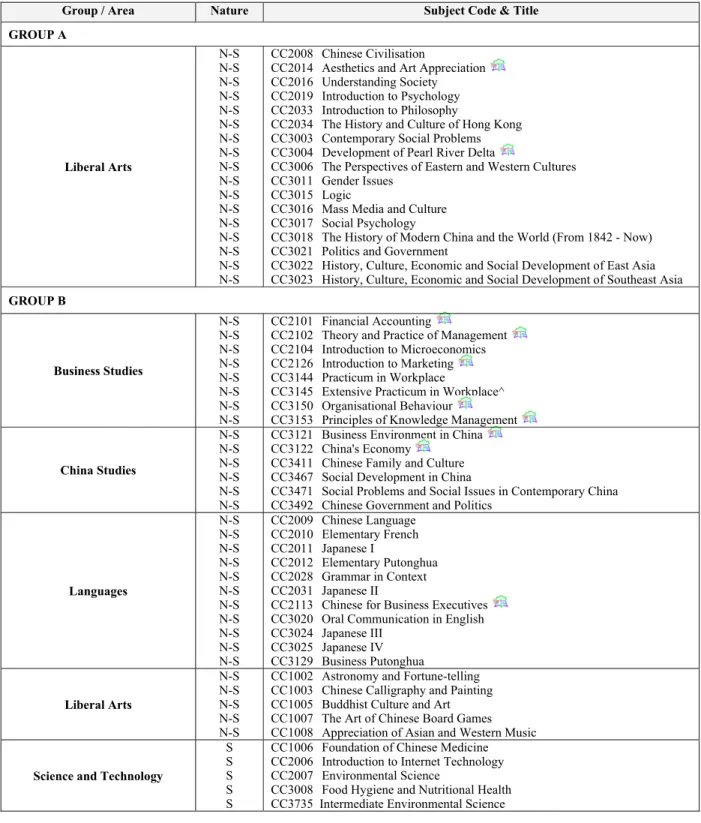
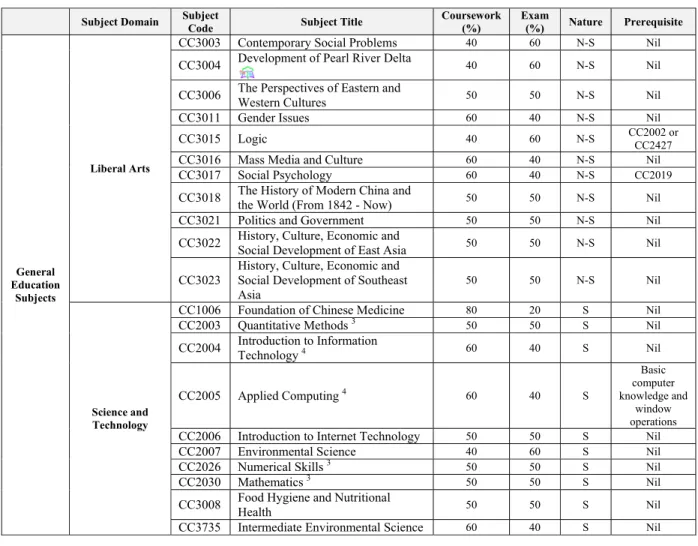
Students are given the flexibility to complete 6 or 9 credits in GE elective subjects, of which at least one subject should be selected from Group A of the following subject areas listed in Table 1:
Group A Group B
• Liberal Arts • Business Studies • China Studies • Languages • Liberal Arts
• Science and Technology
Should students decide to take 9 credits in GE elective subjects, they will have to complete a total of 24 credits in GE subjects and 36 credits in award-specific subjects for graduation. Should students choose to take 6 credits in GE elective subjects, they will have to take an additional award-specific elective and complete a total of 21 credits in GE subjects and 39 credits in award-specific subjects for graduation.
Nonetheless, students are not allowed to take the individual programme’s award-specific subjects (both compulsory and elective) as GE elective subjects, even though those award-specific subjects are listed in Table 1.
8
Table 1 - General Education Elective Subjects
Group / Area Nature Subject Code & Title
GROUP A Liberal Arts N-S N-S N-S N-S N-S N-S N-S N-S N-S N-S N-S N-S N-S N-S N-S N-S N-S
CC2008 Chinese Civilisation
CC2014 Aesthetics and Art Appreciation CC2016 Understanding Society CC2019 Introduction to Psychology CC2033 Introduction to Philosophy
CC2034 The History and Culture of Hong Kong CC3003 Contemporary Social Problems CC3004 Development of Pearl River Delta
CC3006 The Perspectives of Eastern and Western Cultures CC3011 Gender Issues
CC3015 Logic
CC3016 Mass Media and Culture CC3017 Social Psychology
CC3018 The History of Modern China and the World (From 1842 - Now) CC3021 Politics and Government
CC3022 History, Culture, Economic and Social Development of East Asia CC3023 History, Culture, Economic and Social Development of Southeast Asia
GROUP B Business Studies N-S N-S N-S N-S N-S N-S N-S N-S
CC2101 Financial Accounting
CC2102 Theory and Practice of Management CC2104 Introduction to Microeconomics CC2126 Introduction to Marketing CC3144 Practicum in Workplace
CC3145 Extensive Practicum in Workplace^ CC3150 Organisational Behaviour CC3153 Principles of Knowledge Management
China Studies N-S N-S N-S N-S N-S N-S
CC3121 Business Environment in China CC3122 China's Economy
CC3411 Chinese Family and Culture CC3467 Social Development in China
CC3471 Social Problems and Social Issues in Contemporary China CC3492 Chinese Government and Politics
Languages N-S N-S N-S N-S N-S N-S N-S N-S N-S N-S N-S
CC2009 Chinese Language CC2010 Elementary French CC2011 Japanese I
CC2012 Elementary Putonghua CC2028 Grammar in Context CC2031 Japanese II
CC2113 Chinese for Business Executives CC3020 Oral Communication in English CC3024 Japanese III
CC3025 Japanese IV CC3129 Business Putonghua
Liberal Arts N-S N-S N-S N-S N-S
CC1002 Astronomy and Fortune-telling CC1003 Chinese Calligraphy and Painting CC1005 Buddhist Culture and Art CC1007 The Art of Chinese Board Games CC1008 Appreciation of Asian and Western Music
Science and Technology
S S S S S
CC1006 Foundation of Chinese Medicine CC2006 Introduction to Internet Technology CC2007 Environmental Science
CC3008 Food Hygiene and Nutritional Health CC3735 Intermediate Environmental Science S = Science subject N-S = Non-science subject
^ Subject with 6 credits
Continuing Education Fund approved subject. Students enrolled in this subject may apply for reimbursement of subject fee, subject to the satisfaction of the conditions as set out by the Government and the availability of funds. Students are required to open a CEF account before commencement of the subject.
8.6 Award-specific Requirements 8.6.1. Associate in Engineering
Apart from the general education subjects, all students under Associate in Engineering
programme are required to complete 7 specific compulsory and 5 or 6 award-specific elective subjects# for a total of 36 or 39 credits in the area of Engineering.
(I) Award-specific Compulsory Subjects (21 credits)
Students are required to complete the following 7 award-specific compulsory subjects. These subjects provide students with a broad foundation and essential knowledge needed for various disciplines of engineering. The 4 Level-2 subjects below are normally to be taken in Stage 1.
Level 2 Level 3
• CC2201 Principles of Programming • CC3305 Engineering Management • CC2302 Engineering Mathematics • CC3309 Society and the Engineer • CC2305 Basic Electricity and
Electronics • CC3732 Engineering Graphics and Computing • CC2307 Engineering Science
(II) Award-specific Elective Subjects* (15 or 18 credits#)
Students are required to complete 5 or 6 subjects chosen freely from the pool of subjects below. Students who wish to concentrate in one or more areas of engineering studies may choose their award-specific elective subjects accordingly.
Electrical and Electronics Engineering
• CC3202 Software Engineering
• CC3204 Data Communications and Networking • CC3301 Communication Systems Principles • CC3302 Computer Systems Principles • CC3304 Digital System Design • CC3313 Linear Systems • CC3731 Electrical Engineering
Industrial and Manufacturing Systems Engineering
• CC3303 Design of Production and Service Systems • CC3306 Industrial Engineering Techniques and Methods • CC3307 Manufacturing Technology
• CC3308 Quality Engineering • CC3310 Statistics and Probability • CC3311 Engineering Materials • CC3314 Engineering Project
Information Engineering
• CC2203 Data Structures and Algorithms • CC3202 Software Engineering
10
• CC3204 Data Communications and Networking • CC3301 Communication Systems Principles • CC3302 Computer Systems Principles
Mechanical and Building Services Engineering
• CC3307 Manufacturing Technology • CC3310 Statistics and Probability • CC3311 Engineering Materials • CC3312 Thermofluids
• CC3314 Engineering Project • CC3315 Applied Mechanics
• CC3316 Architectural Technology in the Built Environment • CC3730 Dynamics and Control
• CC3731 Electrical Engineering
# Please refer to Section 8.5 General Education Requirements
*
The offering of any of these subjects is conditional upon enrolment figures and the availability of resources. Some subjects may require completion of prerequisites before enrolment. For details on prerequisite requirements for individual subjects, please refer to Table 7.
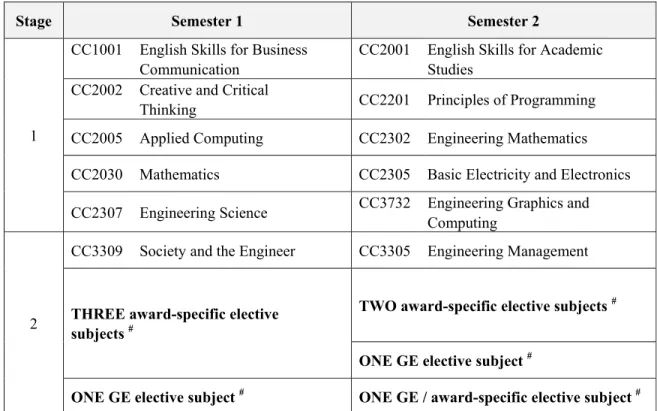
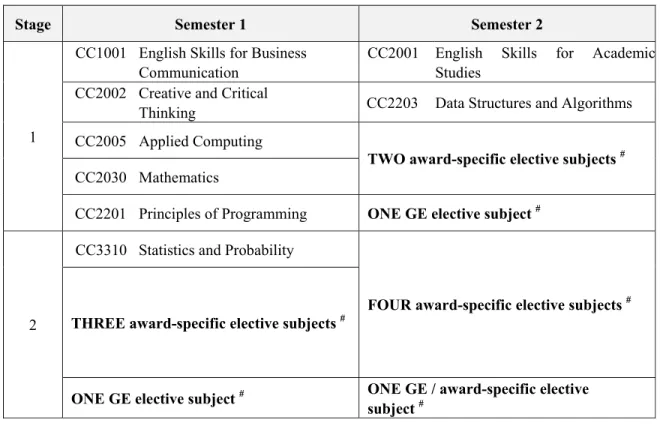
Table 2 - Study Pattern for Associate in Engineering*
Stage Semester 1 Semester 2
CC1001 English Skills for Business Communication
CC2001 English Skills for Academic Studies
CC2002 Creative and Critical
Thinking CC2201 Principles of Programming CC2005 Applied Computing CC2302 Engineering Mathematics CC2030 Mathematics CC2305 Basic Electricity and Electronics 1
CC2307 Engineering Science CC3732 Engineering Graphics and Computing
CC3309 Society and the Engineer CC3305 Engineering Management TWO award-specific elective subjects # THREE award-specific elective
subjects #
ONE GE elective subject # 2
ONE GE elective subject # ONE GE / award-specific elective subject # * HKCC reserves the right to change the study pattern.
# Students should ensure that the general education and / or award-specific elective subjects they have selected satisfy the level, general education / subject domain and award-specific requirements. It is students’ sole responsibility to ensure that they have completed all the requirements for graduation.
8.6.2 Associate in Information Technology
Apart from the general education subjects, all students under Associate in Information Technology programmeare required to complete 8 award-specific compulsory and 4 or 5 award-specific elective subjects# for a total of 36 or 39 credits in the area of IT.
(I) Award-specific Compulsory Subjects (24 credits)
Students are required to complete the following 8 award-specific compulsory subjects. These subjects provide students with the core knowledge and working skills required by information technology professionals. The 3 Level-2 subjects below are normally to be taken in Stage 1. A Programming Project offered in the semester before graduation provides an opportunity for students to integrate and apply their knowledge and skills.
Level 2 Level 3
• CC2201 Principles of Programming • CC3201 Fundamentals of Database Systems
• CC2202 Computer System
Architectures • CC3202 Software Engineering • CC2203 Data Structures and
Algorithms • CC3204 Data Communications and Networking • CC3205 Operating Systems • CC3206 Programming Project
(II) Award-specific Elective Subjects* (12 or 15 credits#)
Students are required to complete 4 or 5 subjects chosen freely from the pool of subjects below. Students who wish to concentrate in one or more areas of studies may choose their award-specific elective subjects accordingly.
Computing
y
CC2204 Discrete Mathematicsy
CC3203 Information Systems Analysis and Designy
CC3207 Object Oriented Programmingy
CC3210 Database Design and Implementationy
CC3208 Internet Programmingy
CC3209 Internetworking Protocols and SystemsInternet and Multimedia Technology
• CC2305 Basic Electricity and Electronics • CC3207 Object Oriented Programming • CC3304 Digital System Design
• CC3208 Internet Programming
• CC3209 Internetworking Protocols and Systems • CC3729 Computer Game Programming
• CC3736 Multimedia and User Interface Design
# Please refer to Section 8.5 General Education Requirements
* The offering of any of these subjects is conditional upon enrolment figures and the availability of resources. Some subjects may require completion of prerequisites before enrolment. For details on prerequisite requirements for
12
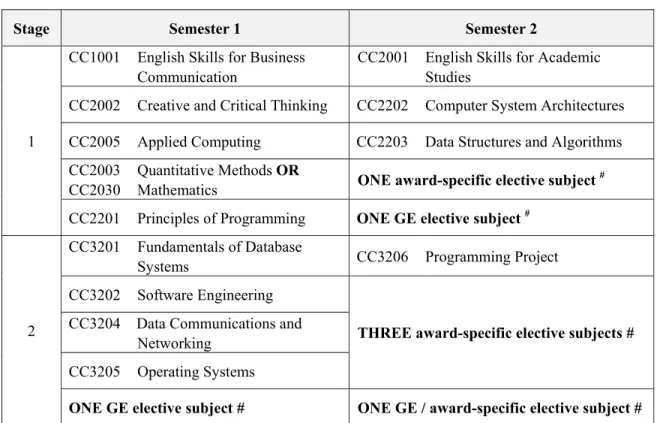
Table 3 - Study Pattern for Associate in Information Technology*
Stage Semester 1 Semester 2
CC1001 English Skills for Business Communication
CC2001 English Skills for Academic Studies
CC2002 Creative and Critical Thinking CC2202 Computer System Architectures CC2005 Applied Computing CC2203 Data Structures and Algorithms CC2003
CC2030
Quantitative Methods OR
Mathematics ONE award-specific elective subject # 1
CC2201 Principles of Programming ONE GE elective subject # CC3201 Fundamentals of Database
Systems CC3206 Programming Project
CC3202 Software Engineering CC3204 Data Communications and
Networking
CC3205 Operating Systems
THREE award-specific elective subjects # 2
ONE GE elective subject # ONE GE / award-specific elective subject # * HKCC reserves the right to change the study pattern.
# Students should ensure that the general education and / or award-specific elective subjects they have selected satisfy the level, general education / subject domain and award-specific requirements. It is students’ sole responsibility to ensure that they have completed all the requirements for graduation.
8.6.3. Associate in Statistics and Computing for Business
Apart from the general education subjects, all students under Associate in Statistics and Computing for Business programme are required to complete 9 award-specific compulsory and 3 or 4 award-specific elective subjects# for a total of 36 or 39 credits.
(I) Award-specific Compulsory Subjects (27 credits)
Students are required to complete the following 9 award-specific compulsory subjects. The 4 Level-2 subjects below are normally to be taken in Stage 1.
Level 2 Level 3
• CC2101 Financial Accounting • CC3201 Fundamentals of Database Systems
• CC2201 Principles of Programming • CC3401 Applied Business Computing Project
• CC2422 Linear Algebra • CC3403 Applied Statistical Methods • CC2425 Statistics for Business I • CC3430 Financial Mathematics
• CC3476 Statistics for Business II
(II) Award-specific Elective Subjects* (9 or 12 credits#)
Students are required to complete 3 or 4 subjects chosen freely from the pool of subjects below.
Level 3
y
CC3203 Information Systems Analysis and Designy
CC3208 Internet Programmingy
CC3210 Database Design and Implementationy
CC3409 Business Forecasting Methodsy
CC3423 Economic and Social Statisticsy
CC3456 Management Information Systemsy
CC3458 Operations Research for Businessy
CC3475 Statistical Data Analysisy
CC3477 Survey Design and Analysisy
CC3733 Further Calculus# Please refer to Section 8.5 General Education Requirements
* The offering of any of these subjects is conditional upon enrolment figures and the availability of resources. Some subjects may require completion of prerequisites before enrolment. For details on prerequisite requirements for individual subjects, please refer to Table 7.
14
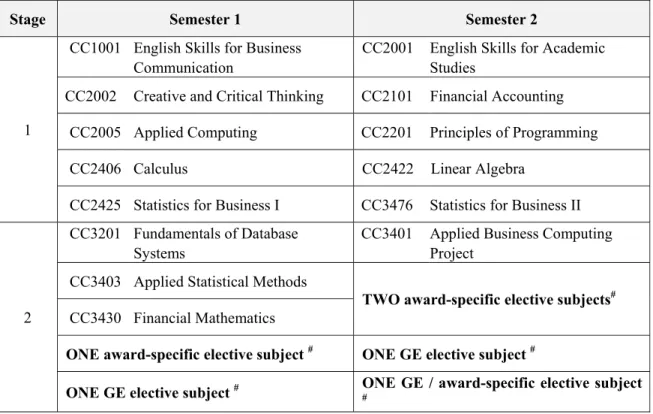
Table 4 - Study Pattern for Associate in Statistics and Computing for Business*
Stage Semester 1 Semester 2
CC1001 English Skills for Business Communication
CC2001 English Skills for Academic Studies
CC2002 Creative and Critical Thinking CC2101 Financial Accounting CC2005 Applied Computing CC2201 Principles of Programming CC2406 Calculus CC2422 Linear Algebra
1
CC2425 Statistics for Business I CC3476 Statistics for Business II CC3201 Fundamentals of Database
Systems
CC3401 Applied Business Computing Project
CC3403 Applied Statistical Methods CC3430 Financial Mathematics
TWO award-specific elective subjects# ONE award-specific elective subject # ONE GE elective subject # 2
ONE GE elective subject # ONE GE / award-specific elective subject #
* HKCC reserves the right to change the study pattern.
# Students should ensure that the general education and / or award-specific elective subjects they have selected satisfy the level, general education / subject domain and award-specific requirements. It is students’ sole responsibility to ensure that they have completed all the requirements for graduation.
8.6.4. Associate of Science
Apart from the 7 or 8 general education subjects, all students under Associate of Science
programme are required to complete 3 specific compulsory and 9 or 10 award-specific elective subjects# for a total of 36 or 39 credits.
(I) Award-specific Compulsory Subjects (9 credits)
Students are required to complete the following 3 award-specific compulsory subjects. The Level-2 subjects below are normally to be taken in Stage 1.
Level 2 Level 3
• CC2201 Principles of Programming • CC3310 Statistics and Probability • CC2203 Data Structures and Algorithms ^
OR
• CC2307 Engineering Science ^
OR
• CC2417 Human Biology I ^
(II) Award-specific Elective Subjects* (27 or 30 credits#)
Students are required to complete 9 or 10 subjects either chosen freely from the pool of subjects below OR concentrate in one of the listed area of concentration.
Level 2
• CC2007 Environmental Science • CC2101 Financial Accounting • CC2110 Food Service Operations
• CC2202 Computer System Architectures 1 • CC2203 Data Structures and Algorithms • CC2204 Discrete Mathematics
• CC2302 Engineering Mathematics • CC2305 Basic Electricity and Electronics • CC2307 Engineering Science
• CC2404 Applied Physics and Instrumentation in Health Care • CC2417 Human Biology I
• CC2418 Human Biology II • CC2439 General Chemistry Level 3
• CC3008 Food Hygiene and Nutritional Health • CC3135 Inventory and Warehousing Management
• CC3143 Business Logistics and Supply Chain Management • CC3201 Fundamentals of Database Systems
• CC3202 Software Engineering
• CC3203 Information Systems Analysis and Design • CC3204 Data Communications and Networking • CC3205 Operating Systems 2
• CC3206 Programming Project 3
• CC3207 Object Oriented Programming • CC3208 Internet Programming
• CC3209 Internetworking Protocols and Systems • CC3210 Database Design and Implementation • CC3301 Communication Systems Principles • CC3302 Computer Systems Principles 1 2
• CC3303 Design of Production and Service Systems • CC3304 Digital System Design
• CC3305 Engineering Management
• CC3306 Industrial Engineering Techniques and Methods • CC3307 Manufacturing Technology
• CC3308 Quality Engineering • CC3309 Society and the Engineer • CC3311 Engineering Materials • CC3312 Thermofluids
• CC3313 Linear Systems • CC3314 Engineering Project 3
16
• CC3316 Architectural Technology in the Built Environment • CC3401 Applied Business Computing Project 3
• CC3403 Applied Statistical Methods • CC3406 Basic Immunology
• CC3408 Biology of Ageing
• CC3409 Business Forecasting Methods • CC3423 Economic and Social Statistics • CC3430 Financial Mathematics
• CC3434 General Microbiology 4 • CC3450 Introduction to Microbiology 4 • CC3456 Management Information Systems • CC3458 Operations Research for Business • CC3475 Statistical Data Analysis
• CC3476 Statistics for Business II • CC3477 Survey Design and Analysis
• CC3487 Introduction to Pathophysiology and Pharmacology • CC3728 Analytical Chemistry
• CC3729 Computer Game Programming • CC3730 Dynamics and Control
• CC3731 Electrical Engineering
• CC3732 Engineering Graphics and Computing • CC3733 Further Calculus
• CC3734 General Biochemistry
• CC3735 Intermediate Environmental Science • CC3736 Multimedia and User Interface Design
Area of Concentration
Students who wish to concentrate in one of the following subject areas should complete at least 6 subjects (18 credits) in that area. The area of concentration will be added in parentheses in the transcript of study for students successfully complete 6 or more subjects from one single area of concentration.
Applied Physics
• CC2302 Engineering Mathematics
• CC2305 Basic Electricity and Electronics • CC2307 Engineering Science
• CC2404 Applied Physics and Instrumentation in Health Care • CC3311 Engineering Materials
• CC3312 Thermofluids • CC3315 Applied Mechanics
Applied Biological and Chemical Sciences
• CC2110 Food Service Operations • CC2417 Human Biology I • CC2418 Human Biology II • CC2439 General Chemistry
• CC3406 Basic Immunology • CC3408 Biology of Ageing • CC3434 General Microbiology 4 • CC3450 Introduction to Microbiology 4 • CC3728 Analytical Chemistry
• CC3734 General Biochemistry
Environmental Science
• CC2007 Environmental Science • CC2417 Human Biology I • CC2418 Human Biology II • CC2439 General Chemistry
• CC3316 Architectural Technology in the Built Environment • CC3408 Biology of Ageing
• CC3434 General Microbiology 4 • CC3450 Introduction to Microbiology 4
• CC3487 Introduction to Pathophysiology and Pharmacology • CC3735 Intermediate Environmental Science
Information and Management Science
• CC2203 Data Structures and Algorithms • CC2204 Discrete Mathematics
• CC3135 Inventory and Warehousing Management
• CC3143 Business Logistics and Supply Chain Management • CC3201 Fundamentals of Database Systems
• CC3202 Software Engineering
• CC3203 Information Systems Analysis and Design • CC3409 Business Forecasting Methods
• CC3458 Operations Research for Business • CC3475 Statistical Data Analysis
• CC3477 Survey Design and Analysis • CC3733 Further Calculus
# Please refer to Section 8.5 General Education Requirements
* The offering of any of these subjects is conditional upon enrolment figures and the availability of resources. Some subjects may require completion of prerequisites before enrolment. For details on prerequisite requirements for individual subjects, please refer to Table 7.
1
CC2202 and CC3302 are mutually exclusive. 2
CC3205 and CC3302 are mutually exclusive. 3
CC3206 and CC3401 are mutually exclusive. 4
18
Table 5 - Study Pattern for Associate of Science*
(I) Study Pattern A
Study Pattern A is more suitable for students who wish to concentrate in the area of Information and Management Science.
Stage Semester 1 Semester 2
CC1001 English Skills for Business Communication
CC2001 English Skills for Academic Studies
CC2002 Creative and Critical
Thinking CC2203 Data Structures and Algorithms CC2005 Applied Computing
CC2030 Mathematics
TWO award-specific elective subjects # 1
CC2201 Principles of Programming ONE GE elective subject # CC3310 Statistics and Probability
THREE award-specific elective subjects # FOUR award-specific elective subjects # 2
ONE GE elective subject # ONE GE / award-specific elective subject #
(II) Study Pattern B
Study Pattern B is more suitable for other areas of concentration.
Stage Semester 1 Semester 2
CC1001 English Skills for Business Communication
CC2001 English Skills for Academic Studies
CC2002 Creative and Critical
Thinking CC2201 Principles of Programming CC2005 Applied Computing
CC2030 Mathematics
TWO award-specific elective subjects # 1
CC2307 OR
CC2417
Engineering Science Human Biology I
(II) Study Pattern B (Continued)
Stage Semester 1 Semester 2
CC3310 Statistics and Probability
THREE award-specific elective subjects # FOUR award-specific elective subjects # 2
ONE GE elective subject # ONE GE / award-specific elective subject #
* HKCC reserves the right to change the study pattern.
# Students should ensure that the general education and / or award-specific elective subjects they have selected satisfy the level, general education / subject domain and award-specific requirements. It is students’ sole responsibility to ensure that they have completed all the requirements for graduation.
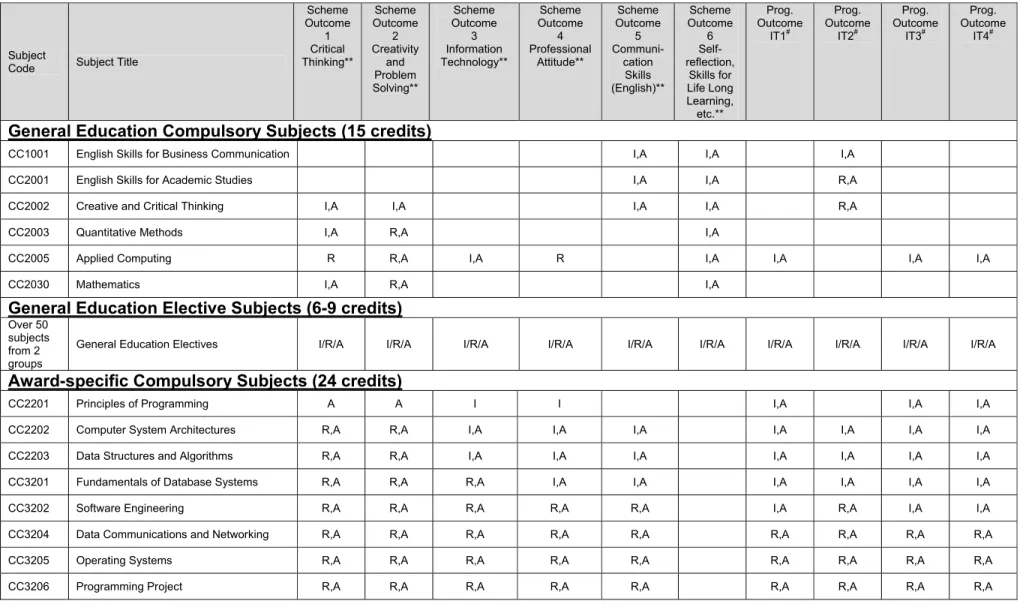
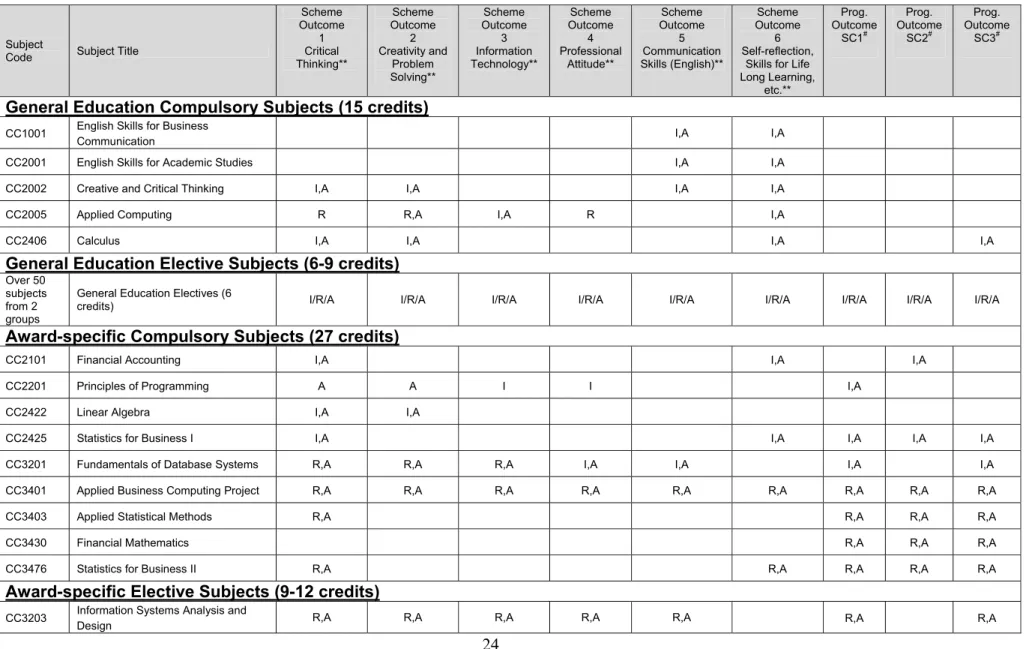
8.7 Programme Curriculum Maps
Each of programme curriculum maps in Table 6.1 - 6.4 presents a mapping of the subjects available to students of that programme in relation to the intended learning outcomes as presented in Section 3. Each programme curriculum map denotes how each of the Scheme and Programme-specific outcomes is introduced, reinforced and assessed. It is worth noting that the Scheme and Programme-specific outcomes are achieved not just through the content of the subjects, but also through the variety of learning and teaching activities through which the contents are delivered.
Furthermore, co-curricular student development activities organised by the Student Development Committee, the Student Union or other organisations also contribute to the Scheme and Programme-specific outcomes.
Key to Table 6.1 – 6.4:
I The learning leading to the particular outcome is introduced in that subject R The learning leading to the particular outcome is reinforced in that subject A The learning leading to the particular outcome is assessed in that subject
20
Table 6.1 – Programme Curriculum Map of Associate in Engineering
Subject
Code Subject Title
Scheme Outcome 1 Critical Thinking** Scheme Outcome 2 Creativity and Problem Solving** Scheme Outcome 3 Information Technology** Scheme Outcome 4 Professional Attitude** Scheme Outcome 5 Communi-cation Skills (English)** Scheme Outcome 6 Self-reflection, Skills for Life Long Learning, etc.** Prog. Outcome E1# Prog. Outcome E2# Prog. Outcome E3# Prog. Outcome E4# Prog. Outcome E5# Prog. Outcome E6# Prog. Outcome E7#
General Education Compulsory Subjects (15 credits)
CC1001 English Skills for Business Communication I,A I,A I,A I,A
CC2001 English Skills for Academic Studies I,A I,A I,A I,A
CC2002 Creative and Critical Thinking I,A I,A I,A I,A I,A I.A
CC2005 Applied Computing R R,A I,A R I,A I,A I I
CC2030 Mathematics I,A R,A I,A I,A I,R,A I
General Education Elective Subjects (6-9 credits) Over 50
subjects from 2 groups
General Education Electives
(6 or 9 credits) I/R/A I/R/A I/R/A I/R/A I/R/A I/R/A I/R/A I/R/A I/R/A I/R/A I/R/A I/R/A I/R/A Award-specific Compulsory Subjects (21 credits)
CC2201 Principles of Programming A A I I I,A I,A I I
CC2302 Engineering Mathematics I,R,A I,A I I I,R,A I,R I
CC2305 Basic Electricity and Electronics I I I I I,R,A I,R I I
CC2307 Engineering Science I I I I,R I I I
CC3305 Engineering Management I,A I,R I,R,A R R I,R I I I,R,A I,R,A R,A
CC3309 Society and the Engineer R I,R,A R I,R I,R I,R,A I,R,A R,A
CC3732 Engineering Graphics and Computing I I,R,A I I I I I,R,A I
Award-specific Elective Subjects (15-18 credits)
CC2203 Data Structures and Algorithms R,A R,A I,A I,A I,A I I,R I I
** For the full outcome statements of the AD Scheme, please refer to Section 3.
# For the full outcome statements of the Associate in Engineering programme, please refer to Section 3. Subject
Code Subject Title
Scheme Outcome 1 Critical Thinking** Scheme Outcome 2 Creativity and Problem Solving** Scheme Outcome 3 Information Technology** Scheme Outcome 4 Professional Attitude** Scheme Outcome 5 Communi-cation Skills (English)** Scheme Outcome 6 Self-reflection, Skills for Life Long Learning, etc.** Prog. Outcome E1# Prog. Outcome E2# Prog. Outcome E3# Prog. Outcome E4# Prog. Outcome E5# Prog. Outcome E6# Prog. Outcome E7#
Award-specific Elective Subjects (cont’d)
CC3203 Information Systems Analysis and Design R,A R,A R,A R,A R,A I I I,R I,A I CC3204 Data Communications and Networking R,A R,A R,A R,A R,A R,A R,A R R,A
CC3301 Communication Systems Principles I I,R I,R I,R I,R I,R,A I,A I
CC3302 Computer Systems Principles I I,R,A I,R R,A I,R I,R,A I,R,A I
CC3303 Design of Production and Service Systems R I,R I,R I,R I,R,A I,R,A I,R
CC3304 Digital System Design I I,R I,R I,R R,A I,R I,R,A I,R
CC3306 Industrial Engineering Techniques and Methods R I I,R I,R I,R,A I,R I,R,A
CC3307 Manufacturing Technology I,R I I,R I,R I,R I,R I,R,A I
CC3308 Quality Engineering I,R I,R I,R I,R R,A I,R I I
CC3310 Statistics and Probability R I,R I,R I,R,A I,R,A
CC3311 Engineering Materials R I I,R I,R I,R,A I,R I I
CC3312 Thermofluids I,R I,R I,R,A I,R I I
CC3313 Linear Systems I,R I,R I,R I,R I,R,A I
CC3314 Engineering Project R,A R,A I,R,A R R I,R I,R R R,A R,A R
CC3315 Applied Mechanics I I,R I,R I,R,A I,R I
CC3316 Architectural Technology in the Built Environment I I I,R I,R I I I,R
CC3730 Dynamics and Control R I,R I,R I,R I,R,A I,R
22
Table 6.2 - Programme Curriculum Map of Associate in Information Technology
Subject
Code Subject Title
Scheme Outcome 1 Critical Thinking** Scheme Outcome 2 Creativity and Problem Solving** Scheme Outcome 3 Information Technology** Scheme Outcome 4 Professional Attitude** Scheme Outcome 5 Communi-cation Skills (English)** Scheme Outcome 6 Self-reflection, Skills for Life Long Learning, etc.** Prog. Outcome IT1# Prog. Outcome IT2# Prog. Outcome IT3# Prog. Outcome IT4#
General Education Compulsory Subjects (15 credits)
CC1001 English Skills for Business Communication I,A I,A I,A
CC2001 English Skills for Academic Studies I,A I,A R,A
CC2002 Creative and Critical Thinking I,A I,A I,A I,A R,A
CC2003 Quantitative Methods I,A R,A I,A
CC2005 Applied Computing R R,A I,A R I,A I,A I,A I,A
CC2030 Mathematics I,A R,A I,A
General Education Elective Subjects (6-9 credits) Over 50
subjects from 2 groups
General Education Electives I/R/A I/R/A I/R/A I/R/A I/R/A I/R/A I/R/A I/R/A I/R/A I/R/A Award-specific Compulsory Subjects (24 credits)
CC2201 Principles of Programming A A I I I,A I,A I,A
CC2202 Computer System Architectures R,A R,A I,A I,A I,A I,A I,A I,A I,A
CC2203 Data Structures and Algorithms R,A R,A I,A I,A I,A I,A I,A I,A I,A
CC3201 Fundamentals of Database Systems R,A R,A R,A I,A I,A I,A I,A I,A I,A
CC3202 Software Engineering R,A R,A R,A R,A R,A I,A R,A I,A I,A
CC3204 Data Communications and Networking R,A R,A R,A R,A R,A R,A R,A R,A R,A
CC3205 Operating Systems R,A R,A R,A R,A R,A R,A R,A R,A R,A
Subject
Code Subject Title
Scheme Outcome 1 Critical Thinking** Scheme Outcome 2 Creativity and Problem Solving** Scheme Outcome 3 Information Technology** Scheme Outcome 4 Professional Attitude** Scheme Outcome 5 Communi-cation Skills (English)** Scheme Outcome 6 Self-reflection, Skills for Life Long Learning, etc.** Prog. Outcome IT1# Prog. Outcome IT2# Prog. Outcome IT3# Prog. Outcome IT4#
Award-specific Elective Subjects (12-15 credits)
CC2204 Discrete Mathematics R,A R,A I,A I,A I,A I,A
CC2305 Basic Electricity and Electronics I I I R,A R
CC3203 Information Systems Analysis and Design R,A R,A R,A R,A R,A R,A R,A R,A R,A
CC3207 Object Oriented Programming R,A R,A R,A R,A R,A R,A R,A R,A R,A
CC3208 Internet Programming R,A R,A R,A R,A R,A R,A R,A R,A
CC3209 Internetworking Protocols and Systems R,A R,A R,A R,A R,A
CC3210 Database Design and Implementation R,A R,A R,A R,A R,A R,A R,A
CC3304 Digital System Design I I,R I,R R,A R,A R I
CC3729 Computer Game Programming R,A R,A R,A R,A R,A I R,A R,A R,A R,A
CC3736 Multimedia and User Interface Design R,A R,A R,A R,A R,A R,A R,A R,A R,A
** For the full outcome statements of the AD Scheme, please refer to Section 3.
24
Table 6.3 - Programme Curriculum Map of Associate in Statistics and Computing for Business
Subject
Code Subject Title
Scheme Outcome 1 Critical Thinking** Scheme Outcome 2 Creativity and Problem Solving** Scheme Outcome 3 Information Technology** Scheme Outcome 4 Professional Attitude** Scheme Outcome 5 Communication Skills (English)** Scheme Outcome 6 Self-reflection,
Skills for Life Long Learning, etc.** Prog. Outcome SC1# Prog. Outcome SC2# Prog. Outcome SC3#
General Education Compulsory Subjects (15 credits) CC1001 English Skills for Business
Communication I,A I,A
CC2001 English Skills for Academic Studies I,A I,A
CC2002 Creative and Critical Thinking I,A I,A I,A I,A
CC2005 Applied Computing R R,A I,A R I,A
CC2406 Calculus I,A I,A I,A I,A
General Education Elective Subjects (6-9 credits) Over 50
subjects from 2 groups
General Education Electives (6
credits) I/R/A I/R/A I/R/A I/R/A I/R/A I/R/A I/R/A I/R/A I/R/A
Award-specific Compulsory Subjects (27 credits)
CC2101 Financial Accounting I,A I,A I,A
CC2201 Principles of Programming A A I I I,A
CC2422 Linear Algebra I,A I,A
CC2425 Statistics for Business I I,A I,A I,A I,A I,A
CC3201 Fundamentals of Database Systems R,A R,A R,A I,A I,A I,A I,A
CC3401 Applied Business Computing Project R,A R,A R,A R,A R,A R,A R,A R,A R,A
CC3403 Applied Statistical Methods R,A R,A R,A R,A
CC3430 Financial Mathematics R,A R,A R,A
CC3476 Statistics for Business II R,A R,A R,A R,A R,A
Award-specific Elective Subjects (9-12 credits) CC3203 Information Systems Analysis and
Subject
Code Subject Title
Scheme Outcome 1 Critical Thinking** Scheme Outcome 2 Creativity and Problem Solving** Scheme Outcome 3 Information Technology** Scheme Outcome 4 Professional Attitude** Scheme Outcome 5 Communication Skills (English)** Scheme Outcome 6 Self-reflection,
Skills for Life Long Learning, etc.** Prog. Outcome SC1# Prog. Outcome SC2# Prog. Outcome SC3#
Award-specific Elective Subjects (cont’d)
CC3208 Internet Programming R,A R,A R,A R,A R,A R,A R,A
CC3210 Database Design and Implementation R,A R,A R,A R,A R,A R,A
CC3409 Business Forecasting Methods R,A R,A R,A R,A
CC3423 Economic and Social Statistics R,A R,A R,A R,A
CC3456 Management Information Systems R,A R,A R,A R,A
CC3458 Operations Research for Business R,A R,A R,A
CC3475 Statistical Data Analysis R,A R,A R,A R,A R,A
CC3477 Survey Design and Analysis R,A R,A R,A R,A R,A
CC3733 Further Calculus I R,A R,A I,R R,A
** For the full outcome statements of the AD Scheme, please refer to Section 3.
26
Table 6.4 - Programme Curriculum Map of Associate of Science
Subject Subject Title
Scheme Outcome 1 Critical Thinking** Scheme Outcome 2 Creativity and Problem Solving** Scheme Outcome 3 Information Technology** Scheme Outcome 4 Professional Attitude** Scheme Outcome 5 Communication Skills (English)** Scheme Outcome 6 Self-reflection,
Skills for Life Long Learning, etc.** Prog. Outcome AS1# Prog. Outcome AS2# Prog. Outcome AS3#
General Education Compulsory Subjects (15 credits)
CC1001 English Skills for Business Communication I,A I,A I
CC2001 English Skills for Academic Studies I,A I,A I
CC2002 Creative and Critical Thinking I,A I,A I,A I,A I
CC2005 Applied Computing R R,A I,A R I,A I,A I,R R
CC2030 Mathematics I,A R,A I,A I I,R
General Education Elective Subjects (6-9 credits) Over 50
subjects from 2 groups
General Education Electives (6 or 9 credits) I/R/A I/R/A I/R/A I/R/A I/R/A I/R/A I/R/A I/R/A I/R/A Award-specific Compulsory Subjects (9 credits)
CC2201 Principles of Programming A A I I I,A I,A R
CC3310 Statistics and Probability R I,R I,R I,R,A
One of the following three subjects:
CC2203 Data Structures and Algorithms R,A R,A I,A I,A I,A I,R I,R,A I,R,A
CC2307 Engineering Science I I I,A I
CC2417 Human Biology I I,R I,R,A I,R I,R I,R,A I,R
Award-specific Elective Subjects (27-30 credits)
CC2007 Environmental Science I,R R,A R,A R R,A I,R I,R I,R,A I,R
CC2101 Financial Accounting I,A I,A I,A I
CC2110 Food Service Operations I,A I,A
Subject Subject Title Scheme Outcome 1 Critical Thinking** Scheme Outcome 2 Creativity and Problem Solving** Scheme Outcome 3 Information Technology** Scheme Outcome 4 Professional Attitude** Scheme Outcome 5 Communication Skills (English)** Scheme Outcome 6 Self-reflection,
Skills for Life Long Learning, etc.** Prog. Outcome AS1# Prog. Outcome AS2# Prog. Outcome AS3#
Award-specific Elective Subjects (cont’d)
CC2203 Data Structures and Algorithms R,A R,A I,A I,A I,A I,R I,R,A I,R,A
CC2204 Discrete Mathematics R,A R,A I,A I,A I I,A I,A
CC2302 Engineering Mathematics I,R,A I,A I I,R I,R,A I,R
CC2305 Basic Electricity and Electronics I I I I I,A
CC2307 Engineering Science I I I,A I
CC2404 Applied Physics and Instrumentation in Health Care I,R I,R,A I,R I,R I,R,A I,R,A I,R,A
CC2417 Human Biology I I,R I,R,A I,R I,R I,R,A I,R
CC2418 Human Biology II I,R I,R,A I,R I,R I,R,A I,R
CC2439 General Chemistry I,R I,R,A R I,R I,R I,R I,R,A I,R
CC3008 Food Hygiene and Nutritional Health I,R I,R,A R I,R R,A I,R I,R,A I,R,A R
CC3135 Inventory and Warehousing Management I I,R I,R I,R I,R I I,R I,R,A I,R
CC3143 Business Logistics and Supply Chain Management I,R I,R I,R,A I,R I,R I I,R I,R,A I,R
CC3201 Fundamentals of Database Systems R,A R,A R,A I,A I,A I,A I,A I,A
CC3202 Software Engineering R,A R,A R,A R,A R,A I,A I,A I
CC3203 Information Systems Analysis and Design R,A R,A R,A R,A R,A I,A I,R,A R
CC3204 Data Communications and Networking R,A R,A R,A R,A R,A R,A R,A R
CC3205 Operating Systems R,A R,A R,A R,A R,A R,A R,A R
CC3206 Programming Project R,A R,A R,A R,A R,A R,A R,A R
CC3207 Object Oriented Programming R,A R,A R,A R,A R,A R,A R,A R
CC3208 Internet Programming R,A R,A R,A R,A R,A R,A R,A R
28
Subject Subject Title
Scheme Outcome 1 Critical Thinking** Scheme Outcome 2 Creativity and Problem Solving** Scheme Outcome 3 Information Technology** Scheme Outcome 4 Professional Attitude** Scheme Outcome 5 Communication Skills (English)** Scheme Outcome 6 Self-reflection,
Skills for Life Long Learning, etc.** Prog. Outcome AS1# Prog. Outcome AS2# Prog. Outcome AS3#
Award-specific Elective Subjects (cont’d)
CC3210 Database Design and Implementation R,A R,A R,A R,A R,A R,A R
CC3301 Communication Systems Principles I I,R I,R I,R,A I,R,A R
CC3302 Computer Systems Principles I I,R,A I,R I,R,A I,R,A R
CC3303 Design of Production and Service Systems R I,R I,R I,A I,R,A I
CC3304 Digital System Design I I,R I,R R,A R,A R
CC3305 Engineering Management I,A I,R I,R,A R R I,R I I
CC3306 Industrial Engineering Techniques and Methods R I I,R I,A I,R,A I,A
CC3307 Manufacturing Technology I,R I I,R I,R,A I,R,A I,A
CC3308 Quality Engineering I,R I,R I,R I,R,A I,R,A R,A
CC3309 Society and the Engineer R I,R,A R I,R R,A R
CC3311 Engineering Materials R I I,R I,R I,R,A I,R
CC3312 Thermofluids I,R I,R I,R,A I,R
CC3313 Linear Systems I,R I,R R R,A R
CC3314 Engineering Project R,A R,A I,R,A R R I,R R,A R,A R
CC3315 Applied Mechanics I I,R I R,A R
CC3316 Architectural Technology in the Built Environment I I I,R I I
CC3401 Applied Business Computing Project R,A R,A R,A R,A R,A R,A R,A R,A R
CC3403 Applied Statistical Methods R,A R,A R,A R
CC3406 Basic Immunology I,R I,R,A R R I,R I,R I,R,A R
Subject Subject Title Scheme Outcome 1 Critical Thinking** Scheme Outcome 2 Creativity and Problem Solving** Scheme Outcome 3 Information Technology** Scheme Outcome 4 Professional Attitude** Scheme Outcome 5 Communication Skills (English)** Scheme Outcome 6 Self-reflection,
Skills for Life Long Learning, etc.** Prog. Outcome AS1# Prog. Outcome AS2# Prog. Outcome AS3#
Award-specific Elective Subjects (cont’d)
CC3409 Business Forecasting Methods R,A R,A R,A R
CC3423 Economic and Social Statistics R,A R,A R,A R
CC3430 Financial Mathematics R,A R,A R
CC3434 General Microbiology I,R I,R,A R I,R,A I,R I,R I,R,A I,R
CC3450 Introduction to Microbiology I,R I,R,A R I,R,A I,R I,R I,R,A I,R
CC3456 Management Information Systems R,A R,A R,A R,A
CC3458 Operations Research for Business R,A R,A R,A
CC3475 Statistical Data Analysis R,A R,A I,R,A I,R,A
CC3476 Statistics for Business II R,A R,A R,A R,A
CC3477 Survey Design and Analysis R,A R,A I,R,A I,R,A
CC3487 Introduction to Pathophysiology and
Pharmacology I,R,A I,R I,R,A I,R,A I,R I,R,A I,R,A I,R
CC3728 Analytical Chemistry I,R I,R,A R I,R I,R I,R I,R,A I,R
CC3729 Computer Game Programming R,A R,A R,A R,A R,A I R R,A R
CC3730 Dynamics and Control R I,R R R,A R
CC3731 Electrical Engineering R R I,R R R,A R
CC3732 Engineering Graphics and Computing I I,R,A I I I I,R,A I
CC3733 Further Calculus I R,A R,A R,A I,R,A I,R
CC3734 General Biochemistry I,R I,R,A I,R I,R I,R,A R
CC3735 Intermediate Environmental Science I,R I,R,A R I,R I,R I,R I,R,A I,R
CC3736 Multimedia and User Interface Design R,A R,A R,A R,A R,A R,A R,A R
30
9. Medium of Instruction
The medium of instruction is English, unless otherwise specified in the subject syllabuses.
10. Teaching and Learning Methods
The teaching and learning philosophy underlying the Scheme is based on a holistic, diversified, and flexible approach – one which enables students to achieve the intended learning outcomes. Different teaching and learning methods are used. Some are more effective in building up students’ subject knowledge while others contribute more to developing students’ generic skills and professional competence.
Teaching and learning methods may vary from subject to subject and may include interactive lectures, tutorials, case-based learning, problem-based learning, simulation, role plays, group work, practicum, experiential learning, fieldwork, guest talks, company visits, study tours, etc. The diversity of teaching and learning methods addresses the need to use the most appropriate ways to achieve the intended learning outcomes of each subject. Teaching is conducted through lectures as well as tutorials and/or seminars. To maximise students’ learning, subject lecturers not only play the role of introducing new concepts and imparting knowledge, but they also act as facilitators to encourage students to share their ideas and experience through class discussions, case studies, oral presentations, and group activities. Laboratory sessions and/or practicum will be included for practical subjects to provide hands-on practice. For award-specific subjects, more emphasis will be given to the competence-based and practical orientation of the curriculum.
11. Assessment and Examinations 11.1 Principles of Assessment
Assessments used in the Associate Degree Scheme in Science and Technology can be developmental, summative or both. For summative assessment, the prime purpose is to enable students to demonstrate that they have met the aims and intended learning outcomes of the award and, in particular, that they have fulfilled the requirements of each subject and have achieved the standard commensurate with the award at the end of their studies. Methods of assessment will be selected on the basis of their suitability to assess the extent to which students have achieved the intended learning outcomes.
Assessment will also provide constant feedback to students, thus serving a developmental function as well. Students will be informed of their performance in the assessment so that they are aware of the extent to which they have attained the intended learning outcomes, and of the areas that they need improvements.
11.2 Role of Subject Assessment Review Panel
The Subject Assessment Review Panel (SARP) is responsible for monitoring the academic standard and quality of subjects and ratifying subject results. SARP reviews the distribution of grades within a subject and finalises the grades at the end of each semester / term before submitting them to the Board of Examiners (BoE). The BoE will not attempt to change the grades. SARP is also responsible for granting late assessments to students and deciding the form of late assessments.
The SARP is to be chaired by the Director of HKCC or delegate. Members of the SARP include the relevant subject examiners, and where appropriate, the Scheme Leader, Assistant Scheme Leader(s), Programme Leader(s), Assistant Programme Leader(s), Deputy Programme Leader, and other co-opted members.
11.3 Role of Board of Examiners
The Board of Examiners (BoE) meets at the end of each semester to review students’ progress and is responsible to the Academic Board of College of Professional and Continuing Education for making decisions on:
1. the classification of awards to be granted to each student on completion of the programme;
2. de-registration cases; and
3. cases with extenuating circumstances.
The BoE is chaired by the Director HKCC or delegate. Members of the BoE include the Scheme Leader, the Deputy Scheme Leader, Programme Leader(s), Assistant / Deputy Programme Leaderes (where appropriate) and other co-opted members.
11.4 Assessment Methods
Students’ performance in a subject shall be assessed by coursework and/or examinations, as deemed appropriate. Where both methods are used, the weighting of each in the overall subject grade has been clearly stated in this definitive scheme document. To pass a subject, students must obtain a pass grade in both coursework AND examination, if any. Satisfying (or otherwise) the attendance requirement as stipulated in Section 7 will also affect the pass and failure of a student in a subject.
All assessment methods will be designed on the basis that they can assess the extent to which students have attained the intended learning outcomes. The methods may include objective questions, open-ended essays, group projects, field study, laboratory work, presentations, reflective journals, learning portfolios, case study, and various forms of classroom participation.
At the beginning of each semester, the subject lecturer will inform students of the details of the assessment methods to be used within the assessment framework as specified in the definitive scheme document.