INTRODUCTION
In April 2016, the OpenStack Foundation released a very enlightening User Survey which focused on networking features in OpenStack. The following key metrics (as percentage of respondents) from the survey came to the forefront:
■
■ Usage: Full operational use, in production – 65%; On-premise, private cloud deployment –
65%; Neutron Networking – 90%
■
■ Important emerging technologies: SDN/NFV - 52%; Containers - 70%; Bare Metal - 50%
■
■ Workloads and frameworks: Private and public cloud products and services - 49%;
NFV – 29%
■
■ Preferred hypervisor: KVM – 93%; VMware – 8%
■
■ Neutron drivers in Use: OVS - 80%; ML2 - 31%; Linux Bridge - 21%; Contrail - 14%;
SR-IOV – 2%
■
■ Neutron features actively used/interested in: Distributed across many features. Those
that got 20% or higher: software load balancing, routing, VPN, accelerated vSwitch, QoS, software firewalling
What is striking is the pervasive use of Open vSwitch (OVS), and among Neutron features, the strong interest in software-based networking on the server, or server-based networking. Emerging technologies such as SDN/NFV and use of containers in bare metal server environ-ments further justify the need for server-based networking. This trend, starkly visible from the survey report, is naturally in line with how the largest data centers in the world (such as Microsoft Azure) have opted for server-based networking as the most flexible and scalable form of networking.
With increasing bandwidth requirements and adoption of 10GbE and higher speed technol-ogies, it is well understood today that accomplishing server-based networking tasks using general purpose CPUs is highly inefficient. Microsoft has indicated use of SmartNICs to scale their server-based networking infrastructure more efficiently. SmartNICs are used to offload and accelerate the server-based networking datapath. Ericsson and Netronome have demon-strated up to 6X lower TCO utilizing Netronome Agilio hardware-accelerated server-based networking incorporated in the OpenStack-based Ericsson’s Cloud SDN platform.
To achieve such benefits, enhancements to the OpenStack networking plug-in architecture are needed. Let’s start by exploring what is feasible today.
OpenStack Networking: Where to Next?
WHAT IS STRIKING ISTHE PERVASIVE USE OF OPEN VSWITCH (OVS), AND AMONG NEUTRON FEATURES, THE STRONG INTEREST IN SOFTWARE-BASED NETWORKING ON THE SERVER, OR SERVER-BASED NETWORKING.
page 2 of 5
Netronome Systems, Inc.
CURRENT STATE OF ACCELERATED OPENSTACK NETWORKING
At the OpenStack Summit 2015 in Vancouver, Mirantis presented the state of hardware-acceler-ated networking. The below discussion is based on excerpts from that comprehensive presen-tation.
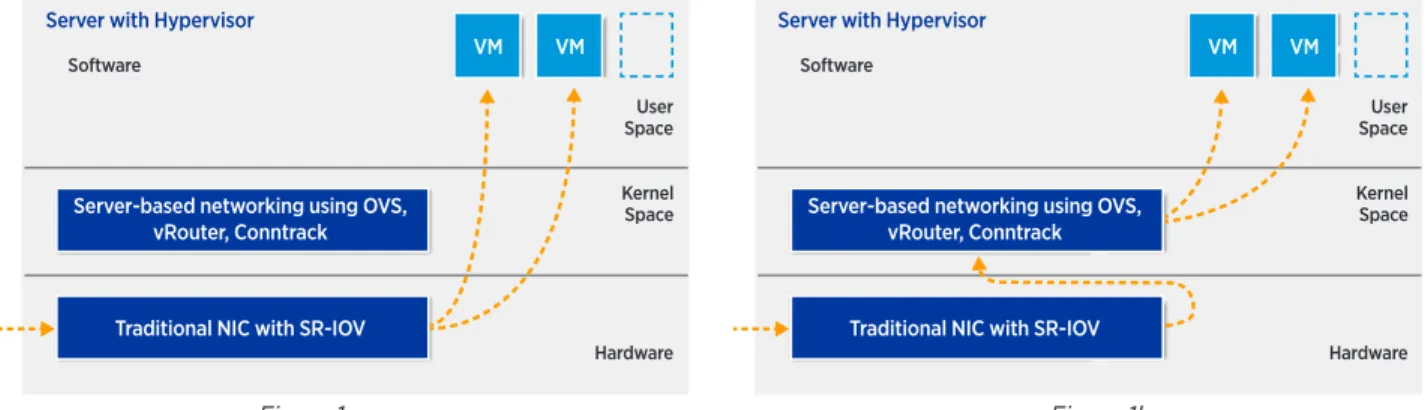
Today, SR-IOV plug-ins used with SR-IOV-capable server NICs are the only feasible form of networking hardware acceleration. When this is implemented in OpenStack Neutron using traditional NICs, bandwidth delivered to VMs is improved significantly, latency for VM to VM traffic is reduced, and CPU use for networking tasks is greatly reduced. However, the number of server-based networking features available at such high performance is severely limited. Figures 1a and 1b show the packet datapath from a network port on the server to a VM. With the datapath shown in Figure 1a, high bandwidth and low latency benefits are available for a very limited set of features as shown in Table 1, making the solution feasible for a very limited set of applications. When more features are needed, one needs to fall back to the datapath shown in Figure 1b, resulting in poor performance and high CPU usage. Note that SR-IOV adoption based on the recent survey is only 2% and this could be a reason.
Hardware User Space Software
Server with Hypervisor
Software
Server with Hypervisor
Kernel Space Server-based networking using OVS,
vRouter, Conntrack
Traditional NIC with SR-IOV
VM VM
Hardware User Space Kernel Space Server-based networking using OVS,
vRouter, Conntrack
Traditional NIC with SR-IOV
VM VM
Figure 1a Figure 1b
OpenStack Networking Plug-In Features SR-IOV with Traditional NICs
VM Performance High
Latency Low
CPU Core Saving High
Net Virtualization & Other VLAN only
Anti-Spoofing Yes
Load Balancing No
ACL Security (stateless) No
Firewall Security No
VM Migration No
Per Flow Analytics No
Favorable Unfavorable Acceptable
Table 1
Some of the above challenges can be addressed using DPDK where the server-based net-working datapath (as in OVS or Contrail vRouter) is maintained in software, but is moved to the user space to reduce user space to kernel space context switching overheads. This
approach is shown in Figure 2 below. This approach delivers additional server-based network-ing features (compared to SR-IOV) and improved performance (compared to a kernel-based networking datapath). This however comes at the cost of high latency and high CPU usage, and with use of larger number of flows in the networking datapath (as needed in security, load balancing and analytics applications) performance can be severely affected. As such, the DPDK approach has not found widespread adoption either.
Software
Server with Hypervisor
Hardware User Space
Kernel Space
Server-based networking using OVS, vRouter, Conntrack
Traditional NIC with SR-IOV
VM VM
FIGURE 2
OpenStack Networking Plug-in Features DPDK with other Vendor NICs
VM Performance Med
Latency High
CPU Core Saving Low
Net Virtualization & Other VLAN, VxLAN, GRE
Anti-Spoofing Yes
Load Balancing Yes
ACL Security (Stateless) Yes
Firewall Security No
VM Migration Yes
Per Flow Analytics No
Favorable Unfavorable Acceptable
This is the current state of accelerated OpenStack networking as was aptly summarized by the presentation at the OpenStack Summit 2016 in Vancouver. The April 2016 Survey sheds new light on what is needed from OpenStack networking. This leads us to the next question.
page 4 of 5
Netronome Systems, Inc.
WHERE DO WE GO FROM HERE?
At the OpenStack Summit 2016 in Austin, Netronome demonstrated how OpenStack net-working can be extended to deliver hardware-accelerated server-based netnet-working. Ne-tronome’s Agilio server networking platform will be utilized with OpenStack, OVS, Contrail vRouter and Linux Conntrack technologies to showcase an extended set of features made possible at high performance (high bandwidth and low latency) and efficiency (low server CPU usage, freeing them up for more VMs). This is enabled by offloading the OVS, Contrail vRouter or Linux Conntrack datapaths into the Agilio intelligent server adapter (SmartNIC) as shown in Figure 3. This approach, highlighted in Table 3, shows features needed in a broad array of workloads and deployment frameworks can be enabled at high performance and efficiency. This includes infrastructure as a service (IaaS), telco cloud SDN and NFV, as well as traditional IT and private/hybrid cloud workloads.
Figure
Software
Server with Hypervisor
Hardware User Space Kernel Space Server-based networking using OVS,
vRouter, Conntrack
Traditional NIC with SR-IOV
VM VM
3
OpenStack Networking Plug-In Features
SR-IOV With Other Vendor NICs*
DPDK With Other Vendor NICs*
Enhancements Based On Netronome Agilio Platform
VM Performance Med Med High
Latency High High Low
CPU Core Saving Low Low High
Net Virtualization & Other VLAN only VLAN, VxLAN, GRE VLAN, VxLAN, GRE, MPLS, NSH
Anti-Spoofing Yes Yes Yes
Load Balancing Yes Yes Yes
ACL Security (Stateless) Yes Yes Yes
Firewall Security No No Yes
VM Migration Yes Yes Yes
Per Flow Analytics No No Yes
Markets NFV POP Clusters On-premise NFV POP, IaaS & Enterprise DC, NFV
Favorable Unfavorable Acceptable
NETRONOME’S AGILIO SERVER NETWORKING PLATFORM WILL BE UTILIZED WITH OPENSTACK, OVS, CONTRAIL VROUTER AND LINUX CONNTRACK TECHNOLOGIES
TO SHOWCASE AN EXTENDED SET OF FEATURES MADE POSSIBLE AT HIGH PERFORMANCE AND EFFICIENCY.
Netronome Systems, Inc.
2903 Bunker Hill Lane, Suite 150 Santa Clara, CA 95054 Tel: 408.496.0022 | Fax: 408.586.0002
www.netronome.com
©2016 Netronome. All rights reserved. Netronome is a registered trademark and the Netronome Logo is a trademark of Netronome. All other trademarks are the property of their respective owners.
This model of delivering server-based networking using SmartNIC hardware such as Netro-nome’s Agilio platform is also ideally suited for bare metal server-based container deploy-ments of the future. Features such as networking virtualization, service chaining, load bal-ancing, security and analytics can be implemented and provisioned from outside the domain of the operating system running on the server. In this case, control plane orchestration using an SDN Controller or OpenStack is implemented directly with the SmartNIC. This concept is shown in Figure 4 below.
Hardware User Space
Kernel Space
SmartNIC with OVS, vRouter or Conntrack data path offload
Container Container
Software Bare Metal Server
Figure 4
CONCLUSION
For all of this to be a reality, the OpenStack networking plug-in specification will have to be enhanced beyond the SR-IOV-based capabilities that exist today. Netronome is taking a lead-ership role in the development of these enhancements with industry leaders such as Mirantis, Ericsson, Juniper Networks and others. A draft open specification covering these enhance-ments is expected in Q3 of 2016 and this will be contributed to the OpenStack community for further feedback and eventual acceptance for industry-wide adoption.