Agenda Item 7.02.A.4
New Program Proposal
Master of Science in Mechanical Engineering The Citadel
Summary
The Citadel requests approval to offer a program leading to the Master of Science in Mechanical Engineering to be implemented in August 2016. The proposed program is to be offered through traditional instruction. The following chart outlines the stages of approval for the proposal. The Committee on Academic Affairs and Licensing (CAAL) voted to recommend approval of the proposal. The full program proposal is attached.
Stages of Consideration Date Comments Program Proposal Received 8/1/15 Not Applicable Comments and suggestions
from CHE staff sent to the institution
8/21/15 Staff requested the proposal be revised to:
• Identify the companies requesting the program
• Identify the 2+2 program referenced in the Background section.
• Revise the Curriculum by Category chart to show the core requirements, electives, and other requirements in addition to the focus area requirements.
• Revise the language in the proposal to make it clear that the focus area is a collection of electives, but not an official concentration, option or track.
• Explain that if the student is interested in earning a graduate certificate in one of the focus areas, the student will need to
complete additional coursework to meet all of the requirements of the certificate program.
• Provide a brief explanation and timeline for developing and implementing these new courses.
• Provide the total FTE needed to support the program.
• Provide an estimated hire date for the new faculty member.
• Clarify the amount of funds spent on library resources for engineering.
• Explain The Citadel’s relationship with the Clemson Restoration Institute.
Agenda Item 7.02.A.4
Stages of Consideration Date Comments
• Describe the Taskstream software and provide more detail as programmatic assessment.
• Identify the specific courses in which the particular Student Learning Outcome will be assessed.
ACAP Consideration 9/10/15 ACAP members discussed the need for the proposed program. Representatives from Academic Affairs, Clemson, Coastal Carolina University, USC Aiken, and Winthrop, requested the following explanations:
• Source of faculty personnel (full-time or part-time via recruitment, re-assignment, or otherwise) needed to teach the new courseload
• Total number of new courses and projected budget for new course implementation
• Details about collaboration with Clemson
• Capability to provide student support
• A description of the proposed program certificates
Revised Program Proposal Received
9/16/15 The revised proposal and appendix satisfactorily addressed the requested revisions.
CAAL Consideration 10/16/2015 The Committee agreed to consider all three Master of Engineering proposals (Civil, Electrical, and Mechanical) as a group. Commissioners asked why The Citadel chose not to submit one degree program with three concentrations.
The representative from The Citadel explained that the three specific degrees were developed to meet employers’ expectations.
Commissioners then asked about the following topics:
• How the proposed programs will affect Clemson and USC
• Course transferability
• The revenue model
• Enrollment projections, including the substantial projected increase in year 4
• The number of new courses required
• The financial loss in the third year. Representatives from The Citadel provided the following responses:
• The proposed programs are not expected to affect the enrollments at Clemson or USC and that The Citadel has an MOU with Clemson to share up to 50% of the courses.
Agenda Item 7.02.A.4
Stages of Consideration Date Comments
• Regarding transferability, the courses will transfer to each institution.
• Regarding the revenue model, tuition will go to the institution that teaches the course.
• Enrollment projections are estimates based on conversations with local companies (the representative provided a brief explanation of how the projections were made.)
• Additionally, most of the students will be employed full-time and enrolled part-time because the programs are designed to enable employees in the Lowcountry to improve their skill set.
• Regarding the year 4 enrollment projection increase, representatives stated that students are in the pipeline already because of the certificate programs offered by The Citadel, and furthermore, emphasized that the enrollment will be limited by the number of courses offered, not student demand.
• The Citadel has the capacity for the number of new courses with a plan for new courses to be developed and implemented gradually.
• The Citadel’s representative stated that if each program grows within the first two years as estimated, there will be a need to hire an additional faculty member in year three which would explain the loss. However, she noted that each program will be profitable over the course of the first five years.
Two Committee members mentioned that they submitted questions to the institution which were answered satisfactorily prior to the meeting. The questions addressed the types of engineering fields needed in the Lowcountry; the long-term goal to offer engineering PhD’s in the Lowcountry; projected enrollment; the costs and benefits of offering the programs; accreditation; faculty; and instruction sites. The questions and the institution’s responses are included in the attached proposal packet.
Commissioners praised the programmatic assessment described in the proposal.
about Program Proposals considered at the October 16, 2015 CAAL meeting
The Citadel, M.S., Mechanical Engineering General comments for all The Citadel programs
1. These programs increase the number of masters students in engineering disciplines by more than 100.
A. What is the effect on Clemson, USC?
Response: Based on our surveys (verbal – not able to do anything official until program approved) of local companies, the anticipated growth of these companies in the out years and the number of
employees currently not taking courses at Clemson or USC (desire face-to-face or online is not available in their desired sub-discipline) show a trend of not affecting the enrollments at Clemson or USC. Additionally, we have signed an MOU with Clemson to share up to 50% of our graduate courses to better assist students taking courses at both universities and completing the degree at the desired university based on desiring a thesis or no thesis at the MS degree level. These new engineering MS degrees will provide opportunities to students not currently taking courses at Clemson or USC due to being available locally.
B. Are the estimates of program size reasonable, roughly 40 a piece for 5 programs? Where will these students come from? All internal to The Citadel from other programs like the program management MS? Or will they come from other state institutions?
Response: The program sizes are estimates based on verbal conversations with local companies. We tried to project lower bound amounts. As a point of reference on making these estimates, we projected 210 enrollments in our new ME undergraduate degree in 5 years. We have 170 students in only 2 years. Again, the 210 was only an estimate. For the graduate degrees, we will work to establish cohorts to ensure courses meet as well as more accurate timeliness of the courses to allow for consistent progression through the degree. As stated in the program request form, we expect most, if not all, of the students will be full-time enrolled in the Lowcountry and will be part-time students. These degrees and associated inherent graduate certificates are to allow employees in the Lowcountry to improve their skill set.
C. Each program requires roughly 25 new courses. Does The Citadel have the capacity to create these in the needed time?
Response: Each course to be completed has an outline developed by a current faculty member as part of developing the course descriptions presented in the proposal. The roll-out of courses presented in the appendix was an estimate based on establishing cohorts in each of the sub-disciplinary areas
simultaneously to display how we would meet the demand; however, we believe this will be unlikely. We have met with each faculty member to get their input on the roll-out provided if cohorts can be established within each sub-disciplinary area as a worse case for them developing courses, but a best case for The Citadel.
about Program Proposals considered at the October 16, 2015 CAAL meeting
D. Programs show a financial loss in the third year, with five programs this adds to a significant amount. Has the board of trustees agreed with this financial plan? It is noted that the board did not sign for agreement to the individual programs, shouldn't they have?
Response: If each program grows within the first two years as estimated, there will be a need for the hiring of an additional faculty member to cover the demand or some sub-disciplinary cohorts might need to be delayed a year to stagger new faculty hiring. However, if viewed over the five years of the table, it is anticipated that each program will be profitable. Student demand for courses will better inform the actual growth required in each of the degree programs.
Master of Science in Civil Engineering, Master of Science in Electrical Engineering and Master of Science in Mechanical Engineering:
1. Page 5 – The Charleston Regional Competitiveness Center forecasts are sourced as projecting a 16.4% growth in the engineering field in the area by 2018. Is that study specific to the various types of engineers which will be needed?
Response: This data source is for many types of engineering fields needed in the Lowcountry, but the major ones are CE, EE, and ME. Another of the high interest areas is aeronautical, which we are addressing as a portion of our ME program (4 courses can be taken in aeronautical for a certificate as well as 4 courses as part of the MS degree) for overall efficiency. We believe that the curricular addition of the certificates and masters degrees creates a strong value proposition for high caliber engineering firms to further locate in the Lowcountry.
2. Page 7 – “To support the long-term goal to offer engineering PhD’s in the Lowcountry….” At what point in time would that be and what additional resources would be necessary? Response: Clemson and USC will offer the PhDs. We have signed an MOU with Clemson to allow up to 50% of each other’s courses to be accepted by the other school. We have used very similar course descriptions for our MS level courses so that it eases the acceptance of the courses by Clemson and USC. The MOU also supports our faculty teaching courses for Clemson that are at the PhD level. Clemson plans (CHE approved) to offer PhD programs through the restoration center, but they do not see it possible to be able to have the requisite faculty on hand to offer the number of MS and PhD courses needed in the Lowcountry. That is where our MS programs come in and assist in the stated needs by our legislature to have more PhD programs available in the Lowcountry (i.e., University of Charleston). The University of Charleston is not poised to be able to offer engineering, The Citadel will be with these MS degrees and will work with Clemson and USC to offer PhD programs (we will teach required courses and our faculty can be a part of the dissertation research committees). The actual administration of the PhD programs and associated research is a mission for Clemson and USC, not us. The need for a Ph.D. in the Lowcountry is likely far on the horizon. We want to be a part of the solution by providing what we can – MS programs (which we know has demand in the area), faculty teaching some of the doctoral courses
about Program Proposals considered at the October 16, 2015 CAAL meeting
3. Page 14 – CIVL 504: Designing for Natural and Manmade Hazards looks like an excellent course. Is this specifically designed for the needs of the Lowcountry and state of South Carolina?
Response: Yes and no. It will cover a number of natural hazards such as earthquakes, hurricanes, tornados, blasts, etc. Many of those are inherent in the natural and manmade hazards we experience in SC. This is a course we hope to eventually go online with so, we need to ensure it has a broader base of hazards than only those in SC.
4. Projected Enrollments in all three programs are the same?
Response: The projected enrollments are the lowest numbers we think will be in each program. We expect higher numbers, but since we cannot actively survey each company in the area nor advertise the MS degrees with other programs around the country until we have approval for the program through CHE, we decided to use the lowest reasonable numbers that show we are still profitable over a 5 year period of time. We had fairly conservative numbers in the ME undergraduate program (210 students in the program by the 5 year mark) and we have almost reached that number in only 2 years (186 students in the ME program). We would rather be on the low end for our estimate rather showing numbers that might be difficult to obtain. So the numbers are conservative and were used for planning to show the program will be profitable.
5. Page 24 – Cost/benefit analysis – The long-term net gain is minimal and identical for all three programs. Please discuss.
Response: This information is tied directly to the estimated enrollments (low end estimates for each program – need five students for a course to make and therefore for us to offer the first course). We purposely tied this to the worst case numbers to show we are still profitable. We expect even greater numbers, but no way to know for sure until we begin to advertise and recruit heavily which we cannot do until we have CHE approval.
General questions affecting the School of Engineering at The Citadel:
1. Would these programs have any impact on The Citadel’s national ranking of #22 in the nation for its school?
Response: The new masters degrees should help (but certainly would not hurt) the ranking since the #22 ranking is for programs with no more than MS programs. Clemson and USC are ranked with programs having PhD programs. Notice that there are no rankings for programs with only a BS, they are lumped in with the programs where the highest degree offered is an MS. The reason is schools with MS and undergraduate degrees are more focused on students directly entering the workforce, where the programs with PhD programs are also heavily focused at both the MS and PhD level on research results. This ensures an appropriate comparison for rankings.
2. Would these programs impact the recent SACS reaccreditation with zero recommendations? Response: No. When we are reassessed in four years, the assessment data for these new programs will
about Program Proposals considered at the October 16, 2015 CAAL meeting
gaining ABET accreditation for our BS programs to assess our MS programs. The assessment will be focused on SACS accreditation criteria.
3. Will these programs be offered at the Lowcountry Graduate Center or on The Citadel campus or a mixture of both?
Response: Right now we are planning on offering on campus since the ability to walk into the lab to show theory in action is so powerful. Some courses and faculty might opt to teach at the LGC if they do not see a need to use the available lab equipment. Those students opting to take project management courses for one of the four courses that do not have to be an engineering course will take the course at the Lowcountry Graduate Center.
4. For the joint programs offered through The Citadel/Clemson, who would oversee the students?
Response: We do not have any joint programs. What we do have is an articulation agreement that allows students to more easily take courses at the other institution and transfer them to The Citadel. They will not need to apply to the other school; their admittance at the home school will allow them to enroll in a course at the other school. The students who desire a thesis as part of the MS degree will need to have Clemson as the home school. Those only desiring to take 10 courses for the MS degree can have either school as a home school. Our faculty will be adjunct for Clemson if they are teaching a PhD level course to assist Clemson in offering a PhD program at the restoration center. So no joint programs, but an MOU to assist in students in easy transfer of courses.
5. Can you really get by with hiring only one faculty member?
Response: Yes, if the enrollment numbers stay low and the students only opt to take 6 technical courses and all desire to take 4 non-technical (project management, business, leadership, etc.) courses to complete the degree. Again, we can only go by word of mouth at this time and will request additional faculty as the demand grows. Initially, the CE, EE, and ME graduate courses will be offered in the summer when faculty are looking for additional pay capitalizing on the business, leadership, and program management courses already being offered during the academic year to assist students to be able to take at least one course each term. As demand grows and we have cohorts desiring a certain slate of courses, we will need to have the courses offered in the fall and spring and we will accordingly request more faculty positions during the budget building process.
Proposal Master of Science in Mechanical Engineering Science with Certificates (CIP Code 14.1901) 1. Page 19 and 21. Page 19 says a new hire
The new hire in 2016 has already been approved as part of the new ME undergraduate program build out to a total of 7 faculty as approved by CHE on 3 Oct 2013. We still need to hire 3 new ME faculty in the next two years (the notation for 2016 is included in this amount) to complete the hiring of 7 ME faculty. The salary shown in 2018 is an additional hire based on estimated growth of the new ME
Name of Institution The Citadel
Name of Program (include concentrations, options, and tracks) Master of Science Degree in Mechanical Engineering
Program Designation
Associate’s Degree Master’s Degree Bachelor’s Degree: 4 Year Specialist
Bachelor’s Degree: 5 Year Doctoral Degree: Research/Scholarship (e.g., Ph.D. and DMA) Doctoral Degree: Professional Practice (e.g., Ed.D., D.N.P., J.D., Pharm.D., and M.D.)
Does the program qualify for supplemental Palmetto Fellows and LIFE Scholarship awards?
Yes No
Proposed Date of Implementation CIP Code
Aug 2016 14.1901
Delivery Site(s)
Courses offered on-site and/or at the Low Country Graduate Center
Delivery Mode
Traditional/face-to-face* Distance Education
*select if less than 50% online 100% online
Blended (more than 50% online) Other distance education
Program Contact Information (name, title, telephone number, and email address) Dr. Ronald Welch
Dean of Engineering 843-953-6588
Institutional Approvals and Dates of Approval Graduate Curriculum Committee: 17 Feb 2015 Academic Board: 24 Feb 2015
Background Information
State the nature and purpose of the proposed program, including target audience and centrality to institutional mission. (1500 characters)
The MSME is intended to meet the expressed needs of South Carolina industries, especially Charleston based companies. Nationally, Mechanical Engineering is broken out as a separate category by the Department of Labor which shows that Mechanical Engineers are the second most hired group of engineers after civil and before electrical engineers.
The engineering related job market in the Charleston area has exploded in recent years, including a dramatic increase in the need for Mechanical Engineers. Employers include health care, aviation, defense applications, power systems, telecommunications, automotive,
manufacturing, testing, data centers, and many others. The MSME supports The Citadel’s LEAD 2018 Objective 2 (academic programs of distinction), Objective 4 (expand enrollment in The Citadel Graduate College), and Objective 8 (provide outreach to the region and serve as a resource in its economic development) and is being developed at the request of a number of Charleston based companies such as Boeing, Bosch, UEC Electronics, RFV Rotarian, Daimler, etc. The desire to hire local talent and educate an existing workforce drives the need for a local graduate ME program to complement an existing undergraduate engineering program. Our ability to offer graduate courses within The Citadel MSME is complementary to any other graduate courses being offered in the Lowcountry in providing graduate engineering education. Engineering problem solving is in increased demand and mechanical engineers are a necessary and diverse core engineering skill set that are primarily focused on
manufacturing processes and professional services. List the program objectives. (2000 characters)
Student outcomes describe what students are expected to know and be able to do by the time of graduation. These relate to the skills, knowledge, and behaviors that students acquire as they progress through the program. Graduates of the Master of Science degree program in Mechanical Engineering will, by the time of graduation:
• Outcome 1: Demonstrate breadth of knowledge in complimentary areas of mechanical engineering that promotes an awareness of and skill in interdisciplinary problem solving. • Outcome 2: Demonstrate a depth of knowledge in a chosen focus area of mechanical
engineering that allows the student to apply innovative techniques to solve problems. • Outcome 3: Demonstrate knowledge in methods of advanced analysis appropriate for
professional use when solving problems.
• Outcome 4: Demonstrate knowledge of contemporary issues in their chosen focus area. • Outcome 5: Demonstrate the skills relevant to graduate level work to include the ability to
formulate problems, synthesize and integrate information, work collaboratively, and to communicate effectively.
• Outcome 6: Demonstrate preparation for successful careers in industry or continued graduate work and an ethic for lifelong learning.
Assessment of Need
Provide an assessment of the need for the program for the institution, the state, the region, and beyond, if applicable. (1500 characters)
The number of students taking engineering courses at The Citadel has increased dramatically over the last few years. For example, the number of undergraduate engineering students within the Corps of Cadets has grown from 318 in 2012 to 379 students in 2014. The number of evening students has grown from 65 to 85 students. All of this growth is prior to the inclusion of the mechanical engineering undergraduate cadet and evening students who began to attend in fall 2014 (90 new students). The number of enrollments in our MS in Project Management has grown from 95 in 2011 to over 350 in 2013-2014. Many of the evening students in Project Management have asked when we will begin to offer more technical masters level courses and degrees. The arrival of Boeing and their survey of employee educational needs estimate nearly 1000 employees needing undergraduate degree
completion, many in engineering. However, recent discussions with key leaders and news releases at Boeing and other companies in the Lowcountry have noted a desire for their current workforce to
complete certificates that will show immediate skill attainment as well as master’s level technical degrees. There are few key technical areas / skills this program will ensure anyone with a MSME who wants to work locally will either “have” or “be exposed” to:
Technical Skills / Competencies-
1) Advanced Analytic Tools- “product design & mfgrs” needing analysis tools and specialized training skills such as: 3D Modeling w/ Finite Element Analysis (FEA), Computational Fluid Dynamics (CFD) and system simulations. More and more of the product design at companies is going to 100% “model based definition” 2) Design for Manufacturability and/or Assembly & Advanced Quality Management- Probably over 75% of the
companies we are supporting in the Lowcountry area are “manufacturers” and we need MEs with basic Design for Manufacturing / Design for Assembly (DFM/DFA) and QA skills and/or knowledge. Just “exposing” the student to these topics in one course may be the way to go. A multi-subject course that covers DFM, DFA, Lean Mfg, and other advanced quality topics (Six Sigma & design of experiments / Analysis of Variance (DOE/ANOVA), failure modes and effects analysis (FMEA), etc).
3) Advanced Materials Science / Engineering- Composites is a must have but we need to address all the other industries’ needs that support “metals” (advanced metallurgy class and lab possibly, corrosion, heat treating, etc).
4) Machine design or automated manufacturing systems / equipment design- basic robotics course (overview only or maybe a lab), and require exposure to programming
5) Product Development and/or Systems Engineering skills / competencies- product development “stage-gate” or life cycle models and the systems engineering “V” model to manage large complex product or system designs. This could go under “management” but can be technical.
The Charleston Regional Competitiveness Center forecasts there will be a 16.4% growth (7200 new jobs) in the engineering field in the area by 2018. This information follows closely to the Department of Labor statistics that show a 12 month growth rate for construction in South Carolina as 7.2% while in Charleston it was 16.2%, growth rate for manufacturing in South Carolina as 2.0% while in Charleston it was 25.4%, and the growth rate for trade, transportation, and utilities in South Carolina as 2.5% while in Charleston it was 3.1%. Many other areas were growing at a faster rate in Charleston than the state as a whole.
Employment Opportunities
Is specific employment/workforce data available to support the proposed program?
Yes No
If yes, complete the table and the component that follows the table on page 4. If no, complete the single narrative response component on page 5 beginning with “Provide supporting evidence.” Employment Opportunities Occupation Expected Number of Jobs Employment
Projection Data Source
Based on industry input noted above, a majority of students will be fully employed and part-time students. In-depth
discussion in next section.
Provide additional information regarding anticipated employment opportunities for graduates. (1000 characters)
Provide supporting evidence of anticipated employment opportunities for graduates, including a statement that clearly articulates what the program prepares graduates to do, any documented citations that suggests a correlation between this program and future employment, and other relevant information. Please cite specific resources, as appropriate. (3000 characters)
Note: Only complete this if the Employment Opportunities table and the section that follows the table on page 4 have not previously been completed.
There is not specific employment data beyond the fact that there is documented growth of current and new companies providing engineering support and/or products for the rapidly expanding manufacturing hub here in the Lowcountry. One example; Boeing has expanded its workforce to 7500 employees within the last year (many desiring additional skills through graduate certificates and MS degrees) and is currently bringing in a design center, a research center, and expanding the plant footprint. This only scratches the surface of the numerous newspaper articles noting companies moving production of required aeronautical parts to decrease the shipping costs from Washington State. Each of these companies require an engineering team to support design and production. The future deepening of the harbor heightens the desire for more companies to locate their production efforts here in the
Lowcountry such as Continental Tire, Daimler (1300 jobs), etc. Charleston County is the only county in the US that manufactures planes, boats, and now automobiles. Most of the students that will be taking the courses within the MSME and its associated certificates will be existing mid-level employees with Lowcountry companies working to improve their current skill set. Some local industries need advanced degrees in their workforce and offer flexible work hours and pay for the employees’ degrees / certificates. The availability of the Mechanical
Engineering advance degree and/or certificates is a huge benefit for local employees, military, and veterans who are unable to travel to the nearest graduate level campus. The MSME is a logical, natural progression for the local 2+2 program with Trident Technical College in North Charleston. Our industry contacts as well as our robust departmental industry advisory board (list attached in the Appendix) have been asking for a number of years for engineering level master degrees in the Lowcountry to support not only improved technical competence and company advancement, but also promotion opportunities for the current workforce. As noted in many locations to include Forbes Magazine, the master’s degree helps distinguish a candidate for promotion and advancement within the company and industry.
The argument within the State House for many years is the need for a comprehensive
university in the Lowcountry to be able to offer those already here the ability to obtain PhD level degrees. To support the long-term goal to offer engineering PhD’s in the Lowcountry, The Citadel is positioned with its all PhD faculty team to offer an MSME degree. The new
mechanical engineering graduate program will closely resemble course offerings at Clemson University and USC to ensure ease of transfer for students desiring to transfer for a MS Thesis option or PhD.. An MSME degree at The Citadel will support the needs of local students unable to fully attend Clemson or USC for an MS degree, courses needed by PhD students conducting research in the Lowcountry, employees of local companies, and the current students already taking a BSME at The Citadel whether as a cadet or an evening student.
Will the proposed program impact any existing degree programs and services at the institution (e.g., course offerings or enrollment)?
Yes No
If yes, explain. (500 characters) n/a
List of Similar Programs in South Carolina
Program Name Institution Similarities Differences
MSME Clemson University Offering of courses in composites,
mechatronics, manufacturing, aeronautics, power and energy
The Citadel MSME will only be a no thesis MS degree, only requires 6 ME courses and the other 4 courses can be Technical (ME, CE, EE, other) or non-technical (accounting, business, leadership, project management, etc.)
MSME The University of
South Carolina
Offering of courses in composites,
mechatronics, manufacturing, aeronautics, power and energy
The Citadel MSME will only be a no thesis MS degree, only requires 6 ME courses and the other 4 courses can be Technical (ME, CE, EE, other) or non-technical (accounting, business, leadership, project management, etc.)
Notes:
There are no Masters of Science in Mechanical Engineering programs in the Low Country of South Carolina. There are MSME programs at Clemson University and The University of South Carolina, but limited opportunity for local students in the heavily populated area of Charleston to attend face-to-face a Mechanical Engineering program without leaving the area as well as limited opportunity for local employees to further their education face-to-face in Mechanical Engineering. The Citadel has a Bachelor of Science in Mechanical Engineering. Trident Technical College has an Associate in Science, Mechanical Engineering Transfer. Many students in the Associate in Science, Mechanical Engineering Transfer program at Trident Technical College matriculate into The Citadel’s evening undergraduate Mechanical Engineering program. Many of these students desire to continue living in the Lowcountry and eventually obtain a MSME degree face-to-face.
Description of the Program Projected Enrollment
Year Fall Spring Summer
Headcount Credit Hours Headcount Credit Hours Headcount Credit Hours
2016-2017 5 45 5 45 3 15
2017-2018 12 108 12 108 6 18
2018-2019 19 171 19 171 10 30
2019-2020 29 261 29 261 15 45
2020-2021 39 351 39 351 20 60
Besides the general institutional admission requirements, are there any separate or additional admission requirements for the proposed program?
Yes No
If yes, explain. (1000 characters) n/a
Are there any special articulation agreements for the proposed program?
Yes No
If yes, identify. (1000 characters) n/a
Curriculum
Select one of the following charts to complete: Curriculum by Year or Curriculum by Category
The categories listed in the following table represent courses in the focus areas of the proposed MSME program. Focus areas are a collection of courses that are interrelated. They will not be recorded on a student’s transcript, but they allow the student depth in a particular area of mechanical engineering and to build on previous knowledge. Specific requirements for the courses are listed in a subsequent table in this section.
The Citadel MSME will require 30 credit hours where 18 credit hours will be technical while 12 credit hours can be non-technical (finance, accounting, leadership, program management, etc.). Of the 18 credit hours of technical courses, 12 must be from one of the five categories listed in the following table. The other 6 technical hours can be from the same or a different category.
Requirements - Citadel MS in Mechanical Engineering:
• 30 credit hours, non-thesis
• Require at least 6 courses (18 hours) in technical classes; 4 courses (12 hours) in one focus area / category
• 4 courses (12 hours) in technical or non-technical classes (Mechanical, Electrical, Civil, Program Management, Business)
Curriculum by Category*
Composites Credit hours Aeronautical (Recommended sequence
is MECH 611, 670, 771, and 772)
Credit Hours MECH 604: Advanced Mechanics of Materials 3 MECH 631: Advanced Engineering
Mathematics
3
MECH 605: Materials and Process Selection 3 MECH 611: Advanced Fluid Mechanics 3
MECH 606: Fatigue and Fracture 3 MECH 670: Applied Aerodynamics 3
MECH 702: Theory of Elasticity 3 MECH 771: Compressible Flow 3
MECH 703: Theory of Plasticity
Note: Recommend MECH 702 before 703
3 MECH 772: Computational Methods in Thermal Sciences
3
MECH 708: Mechanics of Composite Materials 3 Manufacturing (Courses can be taken in any
sequence)
Power and Energy (Courses can be taken in any sequence)
MECH 625: Computer-Aided Design and Analysis 3 MECH 615: Applied Heat Transfer 3
MECH 635: Computer-Aided Design and Analysis Laboratory
0 MECH 617: Advanced Topics in Renewable Energy Systems
MECH 645: Machine Design 3 MECH 619: Power Systems Engineering 3
MECH 660: Advanced Design 3
Mechatronics (Courses can be taken in any sequence except MECH 755)
MECH 650: Modeling, Analysis, and Control Systems
3
MECH 655: Advanced Mechatronics 3
MECH 750: Introduction to Modern Control Engineering
3 MECH 755: Nonlinear Control Engineering 3
* Add category titles to the table (e.g., major, core, general education, concentration, electives, etc.)
Course Descriptions for New Courses
New courses will be developed during 2016 - 2018. Most 600-699 courses will be developed in the 2016-2017 academic year. 700-799 courses will be developed 2017 – 2018. Priority will be to courses and focus areas requested by enrolling students and in demand by employers through an employer survey.
Course Name Description
MECH 604: Advanced Mechanics of Materials
Advanced topics in mechanics of materials, including three-dimensional stress and strain transformations, torsion of non-circular prismatic bars, shear center, unsymmetrical bending, curved beams, flat plates, elastic strain energy, and theories of failure and application to machine and structural design. Prerequisites: CIVL 304 or consent of program director.
MECH 605: Materials and Process Selection
Engineering application of materials. Material, shape, and process selection for mechanical designs based on function, constraints, objectives, and free variables. Materials and the environment. Prerequisites: CIVL 304 or consent of program director.
MECH 606: Fatigue and Fracture Stationary crack under static loading, energy balance, crack initiation and growth, dynamic crack
growth, and fatigue of metals, ceramics, polymers, and composites. Prerequisite: MECH 304 Engineering Materials or equivalent.
MECH 702: Theory of Elasticity Plane stress and plane strain; two-dimensional problems in rectangular and polar coordinates;
strain energy methods; complex variables in two-dimensional problems; the general equations of three-dimensional elasticity. Prerequisites: MECH 604 (Advanced Mechanics of Materials) or consent of program director.
MECH 703: Theory of Plasticity Stress and strain tensors; elastic stress-strain relations, criteria of yielding; plastic stress-strain relations; elastoplastic problems of spheres and cylinders; the plane elastoplastic problem; the slip-line field. Prerequisites: MECH 604 (Advanced Mechanics of Materials) or consent of program director.
MECH 708: Mechanics of Composite Materials
Analysis of stress, strain, and strength of fiber reinforced composite laminates and structures. Topics include laminated plate theory, stress analysis of orthotropic plates, damage mechanisms,
fatigue, impact, thermal and environmental effects. Prerequisite: MECH 604 (Advanced Mechanics
of Materials) or consent of program director. MECH 631: Advanced
Engineering Mathematics
Classification and solution of partial differential equations; includes linear superposition, separation of variables, Fourier and Laplace transform methods, Green’s functions, similarity solution, and spectral methods; introduction to solution of nonlinear partial differential equations, including both exact and approximate techniques, with a strong emphasis on physical systems. Prerequisite: MATH 335 (or equivalent undergraduate Applied Mathematics II course) or consent of program director.
equations, and boundary layer theory. Basic concepts in turbulent flow are also covered.
Prerequisites: MATH 231 and MECH 311 or consent of program director.
MECH 670: Applied Aerodynamics
Applied Aerodynamics introduces the basic theories for analyzing the aerodynamic forces on a vehicle in flight. Topics include incompressible flow over airfoils and finite wings, laminar and turbulent boundary layers in airfoil analysis, and boundary layer transition. Prerequisites: MATH 231 and MECH 311 or consent of program director.
MECH 771: Compressible Flow Compressible Flow combines aspects of classical thermodynamics and equilibrium mixtures with
compressible fluid flow. Chemical thermodynamics and real gases are explored. One-dimensional flows through nozzles and diffusers are analyzed. Normal and oblique shock relations, Prandtl-Meyer flow, and method of characteristics are also introduced. Prerequisites: MATH 231 and MECH 611 or consent of program director.
MECH 772: Computational Methods in Thermal Sciences
Computational Methods in Thermal Sciences is an introduction to the field of Computational Fluid Dynamics (CFD). Finite difference methods for the solution of fluid dynamics and heat transfer problems are utilized. Students will gain a general understanding of numerical methods, computer programming, and fluid dynamics and heat transfer through project-based assignments. Finite
volume methods are also introduced. Prerequisites: MATH 231, MECH 611, MATLAB experience
or consent of program director. MECH 625: Computer-Aided
Design and Analysis
Geometric and solid modeling, finite element analysis, optimization, rapid
prototyping. Emphasizes practical utilization of computer-based design tools. Prerequisites:
MECH102 and MECH 325 or consent of program director. Corequisite: MECH 635.
MECH 635: Computer-Aided Design and Analysis Laboratory
Non-credit laboratory to accompany MECH 625. Corequisite: MECH 625.
MECH 640: Manufacturing Process and Design
Selection and analysis of manufacturing processes. Product and process design for automated manufacturing. Economic analysis of manufacturing. Automated manufacturing, knowledge-based systems, and flexible product manufacture. Prerequisites: MECH 340 or consent of program director.
MECH 645: Machine Design Selection, design, assembly, and analysis of common machine elements including springs, shafts,
gears, clutches, brakes, and bearings. Computer-based methods of optimization employed when appropriate. Prerequisites: MECH 345 or consent of program director.
MECH 660: Advanced Design Creative decision-making processes for design. In-depth study of design in mechanical
engineering. Quality functions, robust design, axiomatic design, and design for assembly. MECH 615: Applied Heat
Transfer
Fundamentals of conduction, convective heat transfer, diffusive and convective mass transfer, heat-exchanger design; tradeoff associated with heat transfer systems, workable and optimal
the life cycle cost and present value to evaluate systems. Same as MECH 417 but includes graduate student project / report. Prerequisites: MECH 415or consent of program director. MECH 618: Energy Sources,
Technology, and Policy
Multidisciplinary overview of energy technologies, fuels, environmental impacts, and public policies. Quantitative engineering analysis in energy, including the differences among fuels and energy technologies, the electricity sector, liquid fuels, conventional fuels, renewable fuels, impacts on the environment, basics of atmospheric chemistry, and water use for power plant cooling. Energy policy and the societal aspects of energy, such as culture, economics, war, and international affairs, are covered. Prerequisites: MECH 415 or consent of program director. MECH 619: Power Systems
Engineering
Physical features, operational characteristics, and analytical models for major electric power systems and components; advanced techniques for solving large power networks; load flow, symmetrical components, short circuit analysis. Prerequisites: MECH 415 or consent of program director.
MECH 650: Modeling, Analysis, and Control Systems
Methods for analytical modeling, analysis, prediction, and control of linear, stationary time series of multidisciplinary dynamic systems, including mechanical, electrical, electro-mechanical, hydraulic and pneumatic systems; includes examples of advanced research in nonstationary time-series modeling and applications in manufacturing and other areas. Students complete a project on a topic of their choice. Prerequisite: MECH 350 and MECH 450 or consent of program director. MECH 655: Advanced
Mechatronics
Integrated use of mechanical, electrical, and computer systems for information processing and control of machines and devices. System modeling, electro- mechanics, sensors and actuators, basic electronics design, signal processing and conditioning, noise and its abatement, grounding and shielding, filters, and system interfacing techniques. Prerequisite: MECH 350 and MECH 450 or consent of program director.
MECH 750: Introduction to Modern Control Engineering
State variable methods, eigenvalues, and response modes; controllability, observability, and stability; calculus of variations; optimal control; control of regulator and tracking servomechanisms; Hamilton-Jacobi, dynamic programming; deterministic observers, Kalman filter; discrete and
continuous time. Prerequisite: MECH 350 and MECH 450 or consent of program director.
MECH 755: Nonlinear Control Engineering
Characteristics of nonlinear systems; State space formulation; stability criteria; Liapunov functions; describing functions; signal stabilization; Popov and circle criteria for design;adaptive
control-systems. Prerequisite: MECH 350 and MECH 650 or consent of program director.
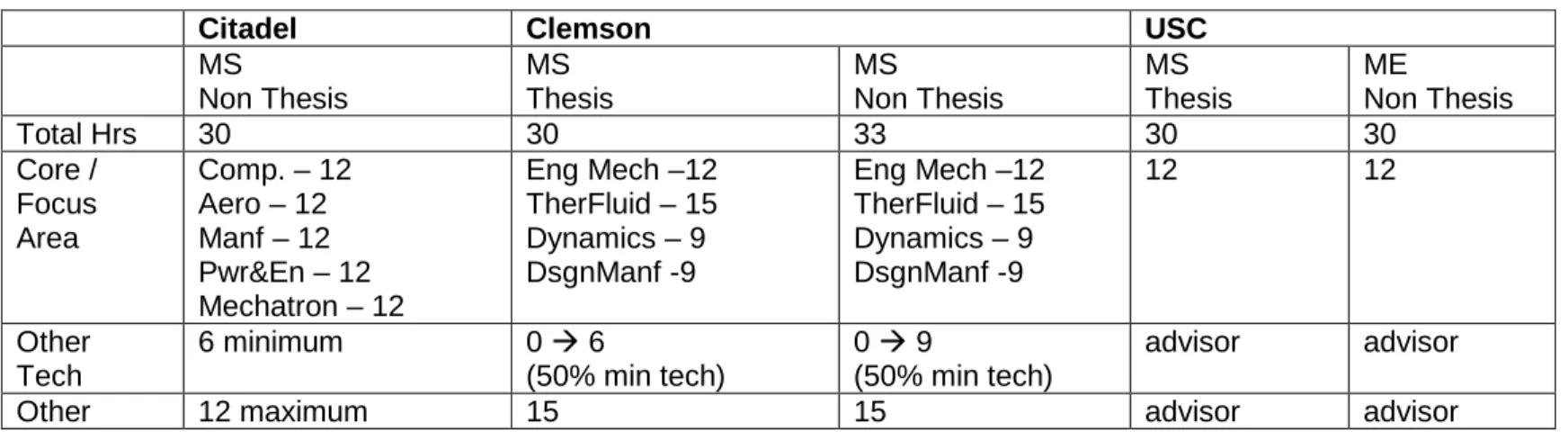
The new mechanical engineering graduate program will closely resemble course offerings at Clemson University and USC to ensure ease of transfer for students desiring to transfer for a MS Thesis option or PhD. A comparison of the degree with those at Clemson University and the University of South Carolina is provided below in Table 1. The Citadel MSME will require 30 credit hours where 18 credit hours will be technical while 12 credit hours can be non-technical (finance, accounting, leadership, program management, etc.). As shown in Table 1, there will be the opportunity to complete individual graduate certificates in five main focus areas to meet the needs of the local industry in South Carolina: Manufacturing, Materials, Mechatronics, Power and Energy, and Aeronautics. If
Table 1: MS Mechanical Engineering Comparison to Other Institutions
Citadel Clemson USC
MS Non Thesis MS Thesis MS Non Thesis MS Thesis ME Non Thesis Total Hrs 30 30 33 30 30 Core / Focus Area Comp. – 12 Aero – 12 Manf – 12 Pwr&En – 12 Mechatron – 12 Eng Mech –12 TherFluid – 15 Dynamics – 9 DsgnManf -9 Eng Mech –12 TherFluid – 15 Dynamics – 9 DsgnManf -9 12 12 Other Tech 6 minimum 0 6 (50% min tech) 0 9 (50% min tech) advisor advisor
Other 12 maximum 15 15 advisor advisor
Citadel MS in Mechanical Engineering:
• 30 credit hours, non-thesis
• Require at least 6 courses (18 hours) in technical classes
• 4 courses (12 hours) in technical or non-technical classes (Mechanical, Electrical, Civil, Program Management, Business) Example Course Plan:
If a student, for example, has a focus in Composites, he/she must take the 4 Composite courses. The remaining technical courses must be a minimum combination of 2 from the Other Technical Courses (from available focus areas such as Aero). The Other 4 courses can be from non-technical (Business, Leadership, Program Management) or from technical programs (Mechanical, Electrical, or Civil). See example in Table 2, below.
Table 2: Sample Course Plan for Composite Focus in MS ME Program
Course # and Title 30 Credit Hours
MS ME Focus Area (Composites)
MECH 604: Advanced Mechanics of Materials MECH 606: Fatigue and Fracture
MECH 702: Theory of Elasticity
MECH 708: Mechanics of Composite Materials
3 3 3 3
Other Tech Courses MECH 605: Advanced Engineering Mathematics
MECH 670: Applied Aerodynamics
3 3
Other Courses PMGT 650: Overview of Technical Project Mgmt
PMGT 651: Tech Project Planning and Scheduling PMGT 652: Applications in Quality Management PMGT 653: Technical Project Support and Operations
3 3 3 3
Faculty
Faculty and Administrative Personnel
Rank
Full- or
Part-time
Courses Taught or To be Taught, Including Term, Course Number & Title, Credit
Hours
Academic Degrees and Coursework Relevant to Courses Taught, Including Institution and Major
Other Qualifications and Comments (i.e., explain role and/or changes in assignment) *Professor Full-time To be hired
Associate Professor Full-time MECH 650 MECH 655 MECH 750 MECH 755 PhD, MSE: ME Univ TX at Austin; Model & Simul, Sys Dynamics, Cntrl Sys Dsgn, Veh Sys Dyn, Mechatronics Professional Engineer, PE Associate Professor Full-time MECH 604 MECH 605 MECH 606 MECH 702 MECH 703 MECH 708
PhD, University of New Orleans: Plasticity, Elasticity, Aerospace Composites, Advanced Composite Materials, Fracture Mechanics ;
ME, Poznan University of Technology: Solid-state Physics, Production Technology Assistant Professor Full-time MECH 625 MECH 635 MECH 640 MECH 645 MECH 660 PhD, ME
Georgia Tech; Computer Aided Design, Mfg Processes and Systems, Mfg Systems, Micro Mfg, Eng Economy, Fracture Mechanics, Structural Vibrations
Assistant Professor Full-time MECH 631 MECH 611 MECH 670 MECH 771 MECH 772
MS, MAE, Univ of Virginia; PhD, Univ. of Tenn-Knoxville Comp Flow, Fluid Mech, Adv Engr Math, Num Methods, CFD, Conduction, Convection, Radiation, Stat Mech, Non-Eq. Thermo, Combustion Fundamentals of Engineering, EIT *Assistant Professor Full-time MECH 615 MECH 617 MECH 618 MECH 619
Howison, MS, MAE – UVA; PhD, Univ. of Tenn-Knoxville Conduction, Convection, Radiation, Combustion
Rabb, PhD, ME – UT Austin;
Radiation Heat Transfer, Combustion, Sys Dynamics
These two individuals can covered until assistant professor is hired.
Total FTE needed to support the proposed program (i.e., the total FTE devoted just to the new program for all faculty, staff, and program administrators):
Faculty Staff Administration
Expect to hire the new FTE in 2016-2017. Request position within 2016-2017 budget build.
Faculty /Administrative Personnel Changes
Provide a brief explanation of any additional institutional changes in faculty and/or administrative assignment that may result from implementing the proposed program. (1000 characters)
Faculty are required to teach a full load – 12 credit hours each semester. Each faculty member may consult one day per week and can gain teaching release time for successful research proposals. Additionally, The Citadel has a foundation grant that provides funding ($2500 each area/year) in the following three areas: research seed funding, result
presentations at conferences, and/or participate in faculty development opportunities. The new MSME program will start with current faculty teaching courses as an add pay in the summer while leveraging the ability for students to take up to 4 non-technical courses already being offered throughout the year. As the demand increases beyond the ability for faculty to cover courses with add pay, faculty positions will be requested or reallocated. Current estimates would allow the program to cover 6 graduate courses per semester when the full complement of faculty are hired based on the BSME program approved 3 October 2013 and one additional FTE faculty member (2017). The staff and administration positions supporting the BSME will also support the MSME program.
Library and Learning Resources
Identify current library/learning collections, resources, and services necessary to support the proposed program and any additional library resources needed. (1000 characters)
The 2011 Standards for College Libraries does not address Mechanical Engineering specifically beyond recommending that a comparison of our holdings should occur with a group of peer institutions. The Citadel’s holdings were compared with those of Clemson and USC (PASCAL members), VMI, UT-Chattanooga, Western Carolina, and University of North Florida. The Citadel library catalog holdings are small for mechanical engineering; however, the current ebook package, Academic Complete from ebrary, yields 3,521 hits from the same phrase search. These ebooks are available from on and off campus to currently-enrolled students.
The top 5 U.S. journals in mechanical engineering are IEEE/ASME Transactions on
Mechatronics (access IEEE), Precision Engineering (access ScienceDirect), Journal of Fluids and Structures (access ScienceDirect), Journal of Sound and Vibration (access
ScienceDirect), Tribology Letters (access ScienceDirect), and Tribology International (access
ScienceDirect). The Citadel has access to all of them.
The new BSME program has purchased a print version of the entire ASTM package. We expect many fully employed students will be using company resources to complete assignments. The Citadel currently spends approximately $40,000 per year on library
Student Support Services
Identify academic support services needed for the proposed program and any additional estimated costs associated with these services. (500 characters)
The Citadel currently has strong student support services for existing undergraduate
programs, graduate programs and veterans. These same services would provide support for the evening students who would be taking courses within the MSME degree or associated certificates. It is expected that a majority of the students will be either full time employed or completing research degrees through Clemson’s Restoration Institute. The Citadel and Clemson support credit (up to five courses) for each other’s masters programs and The Citadel courses and faculty could support the research and associated courses at Clemson’s Restoration Institute.
Physical Resources
Identify any new instructional equipment needed for the proposed program. (500 characters) The equipment being purchased as part of the new BSME program as well as the equipment used within the BSCE and BSEE programs will support any physical demonstrations needed within MSME level courses. Since the MSME degree requires only 10 courses and no thesis, the lab equipment needs will be limited to support for showing theoretical concepts within a given course. The five focus areas: composites, mechatronics, manufacturing, aeronautics, and power and energy are the same as the five focus areas within the BSME and associated equipment being purchased.
Will any extraordinary physical facilities be needed to support the proposed program?
Yes No
Identify the physical facilities needed to support the program and the institution’s plan for meeting the requirements, including new facilities or modifications to existing facilities. (1000 characters)
Financial Support
Program Administration
0 0 0 0 0 0
Faculty and Staff Salaries 6,000 12,000 105,000 105,000 117,000 345,000 Graduate Assistants 0 0 0 0 0 0 Equipment 0 0 0 0 0 0 Facilities 0 0 0 0 0 0 Supplies and materials 500 500 500 500 500 2500 Library Resources 0 0 0 0 0 0 Other* 0 0 0 0 0 0 Total 6,500 12,500 105,500 105,500 117,500 347,500 Sources of Financing Category 1st 2nd 3rd 4th 5th Total Tuition Funding 19,500 45,000 72,000 109,500 147,000 393,000 Program-Specific Fees 0 0 0 0 0 0
State Funding (i.e., Special State Appropriation)* 0 0 0 0 0 0 Reallocation of Existing Funds* 0 0 0 0 0 0 Federal Funding* 0 0 0 0 0 0 Other Funding* 0 0 0 0 0 0 Total 19,500 45,000 72,000 109,500 147,000 393,000
Net Total (i.e., Estimated New Costs Minus Sources of Financing
13,000 32,500 (33,500) 4,000 29,500 45,500
*Provide an explanation for these costs and sources of financing in the budget justification. Estimated New Costs by Year
Budget Justification
Provide a brief explanation for the other new costs and any special sources of financing (state funding, reallocation of existing funds, federal funding, or other funding) identified in the Financial Support table. (1000 characters)
Note: Institutions need to complete this budget justification only if any other new costs, state funding, reallocation of existing funds, federal funding, or other funding are included in the Financial Support table.
n/a
Evaluation and Assessment
Programmatic Assessment: Provide an outline of how the proposed program will be
evaluated, including any plans to track employment. Identify assessment tools or software used in the evaluation. Explain how assessment data will be used. (3000 characters)
The Citadel is accredited by the Commission on Colleges of the Southern Association of Colleges and Schools. The undergraduate engineering programs are accredited by ABET (ME will request initial accreditation in June 2016). The MS in Project Management has requested accreditation through the Project Management Institute Global Accreditation Center. The MSME program will track accomplishment of Program Outcomes through the Taskstream software. Taskstream’s platforms provide a centralized information and communication hub for assessment, accreditation, and planning activities across an institution. These include academic and non-academic outcomes assessment, planning, and program review. Taskstream offers specialized tools that enable users to document learning outcomes, align outcomes to
institutional goals and standards, develop assessment plans, create curriculum maps, manage faculty credentials, and improve education based on findings. Taskstream’s suite of tools facilitates the collection of student work, student reflections on the learning process, and faculty or peer rubric-based assessment. Rubrics, which are used to clarify expectations and scoring criteria, may also be aligned with established learning outcomes, standards, and competencies. The software provides reporting capabilities to support the aggregation and analysis of student performance data for the review of program and institutional effectiveness, as well as for reporting to accrediting agencies and other external stakeholders.
All programs within the School of Engineering track employment or employment changes after completion of each degree. The MSME will track employment data in a similar way, but will also track from where students are initiating their MSME (time employment, research, full-time schooling by continuing their education after a BSME, etc.). Surveys from employers and
Student Learning Assessment Expected Student Learning
Outcomes Methods of/Criteria for Assessment
Demonstrate breadth of knowledge in complimentary areas of mechanical engineering that promotes an awareness of and skill in
interdisciplinary problem solving
Exams, design projects
Courses: MECH 605, MECH 708, MECH 611, MECH 631, MECH 625, MECH 660, MECH 615, MECH 618, MECH 650, MECH 750
Demonstrate a depth of knowledge in a chosen focus area of mechanical engineering that allows the student to apply innovative techniques to solve problems
Exams, design projects and graduate certificates in focus areas
Courses: MECH 604, MECH 606, MECH 611, MECH 671, MECH 640, MECH 645, MECH 617, MECH 619, MECH 655, MECH 755
Demonstrate knowledge in methods of advanced analysis appropriate for professional use when solving problems
Exams, design projects, homework
Courses: MECH 605, MECH 772, MECH 635, MECH 617, MECH 655 Demonstrate knowledge of
contemporary issues in their chosen focus area
Papers, presentations
Courses: MECH 708, MECH 772, MECH 660, MECH 617, MECH 655 Demonstrate the skills relevant to
graduate level work to include the ability to formulate problems, synthesize and integrate information, work
collaboratively, and to communicate effectively
Exams, design projects, homework, presentations
Courses: MECH 702, MECH 703, MECH 670, MECH 640, MECH 617, MECH 655
Demonstrate preparation for successful careers in industry or continued
graduate work and an ethic for lifelong learning
Surveys, work placement tracking, and graduate certificates in focus areas of the MSME program Courses: MECH 708, MECH 772, MECH 660, MECH 618, MECH 755
Will the proposed program seek program-specific accreditation?
Yes No
If yes, provide the institution’s plans to seek accreditation, including the expected timeline for accreditation. (500 characters)
n/a
Will the proposed program lead to licensure or certification?
Yes No
If yes, explain how the program will prepare students for licensure or certification. (500 characters)
n/a
Teacher or School Professional Preparation Programs
Is the proposed program a teacher or school professional preparation program?
Yes No
If yes, complete the following components. Area of Certification
n/a
Please attach a document addressing the South Carolina Department of Education Requirements and SPA or Other National Specialized and/or Professional Association Standards.
Appendix – Additional Questions from CHE
1.
How are we going to fund the new degree when we have asked for no money and
placed none in the table.
The new mechanical engineering (ME) degree will start slowly allowing the administration to
gage interest and demand, and at the same time, not strain any existing resources. We anticipate
the majority of the initial students to be part-time since they will be full-time employed within
the Low Country. The new degree requires no new infrastructure, laboratory facilities, or
services since the new master’s degree is an evening program and a majority of our
undergraduate courses and laboratories are completed by 5 PM each day; therefore, we have the
infrastructure to support the new MS degree which begins after 5 PM.
Initially, full time PhDs at The Citadel will teach the MS ME courses and will be compensated
with add pay. In subsequent years, adjuncts will be used to fill teaching opportunities within the
undergraduate degree to allow PhD credentialed faculty to teach within the graduate degree as
the demand increases. Currently the program utilizes no adjuncts to support the undergraduate
program. A full time faculty member will be hired when the demand for full time graduate
courses grows to justify a full time position. The administration of the program will initially be
handled by the Department Head with the addition of a program director (course reduction for an
existing faculty member) once the work load and revenue generation allow for that increase.
2. How we plan to roll-out the new programs.
Summary: Initially, the mechanical engineering (ME) program will select one or two focus areas
(Composites, Aeronautics, Manufacturing, Power and Energy, or Mechatronics) to offer to the
first cohort of students. The ME courses will be developed and taught based on interest from
prospective students and employers. Surveys will be used to gather this data. In the first cohort
(1-2 years), we expect the current faculty to be able to develop and teach two courses over the
summer term, and one course each semester in the fall and spring. Students will be able to take
two technical courses during the summer term, and one technical course during each long
semester. If students wish to take additional courses during the fall and spring terms, they can
take existing, non-technical graduate level courses in Program Management, Business,
Leadership or technical graduate level courses in other engineering departments such as civil and
electrical. Students must complete at least six technical courses. The remaining four courses can
be technical or non-technical.
Example: Based from surveys of potential student and local employers, the Aeronautical focus
area is selected as the first to be developed. Students would earn a MSME selecting the
Technical Courses
Non-Technical Courses
Summer 2016 MECH 631: Adv Eng Math
Fall 2016
MECH 611: Adv Fluid Mechanics
PMGT
or
BADM 600/700 level
Note: PMGT and BADM
courses are currently offered fall,
spring, and summer and can
support additional enrollment.
Spring 2017
MECH 771: Compressible Flow
PMGT
or
BADM 600/700 level
Summer 2017 MECH 772: Comp Mthds in Thermal Sci
Fall 2017
MECH 604: Adv Mech of Matls
PMGT
or
BADM 600/700 level
Spring 2018
MECH 605: Matls and Process Selection
PMGT
or
BADM 600/700 level
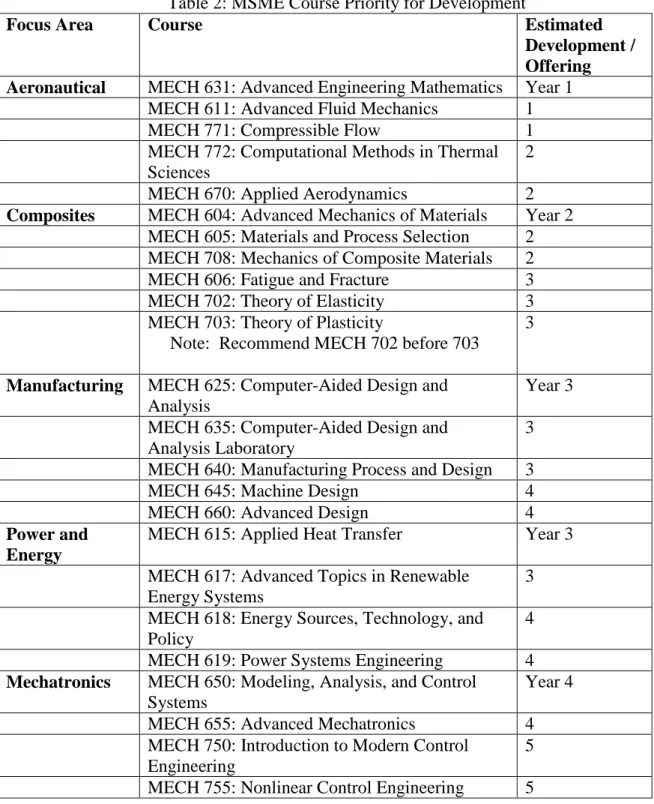
Priority: The following table lists the initial priority of focus areas with the course development
sequence within each.
Table 2: MSME Course Priority for Development
Focus Area
Course
Estimated
Development /
Offering
Aeronautical
MECH 631: Advanced Engineering Mathematics
Year 1
MECH 611: Advanced Fluid Mechanics
1
MECH 771: Compressible Flow
1
MECH 772: Computational Methods in Thermal
Sciences
2
MECH 670: Applied Aerodynamics
2
Composites
MECH 604: Advanced Mechanics of Materials
Year 2
MECH 605: Materials and Process Selection
2
MECH 708: Mechanics of Composite Materials
2
MECH 606: Fatigue and Fracture
3
MECH 702: Theory of Elasticity
3
MECH 703: Theory of Plasticity
Note: Recommend MECH 702 before 703
3
Manufacturing
MECH 625: Computer-Aided Design and
Analysis
Year 3
MECH 635: Computer-Aided Design and
Analysis Laboratory
3
MECH 640: Manufacturing Process and Design
3
MECH 645: Machine Design
4
MECH 660: Advanced Design
4
Power and
Energy
MECH 615: Applied Heat Transfer
Year 3
MECH 617: Advanced Topics in Renewable
Energy Systems
3
MECH 618: Energy Sources, Technology, and
Policy
4
MECH 619: Power Systems Engineering
4
Mechatronics
MECH 650: Modeling, Analysis, and Control
Systems
Year 4
MECH 655: Advanced Mechatronics
4
MECH 750: Introduction to Modern Control
Engineering
5
MECH 755: Nonlinear Control Engineering
5
and/or roll-out of the new programs.
An articulation agreement (ref TIGE, The Institute for Graduate Education) between The Citadel
and Clemson is in effect for the new MS programs. The Citadel and Clemson support credit (up
to five courses) for each other’s masters programs. This is above the typical limit of 9-12
transfer hours or 3-4 courses from another institution. Under the agreement, The Citadel’s
courses and faculty could support the research and associated courses (graduate level) at
Clemson’s Restoration Institute. This relationship will help to provide additional students and
course offering that neither institution would have individually. The Citadel currently has one
faculty member and two students working with Clemson’s Restoration Institute.
4. Complete list of current faculty, adjunct, and staff supporting the program. We are in
the process of adding additional adjuncts once the MS program is approved.
Faculty Name
Highest Degree Earned-
Field and Year
R
ank
1
T
y
p
e o
f A
cad
em
ic
A
ppoi
nt
m
ent
2T,
TT,
N
TT
FT
o
r PT
Years of
Experience
P
ro
fe
ss
io
n
al R
eg
is
tr
atio
n
/
C
er
tif
ic
atio
n
–
C
u
rre
n
t
E
m
pl
oye
r i
f not
C
it
ade
l
G
ovt
./
Ind. P
ra
ct
ic
e
T
each
in
g
T
h
is
I
n
stitu
tio
n
Robert J. Rabb
Ph.D., Mechanical 2007
ASC
TT
FT 19
8
2
MO
Monika Bubacz
Ph.D., Mechanical, 2006
ASC
TT
FT 5
8
2
Kevin Skenes
Ph.D., Mechanical, 2014
AST
TT
FT 1
1
1
Jason Howison
Ph.D., Aerospace, 2015
AST
TT
FT 2
1
1
EIT
Jeremy Barrows
M.S. Industrial & Systems,
2005
A
NTT
PT 15
0
0
Boeing
Adam Cho
M.S. Mechanical, 2014
A
NTT
PT 1
1
0
EIT /
Boeing
Rachel Hannah
M.S. Mechanical, 2009
A
NTT
PT 6
2
0
EIT /
Boeing
1. Code: P = Professor ASC = Associate Professor AST = Assistant Professor I = Instructor A = Adjunct O = Other 2. Code: TT = Tenure Track T = Tenured NTT = Non Tenure Track