Link to Budget Information
THE UNIVERSITY OF NORTH CAROLINA
APPENDIX A: NOTIFICATION OF INTENT TO PLAN A NEW BACCALAUREATE OR MASTER’S PROGRAM Date: 09/25/2011
Constituent Institution: East Carolina University
School/College: College of Technology and Computer Science Department: Engineering
Program Identification: MS in Biomedical Engineering CIP Discipline Specialty Title: Biomedical Engineering
CIP Discipline Specialty Code: 14.0903 Level: B M
X I
Exact Title of the Proposed Degree: Master of Science in Biomedical Engineering
Exact Degree Abbreviation (e.g., BS, BA, MA, MS, CAS) MS
Does the proposed program constitute a substantive change as defined by SACS? Yes No X a) Is it at a more advanced level than those previously authorized? Yes No X b) Is the proposed program in a new discipline division? Yes No X
Approximate date for submitting the request to establish proposal (must be within
one year of date of submission of notification of intent to plan): May 2013
Proposed date to establish degree (month and year): (Date can be no sooner than six months after the date of notification of intent to plan and must allow at
least three months for review of the request to establish, once submitted). January 2014
1. Describe the proposed new degree program. The description should include: a) a brief description of the program and a statement of educational objectives
As the population ages, the need for advanced medical tools, devices and diagnostics increases along with a need to improve our understanding of disease states. Thus as this need increases so does the demand for biomedical engineers. Due to their unique background, biomedical engineers have one foot grounded in the medical field and one foot grounded in engineering principles. By straddling these fields, biomedical engineers form a bridge upon which medical need, clinical practice, creativity, collaboration and research can travel freely from one side to the other. Graduate of the proposed program will have a direct impact on the lives and health of those living in eastern North Carolina.
According to the Bureau of Labor Statistics, the employment growth for biomedical engineering will increase by 72% over the next ten years illustrating an increasing demand for people in this field. In addition the Labor Market Information Division of the Employment Security Commission of North Carolina predicts a 38% increase in biomedical engineering jobs from 2006-2016. Thus there is a demand within the state of North Carolina for biomedical engineers.
The MS in biomedical engineering will be developed by the ECU Department of Engineering as a collaborative, research based graduate degree which supports the engineering research needs of a range of key university areas of the Brody School of Medicine, the School of Dental Medicine, College of Allied Health Sciences, Thomas Harriot College of Arts and Sciences, and the College of Health and Human Performance. The degree program will be delivered on campus and the focus of the program is to prepare students who are skilled in the learning and discovery process that integrate engineering and life sciences for the advancement of human health. Biomedical engineering combines engineering principles and methodology with physical, chemical, and mathematical sciences to solve problems in biology, medicine, behavior, and health. Due to the
as bridge builder between technological and clinical communities. Consequently we have established the following degree program objectives:
Produce graduates with advanced biomedical engineering skills to serve state and regional industries, hospitals, government agencies, and national and international industries.
Produce graduates with the background and technical skills in biomedical engineering to work professionally in research, laboratory operations, and biomedical related industry.
Prepare graduates for personal and professional success with awareness and commitment to their ethical and social responsibilities, both as individuals and in team environments.
Prepare graduates who are capable of entering and succeeding in advanced and terminal degree programs in fields such as engineering, science, or medicine.
Furthermore, Graduates of the program will be able to:
Explain the mathematical and physical foundations of biomedical engineering and demonstrate these principles in the design of biomedical instruments, the analysis of biological systems, and the technological advancement necessary for improved health care outcomes.
Apply biomedical engineering knowledge in an ethically responsible manner for the good of society. Question and critically evaluate alternate assumptions, approaches, procedures, tradeoffs, and results related to engineering and biological problems.
Apply knowledge of mathematics, physical sciences, life sciences and engineering to formulate and study or solve engineering and biomedical problems, including problems at the interface of engineering, medicine, and biology.
Plan and conduct experiments and analyze and interpret experimental measurements collected on physical systems and living systems.
Design electronic, mechanical and/or computer-based devices and software for applications including medical instrumentation, physiological measurement and signal processing, prosthesis development, and engineering simulation of living systems.
Communicate effectively using appropriate technology and information resources to document procedures, analyze engineering problems and solutions, and present project results.
Biomedical engineering is a discipline that integrates the engineering sciences with biology and medicine. The field of biomedical engineering has seen a dramatic escalation in activity over the past 20 years leading to the development of a wide variety of medical devices, medical procedures, and a basic understanding of biological processes. Engineering approaches are becoming increasingly important in modern biological and medical research and in the development of new technologies that stem from recent discoveries. Based on these
capabilities, this program will provide a foundation in biomedical engineering expertise to support researchers in diverse areas across the university to improve and develop their research capabilities in areas such as
biomechanics, biomaterials, instrumentation and bio sensors, biomedical imaging, and computational modeling and data analysis.
We envision the program to be typically a two-year program with a minimum of 30 semester hours of
coursework and thesis. Approximately 18 semester hours of the coursework will come from the Department of Engineering, an additional 3 – 6 semesters hours thesis credit and additional courses from the Departments of Physiology, Pharmacology, Bioethics and Interdisciplinary Studies, Biology, Physics, Mathematics, Biostatistics and other disciplines as required to support the interests and research of individual students and faculty.
b) the relationship of the proposed new program to the institutional mission and how the program fits into the institution’s strategic plan and its response to UNC Tomorrow
This unique program targets an emerging and advanced technological field and integrates with key components of the ECU mission statement: to serve through education, to serve through research and creative activity, and
to serve through leadership and partnership. The proposed MS in biomedical engineering is consistent with
and supports these components. This program:
Offers a unique graduate education option preparing engineers and scientists to meet the challenges of biomedical discovery and applications of engineering to medicine in service to the people of North Carolina, their health and their welfare.
Provides opportunities for partnership with the Brody School of Medicine, School of Dental Medicine, College of Allied Health Sciences, and the College of Health and Human Performance, regional industry, government, and defense system organizations.
Enhances new and emerging research opportunities for the faculty in the Brody School of Medicine, School of Dental Medicine, College of Allied Health Sciences, Thomas Harriot College of Arts and Sciences, and the College of Health and Human Performance with the Department of Engineering. This program will enhance partnerships in an emerging field and advance the art of biomedical engineering.
Focuses on development of technology professionals in a key engineering field and promotes development of strong linkages and interactions with the industrial, business, and public sector organizations of eastern North Carolina.
In addition, the proposed master of science program specifically addresses the following ECU Strategic Directions and related sub elements as presented in ECU Tomorrow:
Education for a new century:We will be responsive to the changing demands of the economy, offering excellent
undergraduate and graduate programs that provide the global skills and knowledge necessary for success in the twenty-first century.
Economic Prosperity in the East: We will invest in academic programs that give individuals the right skills and tools needed to compete and thrive in a twenty-first-century workplace. We will provide ongoing
educational and learning opportunities to support the continued development of a competitive workforce for North Carolina.
Biomedical engineering is a 21st century career field. The proposed program meets the demands of the economy, providing a graduate program which allows ECU graduates to excel and compete in the global economy. In addition, this degree has substantial positive impact on improving the resources for the
regional community to improve health care and jobs. Engineering is a global business field, and graduates of the proposed program will be well-prepared to participate in this global endeavor.
ECU will increase investment in innovation and research: We will lead in innovation in health sciences and information technology and seek to develop products that compete in the growing knowledge-based economy. We will focus on developing applied, translational, and externally focused research that emphasizes the economic and physical health of our citizens.
Health Care and Medical Innovation: ECU will save lives, cure diseases, and positively transform the quality of health care for the region and state. ECU will expand our research in health sciences with a
particular emphasis on the health concerns of the region and state. We will expand biomedical and health-related research funding to $75 million annually.
The MS in biomedical engineering will have a strong impact on health care and innovation. This program will positively influence research productivity, support innovation in health sciences, support
interdisciplinary research improving health care and biotechnology, and support overall improvement of the health of our citizens. Funding for biomedical engineering research is available through NSF, NIH, and private foundations, and funding for this interdisciplinary effort will be sought from all sources. Engineering faculty are currently involved in interdisciplinary efforts with faculty and graduate students from across ECU. Outcomes of these research efforts will result in potential biomedical engineering devices and products to enhance the biotechnology workforce and economic development in North Carolina. c) the relationship of the proposed new program to other graduate programs at the institution
The proposed MS in biomedical engineering does not compete with any other graduate program at East Carolina University. Rather it enhances and conplements the resources available to programs and colleges throughout the university. Those colleges and programs are listed below. This list is not intended to be comprehensive but clearly illustrates the potential for enhanced and collaborative research.
College of Allied Health Sciences Communication Sciences and Disorders Occupational Therapy
College of Health and Human Performance Exercise and Sports Science
Brody School of Medicine Anatomy and Cell Biology Biochemistry
Bioethics and Interdisciplinary Studies Cardiovascular Sciences
Microbiology and Immunology Pathology and Laboratory Medicine Pharmacology and Toxicology Physiology
Radiation Oncology
East Carolina Diabetes and Obesity Institute East Carolina Heart Institute
School of Dental Medicine
Thomas Harriot College of Arts and Sciences Physics
Chemistry Biology
Interdisciplinary Program in Biological Sciences Mathematics
Psychology
d) special features or conditions that make the institution a desirable, unique, or appropriate place to initiate such a degree program.
East Carolina University is the only university within the UNC system that offers academic programs in engineering, medicine, dentistry and allied health on one campus. This program will take advantage of the unique proximity and combined strengths of the technical and engineering sciences in the Department of Engineering; and the biological and medical sciences in the Brody School of Medicine, School of Dental Medicine, College of Allied Health Sciences, College of Health and Human Performance, Thomas Harriot College of Arts and Sciences, East Carolina Diabetes and Obesity Institute, and East Carolina Heart Institute. These departments, schools, colleges and institutes are located on the campuses of East Carolina University with easy access to faculty and students. The proximity of the facilities and a congenial collaborative spirit among faculty provide a unique environment for multidisciplinary educational and research experiences in this rapidly-growing discipline.
Research opportunities are growing in the areas of biomicroelectromechanical systems (bioMEMS), imaging, and cell and tissue engineering with applications in cardiovascular sciences, metabolism, orthopedics, cancer and vision. Breakthroughs in nanotechnology for cell transplants; microfabrication of biodegradable polymers for drug delivery; design of virtual bone dissection simulations; biomechanics of tissue (bone, eye, breast); magnetic resonance imaging and spectroscopy; corneal topography; study of mechanoregulation /
mechanosignaling in vascular cells / tissues; and biocompatibility of novel implant materials name only a few of the areas under investigation. The presence of additional graduate students and faculty focused on biomedical engineering problems, working in close collaboration with researchers (both faculty and students) in other colleges and schools will broaden the ECU biomedical research portfolio and provide credibility and capacity to seek externally funded projects that are currently intractable.
2. List all other public and private institutions of higher education in North Carolina currently operating programs similar to the proposed new degree program.
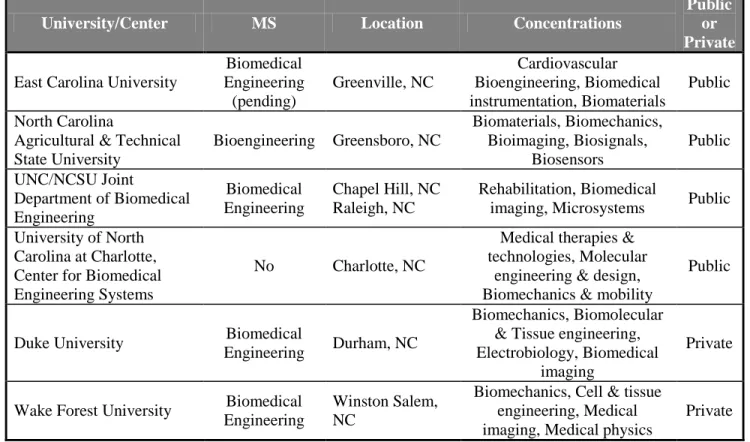
The following summaries and Table 1 describe the related programs of UNC system or private universities: There is no duplication or conflict with any of these listings.
UNC SYSTEM SUMMARY North Carolina Agricultural and Technical State University Bioengineering
Location: Greensboro, NC, about 160 miles from ECU campus.
NC A&T University, in collaboration with the University of Pittsburgh, University of Cincinnati, and Germany’s Hannover School of Medicine, Indian Institute of Technology Madras, California State University at Los Angeles, Guilford Technical Community College, and Edmonds Community College, has developed an educational and research program in bioengineering. The graduate curriculum in bioengineering offers concentrations in biomaterials, biomechanics, bioimaging, biosignals and biosensors. Some courses are offered by distance education.
University of North Carolina at Chapel Hill (Location: Chapel Hill, NC, about 111 miles from the ECU campus) North Carolina State University (Location: Raleigh, NC, about 85 miles from the ECU campus)
Biomedical Engineering
The University of North Carolina at Chapel Hill/ North Carolina State University Joint Department of Biomedical Engineering was established in 2003 and offers a Master of Science degree in biomedical engineering. The engineering cores include rehabilitation engineering, biomedical imaging and microsystems engineering. Courses are offered on the UNC or NCSU campus. Courses are not offered by distance education.
University of North Carolina at Charlotte (Location: Charlotte, NC, about 240 miles from the ECU campus) Center for Biomedical Engineering Systems (CBES)
No MS degree offered with similar program.
The CBES at the University of North Carolina at Charlotte was established in 2005 to include research faculty in the Colleges of Engineering, Arts & Sciences, Health & Human Services and Computing & Informatics, OrthoCarolina, Carolina’s Medical Center and Presbyterian Hospital. The research focus of the CBES includes medical therapies & technologies, molecular engineering & design and biomechanics & mobility research. The Mechanical
Engineering Department offers one course in biotechnology and bioengineering.
Appalachian State University, Elizabeth City State University, Fayetteville State University, North Carolina Central University, North Carolina School of the Arts, University of North Carolina at Asheville, University of North Carolina at Greensboro, University of North Carolina at Pembroke, University of North Carolina at Wilmington, Western Carolina University, Winston-Salem State University:
No MS degree offered with similar program.
PRIVATE UNIVERSITIES Programs at the following private colleges and universities were also surveyed. Duke University (Location: Durham, NC, about 110 miles from the ECU campus) Biomedical Engineering
Offers a Master of Science degree in biomedical engineering. Major research programs include biomechanics, biomolecular & tissue engineering, electrobiology and biomedical imaging. Courses are offered on the Duke University campus. Courses are not offered by distance education.
Wake Forest University (Location: Winston-Salem, NC, about 200 miles from the ECU campus) Biomedical Engineering
The joint graduate degree program in biomedical engineering is offered through Virginia Polytechnic Institute and State University (Virginia Tech) and Wake Forest University in the School of Biomedical Engineering and Sciences. The program awards a Master of Science degree in biomedical engineering. Areas of concentration include biomechanics, cell & tissue engineering, medical imaging & medical physics. The program was established in 2003. Courses are offered on the Wake Forest and Virginia Tech campuses. Some courses are offered by
Table 1 – Summary of Biomedical Engineering graduate programs offered in North Carolina
University/Center MS Location Concentrations
Public or Private
East Carolina University
Biomedical Engineering (pending) Greenville, NC Cardiovascular Bioengineering, Biomedical instrumentation, Biomaterials Public North Carolina
Agricultural & Technical State University Bioengineering Greensboro, NC Biomaterials, Biomechanics, Bioimaging, Biosignals, Biosensors Public UNC/NCSU Joint Department of Biomedical Engineering Biomedical Engineering Chapel Hill, NC Raleigh, NC Rehabilitation, Biomedical
imaging, Microsystems Public University of North
Carolina at Charlotte, Center for Biomedical Engineering Systems
No Charlotte, NC
Medical therapies & technologies, Molecular
engineering & design, Biomechanics & mobility
Public
Duke University Biomedical
Engineering Durham, NC
Biomechanics, Biomolecular & Tissue engineering, Electrobiology, Biomedical
imaging
Private
Wake Forest University Biomedical Engineering
Winston Salem, NC
Biomechanics, Cell & tissue engineering, Medical imaging, Medical physics
Private
3. Estimate the number of students that would be enrolled in the program during the first year of operation. Full-time 10 Part-time 1
4. If there are plans to offer the program away from campus during the first year of operation:
There are no plans to offer this program away from campus.
a) briefly describe these plans, including potential sites and possible method(s) of delivering instruction. b) indicate any similar programs being offered off-campus in North Carolina by other institutions (public
or private).
c) estimate the number of students that would be enrolled in the program during the first year of operation:
Full-time Part-time
5. List the names, titles, e-mail addresses, and telephone numbers of the person(s) responsible for planning the proposed program.
A core engineering faculty group will be responsible for the planning of the proposed program. A collaborative affiliated group will also be created to support the core engineering faculty. Lastly the Engineering Advisory Board will also serve as advisors.
Core Engineering Group
O. Hayden Griffin, Jr., Ph.D., Professor and Chair of Engineering, [email protected], 252-737-1026 Barbara J. Muller-Borer, Ph.D., Associate Professor of Medicine*, [email protected], 252-744-2546 Stephanie George, Ph.D., Assistant Professor of Engineering, [email protected], 252-737-2826
Chad Bossetti, Ph.D., Assistant Professor of Engineering, [email protected], 252-737-1930
Loren Limberis, Ph.D., Assistant Professor, Department of Engineering, [email protected], 252-328-9715 Rick Williams, Ph.D., Associate Professor, Department of Engineering, [email protected], 252-737-1028 Jason Yao, Ph.D.,Associate Professor, Department of Engineering, [email protected], 252-737-1029
Stephanie Sullivan, Ph.D., Teaching Instructor, Department of Engineering, [email protected], 252-328-6950 * It should also be noted that while Dr. Muller-Borer’s academic appointment is in BSOM she has an adjunct
appointment and has been teaching courses and mentoring new faculty in the Department of Engineering. She has assumed a leadership role in creation of the proposed MS in biomedical engineering.
Collaborative Affiliated Group
David Cistola, Ph.D., MD, Associate Dean of Research, College of Allied Health, [email protected], 252-744-6012
Peter Kragel, M.D., Director, Leo Jenkins Cancer Center, Professor and Chair, Department of Pathology and Laboratory Medicine, [email protected], 252-744-8368
Wiley Nifong, MD, Associate Professor, Department of Cardiovascular Sciences, [email protected], 252-744-2187
Evelio Rodriguez, MD, Assistant Professor, Department of Cardiovascular Sciences, [email protected], 252-744-4400
John Cahill, MD, Assistant Professor, Department of Cardiovascular Sciences, [email protected], 252-744-4400 Phillip Pekala, Ph.D., Chair, Department of Biochemistry and Molecular Biology, [email protected], 252-744-2684
Robert Lust, PhD, Chair, Department of Physiology and Interim Associate Dean for Research & Graduate Studies, [email protected], 252-744-2762
Terry West, Ph.D, Director, Interdisiciplinary Program in Biological Sciences, [email protected], 252-328-6306 Tarun Podder, Ph.D., DABR, Clinical Associate Professor, Department of Radiation Oncology, [email protected], 252-744-8472
Joe Houmard, PhD, Professor, Director of Human Performance Laboratory, [email protected], 252-737-4617 Maria Clay, PhD, Chair, Department of Bioethics and Interdisciplinary Studies, [email protected], 252-744-2797 Waldemar de Rijk, PhD, DDS, MS, Unit Chief and Clinical Associate Professor, Biomedical Materials Sciences, School of Dental Medicine,
[email protected]
, 252- 737-7020The intent to plan a new program has been reviewed and approved by the appropriate campus committees and authorities.