The Integrated Business Services Model:
The New Answer for Your Master Data, Reporting
and Analytics Needs
1 For more information on the integrated business services
Although master data management is not a new idea, the
concept of enhanced reporting and analytics for improved
business insights continues to gain strength. If they haven’t
already, many businesses will soon be making significant
investments in master data, reporting and analytics designed
to improve their knowledge of customers; re-position their
products in the market; drive more profitable sales; better
manage their resources; and ultimately deliver better financial
performance. At present, however, these investments typically
are done at the independent function or business unit level—
rather than in a holistic, enterprise-wide fashion.
At the same time, many shared services organizations are under increasing pressure to provide higher-order services that can deliver more strategic value for the business. In fact, Accenture has seen a rising interest in the further evolution of shared services to the integrated business services (IBS) model1, which can deliver higher-value
services on an enterprise-wide basis in a consistent, high-quality and cost competitive manner.
Organizations at the forefront of both trends are often realizing the significant value that can come from aligning the two concepts within the right sourcing and governance model to create an enterprise-wide master data, reporting and analytics capability. Such a capability can support the organization and each of its business units in outmaneuvering and outperforming its competitors. Just as finance, IT, sales, marketing and human resources have often brought together the non-core activities from around the enterprise, Accenture sees considerable potential value ahead for organizations that provide master data, reporting and analytics capabilities as a service within the IBS organization.
The efficiencies in people, process and technology alone could build a stand-alone business case for providing master data, reporting and analytics capabilities within the IBS organization. But even greater value may come from this service, as it can provide much-needed insight that can directly improve both the effectiveness and overall business outcomes of the company. In fact, Accenture has already seen clients across industries achieve value through the insights that have come from providing master data, reporting and analytics services within the IBS organization (see Figure 1).
Integrated Business Services: The New Answer for Your Master Data, Reporting and Analytics Needs
The Integrated Business Services Model: The New Answer for Your Master Data, Reporting and Analytics Needs
Figure 1. Industry examples of value achieved through master data, reporting and analytics services provided by IBS organizations.
Company Global Consumer Products Company National Retail Chain Global Communications & Technology Company Global Energy Company Scope • Finance • Sales • Marketing • Human Resources • Operations • Finance • Operations • Human Resources • Supply Chain • Finance • Finance Value
• Implemented single point of responsibility for master data accuracy • Increased usage of synchronized standardized reports while decreasing
divergent ad hoc requests
• Accelerated financial and operational data availability to earlier in the monthly
close/reporting cycle
• Improved pricing data accuracy by 95 percent in selected cases
• Reduced the need for transactional staff while creating a home for analytic talent • Provided metrics and insight down to the store level
• Created actionable intelligence resulting in growing revenues and improved
operating income
• Reduced inventory and increased compliance • Improved staff retention
• Increased customer satisfaction • Scalable organization
• Standardized reports with reduced report portfolio
• Improved decision making through consistent business management (metrics/KPIs)
and insights
• Centrally driven technology strategy/requirements • Significant savings from offshoring back-office reporting • Headcount reduction by year three
• Realized cost savings that aligned to the soft savings of time back to service customers • Appropriate cost/customer service balance
• Standardized the process, tools and outputs
• Rationalized number of reports produced by 50 percent • Standardized enterprise-wide metrics
In this paper, we examine how establishing master data, reporting and analytics capabilities within a single IBS organization can address five of the most common challenges faced by organizations that currently have these capabilities spread across functions and business units.
Challenge 1: Building consistency in data structures and centralizing quality management
Challenge 2: Meeting the evolving
analytical needs of the business
Challenge 3: Developing cross-functional,
data-driven insight
Challenge 4: Providing career paths for
master data, reporting and analytics resources
Challenge 5: Maximizing master data,
reporting and analytics technology investments
Challenge 1: Building
consistency in data
structures and centralizing
quality management
Even with a strong corporate governance structure, an enterprise can face a higher risk of data quality issues when functions and business units develop their own master data, reporting and analytics capabilities. Additionally, when different business units have control over how they use and report on information, they may present the data (using unique formats or views, non-standard time periods, revised data definitions, etc.) that reflects the business unit in the most favorable manner. They may benefit in the short term, but they then spend time “proving” their underlying data and analytics to corporate. At the same time, corporate decision-makers often struggle with disparate presentations that may drive different conclusions.
How IBS can help
Establishing master data, reporting and analytics as a service within the IBS organization can mean that there is a single owner of the governance and management of the data across the enterprise, which can pave the way
toward “one version of the truth.” Moving
control of data to IBS can introduce a much-needed independent authority over data standards. IBS is designed to take responsibility for maintaining data consistency across the organization and for gaining cross-functional agreement before making any changes. The clear ownership can help guard against the proliferation of master data elements from function to
function or from business unit to business unit. Instead, IBS can establish one process with consistent and standardized output that takes into account the requirements of
each of the parties. Moreover, because IBS
is designed to have accountability, it can provide considerable incentive to maintain established standards and to promote an environment in which individuals involved in the set-up and maintenance of master data elements are educated in the proper use of the data elements.
IBS can also help to not only promote consistency in data structures, but also to centralize quality management. The proliferation of ad hoc reports and/or significant rework by the functions/business units can be eliminated. The data can all be viewed in the same way. The richness of common, shared reports with key measures from multiple functions can bring exponentially greater business value as it leads to improved decision making. An additional possible bonus is that the data can often now be officially “watermarked” (through a semi-transparent image that sits behind the text of the report) and certified, since IBS is an
independent and objective authority. Key
management review meetings can now be run using only those reliable reports and analysis that have authenticated data sources (as evidenced by the “watermark”). Officially watermarked data can increase trust in the data and reduce wasted effort on data reconciliation.
The Integrated Business Services Model: The New Answer for Your Master Data, Reporting and Analytics Needs
For example, a global life sciences company had two different ways of defining “days sales outstanding.” The discrepancy in approach called into question the conclusions about customers, sales and financials, and eventually undermined confidence in the integrity of the data
itself. Management wasted time trying to
reconcile differences and force conclusions based on inconsistent data sources, rather than making important business decisions based on higher-order multi-functional business analytics that could have been delivered directly into their hands.
Challenge 2: Meeting the
evolving analytical needs
of the business
In today’s fast-paced environment, businesses can benefit from the ability to move quickly into new territories or new segments to stay ahead of their competition. At other times, they may find themselves dealing with an increasingly volatile marketplace. Time is often of the essence when making business decisions in these situations, and if the data/reporting structures are not in place, the enterprise may miss opportunities or see substantial impact from risks that materialize into issues.
How IBS can help
IBS is, by nature, customer-focused. By moving ownership of the master data, reporting and analytics capabilities to IBS, the enterprise can tap into the structural support needed to easily scale, modify and improve the services to meet the changing needs of the business. The combination of governance, consistent data structures across entities and a dedicated team whose skills range from transactional data management to higher-order analysis can mean that IBS provides the timely information and insight that leadership teams desire to make decisions designed to keep them ahead of the competition and out of harm’s way.
For example, one media and entertainment company wanted to better understand consumer consumption habits across release
windows (e.g., theatrical, DVD, on demand,
etc.). The company hypothesized that if it could connect consumption habits and behaviors across windows, the company could develop a holistic and effective social media strategy to better engage customers and influence consumption, thereby leading to increased sales and improved margins. The company quickly discovered that exploiting this opportunity would require addressing incompatible data structures and business goals across siloed business units (i.e., theatrical, television and home entertainment). IBS-owned master data, reporting and analytics would have accelerated its ability to capitalize on a strong idea and generate a more optimized value chain.
Challenge 3: Developing
cross-functional,
data-driven insight
When it comes to data-driven insights, the whole truly can be greater than the sum of its parts. Although functions and business units may realize initial success in developing their own master data, reporting and analytics capabilities, true insight often comes when organizations are able to quickly, easily and confidently link the data and the insights from multiple functions/business units (for example, finance and sales). Additional insights (and value) are often generated if the organization can adeptly layer in and manage third party data sources as well.
How IBS can help
A common fundamental driver behind developing a shared master data, reporting and analytics capability is to enable a single entity to have ownership of and access to consistent data from across functions and business units. This entity can become a cornerstone of progress and give the organization the ability to not only provide common, shared and standardized reports but also, to derive
genuine business insight and take action on it. The consistent data can be used to generate reports focused on key functional measures, or combined with third-party information (such as macro-economic forecasts), which can multiply the value of all the information exponentially. In short, it can accelerate the ability for the core business to perform a full range of reporting and analytics—from foundational, standard reporting to more advanced, predictive business analytics.
For example, a leading consumer products company recently used multi-function analytics across finance, sales, marketing and supply chain to make the connection that an anticipated poor crop season in one sales region would drive down demand for migrant workers and thus have a major impact on sales for particular products. Because of this macro-economic predictive business analytics capability, the company was able to anticipate the decreased sales, adjust inventory, make corresponding marketing decisions to boost sales in other regions and products, and reflect the revised forecast in the latest management reports.
Challenge 4: Providing
career paths for master
data, reporting and
analytics resources
The skill sets within any proper master data, reporting and analytics capability can run the gamut—from transactional data management to basic reporting to, at the very far end of the value spectrum, predicative analytic skills that may require
a PhD. As with any organization, there
can be a delicate balance between hiring enough resources with the proper skill sets to meet business needs while maintaining a sustainable payroll cost structure. The organization can benefit from avoiding over/under utilization of resources, while meeting the demands of skilled resources— people who desire a career, not just a job, and expect adequate compensation. It can become difficult, expensive and, in some cases, unrealistic for organizations to duplicate this capability across multiple functions.
How IBS can help
One of the major constructs of IBS, regardless of function, is the ability to provide relevant training and career progression possibilities through a variety of roles—including management positions. For individuals who have historically worked exclusively within a specific function or business unit master data, reporting and analytics team, the typically more rigorous IBS talent management process can be a welcome change. They often have more performance management and personal development opportunities as they gain
exposure to multiple areas of the business. New internal opportunities may arise to take a leadership role, either specific to master data, reporting and analytics; within the larger IBS hierarchy; or within another business unit or corporate.
The benefit to the business can be substantial as well. By building a single master data, reporting and analytics team designed to service the organization in its entirety, the organization can have an opportunity to consider new sourcing strategies. For example, basic reporting functions of low sensitivity and low complexity may be appropriate to move to lower-cost locations, while more advanced capabilities might be sourced in a differentiated fashion.
For one industry leading global communications and technology organization, Accenture identified the potential for net cost savings in the range
of 35-45 percent. These savings came from
the wage arbitrage, work and workforce optimization, and efficiency gains achievable through outsourcing of core reporting services.
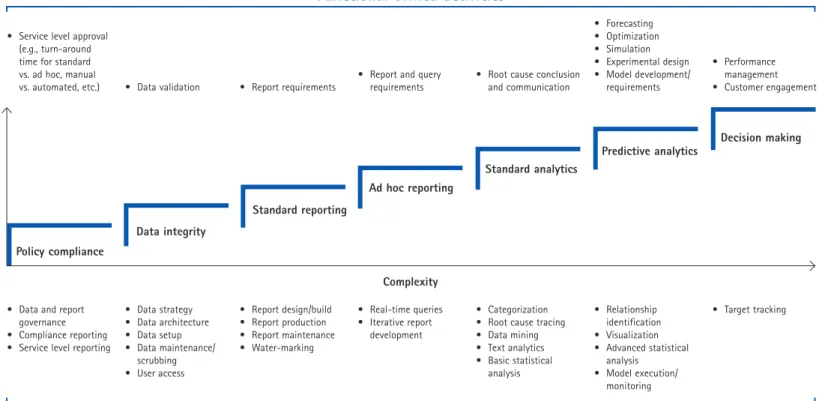
As the need for higher-value analytics becomes clear, the services organization and businesses served can benefit from working together to build the business case for the right sourcing model (see Figures 2 and 3).
The Integrated Business Services Model: The New Answer for Your Master Data, Reporting and Analytics Needs
Figure 2. Master data, reporting and analytics value chain and functional versus IBS responsibilities.
Figure 3. Potential sourcing model for master data, reporting and analytics services. Outsourced Captive • Target tracking • Model execution/monitoring • Data strategy • Data architecture • Data and report governance • Compliance reporting • Service level reporting
• Relationship identification • Visualization
• Advanced statistical analysis • Categorization
• Data mining/text analytics • Basic statistical analysis • Root cause tracing • Real-time queries • Iterative report development • Report design/build • Report production/maintenance • Water-marking • Data setup • Data maintenance/scrubbing • User access Decision making Predictive analytics Standard analytics Ad hoc reporting Standard reporting Data integrity Policy compliance
Captive Activities Outsourced Activities
Functional owned activities
IBS (captive and outsourced) owned activities • Service level approval
(e.g., turn-around time for standard vs. ad hoc, manual
vs. automated, etc.) • Data validation • Report requirements
• Report and query
requirements
• Root cause conclusion
and communication • Forecasting • Optimization • Simulation • Experimental design • Model development/ requirements • Performance management • Customer engagement
• Data and report
governance
• Compliance reporting • Service level reporting
• Data strategy • Data architecture • Data setup • Data maintenance/ scrubbing • User access • Report design/build • Report production • Report maintenance • Water-marking • Real-time queries • Iterative report development • Categorization • Root cause tracing • Data mining • Text analytics • Basic statistical analysis • Relationship identification • Visualization • Advanced statistical analysis • Model execution/ monitoring • Target tracking Complexity Policy compliance Data integrity Standard reporting Ad hoc reporting Standard analytics
Predictive analytics Decision making
Value
Challenge 5: Maximizing
master data, reporting
and analytics technology
investments
When different functions and
organizational entities make autonomous decisions to invest in their own master data, reporting and analytics capabilities, the investments often do not achieve maximum return. The individual entities often develop their own methods for analyzing data and provide reports to their constituents in their own format (which may or may not resemble that of the
other organizational entities). Data and
reports from individual entities may require significant rework before consolidation, and the quality and accuracy of the data may be called into question. The enterprise can lose precious decision-making time
during iterations. Ultimately, what starts
out as smart investments by individual organizational entities can turn into a costly way for the enterprise to run its business as a whole.
How IBS can help
Building high performance in analytics and reporting generally involves investment in both technology applications and infrastructure. By bringing management of these investments under the purview of the IBS organization, the company as a whole can benefit from smarter, big-picture investments designed to promote a consistent architecture built to meet end-to-end business requirements. The approach is typically more cost-efficient and the resulting capabilities better.
Making the connection:
Determining what moves
to the master data,
reporting and analytics
service within the IBS
organization
From a function-by-function perspective, how does an enterprise determine which data types and reporting capabilities should reside in the IBS organization? The table shown in Figure 4 provides functional examples of the data types and reporting capabilities that might be better organized and delivered out of the IBS organization, relevant to master data, reporting and analytics.
The Integrated Business Services Model: The New Answer for Your Master Data, Reporting and Analytics Needs
Figure 4. Examples of data types and reporting capabilities (by function) that could move to an IBS model.
Finance Sales Marketing Human Resources Operations • Budget/forecast • Actuals • Cost benchmarking • Customers • Products
• Pricing (compliance, change request and modeling/elasticity) • Volume • Revenue • Market share • Margin • Promotions spend • Customer segmentation • Marketing return on investment • Social media • Headcount • Open positions • Time to fill • Performance management • Suppliers • Procurement spend • Make/buy • Standards setting • Production cost variances
Conclusion
As organizations continue to focus on developing
data-driven business insight, master data, reporting and analytics
can be a prime target to be delivered as a service via the IBS
organization. By embedding this capability within the IBS
organization and offering it as a service, companies can put
data governance, quality and standards into the hands of an
organization that can continue to drive efficiencies, improve
processes, innovate their services and ensure consistency
in data and analytics. It can provide a career path for master
data, reporting and analytics resources, which can benefit
both the individual as well as the organization. More critically,
it can push the organization toward the often desired but
elusive “one version of the truth” across businesses and
functions which, when coupled with third party data, can
become the foundation for accelerating insights that can
help today’s leaders answer their analytics questions in an
effort to outmaneuver and outperform their competitors.
Follow Us
Twitter http://twitter.com/accenture_fepWatch Us
YouTube http://www.youtube.com/accentureConnect With Us
LinkedIn http://www.linkedin.com/company/ accenturecapability assessments, and architecting integrations and transformations, with a deep focus on the Finance function.
Daniel (Dan) Baldor is a senior manager in the Accenture Finance and Enterprise
Performance practice based in Miami. He has more than 12 years of experience
assessing, designing and implementing shared services operating models for clients in multiple industries.
Kristin McMinn is a senior manager in the Accenture Finance and Enterprise
Performance practice based in Kansas City. She has over 15 years of experience in
helping clients improve their processes as well as design and implement shared services solutions, and currently leads the development of offerings related to this area.
The authors would like to thank Paul Jeruchimowitz, Eric Noren and Dominic Lacy for their contributions to this article.
DISCLAIMER: This document is intended
for general informational purposes only and does not take into account the reader’s specific circumstances, and may not reflect the most current developments. Accenture disclaims, to the fullest extent permitted by applicable law, any and all liability for the accuracy and completeness of the information in this document and for any acts or omissions made based on such information. Accenture does not provide legal, regulatory, audit or tax advice.
Readers are responsible for obtaining
such advice from their own legal counsel or other licensed professionals.
experience, comprehensive capabilities across all industries and business functions, and extensive research on the world’s most successful companies, Accenture collaborates with clients to help them become high-performance businesses and governments. The company generated net
revenues of US$27.9 billion for the fiscal
year ended August. 31, 2012. Its home page is www.accenture.com.
About Accenture
Management Consulting,
Finance & Enterprise
Performance
Accenture is a leading provider of
management consulting services worldwide.
Drawing on the extensive experience of its
16,000 management consultants globally,
Accenture Management Consulting works
with companies and governments to achieve high performance by combining broad and deep industry knowledge with functional capabilities to provide services in Strategy,
Analytics, Customer Relationship Management, Finance & Enterprise Performance, Operations, Risk Management, Sustainability and Talent
& Organization. Accenture Finance &
Enterprise Performance consulting services
help finance organizations maximize the value they create for their enterprises.
For more information, please visit us at www.accenture.com/fep.
Copyright © 2012 Accenture All rights reserved.
Accenture, its logo, and High Performance Delivered