Next-Generation
Media Processing for
Packet Networks
Within the last ten years, the IT world has experienced a revolution in the way applications are created and delivered. Vertically integrated, single-vendor solutions are rapidly being replaced by standards-based Web applications running on a distributed IP architecture.
In the telecom world, next generation network architectures are evolving in the same direction. Carriers and service providers seek lower capital and operational costs, transparent migration of legacy services, and most
importantly, new kinds of enhanced services that can attract and retain high-margin customers. An open, protocol-driven service delivery architecture— based on the three-tier Web model that separates presentation, business logic and database functions—allows them to leverage the technology, tools and infrastructure of the IT world to speed delivery of these enhanced services for their wireline, wireless and broadband networks.
Within this next-generation
architecture, Media Servers provide the specialized media processing resources needed to perform transcoding, DTMF detection, conferencing, and other computation-intensive media
processing tasks. This white paper will examine how these Media Servers fit within the web-based service delivery architecture, and describe how SIP Media Servers, advances in software-only media processing, and a growing ecosystem of application providers will help deliver a new generation of enhanced services for packet networks.
Introduction
In an increasingly competitive environment, carriers and service providers delivering enhanced services over wireline, wireless or broadband networks must adapt to rapidly evolving business and technical challenges. In an effort to control spending, they must focus their limited development resources on core competencies, outsourcing critical components needed to deliver a complete solution. At the same time, they must continue to enhance their legacy services to protect their current revenue streams. And, most importantly, they must quickly create and deploy unique new services, rich in media content to attract and retain valuable subscribers.
Next-generation networks (NGNs) make this possible. Their open, protocol-driven service delivery architecture allows service providers to select best-of-breed components from an active ecosystem of third party vendors. By separating access from applications, NGNs allow services for wireline, wireless and broadband subscribers to be deployed cost-effectively on shared network elements. Finally, NGNs based on the three-tier Web model—with separate presentation, business logic and database elements—leverage the technology, tools and infrastructure of the IT world to speed the creation and deployment of innovative new enhanced services.
Elements of the Next Generation Network
Next-generation packet networks extend the PSTN concept of a “service node,” traditionally a vertically integrated solution based on
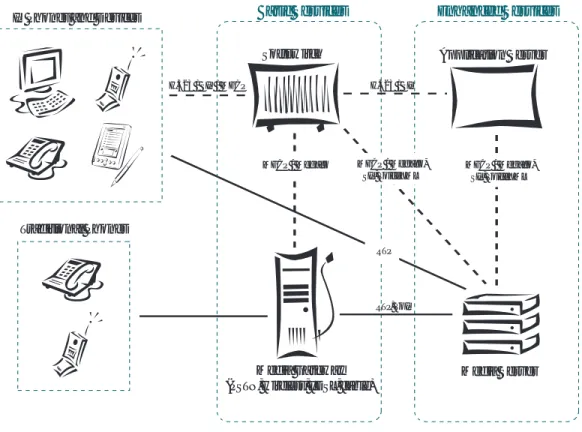
proprietary APIs, to a collection of modular components within a standards-based, distributed packet architecture. As shown in Figure 1 below, these new networks define specialized system elements linked by standardized IP protocols and media, supporting highly flexible system implementations based on best-of-breed open systems components.
In this model, basic access services are provided by application-independent network infrastructure, including softswitches and gateways. However, enhanced services are being implemented as applications running on application servers or softswitches, sharing valuable media server resources with other applications. Because network access is managed independently of the applications, innovative new services can be transparently delivered to new and existing wireline, wireless and broadband subscribers (see Figure 2), supporting a cost-effective cap-and-grow strategy for deploying IP-based services on existing infrastructure.
Figure 1: Next-Generation Packet Architecture (IPCC Reference Architecture Rel 2)
Figure 2: Access Transparency IP Phones and Devices
Traditional Phones
Softswitch
Basic Services Enhanced Services
Application Server
Media Server Media Gateway
(PSTN, wireless, xDSL, cable)
H.323 / SIP / MGCP H.323 / SIP
MGCP / Megaco MGCP / Megaco, SIP, VoiceXML
MGCP / Megaco, SIP, VoiceXML RTP RTP, VoIP App ServerApp Server MGC MGC MG 3G WBS Cable Head -MG Access Network Media Server Application Network App Server App Server App Server App ServerApp Server MGC MGC MG 3G WBS Cable Head -Cable MG PSTN 2/2.5G Wireless Wireless 3G Access Network Media Server Application Network App Server App Server App Server
These new services are increasingly implemented as SIP/VXML running on Web-based Application Servers. SIP is ideal for this purpose, having gained rapid industry adoption due to its unique combination of simplicity and flexibility. VoiceXML, already in widespread use within the speech community, complements SIP with its powerful script-driven capabilities.
Applications obviously represent a high-value, highly differentiated component of the overall service, and industry-leading vendors offer a comprehensive range of advanced applications and service creation tools to help boost all-important service velocity.
This open, protocol-driven service creation and delivery architecture—based on the three-tier Web model that separates access (presentation), applications (business logic) and database functions—leverages the technology, tools and infrastructure of the Web to help speed deployment of innovative new services for wireline, wireless and broadband networks.
The Next-Generation SIP Media Server
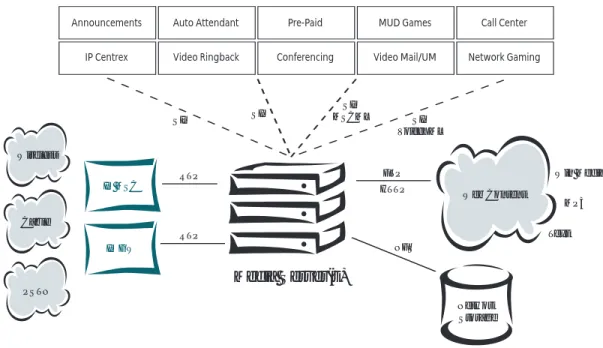
Within the NGN, enhanced services rely upon Media Servers to perform computation-intensive media processing tasks such as playing announcements, recording messages, conferencing and transcoding. Media Server resources are shared among all applications, so service providers can scale multiple services independently and maximize utilization of media server resources
(see Figure 3). More importantly, service providers can deploy best-of-breed applications from a variety of third-party vendors on a
common media server, simplifying the business case, development, delivery and maintenance of new services.
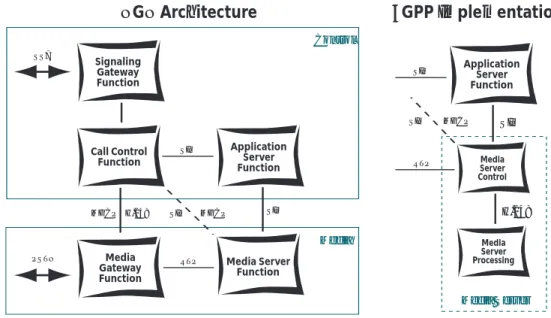
Thanks to the flexibility inherent in these distributed packet architectures, industry standards organizations have defined reference architectures that use different types of protocols to link the media and application servers. Device control protocols such as MGCP and Megaco/H.248 represent a traditional master/slave relationship between application and resources; the
“stimulus+markup” approach, typically utilizing SIP and VXML, represents a more flexible client/server model in which the client requests services from stateless servers. This flexibility allows SIP Media Servers to integrate within networks that are based on device control protocols, such as the current 3GPP implementation (see Figure 4).
Figure 3: Next-Generation SIP Media Server
Media Server(s)
NFS FTP HTTP
Network Storage
Web Content
MP3 Win Media
Text
SIP VoiceXML SIP
MSCML
IP MSC
IP GW
RTP
RTP
Wireless
SIP SIP
Announcements
IP Centrex
Auto Attendant
Video Ringback
Pre-Paid
Conferencing
MUD Games
Video Mail/UM
Call Center
Network Gaming
Cable
Figure 4: Media Server and 3GPP
Figure 5: COTS Hardware for Media Servers
Control
Media Application
Server Function
Application Server Function
Media Server Function
Media Server Control
Media Server Processing
Call Control Function
Media Gateway Function PSTN
SS7
N
G
N
Arc
h
itecture
3
GPP
Im
ple
m
entation
Media Server SIP
MGCP MGCP
MGCP
H.248 SIP
SIP SIP
RTP
SIP H.248
Signaling Gateway Function
SIP
RTP
These highly specialized media servers traditionally required proprietary DSP hardware. However, continued
advances in processor performance now make software-only media processing practical. Next-generation media servers utilize low-cost, high-performance COTS servers/blades and tools; DSP-based hardware acceleration is only needed for enhanced conferencing or low bit rate transcoding. “IT friendly” hardware and management tools improve OPEX, while standards-based hardware drives down CAPEX costs and leverages ongoing innovation in the overall server market to provide flexible deployment options and cost-effective scalability (see Figure 5).
Conclusion
Next-generation packet networks, based on an open, protocol-driven service delivery architecture, provide an ideal platform for the creation and deployment of advanced, IP-based enhanced services. Distributed IP architectures decouple network access from applications, and signaling from media, so innovative new services for wireline, wireless and broadband subscribers can be deployed more quickly and cost-effectively.
Standards provide the foundation. From the hardware perspective, “software only” media servers can utilize COTS servers and tools to minimize cost and maximize scalability. On the protocol side, next-generation media servers leverage the simplicity and flexibility of SIP and VoiceXML, allowing service providers to select from best-of-breed applications offered by a growing ecosystem of third-party vendors.
Corporate Headquarters
Brooktrout, Inc. 250 First Avenue Needham, MA 02494-2814 U.S.A.
Phone: +1 781 449-4100 Fax: +1 781 449-9009
Sales
Needham, MA +1 781 449-4100 Los Gatos, CA +1 408 370-0881 Atlanta, GA +1 770 814-4155 Chicago, IL +1 847 981-5062 Belgium +32 2 658-0170 United Kingdom +44 1344 380280 Japan +81 3518 3530 Canada +1 416 860-6240 Latin America +1 305 347-5113
©2004 Brooktrout Technology, Inc. All rights reserved. Trademarks and product names found in this publication have been used for identification purposes only and may be