in Adulthood
The Cardiovascular Risk in Young Finns Study
Heikki Aatola, Nina Hutri-Ka¨ho¨nen, Markus Juonala, Jorma S.A. Viikari, Janne Hulkkonen,
Tomi Laitinen, Leena Taittonen, Terho Lehtima¨ki, Olli T. Raitakari, Mika Ka¨ho¨nen
Abstract—Limited and partly controversial data are available regarding the relationship of arterial pulse wave velocity and childhood cardiovascular risk factors. We studied how risk factors identified in childhood and adulthood predict pulse wave velocity assessed in adulthood. The study cohort consisted of 1691 white adults aged 30 to 45 years who had risk factor data available since childhood. Pulse wave velocity was assessed noninvasively by whole-body impedance cardiography. The number of conventional childhood and adulthood risk factors (extreme quintiles for low-density lipoprotein cholesterol, high-density lipoprotein cholesterol, systolic blood pressure, body mass index, and smoking) was directly associated with pulse wave velocity in adulthood (P⫽0.005 andP⬍0.0001, respectively). In multivariable regression analysis, independent predictors of pulse wave velocity were sex (P⬍0.0001), age (P⬍0.0001), childhood systolic blood pressure (P⫽0.002) and glucose (P⫽0.02), and adulthood systolic blood pressure (P⬍0.0001), insulin (P⫽0.0009), and triglycerides (P⫽0.003). Reduction in the number of risk factors (P⬍0.0001) and a favorable change in obesity status (P⫽0.0002) from childhood to adulthood were associated with lower pulse wave velocity in adulthood. Conventional risk factors in childhood and adulthood predict pulse wave velocity in adulthood. Favorable changes in risk factor and obesity status from childhood to adulthood are associated with lower pulse wave velocity in adulthood. These results support efforts for a reduction of conventional risk factors both in childhood and adulthood in the primary prevention of atherosclerosis. (Hypertension. 2010;55:806-811.)
Key Words:cardiovascular health 䡲 risk factors 䡲 elasticity 䡲 epidemiology 䡲 pulse wave velocity
I
t is well recognized that atherosclerosis has its roots in childhood. Risk factors identified in childhood predict the occurrence of preclinical carotid atherosclerosis in adult-hood.1–3 Risk factors have also been associated withde-creased arterial elasticity in cross-sectional studies.4 – 6 We
have demonstrated previously a link between youth risk factor exposure and decreased carotid elasticity in adulthood.7
Arterial pulse wave velocity (PWV) is commonly used as a marker of arterial stiffness. In various patient categories, including patients with hypertension,8 end-stage renal
fail-ure,9and diabetes mellitus,10PWV is an independent
predic-tor of all-cause and cardiovascular mortality. Furthermore, aortic PWV is associated with higher cardiovascular mortal-ity, coronary heart disease, and stroke among generally healthy older adults.11
Previous observations concerning the relationship between risk factors identified in childhood/adolescence and arterial PWV in adulthood have been controversial. Li et al12 (835
participants, aged 24 to 44 years) reported a direct correlation between childhood blood pressure and PWV in adulthood, whereas Oren et al13(524 participants, aged 27 to 30 years)
did not find an association between adolescent blood pressure and adult PWV. To gain more insight on determinants of arterial PWV in adulthood, we measured PWV in 1691 white adults aged 30 to 45 years. These individuals were partici-pants of the prospective Cardiovascular Risk in Young Finns Study for whom risk factor data were available since their childhood. In the present study, we have analyzed the associations of risk factors measured in childhood and adult-hood with PWV assessed in adultadult-hood.
Methods
Subjects
The first cross-sectional survey was conducted in 1980 for 3596 subjects aged 3 to 18 years.14They were randomly selected from the national register. Four follow-up studies were conducted in 1983,
Received October 18, 2009; first decision November 9, 2009; revision accepted December 21, 2009.
From the Departments of Clinical Physiology (H.A., J.H., M.K.), Pediatrics (N.H.-K.), and Clinical Chemistry (T.Le.), University of Tampere and Tampere University Hospital, Tampere, Finland; Departments of Medicine (M.J., J.S.A.V.) and Clinical Physiology (O.T.R.) and the Research Centre of Applied and Preventive Cardiovascular Medicine (M.J., O.T.R.), University of Turku and Turku University Hospital, Turku, Finland; Department of Clinical Physiology and Nuclear Medicine (T.La.), Kuopio University Hospital, Kuopio, Finland; Department of Pediatrics (L.T.), University of Oulu, Oulu, Finland; Vaasa Central Hospital (L.T.), Vaasa, Finland.
Correspondence to Mika Ka¨ho¨nen, Tampere University Hospital, Department of Clinical Physiology, PO Box 2000, FI-33521 Tampere, Finland. E-mail [email protected]
© 2010 American Heart Association, Inc.
Hypertensionis available at http://hyper.ahajournals.org DOI: 10.1161/HYPERTENSIONAHA.109.145102
806
1986, 2001, and 2007, with 2991, 2779, 2283, and 2204 participants, respectively. The study cohort for the present analysis included those 1691 nonpregnant subjects with available PWV data who were not using antihypertensive or cholesterol-lowering medication. Subjects with type 1 or 2 diabetes mellitus were also excluded. All of the subjects gave written, informed consent, and the study was approved by the local ethics committees.
Clinical Characteristics
Height and weight were measured, and body mass index (BMI) was calculated. Skinfold thicknesses (in 1980, 1983, and 1986) were measured as described previously.7 Blood pressure was measured from the brachial artery with standard methods, as described previously.7The mean of 3 measurements was used in the analysis. Smoking habits were ascertained with a question-naire in subjects aged ⱖ12 years. Smoking was modeled as a dichotomous variable (smoking or nonsmoking). Smoking was defined as regular cigarette smoking on a weekly basis or more often in adolescents and in adults.
Biochemical Analyses
Venous blood samples were taken after fasting for 12 hours. Standard methods were used for serum total cholesterol, triglycer-ides, high-density lipoprotein (HDL) cholesterol, insulin, and glu-cose concentrations (gluglu-cose only in 1986, 2001, and 2007). Low-density lipoprotein (LDL) cholesterol concentration was calculated by the Friedewald formula. Childhood C-reactive protein (CRP) was analyzed in 2005 from serum samples that were taken in 1980 and stored at ⫺20°C. Details of all of the methods and analytic procedures have been reported previously.7,15–17
Arterial PWV Studies
We used a whole-body impedance cardiography device (CircMon, JR Medical Ltd) to determine PWV. CircMon includes whole-body impedance cardiography channel (ICG), distal impedance plethys-mogram channel (IPG), and an ECG channel (Figure 1A). When the pulse pressure wave enters the aortic arch and the diameter of the aorta changes, the whole-body impedance decreases. The CircMon software measures the time difference between the onset of the decrease in impedance in the whole-body impedance signal and, later, the popliteal artery signal. The PWV can be determined from the distance and the time difference between the 2 recording sites (Figure 1B). The repeatability index and the reproducibility index were good (99% and 87%, respectively).18A detailed description of the method and the validation study has been reported previously.19 Statistical Methods
Values for triglycerides, insulin, glucose, and CRP were log-transformed before analyses, because of skewed distributions. The comparisons between study participants and nonparticipants (sub-jects lost to follow-up or excluded) were performed using regression analysis adjusted with age for continuous variables and with the2
test for categorical variables.
To study the effects of risk variables on PWV, we calculated age-and sex-specificzscores for each risk variable in each study year. Childhood risk variable load was assessed by calculating the average ofzscores from years the 1980, 1983, and 1986. In these analyses, only measurements conducted at ages 3 to 18 years were used. Adulthood risk variable load was assessed by calculating the average ofzscores in 2001 and 2007.
The univariate relationships between load variables and PWV in childhood and adulthood were examined by regression analysis. To examine whether sex modifies the associations between risk vari-ables and PWV, we included sex⫻risk variable interaction terms in the regression models. To evaluate which childhood or adulthood risk variables were independently associated with PWV, we used stepwise multivariable regression analysis. In regression analysis we used a heart rate–specificzscore for PWV.20
To examine the effect of multiple risk factors on PWV, we calculated a risk score, determined as the number of risk factors. Risk
factors were defined as values at or above the age- and sex-specific 80th percentile for LDL cholesterol, systolic blood pressure (SBP), and BMI; at or below the 20th percentile for HDL cholesterol; and smoking (assessed in subjectsⱖ12 years of age). One-way ANOVA was used to compare the PWV values in the various groups.
In addition, we studied whether changes in the risk factor score and obesity status between childhood and adulthood were associated with PWV. In these analyses, the presence ofⱖ1 risk factor was considered an unfavorable risk factor status, and a cutpoint of age-and sex-specific 80th percentile for BMI was used in determining favorable or unfavorable obesity status. We usedttests to assess whether subjects with unfavorable status in childhood and favorable in adulthood, favorable status in childhood and unfavorable in adulthood, and favorable status both in childhood and adulthood differed from those having an unfavorable status in childhood and in adulthood.
All of the analyses were performed with the SPSS for Windows (release 16.0.1, SPSS Inc). Statistical significance was inferred at a 2-tailedPvalue⬍0.05.
Figure 1.A, Placement of electrodes in whole-body impedance cardiography with an additional voltage-sensing channel on the left calf for PWV measurement. B, Synchronous recording of ECG, whole-body ICG, and IPG. Time difference between the feet of the ICG (a) and IPG (b) indicates the pulse transit time from aortic arch to popliteal artery.
Results
The representativeness of the present study cohort was studied by comparing the characteristics at the original
baseline study (1980) between the participants of the present study (n⫽1691) and nonparticipants (n⫽1905). There were more males than females among nonparticipants (P⬍0.0001) and they had higher SBP, BMI, and combined skinfold thickness than participants (P⫽0.0001, P⫽0.04, and
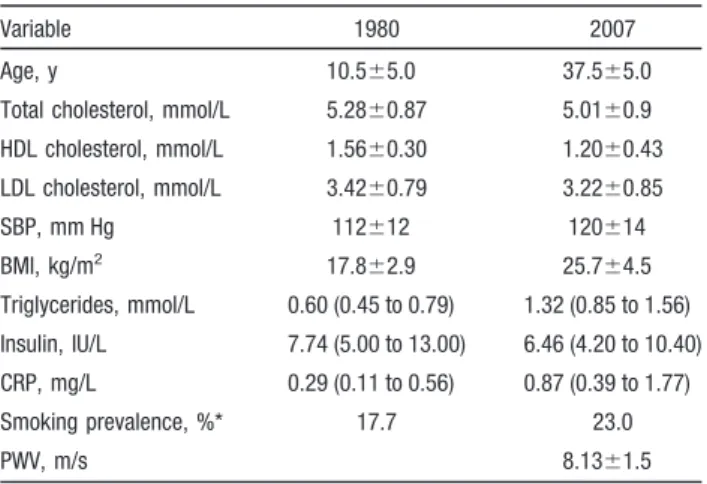
P⫽0.049, respectively). There were no statistically signifi-cant differences in the levels of total cholesterol, HDL cholesterol, LDL cholesterol, triglycerides, insulin, CRP, or smoking prevalence between participants and nonparticipants (Table 1). The characteristics of the study subjects in 1980 and in 2007 are shown in Table 2.
Table 3 shows the results of the regression of PWV on risk factor load variables measured since childhood. In univariate analysis, childhood SBP and glucose were directly associated with PWV in adulthood (P⬍0.0001 and P⫽0.04, respec-tively). In adulthood, all of the risk factor load variables except smoking were associated with PWV in adulthood. The magnitude of association was the highest for SBP. In adult-hood, sex modified the associations between HDL cholesterol and PWV and triglycerides and PWV. HDL cholesterol was significantly (⫽⫺0.18;P⬍0.0001) related to PWV in males but not in females (⫽0.01; P⫽0.89). Triglycerides was directly related to PWV both in males and females (⫽0.25,
Table 1. Baseline Characteristics in 1980 of Study
Participants and Nonparticipants (Subjects Lost or Excluded)
Variable Participants Nonparticipants No. of subjects 1691 1905 Sex, women, %* 54.5 47.8
Age, y† 10.5 10.4
Total cholesterol, mmol/L 5.28 5.31 HDL cholesterol, mmol/L 1.56 1.56 LDL cholesterol, mmol/L 3.42 3.45 SBP, mm Hg‡ 112 113 BMI, kg/m2§ 17.8 17.9 Skinfold thickness, mm㛳 25.9 26.1 Triglycerides, mmol/L¶ 0.60 0.60 Insulin, IU/L¶ 7.74 7.79 CRP, mg/L¶ 0.29 0.29 Smoking prevalence,%# 17.7 15.0
Comparisons between participants and nonparticipants were performed using regression analysis adjusted with age and sex.Pvalue was ⬎0.05 unless informed otherwise.
*The sex differences between the participants and nonparticipants were examined with a2test (P⬍0.0001).
†Thettest was applied between participants and nonparticipants to examine differences in age (P⫽0.87).
‡P⫽0.0001 vs participants. §P⫽0.04 vs participants.
㛳Data show combined thickness of 3 skinfold measurements (subscapular, triceps, and biceps;P⫽0.049).
¶Results are geometric mean values.
#Smoking data were gathered on subjects aged 12 to 18 years defined as regular cigarette smoking on a weekly basis or more often. The differences between the participants and nonparticipants were examined with a 2 test (P⫽0.11).
Table 2. Baseline (1980) and Current (2007) Characteristics of Study Subjects
Variable 1980 2007 Age, y 10.5⫾5.0 37.5⫾5.0 Total cholesterol, mmol/L 5.28⫾0.87 5.01⫾0.9 HDL cholesterol, mmol/L 1.56⫾0.30 1.20⫾0.43 LDL cholesterol, mmol/L 3.42⫾0.79 3.22⫾0.85 SBP, mm Hg 112⫾12 120⫾14 BMI, kg/m2 17.8⫾2.9 25.7⫾4.5 Triglycerides, mmol/L 0.60 (0.45 to 0.79) 1.32 (0.85 to 1.56) Insulin, IU/L 7.74 (5.00 to 13.00) 6.46 (4.20 to 10.40) CRP, mg/L 0.29 (0.11 to 0.56) 0.87 (0.39 to 1.77) Smoking prevalence, %* 17.7 23.0 PWV, m/s 8.13⫾1.5
Values are mean⫾SD or geometric mean (25th to 75th percentiles) or percentages of subjects.
*In 1980, smoking data were gathered on subjects aged 12 to 18 years defined as regular cigarette smoking on a weekly basis or more often. In 2007, smoking was defined as smoking on a weekly basis or more often.
Table 3. Univariate and Multivariable (Final Model for Stepwise Linear Regression Analysis Initially Including Age, Sex, HDL Cholesterol, LDL Cholesterol, Triglycerides, SBP, Skinfold Thickness关Childhood Only兴, BMI, Glucose, Insulin, and CRP) Relations Between Childhood (Ages 3 to 18 Years) and Adulthood (Ages 24 to 45 Years) Risk Factor Load and PWV
Risk Variable
Risk Factor Load in Childhood (in 1980, 1983, and 1986)
Risk Factor Load in Adulthood (in 2001 and 2007)
(SE) P (SE) P
Univariate relations
HDL cholesterol ⫺0.05 (0.03) 0.051 ⫺0.09 (0.03) 0.0005 LDL cholesterol 0.01 (0.03) 0.59 0.08 (0.03) 0.001 Triglycerides 0.03 (0.03) 0.29 0.19 (0.03) ⬍0.0001 SBP 0.11 (0.03) ⬍0.0001 0.34 (0.02) ⬍0.0001 BMI ⫺0.03 (0.03) 0.23 0.13 (0.02) ⬍0.0001 Skinfold thickness 0.01 (0.03) 0.85
Glucose (childhood only 1986)
0.06 (0.03) 0.04 0.14 (0.03) ⬍0.0001 Insulin 0.02 (0.03) 0.47 0.19 (0.03) ⬍0.0001 CRP (childhood
only 1980)
⫺0.01 (0.03) 0.69 0.13 (0.03) ⬍0.0001 Smoking (only
over 12 y)
0.02 (0.06) 0.51 ⫺0.01 (0.05) 0.53 Multivariable
relations
Sex 0.31 (0.05) ⬍0.0001 0.31 (0.04) ⬍0.0001 Age 0.30 (0.01) ⬍0.0001 0.28 (0.004) ⬍0.0001 SBP 0.08 (0.03) 0.002 0.30 (0.02) ⬍0.0001 Glucose (childhood
only 1986)
0.06 (0.03) 0.02 … … Insulin … … 0.08 (0.03) 0.0009 Triglycerides … … 0.07 (0.03) 0.003
P⬍0.0001 and ⫽0.15, P⬍0.0001, respectively), but in females the magnitude of association was lower. In the multivariable model, the independent predictors of PWV were age, sex, SBP, and glucose in childhood and SBP, insulin, and triglycerides in adulthood.
An increasing trend in adulthood PWV was observed across the groups with an increasing number of childhood risk factors (P⫽0.005; Figure 2A). PWV also correlated strongly with an increasing number of adulthood risk factors (P⬍0.0001; Figure 2B). Subjects withⱖ1 risk factor both in childhood and adulthood had increased PWV in adulthood compared with those with no risk factors in adulthood (P⬍0.0001; Figure 3A). Similarly, a favorable change in BMI between childhood and adulthood was associated with slower PWV in adulthood (P⫽0.0002; Figure 3B).
Discussion
The present study shows that age and sex, SBP, and glucose in childhood, as well as SBP, insulin, and triglycerides in
adulthood, are independent predictors of PWV in adulthood. We also demonstrated that the number of risk factors identi-fied in childhood and adulthood correlated directly with adult PWV. Moreover, we found that favorable changes in risk factor status and obesity status in adulthood were associated with lower PWV in adulthood.
Previous studies concerning the relationship between con-ventional risk factors in childhood/adolescence and PWV have been limited, and the results were partly controversial. In the Bogalusa Heart Study, Li et al12 reported that SBP,
BMI, and HDL cholesterol (inverse correlation) in childhood correlated with PWV in adulthood. They also showed that SBP, HDL cholesterol (inverse association), triglycerides, and smoking were cross-sectionally associated with PWV in young adulthood. In another cross-sectional study, Im et al21
showed that mean blood pressure, BMI, sex, and total homocysteine levels were independently associated with PWV. In the Atherosclerosis Risk in Young Adults Study,13
no association between adolescent blood pressure and adult PWV was observed. This controversial result could be at least partly explained by differences in blood pressure measurement methods. Oren et al13 used only
single measurement from school health records, whereas Li et al12and Im et al21measured blood pressure using the
same protocol in the entire cohort.
In the present study, SBP load in childhood was an independent predictor of PWV in adulthood. This is consis-tent with reports mentioned earlier showing an association between arterial stiffness and cumulative burden of SBP since childhood.7,12 The acceleration of atherosclerosis, vascular
smooth muscle hyperplasia, and hypertrophy, as well as the induction of oxidative stress in the arterial wall caused by elevated blood pressure, are probable underlying pathophys-iological mechanisms behind this association.22In addition to
SBP, glucose in childhood was an independent predictor of PWV. This is in line with a previous finding that impaired fasting glucose had a strong association with high intima-media thickness, a marker of early atherosclerosis, in over-weight children.23In adulthood, SBP, insulin, and triglyceride
levels were independent predictors of PWV. These risk factors have been shown to be directly associated with arterial PWV and elasticity in adults7,20 and are independent risk
factors for ischemic heart disease.22,24,25
Our findings show that the number of risk factors identified in childhood was significantly associated with increased PWV in adulthood. The present results are in line with earlier observations showing that the presence of multiple risk factors may lead to the acceleration of atherosclerosis in young people.7,26In this study, we also demonstrated that the
number of risk factors identified in adulthood correlated directly with adult PWV. Notably, the difference of adult PWV between subjects with no risk factors and subjects with ⱖ3 risk factors was 0.87 m/s. This difference is worthy of mention because Blacher et al9 observed an all-cause
mortality-adjusted odds ratio of 1.39 for each PWV increase of 1 m/s in patients with end-stage renal failure.
Observations from this analysis suggest that early life atherosclerotic effects can be modified by low risk factor levels in adulthood. In this study, high risk factor levels in 0 1 2 3 or more
Number of childhood risk factors 0.0
6.0 6.5 7.0 7.5 8.0 8.5 9.0
P
u
ls
e wave velocity
(
m
/s
)
0 1 2 3 or more Number of adulthood risk factors 0.0
6.0 6.5 7.0 7.5 8.0 8.5 9.0
P
u
ls
e wave vel
o
city
(
m
/s
)
P for trend = 0.005
616 626 326 123
A
B
P for trend <0.0001
582 588 351 170
Figure 2.PWV by number of risk factors in childhood (ages 3 to 18 years, in 1980, 1983, and 1986; A) and in adulthood (ages 24 to 45 years, in 2001 and 2007; B). Risk factors were defined as val-ues at or above the age- and sex-specific 80th percentile for LDL cholesterol, SBP, and BMI; at or below the 20th percentile for HDL cholesterol; and smoking (in childhood assessed in subjectsⱖ12 years old).Pvalues from 1-way ANOVA. Bars represent mean⫾95%CI. Dashed line represents population mean. Values inside columns indicate the number of subjects in each group.
childhood were related to significantly decreased PWV in adulthood if combined with low risk factor levels in adult-hood. Moreover, obese youths who became lean adults had slower PWV compared with persistently obese subjects. These observations support the concept that the vascular changes in childhood may improve over time with appropri-ate intervention.
A limitation of this study is the PWV measurement method, which is not yet widely used in epidemiological settings, apparently limiting comparability of the present finding with the observations from other cohorts. However, PWV values measured by CircMon are highly comparable to those measured by Doppler ultrasound method,19indicating
the generalizability of the present findings. In addition, ICG is very useful in epidemiological studies, because the method is easy, fast, operator independent and highly repeatable and reproducible, and the observed variability of the measured parameters is mainly physiological.18,19Reference values for
PWV measured with this method have also been published previously.27Another potential limitation is the
nonparticipa-tion in the follow-up study. However, baseline risk factors in 1980 were mainly similar among participants and
nonpartic-ipants, with the exception of SBP, BMI, and combined skinfold thickness, which were slightly higher in nonpartici-pants. Thus, the present study cohort appears to be fairly representative of the original study population. Because our study cohort was racially homogenous, the generalizability of our results is limited to white European subjects. It is also important to remember that both the impact of baseline values and the impact of follow-up changes in risk factors could have been underestimated or overestimated because of pos-sible regression dilution bias. Finally, observational studies cannot establish causality between cardiovascular risk factors and arterial stiffness.
Perspectives
There is accumulating and consistent evidence showing that conventional risk factors are predictive of cardiovas-cular risk later in life. However, favorable changes in risk factor status from childhood to adulthood may decrease the cardiovascular risk. These results provide support for the reduction of conventional risk factors both in childhood and adulthood.
0 1Risk factor status2 3
0.0 6.0 6.5 7.0 7.5 8.0 8.5 9.0 9.5
Pul
s
e
wave vel
o
cit
y
(
m
/s
)
Body mass index 0.0
6.0 6.5 7.0 7.5 8.0 8.5 9.0 9.5
P
u
ls
e wave velocity
(
m
/s
)
P<0.0001 P=0.28 P<0.0001
1+ RF in youth, 1+ RF in adulthood
810
1+ RF in youth, 0 RF in adulthood
265
0 RF in youth, 1+ RF in adulthood
299
0 RF in youth, 0 RF in adulthood
317
A
B
P=0.002P=0.54 P=0.0002
High in youth, High in adulthood
175
High in youth, Low in adulthood
163
Low in youth, High in adulthood
163
Low in youth, Low in adulthood
1190
0 1 2 3
Figure 3.A, Relations between risk score in childhood (ages 3 to 18 years) and adulthood (ages 24 to 45 years) with PWV in adulthood (2007). Subjects having 0 risk factors were considered to have favorable status and those withⱖ1 risk factors unfavorable status. B, Relations between BMI in childhood (ages 3 to 18 years) and adulthood (ages 24 to 45 years) with PWV in adulthood (2007). A cutpoint of the 80th percentile was used, classifying BMI as favorable or unfavorable status.Pvalues fromt
tests. Bars represent mean⫾95%CI. Values inside columns indicate the number of subjects in each group.
Sources of Funding
This study was financially supported by the Academy of Finland (grants 77841, 117832, and 201888), the Social Insurance Institution of Finland, the Turku University Foundation, the Medical Research Fund of Kuopio University Hospital, the Medical Research Fund of Tampere University Hospital, the Turku University Hospital Re-search Fund, Turku University Hospital Medical Funds, the Emil Aaltonen Foundation, the Juho Vainio Foundation, the Finnish Foundation of Cardiovascular Research, and the Finnish Cultural Foundation.
Disclosures
None.
References
1. Raitakari OT, Juonala M, Ka¨ho¨nen M, Taittonen L, Laitinen T, Ma¨ki-Torkko N, Ja¨rvisalo MJ, Uhari M, Jokinen E, Ro¨nnemaa T, Åkerblom HK, Viikari JS. Cardiovascular risk factors in childhood and carotid artery intima-media thickness in adulthood: the Cardiovascular Risk in Young Finns Study.JAMA. 2003;290:2277–2283.
2. Davis PH, Dawson JD, Riley WA, Lauer RM. Carotid intimal-medial thickness is related to cardiovascular risk factors measured from childhood through middle age: the Muscatine Study.Circulation. 2001; 104:2815–2819.
3. Li S, Chen W, Srinivasan SR, Bond MG, Tang R, Urbina EM, Berenson GS. Childhood cardiovascular risk factors and carotid vascular changes in adulthood: the Bogalusa Heart Study.JAMA. 2003;290:2271–2276. 4. Aggoun Y, Bonnet D, Sidi D, Girardet JP, Brucker E, Polak M, Safar ME,
Levy BI. Arterial mechanical changes in children with familial hyper-cholesterolemia.Arterioscler Thromb Vasc Biol. 2000;20:2070 –2075. 5. Liang YL, Shiel LM, Teede H, Kotsopoulos D, McNeil J, Cameron JD,
McGrath BP. Effects of blood pressure, smoking, and their interaction on carotid artery structure and function.Hypertension. 2001;37:6 –11. 6. Tounian P, Aggoun Y, Dubern B, Varille V, Guy-Grand B, Sidi D,
Girardet JP, Bonnet D. Presence of increased stiffness of the common carotid artery and endothelial dysfunction in severely obese children: a prospective study.Lancet. 2001;358:1400 –1404.
7. Juonala M, Ja¨rvisalo MJ, Ma¨ki-Torkko N, Ka¨ho¨nen M, Viikari JS, Raitakari OT. Risk factors identified in childhood and decreased carotid artery elasticity in adulthood: the Cardiovascular Risk in Young Finns Study.Circulation. 2005;112:1486 –1493.
8. Laurent S, Boutouyrie P, Asmar R, Gautier I, Laloux B, Guize L, Duci-metiere P, Benetos A. Aortic stiffness is an independent predictor of all-cause and cardiovascular mortality in hypertensive patients.Hypertension. 2001; 37:1236 –1241.
9. Blacher J, Guerin AP, Pannier B, Marchais SJ, Safar ME, London GM. Impact of aortic stiffness on survival in end-stage renal disease.Circulation. 1999;99:2434 –2439.
10. Cruickshank K, Riste L, Anderson SG, Wright JS, Dunn G, Gosling RG. Aortic pulse-wave velocity and its relationship to mortality in diabetes and glucose intolerance: an integrated index of vascular function?Circulation. 2002;106:2085–2090.
11. Sutton-Tyrrell K, Najjar SS, Boudreau RM, Venkitachalam L, Kupelian V, Simonsick EM, Havlik R, Lakatta EG, Spurgeon H, Kritchevsky S, Pahor M, Bauer D, Newman A; for the Health ABC Study. Elevated aortic pulse wave velocity, a marker of arterial stiffness, predicts cardio-vascular events in well-functioning older adults.Circulation. 2005;111: 3384 –3390.
12. Li S, Chen W, Srinivasan SR, Berenson GS. Childhood blood pressure as a predictor of arterial stiffness in young adults: the Bogalusa Heart Study.
Hypertension. 2004;43:541–546.
13. Oren A, Vos LE, Uiterwaal CS, Gorissen WH, Grobbee DE, Bots ML. Adolescent blood pressure does not predict aortic stiffness in healthy young adults: the Atherosclerosis Risk in Young Adults (ARYA) Study.
J Hypertens. 2003;21:321–326.
14. Åkerblom HK, Viikari J, Uhari M, Ra¨sa¨nen L, Byckling T, Louhivuori K, Pesonen E, Suoninen P, Pietika¨inen M, La¨hde PL, Dahl M, Aromaa A, Sarna S, Pyo¨ra¨la¨ K. Atherosclerosis precursors in Finnish children and adolescents: I– general description of the cross-sectional study of 1980, and an account of the children’s and families’ state of health. Acta Paediatr Scand. 1985;318(suppl):49 – 63.
15. Juonala M, Viikari JS, Hutri-Ka¨ho¨nen N, Pietika¨inen M, Jokinen E, Taittonen L, Marniemi J, Ro¨nnemaa T, Raitakari OT. The 21-year follow-up of the Cardiovascular Risk in Young Finns Study: risk factor levels, secular trends and east-west difference.J Intern Med. 2004;255: 457– 468.
16. Juonala M, Viikari JS, Ro¨nnemaa T, Taittonen L, Marniemi J, Raitakari OT. Childhood C-reactive protein in predicting CRP and carotid intima-media thickness in adulthood: the Cardiovascular Risk in Young Finns Study.Arterioscler Thromb Vasc Biol. 2006;26:1883–1888. 17. Raiko JR, Viikari JS, Ilmanen A, Hutri-Ka¨ho¨nen N, Taittonen L, Jokinen
E, Pietika¨inen M, Jula A, Loo BM, Marniemi J, Lehtima¨ki T, Ka¨ho¨nen M, Ro¨nnemaa T, Raitakari OT, Juonala M. Follow-ups of the Cardiovascular Risk in Young Finns Study in 2001 and 2007: levels and 6-year changes in risk factors.J Intern Med. In press.
18. Tahvanainen A, Koskela J, Tikkakoski A, Lahtela J, Leskinen M, Ka¨ho¨nen M, Nieminen T, Ko¨o¨bi T, Mustonen J, Po¨rsti I. Analysis of cardiovascular responses to passive head-up tilt using continuous pulse wave analysis and impedance cardiography. Scand J Clin Lab Invest. 2009;69:128 –137.
19. Ko¨o¨bi T, Ka¨ho¨nen M, Iivainen T, Turjanmaa V. Simultaneous non-invasive assessment of arterial stiffness and haemodynamics: a validation study.Clin Physiol Funct Imaging. 2003;23:31–36.
20. Cecelja M, Chowienczyk P. Dissociation of aortic pulse wave velocity with risk factors for cardiovascular disease other than hypertension: a systematic review.Hypertension. 2009;54:1328 –1336.
21. Im J, Lee J, Shim J, Lee H, Lee D. Association between brachial-ankle pulse wave velocity and cardiovascular risk factors in healthy ado-lescents.J Pediatr. 2007;150:247–251.
22. Alexander RW. Hypertension and the pathogenesis of atherosclerosis: oxidative stress and the mediation of arterial inflammatory response–a new perspective.Hypertension. 1995;25:155–161.
23. Reinehr T, Wunsch R, de Sousa G, Toschke AM. Relationship between metabolic syndrome definitions for children and adolescents and intima-media thickness.Atherosclerosis. 2008;199:193–200.
24. Despres J, Lamarche B, Mauriege P, Cantin B, Dagenais GR, Moorjani S, Lupien P. Hyperinsulinemia as an independent risk factor for ischemic heart disease.N Engl J Med. 1996;334:952–958.
25. Assmann G, Schulte H, von Eckardstein A. Hypertriglyceridemia and elevated lipoprotein(a) are risk factors for major coronary events in middle-aged men.Am J Cardiol. 1996;77:1179 –1184.
26. Berenson GS, Srinivasan SR, Bao W, Newman WP, III, Tracy RE, Wattigney WA. Association between multiple cardiovascular risk factors and atherosclerosis in children and young adults: the Bogalusa Heart Study.N Engl J Med. 1998;338:1650 –1656.
27. Koivistoinen T, Ko¨o¨bi T, Jula A, Hutri-Ka¨ho¨nen N, Raitakari OT, Majahalme S, Kukkonen-Harjula K, Lehtima¨ki T, Reunanen A, Viikari J, Turjanmaa V, Nieminen T, Ka¨ho¨nen M. Pulse wave velocity reference values in healthy adults aged 26 –75 years.Clin Physiol Funct Imaging. 2007;27:191–196.