iSCSI-based IP Storage Area
Networks
ESG Analysis – The State of iSCSI-based IP SAN
2006
By Tony Asaro
Senior Analyst
The Need for Storage Networking
It is difficult to understand why anyone would not want to network storage. By now we have all learned the value of sharing IT resources. However, the majority of storage for application servers is still on direct attached storage (DAS)1. While DAS may make economic sense for some environments, it can become a management
nightmare as requirements and capacities grow.
DAS systems are discrete islands that do not share resources and must be managed individually. For example, common maintenance functions such as backup must be performed individually on each DAS system. Storage area networks (SAN) were initially adopted by many organizations to centralize backup. Due to its 1-to-1 nature, backing up DAS systems can be a cumbersome task and becomes more so with each new server and DAS storage system added to the environment. For example, ESG Research has found that the management of tape media is a major concern with customers. Managing tapes is a manual process, which is time consuming and, even worse, can lead to human error. It is not uncommon for companies to lose, damage, or mislabel backup tapes, which will lead to data loss. Losing data can lead to losing revenue and customers, and in today’s litigious and highly regulated environment, there may be even greater consequences. And the more DAS systems, the greater the risk, since each will have its own tape management process.
DAS typically is a single point of failure. If a DAS system breaks, applications become unavailable. ESG Research has found that the majority of companies, regardless of size, cannot tolerate more than four hours of downtime on average for mission-critical applications without a serious negative impact on their business. Downtime can result in losing money and customers.
Keep in mind that mission-critical applications are not just back-office financials or e-commerce systems. ESG has found that the majority of companies and organizations consider e-mail to be a mission-critical application. E-mail is the most popular business communication tool today. Additionally, it is a sales tool used to get orders and negotiate agreements. E-mail is a marketing tool that companies use to share updates on products and make announcements of major events. More importantly is the often overlooked fact that e-mail is considered to be a business record that can be used in a legal discovery process.
If a server with internal storage fails, then not only is the application unavailable, so is the data. If the DAS system is external to the server and the server fails, then the data is still available but there is no server to access it. If the DAS system is a single point of failure and it becomes unavailable, then application servers may still be running but are unable to access or store data.
SAN environments provide various levels of high availability and reliability. SAN storage systems typically are not single points of failure. In the unlikely event of a failed storage controller, a redundant controller still provides access to the data. System administrators often perform remote booting from the SAN. They keep the server’s operating system image and applications on the SAN storage system. In the event of a server failure, they can use another server with a similar configuration to take the place of the failed system. This process is even more efficient when using a virtual machine server image since it does not require a similar server. All that is needed with virtual machines is another server that uses the same type of CPU. SAN environments can be configured to recover rapidly from server and storage system failures above and beyond DAS environments. Additionally, SAN storage systems provide advanced functionality such as snapshot technology and remote mirroring. DAS systems are inefficient in their utilization of physical storage because they are unable to share resources. For example, one DAS system can be 70 percent full while another is only 30 percent utilized. Unfortunately, with DAS, the system that is 70 percent full cannot share capacity with the system that is 30 percent utilized. Therefore, the customer has to buy more storage capacity for the system that is 70 percent full, even though they already have enough storage capacity between the two systems. In a SAN environment, all of the servers can share a single pool of storage.
These are some of the many advantages that SAN has over DAS. And yet the reality is that the majority of storage is still DAS. Time and again, ESG Research has found that the reason that companies do not deploy any technology or solution is because the cost and complexity outweighs the pain of their current environments. It is that simple. In order for the majority of companies to implement SAN solutions, the process must be cost effective and easy to manage on an ongoing basis.
ESG Research conducted a study in 2004 to discover what might drive non-adopters to implement a SAN. The main reasons for not implementing a SAN were cost (48%) and other IT priorities (46%). iSCSI-based IP SAN does address some of the cost concerns of the SAN networking infrastructure. Another important factor in keeping down the cost of storage is that there is a wider selection of lower cost storage systems available on the market. Additionally, the cost of storage capacity is driven down on a regular basis over time.
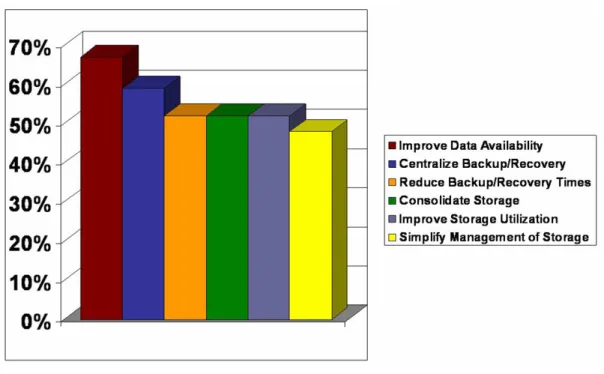
Figure One: What Are the Main Drivers for Implementing Storage Networking?
ESG believes that the fact that SAN storage systems are becoming easier to implement will drive their adoption. While other IT priorities prevent SAN implementations, ESG feels that if the process of deployment and management were less complex, companies would increase the priority of implementing SANs. SAN solutions are becoming much easier to implement and manage. Additionally, IP SAN itself is easier than FC, especially with IP and Ethernet expertise so abundant. Microsoft has done what it can to make IP SAN environments easier and more accessible.
The State of iSCSI-based IP SAN: 2006
What is an iSCSI-based IP SAN? To answer that question, let’s begin with the SCSI protocol. SCSI is a well-defined protocol that was developed so that applications could communicate and store data on SCSI hard disk drives. However, SCSI is not a network technology and therefore an extension was created, which is known as Fibre Channel (FC). The FC protocol uses SCSI commands and therefore is highly integrated with applications that already “speak” SCSI. FC has gained widespread success due to the transparency of integration with the numerous applications that support the SCSI protocol. However, FC requires specialized adapters and switches in order to build a SAN. IP SAN uses the iSCSI protocol and, like FC, is an extension of the SCSI protocol that enables networking. iSCSI-based IP SAN also uses SCSI commands and therefore has the same advantage as FC of being highly integrated and transparent. One of the key advantages of iSCSI-based IP SAN is that it uses Ethernet as its medium and does not require specialized networking infrastructure.
The IP SAN Promise
The promise of IP SAN is that it is cost effective and easy to manage. With it, implementing a SAN becomes a no-brainer decision. Many SMB companies are resistant to using FC because of the additional cost and complexity. And while the cost of FC is being driven down, it still cannot compare to the inexpensive solution of implementing an IP SAN over Ethernet. A FC SAN requires specialized host bus adapters (HBA) but IP SAN can leverage native Ethernet ports that come with each server. And while FC switches are also coming down in price. Ethernet switches are substantially less expensive.
The number of Ethernet ports shipped on an annual basis eclipses FC. As a result, the sheer quantity of Ethernet ports dictates the price and profitability. Certainly, FC switch vendors can reduce pricing but would need to take a substantial hit in terms of profitability in order to be competitive with Ethernet. This does not create a sustainable business model. It is an issue of scale. FC is a lake and Ethernet is the world’s oceans. Most IT departments will tell you that lack of FC expertise is not one of the major reasons that have prevented them from implementing a SAN. IT personnel typically welcome the challenge of new technologies and embrace the idea of gaining expertise in different areas. Other IT priorities take precedence over deploying a SAN because of the amount of time and resource required to research and implement one. Therefore, the lack of FC expertise can indirectly slow down the process of implementing a FC-based SAN.
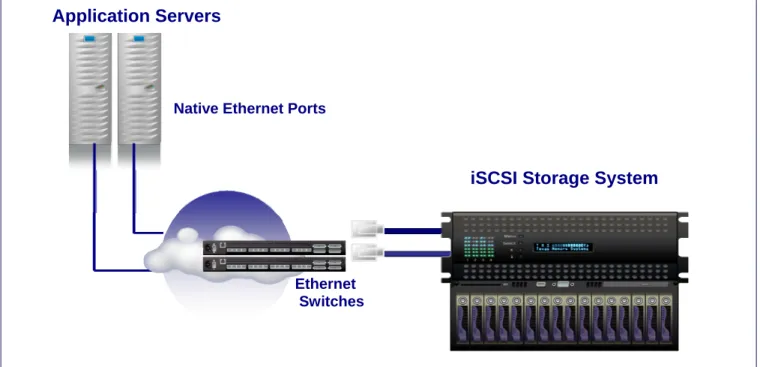
Figure Two: IP SAN
Application Servers
iSCSI Storage System
Native Ethernet Ports
Ethernet Switches
Implementing an iSCSI protocol-based IP SAN is essentially easier than implementing an FC protocol-based FC SAN. First, IP SAN leverages the IP and Ethernet expertise that exists in companies of all sizes today. Second, and perhaps one of the most important advantages that IP SAN has over FC, is the early and focused commitment of Microsoft. Early on, Microsoft developed IP SAN drivers that are native to the Windows operating system. Microsoft has developed a number of tools including Virtual Disk Services (VDS) and Virtual Shadow copy Services (VSS) and integrated its Microsoft Management Console (MMC) to work with external storage systems. Therefore, a Windows Administrator can use common and familiar tools to implement and manage an IP SAN. Additionally, most major Operating Systems have caught up and released native support for iSCSI.
IP versus FC Performance
There is still a great deal of confusion concerning IP performance in comparison to FC for implementing a storage solution. Both of these SAN interconnects are typically measured by bandwidth with “2 Gb” FC SANs dominating the market today and “1 Gb” Ethernet used for the majority of IP SANs. However, while bandwidth can have an impact on performance, it is not synonymous with speed.
Consider the following analogy. Two buses are transporting passengers at 60 miles per hour. One bus can hold 30 passengers and the other can hold 15. If both buses transport 10 passengers 30 miles away they both are able to get their 10 passengers to their destination in 30 minutes.
However, let’s compare both buses at full capacity. The first bus carries 30 people and the second bus carries 15. The results will now change. The first bus can transport 30 people to the destination in 30 minutes while the second bus can only transport 15 people to the destination in the same amount of time. You wouldn’t say that the first bus was faster, but what you could say is that it was able to get more passengers to the destination within the same period of time.
The same difference exists between FC and IP SAN. A 2 Gb FC network has double the bandwidth of a 1 Gb Ethernet network. If the amount of data being transferred over the two networks uses the “full capacity” of their respective bandwidth protocols, the Ethernet network will get less data to the destination than the FC network in the same amount of time. However, most applications are not bandwidth-intensive to this degree. Therefore ESG feels that only on the rarest of occasions, if ever, will the performance difference be felt. Databases and e-mail are extremely common applications in most, if not all, companies, and neither of them is bandwidth-intensive. Therefore, companies will not see a performance difference on a 2 Gb FC network versus a 1 Gb Ethernet network.
Additionally, ESG spoke to one customer who has implemented the Microsoft Round Robin capability, with its iSCSI initiator that essentially aggregates Ethernet bandwidth. This customer claims that it has allowed them to experience enormous amounts of aggregated bandwidth that easily eclipses their FC infrastructure. Similar functionality is not available with FC. Therefore, the issue of FC bandwidth superiority over Ethernet is not altogether black and white.
IP Reliability for Storage Networking
ESG has heard objections that IP is not as reliable as FC for a storage network. For example, critics claim that Ethernet, with dropped packets, out of order delivery, and routine link failures, is ill-suited for storage traffic, where not a single byte of data can be lost. This is a misconception. IP is a closed loop system based on transaction-based exchanges. The SCSI exchange protocol that guarantees reliable command, data, and response transfers is the same as that used over FC. ESG is aware of thousands of mission-critical applications that cannot tolerate data loss or unpredictable performance currently deployed over IP SAN. These environments are reliable and have the same high levels of data integrity as FC.
ESG has also heard erroneous claims that IP SAN has poor error recovery capabilities and lacks multi-path support. Ethernet trunking and driver level multi-path I/O (MPIO) are being used in highly available Microsoft and Linux deployments. End to end solutions based on session level Error Level 2 recovery as defined in the IP SAN specification are available on the market. Version 2 of the Microsoft IP SAN initiator supports all three error levels (0, 1, and 2).
The number of highly available mission-critical applications deployed on IP SAN storage systems is growing rapidly. ESG has spoken with a number of customers who have replaced FC SANs with IP SAN for their core applications and other companies who have bypassed FC and went right to IP SAN for their entire SAN infrastructure. Additionally, one of the most widely used applications for IP SAN is e-mail, which is considered mission-critical by the majority of customers whom ESG has interviewed.
Storage Systems and IP SANs
One of the most important drivers of the IP SAN market is the increased number of storage system products available on the market for customers to choose from. This gives customers options as to which vendor they want to work with and a wide range of products and classes of storage from which to choose. The initial decision whether to deploy an IP SAN is important, but choosing the storage system and vendor to work with is even more essential.
When evaluating storage systems, there are a number of things to consider. Ease of use and ongoing management are on top of the list. Intuitive management interfaces, as well as integration with different operating system tools and applications are highly desired capabilities. Data protection is an essential element since one of the fundamental drivers of implementing a SAN is improving data availability. For example, snapshot technologies are core to improving data availability as well as providing an easy to use mechanism to recover deleted or corrupt data.
Snapshot technology is one of the most useful data management and protection features, providing an easy to use and cost efficient method for creating protection copies of data. A snapshot essentially is a frozen image of primary data at a specific point in time. The snapshot image is read-only and cannot be edited, deleted, or corrupted. However, not all snapshot technology is created equal. The most efficient snapshot technology does not actually write new data but instead creates logical pointers. This approach is fast and essentially does not require any additional disk capacity. The other snapshot method is a copy on write (CoW) and creates a copy of changed data and stores it in a pre-allocated pool. This method requires additional capacity and, at the time of copy, takes up system resources, which may impact performance.
Writable snapshots are a relatively new technology. Snapshots protect data by being unalterable and read-only, making writable snapshots a bit of an oxymoron. However, the ability to turn a read-only snapshot into a writable snapshot can be very useful. Every snapshot solution provides a mechanism to restore snapshot images and make them read/write so that users can edit them again. This process is different than a writable snapshot.
While read-only snapshots are used to protect and recover primary data, writable snapshots are used to provide working copies of primary data. Writable snapshots have the same advantages as read-only snapshots, including near instantaneous creation and space efficiency, as described above. As with read-only snapshots, writable snapshots require no additional capacity at creation and will only require disk space for new data. Writable snapshots enable companies to create additional logical sets of writable data to be used for production purposes. Writable snapshots are used for application testing, load balancing, and data mining.
There are a number of capabilities or features that should also be considered:
• Remote Mirroring. Many companies use remote mirroring as part of a disaster recovery plan.
• Thin Provisioning. Thin provisioning is “just in time capacity” that essentially eliminates allocated but unused storage or stranded storage. It also greatly simplifies storage provisioning tasks, reducing administration costs. Customers should look at storage systems that support thin provisioning differently than those that do not when evaluating the initial capacity configuration, budgeting and planning capacity growth over time, and calculating the total cost of ownership.
• Internal Storage Virtualization. Some storage systems create virtual disks, using the disk drives as a logical pool of storage. This simplifies management and can significantly improve performance.
• Dual Parity RAID Protection. This ensures that no data is lost even if two drives fail in a RAID parity group. Why is that important? The additional protection is good insurance with the continued use of SATA drives and the increase in capacity per drive.
Determining which storage system to use is a core part of implementing a SAN. Each company must evaluate its requirements for ease of use, performance, features, and functions. It is also important to dig a little deeper since not all features and functions provide the same levels of benefit even though they may be called the same thing by different vendors.
The IP SAN Market: 2006
ESG has witnessed IP SAN-based IP SANs go from a concept to a new technology through early adoption, and now to its place in the early mainstream. ESG informally estimates that there are over 12,000 IP SAN deployments in production environments and that number is growing rapidly. ESG predicts that the number of IP SAN deployments should easily double in 2006. Large companies are using IP SAN for departmental servers, remote offices, and tier two applications. Small and medium-sized companies are using IP SAN as a core storage network and for all applications from mission-critical to disk-to-disk backup. ESG has not spoken to one customer who has complained about the ease of management, performance, or reliability of IP SAN. In fact, more than one company has told ESG that they will never go back to FC.
IP SAN Market Dynamics
There is a number of market dynamics driving the success of IP SAN:
• Fundamentally IP SAN is compelling because it uses Ethernet, which is widely adopted throughout the world in companies and organizations of all sizes and within all industries.
• Microsoft and Unix vendors have embraced IP SAN, providing native drivers and embedded tools within their operating systems to make the implementation and ongoing management of IP SAN easy and cost effective.
• VMware virtual machine solutions support IP SAN, including core functionality like remote booting off of the IP SAN.
• There are more IP SAN-based products for customers to choose from. Startups, emerging vendors, and storage leaders now provide solutions and have committed time, money, and resources to supporting IP SAN. This provides more options for customers to choose from. Additionally, the support of more vendors essentially validates that IP SAN is a viable technology.
• Adoption of IP SAN has escalated from 2,500 at the end of 2004 to over 12,000 in Q1 2006.2 • Lower cost storage systems and price per capacity is reduced regularly.
• IP SAN Storage solutions are capable of improving data availability through centralized backups and fast backup and recovery.
• IP SAN provides the ability to consolidate storage to improve the utilization and simplify the management of storage systems.
There are currently hundreds of thousands of SAN implementations but the potential exists for that number to be millions. According to the US Census 2002 study, there are over 508,000 US-based companies with between 20 and 99 employees. There are over 82,000 companies with between 100 and 499 employees. These 82,000 companies have over 332,000 offices. And there are over 17,000 US-based companies with over 500 employees and over one million offices. World-wide, the numbers are much larger still. Clearly, there is an enormous potential for SAN adoption. IP SAN enable this adoption to a much larger extent than FC has been able to accomplish.
2
Figure Three: US-based Companies by Employees
IP SAN Uses and Applications
ESG is seeing IP SAN used for any number of applications, including database, e-mail, streaming media, high performance computing, digital archiving, and disk-to-disk backup. Additionally, IP SAN is being deployed in mixed operating system environments including Windows, Linux, and Unix variants.
ESG has found that many customers are implementing IP SANs for their Microsoft applications with a priority being given to MS Exchange and applications that work with MS SQL. This is due in large part to the fact that many of these companies were using DAS or older 1 Gb FC SAN for these applications. Additionally, the support that Microsoft has provided for IP SAN has been a major factor in adoption.
ESG Customer Interview
ESG has spoken to a number of customers who are using IP SAN-based IP SAN. For this report, ESG interviewed a specific customer who is a great example of the value of IP SAN. It is a small firm of approximately 200 people. They used a combination of DAS storage and 1 Gb FC SAN for all of their applications. Because they were using both DAS and FC they have had experience with other alternatives for implementing storage.
The company was actually planning on implementing a 2 Gb FC SAN and acquired the necessary infrastructure to do so. However, at the time, Windows did not support the particular multi-path driver they required with their storage system. They decided to experiment with IP SAN. The experiment turned into a production IP SAN. They ran their Exchange server in a DAS environment and performance was inadequate. Although they are a 200 person firm, they are power e-mail users with 20 to 25 e-mail transactions per second, per user. The average user gets 2,000 e-mails a day. The DAS system was too unwieldy to manage. Performance was slowing down response time and actually caused disconnects and timeouts.
The company also replaced the 1 GB FC SAN that supported its SQL database. The applications running on SQL included their accounting system, document management database, and contact database. Their environment experiences a high level of transactions.
In Thousands
The manager of the group is extremely impressed with the performance of the IP SAN when compared to the performance of both their DAS storage and 1 Gb FC SAN. The IP SAN provides impressive transactional performance that solved the user access time issues with e-mail. In fact, the manager stated that they have been experiencing “screaming performance.”
The customer stated that he was also pleased with the management of the IP SAN. His network administrator is a Cisco expert and can leverage her knowledge to set up the IP SAN fabric. “She understands VLANs and port level configurations. She had to have those skills – that’s her job and we can reuse that skill set,” he said. As he pointed out, every different FC switch and HBA comes with its own set of tools and applications that require some education process. That is true of Cisco as well but they already have people who know these systems. The company is using existing Cisco 6000 switches and has configured dedicated VLANs for the IP SAN. This was infrastructure they had already invested in. “But even if we went out and bought four 1 Gb Ethernet switches, the cost would have been less than one FC switch with redundant power supplies,” he stated.
This IT manager is a major proponent of IP SAN and would only use FC if they had a dedicated server for a bandwidth intensive application. However, for their core applications and data, they will continue to use IP SAN even though they acquired the FC infrastructure and Windows now supports the drivers they need.
ESG’s View
There is a great deal of value in networking storage and yet the majority of storage is still direct attached. Imagine if our servers and PCs weren’t networked. We couldn’t share information or send e-mails or access the Internet. Imagine if our office telephone systems weren’t networked and we couldn’t transfer phone calls or set up conference calls. And yet storage networking has not achieved nearly the adoption rates of other technologies that we network. The reasons for this ultimately are cost and complexity.
iSCSI-based IP SAN is fundamentally easier and less expensive than FC. Additionally, there are not any real compromises or trade-offs that customers have to make when choosing IP SAN over FC. IP SAN performance, reliability, and maturity are at the point where they are no longer a risk. In fact, iSCSI-based IP SAN is now embraced by companies both large and small (and everything in between). Small and medium-sized businesses are adopting IP SAN and using it for mission-critical applications as their core SAN infrastructure. Large companies and organizations are implementing IP SAN in the data center, at remote sites, and for departmental servers. iSCSI-based IP SAN opens up new and untapped opportunities because it provides an easier and less expensive approach than FC SAN. Storage networks as a whole have not achieved the same level of simplicity and cost effectiveness required to make it a “no-brainer” decision. IP SAN has the potential to get the entire industry closer to that goal.
All trademark names are property of their respective companies. Information contained in this publication has been obtained by sources the Enterprise Strategy Group (ESG) considers to be reliable but is not warranted by ESG. This publication may contain opinions of ESG, which are subject to change from time to time. This publication is copyrighted by The Enterprise Strategy Group, Inc. Any reproduction or redistribution of this publication, in whole or in part, whether in hard-copy format, electronically, or otherwise to persons not authorized to receive it, without the express consent of the Enterprise Strategy Group, Inc., is in violation of U.S. copyright law and will be subject to an action for civil damages and, if applicable, criminal prosecution. Should you have any questions, please contact ESG Client Relations at (508) 482-0188.