Manmeet kaur Marwah Page 194 IMPACT OF SELF HEALING PRACTICES IN RELATION TO LIFE ORIENTATION AND
POSITIVE BENEFIT AMONG INDIVIDUALS WITH ILLNESS
Manmeet kaur Marwah
Department of psychology, Panjab university, Chandigarh (India)
Abstract
Illness, whether acute or chronic, often impacts much more than just our physical health and well-being. The mind and body both play a role in coping with, recovering from, and preventing a wide range of illnesses. This relationship between our psychological selves and physical selves is often complex and, in some cases, is poorly understood, but that doesn’t make it any less important or revelatory. The investigation was designed to study the impact of self-healing practices, such as meditation, yoga, exercises, etc., on individuals whose daily life functioning is hampered with some sort of illness on life orientation and Positive benefit of their illness. The sample was collected through purposive sampling technique and consisted of 30 individuals both males and females who have difficulty in normal functioning due to their illness. The sample was divided into two groups i.e. those who practiced self-healing and those who didn’t practice self-healing. The tests administered were life orientation test – revised and silver linings questionnaire (Samantha C. Sodergren and Michael E. Hyland). The data was analyzed through t-test and results showed significant difference among individuals who practice self-healing practices and who don’t with respect to life orientation, however no significant difference was found with respect to the extent to which people believe their illness has had a positive benefit despite the negative consequences of being ill.
Keywords: illness, life orientation, positive benefit, self-healing
Introduction
Illness isn’t just a personal issue, though it may feel acutely personal to those who are suffering from it. In fact, illness can cast a much wider net, impacting not only the individual but also anyone who interact with that individual [1]. These psychological issues can affect the perception, treatment, and well-being of those who have everything from a simple infection to a life-threatening illness.It’s not just chronic illnesses that carry a psychological weight; acute illnesses can pose a problem, too. It is said that the root of an illness is in the mind or consciousness. So, by attending to the mind, clearing it of any disturbances, the recovery speeds up [2].
The psychology of healing
Manmeet kaur Marwah Page 195 The mind body connection
Much of what happens in our bodies is outside of our conscious control, but not everything. While our brains unconsciously dictate everything from breathing to digesting lunch, our feelings, actions, and even overall outlook on life are things under our control that can, and often do, have a major impact, for better or for worse, on how our bodies function [4]. Relationships between the mind and body need not always be negative, however. Research also suggests that a positive mental state can help alleviate symptoms of certain diseases. A recent study at the University of South Carolina found a strong connection between a personal emotional and physical well-being among those with Type I diabetes. Those who reported feeling better mentally, also felt better physically, while those who felt worse often reported having higher blood sugar. Researchers believe that stress as well as coping methods for dealing with the disease can play a major role in the severity of symptoms and the development of additional life-threatening conditions [5].
As it turns out, an optimistic mental outlook can actually have a significant impact on nearly every aspect of health. Researchers at University of Pittsburgh followed more than 100,000 women over the course of 15 years. Those who self-reported as being optimistic were 14% less likely to die from any cause over the course of the study than pessimists and 30% less likely to die from heart disease. The optimists in the study were also at a lower risk of having high blood pressure or diabetes, and overall were less likely to smoke cigarettes. The study also revealed that being trusting, rather than cynical and hostile, has serious health impacts, too. Those who were cynical and hostile were 16% more likely to die during the study period and 23% more likely to get cancer.
While a negative attitude, stressful life, or emotionally tumultuous experience isn’t a guarantee that health outcomes will be poor, it does increase the risk of disease, depression,
and numerous kinds of health problems. However, the connection between what we think and feel and our overall health operates, it’s clear that sometimes mind really does have power over matter.
Role of self-healing
Yoga is recognized as a form of mind-body medicine that integrates an individual's physical, mental and spiritual components to improve aspects of health, particularly stress related illnesses [6]. Regular practice of yoga promotes strength, endurance, flexibility and facilitates characteristics of friendliness, compassion, and greater self-control, while cultivating a sense of calmness and well-being. Sustained practice also leads to important outcomes such as changes in life perspective, self-awareness and an improved sense of energy to live life fully and with genuine enjoyment. The practice of yoga produces a physiological state opposite to that of the flight-or-fight stress response and with that interruption in the stress response, a sense of balance and union between the mind and body can be achieved [7][8].
These studies demonstrate that while healing may be a physical process, self-healing practices such as meditation, yoga and positivity can all play a role in boosting the body’s ability to bounce back from serious injury or illness.
Rationale of the Study
Manmeet kaur Marwah Page 196 Objectives
The study aims to compare the individuals suffering from some sort of illness who practice self-healing practices such as meditation, yoga, exercise, etc and those who don’t practice with respect to life orientation.
The study aims to compare the individuals suffering from some sort of illness who practice self-healing practices such as meditation, yoga, exercise, etc and those who don’t practice with respect to the extent to which people believe their illness has had a positive benefit despite the negative consequences of being ill.
Hypotheses
It is expected that individuals with illness who practice self-healing are more optimistic towards life than their counterparts.
Individuals with illness, practicing self-healing, would believe more in the fact that their illness has had a positive benefit despite the negative consequences of being ill than their counterparts.
Sample
In the present study, a total sample of 30 individuals both male and female were taken, out of which 15 were the individuals suffering from some sort of illness who practice self-healing such as meditation, yoga, exercise, etc and 15 were those who don’t practice, between the age group of 16-24 years. Homogeneity of the sample was maintained by selecting individuals with illness who have disturbed daily life functioning.Sampling technique: purposive sampling
Measures
Life Orientation Test - Revised (LOT-R) A 10-item measure of optimism versus pessimism. Of the 10 items, 3 items measure optimism, 3 items measure pessimism, and 4 items serve as fillers. Respondents rate each item on a 4-point scale: 0 = strongly disagree, 1 = disagree, 2 = neutral, 3 = agree, and 4 = strongly agree. LOT-R is a revised version of the original LOT (Scheier & Carver, 1992). The original LOT had 12 items: 4 worded positively, 4 worded negatively, and 4 fillers.
6.2 Silver Lining Questionnaire
(Samantha C. Sodergren and Michael E. Hyland)
The Silver Lining Questionnaire measures the extent to which people believe their illness has had a positive benefit despite the negative consequences of being ill. Research suggests that this positive interpretation is not due to a form of self-delusion but instead reflects personal growth and that it can be enhanced by the context. Its role in recovery from illness is complex.
Data Analysis
The present study was carried out to study the effects of self-healing practices on people suffering with some sort of illness with respect to life orientation andthe extent to which people believe their illness has had a positive benefit despite the negative consequences of being ill. For this purpose, life orientation test and silver linings questionnaire were administered to the participants. Students t test was applied to the collected data in order to study the significance if any.
Manmeet kaur Marwah Page 197
df= 28
**p < .01.
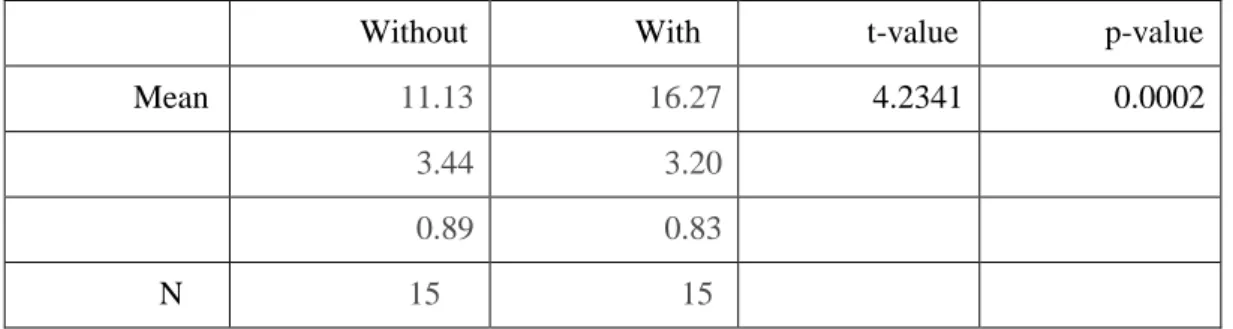
The mean of individuals practicing exercise is 16.27, whereas mean of individuals not practicing exercise is 11.13; SD of individuals with exercise is 3.20 and SD of individuals without exercise is 3.44; SEM of individuals with exercise is 0.83 and SEM of individuals without exercise is 0.89. The obtained two tailed P value equals 0.0002 and the t value equals to 4.2341. The finding reveal that there is a significant difference among individuals suffering from some sort of illness who practice self-healing exercises such as meditation, yoga, exercise, etc and those who don’t practice with respect to life orientation.
TABLE 2: student’s t-test on the extent to which people believe their illness has had a positive benefit despite the negative consequences of being ill, between the two groups.
The result is not significant at p < .05.
The mean of individuals practicing exercise is 16.47, whereas mean of individuals not practicing exercise is 13.53; SD of individuals with exercise is 8.62 and SD of individuals without exercise is 10.08; SEM of individuals with exercise is 2.23 and SEM of individuals without exercise is 2.60. The obtained two tailed P value equals to 0.3988 and the t value equals to 0.8568. The findings clearly indicate
that there is no significant difference among individuals suffering from some sort of illness who practice self-healing exercises such as meditation, yoga, exercise, etc and those who don’t practice with respect to the extent to which people believe their illness has had a positive benefit despite the negative consequences of being ill.
Without
self-healing
With
self-healing
t-value p-value
Mean 11.13 16.27 4.2341 0.0002
SD
3.44 3.20
SEM
0.89 0.83
N 15 15
Without
self-healing
With
self-healing
t-value
p-value
Mean 13.53 16.47
0.8568 0.3988
SD 10.08 8.62
SEM 2.60 2.23
Manmeet kaur Marwah Page 198 Discussion
The study aims to compare the individuals suffering from some sort of illness who practice self-healing exercises such as meditation, yoga, exercise, etc and those who don’t practice with respect to life orientation and the extent to which people believe their illness has had a positive benefit despite the negative consequences of being ill. Illness, whether acute or chronic, often impacts much more than just our physical health and well-being. The mind and body both play a role in coping with, recovering from, and preventing a wide range of illnesses, and there are often major ramifications for both if either sees major disruption. This relationship between our psychological selves and physical selves is often complex and, in some cases, is poorly understood, but that doesn’t make it any less important or revelatory.
"Exercise is something that psychologists have been very slow to attend to," agrees Michael Otto, PhD, a professor of psychology at Boston University. "People know that exercise helps physical outcomes. There is much less awareness of mental health outcomes — and much, much less ability to translate this awareness into exercise action."
The results as seen from table 1 on individuals suffering from some sort of illness who practice self-healing exercises such as meditation, yoga, exercise, etc and those who don’t practice with respect to life orientation show a significant difference with the value of p coming out to be to 0.0002. The mean of with self-healing group is more (16.27) as compared to the mean of without self-healing group (11.13). Hence our hypothesis is accepted which states that individuals with illness who practice self-healing are more optimistic towards life than their counterparts. One of the reasons for this could be that individuals who practice self-healing practices are more positively oriented towards their life than those who don’t. Some studies in this area also supports this finding. Exercise may boost a depressed person's outlook by helping
him return to meaningful activity and providing a sense of accomplishment. Then there's the fact that a person's responsiveness to stress is moderated by activity. "Exercise may be a way of biologically toughening up the brain so stress has less of a central impact," Otto says. According to table 2, the meanof the individuals suffering from some sort of illness who practice self-healing exercises such as meditation, yoga, exercise, etc and those who don’t practice with respect to the extent to which people believe their illness has had a positive benefit despite the negative consequences of being ill, are 16.47 and 13.53 respectively. Although the mean of individuals who practice self-healing is greater than their counterparts, but there exist on significant difference among the two groups with the value of p coming out to be 0.3988. Hence our hypothesis is rejected, which states that individuals with illness, who self-healing, would believe more in the fact that their illness has had a positive benefit despite the negative consequences of being ill than their counterparts. One of the reasons for this could be the small sample size with various illness of different intensity and severity. Research findings show that self-healing exercises such as yoga has the power to heal even the severe illness patients.
According to the 2009 WHO Epilepsy fact sheet, there exist over 50 million worldwide documented cases of epilepsy. With the possibility of lifelong seizures, treatments usually involve management therapy. Patients with epilepsy who do not respond to conventional anti-seizure medications, responded in alternative treatment modalities, such as yoga.
Manmeet kaur Marwah Page 199
in the United States during 2002.Yoga is considered a mind-body intervention that is used to reduce the health effects of generalized stress. Yoga is believed to calm the nervous system and balance the body, mind, and spirit.
Conclusion
The present study was aimed at seeing the impact of self-healing practices on individuals who suffer from illness with respect to life orientation and the belief that their illness has had a positive benefit despite the negative consequences of being ill.The results obtained showed positive results on individuals who practiced self-healing with respect to life orientation. Therefore, it can be said that self-healing exercises may play a role in positively effecting the perception of people in relation to their illness and how it may help them better manage their daily lives along with their illness. However, the beliefthat their illness has had a positive benefit despite the negative consequences of being ill is not much influenced with practicing self-healing. This could be because of the limitation of the study of taking a small sample size with various illness of different intensity and severity. The research could have also been studied with respect to gender differences on both the aspects.This study will not only contribute to the field of health psychology, but also help in forming interventions and treatments for people suffering from illness. It will also focus on the benefits of self-healing exercises and how important they are.
References
[1] Apple, D. (1960). How laymen define illness. Journal of Health and Human Behavior, 1, 219-225.
[2] Altman, D. G. (1982). Understanding health attitudes and conceptions of health and illness developmentally: implications for health education.
[3] Skelton, J. A. & Croyle, R. T. (1991). Mental representation in health and illness. Springer-Verlag New York Inc.
[4] Hinkle, L. E. (1961). Ecologic observations of the relation of physical illness, mental illness and social environment. Psychosomatic Med., 23 (4), 289-290.
[5] Wright B., Physical Disability, a Psychological Approach, Harper, N.Y., 1960
[6] Desikachar K, Bragdon L, Bossart C. The yoga of healing: Exploring yoga's holistic model for health and well-being. Int J Yoga Ther. 2005;15:17–39.
[7] McCall T. New York: Bantam Dell a division of Random House Inc; 2007. Yoga as Medicine.