Developing Efficient Implementations of Bellman–Ford and
Forward-Backward Graph Algorithms for NEC SX-ACE
Ilya V. Afanasyev1, Alexander S. Antonov1, Dmitry A. Nikitenko1,
Vadim V. Voevodin1, Vladimir V. Voevodin1,
Kazuhiko Komatsu2, Osamu Watanabe2, Akihiro Musa2,
Hiroaki Kobayashi2 c
The Authors 2018. This paper is published with open access at SuperFri.org
The main goal of this work is to demonstrate that the development of data-intensive appli-cations for vector systems is not only important and interesting, but is also very possible. In this paper we describe possible implementations of two fundamental graph-processing algorithms for an NEC SX-ACE vector computer: the Bellman–Ford algorithm for single source shortest paths computation and the Forward-Backward algorithm for strongly connected components detection. The proposed implementations have been developed and optimised in accordance with features and properties of the target architecture, which allowed them to achieve performance compara-ble to other traditional platforms, such as Intel Skylake, Intel Knight Landing or IBM Power processors.
Keywords: graph algorithms, NEC SX-ACE, vector computing, data-intensive applications.
Introduction
With a modern variety of hardware and software solutions in supercomputing, it is very im-portant to study fundamental properties of algorithms in order to understand which architectures are more suitable for various groups of algorithms. One very important and challenging example is a group of data-intensive algorithms: those algorithms usually stress target platform memory subsystem, as a result demonstrating low performance, high latency and poor data-cache us-age due to low data locality. Graph algorithms represent data-intensive applications extremely well since they tend to have an enormous amount of random memory accesses, paired with low computational complexity. Moreover, graph processing is extremely relevant nowadays since it is used in various important real-world applications, such as web-graphs and social-networks processing. On the hardware side, vectorisation is an important feature of modern processors. NEC company has a long history and a lot of experience in developing vector systems with its computers having a large amount of unique features, such as extremely long vector length. More-over, NEC computers are equipped with high-performance nodes and high-bandwidth memory, what makes them a good candidate for development of data-intensive applications. Since the area of data-intensive application development (and particularly graph algorithms) for vector systems is currently not studied enough, this paper describes implementation details of two fundamental graph processing problems for a NEC SX-ACE computer: single source shortest paths computation and strongly connected components search.
1. Target Platform and State of the Art
In this work we investigate implementations for a NEC SX-ACE computer. A single SX-ACE node includes 4 vector cores, each one with 1 GHz clock frequency. A single vector processing unit (VPU) of each core is capable of processing vectors of 256 length. The peak vector performance
of a single NEC SX-ACE socket is 256 Gflop/s, while peak scalar performance is only 4 Gflop/s per socket. Each vector core also supports out of order execution for vector load and store operations, with advanced data forwarding in vector pipes chaining. Each node is equipped with 256 GB/s high-bandwidth memory. Therefore, the bytes per flop ratio (the ratio of the peak performance to the memory bandwidth) is equal to 1, which is somewhat higher compared to other scalar and accelerator computers.
The approaches described in this paper are suitable only for shared-memory architec-tures (e.g. servers or individual supercomputer nodes). Graph algorithms implementations for shared-memory architectures are generally much more efficient compared to implementations for distributed-memory systems, since graph-processing problems tend to have an enormous amount of inter-node communications, what can easily become a bottleneck for overall perfor-mance. Moreover, modern studies demonstrate that platforms with shared-memory architecture are widely used to process various real-world graphs (social networks, road graphs and many others). There are not many currently existing studies and researches, which cover the develop-ment of graph algorithms or other data-intensive applications on NEC systems. However, there are several existing approaches describing the development of graph algorithms for other systems focused on vectorisation, such as Intel Knight Landing processors [1, 3].
2. Algorithms
In this paper two fundamental graph processing problems are investigated: single source shortest paths (SSSP) and strongly connected components (SCC). The SSSP problem implies finding the shortest paths in an undirected weighted graph from the selected source vertex to other vertices. The SCC problem implies partitioning a directed unweighted graph into disjoint sets of vertices, each one representing a strongly connected component where each vertex is reach-able from another. In order to solve the shortest paths problem, the Bellman–Ford algorithm is used, while the Forward-Backward algorithm with a trim step is used for solving the strongly connected components problem. Those algorithms, together with possible approaches for their parallel implementation are described in detail in [2, 4]. From the computational point of view the Bellman–Ford algorithm requires both floating point and integer arithmetics together with frequent indirect memory accesses. In the meantime, the Forward-backward algorithm requires only integer arithmetics with frequent indirected memory accesses, and has a more complex nested parallelism potential. Furthermore, the Bellman–Ford algorithm has a slightly higher computational complexity than the Forward-Backward algorithm, since it operates with undi-rected graphs. Another important property of both algorithms is that they can be implemented without atomic operations usage, which tend to strongly impede vectorisation.
3. Implementation Details
can greatly help to improve data locality and avoid bank conflicts, which results in significantly better performance.
In order to improve data locality, the following sorting strategy is used: input graph edges are sorted in a way that edges, stored in adjacent memory cells, point to adjacent cells in reachability (or distances) arrays. This reordering results into gather and scatter vector operations being much more efficient for adjacent edges (since information is gathered from adjacent cells of memory in distances or reachability array). It is also possible to remove loops and multiple arcs during this pre-processing stage. The proposed optimisation of storage formats provides almost up to a 20x performance improvement compared to the implementation with randomly sorted edges of the input graph.
To achieve efficient parallelisation and vectorisation inside a single NEC SX-ACE socket, sev-eral OpenMP and compiler-specific directives are inserted. The #pragma parallel for OpenMP directive is used with theschedule(guided,1024)OpenMP clause, in order to reduce overheads of synchronisations between threads; #pragma cdir nodepdirective is used to provide the informa-tion to the compiler that there is no dependency (caused by indirect memory accesses) among loop iterations, which can prevent vectorisation. Moreover, #pragma cdir vprefetch directive,
#pragma cdir vovertake and #pragma cdir vob directives are used to effectively issue vector gather and scatter instructions, which can easily become bottlenecks, as early as possible by overtaking other vector instructions. To effectively apply the overtakes of the vector gather and scatter instructions, loop unrolling is applied manually. Both implemented algorithms demon-strate high (above 99%) vector operation ratio (percentage of vector operations with maximum length inside the generated code) with an average vector length of 256, which means that the whole code for both algorithms was successfully vectorised.
4. Performance Evaluation
Conclusion
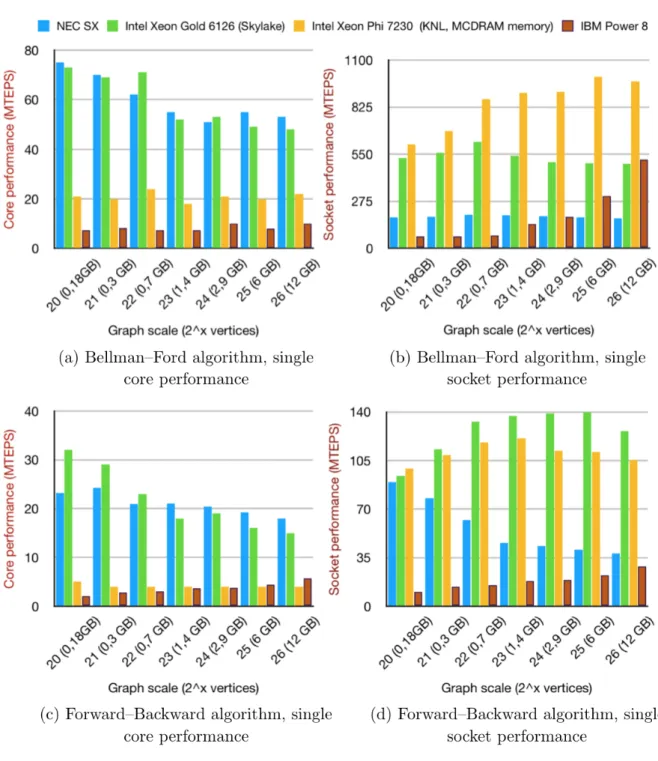
In this paper efficient implementations of two important graph-processing algorithms for NEC SX-ACE platform have been described. The performance values have been compared to the performance of other implementations, obtained on various Intel and IBM platforms capable of vector data processing. The provided comparison demonstrates that NEC SX-ACE architecture allows to achieve the highest per-core performance among other architectures, but unfortunately lacks per-socket performance.
Acknowledgments
The research is carried out using the equipment of the shared research facilities of HPC computing resources at Lomonosov Moscow State University supported by the project RFMEFI62117X0011 and the computational resources of Cyberscience Center at Tohoku Uni-versity supported by Joint Usage/Research Center for Interdisciplinary Large-scale Information Infrastructures in Japan (Project ID: jh170049-ISJ). The reported study was supported by the Russian Foundation for Basic Research, project No. 18-57-50005.
This paper is distributed under the terms of the Creative Commons Attribution-Non Com-mercial 3.0 License which permits non-comCom-mercial use, reproduction and distribution of the work without further permission provided the original work is properly cited.
References
1. Besta, M., Marending, F., Solomonik, E., Hoefler, T.: SlimSell: A vectorizable graph rep-resentation for breadth-first search. In: 2017 IEEE International Parallel and Distributed Processing Symposium (IPDPS). IEEE (may 2017), DOI: 10.1109/ipdps.2017.93
2. Fleischer, L.K., Hendrickson, B., Pınar, A.: On identifying strongly connected components in parallel. In: Lecture Notes in Computer Science, pp. 505–511. Springer Berlin Heidelberg (2000), DOI: 10.1007/3-540-45591-4 68
3. Jiang, L., Chen, L., Qiu, J.: Performance characterization of multi-threaded graph process-ing applications on many-integrated-core architecture. In: 2018 IEEE International Sym-posium on Performance Analysis of Systems and Software (ISPASS). IEEE (apr 2018), DOI: 10.1109/ispass.2018.00033