Abstract
Social capital and organizational commit-ment and performance have long been the sub-jects of many studies as these concepts drive organizational outputs. This study aims to inves-tigate the relationships between these concepts. The study collected data using a questionnaire survey comprising 26 questions conducted with 308 offi cers working in the tax offi ces of the provinces of Diyarbakır, Batman and Mardin in Southeastern Turkey. A separate form was used to collect some demographic variables from the respondents. The fi ndings indicate a positive and signifi cant relationship between social cap-ital and performance. This study also confi rmed that organizational commitment has a mediating effect between social capital and performance.
Keywords: social capital, organizational commitment, organizational performance, tax of-fi ce, structural equation modeling.
AN ANALYSIS OF THE SOCIAL
CAPITAL, ORGANIZATIONAL
COMMITMENT AND PERFORMANCE
IN THE PUBLIC SECTOR
OF SOUTHEASTERN TURKEY
Abdurrahim EMHAN
Aykut TONGUR
Irfan TURKOGLU
Abdurrahim EMHAN
Associate Professor, Ph.D, Department of Aviation Management, Civil Aviation College, Inonu University, SHYO Malatya, Turkey E-mail: [email protected]
Aykut TONGUR (corresponding author) Public Administrator, Ph.D,
Ministry of Interior, Ankara, Turkey Tel.: 0090-545-221.4036 E-mail: [email protected]
Irfan TURKOGLU Associate Professor, Ph.D,
Department of Financial Law, Faculty of Law, Zirve University, Gaziantep, Turkey
1. Introduction
For this study, a Structural Equation Modeling (SEM) was developed to analyze the relationships between social capital and organizational capital, and performance, and whether organizational commitment has a mediating eff ect on such relationships.
If an organization is to succeed and reach its targets, its staff must consistently perform at a high level. To maintain high productivity, an organization must have a high degree of organizational commitment. One premise of this study is that the perceptions of the tax offi cers who participated in this study must exhibit a positive att itude toward performance, organizational commitment, and social capital to facil-itate the collecting of a greater level of taxes to enhance the revenue of the country. To test this premise, we examined the amount of taxes collected in a particular area of Southeastern Turkey where a much lower than the average amount of taxes are collected compared with the rest of Turkey. Provinces like Diyarbakır, Batmanand Mardin collect a lower level of tax revenues compared with the other provinces of Turkey (Turkish Revenue Administration, 2013). If tax offi cials are to eff ectively ex-plain to tax payers that the collected taxes are used to provide public services, and motivate and facilitate taxpayers to undertake their responsibilities in an appropriate and timely manner, tax offi cers must be committ ed to higher performance and have a sense of responsibility and duty to inform and help taxpayers. Such att itudes and performance may motivate more taxpayers to pay their taxes, which in turn, would provide the country with more capital for economic development.
The provinces of Diyarbakır, Batman and Mardin are priority development areas in Turkey. However, this study was designed to be implemented in other provinces that are also priority development areas, especially in Southeastern Turkey, where there is a great deal of separatist activity. One of the goals of this study is to provide a successful demonstration of how the use of a SEM could be nationally generalized to acquire more reliable and valid scores for analyses that could be used to improve the decision-making process for changes to maximize profi ts in public sectors.
Over the last several years, social capital and organizational commitment and per-formance, and their positive contributions to the productivity of organizations have been the key concepts of studies in public administration. These concepts have been the subject of more studies than ever before because their benefi ts and advantages in the effi ciency and eff ectiveness of organizations have been explicitly seen and proven. These concepts have been studied individually or in diff erent combinations; howev-er, there have not been any studies in which all of these concepts have been examined for how they are associated with one another, especially in tax offi ces.
the study subjects from Diyarbakır, Batman and Mardin regarding social capital and organizational commitment or/and performance?
The eff ectiveness of tax offi ces and how they relate to the level of social capital may have an important role in the economic development of the country. A sense of trust, sincerity, commitment to work, and att ention to details by employees constitute the foundation for a higher level of organizational commitment. Offi cers, adminis-trators and other management people in leadership roles, who demonstrate commit-ment to organizational norms, can have positive eff ects on other staff members and can encourage them to strive for a higher level of performance in their own positions. One assumption of this study is that if offi cers working in tax offi ces achieve higher levels of performance, the rate of tax evasion will diminish and awareness about the importance of taxpaying will be developed, resulting in a signifi cant increase in the amount of revenue from taxes collected for the country. If this study produces reli-able and repeatreli-able data, it can make a positive contribution to the related literature and will assist public sector decision makers and other scholars studying these issues.
2. Social capital
Although the concept of social capital has att racted a signifi cant att ention over the last few years, there is no commonly accepted defi nition. Some scholars accept that social capital has three dimensions that form internal and external connections (Adler and Kwon, 2002; Lin, 2001; Putnam, 2000). Cohen and Prusak (2001) defi ne social cap-ital as networks of people who create fi nancial gains through cooperation based on trust, sharing and dynamic relationships. Nahapiet and Goshal (1998) studied the role of social capital as an intellectual capital developed within organizations, and defi ne the concept as the total net of relationships formed by individuals and social groups. These scholars investigated social capital in three dimensions which are structural, re-lational and cognitive. In their work on social capital, Leana and Pil (2006) addressed it as internal and external constructs that have the same three dimensions. Internal social capital is the construction and content of relationships among organizational actors. External social capital is the entry of data from external sources (Burt, 2000).
inves-tigations on social capital mainly focus on communication networks, social norms and trust building,and how these aspects have infi ltrated organizational culture and the climate that guides community (Karagül and Masca, 2005). Based on these sourc-es, another assumption of this study is that structural, relational and cognitive social capital exert positive eff ects on organizational performance.
3. Organizational commitment
Studies have indicated that employees with a higher level of organizational com-mitment have higher levels of performance and more success in achieving organiza-tional goals. Organizations investing in human resources and retaining employees are more likely to see improvements in the level of employee commitment and achieve-ment. Of particular importance is that employees are retained most often when em-ployees have a high level of job satisfaction. These emem-ployees also have lower levels of absenteeism and turnover intention (Bateman and Strasser, 1984; Suliman, 2002).
Diff erent scholars from diff erent research areas have defi ned organizational com-mitment in diff erent ways (Becker, 1960; Kanter, 1968; O’Reilly, 1989; Meyer and Al-len, 1991). For example, Morrow (1983) defi ned organizational commitment as the employees’ intention to stay and keep working in an organization and their adop-tion of organizaadop-tional goals and values. Meyer and Allen (1991) use the three most accepted dimensions to explain organizational commitment: emotional, normative, and continuance. Emotional commitment is the positive emotional relationship of an employee with the organization. Continuance commitment is the awareness of cost associated with leaving the organization. The normative commitment is an employ-ee’s sense of ethical responsibility and commitment toward the organization. The fi rst of these factors is based on how an employee internalizes and supports organization-al goorganization-als and vorganization-alues. The second one is when an employee works at a higher perfor-mance level, doing their best for the organization. The third represents an employee’s determination to make great eff orts on behalf of the organization, and the presence of a personal wish to stay and keep working in the organization (Durna and Eren, 2005).
4. Organizational performance
eval-uation reviews his/her levels of eff ort, eff ectiveness, defi ciencies, qualifi cations and profi ciencies, and should consider the person’s abilities and personal characteristics. The main objective of measuring and evaluating employee’s performance is to help administrators make good decisions about employee’s salaries, promotions, trials and transfers. In other words, measuring organizational performance is to measure the distance between the targeted position and the current one (Akal, 2005; Tongur, 2011).
Basic standards of evaluation and measurement of organizational performance may vary according to the activities, location or time involved in production. For ex-ample, performance standards for a production company are diff erent from a bank’s performance standards. Moreover, performance standards for a company from 20 years ago cannot be expected to be the same now, even for the same company (Şimşek and Çelik, 2011). Businesses evaluate activity results according to outputs that are considered performance indicators, such as profi t levels, effi ciency and eff ectiveness. When outputs exceed inputs, a higher level of performance has been achieved in terms of profi t, effi ciency and eff ectiveness. If the inputs outweigh the outputs, the result is loss, ineffi ciency and poor performance (Şimşek and Çelik, 2011).
How organizations achieve higher performance levels is the focus of this study and is based on the assumption that organizational performance is defi ned as the level of success needed for an organization to reach its targeted goals (Szilagyi and Wallace, 1987; Kim, 2005). High performing organizations are creative and involved with their employees. For example, they may provide fl exible organizational struc-tures and have bett er communication within the organization (Chun and Rainey, 2005). Because of their awareness and organizational commitment, such businesses enjoy advantages such as doing a bett er job at overcoming crises in terms of pro-duction, lowering production costs, reducing work in processing inventory, decreas-ing needs for stordecreas-ing and transportdecreas-ing goods, improvdecreas-ing delivery times, generatdecreas-ing higher quality products, lower rates of employee turnover, and lower costs of doing business (Zerenler, 2005).
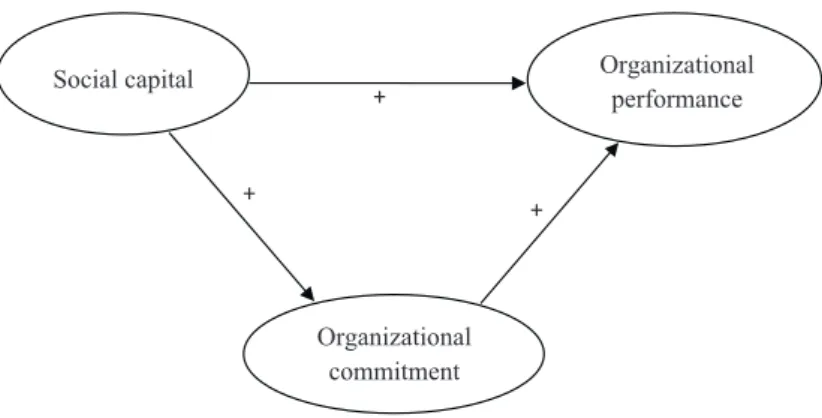
With these assumptions about social capital, and organizational commitment and performance this study investigates the following hypotheses:
H1: There is a positive and linear relationship between social capital and perfor-mance.
H2: There is a positive and linear relationship between social capital and organi-zational commitment.
H3: Organizational commitment has a mediating eff ect between social capital and organizational performance.
+
Social capital Organizational
performance
Organizational commitment +
+
Figure 1: Conceptual model
5. Methodology
To test the research model, except for the demographic variables, a questionnaire survey comprising 26 questions was used. Data was developed and analyzed from the results of the collected surveys from the tax offi ces in Diyarbakır, Batman and Mardin in Southeastern Turkey. The required legal permissions and approval of exempt human research (approval of the ethics board of Dicle University, Medical School was acquired on December 25, 2013) to collect the data was secured for this study.
6. Sampling
To test the research model, except for the demographic variables, a survey was delivered to 450 tax offi cers working in tax offi ces in the three selected provinces of Diyarbakır, Batman and Mardin in Southeastern Turkey. There are nine other prov-inces in Southeastern Turkey that operate under almost the same conditions. Further-more, the ratio of offi cers to clients is very similar in all three tax offi ces. Any of these provinces had an equal probability of being chosen for this study. Thus, a level of randomness was provided in the selection of the provinces of Diyarbakir, Batmanand Mardin according to the simple random selection method. Of all of the offi cers, 308 voluntarily participated in the survey. These 308 surveys were analyzed in this study.
7. Data collection tools
Except for the demographic variables, three diff erent scales were used to rate em-ployees’ social capital, organizational commitment and organizational performance levels.
7.1. Demographic data form
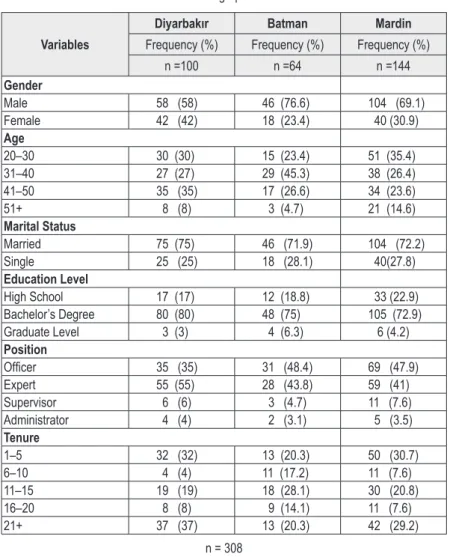
were from Diyarbakır, 64 from Batman, and 144 from Mardin. Table 1 shows the de-mographic characteristics of the respondents.
7.2. Social capital
According to Nahapiet and Ghoshal (1998), social capital has three dimensions: structural, relational and cognitive. All these three dimensions were measured on three diff erent scales, each based on fi ve questions. The structural dimension of social capital (team work, informality, socialization, interaction and change) relates to the level of relationships and social ties among employees. The relational dimension of social capital (respect, honesty, integrity, trust and keeping promises) reveals the un-derlying quality of employee relationships. The cognitive dimension of social capital (understanding, communication, shared opinions, positive and motivational percep-tions and shared visions) focuses on employees’ understanding, communication and positive organizational perceptions. This scale was adapted into the Turkish language by Sahin (2010). A 5-point Likert scale was used as the instrument for a 15-item social capital scale. The defi nition of the available points used in the scale are: (1) strongly disagree, (2) disagree, (3) neither agree nor disagree, (4) agree, and (5) strongly agree. As a result of the reliability analysis, the Cronbach Alpha score was determined to be 0.82. The signifi cance level for this study is .05. In the Kolmogorov-Smirnov test, as p> 0.5, the distribution is normal. As one of the survey questions did not align with the measurement statistics, it was excluded from the analysis.
7.3. Organizational commitment
This scale was adapted by Bakiev (2011) and considers scale used in Nyhan’s (2000) and Porter and Smith’s (1970) studies. In this study, the scale was measured using fi ve questions on a 5-point Likert scale. The defi nition of the available points in the scale are: (1) never/almost never, (2) rarely, (3) sometimes, (4) often, and (5) al-ways/almost always. As a result of the reliability analysis, the Cronbach Alpha score for reliability for this study is 0.81. In the Kolmogorov-Smirnov test, as p> 0.05, the distribution is normal.
7.4. Organizational performance
8. Statistical data analysis
To evaluate the collected data, SPSS18.0 software was used along with the SEM method by taking advantage of AMOS 18.0 software. To compare the study variables, parametrical diff erence tests (t-test, ANOVA) were used. The level for statistical sig-nifi cance is accepted as p<0.05.
9. Findings
Demographic data of the participants are provided in Table 1. Of the total 308 par-ticipants100 were from Diyarbakır, 64 from Batman, and 144 from Mardin.
Table 1: Demographic variables
Variables
Diyarbakır Batman Mardin
Frequency (%) Frequency (%) Frequency (%)
n =100 n =64 n =144
Gender
Male 58 (58) 46 (76.6) 104 (69.1)
Female 42 (42) 18 (23.4) 40 (30.9)
Age
20–30 30 (30) 15 (23.4) 51 (35.4)
31–40 27 (27) 29 (45.3) 38 (26.4)
41–50 35 (35) 17 (26.6) 34 (23.6)
51+ 8 (8) 3 (4.7) 21 (14.6)
Marital Status
Married 75 (75) 46 (71.9) 104 (72.2)
Single 25 (25) 18 (28.1) 40(27.8)
Education Level
High School 17 (17) 12 (18.8) 33 (22.9) Bachelor’s Degree 80 (80) 48 (75) 105 (72.9) Graduate Level 3 (3) 4 (6.3) 6 (4.2) Position
Offi cer 35 (35) 31 (48.4) 69 (47.9)
Expert 55 (55) 28 (43.8) 59 (41)
Supervisor 6 (6) 3 (4.7) 11 (7.6) Administrator 4 (4) 2 (3.1) 5 (3.5) Tenure
1–5 32 (32) 13 (20.3) 50 (30.7)
6–10 4 (4) 11 (17.2) 11 (7.6)
11–15 19 (19) 18 (28.1) 30 (20.8)
16–20 8 (8) 9 (14.1) 11 (7.6)
21+ 37 (37) 13 (20.3) 42 (29.2)
n = 308
Table 2: The goodness-of-fi t statistical scores for a generic and revised model
Index Cut-off Criteria Measurement Model RevisedModel
Chi-square (CMIN) or (χ2) Smaller the best 861 895
Chi-square Associated p Value (p) Value > .05 0 0
Chi-square/Degree of Freedom (χ2/df) Value < 4 2.34 1.90
Root Mean Square Error of Approximation (RMSEA) .05 < Value < .08; acceptable< .05; good 0.083 0.054
RMSEA Associated p Value (PCLOSE) Value > .05 0 0.10
Tucker-Lewis Index (TLI) .90 < value < .95; acceptable> .95; good 0.83 0.91
Comparative Fit Index (CFI) .90 < value < .95; acceptable> .95; good 0.85 0.92
Hoelter’s Critical N (HOELTER INDEX) 75 < value < 200; acceptable> 200; good 95 180
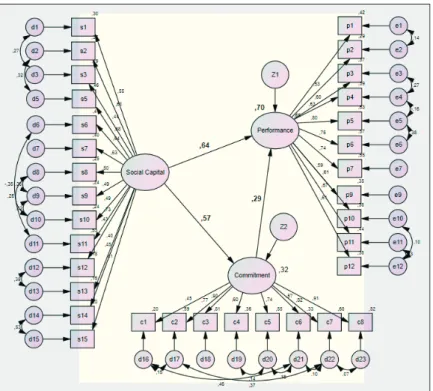
As the variables for social capital, organizational commitment and organizational performance are latent variables, to analyze the relationships among them, the SEM method was used. The mediating role of organizational commitment on the relation-ship between social capital and organizational performance was also investigated. The developed model is presented in Figure 2.
Figure 2: The structural equation model of the relationships between social capital, organizational commitment and organizational performance
indicators are signifi cantly loaded to the latent variables (p<0.5). There is a positive signifi cant relationship between social capital and performance (p<0.5). There is also a positive signifi cant relationship between social capital and organizational commit-ment (p<0.5). Moreover, in this model, the mediating eff ect between organizational commitment and social capital is evident.
According to the SEM scores, there is a very signifi cant relationship between so-cial capital, organizational performance and organizational commitment (p<0.001). The standardized regression weight between social capital and performance is 0.64. It is 0.57 between social capital and organizational commitment. As a result, a 70% variance in performance comes from social capital and organizational commitment. Thus, the unexplained value (Z1) is 30%. There is a variance of 32% in organizational commitment coming from social capital.
Results for analysis of some demographic variables are presented below.
To determine some precise diff erences in the demographic variables, a t test and an ANOVA test were applied, and yielded the following fi ndings:
1. Employees aged between 20 and 30 years old demonstrated lower levels of orga-nizational commitment and performance than other age groups (F: 5.30, p<0.001; F: 3.73, p<0.05).
2. Employees with high school education demonstrated a higher level of organiza-tional commitment and performance than employees graduating from a univer-sity (F: 5.09, p<0.001; F: 3.20, p<0.05; F: 2.96, p<0.05).
3. Employees working in the Diyarbakır tax offi ces had lower levels of social cap-ital, and organizational commitment and performance than employees working in the offi ces in Batman and Mardin (F: 14.5, p<0.0001; F: 6.2, p<0.005; F: 12.9, p<0.0001).
4. Employees having a tenure level of 1-5 years had lower level of organization-al commitment and performance than employees at other tenure levels (F: 3.81, p<0.005; F: 4.46, p<0.005; F: 3.51, p<0.05).
5. Scores for organizational performance and commitment were higher for males than for females (t:2.1, p<0.05; t:2.17, p<0.05; t:3.3, p<0.005).
6. Married employees have higher levels of organizational commitment and perfor-mance than single employees (t:2.23, p<0.05; t:2.2, p<0.05; t:2.61, p<0.05).
10. Discussion
As presented in Figure 2, the results of this study confi rm a 70% variance in per-formance coming from social capital and organizational commitment, there by illus-trating that organizational commitment has a descending mediating eff ect between these factors. Furthermore, even though no specifi c data was gathered, it is possible that demonstrations and separatist events in the region may be aff ecting general mo-tivation and organizational commitment levels in certain populations in the provinc-es of Southeastern Turkey.
explanations for this fi nding include: employees in this age group are in the early years of their business life; they are still in the learning period of their business and daily life; and they are still maturing their development in terms of skills and experi-ments. The t test and ANOVA test also indicated that high school graduates demon-strated higher levels of organizational commitment and performance. This may be due to a perception or reality that these employees have less of a chance to fi nd new jobs than employees who have graduated from a university.
Respondent employees working in the Diyarbakır tax offi ce had lower levels of social capital and organizational performance compared with the other respondents. This could be due to diff erences in the population sizes of the provinces. Diyarbakır is a larger province than the other two selected provinces. As a result of this diff erence, people living in larger cities may have more social relationships, and they are more social than people living in smaller cities. Employees with 1-5 years of tenure demon-strated a lower level of organizational commitment and performance that might be explained by a curvilinear relationship. From this perspective, the dominant view is that the level of organizational commitment, performance and satisfaction in older employees is higher than in younger employees (Gibson and Klein, 1970; Güneri et al., 2011). This is because employees with 1-5 years of tenure level are likely in the early years of their business life. They are still in the learning period of their life. They may have yet to complete their development in terms of skills and experimentation to demonstrate a bett er level of performance. Furthermore, employees in this respon-dent age group were younger than employees in the other age groups. These could be important factors aff ecting employee commitment and performance.
In this study, the t test and ANOVA test scores for social capital and organiza-tional commitment and performance in males is higher than in females. This may be because of the more dominant role of men in the society in the region. In this cultural environment, males have more advantages, such as bett er career opportunities, more prestigious positions and higher salaries than females. These are likely strong factors resulting in the higher level of men’s commitment to the organization found in this study. This result is consistent with the fi ndings of Karrasch (2003) and Arbak and Kesken (2005). Another culturally related factor is the additional responsibilities in the home for women that could diminish their levels of organizational commitment and performance (Aydin et al., 2011). However, married employees scored higher on orga-nizational commitment than unmarried employees, possibly because married employ-ees have diff erent and additional priorities and life responsibilities. These results are consistent with those reported by Boylu et al. (2007) and Bozkurt and Yurt (2013).
com-pared with employees working in Batman and Mardin. Such validated information can be very benefi cial for decision makers working at diff erent levels, especially in the Ministry of Finance. It is also benefi cial for scholars conducting research in similar and related areas.
This study was conducted in only three provinces of Southeastern Turkey and with only a limited number of surveys for analyses. These issues are basic limitations of the study. Another limitation was that this study evaluated the perceptions of em-ployees rather than objective values linked to the study variables, as in most other studies.
References:
7. Adler, P.S. and Kwon, S.W., ‘Social Capital: Prospects for A New Concept’, 2002, Acad-emy of Management Review, vol. 27,no.1, pp. 17-40.
8. Akal, Z., İşletmelerde Performans Ölçüm ve Denetimi Çok Yönlü Performans Göstergeleri, Ankara: Milli Prodüktivite Merkezi Yayınları, 2005.
9. Aktaş, K.,‘İtibar yönetimi, iş memnuniyeti ve örgütsel performans arasindaki ilişkinin analizi: sağlik sektöründe bir uygulama’(unpublished masters dissertation), Gediz Üniversitesi/Sosyal Bil. Enst., Izmir, 2014.
10. Arbak, Y. and Kesken, J., Örgütsel bağlılık, sağlık hizmetlerinde sürekli gelişim için davranışsal bir yaklaşım, İzmir: Dokuz Eylül Üniversitesi Yayınları, 2005.
11. Aydin, A., Sarier, Y. and Uysal, S., ‘The Eff ect of Gender on Organizational Commit-ment of Teachers: A Meta Analytic Analysis’, 2011, Educational Sciences: Theory and Practice, vol. 11, no. 2, pp. 628-632.
12. Bakiev, E., ‘Determinants of Interpersonal Trust, Organizational Commitment for Per-formance within Kyrgyz National Police’, doctoral dissertation, University of Central Florida, 2011.
13. Bateman, T.S. and Strasser, S., ‘A Longitudinal Analysis of the Antecedents of Organi-zational Commitment’, 1984, Academy of Management Journal, vol. 27, no. 1, pp. 95-112.
14. Becker, H.S., ‘Notes on the Concept of Commitment’, 1960, The American Journal of So-ciology, vol. 66, no. 1, pp. 32-40.
15. Boylu, Y.,Pelit, E. and Güçer E., ‘Akademisyenlerin örgütsel bağlılıkları üzerine bir araştırma’, 2007, Finans Politik & Ekonomik Yorumlar, vol. 44, no. 511, pp. 55-74.
16. Bozkurt, O. and Yurt, I., ‘Akademisyenlerin Örgütsel Bağlılık Düzeylerini Belirlemeye Yönelik Bir Araştırma’, 2013, Yönetim Bilimleri Dergisi, vol. 11, no. 22, pp. 121-139.
17. Brewer, G.A. and Selden, S.C., ‘Why Elephants Gallop: Assessing and Predicting Or-ganizational Performance in Federal Agencies’, 2000, Journal of Public Administration Research and Theory, vol. 10, no. 4, pp. 685-712.
18. Burt, R.S., ‘The Network Structure of Social Capital’, 2000, Research in Organizational Behaviour, vol. 22, pp. 345-423.
19. Chun, Y.H. and Rainey, H.G., ‘Goal Ambiguity and Organizational Performance in US Federal Agencies’, 2005, Journal of Public Administration Research and Theory, vol. 15, no. 4, pp. 529-557.
21. Durna, U. and Eren, V., ‘Üç Bağlılık Unsuru Ekseninde Örgütsel Bağlılık’, 2005, Doğuş Üniversitesi Dergisi, vol. 6, no. 2, pp. 210-219.
22. Gibson, J.L. and Klein, S.M., ‘Employee Att itudes as a Function of Age and Length of Service: A Reconceptualization’, 1970, The Academy of Management Journal, vol. 13, no. 4, pp. 411-425.
23. Güneri, S., İlhan, M.N. and Avcı, E., ‘Ankara 112 Acil Sağlık Hizmeti Çalışanlarının Çalışma Koşulları ve İş Memnuniyetinin Değerlendirilmesi’, 2011, Gazi Medical Jour-nal, vol. 22, pp. 1-5.
24. Kanter, R.M., ‘Commitment and Social Organization: A Study of Commitment Mech-anisms in Utopian Communities’, 1968, American Sociological Review, vol. 33, no. 4, pp. 499-517.
25. Karagül, M. and Masca, M., ‘Sosyal Sermaye Üzerine Bir İnceleme’, 2005, Ekonomik ve Sosyal Araştırmalar Dergisi, vol. 1, pp. 37-52.
26. Karrasch, A.I., ‘Antecedents and Consequences of Organizational Commitment’, 2003, Military Psychology, vol. 15, no. 3, pp. 225-236.
27. Kim, S., ‘Individual-Level Factors and Organizational Performance in Government Organizations’, 2005, Journal of Public Administration Research and Theory, vol. 15, no. 2, pp. 245-261.
28. Leana, C. and Pil, F.K., ‘Social Capital and Organizational Performance: Evidence from Urban Public Schools’, 2006, Organization Science, vol. 17, no. 3, pp. 353-366.
29. Lin, N., Social Capital. A Theory of Social Structure and Action, Cambridge: Cambridge University Press, 2001.
30. Meyer, J.P. and Allen, N.J., ‘A Three-Component Conceptualization of Organizational Commitment’, 1991, Human Resource Management Review, vol. 1, no. 1, pp. 61-89.
31. Morrow, P.C., ‘Concept Redundancy in Organizational Research: The Case of Work Commitment’, 1983, The Academy of Management Review, vol. 8, no. 3, pp. 486-500.
32. Nahapiet, J. and Ghoshal, S., ‘Social Capital, Intellectual Capital, and the Organiza-tional Advantage’, 1998, The Academy of Management Review, vol. 23, no. 2, pp. 242-266.
33. Nyhan, R.C., ‘Changing the Paradigm Trust and Its Role in Public Sector Organiza-tions’, 2000, The American Review of Public Administration, vol. 30, no.1, pp. 87-109.
34. O’Reilly, C., ‘Corporations, Culture and Commitment: Motivation and Social Control in Organizations’, 1989, California Management Review, vol. 31, no. 4, pp. 9-25.
35. Öğüt, A. and Erbil, C., Sosyal sermaye yönetimi, Çizgi Kitabevi, 2009.
36. Park, C., Kang, J., Kwon, K. and Kim, S., ‘A Study on the Potential Productivity of Female Public Servants in Korea’, 2001, Korean Policy Studies Review, vol. 10, no. 3, pp. 199-224.
37. Porter, L.W. and Smith, F.J., ‘The Etiology of Organizational Commitment’, 1970, un-published paper, University of California, Irvine, vol. 17, pp. 556-560.
38. Putnam, R.D., Bowling Alone: The Collapse and Revival of American Community, New York: Simon & Schuster, 2000.
39. Schreiber, J.B., Nora, A., Stage, F.K., Barlow, E.A. and King, J., ‘Reporting Structural Equation Modeling and Confi rmatory Factor Analysis Results: A Review’, 2006, The Journal of Educational Research, vol. 99, no. 6, pp. 323-338.
41. Suliman, A.M.T., ‘Is It Really a Mediating Construct? The Mediating Role of Orga-nizational Commitment in Work Climate-Performance Relationship’, 2002, Journal of Management Development, vol. 21, no. 3, pp. 170-183.
42. Szilagyi, A.D. and Wallace, M.J., Organizational Behavior and Performance, Glenview, Ill: Scott Foresman, 1987.
43. Sahin, I., ‘Organizational Social Capital and Perceived Performance of Drug Law En-forcement Departments: A Case Study in Turkey’, doctoral dissertation, University of Central Florida Orlando, Florida, 2010.
44. Şimşek, M.Ş. and Çelik, A., İşletme bilimlerine giriş, Eğitim Kitabevi, 2011.
45. Tongur, A., ‘Organizational Support, Organizational Citizenship Behavior, and Per-ceived Performance: Analysis of Crime Scene Investigation Units of Turkish National Police’, doctoral dissertation, University of Central Florida Orlando, Florida, 2011.
46. Töremen, F., ‘Okullarda sosyal sermaye: Kavramsal bir çözümleme’, 2002, Kuram ve Uygulamada Eğitim Yönetimi Dergisi, vol. 8, no. 4, pp. 556-573.
47. Zerenler, M., ‘Performans Ölçüm Sistemleri Tasarımı ve Üretim Sistemlerinin Per-formansının Ölçümüne Yönelik Bir Araştırma’, 2005, AİBÜ-İİBF Ekonomik ve Sosyal Araştırmalar Dergisi, vol. 1, pp. 1-36.