p-ISSN:2460-1497 and e-ISSN: 2477-3840
DOI: https://doi.org/10.26858/est.v5i2.7286
130
A Development off Integrated-Science Material Using Four Steps
Teaching Material Development Method
Silviana Hendri1, Sjaeful Anwar2
1Science Education, STISIP Amal Ilmiah Yapis Wamena, Indonesia Email: [email protected]
1 Science Education, Universitas Pendidikan Indonesia, Indonesia Email: [email protected]
This is an open access article distributed under the Creative Commons Attribution License CC-BY-NC-4.0 ©2019 by author (https://creativecommons.org/licenses/by-nc/4.0/ ).
ABSTRACT
This study aims to develop, to test the feasibility, to describe the characteristics and to assess students’ understanding of the material of integrated science subject at VIII grade, Junior High School. The theme developed in this study was the phenomena of Volcanic eruption which elaborates various disciplines including earth science, physics, biology, and social sciences. This study employed a Research and Development (R&D) design. The output was a teaching material under the title “Learning Science through The Phenomena of Volcanic eruption”. Some stages carried out in the development of this teaching material included selection, structuring, characterization, and didactic reduction. Research data were analyzed descriptively based on score criteria from assessment conducted on conceptual understanding and feasibility of teaching material. Based on the feasibility test, this teaching material had good content, presentation, language, and graphs. Each of them got the value of 100% by assessor team. Based on the aspect of students’ understanding, this teaching material achieved a score of 56%. Therefore, it can be concluded that this material can be utilized as an additional resource in teaching natural science.
Keywords: teaching material, integrated science, volcanic eruption theme, 4STMD.
INTRODUCTION
Learning is a process of building an understanding through meaningful interaction with the environment, by connecting learner to the learning material and learning environment (Martin, 2011). In the learning process, the interaction occurs among three components, i.e. teacher, students, and learning material (Hutchinson & Torres, 1994) which then provides a chance to learn. Therefore, the material has an important role in the learning process as resource for students. It will assist them to obtain declarative knowledge,
procedural understanding, and intellectual skills and help them to organize the knowledge that they have learned (Yanti, H., Rustaman, N., 2008)
Piaget’s (Suparno, 2001) statement that learner’s individual learning skill is highly based on the learners’ age, therefore it must be adjusted based on their developmental stages.
In science subject, teaching material also holds the important role which describes the appropriate learning tools based on learners’ level (Ranjit, 2007), as the main resource of information about science (Johnstone & Joughin, 1997; Reiser, Brian; Krajcik, Joseph; Moje, Elizabeth; Marx, 2003), as a novel paradigm about principles of scientific work and how natural science is developed, and as the main instruction how teacher should teach the natural science subject (Reiser, Brian; Krajcik, Joseph; Moje, Elizabeth; Marx, 2003).
Based on the concept of the 2013 Curriculum, Biology, Physics, Chemistry, Earth Science and Space should be taught together in the integrated Science subject. Teaching integrated sciences aims to facilitate students to understand the concept more meaningfully, contextually and holistically (Bialek & Botstein, 2004; Liliawati, Rustaman, Herdiwijaya, & Rusdiana, 2013; Wisudawati & Sulistyowati, 2014). Besides that, concepts of natural science can be integrated with other disciplines e.g. social science, technology. Furthermore, students’ skills, attitudes and learning interest should be also taken into account so that the teaching goals can be achieved.
A theme that can be developed in integrated natural science learning is the phenomena of the volcanic eruption. This topic is developed from the concept of earth science integrated with other basic sciences like physics, biology, and geography. Furthermore, this topic also elaborates social discipline which is about the mitigation of that disaster. This is an interesting topic to be developed considering that geographically speaking, Indonesia is situated in the ring of fire, causing frequent eruptions of volcanoes. As a result, presenting this theme in the elementary level is expected to facilitate students to better understand the volcanic eruption disaster and be able to minimize the risk which might hamper them.
Teaching material can be developed through various models. Some methods widely used are: (a) ADDIE model (Gagne, W. Wager, Golas, & Keller, 2004) consisting of five steps including analyzing, design, development, implementation, and evaluation; (b) 4D standing for Define, Design, Develop, and Disseminate (Mulyatiningsih, 2016); and (c) Four Steps
Teaching Material Development (4STMD) developed by Anwar (2014) including selection, structuring, characterization, and didactic reduction.
The development of material of Integrated Science subject in this study employed the Four Steps Teaching Material Development (4STMD) approach developed by Anwar (2014). Four steps involved in this method include selection, structuring, characterization, and didactic reduction. In each step, review and assessment are carried out by experts in order to minimize the weaknesses of teaching material so that the feasibility criteria can be met. 4STMD model has a stage making it different from other methods of teaching material development namely didactic reduction. The didactic reduction is a strategy to reduce the difficulty level (complexity and abstractness) of teaching material to make it easy to teach (more simple and concrete) (Anwar, 2014). In this stage, the teaching material is reduced didactically by considering the psychology and knowledge aspects of students. The implementation of this didactic reduction method allows the teaching material easier to understand and feasible to use as additional resources in teaching. As the consequence, the final output, in this case, the teaching material, produced through these four stages, is ready to be delivered by the teacher and can also be used by students for self-study because it is based on the thinking level of students and the curriculum applied at school.
The teaching material produced through 4STMD received positive feedbacks. Research carried out by Arifin & Anwar (2016), concluded that the teaching material under the theme “ Air” taught based on religious values developed through 4STMD method was feasible to be used for additional material in Natural Science class. It was confirmed by Hendri & Setiawan (2016) stating that the teaching material about earthquake developed with 4STMD method majorly contains simple material and the qualification of learners understanding was in a good category. Based on that research, we could identify that the application of 4STMD method was feasible and tend to be easy to understand.
additional learning resources in the natural science class at Junior High School level.
METHOD
This study employed a Research and Development (R&D) design. It focused on the process and the products of the teaching material development of science subject at junior high school level with the theme of volcanic eruption using Four Steps Teaching Material Development (4S-TMD) method. Instruments used in this study included (1) assessment of the suitability between the teaching goal and basic competencies; (2) measurement of the suitability of concept map, macrostructure and the systematics of material concept; (3) tool to characterize the concept; (4) instrument to assess the feasibility of teaching material; and (5) instrument to test students’ understanding of the learning material concept. It consists of text and some questions developed based on the learning goal. This study involved 6 experts (3 lecturers of Earth Science and 3 Science teachers teaching at junior high school) during the selection and structuring stages; 66 students in the stage of concept characterization; and 5 junior high school Science teachers in evaluating the feasibility of the teaching material. The data were then analyzed to withdraw conclusions. They were divided into three categories: data about concept characteristic analysis, data about students understanding analysis, and data about teaching material feasibility analysis.
Data of concept characterization analysis were used to identify concepts which were difficult to understand by students. The data were then taken as the reference in the didactic reduction process. In this case, the difficulties found in teaching material concept were reduced so that it is easier to understand by students. Data from concept characteristics
analysis were taken from calculating the number of correct answers about main ideas compared with the total number of students, based on the formula (1):
𝐾𝐾 =
𝐼𝑏𝑁
× 100%
(1)Annotation:
KK = the percentage of students who wrote the main idea correctly
Ib = the number of students who wrote the main idea correctly
N = total number of students
Based on the percentage score, characterization data were grouped according to the concepts of teaching materials as presented in Table 1.
Table 1. Criteria Level of Teaching Material Concept
KK Levels of Teaching
Material Concept KK ≥ 75% Easy
75% > KK ≥ 30% Medium 30% > KK Difficult
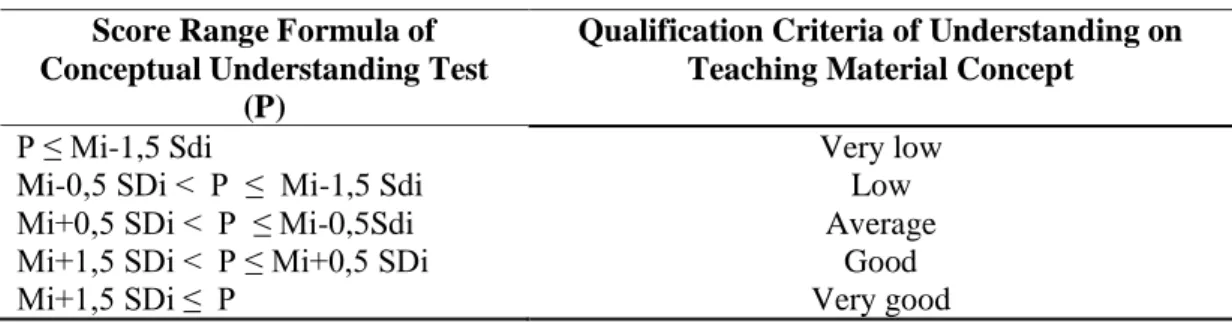
Data obtained from the analysis of the conceptual understanding were used to measure students’ understanding of all concepts existing in the teaching material. They were then manually analyzed with statistic descriptive approach to get the distribution of frequencies and to identify the qualifications of those scores. The score qualification was referred to the Benchmark Reference Assessment (Arifin, 2012) using five scales based on formula and criteria in Table 2. Mi is the average ideal test score while SDi is the ideal standard deviation of test scores.
Table 2. Formula and Qualification Criteria of Test Score on the Conceptual Understanding
Score Range Formula of Conceptual Understanding Test
(P)
Qualification Criteria of Understanding on Teaching Material Concept
P ≤ Mi-1,5 Sdi Very low
Mi-0,5 SDi < P ≤ Mi-1,5 Sdi Low
Mi+0,5 SDi < P ≤ Mi-0,5Sdi Average
Mi+1,5 SDi < P ≤ Mi+0,5 SDi Good
Mi+1,5 SDi ≤ P Very good
While the analysis of data of teaching material feasibility aimed to measure the feasibility of content, presentation, language and graphic (Mulyono, 2007). The percentage of teaching material feasibility assessment is presented in table 3.
Table 3. Criteria of Teaching Material Feasibility Assessment
Assessment Percentage (L)
Feasibility Criteria 90% < L ≤ 100% Very feasible
75% < L ≤ 90% Feasible 60% < L ≤ 75% Quite feasible
L ≤ 60% Less feasible (adapted from the Book Analysis Rating Rubric by the Ministry of Education and Culture
(Kemendikbud, 2013))
RESULT AND DISCUSSION
Result
The development of integrated science teaching material using the Four Step Teaching Materials Development (4STMD) involved four stages which were selection, structuring, characterizing, and didactic reduction. The final product was a student hand out entitled “Learning Science through the Phenomena of Volcanic eruption” which integrates the phenomena of volcanic eruption and concepts in earth science, physics, biology, and social science. In detail, the results of each stage in this teaching material development study are explained as follows:
Selection stage. In this step, some learning goals were developed based on the core competence and basic competence in the curriculum 2013 at Junior High School level. Those learning goals were then developed to be some concepts of science subjects which were under the theme “volcanic eruption” by compiling some textbooks. Then, the basic competencies which were selected, the learning goals, concepts and character values which were developed were validated by 6 experts. Expert validations were carried out aiming at assessing: (1) the suitability between the learning goals and the concept which were developed, and (2) the compatibility between the target character values and teaching material concept.
The basic competences based the development of this teaching material consist of three categories, Main Basic Competence (KD 3.12 class VIII) and Supporting Basic Competencies (KD 3.7& 3.8 class VII, and KD 3.10 class VIII. These selected basic competencies were then generated into twelve learning goals and three character values. From each learning goal, we generated a science concept which would be structured in the next phase. The result of expert validations in each concept and learning goal concluded that (1) the development of learning indicators had confirmed the teaching material concept, and (2) the character values integrated into the teaching material had been suitable with the text of the teaching material concepts.
Structuring Stage. In this stage, we arranged the subject material didactically. This process aimed to connect between one and other concepts so that students can understand the learning material concepts. The output of this is a material draft including concept map, macrostructure, and multiple representations.
A concept map is a strategy utilized by the teacher to assist learners in organizing the concept of material they learn based on the meaning and the relationship among its components. Dahar (2011) explained the function of conceptual map including a). To investigate concepts that have been identified by students; b). To study the learning method; c). To reveal any misconceptions; and d). As an evaluation tool.
A macrostructure is used by the teacher to build knowledge in modeling an appropriate learning strategy for students. It is almost similar to the outline, yet it is explained in more detailed in order to enlarge the proportion of concept. The proportion of macrostructure is the basis of the information unit and has the function to construct a knowledge.
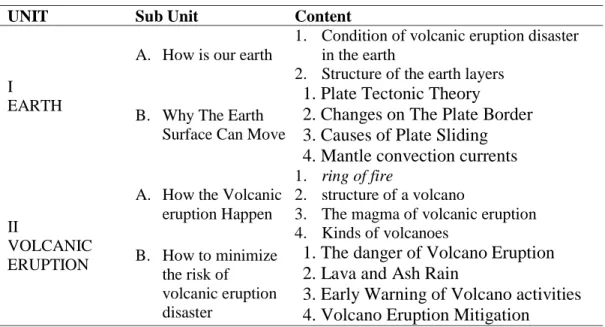
Table 4. The Systematics of Teaching Material
UNIT Sub Unit Content
I EARTH
A. How is our earth
1. Condition of volcanic eruption disaster in the earth
2. Structure of the earth layers
B. Why The Earth Surface Can Move
1. Plate Tectonic Theory
2. Changes on The Plate Border
3. Causes of Plate Sliding
4. Mantle convection currents
II
VOLCANIC ERUPTION
A. How the Volcanic eruption Happen
1. ring of fire
2. structure of a volcano
3. The magma of volcanic eruption 4. Kinds of volcanoes
B. How to minimize the risk of volcanic eruption disaster
1. The danger of Volcano Eruption
2. Lava and Ash Rain
3. Early Warning of Volcano activities
4. Volcano Eruption Mitigation
Characterization Stage. In the charac-terization stage, the teaching material which had been structured didactically was then tested to students to identify the difficult concept. Students were asked to write the main idea (Sjaeful Anwar, …). The reason underlying the implementation of this method was that to understand a text, someone should have a holistic comprehension of each paragraph building it. In other words, by asking students to write the main idea of the teaching material text, they will show their understanding about the text.
Unit I (Earth), consisted of two subunits: (1) How is the structure of our earth, and b) Why can the earth surface move. The subunit point a) contains preliminary information about the occurrence of natural disaster in Indonesia, particularly about a volcanic eruption. In the preliminary information, students are already possible to study the structure of earth layers: crust, mantel, core, and the characteristics of each layer. While the subunit point b) explains the theory of plate tectonics which tell about the movement of the plate. Besides that, students will be introduced with movements of the plate in its border and mantle convection currents which cause those earth plate surfaces moving.
Unit 2 discusses volcanic eruption and is also divided into two subunits: a) How volcanic eruption occurs, and b) How to minimize the risk of volcanic eruption disaster. Point a) is begun with the description of volcanoes and ring of fire, the structure of the volcano, factor affecting the volcanic eruption,
and kinds of volcano. It is followed by point b) explaining the dangers possibly caused by volcanic eruption, volcano activities, and mitigation of volcanic eruption disaster.
Each unit consists of a number of paragraphs. Unit 1 consists of 17 paragraphs, and unit 2 has 12 paragraphs. After being characterized, they were then coded with Roman numeral while the evaluations based on students’ understanding were put in the feedback part. The recapitulation of score from the analysis can be seen in table 6.
Table 6. Recapitulation of difficult concept text
The number of concept text with the category of
Unit I Unit II
Difficult - -
Medium 5 2
Easy 12 10
Furthermore, the feasibility testing on teaching media “Learning Science through the volcanic eruption phenomena” was carried out by five junior high school Science teachers. Four aspects to measure in the evaluation of the teaching material included: 1. Content; 2. Presentation; 3. Language; and 4. Graphics.
There are seven points measured in testing the feasibility of teaching material contents including 1) the suitability between material and KI and KD; 2) the accuracy of concept; 3) the accuracy of phenomena/case/fact and illustration; 2) the accuracy of picture; 5) the accuracy of symbol; 6) the ability to stimulate students’ curiosity; and 7) the compatibility between description, illustration, and fact. Material presentation consists of two assessment points which are 1) the sequence and systematics, and 2) the ability to stimulate students involving and participating for independent learning. Assessment on language aspect involves seven items to measure, namely 1) grammar accuracy; 2) spelling accuracy; 3) standardized terms; 4) consistency in the use of terms and symbols; 5) the effectiveness of the sentence; 6) the simplicity of information to understand easily; and the suitability between the language and student’s emotional
development. While graphics aspect contains seven points to be assessed which are: 1) The font size of title is bigger than that of the author's name and the size of pictures is proportional; 2) The color of the title and the image existing in the teaching material contrast with the color of the background; 3) Illustration of cover represents the content of teaching materials and reveals the character of the object; 4) the layout is consistently based on a particular pattern; 5) Separation between paragraphs are clear; 6) there are captions for illustrations and image; and 7) The use of variations of letters (bold, italic, all capital, small capital) is not too much.
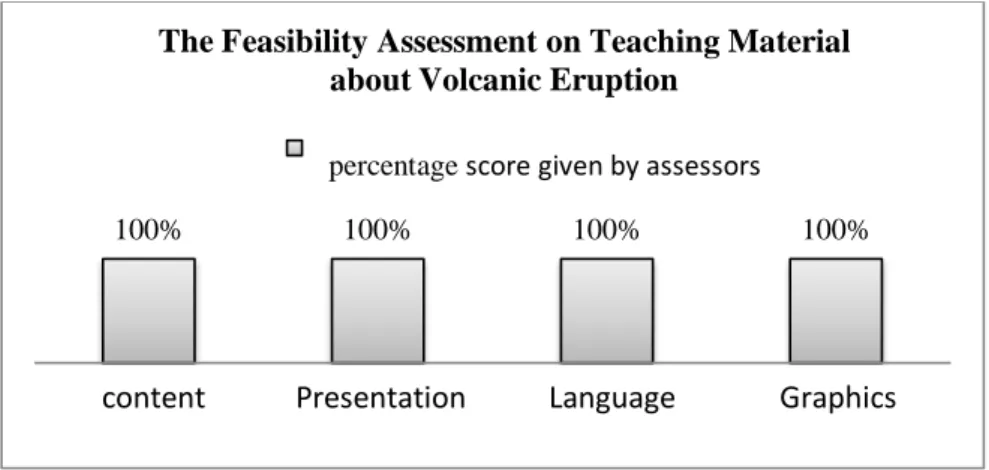
In each assessment aspect, all assessors gave positive responses to each point being measured. So, the result of the assessment conducted on the teaching material feasibility can be presented as in figure 1. This led to a conclusion that the teaching material “Learning Science through Volcanic Eruption Phenomena” developed using Four Step Teaching Materials Development (4STMD) method was feasible to be taught in terms of content, presentation, language, and graphics.
Figure 1. Graph of Assessment on Teaching Material Feasibility
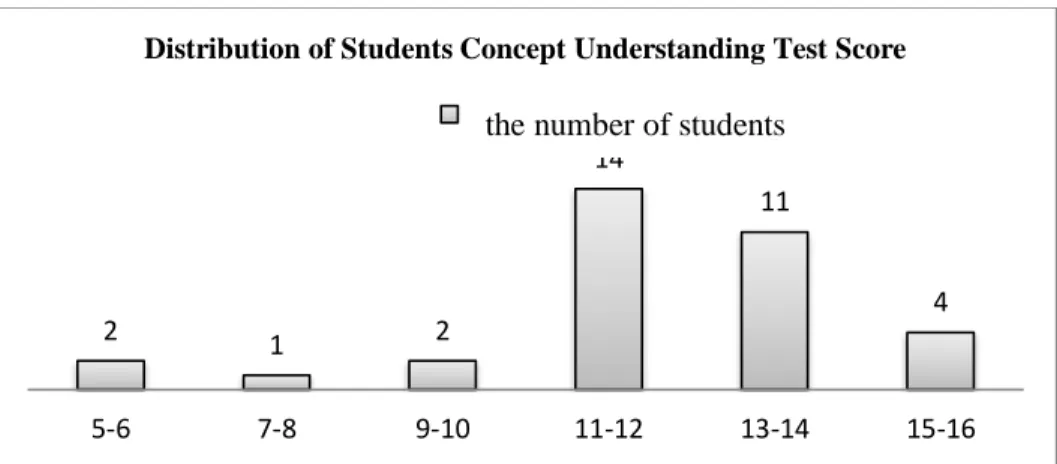
Assessment based on students’ understanding of the teaching material “Learning Science through Volcanic Eruption Phenomena” was carried out using concepts understanding test. This test was structured based on the learning goals referred in developing the teaching material. Questions on concept understanding test consist of 17 items, ten of them were on unit 1 while seven others were on unit 2. Scores obtained by students are
presented in figure 2. The score range of 11-12 was majorly obtained by students (14) that were 41% of them. While the highest score range (15-16) was only obtained by 12 percent of students or four of them. Lastly, the lowest score range (5-6) was obtained by two students only. The average score obtained by students in this concept understanding test was 12.
100% 100% 100% 100%
Aspek konten isi Aspek Penyajian materi
Aspek kebahasaan Aspek Grafika
The Feasibility Assessment on Teaching Material about Volcanic Eruption
Presentase penilaian oleh penguji
content Presentation Language Graphics
Figure 2. The Score Frequency Distribution of Concept Understanding Test on Teaching Material “Learning Science through Volcanic Eruption Phenomena”
The qualification criteria of concept understanding were calculated based on the ideal mean score and ideal standard deviation. While, table 7 presents the score range and concept understanding qualification criteria.
Table 7. Score Ranges and Concept Understanding Qualification
Score Ranges Qualification Percentage
x≤ 4 Very low 0%
4 <x≤ 7 Low 9%
7 <x≤ 10 Average 6%
10 <x≤ 13 Good 56%
13 ≤x Very good 29%
TOTAL 100%
Based on table 7, students’ understanding of the concept was in the very good category when at least 13 of their answers were correct. While, if the score obtained by students was between 10 and 13, their conceptual understanding was categorized into good level. The conceptual understanding was regarded to be average if the score range was between 7 and 10. When it was only between 4 and7, it was in a low category. The very low category refers to the scores below 4. The students understanding qualification can be presented in a graph as in Figure 3.
Figure 3. Qualification of Students’ Conceptual Understanding of the teaching material “Learning Science through Volcanic Eruption Phenomena”
Based on figure 3, it can be identified that most students had a good conceptual understanding of the teaching material “Learning Science through Volcanic Eruption Phenomena”.
Discussion
Based on findings presented above, teaching material produced through the Four Step Teaching Materials Development method can be directly used as additional material in
2 1 2
14
11
4
5-6 7-8 9-10 11-12 13-14 15-16
Distribution of Students Concept Understanding Test Score
jumlah siswathe number of students
Very low
0% Low9%
Average 6%
Good 56% Very good
29%
learning science. This is in line with a study developed by Hendri & Setiawan, (2016) and Arifin & Anwar (2016) which created teaching material for science subject in Junior High School level.
Each stage of the teaching material development conducted in this study had been in accordance with the requirements in designing teaching materials (Liu et al., 2008). In this case, 1) the content of teaching materials must be based on the learning objectives, 2) the knowledge presented in the materials must be accurate, and 3) the use of words must be appropriate with the students' age. The requirements that must be fulfilled in designing teaching material were carried out at the selection process. Here, the theme and concept were determined based on the basic competencies mentioned in the National Curriculum. Those basic competencies were then developed into a number of learning objectives based on students’ needs so that using this teaching material will support students to achieve these learning goals
In the next phase, the concepts of science that have been identified from the development of learning objectives were then structured. This process assisted learners to get a complete figure about the science hierarchy (Anwar, 2014). Unstructured teaching materials will lead to the occurrence of errors in the learning process because students are not able to connect between one and other concepts as a solid knowledge. The systematics of this concept were expected to assist students in building the cognitive structure in their working memory. If the knowledge is well structured in students’ cognitive structure, they will easily remember and store the new information they receive.
In the characterization step, students were instructed to rate the teaching material based on didactic principles. The didactic principle, according to Comenius (Anwar, 2014) can be utilized by the teacher as a guide in delivering material with various concepts which are ranged from simple to complex, close to far, easy to difficult, concrete to abstract, and so on. It was then identified that most of the concepts that were developed in this teaching material were in the easy category.
The difficulty level of this concept was initially categorized to be medium, then was reduced didactically. This aimed to minimize the problem possibly faced by students in
understanding scientific concepts which were rather abstract (Anwar, 2014). This teaching material was designed through a didactic reduction approach both qualitatively and quantitatively to help students to understand concepts. Two concepts which were categorized as a medium were reduced didactically through qualitative design using generalizations, picture explanations, particulates, analogies, and neglect.
Based on the assessment developed by the National Education Standards Agency (BSNP) which consists of four aspects: content, presentation, language, and graphics (Mulyono, 2007) and validation conducted on this book, in general, this teaching material has fulfilled the criteria of a good textbook.
CONCLUSION AND SUGGESTION
Based on this study, it can be concluded that the teaching material in the form of a handout entitled “Studying Science through the Phenomena of Volcanic eruption” which was developed based on the Four Step Teaching Materials Development (4STMD) method can be presented to students at Junior High School. In the process of creating this teaching media, we involved four steps namely selection, structuring, characterization, and didactic reduction.
Assessments carried out by some experts showed that all aspects including the appropriateness between the learning goal and the basic competences, the relevance between the text and the learning goal, and the suitability of characters integrated in the teaching material had been arranged in accordance with the curriculum and valid based on the knowledge concept, and followed the didactic model. Besides that, the concept contained in this teaching material was in the easy criteria, meaning students can understand them easily. This is in line with the qualification of students’ understanding of the teaching material which was at a good level. Similarly, the assessment carried out on the feasibility of the teaching material “Learning Science through the Volcanic Eruption” related to the content, presentation, language, and graphics indicated that this material was feasible to be used in teaching.
Furthermore, we need to identify difficult concept existing in some other schools to obtain more data to compare with. Therefore, studying Science through the Phenomena of Volcanic eruption” which was developed based on the
Four Step Teaching Materials Development
(4STMD) method can be used as a reading resource at Junior High Schools.